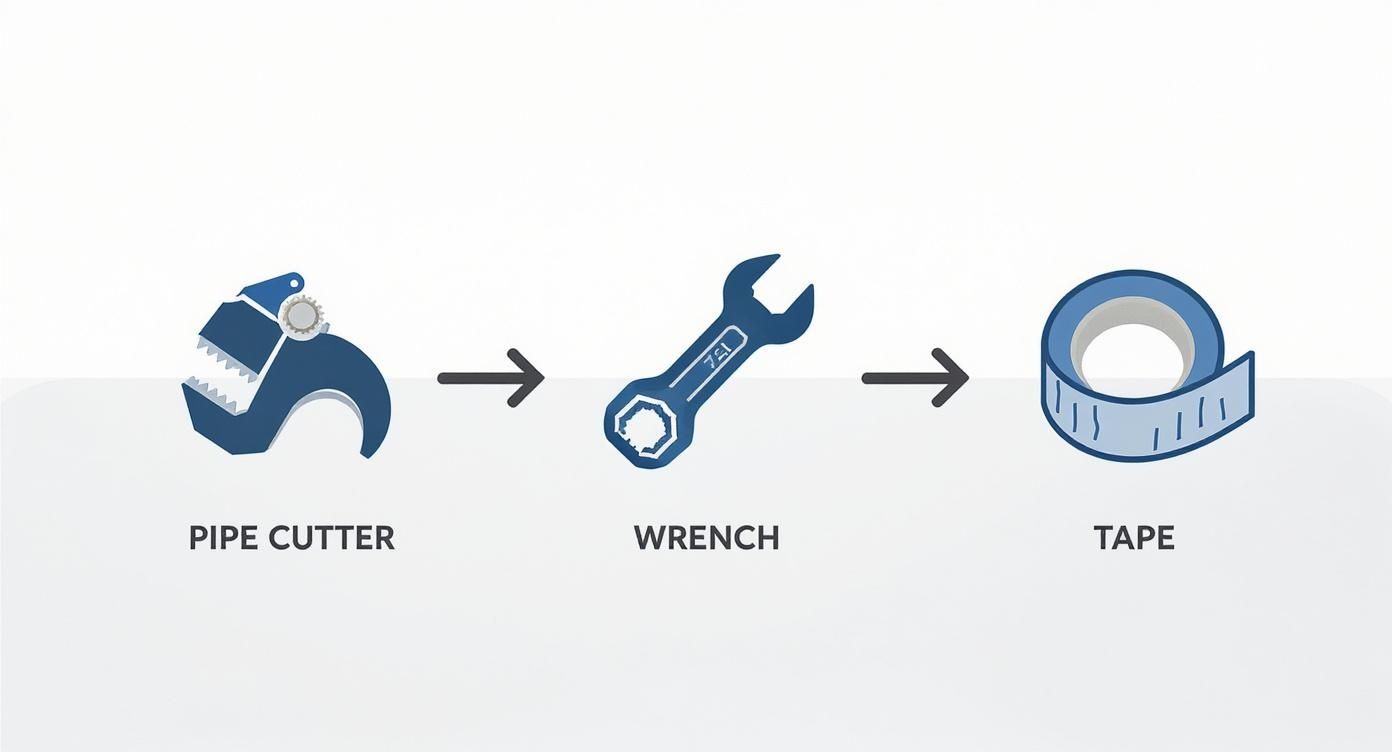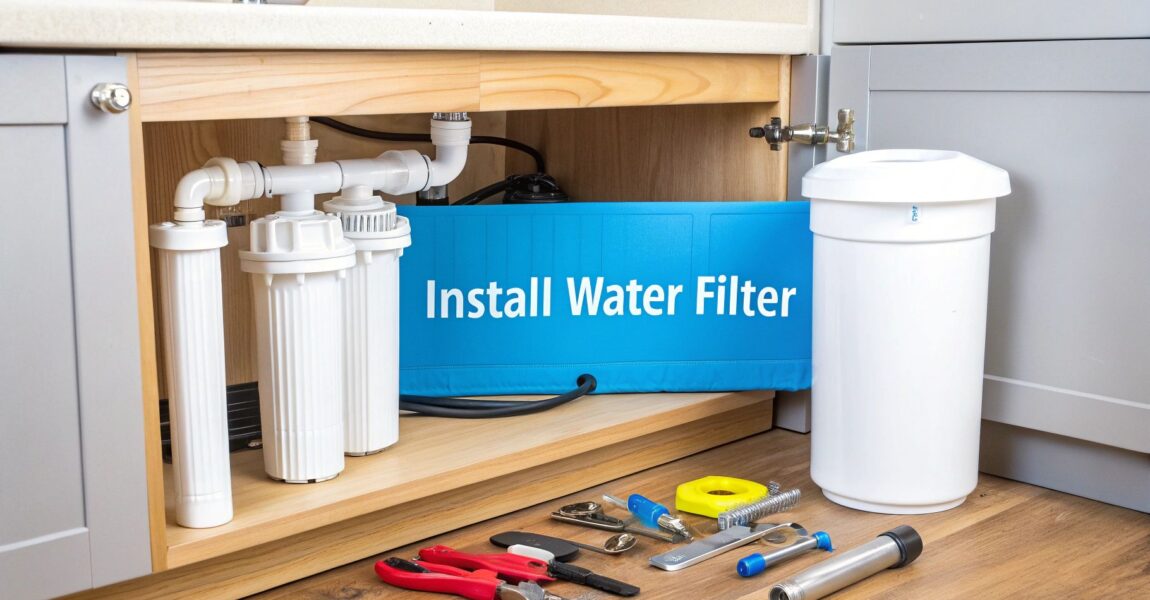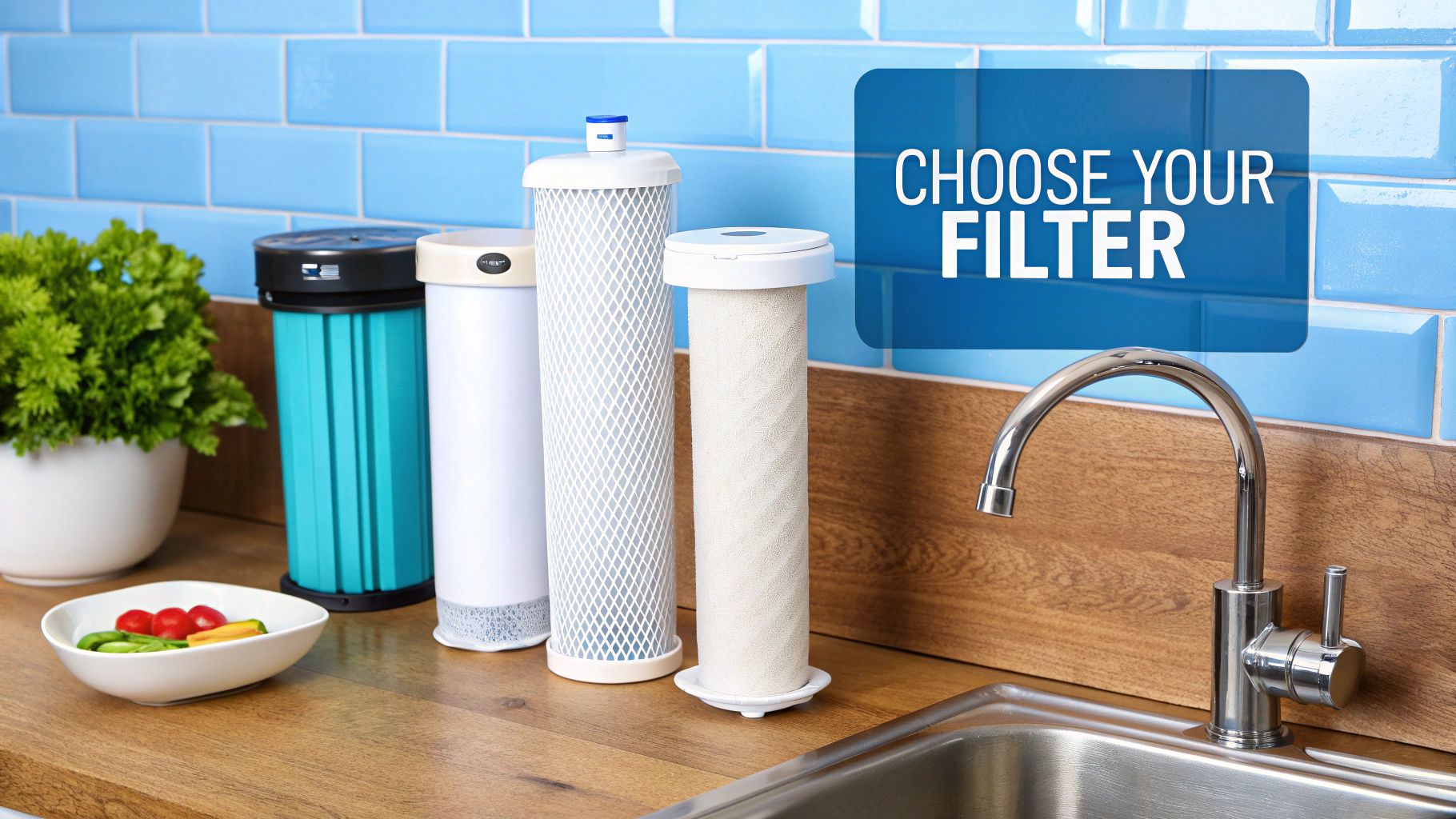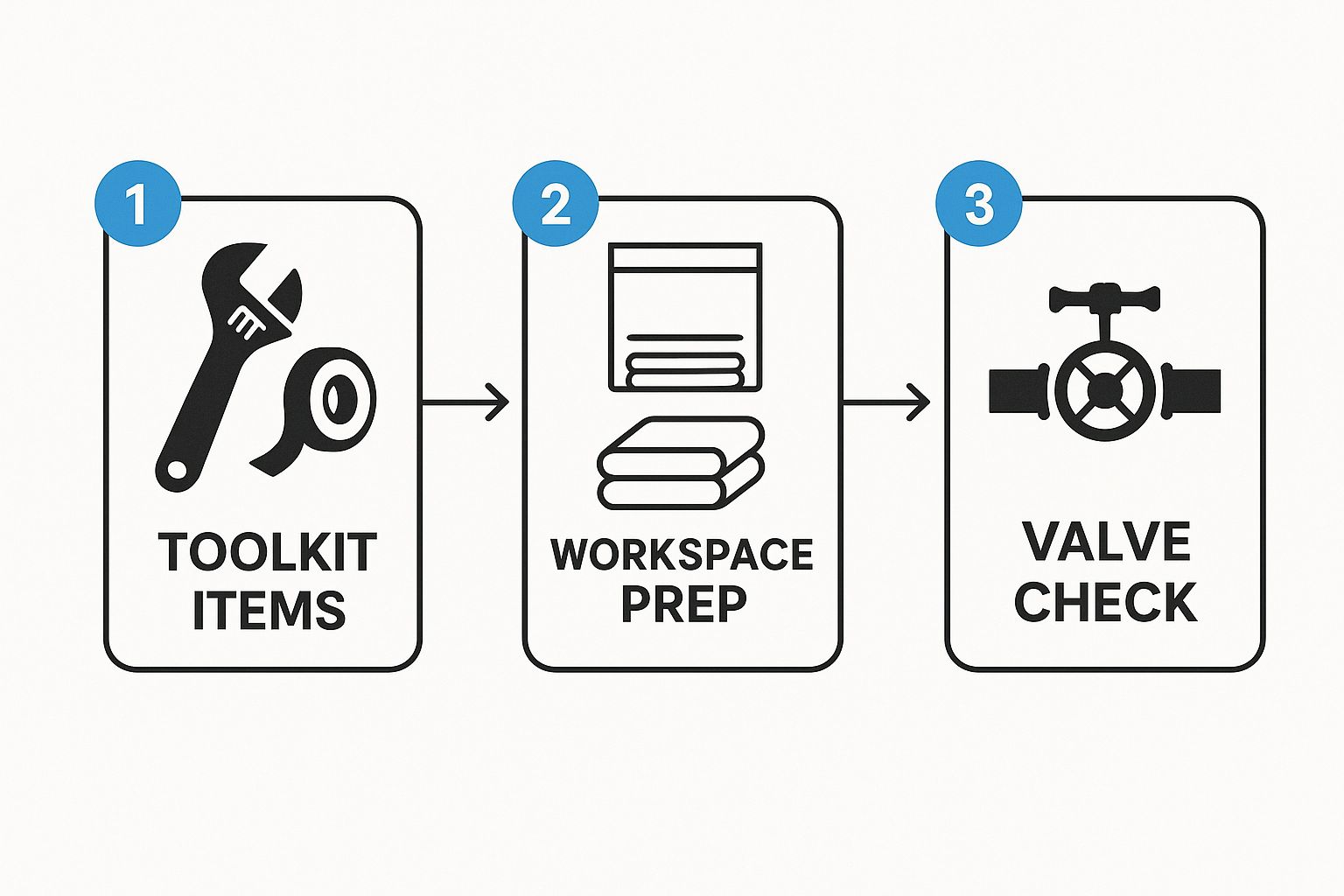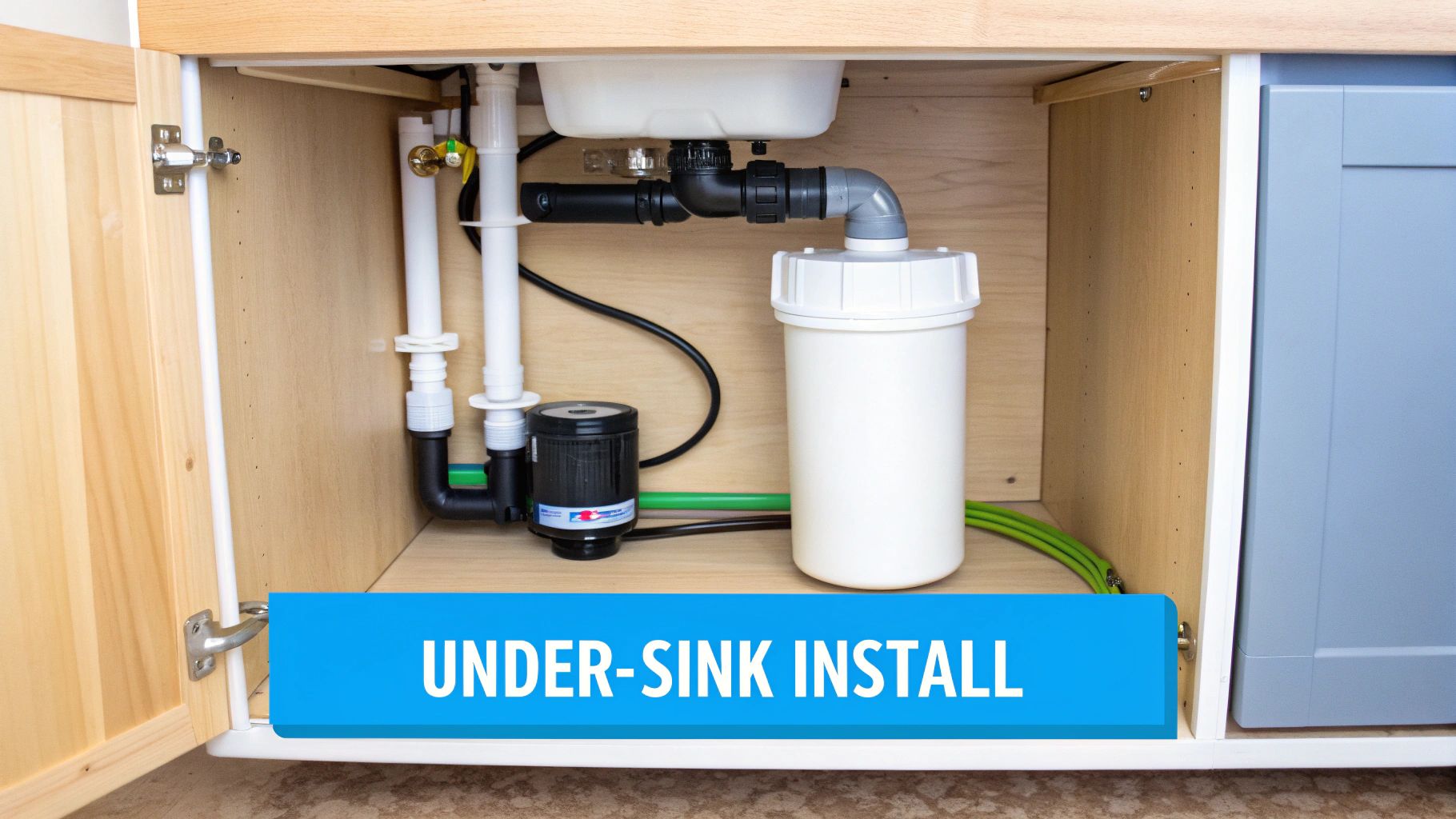
Is Your Tap Water *Really* Clean? The Filtered Truth

We’ve all been there—holding a glass under the tap, pausing for a split second, and wondering, is this stuff actually safe to drink? That moment of hesitation is more common than you think. While our cities do a pretty good job treating our water, what they consider "safe" might not line up with what you consider ideal for your family. Think of municipal treatment as the first draft. A home water filter? That's your final, polished edit.

This guide is all about taking back control. We’re going to dive into why home filtration isn't just a luxury—it's the crucial last step to ensuring the water in your glass is as pure as it can possibly be.

The Unfiltered Truth About Your Tap Water
A clean glass of water being filled from a modern kitchen tap.

Imagine your water is a VIP guest traveling to a gala (your faucet). It leaves the treatment plant looking sharp and clean. But then it has to navigate miles of old, sometimes ancient, underground pipes. Along the way, it can pick up some rather unsavory party crashers.

This is the "last mile" problem. The water was clean when it started its journey, but the trip itself can introduce a whole host of contaminants. That's where a home filtration system steps in, acting like a personal bouncer at your kitchen sink, ensuring only the invited guest—pure water—gets through.

Why Municipal Treatment Is Only Half the Story

Your local water utility is fighting the big battles, neutralizing major threats before they send water into the system. But they can't control the unique conditions of every pipe between their plant and your home. Things like local plumbing integrity and even things like backflow prevention device inspections play a role. A home filter closes that gap.

Think of a home filtration system as your personal quality control manager. It's the final checkpoint that guarantees the water making it into your coffee, your soup, and your drinking glass is nothing but the best.

A Global Thirst for Purity

This isn't just about what's happening in your town. Globally, the quest for clean water is a massive challenge. In 2022, a report from WHO and UNICEF revealed that 1.7 billion people were using drinking water sources contaminated with feces. Even in developed countries, the journey through aging infrastructure means risks remain. It's a powerful reminder that the final say on water quality should happen right at your tap.

What Party Crashers Are Hiding in Your Water?
A magnifying glass held over a glass of water, showing illustrative particles.

Even crystal-clear water can be a crowded party of invisible gatecrashers. Let's meet the usual suspects that your personal filter-bouncer might need to show the door.

Without a filter, you’re essentially trusting that none of these troublemakers hitched a ride into your home. A good filter lets you stop trusting and start knowing.

The Chemical Crew

The most famous member of this group is chlorine. It’s the chemical bouncer hired by the city to kill off dangerous bacteria. It does its job, but it has a bad habit of lingering, leaving behind that "public pool" taste and smell. A simple carbon filter can politely ask it to leave.

But some uninvited chemical guests are far more sinister. Lead is a major villain, often leaching from old pipes and solder. The scary part? There is no safe level of lead exposure. This makes a filter that specifically targets lead an absolute must-have for many homes.

Then there are the stealthier chemicals: pesticides from farm runoff, herbicides, and industrial chemicals known as volatile organic compounds (VOCs). They're the shadowy figures in the corner you definitely don't want sticking around.

Even after a major disaster like a wildfire, toxic chemicals from burnt infrastructure can contaminate the underground pipe network. This can introduce dangerous compounds like benzene into the water supply, posing serious health risks long after the event.

The Gritty Gang

Next up are the physical particles that make your water less than perfect. They might not be a direct health threat, but they're certainly not welcome.

  • Sediment, Silt, and Rust: These are the clumsy party guests who knock things over. They come from old pipes and can make your water cloudy, taste metallic, and even stain your sinks and clothes.
  • Microplastics: This is a growing problem. Tiny plastic fragments from countless sources are now found in tap water around the world. We're still learning about the long-term health effects, but who wants to be a guinea pig? A quality filter is your best bet for keeping them out.

The Biological Bugs

Even with city-level disinfection, there's always a tiny chance of biological contaminants showing up, especially if a pipe breaks. These are the microscopic menaces a filter can stop dead in their tracks.

  • Bacteria and Viruses: Pathogens that can cause nasty, immediate stomach issues.
  • Cysts: Think of these as microbial tanks. Hardy parasites like Giardia and Cryptosporidium are resistant to chlorine and can make you seriously ill.

This rogue's gallery shows why a multi-talented filtration system is so important.

Common Tap Water Contaminants and Their Sources

Contaminant Common Source Potential Impact
Lead Leaching from old pipes, solder, and fixtures Developmental issues, neurological damage
Chlorine Municipal water treatment disinfectant Unpleasant taste and odor
Pesticides/Herbicides Agricultural and urban runoff Potential long-term health risks
VOCs (e.g., Benzene) Industrial pollution, fuel spills, solvents Can increase cancer risk; liver/kidney damage
Sediment/Rust Corrosion of old water mains and plumbing Cloudy water, poor taste, stains fixtures
Microplastics Breakdown of plastic waste, synthetic fibers Health effects are still being studied
Bacteria/Viruses Contamination from sewage or animal waste Gastrointestinal illness (e.g., E. coli)
Cysts (Giardia) Contamination from human/animal feces Severe diarrheal disease ("Beaver Fever")

A home water filter isn't just an appliance; it's a personalized security detail for your drinking water, ensuring it's pure the moment it hits your glass.

How to Decode Your Local Water Quality Report

Every year, your water utility releases a document called a Consumer Confidence Report (CCR). Let's be real: it often looks like a rejected script from a science show, filled with charts and jargon.

But don't throw it away! This report is your secret weapon. It's a report card that tells you exactly what contaminants were found in your water over the past year. You can find it on your utility's website or by searching for "[Your City Name] water quality report."

Translating the Geek-Speak

Once you have the report, you need to know two key terms:

  • Maximum Contaminant Level (MCL): This is the legal limit. It's the highest amount of a substance allowed in drinking water.
  • Maximum Contaminant Level Goal (MCLG): This is the health goal. It's the level where there's no known health risk. This is the perfect-world number.

The most eye-opening part is the gap between the MCL (legal) and the MCLG (ideal). For nasty stuff like lead, the health goal (MCLG) is zero. But the legal limit (MCL) is higher. This creates a "legally acceptable" risk that you might not find acceptable at all.

From Report to Filter: Connecting the Dots

This is where you become the hero of your home's water story. Scan your report for any contaminant with a level above the MCLG, even if it’s below the legal MCL. Those are the specific party crashers that made it past the city's security.

Your report might show trace amounts of lead, pesticides, or disinfection byproducts. Now, the question isn't a vague "is my water safe?" It's a laser-focused "how do I get rid of these specific things?" This insight lets you choose a filter that’s a sharpshooter, targeting your water’s unique problems.

Choosing Your Filtration Champion

Alright, you've unmasked the villains in your water report. Now it's time to choose your champion—the right home water filter for the job. It sounds daunting, but it’s really about matching the filter's superpower to the specific contaminant you want to defeat.

You wouldn't hire a bodyguard who's great at spotting pickpockets if your main threat is a cyber-attack. The same logic applies here. Match the tool to the task.

From Bouncer to Fortress: Know Your Tech

Let's meet the main players. First up, activated carbon filters. These are the friendly bouncers at the door. You’ll find them in pitchers and faucet-mounted filters. They excel at grabbing chlorine, which instantly makes your water taste and smell fantastic. They're an affordable and effective first line of defense.

On the other end of the spectrum is Reverse Osmosis (RO). This is your impenetrable fortress. An RO system, usually installed under the sink, uses a semi-permeable membrane to muscle out nearly everything that isn't pure water. It's a beast, wiping out tough contaminants like lead, arsenic, fluoride, and countless other dissolved solids.

This chart is your treasure map, guiding you from your water report to the right filtration system.
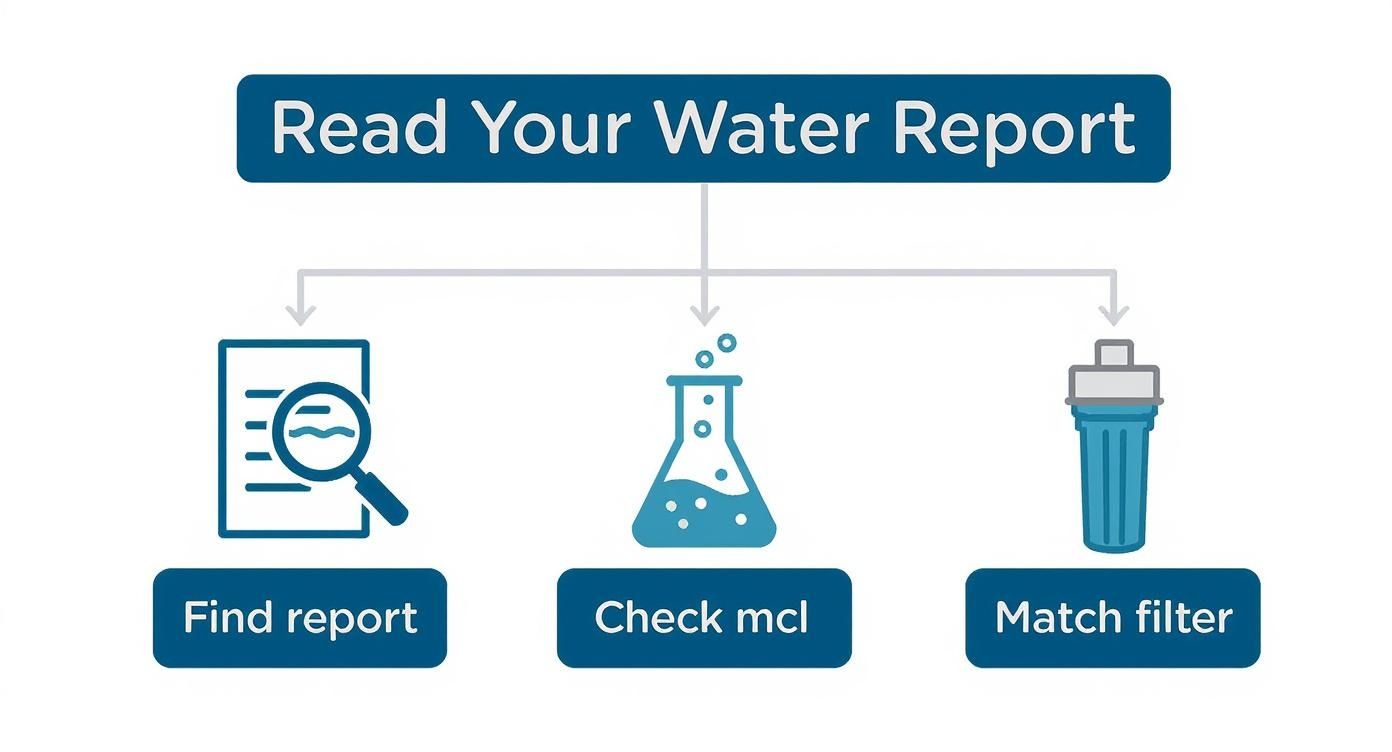
Infographic decision tree for choosing a water filter based on a water quality report.

The key takeaway? Your water report empowers you to make an informed choice, not a wild guess.

The Full Spectrum of Water Warriors

There’s a whole world of options between a simple pitcher and a full-blown RO system. Getting to know them helps you pick the perfect ally for your home.

This table breaks down the most popular filtration technologies, showing what they're best at, what they cost, and how much upkeep they need.

Comparing Home Water Filter Technologies

Filtration Type Best For Removing Average Cost Maintenance Level
Pitcher/Dispenser Filters Chlorine, taste, odor $20 – $70 High (frequent filter changes)
Faucet-Mounted Filters Chlorine, some lead, VOCs $30 – $100 Moderate (replace every 2-3 months)
Countertop Filters Wider range of contaminants than pitchers $50 – $300 Moderate (replace every 6-12 months)
Under-Sink Filters Lead, cysts, chlorine, VOCs, sediment $100 – $500+ Low (replace annually)
Reverse Osmosis (RO) Lead, arsenic, fluoride, TDS, nitrates $200 – $1,000+ Moderate (multiple filters/membrane)
Whole-House Systems Sediment, chlorine, hard water minerals $500 – $3,000+ Low to Moderate (depends on system)

The perfect filter for you is one that balances powerful performance with a price and maintenance schedule you can live with.

Matching Your Filter to Your Foe

So how do you make the final decision? Just line up the problem from your water report with a filter's known strengths. Here are a few scenarios:

  1. Foe: Your water tastes like it came from a swimming pool.

    • Champion: An activated carbon filter (pitcher, faucet, or under-sink) is the perfect, budget-friendly hero.
  2. Foe: Your report shows lead levels are above the zero-tolerance health goal.

    • Champion: A Reverse Osmosis (RO) system is your super-soldier. It offers the highest level of protection against lead.
  3. Foe: You have hard water leaving crusty deposits everywhere, and your water is full of sediment.

    • Champion: A whole-house filtration system, often paired with a water softener, is your all-in-one solution. It protects every tap and appliance in your home.

Choosing a filter is a big deal, but it becomes simple when you focus on solving a specific problem. For a deep dive into models and brands, check out this extensive collection of water filter advice. It’s a fantastic resource for finding the perfect filtration partner for your home.

The Everyday Perks of Filtered Water

Switching to a home water filter does more than just banish invisible contaminants—it delivers an immediate, noticeable upgrade to your daily life. The first thing you'll experience is the taste. It's like switching from standard definition to 4K for your taste buds.

This simple upgrade creates a ripple effect. Your morning coffee is suddenly richer. Your tea is cleaner and brighter. Even simple foods like pasta and steamed vegetables taste purer, free from that subtle chemical background noise you didn't even know was there.

Beyond a Better-Tasting Brew

The benefits go far beyond flavor. By consistently filtering out contaminants like lead, VOCs, and disinfection byproducts, you reduce your family's daily exposure to substances linked to long-term health issues.

It's a proactive health investment. Every glass of filtered water you drink is a small, positive step toward long-term wellness, giving you priceless peace of mind.

It's easy to take clean water for granted. But a staggering 2.1 billion people worldwide still lack access to safely managed drinking water. You can learn more about this global challenge in a report from WHO and UNICEF.

A Win for Your Wallet and the Planet

Let's talk dollars and sense. Yes, there's an upfront cost for a filtration system. But it pays for itself surprisingly quickly once you break free from the endless cycle of buying bottled water.

And the environmental win is huge. Every time you refill a glass from your tap, you're preventing another plastic bottle from ending up in a landfill or the ocean. Filtering at home is a triple win:

  • For Your Health: You're in complete control of your water quality.
  • For Your Wallet: You stop renting your water from beverage companies.
  • For The Planet: You dramatically reduce your plastic waste.

Common Questions About Water Filtration

Even when you're convinced, a few nagging questions can pop up before you pull the trigger on a filtration system. Let's clear the air and tackle the most common concerns.

Getting straight answers is the final step to feeling confident that your tap water isn't just okay—it's awesome.

If My Water Tastes Fine, Do I Really Need a Filter?

This is the biggest myth in the world of water. Great taste is not a guarantee of safety. Many of the most dangerous contaminants—lead, arsenic, pesticides, and VOCs—are completely tasteless, odorless, and invisible.

A filter acts as a safety net, catching the threats you can't detect with your senses. Your taste buds are great, but they're not a science lab.

The only way to know for sure what's in your water is by looking up your local water quality report or having it tested yourself. A filter ensures that even if contaminants are lurking at low levels, they won't end up in your glass.

Are Pitcher Filters Just as Good as Under-Sink Filters?

They're different tools for different jobs. A pitcher filter is a fantastic starting point. It's affordable, portable, and does an excellent job removing chlorine to improve taste and smell.

An under-sink system, however, is a major upgrade. These systems, especially Reverse Osmosis (RO) units, are certified to remove a much longer list of serious contaminants like lead, fluoride, nitrates, and dissolved solids. If your water report shows any of those red flags, an under-sink system is the more powerful and reliable choice.

How Often Do I Actually Have to Change My Filter?

This is non-negotiable. Following the manufacturer's replacement schedule is crucial. An old, clogged filter doesn't just stop working; it can become a breeding ground for bacteria. A neglected filter can actually make your water quality worse than unfiltered tap water.

Here's a quick cheat sheet:

  • Pitcher Filters: Every 2 months or after 40 gallons.
  • Faucet Filters: About every 3 months.
  • Under-Sink & Whole-House Filters: Anywhere from 6 months to a year or more.

Always read the manual for your specific model. It’s the only way to ensure your filter continues to be your champion, protecting you with every drop.


At Water Filter Advisor, our goal is to help you find the right filtration system for your home. Our detailed guides and honest reviews are here to help you protect your family and enjoy cleaner, safer water. Find out more at https://www.waterfilteradvisor.com.

Why Does Water Taste Sweet? Your Home Water Filter Might Be the Answer

You pour a glass of water, expecting that familiar, crisp taste, but instead, you get… sweetness? It’s a strange and often confusing experience. The short answer is that this sweetness usually comes from a few places: naturally occurring minerals, your home’s plumbing, or even your water filter system.

While a sweet taste is often harmless, a sudden change in your water's flavor is your cue to play detective. It’s time to take a closer look at your water quality and what your home filter is—or isn't—doing.

Decoding the Sweet Taste in Your Tap Water

A woman drinking a glass of water, looking thoughtfully at its taste

When you’re thirsty for a neutral, refreshing drink and get a hint of sugar instead, it’s only natural to wonder what’s going on. The reason your water tastes sweet isn't a single issue but more like a puzzle with several possible pieces. Interestingly, your home's water filtration system is a central part of this puzzle, sometimes acting as the cause and other times as the hero.

This guide will walk you through the usual suspects behind sweet-tasting water, with a laser focus on how your home filter fits into the picture. We’ll explore everything from harmless mineral content to the more serious signs of potential contamination, giving you the knowledge to diagnose the cause and find the right filtration fix. Getting that pure, clean taste back is totally achievable—it just starts with understanding your water.

Why Water Taste Matters

How we perceive our water's taste is tied directly to its chemical makeup and where it comes from. This isn't just about personal preference; it can actually impact how much water we drink. For example, a 2018 U.S. study found that about 26% of adults felt their local tap water didn't taste good, which can seriously affect hydration habits.

Getting to the bottom of an "off" taste, like sweetness, is the first step toward installing a home filtration system that solves the problem for good. You can learn more about the study's findings on water taste perceptions.

To get a clearer picture of what might be happening in your pipes, let’s break down the common reasons.

Key Takeaway: A sweet taste in your water can come from its mineral content, your plumbing, or your filter. Figuring out the source is the key to choosing the right home filtration solution to fix it.

The table below is a handy guide to help you start troubleshooting.

Quick Guide to Sweet Tasting Water Causes

Here’s a quick look at the most common reasons your tap water might taste sweet, where the issue likely originates, and whether a home water filter is the solution.

Potential Cause Common Source Filtration Fix?
Natural Minerals High levels of calcium & magnesium in "hard water". Yes (Water Softener/RO)
Plumbing Materials Leaching from old copper or iron pipes. Yes (Reverse Osmosis)
New Filter Cartridge Release of fine particles from new carbon filters. Yes (Flush the new filter)
Contamination Presence of certain organic compounds or lead. Yes (RO/Carbon Filters)
Old Filter Bacteria buildup in an expired filter cartridge. Yes (Replace the filter)

This summary should give you a solid starting point. From here, you can dig deeper into each potential cause to find the perfect home filtration solution.

Natural Minerals and Your Water's Flavor Profile

A clear stream flowing over smooth, multi-colored rocks and minerals

Sometimes, the simplest answer is the right one. The reason your water tastes sweet might have nothing to do with your plumbing or any outside contaminants. It could be coming straight from nature.

Water is a fantastic solvent. As it trickles through underground aquifers and flows over ancient rock formations, it naturally dissolves and picks up a whole host of minerals along the way. That mineral content is often the secret ingredient giving your tap water its unique character. If you live in an area with hard water, your supply is loaded with minerals like calcium and magnesium. While they're perfectly safe to drink, these elements can give the water a subtle, almost earthy sweetness.

Think of it as the water’s terroir, just like with wine. The specific blend of minerals it collects is a direct reflection of your local geology.

The Role of pH and Alkalinity

Beyond the minerals themselves, the pH level of your water is a big player in how it tastes. Water that leans more alkaline (meaning it has a higher pH) is often described as feeling smoother and tasting just a little bit sweeter than more acidic water. This is exactly why some bottled "alkaline waters" have become so popular—people enjoy that smoother taste. Your tap water can be naturally alkaline, too, depending on its source.

A subtle sweetness from minerals and alkalinity is often just the water's natural signature. However, if this natural sweetness just isn't your cup of tea, a home filtration system can easily neutralize it.

How Regional Differences Shape Water Taste

The idea that your local geology changes how your water tastes isn't just a guess—it's a well-documented fact. For example, in areas where water hardness has calcium and magnesium concentrations over 60 mg/L, people often perceive the water as having a softer, sweeter flavor compared to softer water that might be treated with more chlorine.

These mineral profiles are the reason tap water in one city can taste completely different from the next. If you're curious to learn more about the building blocks of our planet's crust, you can check out these fascinating facts about minerals.

Ultimately, if your water's natural sweetness just isn't for you, the good news is you can fix it. A home filtration system like a water softener or a reverse osmosis unit can remove those specific minerals and give you the neutral, crisp taste you're looking for.

When Sweetness Signals a Deeper Problem

A close-up of an old, corroded pipe with water dripping from it

While the light sweetness from natural minerals is typically fine, a sudden, very noticeable sweet taste in your water should raise a red flag. Think of it as your taste buds sending up a flare—something might be seriously wrong with your plumbing. When the flavor changes out of the blue, it's time to stop guessing and start investigating.

This kind of abrupt shift is often the first sign that unwanted contaminants have made their way into your water supply. You can't just ignore it. Some of the most dangerous contaminants, unfortunately, happen to taste sweet. Knowing what these threats are is the first step toward finding a home filtration system that can actually handle them.

The Hidden Danger of Lead and Heavy Metals

One of the most alarming reasons for sweet-tasting water is lead. It’s a heavy metal with a distinctively sweet flavor—which is precisely why it was used in products like paint and even wine for centuries before we fully understood how toxic it is. Lead presents major health risks, especially for children and pregnant women. In fact, there is no safe level of lead exposure.

So where does it come from?

  • Older Pipes: If your home was built before 1986, there’s a good chance it has lead service lines, pipes, or solder joining the pipes to the city’s water main.
  • Corrosion: As these old pipes age and break down, they can corrode, causing lead to leach straight into the water flowing to your tap.
  • Fixtures: Even homes built more recently aren't completely safe. Some brass fixtures and faucets can still contain small amounts of lead.

If you even suspect lead is the problem, don't count on a standard pitcher filter to solve it. You'll need something much more powerful, like a reverse osmosis (RO) system or a filter specifically certified to reduce lead.

Unseen Organic Compounds

Another potential culprit is the presence of certain organic compounds. These substances can get into the water from agricultural runoff, industrial pollution, or even just from decaying organic matter in reservoirs. While not all of them are immediately harmful, some can pose serious long-term health risks.

For example, the chemical structure of some pesticides and herbicides is perceived by our taste buds as sweet. If those chemicals seep into groundwater, they can eventually show up at your faucet. Similarly, certain glycols—often found in antifreeze but also used in food processing—can create a sweet taste if they contaminate the water supply.

A sudden, chemical-like sweetness should never be ignored. It's a clear signal to get your water tested by a certified lab to identify the specific contaminants you're dealing with.

An activated carbon filter is usually your best bet against these kinds of organic compounds. The carbon is incredibly porous, which makes it great at trapping and absorbing these chemicals, stripping them from your water and leaving it with a clean, neutral taste. When you don't know the exact cause of the sweetness, a multi-stage filtration system that combines carbon with other technologies will give you the most comprehensive protection.

Is Your Water Filter Causing the Sweet Taste?

It sounds completely backward, doesn't it? The very thing you installed to guarantee pure, clean water might be the reason it suddenly tastes sweet. This unexpected flavor can pop up for a couple of different reasons, depending on whether your filter is fresh out of the box or has seen better days.

Figuring out the link between your home filtration system and that sweet taste is the first step. It helps you get to the bottom of the issue and make sure you're getting the performance you paid for. Let's dig into how both new and old filters can be the source of the problem.

The New Filter "Break-In" Period

If you've just popped in a new filter cartridge—especially an activated carbon one—you might notice a temporary sweetness. Think of it like breaking in a new pair of leather boots; the filter needs a little time to settle in and start doing its best work.

During this initial "break-in" phase, the filter can release tiny, harmless carbon fines. These are just microscopic dust particles leftover from manufacturing. While they are perfectly safe to drink, these fines can give the water a slightly sweet flavor. This is totally normal and usually goes away on its own after a few gallons of water have run through the system.

Pro Tip: Always flush a new water filter cartridge before you start drinking from it. Just run the water for a few minutes (or whatever the manufacturer's instructions say) to wash away any of those loose carbon fines and get the filter primed for action.

When an Old Filter Turns Against You

Now for the other side of the coin: an old, neglected filter is a much more concerning reason for sweet-tasting water. A water filter isn't a "set it and forget it" kind of deal. It has a limited lifespan and can only capture so many contaminants. Once it's full, it's full.

Worse yet, a saturated filter can turn into a breeding ground for bacteria. As water struggles to pass through the clogged filter media, these bacteria can multiply and release their own byproducts, some of which taste distinctly sweet. At this point, your filter isn't just failing to clean your water—it's actively making it dirtier.

This is exactly why sticking to a regular replacement schedule is absolutely critical for safe, great-tasting water. Here’s a quick checklist to figure out if your filter is the culprit:

  • Check the Date: When was the last time you swapped out the cartridge? If it's been more than three to six months for a standard filter, it's probably time.
  • Notice the Flow: A clogged filter will almost always cause a noticeable drop in your water pressure.
  • Taste the Difference: If the sweet taste showed up gradually and seems to be getting stronger, an old filter is the prime suspect.

Proper filter maintenance is the single most important thing you can do to prevent weird flavors from showing up. By flushing new cartridges and swapping out old ones on time, you make sure your system delivers the pure, refreshing water you expect, not an unwelcome sugary surprise.

Choosing the Right Filtration System for Pure Taste

So, you’ve figured out why your water tastes sweet. Now comes the important part: picking the right tool to fix it. Choosing a home water filtration system isn't about grabbing the first pitcher you see at the store. It's about matching the filter's technology to the specific problem you're dealing with, whether that's excess minerals, weird organic compounds, or something more serious like lead contamination.

When you're up against a funky flavor, the two most effective systems you can get for your home are activated carbon filters and reverse osmosis (RO) systems. They work in completely different ways, and each one is a champ at targeting specific types of contaminants. Getting this choice right is the key to enjoying that pure, crisp water you're after.

Activated Carbon: The Taste and Odor Specialist

Think of an activated carbon filter as a high-tech sponge for your water. The carbon inside is specially treated to create millions of microscopic pores, giving it a massive surface area that traps and soaks up chemical contaminants. This process is called adsorption, and it's what makes these filters so great at getting rid of things that cause weird tastes and smells.

Activated carbon is a fantastic choice for targeting:

  • Organic Compounds: It’s great at removing many of the pesticides and industrial solvents that can give water a chemical-like sweetness.
  • Chlorine: While not sweet, chlorine is a super common additive that messes with your water's overall taste. Carbon filters knock it out of the park.

But you need to know what they can't do. Standard carbon filters won't touch dissolved minerals, salts, or heavy metals like lead. If your sweet taste is coming from hard water, a carbon filter alone isn't going to solve your problem.

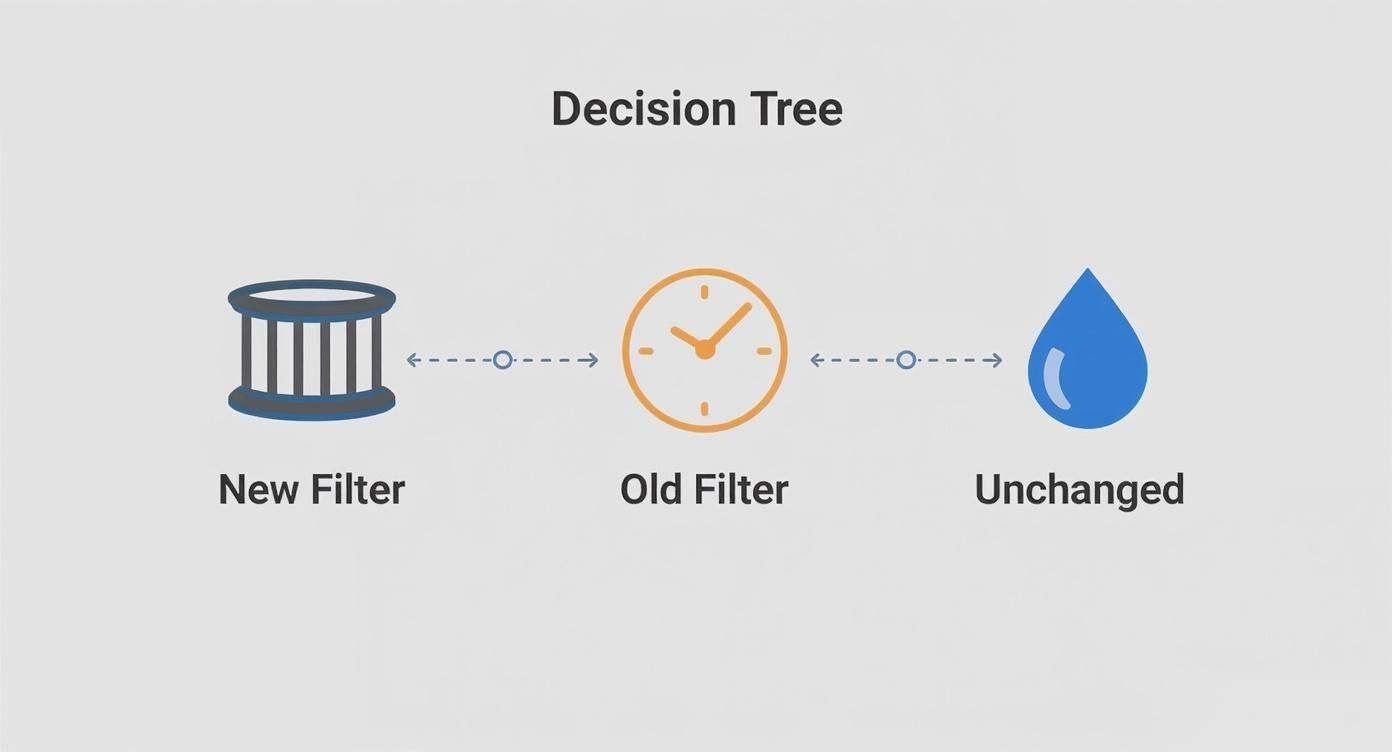
This infographic lays out a simple decision tree to help you figure out if your filter itself is the source of the sweetness.

Infographic about why does water taste sweet

As the chart shows, both brand-new and old filters can be the culprit, which really drives home the importance of flushing new cartridges and keeping up with maintenance.

Reverse Osmosis: The Purity Powerhouse

If you have a strong suspicion that the sweet taste is coming from something more serious, like heavy metals or a really high mineral content, you need to bring in the big guns. A reverse osmosis (RO) system is that bigger gun. It works by forcing water through a special membrane packed with microscopic pores—so tiny that it blocks almost everything that isn't a pure water molecule.

RO systems are the undisputed gold standard for removing:

  • Heavy Metals: They are proven to remove over 99% of lead from drinking water.
  • Dissolved Minerals: They completely eliminate the calcium and magnesium that often cause that sweet taste in hard water.
  • A Wide Range of Contaminants: From fluoride to nitrates and tons of other impurities, RO systems get rid of it all.

Because they're so incredibly thorough, RO systems deliver some of the purest drinking water you can get right from your tap.

A consumer study looking into flavored water discovered that 65.7% of people expect their water to have a pleasant, often slightly sweet, taste. This just goes to show how much our perception is shaped by both what's in the water and what we expect. You can read the full research on water taste preferences to dig deeper.

Comparing Home Water Filtration Systems

With different technologies available, it can be tough to decide which filtration system is best for your home. This table breaks down the most common options to help you compare them at a glance, focusing on what they're good at, what they cost, and how much work they are to maintain.

Filtration Type Effective Against Average Cost Maintenance
Activated Carbon Chlorine, organic compounds, pesticides, bad taste & odor. $20 – $150 Replace filters every 2-6 months.
Reverse Osmosis Heavy metals (lead), minerals, salts, nitrates, fluoride. $150 – $500+ Replace pre-filters every 6-12 months; membrane every 2-3 years.
Water Softener Hard water minerals (calcium, magnesium). $500 – $2,000+ Refill salt periodically (every 1-3 months).
UV Purifier Bacteria, viruses, microorganisms. (Does not remove chemicals or minerals). $200 – $600 Replace UV lamp annually.

Ultimately, the best system is the one that targets the specific contaminants causing your sweet taste. For most flavor issues, an activated carbon or RO system will get the job done right. If you need more help deciding, check out our full collection of water filter advice for more in-depth guides.

Got Questions About Your Water's Taste? We've Got Answers.

When something as basic as your tap water starts tasting funny, it's natural to have questions. A sudden sweet taste can be unsettling, and you need clear, direct answers to feel confident about what you're drinking.

Let's cut through the confusion. Here are the most common questions we hear from people dealing with this exact problem, with a focus on how home water filtration provides the solution.

Is It Safe to Drink Water That Tastes Sweet?

This is the big one, and the honest answer is: it depends. A sweet taste from something harmless like calcium is perfectly fine. But that same taste can also signal a serious problem, like lead contamination. The trouble is, you can't tell the difference by taste alone.

If your water suddenly starts tasting sweet, the safest bet is to stop drinking it and get it tested. You just can't risk it. A professional lab test will tell you exactly what’s in there, so you can find a filter certified to remove that specific contaminant.

How Do I Test My Water?

For a surefire answer, send a sample to a state-certified laboratory. They'll run a full analysis and give you a detailed report on everything from minerals and heavy metals to organic compounds. It’s the most reliable way to know what you’re dealing with.

Want a quicker first look? Grab a quality at-home test kit. These can screen for common culprits like lead, high mineral content (water hardness), and pH imbalances. The results can give you a good idea of whether you need to follow up with a professional lab.

When it comes to safety, don't guess. A water test is a small price to pay for peace of mind, and it points you directly to the right filtration solution for your home.

Will a Basic Pitcher Filter Fix This?

It really hinges on what's causing the sweetness. A standard pitcher with an activated carbon filter does a great job of removing chlorine and certain organic compounds that mess with taste and smell. But that's where its power ends. It's not effective against dissolved minerals or heavy metals.

If your water tastes sweet because of high mineral content or, worse, lead, a simple pitcher filter won't solve the problem. For issues like those, you'll need to step up to a more robust system, like an under-sink reverse osmosis unit or a whole-house water softener.

How Often Should I Change My Filter?

Keeping up with filter changes is non-negotiable if you want your system to work right. Always follow the manufacturer's schedule for your specific model—lifespans can vary a lot.

As a general guideline:

  • Pitcher filters: Every 2-3 months.
  • Faucet-mounted filters: Usually 3-4 months.
  • Under-sink and whole-house filters: Can go anywhere from 6 to 12 months.

If you let it go too long, the filter can get clogged or even become a breeding ground for bacteria. When that happens, it can start dumping new, unwanted tastes—including sweetness—right back into your "filtered" water.


At Water Filter Advisor, our mission is to help you get the purest, best-tasting water for your home. Dive into our detailed guides and reviews to find the perfect filtration system for your needs. Visit us at https://www.waterfilteradvisor.com to learn more.

Distilled vs. Reverse Osmosis: The Ultimate Water Filtration Showdown

So, you're on a quest for pure, delicious water, and you've narrowed it down to two heavy hitters: distillation and reverse osmosis. Welcome to the main event! The real difference between distilled and reverse osmosis water boils down to their very different game plans. Think of it as a science experiment versus a high-tech security checkpoint.

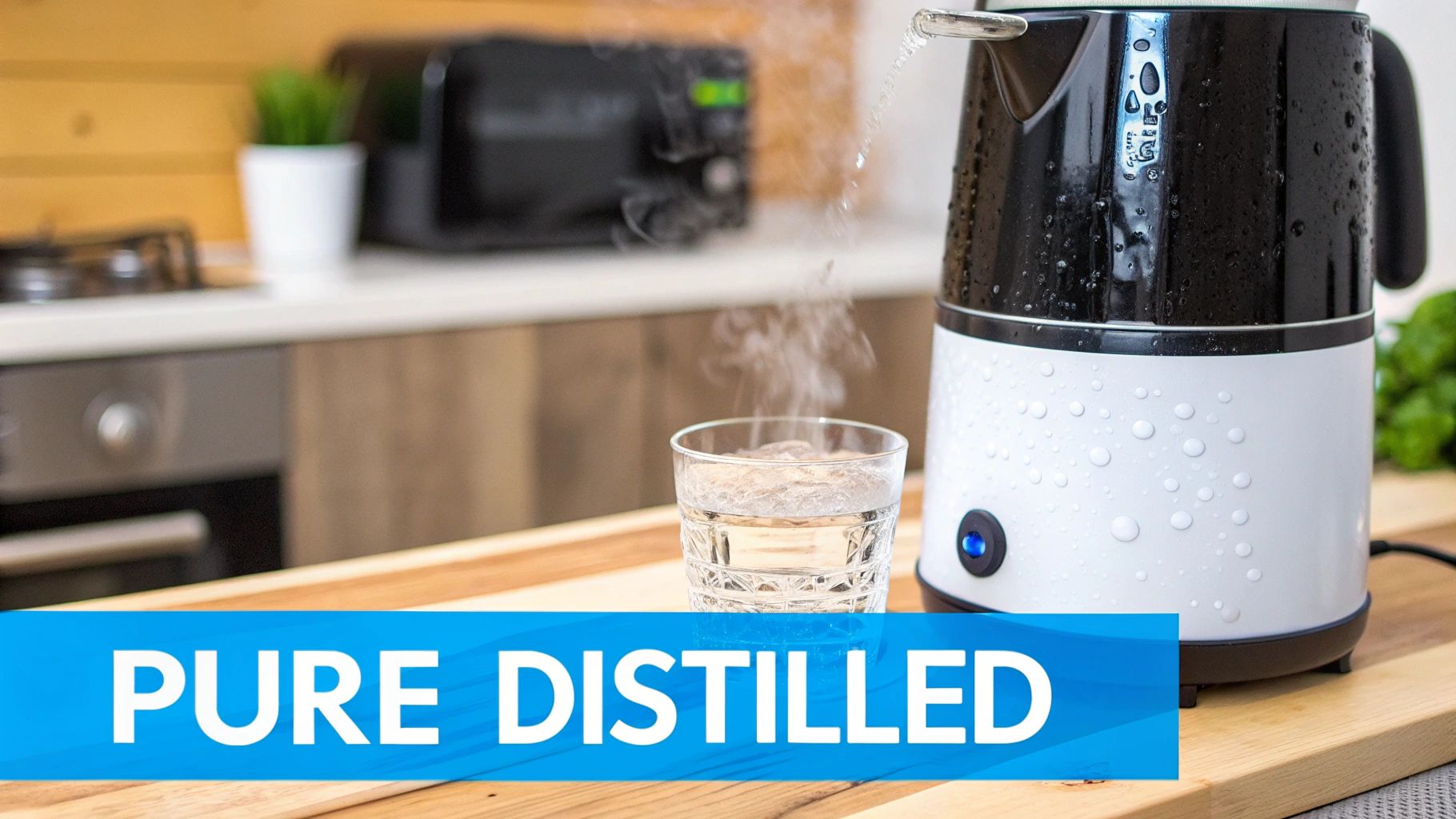
Distillation is like Mother Nature's water cycle, but in a countertop gadget. It boils water, lets the pure steam rise to escape the gunk, and then cools that steam back into pristine liquid. It's a thermal process, using heat to do the dirty work. Reverse osmosis (RO), on the other hand, is a pressure-based filtration process. It's like a bouncer for your water line, using brute force to push water through an absurdly fine membrane that physically blocks troublemakers from passing.

Distilled vs Reverse Osmosis The Homeowner's Quick Guide

When you're standing in the aisle or browsing online for a home water purifier, this is one of the biggest debates you'll encounter. For homeowners, the choice really comes down to what you value most: the absolute, sterile purity you get from distillation, or the convenient, on-demand filtration of a reverse osmosis (RO) system.

Let's be clear: one isn't just flat-out better than the other. The right call depends entirely on your family's needs—what you want your water to taste like, how much hassle you're willing to put up with, and which specific contaminants you're trying to evict from your tap water.

This guide and the table below will give you a quick, at-a-glance feel for the differences in how they work, taste, and fit into your daily life.

A glass of pure water next to a home water filter system.

Key Distinctions at a Glance

Just looking at how these two systems operate tells you a lot about their strengths. A typical home water distiller sits on your countertop, patiently boiling a batch of water, collecting the steam, and condensing it. It’s an incredibly thorough process that’s fantastic at removing things like heavy metals, minerals, and salts. It’s the slow and steady tortoise of the water world.

An RO system is a totally different beast. It's usually tucked away under your sink and spliced right into your plumbing, like a secret agent for your water supply. It works by pushing water through several stages of filters, but the real magic happens at the semipermeable membrane, which does the heavy lifting of blocking a massive range of dissolved solids and pollutants.

The defining difference: Distillation purifies water by turning it into steam to leave contaminants behind. Reverse osmosis purifies water by physically pushing it through a filter that blocks those contaminants.

To make things even simpler, here's a quick table to show you how they stack up side-by-side for typical home use.

Distilled vs Reverse Osmosis An At-A-Glance Comparison

Feature Distilled Water Reverse Osmosis (RO) Water
Purification Method Boiling water into steam & condensing it Pushing water through a semipermeable membrane
Typical Setup Countertop appliance (batch process) Under-sink system (on-demand supply)
Energy Usage Higher (requires electricity to boil water) Lower (uses water pressure)
Taste Profile Often described as "flat" or "bland" Generally crisp, clean, and refreshing
Mineral Removal Removes virtually all minerals Removes most, but some may remain

As you can see, the choice isn't just about which one filters "better." It's about how the system integrates into your home, how much energy it uses, and even what kind of taste you prefer.

How Water Distillation Replicates Nature's Rain Cycle

Ever wondered why the air feels so clean after a good downpour? It's because rain is nature's own purified water, and home distillation basically mimics that process—just a whole lot faster and without the risk of getting struck by lightning.

At its heart, distillation is a beautifully simple thermal process. You start by heating water in a boiling chamber up to 212°F (100°C), where it turns into steam. This jump from liquid to gas is where the magic happens.

A home water distiller on a kitchen counter, showing the process of steam rising and condensing into a clean carafe.

As the pure H₂O vapor rises, it leaves almost everything else behind. Heavier, non-volatile contaminants just can't make the trip. That means things like heavy metals, salts, minerals, and most microbes get left behind as a crusty sediment in the boiling chamber. It's a one-way ticket for water molecules only.

From Steam to Pure Water

Once the steam is separated, it's guided into a cooling channel. A fan typically cools it down, causing the vapor to condense back into liquid. This is your exceptionally pure distilled water, which drips into a clean carafe.

It's just like the steam that rises from a kettle on your stove. The steam itself is pure water, but any scale or residue stays put inside the kettle. A distiller just captures that steam and turns it back into pristine drinking water.

This method results in one of the purest forms of water available, stripped of the vast majority of dissolved solids found in your tap water.

By mimicking nature's cycle of evaporation and precipitation, distillation essentially hits the reset button on your water, leaving you with just H₂O.

What Distillation Removes and What It Misses

Distillation is an absolute powerhouse for removing a specific class of contaminants. Because it physically separates water from solids, it's brilliant at getting rid of:

  • Heavy Metals: Lead, arsenic, mercury, and cadmium have no chance. They're left behind when the water boils.
  • Dissolved Minerals and Salts: It removes calcium, magnesium, sodium, and other inorganic compounds. This is why distilled water is recommended for appliances like irons to prevent mineral buildup.
  • Microbiological Threats: The high heat kills off most bacteria, viruses, and other pathogens, and they can't travel with the steam anyway.

But it’s not a perfect system. The biggest blind spot is with certain volatile organic compounds (VOCs). These are sneaky chemicals with a boiling point at or below water's. When you boil the water, these VOCs can turn to gas right along with the H₂O, travel through the condenser, and end up in your clean water.

To get around this, most modern distillers come equipped with an activated carbon post-filter designed to specifically trap these chemicals. This is a key point to remember when considering the difference between distilled and reverse osmosis, as each technology has its own set of strengths and weaknesses in removing specific contaminants.

How A Reverse Osmosis System Really Works

While a distiller is like a patient scientist, a reverse osmosis (RO) system is a high-tech commando raid on water impurities. It's not just one filter but a whole team of them working together, using high pressure to strip contaminants from your water in a methodical, step-by-step process.

The heart of the whole setup is the semipermeable membrane. You can think of it as a bouncer at an exclusive club, but for water. Its pores are unbelievably small—around 0.0001 microns—so only pure H₂O molecules get past the velvet rope. Everything else, like dissolved salts and lead, is rejected and sent packing down the drain.

But this membrane is delicate. You can't just blast raw tap water at it, or it would clog up and fail in no time. That’s why a home RO system is built with several layers of protection, all designed to safeguard this crucial component.

The Path Water Takes Through An RO System

When water enters a typical under-sink RO system, it goes on a specific journey. Each stage preps it for the next, which is key to getting the purest water possible and making the membrane last.

The whole thing breaks down into three main phases:

  1. Pre-Filtration: First, the water has to get through a couple of "bodyguard" filters. A sediment pre-filter catches the big stuff like rust, dirt, and sand. Then, a carbon block filter grabs chemicals like chlorine, which can eat away at the delicate membrane.
  2. The RO Membrane: With the water now pre-cleaned, it’s forced at high pressure against the semipermeable membrane. This is where you see the biggest difference between distilled and reverse osmosis—RO is a physical separation process, while distillation relies on evaporation. The membrane physically blocks up to 99% of total dissolved solids (TDS), which are then rinsed away into your drain.
  3. Post-Filtration: After passing through the membrane, the purified water sits in a small storage tank under your sink. When you open the RO faucet, the water travels from the tank through one last "polishing" filter, usually another carbon filter. This final touch gets rid of any remaining off-tastes or odors, making sure the water is perfectly crisp when it hits your glass.

An RO system isn't just one filter; it's a team of filters working in concert. The pre-filters protect the membrane, and the post-filter gives the water a final polish for perfect taste.

This multi-stage design is what allows reverse osmosis to tackle such a huge range of contaminants, giving you a steady supply of clean water right from your tap. It’s a smart and highly effective approach for any modern home.

A Head-to-Head Analysis On Contaminant Removal

When you sink your money into a water purification system, the goal is pretty straightforward: make your water safer to drink. The real difference between distilled and reverse osmosis comes down to which contaminants each one is best at removing. Both methods are powerhouses, but they go about it in completely different ways. This makes one a better fit than the other, depending on what’s actually lurking in your water.

Distillation is basically a brute-force approach. You boil the water, catch the steam, and leave nearly everything else behind. This makes it an absolute champion at getting rid of things that have a higher boiling point than water itself.

Reverse osmosis, on the other hand, is more like a highly selective bouncer at a club. It uses a multi-stage process where water is forced through a special membrane that rejects a huge range of dissolved solids based on their size and charge.

How Each Method Handles Common Contaminants

Distillation is almost flawless when it comes to removing heavy metals like lead and arsenic, boasting removal rates of 99.9%. It’s also unmatched for taking out inorganic minerals—think calcium and magnesium—and salts. This is precisely why distilled water has that distinctly "flat" taste. As a bonus, the boiling process kills just about every bacterium and virus.

Reverse osmosis is more of an all-around performer. It’s fantastic at removing dissolved salts, nitrates, and fluoride, typically cutting them down by 95-99%. RO systems also excel at filtering out things like pesticides and chlorine, which makes a huge difference in the taste and smell of your tap water. While it's great against most microbes, it doesn't use heat to sterilize the water.

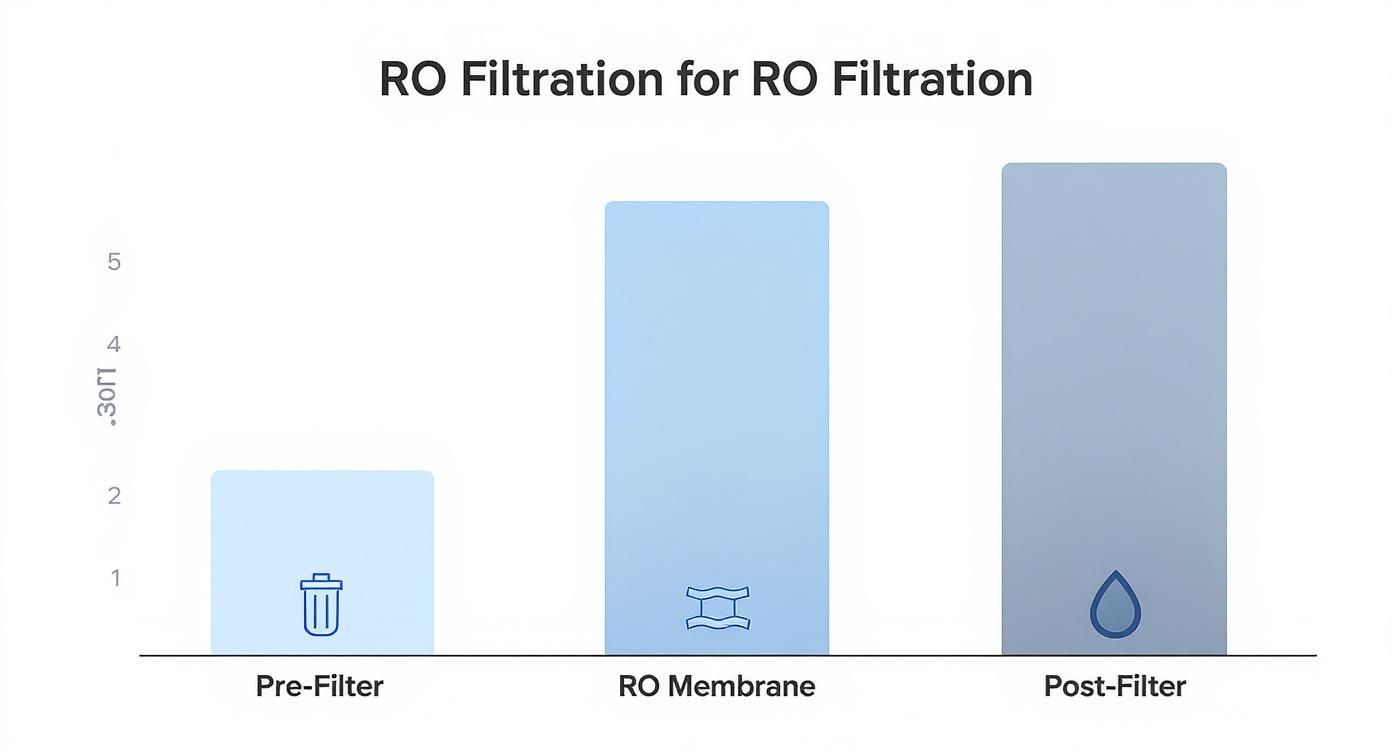
This infographic gives you a good look at how a typical RO system works, showing how each stage plays a part in cleaning the water.

Infographic showing the three main stages of RO filtration Pre-Filter, RO Membrane, and Post-Filter.

As you can see, an RO system isn't just one filter. It’s a complete process where each stage tackles different impurities, protecting the main membrane and polishing the water before it gets to your glass.

Contaminant Removal Effectiveness Comparison

Let's break down how these two stack up against specific, common water contaminants. This table gives a clear side-by-side look at where each method shines and where it might fall short.

Contaminant Distillation Removal Rate Reverse Osmosis Removal Rate
Heavy Metals (Lead, Arsenic) Excellent (99.9%+) Very Good (95-97%)
Dissolved Minerals & Salts Excellent (99.9%+) Excellent (95-99%)
Chlorine & Chloramine Poor (can be vaporized) Excellent (98%+, with carbon filters)
Fluoride Very Good (90-99%) Excellent (95-97%)
Bacteria & Viruses Excellent (99.9%+) Very Good (99%+, membrane blocks them)
Pesticides & Herbicides Good to Very Good Excellent (97-99%, with carbon filters)
Volatile Organic Compounds (VOCs) Poor (without a carbon filter) Very Good (with carbon filters)

Looking at the numbers, it's clear there's no single "best" for everything. Your choice really hinges on what you're trying to remove.

Key Takeaway: Choose distillation if you’re aiming for the absolute highest purity from minerals, heavy metals, and microbes. Go with reverse osmosis for a broader defense against dissolved chemicals like chlorine, fluoride, and pesticides, which results in better-tasting water for daily drinking.

At the end of the day, your local water quality report is your best guide. If heavy metals or microbiological threats are your main worry, distillation offers almost total peace of mind. But if you’re dealing with a cocktail of city water additives and potential agricultural runoff, a multi-stage RO system is the more well-rounded solution.

Long-Term Costs and Daily Practicality: What to Expect

When you look past the purification numbers, the real decider for most people between distilled and reverse osmosis comes down to two things: money and convenience. It's not just about the upfront cost, but how each system fits into your daily life and your monthly budget.

A countertop distiller might look like the cheaper option on the shelf, and it often is. But that initial price tag doesn't tell the whole story.

The True Cost of Running Your System

Distillation is a power-hungry process. A standard home distiller pulls around 800 watts of electricity and needs a good three to four hours to produce just one gallon of water. That adds up on your utility bill, especially if you have a family that goes through a lot of water. It’s the energy vampire of the water filter world.

Reverse osmosis, on the other hand, runs on your home's existing water pressure. It uses a tiny bit of electricity, but not enough to even notice. The main running cost for an RO system is the wastewater it sends down the drain to keep the membrane clean. Older systems were pretty wasteful, but modern ones have gotten much better, with some hitting a 2:1 or even 1:1 waste-to-pure-water ratio.

Financial Insight: With distillation, you're paying your electric company for every drop you make. With reverse osmosis, you're paying the water company—and water is almost always cheaper than the electricity needed to boil it for hours on end.

Maintenance and Day-to-Day Use

This is where the lifestyle fit really comes into play. A distiller is a batch system. You have to fill it, turn it on, and wait. It also needs to be cleaned constantly to get rid of the gunk—all those minerals and scale left behind in the boiling chamber. That descaling process can be a real chore.

An under-sink RO system is way more hands-off for daily use. You get purified water instantly from a dedicated tap whenever you want it. Maintenance is less frequent but follows a set schedule for replacing the filters and membrane.

  • Pre- and Post-Filters: These usually need swapping every 6 to 12 months.
  • RO Membrane: This is the heart of the system and typically lasts 2 to 3 years.

You just have to remember to order the parts and swap them out on schedule. The difference in practicality is pretty clear when you look at the market. The global reverse osmosis market was valued at around $18.8 billion and is growing fast, while the distilled water market is tiny in comparison. That alone shows you which technology is winning out in homes and cities. You can learn more about these market trends and see just how dominant RO has become.

Making The Right Choice For Your Household's Needs

https://www.youtube.com/embed/DOPweBJInr4

So, how do you decide between distilled water and a reverse osmosis system? There’s really no single “winner” here. The best choice comes down to what you actually need the water for in your home. It’s all about matching the right tool to the right job.

The decision really hinges on one simple question: Are you chasing absolute, near-perfect purity for specific tasks, or do you just want a reliable, on-demand source of fantastic-tasting water for your family?

Choose Distillation For Uncompromising Purity

If your goal is to get water that is as pure as scientifically possible, distillation is the undisputed champ. Nothing else comes close to its ability to remove virtually every last mineral and inorganic compound.

You’ll want to go with a distiller if your needs are very specific:

  • Medical Devices: Things like CPAP machines and home sterilizers need water that’s completely free of minerals. Using anything else can cause damaging scale buildup and compromise sterile operation.
  • Small Appliances: Ever notice that white crust in your steam iron or humidifier? That’s mineral scale. Using distilled water stops that from ever happening, making your appliances last much longer.
  • Compromised Immune Systems: The boiling process is an incredibly effective defense against microbiological threats, offering an exceptional layer of safety for anyone who needs it.

Distillation gives you water that's about as close to pure H₂O as you can get. This makes it the go-to solution for specialized uses where you simply can't have any minerals or contaminants.

Choose Reverse Osmosis For Everyday Convenience And Taste

For most households, a reverse osmosis system hits the sweet spot. It delivers an excellent balance of powerful filtration, on-demand convenience, and—most importantly—great-tasting water. It’s a workhorse built for the modern kitchen.

An RO system is almost certainly your best bet if you’re looking for:

  • Great-Tasting Drinking Water: RO excels at removing chlorine, dissolved solids, and other gunk that gives tap water an off-taste or weird smell. The result is crisp, clean water that actually makes you want to drink more.
  • Convenient On-Demand Supply: An under-sink RO system gives you a steady stream of purified water from its own dedicated faucet. It’s perfect for filling a glass, cooking pasta, or making coffee without a second thought.
  • Broad-Spectrum Contaminant Removal: These systems are fantastic at tackling a huge list of common water worries, from lead and fluoride to pesticides and nitrates.

The final call is about weighing these scenarios against what happens in your home every day. If you want more help figuring out what's right for your tap water, we have a ton of practical advice to help you choose wisely.

Tying Up Loose Ends: Your Top Questions Answered

When you're trying to pick the right water system for your home, the same questions always seem to pop up. Let's get those last few uncertainties cleared up so you can choose between distilled and reverse osmosis with total confidence. Here are the most common things people ask.

Is It Unhealthy to Drink Water Without Minerals?

This is a big one, but the short answer is no, it’s not a problem. While it's true both distillation and reverse osmosis strip out beneficial minerals like calcium and magnesium, the reality is we get almost all of these essential minerals from our food, not our water.

For most folks, the massive health benefit of yanking out harmful contaminants—think lead, chlorine, or pesticides—is far more important than the tiny amount of minerals lost. If it’s still a concern, some reverse osmosis systems even have an optional remineralization filter that adds a bit of healthy mineral content back in, which a lot of people think makes the water taste better anyway.

Which Water Is Better for Just Drinking Every Day?

For grabbing a glass of water or filling up the coffee pot, most people hands-down prefer reverse osmosis water. Distilled water has a famously "flat" or even "bland" taste because there's absolutely nothing in it, and a lot of people just don't like it.

On the other hand, RO water, especially after a final carbon "polishing" filter, tastes crisp and clean. Plus, the convenience of having an on-demand faucet right at your sink makes an under-sink RO system way more practical for daily use.

When it comes to daily use, it really boils down to taste and convenience. Reverse osmosis gives you great-tasting, clean water right when you want it, making it the clear winner for most households.

Do Reverse Osmosis Systems Waste a Ton of Water?

Older RO systems definitely earned a bad rap for being water hogs, but modern, high-efficiency systems are a whole different ballgame. Any RO system has to flush away the contaminants it catches, creating wastewater (called brine) that goes down the drain.

The good news is that many new systems have seriously impressive waste-to-pure-water ratios, with some hitting as low as 1:1. That means for every gallon of pure water you get, only one gallon of wastewater is created. It's a small trade-off for getting such a high level of purification on demand.


Ready to find the perfect filtration system for your home? The team at Water Filter Advisor has done the research for you, with in-depth reviews and practical guides to help you choose with confidence. Explore our expert recommendations at https://www.waterfilteradvisor.com.
Finding the Best Inline Water Filter for Your Refrigerator

Ever wonder why the water from your fridge dispenser tastes a little… off? Or why your ice cubes look cloudy and melt into a drink with a faint swimming-pool funk? You’re not imagining it. While your refrigerator’s built-in filter is a nice thought, it’s often just a glorified tea bag for your water line. It might catch a little chlorine, but that’s about it. If you want truly clean, safe, and delicious water and ice, it’s time to call in the specialist: the inline water filter.

Think of it as a bouncer for your fridge's water line. It installs before the water even reaches the appliance, creating a powerful checkpoint that strips out a whole host of nasty contaminants that internal filters can't touch. The best ones are certified for NSF 53, a seal of approval that means they’re proven to reduce health-related contaminants like lead, cysts, and nasty chemicals. They are the secret to unlocking water that's not just better-tasting, but fundamentally cleaner.

Why an Inline Filter is the Ultimate Upgrade for Your Water and Ice

Let's be honest, those little pop-in cartridges inside your fridge are designed for convenience, not performance. They’re tiny, so they can only hold a small amount of filtration media, which is why they’re mostly good for one thing: reducing the taste and smell of chlorine. An inline filter, however, is a whole different beast. It’s an external powerhouse that gets plumbed directly into your water line.

This "outside the box" design is its superpower. Since it isn’t crammed into a tiny refrigerator compartment, an inline filter can be much larger. More size means more filtration media, and that translates into two huge wins for your home: a filter that lasts way longer and, more importantly, one that can wage war on a much broader spectrum of impurities.

A person installing an inline water filter on a refrigerator's water line.

Beyond Just Getting Rid of the Chlorine Taste

An inline filter isn't just about masking bad tastes; it's about actively purifying your water to make it safer for your family.

  • Serious Contaminant Takedown: High-quality inline filters are certified to reduce genuinely harmful stuff like lead, cysts (like Giardia), asbestos, and volatile organic compounds (VOCs). These are invisible villains most standard fridge filters simply ignore.
  • Crystal Clear Ice Cubes: The same junk that messes up your drinking water gets frozen into your ice, making it look cloudy and taste funky. The quality of your filter has a direct impact on your ice, and you can see how different filters for refrigerator ice makers can produce clean, fresh-tasting cubes that don't ruin your drink.
  • Marathon-Like Lifespan: A good inline filter can go for six months, a year, or even longer, often purifying thousands of gallons of water. That's a massive leap from the paltry 200-300 gallon capacity you get with most internal fridge filters.

The real game-changer is the level of protection. An internal filter might be certified for NSF 42 (Aesthetic Effects), but a great inline model will often carry the NSF 53 (Health Effects) certification. That's your proof it removes contaminants that can actually impact your health.

This isn't just a niche product anymore. The demand for cleaner water at home has exploded, pushing the global refrigerator water filter market toward $2.5 billion by 2025, with a steady annual growth between 5.4% and 7.7%. This just shows how vital reliable home water filtration has become. By choosing an inline filter, you’re not just buying a piece of hardware; you’re investing in a more powerful and long-lasting system for truly pure water and ice.

Decoding Filter Specs to Make a Smarter Choice

Choosing the right inline water filter can feel like trying to crack a secret code. You've got terms like "micron rating" and "NSF 42" flying around, and it's easy to get lost in the jargon. But once you understand what these specs actually mean for the water in your home, you can see right past the marketing fluff and find a filter that genuinely delivers.

Think of the filter media as the engine of the whole operation. It’s the stuff inside the cartridge that does all the heavy lifting to pull contaminants out of your water. You'll mainly encounter two types: Granular Activated Carbon (GAC) and Carbon Blocks.

Filter Media: The Heart of the System

GAC filters are filled with loose bits of carbon. As water weaves its way through these granules, the carbon acts like a magnet for chlorine, which is a huge help for improving the taste and smell of your water. They work well and usually don't choke your flow rate, so you won't be waiting an eternity to fill a glass.

Carbon Block filters are a different animal. They're made from super-fine carbon powder that's been compressed into a solid block. This creates a much denser and more intricate maze for water to navigate, allowing it to trap a wider variety of smaller contaminants, including some VOCs and cysts. The trade-off can be a slightly slower flow, but you often get a much higher level of filtration.

Here's the bottom line: if your main goal is to banish that swimming-pool taste from your water and ice, a good GAC filter is your champion. But if you’re concerned about a wider range of chemical contaminants in your home's water supply, a carbon block filter is your best bet for a more robust defense.

Micron Ratings: Size Really Does Matter

A filter's micron rating tells you the size of the particle it can reliably trap. A micron is impossibly small—one-millionth of a meter. So a filter with a 5-micron rating will stop anything 5 microns or larger, but a 0.5-micron filter will snatch much smaller, sneakier particles from your water.

To give you some perspective:

  • Human Hair: Around 50-70 microns
  • Silt and Sediment: Typically 5-30 microns
  • Cysts (like Giardia and Cryptosporidium): Between 2-10 microns

A smaller micron number means more powerful filtration. For instance, to get certified for reducing cysts, a filter needs a rating of 1 micron or less. This is a huge deal if you're concerned about microbiological contaminants in your water.

NSF Certifications: The Gold Standard of Trust

This is arguably the most important thing to look for on the box. An NSF/ANSI certification is a seal of approval from an independent lab, verifying that the filter actually does what the manufacturer claims. It's not just marketing hype; it's a performance guarantee.

These are the three big ones you'll see for home water filters:

  • NSF/ANSI 42 (Aesthetic Effects): This is the baseline certification. It confirms the filter reduces things that affect taste and odor, like chlorine.
  • NSF/ANSI 53 (Health Effects): This is a much tougher standard. A filter with this certification is proven to reduce specific health-related contaminants like lead, mercury, asbestos, and cysts.
  • NSF/ANSI 401 (Emerging Contaminants): This certification deals with newer concerns, showing that a filter can reduce trace amounts of things like pharmaceuticals, herbicides, and pesticides that are increasingly found in water supplies.

Flow Rate and Filter Life

Finally, you have to think about the day-to-day experience. The flow rate, measured in gallons per minute (GPM), dictates how fast your dispenser fills a glass. Most inline filters run at about 0.5 GPM, which is plenty for filling a water bottle without feeling like you're watching paint dry.

The filter lifespan tells you how many gallons it can purify before it needs to be replaced. A standard inline filter is usually good for about 1,500 gallons or six months of use. Knowing this helps you calculate the true long-term cost and how often you'll be performing a quick filter swap.

Comparing The Top Inline Refrigerator Water Filters

Alright, now that we’ve decoded the technical jargon, let’s see how the best inline filters actually perform in the real world. A simple list of features on a box is one thing, but finding the best inline water filter refrigerator solution for your home comes down to your unique water quality, your daily needs, and what you value most.

We're going to move past the marketing fluff and put the top contenders side-by-side, focusing on what really counts: raw filtration power, official certifications, water flow, lifespan, and overall value. This is about connecting the dots from specs on a page to the practical benefits you'll enjoy every day.

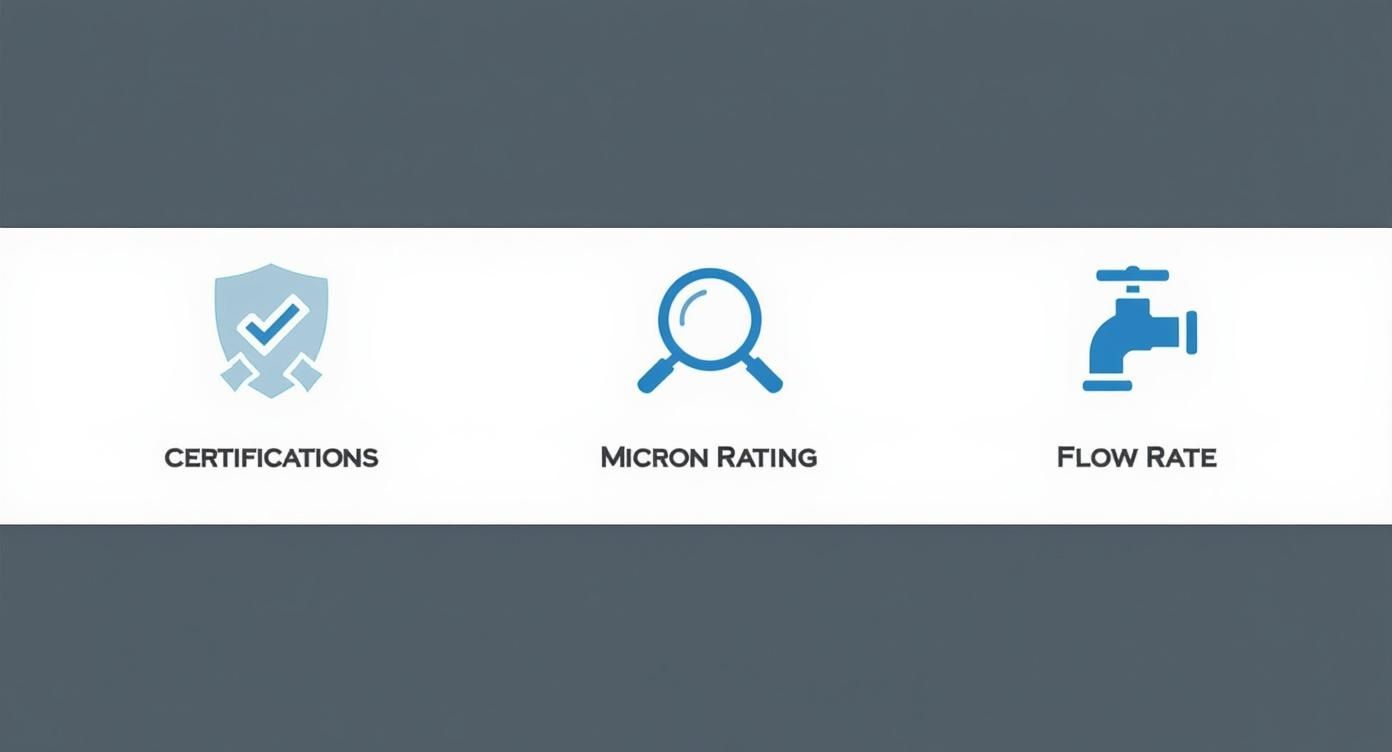
This quick guide highlights the big three specs—certifications, micron rating, and flow rate—that separate a decent filter from a great one.

Infographic about best inline water filter refrigerator

As you can see, these three elements have to work in harmony. They're what determine if a filter just makes water taste a little better or if it's a serious purification workhorse for your home.

Performance Showdown of Leading Inline Filters

To give you a clearer picture, let's lay out the key metrics for a few top-performing models in a side-by-side comparison. This table breaks down what you get with each filter, helping you match their strengths to your specific household needs.

Model Key Certifications Filter Lifespan (Gallons) Flow Rate (GPM) Primary Contaminants Reduced Best For
Heavy Metal Specialist NSF/ANSI 42 & 53 750 0.5 Chlorine, Lead, Cysts, VOCs Homes with older plumbing and lead concerns.
The Marathon Runner NSF/ANSI 42 3,000 0.75 Chlorine, Taste, Odor Busy families seeking long-term value and convenience.
Multi-Stage Defender NSF/ANSI 42 1,500 0.6 Sediment, Chlorine, Bacteria Households using well water or with high sediment.
The Budget Champion NSF/ANSI 42 1,500 0.75 Chlorine, Taste, Odor Renters or those prioritizing low upfront cost.

This showdown illustrates that there’s no single "best" filter—just the best one for a particular home. Now, let's put these into real-world contexts.

Scenario One: The Urban Home With Aging Infrastructure

Picture this: you live in an older city apartment or a house built before the 1980s. Your biggest water worry isn't just that chlorine taste. It's the nagging thought of lead leaching from old pipes and solder. In this case, your buying decision should hinge on one critical credential.

You absolutely need a filter with a solid NSF/ANSI 53 certification specifically for lead reduction.

  • The Heavy Metal Specialist: This filter is built for this exact job. It uses a super-dense carbon block with a tiny pore size, often just 0.5 microns. Its claim to fame is its proven ability to slash lead by over 99%, giving you real peace of mind.
  • The Generalist: Another filter might have a great NSF 42 rating for taste, but without that NSF 53 for lead, it's a non-starter here. It's a fine product, but it fails to address the biggest health risk in this scenario.

For anyone with older home plumbing, the choice is clear. The superior contaminant removal of the Specialist is the only responsible option, even if it’s a bit more expensive or has a slightly slower flow.

Key Differentiator: This isn't about better-tasting water; it's about health protection. An NSF 53 certification for lead is a non-negotiable feature for homes with old pipes, elevating the filter from a simple convenience to an essential home safety device.

Scenario Two: The Busy Family Seeking Convenience and Value

Now, imagine a suburban family with decent municipal water. Their main goals? Get rid of the chemical taste in their water and ice, find a filter that lasts as long as possible so they don't have to change it constantly, and keep the budget in check.

Here, the focus shifts from hardcore contaminant removal to longevity and cost-effectiveness.

  • The Marathon Runner: This filter is a beast, rated for an impressive 3,000 gallons or a full 12 months of use. It relies on Granular Activated Carbon (GAC) to keep the water flowing fast (0.75 GPM), so filling up a bunch of water bottles before soccer practice is a breeze. It’s got the NSF 42 certification to prove it handles chlorine.
  • The Budget Champion: This one is cheaper upfront and also has an NSF 42 certification. The catch? Its lifespan is much shorter, usually just 1,500 gallons or six months.

While the Budget Champion saves you a few dollars at the register, the Marathon Runner is the smarter long-term buy. You'd have to purchase and install two of the budget filters to get the same life out of one long-lasting model, which wipes out the savings and doubles the hassle. For any busy household, that "set it and forget it" factor is a huge win.

Scenario Three: The Water Connoisseur With Well Water

Finally, let's consider a homeowner on a private well. Their water problems are completely different. Instead of chlorine, they're battling sediment, maybe some rust particles, and that "earthy" taste. Plus, their water pressure can be unpredictable.

The right filter for this job needs to be a multi-stage powerhouse.

  • The Multi-Stage Defender: This kind of filter is engineered for tough water sources. It typically uses a multi-step process:
    1. First, a sediment pre-filter (around 5 microns) catches the big stuff like sand and silt. This protects the main filter from getting clogged.
    2. Next, a dense carbon block (maybe 1 micron) goes to work on organic compounds, tastes, and odors.
    3. It might also include KDF media, which helps inhibit bacteria from growing inside the filter housing—a fantastic feature for non-chlorinated well water.
  • The Basic Carbon Filter: A simple GAC filter would be overwhelmed here. It would clog with sediment in no time, your water flow would drop to a trickle, and you’d be swapping it out constantly. It just doesn't have the muscle for untreated water.

For anyone on a well, the multi-stage filter is really the only way to go. Its layered design ensures you get clean water and a decent filter life because it doesn't let sediment overwhelm the carbon core.

A filter's effectiveness is completely situational. The "best" filter is simply the one whose strengths are a perfect match for your home water's specific weaknesses.

Making Your Final Decision

When you're ready to buy, look past the brand name and get right to the performance data. Certifications are your proof of performance, filter life determines your long-term cost and how often you'll be under the sink, and the filter media dictates what’s actually being removed from your water.

As you compare models, you can explore a wide selection of Awesome Water Fridge Filters to see how these different specs line up with different price points. By matching the filter's capabilities to your home's unique water profile, you can confidently pick an inline filter that will deliver pure, fantastic-tasting water and ice for years to come.

A Straightforward Guide to Installing Your Inline Filter

https://www.youtube.com/embed/kho7FMA4t1Q

Installing an inline water filter probably sounds a lot more intimidating than it really is. The truth is, most modern filters are designed for a quick DIY job that just about anyone can knock out in less than 30 minutes. You can put away the plumber's number and that giant toolbox. All you really need is a little confidence and a couple of basic items.

This guide will walk you through it, step by step. We’ll demystify the process and make sure you get a solid, leak-free connection. Your reward? Crisp, clean water and ice straight from your fridge for years to come.

Gathering Your Tools and Supplies

Before you even touch that water line, get all your supplies laid out and ready. It beats scrambling to find something mid-installation. Luckily, the list is short and sweet.

You will need:

  • Your new inline water filter (of course!)
  • A utility knife or a tube cutter to get a nice, clean cut.
  • A small bucket or a few old towels to catch the few drips when you disconnect the line.
  • A marker to jot down the installation date right on the filter cartridge.

That's it. Seriously. Most of the best inline water filter refrigerator kits these days use push-to-connect fittings, so you won’t need any special glues, clamps, or wrenches to get a tight seal.

Step-by-Step Installation Process

With your gear ready, you're set to begin. Just follow these simple steps for a perfect install.

  1. Locate and Shut Off the Water Supply: This is the most critical first step. Find the small shut-off valve on the 1/4" plastic or copper tube running to the back of your refrigerator. It’s usually a small handle or a saddle valve. Turn it clockwise until it stops. To double-check, try the water dispenser on your fridge—if nothing comes out, you're good to go.

  2. Cut the Water Line: Now, decide where you want the filter to live. You'll thank yourself later if you pick a spot with easy access for future changes, like right behind the fridge or under the kitchen sink. Once you've found the perfect spot, use your tube cutter or utility knife to make one clean, straight cut. A crooked cut is the number one cause of a leaky connection.

  3. Connect the Filter: Take a look at your new filter. You should see an arrow printed on it that shows the direction of water flow. This arrow must point towards your refrigerator for the filter to work correctly. Now, just push the end of the waterline coming from the wall firmly into the "in" port. Then, push the other end of the line that goes to your fridge into the "out" port.

The real trick to these modern push-to-connect fittings is making sure the tube is seated all the way in. You should feel a little "click" or see it bottom out about half an inch into the fitting. Give the tube a gentle tug to be sure it’s locked in.

Final Checks and Flushing

You're on the home stretch! These last few steps are just to make sure your work is solid and the filter is ready to provide great-tasting water.

  • Slowly Turn the Water Back On: Head back to the shut-off valve and turn it counter-clockwise, but do it slowly. This lets the pressure build up gradually and avoids any sudden shocks to the system.
  • Check for Leaks: Look closely at the connections on both ends of the filter. If you spot any drips, turn the water off again. Check that your cut is straight and try pushing the tubing more firmly into the fitting.
  • Flush the New Filter: Every new carbon filter has some harmless carbon "fines" (which look like black powder) left over from manufacturing. You need to flush them out. Run about 2-3 gallons of water through your dispenser into a bucket. The water might look a little gray or cloudy at first, but it will clear up quickly.

Once the water runs clear, you're officially done. Don't forget to write the date on the filter so you'll know when it's time for a replacement—usually every six months. You've just successfully installed the best inline water filter refrigerator solution for your home.

Keeping Your Filter at Peak Performance

A person marking the installation date on a new inline water filter.

Alright, you’ve got your new inline filter installed. Fantastic! But before you grab a glass, there’s one small but critical step to get everything running perfectly. Properly commissioning the filter is the key to getting that clean, crisp taste you’re after from day one.

Any new carbon-based filter needs a good flush. This does two things: it clears out any harmless carbon "fines"—tiny, loose particles of carbon left over from the manufacturing process—and it saturates the filtration media. This ensures water flows evenly through the entire cartridge for the best possible performance.

Just run about 2-3 gallons of water through your fridge’s dispenser into a bucket or the sink. Don't be alarmed if the water looks a bit cloudy or discolored at first; that's totally normal. Once it runs crystal clear, your filter is officially ready for duty.

Why Sticking to a Schedule Matters

It's tempting to take a "set it and forget it" approach with an inline filter, but changing it on time is the single most important part of keeping it working. Over time, the filter's media gets clogged with all the contaminants it has trapped from your water. Once it hits capacity, its ability to capture new impurities plummets.

Worse yet, a clogged filter can become a breeding ground for bacteria. It also forces your refrigerator’s water system to work harder, which can strain the appliance and lead to leaks or a frustratingly slow water flow. If neglected, your powerful filter can quickly turn into part of the problem.

Sticking to the manufacturer's replacement schedule isn't just a recommendation—it's the only way to guarantee you're getting the water quality and safety you paid for. An old filter is often worse than no filter at all.

Staying on Top of Filter Swaps

Most inline filters are built to last about six months or for a certain number of gallons, whichever comes first. The easiest trick is to just write the installation date on the filter cartridge with a permanent marker. Pair that with a recurring reminder on your phone’s calendar for six months down the road.

You also need to consider your local water conditions.

  • Hard Water Areas: If your home's water has a high mineral content, you might notice the flow rate slowing down sooner. That's your cue that an earlier replacement is needed.
  • High Sediment: Homes on well water or in older neighborhoods with aging municipal pipes often deal with more sediment. This can clog filters much faster, cutting their effective lifespan short.

There’s a reason the replacement filter market is so huge. The global refrigerator water filter market is projected to grow from $1.23 billion to nearly $1.90 billion by 2031, and replacement cartridges are a massive slice of that pie. It just goes to show how critical regular changes are for home water filter performance.

By following these simple maintenance steps, you can ensure your investment continues to deliver the best-tasting and safest water for your family.

Your Questions About Inline Refrigerator Filters Answered

Even after getting the basics down, you probably still have a few questions about how these filters work for your home. Let’s tackle the most common things people ask, so you can feel totally confident in your choice.

Getting these details sorted out is what separates a decent purchase from a great one.

Can I Use an Inline Filter If My Refrigerator Doesn't Have One?

Absolutely! In fact, that's one of the best reasons to get one. Inline filters are the perfect solution for refrigerators that didn't come with a built-in filter system.

They connect directly to the standard 1/4-inch water line that feeds your ice maker and water dispenser. The filter purifies the water before it even enters your fridge, giving you a serious filtration upgrade no matter how old or basic your appliance is.

Will an Inline Filter Kill My Water Pressure?

It shouldn’t. While adding anything to a water line will technically slow it down a tiny bit, a good inline filter is designed to maintain a smooth flow. Most run around 0.5 GPM (gallons per minute), which is plenty for a fast fill-up at the dispenser.

If you ever notice a major drop in pressure, it's almost never the filter's fault. It’s actually the clearest sign that the filter has done its job, has captured a ton of gunk, and is ready to be swapped out for a fresh one.

An inline filter is often a much better choice than the standard one inside your fridge. They're bigger, so they hold more filter media. This means they last longer and can pull out a much wider range of contaminants—not just the chlorine that affects taste and smell.

How Do I Know When It’s Time for a Replacement?

Most manufacturers suggest a new filter every six months, or after a specific number of gallons (like 1,500) has passed through it. The easiest trick is to grab a permanent marker and write the installation date right on the filter cartridge itself.

I also like to set a recurring reminder on my phone calendar. Beyond that, just trust your senses. If you notice the water starts tasting a little off or the flow from the dispenser slows down, it's definitely time for a change. For more tips on this, you can find a lot of practical advice on water filter maintenance.

Are Inline Filters Actually Better Than the Internal Ones?

When it comes to pure filtration performance, yes, in most cases they are a significant upgrade. The built-in filter that comes with your fridge is convenient, but it's also small and typically only certified to improve taste and smell (NSF 42).

An inline filter, on the other hand, gives you a much higher level of protection. Many are certified under NSF 53, which means they are proven to reduce serious health-related contaminants like lead, cysts, and harmful chemicals. You're getting far more comprehensive purification for your home's water.


At Water Filter Advisor, we provide the insights you need to make confident decisions about your home's water quality. Explore our guides and reviews to find the perfect filtration solution for your family.
https://www.waterfilteradvisor.com

How to Reduce Chlorine in Your Home Water: A Filtration Guide

Tired of your tap water tasting like it just came from the local swimming pool? The undisputed champion for banishing chlorine from your home’s water is a quality filtration system, especially one powered by activated carbon. While letting a pitcher sit on the counter might help a little, it’s a slow-motion solution. For a real, lasting fix, filtration is the only way to go.

Why Your Tap Water Smells Like a Swimming Pool

Ever turn on the kitchen sink and get hit with that unmistakable "public pool" smell? You're not just imagining it. That distinct odor is chlorine, a powerful disinfectant your local water utility adds for a critical reason.

Think of it as a bodyguard for your water. Chlorine's job is to kill off nasty bacteria, viruses, and other pathogens during the long trip from the treatment plant all the way to your tap. This process, called chlorination, has been a massive public health success, saving countless people from waterborne diseases. Without it, drinking tap water would be a serious gamble.

But the very chemical that keeps our water safe can also make it taste and smell… less than ideal. This leaves a lot of people wondering how to get rid of the chlorine once it’s done its job and reached their home. The answer lies in targeted home filtration.

Chlorine vs. Chloramine

Just to make things interesting, many water suppliers now use chloramine instead of just chlorine. This is a more stable compound they make by adding ammonia to the chlorine.

Why the switch? While chlorine evaporates pretty quickly, chloramine sticks around much longer. It's designed to keep the water disinfected right to the end of the line, but that stability also makes it tougher to remove. This is a crucial detail because your standard chlorine filter might not be up to the task. Figuring out if you have chlorine or chloramine is the first step to picking the right filter.

It's About More Than Just Taste and Smell

Getting rid of that chemical taste is a big motivator, but it's not the only reason people install filters. When chlorine mixes with the natural organic stuff in water, it can create what are known as disinfection byproducts (DBPs), like trihalomethanes (THMs).

Your city's water is treated to keep these DBP levels within legally safe limits. Still, many folks would rather just minimize their exposure altogether right at home.

Filtering your water right where you use it gives you the best of both worlds. You get all the protection of a professionally disinfected public water supply, but you get to strip out the chlorine and its byproducts just before you drink, cook, or shower.

This approach lines up with where the industry is heading. Agencies like the U.S. Environmental Protection Agency are constantly tightening the rules, and as reported on GlobeNewswire, there's a lot of research into new ways to handle chlorine with less environmental impact. By installing a home filter, you're just taking that final, personal step to make sure your water is exactly how you want it.

How to Test Chlorine Levels in Your Water

Before you can fix that chlorine taste in your water, you have to know what you’re up against. Think of it like a detective—you need to gather evidence before you can pinpoint the right solution. Just guessing could mean you end up with a filtration system that's either total overkill or not nearly strong enough for the job.

The good news? You don't need a lab coat or a chemistry degree to get solid answers.

Testing your water at home is quick, easy, and gives you the hard data you need to make a smart decision. This first step will tell you exactly what concentration of chlorine you're dealing with.

Simple and Affordable Test Strips

The fastest way to get a reading is with test strips. These are just little disposable paper strips with chemical pads on them. Dip one into a glass of your tap water, give it a swirl for a few seconds, and pull it out.

After about a minute, the pads will change color. All you do is match those colors to the chart that comes with the kit. It's a dead-simple method that gives you a ballpark figure, usually in parts per million (PPM).

While they're super easy to use and cheap, they aren't the most precise tool. For most homes getting city water, a reading between 0.5 and 2.0 PPM is pretty standard. The EPA says levels up to 4.0 PPM are safe, but most of us can taste and smell it long before that—sometimes at levels as low as 0.5 PPM. Test strips are great for a quick "yes" or "no" on whether chlorine is present.

More Accurate Liquid Reagent Kits

If you're after a more precise number, your best bet is a liquid reagent kit, sometimes called a drop test kit. These are the same types of kits people use for swimming pools, but you can easily find versions made specifically for drinking water.

It's a pretty straightforward process:

  • Fill a small vial with a specific amount of your tap water.
  • Add a few drops of a chemical reagent into the vial.
  • Cap it, give it a little shake, and watch the water change color.

Just like with the strips, you compare the final color of the water to a printed chart to find the chlorine concentration. Because you're using a controlled amount of water and a precise number of drops, the results are a lot more reliable than what you'll get from a simple test strip.

Getting an accurate measurement is the first real step in your journey to better water. Knowing your specific chlorine level—whether it's 1.0 PPM or 3.5 PPM—directly influences which type of water filter will be most effective and economical for your household.

The Precision of Digital Meters

For anyone who loves gadgets and wants the most exact reading possible, a digital colorimeter is the way to go. These handheld electronic devices give you pinpoint accuracy and take all the guesswork out of matching colors.

You still add a reagent to your water sample, but instead of eyeballing it, you pop the vial inside the meter. The device shines a light through the sample and measures exactly how much of it is absorbed, then gives you a precise digital reading right on the screen.

Digital meters are definitely the most expensive option, but they're also the most accurate. They're perfect if you're really sensitive to chlorine or just want to track your levels over time to see how they change. Knowing your baseline is key to picking the right filter and, just as importantly, confirming it's actually working once you've got it installed.

Choosing Your Chlorine-Busting Filtration Weapon

A clear glass pitcher of water sitting on a wooden countertop in a sunlit kitchen.

Alright, you’ve tested your water and you know how much chlorine you’re dealing with. Now for the fun part: picking the right gear to get rid of it.

Diving into the world of water filtration can feel like a lot at first, with all the different technologies and acronyms out there. But when your main goal is knocking out chlorine, the best options quickly rise to the top.

The three heavy hitters you’ll see most often for home chlorine removal are Activated Carbon, KDF (Kinetic Degradation Fluxion), and Reverse Osmosis. They all work a bit differently, come with their own price points, and have unique maintenance needs. Let's break them down so you can find the perfect fit for your home and budget.

The Magic of Activated Carbon Filters

Think of activated carbon as a super-powered sponge with an almost magnetic attraction to chlorine. This isn't your backyard BBQ charcoal; it's a special carbon that’s been “activated” to create millions of microscopic pores. The surface area is staggering—a single pound of activated carbon can have a surface area of over 100 acres!

When water passes through the filter, chlorine molecules get pulled into these pores and stick to the surface. This process is called adsorption. The water flows right on through, but the chlorine gets left behind. The result? Water that tastes and smells noticeably cleaner and fresher.

There's a reason activated carbon is the go-to method. It's incredibly effective, pretty affordable, and you'll find it in everything from a simple pitcher filter to a large whole-house system. The core of these filters is often just replacement activated carbon for dechlorinator purifiers, which does the bulk of the work.

KDF Media: The Chemical Neutralizer

Next on the list is KDF, which stands for Kinetic Degradation Fluxion. If activated carbon is a sponge, think of KDF as a tiny chemical factory. This filter media is made of high-purity copper and zinc granules. As water flows over them, they create a small electrochemical reaction.

This reaction, known as redox (oxidation-reduction), literally changes free chlorine into a harmless chloride salt. It doesn’t just trap the chlorine; it neutralizes it on a chemical level. This makes KDF media exceptionally durable and long-lasting.

One of the coolest things about KDF is that it also stops bacteria, algae, and fungi from growing inside the filter. This bacteriostatic property means it not only tackles chlorine but also keeps the filter media itself clean, which can really extend the life of any activated carbon filters it’s paired with.

In fact, a lot of the best filters on the market use both KDF and activated carbon together. The KDF does the heavy lifting on chlorine, protecting the carbon and letting it focus on other organic stuff that affects taste and odor.

This infographic can help you map out your testing and filtering journey.

Infographic about how to reduce chlorine

It’s a simple visual that shows how getting some hard data—whether from simple test strips or a digital meter—is the essential first move.

Reverse Osmosis: The Ultimate Barrier

For the most complete filtration you can get at home, you’ve got Reverse Osmosis (RO). While carbon and KDF are chlorine-zapping specialists, an RO system is designed to remove a massive list of other things, like lead, fluoride, salts, and arsenic. And yes, it’s also fantastic at getting rid of chlorine.

An RO system works by pushing water through a very fine, semi-permeable membrane. The pores in this membrane are so tiny that only pure water molecules can squeeze through. Everything else, including chlorine, gets blocked and flushed down the drain.

The process is so thorough it can eliminate over 99% of chlorine. But there’s a small catch: chlorine is actually pretty tough on that delicate RO membrane. That’s why virtually every home RO system comes with pre-filters, usually activated carbon, to remove the chlorine before it even gets to the membrane. This is key to protecting the most important part of the system and making it last.

People who choose RO usually want more than just chlorine removal; they're aiming for the highest level of water purity possible. If you want to explore different setups, our water filtration advice guides have a ton of great information.

Comparing Chlorine Filtration Methods for Your Home

Trying to decide between these options can feel tough, but it really comes down to weighing how well they work against their cost and how much upkeep they need. This table puts the key details side-by-side to make the choice a little clearer.

Filtration Method Effectiveness Best For Typical Cost Maintenance Needs
Activated Carbon High for chlorine, taste, odor. Does not remove minerals or TDS. Budget-conscious users, improving taste and smell, renters. $ – $$ Regular filter changes (every 3-12 months).
KDF Media Very high for chlorine. Also reduces heavy metals and inhibits bacteria. Long-lasting performance, whole-house systems, pairing with carbon. $$ – $$$ Very low; media can last for several years.
Reverse Osmosis Extremely high (99%+). Removes chlorine and a wide range of other contaminants. Maximum purity, homes with multiple water quality concerns. $$$ – $$$$ Annual pre/post-filter changes; membrane replacement every 2-4 years.

Ultimately, the right system is the one that solves your water issues without becoming a major hassle or a drain on your wallet. Whether it's a simple carbon filter for better-tasting coffee or a full-blown RO system for total peace of mind, there's a solution that fits.

Keeping Your Water Filter Working Like New

A water filter is only as good as its last cartridge change. Getting the system installed is really just the beginning—it’s the consistent maintenance that keeps that fresh, chlorine-free water flowing. If you neglect your filter, it's like buying a brand-new car and never bothering with an oil change. Sooner or later, performance is going to suffer.

I like to think of a filter cartridge as a microscopic parking lot for contaminants. When it's fresh out of the box, there are plenty of open spaces. But over time, every one of those spots gets filled up with chlorine, sediment, and other gunk. Once it’s full, any new contaminants just drive right on by and end up in your glass.

A simple maintenance routine doesn't just guarantee performance; it also prevents nasty bacteria from building up inside the filter housing. This protects your investment and, more importantly, your family's health.

Your Filter Maintenance Timetable

Every filter has a different lifespan, and your best bet is to stick to the manufacturer's recommended schedule. A little planning goes a long way here, ensuring you always have clean, great-tasting water on tap.

Here’s a general guide for the most common filter types:

  • Pitcher Filters: These are the sprinters of the filter world. Plan on swapping the cartridge every one to two months, or after filtering about 40 gallons.
  • Faucet-Mounted Filters: A bit more durable, these usually last for two to three months, which works out to around 100 gallons.
  • Under-Sink & Countertop Filters: These have a lot more capacity and can often go for six months to a year before you need to think about a new cartridge.
  • Whole-House Filters: The true marathon runners. Depending on your water usage and how much sediment is in your water, these can last anywhere from three months to over a year.

Telltale Signs a Filter Change Is Due

Even if you forget to mark your calendar, your filter will give you some clear clues when it's time for a change. You just have to pay attention to what your water is telling you.

The most obvious sign is the return of that distinct chlorine taste or smell. If your morning glass of water suddenly tastes like you're at the community pool, it's a dead giveaway that the filter is saturated and can't absorb any more.

Another huge indicator is a drop in water pressure. If the flow from your filtered tap slows to a trickle, the cartridge is probably clogged with all the sediment and particles it has successfully pulled from your water.

Pro Tip: Grab a permanent marker and write the date you changed the filter directly on the new cartridge or the housing. It's a simple little trick that takes all the guesswork out of remembering when it's due for a replacement.

The Bigger Picture of Chlorine Use

While we're focused on getting chlorine out of our homes, it’s fascinating to look at its use on a global scale. The Asia-Pacific region is a massive player in the chlorine industry, driven by rapid industrialization and an enormous demand for safe water.

For perspective, India's chlorine consumption is projected to hit 3.3 million tons by 2024. At the same time, China's production capacity is expected to reach 4.5 million tons. This growth really highlights the ongoing need for large-scale disinfection. Yet, even as global demand grows, the push to reduce chlorine dependence is gaining momentum, with new technologies offering better, more localized solutions. You can discover more insights about the chlorine market on straitsresearch.com.

This global context really drives home why point-of-use filtration at home is so effective. It lets municipal systems do their job of ensuring broad public health safety, while you get the final say over the quality of the water you and your family actually drink. Keeping that filter in top shape is simply your part of the deal.

Common Questions About Chlorine in Water

Even when you've done your homework, a few questions always seem to pop up when you're trying to improve your home's water quality. It's totally normal. Making the right call means understanding the little details, so let's clear up some of the most common things people ask about reducing chlorine.

Think of this as a quick-reference guide—no deep technical jargon, just straight answers to help you feel confident about your next steps.

Does a Water Softener Remove Chlorine

This is probably one of the biggest points of confusion I hear. The short answer is no, a standard water softener isn't built to remove chlorine. Its one and only job is to combat hard water by swapping out minerals like calcium and magnesium for sodium.

While that's fantastic for stopping scale buildup in your pipes and appliances, it does absolutely nothing to the chlorine or chloramine swimming around in your water. Some of the newer "hybrid" systems do combine a softener with a carbon filter stage, but if you have a typical salt-based softener, you'll need a separate, dedicated filter to tackle chlorine.

Is Chloramine Harder to Remove Than Chlorine

Yes, it absolutely is. Chloramine is a much more stubborn chemical than free chlorine. Water municipalities actually designed it that way—to be more stable and stick around longer in the water supply. Great for disinfection, but a real headache for home filtration.

Simple tricks like letting water sit out or giving it a quick boil are completely useless against chloramine.

To get rid of chloramine effectively, you need a special filter medium called catalytic carbon. Your average activated carbon filter is a champ against chlorine, but it will barely make a dent in chloramine. This is exactly why testing your water or checking your utility’s water report is a non-negotiable first step.

Will My Refrigerator Filter Remove Chlorine

For the most part, yes! The built-in water and ice dispensers on modern fridges almost always use a small activated carbon filter. They do a pretty decent job of reducing the taste and smell of chlorine, giving you clean-tasting drinking water right from the door.

The key thing to remember is their tiny capacity. These filters need to be replaced on a strict schedule—usually every six months—to keep working correctly. They're a great solution for the glass of water you're about to drink, but they won't touch the water coming out of your kitchen tap or showerhead.

Can I Just Boil the Chlorine Out of My Water?

While boiling water for about 15 minutes can force free chlorine to evaporate, it's not a practical home filtration strategy. Here’s why it falls short:

  • It’s an energy hog, making it totally impractical for anything more than a small pot of water.
  • It concentrates other contaminants like heavy metals or nitrates that don't evaporate.
  • It does not work for chloramine, which will stay right where it is.

The impact of chlorine goes beyond just what you drink. It can affect your hair and skin, which is why you see articles explaining the purpose of specialized 'De chlorinate My Hair' products. It just goes to show how far-reaching the effects of chlorinated water can be. Getting these common questions answered is the final step toward picking the right whole-home solution.


At Water Filter Advisor, our mission is to give you clear, research-backed advice so you can have safer, better-tasting water. From deep-dive buying guides to practical tips, we're here to help you make confident choices for your home. Check out all our resources to find the perfect filtration system for your family at https://www.waterfilteradvisor.com.
DIY Guide: How to Install a Whole House Water Filter

Putting in a whole house water filter isn't rocket science, but it does demand a bit of care. The basic idea is you'll find your main water line, shut everything down, cut out a piece of pipe, and then plumb the new filter system into that gap. For anyone who's comfortable with basic plumbing, you're looking at a 2 to 4 hour job from start to finish. A little planning goes a long way to making sure it's a leak-free success and every tap in your house delivers crisp, clean water.

Your Pre-Installation Game Plan

Before you even think about grabbing a pipe cutter, you need a solid game plan. This isn't just about saving time; it's about transforming your home's water from questionable to pristine. I can't tell you how many times I've seen DIY jobs go wrong because someone rushed this part. It's the difference between a smooth installation and multiple frustrating trips to the hardware store—or worse, a slow drip that turns into a water damage nightmare.

A person examining the plumbing connections for a whole house water filter system in a residential setting.

Seriously, spend an hour here. Map it all out in your head and on the floor. This prep work is where you spot potential problems and ensure you have every fitting and tool you need before the water is off and the real fun begins.

Pinpoint the Perfect Location

Where you put this thing is easily the most important decision you'll make. You want to install it on your main water line, right after the main shut-off valve but before the line splits off to your water heater. Get this right, and you guarantee every single drop of water in your house, both hot and cold, gets filtered and purified.

Basements, garages, and utility closets are the usual suspects because the main line is typically exposed and easy to get to. As you're scouting for the perfect spot, keep these three things in mind:

  • Accessibility: Don't just think about getting the unit in there. You have to change the filters later. Leave yourself at least a foot of clear space below the housing so you can actually unscrew it without busting your knuckles.
  • Protection: The filter has to be in a spot that won't freeze. A frozen filter housing will burst, and that's a flooded-basement-level catastrophe you don't want to deal with.
  • Support: These systems get heavy once they're full of water. Make sure the wall you're mounting it to is solid enough to hold the weight without sagging.

A classic rookie mistake is tucking the filter into a tight spot to hide it, only to find out there's no room to get a wrench in there or drop the sump for a filter change. Always, always think about future you.

Identify Your Plumbing Type and Size

Alright, time to play plumber's detective. You need to know exactly what your pipes are made of and how big they are. Most modern homes use either Copper, PEX (the flexible plastic stuff), or PVC. Figuring this out is non-negotiable because it determines the tools and fittings you need. You'll need a tubing cutter for copper, whereas a simple shear-style cutter works for PEX and PVC.

Just as important is the pipe's diameter. The vast majority of homes have either 3/4-inch or 1-inch main lines. The easiest way to check is to wrap a piece of string around the pipe, measure the string's length (the circumference), and then divide that by 3.14 (pi). Or, just grab an adjustable wrench, tighten it onto the pipe, and then measure the gap. Showing up with fittings for a 1-inch pipe when you have a 3/4-inch line will stop your project dead in its tracks. If you're getting into home improvement, looking into other helpful DIY plumbing projects is a great way to build up your skills.

Master the Dry-Fit Layout

This is my secret weapon for a stress-free installation: do a 'dry-fit' before you cut a single thing. Lay the filter unit, shut-off valves, bypass valve, and all your fittings out on the floor right next to where you're going to install it. It's like a dress rehearsal for your plumbing.

This simple step lets you see exactly how it will all go together. You'll know precisely how much pipe to cut and whether you need an extra elbow to get around an obstacle. It's so much easier to solve these little spatial puzzles on the floor than when you're crouched in a closet with water dripping. For more expert tips on choosing the right system, we have a ton of professional advice for your water filter needs to get you pointed in the right direction.

Gathering the Right Tools and Materials

Walking into a hardware store without a solid plan is the difference between a successful weekend project and a week-long headache filled with return trips. Let's get this right the first time. Think of this not just as a checklist, but as your battle plan for a smooth, leak-free whole house water filter installation.

Having every single piece on hand before you make that first cut is the secret. It allows you to work with confidence, moving from one step to the next without any frustrating interruptions.

Your Core Plumbing Arsenal

There are a few tools that are absolutely non-negotiable for this kind of plumbing work. Without them, you're just making the job harder and risking a sloppy finish.

  • Two Pipe Wrenches: You absolutely need two. One wrench holds your pipe or fitting steady while the other does the tightening. This simple trick prevents you from putting stress on your home's existing plumbing, which can cause surprise leaks far from where you're working.
  • Tubing Cutter: Ditch the hacksaw. A dedicated tubing cutter is your best friend for getting a perfectly clean, square cut. This is critical for getting a proper seal, especially if you're using modern push-to-connect fittings.
  • Deburring Tool: After you cut a pipe, the edges will be sharp. A quick spin with a deburring tool smooths them out, which is vital for protecting the O-rings and seals inside your new fittings from getting sliced up during assembly.

These are the fundamentals. They’re what separate a clean, professional-looking job from a messy, amateur one.

The Filtration System Components

Now for the main event—the filter itself and all the bits and pieces to tie it into your water line. What you need will depend on your specific system and whether you have Copper, PEX, or PVC pipes, so always double-check the manufacturer's guide.

Here's a pro tip: Before you go to the store, snap a quick photo of your main water pipe and the filter’s connection ports on your phone. It’s a simple step that can save you from the massive headache of buying the wrong size fittings.

Before you head to the hardware store, make sure you have everything on this list. Having it all laid out and ready to go will make the entire process feel a whole lot less intimidating.

Essential Toolkit for Your Filter Installation

Category Item Pro Tip
Filtration Whole House Filter Housing & Cartridges Look for a system with a built-in pressure relief button. Trust me, it makes changing filters down the road much, much easier.
Connections Fittings (Push-to-Connect, Threaded) Push-to-connect fittings are a DIYer's dream. They're incredibly fast, reliable, and don't require any soldering.
Valves Shut-off Valves (Ball Valves) Always install a shut-off valve before and after the filter. This creates a bypass loop that makes maintenance a breeze.
Sealing Plumber's Tape (Teflon Tape) When wrapping threaded fittings, go clockwise 3-4 times. This ensures the tape tightens as you screw the fitting on, instead of unraveling.
Mounting Mounting Bracket & Screws Use the right screws for your wall type. You'll want lag bolts for wood studs or masonry anchors if you're mounting to concrete.
Miscellaneous Buckets & Towels Have these within arm's reach before you start. You're going to spill some water—it’s inevitable. Be prepared for it.

This checklist covers your bases and helps prevent those last-minute, panicked runs back to the store.

While plenty of handy folks tackle this project themselves, it’s also important to know your own limits. This job involves cutting into your home's main water line. A professional plumber can usually get this done in about 2 to 4 hours. In fact, because it requires precise cuts and watertight connections, around 65% of homeowners choose to have a pro handle the installation. You can learn more about home filtration market trends to see how this fits into the bigger picture of consumer choices.

Alright, let's get this done. This is where the magic happens—where all that prep work pays off and you finally get your hands on the pipes. It can feel like the point of no return, but trust me, it’s the most satisfying part of the job. You're about to transform that box of parts into a clean-water powerhouse for your entire home.

Before you make that first cut, just picture the flow: you'll use a pipe cutter for a nice, clean slice, wrenches to get everything snug, and a little plumber's tape to guarantee a leak-proof seal.

Infographic about how to install a whole house water filter

It really boils down to that simple sequence: cut clean, seal well, and tighten right. Get those three things down, and you're golden.

First Things First: Shut Down and Drain the Line

Before a single tool touches a pipe, you absolutely must shut off the main water supply to your house. Find that main shut-off valve—it's usually right where the water line enters your home—and crank it all the way off.

With the main shut, you've got to get the water out of the pipes. Head to the lowest faucet in your house (a basement sink or an outdoor spigot is perfect) and open it up. Then, pop open a faucet on the top floor. You’ll hear some gurgling as the lines drain and air gets in, which is exactly what we want. This little step saves you from a surprise shower when you make the cut.

Safety First: Keep a couple of buckets and some old towels handy. No matter how well you drain the system, there's always a bit of water left in the line. Being ready for it will keep your work area dry and safe.

Measure Twice, Cut Once: The Plumber's Mantra

Time to mark your pipe. Hold the fully assembled filter unit, with all its valves and fittings, right up against the section of pipe you're installing it on. Use a marker to pinpoint exactly where you need to cut.

Don't forget to account for the length of the fittings! You're not just making room for the filter body; you need space for the whole shebang. Double-check your measurements. Then, seriously, check them a third time. A bad cut is a major pain to fix.

When you're confident, get your tubing cutter on the mark. Slowly tighten it as you rotate it around the pipe. The key is a clean, square cut. A crooked cut is one of the biggest reasons for leaks down the road because it stops the fittings from seating properly.

Installing Your Valves for an Easier Future

With the piece of pipe removed, it's time to put in your new shut-off and bypass valves. This setup is a gift to your future self, I promise. It lets you isolate the filter entirely, meaning you can change cartridges later without shutting off water to the whole house.

First, take a moment to deburr the freshly cut ends of the pipe to smooth out any sharp edges. It seems small, but this step is critical—it prevents you from nicking the O-rings inside your fittings, which is a surefire way to cause a slow drip.

Now, install the first shut-off valve on the incoming water line. Follow that with the filter assembly itself, and then pop the second shut-off valve on the outgoing line. If you planned for a bypass, this is when you'll connect that little loop of pipe that bridges the gap between the two valves.

Sealing the Deal: The Art of Tightening Fittings

Connecting the filter properly is all about creating a watertight seal. If you're working with threaded fittings, plumber's tape is your best friend. Wrap the male threads 3 to 4 times in a clockwise direction. Wrapping it this way ensures the tape tightens down as you screw the fitting on, instead of bunching up.

When you're tightening, always use two wrenches. Use one to hold the filter head or valve steady, and the other to turn the fitting itself. This is called "backing up," and it stops you from putting a ton of stress on the filter housing or your home's plumbing.

Tighten until the connection feels snug, but do not overtighten. Going full-on Hercules here can crack the plastic housing or strip the threads, and that's a mistake you can't fix. You're aiming for "firmly tight," not "cranked-down-with-all-your-might tight."

A properly installed system can remove over 95% of common contaminants like chlorine, sediment, and heavy metals before they even get to your taps. By doing this, you're taking a real step to reduce your exposure to things linked to long-term health issues. You can find more data on the effectiveness of water filtration on persistencemarketresearch.com.

Last but not least, check the flow direction. Every filter head has arrows marking the "IN" and "OUT" ports. Getting this backward will make the filter useless and could even damage it. Make absolutely sure your incoming water line goes to "IN" and the line heading to your house connects to "OUT." All that prep work is about to pay off—you're just one step away from clean water everywhere.

Testing Your Work and Priming the System

https://www.youtube.com/embed/HPlMvL3QF2w

Alright, the pipes are connected and the filter is mounted solid. It’s that moment where you just want to crank the main valve open and call it a day. But hold on—this next part is what separates a successful DIY job from a frantic call to a plumber.

Properly testing your connections is the final, most important step. Think of it as a quality control check on your own work to guarantee a leak-free system. Rushing this is just asking for trouble.

The Slow-Pressure Leak Test

First things first, make sure the shut-off valves you installed before and after the filter are closed. If you put in a bypass valve (and I hope you did), open it up. This is a brilliant little trick that lets you test your main plumbing connections without even letting water touch the new filter yet. You're isolating the joints you cut into the main line, which are the most likely spots for a leak.

Now, walk over to your main water shut-off. Don't just throw it open. Turn it on just a quarter of the way—slow and easy. You’ll probably hear some hissing and gurgling as the pipes fill back up. This gentle pressurization is much kinder to your joints and gives you a chance to catch a major issue before it turns into a geyser.

Grab a good flashlight and start inspecting every single fitting you touched. You’re using three senses here: sight, sound, and touch.

  • Listen: A sharp hiss is a dead giveaway for a pinhole leak.
  • Look: Check under every connection for that first tell-tale drip. It often starts small.
  • Feel: My favorite trick is to run a dry paper towel over each joint. It will pick up even the slightest bit of moisture that your eyes might have missed.

While you're at it, it pays to know what to look for beyond an obvious drip. Being familiar with the critical signs of water damage can help you spot bigger problems before they get out of hand.

Getting the Filter Ready for Action

Once you're 100% certain your connections are bone-dry and solid, it's time to bring the filter online. You can't just open the valves; you need to prime the system to push all the air out.

Close the bypass valve. Now, very slowly, crack open the inlet valve (the one before the filter). You’ll hear the filter housing gurgling as it fills with water.

While it's filling, press the red pressure-relief button on top of the filter head. You'll hear a big whoosh of air escaping. Keep holding that button down until a solid little stream of water shoots out. That's how you know the air is gone.

Pro Tip: Have a small bucket or a bunch of rags right under the filter before you hit that pressure-relief button. It always shoots out more water than you expect once the air is purged.

With the air out, you can open the inlet valve all the way. Now, find a nearby faucet—a utility sink or a bathtub is perfect for this—and turn on the cold water full blast.

Flushing the Carbon Fines

Don't be alarmed when the water comes out cloudy or even blackish for a few minutes. This is totally normal. What you're seeing are carbon fines, which are basically harmless dust-like particles from the new carbon filter. It’s just leftover residue from the manufacturing process.

You need to let that faucet run for a good 10-15 minutes, or until the water is completely clear. This step is non-negotiable. If you skip it, you'll get that murky water coming out of your kitchen sink or into your washing machine.

Once the water is crystal clear, you can go back and fully open the outlet valve after the filter.

And that's it. Your whole house water filter is officially installed and running. Congratulations—you just upgraded the water quality for your entire home.

Long-Term Filter Care and Maintenance

A person inspecting the O-ring and filter cartridge of a whole house water filter system during routine maintenance.

You did it. The whole house water filter is installed and humming along. But getting it running is only half the battle. Think of this system like a new car—it needs routine tune-ups to keep performing its best. A little bit of consistent care turns this project into a long-term win for your home's water quality.

This is where you shift from installer to owner. A simple maintenance schedule is all it takes to guarantee the system you worked so hard on keeps delivering clean, crisp water for years. It really just comes down to knowing what to do and when to do it.

Setting Up a Simple Replacement Schedule

The single biggest mistake I see homeowners make is forgetting to change the filter. A clogged-up cartridge can't do its job, and worse, it can choke your home's water flow. The easiest way to sidestep this problem is to get organized right from the start.

Most filter cartridges come with a recommended lifespan, usually measured in months or the number of gallons they've filtered.

  • Sediment Filters: These are the first line of defense and usually need replacing every 3-6 months.
  • Carbon Block Filters: These are the workhorses pulling out chlorine and chemicals, often lasting 9-12 months.

The moment you finish the installation, grab a permanent marker and write the date directly on the new filter cartridge. While you're at it, set a recurring reminder on your phone for a week before it’s due for a change. This simple trick takes all the guesswork out of maintenance.

It’s no surprise these systems are getting more popular. People are more aware of their water quality than ever before, which is why the global whole house water filter market is projected to hit about $16.91 billion by 2025. This shows a huge shift in how much we value clean water at home. You can dig into more data about whole house water purifier market growth on archivemarketresearch.com.

The Art of a Clean Filter Swap

When that calendar alert goes off, it's time for a quick filter swap. This is where you'll be glad you installed that bypass valve—it lets you change the filter without shutting off water to the rest of the house.

Here’s the drill:

  1. Engage the Bypass: First, close the shut-off valves on the inlet and outlet sides of the filter. Now open the bypass valve to keep water flowing to your home.
  2. Relieve the Pressure: Grab a bucket and place it under the housing. Press the red pressure-relief button on top of the filter housing until you hear a final hiss.
  3. Unscrew and Replace: Use the housing wrench that came with your kit to unscrew the sump. Pull out the old cartridge, give the housing a quick rinse to clear out any gunk, and drop in the new one.
  4. Check the O-Ring: This is a step you can't skip. Inspect the big rubber O-ring for any cracks or signs of wear. Wipe it clean and apply a thin layer of food-grade silicone grease. This keeps the seal from drying out and causing leaks.
  5. Reassemble and Test: Screw the housing back on by hand until it's snug, then give it a final quarter-turn with the wrench. Don't overtighten it. Slowly open the inlet valve and press the relief button again to bleed out any trapped air. Finally, open both valves completely and close the bypass.

A dry or cracked O-ring is the number one cause of a slow leak after a filter change. Taking a few seconds to inspect and lubricate it is one of the smartest things you can do.

Spotting the Signs of a Clogged Filter

Sometimes, your filter will give you a heads-up that it needs changing before your calendar does, especially if your water is heavy with sediment.

The most obvious clue is a noticeable drop in water pressure across the house. If your shower suddenly feels weak or the kitchen faucet seems sluggish, your filter is likely clogged. That's actually a good thing—it means the system is doing its job and trapping all that stuff before it gets to your taps. It's just time for a fresh cartridge.

Answering Your Top Installation Questions

Even after you've tightened the last fitting and turned the water back on, a few questions might still be nagging you. That's totally normal. Putting in a whole house filter is a serious upgrade, and it's smart to think through all the angles. Let's run through some of the most common questions we hear.

Think of this as your final debrief, making sure you're not just set for today, but for the long haul.

Can I Really Do This Myself?

You absolutely can, provided you're already pretty handy with basic plumbing. At its core, the job involves shutting off the water, cutting a piece of pipe, and fitting the new filter system in. Pulling it off yourself can easily save you hundreds of dollars on a plumber's bill.

But, you need to be honest with yourself. If the idea of cutting into your main water line makes you break out in a cold sweat, or if you're dealing with older, tricky plumbing like galvanized steel, calling a pro is the way to go. A small mistake can quickly turn into a big, expensive leak, wiping out any savings you were hoping for.

Where’s the Best Spot to Install the Filter?

The sweet spot is on your main water line, right after the main shut-off valve for your house but before the pipe splits off to feed your water heater. Placing it here means every single drop of water, both hot and cold, gets filtered before it goes anywhere else.

Most people find their main line is exposed in a garage, basement, or utility closet, which are all great spots. When you're picking the final location, keep two things in mind:

  • Easy Access: You have to change the filters later. Leave at least a foot of clear space below the filter housing so you can get the wrench in there and unscrew it without a struggle.
  • No Freezing: Never, ever install the filter where it could freeze. A frozen filter housing will crack, and you’ll be dealing with a flood.

What Happens If I Install It Backwards?

This happens more often than you'd think, and it's a critical mistake. Whole house filters are specifically designed for water to flow in one direction, which is why they have "IN" and "OUT" ports clearly marked.

If you hook it up backwards, you're essentially pushing water against the grain. This immediately tanks the filter's performance, can physically damage the filter cartridge itself, and will almost certainly cause a major drop in water pressure throughout your entire house. Always, always double-check the little flow-direction arrows on the filter head before making your final connections.

One of the most important steps in learning how to install a whole house water filter is verifying the water flow direction. Getting this simple detail right ensures the system works as intended from day one.

How Do I Know When It’s Time to Change the Filters?

How long your filters last is a mix of your local water quality and how much water your family uses. But here are some solid rules of thumb:

  • The sediment pre-filter (the one that catches the big stuff like rust and sand) usually needs to be swapped out every 3-6 months.
  • The main carbon block filter (which handles chlorine and chemicals) can often go for 9-12 months or is rated for a certain number of gallons, like 100,000 gallons.

Don't just rely on the calendar, though. Your house will tell you when it's time. The biggest clue is a slow but steady drop in water pressure at your faucets and in the shower. When that happens, it means the filter is clogged with gunk and has done its job—it just needs a fresh one to get your water flowing freely again.


Ready to take control of your home's water quality? At Water Filter Advisor, we provide the in-depth guides, unbiased reviews, and practical advice you need to find the perfect filtration solution. Explore our resources and make your next water filter decision with total confidence.

Find your perfect filter at https://www.waterfilteradvisor.com.
How to Install a Water Filter: Your Ultimate Guide to Cleaner Sips

So, you're ready to learn how to install a water filter? Let's start with a splash of reality: not every filter is a perfect match for every home or DIY skill level. What's a dream for a renter in a tiny apartment is a plumbing nightmare for a homeowner battling cloudy well water.

The secret isn't just about plumbing; it's about matching the filter's complexity to your own comfort zone. Let's turn that tap water into liquid gold, one step at a time.

Matching a Filter to Your Home and Skills

A person pointing to different types of water filters on a store shelf.

Before you even think about grabbing a wrench, you need to pick your battle. Installing a water filter isn’t a one-size-fits-all mission. The right choice boils down to your living situation, what you’re trying to filter out, and—let's be honest—your willingness to get up close and personal with the pipes under your sink.

It's no secret that the thirst for clean water is real. The global water filter market is projected to swell to an incredible $84.2 billion by 2032, a huge jump from $48.2 billion in 2025. This wave is powered by a growing focus on health and water purity. While this means you have more options than ever, it can also make choosing one feel like navigating a maze.

Finding Your Perfect Filtration Fit

Let's dive into a couple of common home scenarios.

If you're renting an apartment, making permanent changes to the plumbing is a one-way ticket to losing your security deposit. Your best friends here are a simple faucet-mounted filter or a countertop dispenser. These heroes usually require zero tools and can be set up in minutes, giving you an instant upgrade in taste and odor without any landlord drama.

On the flip side, if you own your home and want to declare war on specific contaminants like lead or chlorine, an under-sink system is your long-term champion. This is a more hands-on adventure. You'll need to shut off the water, possibly drill a hole in your countertop for a dedicated faucet, and ensure every connection is as tight as a drum.

Your goal isn't just to install a filter. It's to conquer a project that leaves you feeling accomplished and delivers delicious, clean water—without accidentally creating an indoor swimming pool. Choose a system that aligns with your skills today, not the master plumber you hope to become someday.

To help you out, here’s a quick comparison table that breaks down the most common home water filter types.

Home Water Filter Installation Comparison

Filter Type Installation Difficulty Common Tools Needed Best For
Pitcher/Dispenser Very Easy None Individuals, renters, basic taste/odor removal
Faucet-Mounted Easy None, maybe pliers Renters, small kitchens, improving tap water taste
Under-Sink Moderate Wrench, drill, bucket Homeowners, targeted contaminant removal
Whole-House Difficult Pipe cutter, wrenches, plumbing tape Homeowners, treating all water in the house

This table should give you a clear starting point. A pitcher is a grab-and-go solution, while a whole-house system is a serious commitment—a true weekend warrior project.

Weighing Your Filtration Options

To zero in on your perfect match, keep these three key factors in mind:

  • Installation Difficulty: Does it just screw on, or will you be cutting into your home's main arteries? Be brutally honest with yourself about what you can comfortably handle.
  • Maintenance Commitment: How often does the filter cartridge need changing? A fridge filter is a 30-second snap, but wrangling a whole-house system in a cramped crawl space is a whole different beast.
  • Long-Term Costs: Don't get mesmerized by the initial price tag. Calculate the cost of replacement filters over the next few years to see the real investment.

And remember, if you're eyeing a complex whole-house installation or the thought of touching your main water lines gives you the shivers, there's zero shame in calling in the cavalry. It's always a smart move to consult professional plumbing services when in doubt. Starting with the right filter for your home is the first and most important step to a successful installation.

Your Pre-Installation Toolkit and Workspace Prep

I’ve seen it a thousand times: a flawless, leak-free water filter installation has less to do with being a plumbing wizard and more to do with what happens before you ever touch a pipe. A little preparation is what separates a smooth DIY victory from a frantic, wallet-draining call to a plumber. It all comes down to having the right gear and a clean battlefield.

Diving in without the proper tools is like trying to bake a cake without an oven—it’s just not going to end well. Ever try to tighten a fitting under the sink with just one wrench? The whole thing just spins around mockingly. That’s why having two adjustable wrenches is my golden rule; one to hold the fort (the fitting), the other to do the tightening.

Gathering Your Essential Tools

Beyond the wrenches, a few other items will become your new best friends. You’ll absolutely need a roll of Teflon tape (aka plumber's tape) to create those beautiful, watertight seals on threaded connections. And please, do not underestimate the sheer genius of a good headlamp. It’s a dark, mysterious world under that sink, and a headlamp frees up both your hands for the important work, instead of one holding a flashlight.

Make sure you also have:

  • A bucket to catch the water that will inevitably escape the lines.
  • A few old towels for the drips and spills that are guaranteed to happen.
  • A utility knife or a dedicated tube cutter to get clean, square cuts on plastic tubing.

This nifty infographic breaks down the whole pre-installation game plan into three simple stages.

Infographic about how to install water filter

As you can see, a successful job starts with your toolkit, moves to prepping the space, and hinges on one critical action: shutting off the water.

Preparing Your Under-Sink Workspace

The space you're working in deserves just as much attention as your tools. First things first: completely empty that cabinet under your sink. You need room to maneuver and a clear line of sight to the plumbing. This isn’t just for comfort; it’s to save your cleaning supplies from an unexpected shower.

Here's the most critical tip I can give you: before you disconnect a single thing, find and test the water shut-off valves for your sink. Don't just assume they work. Old valves can seize up like they're frozen in time. Give each handle a gentle turn to make sure it moves freely and actually stops the water flow.

Once the cabinet is clear, lay down your old towels to cover the bottom. This small step is a game-changer, containing any stray water and making cleanup a breeze. With your tools at the ready and your space prepped, you’re officially ready to get started without any nasty surprises.

Installing an Under-Sink Water Filter

An under-sink water filter system neatly installed in a kitchen cabinet.

Alright, this is where the magic happens. Installing an under-sink water filter is hands-down one of the most popular and satisfying DIY projects for your home. It feels like a massive kitchen upgrade, but trust me, it’s completely manageable with a little patience. My goal here is to be your guide, walking you through it step-by-step so you end up with a professional, leak-free setup you can brag about.

First, and I cannot shout this from the rooftops enough: shut off the water. Find the cold water shut-off valve under your sink—it's that small, usually oval-shaped handle. Turn it clockwise until it stops. Next, open your kitchen faucet to let the line drain completely. This gets the leftover water out and, more importantly, relieves the pressure so you don’t get a surprise geyser to the face when you disconnect the supply line.

Making the T-Fitting Connection

That small T-fitting, sometimes called an adapter valve, is where most people get a little nervous. Don't be. This little piece is the heart of your new system. It brilliantly splits the cold water, sending some to your new filter and the rest along to your main faucet. With the water off, use an adjustable wrench to disconnect the flexible cold water line from the shut-off valve.

Now, screw the T-fitting directly onto the valve. Pro tip: wrap the male threads on the valve with a few layers of Teflon tape to guarantee a watertight seal. Once it's on, reconnect the original faucet supply line to the top of the T-fitting. And just like that, you’ve created a dedicated path for your filter.

A Word of Caution: When tightening the compression fittings on that T-adapter, you're aiming for "snug," not "crushed." If you unleash your inner Hulk and crank down too hard, you can damage the delicate plastic or rubber seals inside. That’s the number one cause of those slow, maddening drips that haunt you later.

Mounting the Filter and Faucet

With the plumbing rerouted, it’s time to find a forever home for the filter unit. Pick a spot on the cabinet wall where you can easily reach it for future filter changes. Don't banish it to the dark back corner where it can't be seen or reached! Mark your screw locations with a pencil, drill some small pilot holes, and then screw the mounting bracket securely to the cabinet wall.

Next up is the sleek new filter faucet that came with your kit.

  • Look for an existing hole: Many sinks have a pre-drilled hole covered by a cap, perhaps for a soap dispenser or an old sprayer. This is your golden ticket—the path of least resistance.
  • Drilling a new one: If you have to drill, lay down a layer of masking tape first. This gives your drill bit something to grab onto so it doesn't skate across your beautiful countertop. Always start with a small pilot hole before graduating to the larger bit designed for your specific material (like a diamond hole saw for granite).

This part requires a steady hand, but taking it slow is the secret to avoiding a countertop catastrophe.

Cutting and Connecting the Tubing

The final piece of this puzzle is all about precision. Your kit came with a roll of plastic tubing. You'll use this to connect the T-fitting to the filter's inlet, and then the filter's outlet to the new faucet. The secret to a leak-proof connection here is a perfectly square cut. If the end of the tube is jagged or angled, it won't create a proper seal inside the push-to-connect fittings.

I recommend using a sharp utility knife or, even better, a dedicated tube cutter for a clean, professional edge. Once cut, push the tube firmly into the fitting until you feel a distinct click or feel it bottom out. Give it a gentle tug to make sure it's locked in place. Repeat for all your connections, and you're golden.

This project is a fantastic way to upgrade your home’s water quality on your own terms. Of course, if this installation is part of a larger renovation or you'd just prefer a professional touch, you might want to look into professional kitchen remodeling services to get a seamless integration. But with these tips, you are well on your way to enjoying fresh, filtered water right from your own tap.

Whole-House Systems and Refrigerator Filters: The Full Spectrum

While an under-sink filter is a fantastic weekend project, it only purifies the water at one specific tap. If you're looking to go bigger—or even smaller and simpler—you'll encounter two other common players in the home filtration game: the mighty whole-house system and the humble refrigerator filter.

These two could not be more different in difficulty, but understanding them gives you the complete picture of your home water filtration options.

The Pro-Level Project: Whole-House Filter Installation

A whole-house filter is the undisputed heavyweight champion of water treatment. It cleans every single drop of water entering your home, meaning better water for your showers, your laundry, and every faucet in between.

But let's be crystal clear: this is a major league step up from an under-sink job. For most homeowners, this is a project best left to a professional plumber.

The process involves locating your main water line, usually hiding in a basement or utility closet, right after the water meter. You have to shut off the water to the entire house, drain all the pipes, and then physically cut into your main copper or PEX supply line. This is the point of no return where most DIYers understandably start to sweat. A mistake here isn't just a small leak under the sink; it's a potential indoor water park.

After the pipe is cut, the filter unit is installed using specialized fittings. These units are heavy, especially when full of water, so they also need to be securely anchored to a wall.

Even if you hire this job out, it pays to understand what's involved. You'll be able to ask your plumber intelligent questions, make sense of their quote, and know exactly what a safe, professional installation should look like.

The Easiest Win: Swapping Your Refrigerator Filter

On the complete opposite end of the spectrum, you have the refrigerator filter. This is likely the simplest filter change you will ever perform in your home.

Most modern fridges with water and ice dispensers have a small, built-in filter that needs to be replaced every six months. If you forget, you'll eventually notice the water flow slowing to a trickle and your ice starting to taste a bit…off.

The manufacturers design this to be a ridiculously easy process:

  • Find the filter. It's usually inside the fridge compartment behind a small pop-open door or tucked away at the bottom behind the base grille.
  • Pop the old one out. Most use a simple push-button or a quarter-turn twist-and-lock mechanism to release the old cartridge.
  • Slide the new one in. Just insert the new filter and twist it the opposite way until you hear or feel it click securely into place.
  • Flush the system. This is a critical final step! Run about two gallons of water through the dispenser. This clears out any harmless carbon dust from the new filter and purges any trapped air bubbles, preventing sputtering.

Modern filtration technology, from complex membranes in reverse osmosis systems to the simple activated carbon in your fridge filter, has given homeowners incredible power over their water quality. As you'd expect, different technologies often need specific installation know-how to function correctly. You can dig deeper into how these advancements are changing the market by checking out recent industry research.

Whether you're tackling a major plumbing overhaul or just a five-minute filter swap, doing it right is the key to getting the clean, great-tasting water you deserve.

Final Checks and Troubleshooting Common Drips

A person using a dry paper towel to check a water filter connection for leaks under a sink.

You’ve tightened the last fitting, the filter is mounted, and you're feeling victorious. It feels like you're done, right? Not so fast. These next few minutes are the most critical part of the entire installation. This is where we hunt down and eliminate the tiny drips that grow into big, ugly problems.

The trick is to reintroduce the water slowly. Don’t just crank the shut-off valve open. Crack it just a quarter turn to let the system fill up gently. You’ll hear the filter housing gurgle and sigh as it fills with water.

Now, pause. Just stop and listen for a moment. A hiss or a spray is an immediate red flag. If you hear anything like that, shut the water off instantly and revisit that connection. If all is quiet, you can proceed to the inspection.

The Paper Towel Test

This is an old plumber’s trick, and it's absolutely foolproof. Take a completely dry paper towel and wipe down every single connection you touched—the T-fitting, the lines going in and out of the filter, and the base of the new faucet.

Even the sneakiest, slowest seep will show up instantly on that dry paper towel. It’s a dead giveaway for a leak your eyes might have missed. A single drop every few minutes might seem harmless, but over time it’s more than enough to warp and rot the bottom of your cabinet.

A successful DIY job isn't about finishing fast. It's about not having to call a plumber a week later. Taking a few extra minutes for these final checks is your insurance policy against water damage and a world of frustration.

If everything stays bone-dry for a few minutes, you’re in the clear. Go ahead and open the shut-off valve the rest of the way. Now, run your new filter faucet for a while to flush the system out, just like the manufacturer's instructions recommend.

Solving Common Installation Hiccups

Even when you're careful, a couple of small issues can pop up. Don’t panic; the fixes are almost always surprisingly simple.

  • A Stubborn Drip at a Fitting: If that paper towel test reveals a slow drip from a threaded connection, your first instinct might be to tighten it more. Resist! Turn off the water, disassemble the fitting, and simply re-wrap the threads with some fresh Teflon tape. For compression fittings, usually, a simple quarter-turn with a wrench is all it needs to get a good seal.
  • Sputtering or Low Water Flow: This is almost always one of two things. First, quickly check that the plastic tubing hasn't been kinked or bent sharply. Second, you probably just have some air trapped in the lines, which is completely normal. Let the faucet run for a good 5-10 minutes. This will purge the air, and you’ll see the flow smooth out into a beautiful, steady stream.

By taking the time to perform these final checks, you can pack up your tools with the cool confidence of a pro. This careful finish ensures your hard work pays off with delicious, clean water and a leak-free setup you can count on.

Your Water Filter Installation Questions Answered

Got your filter installed? Fantastic. But if you’re like most people, a few questions are probably bubbling up right about now. It's totally normal to wonder about maintenance, how long the filter really lasts, and if you’ve set everything up for the best possible results.

Let's dive into some of the most common questions we hear in the world of home water filtration. Think of this as your final check-in to make sure you're ready to enjoy that pristine water with total peace of mind.

How Often Should I Really Change My Filter Cartridge?

This is the number one question, and the honest answer is: it depends. The manufacturer’s guideline—usually every six months—is a solid starting point. They base that on an "average" home with "typical" water.

But your home isn't average; it's yours. Your schedule might need to be different.

  • Is your water full of sediment? If you're on a well or live in an area with old city pipes, you’ll probably notice your water pressure dropping sooner. That’s your filter's way of crying for help. Time for an early change.
  • Do you have a big family? A house full of people cooking, drinking, and filling water bottles will exhaust a filter way faster than a single person would.
  • Can you taste a difference? The most reliable sign is when that old chlorine taste or funky smell starts to creep back in. Trust your taste buds—they are your best indicator that the filter has given its all.

Do I Need to Sanitize the System During a Filter Change?

Yes, and please don't skip this crucial step! It’s super simple. Over time, the inside of the filter housing can develop a thin, slimy biofilm made of harmless bacteria. When you remove the old cartridge, you have the perfect opportunity to give the housing a quick clean.

All it takes is a little unscented bleach or a dedicated sanitizer solution followed by a thorough rinse. This simple habit ensures that the pure water coming through your brand-new filter actually stays that way.

Taking a moment to sanitize the filter housing is a small investment in maintaining the highest water quality. It prevents the system itself from becoming a source of contamination, ensuring every glass is as pure as the first.

It's no surprise that more and more people are focused on this. The global water purifier market was valued at around $35.25 billion in 2024 and is expected to more than double by 2034. That incredible growth shows just how much people around the world care about water safety at home. You can dig into the numbers and trends by checking out the latest market research on water purifiers.

Can I Connect My Under-Sink Filter to My Refrigerator?

Absolutely! This is one of our favorite DIY home filtration upgrades. You get pristine, filtered water and ice right from your fridge dispenser without having to buy those pricey, brand-specific refrigerator filters.

You'll just need a T-fitting and some extra quarter-inch tubing. This lets you "split" the filtered water line, sending it to both your new faucet and your fridge's icemaker line. Just double-check that your under-sink system has enough water pressure to run the icemaker properly. Most modern systems can handle it just fine.


At Water Filter Advisor, our goal is to empower you with the knowledge to achieve safer, better-tasting water at home. From choosing the right system to a successful installation, we're here to help every step of the way. Explore our in-depth guides and reviews at https://www.waterfilteradvisor.com.