You fill a glass from the kitchen tap, hold it to the light, and it looks fine. That's the problem. Water issues that worry most families don't announce themselves. Chlorine can show up as taste and odor, but lead, dissolved solids, and newer concerns like PFAS don't give you the courtesy of a warning label.
That's why countertop systems have moved from “nice to have” to a serious home upgrade. The category reached USD 3,157 million in 2024, with projected growth at 11.2% CAGR through 2031 to USD 6,638 million, and the average selling price of USD 160 per unit implies roughly 19,731,000 units sold globally in 2024 according to market analysis on countertop water dispensers. People want better water without opening cabinets, drilling counters, or committing to plumbing work.
A good countertop dispenser can absolutely solve that problem. A bad one can leave you with expensive filter replacements, weak contaminant removal, annoying refill routines, or a bulky appliance that becomes a regret purchase after the first month. The best countertop water dispenser isn't the one with the flashiest feature list. It's the one that fits your water risks, your kitchen, and your long-term budget.
The Clear Case for Better Water on Your Countertop
Countertop dispensers appeal to people who want control without remodeling. Renters like them because they don't need permanent installation. Homeowners like them because they can target drinking water quality without replacing the whole plumbing system.
That convenience matters, but convenience alone shouldn't drive the decision. Water filtration is a health purchase first. If your main complaint is flat taste or chlorine smell, a simpler system may be enough. If you're worried about a broader range of contaminants, the wrong technology can leave a big gap between what the product promises and what it removes in the glass you drink.
Here's the part many shoppers miss. This market is growing fast because countertop units have become mainstream, not because every unit performs equally well. The category is expanding faster than the broader water dispenser market, which tells me buyers are prioritizing ease of use and no-plumber setup, but it also means the shelves are crowded with models that look similar while doing very different jobs.
The smartest buyers start with the contaminants they care about, then choose convenience features second.
A family kitchen usually needs four things from a dispenser:
- Reliable contaminant reduction: Not just marketing language, but meaningful removal claims.
- Daily usability: Easy filling, reasonable waiting time, and enough capacity for actual household use.
- Predictable upkeep: Filter changes, cleaning, and energy use that won't become a nuisance.
- Value over time: A system that stays affordable after the honeymoon period.
That last point deserves more attention than it gets. I've seen plenty of people buy a countertop unit for the compact footprint, then realize the recurring costs are what really determine whether they keep using it.
Early on, it helps to compare by filtration type, ownership costs, and practical fit, not by lifestyle branding.
| Best fit | Filtration style | Main strength | Main trade-off |
|---|---|---|---|
| Taste and odor improvement | Activated carbon | Simple, familiar, convenient | Doesn't match RO for broad contaminant removal |
| Broad contaminant reduction | Reverse osmosis | Strong removal of dissolved contaminants | Slower process and maintenance complexity |
| Low-tech backup or off-grid use | Gravity-fed | No power required | Slower dispensing and fewer premium features |
Decoding Countertop Filtration Technologies
Most countertop units look like small appliances. Inside, they behave very differently. If you understand the filter type, you can ignore half the marketing language on the box.
Right near the top of the list is the filtration media itself.
Activated carbon filtration
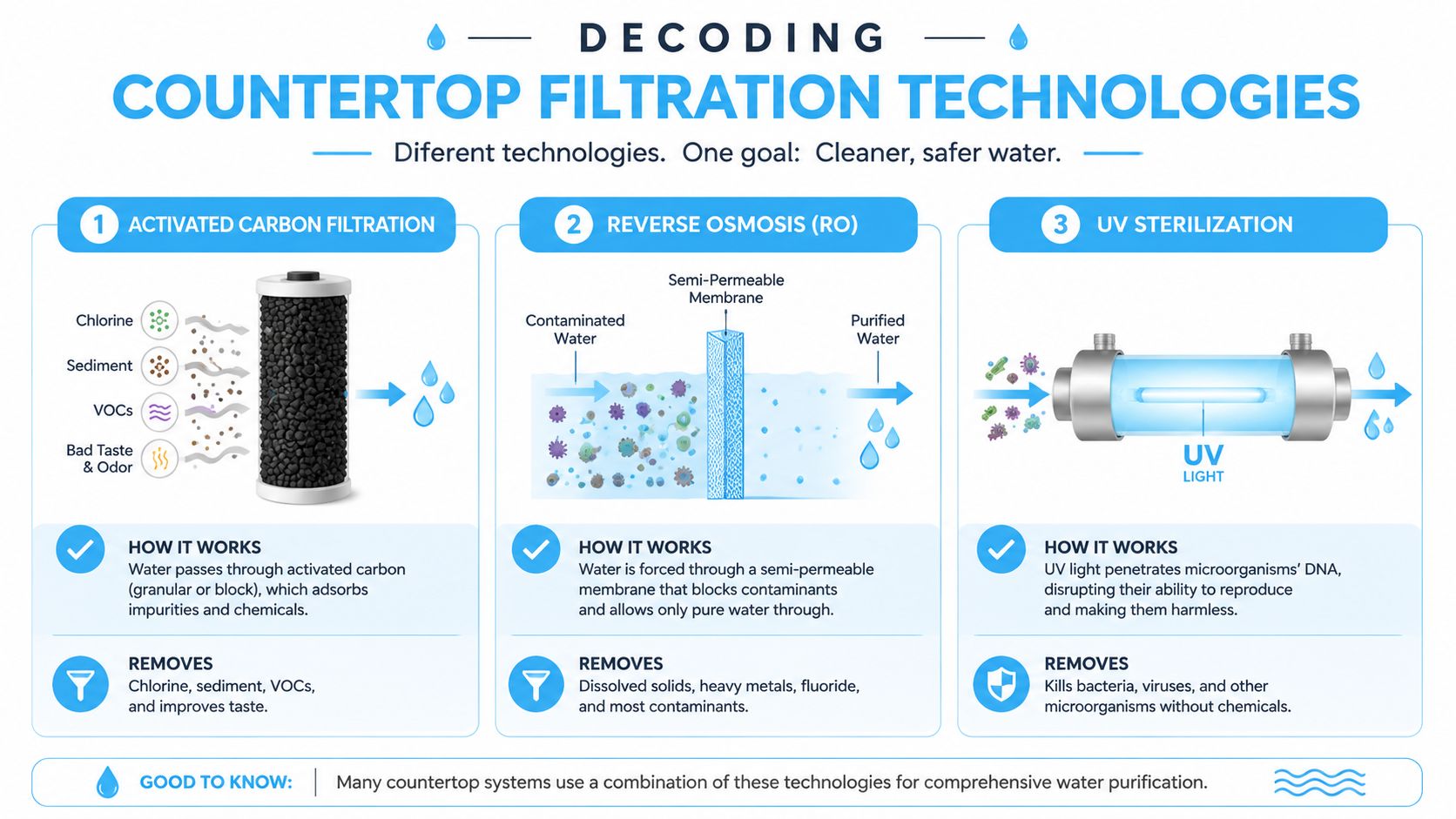
Activated carbon is the workhorse in countertop filtration. According to Consumer Reports' summary of countertop filter technology, activated carbon-block technology, the primary filtration method in all tested countertop water filters, uses black granular activated carbon to pull solid and gas contaminants from water flow, reducing chlorine, sediment, off tastes, odors, and sometimes lead, solvents, and pesticides.
In plain English, carbon acts like a contaminant trap. It's especially good for making municipal water more pleasant to drink. If your tap water smells like a pool or leaves a chemical aftertaste in coffee, carbon is often the first thing that helps.
What it doesn't do well is solve every water problem. Carbon is strong for taste-driven complaints and some health-related contaminants, but performance depends heavily on cartridge design, contact time, and certification. One carbon filter can be solid for chlorine and weak for broader reduction claims. Another can be much better. You have to read past the headline.
Reverse osmosis systems
Reverse osmosis is the heavy-duty option in this category. It pushes water through a semipermeable membrane that removes dissolved solids, heavy metals, and many contaminants that simpler filters can't tackle as effectively.
The trade-off is mechanical complexity. RO systems are usually slower, they need more filter stages, and they produce reject water. The best measured efficiency among lab-tested countertop RO systems noted the AquaTru Carafe at a 4:1 pure-to-waste ratio, meaning 4 gallons of purified water for every 1 gallon wasted, according to testing cited in this countertop dispenser review. That's a strong result for countertop RO, but it still reminds you that high-performance purification comes with operational trade-offs.
For households concerned about PFAS, dissolved solids, or a wider contaminant profile, RO is usually where I tell them to start looking.
Before comparing specific models, this walkthrough gives a useful visual overview:
Gravity-fed and UV-assisted designs
Gravity-fed systems work by letting water move through filter media without pumps or pressure. Their appeal is obvious. They're simple, quiet, and often don't need electricity. That makes them attractive for backup use, cabins, or families who hate appliance complexity.
But gravity systems are usually slower, and they don't automatically compete with RO on dissolved contaminant removal. They're best when simplicity matters more than speed or advanced purification.
UV is different. UV doesn't filter particles out of water. It targets microorganisms by exposing water to ultraviolet light. In countertop dispensers, UV is best thought of as an added treatment layer, not a replacement for solid filtration. If a unit advertises UV, ask what the core filtration media does first. UV can be a useful bonus. It isn't a complete answer by itself.
Practical rule: Choose carbon for better-tasting city water, RO for the toughest contaminant concerns, and gravity when reliability and no-power operation matter most.
Essential Features and Performance Factors to Consider
A dispenser can filter well and still be annoying to live with. A proper test happens on a busy weekday morning when someone wants cold water, someone else is filling a bottle, and the unit is humming on the counter next to the coffee maker.
Certifications and what they actually tell you
The certification marks matter because they separate broad promises from defined test standards. Top countertop dispensers are commonly judged against NSF/ANSI 53 and 42, alongside performance factors like temperature stability and noise, according to this technical market guide for water dispensers. In practical terms, many shoppers use NSF/ANSI 42 to think about aesthetic issues like chlorine taste and odor, while NSF/ANSI 53 is more relevant when health-effect contaminant reduction is part of the buying decision.
Certification is where I start. Everything else comes after.
Noise, energy, and long-term livability
Powered countertop dispensers can be wonderfully convenient, but they're still appliances. Some make enough noise to irritate you in an open kitchen. In the same technical guide, the ClearJet Compact+ (Countertop) is listed at 32 dB, while annual energy use across the market ranges from 0 kWh for the EverClear EcoFlow S to 264 kWh for the AquaGuard Freestanding Elite. That range tells you how wide the gap can be between a passive system and a feature-heavy unit.
A few performance details are worth watching closely:
- Temperature consistency: Leading models are evaluated for stability within +/- 1.2°F, which matters if you want dependable hot or cold dispensing.
- Filter replacement burden: The same guide notes a $89 to $215 range in 3-year filter costs, with the AquaPure ProTemp 3200 at $114 over 3 years and 128 kWh annually.
- Reliability testing: A benchmark of 1,000 continuous operating hours is used for stronger models to verify long-term consistency.
Size and routine use
Capacity, refill frequency, and dispenser height matter more than shoppers expect. A compact unit that fits under cabinets can still be frustrating if it can't handle family bottle refills without constant attention.
If you're comparing models and need a broader framework for evaluating certifications, maintenance, and use cases, Water Filter Advisor's advice library is a practical reference point.
Buy for your busiest day, not your quietest day. A dispenser that feels adequate for one glass can feel undersized by dinner.
Best Picks for Every Home and Budget in 2026
The best countertop water dispenser depends on what problem you're solving. I'd rather match a product to a household than declare one universal winner.
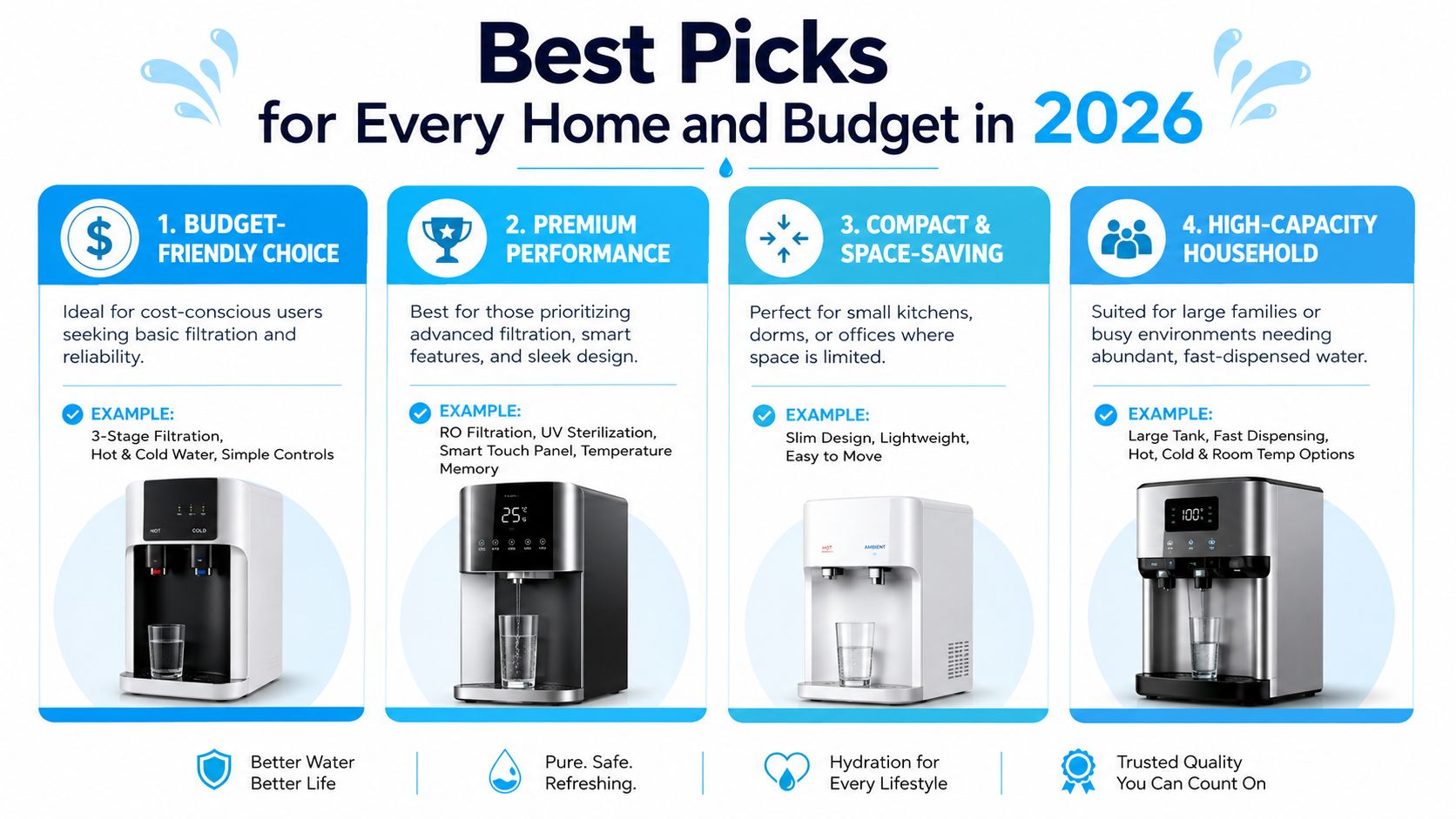
| Household need | Recommended type or model | Why it stands out | Main caution |
|---|---|---|---|
| Maximum contaminant reduction | AquaTru Carafe | Exceptional validated contaminant performance | Ongoing filter cost matters |
| Simple daily use | Gravity-fed countertop system | Quiet, low-tech, dependable | Slower and less comprehensive |
| Small kitchens | Compact carbon-based dispenser | Better fit and easier placement | Check cartridge performance carefully |
| Budget-focused homes | Basic certified carbon system | Lower entry cost and easy routine use | Don't expect RO-level purification |
Best for maximum contaminant removal
If your priority is health-focused performance, AquaTru Carafe is the standout name in this category. Independent Tap Score analysis in lab testing of 9 countertop RO systems gave it a 9.57/10 score, and the testing reported 100% removal of every health-related contaminant in baseline samples along with performance certification for all 83 of its claimed reduction metrics, as detailed in Water Filter Guru's countertop RO testing.
That's a rare result. It's the kind of performance benchmark that separates serious purification from “good enough for taste.”
For buyers worried about what they can't see, AquaTru Carafe is the strongest evidence-backed countertop pick in this group.
Pros
- Broad contaminant reduction validated by lab testing
- Countertop format avoids under-sink installation
- Strong fit for households prioritizing water quality over gadget appeal
Cons
- RO ownership costs are higher
- Slower and more involved than a simple carbon system
- More system complexity than many families need
Who this is for
Families concerned about a wide contaminant spectrum, including households that want stronger reassurance than basic chlorine and lead reduction.
Best for PFAS-focused shoppers
PFAS has pushed a lot of families to look beyond generic certifications. That's wise. Many countertop units can claim solid chlorine and lead performance while saying much less about emerging contaminants.
According to Quality Water Lab's countertop review, only the AquaTru Carafe is IAPMO-certified to eliminate 84 contaminants including PFOA and PFOS, while many competitors only meet NSF/ANSI 42 and 53 for chlorine and lead. If PFAS is your top concern, that distinction matters more than countertop aesthetics or touch controls.
Why I'd separate this category from the one above: a system can be generally strong and still not be the one I'd point to first for PFAS-focused buying. Here, the documented certification angle is the key advantage.
Best for simplicity and reliability
A gravity-fed countertop system isn't glamorous, but there's a reason many households stay loyal to this format. There's less to break, less noise, and usually less frustration. If you value predictable operation over fast dispensing or advanced temperature features, this style has a lot going for it.
What works well:
- No dependence on powered cooling or heating: Fewer appliance-like failure points.
- Straightforward maintenance: Cartridge changes and cleaning are usually easier to understand.
- Flexible placement: Good for rentals, backup use, or kitchens where outlet space is limited.
What doesn't:
- You wait longer
- You refill more often
- You won't usually get the broad contaminant coverage of top RO systems
This is also the category I suggest for people trying to solve coffee and water issues together in one kitchen setup. Taste improvement often changes tea, coffee, and drinking water all at once, and simpler countertop systems can be a sensible entry point if your goal is better flavor with minimal fuss.
Best for small kitchens
Small kitchens punish oversized appliances. A compact carbon-based countertop dispenser often makes the most sense here because it keeps the footprint manageable and the user experience simple.
The catch is that “compact” shouldn't become an excuse for weak filter performance. In tiny kitchens, buyers tend to overvalue dimensions and undervalue cartridge capability. That's backwards. I'd rather see a slightly larger unit with stronger certified reduction than a sleek cube that mostly improves taste and leaves bigger questions unanswered.
Counter space is expensive. Don't spend it on a dispenser that only looks efficient.
Who this is for
Apartment dwellers, condo owners, dorm users, and anyone working with low cabinet clearance or a crowded prep area.
Best budget-friendly option
A basic certified carbon system is still a smart buy for the right home. If your water is municipally treated, your main complaints are chlorine smell and unpleasant taste, and you want a lower-cost entry into filtration, this category can be very satisfying.
The mistake is assuming “budget” means “best value.” Sometimes it does. Sometimes it means a cheaper unit that burns you later with inconvenient cartridge changes or disappointing contaminant coverage. Budget buys work best when your expectations are realistic and your water concerns are modest.
Calculating the True Cost of Clean Water
Sticker price tricks people. A countertop dispenser can look affordable on day one and become expensive by the end of the first year.
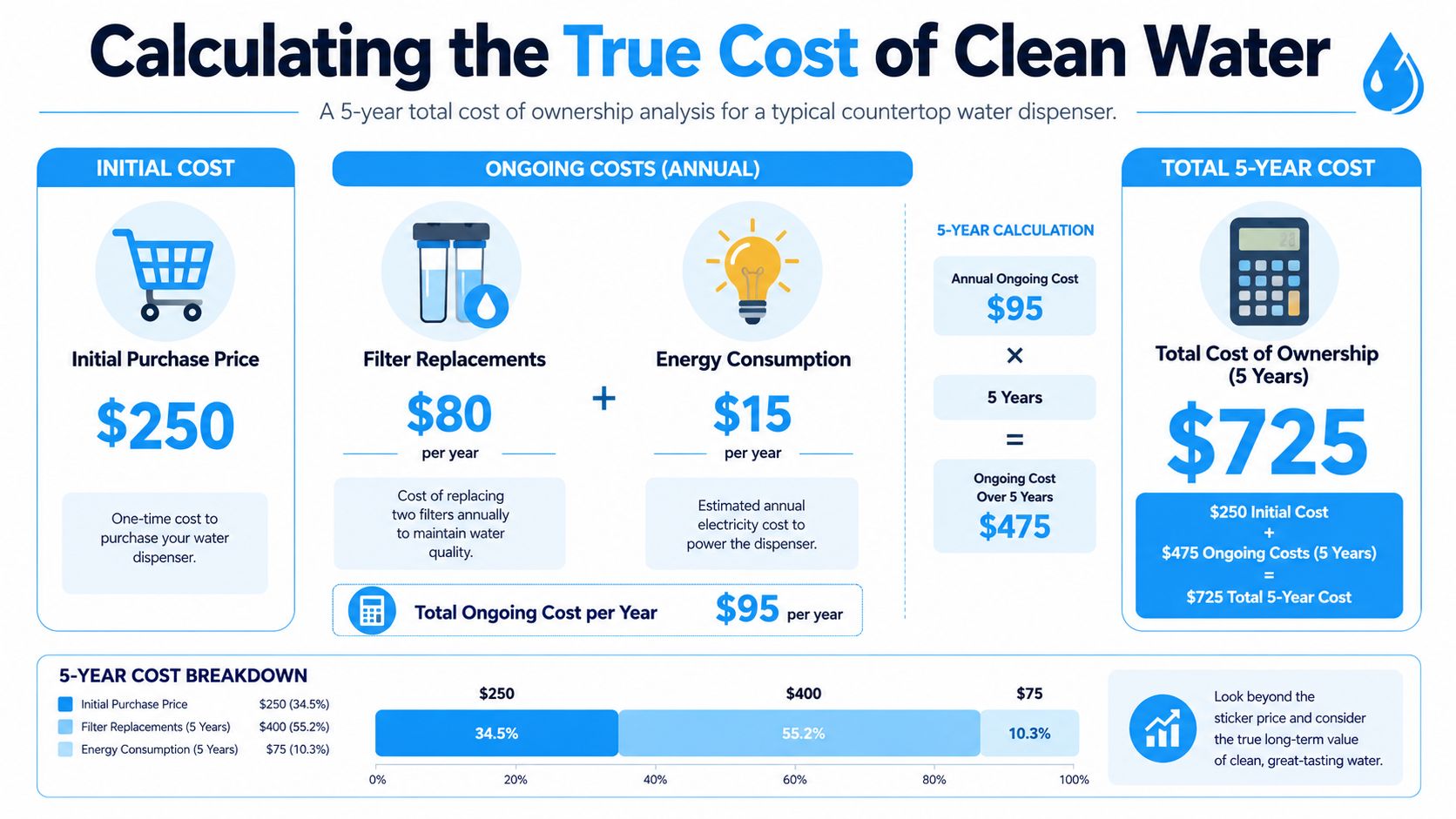
That's especially true with RO systems. CNET's review of countertop water filters notes that AquaTru Carafe costs $375 and that replacement filters can exceed $100 annually. That doesn't make it a bad buy. It means you should judge it like an appliance with recurring operating costs, not like a one-time kitchen accessory.
The three costs that matter
When I evaluate a countertop unit, I separate ownership into three buckets:
Purchase price
This gets the most attention and often deserves the least.Replacement filters
Regarding these components, cheap-looking systems can become expensive, and premium systems can justify themselves.Energy use
Powered heating and cooling add convenience, but they can also add ongoing cost and noise.
A simple way to think about it is this. If a family buys for taste improvement only, a basic carbon unit may deliver a lower long-term burden. If a family needs stronger contaminant reduction, a more expensive RO unit may still be the better value because it solves the actual problem instead of the superficial one.
What good value actually looks like
Good value isn't the lowest upfront number. It's the lowest cost for the level of protection and convenience you need.
Use this quick screen when comparing options:
- Ask what the filters cost over time: Not just the first replacement set.
- Check whether the unit needs electricity: Especially if it offers heating or chilling.
- Match the system to your risk level: Paying more makes sense if the water concern is serious.
- Avoid false economy: A cheaper unit that doesn't address your priority contaminant is wasted money.
Regional water conditions can change the math, especially if you're comparing point-of-use filters against larger home upgrades. For households thinking more broadly, this water filtration guide for Northern Colorado homeowners is a useful example of how local conditions affect system choice and budgeting.
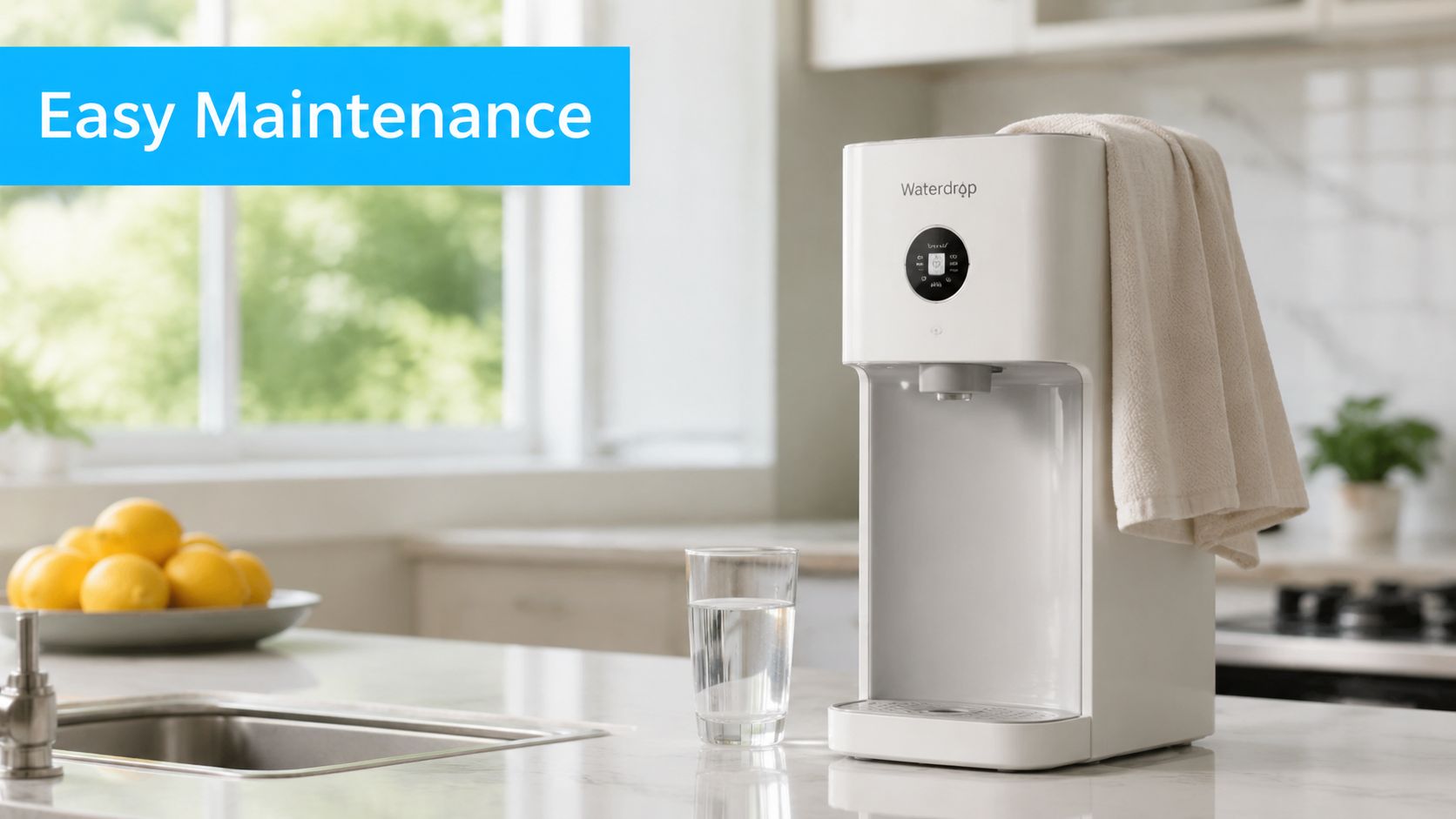
Simple Maintenance for Lasting Performance
A countertop dispenser only stays trustworthy if you maintain it. Neglected units can develop odor, scale, slime around dispensing points, and performance drop-off that people wrongly blame on the filter brand.
A maintenance routine that actually works
- Change filters on time: Don't stretch cartridges just because water still comes out. Delayed changes can reduce performance and worsen taste.
- Wash reservoirs and carafes regularly: Use the manufacturer's approved cleaning method and rinse thoroughly so you don't leave residue behind.
- Clean the spout area: This is one of the easiest places for buildup to form because hands, cups, and kitchen air all meet there.
- Descale heated systems when needed: Hard water can punish hot-water functions fast. If your dispenser heats water, scale control matters.
- Use fresh feed water: Don't leave stagnant source water sitting for long periods before filtration.
Mistakes I see often
Some owners replace the filter and forget the rest of the machine. Others clean the tank but ignore seals, lids, and drip trays. Both shortcuts come back to bite.
A clean filter in a dirty dispenser still gives you a dirty user experience.
The best habit is simple. Put maintenance on a calendar. Countertop systems don't need constant attention, but they do need consistent attention. A few minutes of care protects taste, flow, and confidence in what you're drinking.
Frequently Asked Questions
Do countertop dispensers chill the water
Some do, some don't. Chilling is a feature, not a default. If cold water matters in your home, verify that the unit actively cools rather than storing room-temperature filtered water.
Can I use well water with these systems
Sometimes, but you should be careful. Well water quality varies too much for blanket advice. Test the water first, then choose a system based on the actual contaminants present. A countertop dispenser can help, but it shouldn't be your first guess.
How do I know when to change the filter
Follow the manufacturer's schedule first. If the unit has an indicator, use it as a reminder, not an excuse to ignore taste changes, slow flow, or odor. Those are practical warning signs too.
Do these systems remove healthy minerals
Some do, especially RO systems. Whether that matters depends on your priorities and diet. For many buyers, contaminant reduction is the bigger concern. For others, mineral retention affects taste preference more than health concerns.
Will a countertop unit damage my counters
Usually no, if you manage drips, spills, and heat correctly. If your dispenser sits on quartz, these tips for protecting quartz counters are worth a look so the appliance doesn't leave stains, moisture issues, or heat marks over time.
If you're narrowing down the best countertop water dispenser for your home, Water Filter Advisor is a strong next stop for practical buying guides, filter comparisons, and maintenance advice that helps you choose a system you'll still be happy with long after installation day.
- July 18, 2026
- Uncategorized
