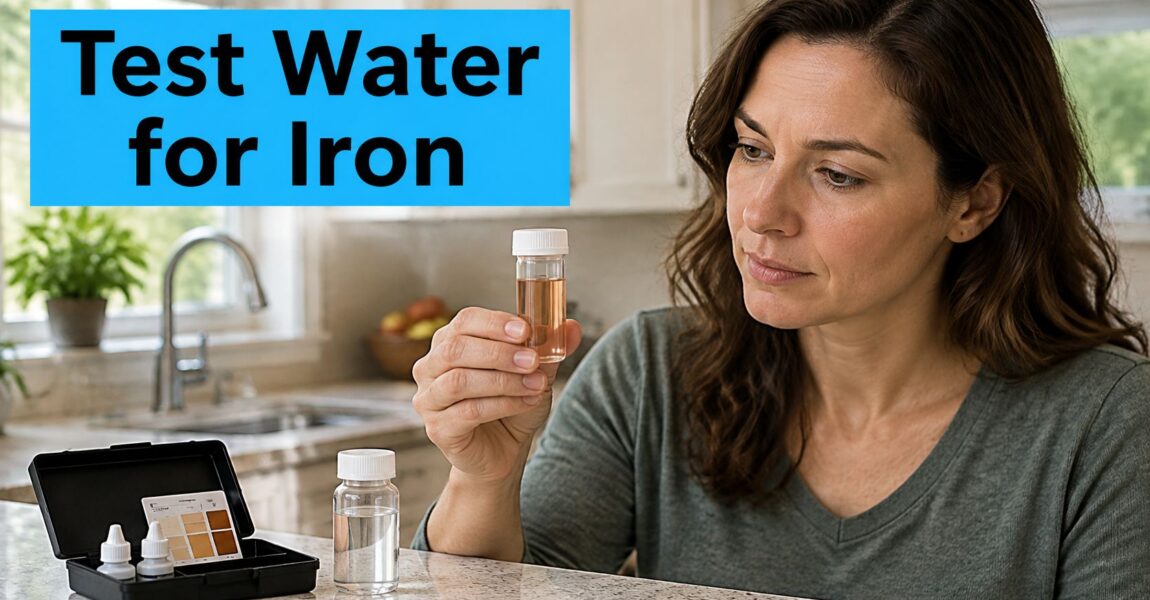
Your laundry comes out with orange marks, the toilet bowl keeps developing a rusty ring, and the filter cartridge looks filthy even though the water in your glass is clear. You buy an iron kit, get a low reading, and wonder whether you tested the wrong thing. You might have.
Knowing how to test water for iron starts with choosing what to measure, not just matching a color to a chart. For home filtration, the useful question is whether iron arrives dissolved in the water, already suspended as rust particles, or in a mixture that changes before you finish testing.
Iron Test Options Compared at a Glance
A useful iron test distinguishes dissolved iron, measured after filtering the sample, from total iron, which includes dissolved material and suspended or precipitated particles. That distinction matters when you're deciding whether a sediment cartridge can help or whether the water needs treatment before particle filtration.
Colorimetric tests use a chemical reaction to create a measurable color. Many methods first convert iron to ferrous iron, Fe(II), then react it with 1,10-phenanthroline to produce an orange complex. A ferrous-only field kit omits the broader conversion needed to measure other forms, so don't assume every orange-color test measures total iron.
Iron test options and what each one measures
The Merck technical guide to sensitive iron determination describes laboratory photometric measurement to approximately 0.01 mg/L, specialist triazine quantification to 0.0025 mg/L, and more sensitive alternatives. The comparison below separates those laboratory options from a field comparator's practical screening capability.
| Test option | What it measures | Lowest reliable reading | Best for |
|---|---|---|---|
| Field phenanthroline ampoule or comparator kit | Ferrous iron, Fe(II) only | About 0.1 mg/L in the USGS field procedure described below | Quick screening of a clean-looking tap or well |
| Laboratory colorimetry, preserved sample | Total or dissolved iron, according to filtration and preservation | Approximately 0.01 mg/L | Confirming a result before choosing a filter |
| Laboratory flame AAS or ICP-OES | Total iron at low concentrations with appropriate preparation | Use the laboratory's method-specific reporting limit | Near-threshold results and laboratory total-metals analysis |
| Specialist triazine photometric method | Iron after nitric acid preservation | 0.0025 mg/L as reported in one application | Trace-level checks by specialist laboratories |
AAS means atomic absorption spectroscopy. ICP-OES means inductively coupled plasma optical-emission spectrometry. Both are laboratory instruments, not equipment you need beside the kitchen sink.
Choose for the decision you're making
Use a field kit when you want a quick indication of ferrous iron in clean-looking water. Its advantages are convenience and immediate testing; its limitation is that it answers a narrower question than a properly prepared total-iron analysis.
Before buying whole-house equipment, request total and dissolved iron together. That pairing is more useful than paying for extreme trace sensitivity without knowing which iron forms are loading your filter.
Practical rule: When water contains sediment, a reading approaches a decision threshold, or you're checking treatment performance, choose laboratory confirmation over a broad color band.
Collect and Run an Iron Test Step by Step
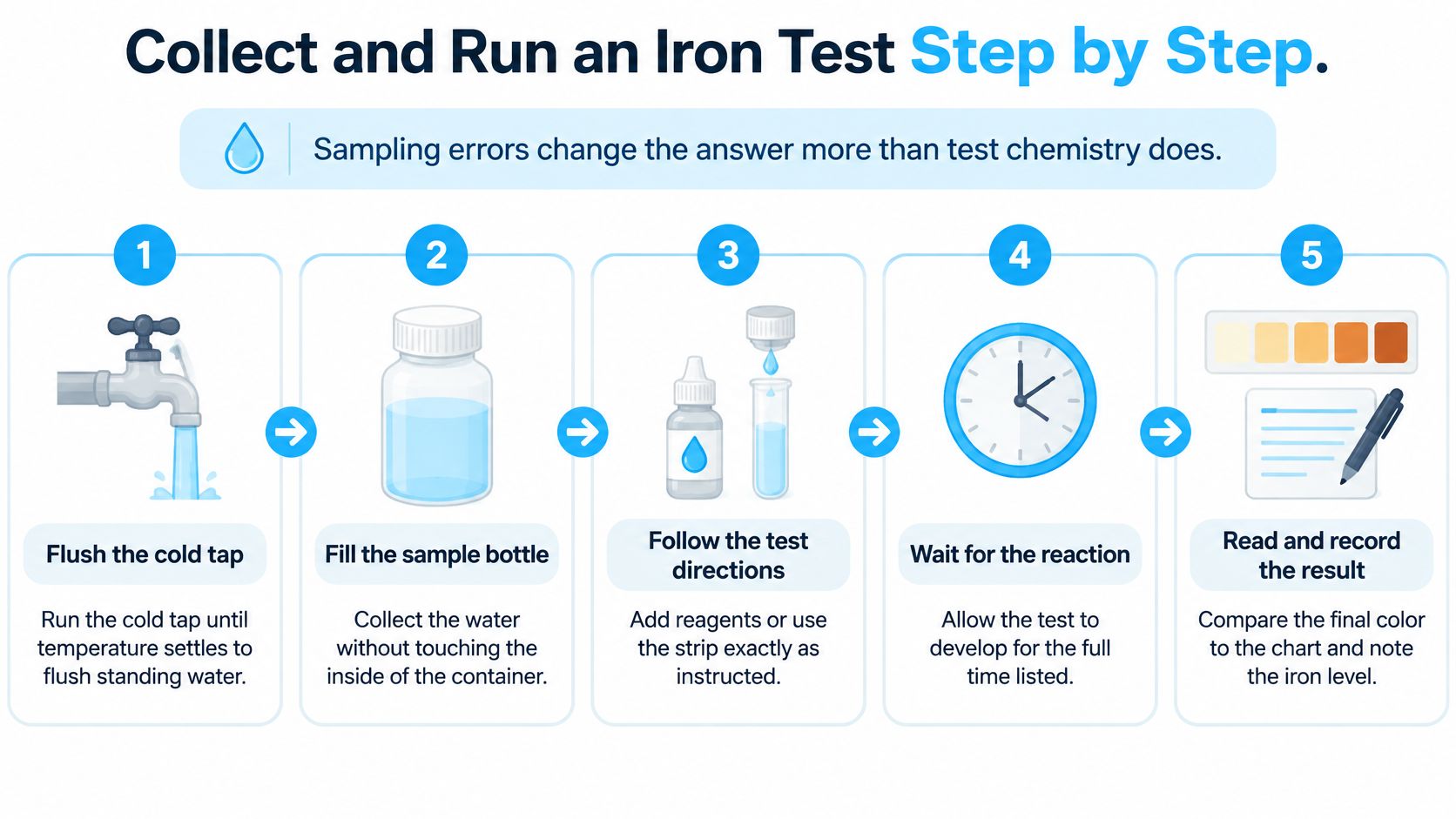
Sampling mistakes can change the answer more than the test chemistry does. A perfect color comparison won't rescue water collected in a rusty container or left sitting while its iron changes form.
Arrange laboratory bottles and preservation instructions before collecting anything. Nitric acid preservation isn't a kitchen-counter improvisation. Use laboratory-supplied materials and handling directions, or have a trained sampler prepare the samples.
Collect samples that answer the right question
The USGS iron sampling and analysis procedure specifies immediate filtration through a 0.45 µm membrane for dissolved iron and preservation with ultrapure nitric acid to pH below 2. It also explains why ferrous iron needs a separate, promptly analyzed portion rather than relying on a preserved metals bottle.
Choose and label the sampling locations. Collect from the untreated well or incoming line and from an indoor cold-water tap. Mark whether each location is before or after existing filtration. Don't compare an untreated sample with a treated sample without recording that difference.
Flush for a representative source sample. Run the cold tap until its temperature settles and field conditions stabilize. This clears standing water. If you're investigating plumbing corrosion, arrange a separate first-draw tap sample with the laboratory rather than flushing away the evidence you want to measure.
Fill a clean, metal-free container. Don't touch the bottle's interior or cap lining. Avoid disturbing settled material around the collection point. However, don't let a collected total-iron sample settle and then pour only the clear top into another bottle.
Separate the dissolved-iron portion immediately. Use the membrane specification above and laboratory-approved equipment. This removes particles before preservation, allowing the laboratory to distinguish the filtered fraction from the total sample.
Preserve and chill the laboratory samples. Follow the laboratory's acidification procedure for each bottle. Keep samples chilled and arrange prompt delivery using its shipping instructions. Don't rinse a bottle that already contains preservative.
Test ferrous iron separately and promptly. An aliquot is a separate portion of the same sample. Keep this portion available for immediate field testing because exposure to air can convert ferrous iron to ferric iron before analysis.
Write down the handling history. Record location, collection time, filtration, preservation, cooling, and testing time. Include whether treatment equipment was operating normally and whether you noticed discoloration or sediment.
Run the field kit without changing the sample
The USGS ferrous-iron field methodHach_M.pdf) describes collecting at least 40 mL, reserving at least 10 mL of the same water for a zeroing vial, and a field determination limit of about 0.1 ppm, equivalent to 0.1 mg/L. Those volumes belong to that procedure, so use your kit's exact requirements if its design differs.
Set out the comparator, ampoule, timer, clean vessel, and recording sheet before opening the sample. Fill the blank or zeroing vial first. This gives the instrument or comparator a reference for the water's original appearance.
Add the sample to the phenanthroline ampoule as directed, mix rapidly, and allow the full specified reaction time. Compare the developed orange color against the standards under the kit's recommended viewing conditions. Record the result and the kit's measurement range, not just a description such as pale orange.
If the result reaches the upper end of the scale, don't estimate beyond it. Dilute only with metal-free water and apply the dilution factor if the method permits, or send a sample to the laboratory.
A preserved total-metals bottle doesn't reliably retain the original ferrous-to-ferric balance. Keep the total-iron investigation and the immediate ferrous test separate.
Rusty containers can add iron. Delays and sunlight can change it. Use opaque containers and cooling where the method calls for them, and never interpret an undeveloped ferrous test as proof that total iron is low.
Reading Iron Results Against the 0.3 mg/L Limit
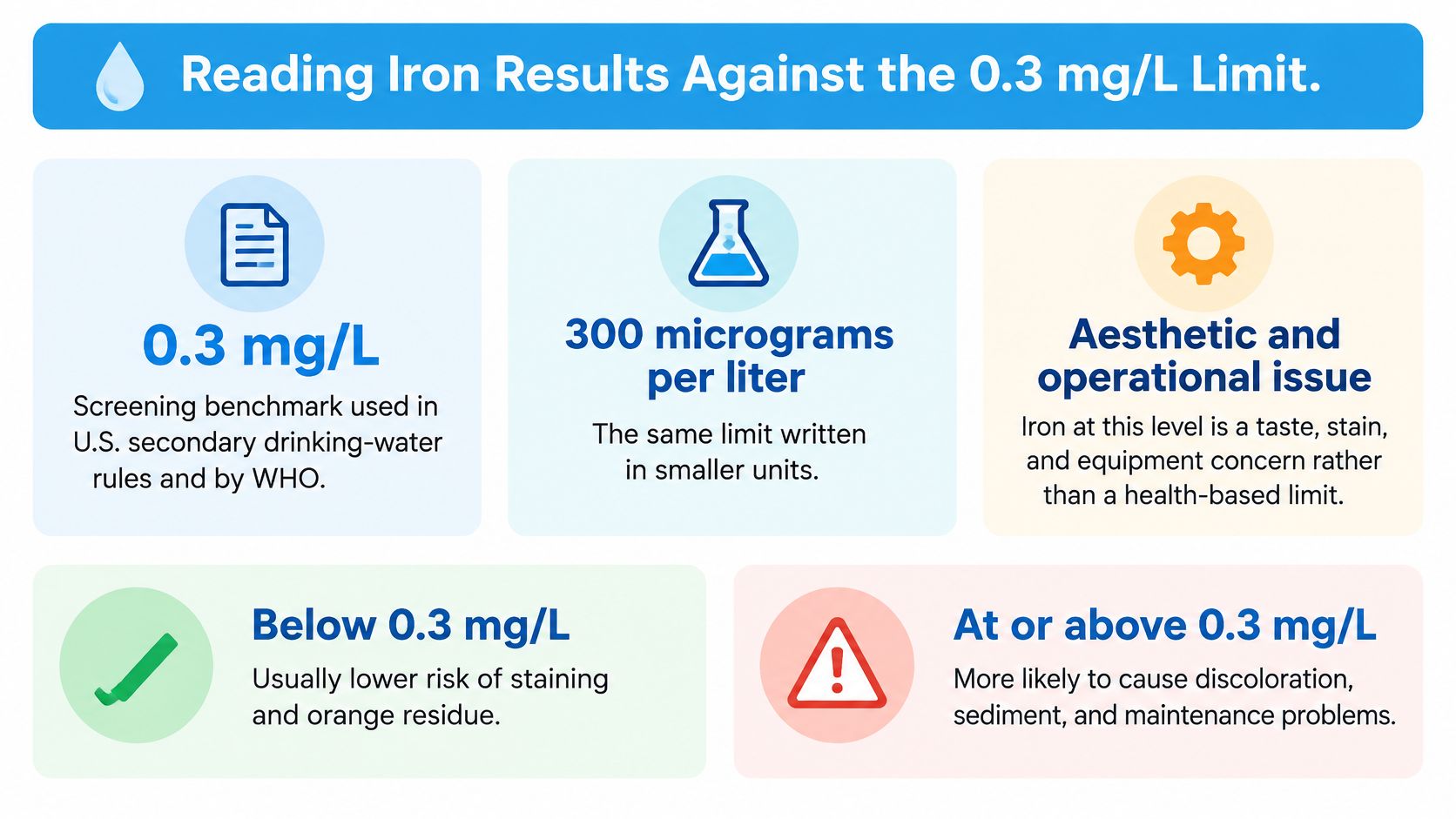
0.3 mg/L, or 300 micrograms per liter, is the commonly used iron screening benchmark: the World Health Organization drinking-water guidance describes staining above that concentration and notes that noticeable taste is usually absent below it, although color or turbidity can still occur.
The EPA secondary drinking-water standards also list iron at 0.3 mg/L as a non-enforceable federal aesthetic guideline. This is a household staining and maintenance benchmark, not a health-based dividing line between safe and unsafe water. An iron result alone doesn't establish overall drinking-water safety.
Iron result ranges and the next step for each
Use these ranges as practical decision bands, not guarantees that a particular household will or won't develop stains. A low field reading deserves less confidence when the sample sat before testing or the kit measured only ferrous iron.
| Result or condition | What it usually means | Next step |
|---|---|---|
| Under 0.1 mg/L | Below the practical field comparator floor described above; iron staining is less likely if representative laboratory testing confirms it | Retest after plumbing changes or if staining starts |
| 0.1 to 0.3 mg/L | At or below the aesthetic benchmark; taste is usually unaffected | Monitor laundry and fixtures; compare source and tap samples |
| Over 0.3 mg/L | Above the benchmark; staining and sediment are concerns | Obtain laboratory dissolved and total iron results before buying a filter |
| Clear water that later turns rusty | Consistent with dissolved ferrous iron oxidizing after exposure to air | Test Fe(II) promptly in the field and total iron in a laboratory |
Match the report to what happens at home
The most useful report includes a concentration, units, and a clear description of the analysis. A result marked below reporting limit means the method didn't quantify iron below its reporting capability. It doesn't mean the sample contains none.
For help distinguishing measured values from reporting limits and comparison standards, use our guide to how to read water test results. Keep the laboratory's sample descriptions beside the numbers when comparing untreated and treated water.
A high indoor-tap result doesn't automatically justify a larger source-water filter. If the incoming sample is lower, investigate household plumbing or accumulated deposits. For visibly rusty or sediment-laden water, identifying the form and origin of the iron matters more than arguing over a small numerical difference.
When a Clean Test Still Hides an Iron Problem
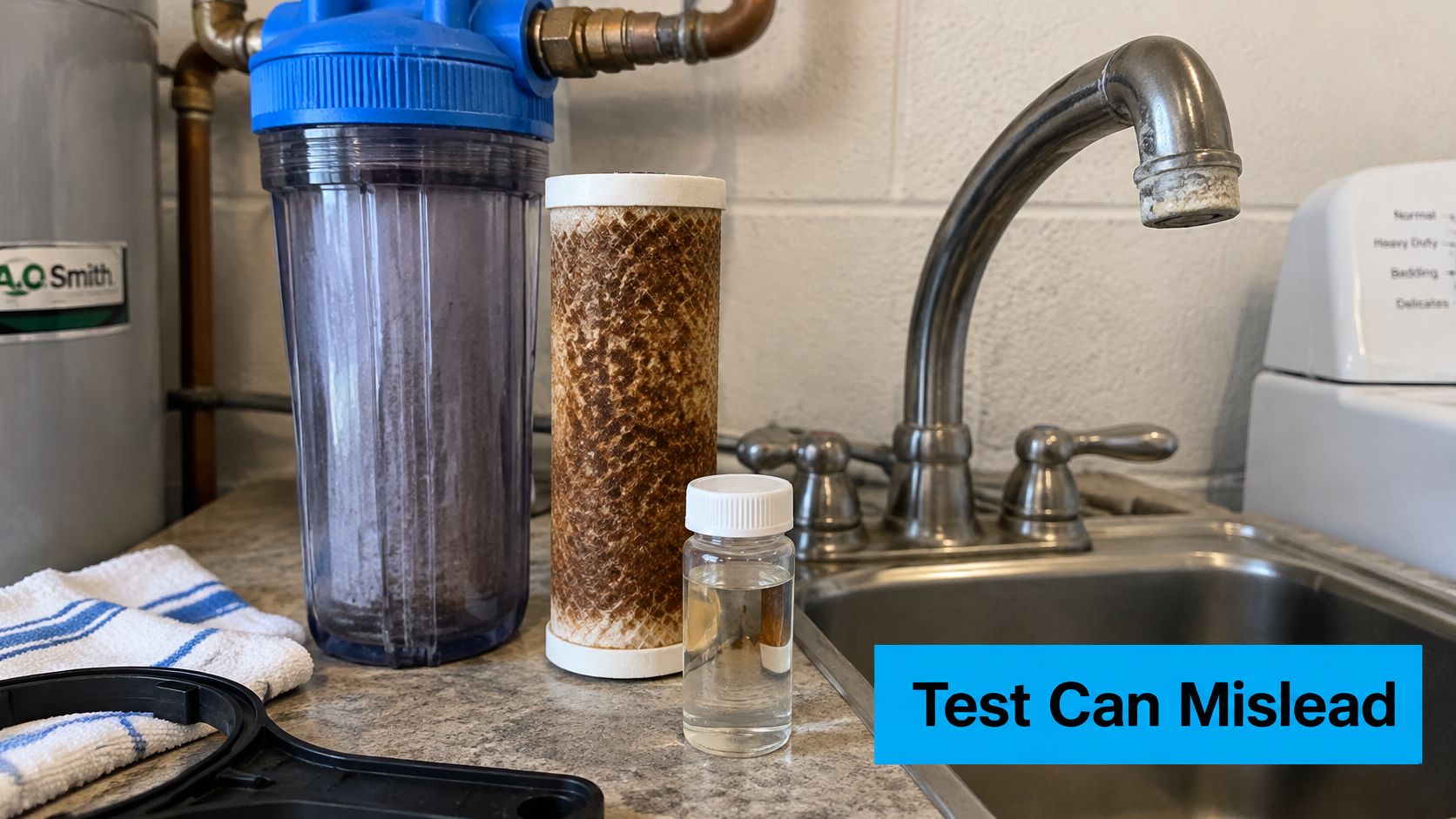
Say you're on a private well, the iron result looks modest, and you're replacing cartridges every few weeks. The water still smells unpleasant, or you find slippery orange deposits around plumbing. Another cartridge might catch more debris, but it won't tell you why that debris keeps arriving.
A concentration result measures water chemistry. It doesn't establish whether the well has biological fouling, accumulated deposits, or a combination of problems.
Separate filter loading from well fouling
A USGS investigation of iron-related well-screen encrustation found that iron bacteria can contribute to encrustation and biofouling. It associated Gallionella ferruginea with low but detectable dissolved oxygen and high dissolved iron. Biofouling means organisms and their deposits build up on surfaces, potentially obstructing well components before water reaches your household filter.
Ferrous iron can also indicate oxygen-poor, iron-reducing groundwater conditions. If hydrogen sulfide odor accompanies the problem, investigate sulfide alongside iron rather than assuming an iron-removal cartridge will address both.
Pair the iron investigation with:
- Sulfide testing, especially when odor accompanies staining or rapid filter plugging.
- Manganese and pH, to help evaluate the water chemistry before selecting treatment media.
- Dissolved oxygen or oxidation-reduction indicators, which help a professional interpret the conditions supporting the observed chemistry.
- A deposit inspection, looking for gelatinous orange or black material in accessible plumbing and filter housings.
Don't diagnose bacteria from a dirty cartridge
A rust-colored cartridge isn't a bacterial identification test. Neither is a clear sample bottle. Confirmation may require examining deposits, biofilm, or well components, rather than analyzing water alone.
Our guide to iron bacteria in well water explains why these deposits deserve a different investigation from ordinary dissolved-iron treatment.
Before replacing another cartridge: Find out whether you're capturing incoming particles or repeatedly collecting material from a fouled well or plumbing system.
Record how quickly filters plug, whether the problem changes seasonally, and where slime or odor appears. A qualified well contractor can use that history to assess whether inspection, rehabilitation, or a professionally planned disinfection treatment is appropriate. Filtration may still be needed, but it shouldn't substitute for addressing a persistent source of fouling.
Confirm Your Iron Numbers Before Buying a Filter
Move from screening to a certified laboratory report when the result approaches or exceeds the aesthetic benchmark, stains persist, or water arrives rusty. Buy equipment against a documented treatment problem, not against the darkest square on a strip.
The EPA's private-well guidance recommends iron testing when plumbing fixtures or laundry are stained and advises using laboratories certified for drinking-water analysis. Reports should give each substance's measured concentration and identify whether it exceeds a national primary or secondary drinking-water standard.
Turn the results into an equipment specification
A sediment cartridge captures particles; it isn't an all-purpose answer to dissolved iron. When comparing oxidation systems, catalytic media, or other iron-removal equipment, give the supplier the complete report and ask which measured conditions the proposed system addresses.
- Request paired total and dissolved iron analyses. Arrange separate prompt Fe(II) testing if staining or clogging remains unexplained. Confirm the bottle, filtration, and preservation requirements before sampling.
- Record collection conditions on the laboratory form. Identify source and tap locations, existing treatment stages, visible sediment, and sample handling.
- Keep the numerical report with your filter paperwork. Use the same sampling locations when checking whether the installed treatment performs as intended.
Keep specialist purification in perspective
If you're comparing household filtration with specialist equipment, the water purification options from Labs USA provide context for laboratory-focused systems. Those aren't automatically substitutes for whole-house iron treatment. Match the application and required water quality before comparing equipment.
This week, arrange the laboratory bottles and collect the source and indoor-tap samples using the correct handling procedure. That gives you a defensible starting point for choosing filtration instead of another round of cartridge roulette.
We link readers to home water test kits, and our Simple Water Test Kits section lets you browse the available options. Visit Water Filter Advisor to choose a suitable starting test, then use our Choosing a Water Filter guide to connect your confirmed iron results with the right filtration approach.
- November 12, 2026
- Uncategorized
