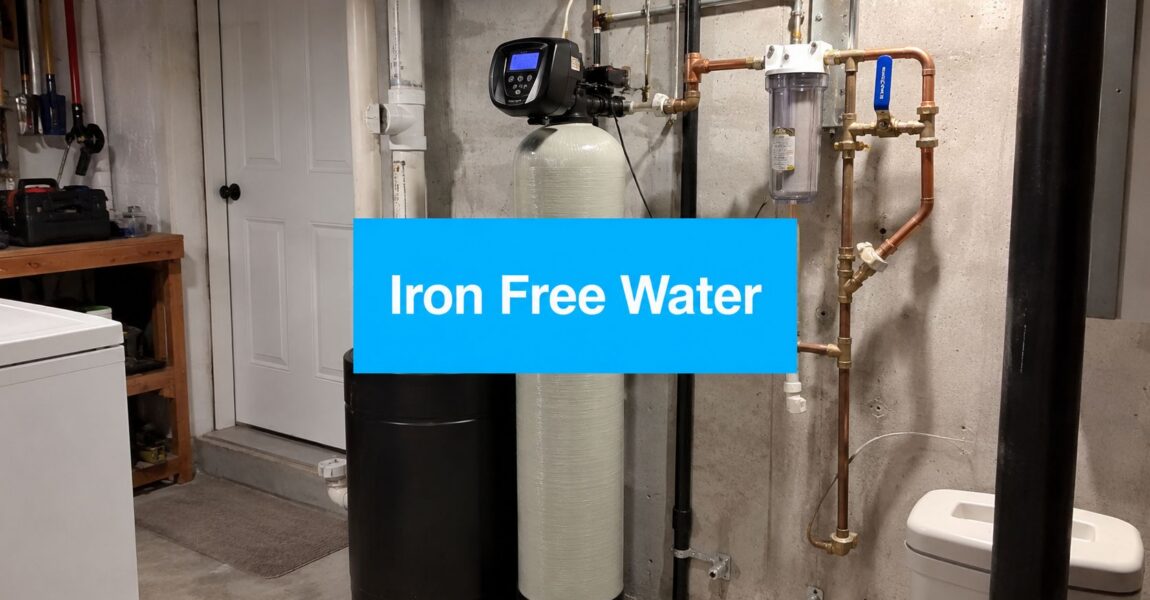
A whole house iron filter system sits on the main water line and treats water before it reaches showers, sinks, laundry equipment, and water heaters. That sounds straightforward until a system performs well on installation day, then starts sending orange water into the bathtub weeks later. The difference usually comes from three things working together, oxidation chemistry, filter media, and household operating conditions.
Iron treatment isn't just a matter of trapping “rust.” Dissolved ferrous iron may be invisible at the faucet, while ferric iron arrives as visible particles. Manganese, hydrogen sulfide, tannins, sediment, hardness, and iron bacteria can change which technology works and how much maintenance the equipment needs. The right system begins with a water report, not a product label.
The Morning Your Water Tells You Something Is Wrong
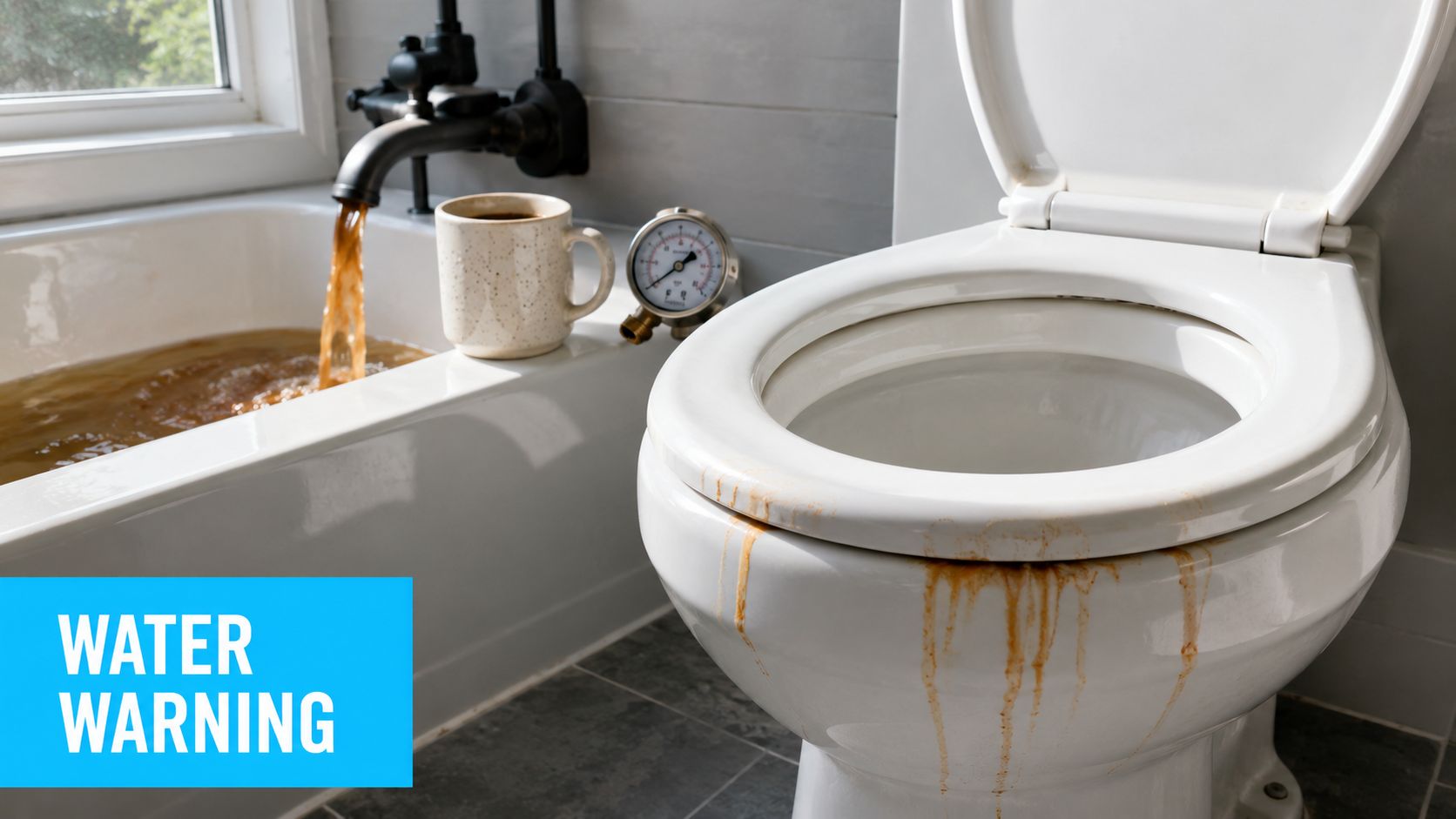
The first clue may appear before breakfast. An orange streak runs down the new toilet bowl. The bathtub tap releases brown water after the well pump cycles, and coffee has a faint metallic tang that wasn't there before. By laundry day, pale clothing carries rusty spots, the dishwasher leaves a dull film, and a thin rust ring has formed around the sink drain.
That household isn't dealing with a problem limited to appearance. Iron deposits can foul aerators, valves, appliances, and plumbing while changing water color, flavor, and odor. The World Health Organization's historical iron guidance explains that iron is mainly treated as an aesthetic concern, with visible staining becoming a practical issue above 0.3 mg/L. The same guidance says noticeable taste is usually absent below that level, while higher concentrations can stain laundry and plumbing fixtures.
Two forms of trouble at the tap
Clear-water iron often looks harmless when it leaves the faucet. It can remain dissolved until the water sits in a toilet, washing machine, glass, or sink and meets oxygen. Then it oxidizes and leaves the familiar orange or reddish-brown residue.
Red-water iron behaves differently. It has already oxidized before reaching the fixture, so the water may pour visibly yellow, orange, or brown. That particulate iron can lodge in faucet screens, toilet fill valves, and small passages before a homeowner sees the full extent of the problem.
Installer's observation: A clean-looking glass doesn't prove the water is iron-free. It may only mean the iron hasn't oxidized yet.
A proper diagnosis connects the stain to the chemistry underground and inside the pipes. Testing reveals whether the system needs oxidation, physical filtration, disinfection, pH correction, or a combination of treatments.
How Iron Gets Into Water and What It Does Inside Your Home
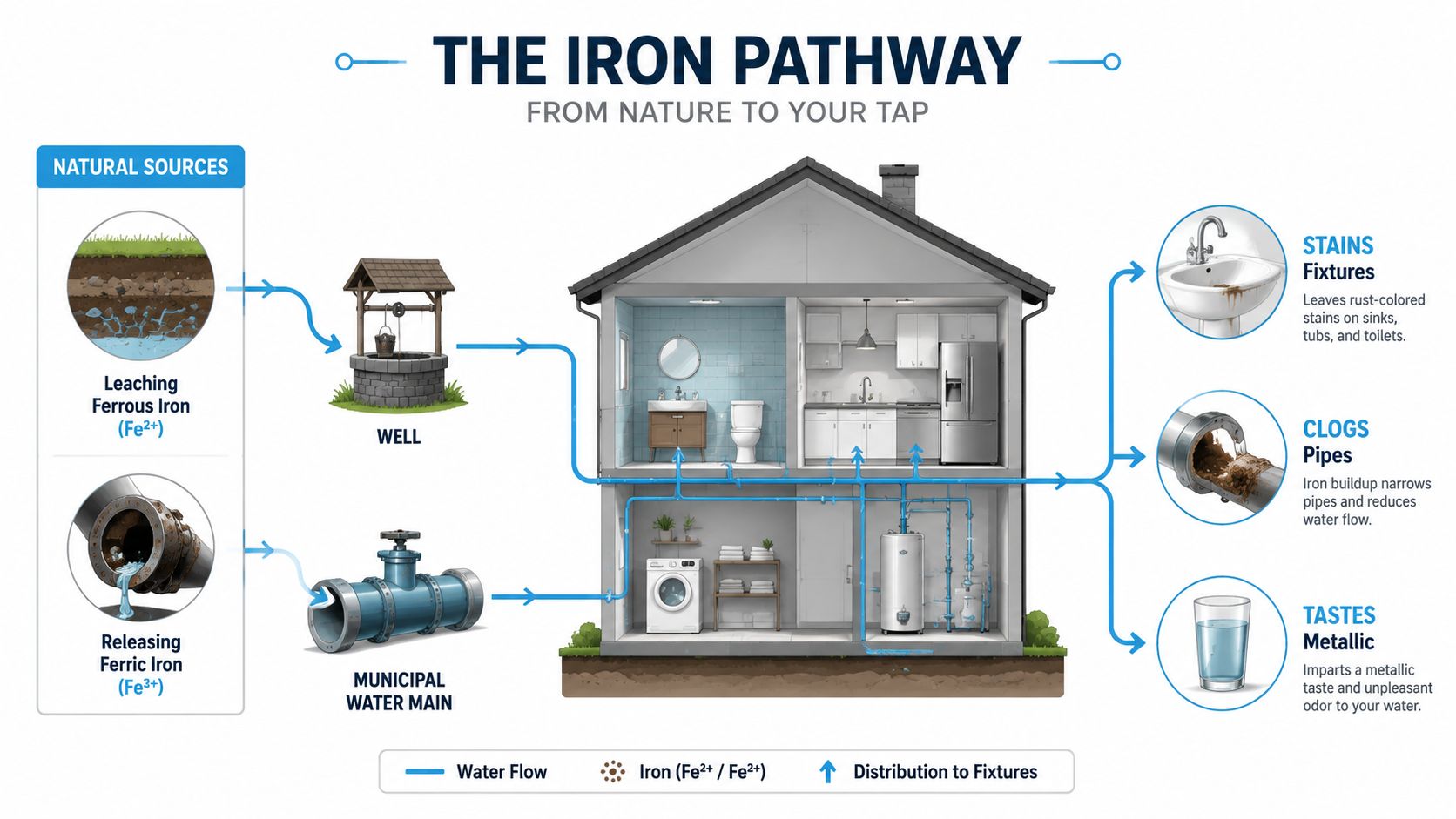
Groundwater often picks up iron as it moves through iron-bearing soil and rock. In private wells, low-oxygen conditions can keep iron dissolved as ferrous iron, Fe²⁺. Aging cast-iron mains, well components, or household plumbing can also release ferric iron, Fe³⁺, which is already oxidized and travels as particles.
The easiest analogy is sugar and sand. Ferrous iron behaves more like sugar dissolved in water. You can't remove it with a simple screen because there isn't a visible particle to catch. Ferric iron behaves more like sand in a glass. It can settle, clog, and collect in places where water slows down.
What happens after the water enters the house
Oxygen and chlorine can convert dissolved ferrous iron into insoluble ferric particles. Those particles may stain porcelain, collect in aerators, clog toilet valves, and build deposits around water-heater components. Clear water can therefore cause a delayed orange stain, while ferric water can create an immediate brown plume.
A basic inspection helps, but it can't replace laboratory testing:
- Observe the water immediately. Fill a clear glass and watch for color, cloudiness, or particles.
- Let a sample stand. Clear water that develops orange color points toward oxidation of dissolved iron.
- Use a screening strip or kit. This can flag iron, but it won't identify every related issue.
- Order a laboratory analysis. Ask for iron, pH, hardness, manganese, tannins, and other relevant well-water parameters.
A single iron number isn't enough to select media. Low pH can prevent some oxidation media from working correctly. Manganese may need a more demanding chemistry window. Tannins can consume oxidants and interfere with filtration. Hydrogen sulfide creates a rotten-egg odor that points to a gas problem, not merely more iron.
If hydrogen sulfide is part of the complaint, maintenance knowledge from practical gas monitor upkeep tips can also help homeowners understand why gas detection and treatment equipment require regular attention.
The Main Technologies Whole House Iron Filters Use
Iron-removal technologies don't compete in a universal ranking. Each one changes the water in a different way, and each has a failure point that appears when the chemistry falls outside its operating window.
Oxidizing media, including Birm and manganese greensand, converts or catalyzes dissolved iron so the resulting particles can be captured in the media bed. Greensand-style systems need periodic regeneration with an oxidant. Birm-style systems depend on pH and dissolved oxygen, and the Birm operating guidance specifies water free of oil and hydrogen sulfide, organic matter below about 4 to 5 ppm, dissolved oxygen at least 15% of the iron content, and pH of 6.8 or higher for iron removal.
Air-injection and aeration systems introduce air before filtration. The air supplies oxygen, allowing ferrous iron to form particles in a tank or contact space. These systems can reduce chemical handling, but they still need effective filtration and backwashing. Hydrogen sulfide, manganese, low pH, and limited contact time can push performance outside the practical window.
Chemical oxidation uses chlorine, potassium permanganate, or hydrogen peroxide to convert dissolved contaminants into filterable solids. It can be useful when iron bacteria, manganese, hydrogen sulfide, or heavier iron loading complicates air oxidation. The tradeoff is chemical storage, feed control, residual management, and possible damage when an oxidant is overfed.
Catalytic carbon is usually a polishing or dechlorination stage rather than a complete iron solution. It can help with taste, odor, and residual chlorine after oxidation, but iron particles can clog the bed. Homeowners comparing fine sediment stages can also review practical 0.22 micron filter tips to understand why pore size alone doesn't solve dissolved iron.
Salt-based softeners can exchange limited ferrous iron along with hardness. They aren't a dependable answer for substantial iron, ferric particles, iron bacteria, or water with conditions that foul resin. If iron reaches the softener first, resin can lose useful capacity and require more attention.
Phosphate and polyphosphate sequestrants hold iron in solution rather than remove it. That may reduce visible staining in some applications, but the iron remains in the water. Heat and changing chemistry can also weaken sequestration, especially around water heaters and hot-water fixtures.
| Technology | How It Treats Iron | Best Operating Window | Common Failure Mode |
|---|---|---|---|
| Birm-style media | Catalyzes oxidation and captures particles | Adequate oxygen, pH at or above the media requirement, low oil and sulfide | Iron passes through when oxygen or pH is inadequate |
| Manganese greensand | Oxidizes or adsorbs iron, then releases it during backwash and regeneration | Managed oxidant feed, suitable pH, controlled iron and manganese load | Media exhausts or regeneration is missed |
| Air injection | Adds oxygen before filtration | Dissolved ferrous iron with enough contact and a capable filter bed | Incomplete oxidation or fouled air components |
| Chemical oxidation | Converts dissolved contaminants into solids | Feed rate matched to iron, manganese, sulfide, and biology | Overfeed, underfeed, or residual chemical problems |
| Catalytic carbon | Polishes taste, odor, and some residuals | Downstream of suitable oxidation and sediment control | Clogging and premature exhaustion |
| Softener or sequestrant | Exchanges limited iron or keeps it dissolved | Low ferrous iron or nuisance-control applications | Resin fouling or iron remaining in the water |
How the System Actually Works Day to Day
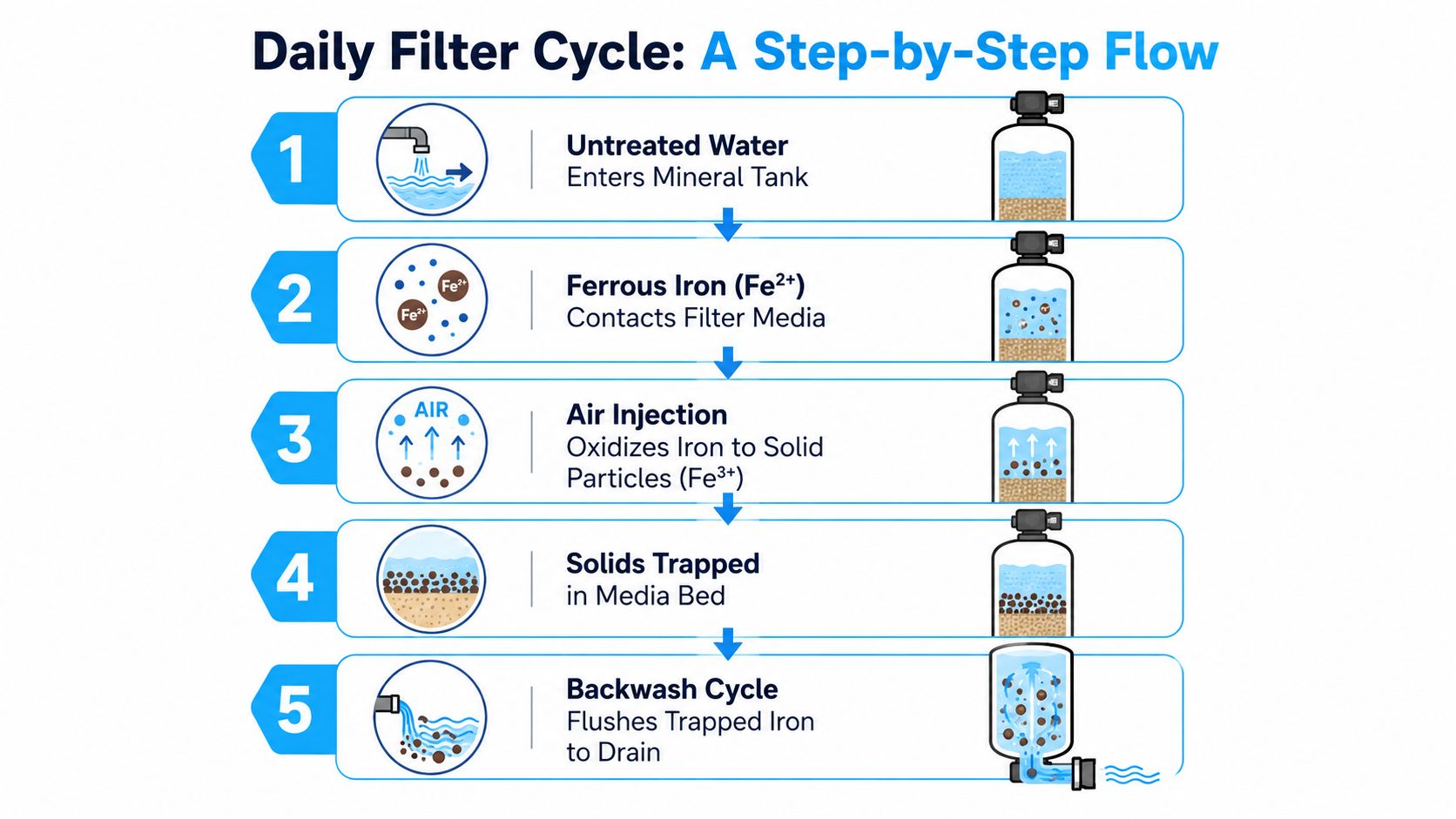
A backwashing iron filter is a working chemical process, not a passive tank of gravel. Untreated water enters the mineral tank, contacts the media, and undergoes oxidation. Ferrous iron becomes ferric particles, and the bed holds those solids until the control valve sends water upward through the tank and out to a drain.
The cleaning cycle
The exact sequence depends on the equipment, but the practical logic is consistent:
- Service: Water flows downward through the media and treated water leaves the tank.
- Backwash: Water flows upward, expands the bed, and carries trapped iron to the drain.
- Air or oxidant restoration: An air-injection or chemical stage restores the media's ability to oxidize iron.
- Rinse: The valve settles and clears the bed before normal service resumes.
One chemical-free iron-filter manual describes a four-step cycle, backwash, air draw, rapid rinse, and service, with backwash requiring at least 30 psi inlet pressure and the full cycle taking about 15 minutes. During backwash, the upward flow is the cleaning mechanism, not an optional accessory. The cited iron-filter manual provides those operating details.
Backwash flow matters because the bed must expand enough to release trapped solids. Too little flow leaves iron behind and creates channeling. Excessive flow can carry media toward the drain. The pump, drain line, control valve, and tank size must therefore work as one assembly.
A greensand-style unit may regenerate with potassium permanganate or chlorine. One technical sheet lists normal potassium permanganate use at about 1 to 2 ounces per cubic foot of media, with practical treatment limits of 15 ppm iron, 5 ppm manganese, and 2 ppm hydrogen sulfide for that system design. Those figures come from the greensand technical sheet, and they shouldn't be treated as universal ratings for every media bed.
Watch the drain during a cycle. Dark or orange water at the beginning, followed by clearer discharge, usually indicates that the bed is releasing captured material. A creeping pressure drop, weak flow, or recurring color after regeneration suggests the schedule, backwash rate, or chemistry needs attention.
Why Some Iron Filters Fail Before Their Time
Most early failures begin with a mismatch between the water report and the media's operating window. The tank may be sound, the valve may be functional, and the installation may look tidy, yet the system still can't oxidize or remove the contaminant load arriving at the inlet.
Birm illustrates the problem clearly. Low dissolved oxygen, unsuitable pH, oil, hydrogen sulfide, or organic matter can shut down the chemistry the media depends on. Greensand has a different vulnerability. It can work effectively when regeneration is controlled, but missed oxidant dosing, excess loading, or poor backwash leaves the bed progressively less capable.
Iron bacteria create a separate category of failure. Pentair installation guidance warns that iron bacteria can cause frequent service, shorten system life, and require chlorine or other bacterial control before filtration works properly. Slimy deposits can form mounds inside the tank and pipes, forcing water around the media instead of through it.
The costliest mistake is treating biology as if it were only chemistry.
A unit sized for a quiet household can also struggle in a busy home. If the control valve backwashes only by time, the system may receive more iron and manganese than the schedule accounts for. Irrigation, frequent laundry, and simultaneous showers add demand that a showroom demonstration doesn't reveal.
| Failure Cause | Water Chemistry Trigger | Symptom at Home |
|---|---|---|
| Incomplete oxidation | Low dissolved oxygen, unsuitable pH, or inadequate contact | Clear water turns orange after treatment |
| Media exhaustion | Heavy iron, manganese, sulfide, or organic loading | Staining returns before the next cycle |
| Iron bacteria | Slimy biological growth and deposits | Frequent service, odors, channeling, or pressure loss |
| Poor regeneration | Missed oxidant feed or insufficient backwash | Dark drain water and weak treated flow |
| Chemical overfeed | Excess chlorine or another oxidant | Media damage, taste, or residual chemical |
| Undersizing | Household or irrigation demand exceeds design | Pressure drop and early breakthrough |
The Health Canada technical document describes oxidation followed by filtration as a common groundwater approach and identifies point-of-entry oxidizing filters such as greensand at residential scale. The lesson is practical: choose the treatment sequence around the actual water chemistry, not the brand name printed on the tank.
Sizing a Whole House Iron Filter Without Buying the Wrong One
Sizing starts with two separate flow questions. Service flow is what the home needs while fixtures operate. Backwash flow is what the tank needs to clean itself. A filter can meet the first requirement and still fail because the well pump or drain cannot deliver the second.
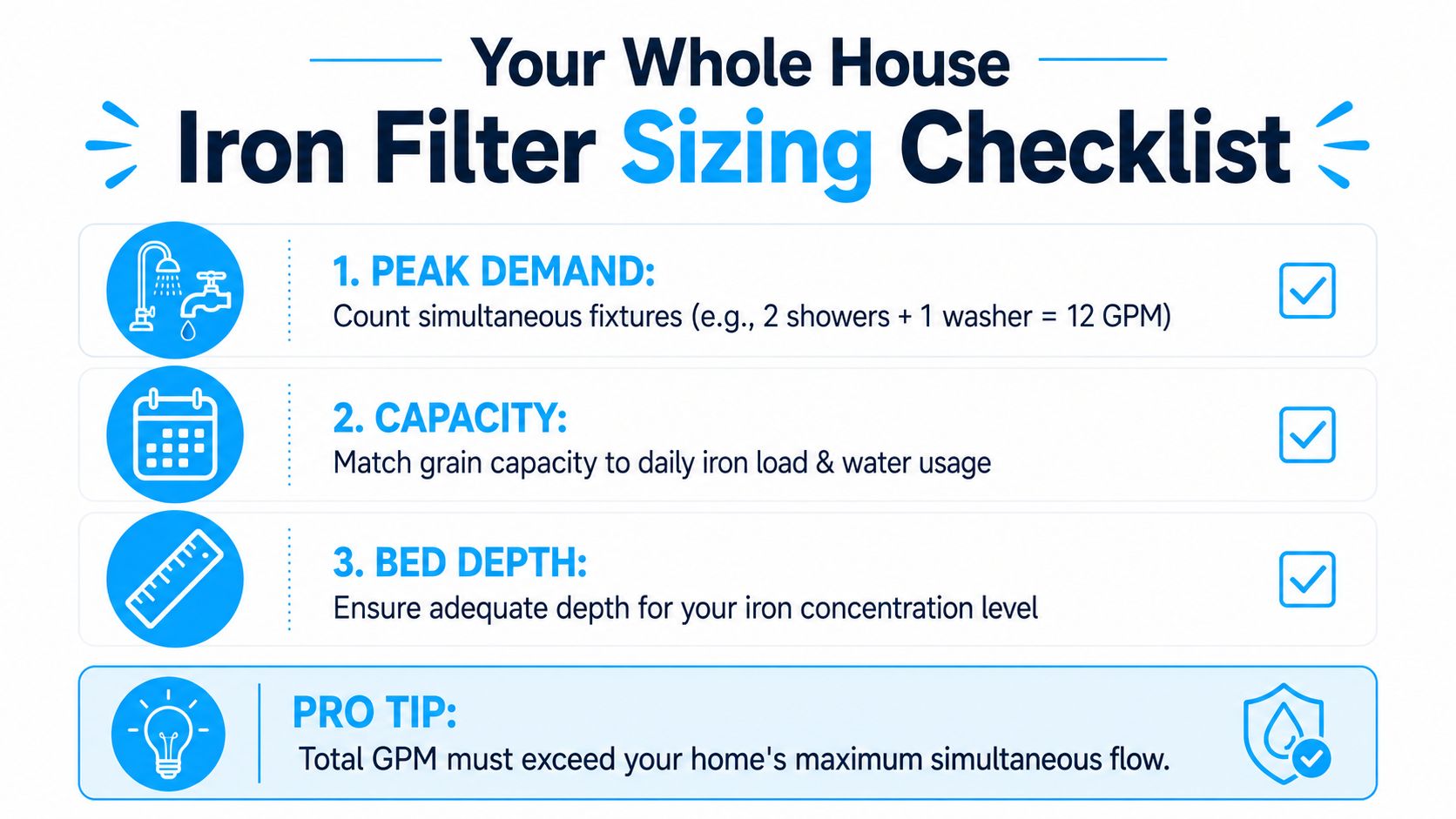
Count the fixtures that may run together during the busiest routine. A shower, toilet refill, washing machine, and outdoor use can overlap. Irrigation deserves special caution because it can consume water continuously rather than in short household bursts.
A practical sizing checklist
- Measure peak household demand. Use the home's simultaneous fixture demand, not the average daily flow.
- Verify the pump and pressure. Compare available inlet pressure and pump output with the filter's service and backwash requirements.
- Review contaminant load. Iron concentration, manganese, sulfide, and tannins all affect how quickly the bed loads.
- Match bed depth and tank diameter. The media needs enough depth for contact and enough surface area for the required flow.
- Confirm the drain path. A generous drain route is easier to provide before installation than after a tank is already in a finished basement.
Don't confuse a manufacturer's maximum service flow with a recommended continuous flow for a home using irrigation. Continuous demand can exhaust media faster and interfere with effective oxidation. A qualified installer should calculate the loading between regeneration cycles, then check whether the well and drain can support the required backwash.
One residential manual warns that heavy iron and manganese loading can reduce pressure and flow when too much water passes between backwash cycles. It recommends shortening the interval to every other day or even daily in extreme cases, and says the system shouldn't operate more than 3 days between backwashes. The residential backwash manual also describes systems preset to backwash every third day, with a complete regeneration cycle lasting about 50 minutes and untreated water available during that period.
Real Cost, Maintenance, and Lifespan of a Whole House Iron Filter System
The purchase price is only one part of iron treatment. A whole-house installation may also need bypass plumbing, a drain connection, electrical power, a sediment stage, pH correction, an air pump, or chemical-feed equipment. A low-maintenance design can cost more initially while reducing chemical handling, whereas a chemically regenerated bed may demand more supplies and closer monitoring.
Media maintenance depends on the technology. Manganese greensand needs regeneration with an oxidant, while Birm depends on proper pH and oxygen and still needs regular backwashing. Catalytic carbon may serve as a downstream polishing stage, but iron breakthrough and sediment can shorten its useful service.
What belongs in the ownership budget
- Equipment: Mineral tank, control valve, media, air or chemical components, and any required prefilters.
- Installation: Main-line cutting, bypass plumbing, drain routing, electrical work, and commissioning.
- Consumables: Potassium permanganate, chlorine, peroxide, salt, replacement cartridges, or bacterial-control supplies.
- Water and drainage: Backwash cycles consume water and require a drain that can accept the discharge.
- Service time: Testing, valve inspection, media checks, and cleaning after iron bacteria or heavy sediment.
Don't accept a media-life promise without asking what water chemistry supports it. Iron concentration, manganese, sulfide, tannins, household demand, and skipped backwashing can all shorten service life. A service log should record test results, backwash dates, chemical additions, pressure changes, and the date when staining first reappears.
| Cost and Maintenance Comparison by Iron Filter Type | Filter Type | Media Replacement | Annual Operating Cost | Typical Lifespan |
|---|---|---|---|---|
| Oxidizing media | Birm or greensand-style tank | Depends on chemistry, loading, and regeneration | Backwash plus any required oxidant | Depends on maintenance and water conditions |
| Air-injection system | Air-treatment and filtration components | Depends on media fouling and service | Electricity, backwash, and component service | Depends on pump, chemistry, and cleaning |
| Chemical-feed system | Oxidation stage plus filter media | Depends on oxidant exposure and contaminant load | Chemical supply, power, backwash, and service | Depends on feed control and maintenance |
| Catalytic carbon stage | Carbon bed | Replaced when exhausted or fouled | Replacement media and backwash where applicable | Depends on chlorine, sediment, and iron exposure |
| Softener or sequestrant | Resin or injection media | Depends on iron loading or media exhaustion | Salt or dosing supplies and maintenance | Depends on iron contact and operating conditions |
The EPA's secondary iron standard is 0.3 mg/L, or 300 µg/L, and addresses aesthetic issues such as taste, odor, and staining rather than health protection. That threshold helps explain why homeowners often pay for treatment when the first priority is protecting fixtures and reducing nuisance maintenance.
Matching the Right System to Your Home and Water
Start with a laboratory water test that includes iron, pH, hardness, manganese, and tannins. Add testing for hydrogen sulfide and bacteria when odor, slime, or recurring deposits suggest they may be present.
Low ferrous iron with suitable pH may fit Birm or air injection. Lower pH, higher loading, manganese, sulfide, or iron bacteria may point toward greensand, chemical oxidation, or a layered design. Hardness can call for a softener after iron removal, because iron should be treated before resin whenever both problems exist.
Your household determines the next filter. Check peak flow, bathrooms, irrigation, pump capacity, drain access, and whether you prefer chemical handling or a more equipment-intensive salt-free approach. For installation planning, ShamFix's guide to finding plumbers offers useful advice on evaluating a qualified professional.
Use Water Filter Advisor's water filtration advice to compare treatment stages, media, testing considerations, and maintenance questions. Choose by water chemistry first, household demand second, and maintenance tolerance third. That sequence is much more reliable than choosing a tank because its label promises the highest iron capacity.
Water Filter Advisor helps homeowners compare whole-house iron filters, understand media and certification claims, and plan maintenance around real water conditions. Visit Water Filter Advisor to turn your laboratory report and household demands into a treatment decision you can maintain.
- September 3, 2026
- Uncategorized
