Whole House Iron Filter System: A Homeowner’s Guide

A whole house iron filter system sits on the main water line and treats water before it reaches showers, sinks, laundry equipment, and water heaters. That sounds straightforward until a system performs well on installation day, then starts sending orange water into the bathtub weeks later. The difference usually comes from three things working together, oxidation chemistry, filter media, and household operating conditions.

Iron treatment isn't just a matter of trapping “rust.” Dissolved ferrous iron may be invisible at the faucet, while ferric iron arrives as visible particles. Manganese, hydrogen sulfide, tannins, sediment, hardness, and iron bacteria can change which technology works and how much maintenance the equipment needs. The right system begins with a water report, not a product label.

The Morning Your Water Tells You Something Is Wrong

The first clue may appear before breakfast. An orange streak runs down the new toilet bowl. The bathtub tap releases brown water after the well pump cycles, and coffee has a faint metallic tang that wasn't there before. By laundry day, pale clothing carries rusty spots, the dishwasher leaves a dull film, and a thin rust ring has formed around the sink drain.

That household isn't dealing with a problem limited to appearance. Iron deposits can foul aerators, valves, appliances, and plumbing while changing water color, flavor, and odor. The World Health Organization's historical iron guidance explains that iron is mainly treated as an aesthetic concern, with visible staining becoming a practical issue above 0.3 mg/L. The same guidance says noticeable taste is usually absent below that level, while higher concentrations can stain laundry and plumbing fixtures.
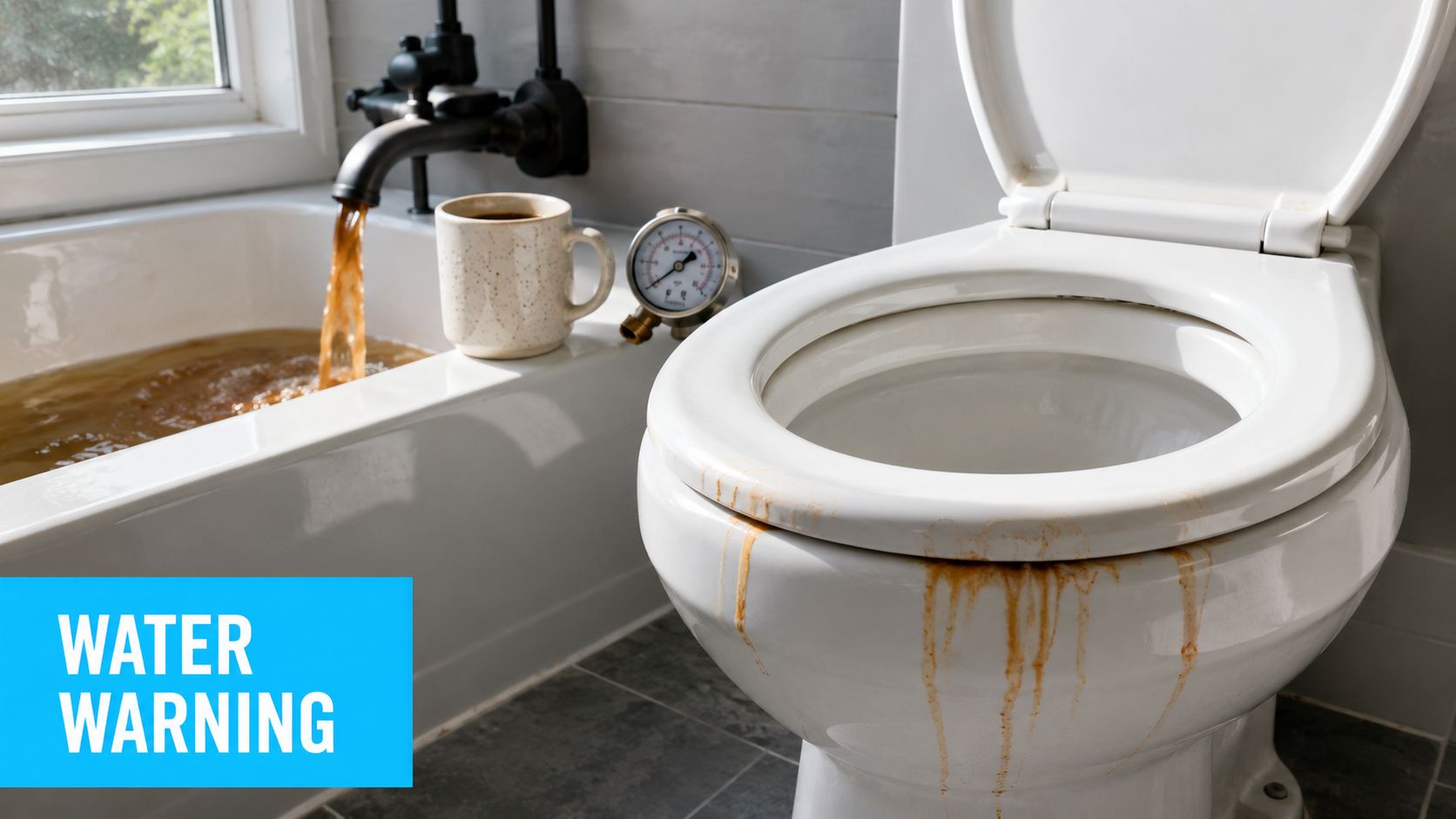
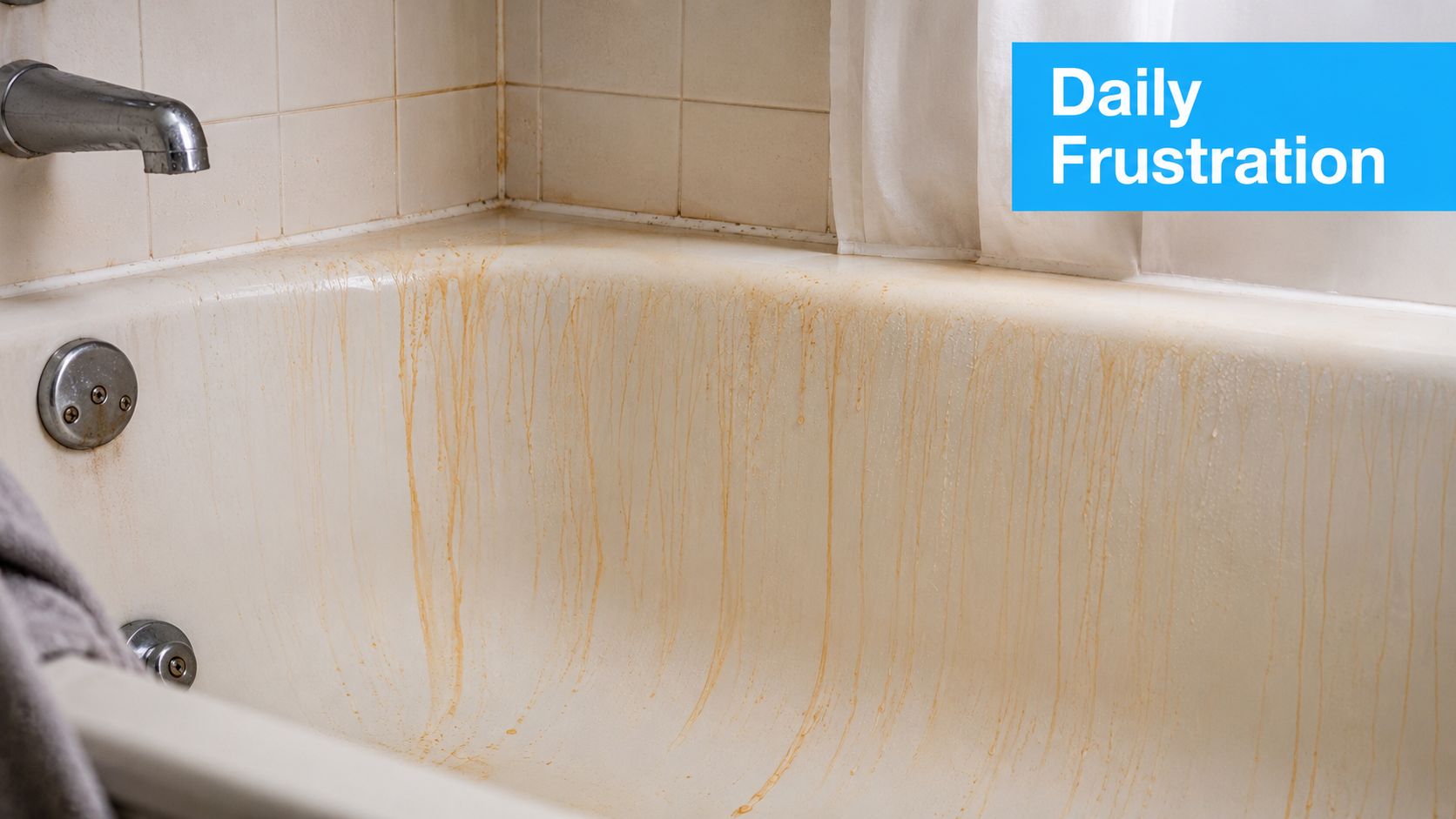
A bathroom tub and toilet filled with rusty, contaminated water indicating poor home water quality issues.

Two forms of trouble at the tap

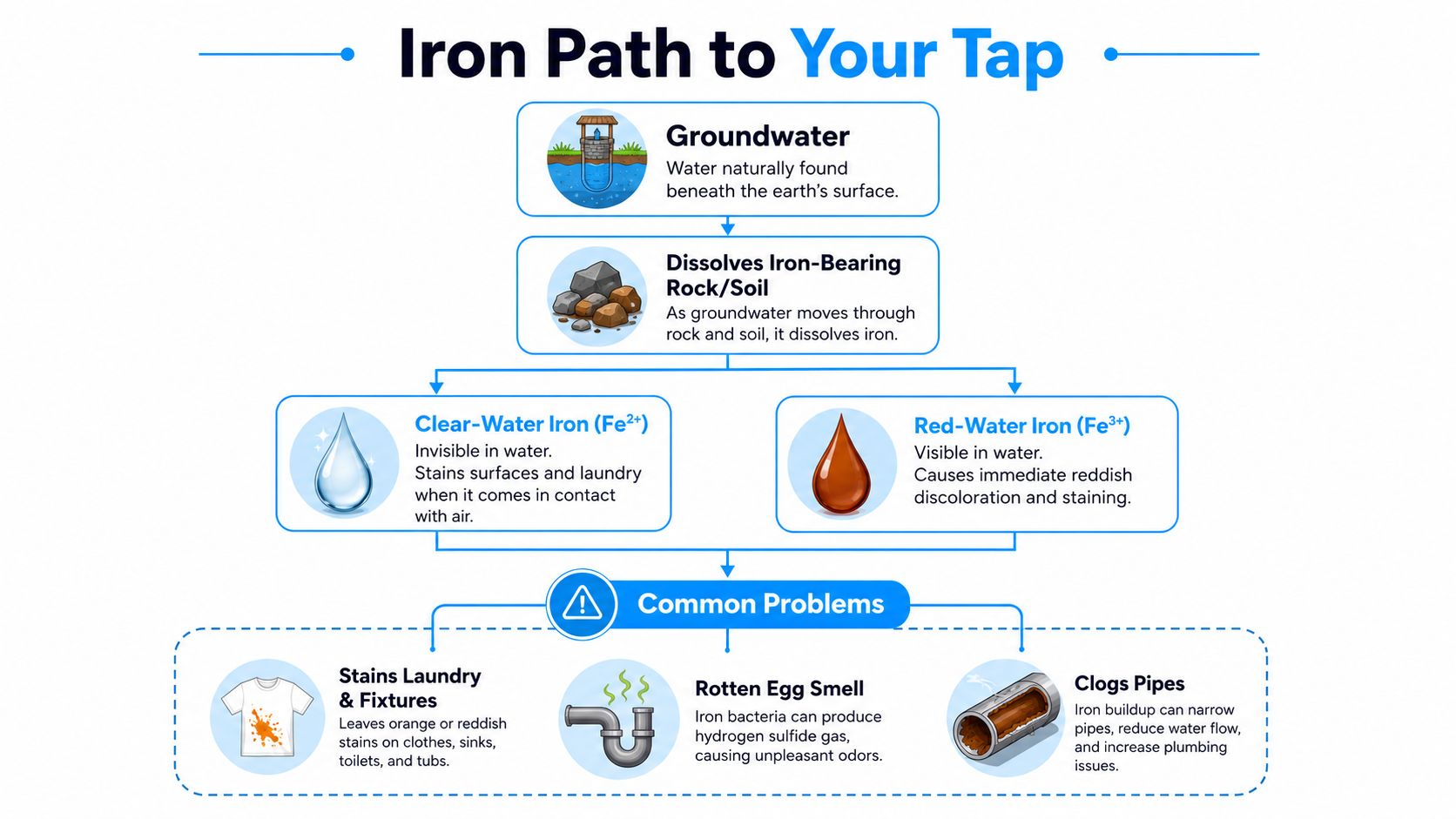
Clear-water iron often looks harmless when it leaves the faucet. It can remain dissolved until the water sits in a toilet, washing machine, glass, or sink and meets oxygen. Then it oxidizes and leaves the familiar orange or reddish-brown residue.

Red-water iron behaves differently. It has already oxidized before reaching the fixture, so the water may pour visibly yellow, orange, or brown. That particulate iron can lodge in faucet screens, toilet fill valves, and small passages before a homeowner sees the full extent of the problem.

Installer's observation: A clean-looking glass doesn't prove the water is iron-free. It may only mean the iron hasn't oxidized yet.

A proper diagnosis connects the stain to the chemistry underground and inside the pipes. Testing reveals whether the system needs oxidation, physical filtration, disinfection, pH correction, or a combination of treatments.

How Iron Gets Into Water and What It Does Inside Your Home

Groundwater often picks up iron as it moves through iron-bearing soil and rock. In private wells, low-oxygen conditions can keep iron dissolved as ferrous iron, Fe²⁺. Aging cast-iron mains, well components, or household plumbing can also release ferric iron, Fe³⁺, which is already oxidized and travels as particles.

The easiest analogy is sugar and sand. Ferrous iron behaves more like sugar dissolved in water. You can't remove it with a simple screen because there isn't a visible particle to catch. Ferric iron behaves more like sand in a glass. It can settle, clog, and collect in places where water slows down.

What happens after the water enters the house

Oxygen and chlorine can convert dissolved ferrous iron into insoluble ferric particles. Those particles may stain porcelain, collect in aerators, clog toilet valves, and build deposits around water-heater components. Clear water can therefore cause a delayed orange stain, while ferric water can create an immediate brown plume.

A basic inspection helps, but it can't replace laboratory testing:

  1. Observe the water immediately. Fill a clear glass and watch for color, cloudiness, or particles.
  2. Let a sample stand. Clear water that develops orange color points toward oxidation of dissolved iron.
  3. Use a screening strip or kit. This can flag iron, but it won't identify every related issue.
  4. Order a laboratory analysis. Ask for iron, pH, hardness, manganese, tannins, and other relevant well-water parameters.
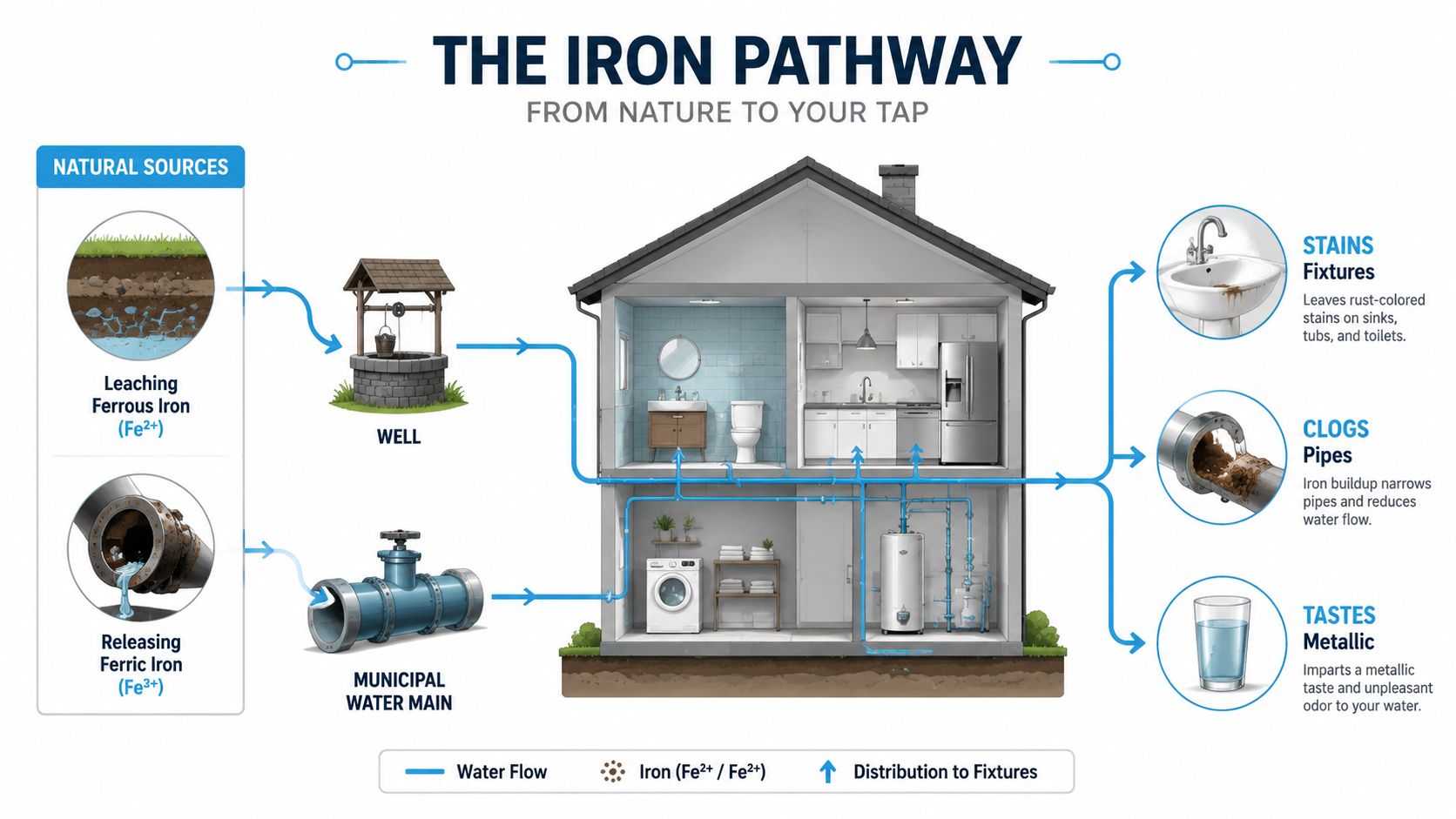
An infographic illustrating how iron from natural sources travels through water systems to cause household problems.

A single iron number isn't enough to select media. Low pH can prevent some oxidation media from working correctly. Manganese may need a more demanding chemistry window. Tannins can consume oxidants and interfere with filtration. Hydrogen sulfide creates a rotten-egg odor that points to a gas problem, not merely more iron.

If hydrogen sulfide is part of the complaint, maintenance knowledge from practical gas monitor upkeep tips can also help homeowners understand why gas detection and treatment equipment require regular attention.

The Main Technologies Whole House Iron Filters Use

Iron-removal technologies don't compete in a universal ranking. Each one changes the water in a different way, and each has a failure point that appears when the chemistry falls outside its operating window.

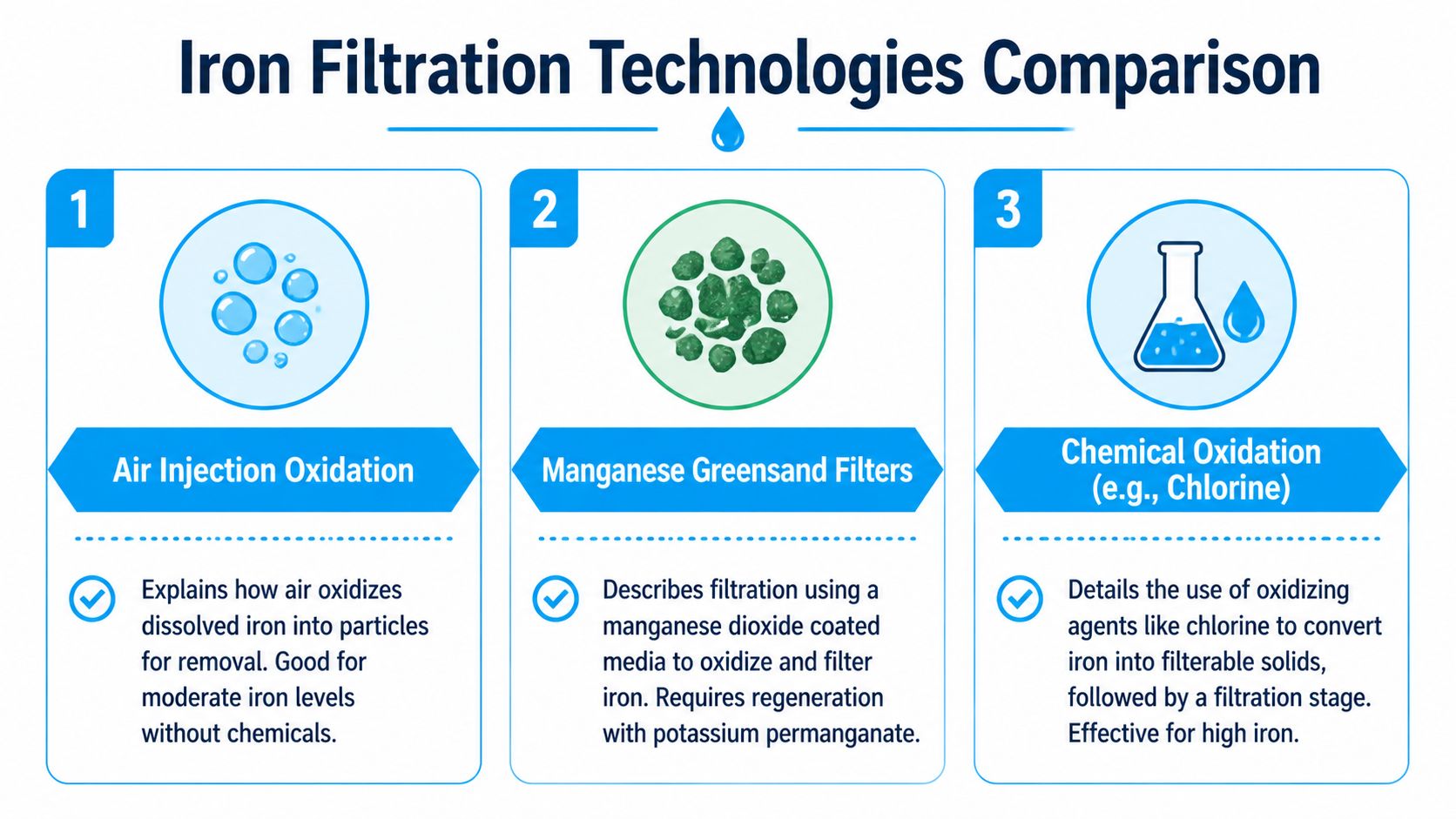
Oxidizing media, including Birm and manganese greensand, converts or catalyzes dissolved iron so the resulting particles can be captured in the media bed. Greensand-style systems need periodic regeneration with an oxidant. Birm-style systems depend on pH and dissolved oxygen, and the Birm operating guidance specifies water free of oil and hydrogen sulfide, organic matter below about 4 to 5 ppm, dissolved oxygen at least 15% of the iron content, and pH of 6.8 or higher for iron removal.

Air-injection and aeration systems introduce air before filtration. The air supplies oxygen, allowing ferrous iron to form particles in a tank or contact space. These systems can reduce chemical handling, but they still need effective filtration and backwashing. Hydrogen sulfide, manganese, low pH, and limited contact time can push performance outside the practical window.

Chemical oxidation uses chlorine, potassium permanganate, or hydrogen peroxide to convert dissolved contaminants into filterable solids. It can be useful when iron bacteria, manganese, hydrogen sulfide, or heavier iron loading complicates air oxidation. The tradeoff is chemical storage, feed control, residual management, and possible damage when an oxidant is overfed.

Catalytic carbon is usually a polishing or dechlorination stage rather than a complete iron solution. It can help with taste, odor, and residual chlorine after oxidation, but iron particles can clog the bed. Homeowners comparing fine sediment stages can also review practical 0.22 micron filter tips to understand why pore size alone doesn't solve dissolved iron.

Salt-based softeners can exchange limited ferrous iron along with hardness. They aren't a dependable answer for substantial iron, ferric particles, iron bacteria, or water with conditions that foul resin. If iron reaches the softener first, resin can lose useful capacity and require more attention.

Phosphate and polyphosphate sequestrants hold iron in solution rather than remove it. That may reduce visible staining in some applications, but the iron remains in the water. Heat and changing chemistry can also weaken sequestration, especially around water heaters and hot-water fixtures.

Technology How It Treats Iron Best Operating Window Common Failure Mode
Birm-style media Catalyzes oxidation and captures particles Adequate oxygen, pH at or above the media requirement, low oil and sulfide Iron passes through when oxygen or pH is inadequate
Manganese greensand Oxidizes or adsorbs iron, then releases it during backwash and regeneration Managed oxidant feed, suitable pH, controlled iron and manganese load Media exhausts or regeneration is missed
Air injection Adds oxygen before filtration Dissolved ferrous iron with enough contact and a capable filter bed Incomplete oxidation or fouled air components
Chemical oxidation Converts dissolved contaminants into solids Feed rate matched to iron, manganese, sulfide, and biology Overfeed, underfeed, or residual chemical problems
Catalytic carbon Polishes taste, odor, and some residuals Downstream of suitable oxidation and sediment control Clogging and premature exhaustion
Softener or sequestrant Exchanges limited iron or keeps it dissolved Low ferrous iron or nuisance-control applications Resin fouling or iron remaining in the water

How the System Actually Works Day to Day

A backwashing iron filter is a working chemical process, not a passive tank of gravel. Untreated water enters the mineral tank, contacts the media, and undergoes oxidation. Ferrous iron becomes ferric particles, and the bed holds those solids until the control valve sends water upward through the tank and out to a drain.
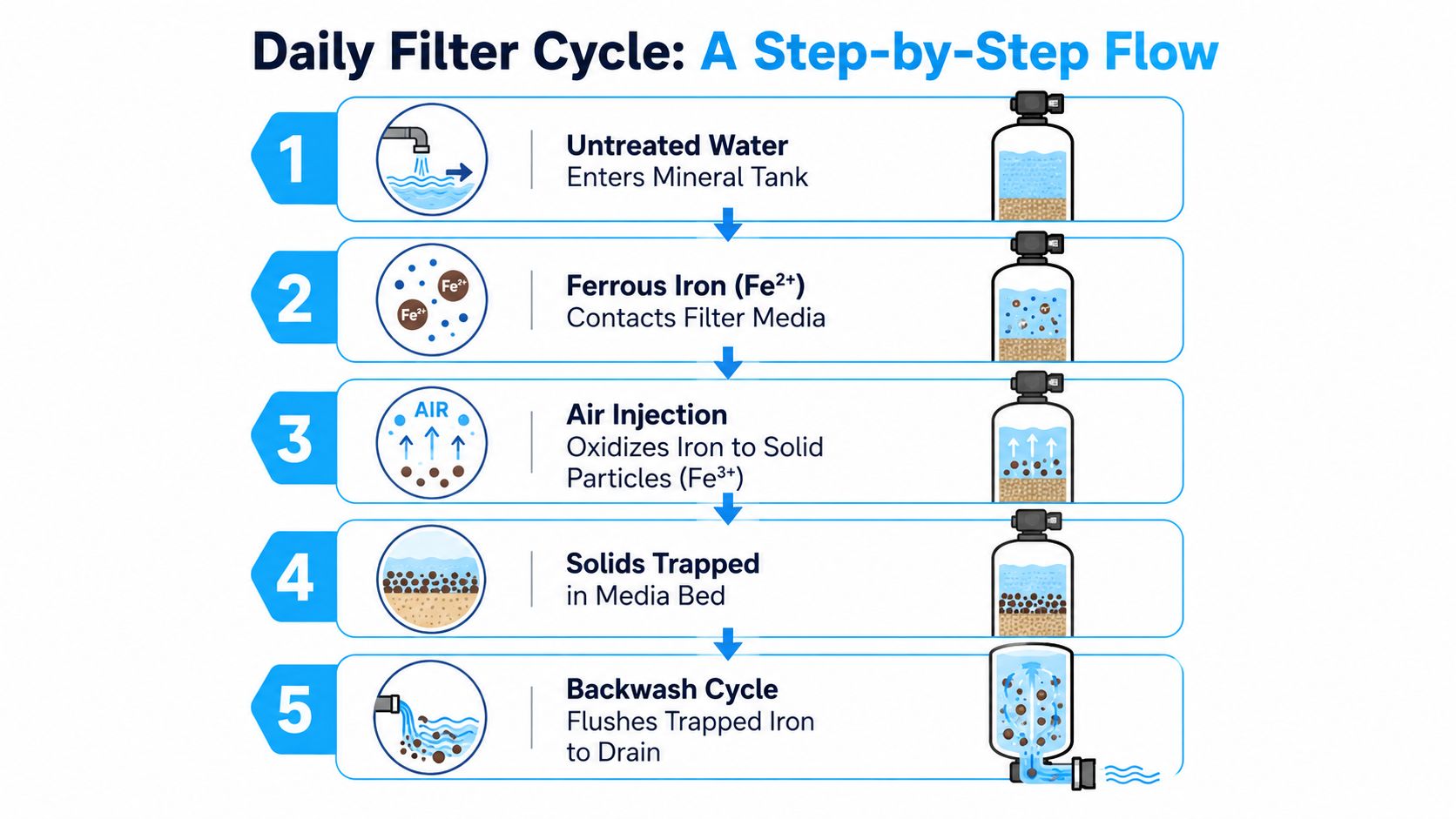
A diagram illustrating the five-step daily cycle of a whole house iron filter system water filtration process.

The cleaning cycle

The exact sequence depends on the equipment, but the practical logic is consistent:

  • Service: Water flows downward through the media and treated water leaves the tank.
  • Backwash: Water flows upward, expands the bed, and carries trapped iron to the drain.
  • Air or oxidant restoration: An air-injection or chemical stage restores the media's ability to oxidize iron.
  • Rinse: The valve settles and clears the bed before normal service resumes.

One chemical-free iron-filter manual describes a four-step cycle, backwash, air draw, rapid rinse, and service, with backwash requiring at least 30 psi inlet pressure and the full cycle taking about 15 minutes. During backwash, the upward flow is the cleaning mechanism, not an optional accessory. The cited iron-filter manual provides those operating details.

Backwash flow matters because the bed must expand enough to release trapped solids. Too little flow leaves iron behind and creates channeling. Excessive flow can carry media toward the drain. The pump, drain line, control valve, and tank size must therefore work as one assembly.

A greensand-style unit may regenerate with potassium permanganate or chlorine. One technical sheet lists normal potassium permanganate use at about 1 to 2 ounces per cubic foot of media, with practical treatment limits of 15 ppm iron, 5 ppm manganese, and 2 ppm hydrogen sulfide for that system design. Those figures come from the greensand technical sheet, and they shouldn't be treated as universal ratings for every media bed.

Watch the drain during a cycle. Dark or orange water at the beginning, followed by clearer discharge, usually indicates that the bed is releasing captured material. A creeping pressure drop, weak flow, or recurring color after regeneration suggests the schedule, backwash rate, or chemistry needs attention.

Why Some Iron Filters Fail Before Their Time

Most early failures begin with a mismatch between the water report and the media's operating window. The tank may be sound, the valve may be functional, and the installation may look tidy, yet the system still can't oxidize or remove the contaminant load arriving at the inlet.

Birm illustrates the problem clearly. Low dissolved oxygen, unsuitable pH, oil, hydrogen sulfide, or organic matter can shut down the chemistry the media depends on. Greensand has a different vulnerability. It can work effectively when regeneration is controlled, but missed oxidant dosing, excess loading, or poor backwash leaves the bed progressively less capable.

Iron bacteria create a separate category of failure. Pentair installation guidance warns that iron bacteria can cause frequent service, shorten system life, and require chlorine or other bacterial control before filtration works properly. Slimy deposits can form mounds inside the tank and pipes, forcing water around the media instead of through it.

The costliest mistake is treating biology as if it were only chemistry.

A unit sized for a quiet household can also struggle in a busy home. If the control valve backwashes only by time, the system may receive more iron and manganese than the schedule accounts for. Irrigation, frequent laundry, and simultaneous showers add demand that a showroom demonstration doesn't reveal.

Failure Cause Water Chemistry Trigger Symptom at Home
Incomplete oxidation Low dissolved oxygen, unsuitable pH, or inadequate contact Clear water turns orange after treatment
Media exhaustion Heavy iron, manganese, sulfide, or organic loading Staining returns before the next cycle
Iron bacteria Slimy biological growth and deposits Frequent service, odors, channeling, or pressure loss
Poor regeneration Missed oxidant feed or insufficient backwash Dark drain water and weak treated flow
Chemical overfeed Excess chlorine or another oxidant Media damage, taste, or residual chemical
Undersizing Household or irrigation demand exceeds design Pressure drop and early breakthrough

The Health Canada technical document describes oxidation followed by filtration as a common groundwater approach and identifies point-of-entry oxidizing filters such as greensand at residential scale. The lesson is practical: choose the treatment sequence around the actual water chemistry, not the brand name printed on the tank.

Sizing a Whole House Iron Filter Without Buying the Wrong One

Sizing starts with two separate flow questions. Service flow is what the home needs while fixtures operate. Backwash flow is what the tank needs to clean itself. A filter can meet the first requirement and still fail because the well pump or drain cannot deliver the second.

Count the fixtures that may run together during the busiest routine. A shower, toilet refill, washing machine, and outdoor use can overlap. Irrigation deserves special caution because it can consume water continuously rather than in short household bursts.

A practical sizing checklist

  1. Measure peak household demand. Use the home's simultaneous fixture demand, not the average daily flow.
  2. Verify the pump and pressure. Compare available inlet pressure and pump output with the filter's service and backwash requirements.
  3. Review contaminant load. Iron concentration, manganese, sulfide, and tannins all affect how quickly the bed loads.
  4. Match bed depth and tank diameter. The media needs enough depth for contact and enough surface area for the required flow.
  5. Confirm the drain path. A generous drain route is easier to provide before installation than after a tank is already in a finished basement.
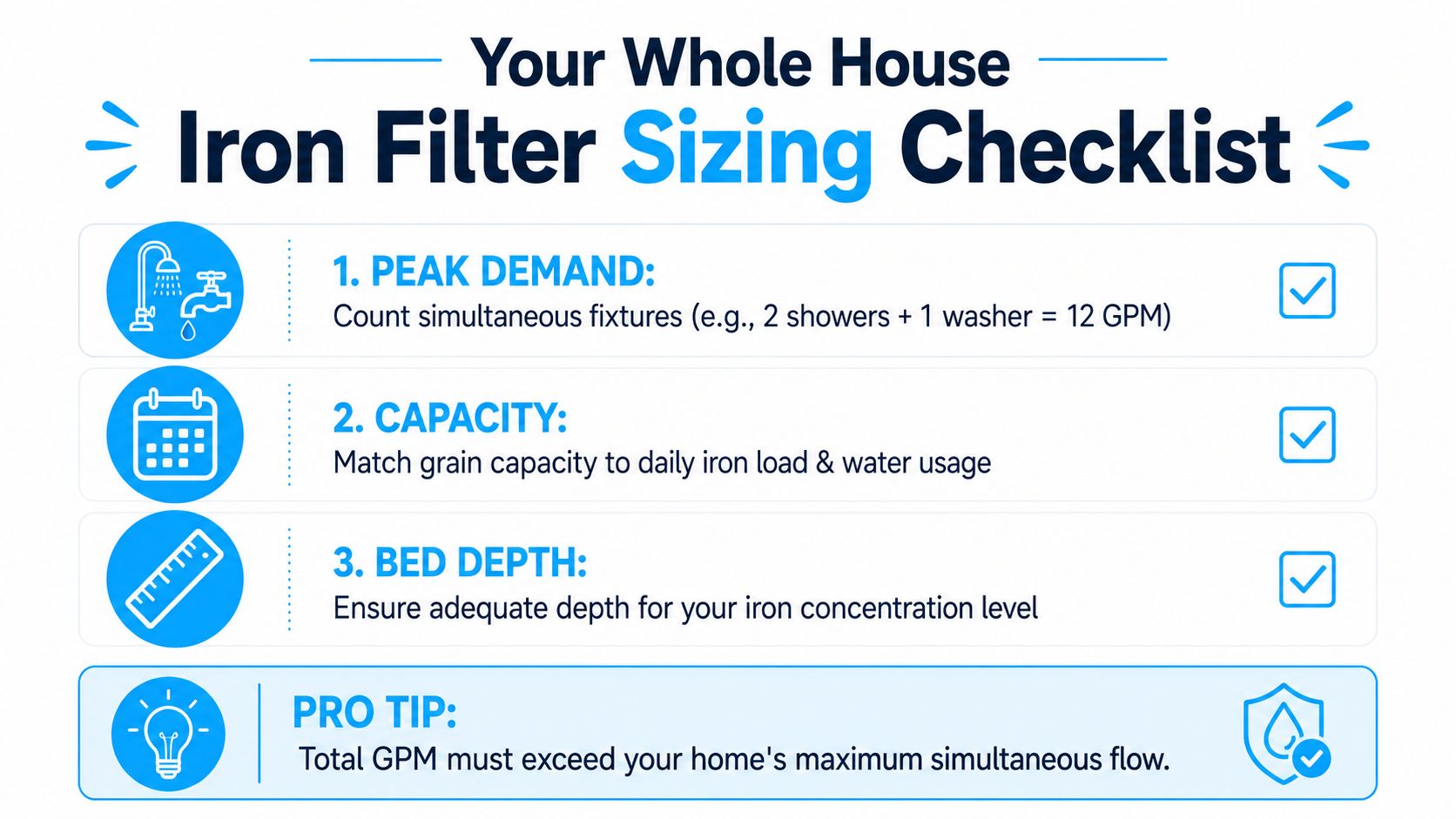
A checklist for sizing a whole house iron filter system with three key steps and a pro tip.

Don't confuse a manufacturer's maximum service flow with a recommended continuous flow for a home using irrigation. Continuous demand can exhaust media faster and interfere with effective oxidation. A qualified installer should calculate the loading between regeneration cycles, then check whether the well and drain can support the required backwash.

One residential manual warns that heavy iron and manganese loading can reduce pressure and flow when too much water passes between backwash cycles. It recommends shortening the interval to every other day or even daily in extreme cases, and says the system shouldn't operate more than 3 days between backwashes. The residential backwash manual also describes systems preset to backwash every third day, with a complete regeneration cycle lasting about 50 minutes and untreated water available during that period.

Real Cost, Maintenance, and Lifespan of a Whole House Iron Filter System

The purchase price is only one part of iron treatment. A whole-house installation may also need bypass plumbing, a drain connection, electrical power, a sediment stage, pH correction, an air pump, or chemical-feed equipment. A low-maintenance design can cost more initially while reducing chemical handling, whereas a chemically regenerated bed may demand more supplies and closer monitoring.

Media maintenance depends on the technology. Manganese greensand needs regeneration with an oxidant, while Birm depends on proper pH and oxygen and still needs regular backwashing. Catalytic carbon may serve as a downstream polishing stage, but iron breakthrough and sediment can shorten its useful service.

What belongs in the ownership budget

  • Equipment: Mineral tank, control valve, media, air or chemical components, and any required prefilters.
  • Installation: Main-line cutting, bypass plumbing, drain routing, electrical work, and commissioning.
  • Consumables: Potassium permanganate, chlorine, peroxide, salt, replacement cartridges, or bacterial-control supplies.
  • Water and drainage: Backwash cycles consume water and require a drain that can accept the discharge.
  • Service time: Testing, valve inspection, media checks, and cleaning after iron bacteria or heavy sediment.

Don't accept a media-life promise without asking what water chemistry supports it. Iron concentration, manganese, sulfide, tannins, household demand, and skipped backwashing can all shorten service life. A service log should record test results, backwash dates, chemical additions, pressure changes, and the date when staining first reappears.

Cost and Maintenance Comparison by Iron Filter Type Filter Type Media Replacement Annual Operating Cost Typical Lifespan
Oxidizing media Birm or greensand-style tank Depends on chemistry, loading, and regeneration Backwash plus any required oxidant Depends on maintenance and water conditions
Air-injection system Air-treatment and filtration components Depends on media fouling and service Electricity, backwash, and component service Depends on pump, chemistry, and cleaning
Chemical-feed system Oxidation stage plus filter media Depends on oxidant exposure and contaminant load Chemical supply, power, backwash, and service Depends on feed control and maintenance
Catalytic carbon stage Carbon bed Replaced when exhausted or fouled Replacement media and backwash where applicable Depends on chlorine, sediment, and iron exposure
Softener or sequestrant Resin or injection media Depends on iron loading or media exhaustion Salt or dosing supplies and maintenance Depends on iron contact and operating conditions

The EPA's secondary iron standard is 0.3 mg/L, or 300 µg/L, and addresses aesthetic issues such as taste, odor, and staining rather than health protection. That threshold helps explain why homeowners often pay for treatment when the first priority is protecting fixtures and reducing nuisance maintenance.

Matching the Right System to Your Home and Water

Start with a laboratory water test that includes iron, pH, hardness, manganese, and tannins. Add testing for hydrogen sulfide and bacteria when odor, slime, or recurring deposits suggest they may be present.

Low ferrous iron with suitable pH may fit Birm or air injection. Lower pH, higher loading, manganese, sulfide, or iron bacteria may point toward greensand, chemical oxidation, or a layered design. Hardness can call for a softener after iron removal, because iron should be treated before resin whenever both problems exist.

Your household determines the next filter. Check peak flow, bathrooms, irrigation, pump capacity, drain access, and whether you prefer chemical handling or a more equipment-intensive salt-free approach. For installation planning, ShamFix's guide to finding plumbers offers useful advice on evaluating a qualified professional.

Use Water Filter Advisor's water filtration advice to compare treatment stages, media, testing considerations, and maintenance questions. Choose by water chemistry first, household demand second, and maintenance tolerance third. That sequence is much more reliable than choosing a tank because its label promises the highest iron capacity.


Water Filter Advisor helps homeowners compare whole-house iron filters, understand media and certification claims, and plan maintenance around real water conditions. Visit Water Filter Advisor to turn your laboratory report and household demands into a treatment decision you can maintain.
Iron Filter for Well Water: A Homeowner’s Guide

You scrub the bathtub on Saturday, and by Monday orange streaks are running down the sides again. The toilet bowl looks rusty within days, white laundry comes out yellowed, and water from the kitchen tap carries a metallic tang. In the morning, you fill the kettle and notice reddish flecks settling at the bottom. You start wondering whether an iron filter for well water will solve the mess, whether the water is safe, and whether you need a simple filter or a complete treatment system.

The right answer depends on more than seeing rust. Dissolved iron, visible iron particles, manganese, iron bacteria, pH, and hardness all affect treatment. This guide explains how to identify the problem, compare whole-house filtration options, size a system, and plan for maintenance without relying on brand hype.

Living with Iron in Your Well Water

Saturday's bathtub cleaning can look pointless by Monday. Orange streaks return, a white shirt comes out yellowed, and reddish slime appears around the toilet tank's waterline. Water from the tap may look clear at first, then develop color after sitting in a glass or kettle.

That delayed change is why iron can be difficult to diagnose by sight alone. Dissolved iron passes through the faucet unseen, then reacts with air and leaves deposits on porcelain, fabric, plumbing, or appliances. Visible particles behave differently, so the right iron filter for well water depends on the iron form and test results.

A stained, off-white bathtub with orange rust streaks running down the sides due to hard well water.

What an iron filter does

A whole-house iron filter connects to the main water line, treating water before it reaches showers, sinks, laundry machines, and water heaters. Some systems capture iron particles already in the water. Others first expose dissolved iron to air or another oxidizing process, turning it into particles that the tank can trap and remove during backwashing.

The household benefits are practical:

  • Cleaner fixtures: Less iron reaches tubs, toilets, faucets, and shower surfaces.
  • Better laundry: Treating water before washing helps limit yellow or orange discoloration.
  • Improved taste: Lower iron levels can reduce a metallic taste in drinking water.
  • Protected plumbing: Filtration limits iron deposits inside pipes and appliances.

The EPA's secondary standard for iron is 0.3 mg/L, also called 0.3 ppm. This guideline addresses taste, odor, sediment, and staining rather than a health risk. The agency explains the regulatory context in its guidance on secondary drinking water standards for nuisance contaminants.

Practical rule: Select a filter after identifying the iron form, concentration, and surrounding water chemistry. A product page's removal claim is not enough.

A small amount of clear-water iron may call for a different treatment approach than visible ferric particles, iron bacteria, or a high iron load. The filter must match what the water test shows, not just the stain left behind.

How Iron Gets Into Well Water and Why It Matters

Groundwater picks up iron as it moves through iron-bearing rock and soil. The iron may remain dissolved, attach to particles, or support biological growth inside pipes and fixtures. Each form behaves differently, so two wells with equally unpleasant stains may need different treatment.

The forms homeowners usually encounter

Ferrous iron, or clear-water iron, is dissolved iron in the Fe²⁺ state. Water may look clear at the tap, then turn orange or brown after exposure to air. Oxidation changes the dissolved iron into solid particles, which is why a clear glass can develop a rust-colored film later.

Ferric iron, or red-water iron, is already oxidized in the Fe³⁺ state. It appears as visible orange, red, or brown particles as soon as the water emerges. A sediment filter may capture some of this material, but a household with continuing iron often needs a properly sized oxidation and filtration stage.

Iron bacteria create slimy deposits or biofilms in toilet tanks, pipes, and treatment equipment. A standard iron filter may remove particles but won't necessarily eliminate the biological source. Disinfection and professional diagnosis may be needed when slime, recurring buildup, or related odors appear.

Manganese often travels with iron. It can produce dark brown or black staining and a bitter or metallic taste, which changes the media and operating conditions a system needs. Hardness matters too, because a softener may be useful for low ferrous iron and hardness, while iron can foul softener resin when the load becomes too high.

An infographic showing the process of how iron from groundwater travels through pipes to cause common household water problems.

A pH below 7 can reduce the performance of some iron-removal media. That doesn't mean every acidic well needs the same correction, but it does mean pH belongs in the treatment decision.

You can also watch this visual explanation of the path from groundwater to household problems:

The central lesson is simple. Iron form and concentration determine the treatment approach. Testing comes before shopping.

Testing Your Well Water Before You Buy a Filter

A water test keeps you from buying a filter that removes the wrong form of iron. Start with an inexpensive home test strip as a screening tool. It can help indicate whether total iron is near or above the practical nuisance threshold of 0.3 ppm, but it won't provide the complete chemistry needed for system design.

For a purchase decision, use a certified laboratory panel. Ask for results covering:

  • Total iron, the overall iron concentration.
  • Ferrous and ferric iron, when the laboratory offers separate reporting.
  • Manganese, because it can require different media or oxidation conditions.
  • pH, which affects oxidation and catalytic media.
  • Hardness, useful when comparing an iron filter with a softener.
  • Tannins, if the water has tea-colored staining or organic discoloration.

Collect the sample carefully

Run the cold-water tap for several minutes before filling the container. Use a clean sample bottle, avoid splashing or aerating the water, and send the sample to the laboratory promptly. A poorly collected sample can change the apparent balance between dissolved and particulate iron, making the report less useful.

Read the results as a treatment signal, not as a product recommendation. Water near the EPA's secondary iron standard may produce nuisance staining even when the water looks acceptable at first. The agency describes 0.3 mg/L as a non-mandatory aesthetic standard, not a health-based limit, so the result helps define comfort and treatment needs rather than proving that the water is unsafe.

Parameter EPA Secondary Standard Action Level Filter Implication
Iron 0.3 mg/L, 0.3 ppm (EPA guidance) Water above this level is often objectionable for taste, odor, or staining Select treatment according to iron form, pH, and concentration
Manganese 0.05 mg/L Dark staining or taste can justify treatment Consider media designed for both iron and manganese
pH No single iron-treatment action value applies to every system A pH below 7 can reduce performance for some media (Minnesota iron guidance) Correct pH or choose media that fits the chemistry
Hardness No iron-specific EPA secondary value High hardness may influence equipment choice Compare a dedicated iron filter with a softener

As a broad engineering guide, Minnesota health information notes that many wells have iron below 10 mg/L, while some softeners may handle up to 10 mg/L under reported conditions, with 2 to 5 mg/L being a more common practical limit. Manganese greensand is often associated with roughly 10 to 15 mg/L in treatment guidance, while higher concentrations may need oxidation followed by filtration. These ranges are not guarantees. They show why the lab report should drive the design.

Comparing the Main Iron Filter Types

The five common approaches below solve different problems. A filter that performs well for low ferrous iron may struggle with manganese, iron bacteria, acidic water, or a heavy ferric load.

Birm

Birm is catalytic media used for low-to-moderate dissolved ferrous iron. It needs favorable water chemistry, including a pH above about 6.8 in common treatment guidance, and it doesn't require chemical regeneration. It can suit a household with clear-water iron and stable pH, but it isn't the automatic choice for bacterial iron or severe chemistry problems.

Manganese greensand

Manganese greensand and Greensand Plus use manganese-dioxide-coated media. The coating helps convert dissolved iron and manganese into filterable solids, and the media is periodically regenerated with potassium permanganate. Technical guidance commonly places this approach at about 6 mg/L for iron under stated conditions, while other private-well guidance cites moderate ranges that can extend higher depending on design and chemistry. See the manganese greensand treatment overview for the media principle.

Advanced oxidizing media

Media such as Katalox Light or Filox offers a stronger oxidation and filtration approach for households dealing with more substantial iron or manganese. These systems may avoid routine chemical feed, but they need adequate backwash flow to lift and clean the media. If the well pump can't deliver that flow, the tank may accumulate iron and lose performance.

Aeration systems

Aeration adds oxygen before filtration. The oxygen helps convert dissolved ferrous iron into solid particles, which a downstream filter then captures. This approach often fits higher ferrous iron or sulfur odors, although odor, bacteria, tannins, and manganese can require additional treatment stages.

Ion-exchange softeners

A water softener can help with hardness and some low-level ferrous iron. It isn't a dedicated solution for visible ferric particles, iron bacteria, or a high iron load. If you're also evaluating hardness treatment, this discussion of softener benefits for LA homes provides useful context, though well-water chemistry still determines whether a softener is appropriate.

Filter Type Best Iron Range (ppm) pH Requirement Chemicals Needed Best For
Birm Low to moderate ferrous iron Commonly above 6.8 None for regeneration Clear-water iron with suitable pH
Manganese greensand Moderate iron and manganese Can work across a broader range than Birm Potassium permanganate regeneration Iron with manganese and manageable chemical maintenance
Advanced oxidizing media Moderate to higher iron and manganese Depends on media and design Often none, but strong backwash is needed Higher capacity treatment where the pump supports backwash
Aeration plus filtration Higher ferrous iron or sulfur odor Depends on the complete system Air, with chemical oxidation possible when needed Dissolved iron that needs oxidation before filtration
Water softener Low ferrous iron with hardness Depends on resin and water chemistry Salt for regeneration Combined hardness treatment and limited iron removal

Recent research reinforces why this comparison can't become a universal “best filter” list. Natural-media systems using combinations such as sand-zeolite, sand-charcoal, silica sand with activated carbon, and coconut-shell carbon have shown iron removal ranging from about 72% to nearly 92%, depending on media depth and design (the reported natural-media results). The media name matters, but bed configuration and water chemistry matter just as much.

Sizing, Installation, and Real Cost

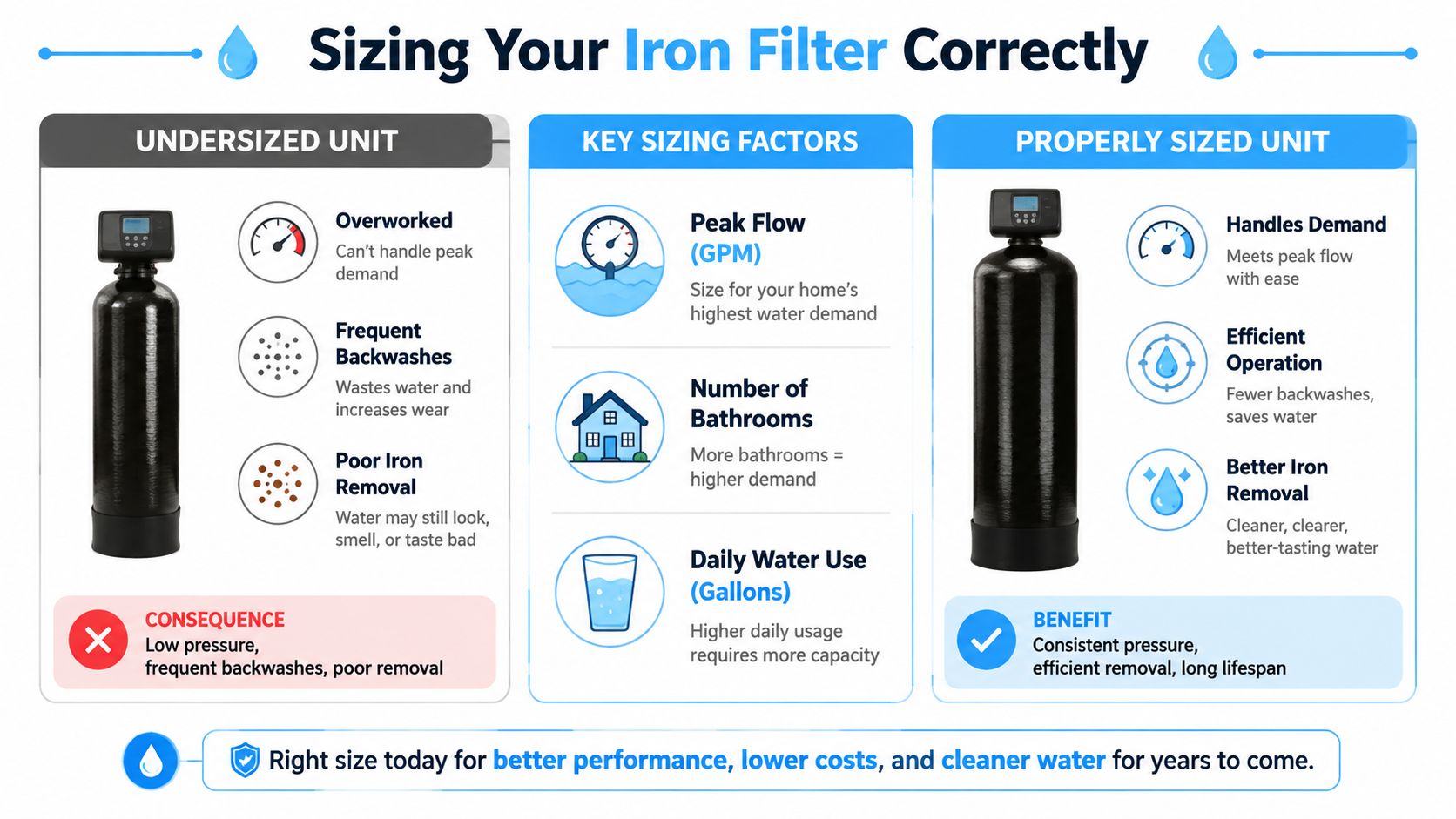
Iron concentration helps select the treatment method, but it doesn't determine tank size by itself. The unit must handle the home's peak flow, the number of bathrooms, daily water use, and the well pump's ability to provide backwash flow.

An undersized tank can restrict pressure, backwash too frequently, and allow water to channel through the media instead of contacting it evenly. An oversized tank may consume more backwash water and media than the household needs. Ask the installer to calculate service flow and backwash requirements together.

Where the system belongs

Most whole-house systems go at the point of entry after the pressure tank and before the water heater. Include a bypass valve so you can service the equipment, and provide a proper drain route for backwash water. Sediment pre-filtration may protect the control valve and media when the well carries sand or silt.

A single-tank Birm system or a softener replacement may suit an experienced DIY homeowner. Aeration equipment, chemical feeders, and multi-tank oxidizing systems deserve a licensed plumber or water-treatment professional, especially when electrical controls, drain flow, or chemical handling are involved.

Budget by treatment category

The following purchase ranges are the planning figures commonly used for these system types:

  • Basic Birm: 800 to 1,500 dollars.
  • Manganese greensand: 1,200 to 2,500 dollars.
  • Advanced oxidizing media: 2,000 to 4,000 dollars.
  • Aeration: 2,500 to 5,000 dollars.
  • Professional installation: 300 to 800 dollars.
  • Operating costs: 100 to 300 dollars per year, including salt, permanganate, electricity, and backwash water.

These figures are budgeting ranges, not guarantees, and the system's chemistry and plumbing requirements can change the final price. Media replacement also belongs in the lifecycle calculation rather than being treated as an unexpected repair.

A comparison infographic showing the importance of correctly sizing an iron filter system for home water treatment.

Maintenance and Long-Term Performance

An iron filter doesn't remove the need for attention. It moves the work from scrubbing fixtures to managing backwash, checking water quality, and keeping the media exposed to the chemistry it needs.

Backwash frequency depends on iron load and tank size. Many residential systems are programmed to backwash every 2 to 7 days, but the correct schedule comes from the media manufacturer's requirements and the water test. Too little backwashing lets trapped iron accumulate. Too much wastes water and can shorten the useful life of the media.

Watch the water and the pressure

Returning stains are an obvious warning sign, but they're not the only one. A pressure drop, reduced flow, or a control valve that fails to complete its cycle can indicate that the bed isn't cleaning properly. Channeling is especially troublesome because water finds an easier path through the tank and bypasses much of the media.

Owners can handle several routine checks:

  • Check supplies: Inspect salt or potassium permanganate levels when the system uses them.
  • Inspect the brine tank: Look for bridging, buildup, or mechanical problems.
  • Test treated water: Use iron test strips quarterly and compare the result with the system's target.
  • Review settings: Confirm that the control valve follows the required regeneration schedule.
  • Schedule service: Arrange a media change when treated water rises above 0.3 ppm, using the EPA secondary standard as the practical aesthetic benchmark.

Typical media life varies by water quality, maintenance, and operating conditions. Birm is often estimated at 5 to 8 years, greensand at 8 to 10 years, and advanced oxidizing media at 10 or more years. Replacement media commonly costs 300 to 800 dollars.

Research also shows that operating time and bed configuration influence performance. A 2025 study reported statistically significant differences at different sampling times, while a 2026 study found that increasing coconut-shell carbon thickness beyond 30 cm produced flattening gains (the study discussion of operating conditions). That supports a practical lesson: adding more media isn't automatically the same as improving a system.

Neglecting sediment pre-filtration, skipping annual inspections, or ignoring pH drift can reduce catalytic-media performance. A filter that worked after installation may need adjustment when the well chemistry changes.

Choosing the Right System and Next Steps

A clear glass of water can still contain dissolved ferrous iron, while orange particles usually indicate ferric iron. Start with the water test, then match the system to the iron form and concentration rather than choosing by product name.

Ask four questions:

  1. Is the iron ferrous, ferric, or biological?
  2. What is the measured iron concentration?
  3. What are the pH, manganese, hardness, sulfur, and tannin results?
  4. Can the well pump supply the required service and backwash flow?

A softener may suit low clear-water iron when hardness also needs treatment. Birm is commonly considered for roughly 0.5 to 5 ppm at pH above 7. Manganese greensand can suit approximately 1 to 10 ppm when manganese is part of the problem. Higher concentrations, or iron linked with sulfur, bacteria, or tannins, may need aeration or chemical oxidation before filtration. Minnesota's private-well iron guidance describes oxidation and filtration as a standard approach for higher iron levels, especially above 10 mg/L.

Iron Level / Conditions Recommended System Best When
Low ferrous iron with hardness Water softener One system can address hardness and limited clear-water iron
About 0.5 to 5 ppm, pH above 7 Birm The well has stable chemistry and no bacterial iron
About 1 to 10 ppm, manganese present Manganese greensand The owner accepts potassium permanganate regeneration
Higher iron or difficult oxidation Aeration or advanced oxidizing media The pump and drainage support the required treatment
Above 10 ppm, sulfur, bacteria, or tannins Chemical oxidation followed by filtration Pre-oxidation is needed before solids can be filtered

Installation depends on plumbing access, drainage, electrical needs, and the number of treatment stages. Renters may be unable to install a point-of-entry system. A point-of-use filter can improve drinking-water taste, but it will not prevent shower, laundry, or fixture staining.

Use a current laboratory test when the well changes, stains return, or treated-water results rise. Persistent problems can point to iron bacteria, pH drift, inadequate backwash flow, exhausted media, or a system that did not match the original test. For practical help comparing equipment and maintenance requirements, review this water filtration advice.

Confirm the final choice with a certified laboratory result and a licensed water-treatment professional. The right iron filter for well water matches the iron form, concentration, and household flow. Water Filter Advisor also provides factual guides on whole-house filters, treatment stages, media, testing, and maintenance.

Best Well Water Filter System for Home 2026

You turn on the kitchen tap, fill a glass, and pause. Maybe it smells a little like rotten eggs. Maybe the sink has orange streaks that keep coming back no matter how hard you scrub. Maybe your laundry feels stiff, your shower glass spots up fast, or your coffee tastes oddly metallic.

If that sounds familiar, your well water is telling you something.

A lot of homeowners assume those quirks are just part of country living. They aren't. They're signs that your water likely needs treatment, and the right well water filter system for home use can fix a lot more than taste. It can protect plumbing, appliances, fixtures, and the people drinking the water every day.

The hard part is that well water doesn't follow a universal script. Two homes on the same road can have completely different water. That's why the biggest mistake I see is buying a filter first and asking questions later. A shiny “whole house” unit from the internet won't help much if it's designed for chlorine and your real problem is iron, sediment, sulfur, low pH, or bacteria.

Is That Normal? Your Introduction to Well Water Realities

If you've lived on city water before, well water can feel unpredictable. One week the water looks fine. Then the toilet tank starts staining. The dishwasher leaves film. The bathroom faucet spits a little grit. Somebody in the house says the shower smells off.

That's the nature of private wells. Your home doesn't get the same treatment train that municipal water gets before it reaches the tap. The well pulls water from the ground exactly as it exists on your property, with whatever minerals, gases, particles, or microbes happen to be there.

Some of those issues are mostly household nuisances. Others can affect safety. The trouble is that your eyes and nose can't tell the whole story.

What well water problems usually look like

Most homeowners first notice one of these signs:

  • Rusty or orange stains: Often a clue that iron is present.
  • Black or dark staining: Sometimes linked to manganese.
  • Rotten egg odor: A classic sign of hydrogen sulfide.
  • Cloudy water or grit: Usually sediment such as sand, silt, or clay.
  • Scale on fixtures: Often caused by hardness minerals.
  • Dry skin or poor soap lather: Another common hardness complaint.

A good filter system isn't one product. It's a treatment plan. It's similar to fixing a car. If the battery is dead, changing the tires won't help. Water filtration works the same way. You have to match the tool to the actual problem.

Practical rule: Don't shop by symptom alone. “Bad smell” and “orange stain” are clues, not a diagnosis.

That's why the smartest path is simple. Test first. Identify the contaminants. Then build a system in the right order. When homeowners do that, well water becomes much less mysterious and much more manageable.

Decoding Your Water The Common Well Contaminants

A lot of well water trouble starts with a bad assumption. Homeowners see one symptom, buy one filter, and expect one box to solve everything. Wells rarely work that way.

Two homes on the same road can need completely different treatment. One may have iron and hardness. The next may have acidic water, bacteria, or nitrates with no obvious warning signs at all. That is why the universal filter idea causes so many expensive mistakes.

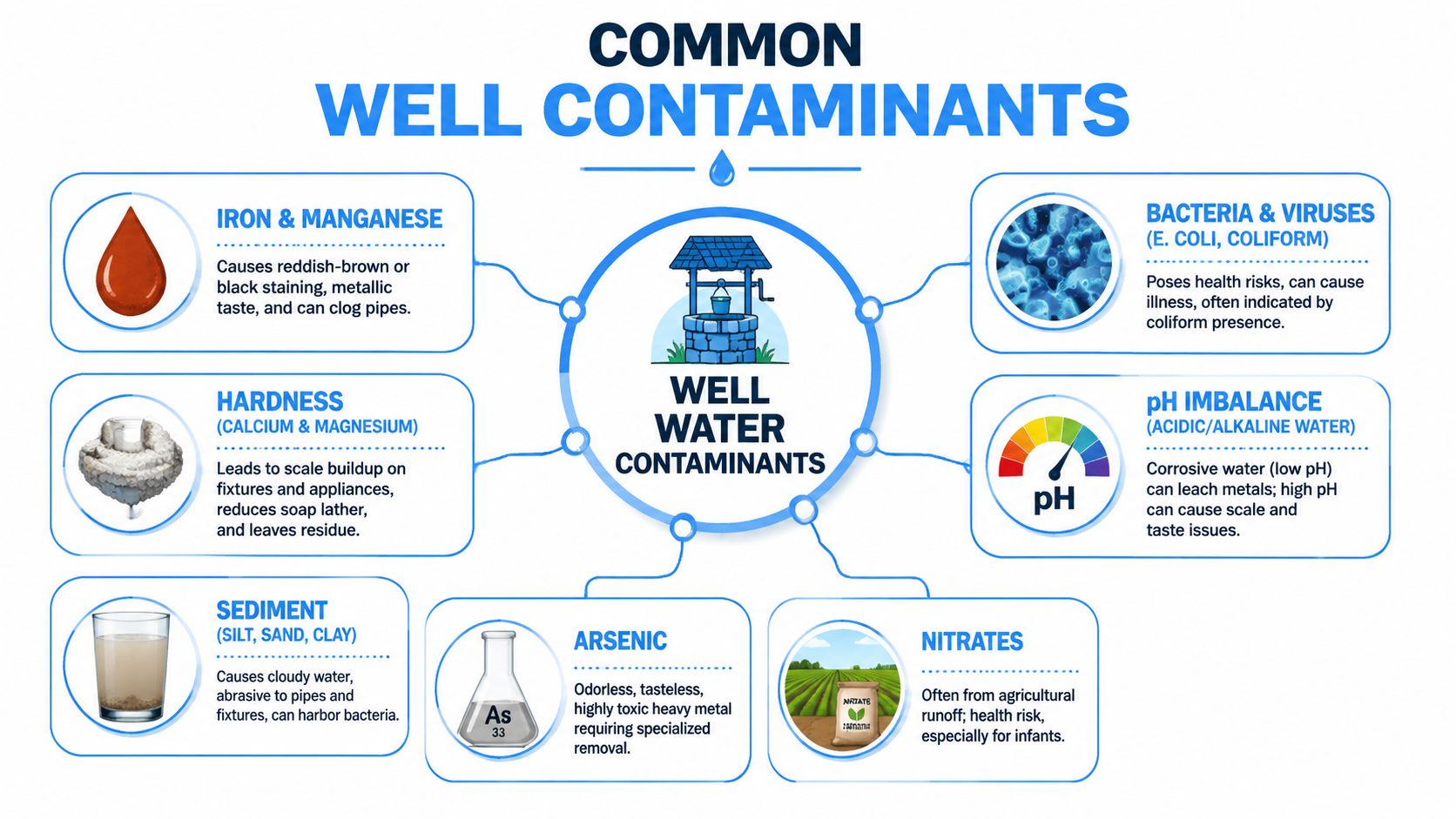
An infographic showing common well water contaminants including iron, hardness, sediment, bacteria, pH imbalance, arsenic, and nitrates.

The usual suspects in a private well

Here's a plain-English look at the contaminants that show up most often in private wells.

Contaminant What you notice Why it matters
Iron Orange stains, metallic taste Stains fixtures, clogs plumbing, fouls appliances
Manganese Dark staining, off taste Leaves black marks and can build up in plumbing
Hydrogen sulfide Rotten egg smell Makes water unpleasant and can point to a broader treatment issue
Sediment Cloudiness, grit, dirty filter housings Wears on valves, faucets, and downstream equipment
Hardness minerals Scale, soap scum, stiff laundry Reduces appliance efficiency and leaves deposits
Low pH Corrosion signs, blue-green stains in some homes Acidic water can damage plumbing
Bacteria Often no visible sign Can create a health concern
Nitrates Usually no smell or color A health concern, especially for infants
Arsenic and other dissolved contaminants Often invisible Need specialized treatment, not guesswork

Some of these are nuisance problems. Some are safety problems. Some are both.

That difference matters because stain-causing water and unsafe water do not always look different at the tap.

What these contaminants actually do

Iron is the rust monster.
It leaves orange or reddish-brown stains in sinks, tubs, and toilets. Over time, it can also coat plumbing parts and make appliances work harder.

Manganese often hides beside iron.
It tends to leave dark brown or black staining. Homeowners sometimes blame dirt or old fixtures when manganese is responsible.

Hydrogen sulfide is the rotten egg smell.
Sometimes you notice it only in hot water. Sometimes it shows up at every tap. Either way, smell alone does not tell you whether the fix is oxidation, filtration, water heater service, or a combination.

Sediment is sandpaper in slow motion.
Sand, silt, and clay scrape away at valves, faucet cartridges, and treatment equipment. If sediment is not handled first, the filters behind it often clog early and underperform.

Hardness acts like mineral scale in a teakettle.
It builds layer by layer inside pipes, on fixtures, and inside water-using appliances. You may notice soap that will not lather well, spots on dishes, or stiff laundry.

Low pH means the water is acidic.
Acidic water can slowly eat at plumbing, which may lead to corrosion signs such as blue-green staining in some homes. The water may look clear while it is still causing damage.

Bacteria, nitrates, arsenic, and other dissolved contaminants are the quiet ones.
They often have no taste, color, or smell that a homeowner can trust. That is where guesswork gets risky.

Why symptoms can fool you

A rotten egg smell does not automatically mean one specific filter will fix the problem. Orange staining does not prove iron is the only issue. Cloudy water may be coarse grit, fine silt, air, or a mix.

Well water is more like a tool kit problem than a single broken part. If you use the wrong tool, you can spend money and still have the same water. A carbon cartridge, for example, may help with certain taste and odor complaints, but it is not a cure-all for iron, manganese, acidity, bacteria, and sediment at the same time.

That is why a one-size-fits-all system often disappoints. The wrong setup can miss the contaminant, treat stages in the wrong order, or create extra maintenance problems that did not need to exist.

If you want a practical starting point, this guide to well water treatment advice and filter planning can help you see how different problems call for different solutions.

Why neighbors can have different water

Groundwater changes from lot to lot. Soil conditions, rock layers, well depth, nearby land use, plumbing materials, and well construction all affect what ends up at the tap.

So yes, your neighbor's filter may work well for their house and still be completely wrong for yours.

That is the big lesson in this section. Common contaminants follow patterns, but your well still needs its own diagnosis. The smart move is to learn the likely suspects, then confirm them with professional water testing before you buy equipment.

Stop Guessing and Start Testing Your Well Water

Most bad filtration decisions start with a shortcut.

A homeowner smells sulfur, sees a few stains, and buys the first whole-house filter that promises “clean, pure water.” A month later, the smell is still there, the pressure has dropped, or the filter is clogging constantly. The unit didn't fail. The diagnosis failed.

Most existing content oversimplifies well water filtration by pushing a generic spin-down or whole-house sediment filter without dealing with the specific sediment size your well produces, as noted by National Water Service on why well water needs filtration. That matters because coarse sand and fine silt behave very differently inside a system.

DIY strips have a place, but they aren't a design plan

At-home kits can be useful for a quick screen. They're fine if you want an early warning or you're checking one simple issue. But they don't replace a professional lab analysis when you're spending real money on treatment equipment.

A lab report gives you the detail that symptoms can't. It helps answer questions like:

  • Is the staining from iron, manganese, or both?
  • Is the water acidic enough to require neutralization?
  • Is the sediment coarse grit or fine suspended material?
  • Are there bacteria or nitrates present even though the water looks clear?
  • Will one treatment stage interfere with another?

That last point trips up a lot of people. They buy a filter for the obvious problem, then create a second problem because the system was built in the wrong order.

What to ask for when you test

When you contact a certified lab, ask for a report that helps you choose equipment, not just a yes-or-no water check. You want enough detail to identify particles, dissolved contaminants, nuisance problems, and safety issues.

A good test process usually includes:

  1. Collecting the sample correctly: Follow the lab instructions closely so the sample reflects your actual tap water.
  2. Testing before buying equipment: Don't reverse the order.
  3. Reviewing the report as a whole: A single result rarely tells the full story.
  4. Using the report to size and sequence treatment stages: Effective systems are built at this point.

For homeowners who want a practical next step, this guide to well water testing and filter advice is a useful place to organize questions before you buy.

Spend money on testing before you spend money on tanks. A lab report is cheaper than replacing the wrong system.

The biggest myth in well water treatment is that symptoms equal certainty. They don't. Orange stains suggest iron. A smell suggests sulfur. Cloudiness suggests sediment. But only testing tells you how much, what type, and what has to happen first.

Matching the Filter Type to the Contaminant

A lab report changes the whole conversation.

Before testing, a lot of homeowners shop by symptom. Rotten-egg smell means buy one thing. Orange stains mean buy another. Cloudy water means grab a sediment filter and hope for the best. That shortcut is exactly how people end up with expensive equipment that never fixes the underlying problem.

The better approach is to match each treatment stage to a confirmed contaminant. Well water is rarely a one-filter problem. It is usually a chain of smaller problems that need to be handled in the right order.

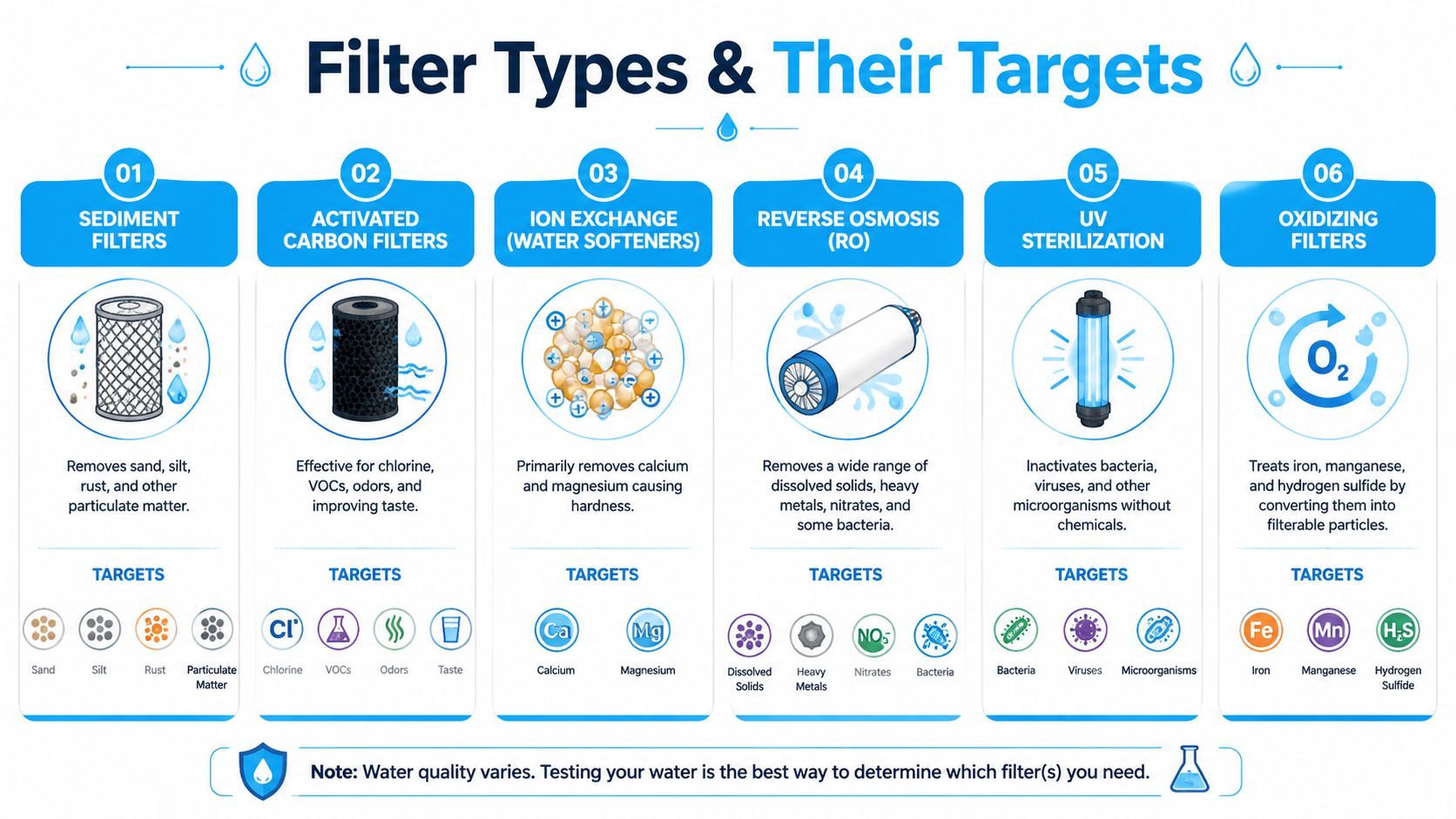
An infographic detailing six types of water filters, their primary functions, and the specific contaminants they target.

What each filter type actually does

A filter works best when you ask it to do the job it was built for. A coffee filter catches grounds, but it does nothing to dissolved sugar. Water treatment works the same way. Some devices catch particles. Some change the chemistry. Some disinfect.

Here is a practical side-by-side view:

Filter type Best for What it does not do well
Sediment filter Sand, silt, rust, particulate matter Doesn't remove dissolved minerals or disinfect
Activated carbon Taste, odor, some chemical reduction Not a cure-all for iron, hardness, or bacteria
Iron or oxidizing filter Iron, manganese, sulfur-related nuisance issues Needs proper pre-treatment and sizing
Water softener Hardness minerals Doesn't replace sediment or disinfection stages
UV purifier Bacteria and microorganisms Doesn't remove sediment or dissolved minerals
Reverse osmosis Drinking water purification, dissolved contaminants Usually not the whole-house answer by itself

That table matters because the biggest myth in this category is the universal filter myth. Homeowners are often shown one product that claims to handle everything. Real wells do not cooperate with that kind of sales pitch.

How these filter stages work together

A sediment filter works like the doormat at the front door. It catches grit before that grit clogs valves, scratches seals, or blinds more specialized equipment farther down the line.

An activated carbon filter cleans up taste and odor in the right setting. It can also reduce certain chemicals. But on private well water, carbon is not a safe blind guess. If iron, sulfur, or heavy sediment are still present, carbon can foul quickly and stop doing much useful work. Some whole-house carbon systems, such as those described in Aquasana whole-house filter specifications, are built for long service life. That still does not make carbon the right first step for every well.

A UV purifier handles a different job entirely. It disinfects clear water. It does not strain out dirt, remove iron, or fix hardness. If cloudy water reaches a UV chamber, the light can be blocked and treatment can fall short.

Why one-size-fits-all systems fail

Here is a common real-world example. A homeowner smells sulfur, sees orange staining, and buys a carbon tank because the ad says it fixes bad well water. The smell improves for a short time. The staining stays. Flow starts to drop. A few months later, the system is blamed when the actual problem was the match, not just the product.

Iron, manganese, sulfur, low pH, hardness, and sediment often overlap. One treatment stage can also create a new condition that another stage must address. A neutralizer can raise hardness. An oxidizing step can create particles that need filtration. A softener can help with some dissolved iron, but it is not meant to carry the full load when iron is high.

That is why sequence matters as much as filter choice.

A common treatment path looks like this:

  • Sediment filtration first: protect valves, media, and downstream equipment
  • Specialty treatment next: target iron, manganese, sulfur, or pH correction
  • Softening after that when needed: remove hardness, including hardness added by pH correction media
  • Disinfection last: treat microbiological risk after the water is clear enough for the disinfecting stage to work well

For a well with iron, acidic water, and sulfur odor, the order can be the difference between clean water and constant service calls. This treatment sequence demonstration shows how those stages are often arranged so each one supports the next.

The right filter for the wrong contaminant is still the wrong filter.

When RO makes sense

Reverse osmosis is a specialist, not a whole-house cure.

It is often a strong choice at a drinking water tap when testing shows dissolved contaminants that need a higher level of reduction. It is also one of the technologies commonly used when homeowners want extra protection for drinking and cooking water. As noted earlier, products marketed for health-related reduction claims should be checked carefully for the specific certification tied to the contaminant you need to address, such as NSF 53 or 58 where applicable.

That last part gets skipped too often. Buying RO because it sounds advanced is still guessing. In some homes, RO is a smart finishing step at the kitchen sink. In others, the need is iron treatment, pH correction, sediment removal, or disinfection at the whole-house level first.

Good well water treatment is less like buying one magic gadget and more like building the right lineup for your water. Testing tells you who belongs on the field.

Sizing and Installing Your Well Filtration System

A filter can be the right type and still be the wrong fit. That usually shows up as poor water pressure, short filter life, or a system that can't keep up when two showers and the washing machine are running at the same time.

That's where sizing comes in.

A professional plumber uses a measuring tape to inspect copper pipes connected to a residential water heater.

Whole-house versus point-of-use

A point-of-entry system treats water as it enters the home. That means showers, sinks, laundry, toilets, and appliances all benefit.

A point-of-use system treats water at one location, such as an under-sink drinking water tap. That's useful when you want extra polishing at the kitchen sink, but it won't stop staining in the bathroom or sediment damage in the water heater.

The choice often comes down to where the problem lives.

  • Whole-house treatment fits: sediment, iron, sulfur odor, hardness, pH correction, whole-home bacteria concerns.
  • Point-of-use treatment fits: drinking and cooking water polishing, or targeted final-stage purification.

Why housing size and micron rating matter

For well water, the first stage has to be more than an afterthought. SpringWell states that sediment filters for well systems should be sized to a 20-inch Big Blue housing with 4-inch diameter and use 20-micron filtration as the primary defense to protect downstream equipment, while 5-micron sediment filtration captures sand, silt, and clay; the same source notes catalytic carbon media can remove 97 to 99% of chlorine and chloramine, and system lifespan is 1 year per 100,000 gallons or 10 years for 1 million gallons, according to SpringWell whole-house filter details.

That's a good illustration of a bigger point. Housing size, media type, and micron rating all change how a system performs. A tiny cartridge housing on a sediment-heavy well is like putting a coffee filter in front of a leaf blower. It'll plug fast and frustrate everyone in the house.

How to think about flow

You don't need to become a hydraulic engineer. You just need to think practically.

Ask yourself:

  • How many bathrooms are in use at once?
  • Does the home have large tubs, irrigation, or high-demand fixtures?
  • Do pressure complaints already exist?
  • Will the treatment system add pressure drop under peak use?

If the system is undersized, the family notices it immediately. Showers weaken. Fill times stretch. Appliance performance gets inconsistent.

Here's a useful visual if you want to see how whole-house equipment is commonly laid out in a home plumbing setup:

DIY or hire a pro

Some homeowners can install a basic setup. Others are better off hiring a water treatment pro or a plumber who works with wells regularly.

DIY makes sense if you're comfortable with:

  • Pipe cutting and reconnection
  • Bypass valve placement
  • Mounting large housings or tanks
  • Following flow direction and service clearances
  • Checking for leaks and pressure issues after startup

Hire a professional if the system includes multiple tanks, pH correction, oxidizing media, UV, drain lines, or any treatment train that needs tuning after installation.

A clean install matters. Filters need room for service, proper shutoffs, and a layout that lets you maintain one stage without tearing apart the whole system.

Maintenance Schedules and Lifetime Ownership Costs

A lot of homeowners compare systems by sticker price alone. That's a mistake. The better question is, “What will this setup ask from me every year?”

A well water system is more like a furnace than a toaster. It needs periodic attention to keep doing its job.

The recurring work nobody should ignore

Some parts need regular replacement. Others last for years. The trick is knowing which is which so you don't overpay or neglect something critical.

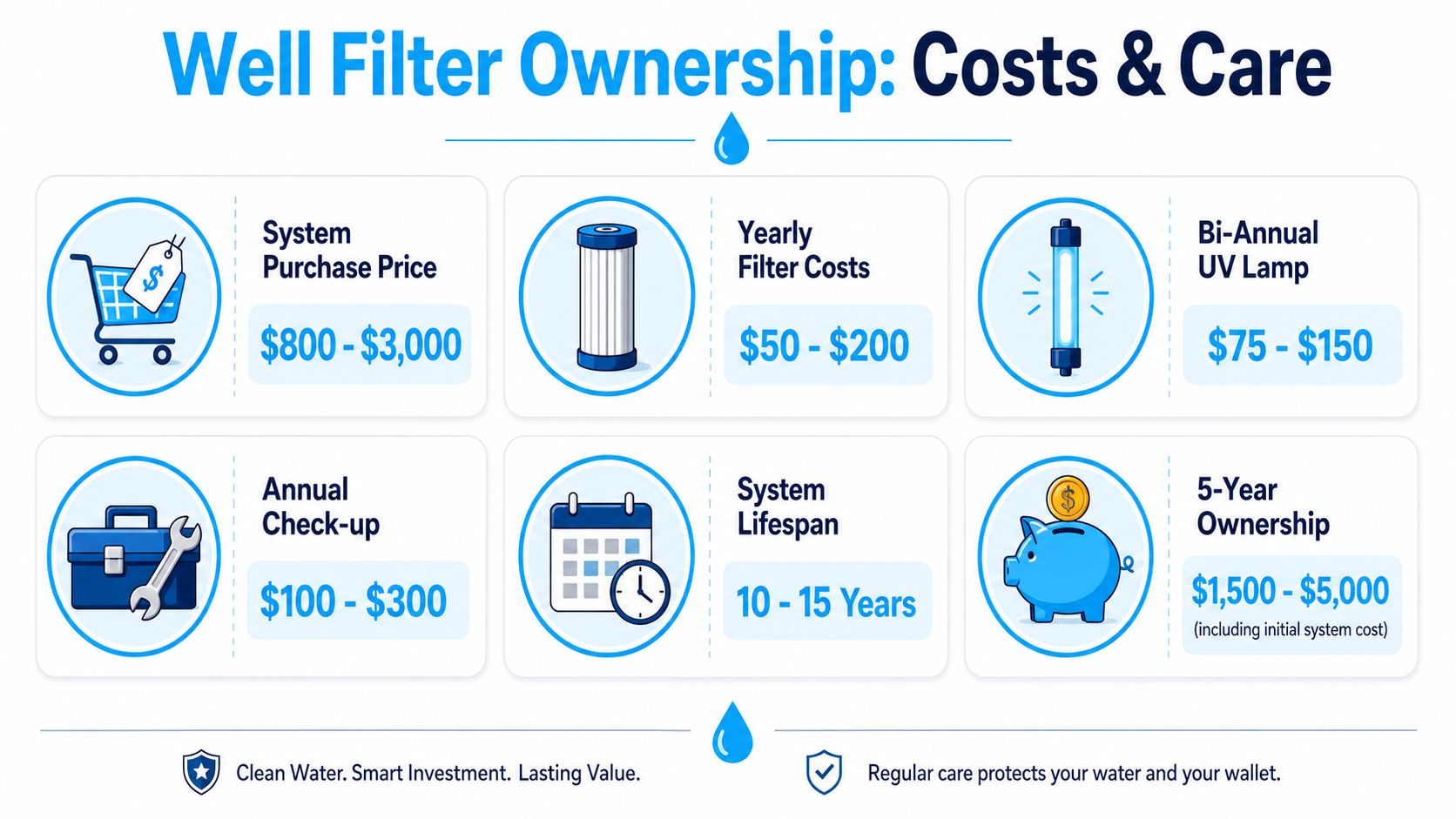
An infographic detailing the costs and maintenance requirements for residential well water filter systems over time.

For advanced whole-house systems, long-term operational costs are estimated at $25 to $40 per year for sediment post-filter replacement, typically changed every 6 to 9 months, while the main filtration media can last 6 to 10 years and treat up to 1 million gallons.

That's a useful reminder that the expensive-looking tank in the basement often isn't the part you service most often. The little pre or post filter usually gets the routine attention.

What maintenance usually looks like

A practical ownership schedule often includes:

  • Sediment cartridges: Changed on schedule, or sooner if pressure drops and the water is sediment-heavy.
  • Main media bed: Replaced far less often, usually years apart depending on water quality and usage.
  • System checks: Inspect housings, valves, and bypasses for leaks or wear.
  • Water retesting: Especially important after installing treatment that changes water chemistry.

The exact schedule depends on your water, not just the box label. A clean, steady well and a muddy seasonal well won't treat filters the same way.

Cost mistakes that catch people off guard

The cheapest system can become the expensive one if it requires constant cartridge changes, can't handle sediment load, or lets iron foul downstream equipment. On the other hand, an oversized or poorly selected setup can lock you into maintenance you never needed.

A smarter way to compare systems is to ask:

Question Why it matters
How often do the routine filters change? This affects yearly upkeep and convenience
How long does the main media last? This affects long-term value
What happens if my sediment load changes? Wells can shift with seasons and weather
Can I buy replacement parts easily? Hard-to-source parts become a headache fast

One more thing. If your system includes neutralization or softening, retesting after installation matters. Treatment can change water balance, and those changes may create a second maintenance need if nobody checks.

Your Final Well Water Filter Decision Checklist

By the time you're ready to buy, the goal isn't to find the flashiest system. It's to avoid expensive mismatches.

A good buying checklist keeps you from skipping steps when product pages start making broad promises.

The short list that protects you from a bad purchase

Print this out or keep it on your phone while you compare options.

  • Have I tested my water with a lab, not just guessed from symptoms?
  • Do I know my top contaminants in order of importance?
  • Do I know whether I need whole-house treatment, point-of-use treatment, or both?
  • Have I matched each contaminant to a specific treatment type?
  • Do I know the treatment order, not just the treatment names?
  • Is the system sized for my household flow and sediment load?
  • Can I live with the maintenance schedule?
  • Are replacement filters or media easy to get?
  • If bacteria is a concern, is disinfection part of the plan?
  • If hardness or low pH is involved, have I considered how one stage affects the next?

One last reality check

If a seller claims one tank solves every well water problem, slow down. Complex well water usually needs a staged approach. The more mixed the water issues are, the more important sequencing becomes.

For homeowners who want a broader overview of understanding water treatment options, that resource does a good job of framing how different treatment methods fit different household problems.

Buy the system that matches your test results, your plumbing, and your tolerance for maintenance. Don't buy the system with the best slogan.

That's how you make a confident decision. Not by chasing a universal fix, but by building a setup that fits your well.

Frequently Asked Questions About Well Filtration

A lot of well owners reach this section hoping for one simple answer. One filter. One tank. One fix. That would be nice, but well water rarely behaves that way.

A private well is more like a custom recipe than a standard utility supply. One home deals with iron and sulfur smell. The next fights sediment, low pH, and bacteria risk. That is why the right answer usually starts with, "What did your water test show?"

Can one filter really handle all well water problems?

In most homes, no.

A single filter can target one issue well, or a small group of related issues. It cannot reliably handle every possible well water problem at once. Sediment needs one kind of treatment. Hardness needs another. Iron, sulfur, acidity, and bacteria each call for their own approach, and the treatment order matters too.

The "universal filter" idea sounds convenient because it skips the hard part. The hard part is matching the equipment to the water you have, not the water a product label assumes you have.

Why does my water taste fine at first, then seem worse after a while?

Filters wear out, media gets used up, and cartridges clog. That is one common reason.

Another is a poor match between the filter and the contaminant load. A system may look fine on day one but struggle after weeks or months if your well has more sediment, iron, or organic material than the unit was built to handle. It is a bit like using a coffee filter to catch mud. It works for a moment, then plugs up or lets the wrong things pass through.

Some point-of-use systems also create confusion. A carbon filter can improve taste and odor at first, but carbon is not a disinfection method. Guidance from Aquaclear on whole-home filtration considerations notes that treatment plans need to account for bacterial risk, especially in well water setups where carbon media may be part of the system.

Does a carbon filter remove bacteria from well water?

Carbon helps with taste, odor, and some chemical reduction. It is not the tool you rely on for bacteria control.

If bacteria is part of the risk, the treatment plan needs a disinfection step. In many homes, that means UV placed after proper prefiltration so the light can do its job. Without that step, a carbon filter may make water taste better while leaving the main safety question unanswered.

Are under-sink filters enough for a well?

They can make sense for drinking and cooking water at one faucet.

They do not solve house-wide problems such as sediment in showers, rust stains in toilets, sulfur smell in hot water, or scale building up in pipes and appliances. If the trouble shows up all around the house, treatment usually needs to start where the water enters the home, not only where you fill a glass.

What about salt-free systems?

Salt-free systems are often marketed in ways that blur an important distinction. Conditioning is not the same thing as removing hardness minerals.

If your lab results show mild scaling concerns, a salt-free option may fit some homes. If your well water is hard, do not assume a salt-free device will perform like a conventional softener. Chemistry still sets the rules, no matter how polished the sales pitch sounds.

Should I retest after installation?

Yes.

Retesting confirms whether the system is solving the problem you paid to solve. It also catches cases where a system improved one issue but left another one behind. That matters with wells, because water can change with season, rainfall, pump work, or aquifer conditions.

A good installation is a strong start. A follow-up test is the proof.

What's the biggest mistake homeowners make?

Buying equipment before getting a proper lab test.

That one mistake leads to a chain of expensive problems. The wrong media. The wrong flow rate. The wrong treatment order. The wrong maintenance plan. Many homeowners are sold a box before anyone has identified what is in the water, and that is how a "deal" turns into years of frustration.

If you're sorting through test results, comparing filter types, or trying to avoid a costly mismatch, Water Filter Advisor is a practical place to start. It helps homeowners compare filtration options, understand maintenance, and make sense of the claims that show up on water treatment product pages.

Best Whole House Iron Filter for Well Water (2026 Guide)

Orange streaks in the toilet bowl. Brown staining around the tub drain. A glass of water that looks clear at first, then leaves a metallic aftertaste you can’t ignore. If that sounds familiar, you’re not dealing with a small nuisance. You’re dealing with a whole-house water problem that reaches every faucet, appliance, and pipe in the home.

A lot of homeowners start the search for the best whole house iron filter for well water by looking for one machine that will “remove iron.” That’s usually the wrong starting point. Iron is rarely the only issue in a well. It often shows up with hardness, manganese, sulfur odor, sediment, or even iron bacteria. Buy a filter for the wrong version of the problem, and you end up with staining that never goes away, pressure that drops, and equipment that clogs long before it should.

The better approach is to think like a water treatment installer. Build a treatment train. Test first, identify the actual contaminants, then choose the right sequence of equipment so each stage helps the next one work better.

Is Your Well Water Waging War on Your Home

The signs usually show up slowly. First it’s a faint orange line in the sink. Then white towels start coming out of the wash looking yellowed. Then someone mentions the water tastes like a handful of pennies. By the time most homeowners start shopping, the water has already been working on the plumbing for a while.

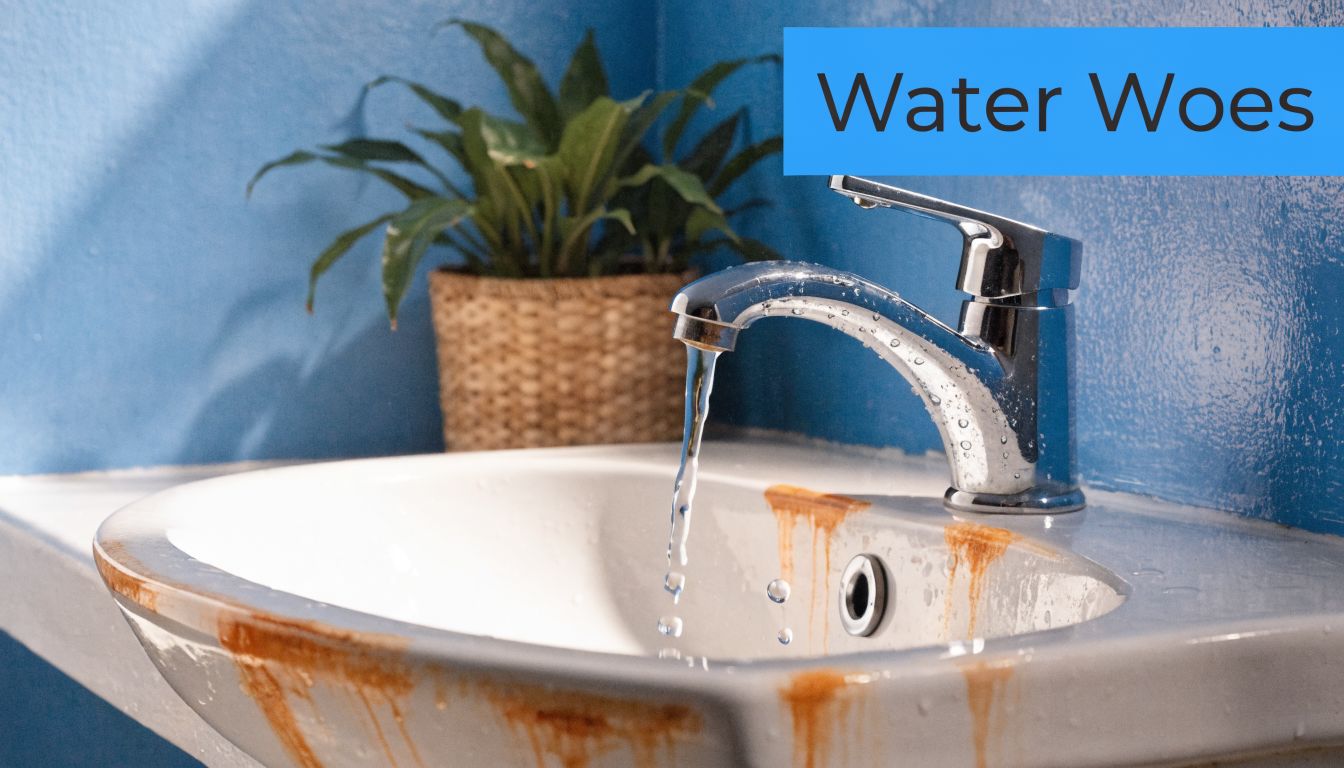
A bathroom sink stained with rust showing water flowing from a metal faucet against blue walls.

Iron in well water isn’t rare. Iron contamination affects approximately 23 million U.S. households relying on private wells, and the U.S. Geological Survey reports that 15 to 20% of these wells exceed the EPA’s secondary standard of 0.3 ppm for iron, which is where staining, metallic taste, and plumbing damage become common issues, according to this review of iron filter performance and well water conditions.

What iron does in a house

Iron creates two kinds of frustration at the same time. One is visible. Rust-colored staining on fixtures, tubs, toilets, grout, and laundry. The other is hidden. Iron builds up inside valves, water heaters, dishwasher parts, and narrow plumbing passages.

That combination tricks people into underestimating the problem. They focus on the ugly stains because they can see them. Meanwhile, the plumbing keeps collecting deposits.

Practical rule: If iron is staining your toilet tank or sink, it’s also traveling through everything else that uses water.

Why a simple product list won’t help enough

Homeowners often ask which unit is “best,” as if all iron filters are interchangeable. They aren’t. Some systems are strong with dissolved iron but struggle with sulfur. Some handle manganese well. Some are fine in a clean well but fail fast when hardness or bacteria gets involved.

That’s why the right answer usually sounds less exciting than people expect. It starts with diagnosis, not shopping. The best system is the one that matches your water chemistry, your home’s flow demand, and the order your equipment is installed in.

First Step Always Test Your Water

If you skip testing, you’re guessing. In well water, guessing gets expensive fast.

A homeowner sees orange staining and buys an iron filter online. It arrives, gets installed, and maybe it helps for a while. Then the rotten egg smell comes back, pressure starts dropping, or the stains never fully stop. Most of the time, the filter itself isn’t defective. The diagnosis was.

A person holding a clear sample vial filled with liquid for water quality testing purposes.

Iron isn’t one thing

When people say “I have iron,” they might mean very different water conditions.

  • Ferrous iron is dissolved iron. It often comes out of the tap looking clear, then turns orange after it sits or hits air. This is often called clear-water iron.
  • Ferric iron is already oxidized. You can think of it as rust particles floating in the water. It’s visible and easier to trap with the right filtration stage.
  • Iron bacteria is the troublemaker many product pages barely explain. It forms slime, fouls plumbing, and can overwhelm filters that would work fine on ordinary iron.

Each one behaves differently. That matters because treatment depends on how the iron enters the filter and what else is traveling with it.

What to test for besides iron

A proper well water workup should identify more than the iron level.

You also want to know:

  • Hardness, because hard water can interfere with some iron systems and create scale that shortens equipment life.
  • Manganese, because it often rides along with iron and can stain fixtures dark brown or black.
  • Hydrogen sulfide, which creates the rotten egg smell and changes the treatment approach.
  • pH, because some media need the right water chemistry to work consistently.
  • Sediment and turbidity, because grit can load a filter bed too quickly.
  • Bacteria concerns, especially if you’ve seen slime in toilet tanks or around plumbing fixtures.

Test results should tell you what needs to happen first, second, and third in the treatment line. They should not just point you to one tank.

Why testing saves money

The biggest mistake in this category is buying a strong iron filter for a mixed-contaminant well and expecting it to solve everything alone. It won’t. If the water contains iron plus hardness, or iron plus sulfur, or iron plus bacteria, you’re building a system, not buying a single fix.

That’s why I always treat testing as the first piece of equipment, even though it isn’t equipment. A test prevents you from putting the wrong tank in the middle of the plumbing and asking it to do a job it was never built for.

If you need help understanding the basics before you compare equipment, the practical guidance in Water Filter Advisor’s water filtration advice library is useful for sorting through common home treatment setups and terminology.

A quick read on the water you already have

Even before the formal test comes back, your house is already giving clues.

  1. Clear water that turns orange later usually points toward dissolved iron.
  2. Water that already looks rusty suggests oxidized iron or sediment-heavy conditions.
  3. Slimy buildup in the toilet tank raises suspicion for iron bacteria.
  4. Rotten egg odor usually means sulfur is part of the story.
  5. Soap that won’t lather and scale on fixtures points toward hardness joining the party.

Those clues aren’t enough to size a system, but they are enough to stop you from buying blind.

Comparing Iron Filtration Technologies

Most whole-house iron filters do the same job in broad terms. They convert iron into a form the system can capture, then they flush the collected material out during backwash. The difference is how they do that job, what kind of water they work best in, and how much babysitting they require.

Here’s a simple side-by-side view.

Technology Best fit Strengths Trade-offs
Air Injection Oxidation Homes with typical iron issues and a preference for chemical-free treatment Strong whole-house option, low day-to-day involvement, widely used Can struggle when water has iron bacteria or high hardness
Manganese greensand Water that needs oxidation and filtration in one media bed Effective when matched properly to the water Requires regeneration chemistry and more hands-on upkeep
Catalytic media such as Katalox-Light Homeowners wanting strong oxidation support with durable media Good fit in many iron and manganese applications Still depends on correct sizing and water chemistry
Chemical oxidation with chlorine or peroxide Tough wells with sulfur, slime, or severe mixed contamination More aggressive treatment for difficult water More components, more maintenance, and chemical handling
Water softener only Very light iron combined with hardness Useful support equipment in the right role Not a substitute for a real iron filter in most wells

A comparison chart showing three iron filtration technologies: air injection, manganese greensand filters, and chemical oxidation.

Air Injection Oxidation systems

Air Injection Oxidation, usually shortened to AIO, is where many of the best residential systems live. The idea is simple. The system introduces air into the tank, oxygen reacts with dissolved iron, and the iron changes from something invisible in the water into particles the media can catch.

This process is akin to taking steam and turning it into droplets you can wipe off a mirror. The iron was there the whole time. Oxidation just makes it possible to grab it.

Modern AIO systems are often a set-and-forget solution for many homes. Models like the SpringWell WS1 are presented as effective up to 7 ppm iron, while the SoftPro IronMaster is positioned for more severe situations up to 30 ppm, according to this roundup of whole-house well water systems.

That’s why AIO is often the first technology I look at for the best whole house iron filter for well water. It’s clean, effective in the right conditions, and doesn’t force the homeowner into constant chemical handling.

Catalytic media and why it matters

AIO systems still depend on the media inside the tank. Media is the working surface where oxidized contaminants get trapped and removed during backwash. One of the names you’ll see often is Katalox-Light, especially in systems built for stronger iron loads.

Some homeowners focus almost entirely on the control valve brand and ignore the media. That’s backwards. The valve controls the cycle. The media does the water treatment.

A stronger media bed can mean better contaminant handling, longer useful life, and more stable performance when the well water changes a bit through the year. That doesn’t make every catalytic-media system equal, but it does explain why two tanks that look similar on the outside can perform very differently.

If a product description talks about “removing iron” but says little about the media, be cautious. That’s like buying a vacuum based on the power button and ignoring the motor.

Greensand and older oxidizing media

Manganese greensand has been used for a long time, and it still has a place. It works by coating media with an oxidizing surface that helps convert and filter iron and manganese. The catch is maintenance. These systems typically need regeneration with chemicals.

That extra step doesn’t make greensand bad. It just makes it less appealing for homeowners who want low involvement. A well-matched greensand setup can work very well, but it asks more from the owner and leaves less room for neglect.

Birm also shows up in some comparisons. It can work in the right water, but it’s less forgiving than many people think. If the chemistry isn’t favorable, performance can fall off quickly.

Chemical oxidation for difficult wells

Some wells need a stronger approach. That’s especially true when sulfur odor, biofouling, or stubborn mixed contamination shows up. In those cases, a chemical feed system paired with a contact stage and filtration can outperform a simple AIO tank.

Chemical oxidation is the heavy-duty route. Instead of relying on air alone, the system injects an oxidizer such as chlorine or peroxide to convert contaminants aggressively before they hit the filter stage.

This approach is less elegant but often more dependable in ugly water. It’s the work truck of iron treatment. More parts, more upkeep, more attention. But when the water is hostile, a work truck beats a sports car.

The limited role of water softeners

A water softener can help with small amounts of iron in some homes, especially when hardness is also a problem. But using a softener as your primary iron filter is one of the most common mistakes in well water treatment.

Softeners are hardness machines first. If the well has meaningful iron, especially when staining is obvious, the softener usually needs help from a dedicated iron stage ahead of it or beside it in the treatment plan.

That’s the difference between a system that limps along and one that solves the problem.

Key Factors for Choosing Your System

Shoppers get overwhelmed because spec sheets throw around terms like valve size, media volume, service flow, and backwash rate as if everyone installs this equipment for a living. What matters is how those specs play out at 7 a.m. when someone’s showering, the dishwasher is running, and the washing machine kicks on.

Flow rate matters more than most people expect

If a unit is undersized for the home, it may still remove iron on paper and still feel disappointing in real life. That’s because the best whole house iron filter for well water has to treat the water without choking the house.

A larger household or a home with several bathrooms needs enough service flow to keep pressure usable during peak demand. If the filter can’t keep up, you’ll feel it first in the shower.

A few practical checks help:

  • Bathroom count matters: More bathrooms usually mean more overlapping water use.
  • Fixture habits matter: A home with irrigation, large tubs, or frequent laundry loads places a different demand on the system.
  • Well pump matters too: The filter can’t deliver more flow than the rest of the plumbing can support.

Size the plumbing path, not just the tank

Port size and pipe size affect how freely water moves through the treatment line. In a larger home, narrow connections can act like a pinch point even if the tank itself looks substantial.

That’s one reason I like homeowners to review complete-system layouts, not just isolated filter specs. Broader references on best whole home water filtration systems can help you compare how iron filters fit into full-house plumbing strategies rather than treating them like stand-alone gadgets.

Think in ownership costs, not sticker price

The cheap unit often becomes the expensive one. You pay once at checkout, then pay again in media changes, chemical supplies, lost pressure, or equipment that never fully fixes the stains.

Focus on these questions:

  • How often does the system backwash? Frequent backwash can be fine if it’s necessary, but it affects water use and wear.
  • What media is inside? Better media usually means better durability and less frustration.
  • Does the system need chemical replenishment? That changes both maintenance and running cost.
  • How easy is service? Straightforward controls and available replacement parts matter more than flashy marketing.

A good iron filter should fit your water and your habits. If it only works when everything is ideal, it’s not a good home system.

The control valve deserves attention

The valve is the traffic controller. It determines when the unit backwashes, how long cycles run, and how reliably the system cleans itself. A solid valve paired with the right media usually outperforms a fancy-looking tank with weak internals.

Homeowners don’t need to become valve experts. They just need to avoid treating the control head like an afterthought.

Best Iron Filters for Common Well Water Scenarios

Product selection finally makes sense. Not by asking which unit is “best” in the abstract, but by matching the equipment to the water profile.

Low to moderate iron with otherwise clean well water

If your test shows straightforward iron and no major sulfur, bacteria, or heavy hardness complications, an AIO system is usually the cleanest answer.

Systems like SpringWell WS1 make sense. It’s positioned for homes dealing with iron in the lower to moderate range, and the appeal is obvious. Chemical-free treatment, whole-house coverage, and a design homeowners can live with without constant attention.

This type of setup is often the sweet spot for people who want a real fix without building a mini treatment plant in the basement.

Higher iron levels that need more muscle

Once the iron gets more aggressive, you need a system built for heavy loading. That’s where SoftPro IronMaster stands out in many comparisons. It’s frequently mentioned for handling stronger iron situations and uses the AIO approach with media designed for tougher work.

The practical reason to step up here is simple. When iron is heavy, a lighter-duty system may work briefly, then start slipping. Staining returns, backwash becomes more important, and the homeowner ends up chasing symptoms.

For high-iron wells, I’d rather see a system with headroom than one operating at the edge of its comfort zone.

Iron plus manganese

Iron and manganese often travel together, but they don’t always behave the same way in treatment. Manganese can be harder on some systems and may push the recommendation toward media and designs known to handle that combination well.

In those cases, Pentair’s Iron & Manganese Combo is worth a look because it’s noted for manganese-heavy conditions among verified products. The key point isn’t the brand name alone. It’s that manganese changes the target. A filter that’s merely “good for iron” may not be the right fit once manganese becomes a priority.

Iron plus rotten egg odor

If the water smells like sulfur, don’t treat it like an iron-only job. That smell changes the system choice.

A strong candidate in this category is US Water Systems Matrixx Infusion, which is positioned for homes dealing with both iron and hydrogen sulfide. This is exactly the kind of scenario where homeowners waste money by buying a standard iron tank, only to learn later that odor control needed to be built into the original design.

For sulfur combinations, the right system doesn’t just remove staining. It restores the house to a point where showers, laundry, and kitchen water stop announcing themselves.

Iron plus hardness

This is one of the most common mixed problems in well water, and it’s where treatment train thinking pays off.

If the house has both iron and hard water, the answer usually isn’t “buy a better iron filter” or “buy a bigger softener.” It’s sequence. In many homes, the iron stage and the softener need to work together, each doing the part it’s good at.

A practical setup often looks like this:

  1. Sediment protection first if the well carries grit or visible particulate.
  2. Iron removal next so the softener isn’t asked to carry the whole load.
  3. Softener after that to deal with hardness and polish up the water for daily use.

That order protects the softener and gives better long-term stability.

Clean iron versus messy iron

Not every iron problem deserves the same confidence in AIO. If the well is relatively clean and the issue is mostly dissolved iron, AIO can be an excellent fit. If the well has slime, sulfur swings, or clear signs of biological fouling, I move much faster toward stronger pretreatment or chemical oxidation.

That distinction matters more than the brand list. Homeowners don’t lose money because they bought a “bad” product. They lose money because they bought the right product for somebody else’s water.

The best recommendation isn’t the unit with the loudest marketing. It’s the one that matches the chemistry in your test report and the order of equipment in your plumbing line.

Solving Complex Problems Iron Bacteria and Mixed Contaminants

Simple buying guides frequently fall short. They treat all iron like a basic oxidation problem. It isn’t.

Iron bacteria changes the game because you’re not just removing dissolved minerals. You’re dealing with slime, biofilm, and fouling that can coat plumbing and overwhelm media beds. A standard AIO tank can look perfect on the sales page and still struggle badly in that environment.

A useful warning from product analysis is that standard AIO systems can clog rapidly if water hardness exceeds 10 gpg or iron bacteria is present, often forcing the homeowner to add a pre-filter or water softener at an extra cost of $800 to $1,500, as noted in this discussion of mixed-contaminant well water and iron filtration limits.

How to recognize an iron bacteria problem

You may be dealing with iron bacteria if you notice:

  • Slimy residue in toilet tanks, filter housings, or around fixtures
  • Recurring odors that don’t line up neatly with a standard sulfur-only problem
  • Filters plugging early even when the equipment seems properly chosen
  • Persistent staining after installing a basic iron system

Iron bacteria often requires disinfection thinking, not just filtration thinking.

What usually works better

For these tougher wells, the treatment train often becomes more important than the individual filter.

A common order is:

  1. Sediment stage if grit or turbidity is present
  2. Oxidation or chemical injection stage when the water needs stronger treatment
  3. Iron filtration media tank
  4. Water softener if hardness is part of the water profile
  5. UV sterilizer when biological protection is needed after the rest of the treatment

This isn’t the only valid order, but it shows the logic. You don’t want downstream equipment fighting upstream problems it was never designed to handle.

Where homeowners get into trouble

The most expensive phrase in well water treatment is “I thought this one unit would do it all.”

Mixed contaminants rarely reward that mindset. If your well has iron, hardness, sulfur, and bacteria concerns, you’re building a chain. Every link has to support the next one. When that sequence is wrong, even good equipment performs like bad equipment.

Installation Maintenance and Troubleshooting

A whole-house iron system isn’t difficult to live with when it’s installed correctly. Most long-term headaches trace back to placement, drain setup, bypass access, or poor sequencing.

A professional maintenance person performs upkeep on a metal water filter system connected to plumbing pipes.

Decide early whether this is DIY or pro work

Some mechanically inclined homeowners can handle installation if the plumbing is accessible and the treatment plan is simple. But a whole-house iron filter still needs correct bypass orientation, drain routing for backwash, enough space to service the tank, and proper tie-in ahead of the fixtures you want protected.

If you’re installing equipment during a renovation or trying to understand where the treatment line fits into the home’s supply layout, a plain-English guide to plumbing rough-ins helps make sense of how and where water lines are set before finish plumbing goes in.

Maintenance that keeps the system working

A good maintenance routine is simple and repeatable.

  • Watch the backwash cycle: Make sure the system is cleaning itself and draining properly.
  • Inspect for pressure changes: A sudden drop can point to fouled media, clogged prefiltration, or a valve issue.
  • Check for returning stains or odor: That usually means the treatment is no longer matching the water, or a stage upstream is failing.
  • Keep the bypass accessible: You don’t want to dig behind storage shelves during service.
  • Retest water when conditions change: Seasonal shifts or well work can change performance.

Here’s a helpful walkthrough of what proper service and upkeep looks like in the field.

Troubleshooting the common complaints

If pressure drops after installation, check the sediment stage first and confirm the system was sized for household demand. If stains return, don’t assume the unit is “bad.” Confirm the media is still functioning, the valve is cycling properly, and the original test didn’t miss a mixed-contaminant issue.

If the system seems noisy during regeneration, that can be normal, but sharp changes in sound deserve a look at the drain line, valve movement, and backwash flow.

The goal is simple. Protect the investment by treating the system like home equipment, not a mystery tank you ignore until the toilet turns orange again.


If you want help comparing systems, understanding test results, or figuring out the right treatment train for your home, Water Filter Advisor is a practical place to keep researching. Their guides can help you sort through iron filters, softeners, UV systems, and maintenance questions so you can choose equipment that suits your water.