You shower, towel off, and instead of feeling clean, your skin feels tight. Your scalp itches by lunchtime. Your hair looks rough even though you used the same shampoo that worked fine somewhere else. Most homeowners call that “hard water” and stop there.
Sometimes that guess is right. Often, it's incomplete.
A lot of people are standing under municipal water every day without realizing that chlorine is part of the shower experience. It's added to public water for safety, but once that hot water hits your skin and hair, it can be a different story. That's where shower filters become useful. Not magical. Not a cure-all. But useful in a very specific, targeted way.
That Hard Water Feeling Might Just Be Chlorine
You step out of the shower and your skin feels tight before you even reach for the towel. Your hair dries flat, your scalp gets itchy, and the bathroom carries a faint pool smell. In plenty of city-water homes, that gets blamed on hard water by default.
Sometimes the better first suspect is chlorine at the showerhead.
That distinction matters because chlorine and hardness create different problems, and shower filters are built to handle one far better than the other. Municipal systems use chlorine for a good reason. It helps keep water safe as it travels through the distribution system. But once that heated water is hitting your skin and hair every day, the same disinfectant can feel harsh.
The clue many homeowners miss
Look at the symptoms and the bathroom itself. If you have dryness, a stripped feeling after showering, fading hair color, or a chemical smell, but you do not see much white scale on fixtures or stubborn soap scum, chlorine is a strong possibility.
That is a very different pattern from classic hard water.
The U.S. Environmental Protection Agency explains that chlorine is commonly used to disinfect drinking water in public systems, which is why it is so often part of the shower experience in municipal homes, as outlined in the EPA's overview of drinking water disinfection. A shower filter targets that point-of-use exposure. It is a focused fix for a focused problem.
Practical rule: If the shower smells chemical and your skin feels stripped, start with chlorine as the likely irritant before assuming you need a water softener.
Why hot showers tend to make it more noticeable
Heat changes the feel of the shower, even if it does not turn the water into a different category of problem. Long, hot showers tend to leave skin and hair more stressed, so chlorine exposure stands out more. Homeowners usually describe it as that squeaky, over-cleansed feeling that shows up right after rinsing.
I see this confusion all the time. People assume any uncomfortable shower must be hard water, then buy the wrong solution first.
A shower filter can help if chlorine is the trigger. It will not solve mineral hardness, and it will not stop scale from building up through the rest of the plumbing. But if the main complaint is chemical harshness at the point of contact, a filter is aimed at the right target.
What a shower filter changes
A shower filter does not rebuild your water system or treat every tap in the house. It changes the water that reaches your body during one of the highest-contact uses in the home.
Used in the right situation, that is the main benefit. Less chlorine exposure at the shower can mean a more comfortable rinse, fewer complaints about odor, and a clearer explanation for why the water feels bad in the first place. That is a better starting point than lumping every shower problem under “hard water” and hoping one product solves all of it.
Unpacking the Skin and Hair Glow-Up
A common shower complaint sounds cosmetic at first. Skin feels tight after rinsing. Hair turns rough, flat, or harder to manage. Homeowners often blame hard water right away, but in many bathrooms the bigger day-to-day trigger is chlorine touching skin and hair over and over.
That distinction matters because the fix changes with the cause. A shower filter can reduce chlorine exposure at the point of use. It does not soften water, and it does not solve every reason skin or hair may feel off.
What happens on skin
Skin relies on natural oils and a stable barrier to stay comfortable. Chlorinated water can leave that barrier feeling stripped, especially after hot showers or longer rinse times. People with dry, reactive, or eczema-prone skin usually notice this fastest.
Some shower filters are tested for chlorine reduction under shower conditions, including products covered by NSF/ANSI 177 shower filtration guidance from IAPMO R&T. In practice, lower chlorine at the showerhead often means less post-shower tightness, less itching, and less of that over-cleansed feel.
The key point is simple. Filters do not add moisture to skin. They reduce one source of irritation.
For homeowners trying to sort out whether they need a filter, softener, or something more targeted, this water treatment advice guide is a useful starting point.
What happens on hair
Hair shows the same pattern. Chlorine can leave it feeling drier and less smooth, and color-treated hair often loses that freshly-done feel faster under heavily chlorinated water. People usually describe the change in practical terms. More tangling. Less shine. More frizz. A rougher feel at the ends.
A filter helps by cutting down contact with the disinfectant itself. That can make hair easier to rinse, comb, and manage. It can also help preserve the look of dyed hair, though it will not undo damage that is already there.
Why people notice the change quickly
Showering is a repeated exposure. If chlorine is the irritant, reducing it can produce a noticeable difference within a fairly short stretch of time because you are removing the same stressor from a daily routine.
Homeowners usually report a few specific changes:
- Softer-feeling skin after rinsing: Less tightness and less of the squeaky, stripped feeling.
- A calmer scalp: Less itchiness for people who react to chlorinated water.
- Improved hair feel: Hair may feel smoother, less brittle, and easier to detangle.
- Better color retention at the shower: Useful for anyone paying to maintain salon color.
What this benefit does not mean
However, much marketing often takes a wrong turn. A shower filter does not treat acne, cure eczema, or replace good skin and hair care. It removes or reduces selected shower contaminants, mainly chlorine, that can make existing dryness or sensitivity worse.
That is the value. Better comfort, fewer irritant complaints, and a clearer understanding of what the filter can and cannot do.
What Contaminants Shower Filters Actually Remove
A shower filter works best when you understand what's inside it. Most of the meaningful performance comes from the filtration media, not the chrome finish, the number of “stages” printed on the box, or the luxury branding.
KDF and calcium sulfite do the heavy lifting
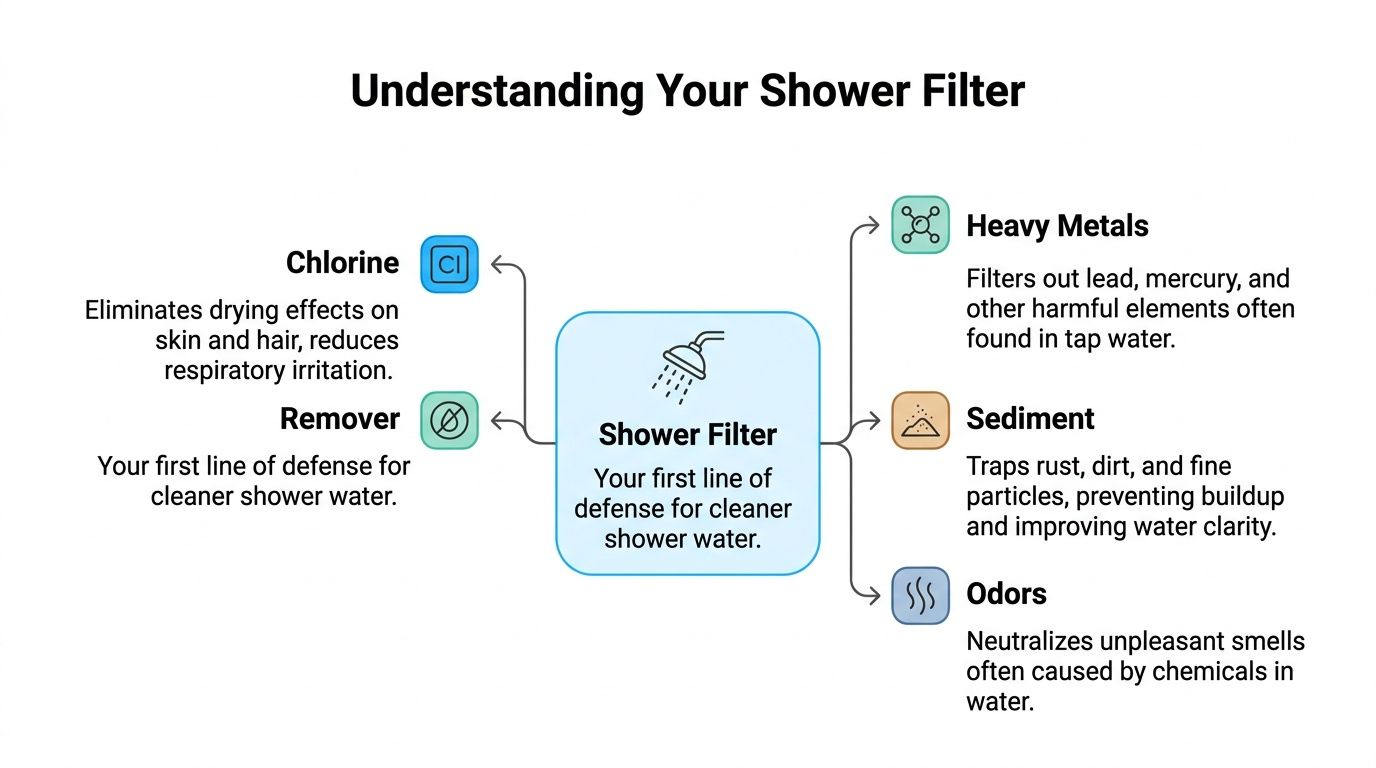
Two materials show up repeatedly in better shower filters: KDF copper-zinc media and calcium sulfite. These aren't there for decoration. They target chlorine by changing it chemically rather than trapping it like dirt in a screen.
Shower head filters using KDF copper-zinc media and calcium sulfite achieve up to 96–99% chlorine reduction by electrochemically converting chlorine into harmless chloride ions. Laboratory testing also shows that filters certified under NSF/ANSI 177 eliminate 100% of detected chlorine and associated disinfection byproducts like chloroform, according to Pentair's explanation of NSF 177 chlorine reduction performance.
That's why the better filters don't just “screen out” chlorine. They neutralize it.
Carbon and other media play support roles
Many shower filters also use carbon-based media. Think of carbon as a chemical sponge. It can help with odor and with some organic compounds. In multi-stage designs, it often supports the main chlorine-reduction media rather than replacing it.
Other stages may help with:
- Chloramines: Important in some municipal systems.
- VOCs and odors: Useful when shower water smells chemical.
- Trace heavy metals: Some filters are designed to reduce them at the point of use.
- Sediment: Helpful for rust or fine particles from aging plumbing.
If you want a grounded way to compare media types and claims, Water Filter Advisor's water filtration advice library is a solid place to sort out the basics before buying.
Under the hood matters more than the marketing
A box that says “15-stage” or “20-stage” doesn't automatically outperform a simpler design with proven media. Stage counts are easy to advertise. Media quality and certification are harder to fake.
Here's the practical hierarchy I use when evaluating a shower filter:
| What to check | Why it matters |
|---|---|
| KDF or calcium sulfite | These are proven chlorine-targeting media |
| NSF/ANSI 177 certification | Shows verified chlorine reduction claims |
| Sediment prefiltration | Helps protect media and improve water clarity |
| Clear replacement schedule | Tells you the brand expects the unit to be maintained |
A shower filter is a chemistry device disguised as bathroom hardware. Buy it for the media, not the finish.
Know the Limits When You Need More Than a Shower Filter
The fastest way to waste money on water treatment is to buy a shower filter when you need a water softener. This confusion is everywhere, and it leads to bad reviews from people who bought the wrong tool for the wrong job.
Filtration is not softening
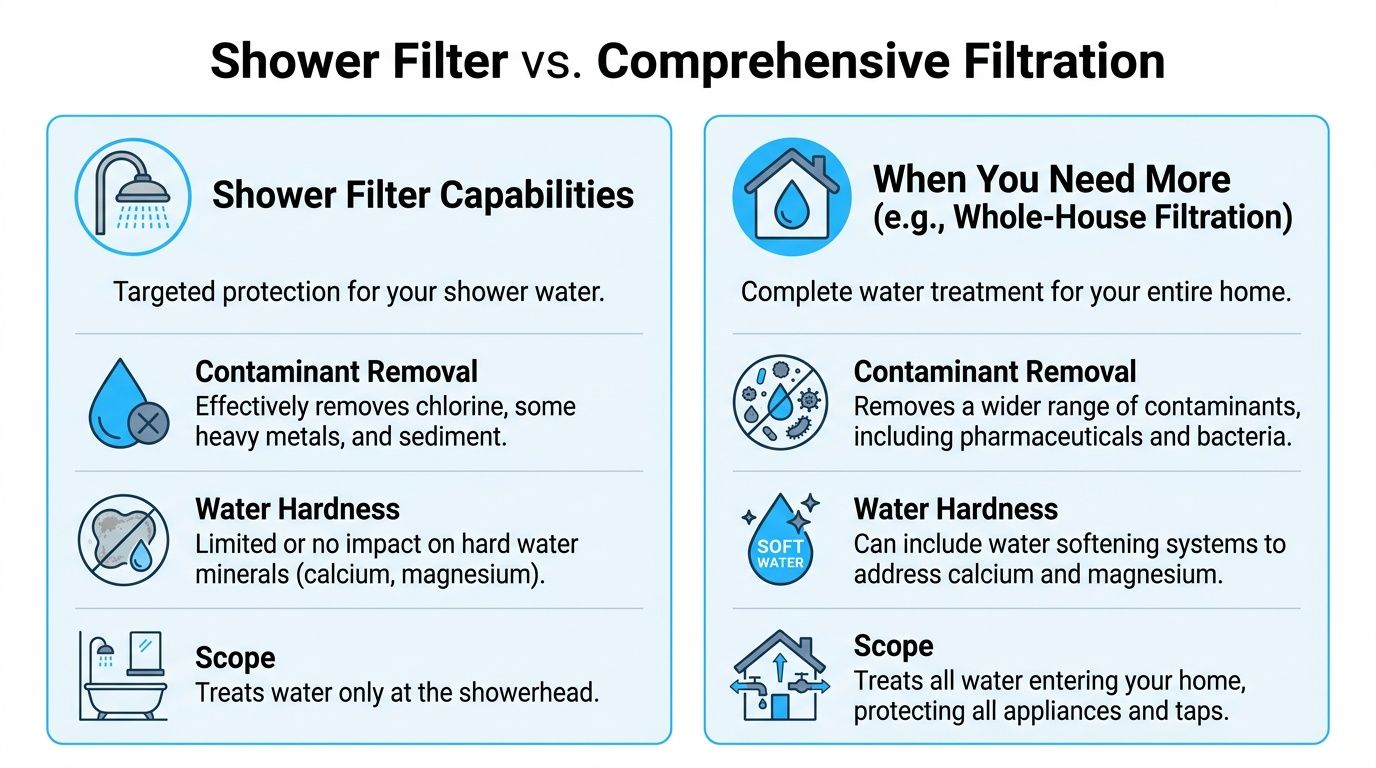
A shower filter is built to reduce contaminants like chlorine and chloramine. It is not built to remove dissolved hardness minerals from the water stream. Those minerals are mainly calcium and magnesium, and they cause the classic hard-water problems homeowners recognize in the bathroom and throughout the house.
Shower filters effectively remove chlorine and chloramine but do not address water hardness caused by dissolved calcium and magnesium minerals. For households with hard water, an ion-exchange water softener is the only reliable solution, according to The Water Professor's guide to shower filter effectiveness and hard water limits.
That's the dividing line. If your shower leaves scale on tile, soap won't lather well, or your fixtures develop crusty mineral buildup, a shower filter won't fix the root problem.
Signs you need more than point-of-use filtration
A simple self-check helps:
- White scale on faucets and glass: That points to hardness minerals.
- Soap scum everywhere: Also a hardness clue.
- Laundry and dishes affected too: A whole-house issue, not just a shower issue.
- Dry skin with chemical smell but little scale: More likely a chlorine-focused problem.
Those distinctions matter because homeowners often expect a shower filter to do both jobs. It won't.
Where a shower filter still fits
Even in a hard-water home, a shower filter can still be worthwhile if chlorine is part of the irritation. It just shouldn't be mistaken for complete treatment. Some homes need a softener for hardness and a separate filtration strategy for chemical contaminants.
Bathroom hygiene also matters once you improve the water itself. If you share facilities or use communal showers at a gym, these actionable tips for shower cleanliness add a practical layer of protection that filtration alone can't provide.
If your problem is mineral hardness, a shower filter can be helpful around the edges. It won't solve the center of the problem.
Will a Filter Ruin Your Water Pressure
This is the practical fear that stops a lot of homeowners from buying one. Nobody wants cleaner water if the shower turns into a weak dribble.
Some pressure loss is possible, but design matters
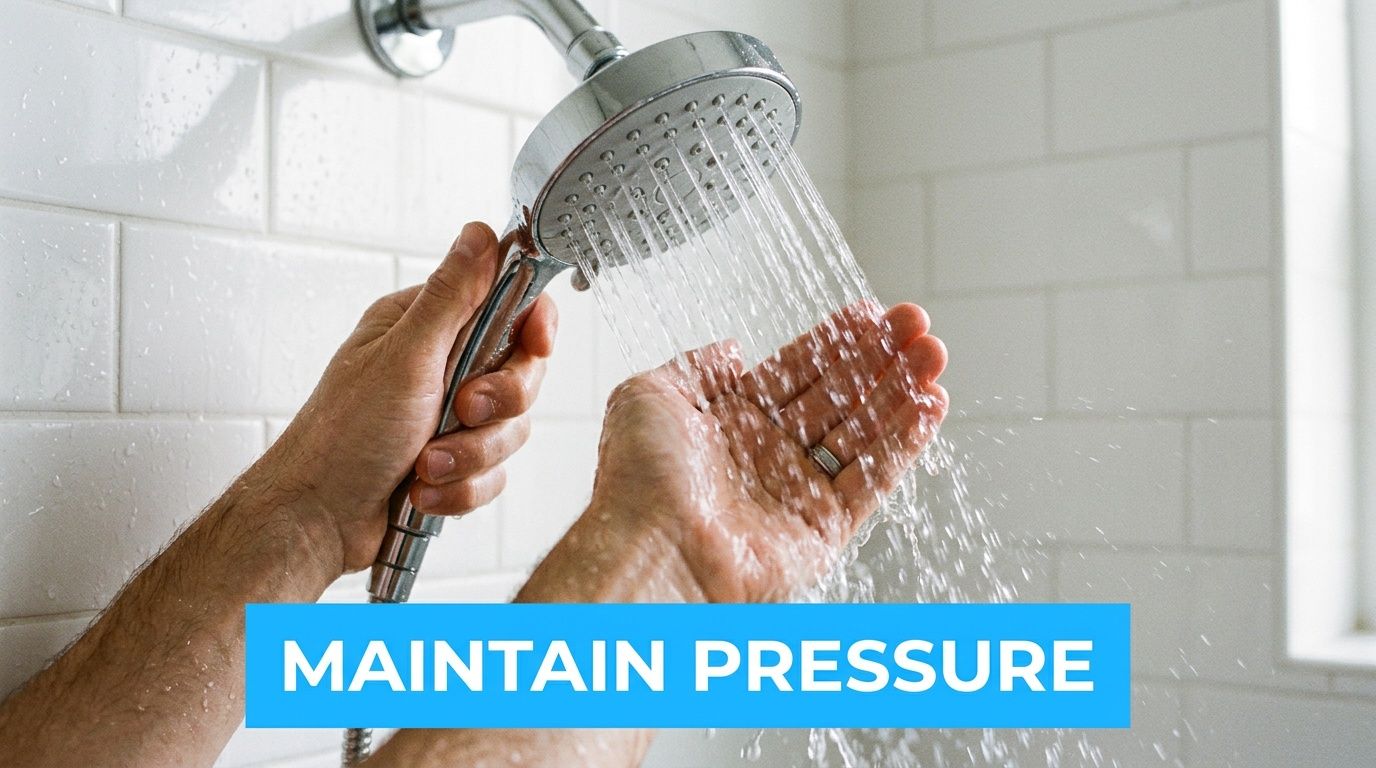
Any filter creates some resistance because water has to move through media. The question isn't whether there's resistance. The question is whether the unit is engineered well enough that you won't feel it much in daily use.
Non-certified models can cause a flow-rate reduction of up to 15%, at about 32.3 seconds per gallon versus a 27.5-second baseline, while NSF 177-certified units are designed to maintain flow efficiency while achieving over 95% chlorine removal, according to Cascada's comparison of certified and non-certified filtered shower heads.
That's the trade-off in plain terms. Cheap filter designs may slow the shower noticeably. Better-certified designs aim to preserve the experience while still doing useful filtration.
Why some filters feel worse than others
Three things usually affect performance:
Media density
A tightly packed cartridge can slow water more than a balanced design.Cartridge age
A tired cartridge often performs worse than a fresh one.Base home pressure
If your house already has weak pressure, any added restriction will be more noticeable.
A lot of complaints blamed on “all shower filters” are really complaints about poor product design or overdue cartridge changes.
Here's a useful visual explainer on what to look for in a practical setup:
How to avoid a disappointing shower
If strong spray matters to you, prioritize certified units and read product details carefully. Don't chase oversized claims about dozens of stages. Look for proof that the filter balances chlorine reduction with flow.
A well-made shower filter should feel like a normal shower with cleaner water. If it feels like a garden hose running out of patience, the design is probably the problem.
Keeping Your Water Pure with Proper Maintenance
A shower filter only works when the cartridge still has life left in it. After that, it's just a bulky attachment on your shower arm.
That's the part many homeowners underestimate. They focus on installation and forget that the cartridge is a consumable.
Replacement is not optional
Shower filters typically require replacement every 3 to 6 months to maintain effective chlorine removal because their filtration media degrade under continuous use. If you ignore that schedule, performance drops and the expected benefits fade with it, according to Culligan's overview of shower filter replacement timing.
That schedule isn't a suggestion from marketers trying to sell more cartridges. It reflects the finite capacity of the media inside the unit.
Maintenance reality: A shower filter past its service life usually doesn't fail dramatically. It just stops helping much.
What overdue maintenance looks like
Homeowners often miss the signs because nothing visibly “breaks.” The water still flows, so they assume the filter still works. But once the media are spent, chlorine reduction falls off.
Watch for these clues:
- The old symptoms return: Skin feels tighter again, hair gets rougher, or the water smells more chemical.
- Flow starts to change: Some cartridges clog or compact as they age.
- You can't remember the install date: That alone is enough reason to check.
A smarter way to own one
The easiest way to get real shower head filter benefits is boring but effective:
- Mark the install date: A small note under the sink works.
- Buy replacement cartridges early: Don't wait until the old one is obviously overdue.
- Factor ownership cost into the purchase: Cheap units can become expensive if cartridges are hard to find or replaced often.
A shower filter is a maintenance product, not a one-time upgrade. If you're willing to replace the cartridge on schedule, it can do its job well. If you want something you never have to think about, a shower filter isn't that kind of device.
How to Choose a Shower Filter That Actually Works
You step into a hot shower expecting relief, and within minutes your skin feels tight and your hair starts acting like straw again. That is the moment to ignore the packaging and look at what the filter is built to do.
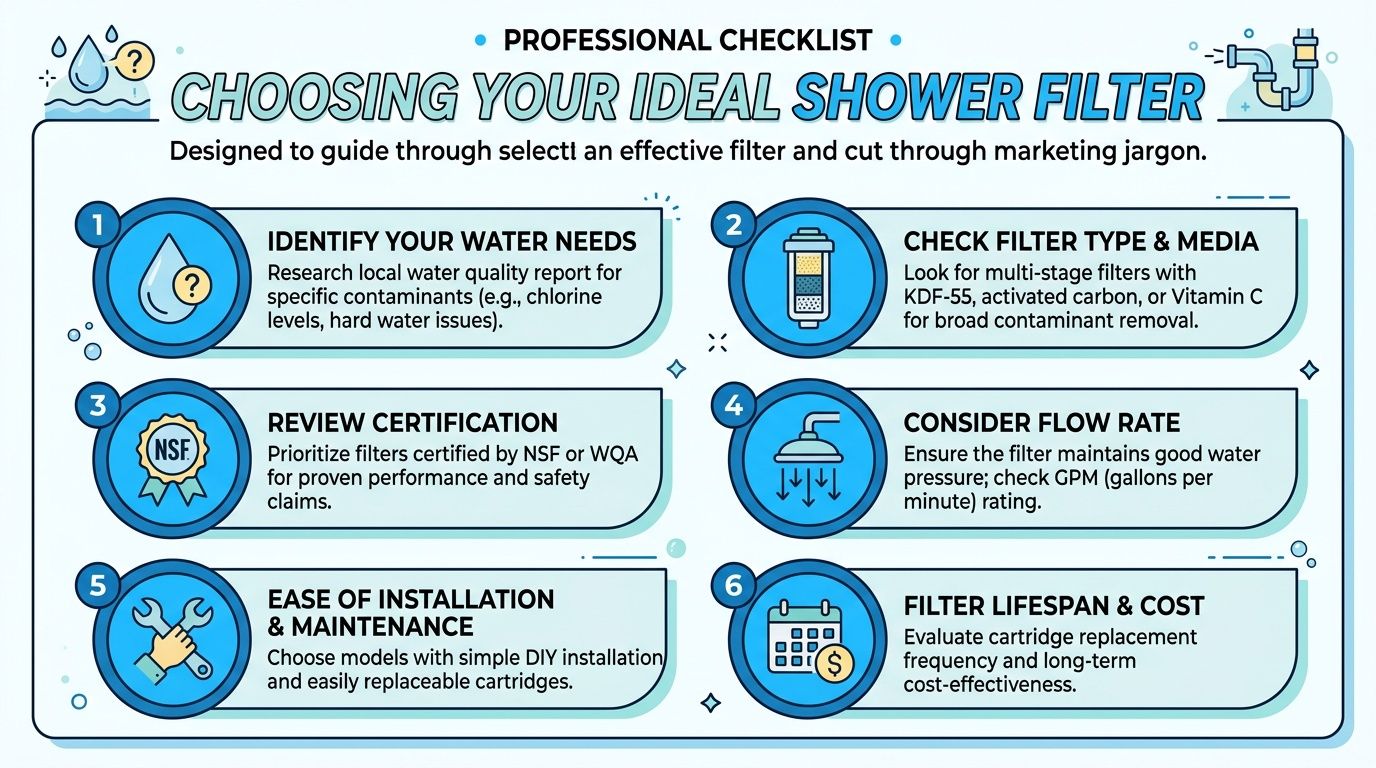
A good buying decision starts with the water problem, not the brand. If chlorine or chloramine is the main irritant, a shower filter can help. If the underlying issue is hard water scale, soap scum, and mineral buildup, a shower filter usually will not solve it. That is where homeowners get disappointed. They buy a filter for the wrong job, then assume all shower filters are useless.
Start with proof, not promises
The fastest way to sort serious products from marketing fluff is to look for independent testing. Certification matters because shower filter brands love broad claims about cleaner water, better skin, and healthier hair, but those claims are only as good as the testing behind them.
For chlorine reduction, NSF/ANSI 177 is one of the more relevant standards to look for. If a brand does not show certification, test data, or a clear performance claim, treat it cautiously. Some uncertified filters still use decent media and can reduce chlorine. The problem is that you are being asked to trust the label.
Use this buying checklist
A practical evaluation process is simple:
Match the filter to the problem
Buy for chlorine, odor, or sediment concerns. Do not expect meaningful softening from a standard shower filter.Check the filter media
KDF and calcium sulfite are common for chlorine reduction. Media type matters more than a long “stage count.”Look for relevant certification or test results
Independent verification carries more weight than skincare claims or before-and-after photos.Read the replacement schedule closely
A brand should tell you how long the cartridge lasts and under what conditions. Vague language is a warning sign.Check flow rate and fitting type
The filter needs to fit your setup and maintain a shower you will still want to use every day.
Ignore the flashy distractions
Stage count is one of the easiest ways to make an ordinary filter sound advanced. In practice, ten stages of weak media can perform worse than a simpler design with the right material and honest testing.
The same goes for wellness language. A shower filter should tell you what it reduces, what it does not reduce, how long the cartridge lasts, and what evidence supports those claims. If that information is missing, the polished product page is doing the heavy lifting.
I tell homeowners to judge these products the same way I would in the field. Start with your water. Match the media to the contaminant. Verify the claim if you can. Then look at cartridge cost, replacement frequency, and pressure performance before you buy.
If your water needs more than chlorine reduction, the better answer may be a softener or a whole-house water filtration system, not a fancier shower attachment.
If you're comparing shower filters, whole-house systems, or replacement cartridges and want plain-English guidance without the marketing fog, Water Filter Advisor is a useful next stop. It helps homeowners sort through certifications, media types, maintenance demands, and real-world trade-offs so you can choose a system that fits your water, your budget, and your bathroom.
- July 5, 2026
- Uncategorized
