Ever take a sip of water and wonder what’s really in it? Sure, it’s treated at a plant, but then it travels through miles of pipes to reach your kitchen. Think of that journey as a long road trip—your water is bound to pick up a few unwelcome hitchhikers along the way.
Installing water filters for house systems is like hiring a bouncer for your faucet, making sure only the purest, cleanest water gets past the velvet rope and into your glass.
Why Your Home's Water Quality Matters More Than You Think
Imagine your water supply is a package. It leaves the treatment plant pristine, but by the time it arrives at your home, it’s collected some serious "road dust." This is why a good home water filter is so much more than a flavor enhancer—it's a critical shield for your family's health and the longevity of your plumbing and appliances.
Beyond Bad Taste and Odors
That faint "swimming pool" scent or funky taste? That's often chlorine, a workhorse disinfectant that kills bacteria but murders the taste of your morning coffee. While it’s doing its job, it’s not exactly a welcome guest at the dinner table.
But the uninvited party guests in your water go far beyond what you can taste or smell:
- Sediment and Rust: These tiny troublemakers from aging pipes can turn your water cloudy and build up gunk inside your appliances.
- Heavy Metals: Lead can leach from old plumbing, posing serious health risks, especially for children.
- Hard Water Minerals: Meet calcium and magnesium, the villainous duo behind the crusty scale that clogs pipes and shortens the lifespan of water heaters, dishwashers, and coffee makers.
We're also becoming more aware of newer concerns. For instance, learning about a water filter for microplastics can help you create a more complete shield for your home's water.
Think of it this way: Filtering your water is the final, essential step in a long delivery chain. It ensures the water that actually reaches your glass is as pure as possible, free from the contaminants it may have picked up on its journey.
This growing awareness is a big reason why homeowners are driving the global water filtration market, making up about 70% of the total market share. It’s a clear signal that families want to take control of their water quality.
Ultimately, you have two main approaches to fixing these issues: whole-house filters that treat every drop of water entering your home, or point-of-use filters that purify water right at a specific tap. Figuring out which path is right for you is the first big step toward reclaiming your water quality.
Choosing Your Filtration Strategy: Whole-House vs. Point-of-Use
When it comes to filtering your home's water, you face a classic "all or one" decision. Do you need a superhero guarding every single drop that enters your house, or do you need a highly-trained specialist just for the water you drink and cook with?
That's the fundamental difference between a whole-house filter and a point-of-use filter. Each one tackles water quality from a different angle, and choosing the right one is all about matching the solution to your specific problem.
A whole-house system—also called a Point-of-Entry (POE) system—is that superhero. Plumbed right into your main water line, it acts as a gatekeeper, purifying all the water that flows into your home. This means better water for drinking, sure, but also for your showers, laundry, and even your toilets.
On the other hand, a Point-of-Use (POU) system is the specialist. These filters are installed at a single location, like your kitchen sink or fridge, to deliver exceptionally pure water right where you consume it. They're laser-focused on providing the best possible water for drinking and cooking, leaving the rest of the house's water as-is.
The All-Encompassing Guardian: Whole-House Systems
Think of a whole-house water filter as your home's personal bodyguard. By treating water the moment it enters, it provides a blanket of protection you'll feel far beyond your drinking glass. This is the ultimate solution if your water issues are widespread and affect more than just taste.
For instance, if your water is plagued by sediment, a whole-house filter keeps that grit out of your pipes and appliances entirely. This can save the sensitive parts inside your water heater, washing machine, and dishwasher from getting gummed up and wearing out too soon. The same goes for hard water—a whole-house system with a water softener is the only way to truly stop that crusty scale buildup in its tracks.
The benefits are comprehensive and noticeable all over the house:
- Appliance Protection: Your water-using appliances will simply run better and last longer without being constantly bombarded by sediment and hard water minerals.
- Healthier Showers: Filtering out chlorine can work wonders for your skin and hair, leaving them less dry and irritated. It just feels better.
- Cleaner Laundry: Filtered water helps soaps and detergents rinse out completely, which can leave your clothes feeling softer and looking brighter.
The Precision Specialist: Point-of-Use Filters
While whole-house systems are fantastic for protecting your plumbing and appliances, they don't always offer the most intensive filtration for drinking water. That's where point-of-use filters steal the show. These systems are built to do one job and do it incredibly well: making your drinking water as pure and tasty as possible.
It's like brewing a great cup of coffee. The water you use makes up over 98% of what's in your mug, and its quality has a massive impact on the final taste. Funky minerals or a whiff of chlorine can introduce bitterness or a flat, chalky flavor that ruins good coffee beans. A POU filter, especially a good under-sink reverse osmosis system, strips out those impurities with surgical precision.
This targeted approach is perfect if your main goal is pristine drinking and cooking water. It has a lower upfront cost and is usually much easier to install, making it a fantastic option for renters or anyone on a tighter budget.
Here’s a quick rundown of where these focused filters excel:
- Superior Contaminant Removal: Many POU systems, especially reverse osmosis (RO) units, can remove a wider and more difficult range of contaminants like lead, fluoride, and other dissolved solids than most standard whole-house filters.
- Lower Initial Cost: Since you're only outfitting a single tap, the equipment is smaller and much more affordable to buy.
- Simple Installation: Many faucet-mounted and countertop filters can be set up in just a few minutes with zero plumbing experience needed.
Whole-House vs. Point-of-Use Filter At a Glance
To make the choice a little clearer, here’s a quick comparison to help you decide which filtration strategy best fits your home's needs and budget.
| Feature | Whole-House Filter | Point-of-Use Filter (e.g., Under-Sink) |
|---|---|---|
| Filtration Scope | Treats every drop of water entering the home. | Filters water at a single tap (e.g., kitchen sink). |
| Primary Goal | Protects plumbing, appliances, and provides general-purpose clean water. | Delivers highly purified water for drinking and cooking. |
| Installation | Typically requires professional plumbing installation. | Often a DIY project, especially for faucet and countertop models. |
| Initial Cost | Higher, ranging from several hundred to thousands of dollars. | Lower, ranging from under a hundred to several hundred dollars. |
| Maintenance | Filter changes are less frequent (e.g., every 6-12 months). | Filter changes can be more frequent (e.g., every 2-6 months). |
| Best For | Homeowners with hard water, sediment issues, or chlorine sensitivity. | Renters or anyone prioritizing drinking water quality on a budget. |
Ultimately, the best system is the one that solves your water problems. Are you fighting a battle on all fronts against scale, sediment, and chlorine? A whole-house system is your champion. Or is your primary mission simply to get the purest, best-tasting glass of water possible? A point-of-use filter will be your most trusted ally.
What’s Actually Inside That Filter? A Look Under the Hood
Let's pull back the curtain on common water filters for house systems and see what makes them tick. Forget the dense technical jargon; we’ll use simple analogies to make the science behind clean water easy to grasp. Every filter technology is a specialist, built to solve a specific problem with your water.
Think of it like building a superhero team for your home. You wouldn’t send the super-strong guy to handle a job that needs super speed—you pick the right hero for the task. Water filtration works exactly the same way.
This flowchart lays out the two main strategies: treating all the water coming into your house versus targeting specific faucets.
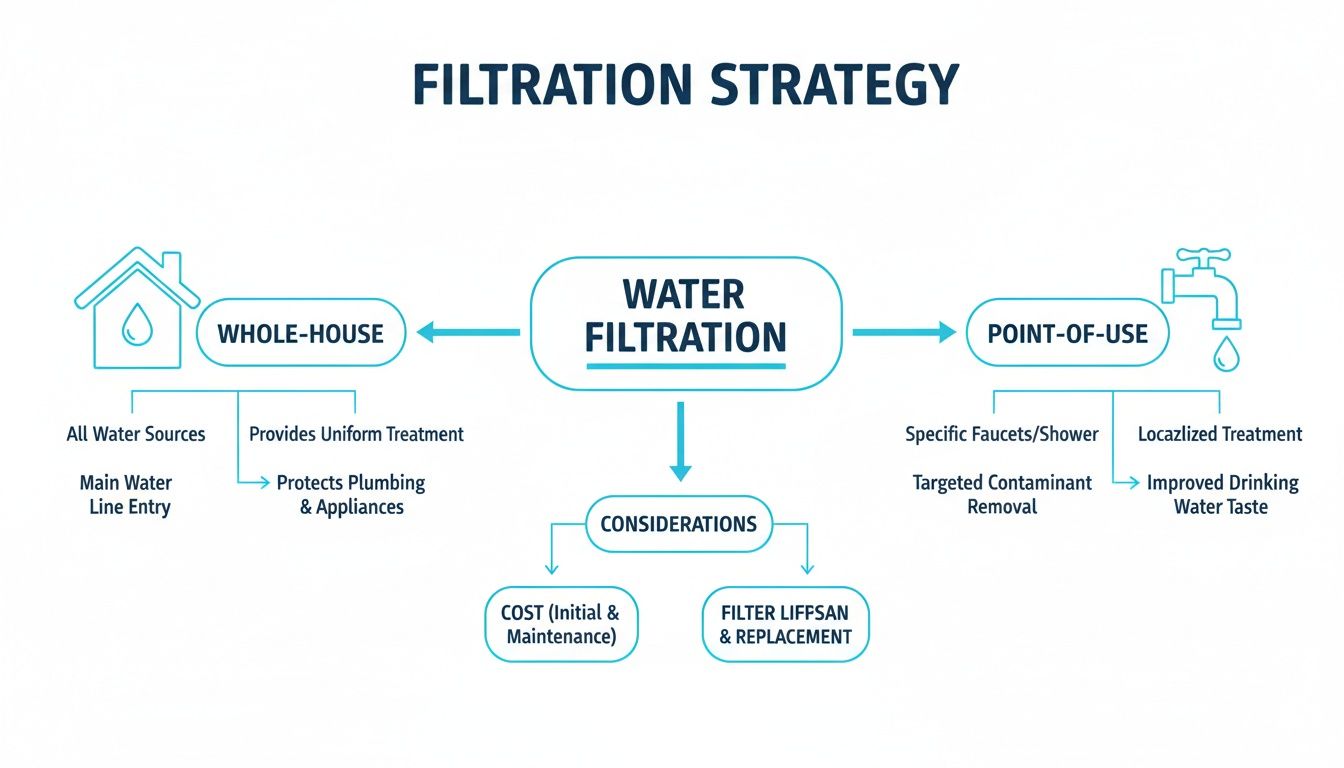
As you can see, a whole-house system acts as a first line of defense, while a point-of-use filter provides specialized, high-level purification right where you need it most.
Activated Carbon: The Contaminant Sponge
The most common workhorse in the filtration world is activated carbon. Imagine a super-absorbent sponge packed with millions of tiny nooks and crannies. As water passes through, contaminants like chlorine and volatile organic compounds (VOCs) get stuck in these pores in a process called adsorption.
This is why carbon filters are rockstars at making your water taste and smell better. They grab onto that "swimming pool" chlorine odor, making your water much more enjoyable to drink and cook with.
Sediment Filters: The Bouncer
Next up is the simplest but most critical player on the team: the sediment filter. This is your home’s bouncer, stopping big, clunky particles at the door. Think of it as a fine mesh screen that catches stuff like:
- Rust flakes from aging pipes
- Sand and silt, especially if you have well water
- General dirt and debris
Sediment filters are almost always the first stage in any multi-step filtration system. By catching all the big gunk first, they protect the more specialized (and expensive) filters down the line from clogging up too quickly.
Reverse Osmosis: The VIP Bouncer
When you need the absolute purest drinking water, Reverse Osmosis (RO) is the gold standard. Picture a high-end nightclub with a bouncer who has an incredibly strict guest list—that's the RO membrane. This membrane has pores so minuscule that only pure water molecules are allowed to pass through.
Everything else—heavy metals like lead, dissolved salts, fluoride, and tons of other tiny contaminants—gets rejected and washed down the drain. The technology is so effective it has become a dominant force in the residential water filtration market, largely because of its power to remove high levels of dissolved solids and metals.
Because RO is so thorough, you’ll usually find it in under-sink, point-of-use systems designed to produce top-tier drinking and cooking water. It's the ultimate specialist for your kitchen tap.
UV Purifiers: The Guardian Angel
What about invisible threats like bacteria, viruses, and other nasty microorganisms? That’s a job for an Ultraviolet (UV) purifier. This technology is like a guardian angel, using a powerful UV lamp to zap the DNA of these living contaminants.
The UV light effectively neutralizes the microbes, making it impossible for them to reproduce and make you sick. It’s a completely chemical-free way to disinfect water, making it an essential tool for anyone on a private well or with concerns about biological contamination.
Water Softeners: The Mineral Manager
Finally, we have the hero that tackles hard water problems: the water softener. This system is your home's dedicated mineral manager, targeting the calcium and magnesium that cause that crusty, white scale buildup on everything. It works through a clever process called ion exchange.
Think of it like a trading post. The softener contains a bed of resin beads loaded up with sodium ions. As hard water flows through, the calcium and magnesium ions—the real troublemakers—stick to the resin and "trade places" with the sodium. The result? Softened water that won't clog your pipes, ruin your appliances, or leave spots on your dishes. You can dive deeper into the specifics of how different media work by reviewing filter pack details.
How to Diagnose Your Water Problems Before You Buy
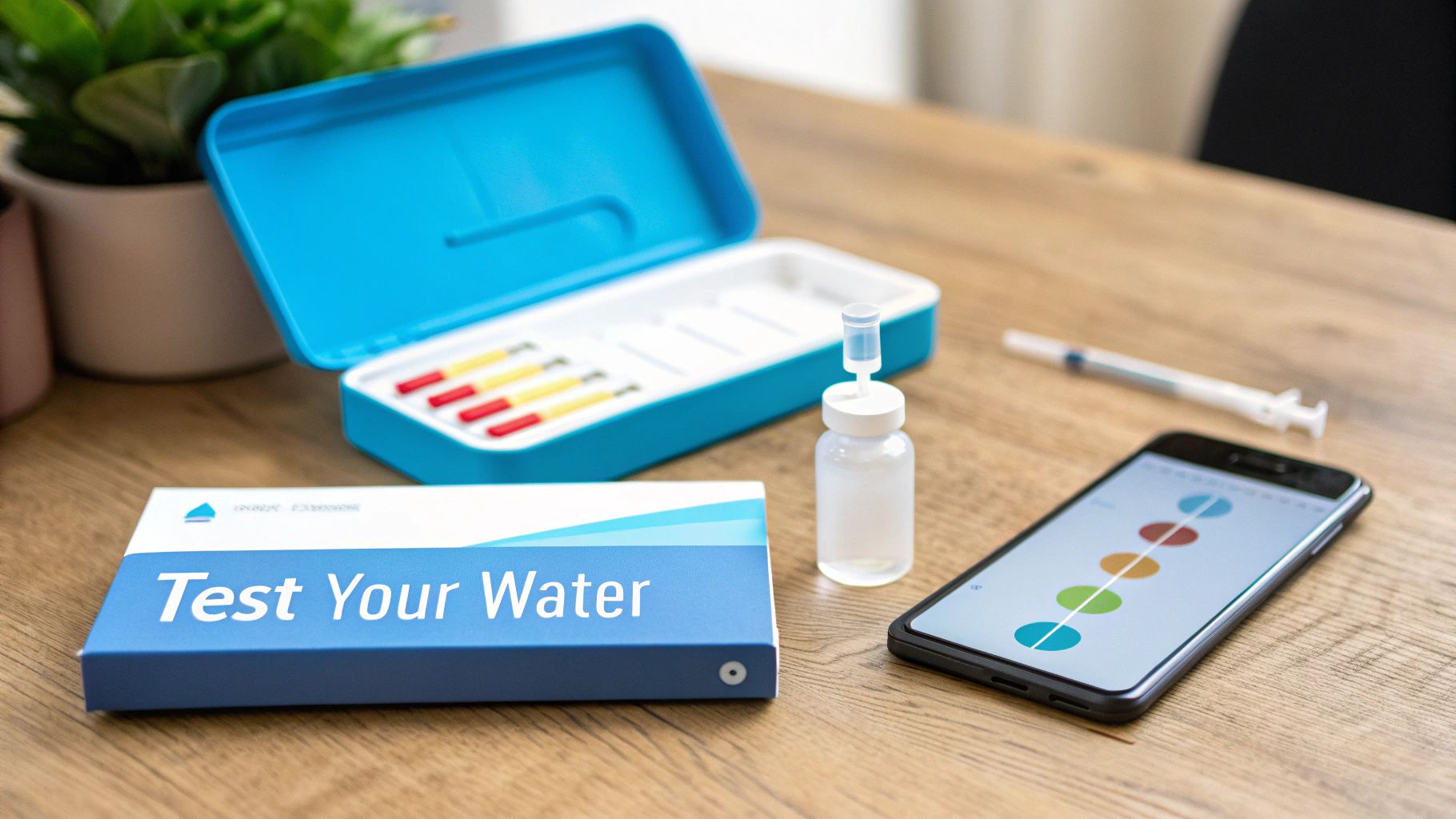
Here's a secret: choosing a water filter without knowing what’s actually in your water is a total shot in the dark. It’s like a doctor prescribing medicine without a diagnosis. You might get lucky, but you're far more likely to waste money on a system that doesn't even touch the real problem.
Before you spend a dime on any water filters for house systems, you’ve got to play detective.
Luckily, figuring out what's going on with your water isn't as complicated as it sounds. You have three solid ways to find out exactly what’s flowing from your taps, and each one is perfect for different situations and concerns.
Start with Your City’s Free Water Report
If your water comes from a municipal supplier, your first move is both simple and completely free. By law, your local water utility has to give customers a Consumer Confidence Report (CCR) every single year. Think of it as a detailed report card on your local water quality.
This report is like a general health checkup for your city's water. It lists the contaminants they tested for, the levels they found, and how those numbers stack up against national safety standards. You can almost always find it on your utility's website, or just call them and ask for a copy.
The CCR is a great starting point. It’ll clue you into common issues like high chlorine or if your area deals with specific industrial byproducts. What it won't tell you, however, is what's happening inside your own pipes—like lead leaching from old plumbing.
Use an At-Home Test Kit for Quick Insights
Want a more immediate, hands-on answer? Grab an at-home water test kit. These kits are cheap, easy to use, and give you fast results for some of the most common water quality issues right there in your kitchen.
Most basic kits will check for things like:
- Chlorine: Does your water have that distinct "pool" smell? A simple test strip can confirm it.
- Water Hardness: This measures calcium and magnesium, the two culprits behind that crusty scale buildup on your fixtures.
- pH Levels: You can quickly see if your water is acidic or alkaline, which can impact your plumbing over time.
- Iron and Copper: High levels can be a red flag that your pipes might be starting to corrode.
It's not going to be as surgically precise as a lab analysis, but an at-home kit gives you real, actionable data. If the strip shows off-the-charts hard water, you know a water softener should be on your radar. If chlorine is high, an activated carbon filter immediately becomes a top contender.
Get a Lab Test for a Definitive Diagnosis
So, when do you need to bring in the big guns? If you have a private well or you're worried about something specific like lead, sending a sample to a state-certified lab is the only way to go. Well water isn't regulated by public utilities, which means you are 100% responsible for its safety.
A lab test is the gold standard. It gives you the most comprehensive and accurate analysis you can get, screening for a huge range of contaminants—heavy metals like lead and arsenic, bacteria like E. coli, nitrates, pesticides, and more. This is how you get true peace of mind.
Once you have your results—whether from a CCR, a home kit, or a lab—you can finally match your water’s specific problems to the right filtration tech. High sediment means you need a sediment filter. Hard water points you to a softener. And a positive bacteria test means a UV purifier isn't a luxury; it's a necessity.
For more in-depth help connecting your test results to the perfect system, you can find a ton of great water filter advice and resources to guide you.
Installation, Maintenance, and the True Cost of Ownership
So you’ve picked out your perfect water filters for house system and the box has just landed on your doorstep. What’s next? Getting clean water flowing from your taps involves more than just the initial purchase. The real journey begins with installation, continues with regular upkeep, and requires a clear understanding of the true lifetime cost.
Let's start with getting it set up. The difficulty here really boils down to what kind of system you bought. Simple faucet-mounted filters or countertop units are a breeze—most are designed for a quick, tool-free DIY install you can knock out in minutes. They’re a fantastic choice for renters or anyone who wants a fast fix without calling a plumber.
On the other hand, bigger systems demand a bit more effort. Whole-house filters and under-sink reverse osmosis systems need to be tied directly into your plumbing. If you're a seasoned DIY pro, you might be up for the challenge. For most of us, though, it’s best to hire a professional plumber to make sure everything is connected correctly and, most importantly, won't leak. Don't forget to factor that installation cost into your initial budget.
The Most Important Job: Changing the Filters
Once your system is up and running, your main job is maintenance. And nothing is more important than changing the filters on schedule.
Think of it like getting an oil change for your car. You wouldn't just keep driving for years without one and expect the engine to perform, right? Your water filter is exactly the same.
An old, clogged filter just can't do its job. In the best-case scenario, it simply stops filtering, and all those contaminants you wanted to get rid of start pouring through your tap again. In the worst-case scenario, that exhausted filter can become a breeding ground for bacteria or even dump a concentrated dose of trapped gunk back into your water.
Following the manufacturer's replacement schedule isn't just a friendly suggestion—it’s the single most critical thing you can do to ensure your system keeps delivering the clean, safe water you paid for.
Budgeting Beyond the Sticker Price
The upfront cost of a water filter is only one piece of the puzzle. The true cost of ownership is all about the ongoing expense of replacement filters. This is where doing a little homework before you buy can save you a ton of cash and headaches later. Always look up the price and availability of replacement cartridges for any system you're considering.
Here’s a realistic breakdown of what you can expect to spend each year on new filters for the most common systems:
- Faucet Filters: These need to be swapped out frequently, usually every 2-3 months. Plan on spending $30 to $60 annually.
- Under-Sink Systems: You'll likely change pre-filters every 6-12 months and the main RO membrane every 2-4 years. A good annual budget would be $50 to $150.
- Whole-House Systems: The big sediment and carbon filters for these systems typically last anywhere from 3-12 months. Annual costs can vary quite a bit but often land between $75 and $250.
These ongoing costs are a crucial part of your budget. A cheap system with pricey or hard-to-find filters is almost never a good deal in the long run.
The Mark of Trust: NSF/ANSI Certification
So, how do you know a filter actually does what the box says it does? Look for a certification from an independent group like the NSF (National Sanitation Foundation). NSF/ANSI certifications are the gold standard in the water filtration world.
That little seal means the product has been put through its paces with rigorous testing to prove it meets strict standards for contaminant removal and material safety. It’s your independent guarantee that the filter performs as advertised. When you see that NSF mark, you know you’re getting real protection, not just marketing hype.
A Few Final Questions
Diving into the world of water filters for house systems can definitely leave you with a few last-minute questions. It's totally normal. Getting those final answers is the key to picking a system you'll be happy with for years to come. Here are a few of the most common things people ask.
Will a Whole House Water Filter Kill My Water Pressure?
This is a huge one, and the short answer is no—not if it's the right size for your home. A quality system is engineered to match your home's plumbing and the amount of water your family actually uses.
If you do notice a big drop in pressure, that’s almost always a red flag. It usually means one of two things: either the filter is clogged solid and screaming to be changed, or the system was too small for your home’s flow rate from the start.
How Often Do I Really Need to Change the Filters?
Stick to the manufacturer's schedule. Seriously, it's the most important piece of maintenance you can do. Every system is a bit different, but a general timeline looks something like this:
- Sediment Filters: Plan on every 3-6 months. If you're on well water, you might be changing it even more often.
- Carbon Filters: These usually last 6-12 months before they've absorbed all they can handle.
- Reverse Osmosis (RO) Membranes: These are the long-haul players, lasting anywhere from 2-5 years because the other filters protect them.
Remember, a filter that's past its prime doesn't just stop working. It can turn into a breeding ground for bacteria or, even worse, start dumping all the contaminants it caught right back into your water. Pop a reminder in your phone's calendar—it’s a simple trick that works.
Are These Systems Actually Worth the Money?
Absolutely. You're not just buying a piece of equipment; you're making an investment that pays you back in a few different ways. You’re getting peace of mind by protecting your family from things you can't see or taste in the water. You’re getting better-tasting coffee, tea, and food. You’re also protecting your expensive appliances from the scale and gunk that kills them early.
When you stack up the long-term benefits against what you'd spend on bottled water or a new dishwasher, a filtration system just makes sense for the health and value of your home.
I'm a Renter—What Are My Options?
Renters have some fantastic options that don't involve a single permanent change. Faucet-mounted filters are a crowd-favorite because you can literally install them in a minute with zero tools. For something a bit more powerful, countertop filters are great; they hook up to your existing faucet and can do some serious filtering.
You can even upgrade your daily shower with a simple screw-on showerhead filter to get rid of that nasty chlorine smell and feel. All these can be put on and taken off without leaving a trace, making them perfect for any rental.
Ready to find the perfect water filtration solution for your home? The experts at Water Filter Advisor provide in-depth guides, unbiased reviews, and practical advice to help you make a confident decision. Explore your options and start your journey to cleaner, safer water today at https://www.waterfilteradvisor.com.
- January 27, 2026
- 0
- Uncategorized
