Discovering coliform bacteria in your water is like finding a stranger in your house—it's a sign something is seriously wrong with your security. But don't panic. A good water filter for coliform is the best home security system you can buy for your tap water. Technologies like Ultraviolet (UV) light, Reverse Osmosis (RO), or ultrafiltration are incredibly effective at either physically removing these unwanted guests or zapping them into oblivion.
While most coliforms won't harm you, their presence is a giant red flag. It’s your water’s way of screaming that a barrier has been breached, leaving a wide-open door for truly nasty pathogens like E. coli to waltz right in. A certified water filter acts as your home's personal bodyguard, ensuring that what comes out of your faucet is safe and clean, every single time.
What Are Coliform Bacteria in Your Water?
Think of coliforms as nature’s alarm system for your water. Their discovery in a water test is like the check engine light suddenly flashing on your car's dashboard.
The light itself isn't the problem, but it’s telling you something under the hood is seriously wrong. In the same way, most coliform bacteria are harmless, but their presence is a clear signal that the safeguards protecting your water have failed. It means a door has been left open for more dangerous germs to sneak into your pipes.
The Different Types of Coliform Bacteria
When you get a water test report back, you'll likely see a few different names. Understanding what they mean helps you gauge the real risk to your family. Water quality experts break them down into a few key groups, each telling a piece of the story.
There are three main categories you need to know:
- Total Coliforms: This is a huge, diverse group of bacteria that are all over the place in nature—in soil, on plants, and in lakes and rivers. Finding them in your water suggests that surface contaminants have somehow seeped into your system, but it doesn't automatically mean it's from a hazardous source.
- Fecal Coliforms: Now we're getting more specific. This is a sub-group of total coliforms, and they come from one place: the intestines and waste of warm-blooded animals (including people). Discovering these is a much more serious warning that your water has been contaminated by sewage or animal feces.
- Escherichia coli (E. coli): This is the one everyone's heard of. As the most well-known member of the fecal coliform family, finding E. coli is the smoking gun for recent fecal contamination. Certain strains can cause violent gastrointestinal illness, so a positive test requires immediate action.
The U.S. Environmental Protection Agency (EPA) has a zero-tolerance policy for E. coli in drinking water. A single positive sample is considered a violation of safety standards and requires immediate notification and corrective action to protect public health.
Why They Are Called Indicator Organisms
So, why not just test for the dangerous germs directly? Because testing for every single waterborne virus and bacteria out there would be outrageously complicated and expensive. Instead, labs look for coliforms because they're common and easy to find.
They are called indicator organisms for a reason. If these widespread bacteria are present, it’s a powerful sign that the protective barriers around your water source—whether that’s the city treatment plant or your private well casing—have been compromised.
This failure means that the really bad stuff like Giardia, Cryptosporidium, and harmful E. coli strains could have slipped in, too. Coliforms are the canary in the coal mine, warning you of potential danger before anyone gets sick.
How Bacteria Get Into Your Home's Water
It's a bit unsettling to think about, but invisible bacteria can find a way into the water you drink every day. How they get there is a different story depending on where your water comes from—a private well or your city’s municipal supply.
But the core problem is always the same: a tiny breach is all it takes for contamination to start. Think of it like a fortress. Your water system is designed to be sealed and secure, but even the smallest crack in the wall can let intruders in. Figuring out where those weak points are is the key to defending your water with the right filter.
Why Private Wells Are So Vulnerable
If you have a private well, you're the one in charge of security. It's your responsibility to guard against contamination, which means you need to know where to look for trouble. It’s a lot like maintaining the roof on your house; a small, hidden leak can go unnoticed for a long time while causing serious damage.
Most well contamination happens quietly, out of sight.
- A Broken Seal: A cracked well casing or a loose, improperly sealed well cap is like leaving your front door wide open. Rainwater washes over the ground, picking up bacteria from the soil, and funnels it straight into your well.
- Nearby Farms: Living in a rural area has its perks, but nearby agricultural activity can be a risk. Runoff from fields treated with manure or fertilizers can soak into the ground, eventually making its way into the aquifer that feeds your well. This risk skyrockets after heavy rain.
- Bad Septic Systems: A failing septic system—or even a perfectly good one that’s just too close to your well—can leak raw sewage into the surrounding soil. From there, it’s a short trip for dangerous stuff like fecal coliforms and E. coli to migrate through the ground and into your drinking water.
Studies on private wells have shown a direct link between septic systems and water quality. Wells located within 100 feet of a septic drain field were found to be far more likely to test positive for total coliforms and E. coli.
How City Water Can Go Wrong
You’d think being on city water means you’re in the clear, right? While it’s true that municipal water gets treated at a central plant, it still has to travel miles through a massive network of underground pipes to reach your home. And sometimes, that aging infrastructure is where the problems begin.
Picture the city's water main like a major highway. Most of the time, everything runs smoothly. But one bad accident can cause a massive pile-up and create unexpected problems for miles.
Here are the most common ways city water gets contaminated:
- Old, Crumbling Pipes: Many American cities are relying on water pipes that were put in the ground before your grandparents were born. Over decades, these pipes corrode, rust, and develop cracks. Those cracks become entry points for contaminated groundwater to get sucked into the system.
- Water Main Breaks: This is the most dramatic failure. When a large water main bursts, the pressure is lost instantly. As water rushes out, a vacuum is created, pulling in surrounding dirt, mud, and bacteria right into the clean water line.
- Sudden Pressure Drops: You don't need a full-blown break for things to go wrong. A significant drop in pressure—maybe from firefighters hooking up to a hydrant or heavy use in one area—can cause the same vacuum effect. This "negative pressure" can slurp contaminants into the pipes through tiny, pre-existing cracks.
Whether you're on a well or city water, it's clear that contamination can happen. This is exactly why a good water filter for coliform is so important. It acts as your last line of defense, protecting you and your family right at the tap.
The Most Effective Coliform Removal Technologies
Finding out you have coliform bacteria in your water is alarming, but the good news is there are proven, reliable ways to get rid of them. Choosing the right water filter for coliform means understanding how these different systems work to protect your family. Each one tackles bacteria in a unique way, giving you a solid line of defense.
Think of it like hiring different kinds of security for your water supply. Some are like bouncers, physically blocking unwanted guests from getting in. Others are more like high-tech security systems, neutralizing threats before they can cause any harm. Let’s walk through the most effective options out there.
Ultraviolet Purification: A Sunburn for Microbes
One of the most powerful and popular methods for water disinfection is ultraviolet (UV) purification. A UV system doesn't actually remove bacteria from the water; instead, it zaps them and renders them completely harmless. It's basically a high-intensity, concentrated sunburn for microbes.
Here's how it works: your water flows through a chamber that houses a special UV lamp. This lamp emits intense ultraviolet light at a very specific wavelength (254 nanometers) that penetrates the cell walls of bacteria like coliform and E. coli and completely scrambles their DNA. This process, called ultraviolet germicidal irradiation (UVGI), makes it impossible for them to reproduce or make you sick.
One of the biggest wins for UV systems is that they purify water without adding a single chemical. That means the taste, smell, and color of your water don't change at all. You get powerful disinfection that neutralizes 99.99% of harmful bacteria and viruses while keeping your water's natural qualities intact.
Reverse Osmosis: The Nightclub Bouncer
If UV is the silent zapper, Reverse Osmosis (RO) is the exclusive nightclub bouncer with a list he checks twice. It's a physical filtration process that uses your home's water pressure to force water through a special membrane with ridiculously small pores—we're talking as tiny as 0.0001 microns.
This membrane is the ultimate gatekeeper. It's so selective that only pure H2O molecules are small enough to pass through. Everything else—bacteria, viruses, salts, heavy metals, and other contaminants—gets rejected and washed right down the drain. This is what makes RO systems so incredibly good at what they do.
This infographic shows just how easily both private wells and city water systems can get contaminated, which really drives home the need for a final barrier filter in your home.
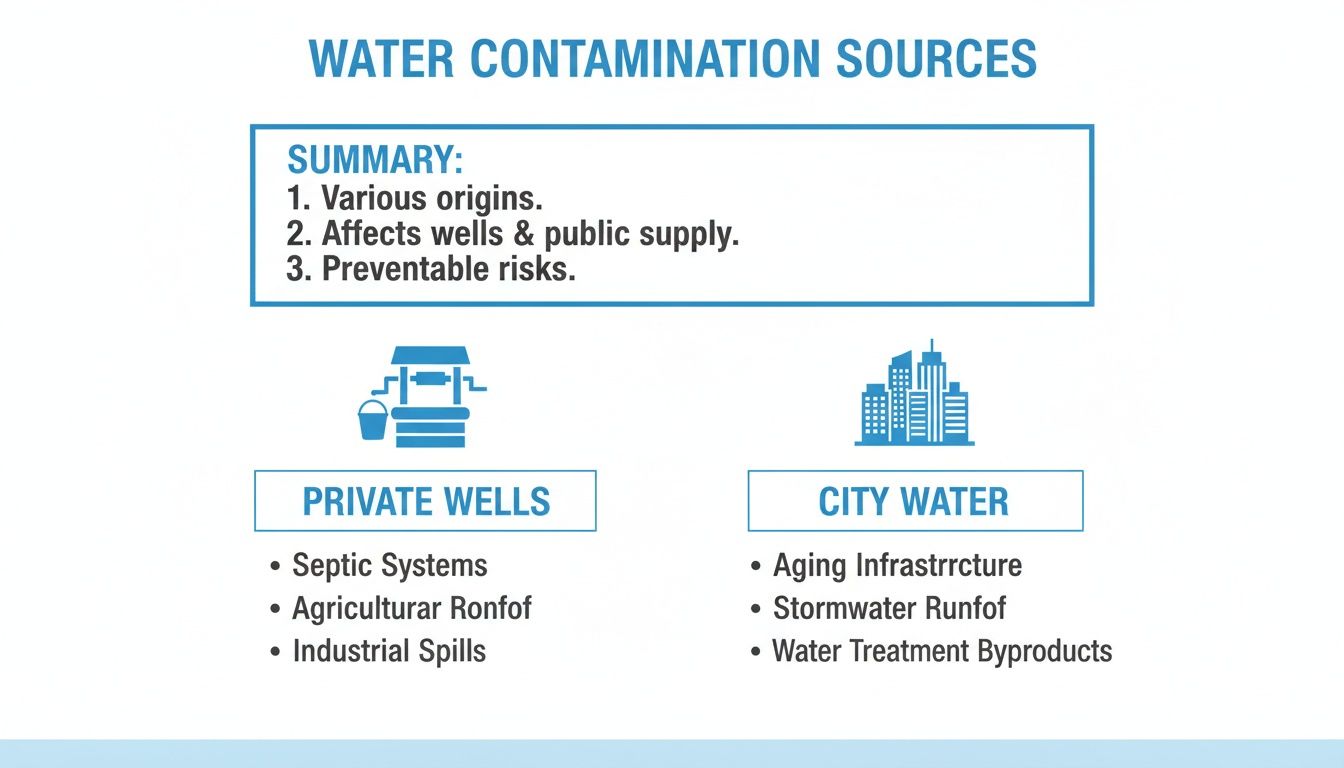
Whether it’s a leaky well cap or a tiny crack in a city water main, these vulnerabilities show why having a filter at your home—either for the whole house or just at the kitchen sink—is a critical last line of defense.
Ultrafiltration: The Microscopic Net
Ultrafiltration (UF) is another highly effective physical barrier. The best way to picture a UF filter is as a microscopic net woven from thousands of tiny, hollow fibers. The pores in these fibers are bigger than an RO membrane's but still plenty small—around 0.02 microns—to physically block and trap bacteria, protozoa, and even some viruses.
Water is pushed through these hollow fibers, and while the clean water passes through, all the nasty stuff gets caught on the outside. Because UF doesn't remove dissolved minerals, it's a fantastic choice for people who want to keep the natural mineral content of their water while still getting total peace of mind from microbiological threats.
To help you figure out what’s best for your home, I've put together a table comparing these top technologies side-by-side.
Comparing Coliform Removal Technologies
This table compares the most effective water treatment methods for eliminating coliform bacteria, helping you choose the best fit for your home's needs and budget.
| Technology | How It Works | Effectiveness on Coliforms | Best For | Typical Cost | Key Maintenance |
|---|---|---|---|---|---|
| UV Purification | Uses ultraviolet light to scramble bacterial DNA, preventing reproduction. | Excellent (99.99% inactivation) | Whole-house disinfection, especially for well water. | $300 – $1,500 | Annual UV lamp and quartz sleeve replacement. |
| Reverse Osmosis | Forces water through a semipermeable membrane that blocks bacteria. | Excellent (99.99%+ removal) | Under-sink systems for drinking/cooking water. | $200 – $600 | Pre-filter changes every 6-12 months; membrane every 2-4 years. |
| Ultrafiltration | Uses a hollow fiber membrane to physically block bacteria and viruses. | Very Good (99.9%+ removal) | Point-of-use or whole-house where mineral retention is desired. | $250 – $1,200 | Regular backwashing; cartridge replacement every 1-3 years. |
| Sub-Micron Filters | Traps bacteria in a filter medium with a pore size of 0.2 microns or less. | Good (for bacteria, not viruses) | Portable filters, emergency use, or as a pre-filter. | $50 – $200 | Frequent cartridge replacement based on usage. |
Each of these systems offers a rock-solid solution if you're dealing with coliforms. Your final decision will come down to things like your water source, how bad the contamination is, your budget, and whether you want to treat every drop of water in your house or just what comes out of the kitchen tap.
Choosing the Right Water Filter for Coliform
Now that you know which technologies can knock out coliform bacteria, how do you pick the right system for your home? Choosing the best water filter for coliform isn't about finding a single "magic bullet" product. It's about matching the right tool to the job, and that job looks very different depending on whether your water comes from the city or a private well.
Your entire decision boils down to one simple question: Are you adding a final line of defense against a potential municipal system failure, or are you building a complete bacterial shield for your own well water? Each scenario requires a totally different game plan.
Solutions for City Water Users
If you're on city water, your main worries are things like aging pipes, sudden water main breaks, or those dreaded boil water advisories. Your goal is simply to create a final, bulletproof barrier right where you use your water most. For this, a point-of-use system is almost always the most practical and effective way to go.
These systems treat the water at a single tap—usually the kitchen sink, where you get all your water for drinking and cooking.
- Under-Sink Reverse Osmosis (RO) System: An RO unit tucked away under your kitchen sink is a fantastic final barrier. It doesn't just physically block bacteria; it also tackles a huge list of other common contaminants like lead, chlorine, and other dissolved solids.
- Under-Sink UV Purifier: If your concern is purely microbiological, a dedicated UV system can be installed on the line to your main faucet. This guarantees that any stray bacteria that might have survived the trip from the treatment plant are zapped just seconds before the water hits your glass.
A More Robust Plan for Well Owners
For well owners, the game changes completely. The risk of contamination is much higher and can come from a number of sources. Since you are the sole manager of your water's safety from the ground up, a whole-house solution isn't just a good idea—it's the industry standard. This approach ensures every single tap in your home, from the kitchen to the bathroom shower, delivers microbiologically safe water.
A proper whole-house setup for well water is almost always a multi-stage process:
- Sediment Pre-filter: This is always step one. It catches all the dirt, sand, and rust particles. This isn't just for clean-looking water; it's critical because sediment can actually act like a shield for bacteria, protecting them from the UV light and making the whole system less effective.
- Whole-House UV Purifier: Right after the pre-filter, a powerful UV system acts as your primary microbiological defense, neutralizing 99.99% of bacteria and viruses as the water enters your home's plumbing.
As you weigh your options, it helps to understand the pros and cons of different types of filtration systems to make a truly informed choice.
Decoding Certifications: Your Seal of Approval
So, how can you be sure a filter actually does what the box says it does? You look for certifications from NSF International (which used to be called the National Sanitation Foundation). Think of an NSF seal as a stamp of approval from a trusted, independent third party that has rigorously tested and verified a product’s claims.
A sobering 2014 global assessment found that 1.8 billion people around the world depend on drinking water sources contaminated with fecal matter. That staggering number is a stark reminder of why a final barrier is so important, even on treated city water where old, cracking pipes can let contaminants back in.
When it comes to bacteria, two standards are absolutely essential:
- NSF/ANSI 55 (Ultraviolet Microbiological Water Treatment Systems): This standard is broken into two tiers. Class A systems are certified to disinfect water, removing microorganisms like bacteria and viruses, which makes them suitable for treating contaminated water. Class B systems are only certified for "supplemental" treatment on water that's already considered safe, like public tap water.
- NSF/ANSI 58 (Reverse Osmosis Drinking Water Treatment Systems): This certification confirms that an RO system is effective at reducing a broad spectrum of contaminants, including cysts, which are even larger than bacteria.
Choosing a certified product gives you peace of mind, knowing your investment is backed by real science and independent testing. For more in-depth guidance on finding the perfect system, be sure to check out our extensive advice on water filters.
Your Action Plan for Contaminated Water
Getting a water test back positive for coliform bacteria is definitely jarring. It's okay to feel a moment of shock, but don't panic. Think of it as a clear signal that it's time to take action. With a simple, methodical plan, you can tackle the problem head-on and make your home's water safe again.
We'll break this down into a calm, four-step drill for your water supply: Test, Isolate, Treat, and Retest. Following this process turns a moment of uncertainty into a clear path forward, giving you total control over the health and safety of your family.
Step 1: Confirm the Problem with Testing
First things first, let's make sure we know exactly what we're dealing with. A single positive test is a big red flag, but getting a second, follow-up test from a state-certified lab is absolutely critical. This confirms the initial findings and makes sure you aren't about to spend time and money chasing a false positive.
Your local health department can point you to a list of certified labs in your area. When you collect the sample, follow the lab's instructions to the letter. It’s surprisingly easy to accidentally contaminate the sample from your hands or the faucet, which can completely throw off the results. An accurate diagnosis is the bedrock of an effective solution.
Step 2: Isolate and Protect Your Household
While you're waiting for confirmation or figuring out a treatment plan, your number one priority is protecting everyone in your home. This means immediately stopping the use of your tap water for anything that involves consumption.
Put these safety measures in place right away:
- Switch to Bottled Water: Use it for everything—drinking, cooking, making ice, and brushing teeth. No exceptions.
- Issue a Household "Boil Water" Notice: For tasks like washing dishes or rinsing produce, bring a pot of water to a rolling boil for at least one full minute, then let it cool before using. This is a tried-and-true method for killing harmful bacteria.
Taking immediate protective steps is non-negotiable. A positive coliform test means there's a breach in your water's safety barrier. Temporary measures like boiling water are your essential first line of defense until a permanent fix is in place.
Step 3: Treat the Contamination
Now it's time to put a permanent solution in motion. This is where you choose and install the right water filter for coliform based on the technologies we've already covered, whether that's a whole-house UV purifier or an under-sink reverse osmosis system.
The best system for you really depends on your water source and how bad the problem is. A home with well water that has persistent coliform issues, for instance, is a prime candidate for a robust whole-house UV system paired with a sediment pre-filter. That combination ensures effective, long-term disinfection.
Beyond just filters, you need an immediate action plan, especially if you're dealing with a major contamination event. For instance, homeowners facing a worst-case scenario should consult an essential guide to sewage damage clean up to understand the much bigger steps required for severe situations.
Step 4: Retest to Verify the Solution
You've installed your new filtration system and it's up and running. Great! But you're not done just yet. The final, crucial step is to close the loop and verify that your solution actually worked. Wait a few days to a week after installation, then take another water sample and send it back to that certified lab.
This retest is your proof of success. A negative result for both coliform and E. coli is the official all-clear, confirming that your new filter has knocked out the threat and your water is safe to drink again. This final step is what turns a stressful situation into lasting peace of mind.
Maintaining Your Filter for Long-Term Safety
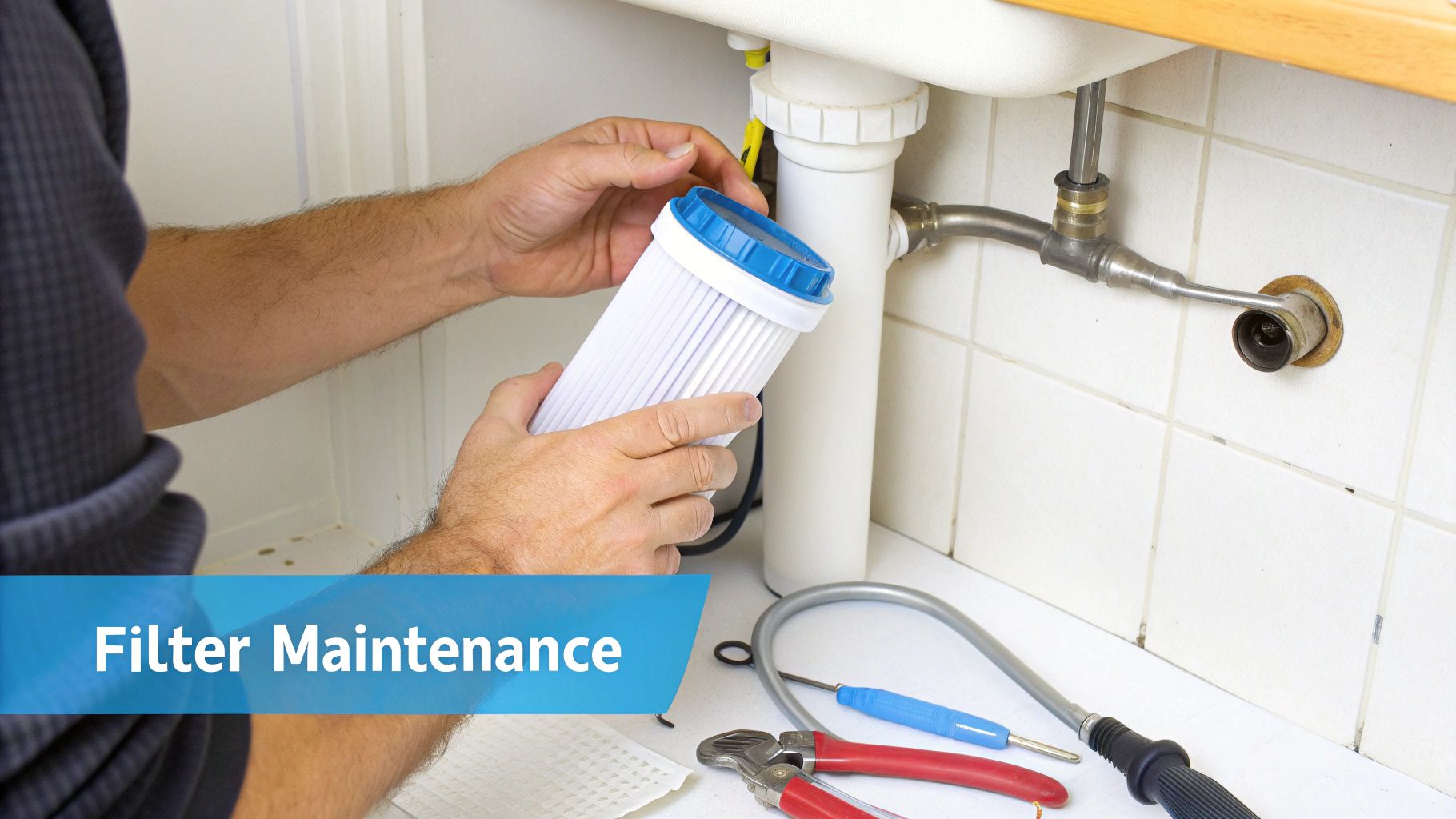
Getting a high-quality water filter for coliform installed is a massive step toward making your home's water safe. But the job isn't done. Think of it like a performance car—it needs regular oil changes and tune-ups to keep running like it should.
Consistent maintenance is the single most important thing you can do to make sure your filter keeps protecting your family. A neglected system doesn't just stop working; it can actually become a breeding ground for bacteria, completely undoing all your hard work and investment.
Creating a Practical Maintenance Schedule
The real secret to long-term safety is consistency. Just follow the manufacturer's recommended schedule. It takes all the guesswork out of the process and keeps your system in peak condition. Different filters have different needs, but the basic rhythm of care is usually the same.
Think of your maintenance plan as a roadmap to safe water. It's what ensures every part of the system is doing its job, providing that critical barrier against coliforms and other nasty stuff.
Your schedule should include a few non-negotiable tasks:
- Pre-Filter Swaps: If your system has sediment pre-filters, these are your first line of defense. They usually need to be replaced every 3 to 6 months. This prevents clogs that tank your water pressure and protects the more sensitive parts of your system down the line.
- UV Lamp Replacement: The UV lamp is the heart of a UV purification system. It might still light up after a year, but its germ-killing power drops off a cliff. Swapping it out annually is non-negotiable if you want to be sure it’s actually neutralizing bacteria.
- System Sanitization: Every so often, you need to flush and sanitize your system, especially if it's a reverse osmosis unit. This simple step prevents biofilm from building up and keeps everything clean and effective.
Here's something most people don't know: neglecting filter changes can lead to a problem called "channeling." This is where water literally carves a path around an old, clogged filter instead of passing through it. Contaminants, including bacteria, get a free pass right into your tap. It creates a completely false sense of security.
How to Spot Early Signs of Trouble
Beyond your regular schedule, you need to learn to spot the warning signs that your system needs attention. Catching these things early can stop a small problem from becoming a total failure.
These are the clues your system is asking for a check-up:
- A Sudden Drop in Water Pressure: This is usually the first and most obvious sign of a clogged filter. If your showerhead starts trickling or your faucets are running slow, it's a dead giveaway that your sediment or carbon pre-filters are maxed out and need to be replaced.
- Warning Lights or Alarms: Modern UV systems have sensors that watch the lamp's performance. If you see an indicator light or hear an alarm, it means the lamp is no longer effective. It needs to be replaced immediately to ensure disinfection is actually happening.
- Changes in Water Taste or Odor: Remember that "off" taste or smell that your filter got rid of? If it suddenly comes back, that's a clear sign the filter media (like activated carbon) is spent and can no longer do its job.
Staying on top of this routine maintenance is what turns your water filter from a simple appliance into a reliable, long-term health investment. A well-maintained system gives you the peace of mind that every single drop of water from your tap is as safe as it can possibly be.
Got Questions About Coliform Filters? We've Got Answers.
When you're dealing with something like bacterial contamination in your water, you're bound to have questions. Finding the right water filter for coliform means getting clear, no-nonsense answers to protect your family's health.
Let's cut through the jargon and tackle the most common things homeowners ask when that water test comes back positive.
Will a Brita Pitcher Get Rid of Coliform Bacteria?
No, a standard pitcher filter like a Brita won't touch coliform bacteria. These filters are great for what they're designed for—using activated carbon to make your water taste and smell better by removing things like chlorine.
But their filter pores are way too big to catch microscopic bugs like bacteria. For something that small, you need a certified purification system—think UV, reverse osmosis, or an ultra-fine absolute filter that's specifically built to stop pathogens in their tracks.
How Often Should I Test My Well Water for Coliforms?
For private well owners, testing for total coliforms and E. coli at least once a year is non-negotiable. Think of it as your annual safety check-up.
You'll also want to test your water immediately if certain situations pop up:
- After a flood or any significant ground disturbance near your wellhead.
- If you notice any change in your water’s taste, odor, or color.
- Anytime your well has been repaired or you've had the pump replaced.
- If anyone in the house has unexplained stomach or gut issues.
Is Shocking My Well with Chlorine a Permanent Fix?
Shock chlorination is a powerful tool, but it's a temporary one. It’s like hitting a reset button—it wipes out the immediate bacterial problem that’s already in your well.
Think of shock chlorination as a one-time deep clean. It sanitizes the well but doesn't fix the leaky window that let the germs in.
The problem is, it doesn't plug the hole that let the bacteria in to begin with. If you have a cracked well casing or a faulty seal, the coliforms will be back. A permanent water filter for coliform, like a whole-house UV purifier, is what provides that constant, 24/7 protection against whatever might get in down the road. It’s the long-term solution, not just a quick fix.
At Water Filter Advisor, we're here to help you find the right filtration solution to keep your family's water safe. For more deep-dive guides, product reviews, and expert advice, come see us at https://www.waterfilteradvisor.com.
- January 22, 2026
- 0
- Uncategorized
