Shopping for a water filter can feel like navigating a maze in the dark. You've got beefy whole-house systems that guard every drop of water entering your home, and then you have nifty little filters that screw right onto your faucet. The tech is just as varied—from humble activated carbon filters that make your water taste like a mountain spring to sophisticated reverse osmosis systems that strip out a laundry list of contaminants.
The good news? Whatever your water woes, there’s a filter out there ready to be your hero.
Your Journey to Better, Safer Water Starts Here
Welcome, water warrior. Let's cut through the noise and confusing jargon of the water filtration world. This guide is all about giving you clear, practical advice you can actually use to find the perfect filter for your home.
The "right" filter isn't always the biggest or most expensive. It’s the one that directly tackles the specific issues with your water. Whether you're on city water or a private well, the first step is always knowing what you're up against.
Why Filtering Your Water Matters
Even if your tap water is deemed "safe" by municipal standards, it can still harbor party-crashers that affect its quality, taste, and even your appliances. City-treated water often contains chlorine, which is a champ at disinfection but not so great for your morning coffee's flavor.
Other common troublemakers include:
- Sediment: Little bits of rust, sand, and dirt that cloud up your water and can wreak havoc on your plumbing and appliances. Think of it as liquid sandpaper for your pipes.
- Heavy Metals: Lead from old pipes is a major concern, as it can pose serious health risks, especially for children.
- Hardness Minerals: If you have crusty buildup on your faucets, that’s calcium and magnesium. This "hard water" scale can destroy water heaters and dishwashers over time.
Homeowners are catching on. In fact, the global market for water purifiers is expected to explode from USD 48.1 billion in 2025 to USD 97 billion by 2035, and residential filters make up about 70% of that. You can dig into the numbers yourself in this detailed report on GM Insights.
Finding the right solution means first identifying your specific problem. A strange smell, cloudy appearance, or hard water stains are all clues pointing toward the type of filtration you need.
Think of this guide as your roadmap. We’ll walk through the different kinds of filters, break down the technologies that make them work, and show you exactly how to match a solution to your problem. By the time you're done, you'll have the confidence to choose the right system for your family's health and peace of mind.
Whole House vs Single Faucet Filtration
Before we dive into the nitty-gritty of specific types of water filters, let's talk strategy. You have two main ways to tackle your home's water: treat every drop that comes in, or zero in on the spots where you use it the most. This single decision shapes everything that comes next—from cost and upkeep to the actual benefits you’ll get.
Think of it this way: you could install a giant gatekeeper at the entrance to your property to screen everyone who enters. Or, you could put high-tech locks just on the doors you use most, like your front door. Both work, but they solve different problems.
Point-of-Entry (POE) vs. Point-of-Use (POU) At a Glance
To make this decision easier, here’s a quick breakdown of the two approaches. This table compares the big-picture "gatekeeper" systems with the specialized "guard" filters, helping you see where each one shines.
| Feature | Point-of-Entry (Whole-House) | Point-of-Use (Single Faucet, Shower, etc.) |
|---|---|---|
| Coverage | Treats all water entering the home—faucets, showers, laundry, toilets. | Treats water at a single location, like the kitchen sink or a specific shower. |
| Primary Goal | Protects plumbing and appliances from scale, sediment, and chlorine. | Provides highly purified water for drinking, cooking, or bathing. |
| Installation | Usually requires a professional plumber; connects to the main water line. | Often a simple DIY installation that takes just a few minutes. |
| Cost | Higher upfront investment ($500 – $3,000+). | Lower upfront cost ($30 – $500). |
| Best For | Homeowners tackling hard water, sediment, or chlorine issues house-wide. | Renters or those targeting specific contaminants like lead in drinking water. |
Ultimately, the right choice comes down to what you're trying to fix. Are you waging a war on hard water buildup in your pipes and appliances? Go with a POE system. Are you just trying to get great-tasting, safe drinking water from one tap? A POU filter is your best bet.
The Gatekeeper: Point-of-Entry Systems
A Point-of-Entry (POE) system is that security gate for your whole property. Better known as a whole-house water filter, it gets hooked up to your main water line, treating every gallon of water that flows into your home. That means your showers, washing machine, toilets, and every sink get filtered water.
The main job of a POE system is often to protect your home’s guts—the pipes and appliances. By grabbing things like sediment, chlorine, and hard water minerals right at the source, it keeps them from ever causing trouble. This is a game-changer for extending the life of your water heater and dishwasher by stopping that crusty scale buildup.
These systems are a real long-term investment in your home's health. But they do come with a higher price tag and almost always need a professional to install them correctly.
The Specialist: Point-of-Use Filters
On the other side, you have Point-of-Use (POU) filters. These are the specialized guards. Think of the filter you screw onto your kitchen faucet, the one tucked away under the sink, or the one built right into your showerhead. Their whole purpose is to deliver highly purified water right where you need it most—for drinking, cooking, or showering.
POU systems are fantastic for renters or anyone who wants to fix a specific water problem without redoing their plumbing. For instance, an under-sink reverse osmosis system can give you incredibly pure drinking water, stripping out a huge range of contaminants like lead and other nasty dissolved solids. Even a simple faucet filter can make your tap water taste and smell a hundred times better by getting rid of chlorine.
Here's a pro tip: many people use both. They’ll install a whole-house filter as the first line of defense to catch sediment and chlorine, then add a point-of-use filter under the kitchen sink for an extra level of purification just for their drinking water.
So, how do you decide? It all comes down to your goals. Are you trying to save your entire plumbing system from hard water? Or are you just focused on getting the cleanest, best-tasting water from your kitchen tap? Answering that question is your first step toward picking from the many types of water filters and getting a setup that works perfectly for you.
A Look at the Most Common Types of Home Water Filters
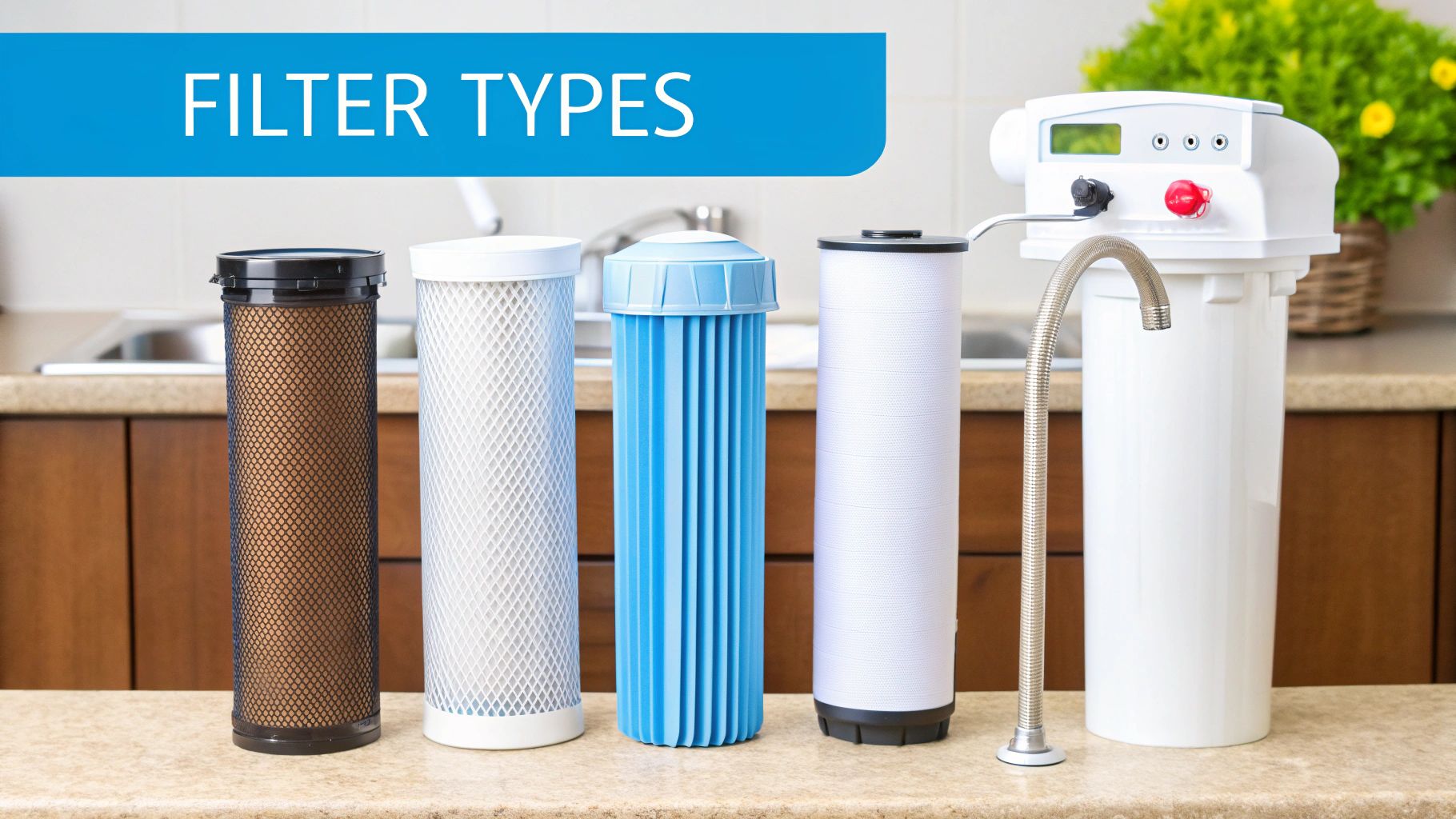
Now that we've covered the big picture—treating your whole house versus just a single tap—we can get into the actual hardware. Picking a water filter is a lot like choosing the right tool for a job. You wouldn't bring a sledgehammer to hang a picture, right? Each filter is built for a specific purpose, budget, and home.
The demand for easy, effective solutions is booming. In fact, the global home water filtration market was on track to hit USD 7.13 billion by 2026, largely because so many people want systems they can install themselves. These point-of-use filters are a huge hit with renters and homeowners who don't want to get into a major plumbing project.
Let's dive into the most common options you'll find out there.
Whole-House Systems: The All-In-One Solution
Think of a whole-house system as the ultimate gatekeeper for your home's water. Installed right where the main water line enters your house, it treats every single drop. This protects not just your drinking water but your entire plumbing system and every appliance—from the dishwasher to the washing machine—from sediment, chlorine, and hard water minerals.
- Best Use Case: Perfect for homeowners facing widespread issues like hard water scale, sediment from a well, or that swimming-pool chlorine smell from every faucet.
- Cost & Installation: These are a bigger investment upfront, typically running from $500 to over $3,000. You'll almost always need a professional plumber to install it.
- Maintenance: You'll usually change out large sediment and carbon filters every 6-12 months, though some high-end systems can go even longer.
Under-Sink Filters: The Hidden Powerhouse
Under-sink filters are probably the most popular choice for getting purified water right at the kitchen sink. They stay tucked away in the cabinet, connected to a dedicated faucet for drinking and cooking. These systems can be as simple as a single carbon filter or as powerful as a multi-stage reverse osmosis unit that strips out nearly everything.
They’re a fantastic choice for anyone who wants seriously purified water without cluttering up the countertop. Plus, having a separate faucet means you're not wasting that perfectly filtered water on washing dishes. If you're weighing your options, this water filtration systems comparison guide is a really helpful resource.
Faucet-Mounted Filters: The Quick and Easy Fix
For pure convenience and a dead-simple setup, nothing beats a faucet-mounted filter. These little gadgets screw right onto your kitchen faucet, usually in minutes and with no tools required.
Most have a small lever that lets you flip between filtered water for a drink and regular tap water for washing up, which makes the filter cartridge last longer. While they won't purify water to the same degree as an under-sink system, they do an amazing job of getting rid of chlorine and making your water taste great.
Key Takeaway: Faucet filters are your low-cost, no-commitment ticket into the world of water filtration. They are a brilliant option for renters, college dorms, or anyone who just wants better-tasting water right now.
Shower Head Filters: The Beauty and Wellness Upgrade
You might not think about the water you shower in, but filtering it can make a huge difference for your skin and hair. Shower head filters are specifically designed to tackle chlorine, which is notorious for stripping your body's natural oils and leaving you with dry, itchy skin and brittle hair.
- Best Use Case: Anyone dealing with dry skin, a flaky scalp, or straw-like hair. They're also a must-have for preserving color-treated hair.
- Cost & Installation: Super affordable, usually between $25 and $75. Installing one is as easy as screwing on a new showerhead.
- Maintenance: Just pop in a new cartridge every 4-6 months.
Pitcher And Countertop Filters: The Portable Choice
Water filter pitchers are the classic, entry-level option. Just fill the top reservoir with tap water and let gravity do the work, slowly dripping filtered water into the pitcher below. Countertop units are a similar idea, but they're bigger and usually have a spigot for easy pouring.
They're cheap and you can take them anywhere, but they're also the slowest and hold the least amount of water. They really only make sense for one person or a small household just looking to filter a few glasses of drinking water a day. They're great for taste and chlorine but aren't built to handle more serious contaminants.
How Different Water Filtration Technologies Work
To really get a handle on the different types of water filters, you have to look under the hood. Think of filtration technologies as the special "skills" a filter has. Each one is a specialist, trained to go after specific kinds of contaminants.
This isn’t about dense science; it’s about matching the right tool to the right problem. Once you understand how these core technologies work, you can see right past the marketing jargon and know what a filter can actually do for your water.
Activated Carbon: The Contaminant Magnet
Activated carbon is the undisputed workhorse of the water filtration world. You'll find it in just about everything, from a simple pitcher to a sophisticated whole-house system. The easiest way to picture it is as a powerful magnet with a massive surface area.
So, how does it work? The carbon is "activated" with a process that creates millions of tiny pores, giving it a ridiculously large surface to trap junk. As water flows through, unwanted chemicals like chlorine, pesticides, and volatile organic compounds (VOCs) get stuck to the carbon's surface. This process is called adsorption.
This is exactly why activated carbon filters are absolute superstars at making your water taste and smell better. They grab the chlorine that gives city water that "public pool" odor, leaving you with nothing but clean, crisp-tasting water.
Reverse Osmosis: The Ultimate Gatekeeper
When you need the absolute highest level of purification, reverse osmosis (RO) is the technology you turn to. Imagine a screen so incredibly fine that only pure water molecules can squeeze through. Everything else—we're talking heavy metals like lead, dissolved salts, arsenic, and fluoride—gets blocked and flushed down the drain.
An RO system uses your home's water pressure to force tap water through a semi-permeable membrane. This process is so thorough that it can remove up to 99% of total dissolved solids (TDS) from your water.
Because it’s so powerful, RO is the go-to for tackling serious contamination issues. Membrane-based filters, especially RO systems, are the dominant force in home water treatment because they are so effective at removing dissolved solids and heavy metals. That said, UV-LED filtration is gaining ground as more people look for chemical-free purification. You can dig into more data on these market trends in this SkyQuest Technology industry report.
UV Purifiers: The Microbe Zapper
Some of the scariest contaminants in your water are totally invisible: bacteria, viruses, and other nasty microorganisms. Ultraviolet (UV) purification is a completely chemical-free way to deal with these biological threats.
Think of it like a concentrated blast of sunlight. A UV purifier uses a special lamp to zap the water with a specific wavelength of UV light. This light scrambles the DNA of microorganisms like E. coli, Giardia, and Cryptosporidium, which makes them harmless and unable to reproduce.
It's critical to know what UV doesn't do.
- It does not remove sediment, chemicals, or metals. UV is purely for disinfection.
- It needs clear water to work. Cloudy or murky water can shield microbes from the light.
For this reason, a UV purifier is almost always paired with a sediment pre-filter to make sure the light can reach and neutralize every last bug.
Ion Exchange: The Hard Water Softener
If you're in a constant battle with that chalky white buildup on your faucets and shower doors, you've got hard water. The culprits are calcium and magnesium minerals, and ion exchange is the technology built specifically to solve this problem.
Here’s a simple way to think about it: imagine a parking lot where every spot is taken by a sodium ion. As your hard water flows through a resin bed filled with these sodium ions, the calcium and magnesium "cars" come along, kick the sodium "cars" out, and take their parking spots. What comes out the other side is softened water that won't leave scale all over your fixtures.
Looking beyond typical filters, understanding advanced wastewater treatment, like polyethylene aerobic treatment units, can offer solutions for more specific water treatment needs, especially in rural settings.
Sediment Filters: The First Line of Defense
Last but not least, we have the unsung hero of many filtration systems: the sediment filter. Its job is simple but absolutely crucial—it’s the bouncer at the door, stopping all the big, clunky particles from getting inside.
These filters are made to catch physical debris like sand, dirt, rust, and silt. They usually act as a pre-filter, protecting more delicate and expensive technologies like RO membranes and UV lamps from getting clogged up and damaged.
A sediment filter is often the very first stage in any whole-house or multi-stage under-sink system. By handling the heavy lifting upfront, it lets all the other specialized filters focus on what they do best, which extends their lifespan and keeps the entire system running like it should.
Matching the Right Filter to Your Water Problems
Picking a water filter can feel like a guessing game. You know something’s off with your water, but with all the different types of water filters on the market, how do you know which one will actually fix your problem?
The secret is to stop looking at the filters first. Instead, start by playing detective with your water.
Think of it like going to the doctor. You wouldn't just ask for a random prescription; you'd tell them your symptoms. Is your water cloudy? Does it reek of chlorine? Do you see those annoying chalky white stains on your dishes and faucets? Each of these clues points you directly to the right filtration technology.
When you match the symptom to the solution, you can be confident you're buying a filter that will make a real difference. It’s simply the best way to get the results you want.
Diagnosing Your Home's Water Issues
Before you can pick the right hero for the job, you need to know who the villain is. Luckily, most household water problems fall into a few common categories, and each one has a telltale sign.
- Bad Taste and Odor: The number one complaint is water that tastes or smells like a swimming pool. That's the chlorine that municipal treatment plants use to disinfect the water supply.
- Hard Water Stains: If you're constantly scrubbing a crusty, white buildup off your faucets, showerheads, and glassware, you've got hard water. Those stains are caused by high levels of calcium and magnesium minerals.
- Cloudy or Murky Water: Water that isn't perfectly clear is likely full of sediment. We’re talking about tiny particles of sand, rust, silt, or dirt that can sneak in from aging city water mains or a private well.
- Serious Health Concerns: Some of the worst contaminants are completely invisible and have no taste or smell, but they pose major health risks. This includes heavy metals like lead (often from old pipes) and microorganisms like bacteria or viruses, which are a bigger worry for well water users.
This decision tree infographic is a great way to see how to connect a specific filtration technology, like activated carbon or reverse osmosis, to your water concerns.
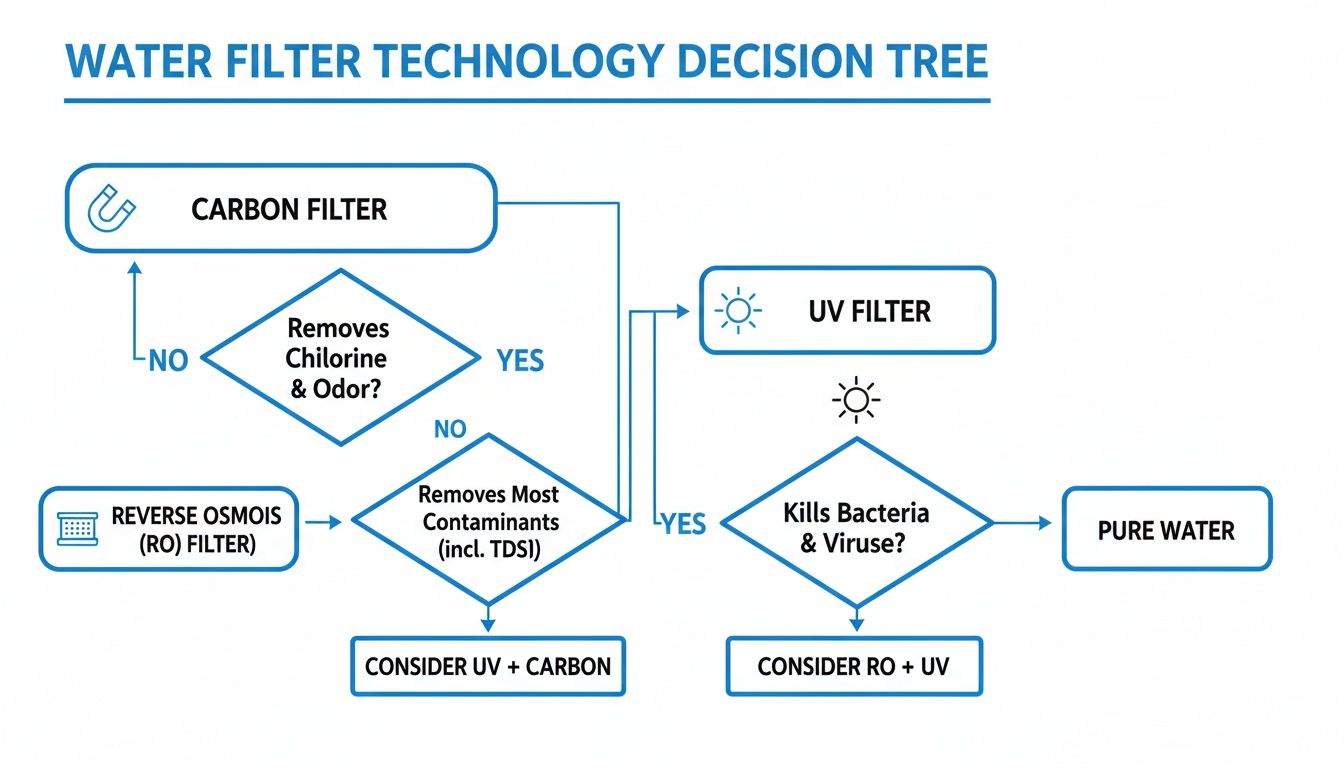
As you can see, the flowchart gives you a clear path from identifying your main issue—be it taste, hard water, or health contaminants—straight to the best technology for the job.
Your Prescription for Purer Water
Once you've diagnosed the problem, finding the fix is straightforward. This handy table acts as your quick reference guide. Just find your water complaint in the first column to see our recommended filter and the technology that makes it work.
Common Water Problems and Their Filtration Solutions
This table will help you quickly identify your water issue and find the most effective type of filter and technology to solve it.
| Common Water Problem | Primary Cause | Recommended Filter Type | Key Technology |
|---|---|---|---|
| Chlorine Taste & Odor | Municipal disinfection chemicals | Faucet, Pitcher, Under-Sink | Activated Carbon |
| Hard Water Scale & Buildup | High levels of calcium and magnesium | Whole-House System | Ion Exchange |
| Lead or Arsenic Concerns | Leaching from old pipes or groundwater | Under-Sink or Whole-House | Reverse Osmosis |
| Cloudy Water with Particles | Sand, rust, silt, and other suspended solids | Whole-House System | Sediment Filter |
| Bacterial or Viral Contamination | Unsafe well water or boil water advisories | Under-Sink or Whole-House | UV Purification |
This approach makes finding the right filter a whole lot simpler.
The smartest first step is always to get a water quality report. Your local municipality can provide one, or you can use an at-home testing kit. This report gives you concrete data, taking the guesswork out of choosing from the various types of water filters.
At the end of the day, this diagnostic approach ensures you aren't just buying a filter—you're investing in a targeted solution for your home. Whether that's an activated carbon filter for better-tasting coffee or a reverse osmosis system for total peace of mind, understanding your water is the key to making it better.
What to Consider Before You Buy a Water Filter
Picking out a water filter isn’t just a one-and-done purchase. It’s a real commitment to having better, safer water in your home for the long haul. So, before you grab one of the many types of water filters off the shelf, it’s worth looking past the price tag and thinking about the details that will matter day-in and day-out.
Thinking about these things upfront is the best way to land a system you’ll actually be happy with. It ensures you get the clean water you want without it turning into a surprise expense or a maintenance nightmare down the road. It's all about finding the right fit for your water and your lifestyle.
Understand the Total Cost of Ownership
That initial sticker price? It’s just the beginning of the story. The real cost of any filter is what we call the Total Cost of Ownership, which is the upfront price plus all the recurring expenses you'll have over its lifetime.
The biggest ongoing cost is almost always the replacement filter cartridges. A cheap faucet filter might look like a steal at $30, but if it needs a new $15 cartridge every two months, you'll end up spending way more over time than you would on a pricier under-sink system with a filter that lasts a whole year. Always, always check the cost and replacement schedule for cartridges before you commit.
Look for NSF and ANSI Certifications
How do you really know if a filter does what it says it does? You look for proof from independent organizations like the NSF (National Sanitation Foundation) and ANSI (American National Standards Institute).
An NSF/ANSI certification isn't just marketing fluff—it's your guarantee that a filter has been put through its paces in rigorous testing. It proves the filter removes the exact contaminants listed on the box. For example, NSF/ANSI 53 is the one you want to see for serious health-related contaminants like lead, while NSF/ANSI 42 covers things that affect taste and smell, like chlorine.
Choosing a certified product gives you real peace of mind, knowing your investment is actually protecting your family. If you want to dive deeper into making smart choices, you can find a ton of helpful water filtration advice and guides here.
Check the Flow Rate and Filter Lifespan
Performance is key, but so is practicality. Two numbers that directly affect how convenient a filter is to live with are its flow rate and lifespan.
- Flow Rate: This is measured in gallons per minute (GPM) and tells you how fast clean water comes out. A slow flow rate might be perfectly fine for a little drinking water tap at the sink, but it would drive you crazy in a whole-house system or a shower filter.
- Filter Lifespan: This is how many gallons the manufacturer says the filter can clean before it’s time for a replacement. Match this up with how much water your family uses to get a feel for the maintenance schedule and avoid a sudden drop in water quality.
By carefully weighing these factors—cost, certifications, and daily usability—you can stop just buying a product and start investing in a reliable, effective solution for your home's water.
Frequently Asked Questions About Water Filters
Even with all this information, you probably still have a few questions rattling around. That’s perfectly normal. Let's tackle some of the most common things people ask so you can feel 100% sure about choosing the right system for your home.
Do Water Filters Remove Beneficial Minerals?
This question comes up a lot, especially when we talk about powerful systems like reverse osmosis. The short answer is yes, some do. Reverse osmosis is so meticulous that it strips out nearly everything, which includes healthy minerals like calcium and magnesium.
But here’s the thing: most of us get the vast majority of our essential minerals from our food, not our water. If you’re still concerned, you can easily add a remineralization filter to your system. It puts a healthy balance of minerals right back into the water after it's been purified.
How Often Do I Really Need to Change My Filter Cartridge?
Following the manufacturer's schedule isn't just a suggestion—it's critical for your filter to work safely and effectively. An old, clogged filter simply can't do its job. Worse, a totally saturated filter can dump a concentrated backlog of contaminants back into your water.
Think of your filter like a sponge. Once it's full, it's done. Most faucet filters will last you 2-3 months, while the bigger under-sink and whole-house cartridges can go anywhere from 6 months to over a year.
What Is the Difference Between a Water Filter and a Water Softener?
This is a huge point of confusion, but the difference is simple. A water filter is built to remove contaminants to make your water safer and taste better. It goes after things like chlorine, lead, pesticides, and bacteria.
A water softener, on the other hand, does one specific job: it removes the "hard" minerals—calcium and magnesium—that cause scale buildup in your pipes and appliances. While you can find systems that do both, they are two different technologies for two very different problems.
Here's an easy way to remember it: Filters purify your water by removing contaminants. Softeners condition your water by removing hardness minerals.
Can I Install a Water Filter Myself?
Absolutely! Well, most of the time. The difficulty really depends on which of the types of water filters you choose.
- DIY-Friendly: Faucet filters, pitchers, and most shower filters are a breeze. You usually don't need any tools, and it only takes a few minutes.
- Moderate Skill: If you're comfortable with basic plumbing, you can probably handle many under-sink systems yourself.
- Professional Recommended: For whole-house systems or complex reverse osmosis units that tie into your main water line, we always recommend calling a licensed plumber. It's the best way to make sure it's done right and prevent any leaks.
At Water Filter Advisor, our goal is to help you get cleaner, safer water. From our detailed guides to practical tips, we're here to give you the clarity you need. Explore all of our expert advice and find the perfect water solution for your home at https://www.waterfilteradvisor.com.
- January 30, 2026
- 0
- Uncategorized
