
Most review tankless electric water heater articles start with the same sales pitch. Smaller box. No standby heat loss. Endless hot water. That advice leaves out the part that decides whether the unit works well in your house or becomes an expensive callback.
A tankless electric water heater is not automatically a smart upgrade. In the field, three things decide the outcome faster than the marketing copy does. Your electrical service. Your incoming water temperature. Your water quality.
The third one gets ignored constantly. That's a mistake. If your home has hard water, iron, or sediment, the heater's elements can foul up long before you feel like you got full value out of the install. A lot of homeowners spend hours comparing kW ratings and almost no time checking what's flowing through the unit.
The practical review is simple. Tankless electric can work very well in the right home, especially for point-of-use setups, apartments, and smaller demand profiles. It can also be the wrong fit for a big household in a cold region with hard water and a crowded electric panel.
| Factor | Tankless Electric Strength | Tankless Electric Weakness | What to check first |
|---|---|---|---|
| Efficiency | Very high conversion efficiency | Savings depend on actual usage pattern | Household hot water demand |
| Size | Wall-mounted and compact | Doesn't solve flow limits by itself | Where you'll use hot water at the same time |
| Installation | No venting needed | Electrical upgrades can be the deal breaker | Panel capacity and breaker space |
| Water quality | Works well with treated water | Scale and sediment can cut performance fast | Hardness, iron, and debris in supply |
| Best fit | Small homes, apartments, point-of-use | Often less satisfying for high simultaneous demand | Daily habits, not just square footage |
Most bad tankless purchases aren't caused by the heater. They're caused by a mismatch between the heater, the house, and the water.
Is a Tankless Electric Water Heater Right for You
The popular assumption is that tankless is always better than a storage tank. It isn't. The U.S. Department of Energy says demand-type water heaters can be 24% to 34% more energy efficient than conventional storage tanks in homes using 41 gallons of hot water or less per day, but only 8% to 14% more efficient in homes with higher use. That tells you something important right away. Usage pattern matters.
If you live alone, have one bathroom, and don't stack hot water loads all day, tankless electric can make a lot of sense. If you have multiple bathrooms, colder groundwater, and people showering while the dishwasher and washing machine are running, the experience changes fast. The unit may still be efficient, but that doesn't mean it will feel generous.
The three questions that decide it
Before looking at Rheem, Stiebel Eltron, or any other brand, answer these:
Can your electrical service support it
Electric tankless heaters draw serious power. If your panel is already loaded, the install can stop right there.How cold is your incoming water
Cold inlet water demands more heating power. A spec sheet that looks great in mild conditions can disappoint in a colder location.What's in your water
Hardness, iron, and sediment affect element life, heat transfer, and maintenance frequency. For many homes, this is the hidden ownership cost.
A good fit and a bad fit
A good fit is a smaller household that wants hot water without a bulky tank and already has solid electrical capacity. A bad fit is the homeowner who expects one electric unit to behave like a large gas system in a high-demand house without any utility trade-offs.
That's why a review tankless electric water heater decision shouldn't start with efficiency claims. It should start with house conditions. The heater is only one piece of the system.
Understanding Key Performance Specs
Spec sheets sell fantasy if you read them out of order. Start with heating power, then match it to your inlet water conditions, then look at flow. If you reverse that sequence, the GPM number will mislead you.
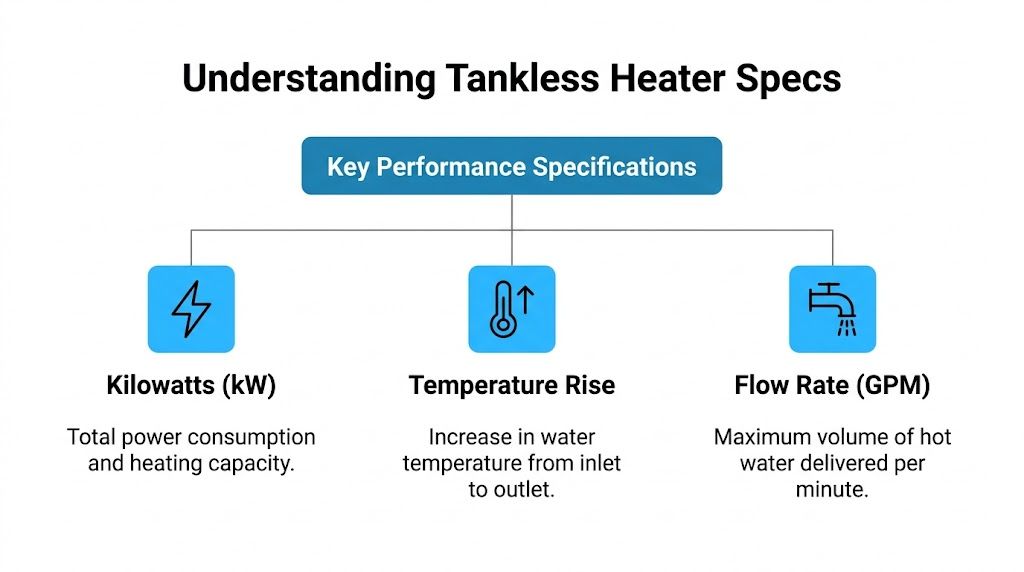
Kilowatts set the ceiling
Kilowatts tell you how much heating work the unit can do. Electric tankless heaters draw far more power than standard tank heaters, which is why panel capacity and breaker space become part of the performance conversation, not just the installation conversation. A unit with limited kW cannot make up for cold inlet water, long pipe runs, or two people trying to use hot water at once.
That matters in practice because the heater does not produce a fixed amount of hot water. It produces a fixed amount of heat. Your house then spends that heat based on inlet temperature, target temperature, and how many fixtures are open.
Temperature rise is the spec that separates good reviews from bad ones
Temperature rise is the difference between the water coming in and the water you want going out. A heater in Florida and the same heater in Minnesota are not doing the same job, even if the box and model number match.
Earlier testing summaries noted that electric tankless units had more trouble holding target temperature as inlet water got colder. That lines up with field experience. Homeowners often blame the brand when the underlying issue is that the unit was sized from the headline GPM instead of the required temperature rise.
Local water quality also starts to matter here. Scale on the elements insulates them, so the unit can lose heating performance before it completely fails. On private wells or older municipal systems, sediment and iron can add restriction inside the unit and at fixture screens. If iron is part of your water profile, this guide on removing iron from household water is worth reviewing before you judge heater performance by the first few months alone.
Practical rule: Do not use the advertised top-end GPM until you know your actual inlet temperature and your desired outlet temperature.
Flow rate is what the household feels
Flow rate is the comfort spec. It tells you how much hot water the unit can deliver per minute under a given set of conditions. The problem is that manufacturers often publish flow under favorable assumptions, and those assumptions are rarely printed in the big bold type.
A listed GPM can be technically correct and still disappoint in a hard-water home with cold groundwater. As scale builds, the heater transfers heat less efficiently. As sediment collects, flow can drop. The number on day one and the performance in year three may not match, especially if the water has not been treated or the unit has not been flushed on schedule.
Efficiency numbers do not decide much here
Electric tankless heaters are generally very efficient at converting electricity into heat. In practice, that does not separate one model from another nearly as much as kW capacity, realistic temperature rise, and how clean the water stays inside the heat chamber.
Read the spec sheet in this order:
- kW tells you the heating muscle
- Temperature rise tells you how much of that muscle your climate uses
- GPM tells you how much hot water is left for actual fixtures
That is the reading method I use in the field, because it matches how these heaters succeed or struggle in real homes.
The Impact of Water Quality on Heater Lifespan
Most electric tankless reviews treat maintenance like a footnote. For a water-focused homeowner, it should be near the top of the page. Water quality is often the difference between a heater that performs cleanly and one that starts losing output, runs hotter internally, and eats its elements.
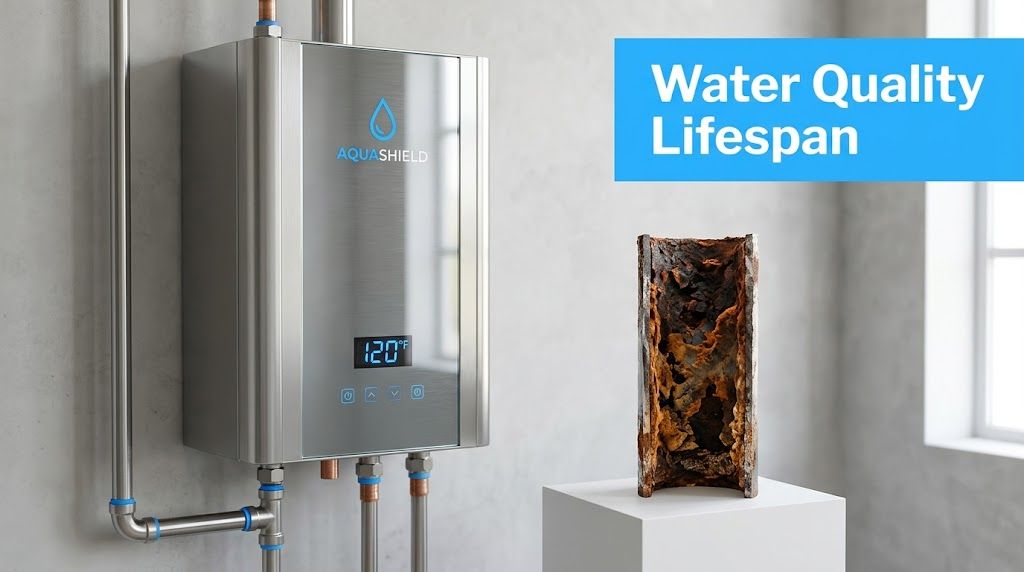
Hard water is the quiet performance killer
The primary issue with electric tankless heaters is scaling on the heating elements. Mother warns that mineral buildup can drop performance quickly, and neglecting annual flushing in hard-water regions can cause element failure and wipe out the efficiency advantage.
That lines up with what plumbers see all the time. The heater still turns on. It still technically heats. But heat transfer gets worse, output gets less satisfying, and service calls become more likely.
A storage tank can limp along while collecting scale. An electric tankless unit is less forgiving because the heating elements are doing intense on-demand work.
Sediment and iron matter too
Hardness gets most of the attention, but it's not the only problem. Sediment can foul screens and internal passages. Iron can stain fixtures, contribute to deposits, and complicate maintenance planning. If your water comes from a well, or if your municipal supply carries visible debris after line work, pre-treatment matters.
For iron-specific treatment options, homeowners dealing with reddish staining or metallic taste should understand how iron removal systems work before adding a tankless unit. A heater can't fix bad feed water. It only suffers from it.
What to do before you install
A smart setup treats the heater as part of a water system, not a standalone appliance.
Test the water first
Check hardness, iron, and visible sediment issues before buying the heater. This is basic due diligence.Use upstream protection when needed
In hard-water homes, a softener or scale-control strategy can protect the heating elements. In sediment-prone homes, a pre-filter helps reduce debris entering the unit.Plan for flushing
“Maintenance-light” doesn't mean “maintenance-free.” If your water is hard, annual flushing isn't optional.
If your water leaves white crust on faucets or spotting on glass, assume your heater will see the same minerals unless you treat the water first.
The real ownership question
A lot of buyers ask whether tankless electric saves energy. The more practical question is whether your local water allows the heater to keep performing the way it did on day one.
That's the missing piece in many review tankless electric water heater roundups. The heater may be efficient on paper and compact on the wall. But if your water chemistry is rough and you don't budget for treatment or maintenance, the true cost of ownership goes up fast.
Comparing Performance and Lifetime Costs
A cheap electric tankless unit can become an expensive water heater if your water is hard and your electrical service is marginal. That is the part many review roundups miss.
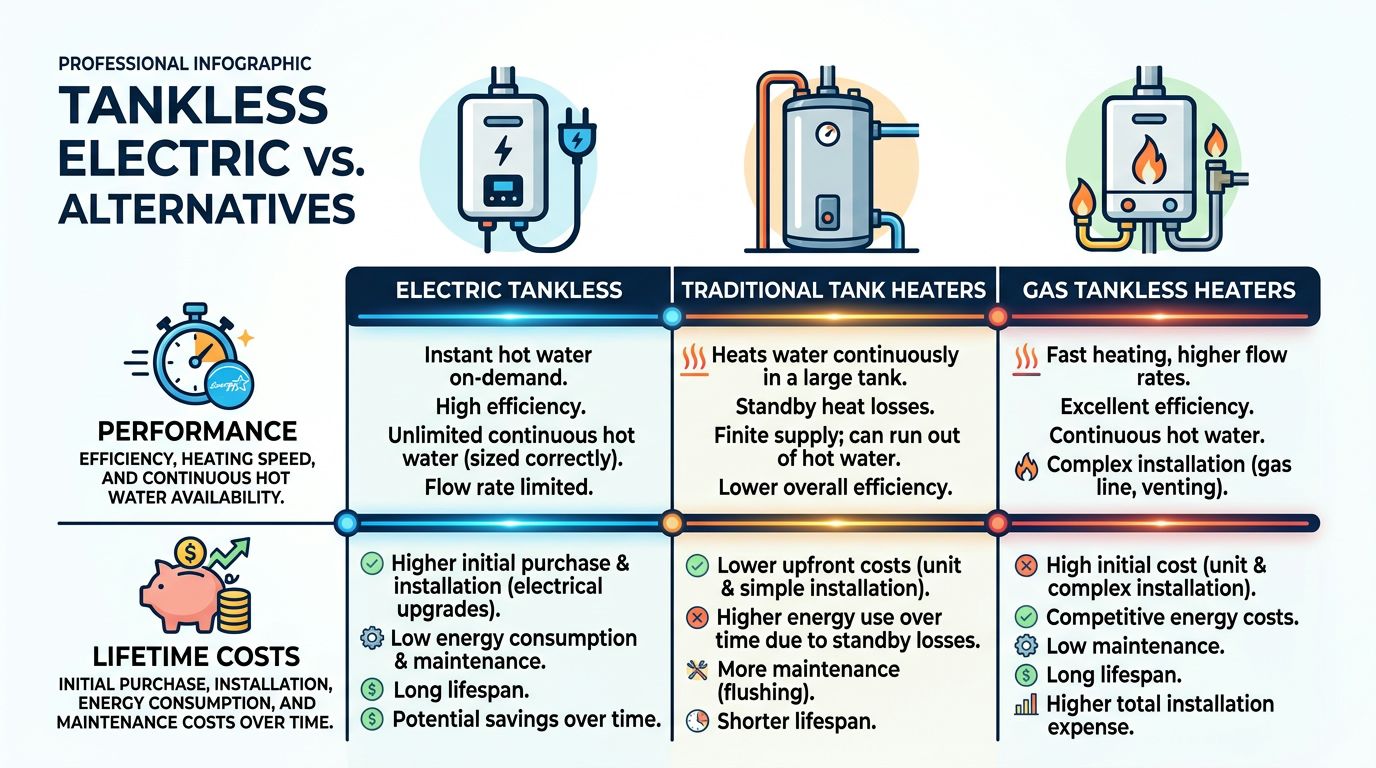
Price the heater, then price the house it has to work in. A tankless electric can be a smart fit in the right home, but lifetime cost depends on three things more than the box price suggests: your electric rate, your incoming water quality, and how often the unit will be pushed near its limits.
Side-by-side trade-offs
| Heater type | Performance profile | Installation profile | Water quality sensitivity | Where it usually fits |
|---|---|---|---|---|
| Electric tankless | Fast response, compact footprint, strongest value when hot water demand is moderate | Can be straightforward or expensive if panel and circuit work are needed | High sensitivity to scale on heating elements and screens | Apartments, small homes, point-of-use setups |
| Gas tankless | Better whole-home output where several fixtures run at once | Venting, combustion air, and gas-line work add complexity | Still affected by scale and sediment, but service issues show up differently | Larger homes, families with heavier simultaneous demand |
| Traditional tank | Predictable delivery with stored reserve, but standby losses never go away | Usually the easiest swap if a tank is already in place | Affected by scale too, though performance decline is often slower and easier to notice | Homes that want simpler replacement and less electrical work |
Efficiency on paper vs cost in service
As noted earlier, independent testing found electric tankless models strong on efficiency ratings while operating cost can still disappoint in places with expensive power. This efficiency gap presents a tangible practical concern. A heater can convert power to heat efficiently and still raise the utility bill more than expected.
Gas tankless often makes more financial sense where natural gas is available and hot water demand is high. Traditional tanks still compete well when replacement cost, simpler service, and lower installation friction matter more than peak efficiency.
If you are comparing water heating with other big utility decisions, this guide to best heating systems for homes helps put the water heater in the larger energy budget.
Lifetime cost is usually won or lost on installation and maintenance
Electric tankless units avoid venting costs, but they often expose electrical limits fast. I see this regularly in older homes. The homeowner buys a compact unit online, then finds out the panel is full, the service is undersized, or multiple new breakers and heavy-gauge wire are needed to make the heater legal and usable.
That can erase the value argument in one estimate.
Gas tankless has its own added costs, mostly around venting and gas supply. A standard tank usually stays cheapest to install when you are replacing like for like, especially if the house already has a workable location, drain pan, and venting setup.
Hard water changes the math more than shoppers expect
Here is the trade-off many buyers miss. Electric tankless heaters are efficient because exposed elements transfer heat directly and quickly. In hard water, those same elements collect scale. As buildup thickens, heat transfer drops, run time increases, and parts run hotter than they should.
You do not always see the problem right away. The first signs are often smaller. Outlet temperature starts to wander. Flow may drop. The unit may cycle strangely or trip protections more often. Then service calls start.
Sediment causes a different kind of wear. Fine debris can clog inlet screens and restrict flow enough to affect performance before the heater itself has technically failed. Homeowners comparing brands should understand how tankless filter cleaning fits into regular service, because this maintenance has a direct effect on output and lifespan.
In soft, clean water, an electric tankless can stay efficient and low-hassle for years. In hard or dirty water, the same unit can become a maintenance item that never quite performs like it did when new.
Which option usually costs less over time
Electric tankless usually wins in smaller homes, point-of-use applications, and properties with decent electrical capacity and manageable water hardness. Gas tankless usually wins where households need more hot water at the same time and fuel cost favors gas. Traditional tanks still win plenty of jobs because they are easier to replace, easier to service, and less sensitive to installation surprises.
The right comparison is total ownership cost under local conditions. If your water leaves scale on faucets, budget for treatment and flushing before you assume tankless electric is the cheaper long-term choice.
Sizing Your Heater and Planning Installation
A lot of electric tankless heaters get blamed for poor performance when the underlying problem was bad sizing and a rushed install. The unit can only heat the water you give it, at the flow rate your house demands, with the electrical capacity your panel can supply. If your incoming water is cold, hard, or dirty, the margin for error gets smaller.
Start with actual household use, not brochure promises. A heater that looks fine on paper can still disappoint if two showers overlap, the dishwasher kicks on, and the inlet water arrives colder than expected for your area.
A simple self-audit
Walk the house and write down what happens during a normal busy hour. Be honest about overlap. Families do not use hot water one fixture at a time just because the spec sheet would prefer that.
Check these four things:
Simultaneous hot water use
One shower is easy. One shower plus a sink, laundry, or dishwasher is a different sizing job.Incoming water temperature
Cold-climate installs need more heating power to deliver the same shower experience.Available electrical capacity
Electric tankless units can need multiple large dedicated circuits. Some homes have the wall space for the heater but not the panel capacity to run it.Local water quality
Hardness and sediment should be part of sizing, not an afterthought. Scale on the heating elements reduces real output over time, so a unit sized too tightly in a hard-water home often feels undersized much sooner than expected.
Estimated Electric Tankless Sizing by Household
| Household Size | Simultaneous Uses | Required GPM (Warm Climate) | Required GPM (Cold Climate) | Typical kW Range |
|---|---|---|---|---|
| Apartment or single occupant | One shower or one sink plus one appliance | Lower range | Moderate range | Lower to mid range |
| Small household | One to two hot water uses at once | Moderate range | Mid to higher range | Mid range |
| Medium household | Two bathrooms with overlapping use | Higher range | High range | Higher range |
| Large household | Multiple simultaneous showers or appliances | Very high range | Often beyond practical electric whole-home comfort | Highest range, if service allows |
Those ranges stay qualitative on purpose. Real sizing depends on fixture flow rates, winter inlet temperature, and how quickly scale buildup is likely to cut performance in your local water.
A plumber sees this mistake all the time. The homeowner buys for today's clean spec sheet output. Two years later, the same heater is working with scaled elements, a partially clogged inlet screen, and less temperature rise at the tap.
What the electrical side really means
The electrical work is often the make-or-break part of the project. Many whole-home electric tankless units need substantial amperage, multiple breakers, and wiring sized correctly from the start. An older panel can turn a simple heater swap into a larger upgrade.
That is why the heater price rarely tells the full story. Panel work, dedicated circuits, permit requirements, cable runs, and labor can change the job cost more than brand choice does.
For homeowners trying to understand code compliance before calling contractors, a short explainer on Part P expertise from Electricians London 247 is a useful reference for why qualified electrical work matters on safety-critical home installations.
A better way to request quotes
Ask for a scope, not just a price. Good quotes should spell out what the installer is assuming and what could change once they inspect the panel and water conditions.
Request these details:
- Heater model and kW requirement
- Number and size of dedicated circuits
- Whether the existing panel can support the load
- Any plumbing changes needed at the install location
- Whether sediment filtration or hardness treatment is recommended upstream
- What routine maintenance the owner will need to do after installation
That water-treatment line matters more than many bids admit. In soft water, it may be a minor concern. In hard or sediment-heavy water, it directly affects output, service frequency, and heater life. If the installer never asks about scale, well water, or debris, the quote is missing part of the actual ownership cost.
Our Recommendations for Different Homes
Brand matters less here than fit. House size, incoming water temperature, panel capacity, and especially water quality decide whether an electric tankless heater feels smart or feels like a callback waiting to happen.
The apartment dweller
Apartments, condos, and smaller homes are often the cleanest fit for electric tankless. Hot water demand is usually lower, pipe runs are shorter, and people are less likely to stack two showers, a dishwasher, and laundry at the same time.
Small point-of-use units and lower-demand whole-home models tend to perform best in this setting. The compact size helps in tight utility spaces, and the lack of venting keeps installation simpler. If the local water is fairly soft and clean, maintenance is usually manageable.
The hard water home
This is the group I tell to slow down.
If your water is hard, carries sediment, or comes from a well with iron or grit, the heater itself is only part of the purchase. Scale collects on heating elements. Sediment restricts flow and adds service calls. A unit that looks efficient on paper can turn expensive fast if the water keeps attacking it.
A better setup is often a tankless heater paired with the right upstream protection. That might mean a sediment pre-filter, a softener, or iron treatment, depending on the water report. Water Filter Advisor publishes maintenance and filtration guides that can help homeowners compare those options while planning the install. That is useful if you are trying to price the treatment side before the heater goes on the wall.
In hard-water homes, the water treatment system often does more to protect your investment than the difference between one heater brand and another.
The large family in a cold climate
Large households in colder regions are where electric tankless gets overbought and underdelivers. Cold incoming water forces the unit to work harder, and high simultaneous demand exposes the flow limits quickly.
That does not mean it cannot work. It means expectations need to match the equipment. For a family that wants multiple back-to-back showers and steady hot water at peak times, gas tankless or another high-capacity setup is often the better choice.
The homeowner replacing a failed tank fast
If the old tank quit and hot water needs to be restored quickly, a standard tank replacement is often the practical answer. It is usually easier to quote, easier to schedule, and less likely to trigger electrical surprises.
Fast swaps and electric tankless rarely mix well. Rushing that decision without confirming panel capacity and water conditions is how jobs expand mid-install.
The careful DIY researcher
Electric tankless can be a good long-term choice for homeowners who plan carefully and do not buy on energy-savings claims alone.
Check three things before you order:
- Your electrical service can support the heater
- Your actual hot water habits match the unit's output
- Your water quality will not scale up or foul the elements too quickly
Get those three right and ownership is usually straightforward. Miss one, especially the water-quality piece, and the heater can cost more to maintain than expected.
If you're sorting out whether your home needs a tankless heater, a softener, a sediment pre-filter, or all three, Water Filter Advisor is a practical place to compare home water filtration options and maintenance guidance before you commit to the install.
- May 18, 2026
- Uncategorized
