Tired of chalky faucets, sad-looking soap suds, and dishes that come out of the dishwasher looking dirtier than they went in? You’re not just imagining it—you’re in a battle with hard water. The only way to win this war for good is to install a whole-house water filtration system that attacks the problem at the source, kicking those pesky hardness minerals like calcium and magnesium to the curb. This is your ticket to stopping limescale in its tracks, getting a luxurious lather, and saving your appliances from an early, crusty demise.
The Telltale Signs of Hard Water in Your Home
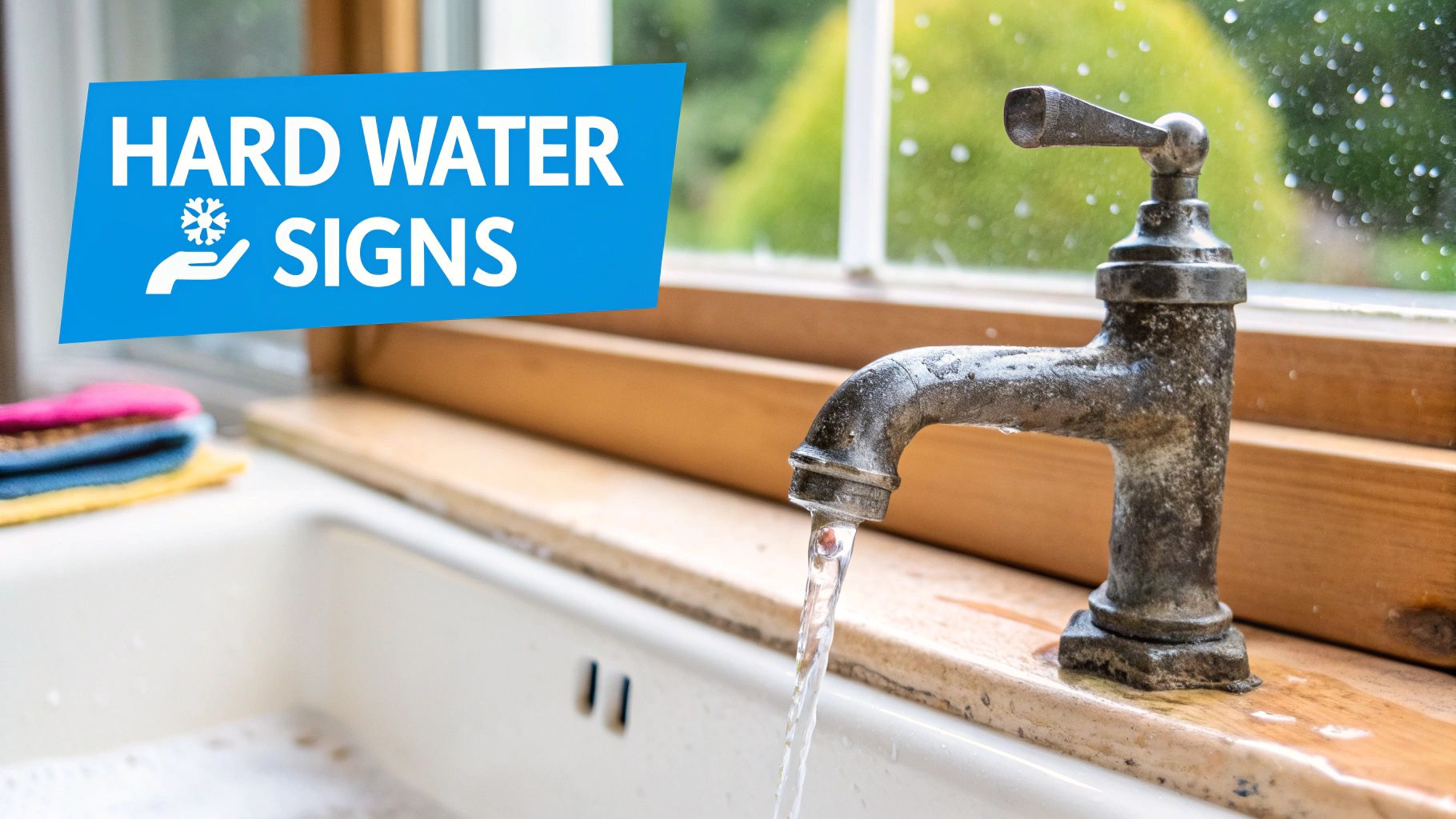
Before you can pick your weapon, you need to be sure you're fighting the right enemy. Luckily, hard water isn't subtle. It leaves a trail of evidence all over your house, disguised as everyday annoyances you've probably just accepted as normal.
Hard water is simply water that’s loaded with dissolved minerals—mostly calcium and magnesium—that it picked up on its journey through the ground. While it’s perfectly safe to drink, it’s a menace to your home. So, if you think your shower doors have a permanent fog or your faucets look like they have a bad case of dandruff, you're not going crazy. That's just hard water making itself at home.
Visible Clues Around Your Sinks and Showers
The easiest place to spot the signs of this mineral invasion is wherever you use water the most. Your kitchen and bathroom are ground zero, and they're probably covered in a trail of gunk that defies all your cleaning efforts.
Look at the base of your faucets and around your showerhead. See that stubborn, white, crusty buildup? That's limescale, the calling card of hard water. It’s what’s left behind when water evaporates, and it’s basically rock. Another dead giveaway is the slimy soap scum that clings to your shower doors and tub. The minerals in your water are having a chemical party with your soap, creating that sticky, insoluble mess.
Chalky spots are another telltale sign, and they can be a real pain to remove. For some specific tips on that, check out Your Ultimate Guide to Removing Hard Water Spots on Windows.
You might also be dealing with:
- Dull, spotty dishes and glassware: No matter how much rinse aid you use, your glasses look like they were dried with a dirty towel.
- Weak water pressure: Limescale isn’t just an eyesore; it’s building up inside your pipes and faucet heads, slowly strangling your water flow.
- That filmy feeling on your skin: The same reaction creating soap scum in your tub is happening on your body, leaving a residue that can clog pores and make your skin feel dry and itchy.
The Invisible Damage to Appliances and Fabrics
What you can't see is often doing the most damage. Hard water is waging a silent war on your appliances, and the collateral damage can get expensive.
Your water heater is public enemy number one for limescale. As it heats the water, scale forms directly on the heating elements, acting like a concrete blanket. This forces the unit to work way harder and burn more energy just to do its job, often leading it to fail years before its time. In fact, studies show that hard water can slash a gas water heater's efficiency by up to 24%.
Hard water doesn't just make cleaning harder; it actively works against the things you’re trying to clean. The minerals prevent detergents from lathering properly, meaning you have to use more product to get the same result, whether you're washing clothes, dishes, or yourself.
This problem carries over to the laundry room, too. Those same minerals get trapped in the fibers of your clothes, leaving them feeling stiff and scratchy. You’ll notice that your bright colors fade faster and your whites start looking dingy or gray, no matter how much bleach you throw at them. It’s a frustrating cycle of washing things that never seem to get truly clean.
To help you connect the dots, here’s a quick reference table.
Hard Water Problems and Their Filtration Solutions
This table breaks down the common issues you're seeing and points you toward the most effective water filtration system to solve them.
| Common Problem | Primary Cause | Effective Filtration Solution |
|---|---|---|
| Limescale on fixtures & appliances | High calcium and magnesium levels | Ion-Exchange Water Softener, Salt-Free Conditioner |
| Soap scum & poor lather | Minerals reacting with soap | Ion-Exchange Water Softener |
| Dull, stiff, or faded laundry | Mineral deposits in fabric fibers | Ion-Exchange Water Softener |
| Dry skin and dull hair | Soap residue left on skin/hair | Ion-Exchange Water Softener, Showerhead Filter |
| Cloudy or spotty dishes | Mineral deposits left after drying | Ion-Exchange Water Softener, Reverse Osmosis |
| Reduced appliance efficiency | Scale buildup on heating elements | Ion-Exchange Water Softener |
Ultimately, understanding these signs is the first step toward finding the right filtration treatment and reclaiming your home.
Alright, you've seen the signs. The soap scum that won’t quit, the chalky film on your faucets—something’s definitely up with your water. The next move is to find out just how hard it is.
Knowing your water's specific hardness level isn't just for bragging rights. It's the critical first step to choosing the right water treatment system. You don’t want to end up with a system that’s too weak to handle the job or, conversely, pay for more power than you actually need.
The Quick and Dirty Soap Suds Test
If you're impatient and want a rough idea right now, try the classic soap suds test. It's free, takes about five minutes, and all you need is a clean bottle with a cap and some basic liquid soap—think simple castile soap, not a fancy detergent.
Here's the drill:
- Fill the clean bottle about a third of the way with your tap water.
- Add around 10 drops of the liquid soap and screw the cap on tight.
- Now, give it a good, hard shake for about 15 seconds.
Take a look. If your water is soft, you’ll see a nice, thick layer of suds, and the water below will be mostly clear. Hard water, on the other hand, will give you a sad-looking, suds-free surface and the water itself will look cloudy or milky. That cloudiness? That's your soap reacting with all the calcium and magnesium, creating the very soap scum you’re trying to get rid of.
For a More Accurate Number: DIY Test Strips
For a more scientific result, grab a pack of DIY water hardness test strips. They're cheap, easy to find at any home improvement store or online, and they give you a real number to work with.
You just dip a strip into a glass of tap water for a couple of seconds, pull it out, and wait. After a minute or so, the strip will change color. You then match that color to the chart that came in the kit.
The chart gives you a hardness reading, usually in Parts Per Million (PPM) or Grains Per Gallon (GPG). Professionals almost always talk in GPG, but the conversion is easy: 1 GPG equals 17.1 PPM.
This number is what really matters. For most homes, once you get over 7 GPG (or 120 PPM), you’re in the territory where a water softener starts to make a lot of sense. That’s the point where you’ll really see limescale build-up wreak havoc on your pipes and appliances.
For Pinpoint Accuracy: A Digital Tester
If you're a data geek or just want to be absolutely certain, a digital water tester is your best bet. These are handheld gadgets that measure the Total Dissolved Solids (TDS) in your water.
While a TDS meter measures everything dissolved in the water (not just the hardness minerals), a high TDS reading in city tap water is almost always a dead giveaway for high hardness. You get an instant, precise reading in PPM on a digital screen, which takes all the color-matching guesswork out of the equation. This kind of precision is perfect if you’re trying to dial in the settings on a high-efficiency water softener.
It's no surprise that more and more people are getting serious about this. The global water softener market was a US$2.9 billion industry back in 2022 and is projected to hit $6.8 billion by 2033. That’s a lot of homeowners deciding to protect their homes from hard water damage. You can check out more details on the water softener market trends on custommarketinsights.com.
Water Softeners vs. Water Conditioners: The Main Event
Okay, so you've confirmed hard water is the problem. Now, how do you fix it? When you're looking for a whole-house filtration solution, it really comes down to two main players: the classic salt-based water softener and the modern salt-free water conditioner.
This isn't just about plumbing hardware. It’s a choice between two completely different philosophies for dealing with those pesky minerals.
Think of it this way: a water softener is like a bouncer at a club, physically throwing the troublemakers (calcium and magnesium) out. A water conditioner, on the other hand, is like a skilled negotiator that convinces them to behave so they don't cause any problems. Both get the job done, but their methods are worlds apart.
The Classic Solution: Salt-Based Water Softeners
For most people, the image that pops into their head when they hear "hard water treatment" is a salt-based water softener. There's a good reason for that—they are the undisputed champions of hardness removal, and their method is both simple and incredibly effective.
The magic happens through a process called ion exchange. Your water flows through a tank filled with resin beads that are covered in sodium ions. Since the calcium and magnesium ions in your water have a stronger charge, they get pulled to the resin like a magnet, bumping the sodium ions off and into your water. It’s a direct swap: bad minerals out, harmless sodium in.
This total removal of hardness minerals is what gives you genuinely soft water. The difference is night and day:
- Limescale vanishes: With the scale-forming minerals gone, they can't build up on faucets, shower doors, or inside your water heater.
- Soap works like it should: You'll get that rich, sudsy lather you see in commercials. You'll also use way less soap, shampoo, and detergent.
- That signature "slippery" feel: This is the tell-tale sign of truly soft water. Without minerals to react with soap, it rinses off completely, leaving your skin's natural moisture behind. It feels slick, but that’s actually the feeling of being 100% clean.
But this level of performance requires some upkeep. Eventually, those resin beads get clogged with all the minerals they've collected. To clean them, the system runs a regeneration cycle, flushing itself with a saltwater brine from a second tank. That brine tank is the part you have to keep topped up with heavy bags of salt.
The Modern Alternative: Salt-Free Water Conditioners
If you're looking for a way to stop scale damage without adding sodium to your water or lugging salt bags, a salt-free water conditioner is a fantastic option. The most important thing to know is that these systems do not remove the minerals, so they don't technically "soften" the water.
So what do they do? They change the minerals' behavior. The most proven technology here is Template Assisted Crystallization (TAC). As water flows through the TAC media, the calcium and magnesium minerals are converted into microscopic crystals.
These tiny, harmless crystals can't stick to pipes, fixtures, or heating elements. They just flow right on through your plumbing and down the drain. You get the number one benefit—scale prevention—without actually altering your water's mineral content. The healthy calcium and magnesium are still there, they've just been neutralized.
Here's the bottom line: Salt-free conditioners are all about preventing scale. You won't get that slippery feeling or mountains of soap bubbles, but you will protect your pipes, water heater, and dishwasher from destructive limescale.
This infographic lays out a few simple ways to figure out just how hard your water is. Knowing your numbers is the first critical step before picking any treatment system.
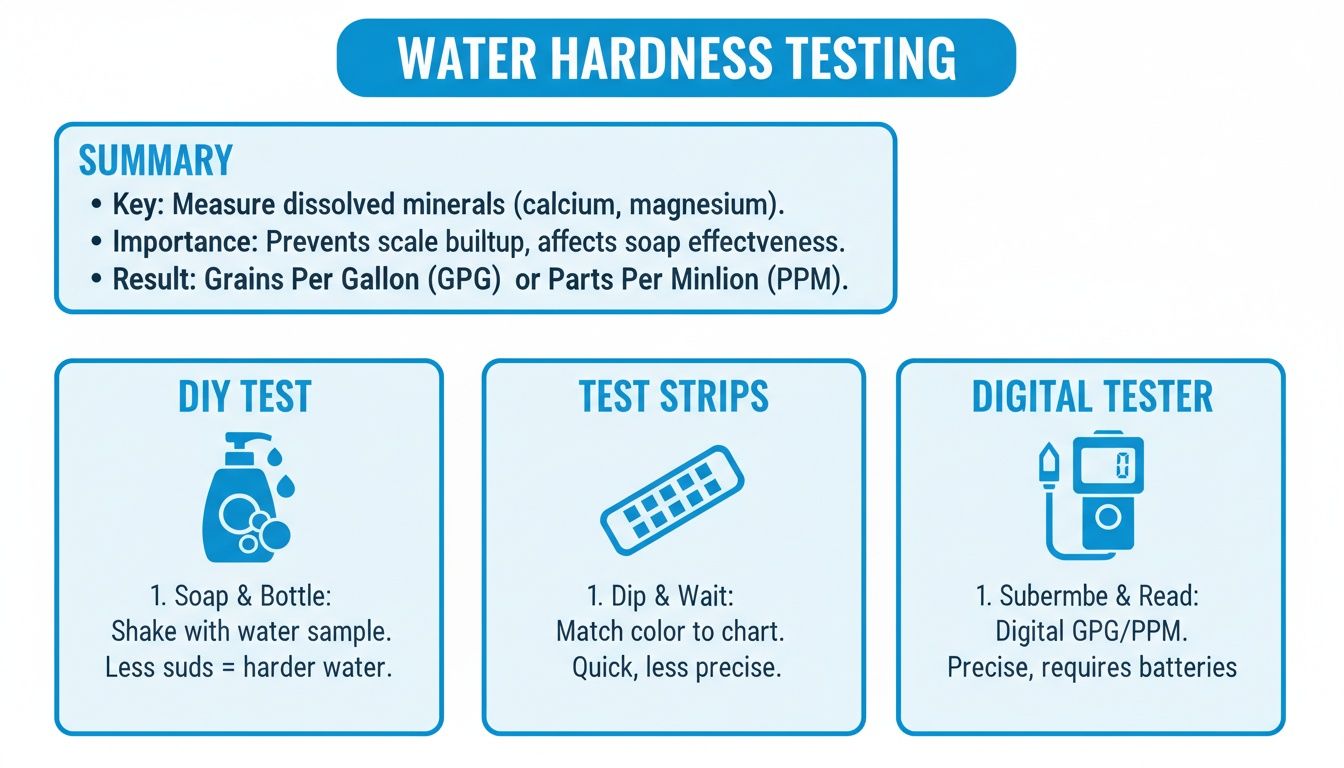
Whether you use a basic soap test or a precise digital meter, getting this data helps you choose and size your system correctly.
Making the Right Choice for Your Home
So, which one is for you? It really comes down to what you're trying to achieve. There’s no single “best” system, just the one that’s the best fit for your home and your priorities.
This head-to-head comparison should make the differences crystal clear.
Water Softener vs. Water Conditioner: Head-to-Head Comparison
| Feature | Salt-Based Water Softener | Salt-Free Water Conditioner |
|---|---|---|
| Primary Function | Physically removes calcium & magnesium | Neutralizes minerals to prevent scale |
| How It Works | Ion Exchange | Template Assisted Crystallization (TAC) |
| Scale Prevention | 100% elimination | Excellent scale prevention (99%+ effective) |
| "Soft Water" Feel | Yes, creates the distinct slippery feel | No, water chemistry is unchanged |
| Soap Lather | Significantly improves lather | No change in lather |
| Maintenance | Regularly add salt (40-50 lbs/month) | Virtually maintenance-free |
| Environmental Impact | Discharges salt brine into wastewater | No salt, no waste, no electricity |
| Initial Cost | Generally lower upfront cost | Often a higher initial investment |
| Ongoing Costs | Salt, water, and electricity for regeneration | None |
| Best For | Homeowners wanting to fix all hard water issues | Homeowners focused on protecting plumbing & appliances |
In the end, it’s a straightforward choice.
If you want the full soft-water experience—no scale, better skin and hair, and amazing soap lather—then a salt-based water softener is the clear winner. It's the only way to physically remove the minerals that cause all the problems.
If your main goal is to protect your home's expensive plumbing and appliances from scale buildup, and you want a zero-maintenance, eco-friendly solution, then a salt-free water conditioner is an excellent choice. It's the ultimate "set it and forget it" system for preventing the costly damage hard water can do.
Exploring Other Hard Water Filtration Methods
While whole-house softeners and conditioners are the heavy hitters, they aren't the only tools in your filtration arsenal. Sometimes, a more focused, targeted approach is exactly what’s needed.
Maybe you just want ultra-pure drinking water or a simple fix for your dry hair. For that, other filtration methods offer the perfect solution. These alternatives can work great on their own or even supplement a larger system, letting you fine-tune the water quality throughout your home.
Reverse Osmosis for Pure Drinking Water
You’ve probably heard of Reverse Osmosis (RO) systems. They are the gold standard for water purification, usually installed right under the kitchen sink with a small, dedicated faucet. An RO system is a multi-stage filtration beast that does a lot more than just soften water.
It works by pushing water through a special membrane filled with microscopic pores. This process strips out nearly everything that isn't H₂O, including:
- Hardness minerals like calcium and magnesium
- Contaminants like chlorine, lead, and pesticides
- Dissolved solids, salts, and even fluoride
What you get is exceptionally clean, great-tasting water that's amazing for drinking and cooking. But that level of purification is exactly why RO is rarely a whole-house solution. These systems produce water slowly and create wastewater in the process, making them impractical and wasteful for things like showers and laundry.
Key Takeaway: An RO system is the ultimate point-of-use filtration fix for pristine drinking water. It will remove hardness minerals from the water you drink, but it isn't designed to protect your home's entire plumbing network from limescale.
The Power of Showerhead Filters
Is your main complaint about hard water what it does to your hair and skin? If so, a specialized showerhead filter is a fantastic and incredibly budget-friendly fix.
These devices are a breeze to install—they just screw on between your existing showerhead and the pipe coming out of the wall. They target the water exactly where it impacts your personal care routine the most.
They use filtration media, often a mix of KDF (Kinetic Degradation Fluxion) and carbon, to cut down on both hardness minerals and chlorine. While they don't technically "soften" water like an ion-exchange system, they do a great job reducing the scale and chlorine that are the real culprits behind dry, itchy skin and dull, brittle hair. This is an ideal solution for renters or anyone who wants to solve skin and hair issues without the cost of a whole-house system.
A Broader Look at Water Filtration
As you can see, treating hard water often involves more than just tackling minerals. The world of water filtration is huge, with systems designed for everything from sediment to specific chemical contaminants. For instance, you might have a softener to handle the minerals but still want a carbon filter to improve the taste and smell.
This is especially true in unique setups, like mobile living. In these cases, a broad approach to water quality is key. For more on keeping water clean on the go, you might want to read up on finding the best RV water filter system.
Reverse osmosis is only becoming more popular. In fact, within the water treatment world, reverse osmosis systems are expected to command about 35% of the market share by the end of 2035. It's easy to see why, since these membrane filters can remove up to 99% of water impurities. Whether it’s for your whole house, your RV, or just your drinking glass, understanding all these options is the key to finding the perfect fix for your water.
Installation and Maintenance for Your Filtration System
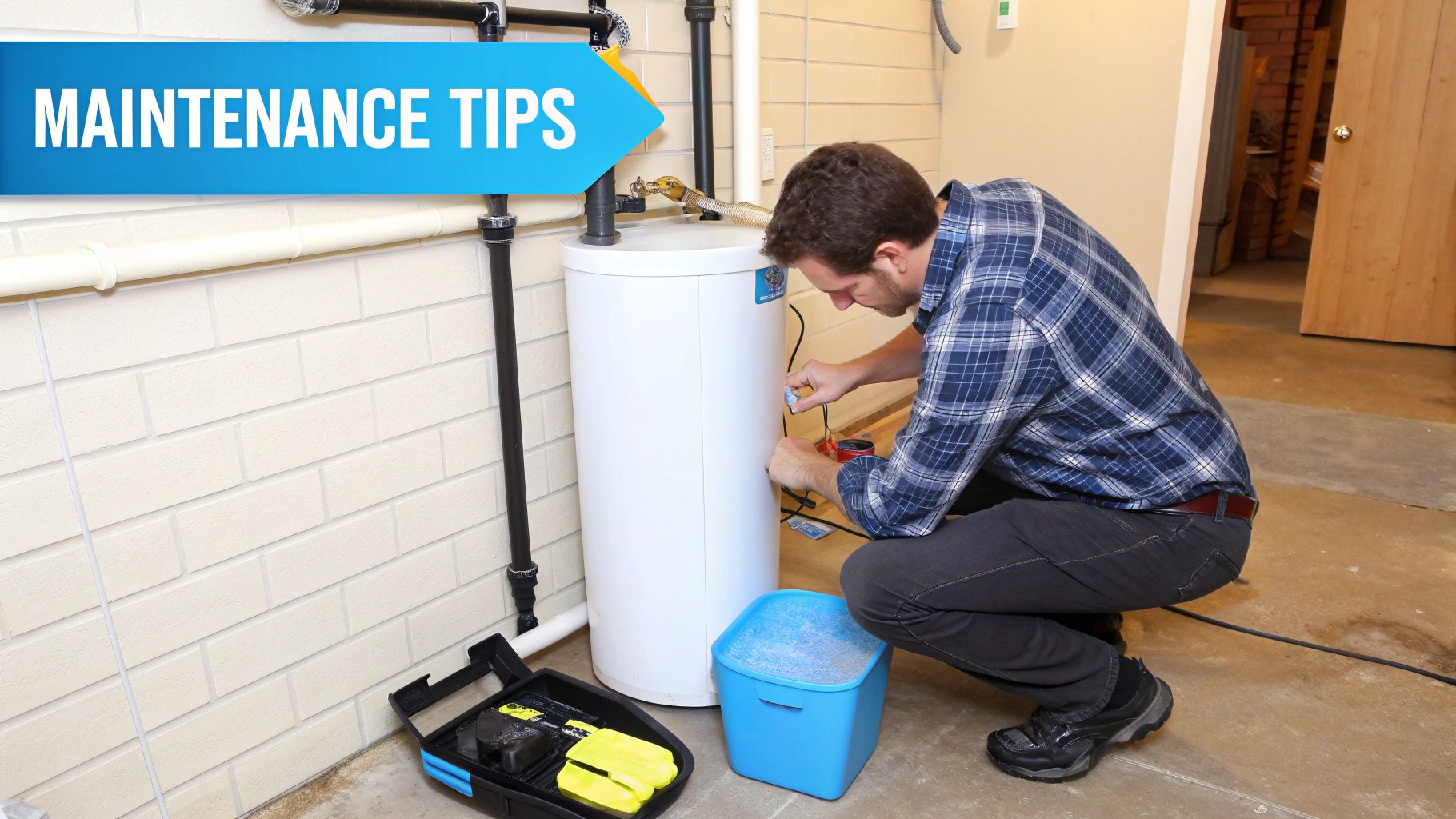
Getting a hard water filtration system is a huge step, but the work doesn't stop once you've made the purchase. Proper installation and a little upkeep are what protect your investment and keep your home running scale-free for years to come.
Think of it this way: even a brand-new car needs its oil changed.
A whole-house system is a serious piece of plumbing. You're cutting into your home's main water line, which can feel pretty daunting. Your first big call is deciding whether to roll up your sleeves and do it yourself or bring in a pro.
DIY Installation vs. Professional Help
If you're already comfortable with plumbing projects, a DIY installation is definitely on the table. Most systems arrive with detailed instructions, and the basic process is straightforward: shut off the main water, cut a piece of pipe, and hook up the new unit. If you've handled pipe cutters, soldering, or PEX fittings before, you'll probably feel right at home.
For a lot of folks, though, this is a job best left to a professional plumber.
A licensed pro brings a lot to the table. They’ll ensure the system is installed to code, won’t leak (preventing a potential disaster), and can help you figure out the optimal spot for the unit. That's a big deal, especially since a salt-based softener needs to be near both a drain and a power outlet.
Expert Insight: Spending a few hundred dollars on a professional installer buys you total peace of mind. A bad install can cause leaks, a drop in water pressure, or even void your warranty, which makes hiring a pro a smart move for such a long-term home improvement.
Your Long-Term Maintenance Checklist
Once your system is up and running, a little routine care goes a long way. The maintenance you'll need to do really depends on the type of filtration system you picked.
For a traditional salt-based water softener, your main task is pretty simple: keep the brine tank topped up with salt. Here’s what that looks like:
- Check the Salt Level: Take a peek inside the brine tank at least once a month.
- Refill as Needed: A good rule of thumb is to keep the tank at least one-third full. For a typical family of four, you'll likely add one 40-pound bag of salt every month or two.
- Choose the Right Salt: Stick to high-purity salt pellets made specifically for water softeners. Cheaper rock salt often has dirt and gunk that can clog up the system's more delicate parts.
- Clean the Brine Tank: About once a year, it's a great idea to empty and clean out the brine tank. This gets rid of any sediment or "salt mush" that’s built up on the bottom.
Care for Salt-Free and Cartridge-Based Systems
If you went with a salt-free water conditioner that uses Template Assisted Crystallization (TAC), your to-do list is much shorter. There's a reason people call these "set it and forget it" solutions.
The TAC media inside the tank will eventually need to be replaced, but usually only every three to five years. It's a job many homeowners can handle themselves in under an hour—just unscrew the tank head, dump out the old media, and pour in the new.
For smaller, cartridge-based filters, like the ones you find on showerheads or under a sink, it’s even easier. All you have to do is swap out the filter cartridge based on the manufacturer's schedule, which is typically every six months to a year. Keeping up with this is key to making sure the filter keeps doing its job effectively.
Your Hard Water Questions Answered
After digging into all the different filtration methods for hard water, there are always a few questions that pop up. This is where we tackle those last few uncertainties head-on, giving you straight answers to the things we hear most often from homeowners just like you. Let's get everything cleared up so you can feel good about your next step.
Will a Water Softener Make My Drinking Water Salty?
This is probably the biggest myth we run into, and it's a totally fair question. While salt-based softeners do use sodium chloride (salt) to regenerate, the actual amount of sodium that makes its way into your tap water is tiny.
It's an ion exchange, not an addition. The system swaps a sodium ion for a calcium or magnesium ion. For most homes with moderately hard water, the sodium added is less than what's in a single slice of white bread. Honestly, you'd be hard-pressed to taste any difference at all.
That said, if you're on a strict, doctor-ordered low-sodium diet, it's something to discuss with them. A great workaround many people choose is to install a whole-house softener and then add a reverse osmosis system under the kitchen sink. You get the best of both worlds: your whole house is protected from scale, and you have ultra-pure, sodium-free water for drinking and cooking.
Can I Treat Hard Water if I Live in an Apartment?
You absolutely can. Installing a big whole-house system is usually off the table for renters, but you’ve still got some fantastic point-of-use filtration options that can make a world of difference. You don't have to just put up with hard water because you don't own the place.
Here are the most common filtration fixes for renters:
- Showerhead Filters: This is the go-to for apartment dwellers. A simple screw-on shower filter designed for hard water can drastically cut down on scale and chlorine. The result? Skin that feels softer and hair that's healthier and easier to manage.
- Faucet-Mounted Filters: For your kitchen sink, a filter that attaches right to the faucet is an easy way to improve the taste and quality of the water you drink and cook with.
- Countertop Filtration Systems: From simple pitcher filters to more advanced countertop units, you can get great-tasting, filtered water without touching the plumbing at all.
These targeted solutions let you enjoy many of the perks of treated water without making a single permanent change.
How Do I Choose the Right Size Water Softener?
Getting the right size water softener is a huge deal for its efficiency and your long-term happiness with it. If it's too small, it will regenerate constantly, wasting salt and water. If it's too big, you've just spent more money than you needed to.
The right size all comes down to two numbers: your water hardness level (in Grains Per Gallon, or GPG) and how much water your household uses each day.
You can figure out your daily needs with a quick calculation:
(Number of People in Home) x (75 Gallons per Person) x (Your Water’s GPG) = Daily Grains to Remove
Let's walk through a real-world example. A family of four with water that has a hardness of 10 GPG would figure it out like this: 4 people x 75 gallons x 10 GPG = 3,000 grains per day. Since you want the system to go a few days between regeneration cycles, a standard 32,000-grain unit would be a solid choice for this family. Most manufacturers have easy-to-read sizing charts to help you lock in the perfect model. For more general filtration questions, you can always find more in-depth articles in our water filter advice section.
At Water Filter Advisor, our goal is to give you the clear, unbiased information you need to find the perfect solution for your home's water. Whether you need a whole-house system or a simple faucet filter, explore our guides and reviews to make a confident choice. Visit us at https://www.waterfilteradvisor.com to get started.
- January 14, 2026
- 0
- Uncategorized
