Your Ultimate Guide on How to Reduce Water Hardness at Home

Ever notice those stubborn white spots on your glassware or feel like your “clean” laundry is still stiff and scratchy? You’re not just imagining it—you're dealing with hard water. The fix is a magical thing called water filtration, designed to remove or neutralize the high levels of dissolved minerals—mostly calcium and magnesium—that are wreaking havoc in your home. Think of learning how to reduce water hardness not just as a chore, but as a superhero move to save your plumbing and appliances from a slow, crusty demise.

Why Hard Water Is Waging a Secret War on Your Home

A bathroom sink faucet shows visible mineral deposits, highlighting hard water damage.

If you've ever felt a chalky film on your hands after washing them or wondered why your shampoo just won't lather up, you've met hard water. It's what happens when water travels through rock and soil, picking up mineral hitchhikers along the way. While it's perfectly safe to drink, those minerals can create a surprising amount of chaos around the house.

And this isn't some rare occurrence. According to the U.S. Geological Survey, a staggering 85% of households in the United States have hard water. In big chunks of the country, like the Midwest and Southwest, hardness levels often top 120 mg/L of calcium carbonate—that's well above the 60 mg/L threshold considered even moderately hard.

The Visible Signs Of A Hidden Problem

The most common signs of hard water are the daily cosmetic annoyances. You’ve probably seen them:

  • Soap Scum: Minerals in the water react with soap to create that gross, sticky film that coats your shower doors, tiles, and tubs.
  • Spotted Dishes: That cloudy haze on your glasses and silverware right out of the dishwasher? That’s mineral residue left behind when the water evaporates.
  • Dull, Stiff Fabrics: Those minerals get tangled up in the fibers of your clothes, making them feel rough and causing colors to fade way too quickly.

But these everyday headaches are just the tip of the iceberg. The real damage is happening where you can't even see it.

The real villain here is limescale—a hard, chalky deposit of calcium carbonate. This stuff builds up inside your pipes, fixtures, and appliances, slowly choking off water flow and tanking their efficiency.

To put it simply, what you see on your faucet is also happening inside your home's vital systems. This table breaks down the daily struggles of hard water versus the perks of switching to soft water.

Hard Water Problems vs Soft Water Benefits

Area of Impact Problem with Hard Water Benefit of Soft Water
Plumbing & Pipes Limescale buildup clogs pipes, reducing water flow. Pipes remain clear, maintaining strong water pressure.
Appliances Reduced efficiency and shorter lifespan for water heaters, dishwashers. Appliances run efficiently and last longer.
Kitchenware Cloudy film and spots on glasses and dishes. Sparkling, spot-free dishes and glassware.
Laundry Stiff, scratchy fabrics and faded colors. Softer, brighter clothes that feel and look newer.
Bathroom Surfaces Stubborn soap scum on showers, sinks, and tubs. Easier cleaning with little to no soap scum buildup.
Skin & Hair Dry, itchy skin and dull, brittle hair. Softer skin and smoother, more manageable hair.

As you can see, the benefits go far beyond just looks.

Long-Term Damage And Hidden Costs

Over time, that mineral buildup turns into a real financial drain. Limescale acts like an insulator, forcing your water heater to work much harder and burn more energy just to heat the same amount of water. This drives up your utility bills and can even shorten the appliance's lifespan, pushing you toward a costly replacement sooner than you’d expect.

And it doesn't stop there. Your coffee maker, dishwasher, and washing machine are all on the chopping block. The tiny valves and pipes inside these machines can get clogged, leading to breakdowns and expensive service calls. Another major headache from all this buildup is a drop in water flow, which often leads to frustrating issues like having no water pressure in your house.

Tackling this problem head-on is a wise investment in your home. By learning how to reduce water hardness, you aren't just making your daily life a little easier—you're protecting your most valuable assets from silent, creeping damage.

How to Accurately Test Your Water Hardness

A hand uses a test strip in a glass of water to check quality on a countertop, 'TEST YOUR WATER' banner.

Before you declare war on hard water, you’ve got to know exactly what you’re up against. Think of it like a doctor needing a diagnosis before prescribing a treatment. If you just guess, you might end up spending a ton of money on a system you don't really need or, even worse, buying one that barely makes a dent in the problem.

The good news is that figuring out your water's mineral content is pretty straightforward. You don’t need a fancy chemistry degree to get a solid baseline. There are a few different ways to go about it, from a quick kitchen experiment to a super-precise professional analysis.

The Quick and Simple Soap Test

Let's start with the easiest method of all: the DIY soap test. This is a fantastic first step that gives you a rough idea of your water’s situation in just a few minutes, using stuff you already have lying around.

All you need is a clean, clear bottle with a lid that seals tight (a regular water bottle works great) and some basic liquid soap. Make sure to use a pure soap, not a detergent that has added softeners or perfumes.

  1. Fill the bottle about a third of the way with regular tap water.
  2. Add just a few drops of the liquid soap, screw the cap on, and give it a really good shake for about 15 seconds.
  3. Now, take a look. If your water is soft, you'll see a healthy layer of suds, and the water underneath should be nice and clear.
  4. If you’ve got hard water, you'll find it’s a real struggle to get a good lather. Instead of fluffy bubbles, you’ll likely see a cloudy, milky solution with a scummy film floating on top.

While this test won't give you an exact number, it’s a great initial indicator. If you're seeing almost no suds and a lot of that soap scum, you know you’re dealing with a pretty significant hardness issue.

Using Water Hardness Test Strips

For a more precise, number-based reading, water hardness test strips are your best bet. They’re cheap, easy to find online or at any home improvement store, and incredibly simple to use. These kits give you a quantitative result, which is what you really need to choose the right size and type of water filter.

Using them is a breeze. You just dip a strip into a glass of your tap water for a couple of seconds, pull it out, and wait for the color to develop. After about a minute, you compare the color on the strip to the chart that came with the kit.

The chart will give you a reading in either parts per million (PPM) or grains per gallon (GPG). Just so you know, one GPG is the same as 17.1 PPM of dissolved minerals.

What does GPG mean for you? Here’s a quick breakdown of the water hardness scale:

  • Soft: 0–3.5 GPG
  • Moderately Hard: 3.5–7 GPG
  • Hard: 7–10.5 GPG
  • Very Hard: Over 10.5 GPG

Knowing your exact GPG number is a game-changer. A house with 10 GPG is going to need a much more powerful filtration system than a home with just 4 GPG. This little piece of data helps you avoid overspending and makes sure the system you buy can actually handle the job.

When Professional Lab Testing Is Necessary

For most homeowners who get their water from a city or municipal supply, those simple test strips are more than enough. However, if your water comes from a private well, or if you have a nagging suspicion that there are other contaminants besides just minerals, professional lab testing is the most reliable way to go.

Well water isn't regulated by the EPA, so its quality can be all over the map. A professional test can nail down the exact hardness level and also screen for things like iron, manganese, sulfur, bacteria, and other nasty stuff that might require a more specialized, multi-stage filtration system.

To get a lab test done, you can start by contacting your local health department for recommendations or find a state-certified lab online. They’ll send you a collection kit with simple instructions. It’s the most accurate assessment you can get and gives you the complete picture to make the smartest long-term investment for your home.

Short-Term Fixes for Hard Water Headaches

Jumping straight to a whole-house water filter isn't always in the cards. Maybe you're renting, you're on a tight budget, or you just want to dip your toe in the water—pun intended—before committing to a big installation. The good news? You don't have to put up with the daily grind of hard water while you weigh your options.

There are some really effective, non-permanent ways to get immediate relief from the most annoying hard water problems. These quick fixes target specific issues, from scratchy towels to irritated skin, giving you a way to manage the problem without tearing into your plumbing.

Get Your Laundry Bright and Soft Again

Hard water and your washing machine are not friends. The calcium and magnesium in the water latch onto your detergent, making it way less effective. Instead of cleaning, a chunk of that soap turns into a nasty curd that sticks to your clothes, leaving them stiff, dingy, and dull.

You can fight back. The easiest weapon in your arsenal is a chelating agent, which you might know as a water conditioner. Products like Calgon or even good old-fashioned borax are fantastic for this. They work by grabbing onto those pesky mineral ions and neutralizing them, freeing up your detergent to do its job.

Just add a conditioner to each load, and you’ll see a real difference. Your whites will look brighter, colors won't fade as fast, and your towels will finally lose that crunchy, board-like feeling. It’s a simple, cheap trick for anyone trying to figure out how to soften water just for their laundry.

Give Your Skin and Hair a Break from the Buildup

The daily battle with hard water gets personal in the shower. Those same minerals that leave spots on your glasses also leave a film on your skin and hair. This residue can clog pores, cause breakouts and dryness, and leave your hair feeling brittle, limp, and impossible to style.

A showerhead filter is a brilliant point-of-use solution here. These little devices just screw on between the shower arm and your showerhead—most don't even need tools to install. Inside, they use filtration media like KDF (Kinetic Degradation Fluxion) or activated carbon to specifically target the minerals and chlorine coming through your pipes.

You'll feel the difference almost right away. Your skin will probably feel less tight and itchy post-shower, and your hair will feel softer and look shinier because it's finally getting a clean rinse without a coating of mineral gunk.

Fight Back Against That Crusty Limescale

Those ugly white deposits crusted around your faucets and all over your shower doors are the most obvious calling card of hard water. This stuff, called limescale, is basically rock and regular cleaners just can't cut it.

To get immediate results, you need something acidic to dissolve the mineral buildup. You've got a couple of options:

  • Vinegar Solution: A simple 50/50 mix of white vinegar and water is a powerhouse, non-toxic limescale buster. For really stubborn spots, soak a rag in the solution and wrap it around the fixture for an hour before you start scrubbing.
  • Commercial Descalers: Products made specifically to tackle calcium, lime, and rust are incredibly effective. They use stronger acids to break down those mineral deposits in a hurry.

Making these little changes can help you keep the most visible signs of hard water in check. While these temporary fixes don't solve the problem at its source, they offer targeted relief and make everyday life a lot more comfortable.

Choosing the Right Permanent Water Filtration System

If you're sick of scrubbing soap scum and dealing with scratchy towels, it's time to look past the quick fixes. A permanent, whole-house system is the only way to stop hard water problems at the source, protecting your pipes, appliances, and sanity. This is where the real game-changers come in.

Picking the right technology can feel like a chore, with a dozen different systems all claiming to be the best. Let's walk through the most common and effective options out there. We’ll cover true water softeners that rip minerals out of your water and conditioners that just stop them from making a mess, so you can figure out what truly fits your home and your budget.

The Gold Standard: Ion-Exchange Water Softeners

When most people think of solving hard water, they’re picturing an ion-exchange water softener. This is the classic, time-tested method for actually getting rid of hardness minerals for good. It physically strips the calcium and magnesium from your water, giving you genuinely soft water at every single tap.

These systems work on a pretty clever principle. Your water gets routed into a large tank filled with thousands of tiny resin beads that are coated in sodium (or potassium) ions. As hard water washes over these beads, they act like tiny magnets, grabbing the "hard" minerals and releasing the "soft" sodium ions into the water instead.

This process is incredibly effective. Water softeners can slash water hardness by 95-99%, which is why they’re still the most powerful solution you can buy. This is a huge deal for the millions of households plagued by limescale buildup that wrecks plumbing and appliances.

Of course, those resin beads eventually fill up with all the minerals they’ve collected. That's when the system "regenerates" by automatically flushing itself with a saltwater (brine) solution from a second tank. This bath washes all the gunk off the beads, sends it down the drain, and recharges them with a fresh coat of sodium ions.

Sodium vs. Potassium Systems

You have a choice of what to fill that brine tank with.

  • Sodium Chloride: This is just plain old salt. It's the most common, cheapest, and easiest-to-find option. It’s highly effective and keeps the system humming along without a fuss.
  • Potassium Chloride: If you're on a strict low-sodium diet or just prefer not to add any sodium to your water, potassium chloride is a solid alternative. It works the exact same way but uses potassium instead. Just know that it’s a bit pricier and sometimes harder to track down.

The Low-Maintenance Alternative: Salt-Free Water Conditioners

Maybe you love the idea of preventing scale but hate the thought of lugging 40-pound bags of salt into your basement. If so, a salt-free water conditioner might be exactly what you need. But let's be crystal clear: these systems don't soften the water—they condition it.

What's the difference? They don't remove the calcium and magnesium. Instead, they use a process called Template Assisted Crystallization (TAC). As water flows through the TAC media, the hard minerals are changed into microscopic crystals that can’t stick to surfaces.

These tiny, harmless crystals just flow right through your plumbing without ever building up as limescale on your pipes, faucets, or water heater. You still get the health benefits of drinking mineral-rich water, but you get the massive perk of scale prevention.

Key Takeaway: A salt-free conditioner is a scale-prevention tool, not a water softener. You won't get that slick, "slippery" feeling of truly soft water or see a dramatic change in soap lather. What you will get is protection for your home's plumbing and appliances from destructive limescale.

Reverse Osmosis for Pure Drinking Water

A whole-house system takes care of your showers and laundry, but what about the water you actually drink? A Reverse Osmosis (RO) system is what’s known as a point-of-use filter, usually installed right under the kitchen sink, and it delivers some of the purest water you can get.

RO systems work by forcing water through a special membrane that’s so fine it removes up to 99% of pretty much everything—hardness minerals, chlorine, lead, fluoride, you name it. It's the same technology used to make most bottled water.

A lot of homeowners go for the one-two punch: a whole-house softener to protect the entire home, paired with an under-sink RO system for pristine, amazing-tasting water for drinking and cooking. You can explore our guides for more in-depth advice on building the perfect setup.

This chart can help you quickly find a temporary fix for whatever hard water headache you're dealing with right now.

Flowchart illustrating temporary hard water fixes for laundry, shower, and various surfaces.

As you can see, whether it's your laundry, shower, or kitchen sink, there's always a targeted fix you can use while you figure out a permanent plan.

A Word on Magnetic Descalers

You've probably seen ads for magnetic or electronic "descalers" online. These are little gadgets that you just clip onto your main water line. They claim to use a magnetic field to change the structure of the hardness minerals so they can't form scale.

It sounds fantastic—no salt, no filters, no maintenance. The problem? The science backing these things up is thin, and their performance is highly debated in the industry. Unlike ion-exchange softeners or TAC conditioners, there are no real standards or certifications to prove they actually work. For results you can count on, you’re much better off sticking with proven technology. Even for small appliances, targeted solutions are key, which is why it's worth learning about specific water filters for preventing limescale where it matters most.

Understanding System Installation, Maintenance, and Costs

Picking out a water filtration system is a huge first step, but the journey doesn't end with the price tag. The real commitment comes with installation, ongoing maintenance, and what I call the "total cost of ownership"—what you'll actually spend over the system's entire life.

Figuring this out upfront means no nasty surprises down the road. Let’s walk through what you can realistically expect after you've made your choice, from getting it set up to keeping it running like a champ.

Getting Your System Installed

Once you have your new water softener or conditioner, you've got two roads to take: roll up your sleeves and DIY, or call in a professional plumber. Your decision really boils down to how comfortable you are with basic plumbing and the complexity of the unit you bought.

A DIY install can definitely save you a few hundred bucks if you're handy. Most systems come with pretty good instructions, and the job typically looks something like this:

  • Shut off the main water supply to your house. (Don't forget this part!)
  • Cut into the main water line right where it comes into your home.
  • Plumb the system's inlet and outlet ports into that line.
  • Connect a drain line for the regeneration cycle (this is for traditional softeners).
  • Plug it in and program the control head.

If the thought of cutting pipes gives you a headache, hiring a pro is the stress-free route. A licensed plumber will make sure everything is installed correctly and up to code, which is great for peace of mind. You won't have to worry about leaks or performance problems.

Expect professional installation to run anywhere from $300 to $800, depending on how tricky your plumbing setup is and local labor rates.

The Long-Term Maintenance Checklist

Keeping your system in peak condition is pretty straightforward, but it does need some regular love. The to-do list changes based on what kind of system you have. For a traditional ion-exchange water softener, you'll be the most hands-on.

You’ll want to check the salt level in the brine tank about once a month and top it off as needed. A good rule of thumb is to keep the tank at least one-third full of salt pellets. For a typical family, this usually means adding a 40-pound bag of salt every couple of months.

Beyond just adding salt, it's a smart move to clean out the brine tank once a year. Over time, junk from the salt can create a "salt bridge" or a layer of sludge at the bottom, which can clog things up and stop the system from regenerating properly.

The resin bed—the real heart of the softener—is incredibly tough and can last 15 to 20 years with good care. If you have a lot of iron or chlorine in your water, though, using a special resin cleaner once a year will help it last even longer and work more efficiently.

Salt-free conditioners, on the other hand, are the champs of low maintenance. No salt, no electricity, no drain line. The internal media is built to last for years—often 6 to 10 years—before you even have to think about replacing it.

Calculating the Total Cost of Ownership

To really make a smart decision, you need to look at the whole financial picture. The sticker price is just the starting line. The total cost of ownership includes the unit itself, installation, and all the ongoing expenses.

A quality water softener can cost anywhere from $800 to over $2,500 for the unit alone. Factor in professional installation, and your upfront investment might be closer to $1,200 to $3,300. From there, your main ongoing cost is salt, which will likely run you $100 to $200 per year.

While that might sound like a lot, the payoff is huge. A 2023 study found that a whole-house water softener can cut your soap and detergent use by up to 50%, saving the average family $150 a year. Even better, it can extend the lifespan of appliances like water heaters by 30%, saving you from a premature replacement that could cost over $1,000. If you want to dive deeper into how water quality affects homes, you can explore the full findings on water stress.

Salt-free conditioners have a similar upfront cost but have almost zero ongoing expenses, saving you cash on salt and water. Reverse osmosis systems have their own costs, mainly filter replacements, which can range from $50 to $150 per year. By weighing these lifetime costs, you can pick a system that gives you great water without breaking the bank.

Your Hard Water Questions Answered

Deciding on a water treatment system is a big move, and it's totally normal to have some questions floating around before you commit. Once you start digging into how to fix hard water, you run into all sorts of myths and common worries. Let's tackle them head-on so you can feel good about your decision.

Will My Water Taste Salty?

This is the first thing everyone asks, and I get it. The good news? No, it won't. A properly working water softener uses salt, but only to clean itself. That salty brine solution gets flushed right down the drain during the regeneration cycle—it never makes it to your tap.

A tiny bit of sodium does get swapped for the hard minerals, but we're talking a minuscule amount. To put it in perspective, an 8-ounce glass of softened water has less sodium than a single slice of white bread. Honestly, most people can't taste the difference at all.

Is Softened Water Safe to Drink?

You bet. For the overwhelming majority of people, softened water is perfectly fine for drinking, cooking, and everything else. The only exception might be for someone on a very strict, doctor-ordered, low-sodium diet.

If that's a concern for you, or if you just want the purest water possible, the gold-standard setup is a whole-house softener paired with a reverse osmosis (RO) system under the kitchen sink. The softener protects your pipes and appliances from scale, and the RO filter takes care of the drinking water, removing the trace sodium and just about everything else.

Here's a simple way to think about it: The whole-house softener is for your house. The reverse osmosis system is for your body.

How Do I Pick the Right Size System?

Sizing a softener has nothing to do with your home's square footage. It’s all about two things: how much water you use and how hard that water is. A system that's too small will run itself ragged trying to keep up, regenerating constantly and burning out way too soon. Go too big, and you've just spent more money upfront than you needed to.

To nail the right size, you just need two key numbers:

  • Daily Water Use: A good rule of thumb is 75 gallons per person, per day. So, a family of four will use roughly 300 gallons daily.
  • Water Hardness in Grains Per Gallon (GPG): You'll get this number from your water test kit or a lab report.

Now for the simple math: multiply those two numbers together. For that family of four with water that’s 10 GPG, you'd get 3,000 (300 gallons x 10 GPG). This means you need a system that can remove at least 3,000 grains of hardness each day. Softeners are rated by their total grain capacity (like 32,000-grain or 48,000-grain), which tells you how much hardness they can pull out before they need to regenerate.

Can I Use Softened Water on My Plants and Garden?

This is one area where you need to be a little strategic. Most houseplants and garden veggies aren't big fans of sodium. Over time, watering with softened water can cause salt to build up in the soil, which can stunt their growth or even kill them.

Thankfully, the fix is incredibly simple. When a softener is installed, the plumber should always set it up to bypass the outdoor hose bibs. Most systems also come with a built-in bypass valve. This gives you the best of both worlds: soft water inside for your showers and appliances, and the untreated hard water your garden needs—which still has the calcium and magnesium that plants actually like.


At Water Filter Advisor, our goal is to cut through the confusion and give you clear, practical information to find the right water solution for your home. From our in-depth guides to unbiased reviews, we’re here to help you get safer, better-tasting water. Explore all of our resources today at https://www.waterfilteradvisor.com.
Water Descaler vs Water Softener: The Ultimate Showdown for Your Home’s Water

What's the real difference between a water descaler and a water softener? It all boils down to a battle with hard water minerals. Think of a water softener as a bouncer that physically removes troublemakers like calcium and magnesium using salt. On the flip side, a water descaler is more like a peacekeeper; it doesn't kick the minerals out, but it changes their behavior so they can't stick to your pipes and cause that destructive limescale.

The Hard Water Dilemma: Time to Pick a Side?

If you're waging war against chalky white buildup on faucets, stiff towels, and glasses that look perpetually cloudy, you're fighting hard water. It’s a super common problem, plaguing an estimated 85% of homes in the U.S.

Hard water is chock-full of dissolved minerals, mainly calcium and magnesium. While they’re perfectly safe to drink, these minerals are absolute villains for your home. They create limescale, that crusty deposit that clogs pipes, sabotages your water heater's efficiency, and dramatically shortens the lifespan of your appliances. The problem isn't about your health—it's about protecting your home's entire water filtration ecosystem. This is where you face the big decision: water descaler vs. water softener.

Understanding the Core Technologies

Picking the right system means getting what makes them tick. It’s not about one being "better," but which one is the right champion for your specific home filtration needs.

  • Water Softeners (Ion Exchange): These are the heavyweights, the classic solution. Their whole mission is to completely remove the minerals that cause hardness. They work by swapping out pesky calcium and magnesium ions for sodium ions, giving you truly "soft" water.
  • Water Descalers (Conditioners): These systems are the clever strategists. They neutralize the minerals' ability to cause damage without actually removing them. Technologies like Template Assisted Crystallization (TAC) convert the minerals into tiny, harmless micro-crystals that just flow right through your plumbing instead of clinging to surfaces.

Here's the bottom line: a softener removes minerals to solve all hard water symptoms, while a descaler conditions them to prevent the most destructive problem—limescale—making it a crucial player in your home filtration setup.

Your choice really hinges on how hard your water is, how much maintenance you’re willing to do, and your personal water philosophy. Here’s a quick tale of the tape.

Feature Water Softener (Ion Exchange) Water Descaler (Conditioner)
Primary Function Physically removes hardness minerals Alters mineral structure to prevent scale
Water Hardness Reduces hardness to near zero Mineral count remains the same
Core Technology Ion exchange using salt and resin Template Assisted Crystallization (TAC)
Feel of Water Silky, slippery feel No noticeable change in water feel
Maintenance Requires regular salt refills Virtually maintenance-free

How Water Softeners Create Truly Soft Water

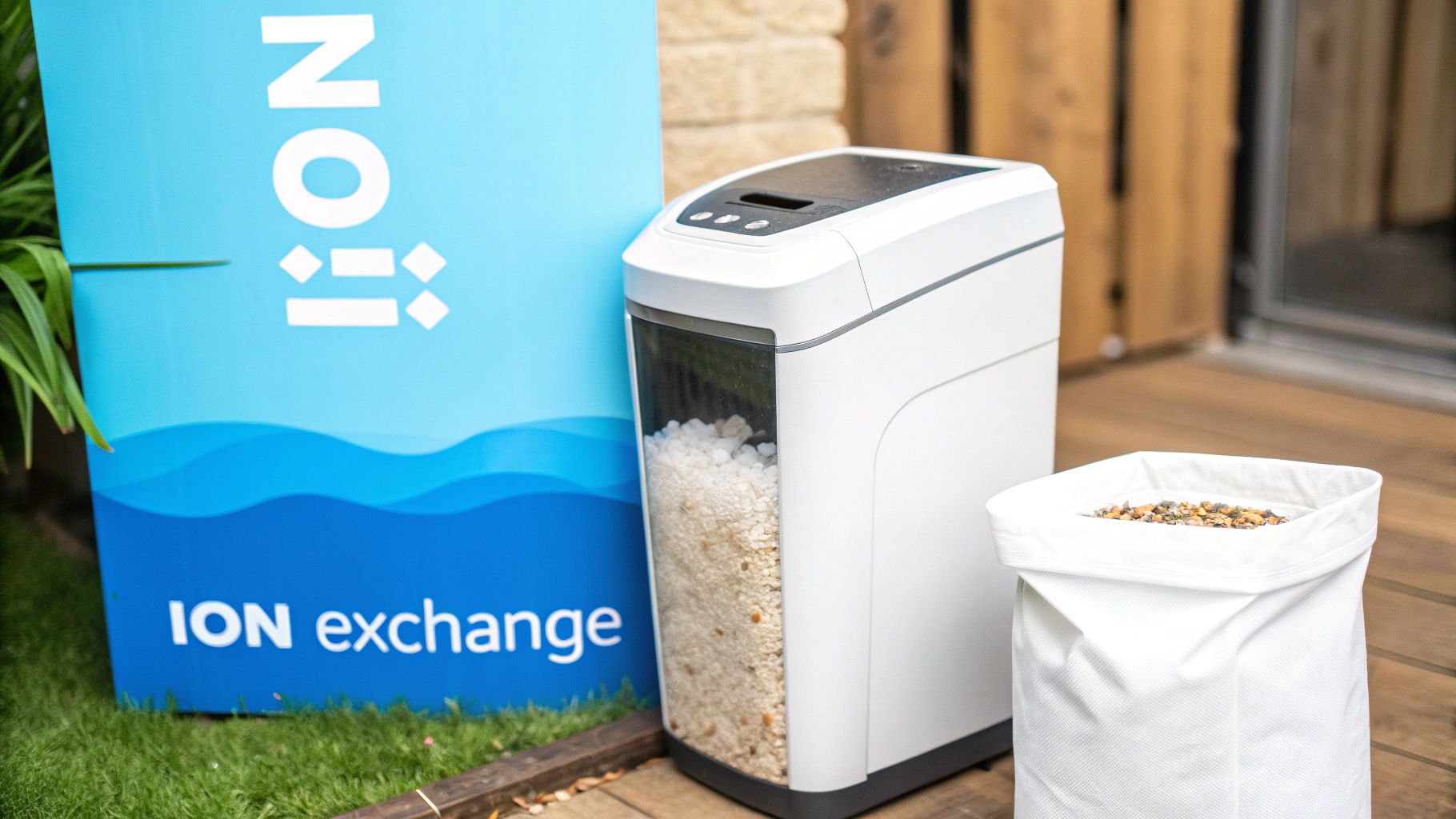
A white water softener machine filled with salt pellets next to an "ION exchange" sign and a bag of media.

When you want a surefire knockout punch for hard water, the classic salt-based water softener is the reigning champ. Unlike systems that just condition water, a true softener is engineered to physically yank the hardness minerals right out. This isn't a partial fix; it’s a complete solution for everything from crusty scale buildup to stubborn soap scum, making it a cornerstone of many home water filtration systems.

The magic behind it all is a process called ion exchange. It sounds complex, but it's basically a clever swap meet. Imagine your softener's main tank is packed with millions of tiny resin beads, all pre-loaded with sodium ions.

As your hard water flows over this resin bed, the calcium and magnesium minerals—the culprits behind your hard water woes—are drawn to the beads like tiny magnets. The resin has a stronger attraction to these minerals, so it grabs them and, in a simple trade, releases its sodium ions into the water. Voila! The water leaving the tank is now genuinely soft.

The Science of Ion Exchange in Action

This mineral-swapping process is incredibly effective, leaving your water almost entirely free of the gunk that causes limescale, stiff laundry, and spotty dishes. The result is water that feels totally different—many people describe it as silky or even a bit slippery to the touch.

But those little resin beads can't work forever without a refresh. They eventually become saturated with all the calcium and magnesium they've collected. When that happens, it's time for a cleaning process known as the regeneration cycle.

During regeneration, the system hits pause on softening. It pulls a concentrated salt solution, or brine, from a separate tank and uses it to flush the resin bed. The sheer amount of sodium in the brine forces the captured hardness minerals off the beads and sends them down the drain. Once the resin is clean and recharged with fresh sodium ions, the softener is ready to get back to work.

Inputs and Outputs: The Complete Cycle

To truly get how a softener works in your home, you have to look at what goes in and what comes out.

  • Input: The main ingredient is salt (either sodium chloride or potassium chloride). You’ll have to add it to the brine tank regularly to keep the system regenerating.
  • Input: The system also uses water to backwash and rinse the resin bed during the regeneration cycle.
  • Output: The star of the show is softened water, flowing to every faucet and appliance, protecting them from scale buildup.
  • Output: The byproduct is brine wastewater. This is a highly salty discharge containing all the flushed-out hardness minerals, which gets sent down your drain.

The undeniable benefit of this process is the complete elimination of scale. By removing the minerals at the source, water softeners protect your entire plumbing infrastructure, from the water heater to the showerhead, ensuring they operate at peak efficiency.

The numbers back up their effectiveness. Salt-based models command a massive 74.18% market share in 2024 precisely because ion exchange is a proven technology. While the global softener market is expected to hit USD 12.58 billion by 2030, the whole "water descaler vs water softener" conversation is heating up as salt-free alternatives find their place. You can dive deeper into these water softener market trends on Mordor Intelligence. Still, this dominance, especially in the U.S. where hard water plagues millions, shows just how many people trust this technology for a definitive end to their hard water headaches.

The Water Descaler: A Smarter, Salt-Free Approach to Scale

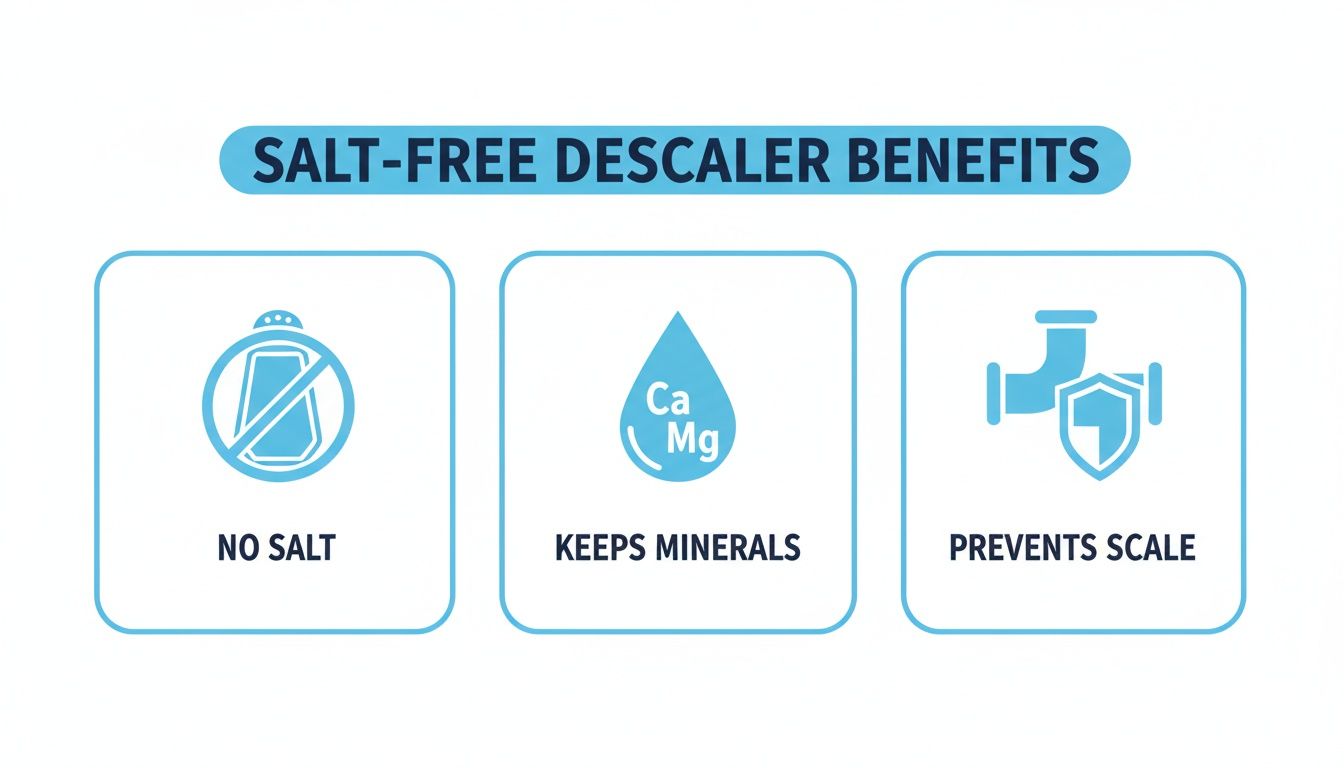
Infographic illustrating the three main benefits of a salt-free descaler: no salt, keeps minerals, and prevents scale.

For homeowners tired of lugging heavy salt bags and worried about salty wastewater, water descalers offer a compelling alternative. You’ll often see them marketed as "salt-free water softeners," but it’s crucial to know they’re technically water conditioners. Their job isn't to remove hard minerals, but to change how they behave.

Instead of yanking calcium and magnesium out of your water, a descaler simply stops them from forming destructive limescale. This means you get the biggest benefit—protecting your pipes and appliances—without actually changing the water's mineral makeup. A water test will show the same hardness level, but those minerals won't be able to stick to surfaces anymore. It's a targeted strike against the worst part of hard water.

The Science of Crystallization

The most trusted and effective technology in this field is Template Assisted Crystallization (TAC). Think of the hardness minerals in your water like tiny, super-sticky Lego bricks that want to clump together on any surface they find.

A TAC system uses a special media with "nucleation sites" that act like a template. As water passes through, these sites grab the calcium and magnesium ions and force them into stable, non-sticky micro-crystals. These harmless, microscopic crystals just flow right through your plumbing without building up. It's a brilliant piece of water filtration science.

Another approach uses magnetic or electronic descalers. These are devices that you wrap around your main water pipe, where they create an electromagnetic field. The idea is that this field changes the electrical charge of the mineral ions, making them repel each other and the pipe walls instead of sticking and forming scale.

Retaining Minerals Without the Mess

One of the coolest things about a descaler is that it leaves beneficial minerals like calcium and magnesium right where they belong—in your water. Since these are essential for a healthy diet, a lot of people prefer not to remove them. A descaler lets you keep the good stuff while neutralizing the bad behavior.

A water descaler neutralizes the threat of limescale while leaving beneficial minerals like calcium and magnesium in your water.

This gives you a great middle-ground option in the water descaler vs water softener debate. You get top-notch scale prevention without needing salt, electricity (for non-electronic models), or the wastewater that comes from a regeneration cycle. It’s pretty much a set-it-and-forget-it solution for your home's water filtration.

This shift toward conditioning water instead of stripping it is making waves in the industry. In the global market for 2024, descalers hold a massive 50% share, leaving traditional water softeners behind at just 30%. This trend shows a clear preference for systems that stop limescale without the environmental footprint of salt and brine. With North America leading the way, projections show descalers could hit a 52% market share by 2025, thanks to their efficiency and eco-friendly design. You can dig into more data on descaler market trends and future opportunities at Cognitive Market Research.

What a Descaler Does Not Do

It's just as important to understand what a descaler can't do. Because the minerals are still in the water, you won't get the other perks that come with truly soft water.

Here’s what you should know:

  • Soap Lather: You won’t notice a big difference in how well your soap lathers up in the shower or washing machine.
  • Water Feel: The water won't have that classic silky, slippery feel you get from soft water.
  • Soap Scum: While it stops scale, you might still see some minor soap scum on surfaces like shower doors.

At the end of the day, a descaler is a highly specialized tool in the water filtration world. It's built to do one thing and do it extremely well: stop limescale from ruining your home’s plumbing and appliances. For homeowners focused on protection and sustainability, it’s a powerful, salt-free alternative.

Comparing Hard Water Solutions Head-to-Head

Trying to choose between a water descaler and a water softener can feel like picking between a sledgehammer and a scalpel. Both are designed to tackle the headaches caused by hard water, but they go about it in fundamentally different ways, leading to very different results and long-term commitments for your home.

Let's break down what really matters for homeowners in this head-to-head comparison. As you weigh your options, it helps to understand the full scope of what's out there. Getting familiar with the various water conditioners on the market will give you a clearer picture of the different technologies available to fight scale.

Effectiveness Against Scale Buildup

The number one reason anyone invests in a home water treatment system is to stop limescale in its tracks. A water softener delivers a complete knockout punch here. It works by physically removing the hard minerals—calcium and magnesium—from your water. With those minerals gone, scale has a 0% chance of forming. This means total protection for your pipes, water heater, and appliances.

A water descaler takes a more tactical approach. It doesn't actually remove the minerals. Instead, it uses technologies like Template Assisted Crystallization (TAC) to change their structure, making them unable to stick to surfaces. It’s incredibly effective at preventing new scale, often reducing it by over 95%. As a bonus, it can even help slowly break down existing buildup over time.

For homes with extremely hard water (anything over 10 GPG), a water softener provides the most reliable and thorough scale prevention. If you're dealing with moderate hardness, a high-quality descaler is an excellent, fuss-free protective measure.

Costs Upfront And Over Time

Your budget will obviously play a big role in this decision. Water softeners typically have a higher upfront cost, usually running between $800 and $2,500 for a decent unit, not including professional installation. The long-term costs also pile up, with regular salt purchases costing around $200-$400 per year, plus the cost of extra water used during regeneration cycles.

Water descalers are generally much easier on the wallet upfront, with most models falling in the $300 to $1,500 range. The real win, though, is their near-zero long-term operational cost. They don't require salt, don't use extra water, and many—like TAC systems—don't even use electricity. They are truly a "set it and forget it" solution.

The infographic below really nails the core, maintenance-free benefits of going salt-free.

It’s a great visual that shows how a descaler prevents scale without salt while leaving healthy minerals right where they belong—in your water.

Environmental And Health Considerations

This is where the two systems couldn't be more different. A water softener’s regeneration cycle flushes a concentrated saltwater solution (brine) down the drain. This salty discharge can be a real problem for local water treatment facilities and has even been banned in some environmentally conscious counties. If you have a septic system, this brine can also disrupt the essential bacterial balance.

From a health standpoint, softeners add a small amount of sodium to the water. It’s usually not enough for most people to notice, but it can be a genuine concern for anyone on a strictly low-sodium diet.

Water descalers, on the other hand, have a minimal environmental footprint.

  • Zero Wastewater: No regeneration cycle means no brine discharge.
  • No Added Sodium: The water's mineral composition isn't altered, so no sodium is introduced.
  • Mineral Retention: They leave beneficial minerals like calcium and magnesium in the water, which are important for our daily diet.

The Feel Of The Water And Daily Use

The final point of comparison is how the water actually feels and affects your daily life. Softened water has a distinct "silky" or even "slippery" feel. This happens because the lack of minerals allows soaps and detergents to lather up like crazy, meaning you'll use less of them. You'll also notice softer skin, smoother hair, and brighter clothes.

A descaler doesn't change the feel of the water at all. Since the minerals are still there, you won't get that slippery sensation or see a huge increase in soap lather. Its benefits are invisible—all the hard work is happening inside your pipes, protecting your home's water system.

Water Descaler Vs Water Softener Feature Comparison

To make the choice a little easier, here is a detailed breakdown comparing the key attributes of water descalers and salt-based water softeners for homeowners.

Feature Water Softener (Ion Exchange) Water Descaler (Conditioner)
Scale Prevention 100% removal of scale-causing minerals. 95%+ prevention by crystallizing minerals.
Ongoing Costs Requires salt, water, and electricity. Virtually zero; no salt or wastewater.
Environmental Impact Produces brine wastewater. Eco-friendly; no waste.
Health Impact Adds sodium to water. Retains healthy, natural minerals.
Water Feel Creates a "silky," slippery feel. No change to water feel.
Maintenance Regular salt refills required. Minimal to no maintenance.

Ultimately, the best choice really comes down to your primary goal. If you want a solution that eliminates every single symptom of hard water—from scale buildup to dry skin and spotty dishes—a water softener is the way to go. But if your main concern is simply protecting your home’s plumbing and appliances with a low-maintenance, eco-friendly solution, then a descaler is the smarter investment for your home filtration strategy.

Which System Is Right for Your Home?

Alright, let's get down to the real question: which of these systems actually makes sense for your home? The water descaler vs. water softener debate isn't just about technical specs; it’s about how a system fits into your life. The right choice depends on your priorities, where you live, and what you’re trying to fix with your home's water.

To make it simple, we’ve broken it down into a few common homeowner situations. Find the one that sounds most like you, and you’ll have your answer.

For the Eco-Conscious Homeowner in a Brine-Restricted Area

If your main goal is sustainability and leaving the smallest environmental footprint, a water descaler is the obvious choice. This is for the person who’s worried about water waste and the impact of salt being flushed into local waterways or their septic system.

A classic water softener's regeneration cycle can dump up to 100 gallons of water down the drain, along with a heavy brine solution. This is such a big deal that some towns have actually banned them. A descaler, especially a Template Assisted Crystallization (TAC) model, is a zero-waste alternative.

  • No Wastewater: It doesn’t produce any brine discharge, so it’s perfectly safe for septic tanks and keeps you compliant with local regulations.
  • No Salt or Chemicals: It operates without adding a single thing to your water or the environment.
  • Energy Efficiency: Many descalers don’t even use electricity, which helps shrink your home's carbon footprint.

Recommendation: For anyone committed to green living, a water descaler is the perfect match. It stops scale buildup without the environmental baggage of a salt-based system.

For the Family Battling Extremely Hard Water

Now, picture a family living in an area where the water hardness is off the charts—we’re talking over 10 grains per gallon (GPG). Their problem is much bigger than just spotty glasses. Appliances are dying early, showerheads are constantly clogged, and everyone's skin and hair feel dry and scratchy.

In this case, the complete mineral removal of a water softener is non-negotiable. A descaler is fantastic for preventing scale, but it does nothing for the other symptoms of seriously hard water, like soap that won't lather and that gross soap scum ring in the tub.

When you're up against severe hard water, a softener's power to physically remove hardness minerals delivers a level of protection and comfort that a descaler simply can't match.

A salt-based softener gives you that slick, "silky" water feel, makes your soaps and detergents work way better, and puts a complete stop to scale. The ongoing cost of salt is a small price to pay for solving every single hard water headache.

Recommendation: A traditional water softener is the only real solution for homes that need full-spectrum relief from extremely hard water.

For the DIYer Who Wants a Zero-Maintenance Solution

If you’re the kind of person who loves a "set it and forget it" solution, the water descaler is your best friend. This is for the homeowner who wants scale protection without ever having to think about maintenance, lugging salt bags, or messing with programming.

Let's be honest, traditional softeners need regular attention. You have to keep an eye on the salt levels, haul those 40-pound bags from the store, and occasionally deal with a regeneration cycle that goes haywire. A TAC-based descaler, on the other hand, gets installed on your main water line and just… works.

While salt-based softeners hold a massive 58.6% of the market in 2025 and require all that upkeep, descalers simply condition the minerals. With over 85% of U.S. households dealing with hard water, descalers also prevent scale in water heaters, which can kill their efficiency by up to 29%. If you're curious how market trends are influencing these choices, you can check out the latest water softener industry analysis from Coherent Market Insights.

Recommendation: A water descaler provides serious scale protection with almost zero effort, making it the perfect choice for a busy, hands-off homeowner. For more general tips on water treatment systems, head over to our water filtration advice page.

Common Questions We Hear About Descalers and Softeners

Even after you've weighed the options, a few last-minute questions always seem to pop up. When you're trying to decide between a water descaler and a water softener, these practical details can make all the difference. We've compiled some of the most common questions we get from homeowners to give you clear, straight answers.

Think of this as your final check-in before you commit to improving your home's water filtration.

Can a Water Descaler Really Get Rid of Old Limescale?

Yes, it can, but think of it as a marathon, not a sprint. A descaler’s main job is to stop new scale from forming by changing the structure of the minerals in your water. But it has a nice side effect.

Over weeks and months, that conditioned water will slowly start to dissolve and break down the existing scale already stuck inside your pipes and on your fixtures. It’s a slow, gentle cleaning process, not a harsh chemical flush, so you'll need to be patient.

Will a Water Softener Make My Water Taste Salty?

This is probably the biggest myth out there, and the answer is almost always no. The ion-exchange process does add a tiny bit of sodium to the water, and how much depends on how hard your water is to begin with. For most people, you'll never even taste it.

That said, the small amount of added sodium can be a real concern for anyone on a strict low-sodium diet. In those cases, a great solution is to keep the water softener for the whole house but add a separate reverse osmosis system under the sink for pure drinking and cooking water.

Key Insight: While softened water is perfectly safe to drink, its sodium content might matter for specific health needs. A descaler adds nothing to the water, completely sidestepping this issue.

Do I Still Need a Filter if I Have a Softener or Descaler?

One hundred percent, yes. This is a critical point that people often misunderstand. Neither a softener nor a descaler is a water filter. Their jobs are very specific: they only deal with hard water minerals to stop scale. They are scale-fighters, not all-purpose purifiers.

They won't touch the common contaminants that ruin your water's taste and safety, like:

  • Chlorine and Chloramine: Chemicals your city uses for disinfection.
  • Lead and Heavy Metals: Nasty stuff that can leach from older pipes.
  • Pesticides and VOCs: Chemicals from runoff that can get into the water supply.
  • Bacteria and Viruses: A major concern, especially for homes on well water.

If you want truly clean, great-tasting water, you absolutely need a dedicated filtration system. This could be a whole-house carbon filter that works in tandem with your softener or descaler, or just an under-sink filter to purify water right at the tap.

Which System Is Better for Well Water with a Lot of Iron?

When you’re on a well, the conversation isn’t just about calcium and magnesium anymore—you’re often dealing with iron. Iron is what causes those ugly reddish-brown stains on your sinks, toilets, and laundry, and gives your water a metallic taste.

For well water with any noticeable amount of iron, a specialized water softener that comes with an iron filter is almost always the right call.

A standard softener can handle trace amounts of dissolved (ferrous) iron, but it gets overwhelmed by higher levels or by oxidized (ferric) iron. That stuff will clog up the resin bed and wreck the system. A dedicated iron filter or an all-in-one softener is built to handle it. Most descalers, especially TAC models, don't treat iron at all, making them a poor choice for this situation. The whole water descaler vs water softener debate gets a lot simpler when iron is in the picture.


At Water Filter Advisor, we believe that every home deserves safe, clean, and great-tasting water. Our in-depth guides and unbiased reviews are designed to help you navigate the world of water filtration with confidence. Explore our resources to find the perfect solution for your family’s needs at https://www.waterfilteradvisor.com.
How to Treat Hard Water: A Homeowner’s Filtration Face-Off

Tired of chalky faucets, sad-looking soap suds, and dishes that come out of the dishwasher looking dirtier than they went in? You’re not just imagining it—you’re in a battle with hard water. The only way to win this war for good is to install a whole-house water filtration system that attacks the problem at the source, kicking those pesky hardness minerals like calcium and magnesium to the curb. This is your ticket to stopping limescale in its tracks, getting a luxurious lather, and saving your appliances from an early, crusty demise.

The Telltale Signs of Hard Water in Your Home

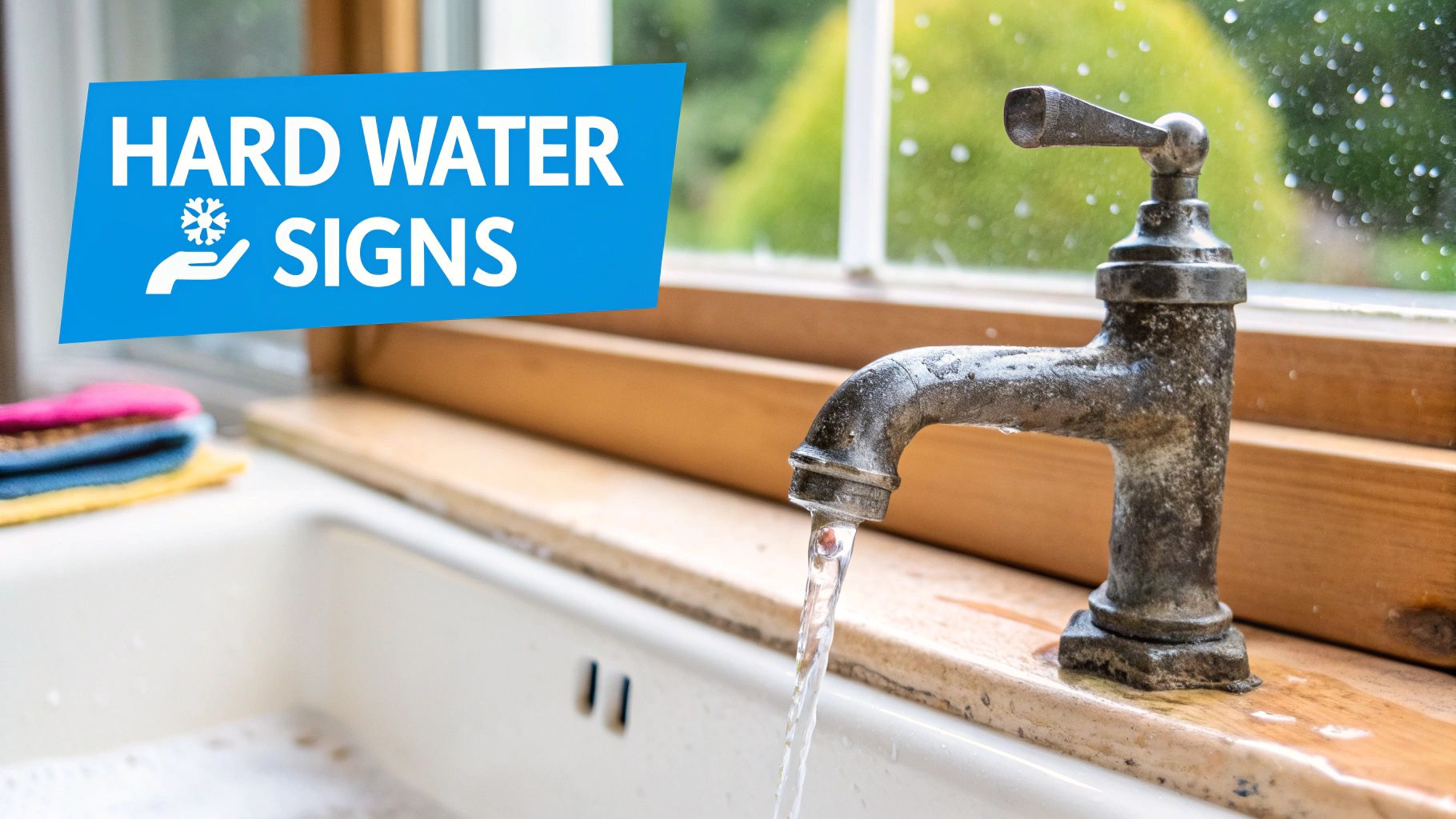
An old faucet with running water in a kitchen sink, showing mineral deposits from hard water.

Before you can pick your weapon, you need to be sure you're fighting the right enemy. Luckily, hard water isn't subtle. It leaves a trail of evidence all over your house, disguised as everyday annoyances you've probably just accepted as normal.

Hard water is simply water that’s loaded with dissolved minerals—mostly calcium and magnesium—that it picked up on its journey through the ground. While it’s perfectly safe to drink, it’s a menace to your home. So, if you think your shower doors have a permanent fog or your faucets look like they have a bad case of dandruff, you're not going crazy. That's just hard water making itself at home.

Visible Clues Around Your Sinks and Showers

The easiest place to spot the signs of this mineral invasion is wherever you use water the most. Your kitchen and bathroom are ground zero, and they're probably covered in a trail of gunk that defies all your cleaning efforts.

Look at the base of your faucets and around your showerhead. See that stubborn, white, crusty buildup? That's limescale, the calling card of hard water. It’s what’s left behind when water evaporates, and it’s basically rock. Another dead giveaway is the slimy soap scum that clings to your shower doors and tub. The minerals in your water are having a chemical party with your soap, creating that sticky, insoluble mess.

Chalky spots are another telltale sign, and they can be a real pain to remove. For some specific tips on that, check out Your Ultimate Guide to Removing Hard Water Spots on Windows.

You might also be dealing with:

  • Dull, spotty dishes and glassware: No matter how much rinse aid you use, your glasses look like they were dried with a dirty towel.
  • Weak water pressure: Limescale isn’t just an eyesore; it’s building up inside your pipes and faucet heads, slowly strangling your water flow.
  • That filmy feeling on your skin: The same reaction creating soap scum in your tub is happening on your body, leaving a residue that can clog pores and make your skin feel dry and itchy.

The Invisible Damage to Appliances and Fabrics

What you can't see is often doing the most damage. Hard water is waging a silent war on your appliances, and the collateral damage can get expensive.

Your water heater is public enemy number one for limescale. As it heats the water, scale forms directly on the heating elements, acting like a concrete blanket. This forces the unit to work way harder and burn more energy just to do its job, often leading it to fail years before its time. In fact, studies show that hard water can slash a gas water heater's efficiency by up to 24%.

Hard water doesn't just make cleaning harder; it actively works against the things you’re trying to clean. The minerals prevent detergents from lathering properly, meaning you have to use more product to get the same result, whether you're washing clothes, dishes, or yourself.

This problem carries over to the laundry room, too. Those same minerals get trapped in the fibers of your clothes, leaving them feeling stiff and scratchy. You’ll notice that your bright colors fade faster and your whites start looking dingy or gray, no matter how much bleach you throw at them. It’s a frustrating cycle of washing things that never seem to get truly clean.

To help you connect the dots, here’s a quick reference table.

Hard Water Problems and Their Filtration Solutions

This table breaks down the common issues you're seeing and points you toward the most effective water filtration system to solve them.

Common Problem Primary Cause Effective Filtration Solution
Limescale on fixtures & appliances High calcium and magnesium levels Ion-Exchange Water Softener, Salt-Free Conditioner
Soap scum & poor lather Minerals reacting with soap Ion-Exchange Water Softener
Dull, stiff, or faded laundry Mineral deposits in fabric fibers Ion-Exchange Water Softener
Dry skin and dull hair Soap residue left on skin/hair Ion-Exchange Water Softener, Showerhead Filter
Cloudy or spotty dishes Mineral deposits left after drying Ion-Exchange Water Softener, Reverse Osmosis
Reduced appliance efficiency Scale buildup on heating elements Ion-Exchange Water Softener

Ultimately, understanding these signs is the first step toward finding the right filtration treatment and reclaiming your home.

Alright, you've seen the signs. The soap scum that won’t quit, the chalky film on your faucets—something’s definitely up with your water. The next move is to find out just how hard it is.

Knowing your water's specific hardness level isn't just for bragging rights. It's the critical first step to choosing the right water treatment system. You don’t want to end up with a system that’s too weak to handle the job or, conversely, pay for more power than you actually need.

The Quick and Dirty Soap Suds Test

If you're impatient and want a rough idea right now, try the classic soap suds test. It's free, takes about five minutes, and all you need is a clean bottle with a cap and some basic liquid soap—think simple castile soap, not a fancy detergent.

Here's the drill:

  • Fill the clean bottle about a third of the way with your tap water.
  • Add around 10 drops of the liquid soap and screw the cap on tight.
  • Now, give it a good, hard shake for about 15 seconds.

Take a look. If your water is soft, you’ll see a nice, thick layer of suds, and the water below will be mostly clear. Hard water, on the other hand, will give you a sad-looking, suds-free surface and the water itself will look cloudy or milky. That cloudiness? That's your soap reacting with all the calcium and magnesium, creating the very soap scum you’re trying to get rid of.

For a More Accurate Number: DIY Test Strips

For a more scientific result, grab a pack of DIY water hardness test strips. They're cheap, easy to find at any home improvement store or online, and they give you a real number to work with.

You just dip a strip into a glass of tap water for a couple of seconds, pull it out, and wait. After a minute or so, the strip will change color. You then match that color to the chart that came in the kit.

The chart gives you a hardness reading, usually in Parts Per Million (PPM) or Grains Per Gallon (GPG). Professionals almost always talk in GPG, but the conversion is easy: 1 GPG equals 17.1 PPM.

This number is what really matters. For most homes, once you get over 7 GPG (or 120 PPM), you’re in the territory where a water softener starts to make a lot of sense. That’s the point where you’ll really see limescale build-up wreak havoc on your pipes and appliances.

For Pinpoint Accuracy: A Digital Tester

If you're a data geek or just want to be absolutely certain, a digital water tester is your best bet. These are handheld gadgets that measure the Total Dissolved Solids (TDS) in your water.

While a TDS meter measures everything dissolved in the water (not just the hardness minerals), a high TDS reading in city tap water is almost always a dead giveaway for high hardness. You get an instant, precise reading in PPM on a digital screen, which takes all the color-matching guesswork out of the equation. This kind of precision is perfect if you’re trying to dial in the settings on a high-efficiency water softener.

It's no surprise that more and more people are getting serious about this. The global water softener market was a US$2.9 billion industry back in 2022 and is projected to hit $6.8 billion by 2033. That’s a lot of homeowners deciding to protect their homes from hard water damage. You can check out more details on the water softener market trends on custommarketinsights.com.

Water Softeners vs. Water Conditioners: The Main Event

Okay, so you've confirmed hard water is the problem. Now, how do you fix it? When you're looking for a whole-house filtration solution, it really comes down to two main players: the classic salt-based water softener and the modern salt-free water conditioner.

This isn't just about plumbing hardware. It’s a choice between two completely different philosophies for dealing with those pesky minerals.

Think of it this way: a water softener is like a bouncer at a club, physically throwing the troublemakers (calcium and magnesium) out. A water conditioner, on the other hand, is like a skilled negotiator that convinces them to behave so they don't cause any problems. Both get the job done, but their methods are worlds apart.

The Classic Solution: Salt-Based Water Softeners

For most people, the image that pops into their head when they hear "hard water treatment" is a salt-based water softener. There's a good reason for that—they are the undisputed champions of hardness removal, and their method is both simple and incredibly effective.

The magic happens through a process called ion exchange. Your water flows through a tank filled with resin beads that are covered in sodium ions. Since the calcium and magnesium ions in your water have a stronger charge, they get pulled to the resin like a magnet, bumping the sodium ions off and into your water. It’s a direct swap: bad minerals out, harmless sodium in.

This total removal of hardness minerals is what gives you genuinely soft water. The difference is night and day:

  • Limescale vanishes: With the scale-forming minerals gone, they can't build up on faucets, shower doors, or inside your water heater.
  • Soap works like it should: You'll get that rich, sudsy lather you see in commercials. You'll also use way less soap, shampoo, and detergent.
  • That signature "slippery" feel: This is the tell-tale sign of truly soft water. Without minerals to react with soap, it rinses off completely, leaving your skin's natural moisture behind. It feels slick, but that’s actually the feeling of being 100% clean.

But this level of performance requires some upkeep. Eventually, those resin beads get clogged with all the minerals they've collected. To clean them, the system runs a regeneration cycle, flushing itself with a saltwater brine from a second tank. That brine tank is the part you have to keep topped up with heavy bags of salt.

The Modern Alternative: Salt-Free Water Conditioners

If you're looking for a way to stop scale damage without adding sodium to your water or lugging salt bags, a salt-free water conditioner is a fantastic option. The most important thing to know is that these systems do not remove the minerals, so they don't technically "soften" the water.

So what do they do? They change the minerals' behavior. The most proven technology here is Template Assisted Crystallization (TAC). As water flows through the TAC media, the calcium and magnesium minerals are converted into microscopic crystals.

These tiny, harmless crystals can't stick to pipes, fixtures, or heating elements. They just flow right on through your plumbing and down the drain. You get the number one benefit—scale prevention—without actually altering your water's mineral content. The healthy calcium and magnesium are still there, they've just been neutralized.

Here's the bottom line: Salt-free conditioners are all about preventing scale. You won't get that slippery feeling or mountains of soap bubbles, but you will protect your pipes, water heater, and dishwasher from destructive limescale.

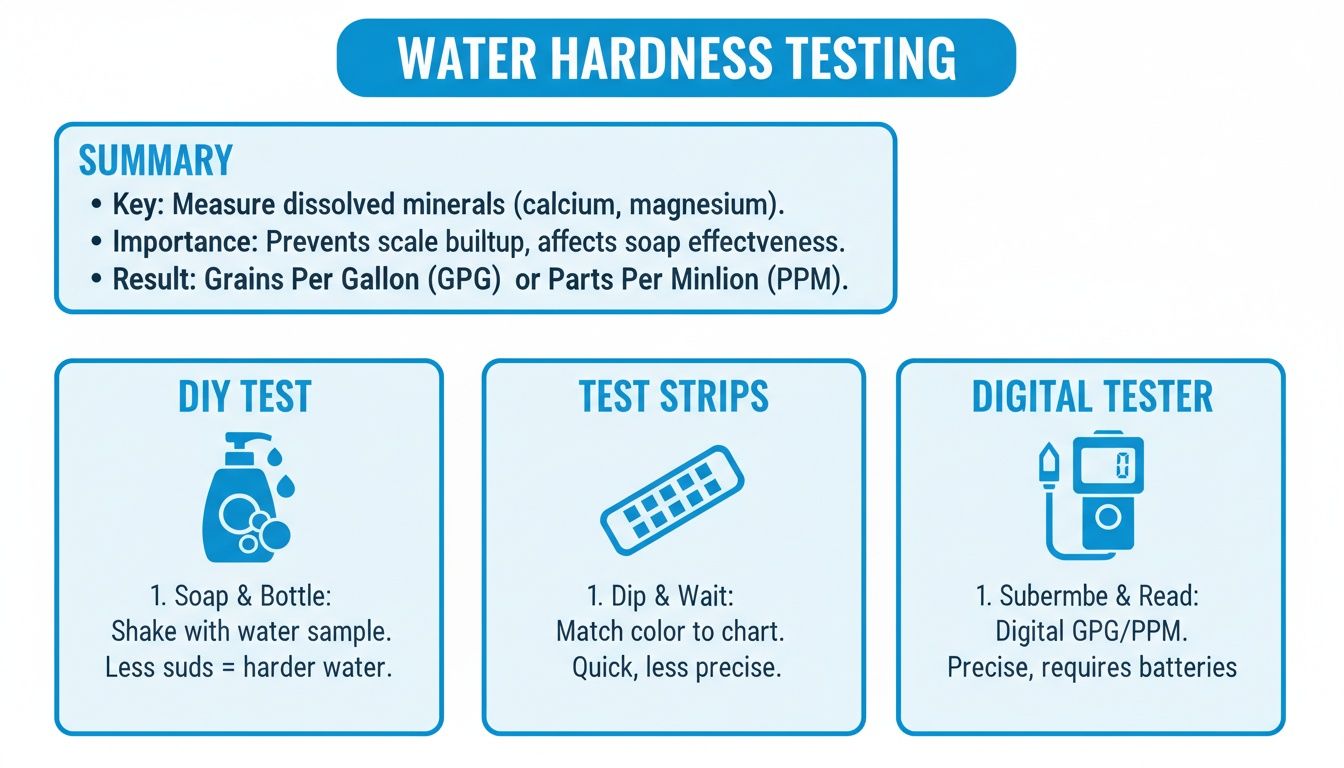
This infographic lays out a few simple ways to figure out just how hard your water is. Knowing your numbers is the first critical step before picking any treatment system.

Infographic on water hardness testing, outlining a summary and three methods: DIY, test strips, and digital testers.

Whether you use a basic soap test or a precise digital meter, getting this data helps you choose and size your system correctly.

Making the Right Choice for Your Home

So, which one is for you? It really comes down to what you're trying to achieve. There’s no single “best” system, just the one that’s the best fit for your home and your priorities.

This head-to-head comparison should make the differences crystal clear.

Water Softener vs. Water Conditioner: Head-to-Head Comparison

Feature Salt-Based Water Softener Salt-Free Water Conditioner
Primary Function Physically removes calcium & magnesium Neutralizes minerals to prevent scale
How It Works Ion Exchange Template Assisted Crystallization (TAC)
Scale Prevention 100% elimination Excellent scale prevention (99%+ effective)
"Soft Water" Feel Yes, creates the distinct slippery feel No, water chemistry is unchanged
Soap Lather Significantly improves lather No change in lather
Maintenance Regularly add salt (40-50 lbs/month) Virtually maintenance-free
Environmental Impact Discharges salt brine into wastewater No salt, no waste, no electricity
Initial Cost Generally lower upfront cost Often a higher initial investment
Ongoing Costs Salt, water, and electricity for regeneration None
Best For Homeowners wanting to fix all hard water issues Homeowners focused on protecting plumbing & appliances

In the end, it’s a straightforward choice.

If you want the full soft-water experience—no scale, better skin and hair, and amazing soap lather—then a salt-based water softener is the clear winner. It's the only way to physically remove the minerals that cause all the problems.

If your main goal is to protect your home's expensive plumbing and appliances from scale buildup, and you want a zero-maintenance, eco-friendly solution, then a salt-free water conditioner is an excellent choice. It's the ultimate "set it and forget it" system for preventing the costly damage hard water can do.

Exploring Other Hard Water Filtration Methods

While whole-house softeners and conditioners are the heavy hitters, they aren't the only tools in your filtration arsenal. Sometimes, a more focused, targeted approach is exactly what’s needed.

Maybe you just want ultra-pure drinking water or a simple fix for your dry hair. For that, other filtration methods offer the perfect solution. These alternatives can work great on their own or even supplement a larger system, letting you fine-tune the water quality throughout your home.

Reverse Osmosis for Pure Drinking Water

You’ve probably heard of Reverse Osmosis (RO) systems. They are the gold standard for water purification, usually installed right under the kitchen sink with a small, dedicated faucet. An RO system is a multi-stage filtration beast that does a lot more than just soften water.

It works by pushing water through a special membrane filled with microscopic pores. This process strips out nearly everything that isn't H₂O, including:

  • Hardness minerals like calcium and magnesium
  • Contaminants like chlorine, lead, and pesticides
  • Dissolved solids, salts, and even fluoride

What you get is exceptionally clean, great-tasting water that's amazing for drinking and cooking. But that level of purification is exactly why RO is rarely a whole-house solution. These systems produce water slowly and create wastewater in the process, making them impractical and wasteful for things like showers and laundry.

Key Takeaway: An RO system is the ultimate point-of-use filtration fix for pristine drinking water. It will remove hardness minerals from the water you drink, but it isn't designed to protect your home's entire plumbing network from limescale.

The Power of Showerhead Filters

Is your main complaint about hard water what it does to your hair and skin? If so, a specialized showerhead filter is a fantastic and incredibly budget-friendly fix.

These devices are a breeze to install—they just screw on between your existing showerhead and the pipe coming out of the wall. They target the water exactly where it impacts your personal care routine the most.

They use filtration media, often a mix of KDF (Kinetic Degradation Fluxion) and carbon, to cut down on both hardness minerals and chlorine. While they don't technically "soften" water like an ion-exchange system, they do a great job reducing the scale and chlorine that are the real culprits behind dry, itchy skin and dull, brittle hair. This is an ideal solution for renters or anyone who wants to solve skin and hair issues without the cost of a whole-house system.

A Broader Look at Water Filtration

As you can see, treating hard water often involves more than just tackling minerals. The world of water filtration is huge, with systems designed for everything from sediment to specific chemical contaminants. For instance, you might have a softener to handle the minerals but still want a carbon filter to improve the taste and smell.

This is especially true in unique setups, like mobile living. In these cases, a broad approach to water quality is key. For more on keeping water clean on the go, you might want to read up on finding the best RV water filter system.

Reverse osmosis is only becoming more popular. In fact, within the water treatment world, reverse osmosis systems are expected to command about 35% of the market share by the end of 2035. It's easy to see why, since these membrane filters can remove up to 99% of water impurities. Whether it’s for your whole house, your RV, or just your drinking glass, understanding all these options is the key to finding the perfect fix for your water.

Installation and Maintenance for Your Filtration System

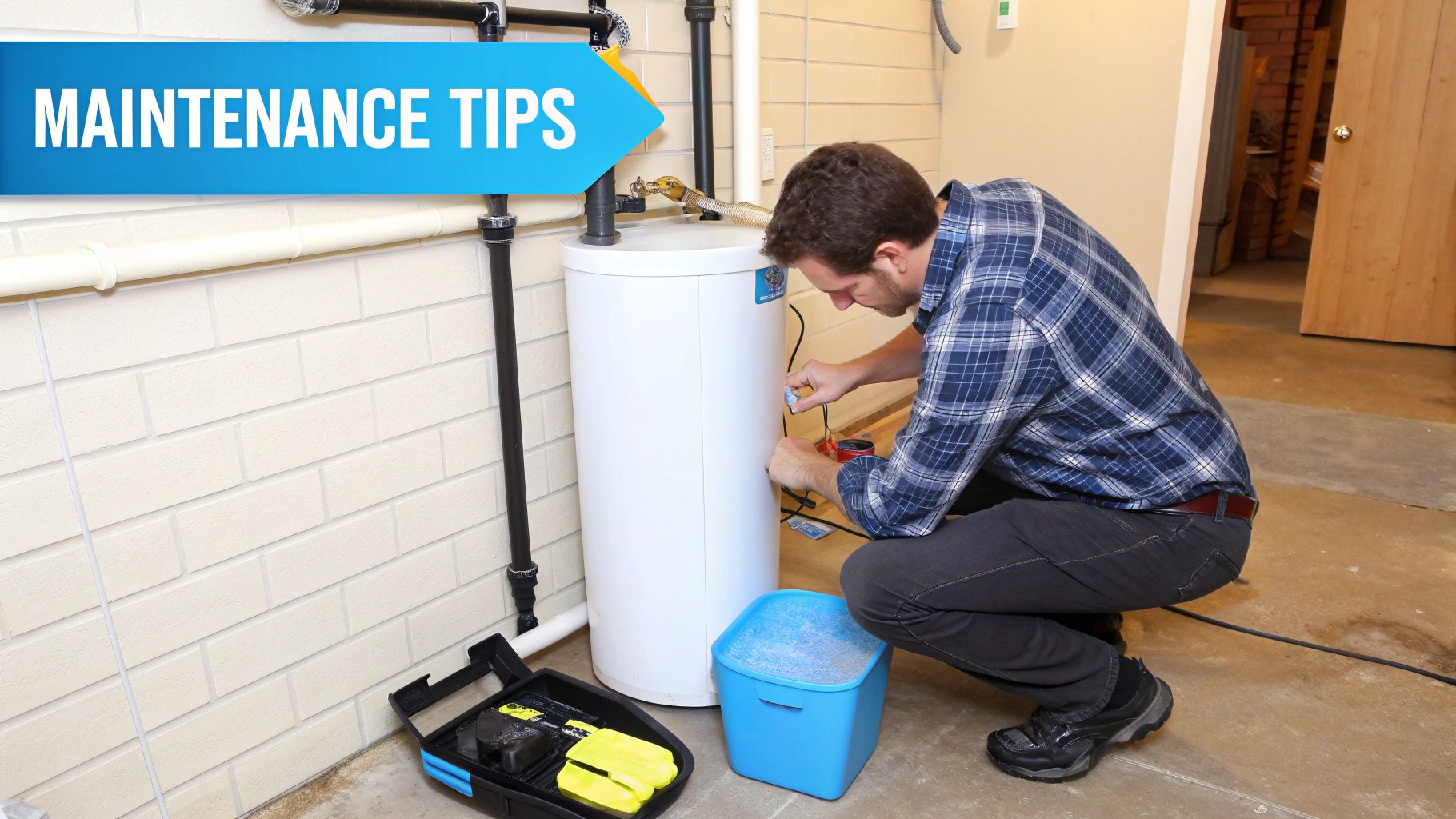
A man performing maintenance on a white water heater in a utility room with tools and a bucket.

Getting a hard water filtration system is a huge step, but the work doesn't stop once you've made the purchase. Proper installation and a little upkeep are what protect your investment and keep your home running scale-free for years to come.

Think of it this way: even a brand-new car needs its oil changed.

A whole-house system is a serious piece of plumbing. You're cutting into your home's main water line, which can feel pretty daunting. Your first big call is deciding whether to roll up your sleeves and do it yourself or bring in a pro.

DIY Installation vs. Professional Help

If you're already comfortable with plumbing projects, a DIY installation is definitely on the table. Most systems arrive with detailed instructions, and the basic process is straightforward: shut off the main water, cut a piece of pipe, and hook up the new unit. If you've handled pipe cutters, soldering, or PEX fittings before, you'll probably feel right at home.

For a lot of folks, though, this is a job best left to a professional plumber.

A licensed pro brings a lot to the table. They’ll ensure the system is installed to code, won’t leak (preventing a potential disaster), and can help you figure out the optimal spot for the unit. That's a big deal, especially since a salt-based softener needs to be near both a drain and a power outlet.

Expert Insight: Spending a few hundred dollars on a professional installer buys you total peace of mind. A bad install can cause leaks, a drop in water pressure, or even void your warranty, which makes hiring a pro a smart move for such a long-term home improvement.

Your Long-Term Maintenance Checklist

Once your system is up and running, a little routine care goes a long way. The maintenance you'll need to do really depends on the type of filtration system you picked.

For a traditional salt-based water softener, your main task is pretty simple: keep the brine tank topped up with salt. Here’s what that looks like:

  • Check the Salt Level: Take a peek inside the brine tank at least once a month.
  • Refill as Needed: A good rule of thumb is to keep the tank at least one-third full. For a typical family of four, you'll likely add one 40-pound bag of salt every month or two.
  • Choose the Right Salt: Stick to high-purity salt pellets made specifically for water softeners. Cheaper rock salt often has dirt and gunk that can clog up the system's more delicate parts.
  • Clean the Brine Tank: About once a year, it's a great idea to empty and clean out the brine tank. This gets rid of any sediment or "salt mush" that’s built up on the bottom.

Care for Salt-Free and Cartridge-Based Systems

If you went with a salt-free water conditioner that uses Template Assisted Crystallization (TAC), your to-do list is much shorter. There's a reason people call these "set it and forget it" solutions.

The TAC media inside the tank will eventually need to be replaced, but usually only every three to five years. It's a job many homeowners can handle themselves in under an hour—just unscrew the tank head, dump out the old media, and pour in the new.

For smaller, cartridge-based filters, like the ones you find on showerheads or under a sink, it’s even easier. All you have to do is swap out the filter cartridge based on the manufacturer's schedule, which is typically every six months to a year. Keeping up with this is key to making sure the filter keeps doing its job effectively.

Your Hard Water Questions Answered

After digging into all the different filtration methods for hard water, there are always a few questions that pop up. This is where we tackle those last few uncertainties head-on, giving you straight answers to the things we hear most often from homeowners just like you. Let's get everything cleared up so you can feel good about your next step.

Will a Water Softener Make My Drinking Water Salty?

This is probably the biggest myth we run into, and it's a totally fair question. While salt-based softeners do use sodium chloride (salt) to regenerate, the actual amount of sodium that makes its way into your tap water is tiny.

It's an ion exchange, not an addition. The system swaps a sodium ion for a calcium or magnesium ion. For most homes with moderately hard water, the sodium added is less than what's in a single slice of white bread. Honestly, you'd be hard-pressed to taste any difference at all.

That said, if you're on a strict, doctor-ordered low-sodium diet, it's something to discuss with them. A great workaround many people choose is to install a whole-house softener and then add a reverse osmosis system under the kitchen sink. You get the best of both worlds: your whole house is protected from scale, and you have ultra-pure, sodium-free water for drinking and cooking.

Can I Treat Hard Water if I Live in an Apartment?

You absolutely can. Installing a big whole-house system is usually off the table for renters, but you’ve still got some fantastic point-of-use filtration options that can make a world of difference. You don't have to just put up with hard water because you don't own the place.

Here are the most common filtration fixes for renters:

  • Showerhead Filters: This is the go-to for apartment dwellers. A simple screw-on shower filter designed for hard water can drastically cut down on scale and chlorine. The result? Skin that feels softer and hair that's healthier and easier to manage.
  • Faucet-Mounted Filters: For your kitchen sink, a filter that attaches right to the faucet is an easy way to improve the taste and quality of the water you drink and cook with.
  • Countertop Filtration Systems: From simple pitcher filters to more advanced countertop units, you can get great-tasting, filtered water without touching the plumbing at all.

These targeted solutions let you enjoy many of the perks of treated water without making a single permanent change.

How Do I Choose the Right Size Water Softener?

Getting the right size water softener is a huge deal for its efficiency and your long-term happiness with it. If it's too small, it will regenerate constantly, wasting salt and water. If it's too big, you've just spent more money than you needed to.

The right size all comes down to two numbers: your water hardness level (in Grains Per Gallon, or GPG) and how much water your household uses each day.

You can figure out your daily needs with a quick calculation:
(Number of People in Home) x (75 Gallons per Person) x (Your Water’s GPG) = Daily Grains to Remove

Let's walk through a real-world example. A family of four with water that has a hardness of 10 GPG would figure it out like this: 4 people x 75 gallons x 10 GPG = 3,000 grains per day. Since you want the system to go a few days between regeneration cycles, a standard 32,000-grain unit would be a solid choice for this family. Most manufacturers have easy-to-read sizing charts to help you lock in the perfect model. For more general filtration questions, you can always find more in-depth articles in our water filter advice section.


At Water Filter Advisor, our goal is to give you the clear, unbiased information you need to find the perfect solution for your home's water. Whether you need a whole-house system or a simple faucet filter, explore our guides and reviews to make a confident choice. Visit us at https://www.waterfilteradvisor.com to get started.