You fill a glass from the kitchen tap, hold it to the light, and pause for a second longer than you used to. Maybe it smells faintly like a pool. Maybe the taste is flat, metallic, or just off. Maybe your coffee hasn't tasted right in weeks, and the white crust around the kettle is starting to annoy you.
That hesitation is why so many households start looking into water filtration. It's no longer a niche habit. In a 2022 survey, 77% of Americans said they filter their drinking water at home, up from 73% in 2020, and 92% of filtration buyers said they prefer independently certified filters (peer-reviewed survey summary). People want cleaner-tasting water, but they also want proof that a filter does what the box says it does.
The part that trips homeowners up is simple. They buy a filter before they know the problem. That's how you end up with a pitcher that helps with chlorine taste but does nothing for a lead concern, or a softener that stops scale but leaves odor untouched.
The Simple Path to Better Tasting Water Starts Here
Most tap-water problems fall into one of a few buckets. Bad taste and odor, health-related contaminant concerns, hard water scale, or microbial safety issues. The trick is matching the complaint to the right treatment method.
If your water smells like chlorine, that points you in one direction. If you're worried about old plumbing and possible lead, that points you in another. If your fixtures keep building up white crust, that isn't usually a drinking-water filtration problem at all. It's a hardness problem, and the right answer often involves softening rather than standard carbon filtration.
Practical rule: Don't shop by filter shape first. Shop by water problem first.
That's the whole game in learning how to filter tap water the smart way. Start with what's in the water. Then choose the technology that's built for that issue. Only after that should you worry about whether the system lives in a pitcher, on a faucet, under the sink, or at the main water line.
A good home setup doesn't have to be complicated. It does have to be targeted. The best results usually come from homeowners who stop thinking in vague terms like “cleaner water” and start asking sharper questions:
- Taste issue: Is the problem chlorine or another odor?
- Health issue: Are you concerned about lead, cysts, or another contaminant?
- House problem: Are scale, spots, and buildup the primary complaint?
- Source issue: Are you on city water or a private well?
Once those answers are clear, the rest gets much easier.
Know What's In Your Water Before You Filter
Buying a filter without testing your water is like replacing car parts before opening the hood. Sometimes you get lucky. More often, you spend money on the wrong fix.
The CDC's guidance is straightforward. Test your water first, then select a filter certified to remove the specific germs or chemicals of concern. The same CDC guidance says to check for certifications such as NSF 42 for taste and odor, NSF 53 for health contaminants like lead or cysts, NSF 58 for reverse osmosis systems, and NSF 62 for distillation systems (CDC guidance on choosing home water filters).
Start with your water source
If you get water from a utility, read your annual water quality report. It tells you what the utility found in the system and how the water was treated. That won't tell you everything happening inside your home's plumbing, but it gives you a solid baseline.
If you use a private well, the testing step matters even more. The CDC says private wells should be tested at least once a year. Well owners deal with a different set of variables, including source-water changes, pressure equipment, and plumbing conditions. If that's your situation, this guide to CJMC Build well water expertise is a useful companion for understanding the broader well-system side of the problem.
What different tests actually tell you
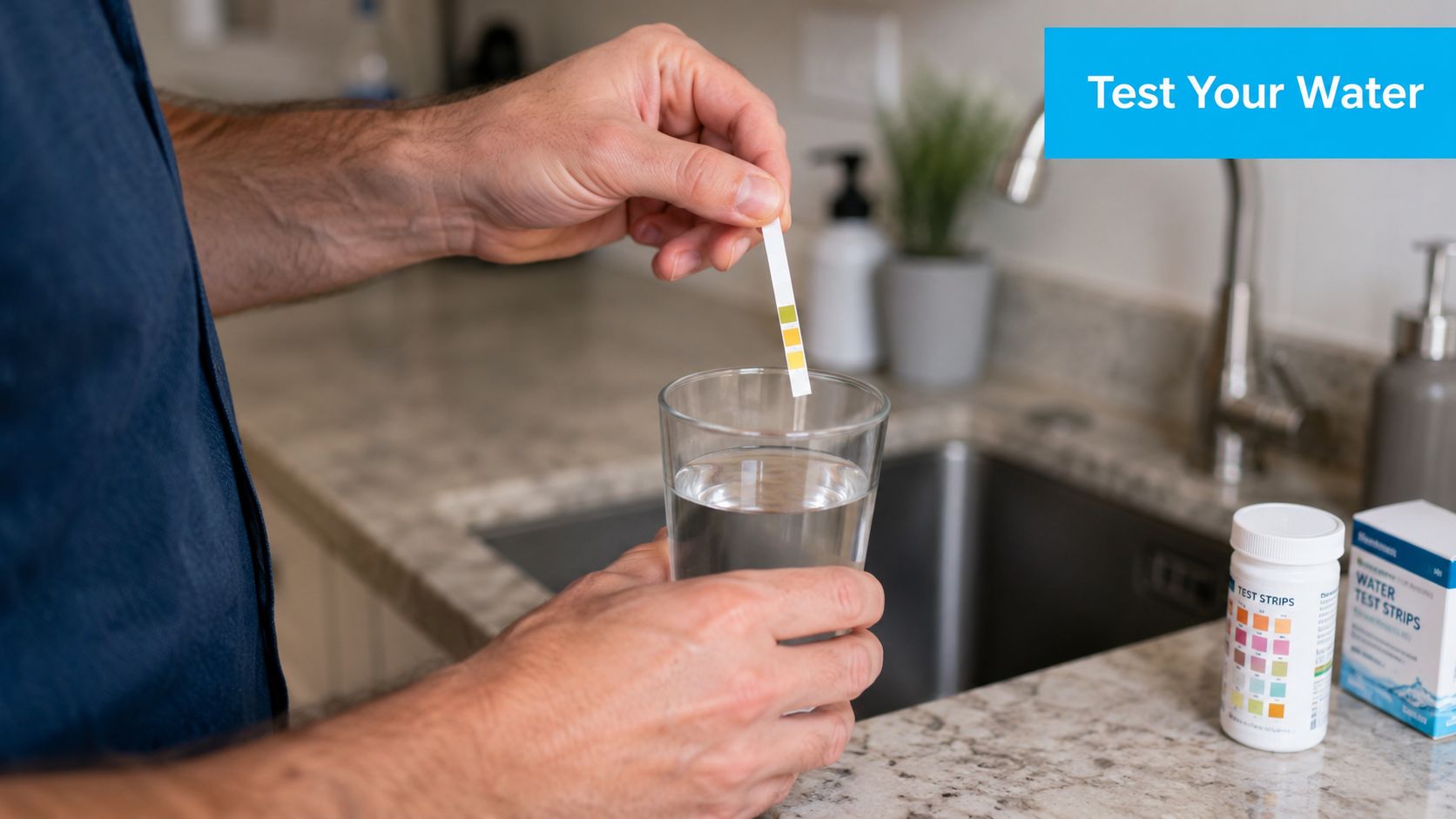
At-home test strips are useful for screening. They can flag obvious issues and help you spot patterns. They're convenient when you want a quick read on hardness, chlorine presence, or other basic characteristics.
Professional lab testing is better when the concern is specific and serious. That includes suspected lead, unusual odor, a known local contaminant issue, or any situation where you need confidence before investing in equipment.
Here's the practical split:
| Situation | Best first move |
|---|---|
| Chlorine taste or odor from city water | Check your utility report, then confirm with a simple home screening if needed |
| Old home with concern about plumbing-related contaminants | Use a targeted lab test |
| White scale on fixtures and appliances | Test for hardness |
| Private well with changing taste, odor, or color | Annual testing, plus added testing when conditions change |
Read the label like a skeptic
A common mistake is assuming every filter removes the same things. They don't. A filter can improve taste and still be the wrong tool for a health-related concern.
The label matters more than the marketing. The CDC also notes that if a filter's pore size isn't small enough, it won't remove the target germs. In plain English, that means the performance claim has to match the contaminant. “Advanced filtration” is not a certification.
If you're worried about lead, cysts, or microbes, don't settle for language like “reduces impurities.” Look for the actual certification tied to the problem.
A Field Guide to Home Water Filtration Tech
Most home filters are just a few core technologies packaged in different ways. Once you understand the engine inside the device, shopping gets much easier.
Activated carbon for taste and everyday city-water complaints
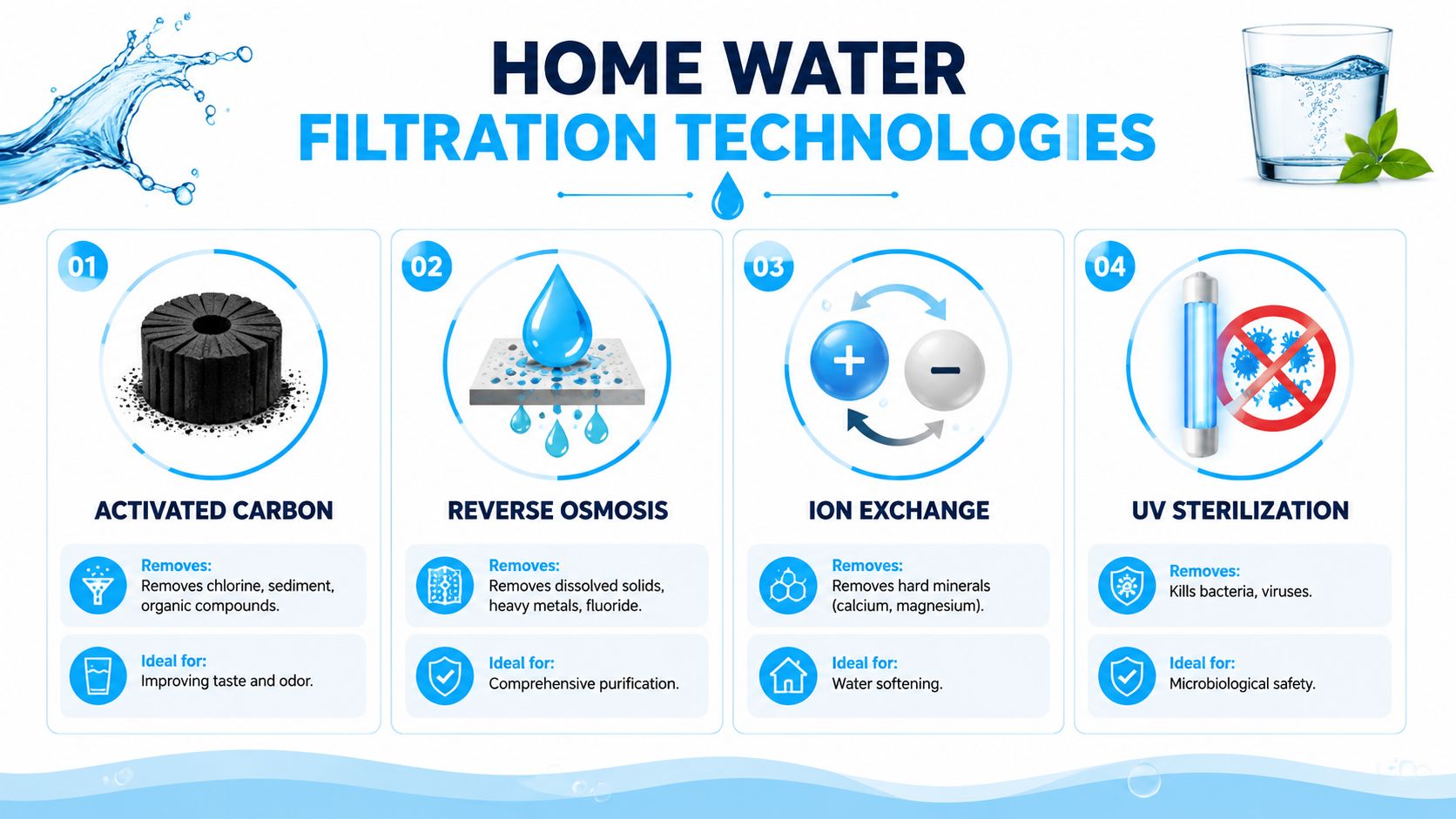
Activated carbon is the workhorse for improving taste and odor. If your water smells like chlorine or tastes stale, carbon is often the first thing I'd look at. It's common in pitchers, faucet filters, refrigerator filters, countertop units, and many under-sink systems.
This is usually the right lane for homeowners who say, “The water is technically safe, but nobody likes drinking it.”
What it does well:
- Improve taste and odor: Especially chlorine-related complaints
- Handle many everyday drinking-water annoyances: The kind that make water less pleasant, not necessarily unsafe
- Fit simple form factors: Pitchers and faucet filters are easy starting points
What it doesn't do well is just as important. Carbon doesn't automatically solve dissolved-mineral problems, and it doesn't replace a technology designed for very high contaminant reduction.
Sediment filters for grit, rust, and protection
Sediment filters don't get much attention because they don't sound glamorous. They matter anyway. Their job is to catch larger particles such as rust, grit, and visible debris before those particles reach finer filter stages.
Sediment filtration is often the first stage in a larger system. It protects carbon blocks, membranes, valves, and fixtures from unnecessary wear.
If your water looks cloudy with visible particles, or if you're on well water, sediment filtration often belongs near the front of the treatment train.
Sediment filters don't “polish” taste. They protect the rest of the system and clean up particle issues.
Reverse osmosis when you need stronger contaminant reduction
Reverse osmosis, usually called RO, pushes water through a specialized membrane. It's a more serious treatment option, typically installed under the sink for drinking and cooking water.
RO is the system people usually mean when they want a more advanced drinking-water setup. It's often chosen when the concern goes beyond taste and into dissolved contaminants.
Trade-offs matter here:
- Strength: Stronger contaminant reduction than a basic carbon filter
- Complexity: More parts, more maintenance, and slower production than simple filters
- Footprint: Usually needs under-sink space and a dedicated faucet
RO also changes the character of the water. Some people love the crisp, stripped-down taste. Others think it tastes flatter than carbon-filtered water.
Ion exchange for hard water, not taste
If your real problem is scale on faucets, cloudy dishes, stiff laundry, or mineral buildup in the water heater, you may need ion exchange. This is the technology used in water softeners.
That's not the same as a drinking-water filter. Softening addresses hardness minerals such as calcium and magnesium. It protects plumbing and appliances, and it improves how water behaves with soap.
A lot of homeowners buy a drinking-water filter expecting it to stop scale. It won't, unless hardness treatment is part of the design.
UV and disinfection for microbial concerns
Some homes need a final disinfection step, especially where microbial safety is the concern. UV systems are one approach used for that purpose. They aren't there to improve flavor. They're there to address microorganisms.
A useful way to think about system design is to borrow the logic used in larger water treatment. The CDC describes municipal treatment as a sequence that includes coagulation, flocculation, sedimentation, filtration, and disinfection. At home, the practical version is often sediment removal, activated carbon, and a final disinfection step when needed. For systems with carbon media, flushing after installation matters too, and one installation guide recommends a 3-minute flush to clear carbon fines (CDC overview of how water treatment works).
Form factor matters after the technology
Once the treatment method is right, then you can pick the format:
| Format | Best for | Main limitation |
|---|---|---|
| Pitcher | Renters, light use, taste improvement | Limited speed and capacity |
| Faucet filter | Simple installation, cooking and drinking water | Can feel bulky at the tap |
| Under-sink | Dedicated drinking-water treatment | Needs space and some installation effort |
| Whole-house system | Treating water at every tap | Bigger upfront commitment |
| Countertop unit | No under-sink work, easier access | Takes counter space |
The right filter isn't the fanciest one. It's the one that solves the actual problem at the point where you need treatment.
Choosing the Right Water Filter For Your Home
The right system depends less on hype and more on your living situation, plumbing setup, and tolerance for maintenance.
For the renter in an apartment
If you can't alter plumbing, keep it simple. A pitcher, countertop unit, or faucet-mounted filter usually makes the most sense. These options are portable, easy to replace, and well suited to taste-and-odor complaints.
They're also easier to live with if you move often. You won't leave hardware behind, and you won't need landlord approval for every upgrade.
A renter should resist one common temptation: overbuying. If the issue is chlorine taste, a simple certified carbon-based option is often the cleaner answer than trying to mimic a full under-sink setup.
For the homeowner with kitchen-only concerns
If the family mostly wants better water for drinking, coffee, tea, baby formula prep, and cooking, an under-sink filter is often the sweet spot. It keeps the counter clear, treats a useful amount of water, and feels more permanent without requiring a whole-house investment.
This is usually where I'd compare a standard carbon-based under-sink system against reverse osmosis. If the concern is mostly flavor and smell, carbon may be enough. If the concern is broader and the testing points that way, RO becomes more compelling.
For side-by-side thinking on system types and use cases, this collection of practical water filtration advice is a helpful next step.
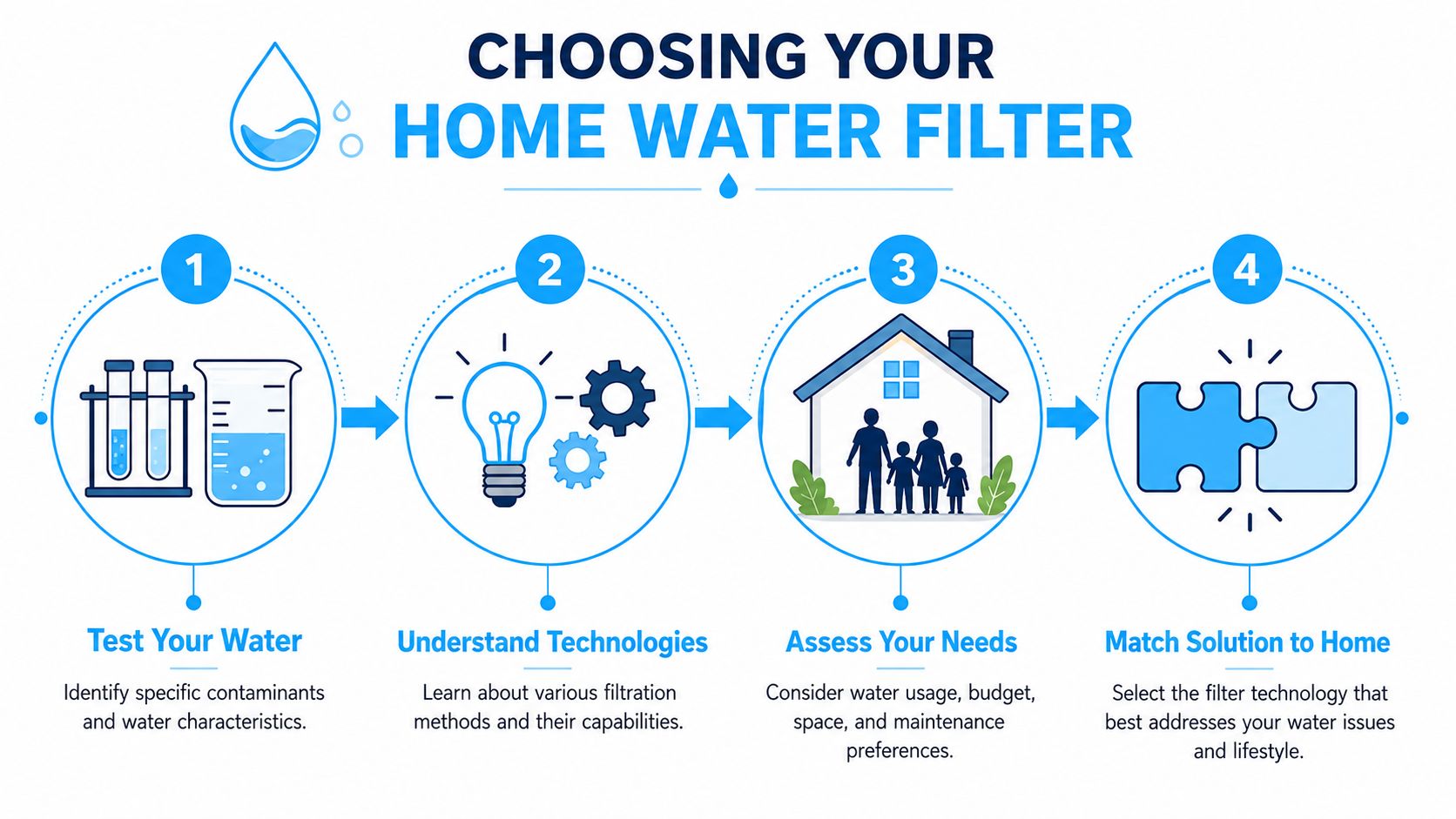
A quick visual can help sort the decision before you buy.
For the family dealing with hard water all over the house
When the complaint includes scale on shower glass, crust on fixtures, poor soap performance, and appliance wear, a drinking-water filter alone won't solve it. For these issues, a whole-house softener or a broader point-of-entry treatment system proves invaluable.
That doesn't mean you must choose one or the other. Many homes benefit from a split strategy:
- Whole-house treatment: For hardness, sediment, or source-wide issues
- Under-sink drinking-water treatment: For taste and targeted drinking-water concerns at the kitchen tap
That combination often works better than trying to force one device to do every job in the house.
For the homeowner on a private well
Well owners usually need to think in layers. Source variability, sediment, pressure equipment, and possible microbial concerns make a single-device mindset less useful.
A staged setup is often the practical answer:
- Sediment control first
- Targeted media next, based on the tested issue
- Disinfection when needed
- Kitchen polishing filter, if you want better drinking-water taste
The best decision usually comes from asking one plain question: where do you need treatment most? At one tap, at every tap, or at the source before water enters the house?
Buy for the water problem you have today, but leave enough flexibility to adjust if your testing or living situation changes.
Installation and Long-Term Maintenance
A good filter can disappoint fast if it's installed carelessly or maintained on guesswork. Most of the “this thing doesn't work” complaints I hear come down to skipped flushing, overdue cartridges, bad seals, or a system that was never matched to the home in the first place.
Installation habits that prevent headaches
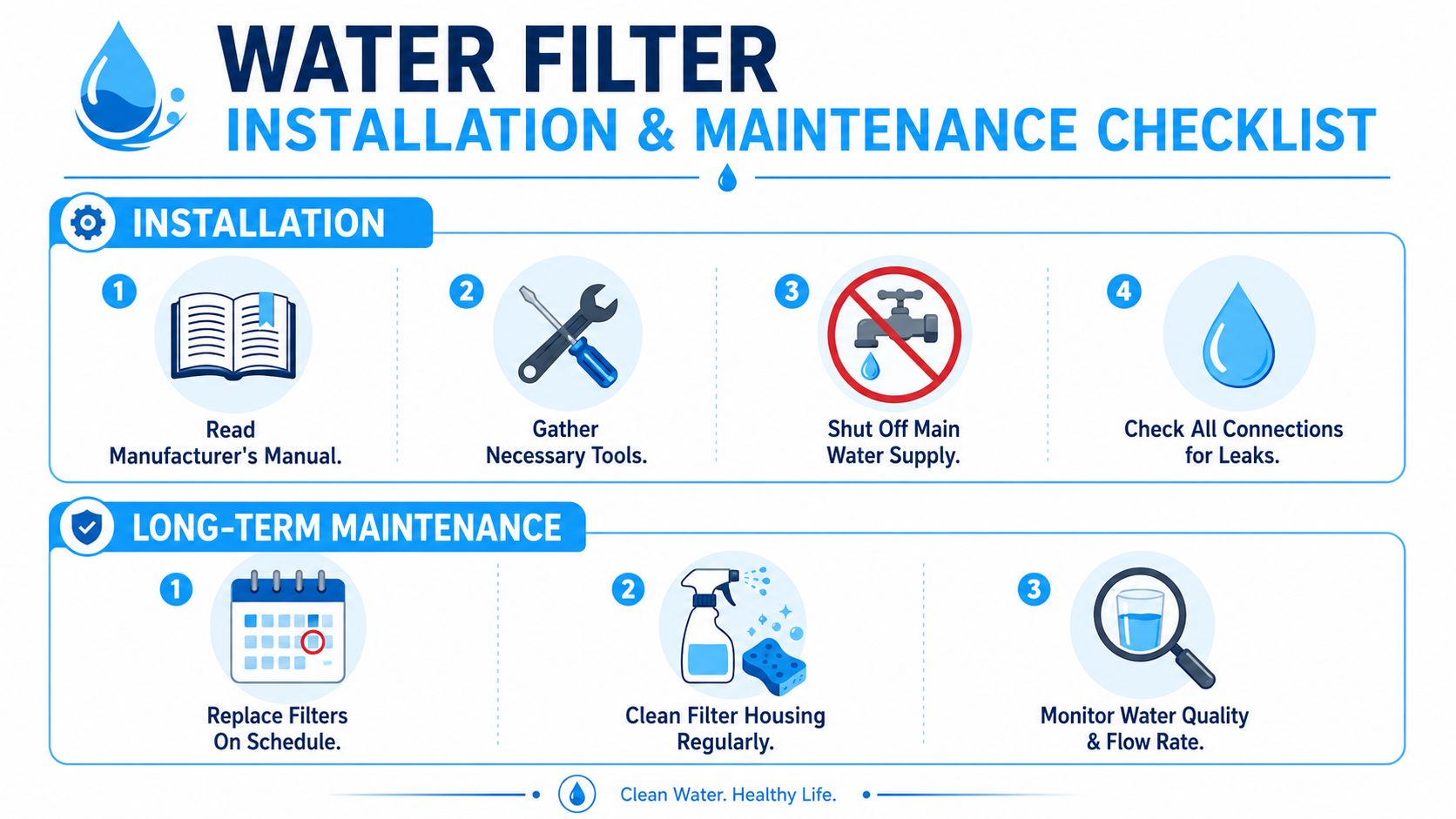
Start with the manual for your exact system. That sounds obvious, but different filters have different flow directions, pressure limits, O-ring placements, and flushing steps.
For most systems, the first installation checklist looks like this:
- Shut off the relevant water supply: Don't work on a live line and hope for the best
- Inspect seals and housings carefully: A twisted O-ring can create a slow leak that shows up later
- Tighten firmly, not aggressively: Overtightening can damage threads and housings
- Flush before drinking: This clears trapped air, loose fines, and manufacturing residue
If the system contains carbon media, the first few gallons may look cloudy or contain black specks. That's usually carbon fines, not a sign that the unit is failing. Flush until the water runs clear and stable.
Maintenance is where performance lives
A filter only works when the media inside it still has capacity. Once that media is exhausted, performance drops. In some cases, flow drops first. In others, taste changes before you notice anything else.
Build a maintenance routine that doesn't rely on memory alone:
| Maintenance task | Why it matters |
|---|---|
| Replace cartridges on schedule | Keeps certified performance from slipping |
| Clean housings when changing filters | Reduces buildup and helps protect new cartridges |
| Watch flow rate | A sudden slowdown often points to clogging |
| Taste and smell the water regularly | Your senses often catch changes before indicator lights do |
A lot of homeowners wait until the water tastes bad again. That's too late. Follow the manufacturer's replacement guidance, and if your water has heavier sediment or higher usage than expected, be ready to shorten the interval.
New filter, old housing, and no cleaning is a common way to sabotage a system that should be working well.
Signs your filter needs attention
You don't need lab equipment to notice trouble. The system often tells you.
Look for these clues:
- Reduced flow: Common with sediment-loaded filters and aging carbon blocks
- Taste or odor returning: Often means the filter media is spent
- Leaks around fittings or housings: Usually a seal, alignment, or overtightening problem
- Cloudy first draw after a cartridge change: Often normal briefly, but it should clear after flushing
For larger systems, keep basic notes. Write the install date on the cartridge. Put replacement dates on a calendar. If your whole-house system has multiple stages, label each housing so nobody swaps cartridges into the wrong place during the next service.
Troubleshooting Common Issues and Final Tips
A new filter should improve the experience of using water at home. If it doesn't, the problem usually isn't mysterious. It's usually one of a handful of common issues.
Slow flow, odd taste, or a disappointing result
Slow flow often means the filter is clogged, the feed valve isn't fully open, or the system is more restrictive by design. Multi-stage filters and RO systems often trade speed for treatment. If the flow feels unusually weak, check for a kinked line, a spent prefilter, or sediment loading.
Strange taste right after installation is usually temporary. Fresh carbon can release fines or a mild new-media taste until it's flushed properly. If the taste persists after thorough flushing, recheck that the cartridge is seated correctly and that the filter matches the complaint you were trying to solve.
Water that still scales is another frequent frustration. That usually means you chose filtration when the problem was hardness. A carbon filter can improve taste and still leave mineral buildup untouched.
When your setup is good but your expectations need adjusting
RO water can taste very clean, but some people describe it as flat. That isn't necessarily a defect. It's often just the result of removing a lot of what gives water its familiar character.
If you live part-time in an RV or travel trailer, some of the same troubleshooting logic carries over. Pressure changes, odd pump behavior, and inconsistent flow can affect filtration performance there too. This guide offers expert advice for RV owners dealing with water-system quirks that can look like filter problems.
A few final habits make filtered water more satisfying day to day:
- Use it in coffee and tea: Flavor differences show up fast there
- Cook with it when taste matters: Soups, rice, pasta, and stock all pick up water character
- Store it in a clean glass pitcher in the fridge: Cold water often tastes better, even with the same filter
- Retest when something changes: New odor, new plumbing work, seasonal shifts, or a move all justify another look
The best answer to how to filter tap water isn't “buy the most expensive system.” It's “match the treatment to the problem, then maintain it like it matters.”
If you want help comparing systems, understanding certifications, or figuring out what fits your home without wasting money on the wrong setup, visit Water Filter Advisor. It's a practical place to keep researching before you buy your next filter.
- June 18, 2026
- Uncategorized
