Are you tired of playing detective, trying to figure out which water softener is the one for your home? It can feel like you’re lost in a funhouse of complicated specs and confusing claims. But here's the good news: you can cut through the noise by focusing on what really matters. The quest for the perfect water softener boils down to three key clues: how hard your water actually is, how much water your family uses, and which type of system is the right sidekick for your home.
Let's crack the code together, so you can make a brilliant choice without getting lost in the technical jargon.
Your Quick Guide to the Right Water Softener
If you're in a constant battle with chalky white buildup on your faucets, soap scum that laughs at your cleaning efforts, and laundry that feels more like sandpaper, you've met the villain of our story: hard water. And you’re definitely not alone. The vast majority of American homes are dealing with water that’s loaded with mineral freeloaders like calcium and magnesium.
A water softener is your home's superhero. It's a whole-house water filter that swoops in to remove those minerals, protecting your pipes, appliances, and even your skin and hair from their damaging effects. But with all the different types, sizes, and brands out there, picking one can feel like a chore.
First Things First: Know Your Numbers
The absolute first step on this adventure is to discover your water's hardness level. This single number is the treasure map that will guide almost every other decision you make.
According to the U.S. Geological Survey, water hardness is measured in grains per gallon (GPG). Anything over 10.5 GPG is considered 'very hard,' and this affects more than 85% of U.S. households, where water typically exceeds 7 GPG. That kind of scale buildup on your water heater's elements can drive up energy bills by 20-30%. You can learn more about finding the right solution for your specific situation over at HomeWater101.com.
Once you have your GPG number, you can start zeroing in on the right system.
Key Water Softener Decision Factors at a Glance
To make this easier, here's a quick table summarizing the most important things to consider. Use it as a checklist to match a system to your home's needs.
| Decision Factor | What to Look For | Why It Matters |
|---|---|---|
| Water Hardness (GPG) | Your home's specific GPG number from a water test. | This number determines the softener's required grain capacity. A higher GPG needs a higher capacity system. |
| Household Size & Usage | The number of people in your home and your average daily water consumption. | A larger family requires a higher-capacity unit to avoid running out of soft water between regeneration cycles. |
| Technology Type | Salt-based ion exchange vs. salt-free conditioners. | Salt-based systems physically remove minerals. Salt-free conditioners alter them to prevent scale buildup but don't create "soft" water. |
| Long-Term Costs | Initial purchase price plus ongoing expenses for salt and water. | The cheapest unit upfront isn't always the most economical. Factor in operating costs for a true comparison. |
This table should give you a solid framework. Now let’s look a little closer at a few of these key factors.
Other Factors to Guide Your Search
Beyond your hardness level, a few other details will help you narrow down the field.
Household Size and Water Usage: A couple living in a small home has very different needs than a family of five. We’ll get into the exact math later, but for now, just think about how many people use water in your house daily.
Technology Type: The big debate is usually between traditional salt-based systems and salt-free conditioners. Salt-based units truly remove the hard minerals, giving you that slick, soft water feel. Salt-free conditioners change the mineral structure to stop them from forming scale, but the minerals are still present.
Long-Term Costs: Don’t just look at the sticker price. You have to factor in the ongoing cost of salt (for salt-based systems), the water used during regeneration cycles, and any potential maintenance down the road.
The goal isn't just to buy a water softener. It’s to invest in the right one that works efficiently, protects your home, and gives you great water for years to come.
This guide will walk you through each of these points, giving you the practical know-how to choose with confidence. For more general guidance on all types of water filters, you can also check out our extensive advice section.
Testing Your Water for Hardness and Contaminants
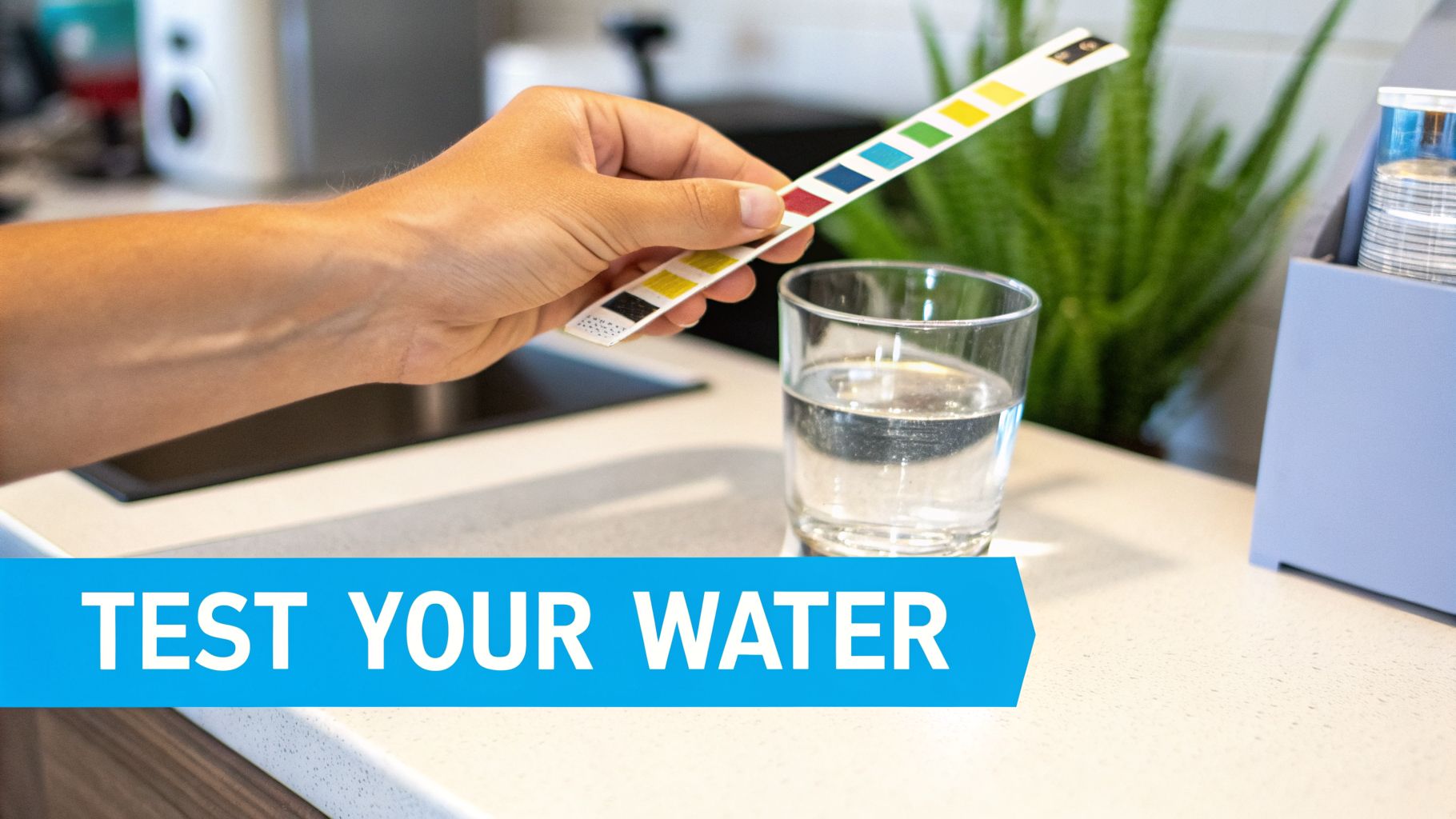
Before you even think about buying a water softener, you have to know what you’re up against. You can’t solve a problem you don’t understand. This isn't just about softening; it's about comprehensive home water filtration.
If you’re seeing stubborn white spots on your faucets and shower doors, that’s a dead giveaway you have hard water. Those crusty deposits are limescale, and they’re a pain. We’ve even got a great guide on understanding and removing hard water stains if you want to tackle the mess you already have.
But what you can see is only half the story. To choose the right equipment, you need real data. Buying a water softener without testing your water is like getting a prescription without seeing a doctor—you’re just guessing.
DIY Testing vs. Professional Lab Analysis
You’ve got two main options for figuring out your water's chemistry: a quick DIY test or a full professional lab analysis.
DIY Water Test Kits are the fast and cheap route.
- You can grab these simple test strips or liquid drop kits at any home improvement store.
- They give you an immediate, ballpark reading of your water hardness, and sometimes chlorine and pH.
- The big downside? They aren't always super accurate and won't tell you about other critical issues like iron or manganese that can destroy a softener.
Professional Lab Analysis is the gold standard.
- You simply collect a sample from your tap and mail it to a certified lab.
- In return, you get a highly accurate and detailed report covering not just hardness but also iron, manganese, pH, total dissolved solids (TDS), and other contaminants that affect your home's water quality.
- It costs more and takes a bit longer, but the information is priceless.
For anyone on well water, I always recommend a professional lab test. It's a small investment that prevents you from buying the wrong thousand-dollar system. Get it right the first time.
Demystifying Your Water Test Results
Once you have your results, a few key numbers will jump out at you. This is where you get the exact information needed to size your whole-house filtration system correctly.
The most important number is your water hardness. It’s usually measured in one of two ways:
- Grains Per Gallon (GPG): This is what the water softener industry uses in the U.S. It’s the number you’ll need to do your calculations.
- Parts Per Million (PPM) or Milligrams per Liter (mg/L): These two are the same thing and are common on lab reports.
Converting is simple. Just divide your PPM number by 17.1 to get your GPG.
Let's say your lab report shows 200 PPM of hardness.
200 PPM / 17.1 = 11.7 GPG
That 11.7 GPG tells you your water is officially "very hard," and it's the exact figure you'll use to size your system.
But don’t stop at hardness. Look for other troublemakers, especially iron. If your report shows iron levels at or above 0.3 PPM, a standard softener is going to struggle. The iron will foul the resin beads, choking the system and drastically shortening its life. In that case, you’ll need to look at either a dedicated iron filter or a softener specifically built to handle high iron—a true multi-stage water filtration approach.
Sizing Your Water Softener: How to Get It Just Right
Choosing the right size water softener is a lot more than just a guess. Get it wrong, and you're in for some frustration. This is the heart of effective home water filtration.
A system that’s too small is a classic rookie mistake. It will struggle to keep up, constantly running regeneration cycles and still leaving you with hard water when you need soft water the most. On the flip side, an oversized unit is just plain wasteful. It will burn through salt and water, regenerating long before it needs to.
So, how do you find that perfect fit? It’s not about how big your house is or even just how many bathrooms you have. The key is calculating your household's actual daily softening needs based on your water hardness and how much water your family uses.
The Only Formula You Need
Let’s get right to it. There's a straightforward bit of math that will give you the most critical number for choosing a softener: the total grains of hardness your system needs to remove each week.
Here's the formula:
(# of People in Home) x (Daily Gallons Per Person) x (Your Water Hardness in GPG) x (7 Days)
This calculation gives you your weekly hardness load, which is the number you’ll use to match with a softener's grain capacity.
What Goes Into the Calculation
To use this formula, you just need to plug in three numbers.
Number of People: Simple enough. Just count everyone living in your home.
Daily Water Use: This one requires a good estimate. While everyone's habits are different, the industry standard for these calculations is 75 to 80 gallons per person per day. This figure covers everything from showers and laundry to flushing toilets and washing dishes.
Water Hardness (GPG): This is the number you got from your water test. It tells you exactly how much mineral content the softener has to tackle in every gallon.
Once you have those figures, you're ready to calculate the grain capacity your home demands. An incorrectly sized system can lead to real waste—an oversized unit might use 25% more water and salt than necessary, while an undersized one will leave you with hard water. If you want to dive deeper into system features, Whirlpool Water Solutions has a great guide on what to look for.
The Bottom Line: Sizing a softener isn't guesswork. It's about matching the machine's capacity to your home's specific demand, which is a direct product of your family's size and your water's mineral content.
A Real-World Example
Let's walk through a quick scenario to see how this plays out.
Imagine a family of four whose water test came back at 15 GPG—moderately hard.
First, we find their total daily water use:
- 4 people x 75 gallons/person = 300 gallons per day
Next, we calculate the daily hardness load:
- 300 gallons x 15 GPG = 4,500 grains of hardness per day
Finally, we find the weekly requirement:
- 4,500 grains/day x 7 days = 31,500 grains per week
For this family, a softener needs to remove at least 31,500 grains of hardness between regeneration cycles.
This makes a 32,000-grain capacity water softener the ideal choice. It's perfectly matched to handle a full week's worth of water before it needs to regenerate, making it incredibly efficient.
What happens if they choose poorly? A smaller, 24,000-grain unit would be forced to regenerate more frequently, wasting salt and water. A huge 48,000-grain system would be overkill, going too long between cycles, which can be inefficient and lead to other problems. The 32,000-grain system hits that sweet spot for consistent performance and optimal efficiency.
Comparing Water Softener Technologies
When you start shopping, you'll quickly realize the term "water softener" gets thrown around a lot. But not all of these home water filtration systems are created equal. The technology inside can be wildly different, and that's where a lot of homeowners get tripped up.
You're really looking at two main camps: salt-based ion exchange softeners and salt-free water conditioners. They approach hard water from completely different angles. Getting the results you want—whether it's silky-smooth water or just protecting your pipes—starts with understanding this fundamental difference.
The Classic: Salt-Based Ion Exchange Softeners
This is the tried-and-true method, the only technology that actually removes the hard minerals from your water. If you want truly soft water, an ion exchange system is the undisputed champion of home water filtration.
Think of it like this: the system's main tank is filled with tiny resin beads that are loaded with sodium ions. As your hard water passes through, the calcium and magnesium—the culprits behind scale and soap scum—get pulled out of the water and stick to the resin. In their place, a sodium ion is released. It's a simple, effective trade.
The end result? Genuinely soft water. It’s what gives you that signature "slick" feel in the shower, makes your soap and shampoo lather up like crazy, and stops scale in its tracks.
Of course, there's a trade-off. Eventually, that resin fills up with hard minerals and needs to be cleaned. That’s the regeneration cycle, where a saltwater brine solution washes the resin, sending all the collected minerals down the drain. This means you’ll have the ongoing task of adding salt to the brine tank and it will use some extra water.
The Low-Maintenance Option: Salt-Free Conditioners
Here’s where we need to be really clear. A salt-free conditioner is not a water softener. A better name for it is a scale-reduction system. It's a different kind of water filtration hero.
These systems use a fascinating technology called Template Assisted Crystallization (TAC). Instead of removing the calcium and magnesium, the TAC media changes their structure. It acts as a template that forces the mineral ions to form into tiny, harmless micro-crystals.
These little crystals are inert and won't stick to anything. They flow right through your plumbing without building up as scale on your pipes, faucets, or hot water heater element.
The key takeaway is this: the minerals are still in your water. A TAC system just crystallizes them so they can’t cause scale damage. You won’t get the slick feel or sudsing benefits of soft water, but you get powerful scale protection.
The big win for salt-free conditioners is that they are completely passive. Set it and forget it. No salt bags to haul, no electricity to run a control valve, and no wastewater from regeneration. They’re a fantastic choice for anyone who wants a zero-maintenance water filtration solution or lives in an area where salt-based softeners are banned.
This flowchart can help you visualize how your home’s specific needs line up with the right system size and type.
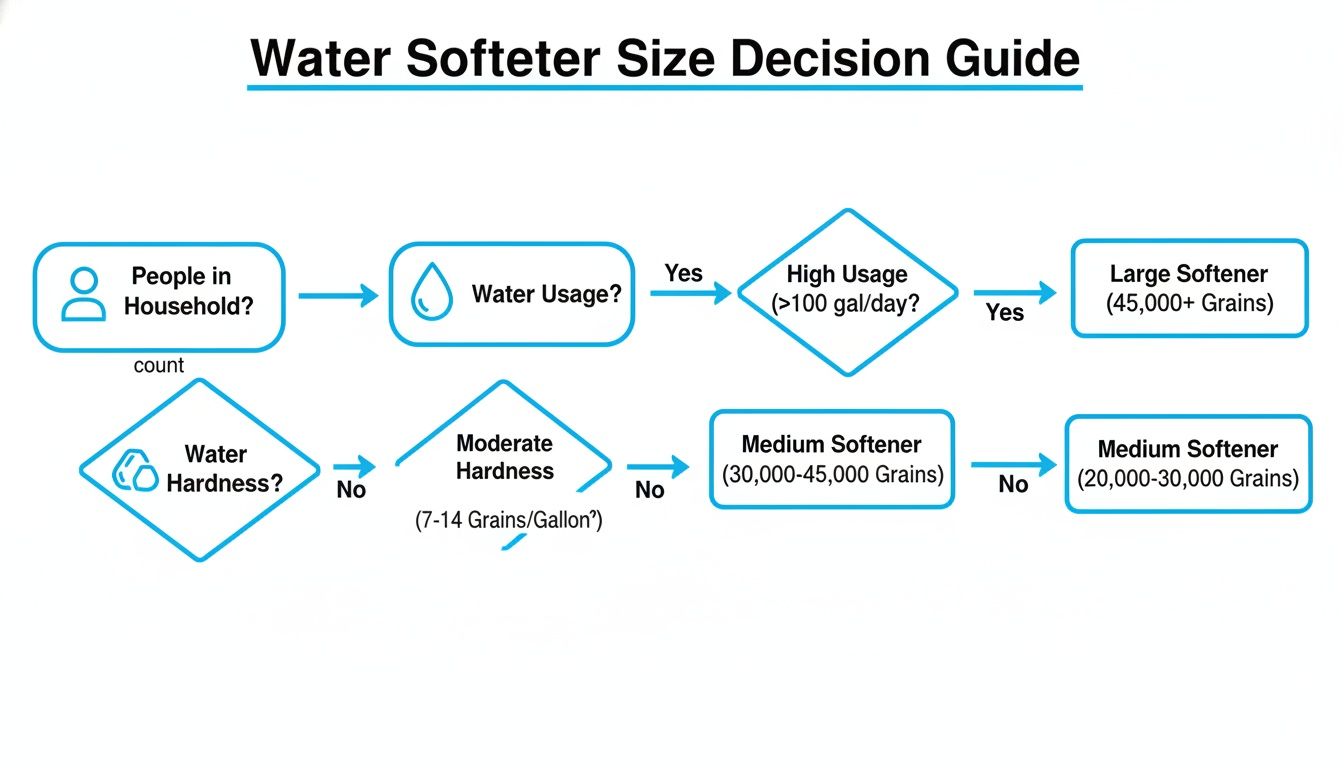
Simply trace your path from household size and water hardness, and it will point you toward the right capacity for your home.
Water Softener vs. Water Conditioner Comparison
To make the choice even clearer, let's put these two water filtration technologies side-by-side. This table breaks down exactly what you get (and what you don't) with each system.
| Feature | Salt-Based Ion Exchange Softener | Salt-Free Water Conditioner (TAC) |
|---|---|---|
| Primary Function | Removes hard minerals (calcium & magnesium) from water. | Conditions minerals to prevent scale buildup; does not remove them. |
| Resulting Water | Genuinely soft water. You'll feel the "slickness" and see better lather. | Water with scale-causing potential neutralized. Minerals remain present. |
| Scale Prevention | 100% scale elimination by removing the source minerals. | Excellent scale prevention (up to 99%) on pipes and appliances. |
| Maintenance | Requires you to add salt regularly. Uses water and electricity for regeneration. | Virtually zero maintenance. No salt, no electricity, no wastewater. |
| Ongoing Costs | Salt bags, water for regeneration, minor electricity use. | No ongoing operational costs. Media may need replacement every 3-6 years. |
| Best For | Homeowners who want all benefits of soft water (softer skin, less soap, no scale). | Homeowners focused on protecting plumbing and appliances with a hands-off system. |
| Environmental Impact | Discharges salt brine (chloride) into wastewater systems. | No environmental impact; adds nothing to the water and produces no waste. |
Ultimately, choosing between a salt-based softener and a salt-free conditioner comes down to your primary goal. One isn't better than the other—they just do different jobs.
So, Which Technology Is Right For You?
It really boils down to what you want to achieve with your water treatment.
Go with a Salt-Based Softener if: You want the full soft-water experience. We're talking no more scale, using less soap, having brighter clothes, and feeling that difference on your skin and hair. You're okay with the simple task of adding salt every few months.
Go with a Salt-Free Conditioner if: Your number one priority is protecting your home's pipes and expensive appliances from scale damage. You want a system you can install and forget about, and you don't mind that the minerals technically remain in the water. This is also your only option if your local municipality has put a ban on brine discharge.
Both are great home water filtration technologies. The secret is simply matching the right tool to your specific job.
Don't Forget the Long-Term Costs
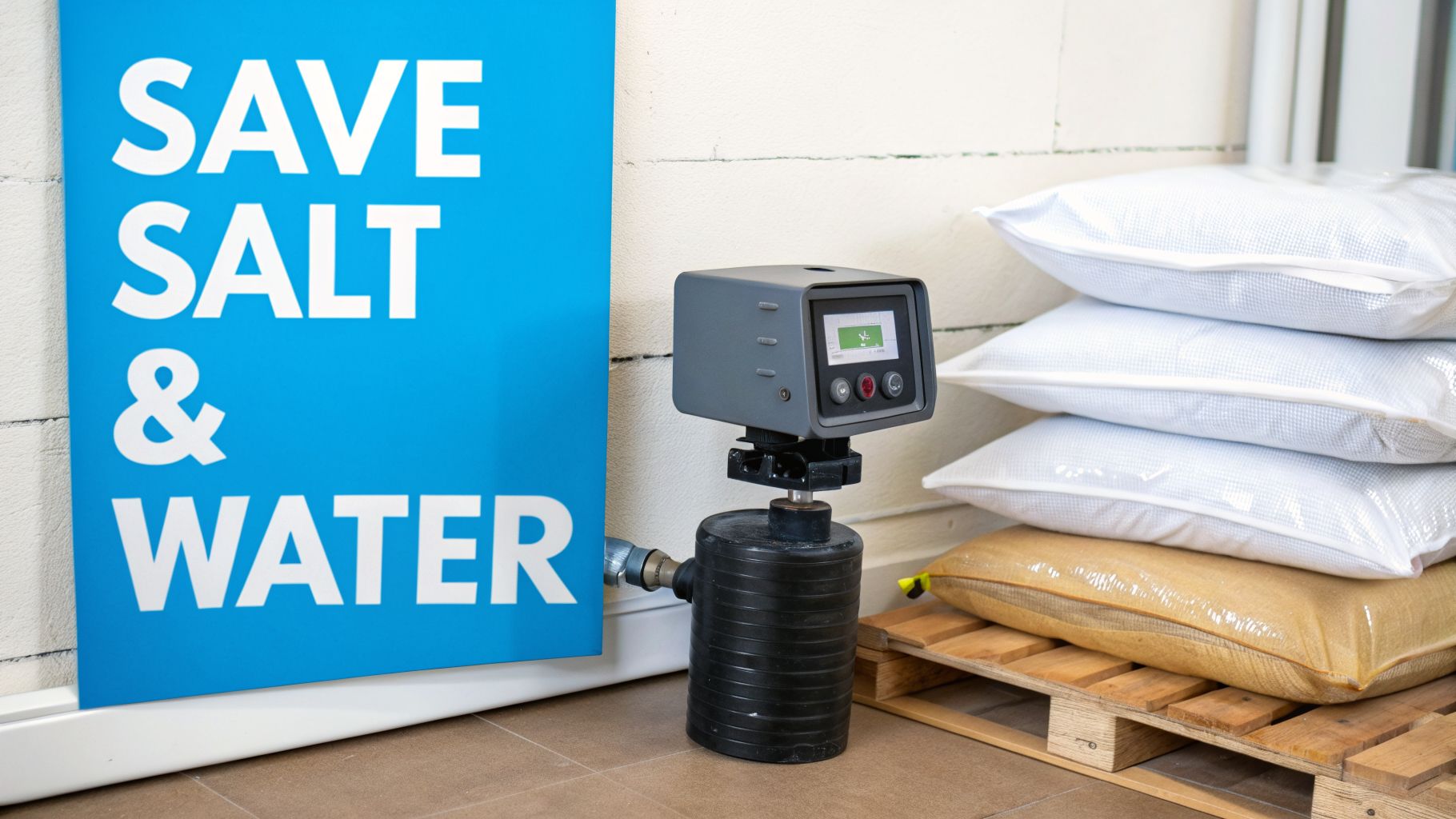
When you’re shopping for a whole-house water filter, it’s easy to get tunnel vision on the price tag. But the real cost? That shows up on your utility bills and in your salt purchases for years to come. How much salt, water, and electricity a system uses over its lifetime is what really determines its value.
All of these ongoing costs come down to one critical process: regeneration. This is how a salt-based system cleans and “recharges” itself, and understanding the different ways they do it is the key to not getting stuck with a resource-guzzling machine.
Smart Regeneration vs. Outdated Timers
Think of it like this: some systems are smart, and some are… well, not. The old-school approach is a timer-based softener. It’s a simple concept—the softener regenerates on a fixed schedule, like every three days at 2 AM, no matter what.
- Timer-Based Systems: These are often cheaper upfront, but they’re incredibly wasteful. If you go on vacation, it regenerates anyway, wasting salt and water. If you have a house full of guests, it might not regenerate soon enough, leaving you with hard water when you need soft water most.
The modern, and much smarter, approach is a demand-initiated (or metered) softener. This type of system has a small water meter inside that tracks your actual water usage. It only triggers a regeneration cycle when it knows the resin beads are almost saturated.
- Demand-Initiated Systems: This “on-demand” method is the only way to go in 2026. It adapts to your household’s unique rhythm, preventing needless regeneration cycles and saving a ton of salt and water in the process.
Choosing the right regeneration style can slash your running costs by up to 50%. A metered system regenerates only when needed, saving 30-40% on salt compared to an old timer model. For a typical family, that can cut annual salt use from 200-300 lbs down to a much more manageable 100-150 lbs.
What About Water Pressure? Don't Underestimate Flow Rate
We’ve all experienced it: you're in the shower, someone flushes a toilet, and the water pressure suddenly vanishes. A water softener that's too small for your home can create that same annoying problem, but for every faucet. That's where flow rate becomes a huge deal.
Measured in Gallons Per Minute (GPM), flow rate tells you how much softened water the system can deliver at any given moment. To avoid pressure drops, you need a softener that can keep up with your family’s peak demand.
Think about what might be running at the same time on a busy morning:
- A standard shower needs about 2.5 GPM.
- A dishwasher running a cycle uses 2 GPM.
- Your washing machine could be pulling 3-4 GPM.
If you've got a couple of those going at once, you’re already at 7 GPM or more. For a typical 3-4 bathroom home, I always recommend looking for a system with a flow rate of at least 10-12 GPM. You can find this number, usually called the "service flow rate," on the manufacturer’s spec sheet. Don't skip checking it.
Look for Independent Proof of Performance
With so many brands making big claims, how can you be sure a softener actually does what it says? You look for a third-party certification seal.
The most important one by far is NSF/ANSI 44. This is the gold standard for whole-house water filtration. It’s an independent certification that proves the softener has been rigorously tested to meet specific performance criteria. An NSF/ANSI 44 certification tells you three crucial things:
- The system truly reduces water hardness to the level it claims.
- It is built with materials that are safe for contact with your drinking water.
- The manufacturer's salt and water efficiency ratings are accurate and verified.
Getting a certified system is your best insurance against slick marketing and poor performance. And while you're focused on efficiency, remember that the softener is just one part of your home. To find more ways to lower your utility bills, check out these practical energy efficiency tips that can lead to significant savings across the board.
Frequently Asked Questions on Water Softeners
Common questions about home water filtration and softeners. Get clear answers to help you choose a system with confidence.
How Much Sodium Does a Water Softener Add?
The amount of sodium added depends directly on your water’s hardness level. It's often less than people think.
For water with a hardness of 10 Grains Per Gallon (GPG), the softening process adds about 75 milligrams (mg) of sodium per quart. For comparison, one slice of white bread can have over 150 mg of sodium.
For those on a strict low-sodium diet, an under-sink reverse osmosis (RO) system is a great addition. This point-of-use filter removes the added sodium from your drinking and cooking water.
Can I Install a Water Softener Myself?
Yes, if you have solid plumbing skills. A DIY installation is possible if you can confidently cut into pipes and follow detailed instructions. Most modern units can be installed in several hours.
The critical step is cutting into your home's main water supply line. If you are not comfortable with this, hire a professional plumber. A professional install guarantees it is leak-free, meets local codes, and functions correctly. A pro installation typically costs between $400 and $800.
What Kind of Salt Should I Use?
You will find two main types of salt for water softeners:
- Solar Salt: Created from evaporated seawater. It is less expensive but may contain insolubles that can build up in the brine tank over time.
- Evaporated Salt: A much purer salt, often 99.9% pure. This is the cleanest option, reducing the risk of "salt bridging" or "mushing" in the tank.
Evaporated salt pellets are recommended for most high-efficiency softeners. They dissolve cleanly and help your system run with less maintenance.
How Long Does a Water Softener Last?
A quality, well-maintained salt-based water softener should last 10 to 20 years.
The lifespan of this whole-house water filter is determined by the control valve and resin tank quality. The resin beads inside the tank, which perform the softening, generally need replacement every 10 to 15 years. High iron or chlorine levels in your water can shorten the resin's life. Salt-free conditioners have a similar lifespan, though their media often requires replacement every 3 to 6 years.
Will a Water Softener Reduce My Water Pressure?
A correctly sized water softener will not cause a noticeable drop in your water pressure. If you experience pressure loss, the system is likely too small for your home's water demand.
Check the flow rate, measured in Gallons Per Minute (GPM), before buying. This indicates how much softened water the system can produce at once. A typical home needs a flow rate of at least 10-12 GPM to support a shower and dishwasher running at the same time. Always confirm the "service flow rate" on the unit’s specifications.
Ready for soft water? Water Filter Advisor provides in-depth reviews and maintenance information. We help you find the perfect water filtration system for your home. Explore our guides at https://www.waterfilteradvisor.com to get started.
- April 5, 2026
- Uncategorized
