Ultimate Guide to Home Water Softeners

You unload the dishwasher, hold up a “clean” wine glass, and there it is again. Chalky spotting. The towels feel a little stiff. Your shower leaves your skin tight instead of refreshed. The faucet keeps growing a white crust no matter how often you wipe it down.

Those little annoyances usually point to one thing. Hard water.

Your Battle Against Hard Water Annoyances Ends Here

A lot of homeowners live with hard water for years before they realize it isn’t just “how water is.” They assume cloudy glasses are a dishwasher problem. They blame dry skin on weather. They think the crust around the showerhead is just normal wear.

It’s not.

Hard water carries extra calcium and magnesium, and those minerals leave traces behind everywhere water goes. That means your dishes, your fixtures, your water heater, your laundry, and your skin all feel the effect.

Several clean wine glasses sitting on a drying rack next to a stack of soft white towels.

This is a widespread household problem, not a niche one. Over 85% of American homes contend with hard water containing high levels of calcium and magnesium, according to All American Plumbing Services.

What hard water feels like in daily life

Some signs are obvious. Others sneak up on you.

  • On dishes and glassware you’ll see spots, haze, or a filmy look that survives the wash cycle.
  • In the bathroom soap scum sticks harder to tile, glass, and fixtures.
  • On your body skin can feel dry, and hair can feel heavier or rougher after rinsing.
  • In the laundry clothes may feel less soft than they should.
  • Inside the house appliances and plumbing slowly collect mineral scale.

Hard water doesn’t just make cleaning harder. It leaves mineral residue behind every time water dries.

Why home water softeners matter

A water softener isn’t mainly about making water feel fancy. It’s about changing the outcome of everyday water use.

When a softener removes hardness minerals, soap rinses better. Glassware dries cleaner. Fixtures stay cleaner longer. Water-using appliances don’t have to fight as much scale buildup.

That’s the “so what?” behind home water softeners. You’re not buying a tank because tanks are exciting. You’re buying fewer headaches at the sink, in the shower, and around the house.

If you’ve been wrestling with the same hard water annoyances week after week, this is the fix that addresses the cause instead of the symptoms.

The Science of How Water Softeners Work

The core idea is simple. Hard water contains dissolved minerals. A softener removes the minerals that cause the trouble.

That sounds technical, but the process is easier to picture than many expect.

What makes water hard

Water hardness is mostly about calcium and magnesium. As water moves through the ground, it picks up these minerals. By the time it reaches your home, those minerals are still riding along.

Hardness is measured in grains per gallon, often shortened to GPG. Water with hardness levels over 10.5 GPG can cause severe scale buildup and can reduce water heater efficiency by up to 48%, according to Liberty Home Guard.

That’s why hard water becomes more than a cosmetic issue. It’s not only the white crust on the faucet. It’s the invisible buildup inside equipment too.

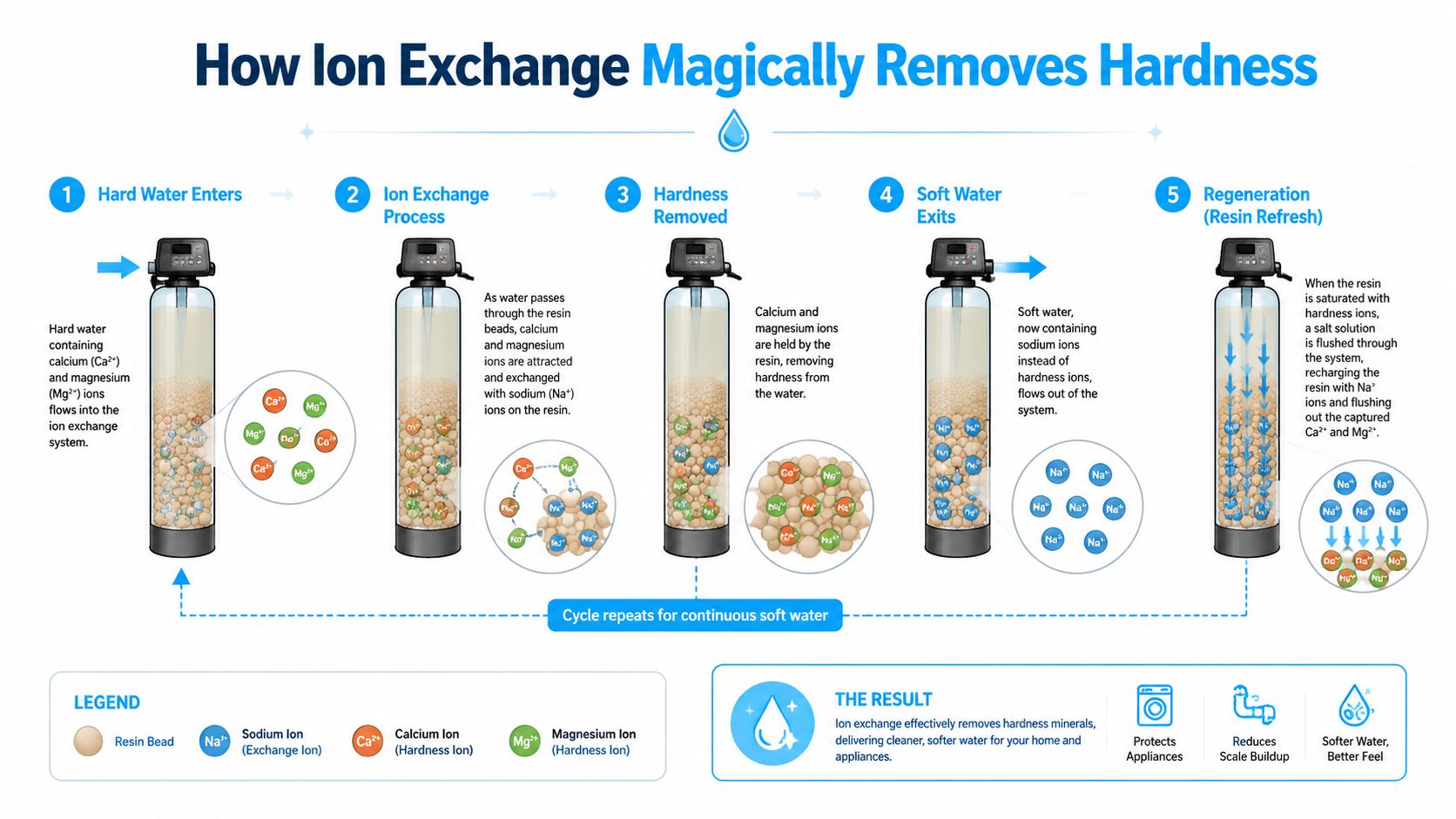
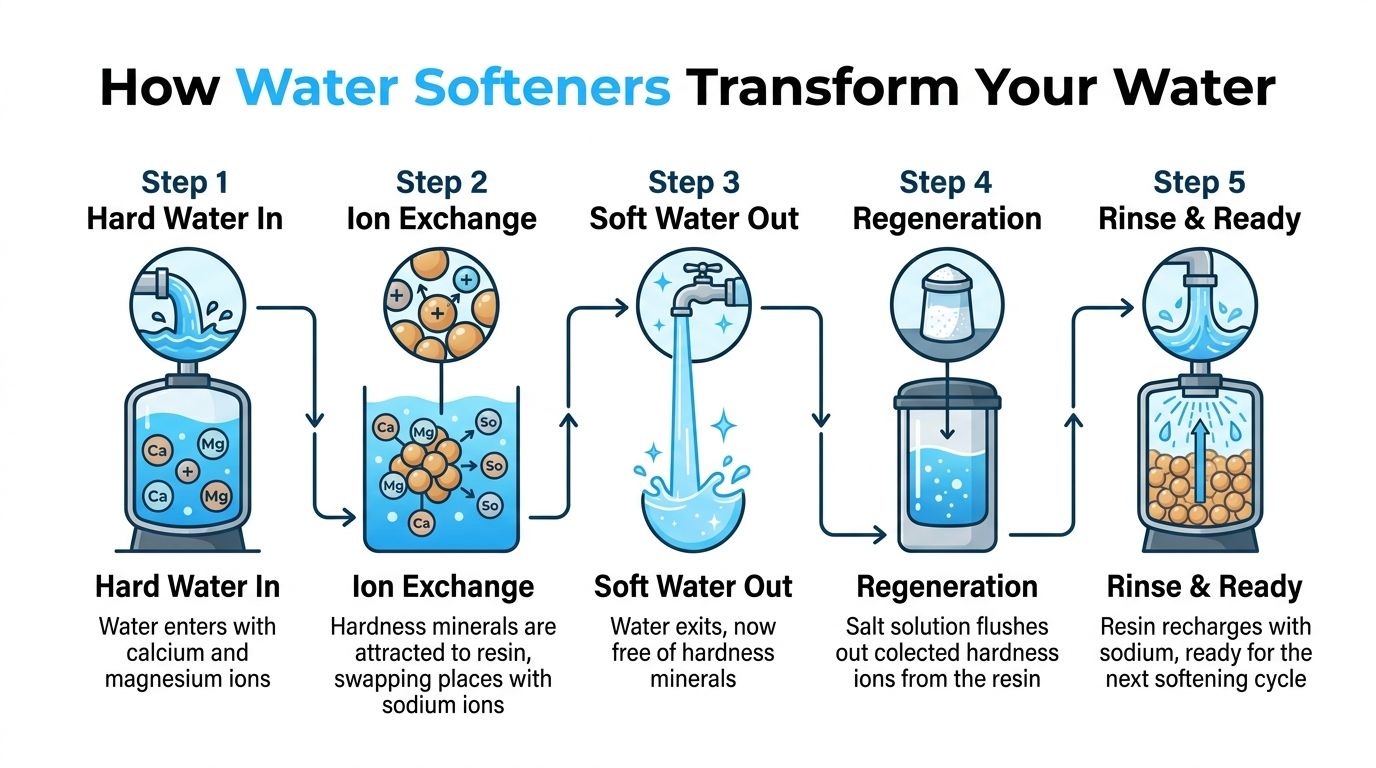
A five-step diagram showing the process of how home water softeners remove minerals to soften water.

Ion exchange in plain English

Most home water softeners use ion exchange.

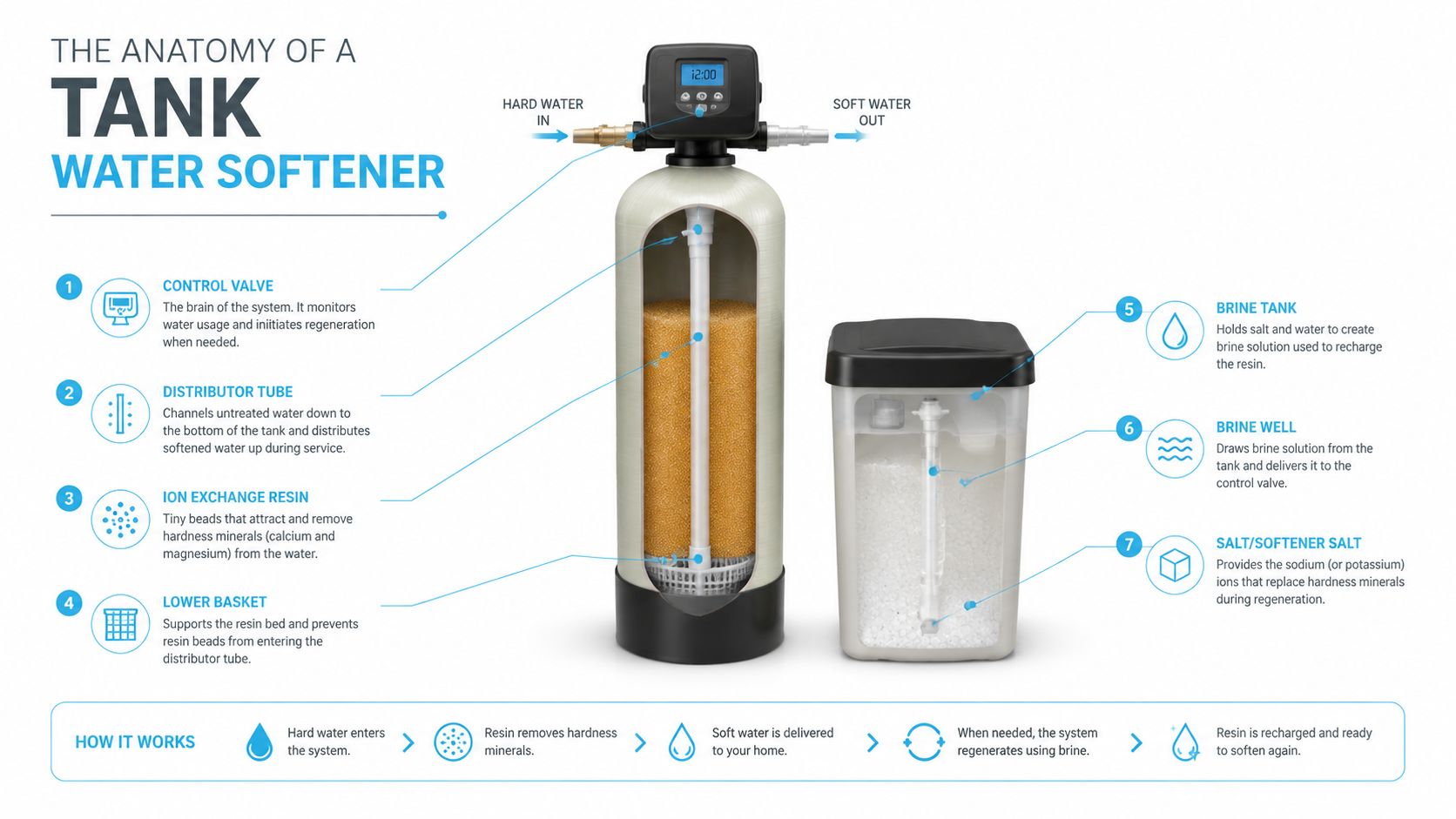
Think of the resin tank like a nightclub with a strict bouncer. Calcium and magnesium walk up to the door. The resin beads inside the tank are set up to grab those hardness minerals and swap them for something else, usually sodium or potassium ions.

The hard minerals get stopped at the door. The softer ions take their place in the water.

That swap is the whole trick.

Here’s the cleaner version of the science. Negatively charged resin beads attract and bind positively charged calcium and magnesium ions. In exchange, the softener releases sodium or potassium ions into the water. The minerals causing hardness stay in the tank until the system cleans itself out.

What comes out of the faucet

After ion exchange, the water isn’t stripped down to nothing. It’s missing the main minerals that create hardness problems.

That changes how water behaves:

  • Soap lathers more easily
  • Rinsing is cleaner
  • Mineral spotting drops
  • Scale buildup slows down

People often confuse “softened” with “filtered.” They’re not the same thing.

A water softener focuses on hardness minerals. It doesn’t do the full job of a drinking water filter that targets taste, odor, chlorine, sediment, or other contaminants. In many homes, people pair softening with filtration because each solves a different problem.

Why regeneration matters

A resin bed can’t grab hardness minerals forever. Eventually, it fills up.

When that happens, the system runs a regeneration cycle. It flushes the resin with brine so the resin can release the captured calcium and magnesium and recharge itself with sodium or potassium again.

If ion exchange is the bouncer, regeneration is the cleanup crew resetting the room for the next shift.

Practical rule: A softener that regenerates efficiently usually saves you hassle over time because it wastes less water and less salt while keeping the resin ready to work.

The main alternative you’ll hear about

Not every system marketed in this category is a traditional softener.

Some homeowners look at salt-free conditioners, often built around a process that changes how minerals behave rather than removing them. The key distinction is important. A salt-free system may help reduce scale formation, but it does not remove calcium and magnesium through ion exchange.

That means the minerals are still in the water.

For some households, that’s acceptable. For others, especially homes with clearly stubborn hard water symptoms, it won’t deliver the same daily feel or appliance protection as an ion-exchange softener.

Where readers usually get confused

The most common mix-up is this:

Question Short answer
Does a softener filter water? Not in the same way a dedicated filter does
Does salt go directly into my tap water? The system uses salt to regenerate the resin
Does soft water contain zero minerals? No, but the hardness-causing minerals are removed through exchange
Are all anti-scale systems true softeners? No

If you remember one thing, remember this: home water softeners remove hardness minerals through ion exchange. Everything else, from smoother-feeling water to cleaner dishes, follows from that one process.

Choosing Your Ideal Home Water Softener System

Shopping for home water softeners gets confusing fast because different products solve different versions of the problem.

One system removes hardness minerals. Another mainly helps control scale. One unit protects the whole house. Another only treats a shower or sink. And then there’s the control valve, which sounds boring until it affects how much salt and water you use for years.

Salt-based versus salt-free

This is the first big fork in the road.

A salt-based water softener uses ion exchange. It removes hardness minerals. A salt-free conditioner changes mineral behavior to reduce scaling but doesn’t remove those minerals in the same way.

Here’s the side-by-side view.

Feature Salt-Based Water Softener Salt-Free Water Conditioner
Primary job Removes hardness minerals through ion exchange Conditions minerals to help reduce scale
Best fit Homes with clear hard water symptoms and stubborn scale Homes seeking lower-maintenance scale control
Water feel Usually gives the classic soft-water feel people expect Doesn’t usually create the same softened feel
Maintenance Needs salt or potassium replenishment Usually lower routine involvement
Drinking water concern May raise sodium content, which matters for some households Avoids that specific sodium issue
Very hard water performance Better choice when hardness is severe Often less satisfying when hardness is strong
Bottom line Best when you want true softening Best when you mainly want scale management

The “best” option depends on your goal.

If your main complaints are rough laundry, mineral spots, soap scum, and scale buildup, a true softener is usually the more direct answer. If you mainly want a lower-maintenance approach and your water issues are milder, a salt-free conditioner may be worth considering.

Whole-house or point-of-use

The next decision is about coverage.

Whole-house systems treat water as it enters the home. That means showers, sinks, water heater, laundry, and appliances all benefit.

Point-of-use units treat water at one location, like a shower or under-sink faucet.

A simple way to decide:

  • Choose whole-house if your problem shows up everywhere, especially on fixtures, in showers, and in appliances.
  • Choose point-of-use if you only care about one outlet and want a more limited fix.
  • Choose a combined approach if you want soft water for the house and dedicated filtration at the kitchen sink.

For homeowners comparing broader treatment setups, it can help to look at how full-home systems are packaged in practice. Resources like Halo Water Filtration systems show how softening and filtration may be combined depending on the house and the water issue.

The feature that matters more than most buyers realize

A lot of people focus on tank size and skip the controller. That’s a mistake.

Demand-initiated regeneration, often shortened to DIR, is one of the smartest upgrades you can choose. Instead of regenerating on a fixed timer whether you used water or not, a DIR system regenerates based on actual usage.

According to the EPA water softener technical sheet, DIR systems can reduce water and salt waste by 20% to 60% and extend resin life to 20+ years, compared with 10 years for timer-based systems.

That’s not an abstract spec sheet advantage. It affects daily ownership in practical ways:

  • Less waste means fewer unnecessary regeneration cycles
  • Lower routine upkeep means you’re not refilling as often for avoidable reasons
  • Longer resin life means fewer long-term headaches
  • Smarter operation means the system matches your real household pattern

If two softeners look similar on paper, the one with demand-initiated regeneration often makes more sense for long-term living.

A simple way to choose

If you’re stuck, use this decision path.

You likely want a salt-based softener if

  • Scale is heavy on fixtures, shower doors, and appliances
  • You want the soft-water feel on skin, laundry, and dishes
  • You need real hardness removal, not just scale management

A salt-free conditioner may fit if

  • You want less routine maintenance
  • Your main goal is reducing scale formation
  • You’re cautious about added sodium

Whole-house makes more sense when

  • The problem affects more than one room
  • You want to protect appliances and plumbing
  • You’re tired of treating symptoms one faucet at a time

The smartest buyers don’t ask only, “Which system is cheapest?” They ask, “Which system changes daily life the way I want?” That question leads to better choices every time.

How to Size Your System for Peak Performance

The most common water softener buying mistake isn’t choosing the wrong brand. It’s choosing the wrong size.

A too-small unit often looks fine on paper and disappoints in real life. It may keep up when one person is home, then struggle when showers, laundry, and the dishwasher overlap.

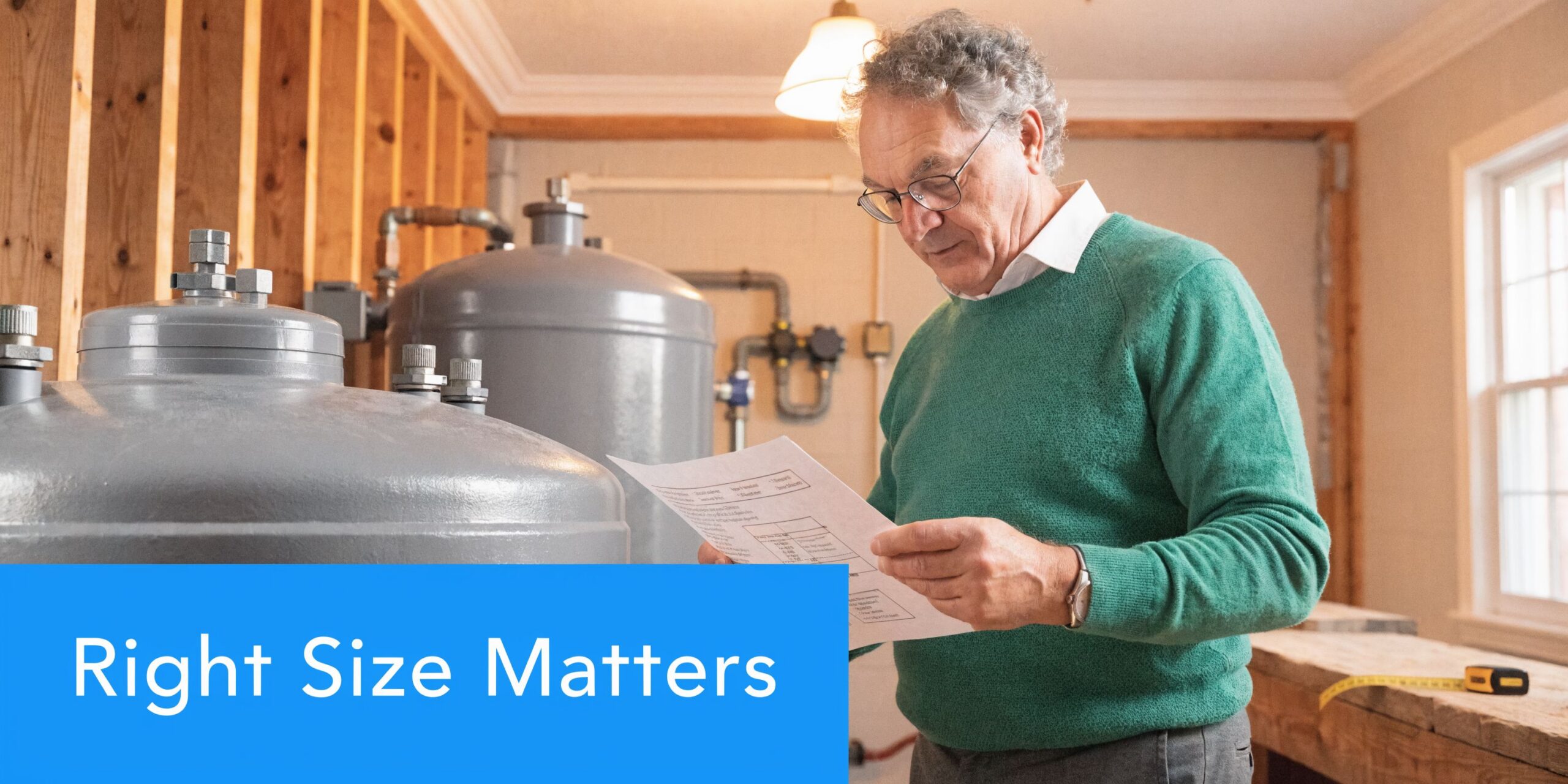
A professional man reviewing technical documents next to large industrial water tanks in a home basement.

According to Quality Water Treatment, undersized units often fail to handle peak-hour demand, and experts recommend matching both grain capacity and flow rate. They note examples of 32,000 to 48,000 grain systems for a 4-person home, while multiple simultaneous uses can require 10 to 15 GPM to avoid pressure drops.

The two numbers that matter most

You need more than a vague estimate.

Start with:

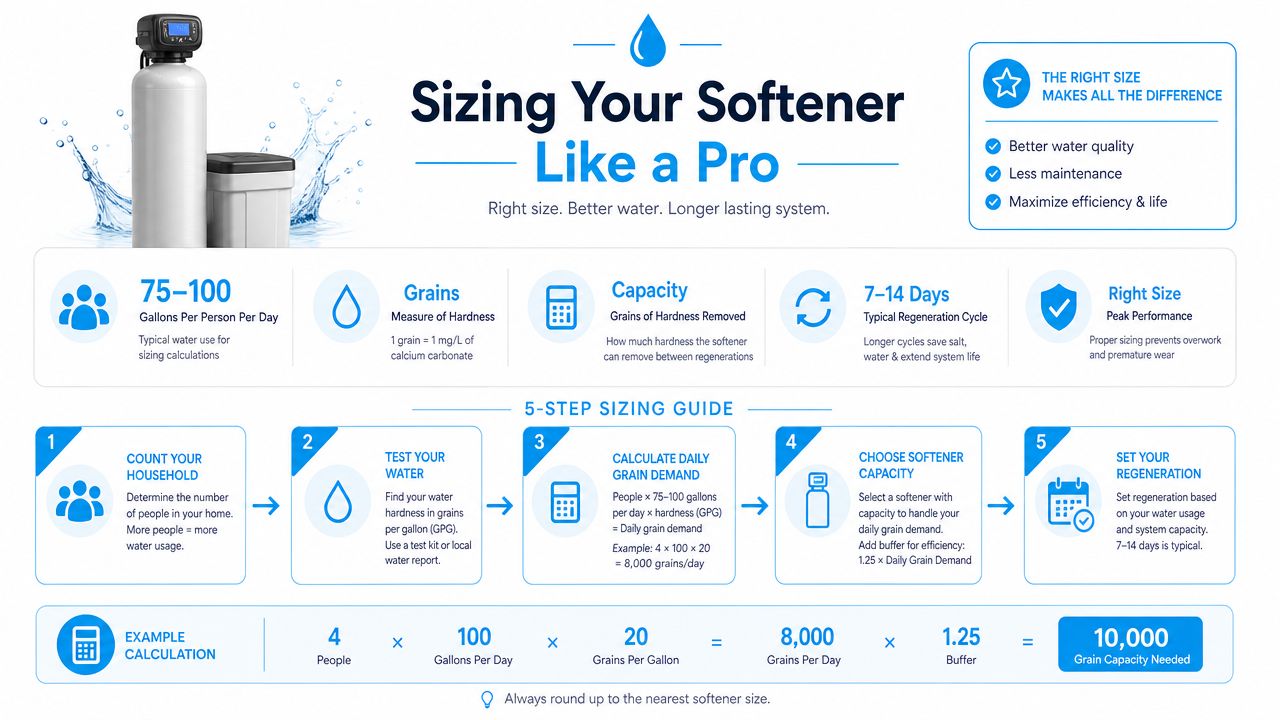
  1. Your water hardness
  2. Your household water demand

Hardness is measured in GPG. Your water supplier may provide it, or a local water test can confirm it. Household demand means how much water your household uses in normal life, especially during busy periods.

A family that uses water in staggered ways has different needs than a family that stacks everything into the same hour every morning.

Grain capacity and flow rate are not the same thing

People often get tripped up here.

Grain capacity tells you how much hardness the unit can remove before regeneration.

Flow rate tells you how much water it can move without becoming a bottleneck.

You need both.

A softener can have enough capacity for the week and still perform poorly if it can’t keep up during peak use. That’s when homeowners say things like, “We bought a system, but the water still seems hard when everyone’s home.”

A practical sizing mindset

Think about your home at its busiest, not at its average.

Ask yourself:

  • Morning rush Are two showers likely to run while someone starts laundry?
  • Kitchen overlap Does the dishwasher often run near dinner while sinks are in use?
  • Appliance protection Do you want the softener to protect the whole house, not just survive light usage?

Buy for your busiest realistic hour, not your quietest weekday afternoon.

A decent sizing conversation should include the number of people in the home, your tested hardness, and whether your house has high simultaneous water use.

Watch this before you compare models

A quick visual walkthrough can make sizing much easier to understand.

What happens when the softener is undersized

The symptoms can be sneaky.

  • Hard water slips through during busy periods
  • Regeneration happens too often, which can wear on the system
  • Water pressure may suffer when too many fixtures run at once
  • Scale and soap scum return, making you wonder why you invested at all

The right size doesn’t feel dramatic. That’s the point. It keeps up.

When home water softeners are properly sized, you stop thinking about them. Your showers feel consistent. Your dishes dry cleaner. Your appliances get the protection you paid for.

Installation and Long-Term Maintenance Explained

Once you’ve picked the right system, the next question is practical. Where does it go, how does it connect, and what will you need to do after it’s installed?

For most whole-house setups, the softener is installed where water enters the home so it can treat the water supply before it reaches fixtures and appliances. That usually means a basement, garage, utility room, or another service area with drain access and enough room for the mineral tank and brine tank.

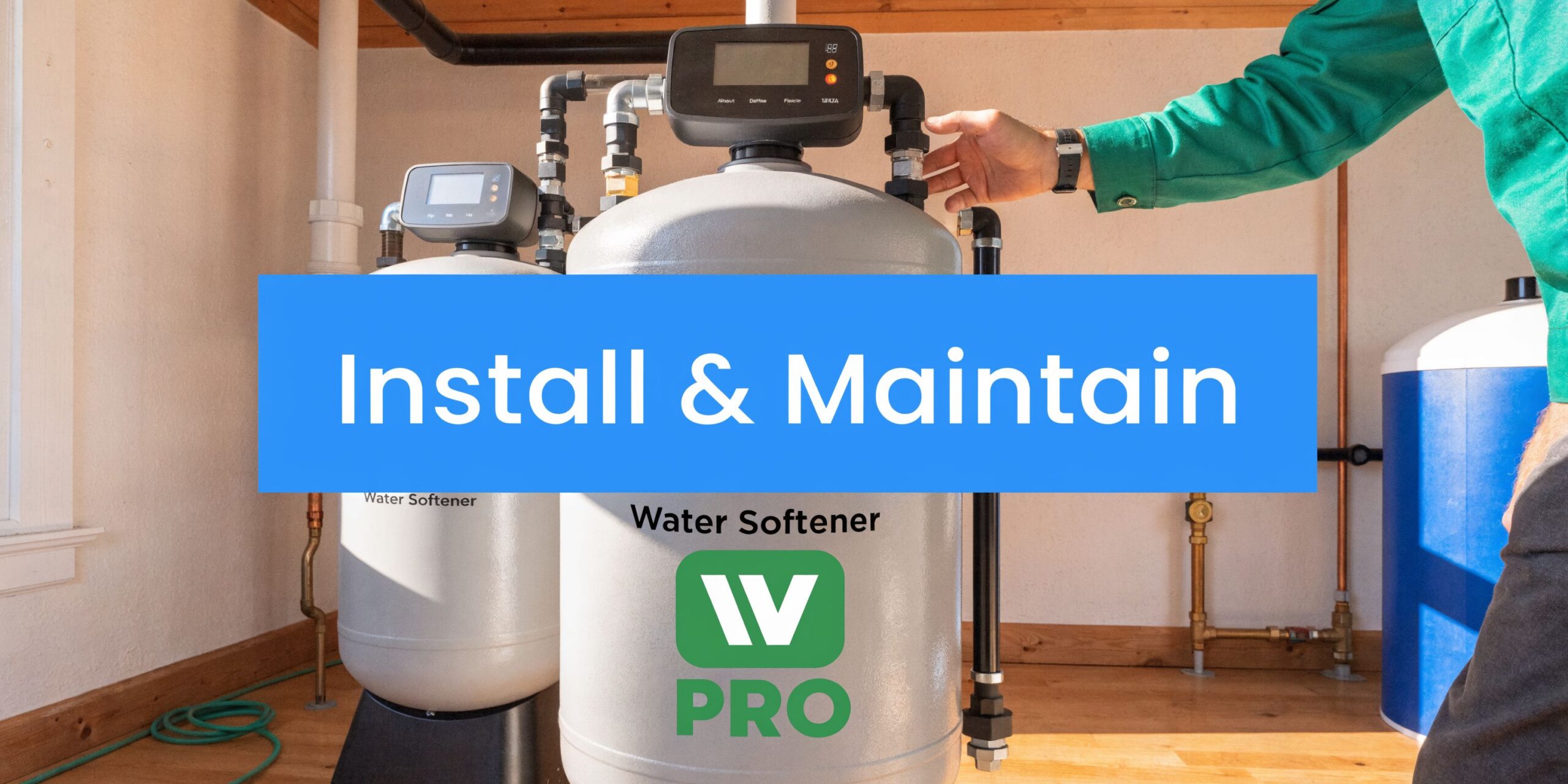
A professional technician installing and maintaining home water softener systems in a residential basement utility room.

What a typical installation includes

A whole-house installation usually involves:

  • Main line connection so incoming water passes through the system
  • Bypass valve setup so you can isolate the unit for service
  • Drain connection for regeneration discharge
  • Brine tank placement where you can refill salt or potassium easily

If your setup includes additional storage or related plumbing components, it helps to understand tank installation basics too. A practical reference on how to properly install a polyethylene tank can be useful when reviewing broader water system layouts.

DIY or hire a pro

Some homeowners can handle installation if they’re comfortable cutting into plumbing, managing shutoffs, and confirming drain requirements. Others are better off hiring a professional, especially if the space is tight, older plumbing is involved, or local code requirements are unfamiliar.

A good rule of thumb is simple. If you’re already nervous about modifying the main water line, this isn’t the place to learn by trial and error.

The maintenance most owners do

Most of the time, ownership is straightforward.

For a salt-based system, the regular job is checking the brine tank and refilling the salt or potassium when needed. That’s the task people remember.

The task people forget is keeping an eye on whether the salt is available to the system. Sometimes a crust forms in the tank and creates a salt bridge, which leaves salt in the tank but prevents proper use.

The maintenance people skip until there’s a problem

Home water softeners don’t need constant fussing, but they do need attention now and then.

Keep an eye on these basics

  • Salt level Don’t wait until the tank is empty.
  • Brine tank condition Break up bridging if the salt has hardened into a crust.
  • Bypass position Make sure nobody accidentally left the unit bypassed after service.
  • Performance signs If spotting and soap scum return, check the system before blaming your dishwasher.

A softener can look fine from the outside and still need a simple fix like salt replenishment or clearing a bridge in the brine tank.

What about resin life

The resin inside the mineral tank doesn’t last forever. Over time, it wears down or loses effectiveness. If your system gets older and performance drops even after normal maintenance, resin may be part of the conversation.

That isn’t usually a frequent task, but it’s part of long-term ownership.

What good maintenance feels like

A well-kept softener is boring in the best possible way.

You refill media as needed. You notice problems early. You don’t wait for scale to return all over the bathroom before checking the system. And because the unit stays in shape, your home keeps getting the practical benefits you bought it for.

Health Environmental and Lifetime Cost Considerations

A water softener solves one household problem while raising a few fair questions. People want to know what happens to the water they drink, what regeneration sends down the drain, and whether long-term ownership still makes financial sense after the purchase.

Those are the right questions.

The sodium question

For many households, softened water is fine for general use. But some people need to pay closer attention.

According to the Minnesota Department of Health, softened water can add 10 to 30 mg/L of sodium, which can matter for people with hypertension or households following low-sodium diets.

That doesn’t mean everyone should avoid salt-based softeners. It means some households should plan around the issue.

Practical ways to reduce sodium concerns

The good news is that you have options.

  • Use an unsoftened tap for drinking and cooking This is one of the simplest solutions.
  • Ask your doctor if sodium is a concern That matters most if someone in the home has a medical reason to monitor intake closely.
  • Use potassium chloride instead of sodium chloride This reduces the sodium issue, though some owners find it behaves differently in the tank.

Some households soften water for bathing and appliances but keep one kitchen tap unsoftened for drinking and cooking. That setup gives you the mechanical benefits without making every glass of water part of the tradeoff.

The environmental side

Softener ownership has an environmental footprint because regeneration produces brine discharge and uses water. That’s one reason efficiency features matter so much.

A system that regenerates based on actual need is generally a better fit than one that cycles on a blind schedule. Smarter regeneration means less avoidable waste. It also means your system is working in a way that reflects real household behavior.

Another practical choice is using a bypass for outdoor irrigation. Most homeowners don’t want softened water going to lawns or gardens if they can avoid it.

How to think about lifetime cost

A lot of buyers focus only on purchase price. That’s understandable, but it misses the bigger picture.

The true cost of home water softeners includes:

  • The system itself
  • Installation
  • Salt or potassium over time
  • Water used during regeneration
  • Routine upkeep
  • How well the system protects appliances and plumbing

A cheap unit that regenerates wastefully or struggles to keep up can cost more in frustration and upkeep than a better-designed model. A properly matched softener can also help reduce some of the waste hard water creates around the house, such as extra detergent use or early appliance wear.

The smart way to judge value is to ask two questions:

  1. What will this system cost me to own?
  2. What household problems will it prevent?

When buyers look at both sides, the decision gets clearer.

Your Top Water Softener Questions Answered

Even after a system is installed, a few questions tend to come up again and again. These are the ones I hear most from homeowners.

Why does my water still feel hard after installation

Start with the obvious checks first. Make sure the unit isn’t in bypass mode, confirm there’s salt or potassium available for regeneration, and check whether the system was sized correctly for your household.

If the problem shows up mostly during busy hours, sizing or flow rate may be the issue rather than total capacity alone.

Why is my softener using so much salt

That can happen when the system regenerates too often, when settings aren’t matched to your water hardness, or when the unit is undersized and works harder than it should.

A demand-based model usually handles this better than an older timer-based unit because it reacts to actual use instead of a fixed schedule.

Is softened water safe for drinking

For many people, it’s acceptable. But if someone in the household has hypertension or follows a low-sodium diet, it’s smart to review the sodium issue with a doctor and consider an unsoftened drinking tap or another workaround.

Can I use softened water on plants or the lawn

Many homeowners prefer not to. If your plumbing setup allows it, bypassing outdoor water use is usually the cleaner choice.

How do I know regeneration is working properly

Look for normal soft-water performance in daily life. If spotting returns, soap doesn’t lather the way it used to, or fixtures start building scale again, the system may need attention.

You should also watch for practical clues like low salt, a salt bridge, incorrect settings, or an accidental bypass.

Do I need a softener, a filter, or both

That depends on the problem. A softener handles hardness minerals. A filter targets other water quality issues such as taste, odor, or specific contaminants.

Many homes benefit from both because the two systems do different jobs.

What’s the easiest first step if I’m unsure

Test your water and define the problem clearly. Don’t shop by brand name first. Shop by water condition and household need.

If you want more plain-English help on water treatment decisions, troubleshooting, and home system choices, this advice library is a strong next stop: https://www.waterfilteradvisor.com/advice/


If you’re comparing water treatment options for your home, Water Filter Advisor is a solid place to keep researching. It helps homeowners sort through filtration and softening choices, compare system types, and understand maintenance before spending money on the wrong setup.

How to Choose a Water Softener in 2026

Are you tired of playing detective, trying to figure out which water softener is the one for your home? It can feel like you’re lost in a funhouse of complicated specs and confusing claims. But here's the good news: you can cut through the noise by focusing on what really matters. The quest for the perfect water softener boils down to three key clues: how hard your water actually is, how much water your family uses, and which type of system is the right sidekick for your home.

Let's crack the code together, so you can make a brilliant choice without getting lost in the technical jargon.

Your Quick Guide to the Right Water Softener

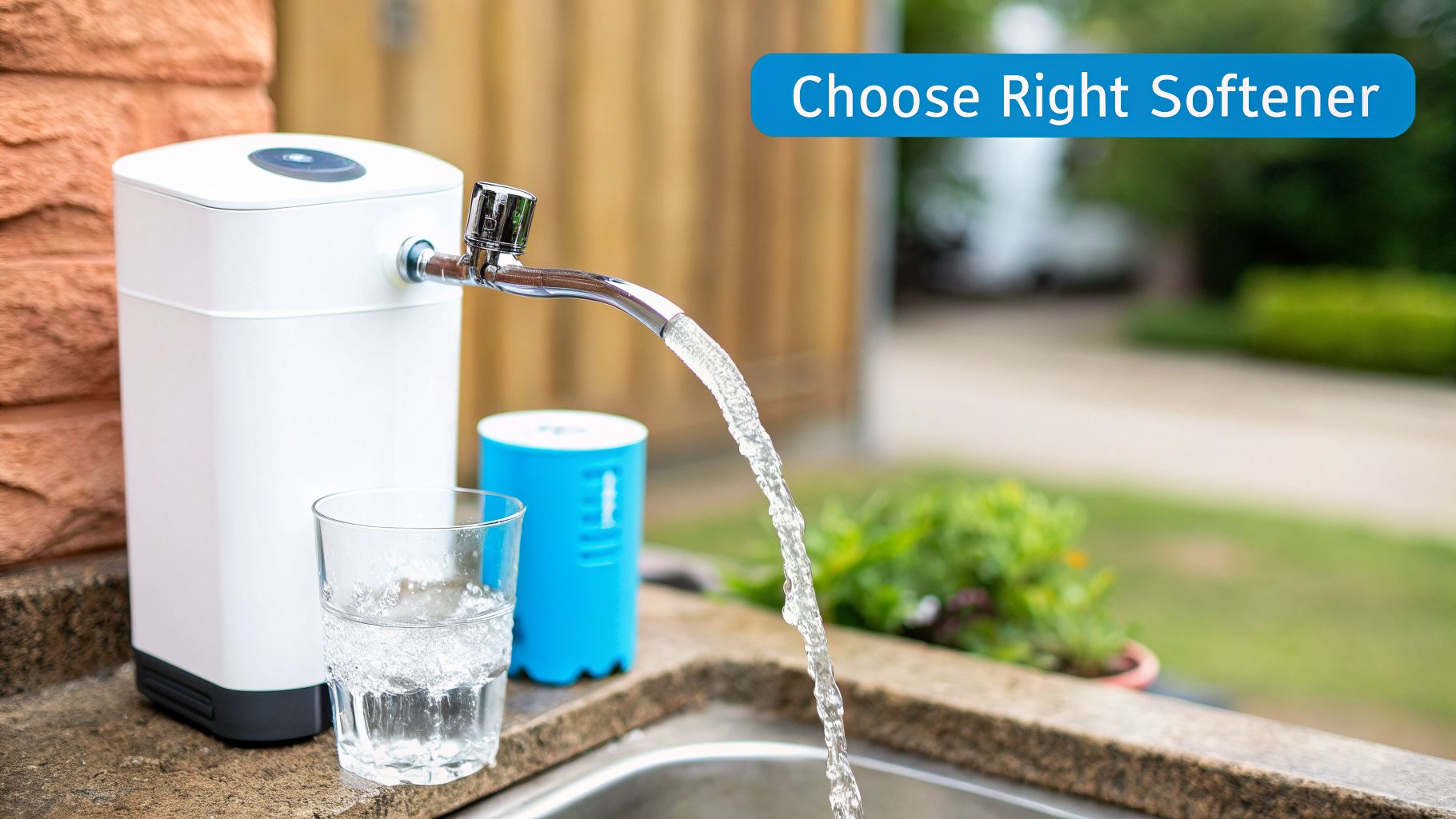
A white water softener dispensing clean water into a sink, with a glass of water nearby.

If you're in a constant battle with chalky white buildup on your faucets, soap scum that laughs at your cleaning efforts, and laundry that feels more like sandpaper, you've met the villain of our story: hard water. And you’re definitely not alone. The vast majority of American homes are dealing with water that’s loaded with mineral freeloaders like calcium and magnesium.

A water softener is your home's superhero. It's a whole-house water filter that swoops in to remove those minerals, protecting your pipes, appliances, and even your skin and hair from their damaging effects. But with all the different types, sizes, and brands out there, picking one can feel like a chore.

First Things First: Know Your Numbers

The absolute first step on this adventure is to discover your water's hardness level. This single number is the treasure map that will guide almost every other decision you make.

According to the U.S. Geological Survey, water hardness is measured in grains per gallon (GPG). Anything over 10.5 GPG is considered 'very hard,' and this affects more than 85% of U.S. households, where water typically exceeds 7 GPG. That kind of scale buildup on your water heater's elements can drive up energy bills by 20-30%. You can learn more about finding the right solution for your specific situation over at HomeWater101.com.

Once you have your GPG number, you can start zeroing in on the right system.

Key Water Softener Decision Factors at a Glance

To make this easier, here's a quick table summarizing the most important things to consider. Use it as a checklist to match a system to your home's needs.

Decision Factor What to Look For Why It Matters
Water Hardness (GPG) Your home's specific GPG number from a water test. This number determines the softener's required grain capacity. A higher GPG needs a higher capacity system.
Household Size & Usage The number of people in your home and your average daily water consumption. A larger family requires a higher-capacity unit to avoid running out of soft water between regeneration cycles.
Technology Type Salt-based ion exchange vs. salt-free conditioners. Salt-based systems physically remove minerals. Salt-free conditioners alter them to prevent scale buildup but don't create "soft" water.
Long-Term Costs Initial purchase price plus ongoing expenses for salt and water. The cheapest unit upfront isn't always the most economical. Factor in operating costs for a true comparison.

This table should give you a solid framework. Now let’s look a little closer at a few of these key factors.

Other Factors to Guide Your Search

Beyond your hardness level, a few other details will help you narrow down the field.

  • Household Size and Water Usage: A couple living in a small home has very different needs than a family of five. We’ll get into the exact math later, but for now, just think about how many people use water in your house daily.

  • Technology Type: The big debate is usually between traditional salt-based systems and salt-free conditioners. Salt-based units truly remove the hard minerals, giving you that slick, soft water feel. Salt-free conditioners change the mineral structure to stop them from forming scale, but the minerals are still present.

  • Long-Term Costs: Don’t just look at the sticker price. You have to factor in the ongoing cost of salt (for salt-based systems), the water used during regeneration cycles, and any potential maintenance down the road.

The goal isn't just to buy a water softener. It’s to invest in the right one that works efficiently, protects your home, and gives you great water for years to come.

This guide will walk you through each of these points, giving you the practical know-how to choose with confidence. For more general guidance on all types of water filters, you can also check out our extensive advice section.

Testing Your Water for Hardness and Contaminants

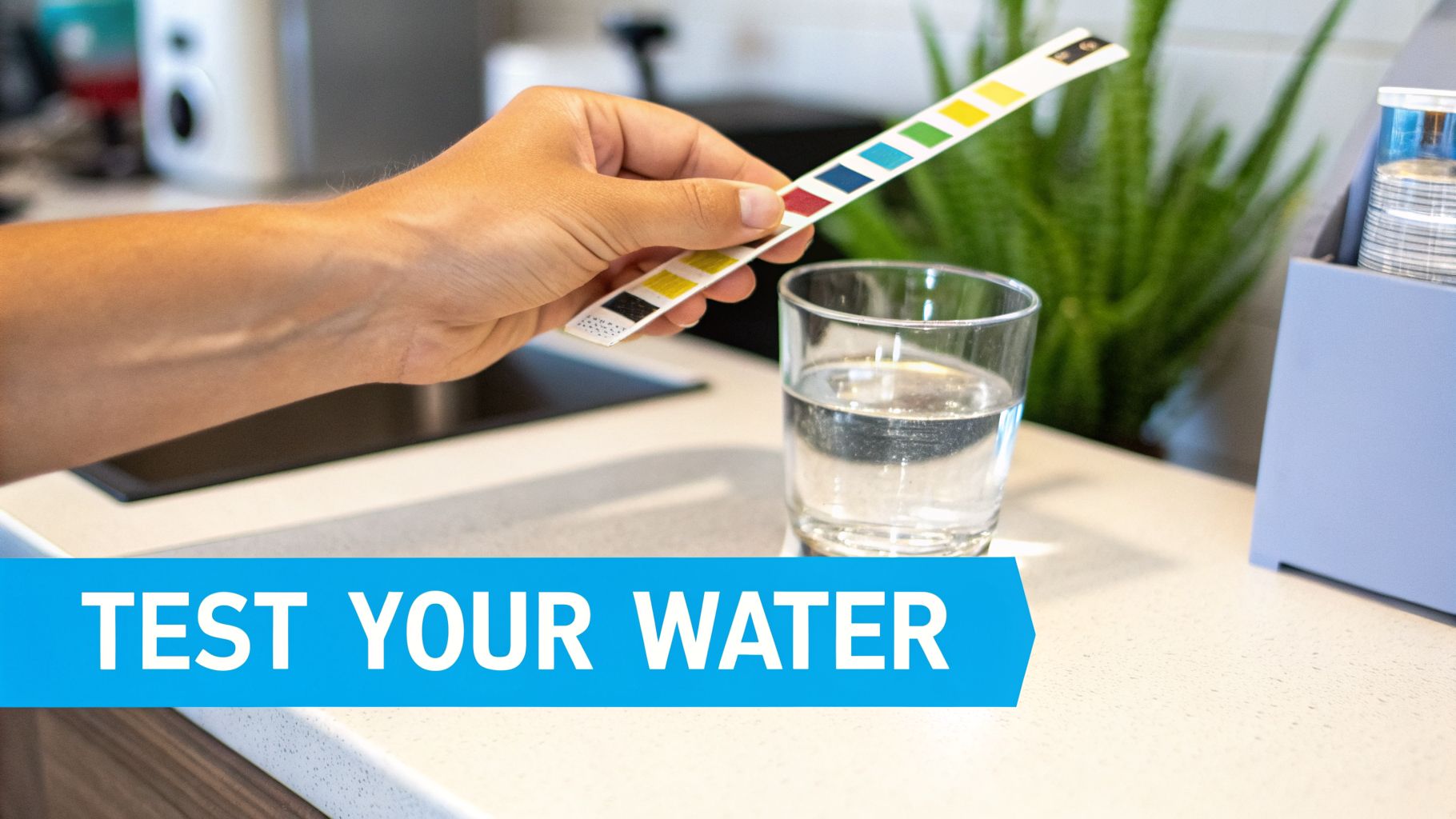
A hand holds a water testing strip over a glass of water on a kitchen counter for quality analysis.

Before you even think about buying a water softener, you have to know what you’re up against. You can’t solve a problem you don’t understand. This isn't just about softening; it's about comprehensive home water filtration.

If you’re seeing stubborn white spots on your faucets and shower doors, that’s a dead giveaway you have hard water. Those crusty deposits are limescale, and they’re a pain. We’ve even got a great guide on understanding and removing hard water stains if you want to tackle the mess you already have.

But what you can see is only half the story. To choose the right equipment, you need real data. Buying a water softener without testing your water is like getting a prescription without seeing a doctor—you’re just guessing.

DIY Testing vs. Professional Lab Analysis

You’ve got two main options for figuring out your water's chemistry: a quick DIY test or a full professional lab analysis.

DIY Water Test Kits are the fast and cheap route.

  • You can grab these simple test strips or liquid drop kits at any home improvement store.
  • They give you an immediate, ballpark reading of your water hardness, and sometimes chlorine and pH.
  • The big downside? They aren't always super accurate and won't tell you about other critical issues like iron or manganese that can destroy a softener.

Professional Lab Analysis is the gold standard.

  • You simply collect a sample from your tap and mail it to a certified lab.
  • In return, you get a highly accurate and detailed report covering not just hardness but also iron, manganese, pH, total dissolved solids (TDS), and other contaminants that affect your home's water quality.
  • It costs more and takes a bit longer, but the information is priceless.

For anyone on well water, I always recommend a professional lab test. It's a small investment that prevents you from buying the wrong thousand-dollar system. Get it right the first time.

Demystifying Your Water Test Results

Once you have your results, a few key numbers will jump out at you. This is where you get the exact information needed to size your whole-house filtration system correctly.

The most important number is your water hardness. It’s usually measured in one of two ways:

  1. Grains Per Gallon (GPG): This is what the water softener industry uses in the U.S. It’s the number you’ll need to do your calculations.
  2. Parts Per Million (PPM) or Milligrams per Liter (mg/L): These two are the same thing and are common on lab reports.

Converting is simple. Just divide your PPM number by 17.1 to get your GPG.

Let's say your lab report shows 200 PPM of hardness.

200 PPM / 17.1 = 11.7 GPG

That 11.7 GPG tells you your water is officially "very hard," and it's the exact figure you'll use to size your system.

But don’t stop at hardness. Look for other troublemakers, especially iron. If your report shows iron levels at or above 0.3 PPM, a standard softener is going to struggle. The iron will foul the resin beads, choking the system and drastically shortening its life. In that case, you’ll need to look at either a dedicated iron filter or a softener specifically built to handle high iron—a true multi-stage water filtration approach.

Sizing Your Water Softener: How to Get It Just Right

Choosing the right size water softener is a lot more than just a guess. Get it wrong, and you're in for some frustration. This is the heart of effective home water filtration.

A system that’s too small is a classic rookie mistake. It will struggle to keep up, constantly running regeneration cycles and still leaving you with hard water when you need soft water the most. On the flip side, an oversized unit is just plain wasteful. It will burn through salt and water, regenerating long before it needs to.

So, how do you find that perfect fit? It’s not about how big your house is or even just how many bathrooms you have. The key is calculating your household's actual daily softening needs based on your water hardness and how much water your family uses.

The Only Formula You Need

Let’s get right to it. There's a straightforward bit of math that will give you the most critical number for choosing a softener: the total grains of hardness your system needs to remove each week.

Here's the formula:

(# of People in Home) x (Daily Gallons Per Person) x (Your Water Hardness in GPG) x (7 Days)

This calculation gives you your weekly hardness load, which is the number you’ll use to match with a softener's grain capacity.

What Goes Into the Calculation

To use this formula, you just need to plug in three numbers.

  • Number of People: Simple enough. Just count everyone living in your home.

  • Daily Water Use: This one requires a good estimate. While everyone's habits are different, the industry standard for these calculations is 75 to 80 gallons per person per day. This figure covers everything from showers and laundry to flushing toilets and washing dishes.

  • Water Hardness (GPG): This is the number you got from your water test. It tells you exactly how much mineral content the softener has to tackle in every gallon.

Once you have those figures, you're ready to calculate the grain capacity your home demands. An incorrectly sized system can lead to real waste—an oversized unit might use 25% more water and salt than necessary, while an undersized one will leave you with hard water. If you want to dive deeper into system features, Whirlpool Water Solutions has a great guide on what to look for.

The Bottom Line: Sizing a softener isn't guesswork. It's about matching the machine's capacity to your home's specific demand, which is a direct product of your family's size and your water's mineral content.

A Real-World Example

Let's walk through a quick scenario to see how this plays out.

Imagine a family of four whose water test came back at 15 GPG—moderately hard.

  1. First, we find their total daily water use:

    • 4 people x 75 gallons/person = 300 gallons per day
  2. Next, we calculate the daily hardness load:

    • 300 gallons x 15 GPG = 4,500 grains of hardness per day
  3. Finally, we find the weekly requirement:

    • 4,500 grains/day x 7 days = 31,500 grains per week

For this family, a softener needs to remove at least 31,500 grains of hardness between regeneration cycles.

This makes a 32,000-grain capacity water softener the ideal choice. It's perfectly matched to handle a full week's worth of water before it needs to regenerate, making it incredibly efficient.

What happens if they choose poorly? A smaller, 24,000-grain unit would be forced to regenerate more frequently, wasting salt and water. A huge 48,000-grain system would be overkill, going too long between cycles, which can be inefficient and lead to other problems. The 32,000-grain system hits that sweet spot for consistent performance and optimal efficiency.

Comparing Water Softener Technologies

When you start shopping, you'll quickly realize the term "water softener" gets thrown around a lot. But not all of these home water filtration systems are created equal. The technology inside can be wildly different, and that's where a lot of homeowners get tripped up.

You're really looking at two main camps: salt-based ion exchange softeners and salt-free water conditioners. They approach hard water from completely different angles. Getting the results you want—whether it's silky-smooth water or just protecting your pipes—starts with understanding this fundamental difference.

The Classic: Salt-Based Ion Exchange Softeners

This is the tried-and-true method, the only technology that actually removes the hard minerals from your water. If you want truly soft water, an ion exchange system is the undisputed champion of home water filtration.

Think of it like this: the system's main tank is filled with tiny resin beads that are loaded with sodium ions. As your hard water passes through, the calcium and magnesium—the culprits behind scale and soap scum—get pulled out of the water and stick to the resin. In their place, a sodium ion is released. It's a simple, effective trade.

The end result? Genuinely soft water. It’s what gives you that signature "slick" feel in the shower, makes your soap and shampoo lather up like crazy, and stops scale in its tracks.

Of course, there's a trade-off. Eventually, that resin fills up with hard minerals and needs to be cleaned. That’s the regeneration cycle, where a saltwater brine solution washes the resin, sending all the collected minerals down the drain. This means you’ll have the ongoing task of adding salt to the brine tank and it will use some extra water.

The Low-Maintenance Option: Salt-Free Conditioners

Here’s where we need to be really clear. A salt-free conditioner is not a water softener. A better name for it is a scale-reduction system. It's a different kind of water filtration hero.

These systems use a fascinating technology called Template Assisted Crystallization (TAC). Instead of removing the calcium and magnesium, the TAC media changes their structure. It acts as a template that forces the mineral ions to form into tiny, harmless micro-crystals.

These little crystals are inert and won't stick to anything. They flow right through your plumbing without building up as scale on your pipes, faucets, or hot water heater element.

The key takeaway is this: the minerals are still in your water. A TAC system just crystallizes them so they can’t cause scale damage. You won’t get the slick feel or sudsing benefits of soft water, but you get powerful scale protection.

The big win for salt-free conditioners is that they are completely passive. Set it and forget it. No salt bags to haul, no electricity to run a control valve, and no wastewater from regeneration. They’re a fantastic choice for anyone who wants a zero-maintenance water filtration solution or lives in an area where salt-based softeners are banned.

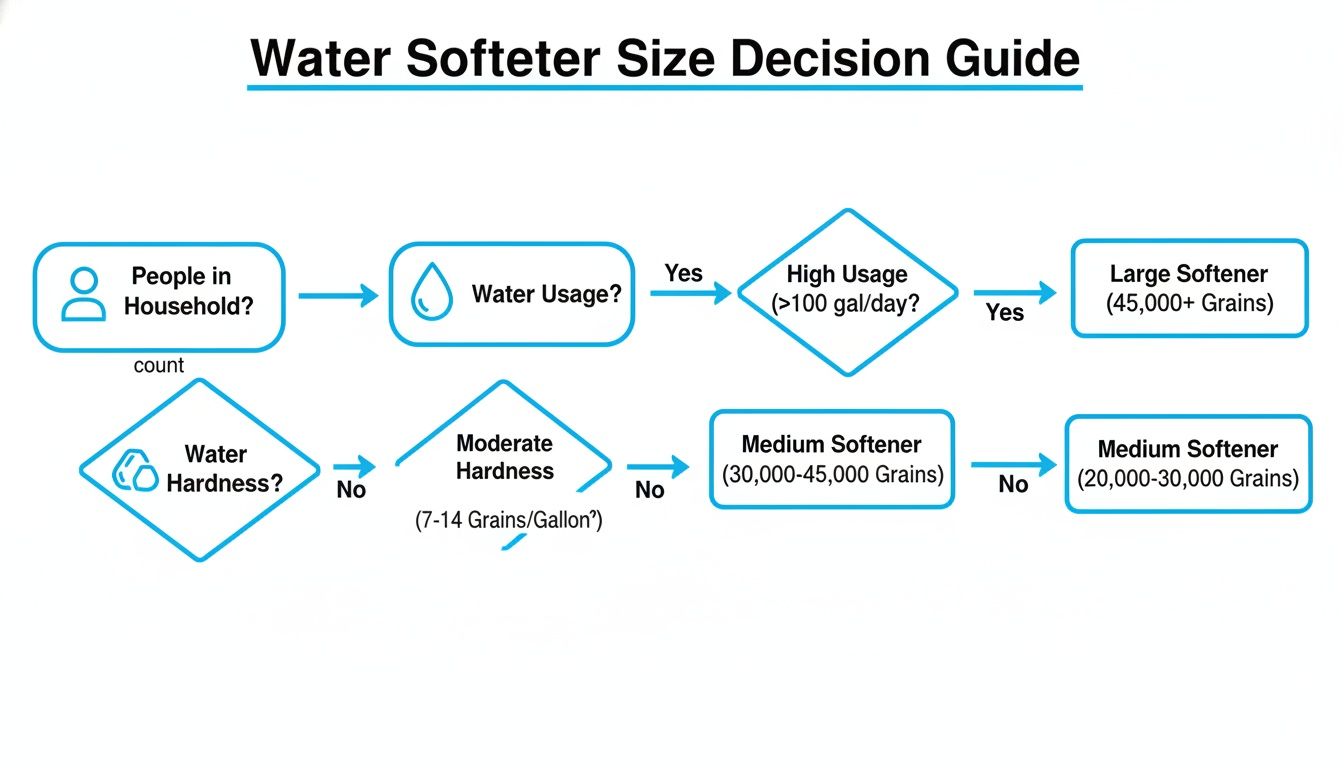
This flowchart can help you visualize how your home’s specific needs line up with the right system size and type.

Flowchart guiding water softener size selection based on household size, water usage, and water hardness.

Simply trace your path from household size and water hardness, and it will point you toward the right capacity for your home.

Water Softener vs. Water Conditioner Comparison

To make the choice even clearer, let's put these two water filtration technologies side-by-side. This table breaks down exactly what you get (and what you don't) with each system.

Feature Salt-Based Ion Exchange Softener Salt-Free Water Conditioner (TAC)
Primary Function Removes hard minerals (calcium & magnesium) from water. Conditions minerals to prevent scale buildup; does not remove them.
Resulting Water Genuinely soft water. You'll feel the "slickness" and see better lather. Water with scale-causing potential neutralized. Minerals remain present.
Scale Prevention 100% scale elimination by removing the source minerals. Excellent scale prevention (up to 99%) on pipes and appliances.
Maintenance Requires you to add salt regularly. Uses water and electricity for regeneration. Virtually zero maintenance. No salt, no electricity, no wastewater.
Ongoing Costs Salt bags, water for regeneration, minor electricity use. No ongoing operational costs. Media may need replacement every 3-6 years.
Best For Homeowners who want all benefits of soft water (softer skin, less soap, no scale). Homeowners focused on protecting plumbing and appliances with a hands-off system.
Environmental Impact Discharges salt brine (chloride) into wastewater systems. No environmental impact; adds nothing to the water and produces no waste.

Ultimately, choosing between a salt-based softener and a salt-free conditioner comes down to your primary goal. One isn't better than the other—they just do different jobs.

So, Which Technology Is Right For You?

It really boils down to what you want to achieve with your water treatment.

  • Go with a Salt-Based Softener if: You want the full soft-water experience. We're talking no more scale, using less soap, having brighter clothes, and feeling that difference on your skin and hair. You're okay with the simple task of adding salt every few months.

  • Go with a Salt-Free Conditioner if: Your number one priority is protecting your home's pipes and expensive appliances from scale damage. You want a system you can install and forget about, and you don't mind that the minerals technically remain in the water. This is also your only option if your local municipality has put a ban on brine discharge.

Both are great home water filtration technologies. The secret is simply matching the right tool to your specific job.

Don't Forget the Long-Term Costs

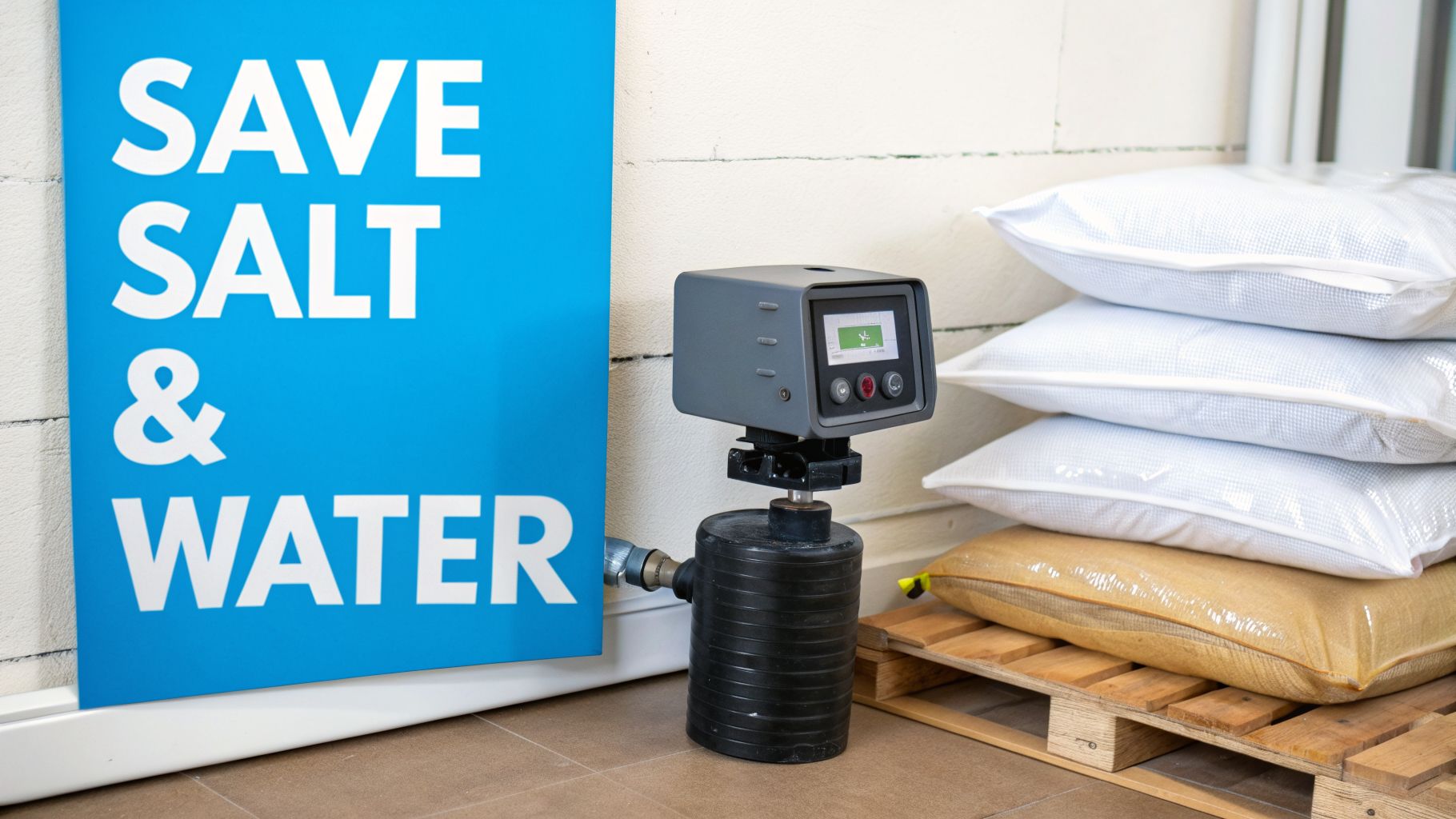
Water softener control unit, stacked salt bags, and a blue sign reading 'SAVE SALT & WATER'.

When you’re shopping for a whole-house water filter, it’s easy to get tunnel vision on the price tag. But the real cost? That shows up on your utility bills and in your salt purchases for years to come. How much salt, water, and electricity a system uses over its lifetime is what really determines its value.

All of these ongoing costs come down to one critical process: regeneration. This is how a salt-based system cleans and “recharges” itself, and understanding the different ways they do it is the key to not getting stuck with a resource-guzzling machine.

Smart Regeneration vs. Outdated Timers

Think of it like this: some systems are smart, and some are… well, not. The old-school approach is a timer-based softener. It’s a simple concept—the softener regenerates on a fixed schedule, like every three days at 2 AM, no matter what.

  • Timer-Based Systems: These are often cheaper upfront, but they’re incredibly wasteful. If you go on vacation, it regenerates anyway, wasting salt and water. If you have a house full of guests, it might not regenerate soon enough, leaving you with hard water when you need soft water most.

The modern, and much smarter, approach is a demand-initiated (or metered) softener. This type of system has a small water meter inside that tracks your actual water usage. It only triggers a regeneration cycle when it knows the resin beads are almost saturated.

  • Demand-Initiated Systems: This “on-demand” method is the only way to go in 2026. It adapts to your household’s unique rhythm, preventing needless regeneration cycles and saving a ton of salt and water in the process.

Choosing the right regeneration style can slash your running costs by up to 50%. A metered system regenerates only when needed, saving 30-40% on salt compared to an old timer model. For a typical family, that can cut annual salt use from 200-300 lbs down to a much more manageable 100-150 lbs.

What About Water Pressure? Don't Underestimate Flow Rate

We’ve all experienced it: you're in the shower, someone flushes a toilet, and the water pressure suddenly vanishes. A water softener that's too small for your home can create that same annoying problem, but for every faucet. That's where flow rate becomes a huge deal.

Measured in Gallons Per Minute (GPM), flow rate tells you how much softened water the system can deliver at any given moment. To avoid pressure drops, you need a softener that can keep up with your family’s peak demand.

Think about what might be running at the same time on a busy morning:

  • A standard shower needs about 2.5 GPM.
  • A dishwasher running a cycle uses 2 GPM.
  • Your washing machine could be pulling 3-4 GPM.

If you've got a couple of those going at once, you’re already at 7 GPM or more. For a typical 3-4 bathroom home, I always recommend looking for a system with a flow rate of at least 10-12 GPM. You can find this number, usually called the "service flow rate," on the manufacturer’s spec sheet. Don't skip checking it.

Look for Independent Proof of Performance

With so many brands making big claims, how can you be sure a softener actually does what it says? You look for a third-party certification seal.

The most important one by far is NSF/ANSI 44. This is the gold standard for whole-house water filtration. It’s an independent certification that proves the softener has been rigorously tested to meet specific performance criteria. An NSF/ANSI 44 certification tells you three crucial things:

  • The system truly reduces water hardness to the level it claims.
  • It is built with materials that are safe for contact with your drinking water.
  • The manufacturer's salt and water efficiency ratings are accurate and verified.

Getting a certified system is your best insurance against slick marketing and poor performance. And while you're focused on efficiency, remember that the softener is just one part of your home. To find more ways to lower your utility bills, check out these practical energy efficiency tips that can lead to significant savings across the board.

Frequently Asked Questions on Water Softeners

Common questions about home water filtration and softeners. Get clear answers to help you choose a system with confidence.

How Much Sodium Does a Water Softener Add?

The amount of sodium added depends directly on your water’s hardness level. It's often less than people think.

For water with a hardness of 10 Grains Per Gallon (GPG), the softening process adds about 75 milligrams (mg) of sodium per quart. For comparison, one slice of white bread can have over 150 mg of sodium.

For those on a strict low-sodium diet, an under-sink reverse osmosis (RO) system is a great addition. This point-of-use filter removes the added sodium from your drinking and cooking water.

Can I Install a Water Softener Myself?

Yes, if you have solid plumbing skills. A DIY installation is possible if you can confidently cut into pipes and follow detailed instructions. Most modern units can be installed in several hours.

The critical step is cutting into your home's main water supply line. If you are not comfortable with this, hire a professional plumber. A professional install guarantees it is leak-free, meets local codes, and functions correctly. A pro installation typically costs between $400 and $800.

What Kind of Salt Should I Use?

You will find two main types of salt for water softeners:

  • Solar Salt: Created from evaporated seawater. It is less expensive but may contain insolubles that can build up in the brine tank over time.
  • Evaporated Salt: A much purer salt, often 99.9% pure. This is the cleanest option, reducing the risk of "salt bridging" or "mushing" in the tank.

Evaporated salt pellets are recommended for most high-efficiency softeners. They dissolve cleanly and help your system run with less maintenance.

How Long Does a Water Softener Last?

A quality, well-maintained salt-based water softener should last 10 to 20 years.

The lifespan of this whole-house water filter is determined by the control valve and resin tank quality. The resin beads inside the tank, which perform the softening, generally need replacement every 10 to 15 years. High iron or chlorine levels in your water can shorten the resin's life. Salt-free conditioners have a similar lifespan, though their media often requires replacement every 3 to 6 years.

Will a Water Softener Reduce My Water Pressure?

A correctly sized water softener will not cause a noticeable drop in your water pressure. If you experience pressure loss, the system is likely too small for your home's water demand.

Check the flow rate, measured in Gallons Per Minute (GPM), before buying. This indicates how much softened water the system can produce at once. A typical home needs a flow rate of at least 10-12 GPM to support a shower and dishwasher running at the same time. Always confirm the "service flow rate" on the unit’s specifications.


Ready for soft water? Water Filter Advisor provides in-depth reviews and maintenance information. We help you find the perfect water filtration system for your home. Explore our guides at https://www.waterfilteradvisor.com to get started.

How to Remove Calcium from Your Water: A Practical Home Guide

So, you're ready to declare war on the calcium in your water? Excellent. Your two superstar players in this fight are the classic salt-based water softener and the high-tech reverse osmosis system. Think of a water softener as a clever diplomat, swapping out hard calcium for soft sodium. Reverse osmosis, on the other hand, is pure brute force—it shoves water through a microscopic bouncer that physically blocks the minerals from getting in.

The Sneaky Cost of Hard Water in Your Home

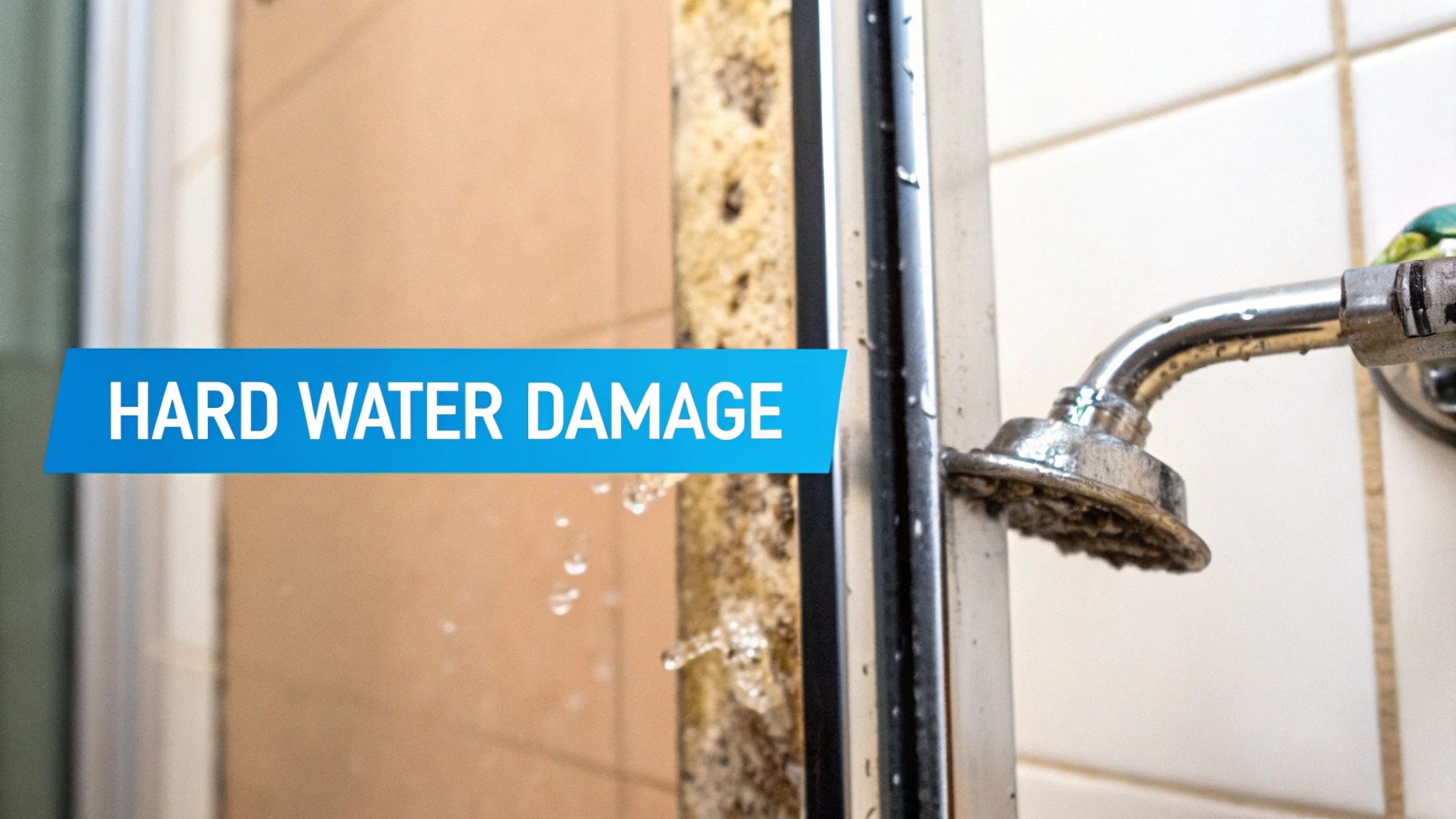
A close-up shows a shower head and door suffering from severe hard water damage and mineral buildup.

If you've ever waged a Saturday morning battle scrubbing that ghostly white film off your shower door, you've met hard water. If you've ever pulled your favorite t-shirt from the dryer only to find it feels like cardboard, you're a victim of hard water. This isn't just a minor inconvenience; it’s the daily grind for millions, all thanks to invisible calcium and magnesium particles crashing the party in your water supply.

These mineral freeloaders are the reason your soap throws a tantrum and refuses to lather, and why your wine glasses come out of the dishwasher looking like they’ve been frosted. You're trapped in an endless, and often losing, fight against soap scum on faucets, sinks, and tubs. But as annoying as these visible clues are, they’re just the opening act. The real damage is happening behind the scenes.

The Hidden Damage Calcium Causes

Beyond the daily cleaning headaches, hard water is silently waging a secret war on your home's plumbing and appliances. That same calcium that leaves spots on your glassware is building a rock-hard fortress inside your pipes called limescale. Over time, this mineral buildup chokes your plumbing, strangling water flow and putting a serious strain on your entire system.

Your water-using appliances are taking the biggest beating. Limescale loves to cozy up to the heating element in your water heater, wrapping it in a mineral blanket. This forces the unit to work overtime, burning more energy just to heat the same amount of water.

Hard water is a problem for a staggering 85% of American households. That relentless scale buildup can slash the lifespan of water heaters by up to 30% and crank up your energy bills by 20-30%.

Let that sink in. It means you could be forking over cash for a new water heater every 8-12 years instead of getting the full 20, all while paying more on your utility bills every single month. The same costly assault is happening to your dishwasher, washing machine, and even your beloved coffee maker. One of the most obvious signs is the never-ending task of removing hard water stains from windows and shower doors—it’s a crystal-clear sign of how much mineral gunk is being left behind.

The good news? You don't have to surrender. By understanding how to remove calcium from your water with the right filtration system, you can protect your home, save money, and finally win the war against limescale for good.

Diagnosing Your Hard Water Problem

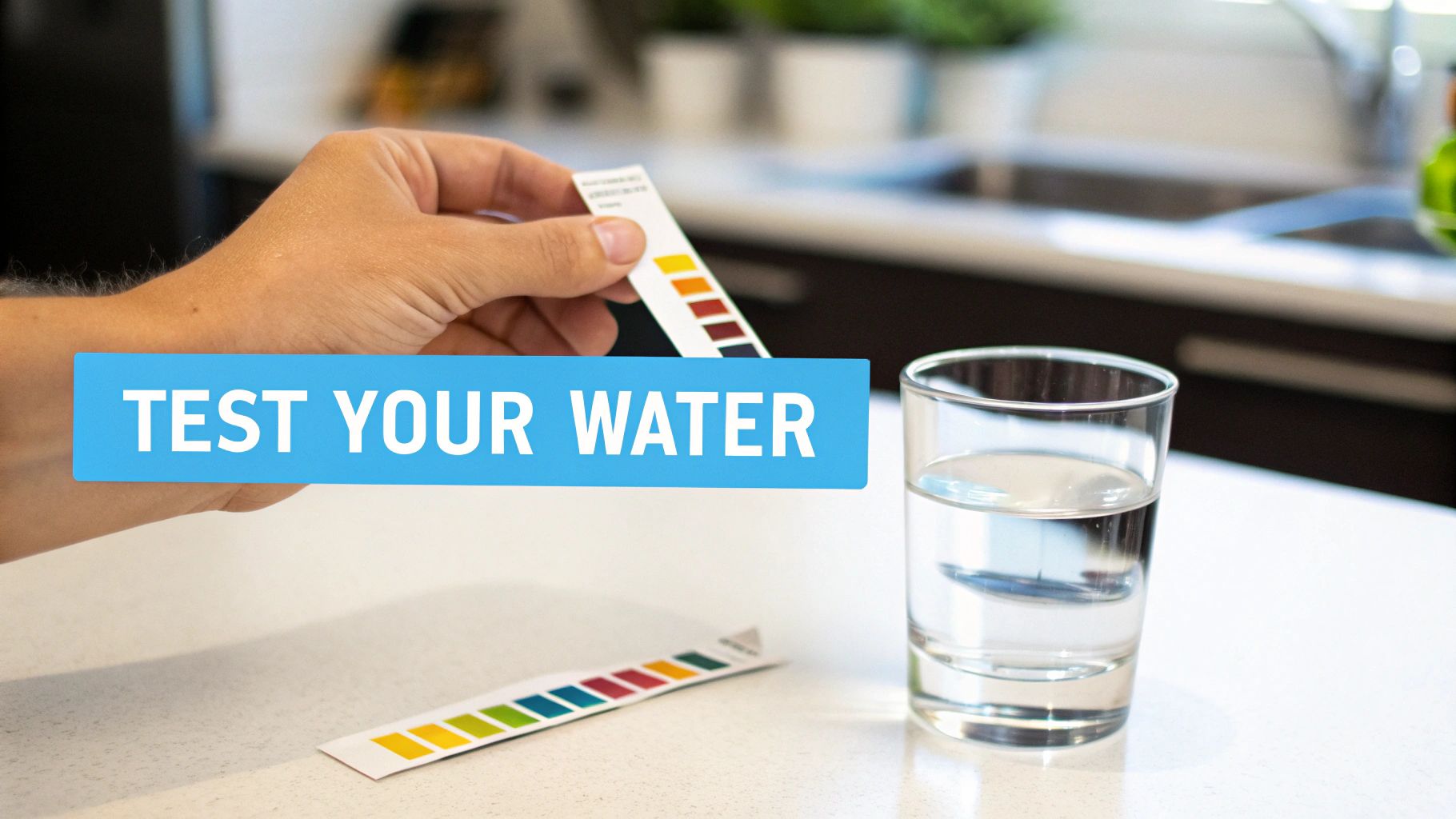
A person's hand holds a water test strip above a glass of water, with 'TEST YOUR WATER' text overlay.

Before you can vanquish the calcium in your water, you have to play detective. You need to know exactly how hard your water is. This isn't just a fun fact for a cocktail party; it's the crucial first step that determines which filtration weapon is actually going to work for your home.

You've probably already spotted the evidence. Those stubborn, milky-white spots on your windows and shower doors? Those are the classic calling cards of hard water, which are primarily calcium and magnesium deposits. While these clues tell you there's a problem, you need a real number to make a smart decision.

Luckily, you don't need a lab coat and a Ph.D. to figure this out. There are several ways to test your water, from simple DIY tricks to highly accurate lab tests.

Quick and Easy At-Home Tests

If you just want a quick confirmation that you're dealing with hard water, you can start with a couple of methods that cost next to nothing. They won't give you a precise number, but they'll tell you if you're on the right track.

  • The Soap Suds Test: This is the old-school way. Grab a clean, clear bottle, fill it about a third of the way with tap water, and add a few drops of pure liquid soap (Castile soap is perfect). Now, shake it like a Polaroid picture. If you get a big, fluffy layer of bubbles, your water is probably soft. If you just get a sad, cloudy film and barely any suds, congratulations, you’ve got hard water.
  • Water Hardness Test Strips: These are cheap, easy, and you can find them at any home improvement store. Just dip a strip into a glass of your water, and watch the color change. Match that color to the chart in the kit, and voilà, you'll have a good estimate of your water's hardness level.

Getting a Precise Measurement

The DIY tests are a great start, but if you're planning to invest in a real water filtration system, you need a more accurate number. This is especially true if you're on a private well, where mineral levels can be all over the map and other sneaky contaminants might be lurking.

Knowing your exact water hardness number is essential. A water softener needs to be programmed with this value to work efficiently. Get it wrong, and you’ll either waste a mountain of salt and water, or worse, the system won't soften your water at all.

For a reliable result, you have a couple of better options. I’ve put together a quick comparison to help you choose the best method for your needs.

Water Hardness Testing Methods Compared

Different testing methods offer varying levels of detail and accuracy. Here’s a breakdown of the most common options to help you decide which is right for your situation.

Testing Method How It Works Accuracy Level Typical Cost Best For
Soap Suds Test Shaking soap in a water-filled bottle to observe suds formation. Low (Qualitative) Free Quick confirmation of a suspected hard water problem.
Test Strips A strip is dipped in water and changes color, which is then matched to a chart. Low to Moderate $10 – $20 A fast, inexpensive estimate of hardness in Grains per Gallon (GPG).
Digital Testers An electronic meter measures Total Dissolved Solids (TDS) in the water. Moderate to High $15 – $50 Getting an instant, precise TDS reading, which is a strong indicator of hardness.
Lab Testing A water sample is mailed to a certified lab for a detailed chemical analysis. Very High $50 – $200+ Homeowners on well water or anyone needing a comprehensive water quality report.

Ultimately, choosing a more precise method like a digital tester or a professional lab test is a smart move. Once you have that specific number, you’ll be armed with the exact data you need to pick the right system, size it correctly, and get it programmed to work perfectly for years to come.

Effective Calcium Removal Methods for Your Home

Alright, you've done your homework and confirmed that hard water is the villain. Now for the fun part: picking your hero. Getting rid of calcium isn't a one-size-fits-all game. It’s about choosing the right tool for the job, whether you need to protect every pipe in your house or just want a perfect, scale-free cup of coffee.

Let's dive into the most common and effective ways to tackle hard water at home. We'll break down how each method works, from classic water softeners that physically rip the calcium out to newer systems that just change its bad behavior. This will give you a clear picture of what's happening to your water and why it matters.

The Gold Standard: Ion Exchange Water Softeners

When you want to remove calcium from your entire home's water supply, the traditional salt-based water softener is still the king of the castle. These systems are the absolute workhorses of the water filtration world, designed specifically to hunt down and eliminate the minerals that make water hard.

Think of it as a microscopic nightclub bouncer. Inside the main tank is a bed of tiny resin beads covered in sodium ions. As your hard water flows through, the rowdy calcium and magnesium ions, which have a stronger electrical charge, get grabbed and pulled onto the resin beads. In the process, they kick the weaker sodium ions off and into the water.

That's the "ion exchange" in a nutshell. The hard minerals get trapped, and a tiny, usually unnoticeable amount of sodium takes their place. The result? Truly soft water flowing to every faucet, showerhead, and appliance you own.

Of course, those resin beads can only hold so many troublemakers before they're full. That's when the system needs to clean itself, a process called regeneration.

  • First, the system backwashes the resin tank to flush out any gunk.
  • Next, it sucks a concentrated saltwater solution (brine) from a separate tank to wash the resin beads.
  • The massive wave of sodium in the brine overpowers the trapped calcium and magnesium, kicking them off the resin and sending them down the drain.
  • Finally, the system gives the resin a good rinse to get rid of any leftover brine, leaving it recharged with sodium and ready to get back to work.

The best part is this all happens automatically, usually in the middle of the night, so you never run out of glorious soft water.

Surgical Precision with Reverse Osmosis

While a water softener is the perfect whole-house guardian, sometimes you need an even higher level of purity—especially for the water you drink and cook with. This is where a Reverse Osmosis (RO) system truly shines. An RO system doesn't just swap minerals; it acts like a microscopic fortress.

Think of it like a top-secret security checkpoint for water molecules. An RO system uses pressure to force water through a special semipermeable membrane—basically a filter with pores so tiny they make a human hair look like a tunnel.

These pores are so incredibly small that only pure water molecules can squeeze through. Calcium, magnesium, and a whole army of other contaminants (like lead, chlorine, and salts) are just too big to pass. They get rejected by the membrane and are unceremoniously washed away down a separate drain line. The purified water is then stored in a small tank under your sink, ready to be dispensed from its own dedicated faucet.

An RO system can strip out up to 99% of all total dissolved solids (TDS), including calcium. This makes it the go-to choice for getting perfectly pure, spot-free water for drinking, making crystal-clear ice, or brewing the best-tasting coffee you've ever had.

Because the process is slow and creates some wastewater, RO is almost always used as a "point-of-use" system at a single tap, not for the whole house. It's the perfect sidekick for a water softener: the softener protects the delicate RO membrane from getting clogged with scale, and the RO system gives you bottled-water quality right from the tap.

A Different Approach: Salt-Free Water Conditioners

For those who want to stop scale damage without adding salt or changing their water's chemistry, there's another popular option: a salt-free water conditioner. Now, it's critical to understand that these systems do not actually remove calcium from the water. Instead, they're like a behavioral therapist, altering calcium's structure so it can't stick to surfaces.

The leading technology here is called Template Assisted Crystallization (TAC). A TAC system uses a special media that acts as a seed for mineral crystals to form. As hard water flows past, the calcium and magnesium ions are grabbed and forced to clump together into tiny, stable micro-crystals.

These crystals are then released back into the water, but because they're now in a hardened, crystalline form, they can't cling to your pipes, faucets, or water heater elements. They just flow right through your plumbing and down the drain, minding their own business.

The big advantages of a TAC system are:

  • No Salt: You never have to buy or lug around those heavy bags of salt.
  • No Wastewater: They don't have a regeneration cycle that flushes water and brine down the drain.
  • Low Maintenance: The media inside can last for several years before it needs to be replaced.

The trade-off is that you don't get the other perks of truly soft water. Soap and shampoo won't lather up any better, you'll still see some water spots (though they should be easier to wipe away), and you won't get that classic silky-smooth feel of soft water on your skin. Think of it strictly as a scale-prevention device.

Calcium Removal Methods At-A-Glance

Trying to decide which system is your champion? It really comes down to your primary goals, budget, and how much maintenance you're willing to do.

This table gives you a quick side-by-side comparison of the top ways to deal with calcium in your home's water.

Filtration Method How It Works Calcium Removal Avg. Initial Cost Ongoing Maintenance
Ion Exchange Softener Swaps calcium ions for sodium ions. Yes, fully removes $800 – $2,500 Adding salt regularly; potential resin replacement every 10-15 years.
Reverse Osmosis (RO) Pushes water through a fine membrane. Yes, filters out $150 – $600 Replacing pre-filters (6-12 months) and RO membrane (2-4 years).
Salt-Free Conditioner (TAC) Crystallizes minerals to prevent scale. No, neutralizes $500 – $1,800 Replacing TAC media every 3-6 years; no salt or electricity needed.

Use this as a starting point. If you want the full benefits of soft water everywhere, a softener is your best bet. If you only care about pristine drinking water, an RO system is perfect. And if you just want to protect your pipes without the salt, a TAC conditioner is a great modern alternative.

Selecting the Right System for Your Household

Choosing a system to remove calcium from your water can feel a little overwhelming. With so many options, sizes, and technical terms floating around, it's easy to get lost. The key is to simplify. You just need to match the right technology to your home, your family, and your water.

Getting this right isn't just about picking a box off a shelf; it's about finding a real-world solution. What works for a couple in a small condo with moderately hard water is going to be totally different from what a family of five on a private well needs.

Sizing Your System Correctly

One of the biggest blunders homeowners make is buying a system that's too small or way too big. An undersized water softener, for example, will constantly be playing catch-up. It'll regenerate too often, which just burns through salt and water. Go too big, and you've just spent more money than you needed to upfront.

To get the sizing just right, you need two key pieces of info:

  • Your household water consumption: The average person uses around 80-100 gallons of water a day. Just multiply that by the number of people in your home to get a daily total. For a family of four, that's roughly 320-400 gallons per day.
  • Your water hardness level: This is the number you got from your water test, measured in grains per gallon (GPG). This tells you exactly how much of a workout the system has to do for every single gallon that flows through it.

With those two numbers, you can figure out the "grains of hardness" your system has to remove each day. Simply multiply your daily water usage by your GPG. For our family of four using 320 gallons with 15 GPG water, that’s 4,800 grains of hardness daily. This number becomes your guidepost for choosing a softener with the right capacity.

A correctly sized system means you'll have a steady supply of soft water without the system constantly regenerating. That saves you money on salt and water over the long haul. It's really the difference between a "set-it-and-forget-it" solution and a constant headache.

Understanding Water Flow Rate

Beyond just capacity, the other critical factor is the flow rate, which is measured in gallons per minute (GPM). This number tells you how much softened water the system can actually deliver at one time. If the flow rate is too low for your family's peak demand, you're going to notice a frustrating drop in water pressure.

Picture this: someone's in the shower, the dishwasher is running, and you flush a toilet. A system with a low GPM just can't keep up with that demand, and the person in the shower suddenly feels the water pressure drop to a trickle. For a typical family home, a system with a flow rate of at least 10-12 GPM is a safe bet to keep everyone happy and the pressure strong.

Whole-House vs. Point-of-Use Solutions

Next up, you have to decide where you want to treat your water. This really boils down to two main approaches: treating all the water that enters your home or just zeroing in on a specific faucet.

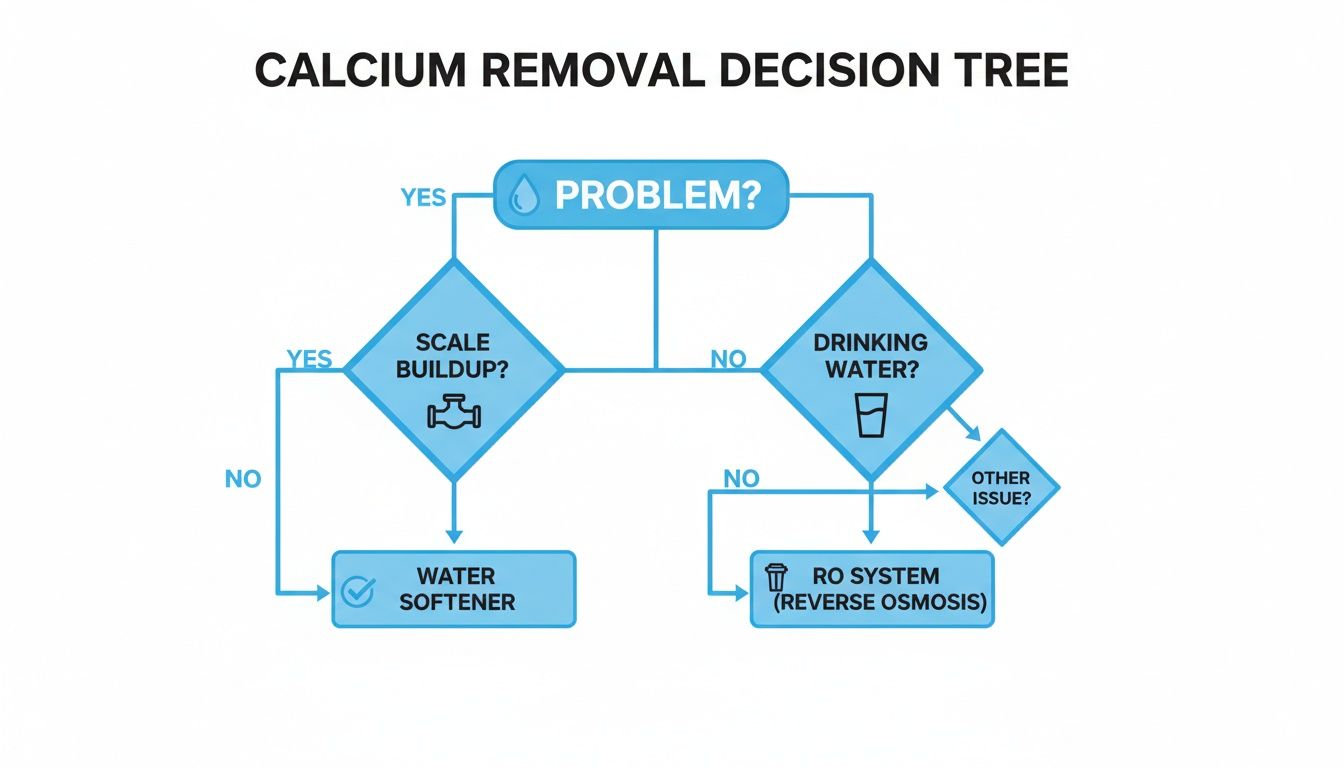
This quick decision tree can help you visualize which path makes the most sense for what you're trying to fix.

Flowchart for calcium removal from water, addressing problems like scale buildup or drinking water concerns.

As the chart lays out, if your main headache is scale buildup wrecking your entire home, a whole-house system is the clear winner.

Whole-House (Point-of-Entry) Systems
These are the heavy hitters, like ion exchange water softeners or salt-free conditioners. They get installed right where your main water line enters the house, treating every drop before it can reach your pipes, appliances, and faucets.

  • Best for: Protecting your entire plumbing system, your water heater, dishwasher, and washing machine from scale. You also get the benefit of soft water for showering, which can be great for your skin and hair.
  • Real-World Scenario: A large family in a rural area with extremely hard well water (25+ GPG). For them, a whole-house softener isn't a luxury—it's essential to prevent constant appliance repairs and keep their plumbing from clogging up.

Point-of-Use (POU) Systems
These systems are specialists. They're designed to deliver highly purified water to a single spot, which is usually the kitchen sink. The most common example is an under-sink reverse osmosis (RO) filter.

  • Best for: Getting the highest purity for your drinking and cooking water. An RO system is the gold standard for removing not just calcium but a whole host of other contaminants, giving you bottled-water quality right from a dedicated faucet. For more helpful insights, you can explore additional water filtration advice from Water Filter Advisor.
  • Real-World Scenario: A couple living in a city apartment with moderately hard water. They aren't too worried about their pipes but really want to get rid of calcium and chlorine for better-tasting coffee and crystal-clear ice. A simple under-sink RO system is the perfect, budget-friendly fit for their needs.

Installation and Long-Term System Care

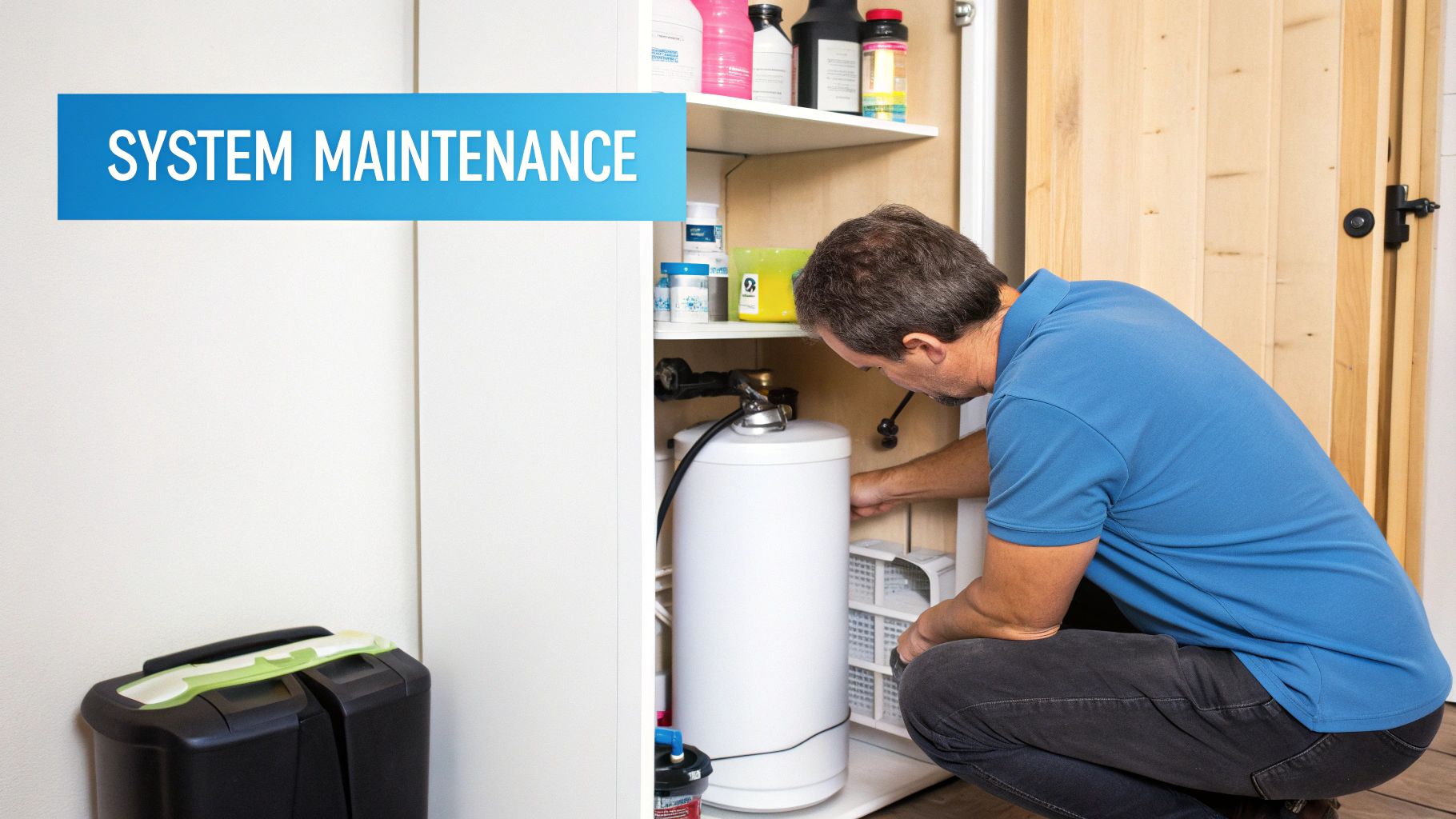
A man in a blue shirt crouches, performing system maintenance on a white water filter in a cabinet.

Choosing the right system is the hard part; getting it running and keeping it that way shouldn't feel like a chore. The final hurdle is installation, followed by a simple care routine that will keep your system performing flawlessly for years. Nailing this ensures you get every penny's worth out of your investment and enjoy consistently great water.

Some systems are perfect for a weekend DIY project, while others really need a pro's touch. It all comes down to the system type and how comfortable you are with plumbing.

Point-of-use units, like an under-sink RO filter, are usually pretty straightforward. The kits are designed for homeowners, with clear instructions and push-to-connect fittings that take the guesswork out of it. If you can read a manual and operate a drill, you can probably have it done in an afternoon.

Whole-house systems are a completely different animal. Installing a water softener or a salt-free conditioner means cutting into your main water line. This is not the time for trial and error. It demands precision, the right tools, and a real understanding of local plumbing codes. A small mistake here can quickly turn into a massive leak and some seriously expensive water damage.

Pro Tip: Unless you've got serious plumbing experience, just hire a licensed plumber for a whole-house system. It's a smart move that guarantees the job is done right, meets code, and keeps your manufacturer's warranty intact.

Creating a Simple Maintenance Routine

Once everything is up and running, a little TLC is all you need. The best part is that modern water filtration systems are built to be incredibly low-maintenance. Your to-do list will just depend on the tech you picked.

Here's what the typical upkeep looks like for the most popular systems:

  • Ion Exchange Water Softeners: This is about as easy as it gets. Your main job is just keeping the brine tank filled with salt. Glance at the salt level once a month and top it off. Most tanks hold enough to last a few months anyway. Stick with high-quality salt to avoid "salt bridging," a hard crust that can form and stop the system from working.
  • Reverse Osmosis (RO) Systems: These systems rely on filter changes to keep the water pure. The sediment and carbon pre-filters generally need to be swapped out every 6 to 12 months. The main RO membrane is much more durable, lasting anywhere from 2 to 4 years. Your system's manual will have a schedule—just pop a reminder in your phone's calendar.
  • Salt-Free Water Conditioners (TAC): If you want "set it and forget it," this is it. The special TAC media that neutralizes the calcium usually lasts 3 to 6 years before you need to think about replacing it. There's no salt to buy, no electricity, and no drain line to monitor.

Troubleshooting Common Hiccups

Even the most reliable system can have an off day. If you notice your water quality has changed, don't panic. Most problems are surprisingly simple to diagnose and fix.

A sudden drop in water pressure is a classic sign. The first thing to check is any pre-filter on your system. A clogged sediment filter is the usual suspect, and it's a cheap and easy fix. On an RO system, low pressure could also signal that it's time to change the filters or that the storage tank's air bladder needs a top-up.

What if your water starts feeling hard again? With a water softener, the fix is almost always simple. First, check if you're out of salt or if a salt bridge has formed. If the salt looks fine, make sure the system's settings—especially the water hardness level you programmed in—are correct and that the unit has power. These few checks will solve the issue over 90% of the time, getting you back to soft, scale-free water.

Frequently Asked Questions About Calcium Removal

Even after digging into the best ways to get rid of calcium, some questions always seem to pop up. Let's clear the air and tackle some of the most common worries homeowners have about taming their hard water for good.

Will a Water Softener Make My Water Taste Salty?

This is easily the biggest myth out there, and the short answer is no. A properly working water softener adds a tiny, almost always undetectable amount of sodium to your water. The exact amount is tied directly to how hard your water is to begin with.

For instance, if your water is moderately hard at 15 GPG, the process adds about 280 mg of sodium per gallon. For a little real-world context, a single slice of white bread has around 170 mg of sodium. Most people never notice the taste.

That said, if you're on a strict sodium-restricted diet or just don't want any added minerals in your drinking water, pairing a whole-house softener with a point-of-use reverse osmosis system at your kitchen sink is the perfect combo.

Can I Use a Water Filter Pitcher to Remove Calcium?

Those standard filter pitchers you keep in the fridge are really only good for one thing: making your water taste and smell better. They use activated carbon to trap things like chlorine, which definitely makes for a more pleasant glass of water.

But when it comes to dissolved minerals like calcium and magnesium, they don't do a thing. Getting rid of hardness requires a specific technology like ion exchange or reverse osmosis. You might see some niche pitchers claim a minor hardness reduction, but they just can’t handle the job in a way that will make a real difference for your appliances or even stop scale from forming in your kettle.

What Is the Difference Between a Water Softener and a Salt-Free Water Conditioner?

This is a really important distinction, and it all comes down to how they deal with calcium.

  • A water softener physically removes the calcium and magnesium minerals from the water using ion exchange. The result is genuinely soft water.
  • A salt-free water conditioner (which uses Template Assisted Crystallization, or TAC) doesn't remove the minerals at all. Instead, it changes their structure, crystallizing them so they can’t stick to pipes and form scale.

So, your choice really depends on what you're trying to achieve. If you're after that silky-smooth feeling in the shower and better lather from your soap, a traditional softener is the only way to go. If your main goal is simply to protect your home’s plumbing from scale buildup without the hassle of salt, a conditioner is a fantastic modern alternative.

How Often Do I Need to Replace the Resin in My Water Softener?

The resin bed is the heart of your softener, and it's surprisingly tough. With a little care and typical city water (that isn't loaded with iron or chlorine), a high-quality resin bed can last anywhere from 10 to 20 years.

The things that really shorten its lifespan are high levels of chlorine or iron, which can break down the tiny resin beads over time. You’ll know it might be time for a change if your system seems to be regenerating correctly but your water still feels hard. Another tell-tale sign is a big drop in water pressure, which can happen if old, broken-down resin particles start clogging up the system. Using a resin cleaner once a year can really help you get the most life out of it.


Ready to find the perfect solution for your home's hard water problems? At Water Filter Advisor, we provide in-depth reviews, buying guides, and practical advice to help you make a confident choice. Explore our resources and find the right filter for your family at https://www.waterfilteradvisor.com.