So, you're on a quest for the perfect fluoride removal filter. What exactly is this magical device? Think of it as your home's personal water bodyguard, specifically trained to spot and remove fluoride from your drinking water.
These aren't your run-of-the-mill filters. They use specialized media like activated alumina, bone char, or hyper-advanced reverse osmosis membranes to latch onto fluoride ions and show them the door. This is a high-level security detail that a standard carbon filter—like the one chilling in your fridge pitcher—simply isn't equipped to handle.
Why Is Fluoride in Water Suddenly a Hot Topic?
It seems like everyone is suddenly a water quality expert, and fluoride is public enemy number one. But why the sudden buzz? For decades, fluoride was hailed as the dental hygiene superhero, a public health triumph for its incredible cavity-fighting powers. But today, the conversation has changed. People are starting to look at their tap water with a more critical eye, asking what's really in it and demanding more control.
This isn't just a random trend. It's part of a massive cultural shift towards personal wellness and taking charge of what we put into our bodies. It's like a vitamin that was once a blanket recommendation for everyone, but now you want to decide on the dosage yourself. Homeowners are graduating from passive water consumers to active managers of their home's ecosystem.
From Public Health Triumph to Personal Choice
The story of water fluoridation began as a sweeping public health initiative. It's been a charged topic ever since municipalities started adding it to public water supplies back in the 1940s to combat tooth decay. Fast forward to today, and over 73% of Americans on public water systems receive fluoridated water.
But here's the flip side: growing concerns about overexposure. Studies have linked excessive fluoride intake to issues like dental fluorosis, which affected an estimated 23% of U.S. kids according to 2010 NHANES data. This very concern has propelled the market for fluoride removal filters from a niche product into a household staple. You can see the explosive growth in the filtration market for yourself over at MordorIntelligence.com.
This history is why the debate is so complex. To truly get it, you have to acknowledge the widely promoted dental benefits of fluoride rinse and other topical treatments, which form the bedrock of pro-fluoridation arguments. The core of today’s conversation isn’t about dismissing those benefits, but about gaining control over the dosage and its source.
The question has evolved. It's no longer a simple "Is fluoride good or bad?" but rather, "How much fluoride am I getting from all sources, and can I have the final say?" This shift towards personal oversight is the real engine driving the demand for effective home water filtration.
Taking Control of Your Tap Water
As a homeowner, you're the captain of your ship. The surging interest in a fluoride removal filter is a direct result of this empowerment. It’s about making a smart, informed decision for your family's health, whether you're in a downtown high-rise or a quiet suburban home.
This guide is your machete to cut through the jungle of information. We're here to validate your questions and give you a clear, practical roadmap to finding the perfect filtration system for your home. We’ll dissect the technology, demystify the costs, and review the real-world performance to help you become the master of your water quality.
So, how do these fluoride removal filters actually work their magic? It’s not some mystical plumbing ritual. It’s just clever science, and you don’t need a chemistry degree to get it.
Let's break down the main technologies. Think of them as three different types of security guards for your water, each with a unique strategy for kicking fluoride and other troublemakers to the curb. Understanding how they operate is the first step to choosing the right system for your home.
This infographic gives you a great overview of the whole fluoride debate, from its controversial history to the solutions available today.
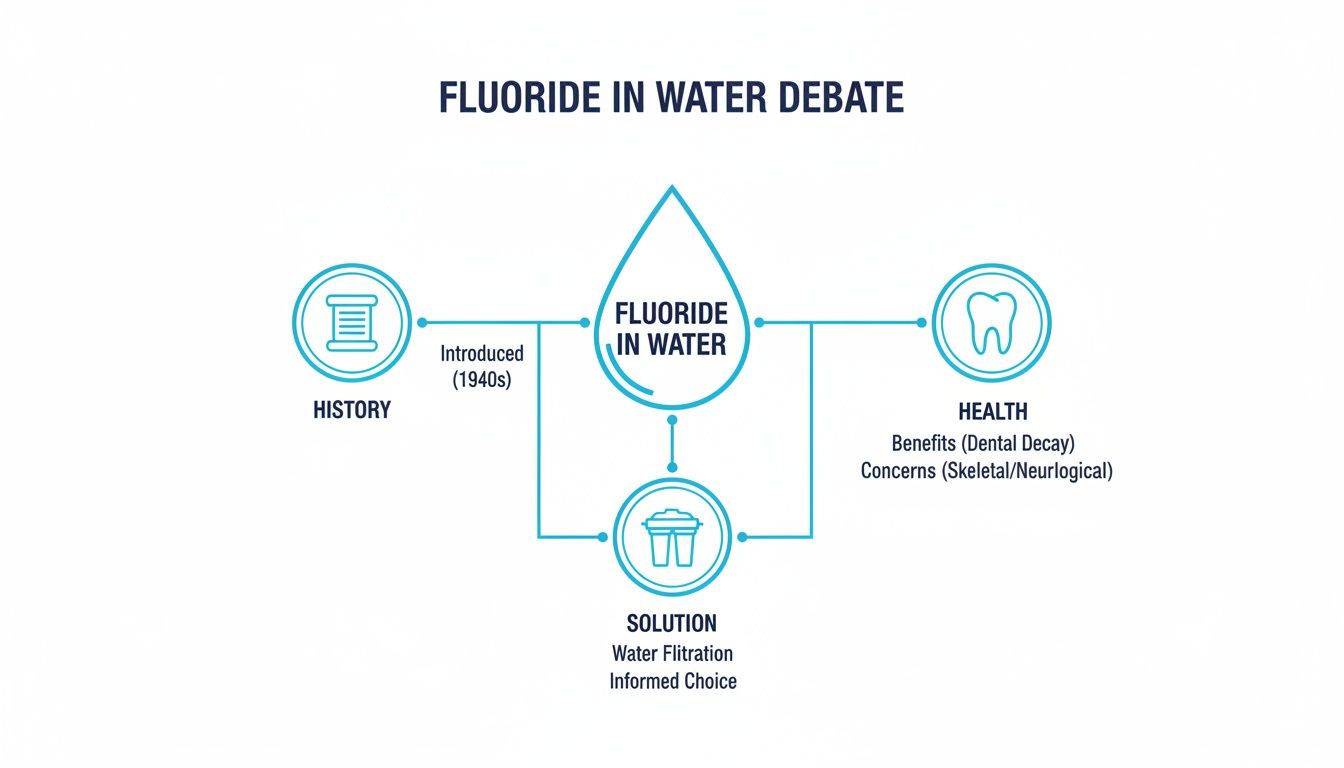
As you can see, concerns over water fluoridation aren't new, and they've directly fueled the development of the filtration tech we're about to dive into.
Comparing Fluoride Removal Filter Technologies
To keep things simple, here’s a quick head-to-head comparison of the top three contenders in the fluoride removal arena. This table cuts through the jargon and shows you exactly what each technology brings to the table.
| Filtration Technology | How It Works (Analogy) | Fluoride Removal Efficacy | Best For |
|---|---|---|---|
| Reverse Osmosis (RO) | The "Microscopic Bouncer" | 90-99% | Ultimate purity; removes the widest range of contaminants beyond just fluoride. |
| Activated Alumina | The "Specialized Magnet" | Up to 90% | Targeted fluoride, arsenic, and selenium removal, especially in slightly acidic water. |
| Bone Char Carbon | The "Natural Sponge" | Up to 90% | A natural approach that also tackles chlorine, heavy metals, and even radioactive isotopes. |
Each of these systems has its own superpower. Now, let’s take a closer look at what’s happening under the hood.
Reverse Osmosis: The Microscopic Bouncer
Reverse Osmosis, or RO, is the undisputed heavyweight champion of water purification. Think of it as a bouncer at an exclusive nightclub with an incredibly strict guest list. It uses your home's water pressure to force water through a special semipermeable membrane.
This membrane is the real VIP. Its pores are so ridiculously tiny that only pure H₂O molecules can squeeze through. Everything else—fluoride ions, heavy metals like lead, dissolved salts, you name it—gets stopped at the velvet rope and flushed away.
Because it's so uncompromising, RO is often called the gold standard, capable of removing 90% to 99% of fluoride. It's more than just a fluoride filter; it’s a full-spectrum purification system that tackles a massive list of contaminants.
- Fluoride Removal Rate: Typically 90-99%.
- Also Removes: Lead, arsenic, chlorine, pesticides, salts, and most other dissolved solids.
- The Process: Water is pushed through an ultra-fine membrane, leaving impurities behind.
The trade-off? RO systems create wastewater (the rejected contaminants) and can strip beneficial minerals from the water. Many modern systems solve this by including a remineralization filter to add healthy minerals like calcium and magnesium back into the water before it hits your glass.
Activated Alumina: The Specialized Magnet
If RO is a general bouncer, Activated Alumina is a specialist, a magnet designed for one primary mission: grabbing fluoride. The filter media is made from aluminum oxide (the same stuff in sapphires and rubies), but it's processed to be incredibly porous with a massive surface area.
Picture your water flowing through a maze filled with tiny, powerful magnets that only attract fluoride. As water passes over the Activated Alumina beads, fluoride ions are literally pulled out of the stream and latch onto the media. This process is called adsorption.
This method is highly effective and is one of the few technologies officially certified by the NSF for fluoride reduction. It works best when your water's pH is slightly acidic, ideally between 5.5 and 6.5.
Activated Alumina can knock out up to 90% of fluoride, but its effectiveness drops as the media gets saturated. That means you have to stay on top of filter changes to keep it performing at its best. It's also a champ at removing arsenic and selenium.
Bone Char Carbon: The Natural Sponge
Our third guard is Bone Char, which acts like a highly absorbent natural sponge. This is actually one of the oldest and most trusted water purification methods on the planet. It's made by charring animal bones in a low-oxygen kiln, creating a porous carbon material that's rich in calcium.
Imagine that bone char as a sponge filled with countless nooks and crannies. As water flows through, the bone char’s surface—which is high in tricalcium phosphate—naturally adsorbs fluoride ions, trapping them so they don't end up in your glass.
Bone char is a powerhouse, often reducing fluoride levels by up to 90%. But it doesn't stop there.
- Chlorine: It’s fantastic at eliminating that chemical swimming-pool taste from chlorine.
- Heavy Metals: It can also pull out harmful metals like lead, mercury, and cadmium.
- Radioactive Isotopes: Uniquely, it even has the ability to remove certain radioactive particles.
This approach offers a powerful, all-natural way to get cleaner, safer, and better-tasting water flowing from your tap.
Choosing Your System: Point-Of-Use vs. Whole-House Filters
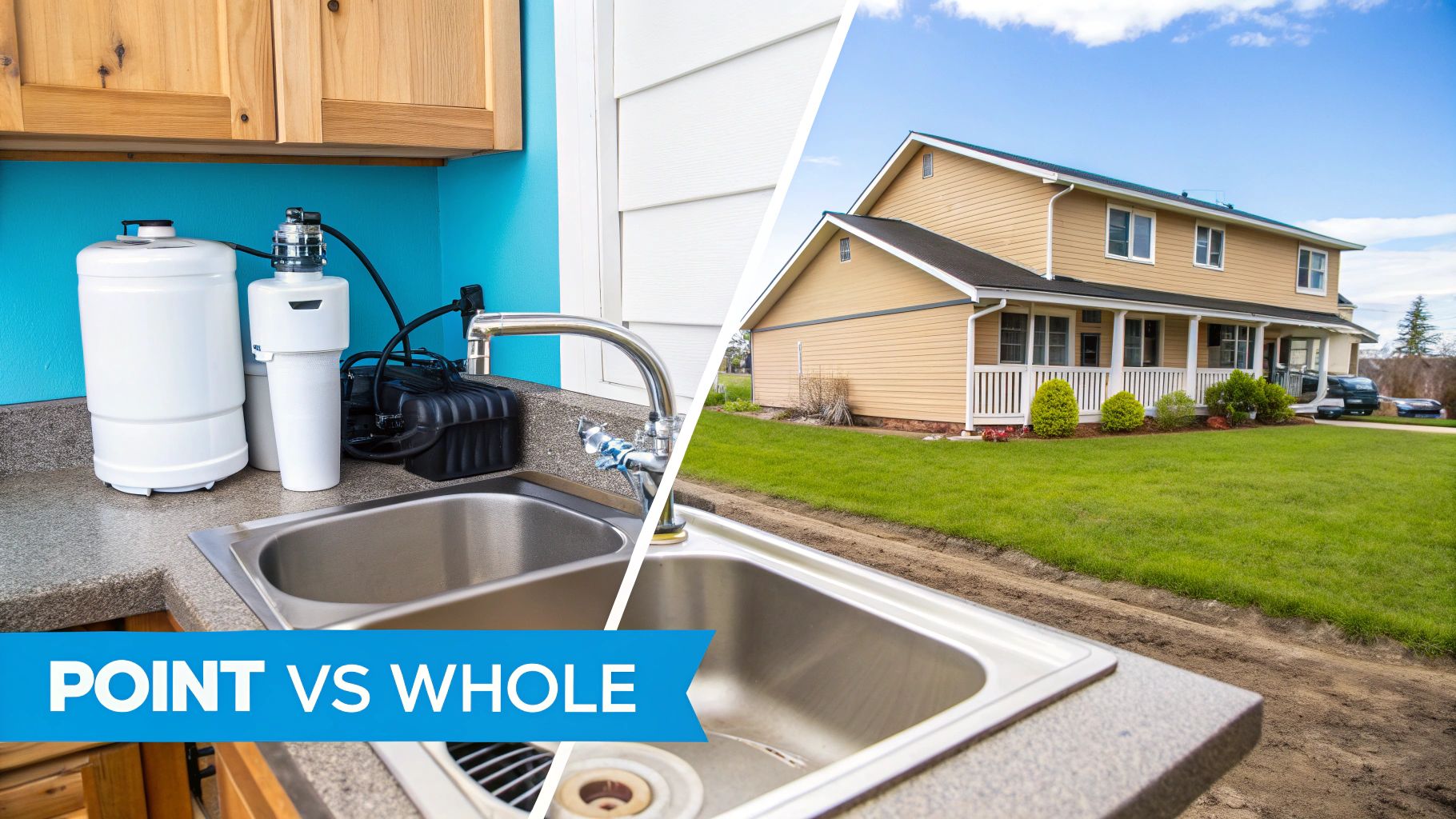
Alright, you've mastered the technologies that zap fluoride. Now for the next big decision: where do you want to filter your water? This choice is less about the science and more about your lifestyle.
Are you focused on purifying just the water you drink and cook with? Or are you aiming for a fortress-like solution that purifies every single drop entering your home? This is the core difference between Point-of-Use (POU) and Whole-House (POE) systems. Each has its pros and cons, and the best one for you depends entirely on your goals, your home, and your budget.
Let's unpack both options so you can figure out which one is your perfect match.
What Are Point-Of-Use Filters?
Think of a Point-of-Use system as a specialist. It targets water right where you’re going to use it—almost always the kitchen sink. It’s like having a personal chef for your drinking water, ensuring every glass you pour and every pot you fill is pristine.
These systems are a fantastic choice for renters and homeowners who want to zero in on their drinking and cooking water. They don't require major plumbing surgery, are easier on the wallet upfront, and come in several convenient forms.
- Under-Sink Filters: These are the most popular for a reason. They hide away neatly under your sink and connect to a separate, dedicated faucet. You get a steady stream of pure water without any clutter on your countertop.
- Countertop Filters: As the name implies, these units sit on your counter and connect directly to your main faucet. Installation is usually a snap, making them a great option if you can't or don't want to mess with the plumbing under the sink.
- Water Pitcher Filters: Here’s a crucial heads-up: most of the pitcher filters you see at the store don't remove fluoride. You have to find a specialized model that uses the right filter media for the job. They’re simple and portable, but do your homework to make sure you get the right one.
POU systems are a fantastic way to dip your toes in the water, so to speak. You get high-quality, fluoride-free water for all your consumption needs without the cost and complexity of a massive installation.
The All-Encompassing Whole-House Filter Solution
If a POU system is a personal chef, then a Whole-House filter is the entire five-star kitchen staff. These systems, also called Point-of-Entry (POE), are installed right where your main water line enters your house.
From that point on, they treat everything. Every faucet, every shower, and every appliance gets the same purified water. This is the ultimate setup for families concerned about more than just ingestion—like absorbing contaminants through the skin in the shower or inhaling them from steam. It offers complete peace of mind.
A whole-house fluoride removal filter is a true investment in your home's infrastructure. It does more than protect your family; it also guards your plumbing and appliances against the scale and chemical damage that can shorten their lifespan.
This level of coverage comes with a higher price tag and usually requires a professional plumber for installation. But for a homeowner who wants a complete, set-it-and-forget-it solution, the value is undeniable. Imagine showering in water that’s as pure as the water you drink. It’s a growing priority for many, which is why the global water filter market hit USD 14.26 billion in 2023 and is projected to reach USD 26.22 billion by 2032. You can dig into the numbers in the full report from SkyQuest.
Making the Right Choice for Your Home
So, which one is it going to be? The decision usually becomes clear when you answer a few key questions. Let’s put these two options side-by-side.
| Feature | Point-of-Use (POU) | Whole-House (POE) |
|---|---|---|
| Scope of Filtration | Treats water at a single point, like the kitchen sink. | Treats all water entering the home. |
| Primary Goal | Provides high-quality drinking and cooking water. | Ensures purified water from every tap, shower, and appliance. |
| Installation | Often DIY-friendly (countertop) or minor plumbing (under-sink). | Usually requires professional installation. |
| Initial Cost | Lower ($100 – $600) | Higher ($1,000 – $5,000+) |
| Best For | Renters, smaller households, or those on a tighter budget. | Homeowners, large families, and those seeking total protection. |
Someone renting an apartment would find an under-sink reverse osmosis system to be a perfect, non-permanent solution for amazing drinking water. On the flip side, a family settling into their forever home might see a whole-house system as a smart, long-term upgrade that adds value to both their health and their property.
Understanding the True Cost of Clean Water
When you’re shopping for a fluoride removal filter, the sticker price is just the tip of the iceberg. To really understand the investment, you have to look at the total cost of ownership—that’s the whole shebang, including the initial purchase, ongoing maintenance, and even a few hidden costs you might not expect.
Thinking about the full financial picture upfront saves you from surprise expenses down the road and helps you budget like a pro. It’s like planning a kitchen remodel; you wouldn’t just budget for the new cabinets and call it a day. In fact, many people consult detailed guides on home renovation costs to see the whole picture. The same mindset applies here.
Let’s break down exactly what goes into the cost of pure, fluoride-free water.
The Initial Purchase Price
First up is the system itself. As we’ve covered, the price range is wide and really depends on whether you go for a targeted point-of-use system or a comprehensive whole-house solution.
- Point-of-Use (POU) Systems: These are your most affordable entry point. A quality under-sink reverse osmosis or activated alumina filter will typically set you back anywhere from $150 to $600.
- Whole-House (POE) Systems: If you want to treat every drop of water in your home, the initial investment is much larger. You're generally looking at $1,000 to over $5,000, depending on the size of your home and the technology you choose.
This upfront cost gets you the main hardware—the filter housings, the first set of cartridges, a storage tank (for RO systems), and a dedicated faucet. But this is just the beginning of the financial journey.
Recurring Costs: Replacement Filters and Media
The real long-term cost of any water filter is its consumables. To keep your system working correctly, you must replace the filter cartridges or media on schedule. If you don't, your filter will stop removing fluoride and could even become a breeding ground for bacteria.
It's just like owning a printer; the machine is a one-time purchase, but you'll always need more ink.
A realistic annual maintenance budget for a typical under-sink reverse osmosis system is between $80 and $200. This covers the pre-filters, post-filters, and a new RO membrane every few years.
For a whole-house system, the costs can be higher, but replacements are less frequent. The large media tanks might only need new material every 3 to 5 years, but that replacement could easily run several hundred dollars when it's due.
Hidden Costs: Water and Electricity
Some filtration technologies have operational costs that aren't printed on the box. Reverse osmosis systems, our best weapon against fluoride, are a prime example.
Because RO works by forcing water through an incredibly fine membrane, it also produces wastewater that carries away all the rejected contaminants. Older systems were notoriously inefficient, wasting several gallons of water for every clean gallon produced. Thankfully, modern systems are much better, often getting close to a 1:1 waste ratio, but it’s still an extra utility cost to factor in.
Additionally, some larger RO systems or units with a UV purification stage need electricity to run booster pumps or lamps. This adds a small but steady amount to your monthly power bill. While these "hidden" expenses might seem minor, they all contribute to the true cost per gallon of your filtered water.
Installation, Maintenance, and Testing Your Water
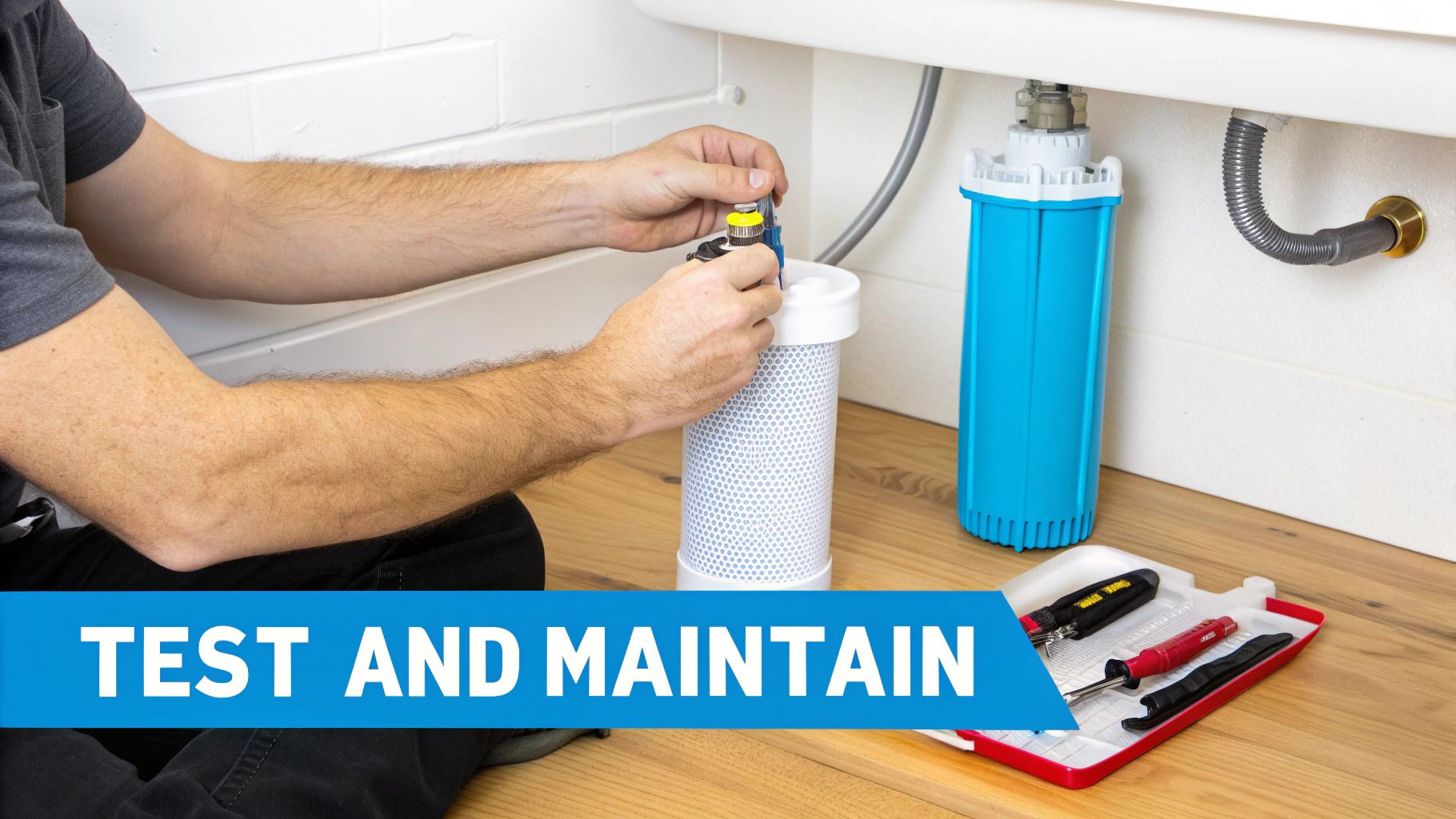
Okay, you've chosen your champion filter. That's a huge step, but the journey isn't over. Owning a fluoride removal filter is a lot like owning a car; you have to install it correctly, keep it maintained, and check under the hood occasionally to make sure it's doing its job.
This is the phase where you get to see the real-world results of your investment and achieve total peace of mind. Let's walk through everything from setup to testing, so you can keep that pure, clean water flowing for years to come.
Getting Your System Set Up
The installation can range from a five-minute task to a project requiring a professional plumber. It all depends on the system you chose. Figuring this out ahead of time will save you a world of headaches.
- DIY-Friendly Options: Most point-of-use systems, like countertop units and faucet-mounted filters, are designed to be ridiculously easy. Pop it on, and you're good to go. Even many under-sink systems are manageable for anyone with basic DIY skills—it's usually just a matter of connecting a few color-coded tubes.
- Professional Installation: Now, whole-house systems are a different animal. Since they tie directly into your main water line, this is almost always a job for a licensed plumber. A pro will ensure it's installed to code, won't leak, and doesn't negatively impact your home's water pressure.
A Simple Maintenance Checklist
Your filter is a workhorse, but it needs a little TLC to keep performing. Regular maintenance isn't optional if you want safe, effective filtration. Once a filter cartridge gets clogged, it stops removing fluoride, restricts water flow, and can even become a breeding ground for bacteria.
Think of your filter cartridges like the oil filter in your car. You wouldn't just ignore it, right? Neglecting it doesn't just hurt performance; it eventually causes much bigger problems. Sticking to a schedule is the single best thing you can do for your system's health.
Here’s a general timeline to keep in mind, but always, always follow the manufacturer's specific guidelines for your model.
- Pre-Filters (Every 6-12 Months): These are the gatekeepers, catching the big stuff like sediment and chlorine to protect the more sensitive (and expensive) filters down the line.
- Post-Filters (Every 12 Months): Think of these as the "polishers." They often treat the water after the main filtration stage to improve the taste and catch anything left over.
- Main Media/Membranes (Every 2-5 Years): This is the heart of your system—the reverse osmosis membrane, activated alumina, or bone char filter. These last much longer, but replacing them on schedule is absolutely critical.
How Do You Know It's Working?
This is the million-dollar question, isn't it? After you've invested in a quality fluoride removal filter, you deserve proof that it's delivering on its promise. The great news is you don't have to just take the company's word for it. You can test the water yourself.
- Home Water Test Kits: You can find specialized fluoride testing kits online. They usually use color-changing strips or simple electronic meters to give you an instant reading. They’re a fantastic way to get a quick before-and-after snapshot of your water.
- Professional Lab Analysis: For the most accurate, bulletproof results, send a water sample to a certified laboratory. They'll give you a precise measurement of fluoride concentration, down to the parts per million. This is how you confirm your filter’s performance with scientific certainty.
The demand for filters that can handle fluoride and other stubborn chemicals is exploding. In fact, the global market for media that filters out contaminants like PFAS is projected to grow by a staggering 183.7%, shooting up from $2.9 billion in 2026 to $8.2 billion by 2036. Technologies like Granular Activated Carbon (GAC) are at the forefront, making up a huge piece of the market for families wanting to ensure their water is truly clean. You can dive deeper into these market trends in a report from Fact.MR.
Common Questions About Fluoride Removal Filters
Even after doing your homework, a few nagging questions can keep you from pulling the trigger on the right fluoride removal filter. That's totally normal. Making a confident choice for your home means getting those last few uncertainties ironed out.
This section is dedicated to tackling those common questions head-on. We'll give you clear, straightforward answers so you can move forward with confidence.
Will a Standard Brita Filter Remove Fluoride?
This is probably the number one question out there, and the answer is a simple, resounding no. A standard Brita filter, or most basic carbon pitchers you grab off the shelf, will not remove fluoride.
Those filters are great for their intended purpose—mainly removing chlorine to make your water taste and smell better. They use a simple activated carbon that acts like a sponge for larger contaminants.
Fluoride ions, however, are tiny and slippery, requiring a more specialized filtration media to capture them. To actually remove fluoride, you need a system that uses technologies like reverse osmosis, activated alumina, or bone char—the very methods we've been discussing.
Do These Filters Also Remove Healthy Minerals?
Great question. The answer really depends on the filtration technology. Some do, and some don't, which is a key difference in the final quality of your water.
-
Reverse Osmosis (RO): Yes, RO systems are incredibly thorough. They strip out almost everything, which includes beneficial minerals like calcium and magnesium. The membrane's pores are just too fine for these minerals to pass through. To address this, many modern RO systems now include a remineralization filter as the final stage to add those healthy minerals back in before the water hits your glass.
-
Activated Alumina and Bone Char: These methods are much more selective. Think of them as specialists that target specific contaminants like fluoride, arsenic, and certain heavy metals. For the most part, they leave the healthy minerals alone, which is a huge plus if you prefer mineral-rich water.
It often comes down to personal preference: Do you want the absolute purest water possible (and then add good stuff back), or would you rather have a filter that surgically removes the bad stuff while leaving the good stuff intact?
How Can I Find Out My Local Fluoride Level?
You have to know your starting point. You can't tell if your filter is working if you don't know how much fluoride is in your tap water to begin with. Luckily, this is usually pretty easy to find out.
Most municipalities are required to provide residents with an annual water quality report, sometimes called a Consumer Confidence Report (CCR).
This report breaks down exactly what's in your water, including fluoride levels. You can usually find it on your local water utility’s website. If it’s not online, just give their office a call. If you're on a private well, the only way to know for sure is to get your water tested by a certified lab.
Are the Filtration Methods Themselves Safe?
Absolutely. The technologies used in a quality fluoride removal filter are well-established and proven to be safe for home use. Still, it's smart to be informed.
For example, some people express concern that activated alumina filters might leach aluminum into the water. It’s a valid question, but filters certified by organizations like the NSF (National Sanitation Foundation) are rigorously tested to ensure they're safe and don't add anything harmful. Any potential aluminum leaching is minimal and considered safe.
Bone char is a natural media, and reverse osmosis is simply a physical barrier. The biggest risk with any filter isn't the technology itself—it's poor maintenance. If you don't change filter cartridges on schedule, they can stop working and even harbor bacteria. For a deeper dive on different water treatment options and safety, you can find a ton of info in articles that offer expert advice on water filters.
Just stay on top of your maintenance schedule, and your system will keep providing clean, safe, and fluoride-free water for years.
At Water Filter Advisor, we believe everyone deserves access to clean, safe water. We're dedicated to providing the most reliable, research-driven reviews and guides to help you make the best choice for your family. Explore our in-depth resources and find your perfect filtration solution today at https://www.waterfilteradvisor.com.
- January 4, 2026
- 0
- Uncategorized
