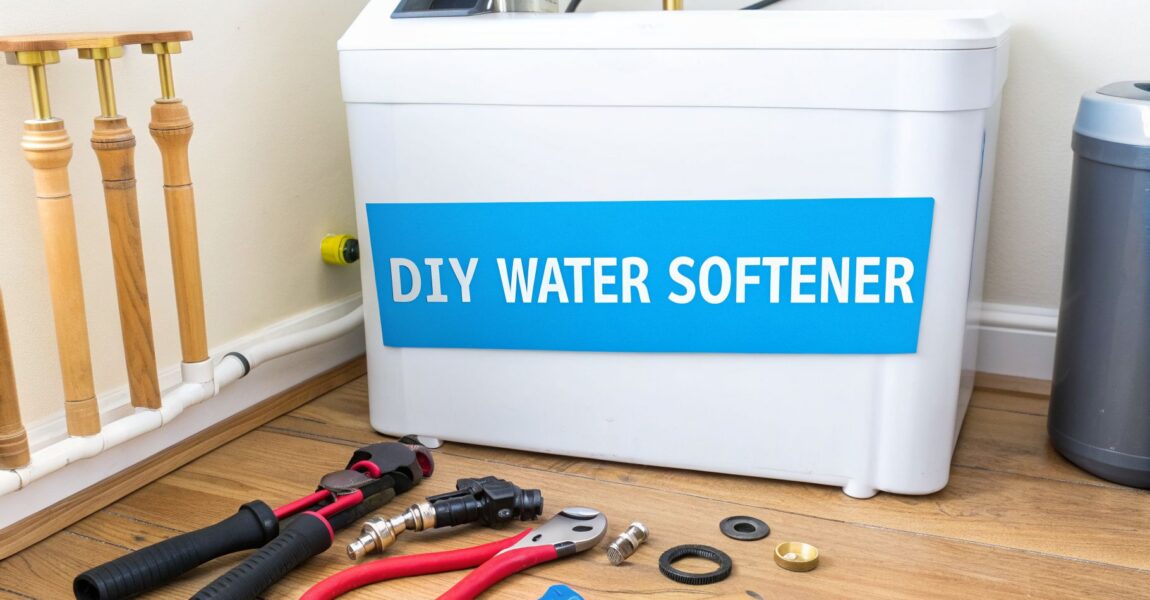
Taking on a DIY water softener installation is one of the best home filtration upgrades you can make, and you can conquer this project in just a few hours. This is a totally manageable mission for a handy homeowner. Modern systems come in plug-and-play kits that can save you a bundle on plumber fees.
Your Guide To Winning The War On Hard Water
If you're sick of the chalky white spots on your faucets, stiff laundry, and the ghost of soap scum haunting your shower doors, you've come to the right place. The villain in this story is hard water, which is loaded with minerals like calcium and magnesium. It might not be a health risk, but it's a real menace to your home's plumbing and appliances.

A water softener is the permanent fix. By installing one yourself, you're not just getting better water—you're protecting your big-ticket investments. Mineral buildup clogs pipes, guts the efficiency of your water heater, and sends dishwashers and washing machines to an early grave.
Why DIY Is The Ultimate Home Filtration Hack
DIY water softener jobs are booming, and for good reason. Today's salt-based and salt-free systems usually include complete kits, letting you sidestep a professional plumber and save anywhere from $500 to $1,000 on the install. The global market for these home water filtration systems reflects this trend.
This guide is here to walk you through the entire process, so you know exactly what you're getting into. We’ll cover the two main types of systems you’ll be looking at:
- Salt-Based Ion Exchange Systems: The traditional workhorses. They are the heavyweight champions of water filtration, pulling hardness minerals out of your water and swapping them with sodium ions. The result is truly soft water.
- Salt-Free Water Conditioners: These don't actually remove the minerals. Instead, they use a process called Template Assisted Crystallization (TAC) to change the mineral structure so it won't stick to surfaces and build up as scale.
When you install a water softener yourself, you gain a deep understanding of your home's water filtration system. You'll be ready for any future maintenance and can be proud you fixed the problem on your own.
We'll give you clear, actionable steps for a successful installation, from planning it out to firing it up. If you want to check out other home water filtration strategies, take a look at our broader https://www.waterfilteradvisor.com/advice/ section. Let's get started on bringing pure, soft water to every tap in your house.
Laying the Groundwork for Your Install
A successful water softener installation is all about the prep work. Honestly, what you do before you even unbox the unit is what separates a smooth Saturday project from a frustrating, leaky mess.
Get these first few steps right, and you'll end up with the right filtration system for your house without any nasty surprises down the road.
First thing's first: you need to know exactly what you're up against. That means testing your water to find out its hardness, measured in grains per gallon (GPG). Don't guess. Grab a simple water hardness test kit online or from the hardware store.
This single number is the most critical piece of the puzzle. It's the secret code that tells you everything you need to know to size your new filtration system correctly.
Choosing Your Water Softener Type
Before you get too deep into sizing, you need to decide which type of system is right for you. The two main players in home water filtration are traditional salt-based softeners and salt-free conditioners. Each has its pros and cons depending on your water, budget, and even local rules.
This table breaks down the key differences to help you make the right call.
| Feature | Salt-Based (Ion Exchange) | Salt-Free (TAC Conditioners) |
|---|---|---|
| How It Works | Physically removes hardness minerals (calcium & magnesium) through ion exchange. A true water filtration process. | Crystallizes minerals so they can't stick to pipes and surfaces. It doesn't actually remove them. |
| Feel of Water | Creates a noticeably "slippery" or "silky" feel. | No change in the water's feel. |
| Maintenance | Requires regular salt refills and uses water/power for regeneration cycles. | Virtually maintenance-free. No salt, no electricity, no wastewater. |
| Best For | Very hard water (over 10 GPG); when you want to eliminate scale buildup completely. | Moderately hard water; areas with brine discharge restrictions; those on low-sodium diets. |
| Environmental Impact | Discharges salt brine into the sewer or septic system. | No salt or chemical discharge, making it more eco-friendly. |
Ultimately, if you're battling seriously hard water and want that classic soft water feel, a salt-based system is your best bet. If you have moderate hardness and prefer a low-maintenance, eco-friendly option that still protects your pipes, a salt-free conditioner is a fantastic choice.
Getting the Sizing Right
Once you know your GPG, you need to figure out your home's daily water demand. A good, solid estimate is to multiply the number of people in your house by 75 gallons per day.
So, a family of four will use roughly 300 gallons of water each day (4 people x 75 gallons/person).
Now, let's put those two numbers together to find out how much filtration work the softener needs to do daily. The math is easy:
Daily Gallons Used × Water Hardness (GPG) = Daily Grains to Remove
Let's stick with our family of four, and say their water tested at 15 GPG:
300 gallons × 15 GPG = 4,500 grains per day
This tells you that you need a softener that can handle at least 4,500 grains of hardness between its cleaning (regeneration) cycles. Softeners are sold by their total capacity, which usually falls between 24,000 to 64,000 grains. A standard 32,000-grain unit would work perfectly here, needing to regenerate about once a week (32,000 ÷ 4,500 ≈ 7 days).
My advice? It's always better to go slightly bigger than you think you need. An undersized unit has to regenerate constantly, which just wastes salt and water and wears out the system faster. Think of it as buying a filtration system with room to grow.
Finding the Right Spot for Your System
With your capacity figured out, it's time to play scout and find the perfect home for your new unit. For any DIY water softener installation, you want to place it as close as you can to where the main water line enters your house. Crucially, it must be installed before the pipe splits off to your water heater.
This makes sure you get filtered, soft water for both your hot and cold taps (we usually leave outdoor faucets on hard water). A basement, garage, or utility closet is your best bet. Make sure the spot has:
- Enough Room: You need space for both the main resin tank and the separate brine (salt) tank, plus room to walk around them for maintenance.
- Power Nearby: Most softeners need a standard 110V GFCI outlet to run the control valve.
- A Place to Drain: The softener has to flush out salty water during regeneration. A floor drain, laundry sink, or standpipe are all good options.
A Quick Check on Local Rules
Last but not least, do yourself a favor and check your local plumbing codes before you buy anything. This is especially important for salt-based systems, as some towns have rules about discharging brine into the sewer or a septic tank.
A quick phone call to your city's building department will clear up any questions. Getting this sorted out now saves a massive headache later and ensures your home filtration project isn't just done right, but done legally.
Assembling Your Tools And Materials
A successful DIY water softener installation all comes down to good prep. Trust me, nothing kills your weekend project faster than having to make multiple runs back to the hardware store for a single fitting you forgot. Let's get everything you need laid out before you even think about cutting a pipe.
Think of it like this: a clean cut, a solid wrench, and good thread sealant are the three pillars of any home filtration plumbing job. Get these right, and you're already halfway to a leak-free installation.

Must-Have Tools For The Job
Let's sort out the absolute non-negotiables. You simply won’t be able to finish the job without these items in your toolkit.
Core Tool Checklist:
- Pipe Cutters: Make sure you have a cutter specifically for your pipe type—PEX, copper, or PVC. A clean, straight cut is everything for a good seal.
- Adjustable Wrenches (x2): You absolutely need two. One wrench holds the fitting in place while the other does the tightening. A couple of 10-inch or 12-inch wrenches are perfect.
- Tape Measure: The old rule holds true: measure twice, cut once. Getting your pipe lengths right from the start saves a lot of headaches.
- Bucket and Towels: Water is going to spill when you drain the lines. It's just a fact. Having a bucket underneath to catch the initial flow and towels for cleanup is just working smart.
- Teflon Tape: Also called plumber's tape, it’s essential for sealing threaded connections. I always grab two rolls. It's cheap, and running out mid-job is the worst.
If you're working with PEX tubing, you’ll also need a dedicated PEX crimping tool and the right size crimp rings. These are specialized, but they're the only way to create a secure connection that will pass inspection and last for years.
Gathering Your Plumbing Materials
Most softener kits will give you the main components: the control head, mineral tank, brine tank, and the bypass valve. That bypass valve is a crucial piece—it lets you shut off the softener for maintenance without turning off water to the entire house.
What the kit won't include is the plumbing to connect that bypass valve to your main water line. The exact pieces you need depend entirely on what's already in your house.
A hard-won personal tip: always buy a few extra fittings than you think you need. Having an extra elbow or connector on hand can turn a potential showstopper into a minor inconvenience.
When you're shopping, you’ll see different pipe materials. Knowing the pros and cons of PPR vs PVC vs CPVC is helpful if you're running new lines, but for this job, you'll mainly need adapters.
- Flexible Water Heater Connectors: These braided stainless steel hoses are a DIYer's best friend. Their flexibility makes it so much easier to line up the softener with your existing pipes. Check the fitting size you need—usually ¾-inch or 1-inch.
- Pipe-Specific Fittings: You'll need the right adapters to go from your home's pipes (copper, PEX, PVC) to the softener's connections. For a no-solder option on copper or PEX, SharkBite fittings are fantastic. They just push to connect and create a surprisingly strong seal.
- Drain Tubing: The kit probably includes a length of this, but unroll it and check. Make sure it's long enough to reach your floor drain or utility sink without any sharp bends or kinks that could block the flow.
Alright, you've got your tools, unboxed the new softener, and picked the perfect spot. Now for the main event: the installation itself. Don't let the plumbing intimidate you. We'll walk through this step-by-step, with some real-world advice to keep things dry and straightforward.

Think of it like minor surgery on your water lines. The plan is to shut everything down, make a few clean connections, and then bring it all back online. Just take your time and check every connection twice.
Safety First: Shut Down and Drain
Before you even think about touching a pipe cutter, kill the water supply to your house. Find the main shutoff valve—it’s usually in the basement, a crawlspace, or near where the water line enters your home from the outside. Crank it all the way off.
Now, you have to get the water out of the pipes. Head to the lowest faucet in your house (maybe a basement sink or an outdoor spigot) and the highest one (like an upstairs shower) and open them both up. This lets air into the system and helps every last drop drain out. This is a non-negotiable step if you want to avoid a surprise shower the second you cut into a pipe.
Making the Cut
With the system drained, it’s time to get to work on the main water line. Grab your tape measure and mark out the section of pipe you’ll be removing to install the bypass valve. Always remember the old rule: measure twice, cut once.
Stick a bucket right underneath where you plan to cut. No matter how well you think you've drained the pipes, there’s always a little water left. Use your pipe cutter to make two clean, straight cuts and remove the section. A clean cut is absolutely critical for getting a perfect, leak-free seal later.
Installing the Bypass Valve
The bypass valve is the nerve center of your new setup. It’s what lets you shut off water to the softener for maintenance without cutting off water to the entire house. Trust me, you’ll be glad you have it.
Most kits come with a bypass valve that attaches right to the softener's control head. Pay close attention to the arrows that show the direction of water flow. This part is crucial:
- The INLET side connects to the pipe bringing water from your main supply.
- The OUTLET side connects to the pipe that feeds the rest of your house and the water heater.
Pro Tip: When you install the bypass valve, make sure the handles are easy to get to. Don't face them toward a wall where you can't reach them. A little bit of planning here will save you a ton of hassle down the road when it's time for maintenance.
Now, connect the valve to your main lines using whatever fittings you chose. If you're using flexible braided lines, get them hand-tight and then give them one last quarter-turn with a wrench. For push-to-connect fittings like SharkBites, make sure the pipe end is clean and push it in firmly until you hear and feel it click home.
Connecting the Softener Tanks
Next, it’s time to hook the main mineral tank up to the bypass valve. Attach your flexible hoses to the inlet and outlet ports on the control head. Again, follow the arrows to make sure water flows in through the hard water side and out through the soft water side.
This is where your type of home filtration system really matters. A traditional salt-based system has two tanks, while a salt-free conditioner is usually just a single unit.
- For Salt-Based Systems: You'll have a separate brine tank. Connect the small brine line tube from the control head over to the port on the brine tank. This little tube is what pulls the salt solution into the main tank during the regeneration cycle.
- For Salt-Free Conditioners: No brine tank, no problem. You can skip that step entirely. Just connect your inlet and outlet, and your plumbing work is almost finished.
This all sounds more complicated than it is. For most DIYers, connecting the valves and tanks is a straightforward job that takes just 2-3 hours. The payoff is huge, often leading to a 99% reduction in hardness down to less than 7 grains per gallon. For a family in a hard-water area, that can mean saving around $200 a year on soaps and energy. You can dig into more data on the water softening market to see just how big an impact these home water filtration systems have.
Running the Drain and Overflow Lines
A salt-based softener has to flush out all the hardness minerals and salty brine it collects during regeneration. To do that, you need to run two lines to a drain.
First is the main drain line. This flexible tube runs from the control head to a floor drain, standpipe, or utility sink. It's critical to leave an air gap of at least 1.5 inches between the end of the tube and the drain. This prevents any contaminated water from being siphoned back into your fresh, filtered system.
Second is the brine tank overflow tube. This is purely a safety measure. If the brine tank ever gets too full, this tube directs the excess water to the same drain, stopping a salty flood before it starts. Use zip ties or a clamp to make sure both tubes are secure and won't pop out of the drain.
Once all your connections are solid and the drain lines are secure, you're officially done with the hardest part of your DIY water softener installation. Step back and admire your handiwork before we move on to the final checks and startup.
Bringing Your New System Online

Alright, the pipes are all connected and you’ve double-checked every fitting. This is the moment you've been working toward. It's time to fire up your new water softener and program the brains of the operation.
The tough part is behind you. Now let's get this filtration system commissioned the right way.
The Slow Introduction of Water
Don't just crank the main water valve all the way open. You never want to slam a new system with a sudden blast of high-pressure water. That's a good way to stress the connections or even damage the softener's guts. Slow and steady is the name of the game here.
First, make sure the softener's bypass valve is still set to "bypass." This lets water flow to the house while keeping the softener isolated for now.
Slowly turn your main water shutoff valve about a quarter-turn open. Go run a faucet somewhere in the house to confirm you have flow, then head back and inspect all your new plumbing for any drips.
If it's all dry, you can now slowly move the bypass valve toward the "service" position. Listen closely—you should hear the big mineral tank start to fill with water. This is your most important leak check. Get a flashlight and get a good look at every single connection you made. Look for the smallest bead of water.
I always give it a solid 15-20 minutes after the tank fills before I call it leak-free. I've seen slow seeps take their time to show up, and finding one now is much better than finding a puddle later.
Programming the Control Head
Once you're positive everything is watertight, go ahead and plug in the control head. This is where you'll tell the softener just how hard your water is and set up its cleaning schedule. The digital display might look a little intimidating, but the process is usually pretty simple.
Your most important job is to enter the water hardness number (in GPG) from your water test. This one setting is the key to the whole operation, as it tells the unit how often it needs to regenerate.
Next, you'll set the time of day and the regeneration time. I always recommend setting it for a time when no one is using water, like 2:00 AM. This way, the regeneration cycle won't interrupt a shower with hard water or cause a drop in water pressure. Some newer softeners have smart features that track your water usage and only regenerate when needed, which is a great way to save on salt and water.
While this is a DIY guide, getting different perspectives on installing water softeners can give you extra tips on programming and what to expect long-term.
Kicking Off the First Regeneration
With the programming done, you have to manually start the very first regeneration cycle. This is a critical step. It flushes out any leftover dust or debris from the manufacturing process and, more importantly, it gives the resin beads their initial charge by soaking them in brine.
Pour a few gallons of water directly into the brine tank first, then add one or two bags of good-quality softener salt. Check your manual to find the "Manual Regeneration" button—you'll usually need to press and hold it to get the cycle started.
This first cycle can take up to two hours to complete. It will run through a few key stages:
- Backwash: Loosens up the resin bed and washes out any sediment.
- Brine Draw: Sucks the salty water from the brine tank to "recharge" the resin.
- Slow Rinse: Pushes the brine solution completely through the resin.
- Rapid Rinse: Flushes all the excess salt and hardness minerals out to the drain line.
- Brine Refill: Adds water back to the brine tank to dissolve salt for the next cycle.
Once that's finished, your system is officially up and running. Congratulations, you're now making beautifully filtered, soft water!
A Simple Maintenance Schedule
Your DIY water softener installation might be complete, but a little bit of care will keep it running smoothly for years to come. The good news is, there isn't much to it.
Your Long-Term Checklist:
- Check Salt Levels Monthly: This is your main job. Just peek in the brine tank once a month and make sure it's at least one-third full of salt.
- Use the Right Salt: Stick to high-purity salt pellets or crystals. You want to avoid rock salt; it's full of dirt and impurities that can eventually clog your filtration system.
- Clean the Brine Tank Annually: About once a year, let the salt level get low and then clean out the bottom of the brine tank. This gets rid of any "salt mush" or sediment and prevents a "salt bridge"—a hard crust that can form and stop the softener from making brine.
Common Questions About DIY Installation
Even after you've followed a guide, questions will pop up. A DIY water softener installation has a lot of moving parts, and it’s totally normal to hit a snag or two.
We get calls all the time about these exact situations. Here are the most common questions we hear, with answers to get you through the finish line.
Can I Install A Water Softener On A Well System?
Absolutely. In fact, if you have well water, you probably need a softener more than most. The main thing to know is that well water often comes with extra baggage—sediment, sand, and sometimes a lot of iron. All that gunk can destroy a new softener.
Your best move is to install a sediment pre-filter right before the water softener's inlet. Think of it as a bodyguard for your softener. It catches all the debris before it can clog up the resin bed. If you skip this, the resin gets fouled, its filtration efficiency tanks, and you’ll be replacing the whole unit way sooner than you should.
What Should I Do If I Notice A Small Leak After Installation?
First, don't panic. A small drip is almost always an easy fix.
Hit the bypass valve first. This is exactly why you installed it. You can shut off water to the softener and keep it running for the rest of the house.
Now, find the leak. Most of the time, it’s a threaded connection that isn't quite sealed.
- Shut off the water to the unit and drain any pressure.
- Unscrew the fitting that's dripping.
- Clean all the old Teflon tape off the threads.
- Wrap the male threads with fresh Teflon tape. Give it a good 3-4 wraps, going in the same direction you'll be tightening the fitting.
- Screw it back together. Get it snug, but don’t go crazy, especially with plastic parts. Over-tightening is a great way to crack a fitting.
Slowly turn the water back on and check your work. That extra tape usually does the trick.
Does My Whole House Need Soft Water?
That’s a great question, and the practical answer is no, probably not. Soft water is incredible for your showers, appliances, and laundry, but your lawn and garden won’t be fans. The sodium in softened water isn't great for plants long-term.
For that reason, standard practice for a DIY water softener installation is to plumb the system so it treats all the water after your outdoor spigots. This gives you the best of both worlds: your indoor plumbing and appliances are protected by superior water filtration, and your garden stays happy.
Why Is My Water Pressure Lower After Installation?
A big drop in water pressure is not normal. It's a red flag that something went wrong during the install.
Start with the simple stuff: check that every single valve is fully open. The main shutoff, the bypass valve, all of them. It's surprisingly easy to leave one only halfway open.
If the valves are good, look for a kink in one of the flexible connector hoses or even the drain line. Also, make sure you didn't install the unit backward—if the water is flowing against the intended direction, it will choke off your pressure. Finally, this can happen if the home filtration system is too small for your house, which is why getting the sizing right from the very beginning is so important.
Water Filter Advisor is your go-to resource for making sense of home water filtration. From in-depth guides to unbiased reviews, we provide the clarity you need to choose the best solutions for your family's health and comfort. Explore our resources today at https://www.waterfilteradvisor.com.
- March 4, 2026
- 0
- Uncategorized
