DIY Water Softener Installation A Homeowner’s Guide to Pure Water

Taking on a DIY water softener installation is one of the best home filtration upgrades you can make, and you can conquer this project in just a few hours. This is a totally manageable mission for a handy homeowner. Modern systems come in plug-and-play kits that can save you a bundle on plumber fees.

Your Guide To Winning The War On Hard Water

If you're sick of the chalky white spots on your faucets, stiff laundry, and the ghost of soap scum haunting your shower doors, you've come to the right place. The villain in this story is hard water, which is loaded with minerals like calcium and magnesium. It might not be a health risk, but it's a real menace to your home's plumbing and appliances.

Close-up of a kitchen sink and faucet heavily covered in hard water stains and mineral deposits.

A water softener is the permanent fix. By installing one yourself, you're not just getting better water—you're protecting your big-ticket investments. Mineral buildup clogs pipes, guts the efficiency of your water heater, and sends dishwashers and washing machines to an early grave.

Why DIY Is The Ultimate Home Filtration Hack

DIY water softener jobs are booming, and for good reason. Today's salt-based and salt-free systems usually include complete kits, letting you sidestep a professional plumber and save anywhere from $500 to $1,000 on the install. The global market for these home water filtration systems reflects this trend.

This guide is here to walk you through the entire process, so you know exactly what you're getting into. We’ll cover the two main types of systems you’ll be looking at:

  • Salt-Based Ion Exchange Systems: The traditional workhorses. They are the heavyweight champions of water filtration, pulling hardness minerals out of your water and swapping them with sodium ions. The result is truly soft water.
  • Salt-Free Water Conditioners: These don't actually remove the minerals. Instead, they use a process called Template Assisted Crystallization (TAC) to change the mineral structure so it won't stick to surfaces and build up as scale.

When you install a water softener yourself, you gain a deep understanding of your home's water filtration system. You'll be ready for any future maintenance and can be proud you fixed the problem on your own.

We'll give you clear, actionable steps for a successful installation, from planning it out to firing it up. If you want to check out other home water filtration strategies, take a look at our broader https://www.waterfilteradvisor.com/advice/ section. Let's get started on bringing pure, soft water to every tap in your house.

Laying the Groundwork for Your Install

A successful water softener installation is all about the prep work. Honestly, what you do before you even unbox the unit is what separates a smooth Saturday project from a frustrating, leaky mess.

Get these first few steps right, and you'll end up with the right filtration system for your house without any nasty surprises down the road.

First thing's first: you need to know exactly what you're up against. That means testing your water to find out its hardness, measured in grains per gallon (GPG). Don't guess. Grab a simple water hardness test kit online or from the hardware store.

This single number is the most critical piece of the puzzle. It's the secret code that tells you everything you need to know to size your new filtration system correctly.

Choosing Your Water Softener Type

Before you get too deep into sizing, you need to decide which type of system is right for you. The two main players in home water filtration are traditional salt-based softeners and salt-free conditioners. Each has its pros and cons depending on your water, budget, and even local rules.

This table breaks down the key differences to help you make the right call.

Feature Salt-Based (Ion Exchange) Salt-Free (TAC Conditioners)
How It Works Physically removes hardness minerals (calcium & magnesium) through ion exchange. A true water filtration process. Crystallizes minerals so they can't stick to pipes and surfaces. It doesn't actually remove them.
Feel of Water Creates a noticeably "slippery" or "silky" feel. No change in the water's feel.
Maintenance Requires regular salt refills and uses water/power for regeneration cycles. Virtually maintenance-free. No salt, no electricity, no wastewater.
Best For Very hard water (over 10 GPG); when you want to eliminate scale buildup completely. Moderately hard water; areas with brine discharge restrictions; those on low-sodium diets.
Environmental Impact Discharges salt brine into the sewer or septic system. No salt or chemical discharge, making it more eco-friendly.

Ultimately, if you're battling seriously hard water and want that classic soft water feel, a salt-based system is your best bet. If you have moderate hardness and prefer a low-maintenance, eco-friendly option that still protects your pipes, a salt-free conditioner is a fantastic choice.

Getting the Sizing Right

Once you know your GPG, you need to figure out your home's daily water demand. A good, solid estimate is to multiply the number of people in your house by 75 gallons per day.

So, a family of four will use roughly 300 gallons of water each day (4 people x 75 gallons/person).

Now, let's put those two numbers together to find out how much filtration work the softener needs to do daily. The math is easy:

Daily Gallons Used × Water Hardness (GPG) = Daily Grains to Remove

Let's stick with our family of four, and say their water tested at 15 GPG:

300 gallons × 15 GPG = 4,500 grains per day

This tells you that you need a softener that can handle at least 4,500 grains of hardness between its cleaning (regeneration) cycles. Softeners are sold by their total capacity, which usually falls between 24,000 to 64,000 grains. A standard 32,000-grain unit would work perfectly here, needing to regenerate about once a week (32,000 ÷ 4,500 ≈ 7 days).

My advice? It's always better to go slightly bigger than you think you need. An undersized unit has to regenerate constantly, which just wastes salt and water and wears out the system faster. Think of it as buying a filtration system with room to grow.

Finding the Right Spot for Your System

With your capacity figured out, it's time to play scout and find the perfect home for your new unit. For any DIY water softener installation, you want to place it as close as you can to where the main water line enters your house. Crucially, it must be installed before the pipe splits off to your water heater.

This makes sure you get filtered, soft water for both your hot and cold taps (we usually leave outdoor faucets on hard water). A basement, garage, or utility closet is your best bet. Make sure the spot has:

  • Enough Room: You need space for both the main resin tank and the separate brine (salt) tank, plus room to walk around them for maintenance.
  • Power Nearby: Most softeners need a standard 110V GFCI outlet to run the control valve.
  • A Place to Drain: The softener has to flush out salty water during regeneration. A floor drain, laundry sink, or standpipe are all good options.

A Quick Check on Local Rules

Last but not least, do yourself a favor and check your local plumbing codes before you buy anything. This is especially important for salt-based systems, as some towns have rules about discharging brine into the sewer or a septic tank.

A quick phone call to your city's building department will clear up any questions. Getting this sorted out now saves a massive headache later and ensures your home filtration project isn't just done right, but done legally.

Assembling Your Tools And Materials

A successful DIY water softener installation all comes down to good prep. Trust me, nothing kills your weekend project faster than having to make multiple runs back to the hardware store for a single fitting you forgot. Let's get everything you need laid out before you even think about cutting a pipe.

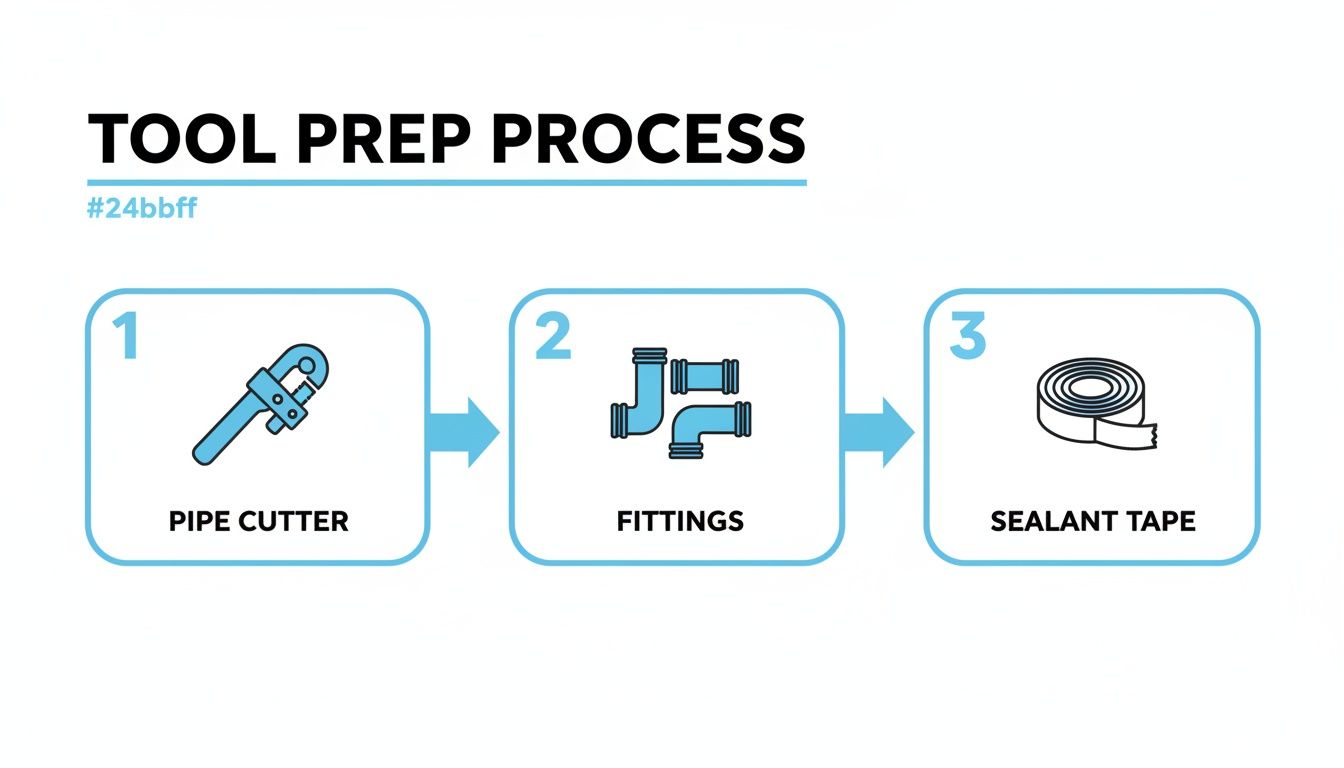
Think of it like this: a clean cut, a solid wrench, and good thread sealant are the three pillars of any home filtration plumbing job. Get these right, and you're already halfway to a leak-free installation.

Essential plumbing tools process showing a pipe cutter, wrench, and teflon tape icons.

Must-Have Tools For The Job

Let's sort out the absolute non-negotiables. You simply won’t be able to finish the job without these items in your toolkit.

Core Tool Checklist:

  • Pipe Cutters: Make sure you have a cutter specifically for your pipe type—PEX, copper, or PVC. A clean, straight cut is everything for a good seal.
  • Adjustable Wrenches (x2): You absolutely need two. One wrench holds the fitting in place while the other does the tightening. A couple of 10-inch or 12-inch wrenches are perfect.
  • Tape Measure: The old rule holds true: measure twice, cut once. Getting your pipe lengths right from the start saves a lot of headaches.
  • Bucket and Towels: Water is going to spill when you drain the lines. It's just a fact. Having a bucket underneath to catch the initial flow and towels for cleanup is just working smart.
  • Teflon Tape: Also called plumber's tape, it’s essential for sealing threaded connections. I always grab two rolls. It's cheap, and running out mid-job is the worst.

If you're working with PEX tubing, you’ll also need a dedicated PEX crimping tool and the right size crimp rings. These are specialized, but they're the only way to create a secure connection that will pass inspection and last for years.

Gathering Your Plumbing Materials

Most softener kits will give you the main components: the control head, mineral tank, brine tank, and the bypass valve. That bypass valve is a crucial piece—it lets you shut off the softener for maintenance without turning off water to the entire house.

What the kit won't include is the plumbing to connect that bypass valve to your main water line. The exact pieces you need depend entirely on what's already in your house.

A hard-won personal tip: always buy a few extra fittings than you think you need. Having an extra elbow or connector on hand can turn a potential showstopper into a minor inconvenience.

When you're shopping, you’ll see different pipe materials. Knowing the pros and cons of PPR vs PVC vs CPVC is helpful if you're running new lines, but for this job, you'll mainly need adapters.

  • Flexible Water Heater Connectors: These braided stainless steel hoses are a DIYer's best friend. Their flexibility makes it so much easier to line up the softener with your existing pipes. Check the fitting size you need—usually ¾-inch or 1-inch.
  • Pipe-Specific Fittings: You'll need the right adapters to go from your home's pipes (copper, PEX, PVC) to the softener's connections. For a no-solder option on copper or PEX, SharkBite fittings are fantastic. They just push to connect and create a surprisingly strong seal.
  • Drain Tubing: The kit probably includes a length of this, but unroll it and check. Make sure it's long enough to reach your floor drain or utility sink without any sharp bends or kinks that could block the flow.

Alright, you've got your tools, unboxed the new softener, and picked the perfect spot. Now for the main event: the installation itself. Don't let the plumbing intimidate you. We'll walk through this step-by-step, with some real-world advice to keep things dry and straightforward.

A man installs a white water softener system, adjusting brass fittings in a utility room.

Think of it like minor surgery on your water lines. The plan is to shut everything down, make a few clean connections, and then bring it all back online. Just take your time and check every connection twice.

Safety First: Shut Down and Drain

Before you even think about touching a pipe cutter, kill the water supply to your house. Find the main shutoff valve—it’s usually in the basement, a crawlspace, or near where the water line enters your home from the outside. Crank it all the way off.

Now, you have to get the water out of the pipes. Head to the lowest faucet in your house (maybe a basement sink or an outdoor spigot) and the highest one (like an upstairs shower) and open them both up. This lets air into the system and helps every last drop drain out. This is a non-negotiable step if you want to avoid a surprise shower the second you cut into a pipe.

Making the Cut

With the system drained, it’s time to get to work on the main water line. Grab your tape measure and mark out the section of pipe you’ll be removing to install the bypass valve. Always remember the old rule: measure twice, cut once.

Stick a bucket right underneath where you plan to cut. No matter how well you think you've drained the pipes, there’s always a little water left. Use your pipe cutter to make two clean, straight cuts and remove the section. A clean cut is absolutely critical for getting a perfect, leak-free seal later.

Installing the Bypass Valve

The bypass valve is the nerve center of your new setup. It’s what lets you shut off water to the softener for maintenance without cutting off water to the entire house. Trust me, you’ll be glad you have it.

Most kits come with a bypass valve that attaches right to the softener's control head. Pay close attention to the arrows that show the direction of water flow. This part is crucial:

  • The INLET side connects to the pipe bringing water from your main supply.
  • The OUTLET side connects to the pipe that feeds the rest of your house and the water heater.

Pro Tip: When you install the bypass valve, make sure the handles are easy to get to. Don't face them toward a wall where you can't reach them. A little bit of planning here will save you a ton of hassle down the road when it's time for maintenance.

Now, connect the valve to your main lines using whatever fittings you chose. If you're using flexible braided lines, get them hand-tight and then give them one last quarter-turn with a wrench. For push-to-connect fittings like SharkBites, make sure the pipe end is clean and push it in firmly until you hear and feel it click home.

Connecting the Softener Tanks

Next, it’s time to hook the main mineral tank up to the bypass valve. Attach your flexible hoses to the inlet and outlet ports on the control head. Again, follow the arrows to make sure water flows in through the hard water side and out through the soft water side.

This is where your type of home filtration system really matters. A traditional salt-based system has two tanks, while a salt-free conditioner is usually just a single unit.

  • For Salt-Based Systems: You'll have a separate brine tank. Connect the small brine line tube from the control head over to the port on the brine tank. This little tube is what pulls the salt solution into the main tank during the regeneration cycle.
  • For Salt-Free Conditioners: No brine tank, no problem. You can skip that step entirely. Just connect your inlet and outlet, and your plumbing work is almost finished.

This all sounds more complicated than it is. For most DIYers, connecting the valves and tanks is a straightforward job that takes just 2-3 hours. The payoff is huge, often leading to a 99% reduction in hardness down to less than 7 grains per gallon. For a family in a hard-water area, that can mean saving around $200 a year on soaps and energy. You can dig into more data on the water softening market to see just how big an impact these home water filtration systems have.

Running the Drain and Overflow Lines

A salt-based softener has to flush out all the hardness minerals and salty brine it collects during regeneration. To do that, you need to run two lines to a drain.

First is the main drain line. This flexible tube runs from the control head to a floor drain, standpipe, or utility sink. It's critical to leave an air gap of at least 1.5 inches between the end of the tube and the drain. This prevents any contaminated water from being siphoned back into your fresh, filtered system.

Second is the brine tank overflow tube. This is purely a safety measure. If the brine tank ever gets too full, this tube directs the excess water to the same drain, stopping a salty flood before it starts. Use zip ties or a clamp to make sure both tubes are secure and won't pop out of the drain.

Once all your connections are solid and the drain lines are secure, you're officially done with the hardest part of your DIY water softener installation. Step back and admire your handiwork before we move on to the final checks and startup.

Bringing Your New System Online

A hand adjusts the digital control panel of a blue water softener system, displaying 'SYSTEM STARTUP'.

Alright, the pipes are all connected and you’ve double-checked every fitting. This is the moment you've been working toward. It's time to fire up your new water softener and program the brains of the operation.

The tough part is behind you. Now let's get this filtration system commissioned the right way.

The Slow Introduction of Water

Don't just crank the main water valve all the way open. You never want to slam a new system with a sudden blast of high-pressure water. That's a good way to stress the connections or even damage the softener's guts. Slow and steady is the name of the game here.

First, make sure the softener's bypass valve is still set to "bypass." This lets water flow to the house while keeping the softener isolated for now.

Slowly turn your main water shutoff valve about a quarter-turn open. Go run a faucet somewhere in the house to confirm you have flow, then head back and inspect all your new plumbing for any drips.

If it's all dry, you can now slowly move the bypass valve toward the "service" position. Listen closely—you should hear the big mineral tank start to fill with water. This is your most important leak check. Get a flashlight and get a good look at every single connection you made. Look for the smallest bead of water.

I always give it a solid 15-20 minutes after the tank fills before I call it leak-free. I've seen slow seeps take their time to show up, and finding one now is much better than finding a puddle later.

Programming the Control Head

Once you're positive everything is watertight, go ahead and plug in the control head. This is where you'll tell the softener just how hard your water is and set up its cleaning schedule. The digital display might look a little intimidating, but the process is usually pretty simple.

Your most important job is to enter the water hardness number (in GPG) from your water test. This one setting is the key to the whole operation, as it tells the unit how often it needs to regenerate.

Next, you'll set the time of day and the regeneration time. I always recommend setting it for a time when no one is using water, like 2:00 AM. This way, the regeneration cycle won't interrupt a shower with hard water or cause a drop in water pressure. Some newer softeners have smart features that track your water usage and only regenerate when needed, which is a great way to save on salt and water.

While this is a DIY guide, getting different perspectives on installing water softeners can give you extra tips on programming and what to expect long-term.

Kicking Off the First Regeneration

With the programming done, you have to manually start the very first regeneration cycle. This is a critical step. It flushes out any leftover dust or debris from the manufacturing process and, more importantly, it gives the resin beads their initial charge by soaking them in brine.

Pour a few gallons of water directly into the brine tank first, then add one or two bags of good-quality softener salt. Check your manual to find the "Manual Regeneration" button—you'll usually need to press and hold it to get the cycle started.

This first cycle can take up to two hours to complete. It will run through a few key stages:

  • Backwash: Loosens up the resin bed and washes out any sediment.
  • Brine Draw: Sucks the salty water from the brine tank to "recharge" the resin.
  • Slow Rinse: Pushes the brine solution completely through the resin.
  • Rapid Rinse: Flushes all the excess salt and hardness minerals out to the drain line.
  • Brine Refill: Adds water back to the brine tank to dissolve salt for the next cycle.

Once that's finished, your system is officially up and running. Congratulations, you're now making beautifully filtered, soft water!

A Simple Maintenance Schedule

Your DIY water softener installation might be complete, but a little bit of care will keep it running smoothly for years to come. The good news is, there isn't much to it.

Your Long-Term Checklist:

  1. Check Salt Levels Monthly: This is your main job. Just peek in the brine tank once a month and make sure it's at least one-third full of salt.
  2. Use the Right Salt: Stick to high-purity salt pellets or crystals. You want to avoid rock salt; it's full of dirt and impurities that can eventually clog your filtration system.
  3. Clean the Brine Tank Annually: About once a year, let the salt level get low and then clean out the bottom of the brine tank. This gets rid of any "salt mush" or sediment and prevents a "salt bridge"—a hard crust that can form and stop the softener from making brine.

Common Questions About DIY Installation

Even after you've followed a guide, questions will pop up. A DIY water softener installation has a lot of moving parts, and it’s totally normal to hit a snag or two.

We get calls all the time about these exact situations. Here are the most common questions we hear, with answers to get you through the finish line.

Can I Install A Water Softener On A Well System?

Absolutely. In fact, if you have well water, you probably need a softener more than most. The main thing to know is that well water often comes with extra baggage—sediment, sand, and sometimes a lot of iron. All that gunk can destroy a new softener.

Your best move is to install a sediment pre-filter right before the water softener's inlet. Think of it as a bodyguard for your softener. It catches all the debris before it can clog up the resin bed. If you skip this, the resin gets fouled, its filtration efficiency tanks, and you’ll be replacing the whole unit way sooner than you should.

What Should I Do If I Notice A Small Leak After Installation?

First, don't panic. A small drip is almost always an easy fix.

Hit the bypass valve first. This is exactly why you installed it. You can shut off water to the softener and keep it running for the rest of the house.

Now, find the leak. Most of the time, it’s a threaded connection that isn't quite sealed.

  • Shut off the water to the unit and drain any pressure.
  • Unscrew the fitting that's dripping.
  • Clean all the old Teflon tape off the threads.
  • Wrap the male threads with fresh Teflon tape. Give it a good 3-4 wraps, going in the same direction you'll be tightening the fitting.
  • Screw it back together. Get it snug, but don’t go crazy, especially with plastic parts. Over-tightening is a great way to crack a fitting.

Slowly turn the water back on and check your work. That extra tape usually does the trick.

Does My Whole House Need Soft Water?

That’s a great question, and the practical answer is no, probably not. Soft water is incredible for your showers, appliances, and laundry, but your lawn and garden won’t be fans. The sodium in softened water isn't great for plants long-term.

For that reason, standard practice for a DIY water softener installation is to plumb the system so it treats all the water after your outdoor spigots. This gives you the best of both worlds: your indoor plumbing and appliances are protected by superior water filtration, and your garden stays happy.

Why Is My Water Pressure Lower After Installation?

A big drop in water pressure is not normal. It's a red flag that something went wrong during the install.

Start with the simple stuff: check that every single valve is fully open. The main shutoff, the bypass valve, all of them. It's surprisingly easy to leave one only halfway open.

If the valves are good, look for a kink in one of the flexible connector hoses or even the drain line. Also, make sure you didn't install the unit backward—if the water is flowing against the intended direction, it will choke off your pressure. Finally, this can happen if the home filtration system is too small for your house, which is why getting the sizing right from the very beginning is so important.


Water Filter Advisor is your go-to resource for making sense of home water filtration. From in-depth guides to unbiased reviews, we provide the clarity you need to choose the best solutions for your family's health and comfort. Explore our resources today at https://www.waterfilteradvisor.com.

A DIY Guide to whole home water filtration system installation That Won’t End in a Flood

Let's be honest, a successful whole-home water filtration system installation doesn't start with a pipe cutter. It begins long before you even dream of getting your tools out; it starts with a rock-solid plan. This isn't just about avoiding a DIY disaster—good planning is what separates a system that delivers pure, delicious water for years from one that becomes your next big headache.

Planning Your Installation for Flawless, Filtered Water

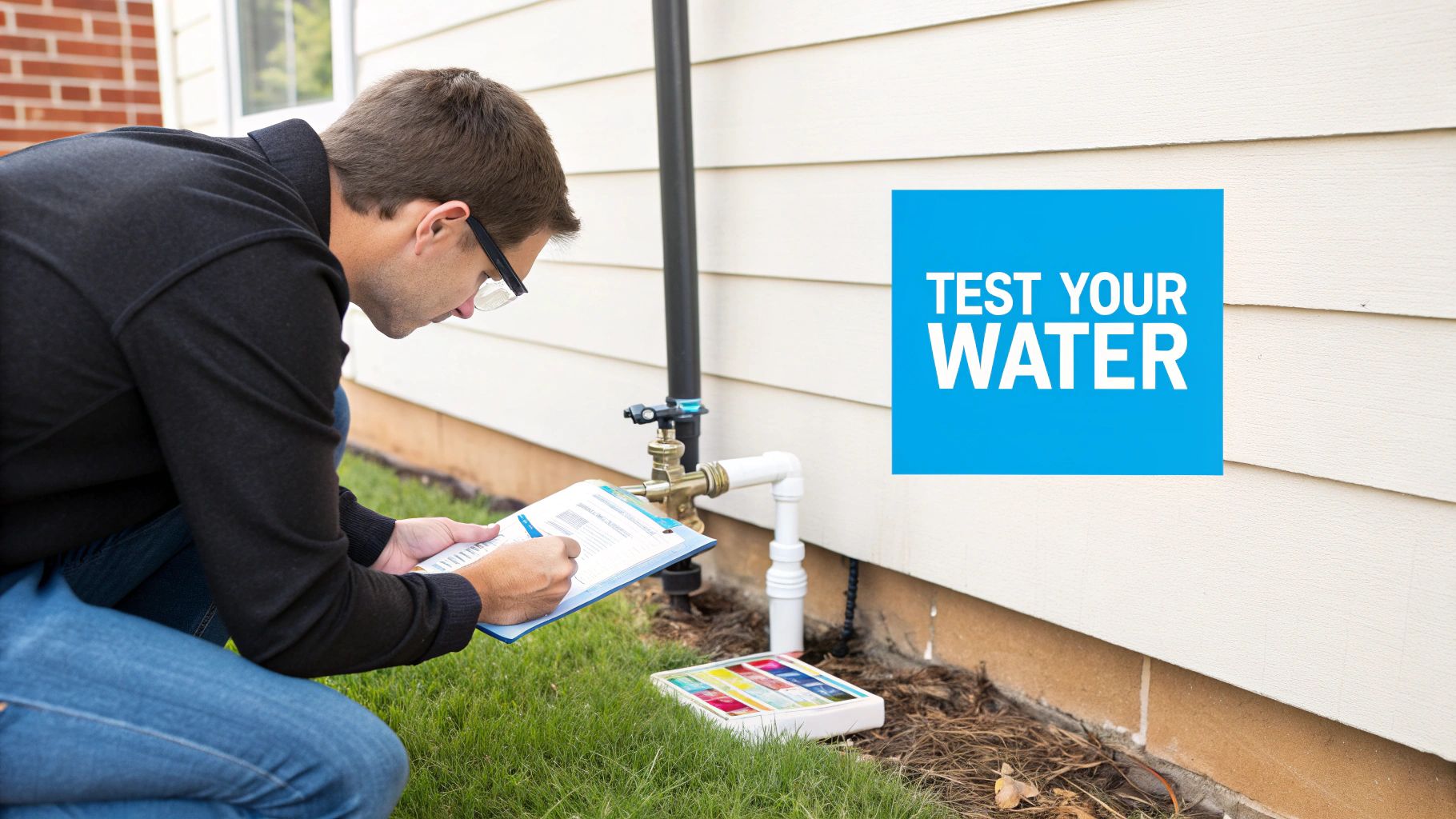
A man kneels outside a home, writing on a clipboard while performing a water quality test.

Jumping into the installation without a little forethought is like trying to bake a cake by just throwing ingredients in a bowl. It’s a recipe for chaos. Trust me, spending an hour or two on planning will save you a world of frustration and maybe even a call to an emergency plumber. This is what separates a pro-level setup from a weekend project gone sideways.

It's no surprise that more people are seeking water that doesn't taste like a swimming pool. The global home water filtration market is expected to hit a staggering USD 37.54 billion by 2034, and whole-house systems are a massive part of that wave. In fact, interest in these systems is set to grow by 61.56% by 2026, mostly because we're all tired of that chlorine funk coming from every tap. You can learn more about these market trends to see just how big this movement for better water has become.

First Things First: Play Detective with Your Water

Before you can fix your water, you have to know what you're fighting. Is it "hard," leaving that chalky film on your shower door? Does it have that faint swimming pool smell or, worse, smell like rotten eggs? Maybe you’re seeing those lovely rust-colored stains in your sinks and toilets.

A good water test is non-negotiable. You can grab a simple DIY kit from the hardware store for a quick snapshot, but for the real story, I recommend sending a sample to a certified lab. They'll give you a detailed report on contaminants like:

  • Chlorine and Chloramine: The stuff cities use to disinfect water that makes your morning coffee taste "off."
  • Sediment and Silt: Gritty particles that make water cloudy and can slowly destroy your appliances from the inside.
  • Hard Minerals: Calcium and magnesium, the tag-team duo behind stubborn limescale buildup.
  • Iron and Manganese: Metals that leave ugly orange and black stains and give water a metallic tang.
  • Lead and VOCs: The more serious troublemakers you definitely want to know about.

Once you know exactly what’s lurking in your H2O, you can choose a filter that’s specifically designed to kick those contaminants to the curb.

Find the Perfect Home for Your Filter

Location, location, location! The best spot for your system is almost always right where the main water line enters your house. Think basement, garage, or a utility closet. Placing it here ensures every single drop of water, both hot and cold, gets purified before it travels anywhere else in your home.

When you’re scouting for a location, keep these things in mind:

  • Accessibility: You're going to need to get to this thing to change filters. Don't shove it into a creepy corner you can barely reach. Think about future-you.
  • Protection: Make sure it's in a place that won't freeze. A frozen filter housing will crack, and you’ll have an indoor water park you never asked for.
  • Drain Access: If you choose a system that backwashes (like a water softener or some large carbon filters), it needs a place to send its wastewater.
  • Power Source: Many modern systems have electronic control heads or UV lights that need to be plugged into a standard outlet.

Don't Choke Your Water Flow: Size Your System Correctly

One of the most common DIY mistakes is buying a system that's too small for the home. The result? A frustrating drop in water pressure every time you try to do two things at once, turning your powerful shower into a pathetic dribble.

To get this right, you need to match the system to your home's peak water demand, which is measured in gallons per minute (GPM).

Think about a chaotic morning in your house—the shower's running, the dishwasher is on, and someone's washing their hands. You need a filter that can handle all of that without breaking a sweat. A plumber can do a proper flow rate test, but you can also get a good estimate based on your home’s size and the number of bathrooms. For more in-depth guidance on choosing the right system, you might find valuable advice on specialized water filtration platforms like https://www.waterfilteradvisor.com.
Of course, clean water is just one piece of the healthy home puzzle. Many homeowners who upgrade their water also look into things like whole-home air purifiers to improve their environment from top to bottom.

Assembling Your Tools and Materials Like a Pro

Nothing kills the momentum of a weekend project faster than an unexpected, last-minute trip to the hardware store for that one tiny fitting you forgot. Trust me, we've all been there. A successful whole home water filtration system installation hinges on having every single tool and part ready before you make that first cut.

Think of it like a TV chef preparing their ingredients—what they call mise en place. Everything is in its place, prepped and waiting. Taking the time to get organized turns a potentially chaotic job into a smooth, professional-feeling process.

Before you even think about shutting off the water, lay everything out on a tarp or drop cloth near your work area. This simple step keeps tiny fittings from rolling into oblivion and protects your floors. It's also your final chance to eyeball everything and make sure you have it all, from the big wrenches down to the last screw.

Your Essential Water Filter Installation Toolkit

To make sure you're not that person making a frantic mid-project hardware store run, I've put together a checklist. This covers just about everything you could need for a standard installation.

Tool or Material Category Essential Items Pro Tip for Selection
Cutting & Measuring Pipe cutter (specific to your pipe type), measuring tape, permanent marker. For copper, a simple tubing cutter is best. For PEX or PVC, a ratchet-style cutter prevents burrs and ensures a clean, square cut.
Wrenches & Fasteners Two pipe wrenches (or one pipe, one adjustable), drill with assorted bits, screwdriver set. Always use two wrenches working in opposite directions on fittings. This stops you from stressing and damaging old pipes.
Safety Gear Safety glasses, work gloves. Non-negotiable. Debris in your eye or a sharp metal burr on your hand will end your project and your good mood instantly.
Sealing & Cleanup Thread seal tape (Teflon tape), a bucket, several old towels or rags. Wrap Teflon tape clockwise on male threads. If you go counter-clockwise, it will unravel as you tighten the fitting.
Piping Specifics Solder & flux (copper), crimp rings & tool (PEX), or primer & cement (PVC/CPVC). Push-to-connect fittings can be a universal alternative. Double-check that your primer/cement is rated for the type of plastic pipe (PVC vs. CPVC) you have. They are not interchangeable.

Having these items on hand before you start is the difference between a frustrating afternoon and a job you can be proud of.

The Right Stuff for a Watertight Seal

The tools get the job done, but the materials are what guarantee every connection stays secure and leak-free for years. This is where you buy your peace of mind.

A leak isn't just a drip; it's a potential disaster waiting to happen. Using the correct fittings and sealant for your pipe type is the single most important step in preventing water damage down the road.

Your shopping list for materials will depend entirely on what kind of plumbing you have. Let's break down the most common setups.

Working with Your Pipe Type

  • For Copper Pipes: You'll be soldering. This means you need solder, flux, a propane torch, and the right copper fittings. Don't forget a small piece of emery cloth or a wire brush to clean the pipe ends—flux won't stick to a dirty surface.

  • For PEX Tubing: Your main options are crimp or clamp rings, which require a special tool. Alternatively, push-to-connect fittings (like SharkBite) are a fantastic, solder-free option that's incredibly DIY-friendly.

  • For PVC/CPVC Pipes: This is a solvent-weld job. You'll need primer (usually purple) and cement specifically designed for your pipe material. The primer cleans the plastic and prepares it for a permanent chemical bond with the cement.

One universal item is thread seal tape. You'll wrap this 3 to 5 times around any male pipe threads to create a perfect, watertight seal.

And for a final bit of real-world advice: have a drill ready. You’ll need it to mount the filter housing securely to a wall or joist. If you’re working in a basement, knowing about selecting the right drill bit for concrete is crucial for anchoring into those tough foundation walls.

Installing Your Water Filtration System: The Main Event

Alright, you’ve done the prep work, your tools are laid out, and now it’s time to bring on the main event. All that planning is about to pay off as we get hands-on with the whole home water filtration system installation. Let's walk through this together, step by step, so you can feel like a plumbing rockstar.

The very first thing you need to do is arguably the most important. To keep this project from turning into an indoor swimming pool, you have to shut off the water supply to the entire house.

Safety First: Shutting Down Your Water Supply

First, find your main water shutoff valve. It's usually hiding in a basement, crawl space, or sometimes in an exterior utility box near your water meter. Give the handle a full clockwise turn until it stops. If it's a lever-style ball valve, you need to turn it 90 degrees until it’s perpendicular to the pipe.

With the main shutoff closed, you still need to get the water out of the pipes. Go open the lowest faucet in your house—think basement sink or outdoor spigot—and then the highest one, like a second-floor bathroom. This little trick uses gravity to drain the lines so you don't get a face full of water when you make that first cut.

Pro Tip: Even after draining, there’s always some water left in the pipes. I always stick a bucket right under where I'm about to cut and have a few old towels ready. It’s the best way to keep your workspace from turning into a swamp.

Measuring and Cutting Your Main Water Line

You’ve heard it a thousand times, but "measure twice, cut once" is the gospel of plumbing for a reason. Hold your fully assembled filter unit up to the section of pipe you’ve chosen. Don't just measure for the filter housing; make sure you account for all the fittings and, crucially, the bypass valve.

Grab a permanent marker and mark your cut lines clearly on the pipe. A crooked cut is a recipe for a bad seal and a frustrating, slow leak down the road.

When you’re ready, grab the right cutter for your pipes:

  • For copper pipe: A tubing cutter clamps on, and you just rotate it around the pipe, tightening the knob with each turn until it pops right through.
  • For PEX or PVC/CPVC: A ratchet-style plastic pipe cutter will give you a clean, straight cut with a few squeezes.

Once the pipe is cut, take a minute to clean up the edges. A simple deburring tool or even a small piece of sandpaper will smooth out any burrs. This is a critical step—any little plastic or metal bits can tear the O-rings inside your new fittings and cause a leak you'll be chasing for weeks.

Assembling the Filter and Bypass Valve

Before you even think about fitting this into your main line, it’s much easier to assemble the filter head, housing, and the bypass valve on a workbench. That bypass valve is a non-negotiable part of the setup. It’s a three-valve system that lets you route water around the filter, which is a total game-changer when it’s time for maintenance. No more shutting off water to the whole house just to swap a filter.

Pay close attention to the manufacturer's directions here, especially the flow-direction arrows on the filter head. For every threaded connection, use thread seal tape. Wrap it clockwise 3-5 times around the male threads; this ensures the tape tightens as you screw in the fitting instead of unraveling.

Making Your Final Connections

Now it’s time to marry the filter assembly to the main water line you just prepped. How you do this depends entirely on the type of plumbing you have.

A diagram illustrating three steps for tool preparation: pipe cutter, fittings, and sealant tape.

As you can see, it comes down to three things: a clean cut, the right fitting, and a proper seal.

These are the most common ways to make the connection:

  • Push-to-Connect Fittings (e.g., SharkBite): These are a DIYer's dream. You just push the fitting onto a clean, deburred pipe until you feel it "click." They work on copper, PEX, and CPVC.
  • PEX Crimp/Clamp Rings: If you have PEX, you'll slide a metal ring over the tubing, insert a barbed fitting, and use a special tool to secure the ring tightly over the barb. It creates a rock-solid connection.
  • Copper Soldering: This is a more advanced skill. It involves cleaning and fluxing the pipe and fitting, heating the joint with a torch, and letting solder flow into the gap to create a permanent bond.
  • PVC/CPVC Solvent Weld: For plastic pipes, you'll apply primer, then a coat of cement. Push the pipe into the fitting with a quarter-turn twist and hold it firmly for about 30 seconds while the chemicals literally weld the two pieces together.

With your connections made, the last step is to securely mount the filter bracket to a wall stud or another solid surface. A filter full of water is surprisingly heavy, and you don't want that weight hanging directly on your pipes.

Bringing Your New System To Life: The Moment of Truth

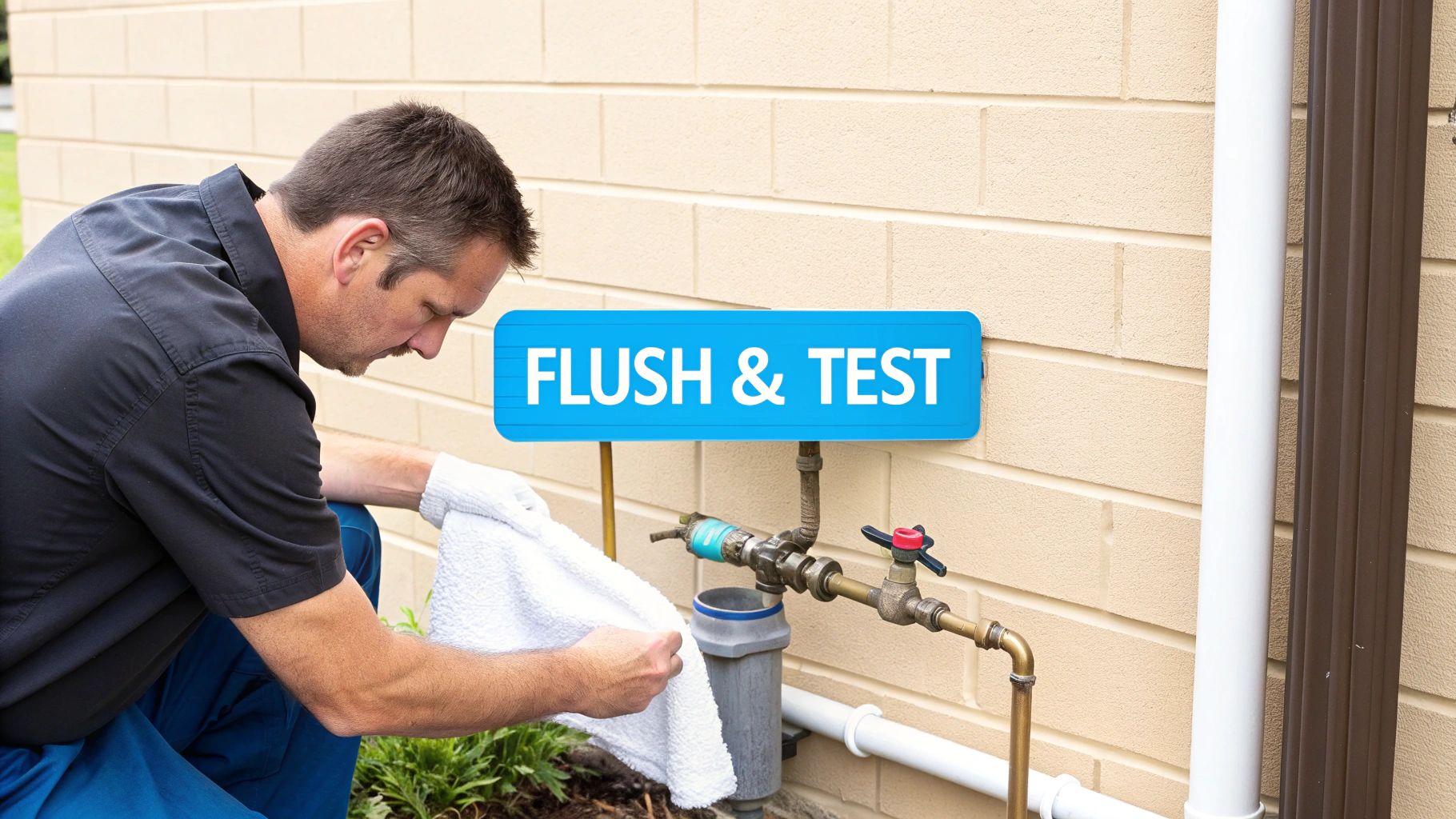
A man in a blue shirt inspecting an outdoor water filtration system on a house wall.

You’ve tightened every fitting and secured the last bracket. Now comes the moment of truth. This is the commissioning process, where patience pays off big time. Jumping in too fast here can lead to leaks, sputtering faucets, and water that still tastes off.

This stage is the real test of your whole home water filtration system installation. Rushing it now puts all that careful work at risk.

The Slow And Steady Water Turn-On

First, leave the bypass valve open and close both the inlet and outlet valves on the filter. Then head to your main shutoff valve and crack it open—just a quarter turn is enough. Listen for a soft hiss as the pipes begin to fill.

After that gentle hiss fades, open the valve fully. Grab a flashlight and go inspect every connection you made. Even a tiny droplet on a new joint means you need to tighten it again before moving forward.

Purging Air And Hunting For Leaks

Next, shut off the bypass valve. Very slowly open the inlet valve feeding the filter and listen as water floods the housing. This is the most pressure-sensitive moment; any weak seal might start leaking now.

The most common leak appears the second the system pressurizes. Watch every connection like a hawk—if you spot a drip, close the inlet, release the pressure, and fix it immediately.

Once the inlet is fully open, repeat the process with the outlet valve. Your system is now under full pressure.

Finally, get the air out. Turn on a nearby cold-water tap (a laundry sink is perfect for this) and let it sputter and spit until you see a smooth, steady stream.

Initiating The First Flush

If your system supports backwashing, now's the time to trigger the cycle from the control head. Expect it to run for 10 to 30 minutes as it washes out fine particles and factory dust.

For simpler cartridge-style setups, you just need to do a straight flush.

  • How to Flush: Simply run cold water from a high-flow tap, like a bathtub, for at least 15-20 minutes.
  • What to Look For: Initially, the water may look cloudy or discolored from fine carbon dust ("fines"). This is completely normal and expected.
  • When It's Ready: Keep flushing until the water runs perfectly clear.

Once you see that crystal-clear stream, pour yourself a glass. With air purged, leaks resolved, and the filter media flushed, your whole home water filtration system is officially open for business.

Maintaining Your System for Long-Term Awesome Water

Alright, your whole home water filtration system installation is done. You're already enjoying that clean, crisp water flowing from every faucet. But to keep things running like a dream, a little routine care is in order. Think of it as protecting your investment, not another chore.

A good maintenance schedule is your ticket to consistently great water. Let it slide, and you're looking at clogged filters, a noticeable drop in water pressure, and the return of the very contaminants you worked so hard to get rid of.

Why You Can’t Just "Set It and Forget It"

The filter media is the heart of your system. Whether it’s a simple sediment cartridge or a massive tank of carbon, it has a limited lifespan. Once it’s saturated with all the gunk it has pulled from your water, it’s done. Using an exhausted filter is like trying to dry dishes with a soaking wet towel—it just doesn’t work.

That’s why sticking to a replacement schedule is the single most important thing you can do.

  • Sediment Pre-filters: These are the bouncers at the club door, catching all the dirt and rust. They usually need swapping out every 3 to 6 months. If you notice your water pressure taking a nosedive, a clogged pre-filter is almost always the culprit.
  • Carbon Filters: The big carbon tank is the heavy lifter, tackling chlorine, funky tastes, and chemicals. The media inside can last a surprisingly long time—anywhere from 3 to 10 years, depending on the quality of the carbon and how much water your family uses.
  • Specialty Cartridges: If you have extra stages for things like bacteria (a UV bulb) or heavy metals (KDF), they have their own schedules. A UV lamp, for instance, needs to be replaced every year. Even if it’s still lit, its sterilizing power fades over time.

Creating Your Simple Maintenance Schedule

You don't need a complicated spreadsheet for this. Just pop a few reminders in your phone's calendar or scribble the dates on a sticky note and slap it right on the filter housing. This little habit will save you a ton of headaches.

Your water filtration system is the guardian of your home's water supply. A little routine maintenance is all it asks for in return to keep doing its job effectively day in and day out.

To make it even easier, here’s what a typical maintenance plan might look like.

A Simple Maintenance Schedule for Whole Home Filters

This schedule gives you a ballpark idea. Your manufacturer's guide will have the exact details, but this is a great starting point.

System Type Maintenance Task Recommended Frequency Time Commitment
Cartridge-Based System Replace sediment pre-filter. Every 3-6 months 15-20 minutes
Carbon Tank System Replace carbon filter cartridge. Every 6-12 months 20-30 minutes
Water Softener Check and refill salt reservoir. Monthly 5-10 minutes
UV Purifier Replace UV lamp and clean quartz sleeve. Annually 30-45 minutes
All Systems Conduct a post-installation water test. Annually 10 minutes (to collect a sample)

A little bit of planning goes a long way in keeping your water pure and your system humming.

Beyond the Basics: Sanitizing and Testing

Here’s a pro tip: when you change a cartridge filter, take an extra ten minutes to sanitize the housing. A few capfuls of unscented household bleach mixed into a gallon of water is all you need. Give the inside a good scrub to keep any nasty bacteria from setting up shop.

It's also a smart move to test your water again about a year after the installation. This confirms the system is still working as it should and alerts you if any new contaminants have snuck into your water supply.

Staying on top of this is more important than ever. The home water treatment market is projected to hit an incredible USD 91.39 billion by 2034, driven by homeowners who are more aware of water quality issues. You can learn more about these market trends and see how consumer awareness is shaping the industry. A little upkeep ensures your system remains a top-tier solution.

Got Questions About Your Filter Install? We've Got Answers.

Even with the best guide in hand, tackling a whole home water filtration system installation for the first time can leave you with a few nagging questions. That's completely normal. This is a big upgrade for your home, so let's clear up some of the common uncertainties we hear from homeowners.

Think of this as the final pep talk. Getting this right isn't just a plumbing project; it's an investment in your family's health and the longevity of all the water-using appliances in your house.

How Much Does It Cost to Have a Pro Install It?

If you're thinking of calling a licensed plumber instead of going the DIY route, you can expect the cost to land somewhere between $300 and $1,500.

Why such a big range? It really boils down to the complexity of the job. If you have easy-to-access PEX or PVC pipes and you're installing a basic cartridge system, you'll be on the lower end. But if it's an involved multi-tank system that requires sweating new copper pipes and running a drain line, the price will naturally creep up.

My best advice? Always get at least three itemized quotes from reputable, licensed plumbers. It's the only way to know you're getting a fair price.

Can I Really Install a Whole House Water Filter Myself?

Absolutely. If you have some basic plumbing skills under your belt and the right tools, installing a whole house water filter is a totally doable weekend project. Honestly, systems with modern push-to-connect fittings have made the job easier than ever.

But you have to be honest with yourself. If the thought of taking a pipe cutter to your home's main water line gives you cold sweats, or if you've never soldered a copper joint, hiring a pro is the smart move. A small mistake can turn into a hidden leak or a full-blown flood—and the cost of that water damage will make a plumber's invoice look like a bargain.

Will a Whole House Filter Kill My Water Pressure?

This is probably the number one concern we hear. The short answer is yes, it will reduce it slightly, but it shouldn't be a deal-breaker. A correctly sized system will typically only cause a minor drop of about 5 to 15 PSI. Most people barely even notice it.

The secret to keeping your pressure strong is all in the sizing. You have to make sure your system's flow rate—measured in gallons per minute (GPM)—can keep up with your family's water usage at its peak.

To keep that pressure drop to a minimum, here's what to do:

  • Go for a High Flow Rate: Pick a system with a GPM rating that meets or beats your home's demand. A house with 3-4 bathrooms, for example, really needs a filter rated for 12-15 GPM.
  • Choose Bigger Ports: Look for filters with 1-inch inlet and outlet ports instead of the smaller ¾-inch ones. Bigger pipes mean better flow.
  • Consider a Booster Pump: If your water pressure is already on the low side to begin with, you can install a water pressure booster pump right alongside the filter to solve the issue for good.

Where’s the Best Place to Install My Filter System?

Location is everything. The sweet spot is on your main water line, right after it enters your house but before it splits off to your water heater or any other fixtures.

Most people find these spots work best:

  • Basements
  • Garages
  • Utility closets

The perfect location isn't just about space. It needs to be easy to get to, so you aren't doing plumbing gymnastics in a crawlspace. It also has to be a spot that's protected from freezing temperatures—a frozen filter housing will crack, and you'll have a major mess on your hands. And don't forget, if your system needs power or has a backwashing feature, you'll need an electrical outlet and a drain nearby.


At Water Filter Advisor, our mission is simple: give you the knowledge you need to get cleaner, safer water in your home. From picking the perfect system to walking you through the install, we're here to help you make smart choices for your family. Check out all our in-depth guides and reviews at https://www.waterfilteradvisor.com.