
If you're on the hunt for the best faucet water filter, you've come to the right place. Sometimes the simplest choice is the smartest one, and the best models blend serious filtration power with a setup so easy you won't even need to open your toolbox. It’s no wonder brands like PUR and Brita are household names—they wage war on common culprits like chlorine and lead, which immediately makes your tap water taste better and safer to drink.
Your Quick Guide to Better Water from the Tap
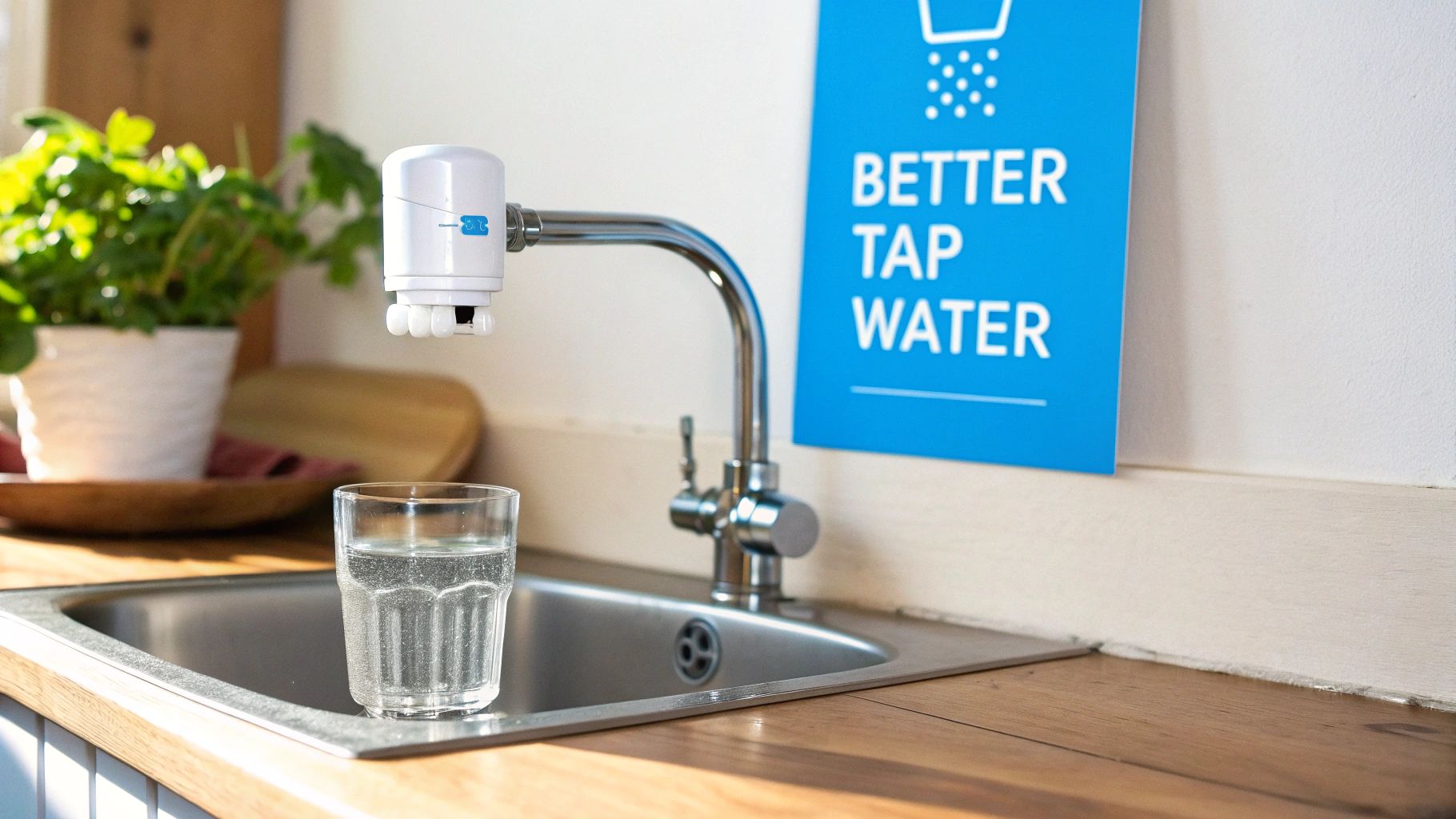
Giving your home's water quality a major upgrade doesn't have to mean calling a plumber or starting a complex renovation. A faucet-mounted filter is one of the most straightforward and effective solutions out there, delivering cleaner, purer water right where you use it most: the kitchen sink.
These little gadgets click right onto your existing faucet in minutes, making them a perfect match for homeowners and renters alike who crave powerful filtration without any permanent changes. The real beauty is in their simplicity and the instant gratification of truly delicious water.
The Power of Simplicity
Think of a faucet filter as a tiny, dedicated bodyguard for your tap. It stands guard, intercepting unwanted junk before it ever makes it into your glass, cup of coffee, or pot of pasta.
Here’s how it works: the device routes your tap water through a small, replaceable cartridge. Inside that cartridge is a marvel of filtration media, usually activated carbon, which acts like a super-magnet for contaminants. This process zeroes in on things that make water taste and smell funky, like chlorine, while also tackling more serious health concerns. It’s a simple concept that pays off every time you hydrate.
A great faucet water filter offers a critical line of defense, transforming your standard tap into a source of purified water with minimal effort and cost.
Faucet Water Filter Key Benefits at a Glance
So, what makes these filters such a smart addition to your kitchen? Let's break down the core benefits that have made them a go-to choice for so many households. The advantages, from better health to a smaller environmental footprint, really speak for themselves. You can find more in-depth filtration advice in our expert guides.
| Benefit | Why It Matters for Your Home |
|---|---|
| Improved Taste and Odor | Removes chlorine and other chemicals that cause that classic "tap water" smell and aftertaste, making water genuinely enjoyable to drink. |
| Contaminant Reduction | Certified models can slash levels of harmful stuff like lead, mercury, certain pesticides, and even pharmaceuticals. |
| Cost-Effective | Gives you filtered water for pennies on the dollar compared to bottled water, saving you a surprising amount of money over time. |
| Convenience | Delivers filtered water on-demand with the flick of a switch, right from your sink. No more waiting for a pitcher to fill up. |
| Easy Installation | Most models just screw onto your faucet in minutes without any tools. This makes them perfect for renters and anyone who isn't a DIY pro. |
| Environmentally Friendly | Drastically cuts down on the need for single-use plastic water bottles, shrinking your household's plastic waste. |
Ultimately, a faucet filter is an incredibly practical tool that offers an immediate and noticeable improvement in your daily life, one delicious glass at a time.
How Faucet Filters Actually Clean Your Water
Ever wondered what's really going on inside that little gadget you snap onto your faucet? It’s not just an empty plastic shell. Think of it as a tiny, on-demand water treatment plant, working hard to make your tap water cleaner, safer, and taste a whole lot better. The secret is in a few clever filtration technologies working together to catch all the unwanted stuff.
At its heart, nearly every faucet filter uses a multi-stage process. Your water flows through different layers, and each layer is designed to grab specific types of contaminants. It’s kind of like a bouncer at an exclusive club, but for your water. The first layer stops the big, obvious troublemakers, while the next one is trained to spot the sneakier, invisible ones.
This process is exactly what separates a good faucet filter from a simple screen. It’s a fast, targeted, and scientific way to purify your water right as it comes out of the tap.
The Contaminant Sponge: Activated Carbon
The undisputed hero inside most of these filters is activated carbon. Picture a charcoal sponge, but one that’s incredibly porous. Its surface is covered in microscopic nooks and crannies, giving it a massive surface area—a single gram can have more surface area than a football field. This unique structure makes it a magnet for certain contaminants.
The process is called adsorption (with a 'd'), which just means chemicals and other gunk physically stick to the carbon’s surface, a lot like how lint sticks to a wool sweater. It’s especially good at grabbing:
- Chlorine: This is what most cities use to disinfect water, and it’s the main reason tap water has that distinct smell and taste. Activated carbon is a champ at removing it, which is why the first thing you'll notice is a huge improvement in flavor.
- Volatile Organic Compounds (VOCs): These are chemicals from industrial solvents and other sources that you definitely don't want in your water.
- Pesticides and Herbicides: Runoff from farms can sometimes introduce these chemicals into the water supply. Carbon helps pull them out.
By the time your water makes it past the activated carbon, it's already much cleaner and tastes worlds better. This is the first and most important step for transforming your tap water.
Tiny Magnets for Heavy Metals
Carbon is great for making water taste good, but it can’t do much about serious health threats like lead. For that, you need a different trick up your sleeve: ion exchange. It’s a smart bit of chemistry that works like a magnet swap.
Inside the filter are tiny resin beads that are "pre-loaded" with harmless ions, like sodium or potassium. When water containing heavy metals like lead or mercury flows past, those dangerous contaminants are drawn to the resin.
In a split second, the resin grabs onto the lead ions and releases its harmless sodium or potassium ions back into the water. This “exchange” effectively yanks the dangerous metals right out of your drink.
This is a must-have feature, especially if you live in a home with older plumbing where lead can leach from the pipes. A filter with ion exchange media gives you a critical layer of defense against these invisible dangers.
Advanced Filtration for Tougher Contaminants
For folks dealing with more complex water issues, some of the better faucet filters pack in extra, specialized materials. They aren't always standard, but they provide an added level of purification when you need it.
One of these is catalytic carbon, which is basically activated carbon on steroids. It's specifically engineered to tackle chloramine, a long-lasting disinfectant that some water utilities use instead of chlorine. Regular carbon isn't great at removing chloramine, but catalytic carbon breaks it down effectively.
You might also see something called Kinetic Degradation Fluxion (KDF). This is a mix of high-purity copper and zinc that creates a tiny electrochemical reaction as water passes through. This process helps reduce other water-soluble heavy metals and also has the neat side effect of inhibiting the growth of bacteria and algae inside the filter, which helps keep it working well for longer. These advanced layers make sure your faucet filter is ready for just about anything.
What Contaminants and Certifications Really Mean
Let’s be honest, not all filters are created equal. When it comes to your drinking water, you can't just take a company's marketing claims at face value. This is where certifications come in—they are your independent, third-party proof that a filter actually does what it claims to do.
Think of it like reading the nutrition label on your food. Certifications tell you exactly what the filter is designed to remove, from common annoyances like chlorine to more serious threats like lead. Understanding them is the single best way to choose a filter with confidence.
Decoding the NSF Seal of Approval
If you spot an NSF/ANSI certification on a filter's box, that's a very good sign. The National Sanitation Foundation (NSF) is a highly respected, non-profit organization that puts products through the wringer to make sure they meet strict public health and safety standards.
When a filter earns that seal, it means it has been rigorously tested to prove it can consistently remove the specific contaminants listed. This isn't a one-and-done deal, either. NSF certification involves ongoing facility inspections and regular re-testing to ensure the quality never slips. It's a reliable stamp of quality that cuts right through the advertising hype.
An NSF/ANSI certification is more than just a sticker on a box; it’s a verified promise that the filter will protect your health by performing exactly as specified, from the first glass of water to the last.
This simple diagram shows the basic idea of how a faucet filter gets the job done right at your tap.
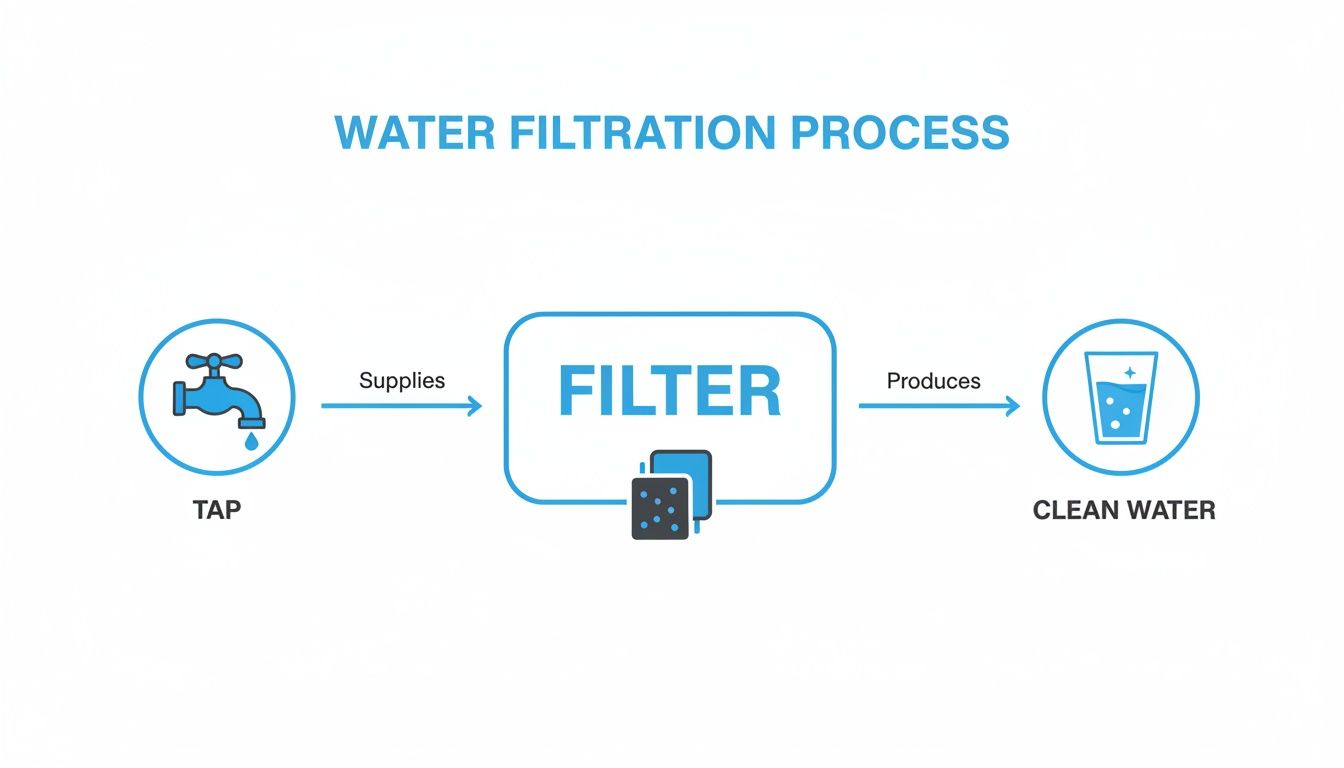
As you can see, your tap water flows through the filter, which traps contaminants and sends fresh, purified water out for you to enjoy.
The Most Important Certifications to Know
Three main NSF/ANSI standards apply to the faucet filters you'll see on the shelf. Each one targets a different group of contaminants, so knowing the difference will help you pick the perfect filter for your home's water.
NSF/ANSI 42: Aesthetic Effects
This is the most common certification out there. It focuses on things that affect the taste, smell, and look of your water. If your main complaint is that your tap water has a strong "swimming pool" odor, a filter with this certification is your ticket to better water. It’s certified to reduce things like chlorine and particulates, making your water much more pleasant for drinking and cooking.NSF/ANSI 53: Health Effects
This one is much more serious. This standard verifies that a filter can reduce contaminants known to be harmful to your health. If you have specific concerns about dangerous substances in your water, this is a critical certification to look for. A filter certified to NSF 53 can be tested against a whole list of nasty stuff, including lead, mercury, asbestos, and certain cysts like Giardia. The key here is that not every NSF 53 filter removes all these things, so you must read the fine print on the performance data sheet to see exactly what it’s certified for.NSF/ANSI 401: Emerging Contaminants
This is a newer standard designed to tackle a modern problem: trace amounts of pharmaceuticals, over-the-counter drugs, herbicides, and pesticides showing up in our water. While the long-term health effects of these "emerging contaminants" aren't fully understood, a lot of people would rather be safe than sorry. An NSF 401 certification offers that extra layer of protection and peace of mind.
The global market for faucet-mounted filters is growing at a steady 7.4%, a sign that more people are taking control of their water quality. Here in North America, which accounts for a massive 78.1% of regional purifier sales, US consumers are driving innovation. We're seeing advanced multi-stage carbon block filters that can eliminate 99.99% of cysts and VOCs, performance that is often validated by these crucial NSF certifications. You can explore the data behind these market trends to see just how much demand for certified filters is booming.
Making Sure the Filter Fits Your Faucet
You can do all the research in the world on certifications and contaminants, but none of it means a thing if the filter won't actually connect to your sink. A filter that doesn't fit is just a fancy paperweight. This final check is arguably the most important one.
The good news? Most faucet filters are designed for a near-universal fit with standard kitchen faucets. Installation is usually a simple DIY job that takes less than five minutes. Seriously.
You just unscrew the little mesh tip at the end of your faucet spout—that’s called the aerator—and screw the filter mount right into its place. That’s typically all it takes. No plumbers, no special tools, just a secure, hand-tightened connection.
Of course, "standard" is a word that doesn't cover every faucet out there. Before you click "buy," it's smart to confirm your faucet is compatible. Also, a quick tip: before you install a brand-new filter, make sure your faucet itself is in good shape. It’s a good idea to fix a leaky faucet before you add another component into the mix. A solid foundation prevents a lot of headaches down the road.
Understanding Faucet Threads and Adapters
So, how do they make one filter fit so many different faucets? The magic is in the adapters included in the box.
Most faucet spouts have threads to hold the aerator on, but sometimes the threads are on the outside (male-threaded) and other times they're on the inside (female-threaded). The best faucet filter kits come prepared for both, shipping with a small handful of plastic or metal adapters.
These little rings simply bridge the gap between your faucet’s specific threads and the filter’s mounting collar. You just find the one that fits your sink, screw it on, and then attach the filter. It’s an elegant system that creates a tight, leak-free seal.
Think of the adapters as a universal translator for your sink. They ensure the filter can "speak the same language" as your faucet's threads, creating a perfect connection regardless of its specific design.
When a Faucet Filter Will Not Work
While adapters solve the vast majority of compatibility issues, some faucet styles are just not built to work with these kinds of filters. A quick check before you buy will save you a ton of frustration and a return trip.
Keep an eye out for these common incompatible faucet types:
- Pull-Out or Pull-Down Sprayers: If your faucet has a sprayer head that pulls out from the main spout, it lacks the standard threaded tip needed for a filter to attach.
- Unthreaded Designer Faucets: Some high-end or uniquely shaped faucets have a smooth, unthreaded spout for a sleek look. No threads, no place to screw on a filter.
- Sprayer-Style Faucets: If the faucet head itself is shaped like a mini shower sprayer, it's a no-go.
- Portable or Unattached Faucets: These aren't common in kitchens but are sometimes used with portable dishwashers and don't have a standard connection point.
Just take a quick look at your current faucet. If you can see and feel threads where the aerator connects, you're almost certainly good to go with the best faucet water filters on the market.
How to Balance Performance, Cost, and Filter Life
Picking the right faucet filter isn't just about grabbing the one that zaps the most contaminants. It’s really a strategic juggling act between filtration power, how long the filter lasts, and what it costs you in the long run. A filter might look amazing on the box, but it won’t do you much good if it clogs up in a month or needs pricey cartridges all the time.
The trick is understanding the give-and-take. A more aggressive filter that targets over 70 contaminants—we’re talking lead, pesticides, the serious stuff—often slows down your water flow a little. That's because the water needs more contact time with the filtration media to get purified. It’s a good thing for safety, but it can be a minor annoyance when you're trying to fill a big pot of water for pasta.
On the flip side, a simpler filter designed mostly for improving taste by removing chlorine will probably give you a faster flow and last longer. Neither one is "better" than the other; it all comes down to what you actually need. Finding your sweet spot is the key to getting a filter that feels like a natural part of your kitchen.
The True Cost of Clean Water
That initial price tag on the filter? That’s just the starting line. The real number you should be looking at is the total cost of ownership, which includes the ongoing cost of replacement filters. This is where a little upfront math can save you a bunch of cash later.
A cheaper filter unit might feel like a steal, but if its replacement cartridges are expensive or only last for 100 gallons, you could end up spending more over a year than you would with a pricier model that uses longer-lasting, more affordable filters. Always calculate the cost-per-gallon to get the real story.
Your goal is to find a filter that not only handles your water quality concerns but also fits comfortably into your long-term budget. A higher initial investment can often pay for itself through significant savings on replacement cartridges.
It's no surprise that faucet filters are a huge part of the booming water purifier market, which is expected to rocket from USD 48.1 billion in 2025 to a massive USD 97 billion by 2035. They also offer some serious savings. One analysis found that a family of four can save around $1,200 annually just by ditching bottled water. And with 85% of users saying their water tastes better after making the switch, the value is pretty clear. You can read more about the water purifier market's growth to see why so many people are turning to home filtration.
Lifespan vs. Filtration Power
A filter's lifespan, usually measured in gallons, is the final piece of the puzzle. Most standard faucet filters are rated for somewhere between 100 and 200 gallons, which for an average family means changing it out every two or three months. This capacity is directly tied to what the filter is designed to remove.
A high-performance filter certified for NSF 53 (which covers health-related contaminants) might have a shorter life. Its dense, multi-layered media has to work harder to grab heavy metals and other nasty particles, so it gets saturated faster. In contrast, a basic NSF 42 filter that just targets chlorine might last much longer because its job is less demanding.
To help you see how these trade-offs play out, I’ve put together a quick comparison. Think of it as a cheat sheet for understanding what you get for your money.
Faucet Filter Performance Trade-Off Comparison
| Filter Type | Typical Filter Life | Flow Rate | Contaminant Removal Focus | Best For |
|---|---|---|---|---|
| Basic Taste & Odor | 200 Gallons | Fast | Chlorine, Particulates (NSF 42) | Households with good city water just looking for better taste. |
| Advanced Health | 100 Gallons | Moderate | Lead, Mercury, Cysts (NSF 53) | Homes with older plumbing or specific health concerns. |
| All-in-One | 120 Gallons | Moderate | Broad Spectrum (NSF 42, 53, 401) | Anyone wanting comprehensive protection against a wide range of contaminants. |
Ultimately, choosing the best faucet filter is about knowing what you’re willing to compromise on. Do you want maximum protection, even if it means changing the filter more often? Or does a longer-lasting, taste-improving filter make more sense for your water and your lifestyle? Answering those questions is how you'll find the perfect balance between performance and practicality.
Putting It All Together: How to Pick the Right Faucet Filter
We've covered the tech, the certifications, and the costs. Now comes the fun part: figuring out which faucet filter is actually the right one for your kitchen. This isn't about finding some mythical "best" filter—it's about finding the perfect match for your water, your home, and what you care about most.
The good news is, this is simpler than it sounds. A few key questions will help you cut through the noise and narrow down the overwhelming number of options to just a couple of great candidates. The goal here is to solve your specific water problems without creating a new set of annoyances.
Start With Your Water
First things first: what are you trying to fix? The answer to this question is the single most important factor in your decision. Are you just trying to get rid of that swimming-pool smell from city water, or are you in an older home worried about lead from the pipes?
If you're a renter in a city apartment, your main complaint is probably the taste and odor of chlorine. A simple, affordable filter certified to NSF 42 is your best bet. It’ll knock out the chlorine and give you crisp, clean-tasting water without making you pay for filtration power you just don’t need.
But if you have genuine health concerns—like lead, cysts, or weird industrial chemicals that show up on your local water report—you need to bring out the bigger guns. A filter certified to NSF 53 is the only way to go. That certification is your proof that the filter can actually tackle those serious contaminants.
The right filter is a direct answer to your biggest water complaint. Don't overspend on heavy-duty lead filtration if chlorine taste is your only issue, and definitely don't settle for a basic taste filter if you're worried about your health.
Factor In Your Lifestyle
Your living situation makes a huge difference. A renter has totally different needs than a homeowner, and a big family will have different priorities than someone living alone.
A renter, for example, needs something that goes on and comes off easily without leaving a trace. A screw-on faucet filter is a perfect, no-fuss solution. For a homeowner looking for a more permanent and stylish upgrade, an integrated system might be the ticket. If you're exploring built-in filtered taps, looking into options like the Brita Extra C Tap can give you a good idea of how features and design can blend right into your kitchen.
Your Final Faucet Filter Checklist
Ready to pull the trigger? Just run through this quick checklist. If you can answer these questions, you're on the fast track to finding the ideal filter for your home.
- What's My #1 Goal? Better taste (NSF 42), removing health contaminants (NSF 53), or a mix of both?
- Will It Fit My Faucet? Double-check that you have a standard threaded faucet. These won't work with pull-out or sprayer-style heads.
- What's the Real Cost? Don't just look at the upfront price. Compare the cost and lifespan of the replacement cartridges. A filter that handles 200 gallons is a much better deal over time than a 100-gallon filter you have to replace twice as often.
- Did I Read the Details? For NSF 53 filters, always check the performance data sheet. Make sure it explicitly lists the specific contaminants you want to remove.
- Am I Okay With Slower Water Flow? Top-tier filtration often means a slightly slower flow rate. Decide if you prioritize speed or maximum contaminant removal.
Answering these questions honestly will point you straight to the perfect faucet water filter, making sure every glass you pour is exactly what you want it to be: clean, safe, and refreshing.
Common Questions About Faucet Water Filters
Even after you've picked out the perfect faucet filter, you'll probably have a few questions once you start using it. Getting the hang of basic maintenance and use is the secret to getting clean, fantastic-tasting water for the long haul. Let's tackle some of the most common ones.
The big one is always about filter replacement. That schedule the manufacturer gives you isn't just a friendly suggestion—it’s a must for performance and safety. An old filter is a saturated filter, and it just can't grab contaminants anymore.
Even worse, it can turn into a hotspot for bacteria or, believe it or not, dump those trapped contaminants right back into your glass. For most faucet models, that means a new cartridge every 100 gallons or about every 2 to 3 months, whichever comes first.
Will It Affect My Water Pressure?
It's a common worry: will this thing slow down my tap? The truth is, a small drop in water pressure is totally normal. You should actually expect it. Think of it as proof the filter is doing its job.
Water has to push its way through some pretty dense material, like activated carbon, and that creates a little resistance. But if you ever notice a major drop in pressure, that's your filter shouting that it's clogged and ready to be replaced. A new cartridge will get that flow right back to its normal, slightly-slower self.
Using hot water with your faucet filter is a recipe for trouble. The heat can melt the adhesives holding the internal components together and damage the delicate filtration media, rendering it useless.
Can I Use Hot Water with the Filter?
That’s a hard no. Faucet water filters are strictly for cold water only. Trying to run hot water through one can wreck its internal parts.
The heat can also trigger something called "channeling," which is when hot water basically burns pathways right through the carbon filter media. When that happens, your filter is officially useless. It might even release a blast of the very stuff it was meant to catch. Always flip that diverter switch for unfiltered water when you need hot, like for doing dishes.
At Water Filter Advisor, we're dedicated to helping you find clear, safe, and great-tasting water solutions. Explore our expert guides and reviews to make confident decisions for your home at https://www.waterfilteradvisor.com.
- February 7, 2026
- 0
- Uncategorized
