You turn on the kitchen tap, fill a white mug, and notice a yellow tint that wasn't there before. The sink has orange streaks around the drain. Fresh laundry comes out looking a little tired, and your coffee has that metallic edge you can't ignore. That's the moment most homeowners start searching for answers, and it's also where a lot of expensive mistakes begin.
High iron in water usually looks worse than it is. For most homes, it's a filtration and maintenance problem, not a crisis. The hard part isn't figuring out that iron is present. The hard part is figuring out which kind of iron you have, because that's what determines whether a softener helps, a filter works, or a brand-new system fails in a week.
The Rusty Truth About High Iron in Water
Orange stains on the toilet bowl, reddish rings in the tub, and metallic-tasting water all point to the same broad issue. Iron has made its way into your household water, and once it starts showing up, it affects more than appearance. It can foul fixtures, stain fabrics, leave residue in appliances, and make ordinary water feel unpleasant to use every day.
The first thing to know is that this usually isn't a major health alarm for healthy adults. According to the U.S. Environmental Protection Agency, the Secondary Maximum Contaminant Level for iron in drinking water is 0.3 mg/L, and that limit is based on staining, taste, and other aesthetic issues rather than health risks (EPA iron standard explained here). That's why homeowners often discover iron because of what they can see, smell, and scrub, not because they felt sick.
If you've already got rust-colored marks outside the house from sprinkler overspray or runoff, this practical guide on how to remove rust stains from concrete can help with cleanup while you solve the water issue at the source.
Practical rule: If the symptom is staining, taste, residue, or repeated fixture cleanup, start with water testing before you buy equipment.
A lot of homeowners jump straight to “best iron filter” searches. That sounds sensible, but “iron filter” is too broad to be useful. Some systems are built for dissolved iron that looks clear at first. Others handle visible rust particles. Some are defeated by tannins and organic iron even when the product box says “iron removal.”
That's where this gets practical. The goal isn't to buy the most powerful-looking system. The goal is to match the water chemistry to the right treatment path so the fix works the first time.
Understanding the Four Types of Iron Contamination
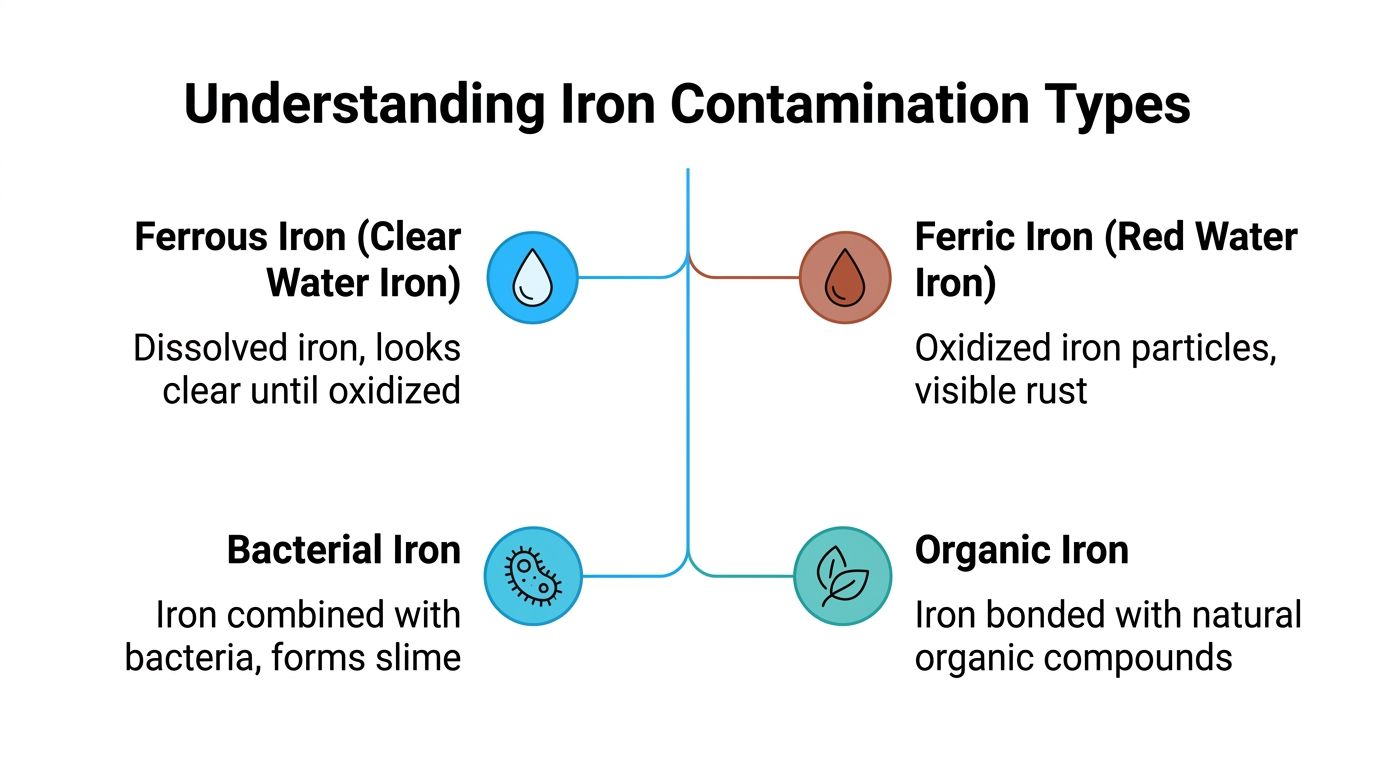
Most homeowners talk about iron as if it's one contaminant with one fix. It isn't. High iron in water can show up in four forms, and each behaves differently inside plumbing and filtration equipment.
Ferrous iron
Think of ferrous iron as sugar dissolved in tea. You can't see it once it's mixed in, but it's there. Water with ferrous iron often comes out of the tap looking clear, then turns yellow, orange, or brown after it sits and meets air.
This is what many people call clear-water iron. It slips past basic sediment filters because it's dissolved, not solid.
Ferric iron
Ferric iron is the opposite. It's already oxidized and has turned into visible particles. If ferrous iron is dissolved sugar, ferric iron is sand in a glass of water.
You'll usually notice cloudiness, rust-colored water, or visible particulate staining. Ferric iron is often easier to understand because you can see it. It's also one reason some homes do well with sediment filtration or dedicated iron media when the contamination is mostly particulate.
Organic iron
Organic iron is where many home filtration plans go off the rails. This form is bonded with natural organic matter, often creating tea-colored or yellow-brown water that doesn't behave like ordinary rust.
It helps to think of it like a stain already mixed into the water. It doesn't always oxidize the way standard iron filters expect it to. That's why a homeowner installs a Birm or greensand unit, follows the instructions, and still gets discolored water. The equipment may not be broken. The water chemistry may be wrong for that technology.
Bacterial iron
Bacterial iron involves iron and microorganisms working together. Instead of just staining, this contamination can form slime inside pipes, tanks, and fixtures.
The warning signs are different:
- Slimy buildup: You may find gel-like residue in toilet tanks or around filters.
- Recurring fouling: Fixtures clog again soon after cleaning.
- Persistent odor or film: The water may have a swampy or unpleasant character along with staining.
Iron bacteria complicate treatment because you're not just removing iron. You're also dealing with biofilm inside the plumbing system.
Why the type matters
Here's the practical takeaway. Two houses can both have “iron problems” and need completely different systems.
- Ferrous iron: Often treated with softening or oxidation-based media, depending on level.
- Ferric iron: Often treated with sediment removal or iron filtration.
- Organic iron: Often needs chemical oxidation and a more specific approach.
- Bacterial iron: Usually calls for disinfection plus filtration, not just a single tank.
If you don't identify the form first, you're guessing. In water treatment, guessing gets expensive fast.
How to Test for Iron and Read the Results
Starting with what's easy, many purchase test strips, dip one in a sample, and hope for a simple answer. Test strips can be useful as an early clue, but they rarely give enough information to choose a whole-house iron system with confidence.

What a basic test can miss
A strip may suggest iron is present, but it usually won't tell you the full story. It won't reliably sort out whether the problem is dissolved iron, oxidized iron, organic iron, or iron tied up with bacteria. It also won't give you the broader chemistry that affects filter performance.
That broader chemistry matters. pH, hardness, and tannins can decide whether a treatment method performs well or fails completely.
When iron concentrations rise above 0.3 ppm, the water is considered objectionable, often causing yellow, red, or brown discoloration and a strong metallic taste. Many wells have iron levels below 10 mg/L, so knowing your actual level is key to treatment (North Carolina iron guidance).
What to ask for in a proper water test
If you're shopping for a home filtration system, ask for a test that goes beyond “iron yes or no.” You want a report that helps you make a buying decision, not just confirm what your sink already told you.
Look for these items:
- Iron level: This tells you how much contamination you're dealing with.
- Iron form clues: Clear-water behavior, visible particles, or tea-colored water all point in different directions.
- pH: Some iron filters depend on oxidation conditions that pH can affect.
- Hardness: This helps determine whether a softener is even part of the conversation.
- Tannins: This is the often-missed one, especially with yellow or tea-colored water.
If your water is discolored and a standard iron filter doesn't seem to make sense on paper, ask about tannins before you buy anything.
A good visual overview can help if you're trying to understand how field testing fits into the process:
How to read the result without overcomplicating it
Don't treat the lab sheet like a chemistry exam. Read it like a filter shopping guide.
If iron is above the aesthetic threshold, action makes sense. If the water stays clear in the glass and then turns rusty later, dissolved iron is likely involved. If the sample looks rusty right away, particulate iron is likely a bigger share of the problem. If the water looks tea-colored or yellow and common oxidation media has a poor track record in your area, organic iron and tannins move to the top of the suspect list.
That's the point where a homeowner stops buying hardware blindly and starts choosing equipment based on evidence.
Your Complete Guide to Home Iron Filtration Methods
There isn't one “best” iron filter for every house. There are only systems that match your water and systems that don't. The most useful way to compare them is by what type of iron they handle, how much complexity they add, and where they tend to disappoint.
The right treatment depends on the iron type: ferrous iron can be removed by a water softener if under 5 to 10 mg/L, but higher levels often require oxidation via manganese greensand filters. Organic iron and iron bacteria usually need more intensive treatment, typically chemical oxidation followed by filtration (iron treatment overview).
Iron filtration method comparison
| Method | Best For (Iron Type) | Iron Capacity | Key Advantage | Key Disadvantage |
|---|---|---|---|---|
| Water softener | Low-level ferrous iron | Under 5 to 10 mg/L | Can address hardness and mild dissolved iron together | Not a good fit for tougher iron problems |
| Manganese greensand filter | Ferrous iron after oxidation, moderate to higher iron loads | Up to 10 to 15 mg/L in suitable applications | Strong option for dedicated iron removal | Can struggle when organic iron or tannins are present |
| Birm or similar oxidizing media | Low to moderate dissolved iron in the right water chemistry | Best for small amounts of iron | Chemical-free operation appeals to many homeowners | Water chemistry can make or break performance |
| Sediment or iron filter for ferric iron | Ferric, particle-form iron | Below 10 to 15 mg/L before stronger pretreatment is needed | Straightforward for visible rust particles | Won't solve dissolved iron by itself |
| Chemical oxidation plus filtration | Organic iron, iron bacteria, mixed iron problems | Suitable for severe or complex cases | Handles difficult water and disinfects when needed | More components, more maintenance |
| Aeration plus filtration | Higher dissolved iron where oxidation is needed | Used when simple media isn't enough | Chemical-free oxidation route in some systems | Not ideal for every flow pattern or water chemistry |
Water softeners
A softener is often the first device homeowners ask about because it already has a place in many homes. That's fair. For mild ferrous iron, it can work.
The limitation is important. A softener is not a universal iron machine. It's most appropriate when dissolved iron is on the lower end and when hardness removal is already part of the plan. If the iron is heavier, mixed with other forms, or accompanied by staining that never lets up, a softener alone often turns into a maintenance burden.
Pros
- Two jobs in one: It can soften hard water and reduce mild clear-water iron.
- Familiar equipment: Plumbers and homeowners already understand the maintenance routine.
- Good fit for mild issues: It makes sense when iron is present but not dominant.
Cons
- Limited range: It isn't built for severe contamination.
- Not for slime or tea-colored water: Organic iron and iron bacteria usually overwhelm this approach.
- Resin fouling risk: Iron can load up the system and reduce performance over time.
For mild situations, this can be a smart move. For stubborn staining, it's often a detour.
Oxidizing media filters
This category includes systems built around media such as manganese greensand or Birm. These filters work by converting dissolved iron into particles and then trapping those particles in the media bed.
They're popular because they sound elegant. No one loves the idea of storing chemicals if a media tank can do the work. In the right water, they can be very effective. In the wrong water, they become a lesson in why pre-purchase testing matters.
A filter can be correctly installed and still be the wrong solution.
These units are usually strongest when the water contains the kind of dissolved iron that oxidizes predictably. They are much less forgiving when tannins or organic bonding interfere with oxidation.
Ferric iron filtration
If the water already carries visible rust particles, treatment can be more mechanical. Ferric iron is often handled with sediment filtration or a dedicated iron filter designed for particle removal.
This is the part many homeowners intuitively understand. If there are particles in the water, trap the particles. That logic works, but only if dissolved iron isn't also slipping through upstream.
A house with mixed iron forms may need more than one stage. Particle removal can clean up what's visible while oxidation or another pretreatment handles what you can't see yet.
Chemical oxidation systems
When iron gets more stubborn, chemistry usually enters the room. Chemical oxidation systems commonly use chlorine or hydrogen peroxide, then follow with filtration to remove the oxidized material. In the more difficult scenarios described in the verified guidance, the oxidant needs contact time before filtration can do its job.
This is often the right lane for:
- Organic iron
- Iron bacteria
- Mixed iron and manganese problems
- Repeated failure of standard media filters
If you're planning service work around your water entry point, shutoff location matters too. Homeowners doing broader plumbing upgrades often benefit from understanding expert guide to external stop taps, especially before adding tanks, bypass valves, or treatment loops.
Aeration systems
Aeration exposes water to air so dissolved iron oxidizes and can then be filtered out. It's attractive because it can reduce reliance on chemicals in some applications.
The trade-off is that aeration isn't magic. It still depends on the water being compatible with that oxidation path. If the contamination includes organic iron or tannins, air alone may not get you where you need to go.
How homeowners usually narrow the field
Start with the water result, not the equipment catalog.
- Mostly mild ferrous iron plus hardness: A softener may be enough.
- Moderate dissolved iron without complicating factors: Oxidizing media can make sense.
- Visible rust particles: Sediment or ferric-focused filtration can be part of the solution.
- Organic iron, tannins, or bacterial slime: Chemical oxidation plus filtration is usually the more dependable path.
If you want broader homeowner guidance on treatment choices and system upkeep, this water filtration advice library is a useful reference point while comparing options.
Choosing the Right Iron Filter System for Your Home
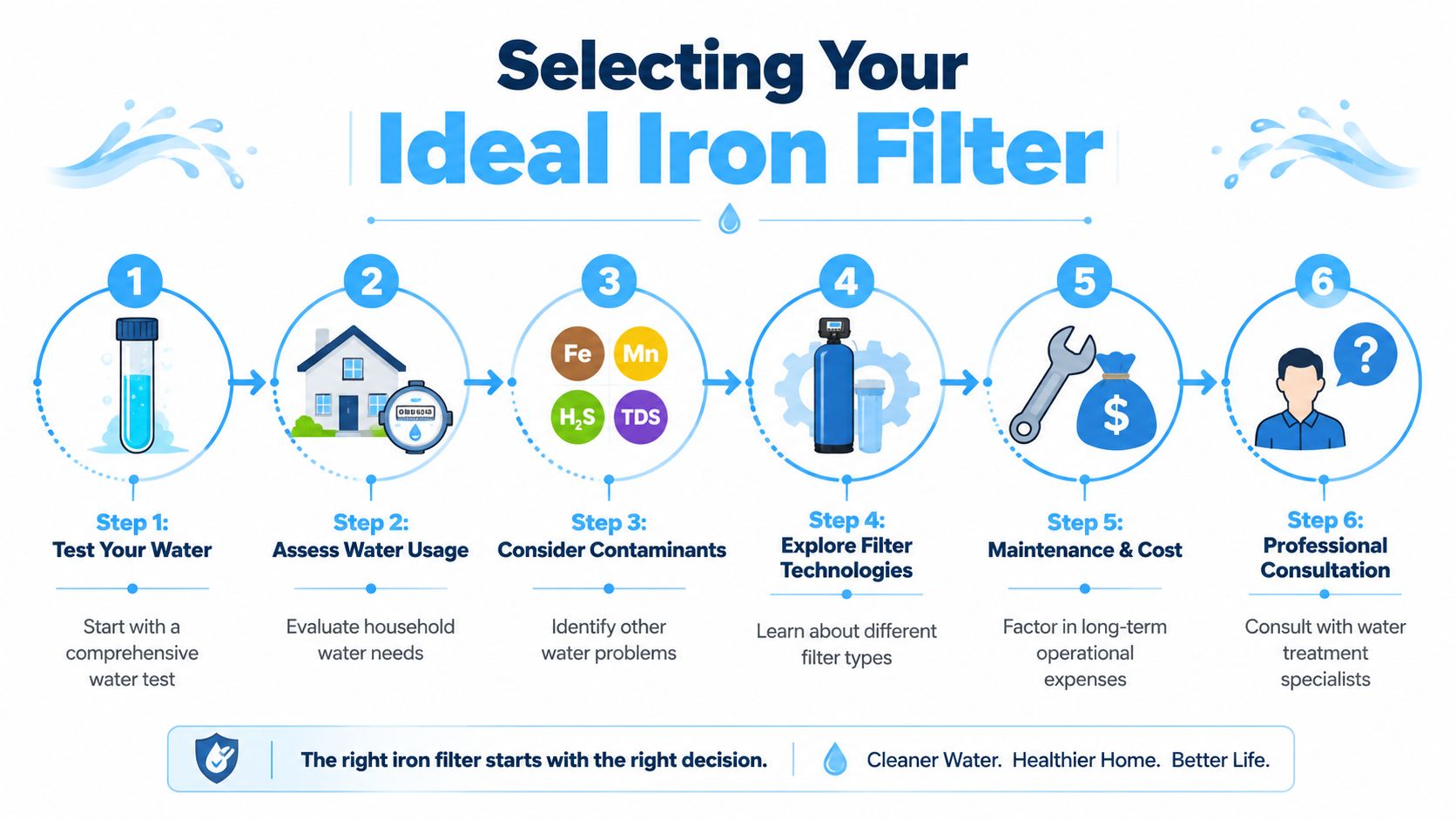
Buying the right iron filter isn't about finding the system with the biggest claims. It's about matching the system to your exact water profile. The homeowners who avoid buyer's remorse are the ones who work through the decision in order.
If your iron is mild and dissolved
If the test points to ferrous iron and the level is still in the range where softening is appropriate, a water softener may be the practical answer. This is especially true when hard water is already annoying you with scale, soap performance, and spotty fixtures.
That's the simplest decision tree. Mild dissolved iron plus hardness often supports a simpler system.
If your water turns rusty after exposure
If the water looks clear at first and then oxidizes after sitting, an oxidation-based filter may fit. For such applications, many people compare greensand, Birm, and similar systems.
But this is also where the most common mistake happens.
A common cause of filter failure is the presence of organic iron and tannins, which prevent the oxidation process used by popular Birm or greensand filters. A water test for tannins is essential before purchase to determine whether advanced chemical oxidation or another method is required (Illinois iron fact sheet).
Don't buy an oxidation filter for yellow or tea-colored water until tannins have been ruled out.
That one step can save a homeowner from installing a perfectly respectable system that never clears the water.
If the water is tea-colored or filters keep “failing”
This is the red-flag scenario. If your water has a yellow-brown cast, looks like weak tea, or keeps defeating common iron filters, think beyond standard media tanks.
In many homes, that points toward organic iron, tannins, or both. At that stage, a stronger oxidation and filtration setup is often the safer investment than trying one more “chemical-free” unit and hoping for a different outcome.
If slime is part of the problem
Slime in toilet tanks, gelatinous residue, or recurring fouling suggests bacterial involvement. Once bacteria enter the picture, filtration alone is usually too narrow a solution.
You need treatment that addresses the biological component as well as the iron itself.
A simple selection framework
Use this checklist before you sign off on equipment:
- Match the iron form first: Dissolved, particulate, organic, and bacterial problems don't belong in the same shopping basket.
- Check for tannins: This is the step many homeowners skip, and it's one of the costliest mistakes.
- Factor in flow needs: Whole-house treatment must keep up with showers, laundry, and fixtures running together.
- Think about maintenance tolerance: Some people want low-touch equipment. Others don't mind refill and service routines if the results are dependable.
If you're curious how aeration concepts scale beyond the home, these aerobic units for industrial applications are a useful example of how retention and oxygen exposure become part of larger treatment designs. The home version is obviously much smaller, but the principle helps explain why contact time matters.
Estimating Costs and Planning for Maintenance
The biggest cost mistake with high iron in water isn't always overspending on equipment. It's buying the wrong category of equipment, then paying to service, replace, or supplement it when the water still stains.
Because systems vary so widely by plumbing layout, water chemistry, flow demand, and whether professional installation is needed, the smartest way to think about cost is by total ownership, not sticker price. A softener may look simpler at first, but if the water really needs oxidation and filtration, that “lower-cost” choice can become the expensive one.
What maintenance really looks like
Different systems ask different things from you:
- Water softeners: Expect ongoing salt use and periodic attention if iron starts fouling the resin.
- Oxidizing media filters: These need backwashing and eventually media service or replacement.
- Chemical oxidation setups: You're taking on replenishment, contact time, and multiple components that need periodic checks.
- Aeration systems: These can reduce chemical handling, but they still need cleaning and filter upkeep.
The severe end of the spectrum is less forgiving. For severe cases involving iron-eating bacteria in well water, the most reliable treatment involves chlorination, a retention tank for contact time, and a backwashing carbon filter to remove oxidized iron and residual chlorine (multi-stage bacterial iron treatment).
How to budget without guessing
Before you approve a system, ask these questions in plain language:
- What recurring supplies will I need?
- How often does this system need service or cleaning?
- What happens if my water chemistry changes seasonally?
- Does this setup treat the actual cause, or just the visible symptom?
The best iron system isn't the one with the fewest parts. It's the one you can maintain consistently and that actually matches the water.
High Iron in Water FAQs
Can city water have iron too?
Yes. Municipal water can still cause staining or metallic taste if iron is present in the supply or introduced through older plumbing infrastructure. Homeowners often associate iron with wells, but a city connection doesn't automatically rule it out.
Will a pitcher filter remove iron?
Usually, no. Pitcher filters are not a serious whole-house or high-iron solution. They don't have the treatment capacity or the right process for most dissolved, organic, or bacterial iron problems, and they won't protect fixtures, laundry, or appliances.
Why is my new iron filter not removing yellow water?
This is one of the most common complaints, and it often points to organic iron or tannins. Standard oxidation-based filters may be designed for more straightforward dissolved iron. If the water is tea-colored or stays yellow after treatment, the system may be mismatched to the water chemistry rather than defective.
Is a whole-house system better than point-of-use treatment?
For most iron problems, yes. Iron affects more than drinking water. It stains tubs, sinks, toilets, fabrics, and appliances. Whole-house treatment solves the problem where the water enters the home instead of trying to clean up after it fixture by fixture.
What's the first thing I should do if I suspect high iron in water?
Get the water tested with enough detail to identify the likely iron form and check for factors such as tannins, hardness, and pH. That single step saves more money than any coupon code or “top-rated” product roundup ever will.
If you're comparing treatment options and want neutral, homeowner-focused guidance, Water Filter Advisor is a solid place to start. It's built for people who want to understand what a filter does, what maintenance looks like, and how to choose a system that fits their water instead of buying on marketing alone.
- July 10, 2026
- Uncategorized
