So, you've decided to stop drinking tap water that tastes faintly of swimming pool. Bravo! When you start to compare water filter systems, the first question isn't about fancy tech or micron ratings. It’s simple: are you trying to clean up all the water flowing into your house, or just the stuff you plan to drink and cook with?
This single decision is the biggest fork in the road. It determines whether you need a full-blown, whole-home defender that protects your plumbing and appliances from the evils of sediment and chlorine, or a targeted specialist right at the kitchen tap.
Your Quick Guide to Comparing Water Filters
It's easy to get lost in a sea of jargon, but picking the right water filter really just comes down to understanding a few key differences. And you're not alone in this quest—the global water filters market was valued at $15.8 billion in 2025 and is projected to climb to $21.86 billion by 2029. Clearly, people are tired of funky-tasting water. You can explore more about the water filter market trends to see just how popular clean water has become.
This guide will demystify the options so you can choose your filtration champion with confidence.
Foundational Filter Categories
Let’s start with the big leagues: whole-house (also called point-of-entry) versus point-of-use systems.
- Whole-House Systems: These are the heavyweights. Installed where your main water line enters your home, they treat every single drop. This means your drinking water, shower water, and even the water your dishwasher uses are all stripped of undesirables like chlorine, sediment, and hard minerals.
- Point-of-Use (POU) Systems: These are the snipers. They filter water at a single location, like your kitchen sink, refrigerator, or showerhead. They’re perfect for targeting specific issues—like making your drinking water taste less like a chemistry experiment—and are usually much easier and cheaper to install.
The core question is simple: Are you fighting a battle on one front (your kitchen sink) or across your entire home? Answering this narrows your options immediately.
To make this first choice even clearer, let's look at the main pros and cons of each approach. This table gives you a high-level summary to get your bearings before we dive deeper.
At-a-Glance Water Filter System Comparison
This chart breaks down the fundamental differences between the two main categories, helping you see where your needs might fit.
| System Type | Best For | Typical Initial Cost | Key Benefit | Primary Limitation |
| :— | :— | :— | :— |
| Whole-House | Homeowners with well water or widespread municipal water issues (chlorine, sediment). | $500 – $3,000+ | Protects all plumbing and appliances; provides filtered water at every tap. | Higher upfront cost and more complex installation, often requiring a plumber. |
| Point-of-Use | Renters or homeowners wanting targeted filtration for drinking and cooking water. | $50 – $500 | Lower initial cost, simple DIY installation, and highly effective for specific contaminants. | Only filters water at one specific point, leaving other taps and appliances unprotected. |
As you can see, the right choice really depends on the scale of your water quality concerns and your budget. One protects everything, while the other offers a focused, affordable solution.
Understanding Core Filtration Technologies
To really compare water filter systems, you have to understand what’s going on inside. Think of it like looking under the hood of a car—different engines give you different results. The real magic of water filtration happens in the technology used to trap or neutralize all the unwanted gunk in your water.
Once you know how these core technologies work, you can see right past the marketing fluff and focus on what matters: real-world performance. You'll be able to glance at a product label and know instantly if it’s built to handle the chlorine taste from city water or the nasty iron stains ruining your sinks. This is the key to making a smart choice.
The Workhorse: Activated Carbon
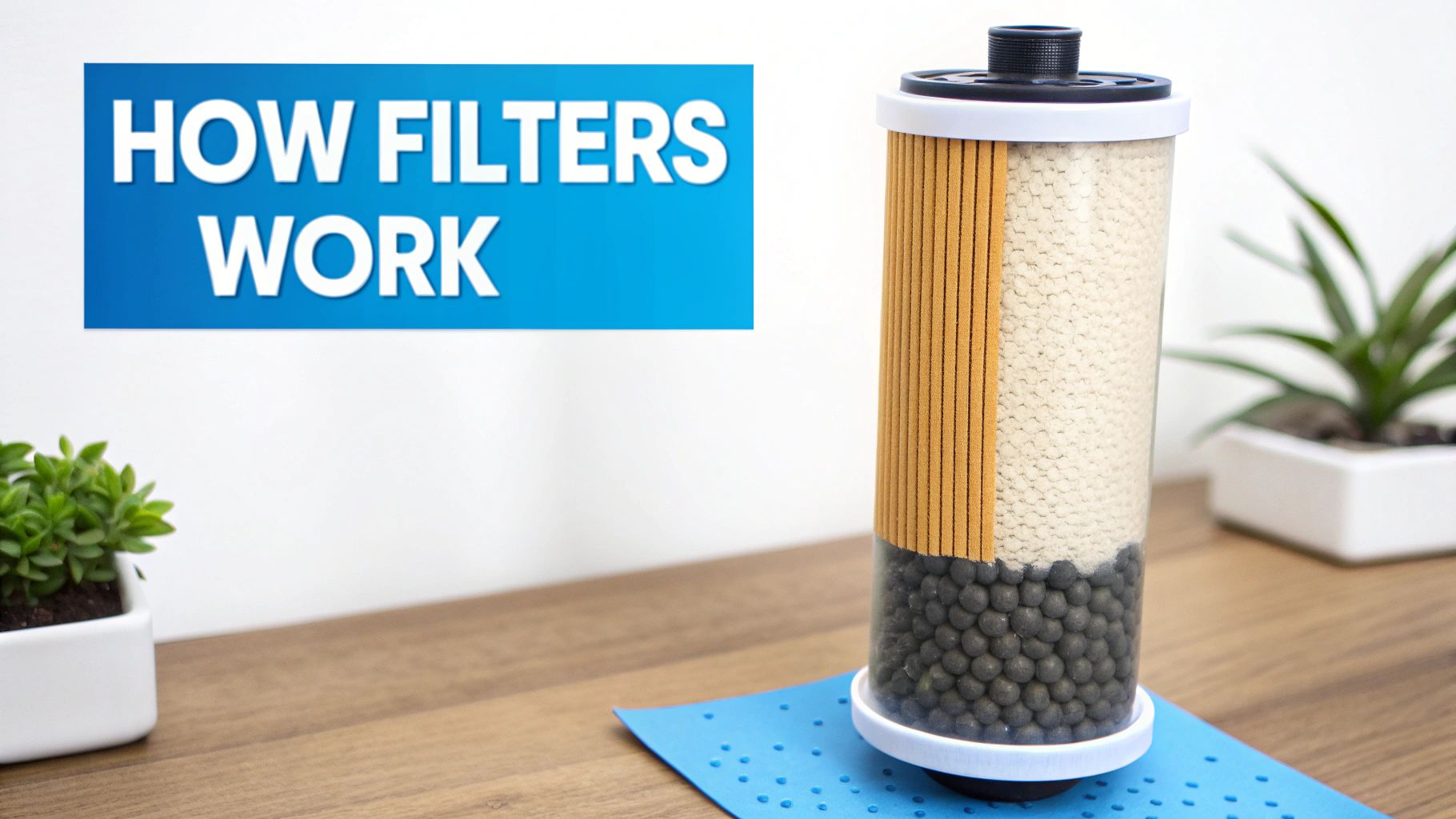
Activated carbon is the Swiss Army knife of filtration. It uses a process called adsorption, where contaminants literally stick to its surface like static cling. Its internal surface is massive—picture a football field's worth of nooks and crannies packed into a small cartridge—making it a powerful magnet for certain impurities.
This is your go-to for improving the general quality, taste, and smell of your water.
- Chlorine and Chloramine: Carbon filters are fantastic at knocking down that chemical taste and odor you get from city-treated water.
- Volatile Organic Compounds (VOCs): This includes stuff like industrial solvents and pesticides that can sometimes seep into the water supply.
Just remember, standard activated carbon won't touch dissolved minerals, salts, or most heavy metals. It’s a great aesthetic improver, but it's not a heavy-duty purifier.
The Purity Benchmark: Reverse Osmosis
If activated carbon is a magnet, Reverse Osmosis (RO) is the bouncer at an exclusive club. It lets only pure water molecules get past the velvet rope. This process uses your home's water pressure to force tap water through a special membrane with ridiculously small pores—we're talking as tiny as 0.0001 microns.
Reverse osmosis is the gold standard for purity. Its membrane is so fine that it can remove an extensive list of contaminants that other filters miss, including dissolved solids, salts, fluoride, and heavy metals like lead and arsenic.
Because it's so thorough, an RO system also creates wastewater (often called brine) that holds all the rejected contaminants. This gets flushed down the drain. It's the necessary trade-off for getting exceptionally pure water right from your tap.
Specialized Media: KDF and Catalytic Carbon
Beyond the big two, some systems bring in specialized media to target very specific problems. You’ll often find these working as one stage in a larger, multi-stage filter.
- KDF (Kinetic Degradation Fluxion): This stuff is made of high-purity copper-zinc granules. It creates a tiny electrochemical reaction that converts chlorine into harmless chloride and helps reduce heavy metals like lead, mercury, and iron. A big plus for KDF is that it’s bacteriostatic, meaning it stops bacteria from growing inside the filter itself.
- Catalytic Carbon: Think of this as activated carbon on steroids. It's been specially processed to be way more effective at grabbing stubborn chloramine—a disinfectant used by many cities that standard carbon has a tough time with. It's also much better at removing hydrogen sulfide, which is what causes that awful "rotten egg" smell.
By getting a handle on these key technologies, you can now look at any product's specs with total confidence. You'll understand not just what a filter does, but how it does it, making sure the system you pick is perfectly matched to your home's unique water challenges.
Whole-House vs. Point-of-Use System Showdown
When you start looking at water filters, the first big decision you'll face is whether to go with a whole-house system or a point-of-use (POU) filter. This isn't just a minor detail—it's the fundamental choice between treating every drop of water in your home or zeroing in on the water you drink and cook with.
Neither one is flat-out better than the other. The right choice for you comes down to your home's specific water problems and what you're trying to accomplish.
Think of it this way: a whole-house system is like central air conditioning. It sets a baseline for comfort throughout the entire house. A point-of-use filter is more like a powerful window AC unit—it delivers a blast of cold air exactly where you need it most. They solve different problems and have their own unique advantages.
The Case for Whole-House Filtration
A whole-house system, sometimes called a Point-of-Entry (POE) system, gets installed right at the source—your main water line. Its job is to filter every gallon of water that enters your home, from the kitchen sink to the washing machine and every showerhead in between. The goal here is less about getting perfectly purified drinking water and more about protecting your entire property.
If you’re a homeowner dealing with hard water scale, high chlorine levels from the city, or sediment clouding up your water, this is almost always the best long-term play.
- Protect Your Pipes and Appliances: Scale and sediment are the silent killers of a home’s plumbing. A whole-house filter acts as a bodyguard for your water heater, dishwasher, and pipes, stopping the mineral buildup that leads to expensive repairs and crummy performance.
- Better Showers and Laundry: By stripping out chlorine and other chemicals, you can make a huge difference in your skin and hair health. Filtered water is just plain softer and less irritating. Your clothes will probably thank you, too—they'll often look brighter and last longer without being bleached by chlorine.
- Total Convenience: There's real peace of mind in knowing that every single tap in your house delivers cleaner, safer water.
One thing to keep in mind is that a whole-house system can sometimes affect your water pressure. If that's a concern, it's worth learning about how to increase water pressure in your home.
The Power of Point-of-Use Systems
Point-of-use (POU) filters are the specialists. You install them at a single spot—under the kitchen sink, on your faucet, or attached to your showerhead—to get high-quality water right where you’re using it. Their targeted approach makes them incredibly popular for being affordable, easy to install, and precise.
And the market proves it. POU filters are the top sellers in a global market that was valued at $37.7 billion in 2025. That figure is expected to more than double by 2034, mostly because households want simple, effective fixes for their drinking water.
This is the go-to solution for renters or anyone whose main goal is just better-tasting water for drinking and cooking.
Comparing Key Scenarios
Let's break down how this choice works in a couple of real-world situations.
Scenario 1: The Renter in the City
Someone renting an apartment can't stand the strong chlorine taste of their tap water. They're not allowed to make any major changes to the plumbing.
- Best Choice: A Point-of-Use system, like a faucet-mounted filter or a simple countertop pitcher.
- Why it works: It’s cheap, requires zero permanent installation, and directly fixes the main complaint: bad-tasting drinking water. A whole-house system is completely off the table.
Scenario 2: The Homeowner with Well Water
A family in the country gets their water from a well. It’s high in iron and sediment, which leaves ugly orange stains in their sinks and toilets.
- Best Choice: A Whole-House system, probably a multi-stage setup with a sediment pre-filter and a dedicated iron filter.
- Why it works: The problem is house-wide. A POU filter would only fix the water at one sink, while the showers, toilets, and laundry would still be dealing with staining and potential damage.
A whole-house system is a proactive investment in your home's health, protecting it from the inside out. A point-of-use system is a reactive solution, providing a precise fix for the water you consume directly.
In the end, let your water test results and your daily life be your guide. If you’re just worried about the taste of your coffee or the water in your glass, a POU system is an efficient, budget-friendly fix. But if you're fighting battles that affect your entire home—from your skin to your water heater—a whole-house system is the only way to get a complete and lasting solution.
Decided a point-of-use (POU) system is the right move for your home? Great. Now the real fun begins. POU filters are all about precision—targeting water quality issues right where you need it most. Each type brings a different mix of power, convenience, and cost to the table.
When you start comparing these systems, it's not really about finding the "best" one overall. It's about finding the one that slots perfectly into your daily life. Let's dig into the most common options, from the heavy-hitters hiding under your sink to the simple grab-and-go pitchers.
Under-Sink Filters: The Hidden Powerhouse
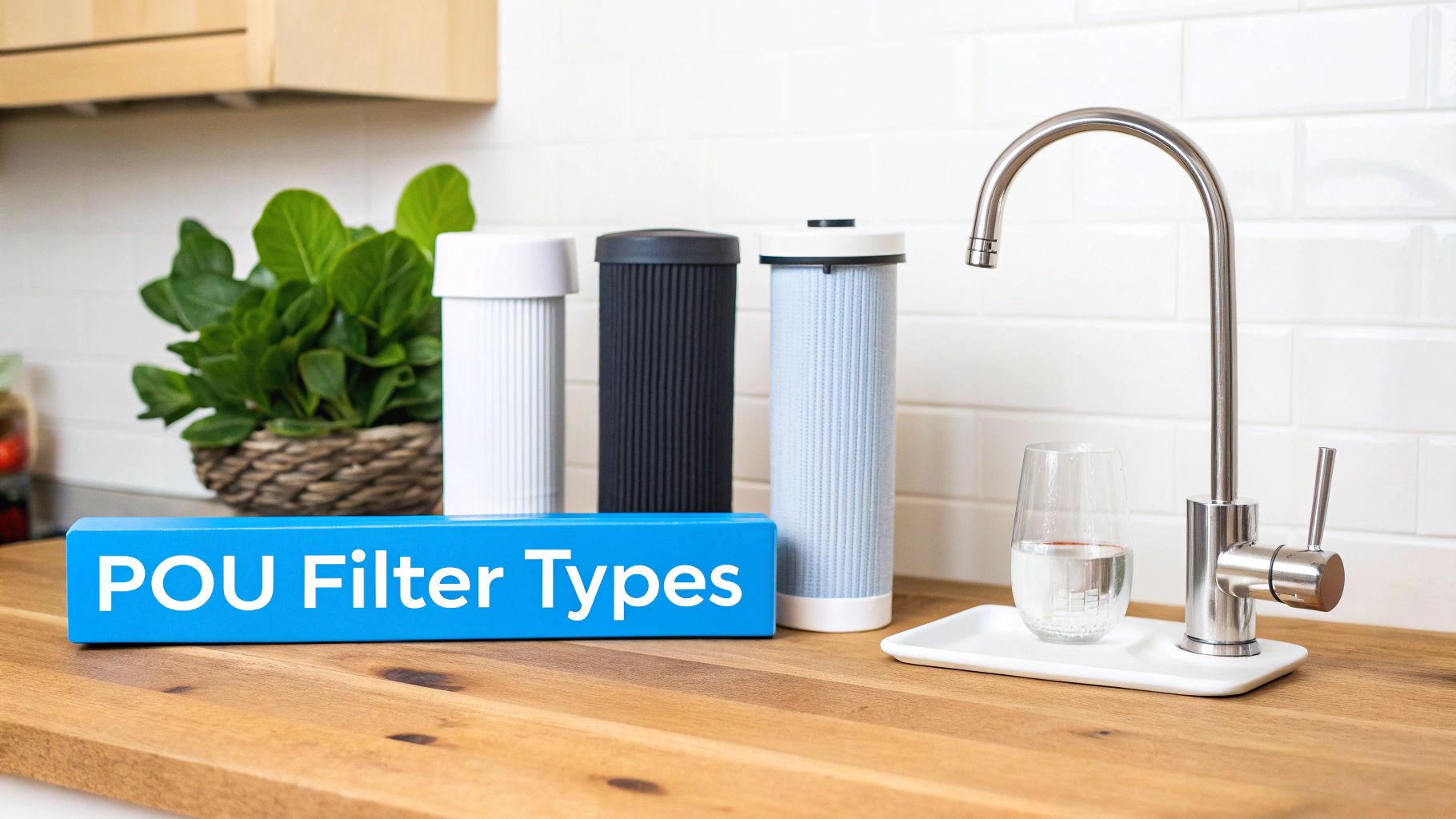
Under-sink filters are the quiet workhorses of the POU world. They get tucked away in the cabinet under your kitchen sink, delivering serious, multi-stage filtration without taking up any counter space. These systems hook right into your cold water line and usually come with a separate, dedicated faucet just for purified water.
This out-of-sight setup allows for much more sophisticated technology, like reverse osmosis membranes and multiple carbon block filters. The result? They can knock out a massive list of contaminants—everything from chlorine and lead to fluoride and other dissolved solids. This is how you get some of the purest drinking water possible from a home filter.
They do require a bit of light plumbing for installation, but the performance is top-notch. It's a fantastic choice for homeowners or long-term renters who want the best filtration without tearing up the kitchen.
Faucet-Mounted Filters: Instant Gratification
If you need a simple solution that works right now, faucet-mounted filters are tough to beat. These little units screw directly onto your existing kitchen faucet in just a few minutes. No tools, no permanent changes. You'll get a noticeable improvement in your water's taste and smell almost immediately.
Most of these use activated carbon to pull out chlorine and some sediment. There’s usually a small lever that lets you switch between filtered water (for drinking and cooking) and regular tap water (for washing dishes), which is a smart feature that helps the filter last longer.
Faucet filters are the sweet spot between performance and convenience. They're perfect for apartment dwellers or anyone who wants better-tasting water on demand without any hassle or damage.
The main trade-off here is filter capacity. You'll be swapping them out more often than an under-sink model, usually every 2-3 months or after about 100 gallons. They also eat up a little bit of the clearance space under your faucet.
Refrigerator and Pitcher Filters: Ultimate Convenience
These two are all about pure, simple ease of use.
- Refrigerator Filters: Already built into your fridge’s water dispenser and ice maker, these are the definition of "set it and forget it." They use a small carbon filter to mainly improve the taste and odor of your water and ice by reducing chlorine.
- Water Filter Pitchers: The most portable and budget-friendly option out there. Pitchers need zero installation. You just fill them up at the tap and let gravity do the work, pulling water through a filter cartridge. They’re great for small households or just for keeping a supply of chilled, filtered water ready to go.
With both, the compromise is in the level of filtration and the slow flow rate. They do a great job on chlorine, but they generally aren't certified to handle more serious contaminants like heavy metals or VOCs.
Showerhead Filters: A Focus on Wellness
Not all POU filters are for drinking. Showerhead filters are designed for one specific job: to improve the water you bathe in. By using KDF media and carbon, they are incredibly effective at reducing chlorine, which is notorious for drying out skin and hair and can be inhaled as steam during a hot shower.
Installation couldn't be easier—just unscrew your old showerhead and twist the new one on. For anyone dealing with dry, itchy skin, brittle hair, or respiratory irritation after showering, this can be a total game-changer. It’s a specialized tool that solves a very common, everyday problem with immediate results.
Faced with a wall of technical jargon and bold claims, how do you figure out which water filter actually works? The secret is learning to read the language of third-party certifications and performance data. This is where marketing fluff meets reality.
Think of a certification as an independent audit of a filter's promises. The biggest name you'll see is the NSF (National Sanitation Foundation), which tests and verifies products against specific ANSI standards. Getting familiar with these standards is your best tool for cutting through the noise.
These aren't just arbitrary labels; they tell you exactly which contaminants a filter is proven to remove, giving you a solid, unbiased baseline for any comparison.
The Three Big NSF/ANSI Standards to Know
When it comes to the water you drink and use at home, three standards are absolutely essential. Each one covers a different aspect of performance, telling you precisely what a system is built to do.
- NSF/ANSI 42 (Aesthetic Effects): This is all about taste, smell, and appearance. If a filter has this certification, it’s proven to reduce things like chlorine and other particulates that make your water less pleasant, but aren't necessarily health risks.
- NSF/ANSI 53 (Health Effects): This one is a big deal. A filter certified to this standard is verified to remove specific contaminants that can impact your health. We're talking about serious stuff like lead, mercury, cysts (like Giardia), and a whole range of volatile organic compounds (VOCs).
- NSF/ANSI 58 (Reverse Osmosis Systems): This standard is specifically for the heavy hitters—RO systems. It confirms the system’s ability to drastically reduce a wide spectrum of contaminants, from dissolved solids and fluoride to arsenic and nitrates.
It’s no surprise that when you look at different filter types, reverse osmosis technology is a major player, projected to hold a 55% market share by 2025. While RO systems often boast impressive contaminant removal stats—frequently certified to NSF/ANSI 58 for reducing total dissolved solids by 90-99%—it's not the whole story. You have to weigh that power against factors like wastewater and ongoing maintenance, making it a crucial point of comparison in any filter search. You can dig deeper into the water treatment market data here.
Making Sense of the Spec Sheet
Beyond the official stamps of approval, you’ll need to get comfortable with a few key performance metrics. These numbers are what tell you how a filter will actually behave in your home day-to-day.
A filter's spec sheet tells a story. The flow rate reveals its impact on your daily routine, the capacity dictates your long-term costs, and the micron rating shows its microscopic power.
Understanding these specs is what separates a confused shopper from a confident buyer. Here’s what they mean in practical terms.
- Flow Rate (GPM): Measured in gallons per minute, this number tells you how quickly water can pass through the system. A low GPM might be perfectly fine for an under-sink filter dedicated to a single faucet, but a whole-house system needs a high GPM (10-20+) to keep up with showers and appliances without killing your water pressure.
- Filter Capacity (Gallons): This is simply the filter's lifespan, measured in gallons. It tells you how much water it can effectively treat before it needs to be replaced. A bigger capacity means fewer filter changes and lower costs over time.
- Micron Rating: This number indicates the size of the pores in the filter material. The smaller the number, the tinier the contaminants it can block. A filter with a 0.5-micron rating, for example, offers a much higher degree of purification than one rated at 5 microns.
Making Your Final Decision with a Practical Framework
Okay, you've got a handle on the different filtration technologies and system types. Now it's time to connect the dots and figure out what actually makes sense for you. Choosing the right water filter isn’t about chasing a single “best” product—it’s about finding the right solution for your specific situation.
Let's walk through the final steps to make sure the filter you choose is the right one for your home, your budget, and your peace of mind.
The absolute most important thing you can do is get your water tested. Guessing what's in your tap water is a waste of time and money. A water test gives you a clear roadmap, showing you exactly what needs to be filtered out, whether it's just high chlorine, lead from old pipes, or something else entirely.
Step 1: Start with a Water Test
You can grab a simple DIY test kit from a hardware store for a quick look, or for a really detailed breakdown, send a sample to a state-certified lab. That lab report will be your guide, flagging any contaminants that are above recommended health levels.
With that data in hand, you can directly compare it to a filter's performance data sheet and NSF certifications. If your test shows lead, you'll know to look for a system certified to NSF/ANSI 53 for lead reduction. It’s an evidence-based approach that takes all the guesswork out of the equation.
Step 2: Assess Your Household's Needs
Once you know what's in your water, think about your home and lifestyle. Your daily habits and the number of people in your house are huge factors in picking the right type and size of a system.
Ask yourself these questions:
- How much water do you really use? A big family running the dishwasher and washing machine every day has completely different needs than a single person in a small apartment. This helps decide between a high-capacity whole-house system and a simple point-of-use filter.
- What are your installation limits? Are you a homeowner who's okay with a little plumbing work, or are you a renter who needs something non-permanent? This will quickly narrow your options between, say, an under-sink system and a faucet-mounted filter.
- What’s your real budget? Don't just look at the upfront price. Figure out the total cost of ownership, which includes replacement filters and how often you'll need them. Sometimes, a pricier system with long-lasting filters actually costs less over time.
This decision tree gives you a great visual for how to think about it.
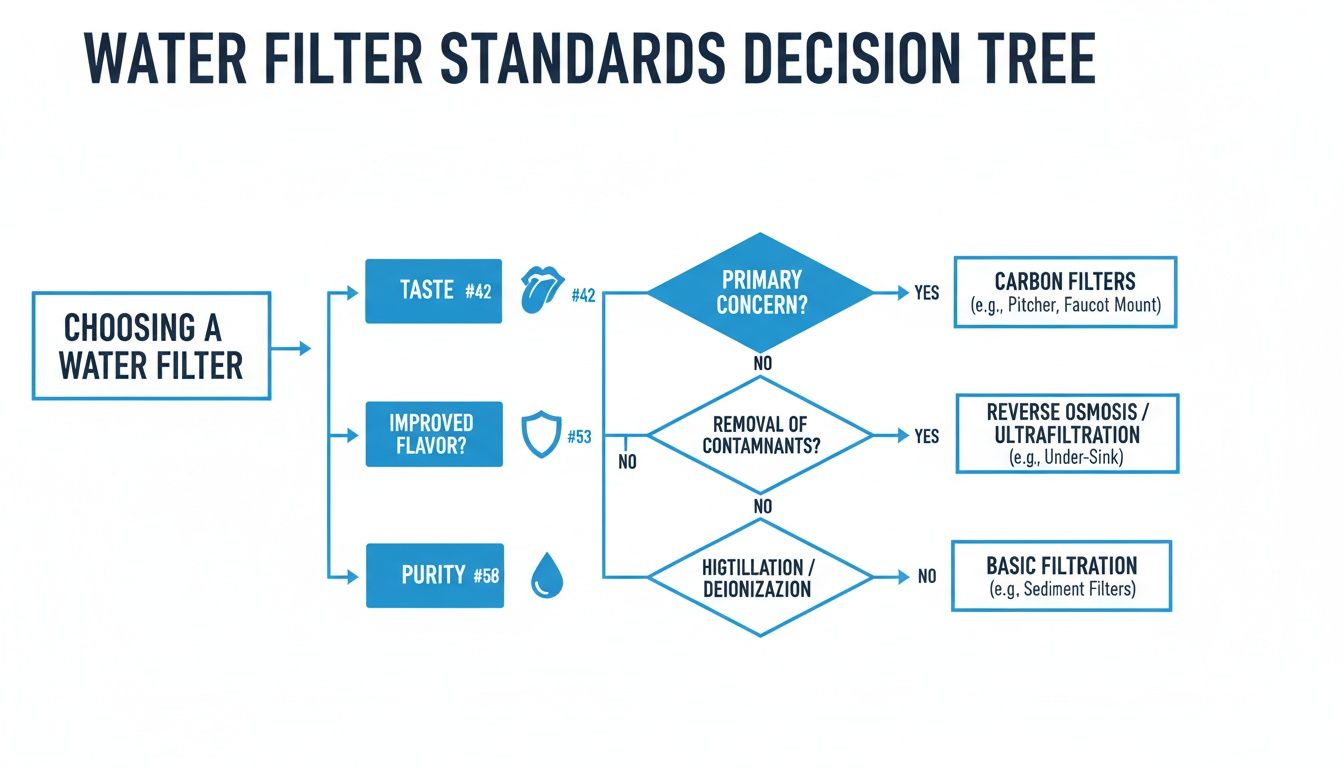
As the graphic shows, if your main goal is better taste, NSF 42 is your target. For specific health contaminants, it’s NSF 53. And for the highest level of purity, you're looking for NSF 58, which covers reverse osmosis systems.
Step 3: Match the System to Your Scenario
Now, let's put it all together with a few common household examples. Think of these as cheat sheets to get you started.
The goal is to find the point where your water test results, daily usage, and budget all intersect. That intersection is where you'll find the perfect water filter system for your home.
- For the City Renter with Chlorine Taste: A faucet-mounted filter or a pitcher certified to NSF 42 is a perfect fit. It's cheap, needs no real installation, and fixes the taste problem without you paying for filtration you don't need.
- For the Family with Well Water: A multi-stage whole-house system is pretty much non-negotiable. You'll likely need a sediment pre-filter for dirt and rust, a carbon filter for chemicals, and maybe even a UV purifier if bacteria is a concern.
- For the Health-Conscious Homeowner: An under-sink reverse osmosis system certified to NSF 58 is the gold standard. It gives you the highest purity for drinking and cooking water, knocking out a huge range of contaminants.
By following this simple, structured approach, you can feel confident in your decision. For more detailed reviews and tailored suggestions, you can find more expert water filter advice to help you lock in your final choice.
Common Questions About Water Filters
Even after you've done your homework, a few last-minute questions always seem to surface right before you pull the trigger. Let's tackle the most common ones people ask when comparing water filter systems.
How Often Should I Change My Filters?
This is probably the most critical question because it hits both performance and your wallet. The real answer depends on the type of system you choose and how hard it has to work with your specific water.
- Pitchers & Faucet Filters: These are the sprinters. Expect to swap them out every 2-3 months, or after filtering around 100 gallons.
- Under-Sink & Refrigerator Filters: These have more staying power, usually lasting anywhere from 6 to 12 months.
- Whole-House Sediment/Carbon Filters: A good rule of thumb is to replace these once a year. If your water has a lot of sediment, you might need to do it every 6-9 months.
- Reverse Osmosis Membranes: The RO membrane is the marathon runner of the group, often going for 2-5 years before it needs to be replaced.
Always, always check what the manufacturer recommends. A filter that's past its prime doesn't just stop filtering effectively—it can become a breeding ground for bacteria and seriously choke your water flow.
Will a Filter Hurt My Water Pressure?
Any filter will create a small dip in water pressure, that’s just physics. But with a properly sized and maintained system, you honestly shouldn’t even notice it. If you suddenly see a major drop in pressure, your filter is clogged and screaming for a replacement.
A sudden drop in water pressure is your filter's way of telling you it's clogged and needs to be replaced. For whole-house systems, choosing a model with a high flow rate (15+ GPM) and 1-inch ports is the best way to prevent pressure issues from the start.
Do I Need a Water Softener and a Filter?
They’re two completely different tools for two different problems. A water filter is all about safety and taste, removing things like chlorine, lead, and pesticides. A water softener, on the other hand, tackles "hard" minerals like calcium and magnesium to stop that crusty scale buildup that kills your appliances and leaves spots all over your dishes.
If your water test shows you're dealing with both—unwanted contaminants and hardness (typically over 7 grains per gallon)—then yes, you might need both. A common setup is to install a water softener first in line, followed by a whole-house filter for a complete treatment solution.
Can I Install a Water Filter Myself?
This really depends on the system and how comfortable you are with a wrench.
- DIY-Friendly: Pitchers, countertop units, and faucet filters are a piece of cake. You can have them up and running in minutes with zero tools.
- Manageable DIY: An under-sink system is a great weekend project for a confident DIYer. It involves some basic plumbing, but it's very doable.
- Professional Recommended: Don't mess around with whole-house systems unless you really know what you're doing. They require cutting into your main water line, and a pro will make sure it’s done right and up to local plumbing codes.
At Water Filter Advisor, we provide in-depth guides and unbiased reviews to help you make the right choice for your home. Explore our resources to find the perfect water filtration solution for your family at https://www.waterfilteradvisor.com.
- January 29, 2026
- 0
- Uncategorized
