Choosing between a reverse osmosis system and an activated carbon filter boils down to one simple, epic question: are you trying to purify your water or just improve it?
If you're on a quest for the purest water imaginable and want to kick almost everything to the curb—we’re talking dissolved salts, heavy metals, and even fluoride—then a reverse osmosis (RO) system is your undisputed champion. However, if you're on city water and your main mission is just to banish that swimming-pool chlorine taste and smell, an activated carbon filter is your quick, affordable, and highly effective sidekick.
Choosing Your Home Water Filtration System
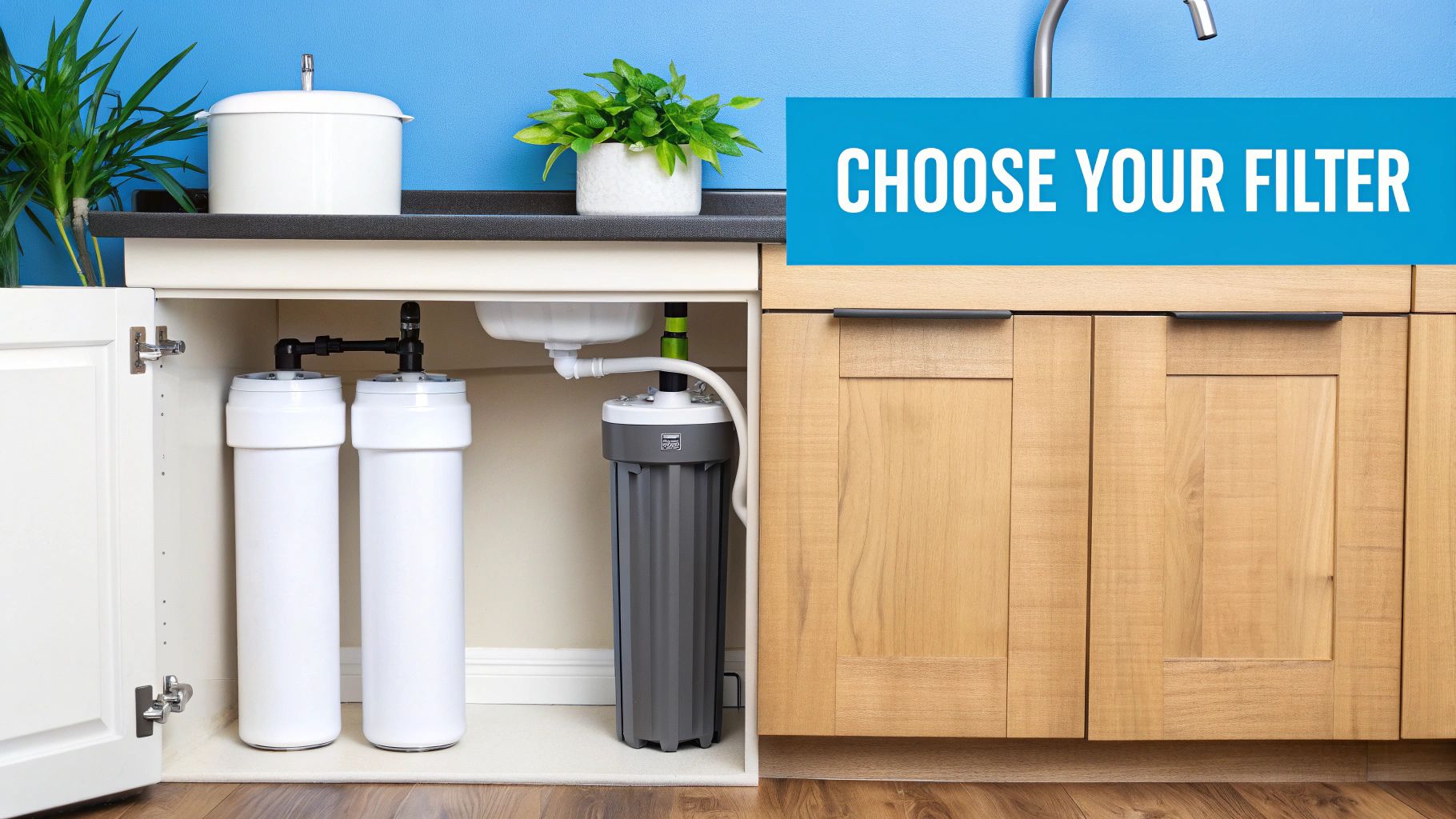
Diving into the world of home water filtration can feel like you've fallen down a rabbit hole, but it gets way simpler once you know what you’re trying to fix. You aren't just buying a gizmo; you're picking a specific technology designed to solve your particular water woes. This guide will demystify the reverse osmosis vs. carbon filtration battle to help you make the right call for your kitchen.
The first rule of Water Filtration Club? Know what’s in your water. Before you spend a dime, it's vital to get a clear picture of your H₂O's current resume. You can learn more about how to test water for bacteria and other invisible party crashers. Having that intel puts you in the driver's seat, allowing you to pick a filter that directly tackles your home's unique challenges.
For more general help, you can also check out a wide range of water filtration advice from industry experts to guide your decision-making process.
| Feature | Reverse Osmosis (RO) | Activated Carbon |
|---|---|---|
| Primary Function | Water purification (removes dissolved solids) | Water improvement (removes taste/odor) |
| Best For | Removing a broad spectrum of contaminants | Improving municipally treated tap water |
| Typical Contaminants | Lead, arsenic, fluoride, salts, nitrates | Chlorine, pesticides, VOCs, chloramine |
| Installation | More complex; typically under-sink with a dedicated faucet | Varies from simple pitchers to under-sink units |
In short, it all comes back to your starting water quality and what you want to achieve. Is your biggest complaint the funky chlorine taste from your city tap? An activated carbon filter will probably do the job just fine.
A simple way to think about it: Activated carbon is like a chemical magnet, grabbing impurities. Reverse osmosis is like an ultra-exclusive nightclub bouncer, physically blocking nearly everything but water molecules from getting in.
But if you're wrangling with well water or have concerns about things carbon filters can't touch—like heavy metals or dissolved solids—then a reverse osmosis system provides a much stronger line of defense. It's the go-to choice for ensuring the absolute highest level of purity for your drinking water.
How RO and Carbon Filtration Actually Work
To really settle the "reverse osmosis vs. carbon water filtration" debate, you have to look under the hood. These two technologies approach water purification from completely different angles.
Think of it this way: one is a bouncer, and the other is a magnet. That simple analogy cuts right to the heart of how each system cleans your water.
The Science of Reverse Osmosis: A Pressure Game
Imagine trying to push a basketball through a keyhole. That’s the basic idea behind reverse osmosis (RO), just on a microscopic level. The heart and soul of an RO system is its semipermeable membrane, a special material with pores so ridiculously small they're hard to even fathom.
The system uses your home’s natural water pressure to force water up against this membrane. Water molecules (H₂O) are tiny enough to slip through, but almost everything else gets left behind. Dissolved salts, heavy metals like lead and arsenic, and a whole rogues' gallery of other contaminants are physically blocked and told, "You're not on the list."
This physical separation is what makes RO so incredibly effective. It doesn’t just chase after a few specific chemicals; it’s a nearly impenetrable barrier that can remove up to 99% of all total dissolved solids (TDS).
This "rejected" water, now loaded with all the gunk that was filtered out, gets flushed down the drain. What you're left with is exceptionally pure water. It’s a simple process of exclusion that ensures only the cleanest H₂O makes it into your glass.
The Magic of Carbon Filtration: An Adsorption Process
Activated carbon filtration, on the other hand, works through a nifty process called adsorption. This isn't the same as absorption, where something soaks up water like a sponge. Instead, contaminants literally stick to the surface of the carbon filter like Velcro.
How? The activated carbon inside these filters—often made from something cool like coconut shells—is treated to create a massive internal surface area full of nooks and crannies. To put it in perspective, a single gram of activated carbon can have the surface area of a football field.
As water flows through, things like chlorine, pesticides, and volatile organic compounds (VOCs) are drawn to this surface and get trapped, almost like iron filings clinging to a powerful magnet.
This approach is fantastic for improving how your water tastes and smells. To see how it zeroes in on these specific issues, it’s worth checking out how a dedicated carbon filtration system is designed.
The choice between them really comes down to what you’re trying to remove. One uses brute force and a physical wall, while the other uses a massive, sticky surface area to grab specific impurities.
Contaminant Removal: A Head-to-Head Comparison
When you're trying to choose between reverse osmosis and a carbon filter, the first question to ask is simple: what, exactly, are you trying to kick out of your water?
These two technologies work in fundamentally different ways, and each one is a champion in its own ring. But this isn't a one-size-fits-all game. The best choice for your home comes down to the unique chemistry of your water.
Let's break down how each system stacks up against the most common water contaminants we see in homes. This direct comparison will show you where each filter really shines—and where it falls short.
This infographic gives you a quick visual on how these two technologies operate. RO uses high pressure to force water through a super-fine membrane, while carbon filters use a process called adsorption, which is more like a chemical magnet.
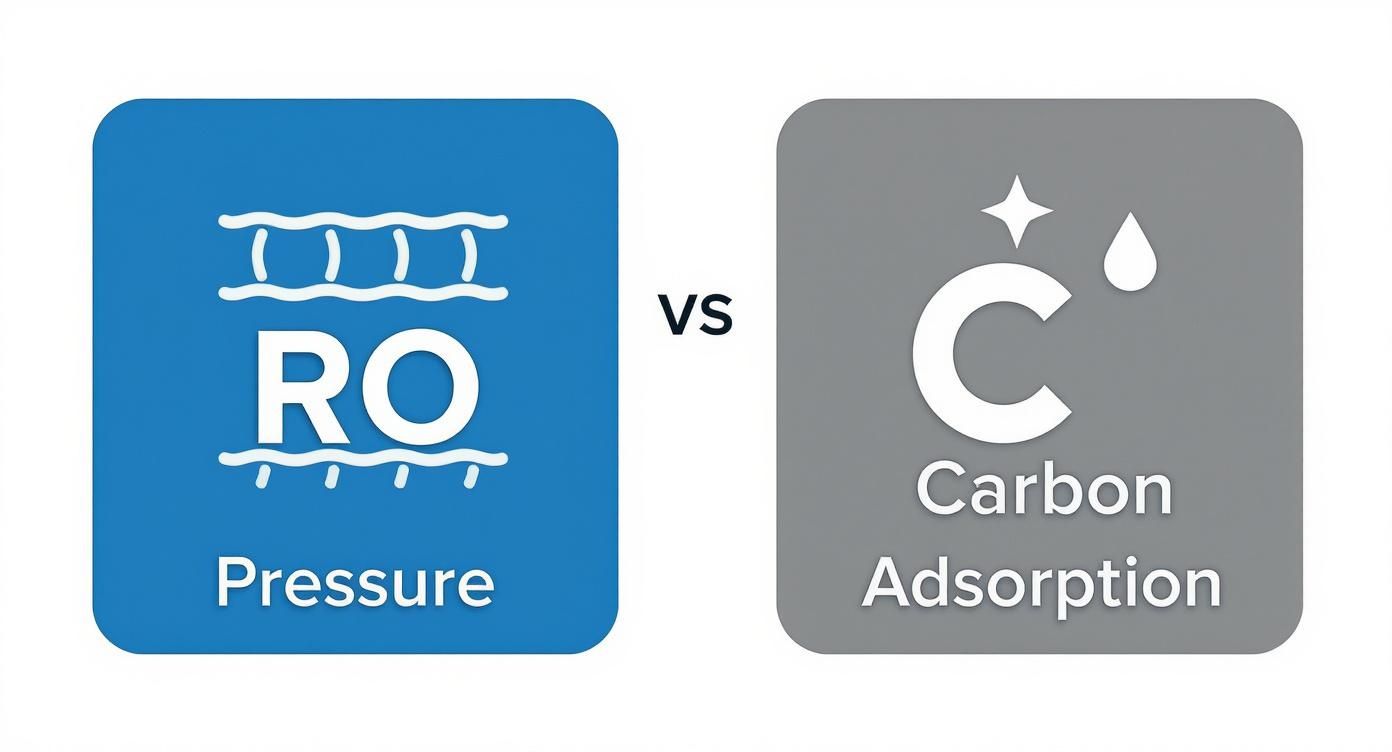
At the end of the day, RO is a physical gatekeeper, and carbon is a chemical trap. That core difference dictates everything about what they can and can't remove.
Heavy Metals and Dissolved Solids
This group includes some of the stuff homeowners worry about most, like lead, arsenic, and mercury. It also covers Total Dissolved Solids (TDS)—basically all the minerals, salts, and other tiny bits dissolved in your water.
When it comes to these contaminants, Reverse Osmosis (RO) is the undisputed heavyweight champ. Its semipermeable membrane is a nearly impenetrable barrier, physically stopping particles as small as 0.0001 microns. This means RO systems can strip out up to 99% of TDS.
That includes things like:
- Lead: A serious concern, especially in older homes where it can leach from pipes.
- Arsenic: A nasty, naturally occurring toxin found in some groundwater sources.
- Fluoride: Often added to city water, but many people prefer to remove it.
- Nitrates and Sulfates: Common runoff contaminants, particularly in agricultural areas.
Activated Carbon filters, on the other hand, just aren't built for this job. While some high-end carbon block filters can reduce lead, they won’t touch arsenic, fluoride, or nitrates, and they won't make a dent in your TDS levels. Their real talents lie elsewhere.
Chemicals and Organic Compounds
Now we're talking about the things that make your water taste and smell funky, along with some potentially harmful chemicals. This is where activated carbon truly excels.
Activated Carbon is a master of adsorption. Think of it like a sponge with a massive surface area, but for chemicals. Its porous structure acts like a powerful magnet for organic compounds, grabbing them as water flows past.
This makes it incredibly good at removing:
- Chlorine and Chloramines: The disinfectants cities use that give tap water its "pool" smell and taste.
- Volatile Organic Compounds (VOCs): Nasty chemicals from things like pesticides, herbicides, and industrial solvents.
- Trihalomethanes (TTHMs): Byproducts that can form when chlorine mixes with organic matter in water.
Reverse Osmosis systems also get rid of these chemicals, but there’s a catch—it's not the RO membrane doing the work. Nearly all RO systems have activated carbon filters built-in as pre- and post-filters. The carbon pre-filter protects the delicate RO membrane from chlorine damage, and the post-filter gives the water a final "polish" to make sure it tastes great.
Key Takeaway: If your main goal is just to improve the taste and smell of city water, a good carbon filter is often all you need. An RO system gets the same result, but it's part of a much more thorough purification process.
Microorganisms: Bacteria and Viruses
If you're dealing with water that might be microbiologically unsafe—like from a private well—your choice of filter is absolutely critical.
Reverse Osmosis can physically block bacteria and viruses. The pores in an RO membrane are so tiny that microorganisms, including cysts like Giardia and Cryptosporidium, are simply too big to get through. But it's crucial to know that most residential RO systems aren't technically certified as microbiological purifiers. If the membrane gets damaged, it could let things slip past.
Activated Carbon filters are not meant to remove bacteria or viruses. Full stop. In fact, if you don't change them on schedule, a carbon filter can actually become a breeding ground for bacteria. While some specialized carbon filters with a tiny 0.5-micron rating can block larger protozoa, they won’t stop bacteria or viruses.
The demand for truly comprehensive purification has pushed reverse osmosis technology to the forefront. The North American market for home water filtration shows this clearly, with RO systems capturing the majority market share in recent years. This is because RO systems hit a sweet spot, balancing powerful contaminant removal with pretty low energy use. Activated carbon filters still play a vital role, often paired with RO or UV systems to adsorb chlorine and other compounds that membrane-based systems can't handle. You can discover more research on home water filtration trends to see how RO is positioned to meet today's tougher water quality standards.
Reverse Osmosis vs Carbon Filter Contaminant Removal Effectiveness
To make things even clearer, here’s a simple table that puts the two technologies side-by-side, showing you exactly how they perform against specific contaminants.
| Contaminant Type | Reverse Osmosis (RO) | Activated Carbon |
|---|---|---|
| Lead | Excellent (Removes 95-98%) | Good (Specialized filters required) |
| Chlorine | Excellent (via carbon pre-filter) | Excellent (Primary strength) |
| Fluoride | Excellent (Removes 90-97%) | None |
| Arsenic | Excellent (Removes >95%) | None |
| Bacteria/Viruses | Good (Physical barrier but not certified) | Poor (Does not remove) |
| Pesticides/VOCs | Excellent (via carbon stages) | Excellent |
| Nitrates | Excellent (Removes 80-90%) | None |
| TDS (Salts) | Excellent (Removes >90%) | None |
Looking at this comparison, it’s obvious that your decision in the "reverse osmosis vs carbon water filtration" debate should start with your water quality report. One is a broad-spectrum purifier for tackling the toughest contaminants, while the other is a specialist for making good water taste great.
Comparing Lifetime Cost and Maintenance
When you’re weighing reverse osmosis against carbon water filtration, the price on the box is only part of the story. To really get a handle on what you'll spend, you have to look at the total cost of ownership over the long haul. That means factoring in the initial purchase, installation, filter replacements, and even the "hidden" cost of wastewater.
A simple carbon pitcher might look like a steal at first, but those replacement filters can start to add up. On the flip side, a reverse osmosis system asks for more money upfront but can deliver purified water at a lower per-gallon cost over its lifetime. Let's dig into the dollars and cents to see which one really fits your budget.
The Upfront Investment
The initial cash you’ll lay out for a filtration system is wildly different between RO and carbon options. Whether you tackle the installation yourself or call in a pro will also play a big role in that first bill.
-
Carbon Filters: You can get started for next to nothing. A basic faucet filter or a pitcher can be had for as little as $20-$50. If you step up to a more serious under-sink carbon system, you're looking at $100 to $300. The good news is that most of these are simple enough to install yourself, letting you skip the plumber's fee.
-
Reverse Osmosis Systems: These are more complicated machines, and the price reflects that. A solid under-sink RO system usually starts around $250 and can easily top $600. While many are designed for a handy homeowner to install, the extra connections and dedicated faucet can be intimidating. A lot of people choose to hire a plumber, which adds another $150-$300 to the startup cost.
Long-Term Maintenance and Recurring Costs
This is where the financial picture gets a lot more interesting. Keeping any water filter running means ongoing maintenance, and these recurring expenses are what truly define the lifetime cost.
With carbon filters, it’s all about replacing the cartridge. For a pitcher, you might be swapping it out every two months, which runs about $40-$60 a year. An under-sink unit’s filter can last from six months to a year, putting your annual cost somewhere between $50 and $100.
A key financial differentiator for RO systems is the multiple stages of filtration. Each stage has its own replacement schedule and cost, creating a more complex but predictable maintenance budget over several years.
Reverse osmosis systems have a few different parts that need to be replaced on a staggered schedule, which means a multi-layered maintenance plan.
- Pre-filters (Sediment and Carbon): These are the workhorses that protect the delicate RO membrane. You'll replace them every 6-12 months, costing you between $50 and $100 annually.
- RO Membrane: This is the heart of the system and its most expensive part. Luckily, it’s built to last, typically 2-4 years. A new one will set you back $50 to $150.
- Post-filter (Polishing Carbon): This final filter gets changed out once a year and usually costs around $20-$40.
The Hidden Costs of Wastewater
Here’s a cost unique to RO systems: wastewater. Because the system has to flush away all the contaminants it traps, it sends a certain amount of water down the drain for every gallon of clean water it makes.
Older, less efficient models were notorious for this, with waste ratios as high as 5:1 (five gallons wasted for every one gallon you got to drink). Thankfully, modern high-efficiency systems have gotten much better, bringing those ratios down to 2:1 or even 1:1. While the hit to your monthly water bill is usually small—often just a few dollars—it's an operating cost that carbon filters simply don't have.
In the United States, the strong preference for RO technology is really driven by health concerns and tough regulations that favor its powerful purification. This market has exploded, with RO systems grabbing the largest share because they're just unmatched at removing dissolved solids, germs, and heavy metals. As water safety rules get stricter, more and more people are turning to RO as a surefire way to get pure water. You can learn more about the factors driving the water purifier market and see why this tech leads the pack. For many, that confidence is well worth the slightly higher lifetime costs.
Which Filtration System Is Right for You?

We've walked through the science, the costs, and what each system is designed to do. Now it’s time to put it all together and figure out what makes sense for your home. Picking the right filter isn't about getting the most powerful technology on the market; it's about matching the tool to the job at hand.
The whole reverse osmosis vs. carbon filter debate gets a lot simpler when you can see your own situation reflected in the choice. Let’s look at a few common scenarios. One of them will probably sound pretty familiar and help you land on the perfect decision.
The City Dweller with Treated Water
Let's say you live in a city or a busy suburb. Your water comes from the municipality, which means it’s already been treated and is microbiologically safe. The problem? It just doesn’t taste or smell quite right. You can pick up on that distinct chlorine note from the disinfection process, and maybe it has a faint earthy smell.
For this situation, a high-quality activated carbon filter is exactly what you need. Its superpower is adsorbing the very things that are ruining your water's taste and smell: chlorine, chloramines, and other volatile organic compounds (VOCs). It’s a simple, cost-effective way to get that crisp, clean water you’re after.
You don't need the brute force of a reverse osmosis system here. Your water is already free from major contaminants like bacteria or heavy metals. A basic under-sink carbon filter or even a good faucet-mounted one will give you the improvement you want without the extra cost and complexity.
The Rural Homeowner with Well Water
Now, let's head out to the country to a home that gets its water from a private well. Well water is a whole different animal. It doesn't come with a handy municipal quality report, so you're often in the dark about what's really in it. It could have high levels of dissolved minerals, nitrates from nearby farms, or even nasty stuff like arsenic.
For this homeowner, a reverse osmosis system is the clear winner. A carbon filter by itself just doesn't cut it when you have this many unknowns. RO provides a comprehensive line of defense that can tackle a huge range of potential issues.
An RO system acts as a final barrier between unknown groundwater quality and your family's drinking glass. It's not just about improving taste; it's about ensuring safety by removing dissolved solids, heavy metals, and other contaminants that carbon can't touch.
By physically blocking up to 99% of all total dissolved solids, an RO system gives you a reliable safety net. It’s the definitive choice when you're the one solely responsible for your water's purity.
The Health-Conscious Family
Picture a family that's meticulous about what they consume. They read every label, buy organic, and want to eliminate any potential long-term health risks lurking in their environment. Their goal is to get as close to pure H₂O as they possibly can, removing everything from fluoride and lead to pesticides and trace pharmaceuticals.
This family is the ideal candidate for a reverse osmosis system. Their goal of total purification lines up perfectly with what RO can do. They aren't just trying to fix a bad taste; they are actively stripping out the widest possible spectrum of contaminants for peace of mind.
Even if their city water is technically "safe" according to regulations, an RO system gives them an unmatched level of control. The power to remove things like fluoride, nitrates, and other chemicals is exactly the kind of assurance they’re looking for.
The Renter on a Budget
Finally, let's consider someone renting an apartment. They want better-tasting water, but making permanent changes to the plumbing is a definite no-go. They also need a solution that's easy on the wallet and doesn't require a single tool to set up.
In this case, a simple activated carbon filter in a pitcher or a faucet-mount unit is the perfect fit. These options are incredibly affordable, require zero installation, and are completely portable. When it's time to move, the filter just goes with them.
For a renter, the higher price tag and semi-permanent nature of an under-sink RO system are usually dealbreakers. A carbon filter offers a massive improvement in taste and odor for a tiny investment, making it the most practical and logical choice for their lifestyle.
Final Checklist: Picking Your Winner
So, you've seen how reverse osmosis and carbon filtration stack up. Now it's time to make the call. Choosing between the raw purification power of an RO system and the targeted approach of a carbon filter doesn't have to be a headache.
This quick guide will walk you through the final questions to ask yourself. Let's make sure you get the right system for your home.
Step 1: Find Out What's in Your Water
This is the most important step, and guessing won't cut it. You need to know exactly what you're trying to filter out. Your best bet is to get a professional water quality report.
- If you have city water: Your local water utility provides a yearly report called a Consumer Confidence Report (CCR). It's required by law and will show you what contaminants they found and at what levels.
- If you have well water: You absolutely need to get a comprehensive lab test done. Make sure it checks for things like heavy metals (lead, arsenic), nitrates, bacteria, and Total Dissolved Solids (TDS).
Think of this report as your roadmap. If you see high TDS or nasty contaminants like fluoride or arsenic, that's a clear signal you need a reverse osmosis system. But if your only real issue is chlorine, a good carbon filter will get the job done.
Step 2: What's Your Main Goal?
Get clear on the number one thing you want to fix about your water. Your main priority will point you straight to the right solution.
- Goal: Just Better Taste and Smell: If your tap water tastes and smells like it came from a swimming pool, activated carbon is the simplest, most direct fix.
- Goal: The Purest Water Possible: If you want to strip out the widest range of contaminants for total peace of mind, then reverse osmosis is really your only option.
Here's the bottom line: Carbon filtration is for improving water that's already decent. Reverse osmosis is for purifying water when you know—or suspect—there are serious issues.
Step 3: Check Your Budget and Your Space
Last but not least, you have to think about the practical side of things. How much can you spend, and where will the system go?
- Budget: Carbon filters are cheap to buy, but you'll be buying replacement filters regularly, and those costs add up. An RO system is a bigger investment upfront, but it often works out to a lower cost per gallon over its lifetime.
- Space & Installation: Are you okay with a multi-stage system living under your sink? It comes with a storage tank and its own dedicated faucet. If that sounds fine, RO is a fantastic choice. If you want something you can install in minutes with zero tools, a carbon pitcher or a faucet-mount filter is what you're looking for.
Got Questions? We've Got Answers.
When you're trying to pick between a reverse osmosis system and a carbon filter, a few common questions always seem to pop up. Let's get them answered so you can feel confident in your choice.
Does Reverse Osmosis Strip Out Healthy Minerals?
Yes, it's true. The RO membrane is incredibly fine and doesn't just stop contaminants—it also removes beneficial minerals like calcium and magnesium.
But here's the thing: most of the minerals our bodies need come from food, not the water we drink. If you're still concerned, you're in luck. Many modern RO systems now come with a remineralization filter as the last step. This stage adds a healthy balance of minerals right back into the water, which also improves the taste and pH.
Is a Carbon Filter Good Enough for My Well Water?
We get this one a lot, and the short answer is no, a carbon filter by itself is not enough for well water. It’s great for making water taste and smell better, but it does not remove the real threats common in well water, like bacteria, viruses, nitrates, or heavy metals such as arsenic.
For well water, you really need the comprehensive protection of a reverse osmosis system. It creates a physical barrier that stops the wide range of contaminants that carbon filters just can't touch. When your water quality is an unknown, RO is the far safer bet.
How Much Water Do RO Systems Actually Waste?
This is a totally fair question, especially given the reputation older systems had. It's true that early RO units were pretty inefficient, sometimes wasting as much as five gallons for every single gallon of pure water they produced.
Thankfully, technology has come a long way. The high-efficiency models on the market today have cut that waste down dramatically. You'll now find systems with much better ratios, often around 2:1 or even an impressive 1:1. So while it still produces more wastewater than a simple carbon filter, it's nowhere near the levels it used to be.
Ready to make a confident choice for your home? The experts at Water Filter Advisor provide in-depth guides and unbiased reviews to help you find the perfect filtration system. Explore your options and get crystal-clear water today at https://www.waterfilteradvisor.com.
- November 10, 2025
- 0
- Uncategorized
