
Ever wonder what's really in your tap water? When you start exploring ways to improve it, you'll quickly run into the great debate: whole house water filtration vs water softener. But here’s the secret: they're not really in competition. One is about creating the healthiest, best-tasting water imaginable, and the other is a specialized tool for a very specific plumbing problem.
Let's focus on the star of the show: the whole house water filter. Think of it as a personal bodyguard for every drop of water that enters your home. Its mission? To purify your water by removing a whole host of unwanted contaminants, giving you healthier, tastier water from every single tap. On the other hand, a water softener is more like a plumber's assistant, designed solely to remove hard minerals that clog up your pipes.
Depending on your water, you might need one, the other, or even both. But understanding the power of filtration is the first step to truly transforming your home's water.
What Problem Are You Really Trying to Solve?
Let's cut through the jargon. What's the real difference between a filter and a softener?
Imagine a water filter is a high-tech security system for your body, while a water softener is an insurance policy for your pipes.
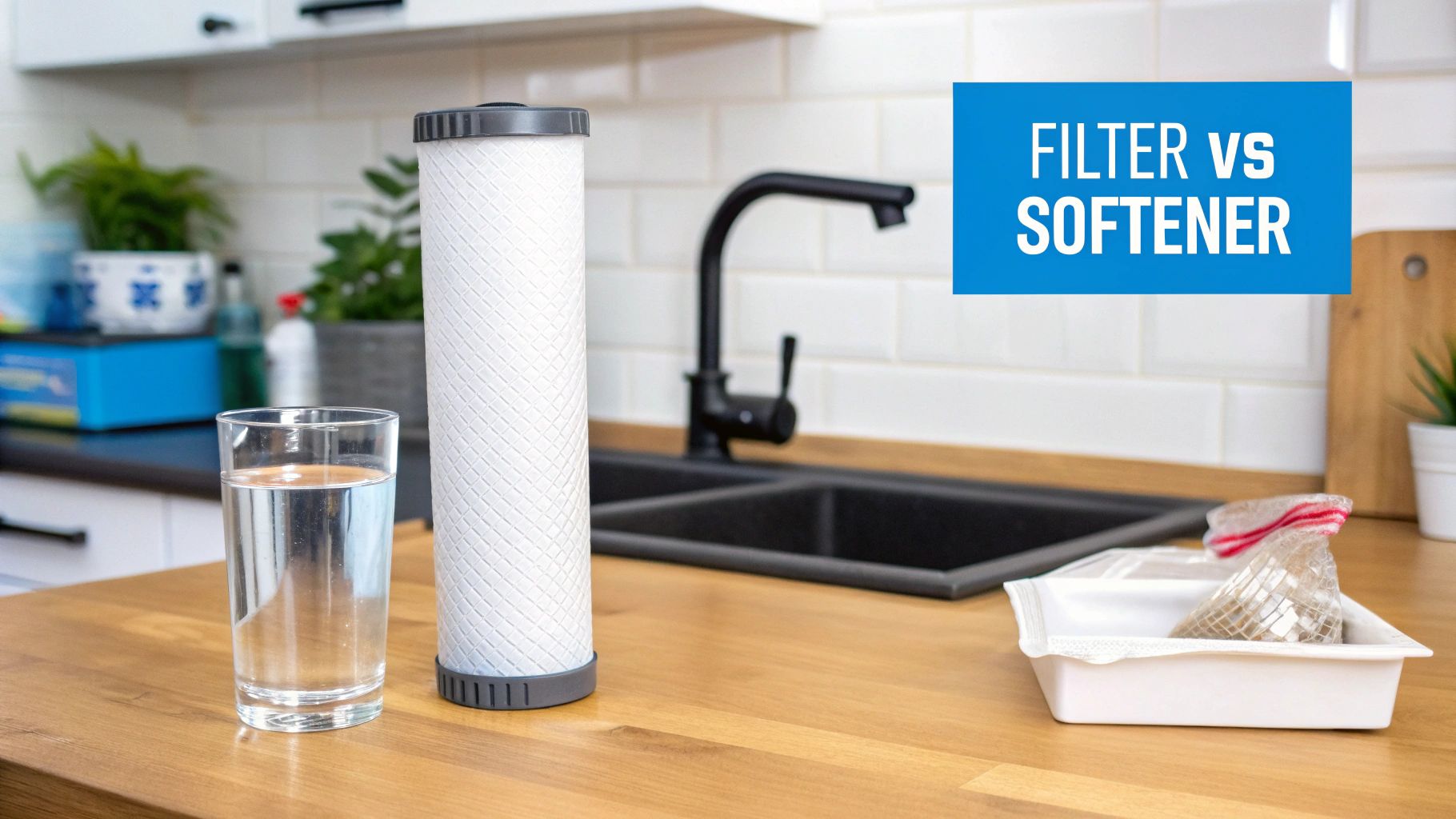
A whole-house water filter is all about your health, safety, and senses. Its job is to be an uncompromising gatekeeper, trapping and removing a wide range of impurities. We're talking about things that can make your water unsafe, smell like a swimming pool, or taste like dirt. It’s the hero your water deserves.
A water softener, by contrast, is a one-trick pony—a very useful one, but still a specialist. Its single, focused mission is to combat "hard water," which is water loaded with minerals like calcium and magnesium. These minerals are harmless to drink but are absolutely brutal on your pipes, faucets, and appliances.
The Core Mission of Filtration
To put it plainly, you get a filter to protect your family's health. You get a softener to protect your financial investment in your home. A filter targets the quality of the water you drink, cook with, and bathe in; a softener deals with the destructive consequences of your water's mineral content.
This is the critical takeaway. A filter won't soften your water, and a softener won't remove chlorine, lead, or pesticides. Each is a specialized tool for a specific task, but filtration is the one that directly impacts your well-being.
Here's the simplest way to remember it: Filtration is for consumption and health, while softening is for plumbing and appliance preservation. Once you get that, you're on your way to diagnosing your water woes and finding the perfect solution.
Let's break it down side-by-side to make it even clearer.
| Feature | Whole House Water Filtration | Water Softener |
|---|---|---|
| Primary Goal | Purification: To remove contaminants from water. | Protection: To remove hardness minerals from water. |
| What It Removes | Chlorine, sediment, pesticides, lead, VOCs, and other chemicals. | Calcium, magnesium, and sometimes small amounts of iron. |
| Key Benefit | Improves water taste, odor, and safety for drinking and bathing. | Prevents scale buildup, extending appliance life and improving efficiency. |
Ultimately, it’s not always an either/or choice. Many homes—especially those on well water—are stuck with both hard water and other contaminants. For them, the ultimate setup involves both systems working in tandem to deliver genuinely clean, problem-free water from every faucet.
How a Whole House Filter Cleans Your Water
Think of a whole house water filtration system as a dedicated security checkpoint for your home's entire water supply. Installed right where the main water line enters your house, its sole job is to stop an army of contaminants before they ever reach your taps. This isn't just a simple strainer; it's a multi-stage purification process designed to give your water a serious upgrade from the ground up.
Your water embarks on a journey through different layers of specialized filter media, with each layer targeting specific impurities. It’s a comprehensive strategy that ensures every single drop—whether for drinking, cooking, or showering—is cleaner, safer, and tastes amazing.
This is the heart of the whole house water filtration vs water softener discussion. While softeners tackle minerals, filtration systems are engineered to purify water by removing the things that impact its taste, smell, and safety.
The Unsung Heroes: Filter Media
The real magic happens inside the filter tanks, where different types of filter media team up to form a powerful line of defense against common water contaminants.
-
Sediment Pre-Filters: This is stage one, the bouncer at the door. These filters catch the big stuff—sand, silt, rust, and dirt. Removing this gunk not only makes your water look clearer but also protects the more advanced filter stages from getting clogged and worn out prematurely.
-
Activated Carbon Filters: This is the brains of the operation. Activated carbon is an incredibly porous material with a massive surface area, making it a rockstar at trapping chemical contaminants through a process called adsorption. It effectively grabs onto chlorine, pesticides, herbicides, and volatile organic compounds (VOCs), which is why your water suddenly starts tasting and smelling fantastic.
Think of activated carbon as a powerful magnet for chemicals. As water flows through, unwanted contaminants stick to the carbon's surface, letting wonderfully pure water flow into your home. This is exactly how that "public pool" smell from chlorinated city water vanishes.
Whole house filters are designed to capture a wide array of contaminants that municipal treatment plants might not completely remove. They can handle everything from chlorine and its byproducts to heavy metals like lead. In fact, real-world tests show just how effective they are, with some systems reducing lead levels to 0.0007 ppm and eliminating disinfection byproducts entirely. For a closer look at what these filters remove, this whole-home water filtration system guide is a great resource.
The Real-World Health Perks
By removing this cocktail of contaminants, a whole house filter does far more than improve your water's taste. It’s a direct investment in your family's health and well-being.
Filtering water at the point of entry means you’re protected from contaminants in the water you drink and the water you shower in. Your skin is your body's largest organ, and it can absorb chemicals like chlorine directly from shower water. By eliminating these substances, a great filtration system can lead to softer skin, healthier hair, and even better indoor air quality by reducing chemical vapors released during a hot shower.
At the end of the day, a whole house filtration system delivers unparalleled peace of mind. You can trust that the water from every tap is consistently clean and safe, tackling potential health concerns at the source.
How Water Softeners Protect Your Home
If a whole-house filter is the guardian of your family's health, a water softener is the bodyguard for your home's plumbing and appliances. It’s designed to fight a single, destructive enemy: hard water.
Hard water is just water that’s loaded with dissolved minerals, mostly calcium and magnesium. While these minerals won't hurt you to drink, they can absolutely wreck your home from the inside out.
A water softener has one job and one job only: stop those minerals before they can cause any damage. This is the fundamental difference to keep in mind when comparing whole-house water filtration vs. water softener systems. One is for broad-spectrum contaminant removal, and the other is a specialist, surgically targeting the minerals that lead to expensive problems.
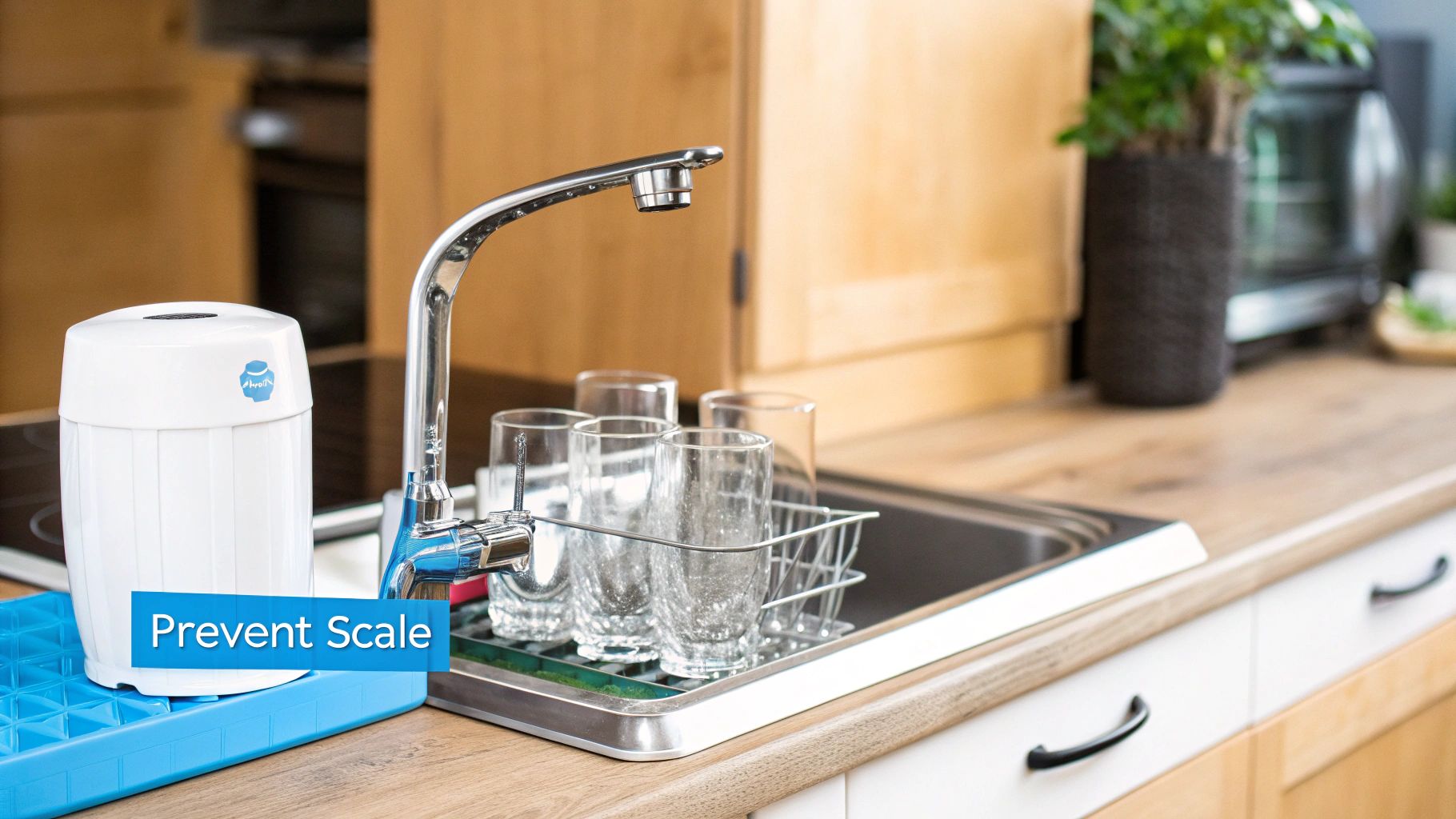
This distinction matters because hard water is everywhere. More than 85% of homes in the U.S. deal with it. The fallout is significant—scale buildup from hard water can drive up a home's energy costs by as much as 29% and slash the lifespan of your appliances by 30%.
The Science of Ion Exchange Explained Simply
The magic behind a salt-based water softener is a process called ion exchange. Think of it as a simple trade. The main tank of the softener is filled with tiny resin beads that are covered in sodium ions.
When hard water flows over these beads, the calcium and magnesium ions—which have a stronger electrical charge—are drawn to the resin. They literally bump the weaker sodium ions off and take their place. The sodium flows out with the water, leaving you with "soft" water that's free of those damaging minerals.
It’s a simple swap, but it completely changes how your water behaves. The system works automatically until the resin beads are full of hardness minerals. Then, it runs a "regeneration" cycle to wash the minerals away and recoat the beads with fresh sodium.
Solving Everyday Hard Water Annoyances
You’ll see the benefits of this mineral swap almost right away. Soft water makes a huge difference in daily chores and eliminates all those frustrating hard water symptoms.
Here’s what you can expect:
- Soap That Actually Lathers: Hardness minerals kill suds. With soft water, you’ll find yourself using way less soap, shampoo, and detergent to get a rich, cleansing lather.
- Spotless Dishes and Glassware: That annoying cloudy film on your glasses? It’s mineral residue. Soft water rinses completely clean, leaving dishes and glassware sparkling.
- Brighter, Softer Laundry: The same minerals that spot your dishes also get trapped in your clothing fibers, making them feel stiff and look dull. Soft water helps detergent work better, keeping colors vibrant and fabrics feeling soft.
A water softener’s primary job is to stop scale buildup before it starts. By removing calcium and magnesium, it protects the expensive, hard-working parts of your home's plumbing from the inside out.
Protecting Your Home's Most Valuable Assets
Beyond the daily perks, a water softener offers critical long-term protection for your home. The biggest threat from hard water is limescale—that hard, chalky gunk that clogs up pipes, faucets, and appliances.
Scale acts like cholesterol in your home’s arteries. It restricts water flow and makes your appliances work much harder than they should, eventually causing them to fail. Hard water can also cause other malfunctions, like the ones covered in this list of common reasons your dishwasher might not be getting water.
By preventing scale from ever forming, a water softener extends the life and efficiency of your most expensive appliances—like your water heater, dishwasher, and washing machine. It saves you a fortune in premature replacement costs and frustrating repair bills.
Comparing Filtration and Softening Head-to-Head
So, when it comes down to the whole house water filtration vs water softener choice, you need to look past the sales pitch and get into the practical, day-to-day realities. How do they actually work? What’s the upkeep really like? What will they cost you over the long haul?
Let's put these two systems side-by-side and break down how they perform in the areas that actually matter to a homeowner. This isn’t just about what’s getting pulled out of your water; it’s about what it’s like to live with each of these systems.
Primary Function: Health vs. Protection
The biggest difference between these two is their fundamental mission. A whole-house water filter is all about your health. Its job is to purify your water by taking out a wide range of nasty contaminants to improve the safety, taste, and smell of the water you drink and use every day.
A water softener, on the other hand, is basically a protection plan for your home. It does one thing and one thing only: it removes the hard minerals—calcium and magnesium—that wreck your pipes and appliances. Its purpose is to stop that destructive scale buildup before it starts, saving you a fortune in repairs and replacements.
Here’s the simplest way to think about it: A filter cleans water for your body. A softener conditions water for your house. They aren't interchangeable.
Installation and Space Requirements
Both of these systems get installed right where your main water line enters your house, but the space they take up can be surprisingly different.
-
Whole House Filters: These are often the more compact option, especially the newer cartridge or single-tank carbon setups. You’re usually looking at one or two tanks or housings you can mount right on the wall or sit on the floor, so they don’t demand a huge amount of real estate.
-
Water Softeners: Your typical salt-based softener is a bit more of a space hog. You've got the main mineral tank (where the magic happens) plus a separate, pretty bulky brine tank for the salt. This two-tank setup almost always needs more floor space than a filtration system.
Maintenance Routines: Salt vs. Filters
This is where your life as a homeowner really changes depending on which system you choose. The ongoing maintenance couldn't be more different.
With a whole house filtration system, your main job is changing out filters. Depending on your water quality and usage, you might swap a pre-filter every few months, but the main carbon media can last anywhere from 5 to 10 years. It’s a pretty clean and predictable task.
A salt-based water softener requires a lot more muscle. You’ll be buying and lugging 40-50 pound bags of salt to dump into the brine tank, probably once a month. You also have to keep an eye on it to make sure it’s regenerating properly and that you don't get a "salt bridge" clogging things up.
Long-Term Operational Costs
Don't just look at the price tag on the box. The real cost of any water treatment system is what you pay to keep it running year after year.
For a whole house filter, your ongoing costs are almost entirely for replacement filters. It’s a straightforward expense you can easily budget for. They also use very little electricity and don’t waste water, unless you have a model that backwashes occasionally.
For a water softener, you’re looking at a few different running costs:
- Salt: This is the big one. You’ll be buying salt for the life of the system.
- Water: Every time the softener regenerates to clean itself, it flushes a good amount of water down the drain.
- Electricity: The control valve needs power to run the regeneration cycles.
These costs add up over time, which is why a softener is generally more expensive to operate than a filter.
Water Filtration vs. Water Softener At A Glance
To make it even clearer, here’s a quick-glance table breaking down the core differences. This should help you see exactly where each system shines.
| Feature | Whole House Water Filtration | Water Softener |
|---|---|---|
| Main Purpose | Removes contaminants for health, taste, and odor. | Removes hardness minerals to protect plumbing and appliances. |
| Targets | Chlorine, pesticides, lead, sediment, VOCs. | Calcium and magnesium. |
| Primary Benefit | Safer, better-tasting water from every tap. | Prevents limescale buildup and extends appliance life. |
| Typical Footprint | More compact; often one or two tanks. | Larger; requires both a mineral tank and a brine tank. |
| Maintenance | Change filters periodically (months to years). | Regularly add heavy bags of salt (monthly). |
| Operating Costs | Replacement filters. | Ongoing purchases of salt, plus water and electricity for regeneration. |
This side-by-side look makes it obvious: these are two very different tools for two very different jobs. One isn't better than the other—it's all about what problem you're trying to solve with your water.
Choosing the Right System for Your Home
Deciding between whole house water filtration vs water softener really comes down to diagnosing your specific water issues. Instead of taking a guess, let the water itself tell you what it needs. Think of it like being a detective—the clues are right there in your home.
Start with your senses. Does your tap water smell like a swimming pool? That’s a clear sign of chlorine, which is a job for a filter. If you notice a metallic taste or that "rotten egg" smell, those are also classic signs that a whole house filter is what you need to remove those contaminants.
The evidence for hard water is more visual and tactile. Are you tired of scrubbing that stubborn white scale off your faucets and showerheads? Is your glassware always cloudy, even right after a wash? These are the telltale signs of excess minerals, pointing you straight toward a water softener.
When a Filter Is Your Priority
If your main concern is the safety and quality of the water you drink and bathe in, a filtration system should be your first consideration. It’s the go-to solution for improving the overall health of your water.
You should make a whole house filter your top priority if you're dealing with:
- Noticeable Odors: A strong chlorine or chemical smell is a dead giveaway that your water needs to be purified.
- Unpleasant Taste: If your water tastes metallic, earthy, or just "off," a filter will target the contaminants causing it.
- Concerns About Contaminants: For anyone worried about invisible threats like lead, pesticides, or VOCs, a high-quality filtration system provides critical peace of mind.
This infographic breaks down the core functions: filters are for health, while softeners are for protection.
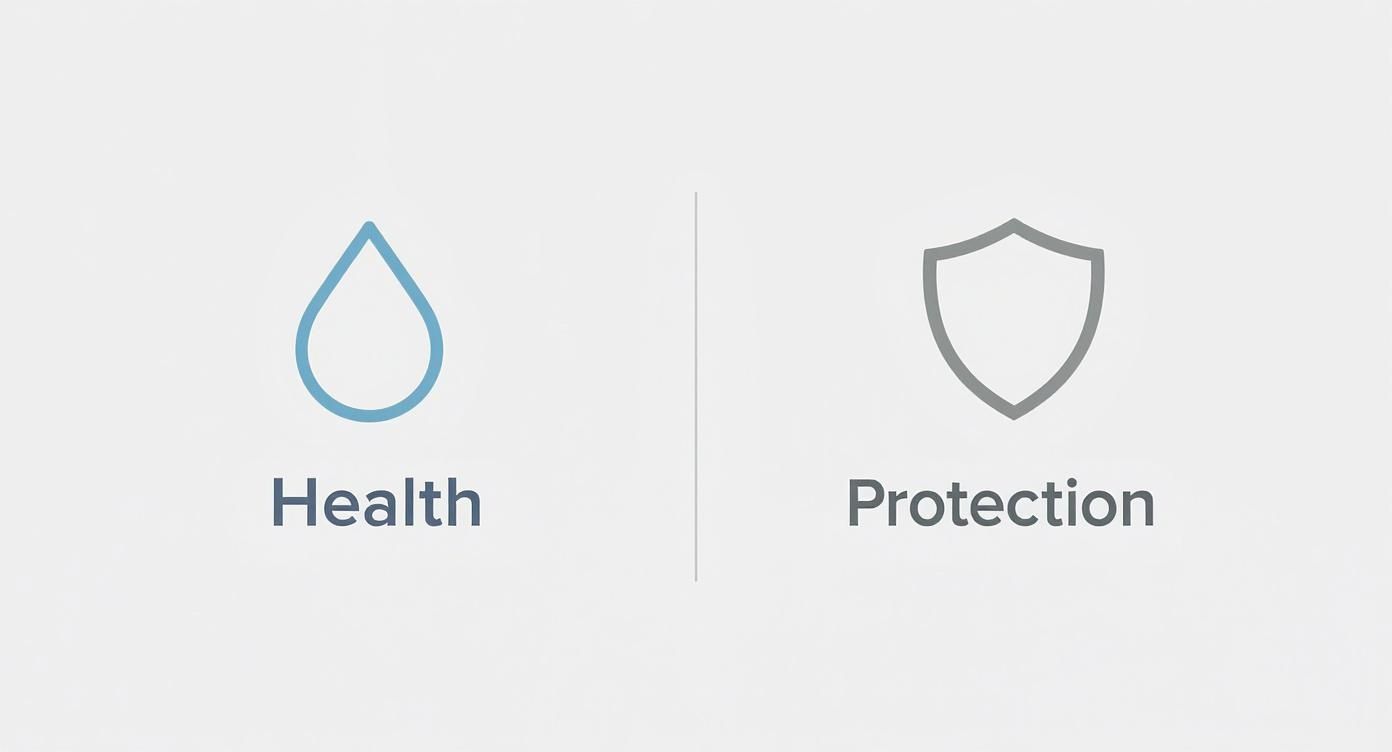
The image makes the distinction clear: filtration improves the water you consume, while softening protects your home’s plumbing and appliances.
When a Softener Is the Answer
If your biggest headaches are home maintenance and extending the life of your appliances, a water softener is the specialized tool for the job. It directly solves the expensive and annoying problems caused by mineral buildup.
A water softener is the right call if your home has:
- Visible Limescale: That chalky white residue on fixtures, shower doors, and in your coffee maker is the most obvious sign of hard water.
- Poor Soap Performance: If soap and shampoo just don't lather well and you find yourself using more and more detergent, hardness minerals are the culprit.
- Appliance Issues: Frequent breakdowns or the early death of your water heater, dishwasher, or washing machine often traces back to scale.
The Common Scenario When You Need Both
For many people, especially those on well water, the problems aren't so clear-cut. You might have hard water that also smells like sulfur and is full of sediment. In these common cases, picking just one system means you’re leaving a big problem unsolved.
The best solution for total water treatment is often a combined system. This setup delivers the best of both worlds: pure, great-tasting water for your family and mineral-free water to protect your home.
When you install both, the order is crucial. The whole house water filter is always installed first, right after the main water line enters your home. This lets it strip out chlorine, sediment, and chemicals that can ruin the sensitive resin beads inside a water softener, making it last longer and work better. The softener comes second, treating the already-filtered water to remove the hardness minerals.
This two-stage setup ensures every tap in your house delivers clean, safe, and soft water. For more detailed guides on specific water problems, you can find tons of practical water filter advice to help you figure out exactly what you need. When looking at your home's water system, also consider if you need water storage solutions like Vertical Water Storage Tanks as part of a complete setup.
Common Questions About Water Treatment Systems
Diving into the world of home water treatment can feel like a lot, especially when you're just trying to solve a specific problem like hard water spots or weird-tasting tap water. As you weigh the pros and cons in the whole house water filtration vs water softener debate, the same handful of questions pop up again and again. Getting clear answers is the key to making a smart investment.
Let’s tackle the most common questions we hear from homeowners. We'll clear up the confusion and give you the straightforward details you need to choose the right system for your family.
Can A Whole House Filter Also Soften Water?
This is probably the number one question we get, and the short answer is a firm no. A standard whole house water filter is a purifier, not a softener. Its job is to grab contaminants like chlorine, sediment, pesticides, and other chemicals that make your water taste and smell bad.
These systems use media like activated carbon, which is fantastic at adsorbing chemicals but simply doesn't interact with the dissolved minerals—calcium and magnesium—that cause hard water. Some devices might claim to reduce scale, but they aren't true softeners and won’t give you the same results as a dedicated ion exchange system.
Think of it this way: a filter is like a sieve catching silt and debris, but the salt dissolved in the water flows right through. You need a completely different tool to deal with dissolved minerals.
If I Get Both Systems, Which One Is Installed First?
When you need both to get the job done, the installation order is absolutely critical. The rule of thumb is simple: the whole house water filtration system always goes first, right after the main water line enters your home. The water softener comes second.
The logic here is all about protecting your equipment. City water is treated with chlorine or chloramines, which are great for killing bacteria but are absolute murder on the resin beads inside a water softener. By putting the filter first, you strip out those harsh chemicals before they can destroy the softener’s resin, which dramatically extends its lifespan.
On top of that, the filter also catches any sediment or grit that could clog the small, precise parts in the softener’s control valve, saving you from a costly repair call down the road.
Are There Health Concerns With Softened Water?
The main thing people wonder about is the sodium that salt-based softeners add to the water. In the ion-exchange process, the hard minerals (calcium and magnesium) get swapped for sodium ions. For the vast majority of people, the amount of sodium added is tiny and poses no health risk—often less than what's in a single slice of bread.
However, if you or someone in your family is on a strict low-sodium diet for a medical reason like hypertension, it’s a valid consideration. The good news is, you have options:
- Use Potassium Chloride: You can use potassium chloride pellets instead of sodium chloride salt. It works the same way but swaps hardness for potassium.
- Install a Reverse Osmosis System: An RO filter at your kitchen sink is a perfect companion to a softener. It removes the added sodium (along with virtually everything else) to give you purified water for drinking and cooking.
- Choose a Salt-Free Conditioner: Also called descalers, these systems don't remove hard minerals or add sodium. Instead, they crystallize the minerals so they can't stick to your pipes and fixtures.
How Do I Test My Water To Know What I Need?
You can't fix a problem if you don't know what it is. Testing your water is the only way to move forward with confidence. Guessing is a great way to waste money on the wrong equipment and still be stuck with the same water issues.
You have two main paths for testing:
- DIY Test Kits: You can grab an inexpensive test kit from a hardware store for a quick read on the basics. These strips will give you a ballpark figure for hardness (measured in Grains Per Gallon, or GPG), chlorine, and pH.
- Certified Laboratory Testing: If you’re worried about things like lead, bacteria, arsenic, or industrial chemicals (VOCs), a professional lab test is non-negotiable. It's the only way to get accurate results you can trust. Check with your local health department for a list of state-certified labs.
A full lab report gives you the hard data you need to make an informed decision. It eliminates all the guesswork and ensures you invest in a system that’s perfectly matched to your water’s unique chemistry.
At Water Filter Advisor, we believe every family deserves access to clean, safe water. Our in-depth guides and unbiased reviews are designed to help you understand your water and choose the best solution with confidence. Explore our resources to find the perfect system for your home at https://www.waterfilteradvisor.com.
- December 4, 2025
- 0
- Uncategorized
