After digging through a mountain of whole house water filter reviews, one thing is crystal clear: these systems are more than just a simple upgrade. They’re a complete overhaul for your home’s water, protecting your pipes, appliances, and your family's health in ways a simple pitcher filter never could.
Why a Whole House Filter Is a Game-Changer
Most people start their search because they're tired of the chlorine taste in their tap water. A whole house filter absolutely solves that, but its real superpower is that it works on every single faucet and water-using appliance in your home. It’s a point-of-entry system, meaning it cleans the water for everything—not just for drinking.
This all-in-one approach is why the market is booming. The global home water filtration market hit a value of USD 20.26 billion in 2024 and is expected to keep climbing. A huge chunk of that growth is driven by whole house units. You can discover more insights about the growing water purifier market if you're curious.
Beyond the Kitchen Sink
Think about it. Your morning shower, the dishwasher, the washing machine—unfiltered water affects them all. A whole house system tackles these issues at the source, giving you consistent, high-quality water everywhere.
Here are the benefits you'll actually notice:
- Appliance and Plumbing Protection: Sediment, chlorine, and hard water minerals are brutal on your pipes, water heater, and washing machine. Filtering them out from the start can extend the life of these expensive appliances and help you avoid costly repairs from scale buildup and corrosion.
- Healthier Skin and Hair: That chlorine in city water is great for killing germs, but it also strips the natural oils from your skin and hair. This leads to dryness and irritation. Filtering your shower water means softer skin and hair, without that chemical smell.
- Brighter and Softer Laundry: Ever wonder why your clothes feel stiff or look faded? Hard water minerals are often the culprit. Filtered water helps your detergent work better, so you get brighter colors and softer fabrics while using less soap.
The biggest benefit, though, is the peace of mind. Knowing every drop of water in your home—for cooking, drinking, bathing, and cleaning—is free from nasty contaminants is a level of confidence you just can’t get from a single-faucet filter.
At the end of the day, installing a whole house water filter is a solid investment. It's an investment in your home's plumbing and, more importantly, in your family's well-being. By treating water the moment it enters your house, you fix dozens of small problems at once and totally change your relationship with the water you use every day.
How Do Whole House Filters Actually Work?
Before you can make sense of any whole house water filter reviews, you have to get a handle on what’s happening inside those tanks. Don't think of these systems as a single wall stopping everything bad. It’s more like a specialized team where every player has a specific job. Each filter type is built to tackle a different problem, from stinky chlorine smells to things you can't even see.
It all starts at the "point of entry"—right where the main water line comes into your house. A whole house system gets installed there, treating every single drop of water before it ever gets to your kitchen sink, your shower, or your washing machine. The specific tech it uses is all based on what's actually in your water to begin with.
The Main Filtration Technologies
Most systems you'll see use a multi-stage approach, layering different filter materials to pull out contaminants one by one. This is a smart setup because it gets rid of the bigger gunk first, letting the later stages focus on the finer, tougher-to-catch stuff.
Here’s a breakdown of the three main players:
- Multi-Stage Carbon and Sediment Filters: This is your go-to setup for most city water problems. A sediment pre-filter is like the bouncer at the door, catching all the obvious troublemakers like rust, sand, and dirt. After that, the water hits an activated carbon filter, which acts like a powerful magnet for chemicals. It's fantastic at grabbing chlorine, pesticides, and those nasty volatile organic compounds (VOCs) that make water taste and smell bad.
- Water Softeners (Ion Exchange): Got hard water? A softener is what you need. It works through a process called ion exchange. Picture tiny little resin beads loaded with sodium ions. When hard water minerals like calcium and magnesium flow past, they get swapped for the sodium. This "softens" the water and stops that crusty scale buildup that wrecks your appliances.
- UV Purifiers: If you’re on well water, you’re probably worried about bacteria and other microbiological threats. A UV purifier is your high-tech security guard. It uses a strong ultraviolet lamp to zap bacteria, viruses, and cysts, effectively scrambling their DNA so they can't reproduce and get you sick. It’s a great chemical-free way to make your water safe to drink.
The EPA's WaterSense program often talks about using water efficiently, which goes hand-in-hand with keeping your home’s plumbing healthy. A good filter system does just that by preventing the scale and corrosion that unfiltered water can cause.
This focus on quality and efficiency is exactly what a good filtration system brings to the table—it protects your pipes and appliances from the constant assault of unfiltered water.
Each filtration method is a specific tool for a specific job. A carbon filter won't soften water, and a softener won't kill bacteria. Understanding this is the key to matching a system to your home's unique water profile.
At the end of the day, picking the right system isn’t about buying the one with the most stages. It’s about figuring out your main water issues and choosing the technology designed to fix them. Once you understand how these filters actually do their job, you’ll be much better equipped to read reviews with a critical eye and find a solution that delivers clean water everywhere in your home.
A Detailed Comparison of Top-Rated Systems
Looking at all the whole house water filter reviews can make your head spin. But if you know what to look for, you can cut right through the marketing fluff and get to the good stuff: performance, filter life, and certified results. Let's break down the metrics that separate a decent filter from a great one.
The most important job of any filter is getting the junk out of your water. This isn't just about making it taste less like a swimming pool; it's about targeting specific problems, like the chlorine from your city's treatment plant or the sediment stirred up from a private well. The best systems use multiple stages to catch a wide range of impurities.
Next up is the flow rate, which we measure in gallons per minute (GPM). This number is huge because it directly affects your home's water pressure. Get a system with too low a GPM, and you'll be dealing with a sad, trickling shower every time someone runs the dishwasher.
Finally, we'll look at how long the filters last. A system that needs new, expensive filters every few months is just a money pit waiting to happen. The real winners have high-capacity cartridges that can go for years—or hundreds of thousands of gallons—making them a true set-it-and-forget-it solution.
To give you a clearer picture, this table lays out the core specs of some of the leading systems on the market. It's a straightforward way to see how they stack up against each other on the most critical performance points.
Performance Breakdown of Leading Whole House Water Filters
| System Model | Filtration Technology | Removes These Contaminants | Flow Rate (GPM) | Filter Lifespan (Gallons) | NSF/ANSI Certified |
|---|---|---|---|---|---|
| Aquasana Rhino® | Sediment, Carbon, KDF | Chlorine, Sediment, VOCs, Herbicides | 7 – 15 | 600,000 – 1,000,000 | 42 |
| SpringWell CF1 | Sediment, Carbon, KDF | Chlorine, Chloramine, PFOA/PFOS | 9 – 20 | 1,000,000 | 42, 53 |
| Pentair PC600 | Sediment, Carbon | Chlorine, Sediment, Particulates | 6 | 600,000 | 42 |
| iSpring WGB32B | Sediment, CTO Carbon | Chlorine, Sediment, Rust, Pesticides | 15 | 100,000 | 42, 53 |
| Express Water | Sediment, GAC, Carbon | Chlorine, Sediment, VOCs, Odors | 15 | 100,000 | 42, 53 |
As you can see, filter lifespan and flow rates can vary quite a bit. A system like the SpringWell or Aquasana is built for the long haul, while others might require more frequent changes but offer a high flow rate out of the box.
Contaminant Removal Capabilities
At the end of the day, a filter has one job: clean your water. But they don't all go about it the same way. The top-tier models are engineered to knock out an impressive list of contaminants, giving you peace of mind with every drop.
Take a quality system like the Aquasana Rhino. It uses a tag-team approach with a sediment pre-filter, activated carbon, and KDF media. This combination is brutally effective against the usual suspects:
- Chlorine and Chloramine: These are the chemicals cities use to disinfect water, and they’re why your tap water might smell and taste like a public pool. A solid carbon filter will get rid of more than 97% of it.
- Sediment and Rust: These are the tiny particles that make water look cloudy and can wreck your appliances over time. A sediment filter is your first line of defense.
- VOCs and Pesticides: Volatile Organic Compounds and other nasty chemicals can find their way into water supplies. Activated carbon is a champ at grabbing and holding onto them.
The best way to know if a filter really does what it says is to look for third-party certifications. You want to see labels like NSF/ANSI 42 (for things like chlorine and taste) and NSF/ANSI 53 (for health-related contaminants like lead). This is your proof that the system has been independently tested and actually works.
Flow Rate and Water Pressure
"Will this thing kill my water pressure?" It's one of the first questions I hear from homeowners, and it's a valid one. This is where the flow rate (GPM) is so important. For an average home, you’ll want a system that can handle 10 to 15 GPM so you can run a few things at once without the water slowing to a crawl.
Think about it: you’re in the shower, and someone starts the washing machine. With a low-GPM filter (say, 5-7 GPM), your shower will feel weak and pathetic. But a system built for high flow (15+ GPM) won't even flinch. The best ones are designed with wider ports and high-flow media to keep your water pressure strong and steady.
Filter Lifespan and Long-Term Value
The sticker price is just the beginning. The real cost of a whole-house filter shows up over time, and it all comes down to the filter lifespan. Swapping out cartridges every few months is a pain, and the cost adds up fast.
The best systems are built like tanks. The Aquasana Rhino, for example, has a main filter that’s good for one million gallons—that can be up to 10 years of clean water. Sure, you’ll still need to change the pre-filters every 3-6 months, but the main unit is built to last. That means less money and less hassle for you.
This simple graphic shows the most common tools in a whole house system's toolbox.
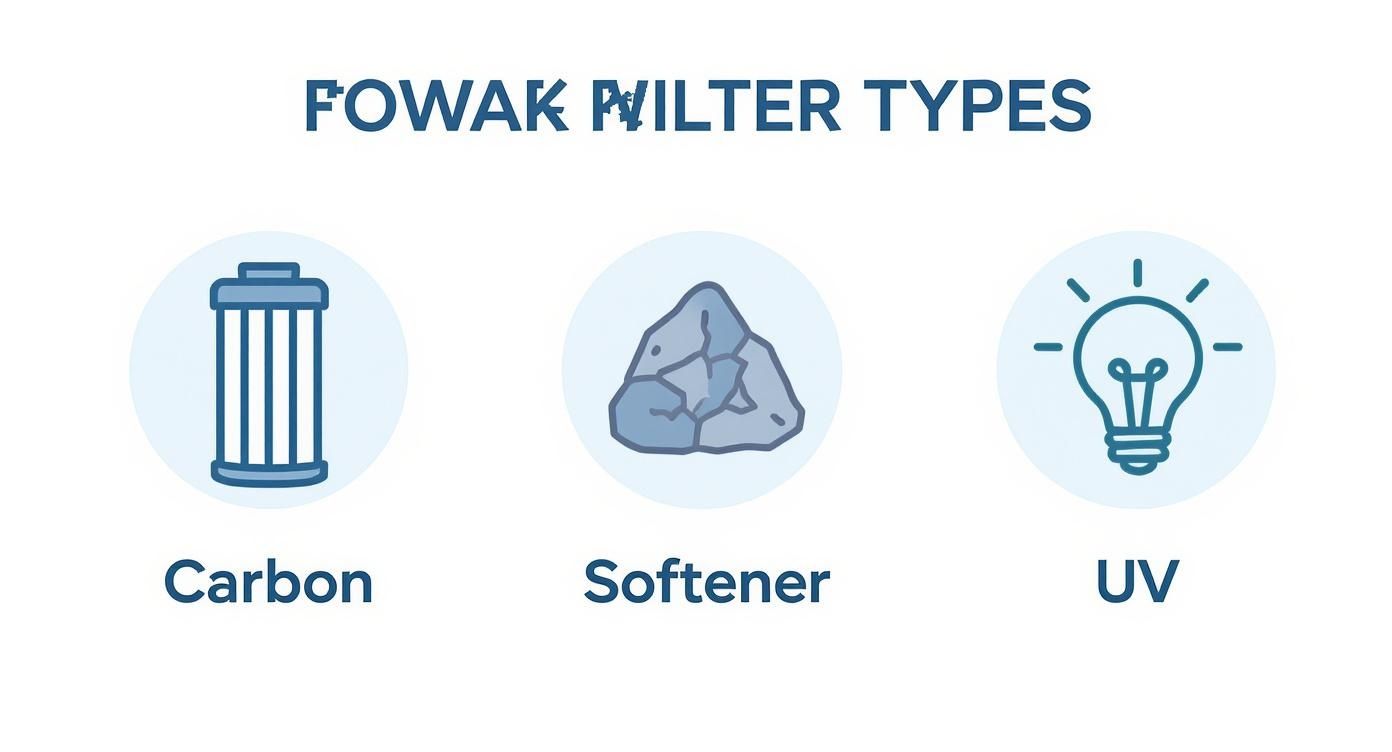
It shows how different technologies—like carbon, water softeners, and UV purifiers—are each designed for a specific job, whether it's removing chemicals or ensuring your water is biologically safe to drink.
System Type and Suitability
The right filter for you really depends on where your water comes from. City water and well water are two completely different beasts.
Best for City Water
If you're on a municipal supply, your main enemies are chlorine, chloramines, and sediment. A multi-stage system with a sediment pre-filter and a big activated carbon tank is perfect for this. It'll make your water taste and smell great while protecting your pipes.
- Key Feature: A high chlorine reduction rate (over 97%).
- Certification to Look For: NSF/ANSI 42.
- Benefit: No more chemical smells, softer skin and hair after a shower, and way better-tasting coffee and tea.
Best for Well Water
Well water is a whole other ballgame. You could be dealing with sediment, iron, manganese, and even bacteria or viruses. A proper well water system needs a multi-layered defense:
- Sediment Pre-filter: To catch all the sand and silt.
- Iron and Manganese Filter: To stop those ugly orange stains and metallic taste.
- Carbon Filter: To handle any pesticides or chemical runoff.
- UV Purifier: This is the knockout punch. It zaps 99.99% of bacteria and viruses to make your water safe to drink.
This is why people love whole house filters—they solve the problem everywhere, for every use. From the kitchen sink to the shower, you get clean, safe water without thinking about it. Users constantly rave about the low maintenance and long filter life, not to mention the huge difference in water clarity and taste. You can discover more insights about the growing water purifier market to see just how essential these systems have become.
Ultimately, picking the right system is about matching its certified performance to your water's specific problems. Focus on contaminant removal, flow rate, and filter life, and you’ll find a whole house filter that gives you great water from every tap.
Calculating the True Cost of Clean Water
That sticker price on a new whole house water filter? It’s just the starting line. To get the full picture of what you’ll actually spend, you need to look at the total cost of ownership. This means factoring in the initial purchase, the cost of professional installation, and—most importantly—the recurring expense of replacement filters and media.
It’s easy to get fixated on the upfront price, but that can be a costly mistake. A cheaper system might look like a great deal today, but if you’re swapping out expensive filters every six months, it will quickly eclipse the cost of a premium system built to last a decade. The real goal is finding the best long-term value, not just the lowest price tag.
Breaking Down the Initial Investment
First up is the system itself. Prices can run from a few hundred dollars to several thousand, depending on what you need it to do. A simple sediment and carbon filter for treated city water will be on the lower end. But if you’re dealing with well water, a more robust setup with a UV purifier and a water softener will naturally cost more.
Next, you have to get it installed. If you’re a seasoned DIYer with plumbing experience, you might be able to handle this yourself. For most people, though, this is a job for a professional.
- DIY Installation: You can save a few hundred bucks, but it involves cutting into your main water line. Only go this route if you’re absolutely confident in your plumbing skills.
- Professional Installation: Expect to pay anywhere from $300 to over $1,000. The final cost depends on how complex the system is and the current state of your home’s plumbing. It’s always smart to get a couple of quotes before you commit.
The Critical Ongoing Costs
This is where the long-term financial reality sets in. Maintenance is a recurring expense, and it can vary wildly from one model to the next. These are the costs you’ll need to budget for year after year.
Here are the most common recurring expenses:
- Sediment Pre-filters: Think of these as the first line of defense for your system. They usually need to be replaced every 3-9 months and are fairly inexpensive, typically costing $20-$50 each.
- Carbon Media/Tanks: The main carbon filter does the heavy lifting. High-capacity tanks can last 6-10 years or filter up to a million gallons. When it’s finally time for a swap, a new tank can run you $500-$800 or more.
- UV Bulbs: If your system includes a UV purifier to kill bacteria and viruses, the bulb needs to be replaced annually to stay effective. These usually cost between $70 and $150.
- Salt (for Softeners): A traditional salt-based water softener needs a steady supply of salt. This can add another $10-$25 per month to your operating costs.
The real value of a whole house filter isn’t its upfront cost, but its cost-per-gallon over its entire lifespan. A system rated for one million gallons might seem pricey at first, but it often brings the cost of purified water down to just pennies per gallon in the long run.
Estimated 5-Year Cost of Ownership Comparison
To really see how these costs play out, let's map it out over five years. This table gives you a clearer idea of how different types of systems stack up financially over time, helping you look beyond the initial price.
See how costs add up over five years. This breakdown compares the initial purchase, installation, and recurring filter expenses for different whole house systems.
| System Type | Initial System Cost | Estimated Installation | Annual Filter Costs | Total 5-Year Cost |
|---|---|---|---|---|
| Basic Sediment/Carbon | $400 – $800 | $400 | $100 | $1,300 – $1,700 |
| High-Capacity Carbon | $1,200 – $2,000 | $500 | $50 | $1,950 – $2,750 |
| Well Water System + UV | $1,800 – $3,000 | $700 | $150 | $3,250 – $4,450 |
| System with Softener | $1,500 – $2,500 | $600 | $200 | $3,100 – $4,100 |
By adding up the true cost of clean water, you can make a much smarter decision. It helps you balance the initial hit to your wallet against the long-term maintenance costs, making sure you pick a system that fits both your water needs and your budget for years to come.
How to Choose the Right Filter for Your Water
Jumping into whole house water filter reviews is a recipe for confusion unless you know exactly what problem you’re trying to solve. The best system in the world is completely useless if it doesn't target the junk floating around in your tap water. So, the first and most critical step is to stop guessing and find out what you’re really up against.
If you're on city water, your local utility is required to publish an annual water quality report, sometimes called a Consumer Confidence Report (CCR). It’s a decent starting point, listing contaminants they've found and at what levels. But for a true picture of what's coming out of your faucets—or if you have a private well—an independent home water test is the only way to go. It gives you a clear, actionable list of what you need to filter out.
Finding Your Perfect Match Through Scenarios
Once you have those test results in hand, you can stop looking at generic features and start matching your specific needs to the right technology. The goal is to find a system built for your exact situation. Think of it less like buying an appliance and more like getting a prescription for your home's water.
Let's walk through a few common real-world scenarios to see how this plays out.
Scenario 1: The City Dweller Tired of Chlorine
You live in a typical suburban home on city water. Your biggest complaints are that your shower smells like a swimming pool and your drinking water has a faint chemical taste. Your appliances seem fine, but you're constantly buying bottled water because the tap stuff just isn't cutting it.
- Your Water Problem: Primarily chlorine, chloramine, and maybe some sediment or VOCs.
- Your Ideal Solution: A multi-stage system that includes a sediment pre-filter followed by a big activated carbon tank. The carbon is the star of the show here; it’s fantastic at grabbing the chlorine and other chemicals that ruin the taste and smell of your water.
- Key Feature to Look For: Make sure it has NSF/ANSI 42 certification. This is the official stamp that proves the system is effective at reducing aesthetic issues like chlorine.
Scenario 2: The Well Water Homeowner Worried About Safety
You’re out in the country and get your water from a private well. It sometimes has a bit of an earthy smell, and you've noticed some rust-colored stains popping up in your sinks and toilets. Your main concern, though, is the invisible stuff—potential bacteria or viruses, since your well isn't treated by a municipality.
- Your Water Problem: Sediment, iron, manganese, and potential microbiological contaminants like bacteria and cysts.
- Your Ideal Solution: You need a heavy-duty, multi-stage system built for well water. It should absolutely have a sediment filter, an iron and manganese filter, a carbon filter for any stray chemicals, and—this is the most important part—an ultraviolet (UV) purifier.
- Key Feature to Look For: The UV purifier is non-negotiable. It uses light to zap 99.99% of microorganisms, making your water biologically safe to drink without adding a single chemical.
Choosing the right filter is all about matching the technology to the contaminant. A carbon filter won't stop bacteria, and a UV light won't remove sediment. Understanding this distinction is the key to getting water that is truly clean and safe for your family.
Scenario 3: The Homeowner Battling Hard Water Scale
Your water tastes perfectly fine, but you're in a constant war against hard water. There’s a chalky white film on your shower doors, your coffee maker is always getting clogged, and your dishwasher leaves spots on every single glass. You're worried about what this scale is doing to your pipes and expensive appliances over time.
- Your Water Problem: High levels of dissolved minerals like calcium and magnesium—in other words, hard water.
- Your Ideal Solution: A whole house filter paired with a water softener or a salt-free water conditioner. A classic softener uses ion exchange to physically remove hardness minerals. A salt-free conditioner, on the other hand, changes their structure so they can’t stick to surfaces and form scale.
- Key Feature to Look For: Look for systems that are explicitly designed to reduce scale buildup. Salt-free conditioners are becoming a popular choice for their low-maintenance, set-it-and-forget-it design.
By figuring out which scenario you're in, you can confidently pick a system that directly solves your problem. That way, every dollar you spend actually delivers the results you’re looking for. The same principle of matching the right tool to the right job is key in all aspects of home maintenance, and it's useful for understanding the differences between various purification systems for your home's air as well.
Practical Tips for Installation and Maintenance
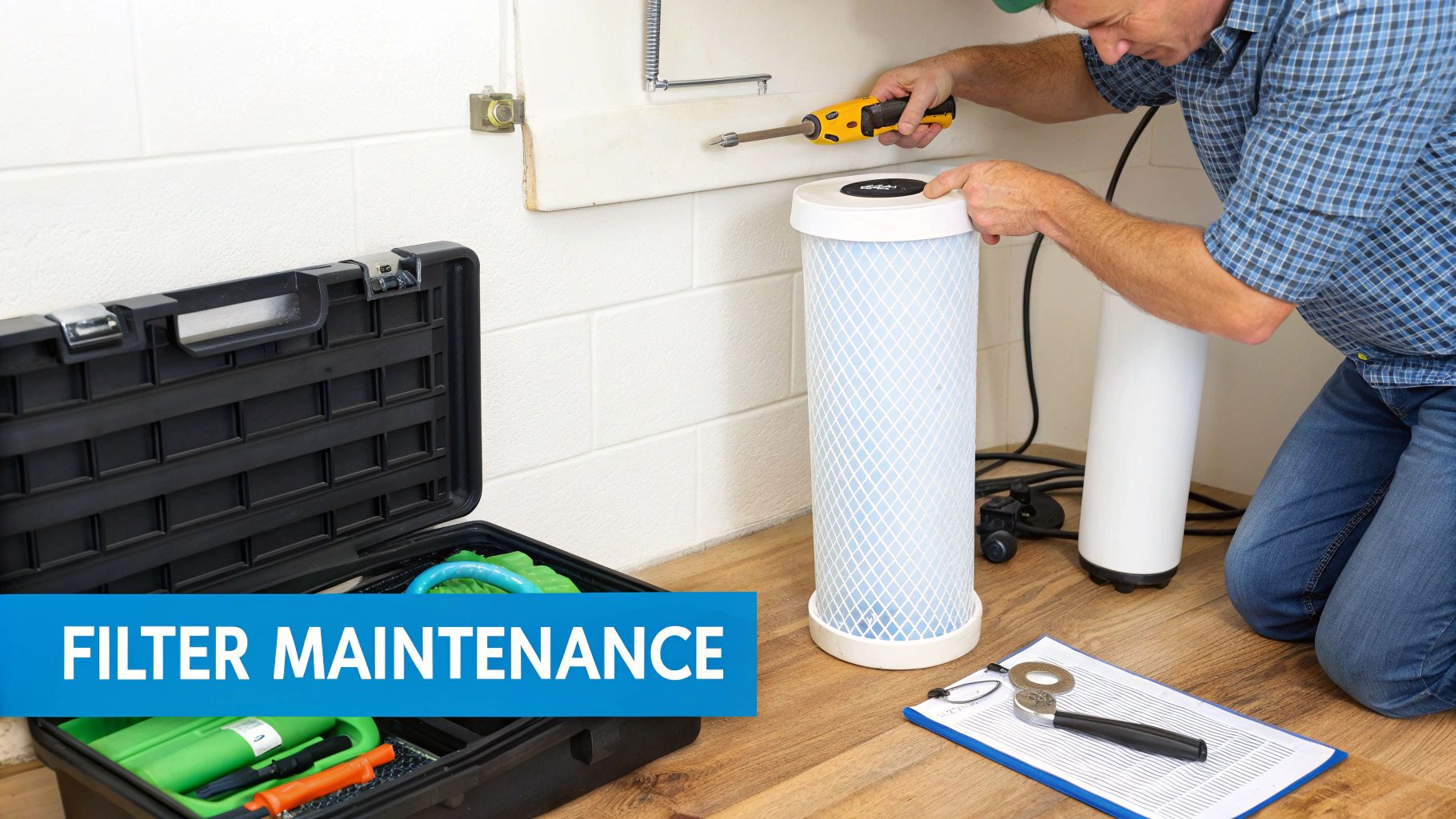
Okay, you've sifted through the whole house water filter reviews and picked your system. What's next? Getting it installed and running is where the rubber meets the road. A proper setup is non-negotiable if you want your filter to perform at its best for years to come.
The first big question is always DIY vs. pro install. While some kits look simple enough, remember that you're cutting into your home's main water line. If you've got serious plumbing chops and the right tools, it’s a project you can probably handle.
For most of us, though, hiring a licensed plumber is the way to go. It's just smarter and safer. A pro makes sure everything is leak-free, up to code, and doesn't do anything to void your warranty.
Proactive Maintenance for Pure Water
Once your system is in, a little upkeep goes a long way. This is how you protect your investment and make sure your water quality stays high. If you neglect it, you'll eventually deal with clogged filters, dropping water pressure, and a system that gives out way too early.
The good news is that for most multi-stage systems, maintenance is pretty simple—it’s mostly just changing out filters. You can always find more in-depth advice on water filter maintenance for specific models, but a basic schedule is all you really need to stay on top of things.
Don't wait until your shower feels weak or that old chlorine smell comes back. A simple, proactive maintenance plan is the best way to guarantee you always have great-tasting water and get the maximum life out of your filter.
Your Essential Maintenance Checklist
Think of this as your cheat sheet for keeping the system running like new. I recommend setting calendar reminders so you don't forget. A few minutes of prevention now saves you from big headaches later.
Here’s what a typical schedule looks like:
- Pre-Filter Change (Every 3-6 Months): This is your system’s front line. The sediment pre-filter catches all the big stuff like rust and sand. Changing it out is the most frequent task, and it's crucial for protecting the more expensive carbon filter down the line. It's a cheap and easy swap with a huge payoff.
- UV Lamp Replacement (Annually): If you have a UV purifier, especially for well water, the bulb must be replaced every 12 months. Don't be fooled if the light is still on—its germ-killing power fades over time. An old bulb gives you a false sense of security, so this is a non-negotiable for safe water.
- Main Media Tank Replacement (Every 5-10 Years): The big carbon tank is the workhorse, often rated for a million gallons or more. Depending on how much water you use and how clean it is to start with, this tank will eventually need to be replaced. Just check your manual for the exact lifespan.
Stick to this simple schedule, and you'll keep your water pressure strong and your water pure. It’s the easiest way to get your money's worth from your new system.
Your Top Water Filter Questions Answered
To wrap things up, here are a few quick answers to the questions we hear most from homeowners when they're looking at whole house water filters.
Will It Lower My Water Pressure?
A properly sized and installed system really shouldn't have a noticeable impact on your water pressure. The key is making sure the filter you choose has a flow rate (measured in GPM, or gallons per minute) that can keep up with your home's demand.
If you do notice a drop in pressure down the road, the most likely culprit is a clogged filter. That's why sticking to a regular maintenance schedule is so important.
How Do I Know What's In My Water?
If you're on city water, your local utility is required to provide an annual Consumer Confidence Report (CCR). This gives you a good baseline.
For a much more detailed picture, especially if you have a private well, grabbing an independent home water test kit is your best bet. It will pinpoint the specific contaminants you're dealing with, so you can choose a system that actually targets your home's unique water issues.
Can I Install a System Myself?
Some of the simpler models are definitely designed with DIY in mind. That said, it almost always involves cutting into your main water line, so you need to be pretty confident in your plumbing skills.
If you're not comfortable with that, we always recommend hiring a licensed professional. It's better to get it done right the first time.
Ready to find the perfect filtration solution for your home? The team at Water Filter Advisor has done the research to make your decision simple and stress-free. Explore our in-depth guides and top picks today!
- December 1, 2025
- 0
- Uncategorized
