Let's be honest, we've all stood at the kitchen sink, stared at a glass of tap water, and had a nagging thought: is this really as clean as it looks? While your city's water supply has to meet federal standards, that doesn't mean it's arriving at your faucet in pristine condition. The invisible troublemakers you can't see, taste, or smell are often the biggest culprits, and that’s where a good home water filtration system becomes your family's personal bodyguard.
Why Your Tap Water Isn't Always Trustworthy
It’s easy to assume your faucet delivers pure, unadulterated H₂O. After all, it's treated to eliminate the big, scary stuff. But that water travels through miles of pipes on its long journey to your home, and it can pick up some unwanted hitchhikers along the way.
Even after municipal treatment, trace amounts of contaminants often sneak through. We're talking about industrial chemicals, pesticides from agricultural runoff, and heavy metals from aging infrastructure. This growing awareness is precisely why the home water filtration market hit USD 15.88 billion in 2024 and is projected to rocket to USD 26.42 billion by 2032. People are tired of wondering what's in their water; they want control.
The Invisible Gunk in Your Glass
Here's the crucial takeaway: "safe" according to regulations doesn't always mean "optimal" for your long-term health. Your tap water can pass every legal test and still contain things you'd rather not be drinking. Knowing the usual suspects is the first step toward choosing the right filtration defense.
Here are a few common offenders that municipal treatment can miss:
- Disinfection Byproducts (DBPs): Chlorine is great for killing germs. But when it mingles with organic matter in the water, it can create unpleasant compounds like trihalomethanes (THMs).
- Heavy Metals: Old plumbing is a major problem. Lead and copper can leach from pipes and service lines, contaminating your water just before it reaches your glass.
- Volatile Organic Compounds (VOCs): Think industrial solvents, degreasers, and fuel components. Spills or improper disposal allows these to seep into groundwater, posing long-term health risks.
- Pharmaceuticals and Pesticides: Everything from agricultural runoff to flushed medications can introduce trace amounts of these chemicals into our water supply.
A home water filter isn’t designed to replace your city’s treatment plant; it's there to perfect the final product. Think of it as a final, personalized gatekeeper guarding your home against its specific water quality issues.
Taking Back Control of Your Water Quality
Ultimately, installing a filtration system puts you back in the driver's seat of your family's health. If you want to know exactly what you're up against, a fantastic first step is testing your water for bacterial contaminants.
Once you have a clear picture of what's in your water, you can select a system certified to remove those specific contaminants. It's a simple, proactive measure that provides invaluable peace of mind. The water filtration system reviews that follow will guide you through the best home options available.
Decoding Water Filtration Technologies
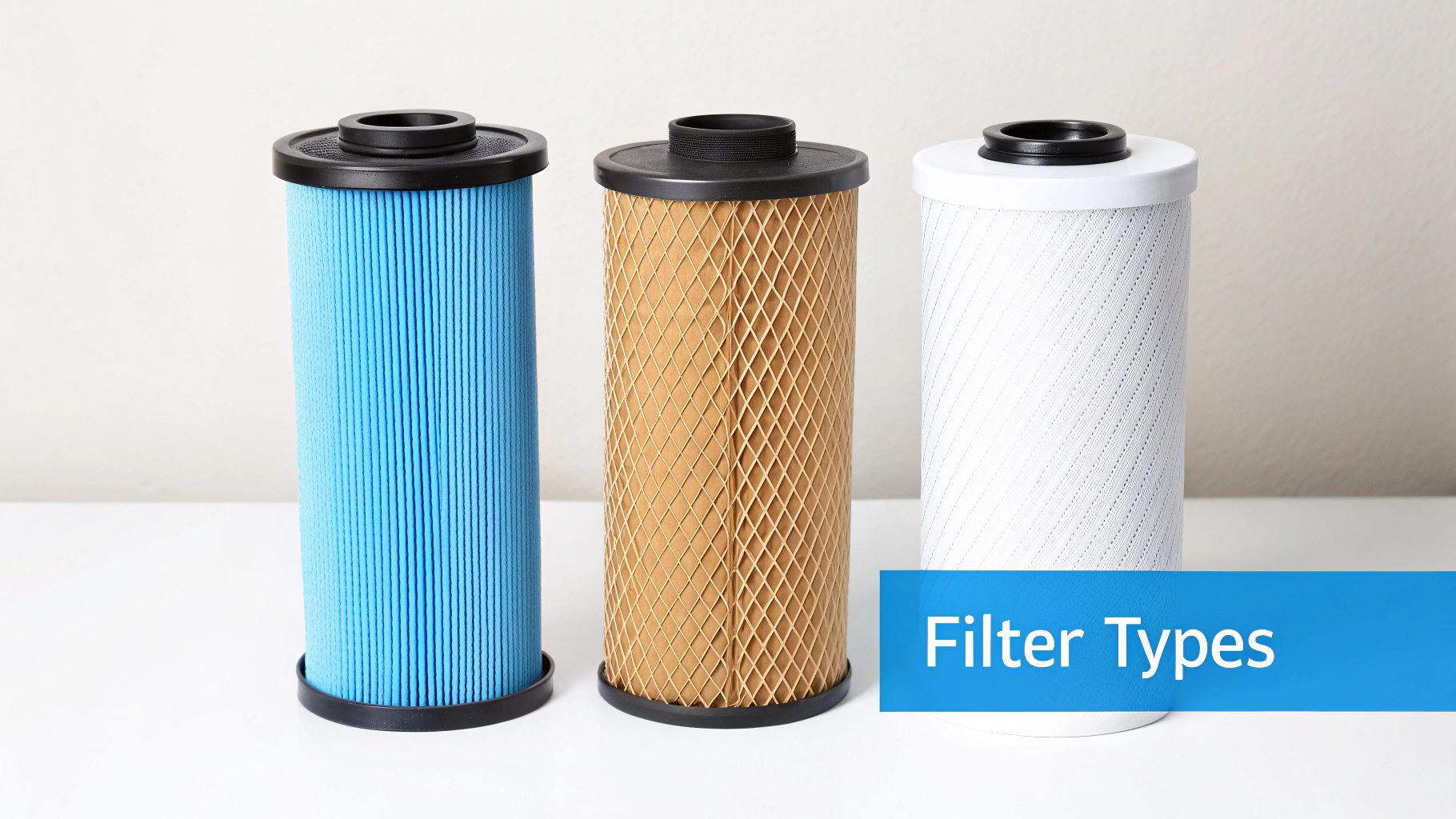
Before you can make sense of any water filtration system review, you need to understand what's happening under the hood. It’s like shopping for a car—you wouldn’t judge it by the paint job alone, would you? You’d want to know about the engine. Filtration technology is the engine, and each type is engineered to solve a different set of water problems.
Understanding these core methods is your best defense against clever marketing. It helps you look beyond brand names and focus on what truly matters: matching the right tech to the specific contaminants in your tap water. Let's break down the main players.
Activated Carbon: The Chemical Magnet
This is the workhorse of the filtration world, found in everything from simple pitchers to sophisticated multi-stage systems. Activated carbon works through a process called adsorption. Imagine its surface is a massive parking lot with countless microscopic spots.
As water flows by, contaminants like chlorine, pesticides, and many VOCs get trapped in these spots, clinging to the carbon like static. This is precisely why carbon filters are so effective at improving your water's taste and smell—they are champions at grabbing the chlorine that cities add for disinfection.
However, they aren't designed to remove most heavy metals, dissolved minerals, or microbiological threats like bacteria. They are the perfect solution for enhancing municipally treated water but may fall short if you're facing more serious contamination.
Reverse Osmosis: The Purity Powerhouse
If activated carbon is a magnet, Reverse Osmosis (RO) is a high-security checkpoint. This system uses your home's water pressure to force water through a semipermeable membrane—essentially a filter with pores so tiny that almost nothing but H₂O molecules can pass through.
The result? Nearly everything else is left behind and flushed down the drain. A high-quality RO system can remove up to 99% of all total dissolved solids (TDS). This includes:
- Heavy metals like lead and arsenic
- Nitrates and sulfates
- Fluoride
- Bacteria and viruses
Because RO is so incredibly thorough, it's often considered the gold standard for pure drinking water. A common criticism is that it also strips out beneficial minerals. To address this, many modern RO systems include a remineralization stage that adds healthy minerals like calcium and magnesium back into the water, improving its taste and pH balance.
Reverse Osmosis is an ideal choice for households with specific, hard-to-remove contaminants like heavy metals or for anyone seeking the highest level of water purity for drinking and cooking.
UV Purification: The Microbe Neutralizer
Unlike methods that physically trap contaminants, Ultraviolet (UV) purification is all about sterilization. It uses a special lamp to zap water with UV-C light, which scrambles the DNA of microorganisms like bacteria, viruses, and cysts.
This doesn't technically kill them, but it renders them harmless and unable to reproduce. Think of it as a bouncer that neutralizes a threat without physically removing it from the club. A huge advantage is that UV adds zero chemicals to your water and doesn't alter its taste or smell in any way.
UV purifiers are a non-negotiable for homes on well water or for anyone in an area prone to boil-water advisories. They offer a powerful defense against biological threats. That said, they do nothing to combat chemicals, sediment, or heavy metals, which is why you’ll almost always find them paired with other filters, like sediment and carbon, to create a complete purification system.
To help you keep these straight, here’s a quick rundown of how the main technologies stack up.
Filtration Technology At-a-Glance Comparison
| Filtration Type | Primary Contaminants Removed | Ideal Use Case | Common Installation Point |
|---|---|---|---|
| Activated Carbon | Chlorine, pesticides, VOCs, bad tastes & odors | Improving taste and smell of municipally treated water | Pitchers, faucet mounts, under-sink, refrigerator filters |
| Reverse Osmosis | Heavy metals, fluoride, nitrates, salts (TDS), bacteria | Achieving highest purity, removing specific dissolved solids | Under-sink for drinking water tap, whole-house systems |
| UV Purification | Bacteria, viruses, protozoa, and other microbes | Disinfecting biologically unsafe water (e.g., well water) | Point-of-entry for whole-house or with under-sink systems |
Knowing these different approaches is the first step. Now when you read water filtration system reviews, you can see past the sales pitch and understand exactly how a system works and what it can—and can't—do for your home.
Head-to-Head Water Filtration System Reviews
Hunting for the perfect water filter can feel overwhelming, but it really just boils down to matching the right technology to your home's needs. We're going to slice through the marketing hype and put three top-tier systems under the microscope. We’ll be comparing a high-performance under-sink reverse osmosis unit, a super-convenient countertop carbon filter, and a robust whole-house solution.
Our evaluation is based on what matters in a real-world home: certified contaminant removal, initial cost and installation hassle, long-term filter expenses, and whether it will sabotage your water pressure. Let's dive in.
The Under-Sink RO Powerhouse: Cloud RO System
For anyone who wants exceptionally pure water for drinking and cooking without filtering every drop in the house, an under-sink reverse osmosis (RO) system is the go-to solution. In a crowded market, the Cloud RO System stands out for its smart design and efficiency, landing it at the top of many water filtration system reviews.
This system uses a multi-stage process, starting with sediment and carbon pre-filters before water is forced through a high-rejection RO membrane. It’s NSF/ANSI 58 certified—the gold standard—confirming it removes a long list of contaminants. We're talking up to 99% of total dissolved solids (TDS) like lead and arsenic, plus fluoride, nitrates, chlorine, and pesticides.
A common complaint with older RO systems was the staggering amount of wastewater they produced. The Cloud RO addresses this with an impressive 1-to-1 waste-to-pure-water ratio. That's a massive improvement over old models that could waste several gallons for every gallon of pure water produced. It's better for your water bill and the environment.
Another brilliant touch is the remineralization stage. After stripping the water clean, it adds back beneficial minerals like calcium and magnesium. This not only improves the water's taste but also raises the pH for a more pleasant, alkaline final product.
The smart app that accompanies the Cloud RO is a game-changer. It provides real-time water quality data and sends notifications when it’s time to change filters. All the guesswork is eliminated.
Installation is surprisingly straightforward for a system that connects to your plumbing. If you're reasonably handy, you can likely complete it in under an hour. The main considerations are the upfront cost, the required space under your sink, and drilling a small hole in your countertop for the dedicated faucet.
The Countertop Convenience: AquaTru Countertop RO
If you're a renter, live in a small space, or simply want to avoid messing with plumbing, countertop filters are your best friend. The AquaTru Countertop Reverse Osmosis Purifier delivers the filtration power of a four-stage RO system with zero installation. Just plug it in, fill the tank, and let it work its magic.
Its process includes a mechanical pre-filter, a carbon pre-filter, the RO membrane, and a final carbon filter. This combination is certified to NSF/ANSI standards 42, 53, 58, 401, and P473, proving it removes over 80 different contaminants. That list covers everything from chlorine and lead to "forever chemicals" like PFOA/PFOS.
Sheer convenience is its greatest selling point. No plumbers, no pipes—just a self-contained unit on your counter. It's perfect for apartments where permanent modifications are a no-go, and it purifies water much faster than those painfully slow pitcher filters.
But this convenience comes with trade-offs. The AquaTru will occupy precious counter space, a significant factor in a compact kitchen. It also has a limited capacity; you have to continually refill the tank, which could become tedious for a large family or avid home cooks. While it's efficient with a waste ratio of about 1-to-3, you do have to manually empty the wastewater tank after each cycle.
This chart breaks down the average annual cost and contaminant removal efficiency for leading filtration brands, giving you a visual snapshot of their long-term value.
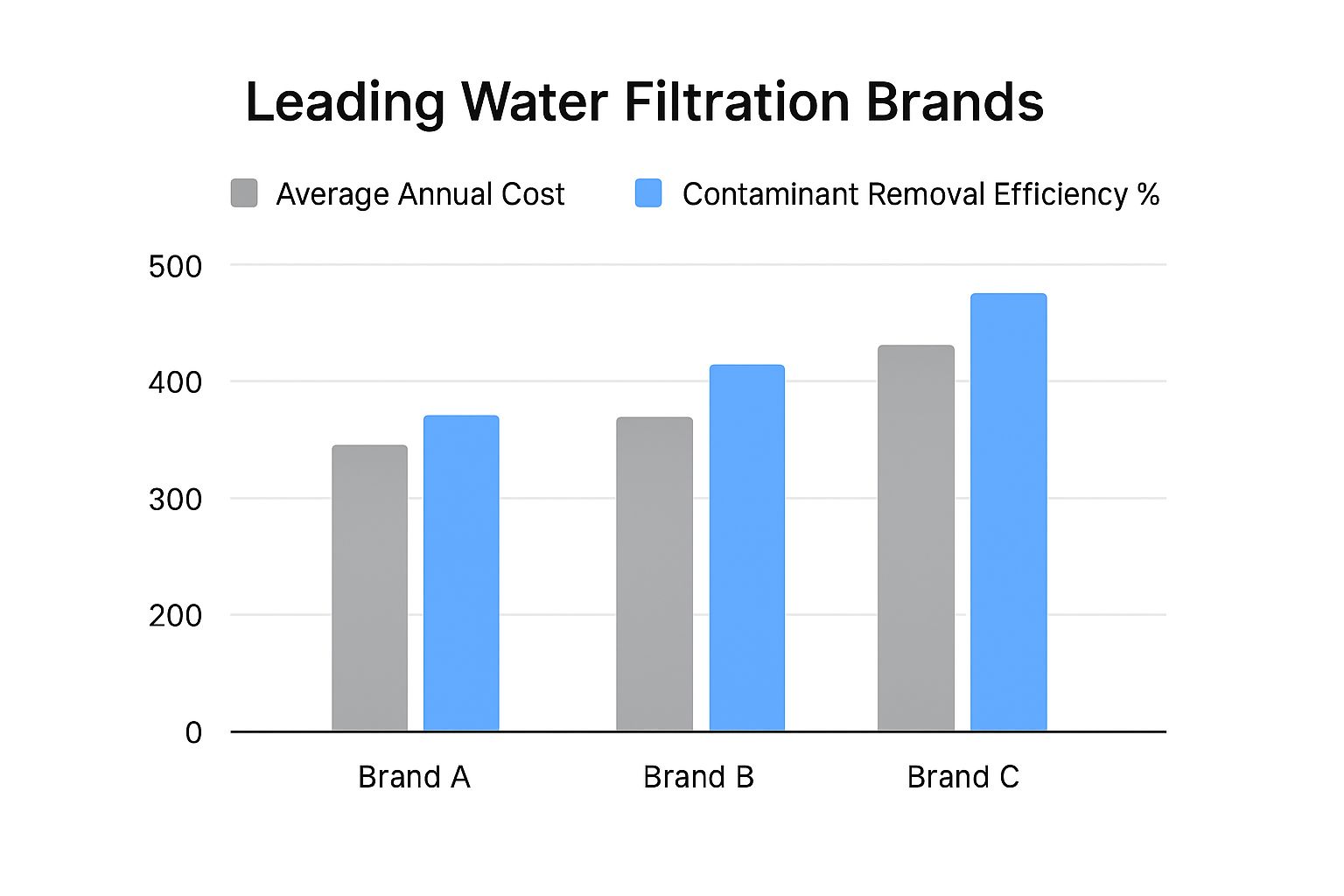
The visualization clearly shows that while some systems may have a higher initial price, their superior efficiency and lower maintenance costs can offer better value over time.
The Whole-House Guardian: SpringWell CF1
For the ultimate "set it and forget it" solution, a whole-house water filter is the undisputed champion. The SpringWell CF1 Whole House Water Filter System treats every single drop of water entering your home. This protects not only the water you drink but also your skin in the shower and all your water-using appliances.
This is a point-of-entry (POE) system, so it's installed where your main water line enters the house. It utilizes a 4-stage design with a proprietary mix of KDF media and catalytic coconut shell carbon, which is exceptionally good at targeting the contaminants commonly found in city water.
Key Contaminants Removed:
- Chlorine and Chloramine: It eliminates these disinfectants, which are notorious for causing bad tastes and smells and can dry out your skin and hair.
- Pesticides and Herbicides: Excellent for filtering out common chemicals from agricultural runoff.
- VOCs and Industrial Solvents: Reduces a wide range of volatile organic compounds.
- Heavy Metals: Helps lower levels of contaminants like lead and mercury.
The biggest victory here is total home protection. Every faucet, showerhead, and appliance receives clean water. That means better-tasting coffee, healthier skin, and a longer lifespan for your dishwasher and washing machine by preventing sediment and chemical buildup.
The SpringWell CF1 is engineered for near-zero maintenance. The main filter is rated for an astounding 1,000,000 gallons, which for an average family translates to about 10 years before a replacement is needed. This makes its long-term cost of ownership incredibly competitive.
The main hurdle is installation. You’ll need a professional plumber, which adds to the initial investment. You might also experience a very slight drop in water pressure, though most homeowners don't even notice it. It’s the priciest of the three, but it solves the widest range of water problems. This trend is gaining momentum, with the global market expected to reach USD 179.85 billion by 2032 as more people prioritize water quality. You can find out more about the global trends in water purification technology.
Head-to-Head Comparison Table
| Feature | Cloud RO System (Under-Sink) | AquaTru (Countertop) | SpringWell CF1 (Whole-House) |
|---|---|---|---|
| Best For | Highest purity drinking water, targeted use | Renters, small spaces, no-installation needs | Comprehensive home protection, low maintenance |
| Installation | DIY-friendly (1-2 hours), requires under-sink space | Plug-and-play, no installation required | Professional plumber required |
| Key Strength | Smart features, water efficiency, remineralization | Portability and extreme convenience | Treats every tap, 10-year filter life |
| Contaminant Focus | TDS, heavy metals, fluoride, chlorine, VOCs | 80+ contaminants including PFOA/PFOS, lead | Chlorine, chloramine, pesticides, VOCs |
| Water Pressure Impact | None on main faucets, dedicated tap only | None | Minimal, can cause a slight drop |
| Ongoing Cost | Filters replaced annually (approx. $200) | Filters replaced every 6-24 months | Main filter replaced every 10 years |
| Upfront Cost | Moderate | Low-to-Moderate | High |
Choosing the right system boils down to your primary goal. If surgically pure drinking water is your top priority, the Cloud RO is a fantastic choice. If convenience is king, the AquaTru delivers RO-quality water without the commitment. And for total, hassle-free protection for your entire home, the SpringWell CF1 is a powerful long-term investment.
Matching the Right Filter to Your Lifestyle
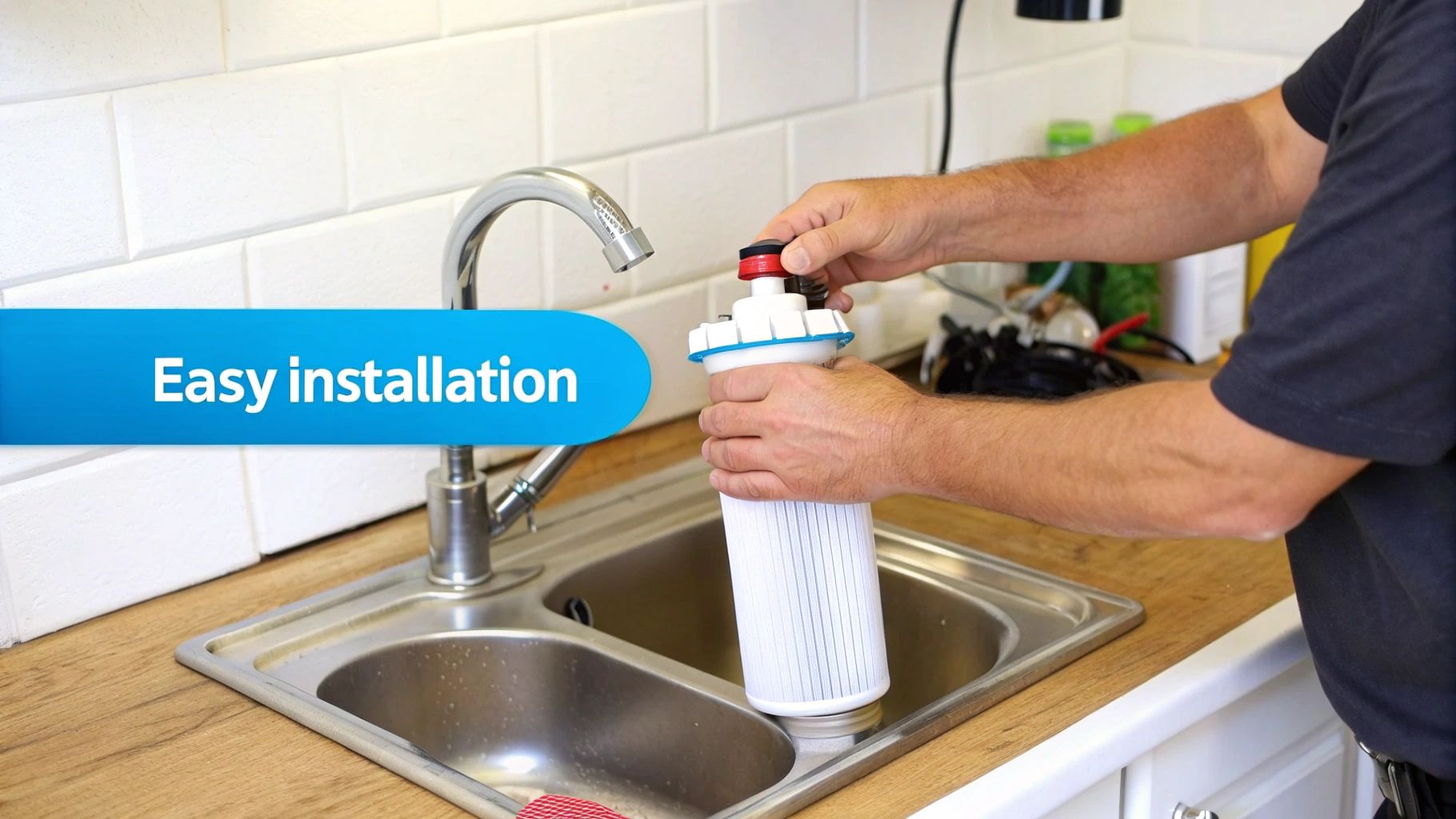
There is no single "best" water filter for everyone. The ideal system for a single person in a city apartment would be a terrible match for a family on a rural property with well water. Your lifestyle, location, and water source are the deciding factors in finding a solution that truly works for you.
Instead of just listing features, let's explore how different filters solve real-world problems. By matching our water filtration system reviews to specific home scenarios, you’ll see a much clearer path to the perfect choice for your household.
The Renter's Solution
When you're renting, you can't exactly start re-routing the plumbing. This simple reality eliminates most under-sink and whole-house systems from consideration. You need something effective, non-permanent, and powerful—a filter that delivers top-tier purification without requiring a single tool.
For renters, it typically comes down to two options:
- Countertop Systems: These are the heavy hitters. Units like the AquaTru sit on your counter and simply plug in, offering reverse osmosis purification that tackles a huge range of contaminants without any permanent installation.
- Faucet Filters: A super easy and affordable upgrade, these attach directly to your existing faucet. They are great for removing chlorine and improving taste, but they don't offer the same deep-cleaning power as a countertop RO system.
The name of the game is portability and performance. You want a filter you can pack up and take with you when you move, one that provides a serious upgrade from a basic pitcher.
The Well Water Homeowner
If your water comes from a private well, you are playing a completely different game than someone on city water. You are essentially your own water utility, meaning you are responsible for handling things municipalities filter out—especially bacteria and sediment. A simple carbon filter won't even begin to cover your needs.
For well water, a multi-stage approach isn’t just a good idea; it’s essential. Your primary concern is microbiological safety, so you need a system built to neutralize bacteria, viruses, and other pathogens long before they reach your glass.
A robust well water filtration setup almost always includes these layers:
- A Sediment Pre-Filter: This is your first line of defense, catching dirt, sand, and rust that can clog and damage the rest of your system.
- A Carbon Filter: This stage targets chemical contaminants like pesticides and herbicides that may have seeped into the groundwater.
- A UV Purifier: This is the most critical component. It uses ultraviolet light to destroy microorganisms like E. coli and Giardia, making the water biologically safe to drink.
For well owners, filtration is less about enhancing taste and more about fundamental health and safety. Combining these stages creates a powerful shield against the unique risks associated with groundwater.
The Busy Family Upgrade
For a busy family in a suburban home, the goal is usually simple: comprehensive, low-maintenance protection for everyone. You want clean water from every tap—for drinking, cooking, bathing, and laundry—without having to think about it. This is where a whole-house system shines as the ultimate home upgrade.
Also known as point-of-entry (POE) systems, these are installed where your main water line enters the house, ensuring every drop of water is filtered. They are fantastic for removing chlorine and chloramine across the board, which not only improves the taste of your water but is also much gentler on your skin and hair in the shower.
The demand for these set-it-and-forget-it solutions is surging. The global water filtration market grew from USD 9,843.43 million in 2021 and is projected to hit USD 14,202.2 million by 2025, largely because families want efficient, whole-home treatment. You can discover more insights about the water filtration market's growth to see the trend. A whole-house filter is a smart investment that protects both your family's health and your home's appliances from the damage caused by hard water and chemicals.
Installation and Long-Term Ownership Costs
The price tag on a water filter is just the beginning of the story. A system's true value emerges over years of use, when you factor in the ease of installation and the ongoing cost of keeping fresh, clean water flowing. Understanding these long-term expenses is key to making a smart choice that fits both your home and your budget.
One of the first decisions many people face is whether to install the system themselves or call a professional. Simpler systems like faucet filters and countertop models are designed for easy, tool-free setup. But when you step up to under-sink and whole-house systems, things become more involved.
DIY vs. Professional Installation
Many modern under-sink systems, including the Cloud RO, are designed with the DIY-er in mind. They come with clear instructions and color-coded components, making it a manageable project for most handy homeowners. The biggest hurdles are typically drilling a small hole for the separate faucet and connecting a single tube to your cold water line.
Whole-house systems, however, are a different beast entirely. These are plumbed directly into your main water line, which means cutting into your home's primary plumbing. This is almost always a job for a licensed plumber. While it adds to the upfront cost, professional installation ensures everything works flawlessly and you don't risk a catastrophic leak or other plumbing disasters.
Our Take: If the job involves your main water line or you're not comfortable with basic plumbing, hiring a pro is money well spent. It prevents leaks, guarantees the system runs at peak performance, and gives you peace of mind.
Calculating the True Cost of Ownership
The largest ongoing expense for any water filtration system is filter replacement. These costs can vary dramatically between models and are a critical component of any honest water filtration system reviews. It's easy to be tempted by a cheap initial purchase, only to discover later that the replacement filters are expensive or need to be changed constantly.
Let's break down the estimated five-year cost for the systems we've reviewed, including the initial purchase and all filter changes:
-
Countertop RO (AquaTru): The filters need to be swapped every 6 to 24 months, depending on the specific component. Over five years, you're looking at about $600 – $750 for replacements, bringing the total cost of ownership to around $1,000 – $1,200.
-
Under-Sink RO (Cloud RO): This system's filters are straightforward—replace them annually for about $200. In total, the five-year cost, including the system itself, lands in the $1,500 – $1,700 range.
-
Whole-House System (SpringWell CF1): While it has the highest upfront cost, its main filter is a marathon runner, lasting an incredible ten years. Your only regular cost is the sediment pre-filter, which you'll change every 6-9 months for about $30. Even with professional installation, the five-year cost typically falls between $2,000 – $2,500, but you're getting comprehensive protection for every tap in your house.
Common Questions About Home Water Filtration
Diving into the world of water filters can definitely bring up a few questions. To help you navigate the options, we've gathered some of the most common queries homeowners have when researching home filtration systems. Our goal is to provide clear, straightforward answers to help you feel confident in your decision.
Do I Really Need a Filter if My City Water Is Safe?
This is an excellent question and one we hear often. While your city's water must meet federal safety standards, "safe" doesn't always mean "ideal." Municipal water often contains chlorine and its byproducts, which can affect taste and smell. More importantly, aging pipes can leach lead and other contaminants into the water on its final journey to your faucet.
Think of a home filter as your last line of defense. It puts you in control, allowing you to remove contaminants that municipal treatment may miss. It delivers a level of purity and peace of mind that a city-wide system simply cannot guarantee for every individual home.
What Is the Difference Between Filtering and Purifying Water?
People often use "filtering" and "purifying" interchangeably, but in the water treatment industry, they have distinct meanings.
- Filtering involves removing sediment and chemical contaminants to improve water's taste, smell, and appearance. Most carbon-based systems, like pitcher filters or faucet-mounted devices, are considered filters.
- Purifying is a much more rigorous process. To be classified as a purifier, a system must remove 99% or more of all contaminants, including microscopic organisms like bacteria and viruses. Systems using Reverse Osmosis or UV light fall into this category.
If you want to dive deeper into the science of water quality, you can find a wealth of expert advice for choosing a water filter that's perfectly suited to your needs.
How Often Should I Change My Water Filters?
The lifespan of a filter depends heavily on the type of system you have and your family's water consumption. It is absolutely crucial to follow the manufacturer's recommended replacement schedule, which is typically based on months of use or total gallons filtered.
Neglecting to change your filters is a serious mistake. A clogged, old filter doesn't just stop working—it can become a breeding ground for bacteria. You could end up with water that's even more contaminated than what you started with.
Will a Water Filter Lower My Home's Water Pressure?
It's true that some systems can cause a slight decrease in water pressure. This is most common with whole-house systems and some complex multi-stage reverse osmosis units. The actual impact depends on the system's design, the number of filter stages, and your home's existing water pressure.
However, high-quality modern systems are engineered to minimize this effect, and most homeowners barely notice a difference. It’s always a good practice to check user reviews for comments on water pressure before making a final decision.
- October 6, 2025
- 0
- Uncategorized
