
So, you're standing at the crossroads of home water treatment, staring down the epic battle of water descaler vs softener. Let's cut through the noise. It all boils down to this: a classic softener yanks out those pesky hard minerals, while a descaler gives them a stern talking-to so they behave and don't wreck your plumbing. Softeners give you that famous silky-smooth water, but descalers are the "set it and forget it" heroes, protecting your pipes and appliances without the drama.
Tackling the Hard Water Villain in Your Home
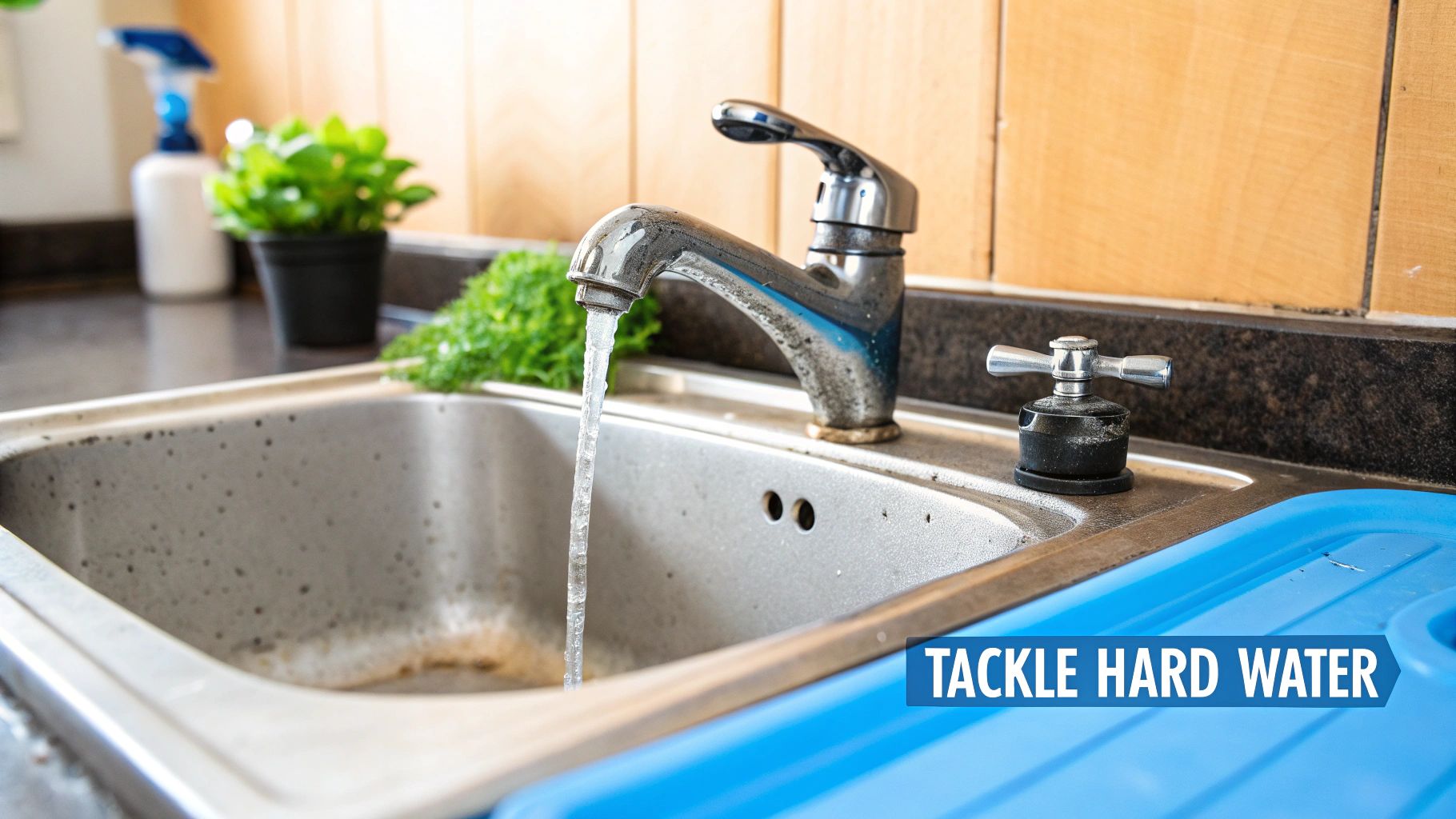
Hard water is the quiet saboteur of the home. It leaves its calling card everywhere—that crusty white film on faucets, soap scum that just won't quit, and appliances that mysteriously die years before their time. The culprits are simple: water that’s jam-packed with dissolved minerals, mainly calcium and magnesium. They’re like uninvited houseguests that refuse to leave.
While these minerals won't hurt you to drink, they're the building blocks of limescale. That stubborn, rock-like gunk is what clogs your plumbing and strangles your water heater, forcing it to work way harder than it should. To fight back, homeowners have two main weapons in their home filtration arsenal: old-school water softeners and their clever, modern cousins, water descalers.
The Scale of the Problem
Getting a handle on hard water isn't just about sparkling faucets; it’s a big deal with real financial consequences. A mind-boggling 85% of American homes have hard water, making the quest for perfect home water filtration a national pastime.
That limescale can slash the lifespan of your pipes by 2-3 years and jack up your home's energy use by 15-25%. It's no wonder the global market for these treatment systems is expected to hit USD 25.5 billion by 2035.
Descaler vs Softener: A Quick Comparison
Nailing the core difference between these two systems is your first mission. While this guide is all about preventing scale from ever forming, you might also need some effective methods for cleaning hard water stains that have already taken hold.
Here’s a quick tale of the tape.
| Feature Comparison | Water Descaler (Conditioner) | Water Softener (Ion Exchange) |
|---|---|---|
| Primary Function | Alters mineral structure to prevent scale | Physically removes hard minerals |
| Water Feel | Unchanged; no "slippery" feel | Silky, "soft" feel |
| Maintenance | None; set it and forget it | Requires regular salt refills |
| Environmental Impact | Eco-friendly; no salt or wastewater | Creates brine discharge (wastewater) |
| Best For | Scale prevention with minimal upkeep | Eliminating all hard water symptoms |
The Science Behind Each Water Filtration Method
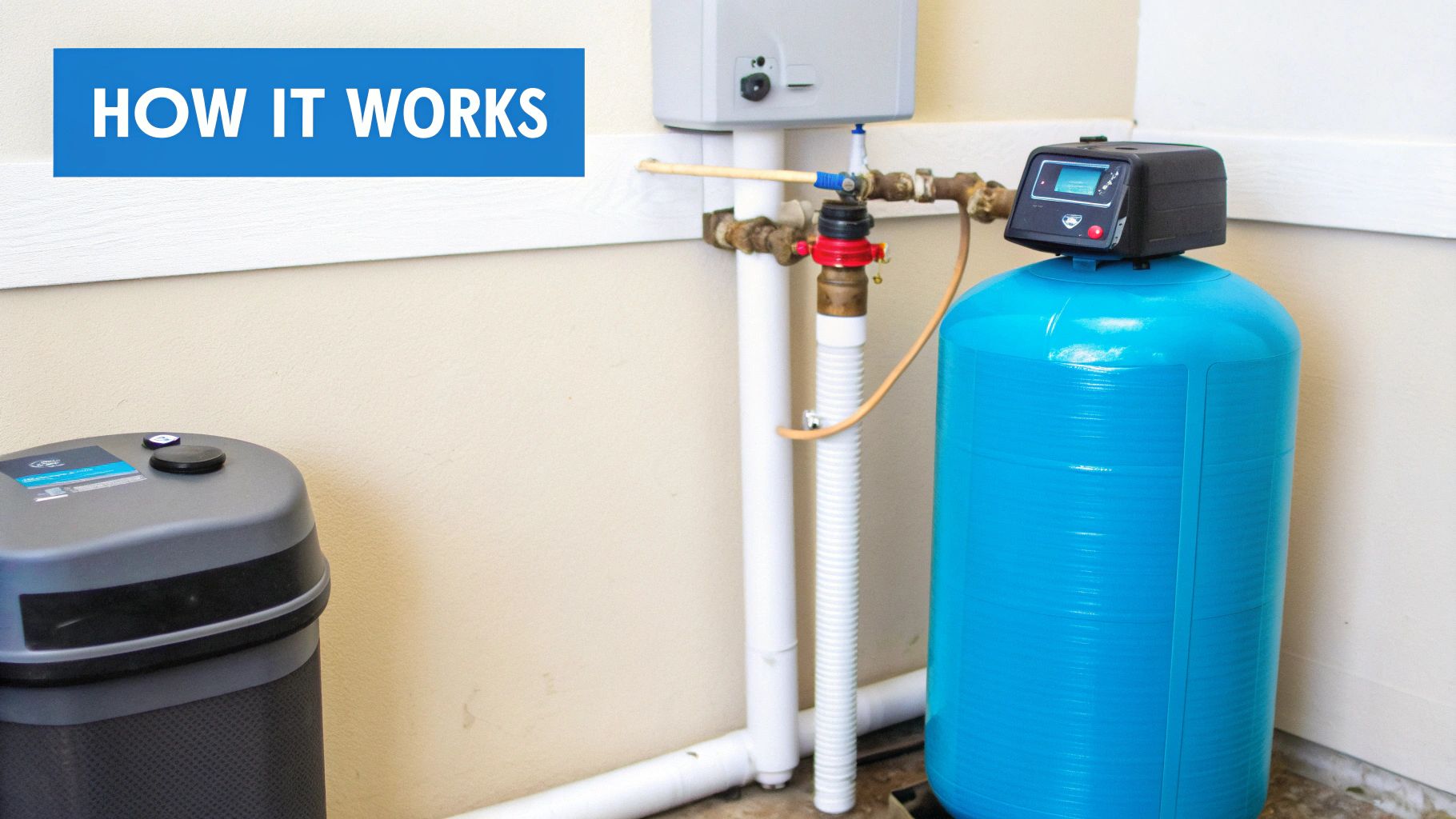
When you're trying to solve the "water descaler vs softener" puzzle, you have to get past the sales hype and look at the science. Both systems aim to stop the carnage caused by hard water minerals, but they go about it in completely different ways.
Think of it like this: one is a burly bouncer at a club, physically throwing the troublemakers (calcium and magnesium) out onto the street. The other is more like a wise diplomat, changing their behavior so they don't cause any problems in the first place.
This fundamental difference changes everything—from how your shampoo lathers up to how much work you have to put in and its impact on the planet. Let's lift the hood and see how these home filtration wizards really work.
How Traditional Water Softeners Work: The Ion Exchange Swap
A classic water softener uses a process that’s been the heavyweight champion for decades: ion exchange. This is a chemical magic trick that physically snatches the hardness minerals right out of your water. It’s like a super-specific net that only catches calcium and magnesium.
Inside the main tank is a bed of tiny resin beads loaded with a negative charge. Before you even flip the switch, these beads are covered in "soft" sodium ions. As your hard water flows through, the party starts. The positively charged calcium and magnesium ions are drawn to the negatively charged beads like moths to a flame.
This attraction is so powerful that the hardness minerals literally kick the sodium ions off the beads and take their place. The now-homeless sodium ions flow out with your water, giving you chemically "soft" water all over the house.
The key takeaway: a softener actually changes the chemical recipe of your water. It’s not just stopping scale—it’s creating brand-new water that’s free from the minerals that made it hard in the first place.
This cycle continues until the resin beads are completely saturated with hardness minerals. At that point, the system has to "regenerate." This is just a fancy term for a cleaning cycle where a super-salty solution (brine) from a second tank floods the resin. The rush of sodium ions from the brine pries the trapped calcium and magnesium off, flushing them down the drain. The resin beads are then recharged with fresh sodium, ready for another round.
How Water Descalers Work: The Conditioning Approach
Water descalers—also called water conditioners—take a completely different, almost zen-like approach. Instead of removing the minerals, they change their physical structure to stop them from forming scale. It's a physical transformation, not a chemical one.
There are a few descaler technologies out there, but one of the most proven is Template Assisted Crystallization (TAC). This method uses special media that acts as a template, or a pattern, for the minerals to grow on.
When hard water passes over this media, the calcium and magnesium ions team up and form tiny, harmless "seed crystals." These microscopic crystals are stable and just don't stick to anything—not your pipes, your water heater, or your showerhead.
Here’s what that means for your home:
- Minerals Stay Put: The beneficial minerals, calcium and magnesium, are still in your water. You just don't have to deal with the scale.
- Scale Is Prevented: The little crystals just float harmlessly through your plumbing and go right down the drain.
- No Salt, No Waste: Because nothing is being removed or flushed out, these systems don't need salt and don't create any wastewater.
You might also see electronic or magnetic descalers, which use electric fields or magnets to get a similar result by agitating the minerals so they can't stick together. No matter the tech, the goal is the same: manage the minerals to stop scale without actually taking them out. This is also why you won't get that slick, "slippery" feeling from a descaler that you get with soft water.
Water Descalers vs. Water Softeners: The Showdown
This is where the rubber meets the road. Deciding between a water descaler and a water softener boils down to one question: do you want to manage the hard minerals, or completely eradicate them?
Each path offers a totally different experience for your home and lifestyle. It’s not just a plumbing decision; it affects your morning shower, your monthly bills, and how you maintain your home. The real question is what you value more—getting rid of every single trace of hardness, or a maintenance-free, eco-friendly way to protect your plumbing.
Scale Prevention Effectiveness
Let's be clear: the number one job for both is stopping limescale. A water softener wins with brute force. By yanking calcium and magnesium out of the water, there’s literally nothing left to form scale. It's a time-tested method that’s incredibly effective, especially if your water is rock-hard (think 10 grains per gallon or more).
Water descalers, specifically the Template Assisted Crystallization (TAC) types, are also shockingly good at this. They don't remove minerals but instead change them into microscopic crystals that can't stick to surfaces. Independent studies show these systems can prevent over 95% of scale buildup, putting them in the same league as softeners. The only catch? Electronic or magnetic descalers are a bit of a wild card; their results can be all over the place.
If your water hardness is off the charts, a softener offers a knockout punch. For more moderate hardness, a quality TAC descaler delivers nearly identical scale prevention without messing with your water's chemistry.
Impact on Water Feel and Taste
Here’s where you’ll notice the biggest daily difference. A water softener gives you that distinctively "soft," almost slippery water. Because the hard minerals are gone, soap lathers up like a bubble machine, leaving your skin feeling silky. Some people love it. Others feel like they can never rinse the soap off. Softened water also picks up a slightly salty taste from the ion exchange process, which can be a dealbreaker if you're watching your sodium.
A water descaler, on the other hand, leaves your water completely alone. The minerals are still in there, so you get no change in how your water feels or tastes. It's the same water you've always had, just without the scale-forming downside. You won't get that slippery feeling or mountains of lather. If your only mission is to protect your plumbing and you like your water as-is, a descaler is a perfect match.
Unpacking Maintenance Demands
The long-term ownership experience is a huge factor. A water softener is a bit needy and requires consistent, hands-on attention.
- Lugging Salt: Get ready to buy and haul heavy bags of salt, usually 40 lbs a pop, to refill the brine tank every month or so.
- Regeneration Cycles: The system has to clean itself regularly with a brine solution, using up both water and electricity.
- Tank Cleaning: Every so often, you'll have to clean out the brine tank to prevent "salt bridges" that can shut the whole system down.
A water descaler is the complete opposite. It's the definition of a "set it and forget it" appliance. Once it's installed, you’re done. There's no salt to buy, no wastewater, and most models don't even use electricity. That zero-maintenance reality is a massive perk for anyone who wants a simple, hassle-free filtration solution.
The True Cost of Ownership
When you’re budgeting for home filtration, you have to look past the sticker price. A good descaler and a softener might have similar upfront costs, but their long-term expenses are worlds apart.
To give you a clearer picture, here’s a quick breakdown of how they stack up over time.
Key Differences At a Glance: Descaler vs Softener
| Feature | Water Descaler (Conditioner) | Water Softener (Ion Exchange) |
|---|---|---|
| How It Works | Alters mineral structure to prevent scale | Removes hardness minerals via ion exchange |
| Scale Prevention | Highly effective (TAC models) | Extremely effective, total removal |
| Water Feel | No change, feels "hard" | "Soft" and silky, sometimes slippery |
| Maintenance | Virtually none ("set and forget") | Requires regular salt refills & cleaning |
| Ongoing Costs | None (media may need replacing every 3-5 yrs) | Salt, water, and electricity for regeneration |
| Environmental Impact | Eco-friendly, no waste | Creates salt-heavy brine discharge |
| Best For | Moderate hardness, eco-conscious homeowners | Very hard water, those wanting "soft" water feel |
The lifetime cost of a water softener adds up. You're looking at hundreds of dollars a year just for salt, not to mention higher water and electricity bills. A softener can easily waste an extra 25 gallons of water per day—or 3,000 gallons per year—just on regeneration. Over the 10-15 year life of the unit, that's a significant expense. A descaler’s only potential future cost is new TAC media every 3-5 years.
The market shows where people's priorities are. Salt-based water softeners still dominate, holding a whopping 74.18% of the global market share because they are a proven, reliable workhorse. But there's a shift happening. Salt-free systems are projected to have the fastest growth through 2030, a clear sign that homeowners are looking for more sustainable ways to filter their water. You can dig into these trends in recent industry reports on water treatment markets.
How to Choose the Right Filtration System for Your Home
Navigating the water descaler vs softener debate can feel like a chore, but picking the right system for your house is probably easier than you think. It really just boils down to what's in your water, your lifestyle, and what you expect your water filtration system to do.
This isn't about finding the single "best" system. It's about finding the one that’s a perfect match for your specific hard water woes.
The first question to ask yourself is this: are you trying to completely transform how your water feels and behaves, or are you just looking to protect your pipes and appliances from that crusty, destructive limescale? Once you know that, you're halfway there.
Start with a Simple Water Test
Before you even think about shopping, your absolute first step should be to test your water. You can't fight an enemy you don't understand. A water test gives you the hard data you need, telling you your water's hardness level, measured in grains per gallon (GPG).
That one number is your treasure map. It immediately tells you which systems are good options and which would be a waste of money. Without it, you're just guessing.
- Under 3 GPG: This is soft or just slightly hard water. You can probably skip any treatment.
- 3-7 GPG: Moderately hard. This is the sweet spot where a quality water descaler really shines.
- 7-10 GPG: Hard water. At this level, both systems are contenders, and your choice will come down to personal preference.
- Over 10 GPG: Very hard water. For this level of mineral assault, a traditional salt-based water softener is almost always your best bet.
You can get this info from a simple home test kit or send a sample to a lab. Once you know your GPG, the path forward becomes much clearer.
Scenarios When a Water Softener Is the Clear Winner
A water softener is the right call when your goal is to wipe out all the annoying effects of hard water, not just prevent scale. It works by physically removing the problem minerals, which fundamentally changes your water.
You should be leaning toward a water softener if:
- Your Water Hardness Is Over 10 GPG. When you're dealing with very hard water, a softener's mineral-removing power offers the most complete protection.
- You Want That "Soft Water" Feel. If you're after silky-smooth skin, brighter clothes, and soap that lathers like crazy, only a softener can deliver.
- You Have High Iron Content. Many softeners are also great at removing ferrous iron, the culprit behind those ugly rust stains in your sinks and toilets.
A water softener is an investment in total comfort and mineral removal. It’s the definitive solution for anyone fed up with every single symptom of hard water and willing to do a bit of maintenance to get rid of them for good.
Situations Where a Water Descaler Is Superior
A water descaler is the perfect solution for homeowners focused on preventing scale in an eco-friendly, zero-maintenance way without changing the water itself. It's a modern, set-it-and-forget-it approach to filtration.
A descaler is the better choice for you if:
- Your Water Hardness Is Moderate (3-7 GPG). Descalers are highly effective in this range, stopping scale buildup before it starts without needing salt or chemicals.
- You're Watching Your Sodium Intake. Since descalers don't add anything to the water, they're the ideal choice for anyone on a sodium-restricted diet.
- You Want an Eco-Friendly, No-Fuss System. With no salt bags to haul, no wastewater, and often no electricity, descalers are the ultimate hands-off home filtration solution.
And the market is showing a clear preference for these sustainable options. The global water descaler market was recently valued at $2.1 billion and is projected to hit $3.9 billion by 2034. This huge growth shows that for many people, descalers are a compelling alternative that avoids the hassle of salt, making them a great fit for renters and environmentally conscious families.
This handy flowchart breaks down the decision. You've got the descaler on the left for low-maintenance scale prevention, and the softener on the right for complete mineral removal.
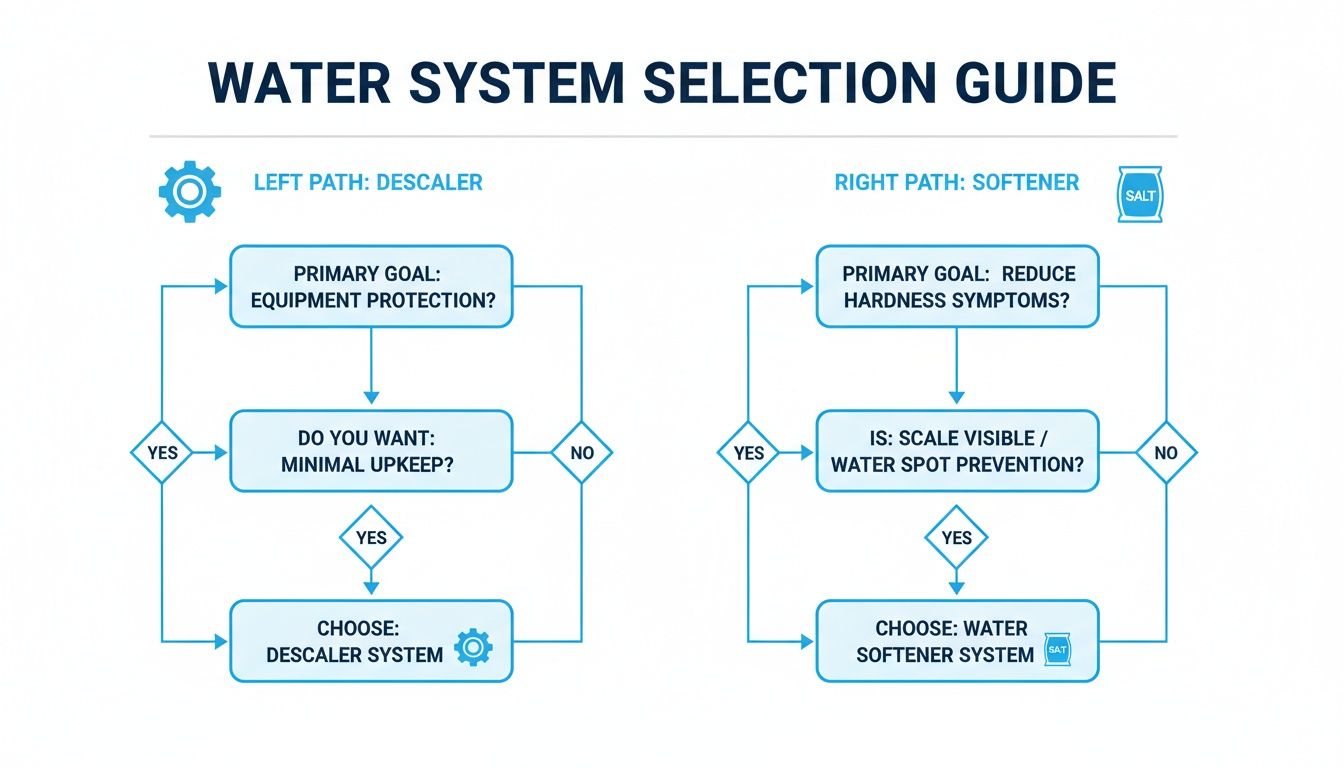
As the chart shows, it really comes down to your water hardness and personal priorities—like how much maintenance you're willing to do. If you're looking for more detailed guidance on different types of home water systems, you can find a lot more information at https://www.waterfilteradvisor.com/advice/.
Installation, Maintenance, and What It Really Costs to Own
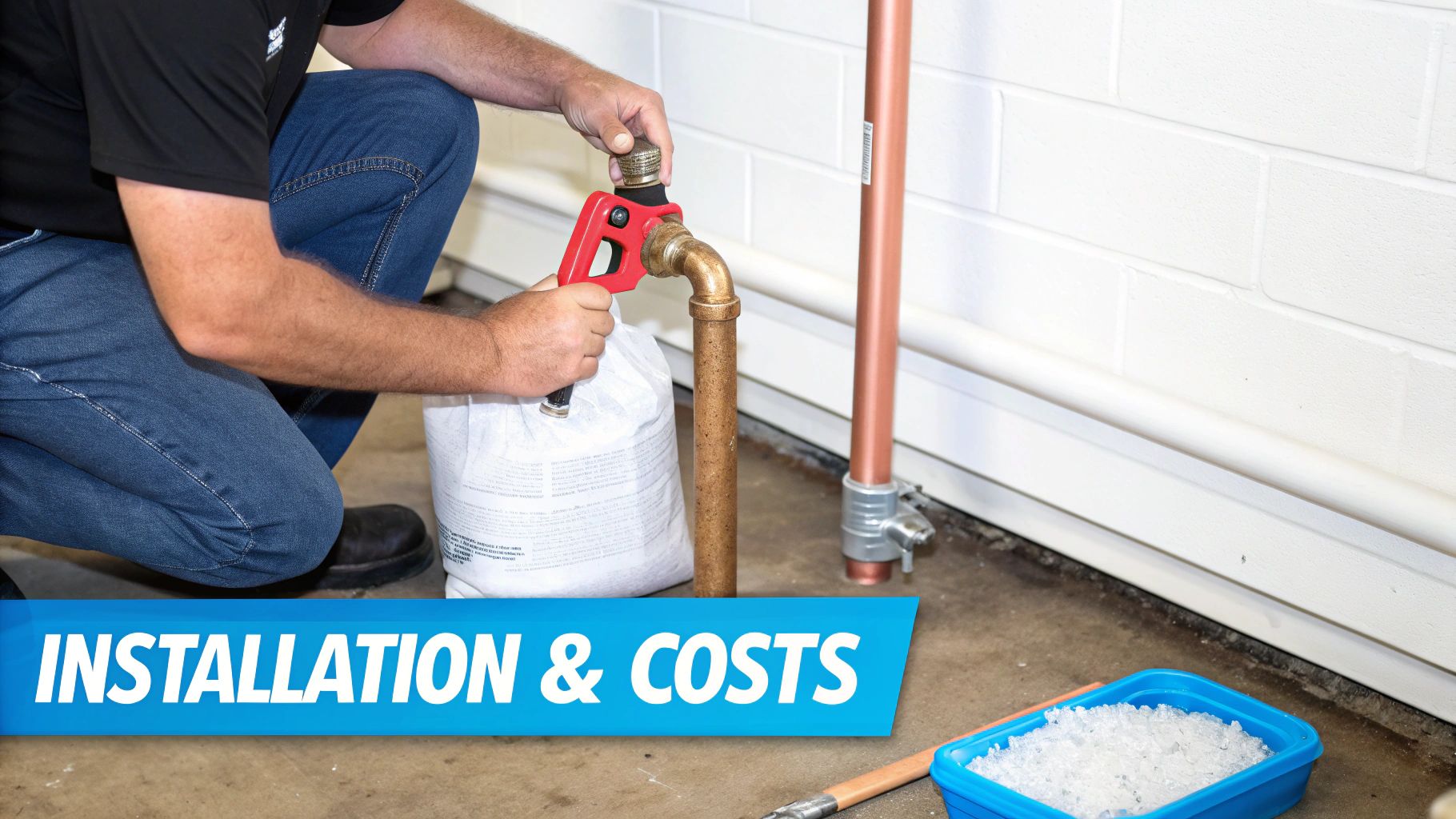
When you’re weighing a water descaler vs. a softener, the differences go way beyond how they filter your water. The day-to-day reality of owning one—from setup to upkeep—is a completely different story. Nailing these practical details is key to picking a system you’ll love for years to come.
The initial setup can set the tone. A water softener, for example, is a much bigger job right from the start. It has to be plumbed directly into your home's main water line.
This means a plumber will be cutting pipes, soldering fittings, and running a new drain line for the salty discharge from its regeneration cycles. For most people, this isn't a simple weekend DIY project. If you're leaning toward a softener, getting familiar with the process of water softener installation and repair is a smart move to avoid headaches.
The Simplicity of Descaler Installation
Water descalers, especially the electronic kind, are the complete opposite when it comes to installation. Most of them are designed for an easy DIY setup.
Instead of serious plumbing work, you just wrap some wires or clamp the device onto the outside of your main water pipe. No cutting, no draining, no plumber. This makes them a fantastic fit for renters or anyone who doesn't want to make major changes to their plumbing.
Maintenance: A Tale of Two Systems
The real split between these two systems becomes clear with ongoing maintenance. A water softener needs your constant attention to keep working right. The biggest chore is keeping that brine tank full of salt.
This involves:
- Constant Salt Runs: You'll be buying heavy, 40-pound bags of salt on a regular basis.
- Heavy Lifting: Then you have to lug those bags from the store to wherever your softener is located.
- System Check-ups: You also need to watch out for "salt bridges," which are hard crusts that can form in the tank and stop the whole system from working.
A water descaler, by comparison, is the definition of a "set it and forget it" device. Once it's installed, you're pretty much done.
With a water descaler, you can cross salt bags, tank refills, and system checks off your to-do list for good. This zero-maintenance design is a huge win for homeowners who just want a simple, hassle-free filtration solution.
Calculating the True Cost of Ownership
The sticker price is just the beginning. To get the full financial picture, you have to look at all the ongoing costs over the system's life. A water softener's expenses keep coming long after you've paid for the unit.
Your long-term softener budget needs to account for:
- Salt: This is the most obvious recurring cost, which can easily run you $100-$300 per year, depending on your water hardness and family size.
- Water: The regeneration process flushes thousands of gallons of water down the drain each year, which you'll see on your utility bill.
- Electricity: The system’s control valve and timer are always on, using electricity 24/7.
A water descaler, on the other hand, has almost no running costs. Electronic models use a tiny amount of power, and TAC systems might need a media change every three to five years. But even that is minor compared to the constant cash outlay for a softener, making the descaler a much more predictable and often cheaper choice over its lifetime.
Your Top Questions About Home Water Filtration, Answered
Jumping into the world of water filtration can feel a little overwhelming. When you're stuck between a water descaler and a softener, it’s easy to get lost in the jargon. Let’s clear up the most common questions so you can make a choice you feel great about.
Will a Water Descaler Make My Water Feel Silky and Soft?
Nope, and this is probably the biggest point of confusion in the water descaler vs softener conversation. A descaler won't change how your water feels one bit. You won’t get that classic "slippery" feeling in the shower that’s a dead giveaway of softened water.
That’s because descalers are designed to leave beneficial minerals like calcium and magnesium right where they are. All they do is alter the minerals to stop them from sticking to your pipes as ugly scale buildup. Think of it as a scale prevention device, not a water-feel-changer.
Can I Use a Descaler if I Have Seriously Hard Water?
While descalers are great for moderately hard water, a traditional salt-based softener is almost always the smarter move for very hard water—we're talking anything over 10 grains per gallon (GPG). The same advice holds true if your water has a high iron content.
Softeners are just plain stronger in these tough situations because they physically yank the problem-causing minerals out of the water entirely. This gives your plumbing and expensive appliances far more reliable protection when mineral levels are off the charts.
If your water test comes back in the double digits for hardness, a water softener offers the most complete and effective fix for the long haul. A descaler might not be able to keep up, leaving your home at risk.
Do Water Softeners Add a Ton of Sodium to My Diet?
This is a really common worry, but the amount of sodium a softener adds is usually much smaller than you'd think. The exact amount is tied to how hard your water is—the harder it is, the more sodium is exchanged.
For most people, a full glass of softened water contains less sodium than a single slice of white bread. That said, if you're on a strict, doctor-ordered low-sodium diet, a descaler is the safer choice. Another popular option is to install a reverse osmosis filtration system for your drinking water after the softener, giving you the best of both worlds.
Are All Water Descalers Created Equal?
Definitely not. The performance of water descalers varies wildly depending on the technology inside.
- Template Assisted Crystallization (TAC): These systems have solid, third-party data to back them up, often preventing over 95% of scale. They're widely seen as the most dependable salt-free option.
- Electronic and Magnetic Descalers: The results from these gadgets are a lot more debated. Their performance can be hit-or-miss, often depending on your specific water chemistry, pipe material, and water flow rate.
If you’re leaning toward a descaler, looking for one that uses TAC technology is your best bet for results you can actually count on.
Ready to find the perfect water filtration solution for your home? Water Filter Advisor provides expert reviews and in-depth guides to help you compare the best systems on the market. Explore our resources and make a confident choice at https://www.waterfilteradvisor.com.
- February 3, 2026
- 0
- Uncategorized
