Water Conditioner for House: The Ultimate 2026 Guide

You wipe the bathroom faucet, and two days later that chalky crust is back. Your dishwasher leaves spots. The shower door looks cloudy no matter how much glass cleaner you use. Soap seems lazy, as if it gave up halfway through the job.

That’s the daily grind of hard water.

A lot of homeowners start searching for a water conditioner for house setups because they want relief without hauling salt bags, adding drain lines, or turning the basement into a mini treatment plant. That’s reasonable. But this topic gets confusing fast, mostly because stores and manufacturers often blur the line between conditioning, softening, and filtering.

That blur causes expensive mistakes. Many people buy a conditioner expecting silky-soft shower water, then feel disappointed when their water still behaves like hard water in some ways. Others buy a softener when all they really wanted was scale protection on fixtures and appliances.

The good news is that the right choice becomes much simpler once you know what each system does.

Tired of Hard Water? An Introduction to Water Conditioners

Hard water is one of those home problems that rarely feels dramatic, but it nags at you every day. It leaves white marks on faucets, stiffens up laundry, and turns glassware into a spot collection. It also works imperceptibly inside your plumbing, where you can’t see it.

That hidden part is what worries most homeowners. Scale can collect in water heaters, pipes, and appliances over time. If you’ve ever dealt with hardness issues in other systems, even outside the house, you already know how frustrating mineral balance can be. This hot tub water hardness guide is a good example of how the same basic mineral problem shows up in different water environments.

What a conditioner is trying to solve

A whole-house water conditioner is designed to reduce the damage caused by hard water minerals, mainly calcium and magnesium. The key word is damage.

A conditioner’s main job isn’t to make water feel silky. It’s to help stop minerals from sticking where they shouldn’t, such as:

  • Inside water heaters where scale can collect on heating surfaces
  • On fixtures where white crust builds around taps and showerheads
  • In appliances like dishwashers, coffee makers, and washing machines
  • Along plumbing lines where mineral deposits can gradually narrow passageways

Why people get confused

The word “conditioner” sounds like a softer, friendlier version of “softener.” That’s where the trouble starts. In everyday conversation, people use them almost interchangeably. In water treatment, they are not the same thing.

Practical rule: If your main complaint is crusty scale and you want a lower-maintenance option, a conditioner may fit. If you want water that feels soft on skin and helps soap lather better, you’re probably looking for a softener instead.

That distinction matters more than any brand name on the box.

The Great Water Debate Conditioner vs Softener vs Filter

Most water treatment confusion comes from one mistaken assumption. People think all whole-house systems are just different versions of the same machine.

They’re not.
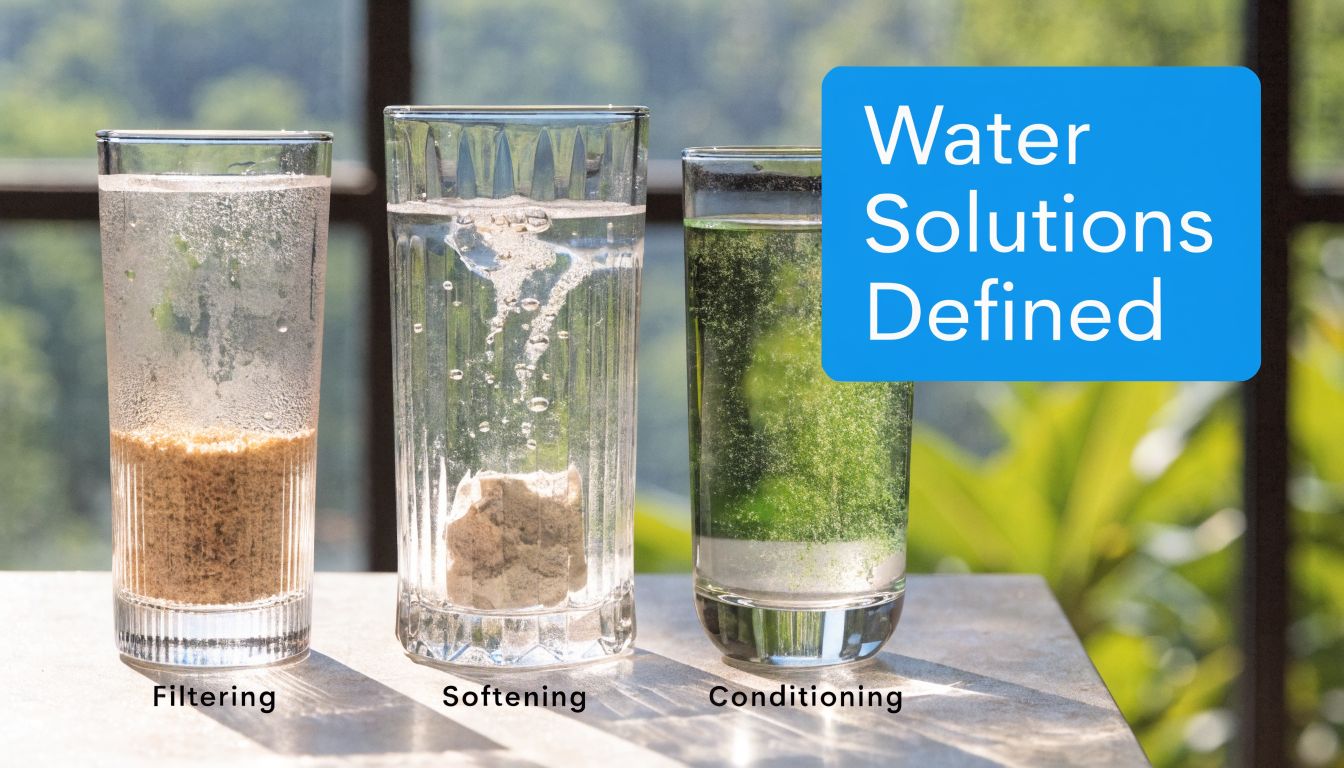
Three glasses showing water treatment concepts labelled as Filtering with sand, Softening with minerals, and Conditioning with algae.

A simple way to think about it is this:

  • A filter is a gatekeeper
  • A softener is a removal service
  • A conditioner is a transformer

Each one solves a different problem.

What a filter does

A whole-house water filter targets contaminants such as sediment, chlorine, odor-causing compounds, or other unwanted substances, depending on the media inside it. A filter is not built to deal with hardness in the same way a softener or conditioner is.

If your water smells like a swimming pool, tastes off, or carries visible particles, a filter is usually part of the answer. But a filter alone won’t stop classic hard-water scale.

What a softener does

A water softener removes hardness minerals from the water. That’s why softened water feels different in the shower and usually works better with soap.

If you want the slippery, soft-water feel, fewer soap issues, and actual hardness removal, this is the category that matches that goal. It’s also why softeners are still the standard choice for many homes with serious hardness problems.

The market reflects how strong that demand remains. The global household water softener system market was valued at USD 1.51 billion in 2025 and is projected to reach USD 2.40 billion by 2033, with North America holding 36% revenue share in 2025. Salt-based systems held 61.5% market share in 2025, according to Data Bridge Market Research on the household water softener system market.

What a conditioner does

A water conditioner for house use tackles hardness from a different angle. It doesn’t remove the minerals. It changes how they behave.

Salt-free water conditioners use Template Assisted Crystallization (TAC) technology to convert hardness minerals into microscopic crystals that remain suspended in water. Unlike salt-based softeners, they do not remove the minerals, which is why the water may still feel hard and may not lather soap as effectively, even while scale buildup is prevented, as explained in Aquasure’s guide to salt-free water conditioners.

That one point saves people from the most common buying mistake.

If you buy a conditioner expecting “soft water,” the product didn’t fail. The expectation did.

The everyday analogy that helps

Think of your kitchen after a busy dinner.

  • A filter is the person standing at the door, stopping unwanted guests from entering.
  • A softener is the cleanup crew that removes the mess entirely.
  • A conditioner is the organizer who keeps the mess from sticking to everything.

All three are useful. They just do different jobs.

Why this matters before you shop

Many product pages throw around terms like “descaler,” “conditioner,” “salt-free softener,” and “whole-house treatment system.” That wording makes different technologies sound interchangeable.

They aren’t. Before you compare brands, know what result you want:

  1. Scale protection only
    A conditioner may be enough.

  2. Soft-feeling water and mineral removal
    A softener is the better fit.

  3. Chlorine, sediment, or taste issues
    You likely need a filter, possibly alongside one of the systems above.

If you want a quick visual explanation before reading deeper, this short video gives useful context.

How a Water Conditioner Transforms Your Water

A good conditioner can seem mysterious because the water coming out of the tap still looks exactly the same. Nothing dramatic happens. No sudsy magic. No obvious change in taste. Yet scale problems can ease up.

That makes more sense once you stop thinking about conditioning as removal and start thinking about it as mineral behavior control.
A close-up of mineral-rich water flowing through a cylindrical filter, symbolizing water purification processes.

TAC in plain English

The best-known salt-free approach uses TAC media. Inside the tank, the media acts like a staging surface. As hard-water minerals pass through, they’re encouraged to form tiny crystals.

A simple mental picture helps. Hardness minerals in untreated water behave like sticky snowflakes. They land on hot surfaces, pipe walls, and fixtures, then pile up. TAC turns them into tiny ball bearings. They’re still present, but they’re less likely to stick.

That’s why a conditioner can help protect equipment while leaving the water chemically hard.

What that means in the home

When minerals are less likely to attach to surfaces, you can see fewer scale-related headaches in places like:

  • Water heaters
  • Dishwashers
  • Tankless heating elements
  • Showerheads and faucet aerators
  • Coffee machines and kettles

Scale isn’t just cosmetic. Technical guidance for residential softening equipment notes that hard water can reduce appliance heat transfer efficiency by 20% to 30%, and effective systems are designed to operate within common household conditions such as 0.2 to 0.6 MPa supply pressure with only 0.03 to 0.06 MPa pressure drop, according to this technical specification guide for water softeners.

What about electronic or magnetic units

Some systems use an electronic or magnetic approach rather than media inside a tank. These products aim to influence mineral behavior through an electromagnetic field around the pipe.

The appeal is obvious. They’re compact, often easier to install, and don’t involve salt or regeneration. But they also tend to raise more questions from homeowners because the process is less visible and less intuitive than water passing through a media tank.

A tank-based conditioner gives many homeowners a clearer mental model: water flows through media, minerals are altered, scale is reduced.

That doesn’t make every electronic unit ineffective. It just means you should pay extra attention to water conditions, installation instructions, and realistic expectations.

Conditioning is not filtration

This is another place where people trip up. A conditioner doesn’t usually remove chlorine, sediment, lead, or other drinking-water contaminants. If those are concerns, you’ll need filtration designed for those jobs.

A conditioner is more like a specialist. It focuses on hardness-related scale behavior. That specialization can be useful, but it’s not broad-spectrum treatment.

Exploring Types of Whole House Water Conditioners

Walk through enough product listings and you’ll see a messy mix of labels. “Descaler.” “Salt-free softener.” “Conditioner.” “Anti-scale system.” Some are legitimate categories. Some are marketing shortcuts.

The easiest way to sort them is by how they try to manage hardness.
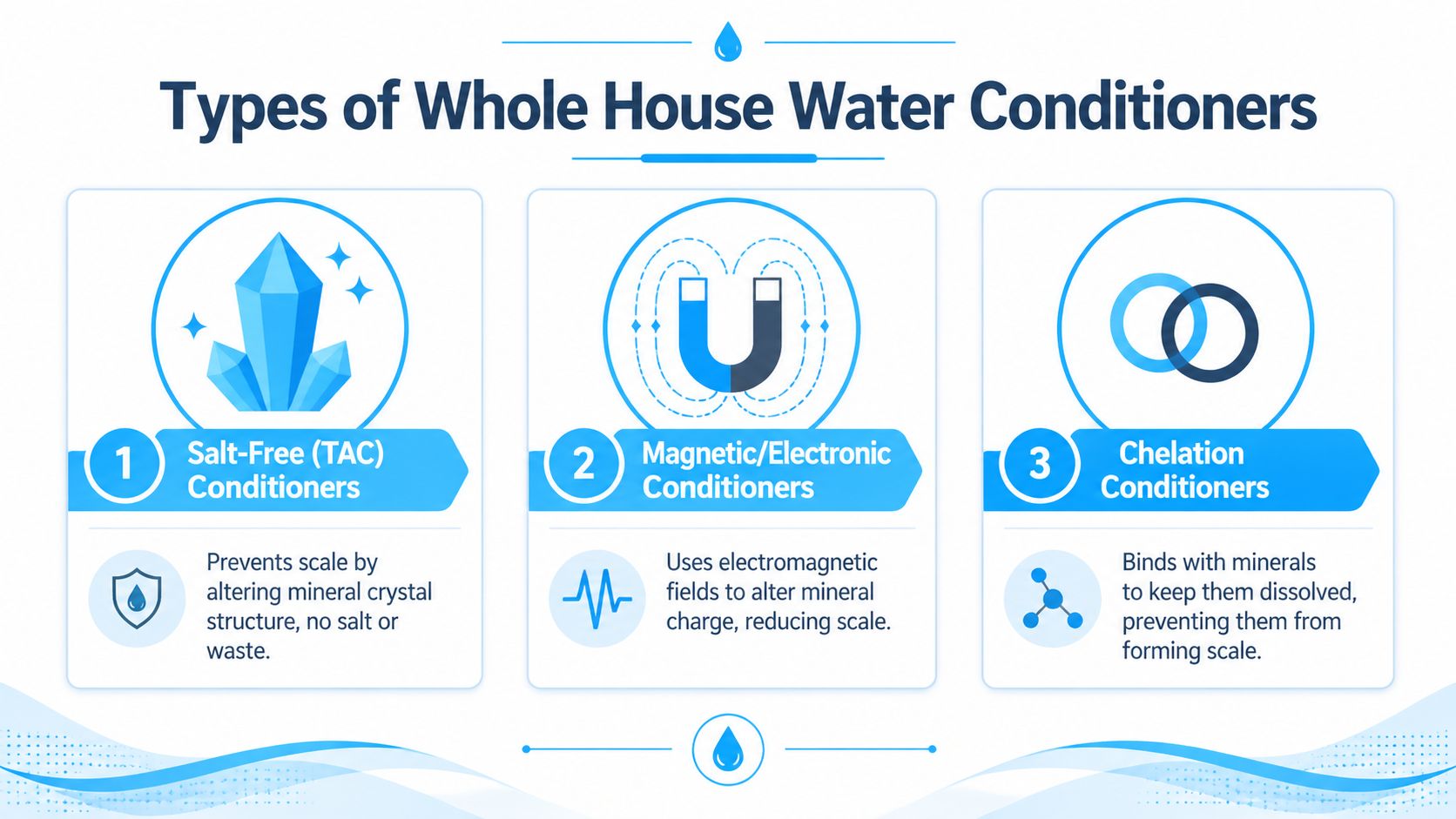
An infographic showing three different types of whole house water conditioners, including salt-free, magnetic, and chelation options.

Salt-free TAC conditioners

These are the systems most homeowners mean when they search for a water conditioner for house use. They rely on media inside a tank to alter how hardness minerals form and deposit.

Their strongest selling point is straightforward. They target scale without salt, drain lines, or regeneration cycles.

In performance tests across 12 homes, salt-free conditioners were 92% effective in scale prevention, while premium salt-based softeners removed up to 98% of hardness minerals, according to water softener performance testing from Quality Water Treatment. That’s the trade-off in one sentence. Conditioners shine at scale prevention. Softeners do a better job if you want actual mineral removal.

Best fit for TAC systems

  • Homes focused on appliance protection
  • Owners who want low routine upkeep
  • People avoiding salt handling
  • Municipal-water homes where hardness is the main headache

Possible frustration points

  • Water won’t feel fully soft
  • Soap may still behave like it does in hard water
  • Spotting can still happen
  • Other contaminants still require separate filtration

Electronic and magnetic descalers

These systems usually mount on or around the pipe rather than using a large treatment tank. They aim to reduce scale formation through electromagnetic influence.

Their biggest advantage is convenience. They’re attractive to people with limited install space or those who don’t want to cut into plumbing as much as a tank system may require.

Their challenge is predictability. Real-world performance can be more dependent on plumbing layout, water characteristics, and proper installation. For homeowners who want the most familiar and established whole-house anti-scale format, tank-style TAC systems often feel less abstract.

Chelation-style conditioners

Some products use chelation concepts, meaning they bind with minerals to keep them dissolved and less likely to form scale. In homeowner conversations, this category gets less attention than TAC or electronic systems, but you may still see it in the market.

The key thing to remember is the same core principle. This is still conditioning, not softening. The goal is scale control, not complete removal of calcium and magnesium.

Why softeners belong in this comparison

A softener is not technically a conditioner, but it belongs in this conversation because it’s the product many people actually need when they think they want one.

If your priority list includes better soap performance, a softer shower feel, or true hardness removal, comparing only conditioners will steer you wrong. You need the contrast.

Water Conditioner and Softener Comparison

System Type How It Works Primary Benefit Removes Minerals? Maintenance Avg. Cost
Salt-Free TAC Conditioner Alters hardness minerals so they are less likely to stick as scale Scale prevention without salt No Low routine upkeep, but media replacement may be needed over time Varies by brand and size
Electronic or Magnetic Conditioner Uses an electromagnetic field to reduce mineral scaling tendency Compact anti-scale option No Usually light routine attention Varies by brand and installation needs
Chelation Conditioner Binds with minerals to keep them from forming scale deposits Scale control in specific applications No Depends on design and any added media stages Varies by brand
Salt-Based Softener Uses ion exchange to remove calcium and magnesium True soft water and hardness removal Yes Regular salt refills and periodic service needs Varies by brand and capacity

A practical way to narrow the field

Ask one question first: Do I want scale control, or do I want soft water?

If the answer is scale control, TAC and similar conditioner options deserve a serious look. If the answer is soft water, stop shopping conditioners and move into softener territory.

The wrong system often comes from answering the wrong question, not from choosing the wrong brand.

Benefits and Realistic Expectations for Your Home

A conditioner can be a smart upgrade. It can also disappoint people who expect it to behave like a softener. Both things are true.

The primary value of a water conditioner for house use is mostly about protection. You’re trying to reduce scale trouble where water flows, heats, sprays, and dries.

What homeowners often like

A well-matched conditioner can help with the kinds of day-to-day annoyances that make a house feel older than it is.

  • Less scale buildup on fixtures means less scrubbing around faucets and showerheads.
  • Appliance protection can matter for water heaters, dishwashers, and other equipment that hates mineral crust.
  • Lower-maintenance operation appeals to homeowners who don’t want regular salt refills.
  • No salt discharge is attractive for people focused on simpler, more environmentally conscious operation.

For many homes, that’s enough. If your biggest complaint is “I’m tired of cleaning white crust off everything,” a conditioner may solve the right problem.

What it probably won’t do

Here, honesty matters.

A conditioner usually won’t give you that slippery soft-water feel after a shower. It may not make soap lather dramatically better. It also won’t replace a carbon filter if your water smells chlorinated or tastes strange.

That’s why some homeowners love conditioners and others think they bought a dud. They were measuring success by completely different standards.

Buy a conditioner for scale prevention. Buy a softener for soft water. Buy a filter for contaminants.

Don’t ignore long-term ownership

Some salt-free systems are marketed as “maintenance-free” and may have lifespans up to 10 years, but long-term cost still matters. You may need pre-filters, post-filters, replacement media cartridges after the initial lifespan, or in some cases an entire unit replacement, as noted by APEC’s salt-free water conditioner overview.

That doesn’t mean conditioners are a bad deal. It means “no salt” is not the same as “no future cost.”

The honest homeowner test

A conditioner is a strong candidate if you’re saying:

  • “I want less scale on appliances and fixtures.”
  • “I don’t need the feel of softened water.”
  • “I want a simpler whole-house setup.”

It’s the wrong fit if you’re saying:

  • “I want my skin and hair to feel different.”
  • “I want soap to work better.”
  • “I want the water to test soft.”

Sizing Installing and Maintaining Your System

At this stage, a lot of promising systems go sideways. Homeowners spend weeks comparing technologies, then undersize the unit, install it in the wrong place, or forget about maintenance until performance slips.

A water conditioner for house use works best when it matches your plumbing reality, not just your online wish list.
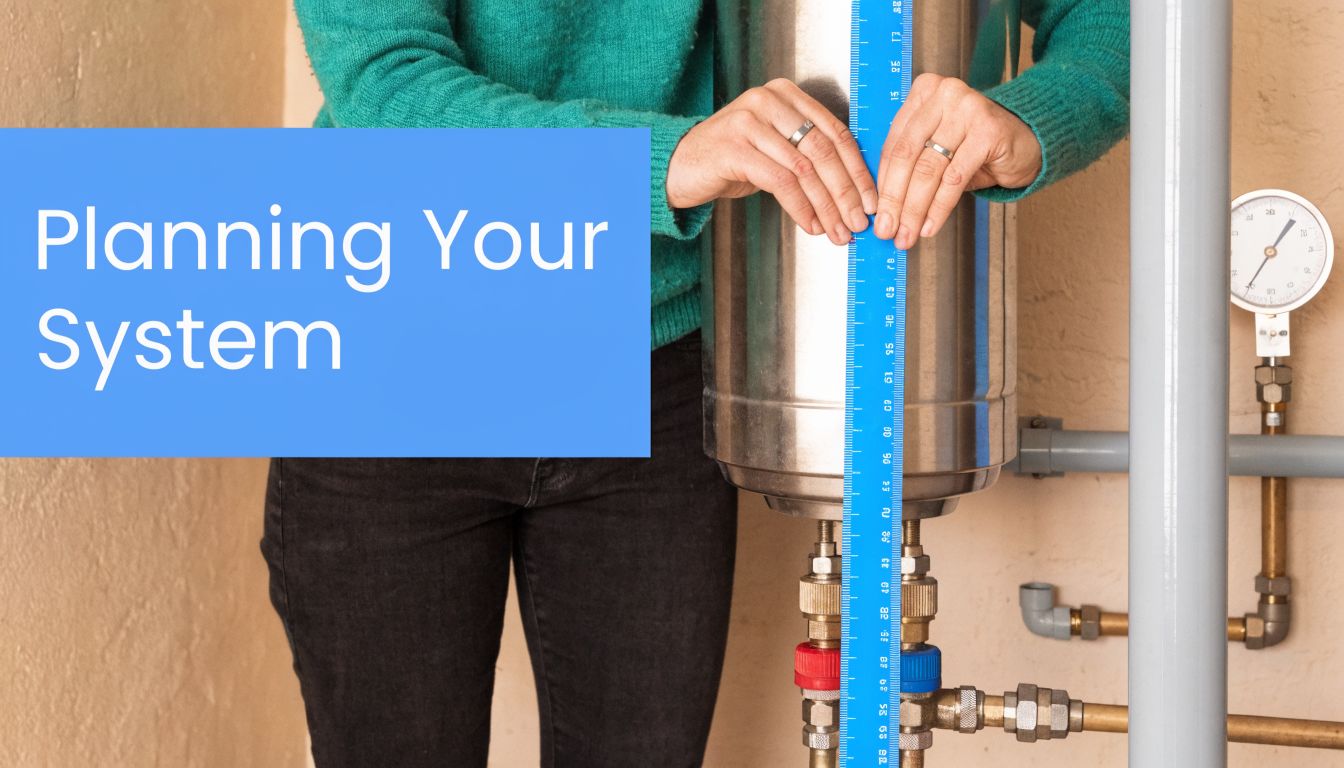
A person measures a vertical stainless steel water treatment tank with a blue ruler for system planning.

Start with hardness and flow

If you’re sizing a traditional salt-based softener, the benchmark formula is (# people × 82 gal/day × GPG) × 3. For a 4-person home at 10 GPG, that points to a 32,000-grain unit. For salt-free conditioners, the bigger issue is matching the system to your home’s peak flow rate, with 8 to 12 GPM being important for a 1 to 3 bath home, according to the U.S. Department of Energy’s guide to purchasing and maintaining a water softener.

That distinction matters. Softeners are usually discussed in grain capacity. Conditioners are more often selected by flow handling and plumbing fit.

A simple sizing routine

Use this order when planning:

  1. Check your water hardness
    Municipal users can review their local report or test at home. Well owners should test directly.

  2. Count simultaneous water use
    Think about what happens during busy hours. Two showers, a washing machine, and a dishwasher can push demand fast.

  3. Match the conditioner to real flow needs
    A unit that looks fine on paper can feel disappointing if it restricts flow during peak use.

  4. Look at install space
    Measure width, height, and service clearance before you buy.

Field advice: The prettiest system in the catalog is useless if you can’t service it comfortably after installation.

DIY or plumber

Some electronic units are friendly to confident DIY homeowners. Tank-based systems often require more planning because they become part of the main water line.

DIY can make sense if you already know how to:

  • Shut down and drain your main line
  • Cut and reconnect plumbing cleanly
  • Add bypass valves if needed
  • Support the unit securely and keep access open

Hire a plumber when:

  • Your plumbing layout is tight or awkward
  • You’re mixing a conditioner with pre-filtration
  • You need to preserve warranty compliance
  • You’re working with older pipe materials
  • You’re unsure where the unit should sit relative to shutoffs and other equipment

If you’re sourcing parts locally in the UK, these London plumbing shop recommendations can help you find fittings, valves, and install supplies without guessing.

Maintenance is still part of the deal

Conditioners often need less attention than softeners, but “less” doesn’t mean “none.”

A sensible maintenance plan includes:

  • Inspecting the unit periodically for leaks, loose fittings, or bypass issues
  • Replacing media when the manufacturer recommends if you have a TAC-style system
  • Checking any pre-filter stage if your setup includes one
  • Reviewing performance signs like renewed scaling around fixtures or appliances
  • Keeping your water records handy so future troubleshooting is easier

For broader homeowner troubleshooting and maintenance reading, the practical guides in the Water Filter Advisor advice center are useful when you’re comparing system layouts and upkeep demands.

Your Decision Checklist Before You Buy

You don’t need to memorize every water-treatment term to choose well. You just need to answer the right questions in the right order.

The five-point checklist

  • Test your water first
    Don’t buy based on guesswork. Hardness level shapes the whole decision.

  • Name your real goal
    If you want to stop scale, a conditioner may work. If you want the feel and performance of soft water, shop for a softener instead.

  • Think beyond purchase price
    Look at future media changes, filter replacements, service access, and any plumber costs.

  • Check your space and plumbing setup
    Measure the install area and think about bypass valves, shutoff access, and whether you may add filtration later.

  • Match the technology to the problem
    Conditioner for scale behavior. Softener for mineral removal. Filter for contaminants.

Two questions that settle most decisions

Ask yourself these and the answer often becomes obvious:

  1. Do I care more about how the water feels, or what it leaves behind?
  2. Am I solving hardness, contamination, or both?

If you care more about shower feel, soap performance, and soft water, a conditioner won’t scratch that itch. If you mostly want to protect fixtures and appliances from mineral crust without dealing with salt, a conditioner may be exactly right.

The best system is the one that solves your actual complaint, not the one with the most impressive label.

Frequently Asked Questions about Water Conditioners

Will a water conditioner help my skin and hair

Sometimes a little, but usually not in the same way a softener does.

A conditioner may reduce some scale-related effects in the plumbing system, but it doesn’t remove hardness minerals from the water. Because of that, many people won’t notice the same change in shower feel, soap rinsing, or hair texture that softened water can provide. If skin and hair comfort is your top priority, a softener is usually the closer match.

Does a water conditioner filter chlorine lead or sediment

No, not by default.

A conditioner’s job is to reduce hardness-related scaling behavior. That’s different from filtration. If you’re worried about chlorine taste, odor, sediment, lead, iron, or other contaminants, you need a filter designed for those specific issues. Many homes benefit from combining technologies rather than asking one device to do everything.

Are electronic descalers real or just hype

They’re real products, but they require careful expectations.

Some homeowners choose them because they’re compact and easier to install than tank-based systems. Their performance can be more dependent on installation quality, water characteristics, and application details. If you want the clearest and most familiar whole-house anti-scale approach, tank-style salt-free conditioners often feel easier to evaluate.

Will a conditioner make my water test soft

No.

That’s one of the most important points in this whole topic. Conditioners don’t remove the calcium and magnesium the way a softener does, so hardness tests usually still show those minerals are present. The aim is not to erase hardness from the water. The aim is to make those minerals less likely to form scale on surfaces.

Is a conditioner enough for well water

Sometimes, but well water often needs a closer look.

Well water can bring hardness together with sediment, iron, sulfur, or other issues. In those cases, a conditioner may be only one part of the final setup. Many well owners need pre-treatment or targeted filtration before adding any anti-scale equipment.

What’s the safest way to avoid buying the wrong system

Get a water test and write down your top complaint in one sentence.

If your sentence starts with “I want water to feel soft,” buy with that goal in mind. If it starts with “I want less scale,” a water conditioner for house use deserves a serious look.


If you’re comparing whole-house systems and want clear, no-hype guidance, Water Filter Advisor is a strong place to keep researching. The site helps homeowners sort out water filters, softeners, conditioners, testing, and maintenance so you can choose a setup that fits your water and your home.

Water Descaler vs Softener: The Ultimate Home Filtration Showdown

So, you're standing at the crossroads of home water treatment, staring down the epic battle of water descaler vs softener. Let's cut through the noise. It all boils down to this: a classic softener yanks out those pesky hard minerals, while a descaler gives them a stern talking-to so they behave and don't wreck your plumbing. Softeners give you that famous silky-smooth water, but descalers are the "set it and forget it" heroes, protecting your pipes and appliances without the drama.

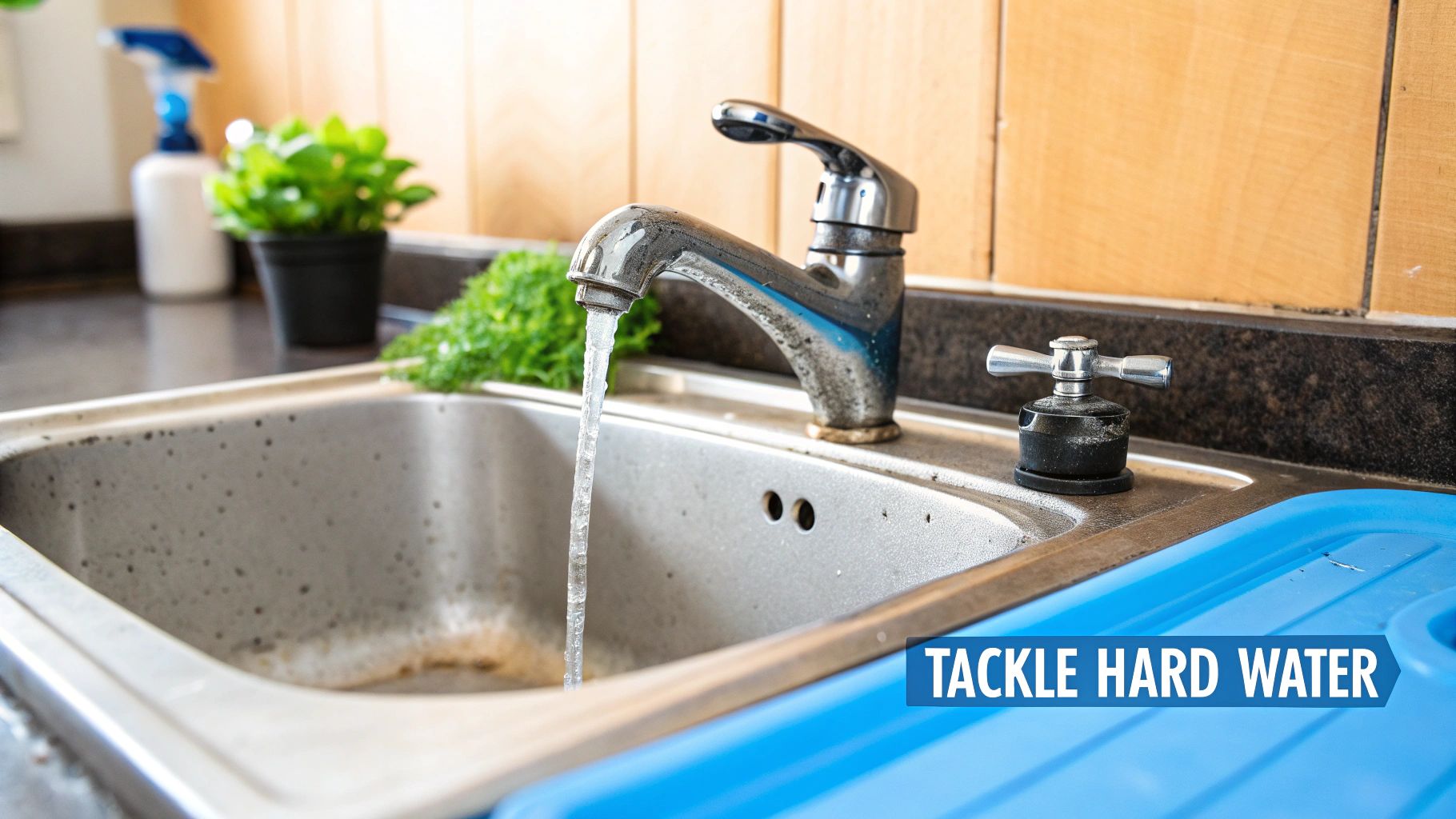
Tackling the Hard Water Villain in Your Home

A close-up of a kitchen sink faucet with running water, showing visible hard water stains.

Hard water is the quiet saboteur of the home. It leaves its calling card everywhere—that crusty white film on faucets, soap scum that just won't quit, and appliances that mysteriously die years before their time. The culprits are simple: water that’s jam-packed with dissolved minerals, mainly calcium and magnesium. They’re like uninvited houseguests that refuse to leave.

While these minerals won't hurt you to drink, they're the building blocks of limescale. That stubborn, rock-like gunk is what clogs your plumbing and strangles your water heater, forcing it to work way harder than it should. To fight back, homeowners have two main weapons in their home filtration arsenal: old-school water softeners and their clever, modern cousins, water descalers.

The Scale of the Problem

Getting a handle on hard water isn't just about sparkling faucets; it’s a big deal with real financial consequences. A mind-boggling 85% of American homes have hard water, making the quest for perfect home water filtration a national pastime.

That limescale can slash the lifespan of your pipes by 2-3 years and jack up your home's energy use by 15-25%. It's no wonder the global market for these treatment systems is expected to hit USD 25.5 billion by 2035.

Descaler vs Softener: A Quick Comparison

Nailing the core difference between these two systems is your first mission. While this guide is all about preventing scale from ever forming, you might also need some effective methods for cleaning hard water stains that have already taken hold.

Here’s a quick tale of the tape.

Feature Comparison Water Descaler (Conditioner) Water Softener (Ion Exchange)
Primary Function Alters mineral structure to prevent scale Physically removes hard minerals
Water Feel Unchanged; no "slippery" feel Silky, "soft" feel
Maintenance None; set it and forget it Requires regular salt refills
Environmental Impact Eco-friendly; no salt or wastewater Creates brine discharge (wastewater)
Best For Scale prevention with minimal upkeep Eliminating all hard water symptoms

The Science Behind Each Water Filtration Method

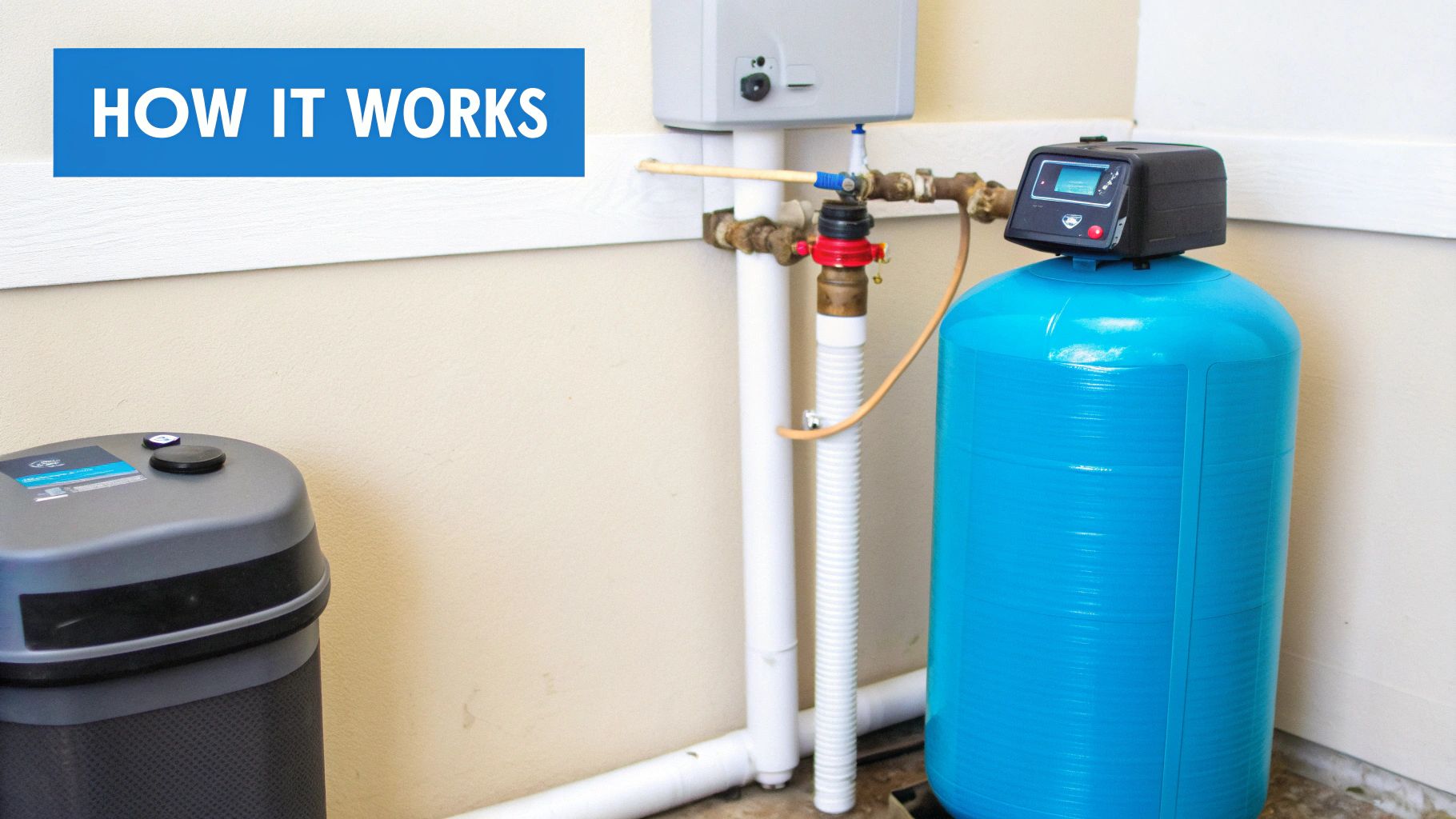
A water treatment system with a blue tank, control head, pipes, and a gray unit, illustrating 'How It Works'.

When you're trying to solve the "water descaler vs softener" puzzle, you have to get past the sales hype and look at the science. Both systems aim to stop the carnage caused by hard water minerals, but they go about it in completely different ways.

Think of it like this: one is a burly bouncer at a club, physically throwing the troublemakers (calcium and magnesium) out onto the street. The other is more like a wise diplomat, changing their behavior so they don't cause any problems in the first place.

This fundamental difference changes everything—from how your shampoo lathers up to how much work you have to put in and its impact on the planet. Let's lift the hood and see how these home filtration wizards really work.

How Traditional Water Softeners Work: The Ion Exchange Swap

A classic water softener uses a process that’s been the heavyweight champion for decades: ion exchange. This is a chemical magic trick that physically snatches the hardness minerals right out of your water. It’s like a super-specific net that only catches calcium and magnesium.

Inside the main tank is a bed of tiny resin beads loaded with a negative charge. Before you even flip the switch, these beads are covered in "soft" sodium ions. As your hard water flows through, the party starts. The positively charged calcium and magnesium ions are drawn to the negatively charged beads like moths to a flame.

This attraction is so powerful that the hardness minerals literally kick the sodium ions off the beads and take their place. The now-homeless sodium ions flow out with your water, giving you chemically "soft" water all over the house.

The key takeaway: a softener actually changes the chemical recipe of your water. It’s not just stopping scale—it’s creating brand-new water that’s free from the minerals that made it hard in the first place.

This cycle continues until the resin beads are completely saturated with hardness minerals. At that point, the system has to "regenerate." This is just a fancy term for a cleaning cycle where a super-salty solution (brine) from a second tank floods the resin. The rush of sodium ions from the brine pries the trapped calcium and magnesium off, flushing them down the drain. The resin beads are then recharged with fresh sodium, ready for another round.

How Water Descalers Work: The Conditioning Approach

Water descalers—also called water conditioners—take a completely different, almost zen-like approach. Instead of removing the minerals, they change their physical structure to stop them from forming scale. It's a physical transformation, not a chemical one.

There are a few descaler technologies out there, but one of the most proven is Template Assisted Crystallization (TAC). This method uses special media that acts as a template, or a pattern, for the minerals to grow on.

When hard water passes over this media, the calcium and magnesium ions team up and form tiny, harmless "seed crystals." These microscopic crystals are stable and just don't stick to anything—not your pipes, your water heater, or your showerhead.

Here’s what that means for your home:

  • Minerals Stay Put: The beneficial minerals, calcium and magnesium, are still in your water. You just don't have to deal with the scale.
  • Scale Is Prevented: The little crystals just float harmlessly through your plumbing and go right down the drain.
  • No Salt, No Waste: Because nothing is being removed or flushed out, these systems don't need salt and don't create any wastewater.

You might also see electronic or magnetic descalers, which use electric fields or magnets to get a similar result by agitating the minerals so they can't stick together. No matter the tech, the goal is the same: manage the minerals to stop scale without actually taking them out. This is also why you won't get that slick, "slippery" feeling from a descaler that you get with soft water.

Water Descalers vs. Water Softeners: The Showdown

This is where the rubber meets the road. Deciding between a water descaler and a water softener boils down to one question: do you want to manage the hard minerals, or completely eradicate them?

Each path offers a totally different experience for your home and lifestyle. It’s not just a plumbing decision; it affects your morning shower, your monthly bills, and how you maintain your home. The real question is what you value more—getting rid of every single trace of hardness, or a maintenance-free, eco-friendly way to protect your plumbing.

Scale Prevention Effectiveness

Let's be clear: the number one job for both is stopping limescale. A water softener wins with brute force. By yanking calcium and magnesium out of the water, there’s literally nothing left to form scale. It's a time-tested method that’s incredibly effective, especially if your water is rock-hard (think 10 grains per gallon or more).

Water descalers, specifically the Template Assisted Crystallization (TAC) types, are also shockingly good at this. They don't remove minerals but instead change them into microscopic crystals that can't stick to surfaces. Independent studies show these systems can prevent over 95% of scale buildup, putting them in the same league as softeners. The only catch? Electronic or magnetic descalers are a bit of a wild card; their results can be all over the place.

If your water hardness is off the charts, a softener offers a knockout punch. For more moderate hardness, a quality TAC descaler delivers nearly identical scale prevention without messing with your water's chemistry.

Impact on Water Feel and Taste

Here’s where you’ll notice the biggest daily difference. A water softener gives you that distinctively "soft," almost slippery water. Because the hard minerals are gone, soap lathers up like a bubble machine, leaving your skin feeling silky. Some people love it. Others feel like they can never rinse the soap off. Softened water also picks up a slightly salty taste from the ion exchange process, which can be a dealbreaker if you're watching your sodium.

A water descaler, on the other hand, leaves your water completely alone. The minerals are still in there, so you get no change in how your water feels or tastes. It's the same water you've always had, just without the scale-forming downside. You won't get that slippery feeling or mountains of lather. If your only mission is to protect your plumbing and you like your water as-is, a descaler is a perfect match.

Unpacking Maintenance Demands

The long-term ownership experience is a huge factor. A water softener is a bit needy and requires consistent, hands-on attention.

  • Lugging Salt: Get ready to buy and haul heavy bags of salt, usually 40 lbs a pop, to refill the brine tank every month or so.
  • Regeneration Cycles: The system has to clean itself regularly with a brine solution, using up both water and electricity.
  • Tank Cleaning: Every so often, you'll have to clean out the brine tank to prevent "salt bridges" that can shut the whole system down.

A water descaler is the complete opposite. It's the definition of a "set it and forget it" appliance. Once it's installed, you’re done. There's no salt to buy, no wastewater, and most models don't even use electricity. That zero-maintenance reality is a massive perk for anyone who wants a simple, hassle-free filtration solution.

The True Cost of Ownership

When you’re budgeting for home filtration, you have to look past the sticker price. A good descaler and a softener might have similar upfront costs, but their long-term expenses are worlds apart.

To give you a clearer picture, here’s a quick breakdown of how they stack up over time.

Key Differences At a Glance: Descaler vs Softener

Feature Water Descaler (Conditioner) Water Softener (Ion Exchange)
How It Works Alters mineral structure to prevent scale Removes hardness minerals via ion exchange
Scale Prevention Highly effective (TAC models) Extremely effective, total removal
Water Feel No change, feels "hard" "Soft" and silky, sometimes slippery
Maintenance Virtually none ("set and forget") Requires regular salt refills & cleaning
Ongoing Costs None (media may need replacing every 3-5 yrs) Salt, water, and electricity for regeneration
Environmental Impact Eco-friendly, no waste Creates salt-heavy brine discharge
Best For Moderate hardness, eco-conscious homeowners Very hard water, those wanting "soft" water feel

The lifetime cost of a water softener adds up. You're looking at hundreds of dollars a year just for salt, not to mention higher water and electricity bills. A softener can easily waste an extra 25 gallons of water per day—or 3,000 gallons per year—just on regeneration. Over the 10-15 year life of the unit, that's a significant expense. A descaler’s only potential future cost is new TAC media every 3-5 years.

The market shows where people's priorities are. Salt-based water softeners still dominate, holding a whopping 74.18% of the global market share because they are a proven, reliable workhorse. But there's a shift happening. Salt-free systems are projected to have the fastest growth through 2030, a clear sign that homeowners are looking for more sustainable ways to filter their water. You can dig into these trends in recent industry reports on water treatment markets.

How to Choose the Right Filtration System for Your Home

Navigating the water descaler vs softener debate can feel like a chore, but picking the right system for your house is probably easier than you think. It really just boils down to what's in your water, your lifestyle, and what you expect your water filtration system to do.

This isn't about finding the single "best" system. It's about finding the one that’s a perfect match for your specific hard water woes.

The first question to ask yourself is this: are you trying to completely transform how your water feels and behaves, or are you just looking to protect your pipes and appliances from that crusty, destructive limescale? Once you know that, you're halfway there.

Start with a Simple Water Test

Before you even think about shopping, your absolute first step should be to test your water. You can't fight an enemy you don't understand. A water test gives you the hard data you need, telling you your water's hardness level, measured in grains per gallon (GPG).

That one number is your treasure map. It immediately tells you which systems are good options and which would be a waste of money. Without it, you're just guessing.

  • Under 3 GPG: This is soft or just slightly hard water. You can probably skip any treatment.
  • 3-7 GPG: Moderately hard. This is the sweet spot where a quality water descaler really shines.
  • 7-10 GPG: Hard water. At this level, both systems are contenders, and your choice will come down to personal preference.
  • Over 10 GPG: Very hard water. For this level of mineral assault, a traditional salt-based water softener is almost always your best bet.

You can get this info from a simple home test kit or send a sample to a lab. Once you know your GPG, the path forward becomes much clearer.

Scenarios When a Water Softener Is the Clear Winner

A water softener is the right call when your goal is to wipe out all the annoying effects of hard water, not just prevent scale. It works by physically removing the problem minerals, which fundamentally changes your water.

You should be leaning toward a water softener if:

  • Your Water Hardness Is Over 10 GPG. When you're dealing with very hard water, a softener's mineral-removing power offers the most complete protection.
  • You Want That "Soft Water" Feel. If you're after silky-smooth skin, brighter clothes, and soap that lathers like crazy, only a softener can deliver.
  • You Have High Iron Content. Many softeners are also great at removing ferrous iron, the culprit behind those ugly rust stains in your sinks and toilets.

A water softener is an investment in total comfort and mineral removal. It’s the definitive solution for anyone fed up with every single symptom of hard water and willing to do a bit of maintenance to get rid of them for good.

Situations Where a Water Descaler Is Superior

A water descaler is the perfect solution for homeowners focused on preventing scale in an eco-friendly, zero-maintenance way without changing the water itself. It's a modern, set-it-and-forget-it approach to filtration.

A descaler is the better choice for you if:

  • Your Water Hardness Is Moderate (3-7 GPG). Descalers are highly effective in this range, stopping scale buildup before it starts without needing salt or chemicals.
  • You're Watching Your Sodium Intake. Since descalers don't add anything to the water, they're the ideal choice for anyone on a sodium-restricted diet.
  • You Want an Eco-Friendly, No-Fuss System. With no salt bags to haul, no wastewater, and often no electricity, descalers are the ultimate hands-off home filtration solution.

And the market is showing a clear preference for these sustainable options. The global water descaler market was recently valued at $2.1 billion and is projected to hit $3.9 billion by 2034. This huge growth shows that for many people, descalers are a compelling alternative that avoids the hassle of salt, making them a great fit for renters and environmentally conscious families.

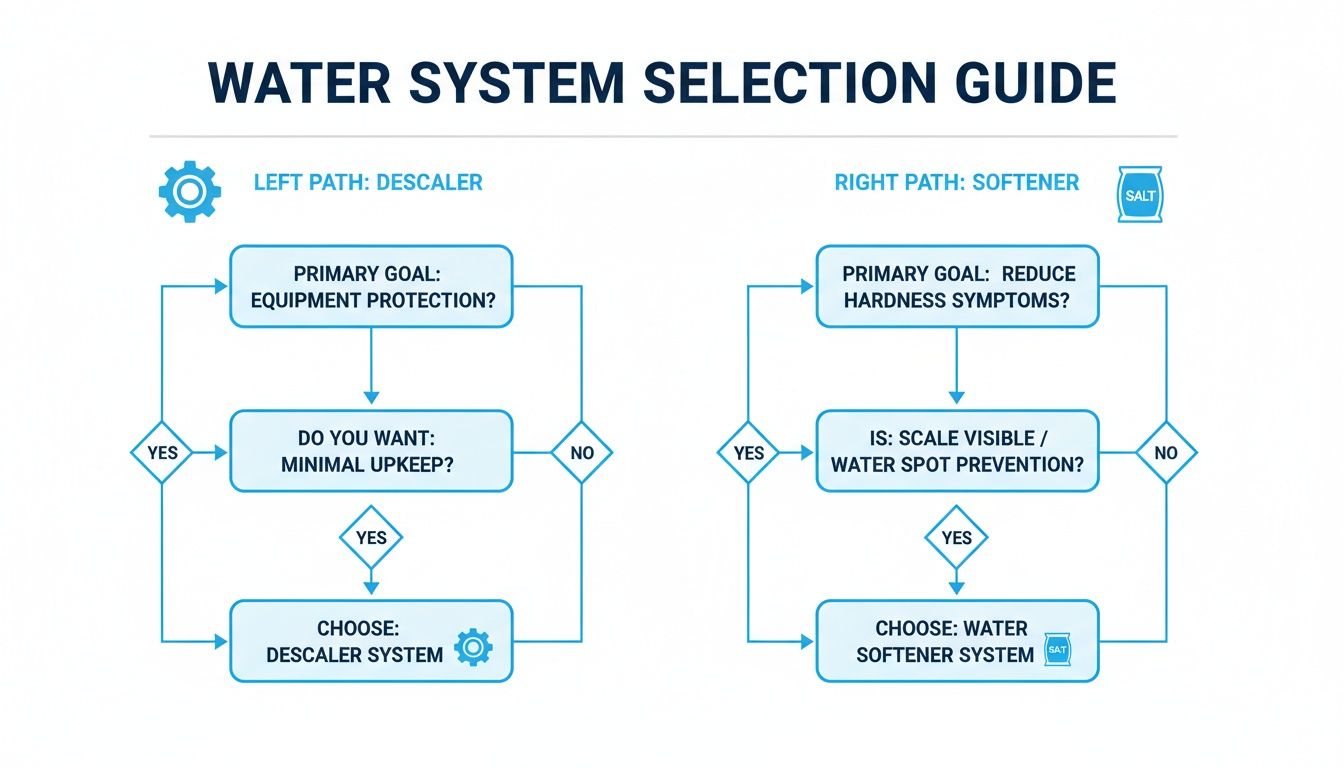
This handy flowchart breaks down the decision. You've got the descaler on the left for low-maintenance scale prevention, and the softener on the right for complete mineral removal.

Flowchart guiding the choice between a descaler and water softener for home water systems.

As the chart shows, it really comes down to your water hardness and personal priorities—like how much maintenance you're willing to do. If you're looking for more detailed guidance on different types of home water systems, you can find a lot more information at https://www.waterfilteradvisor.com/advice/.

Installation, Maintenance, and What It Really Costs to Own

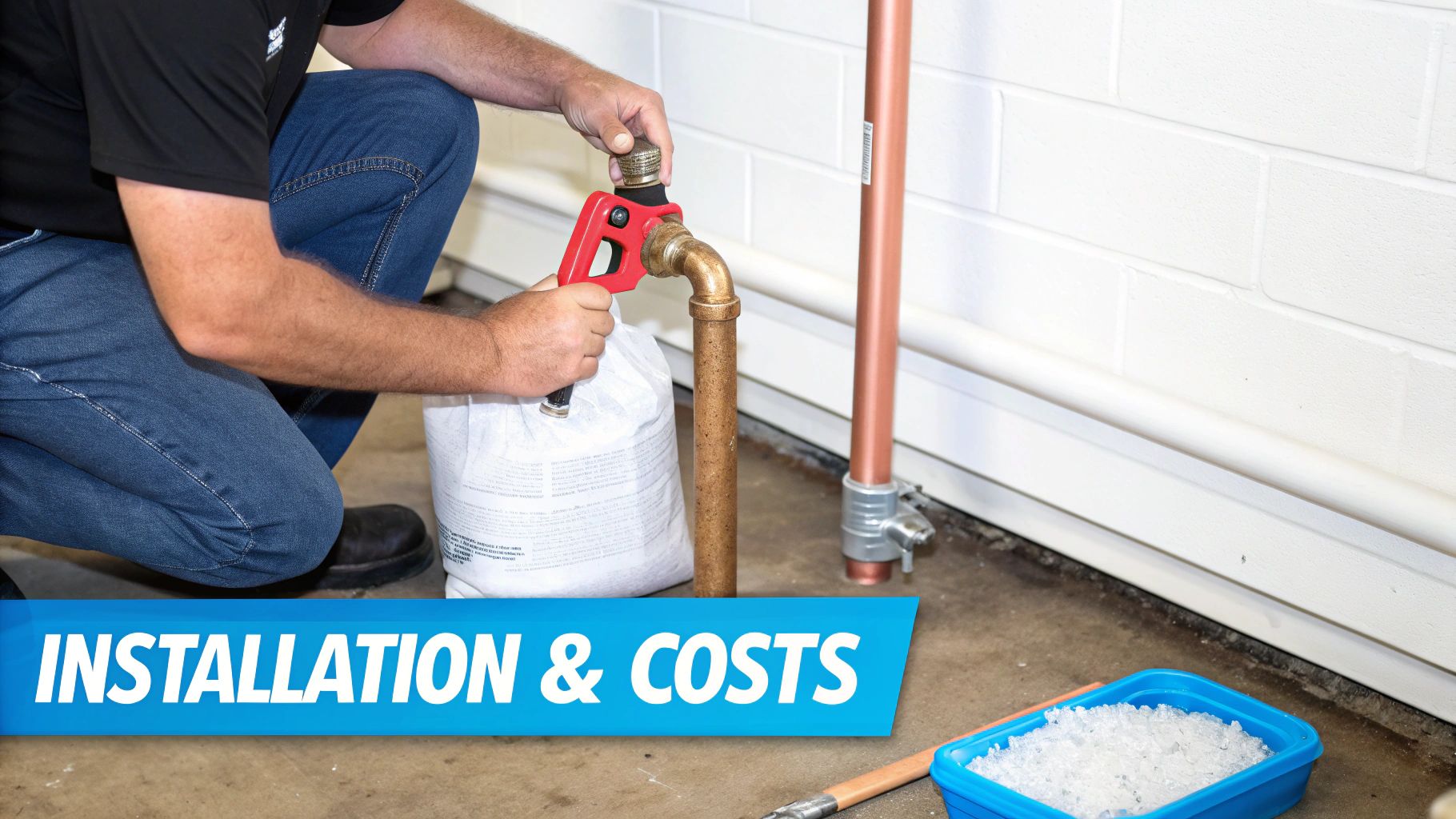
A person's hands installing a water treatment device on a brass pipe with a red tool.

When you’re weighing a water descaler vs. a softener, the differences go way beyond how they filter your water. The day-to-day reality of owning one—from setup to upkeep—is a completely different story. Nailing these practical details is key to picking a system you’ll love for years to come.

The initial setup can set the tone. A water softener, for example, is a much bigger job right from the start. It has to be plumbed directly into your home's main water line.

This means a plumber will be cutting pipes, soldering fittings, and running a new drain line for the salty discharge from its regeneration cycles. For most people, this isn't a simple weekend DIY project. If you're leaning toward a softener, getting familiar with the process of water softener installation and repair is a smart move to avoid headaches.

The Simplicity of Descaler Installation

Water descalers, especially the electronic kind, are the complete opposite when it comes to installation. Most of them are designed for an easy DIY setup.

Instead of serious plumbing work, you just wrap some wires or clamp the device onto the outside of your main water pipe. No cutting, no draining, no plumber. This makes them a fantastic fit for renters or anyone who doesn't want to make major changes to their plumbing.

Maintenance: A Tale of Two Systems

The real split between these two systems becomes clear with ongoing maintenance. A water softener needs your constant attention to keep working right. The biggest chore is keeping that brine tank full of salt.

This involves:

  • Constant Salt Runs: You'll be buying heavy, 40-pound bags of salt on a regular basis.
  • Heavy Lifting: Then you have to lug those bags from the store to wherever your softener is located.
  • System Check-ups: You also need to watch out for "salt bridges," which are hard crusts that can form in the tank and stop the whole system from working.

A water descaler, by comparison, is the definition of a "set it and forget it" device. Once it's installed, you're pretty much done.

With a water descaler, you can cross salt bags, tank refills, and system checks off your to-do list for good. This zero-maintenance design is a huge win for homeowners who just want a simple, hassle-free filtration solution.

Calculating the True Cost of Ownership

The sticker price is just the beginning. To get the full financial picture, you have to look at all the ongoing costs over the system's life. A water softener's expenses keep coming long after you've paid for the unit.

Your long-term softener budget needs to account for:

  • Salt: This is the most obvious recurring cost, which can easily run you $100-$300 per year, depending on your water hardness and family size.
  • Water: The regeneration process flushes thousands of gallons of water down the drain each year, which you'll see on your utility bill.
  • Electricity: The system’s control valve and timer are always on, using electricity 24/7.

A water descaler, on the other hand, has almost no running costs. Electronic models use a tiny amount of power, and TAC systems might need a media change every three to five years. But even that is minor compared to the constant cash outlay for a softener, making the descaler a much more predictable and often cheaper choice over its lifetime.

Your Top Questions About Home Water Filtration, Answered

Jumping into the world of water filtration can feel a little overwhelming. When you're stuck between a water descaler and a softener, it’s easy to get lost in the jargon. Let’s clear up the most common questions so you can make a choice you feel great about.

Will a Water Descaler Make My Water Feel Silky and Soft?

Nope, and this is probably the biggest point of confusion in the water descaler vs softener conversation. A descaler won't change how your water feels one bit. You won’t get that classic "slippery" feeling in the shower that’s a dead giveaway of softened water.

That’s because descalers are designed to leave beneficial minerals like calcium and magnesium right where they are. All they do is alter the minerals to stop them from sticking to your pipes as ugly scale buildup. Think of it as a scale prevention device, not a water-feel-changer.

Can I Use a Descaler if I Have Seriously Hard Water?

While descalers are great for moderately hard water, a traditional salt-based softener is almost always the smarter move for very hard water—we're talking anything over 10 grains per gallon (GPG). The same advice holds true if your water has a high iron content.

Softeners are just plain stronger in these tough situations because they physically yank the problem-causing minerals out of the water entirely. This gives your plumbing and expensive appliances far more reliable protection when mineral levels are off the charts.

If your water test comes back in the double digits for hardness, a water softener offers the most complete and effective fix for the long haul. A descaler might not be able to keep up, leaving your home at risk.

Do Water Softeners Add a Ton of Sodium to My Diet?

This is a really common worry, but the amount of sodium a softener adds is usually much smaller than you'd think. The exact amount is tied to how hard your water is—the harder it is, the more sodium is exchanged.

For most people, a full glass of softened water contains less sodium than a single slice of white bread. That said, if you're on a strict, doctor-ordered low-sodium diet, a descaler is the safer choice. Another popular option is to install a reverse osmosis filtration system for your drinking water after the softener, giving you the best of both worlds.

Are All Water Descalers Created Equal?

Definitely not. The performance of water descalers varies wildly depending on the technology inside.

  • Template Assisted Crystallization (TAC): These systems have solid, third-party data to back them up, often preventing over 95% of scale. They're widely seen as the most dependable salt-free option.
  • Electronic and Magnetic Descalers: The results from these gadgets are a lot more debated. Their performance can be hit-or-miss, often depending on your specific water chemistry, pipe material, and water flow rate.

If you’re leaning toward a descaler, looking for one that uses TAC technology is your best bet for results you can actually count on.


Ready to find the perfect water filtration solution for your home? Water Filter Advisor provides expert reviews and in-depth guides to help you compare the best systems on the market. Explore our resources and make a confident choice at https://www.waterfilteradvisor.com.