How to Filter and Remove Fluoride from Your Water: A Homeowner’s Guide

Yes, the right filter can remove fluoride from your water, but here's the catch: your standard fridge filter or that basic pitcher in your kitchen probably won't cut it. To actually pull fluoride out, you need a system with technology specifically designed to capture tiny dissolved minerals like fluoride ions. Think of it as needing a specialist, not a general practitioner.

Your Quick Guide to Fluoride Filtration Methods

So, you're on a quest for the best way to remove fluoride from your home's drinking water? Fantastic! You've come to the right place. Most of us are familiar with filters that make water taste better by getting rid of chlorine, but taking out fluoride is a whole different ballgame. It's like going from playing checkers to playing chess.

The fluoride ion is incredibly small, which means it can zip right through the pores of a typical activated carbon filter. Imagine trying to catch sand with a fishing net—it just doesn't work. You need a much finer, more specialized tool for the job. Fortunately, several proven technologies are up to the task, each with its own clever approach.
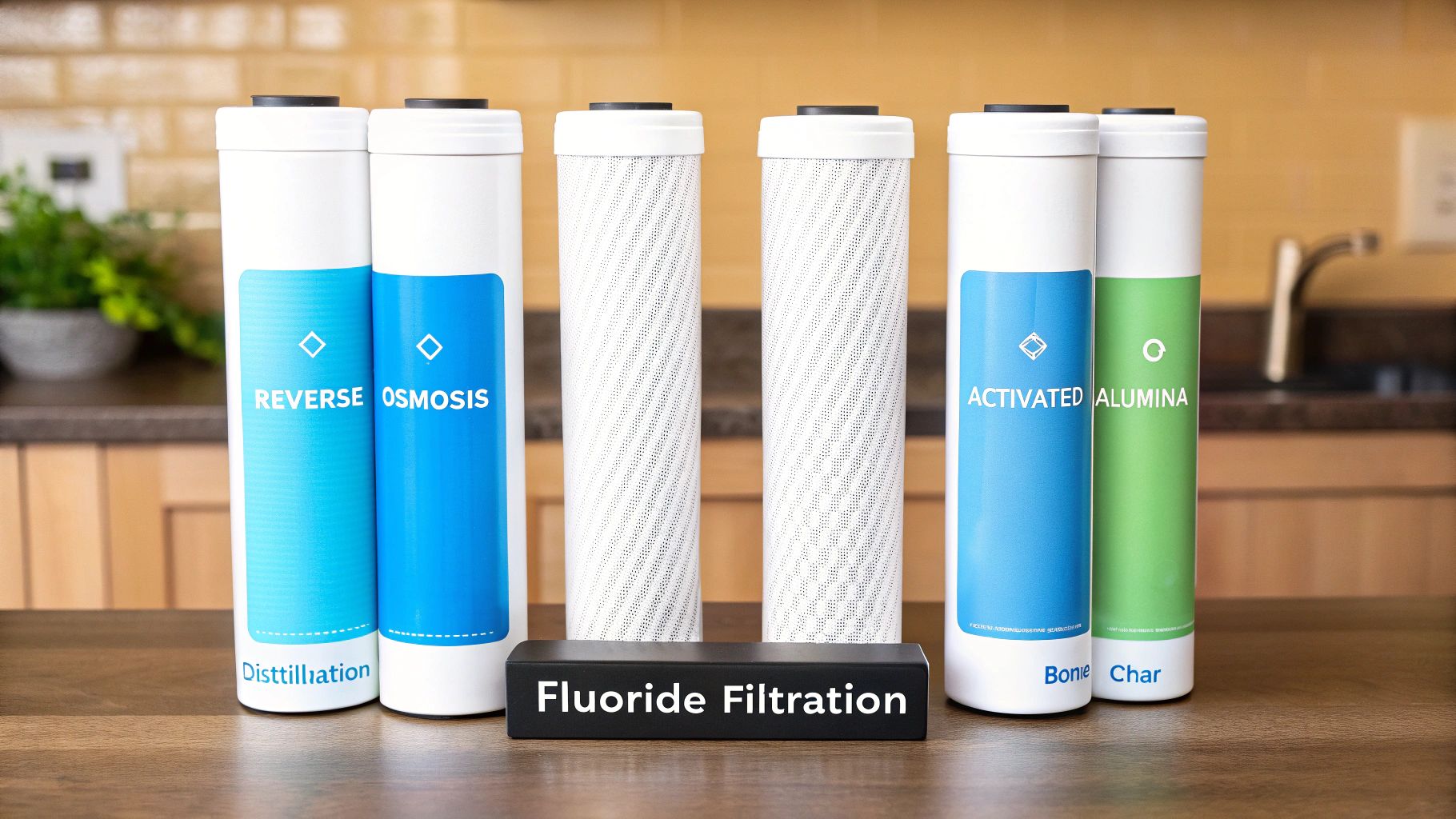
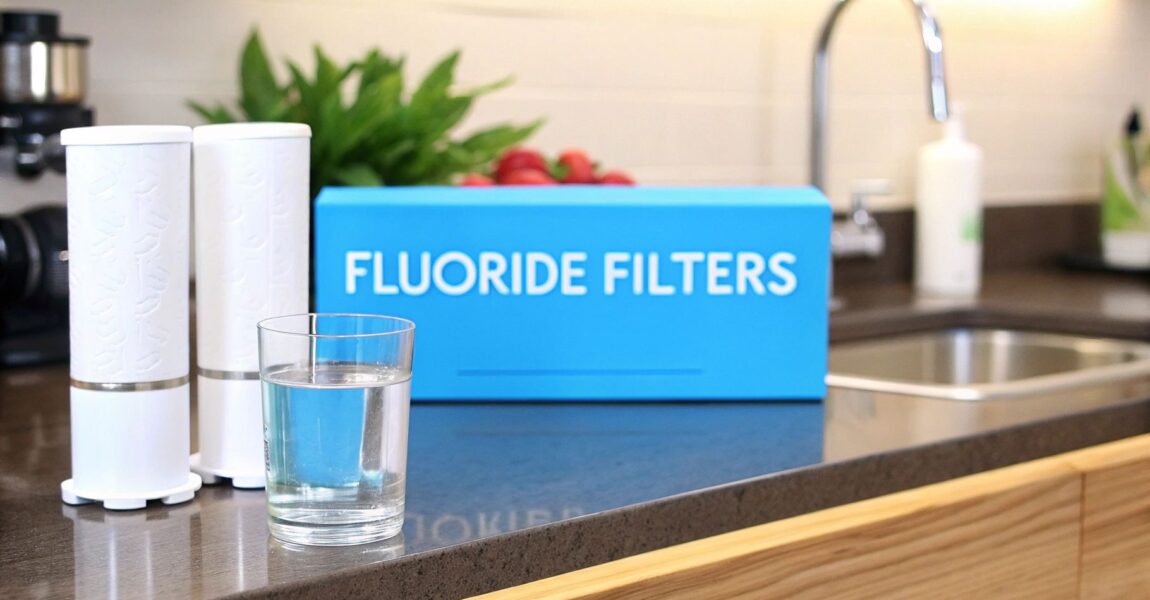
A collection of water filtration systems, including reverse osmosis and bone char, labeled for fluoride removal.

The Four Main Technologies That Work

For homeowners serious about removing fluoride, it really boils down to four main technologies. Each one uses a different scientific principle to separate fluoride from your water, almost like a magic trick happening right under your sink.

  • Reverse Osmosis (RO): This is the heavy hitter of water purification. An RO system uses high pressure to push water through a special membrane with microscopic pores. These pores are so small they block fluoride, lead, chlorine, and a whole host of other contaminants, letting only pure water molecules pass through. It's the bouncer of the filtration world, letting only the VIPs (water molecules) through the velvet rope.
  • Activated Alumina (AA): This method works like a magnet for fluoride. The filter contains a porous material that chemically attracts and traps fluoride ions as water flows over it, effectively pulling them out of your drinking water.
  • Bone Char (BC): This might sound old-school, but it's incredibly effective. Bone char is a type of porous carbon media made from animal bones, and its unique structure is naturally excellent at adsorbing fluoride. It's one of nature's original water filters.
  • Distillation: This process is nature's own purification method, just done in a machine on your countertop. It works by boiling water to create steam, leaving fluoride and other heavy contaminants behind. The steam is then cooled and condensed back into pure, clean water.

Water fluoridation in the U.S. started way back in 1945 to help with dental health, and today, about 63% of Americans (that's over 200 million people) get fluoridated tap water.

Of all the options, reverse osmosis systems are a real standout. Independent lab tests for top brands show they can remove up to 99.9% of fluoride. If you want to dive deeper, you can explore more research on the water filtration market to see the performance data for yourself.

To help you get a clearer picture of which one might be right for you, here’s a quick rundown of how these technologies stack up.

Comparing Fluoride Filtration Technologies

This table offers a quick comparison of the most effective technologies for removing fluoride from your home's drinking water.

Filtration Method Fluoride Removal Rate Best For Pros Cons
Reverse Osmosis 90-99% Under-sink systems Highly effective; removes many other contaminants Wastes some water; higher initial cost
Activated Alumina 85-95% Countertop & under-sink Great for targeted fluoride removal Media needs regular replacement
Bone Char Up to 90% Countertop & pitchers Natural media; also removes other contaminants Slower flow rate; less common
Distillation 99%+ Countertop units Produces extremely pure water Slow process; uses electricity

As you can see, each method has its trade-offs. The best choice really depends on your budget, how much water you need, and your performance expectations.

Why Your Standard Water Filter Can't Remove Fluoride

It’s a common misconception, and a frustrating one for many homeowners. You buy that popular water pitcher or refrigerator filter, assuming it’s giving you pure, clean water. But when it comes to fluoride, that trusty filter is basically taking a nap. The reason is all about size and chemistry.

Your standard filter is great at its job, but its job description simply doesn't include catching something as tiny and slippery as a fluoride ion.
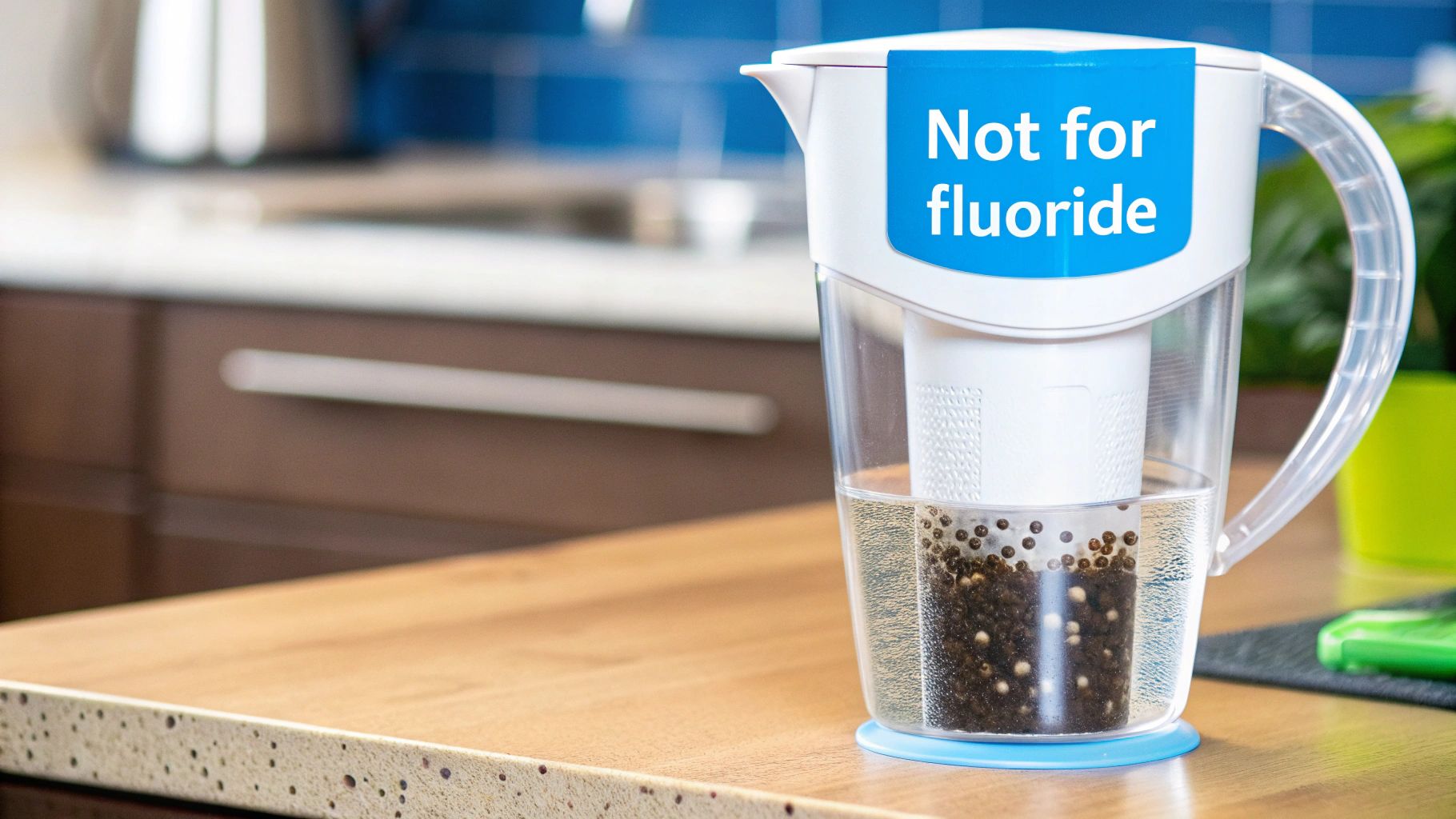
A water filter pitcher with a "Not for fluoride" label sits on a wooden kitchen counter.

Think of it like trying to catch fine sand with a fishing net. The net is perfect for catching fish, but the sand will slip right through the holes. That’s exactly what’s happening inside your filter. Fluoride exists in water as dissolved ions, which are incredibly small particles. Most basic filters use activated carbon as their main tool.

What Activated Carbon Filters Are Good At

Let's be clear: activated carbon is a workhorse. Its surface is a maze of microscopic pores and crevices, which gives it an enormous surface area. This structure makes it a master of adsorption—a process where certain contaminants literally stick to the carbon's surface as water passes by.

This is why it's so effective at tackling the big stuff that makes your water taste and smell off. Activated carbon filters are champs at removing:

  • Chlorine: This is their number one job. They excel at grabbing the chlorine used to treat city water, which is the main reason filtered water tastes so much cleaner and fresher.
  • Volatile Organic Compounds (VOCs): This includes a range of industrial chemicals and solvents that can sometimes seep into water sources.
  • Sediment and Particulates: They also trap larger bits of rust, silt, and sand that can make water cloudy.

The bottom line is that these filters are designed to improve the aesthetics of water by capturing large, clunky contaminants.

Activated carbon filters work by adsorption, where contaminants stick to the filter's surface. While this is great for chlorine and sediment, the fluoride ion is simply too small and not chemically attracted to the carbon in a way that allows for effective removal.

The Fluoride Filtration Challenge

Fluoride ions, however, play by a different set of rules. They are dissolved minerals, meaning they're completely integrated into the water at a molecular level. They are far too small to get physically trapped in the pores of a standard carbon filter.

On top of that, they don't have the right chemical charge to be "sticky" enough for the carbon to grab them. So, the fluoride ions just cruise right on through the filter along with the water molecules, completely untouched.

This is the fundamental mismatch. To pull something that small out of water, you need a totally different strategy. It requires more advanced technologies like reverse osmosis, activated alumina, or distillation, which are specifically engineered to separate these tiny dissolved solids—a task a standard carbon filter was never built to handle.

A Deep Dive into Effective Fluoride Filtration Technologies

So, you've figured out your standard carbon filter isn't going to cut it for fluoride. Now it's time to call in the specialists.

Think of it like this: your basic pitcher filter is a general practitioner, good for common stuff like chlorine. But for a specific issue like fluoride, you need an expert with the right tools. We’re talking about technologies designed from the ground up to pull dissolved minerals out of your water. These systems don’t just strain particles; they use some pretty cool science to get the job done.

We're going to break down the four heavy hitters in the fluoride removal game: Reverse Osmosis (RO), Activated Alumina, Bone Char, and Distillation. Each one works on a completely different principle, and each has its own set of pros and cons for your home.

Reverse Osmosis: The Purity Powerhouse

Reverse osmosis, or RO, is pretty much the gold standard when you want everything gone.

Imagine a bouncer at an exclusive club, but for water molecules. This bouncer is a special semi-permeable membrane with microscopic pores so tiny that only pure H₂O can squeeze through. Your tap water is pushed against this membrane under pressure, and while the small water molecules make it to the other side, bigger molecules—like fluoride, lead, arsenic, and salts—get bounced and flushed down the drain.

It’s a brute-force physical separation that’s incredibly effective. A good RO system will often strip out more than 90% of all total dissolved solids (TDS), making it the top pick if you're concerned about more than just fluoride.

Modern systems like reverse osmosis (RO), activated alumina, bone char, and ion exchange are game-changers, with RO leading at 99.9% removal efficiency in commercial tests. Take the Cloud RO: NSF-certified to standard 58, it erased 100% fluoride, chlorine, arsenic, and lead in rigorous trials, reducing TDS dramatically while remineralizing to a healthy pH of 9.7. Even pitcher options hold up—Clearly Filtered zapped fluoride from 2.18 mg/L to <0.01 mg/L (>99.54%), fluosilicate by 99.49%, and fluosilicic acid by 99.52%, tackling dental fluorosis head-on. You can discover more insights about these commercial fluoride removal systems to see the full scope of their capabilities.

Activated Alumina: The Fluoride Magnet

If RO is a bouncer, then Activated Alumina (AA) is a powerful magnet tuned specifically to grab fluoride. The filter media is made from aluminum oxide, which is loaded with tiny pores, giving it a massive surface area.

As your water flows through, fluoride ions are chemically drawn to the surface of the alumina and get stuck. This process is called adsorption—the contaminants literally stick to the outside of the filter material. It's a highly targeted approach that also works well on arsenic and selenium.

But there are a few catches with Activated Alumina:

  • Water pH is Key: It performs best in slightly acidic water, ideally with a pH between 5.5 and 6.5.
  • Slow and Steady: The water needs to hang out with the media long enough for the magic to happen. That means flow rates are typically on the slower side.
  • Needs Swapping Out: Eventually, the alumina gets clogged with fluoride and stops working. You have to replace the cartridge regularly to keep it effective.

Bone Char: The Natural Adsorbent

Okay, bone char might sound a little weird, but it's one of the oldest tricks in the book for getting rid of fluoride. It’s made from charred animal bones and has a super porous structure that’s fantastic at grabbing fluoride and other heavy metals.

Just like activated alumina, bone char works through adsorption. Its secret weapon is a high concentration of hydroxylapatite, a calcium-phosphate compound that has a natural attraction to fluoride ions. When water passes through, the fluoride gets pulled out and locks onto the bone char.

Lots of people prefer this method because it's a natural material, not something cooked up in a lab. It's also pretty good at removing chlorine and lead, making it a solid, well-rounded option for generally better water quality.

Distillation: The Classic Purifier

Distillation is basically nature's water cycle in a box on your countertop. The concept is dead simple, but it works like a charm. You boil water to create steam, leaving almost all the impurities behind.

Here's the play-by-play:

  1. Boil: Water in the distiller heats up and turns to steam. All the heavy stuff—fluoride, salts, heavy metals—can't evaporate, so it gets left behind.
  2. Cool: The pure water vapor travels into a cooling coil.
  3. Collect: As the steam cools, it turns back into liquid water, which drips into a clean container.

The water you get is about as pure as it gets, with fluoride removal rates often topping 99%. The trade-off? It’s slow, it uses electricity, and it removes everything, including the good minerals. That's why you usually see distillers used for small batches of drinking water, not for an entire house.

Choosing the Right Fluoride Filter System for Your Home

Knowing the science behind a filter to remove fluoride is one thing. Picking the perfect system for your kitchen? That's the real challenge.

What works great for your neighbor might be a terrible fit for you. It really boils down to your kitchen space, how much water your family uses, and your budget. Let’s shift from the technical specs to the practical reality of your home and look at the most common options—from heavy-duty under-sink units to grab-and-go pitchers.

Under-Sink Systems: The Hidden Powerhouse

If you’re looking for top-tier fluoride removal without a machine cluttering up your counter, an under-sink reverse osmosis (RO) system is the gold standard. These systems are tucked away neatly in the cabinet right below your sink, connecting directly to the cold water line.

They usually come with their own dedicated, smaller faucet that sits on your sink, giving you a constant supply of purified water for drinking and cooking. This setup is perfect for families who go through a lot of water and want the best filtration possible without sacrificing counter space. Installation is a bit more involved, but the sheer convenience of having pure water on tap is hard to beat.

Countertop Units: Versatility and Ease

Renting your home? Or maybe you just don’t want a permanent installation? A countertop filter is an excellent choice. These units sit right next to your sink and connect to your faucet with a simple diverter valve. When you want filtered water, you just flip a switch; the rest of the time, your faucet works like normal.

Countertop systems hit that sweet spot between power and convenience. They often use multiple filter stages, including activated alumina or specialized carbon, to effectively get rid of fluoride. Since they don’t require any permanent plumbing changes, they’re ideal for apartments or smaller kitchens where under-sink real estate is at a premium.

Specialized Pitchers: Portable and Practical

Don't expect your standard Brita to do the job here. While most pitchers won't touch fluoride, there are specialized models designed specifically for it. These pitchers use advanced media like bone char or ion-exchange resins to zero in on and capture fluoride ions.

They are by far the most affordable and portable option—great for a single person, a small household, or even for taking to the office. The trade-off is capacity and speed. You’ll be refilling the pitcher constantly, and it filters much slower than a larger system. But for low-volume needs, it’s a simple and effective solution.

If you're trying to figure out which style fits your daily life, this decision tree can help point you in the right direction.
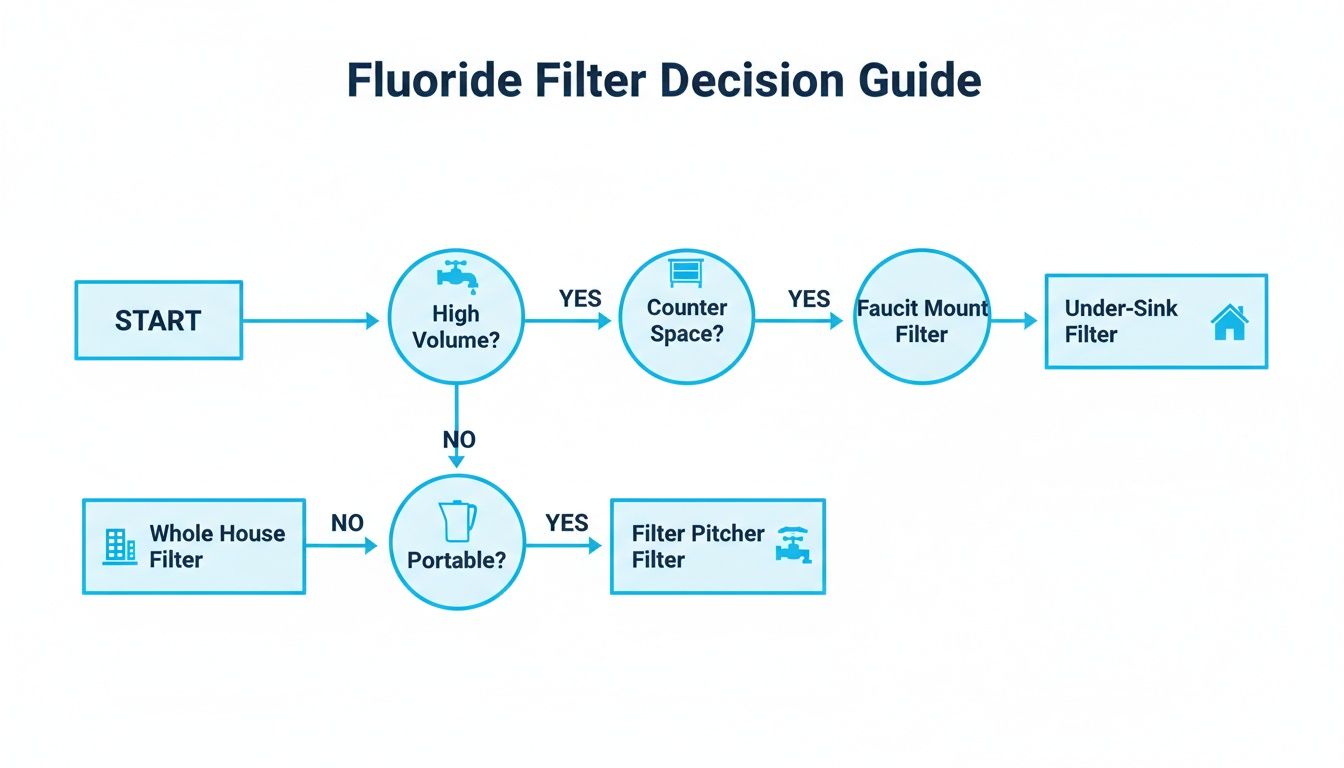
A flowchart guiding users to choose the right fluoride filter based on volume, counter space, and portability.

As the chart shows, if you need a lot of water, an under-sink system is your best bet. If you're on a budget or need something you can move around, a pitcher is the way to go. Countertop units fill that middle ground perfectly.

Why Whole-House Fluoride Filtration Is Rarely a Good Idea

You might be tempted to just filter all the water coming into your home, but this is one of those cases where going bigger isn't better. Whole-house fluoride filtration is incredibly expensive and usually impractical for a couple of big reasons.

The main reason to steer clear of whole-house systems is the massive cost and waste. An RO system big enough to handle an entire house is a huge investment, and it generates a ton of wastewater, which can send your water bill through the roof. On top of that, you'd lose the topical dental health benefits of fluoride when you shower.

For these reasons, your best bet is to stick with a point-of-use filter for the water you drink and cook with. It's the most sensible and cost-effective approach. For more help finding the perfect fit, our collection of expert water filtration advice can offer more guidance.

Independent reviews often praise RO systems like Aquatru, which scored a 9.59 for its 100% fluoride elimination and impressive performance against PFAS and chlorine. Lab data for pitchers from brands like Clearly Filtered shows they can remove over 99.54% of fluoride. However, commercial stress tests show RO maintains its high removal rate of 99.9%, while some pitchers can drop below 50%. This makes your choice of system absolutely critical. Learn more about the global market for these powerful water filters to see how different technologies stack up in the real world.

How to Verify a Filter's Fluoride Removal Claims

The water filter market is a noisy place, full of bold promises. With so many brands claiming their filter can remove fluoride, how do you cut through the marketing hype to find a product that actually works? The secret is looking for independent, third-party proof.

Think of it this way: buying a water filter is an investment in your family's health. You wouldn't make that kind of investment without doing a little homework first. Thankfully, trustworthy manufacturers make it easy by providing clear, verifiable data that shows their products deliver.
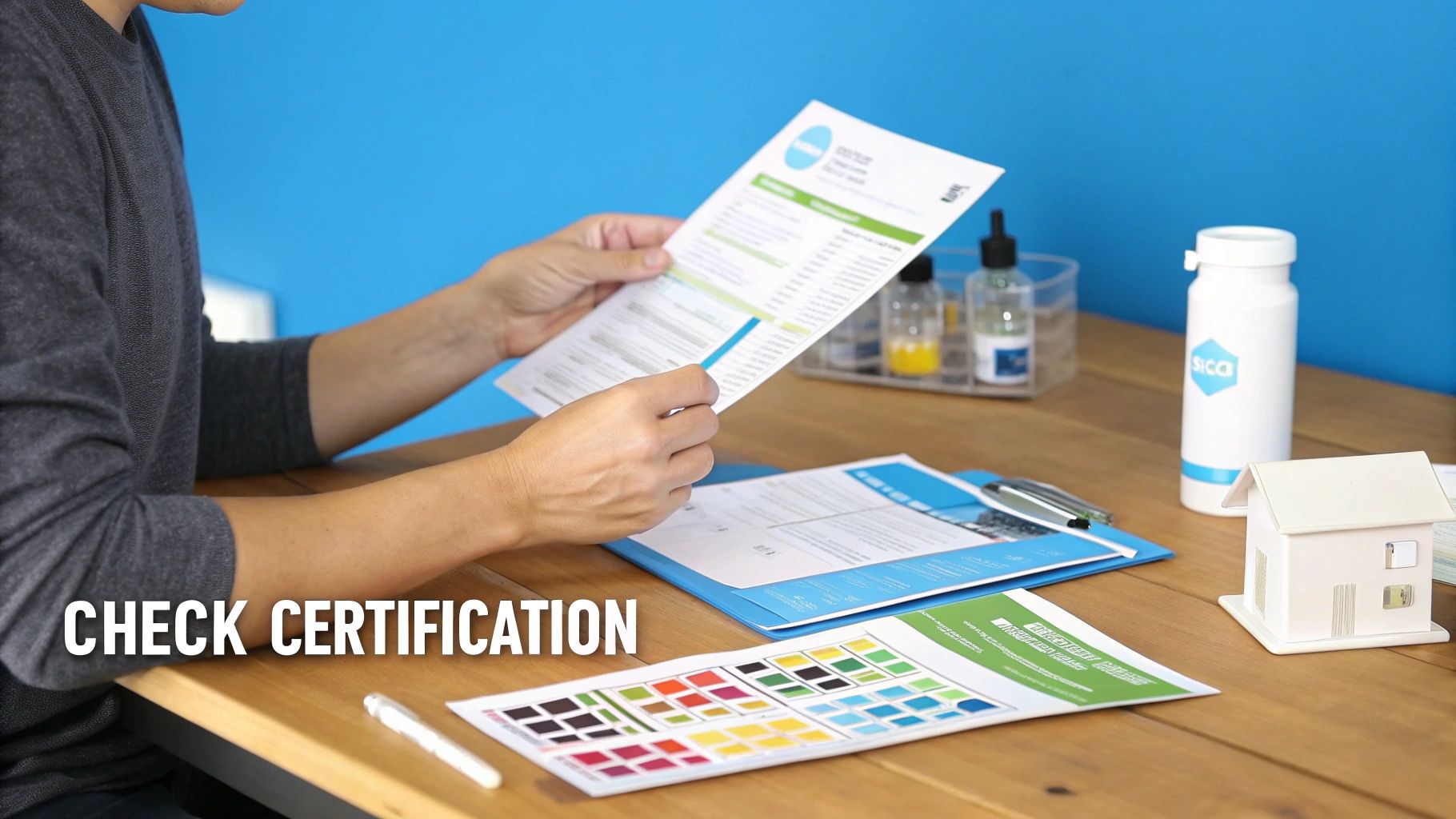
A person at a desk examining documents related to certification, with a model house and Sica bottle.

Look for Independent Certifications

The single most reliable way to confirm a filter's claims is to look for a seal of approval from an independent testing organization. These groups have no skin in the game; their only job is to put a product through its paces against tough industry standards.

In the world of water filtration, the most respected name out there is the NSF (National Sanitation Foundation). When a filter is NSF certified, it means it's been rigorously tested to meet strict public health and safety standards. And for fluoride removal, one specific certification is the one you really want to see.

NSF/ANSI 58: The Gold Standard for Fluoride Reduction
This certification is designed specifically for reverse osmosis (RO) systems and requires testing for fluoride reduction. If an RO system has that NSF/ANSI 58 seal, it’s been independently verified to do the job right.

When you spot that certification, you can feel confident that the product’s claims were proven in a lab, not just dreamed up by a marketing team. You can usually find the NSF seal right on the product packaging, the system itself, or on the manufacturer's official website.

How to Read a Performance Data Sheet

Beyond the official seals, any reputable manufacturer should also provide a Performance Data Sheet. This is basically a technical report card that breaks down exactly which contaminants the filter removes and by how much. Don't let the technical jargon scare you off—you only need to look for a couple of key things.

When you get your hands on a data sheet for a filter you think can remove fluoride, just follow these simple steps:

  1. Find the Fluoride Entry: Quickly scan the list of contaminants for "Fluoride." If you don't see it, the filter wasn't designed or tested to remove it. Simple as that.
  2. Check the Reduction Rate: Right next to the fluoride entry, there should be a percentage. This number tells you how much fluoride the filter successfully removed during testing. For real-world effectiveness, you want to see reduction rates of 90% or higher.
  3. Note the Testing Conditions: The sheet should also mention the conditions of the test, like water pressure and pH level. This gives you some context for how the filter is likely to perform with the water coming out of your own tap.

By learning to spot these key details, you can tune out all the noise and make a truly informed decision. Choosing a certified filter with a clear data sheet is the best way to ensure you're getting a system that delivers on its promise of cleaner, healthier water for your home.

Looking Beyond the Sticker Price: The True Cost of Fluoride Filtration

When you're shopping for a fluoride filter, it’s easy to get tunnel vision and focus only on the initial price tag. But that's just the beginning of the story. The real cost of any water filter system isn't what you pay on day one—it’s the total cost of ownership over months and years of use.

Think of it like buying a car. The upfront cost is a big deal, but so are the ongoing expenses for gas, oil changes, and new tires. Water filters are the same. You're not just buying a piece of hardware; you're committing to its upkeep to keep it running right.

The Hidden Costs: What You'll Really Be Paying For

That initial purchase price is just the down payment. To keep getting clean, fluoride-free water, you'll need to account for a few other things that will definitely add up.

  • Replacement Filter Cartridges: This is the big one. It's the most significant and consistent expense you'll have. Whether it's an activated alumina cartridge or a reverse osmosis membrane, these filters don't last forever. They need to be swapped out on schedule to keep doing their job.
  • Your Utility Bills: Some systems use more resources than others. A water distiller, for example, has to boil water, which takes a fair amount of electricity and will show up on your power bill. Reverse osmosis systems are known for creating wastewater—for every one gallon of pure water you get, it might flush three to four gallons down the drain, slightly bumping up your water bill.

The single biggest long-term cost is almost always the replacement filters. If you put off changing them, you’re not just drinking lower-quality water; you could end up damaging the whole system and facing a much bigger repair bill.

A Five-Year Cost Showdown

Let's make this real. Here’s a look at how the costs stack up for two popular choices over a five-year stretch. It’s a perfect example of how a cheaper start doesn’t always mean you save money in the long run.

Cost Component Under-Sink Reverse Osmosis System Specialized Fluoride-Removing Pitcher
Initial Purchase $250 – $500 $50 – $80
Annual Filter Cost $60 – $120 (for pre-filters & post-filters) $120 – $180 (replacing every 2-3 months)
5-Year Filter Total $300 – $600 $600 – $900
Membrane Replacement $50 – $100 (once every 2-4 years) N/A
Estimated 5-Year Total $600 – $1200 $650 – $980

As you can see, that pitcher looks like a steal at first. But because you're replacing those filters so often, the total cost over five years can creep up to be nearly as much as a high-performance under-sink RO system. This is exactly why you have to look at the big picture before deciding.

Got Questions About Fluoride Removal? We Have Answers.

As you start looking into filters, you'll naturally run into some common questions. From kitchen myths to the practical side of testing, let's clear up the most frequent queries so you can move forward with confidence.

Will Boiling Water Get Rid of Fluoride?

This is a classic kitchen myth. While boiling is great for zapping bacteria and viruses, it actually works against you when it comes to fluoride.

When you boil a pot of water, pure H₂O escapes as steam, but the fluoride ions get left behind. This means the water left in the pot has an even higher concentration of fluoride than when you started. For removing fluoride, you need a filter, not heat.

Do Standard Brita Filters Remove Fluoride?

This is probably the biggest point of confusion out there, and the answer is a firm no. Your standard pitcher filter, like a Brita, uses activated carbon. That’s fantastic for making your water taste and smell better because it grabs onto things like chlorine.

But as we've covered, fluoride ions are tiny and just don't stick to regular carbon. They slip right through. So, while those pitchers are popular, they do not lower the fluoride level in your water. You absolutely need a specialized filter designed for the job.

The decision to remove fluoride is a personal one. It often comes down to your health philosophy, how much fluoride you get from other sources (like toothpaste), and the actual levels in your local water.

How Can I Test My Water for Fluoride?

You can't fix what you don't measure. Knowing your starting point is key. You've got two main ways to go about it:

  • Home Test Kits: You can find test strips or digital meters online that give you a quick reading. They’re convenient for a ballpark figure, but their accuracy can be a bit hit-or-miss.
  • Professional Lab Services: For a rock-solid, reliable number, you can send a water sample to a certified lab. Don't forget, your local water utility also publishes an annual report listing the average fluoride level in your city's supply.

Is It Healthy to Remove All Fluoride from Water?

This question gets right to the heart of a decades-long public health debate. For a long time, community water fluoridation has been praised for drastically cutting down on cavities. Supporters say removing it takes away a vital tool for public dental health.

On the other side of the coin, some people worry about their total fluoride exposure from all sources—water, food, dental products, you name it. They prefer to take control of their intake by using a filter to remove fluoride and relying on topical treatments like toothpaste for the dental benefits. At the end of the day, it's a personal call based on your own research and health priorities.


Here at Water Filter Advisor, we're all about giving you clear, research-backed advice to help you feel confident about your home's water quality. Dive into our in-depth guides and reviews to find the perfect filtration solution for your family at https://www.waterfilteradvisor.com.
How to Reduce TDS in Water for a Cleaner, Tastier Drink

If you're looking for the fastest way to lower the TDS in your water, you'll need a serious filtration system. We're talking about the heavy hitters of home water treatment: reverse osmosis, distillation, or deionization.

These methods are the special ops of water purification, designed to physically pull those dissolved solids out of the water. They go way beyond what a standard carbon filter can do, which mostly just handles things like chlorine and funky smells. For most homes, a reverse osmosis system is the undisputed champ for tackling high TDS.

What Is This TDS Stuff in My Water Anyway?

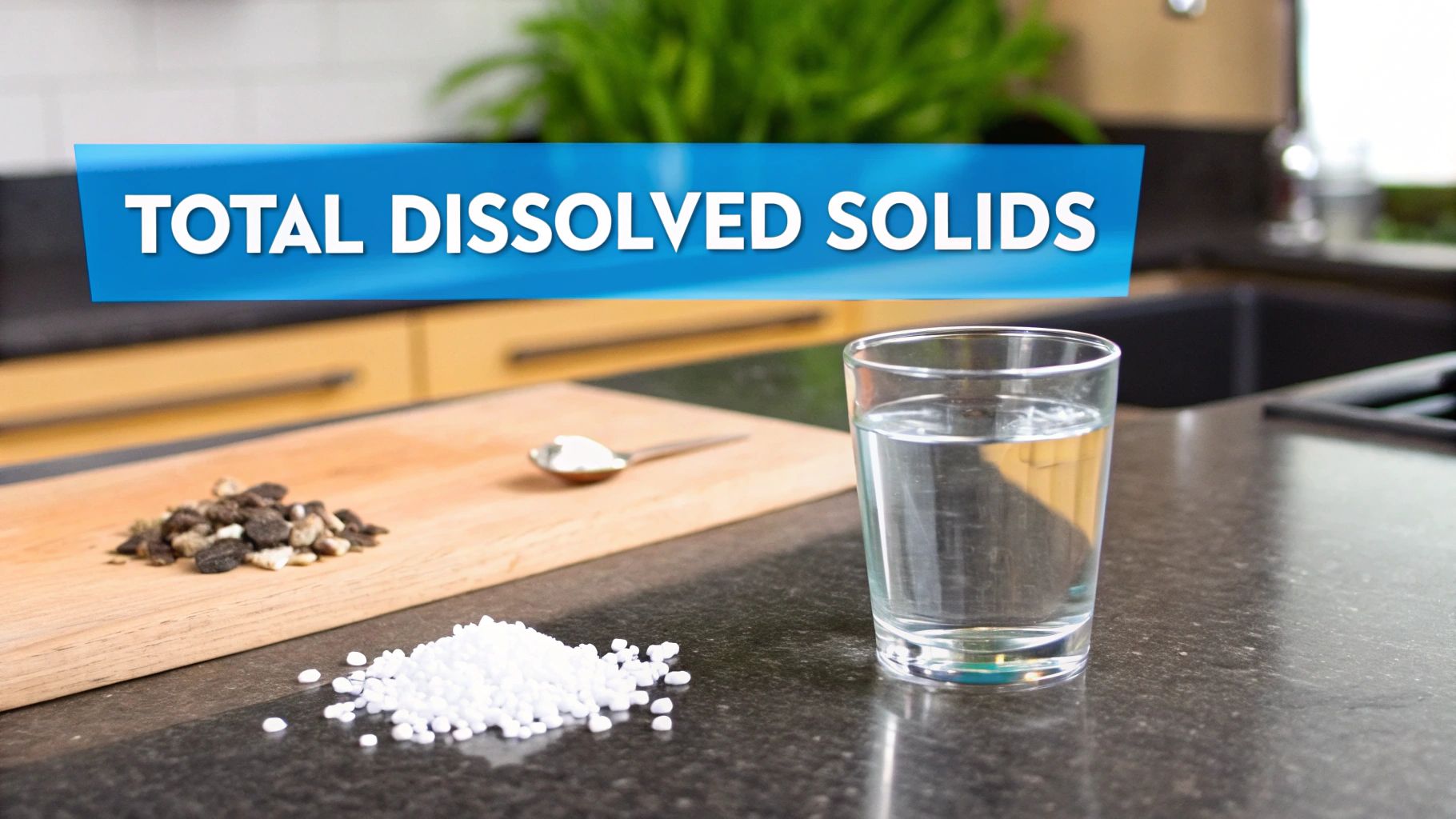
A kitchen counter with a glass of water, various solid particles, and a banner about Total Dissolved Solids.

Ever notice your water tastes a bit… off? Or that your "clean" glasses come out of the dishwasher looking like they have a case of the spots? Maybe your morning coffee just doesn't hit the spot. If any of this sounds familiar, you might be dealing with high Total Dissolved Solids, or TDS.

It sounds like a complicated lab term, but its effects are super practical and show up all over your home.

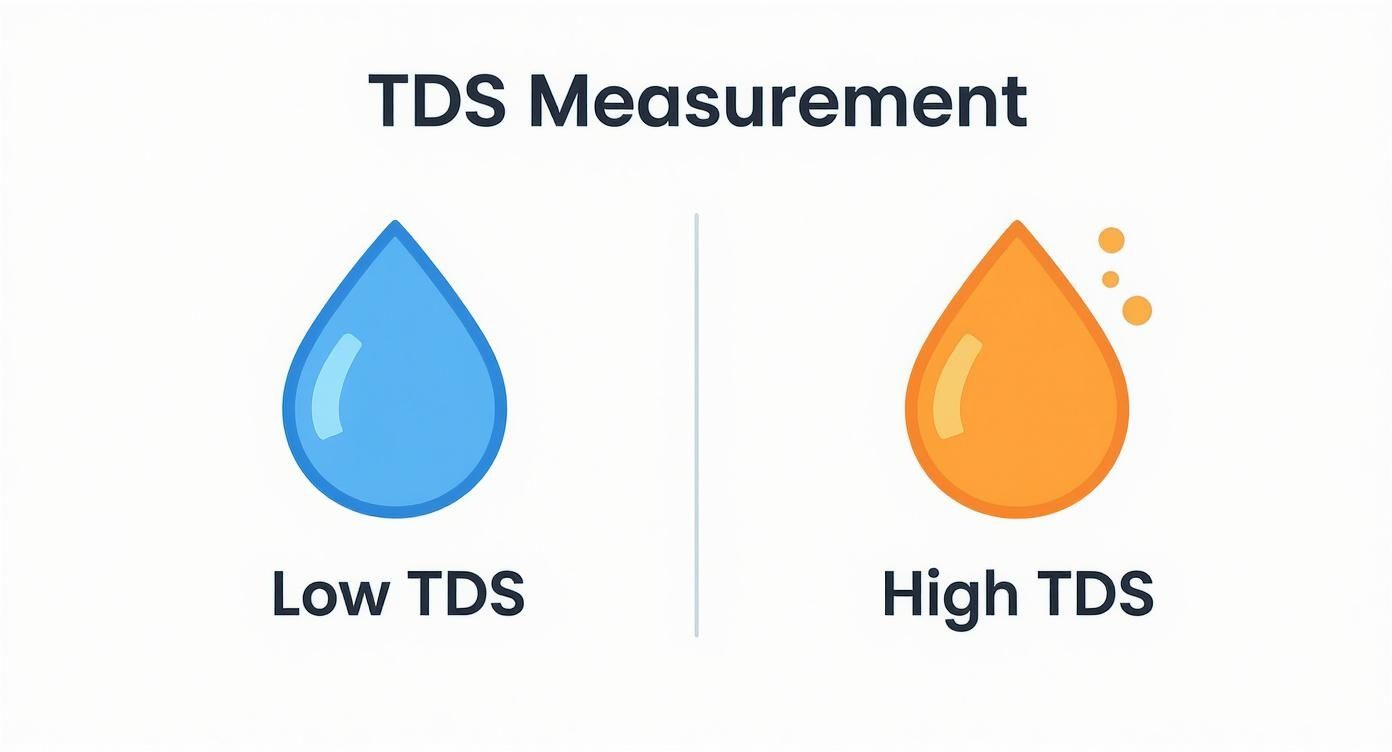
TDS is simply a measure of everything dissolved in your water that isn't pure H₂O. These particles are microscopic, so you can't see them, but they definitely make their presence known. Think of your water as a delivery truck, and TDS is all the cargo it picked up on its journey to your faucet.

Where Do These Solids Come From?

That "cargo" in your water comes from all sorts of places, both natural and man-made. As rainwater seeps into the ground, it naturally dissolves minerals from rocks and soil. This is why you hear about "mineral-rich" spring or well water—that's just a fancy way of saying it has high TDS.

The most common sources of TDS in your tap water include:

  • Good Minerals: Things like calcium and magnesium are big contributors to TDS and are the main reason you get "hard water."
  • Salts and Ions: Sodium, potassium, and chlorides often dissolve into water from natural deposits underground.
  • Trace Metals: Older plumbing can sometimes leach elements like iron, copper, or zinc into the water as it passes through.
  • Runoff: Agricultural runoff carrying fertilizers and pesticides, along with urban discharge, can add a whole host of other substances into the water supply.

Because the sources are so diverse, a TDS reading is really a measure of quantity, not quality. It tells you how much stuff is in your water, but it doesn't tell you what that stuff is. A high reading could just mean you have hard, mineral-heavy water, which is perfectly safe. But in some cases, a spike in TDS could hint at other, less desirable contaminants.

What High TDS Means for Your Home

The U.S. Environmental Protection Agency (EPA) doesn't regulate TDS as a direct health threat. Instead, they consider it a "secondary standard." But high levels can still create a whole bunch of annoying and expensive headaches around the house.

A high TDS reading is often the hidden villain behind common household frustrations. It affects everything from the taste of your food and drinks to the efficiency and lifespan of your water-using appliances.

Here’s where you’ll feel the impact of high TDS the most:

  • Taste and Odor: High concentrations of dissolved solids often give water a bitter, salty, or metallic taste. This ruins the flavor of your coffee, tea, and anything you cook with water, like pasta or soup.
  • Cleaning Nightmares: See those stubborn white spots on your dishes and shower doors? That’s mineral residue left behind when high-TDS water evaporates. It also makes it harder for soap to lather, leading to soap scum and laundry that feels stiff and looks dull.
  • Appliance Assassination: This is the big one. That mineral buildup, known as limescale, can clog pipes and coat the heating elements in your water heater, dishwasher, and coffee maker. This forces them to work harder, use more energy, and eventually, break down completely.

Getting a read on your water's TDS level is the first step. It gives you a clear baseline to figure out if it's a problem you need to solve to make life at home a little bit better.

Testing Your Water's TDS Level at Home

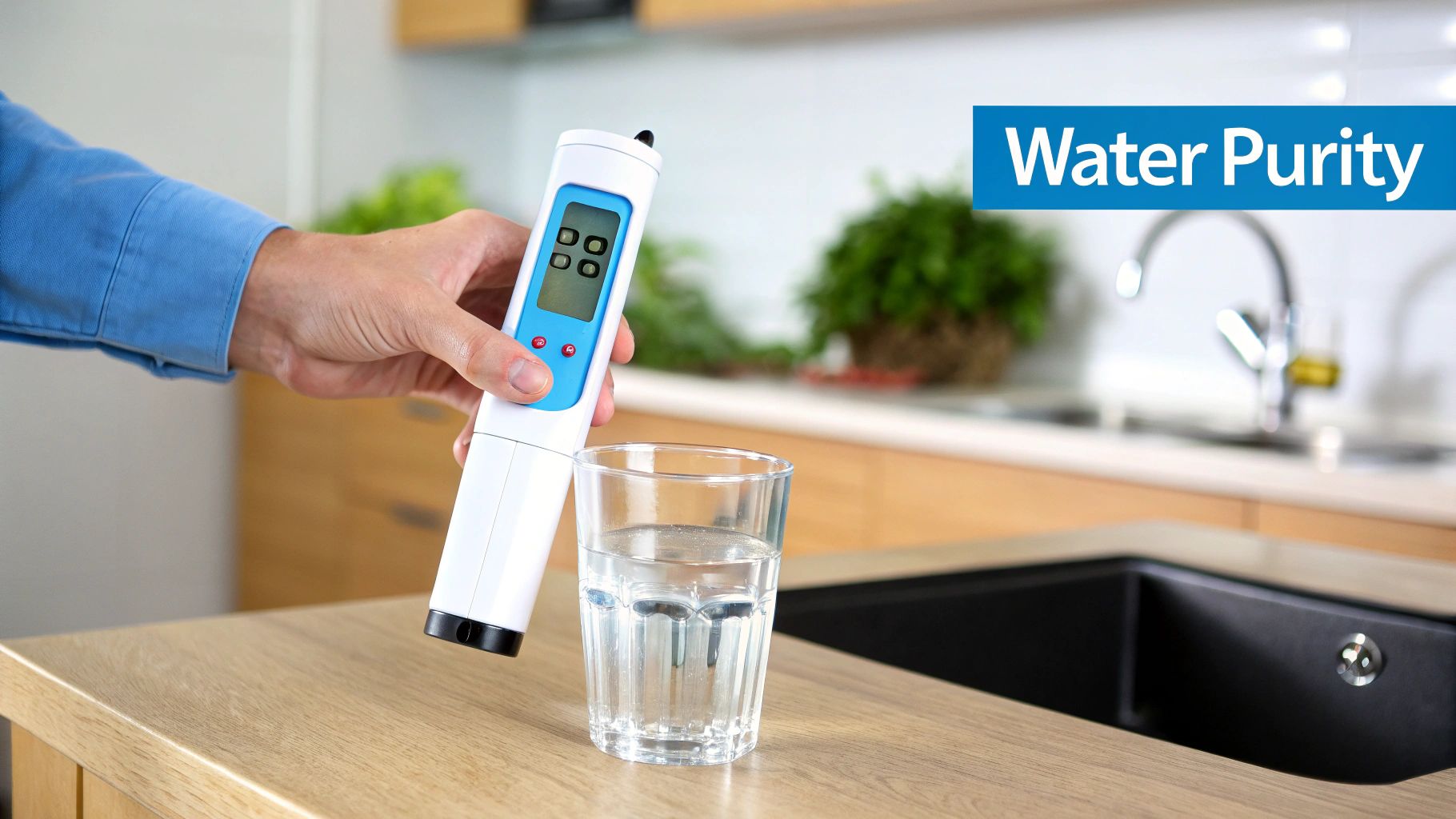
A hand holds a TDS meter above a glass of water next to a running faucet in a kitchen sink, illustrating water quality testing.

Before you can tackle a high TDS problem, you have to know if you even have one. You can't just guess based on spotty dishes or dull laundry—you need a real number. The good news? Getting that number is surprisingly simple and affordable, and you can do it right in your kitchen.

The quickest and most common tool for the job is a digital TDS meter. These handy little devices are inexpensive and give you an instant reading of the total dissolved solids in your water, measured in parts per million (ppm). Think of it as a pocket-sized detective for your water.

Getting a Good Reading with Your TDS Meter

Just dipping the meter in water isn't quite enough to get an accurate reading. To make sure your results are solid, there are a few quick steps to follow. This process will give you a reliable baseline to work from as you figure out how to best treat your water.

Here’s a simple routine for a dependable measurement every time:

  • Prep Your Samples: First, grab two clean, dry glasses. Fill one right from your kitchen tap with cold water, but let the faucet run for about 30 seconds first to clear the pipes. If you already use a filter (like in a pitcher or your fridge), fill the second glass with that water.
  • Ready the Meter: Pop the protective cap off your TDS meter and switch it on.
  • Take the Measurement: Submerge the meter's tip about an inch into the first glass of tap water. Give it a gentle swirl to knock off any air bubbles that might be clinging to the sensors.
  • Log the Number: Just wait a moment for the reading on the digital display to settle. That number is your water’s TDS level in ppm. Jot it down.
  • Rinse and Repeat: Before you test your filtered water, give the meter's probe a quick rinse with distilled water (if you have some handy) or just shake it dry. Then, repeat the whole process with the second glass. The difference between those two numbers is a great indicator of how well your current filter is working.

It's important to know what your TDS reading means. While the EPA suggests a level below 500 ppm for aesthetic reasons like taste and odor, most folks are aiming for a reading somewhere between 50-150 ppm for the best-tasting drinking water.

When a TDS Meter Isn't Enough

A TDS meter is a fantastic tool for getting a quick snapshot of your water, but it does have one big limitation: it tells you how much stuff is dissolved in your water, but not what that stuff is. It can't tell the difference between harmless minerals like calcium and more concerning contaminants like heavy metals.

I always recommend a professional lab test if:

  • You're on well water, which is far more prone to contamination.
  • Your TDS reading is consistently over 500 ppm.
  • You live in an area with known water quality problems or have very old plumbing.
  • You notice a sudden, big jump in your TDS levels that you can't explain.

A lab analysis will give you a detailed report breaking down the specific minerals, salts, metals, and anything else lurking in your water. This is the complete picture you need to choose the right filtration system for your home’s unique water profile, moving you from just a number to a real, targeted solution.

A Head-to-Head Comparison of TDS Reduction Methods

Flowchart illustrating three methods for TDS reduction: reverse osmosis, distillation, and deionization.

So, you've got your TDS number. Now what? The next step is figuring out the best way to lower it, and let's be clear—not all water filters are up to the task. That trusty pitcher filter you keep in the fridge is great for making tap water taste better by zapping chlorine, but it won’t do a thing for dissolved solids.

To really tackle TDS, you need to call in the specialists.

We're talking about three core technologies that are the go-to solutions for slashing TDS at home: Reverse Osmosis (RO), Distillation, and Deionization (DI). Each one has a completely different playbook for stripping solids out of your water, and they all come with their own set of trade-offs.

Reverse Osmosis: The Gold Standard for Home Filtration

For most people looking to get serious about their water quality, Reverse Osmosis is the undisputed champion. It’s the most practical and popular way to get low-TDS water right from your tap.

Think of it like an ultra-exclusive nightclub for water molecules. An RO system uses your home’s water pressure to push water through a special semipermeable membrane. This membrane is a marvel of engineering, with pores so tiny that only pure H₂O can get through.

Everything else—the salts, heavy metals, and other dissolved gunk—gets left behind and flushed down the drain. What comes out the other end is incredibly clean water, often with a TDS reading that’s nearly zero. A good RO system will reliably remove 95% to 99% of all total dissolved solids.

Distillation: The Tried-and-True Purifier

Distillation is one of the oldest tricks in the book for purifying water, and its elegance lies in its simplicity. It’s basically a man-made version of the earth’s natural water cycle.

A home distiller boils water, turning it into pure steam. As the steam rises, it leaves behind all the dissolved solids—minerals, salts, and other contaminants that can't evaporate. The steam is then cooled in a separate container, where it condenses back into liquid. The result is some of the purest water you can make, with a TDS of virtually zero.

While it’s incredibly effective, distillation isn’t always practical for a busy household. It's a slow process, it uses a fair amount of electricity to boil the water, and you can only make a few gallons at a time. It’s a great option for specific uses, but less so for the all-day demands of a family.

Deionization: The Ultimate TDS Scrubber

Deionization, or DI, uses a bit of chemistry to get the job done. A DI system sends water through special resins that are loaded with positive and negative charges. These resins act like super-magnets for dissolved solids, which are basically ions.

As water flows past, the resin beads snatch ions like calcium and chloride right out of the water, swapping them for hydrogen (H+) and hydroxyl (OH-) ions. Those two new ions immediately bond to form pure water (H₂O).

DI systems are amazing at producing ultra-pure water and can easily bring TDS down to absolute zero. But they’re usually reserved for specialized applications like reef aquariums or lab work, not so much for drinking water. The resin cartridges get used up quickly, especially in high-TDS areas, and can be pricey to replace.

For pure, great-tasting drinking and cooking water from a dedicated faucet, Reverse Osmosis is the clear winner. It offers the best balance of performance, affordability, and convenience for the modern home.

Comparing TDS Reduction Technologies for Your Home

To really see how these methods stack up, let's put them side-by-side. This table gives you a quick look at the top home water filtration methods for reducing Total Dissolved Solids (TDS).

Method TDS Removal Rate Initial Cost Ongoing Maintenance Best For
Reverse Osmosis 95-99% Moderate Filter changes (every 6-24 months) Creating superior drinking and cooking water at a dedicated faucet.
Distillation 99%+ Low to Moderate Regular cleaning to remove scale buildup Producing small batches of ultra-pure water for specific uses.
Deionization 99%+ Low to High Frequent resin cartridge replacement Polishing already filtered water for aquariums, labs, or medical use.

For many homes, the ultimate solution is often a tag-team approach. You might have a whole-house carbon filter to handle chlorine and sediment for all your taps and appliances, combined with a dedicated under-sink RO system for the purest possible water right at the kitchen sink.

Choosing the Right Filtration System for Your Home

Okay, you've got your TDS reading and you know the basics of how these systems work. Now it’s time to pick the right one for your home. This isn't about buying the most powerful or expensive system; it's about finding the one that actually fits your water, your budget, and your daily life.

The decision really comes down to a few key questions. Thinking through these helps you get past the technical jargon and focus on what you'll actually use day-to-day. A setup that's perfect for a big family on well water would be total overkill for someone in a city apartment. Let's match the solution to your specific problem.

Start with Your Water Source and TDS Reading

That TDS number you measured is your North Star. It sets the stage for everything else and tells you just how much work needs to be done. Your water source—whether it’s from the city or a private well—is just as important.

Let’s look at a couple of real-world scenarios:

  • The Suburban Family on City Water: Picture a family whose tap water comes from the city and has a TDS reading of 350 ppm. The water is safe, but they're annoyed with spotty dishes and that funky taste in their morning coffee. Their main goal is getting crystal-clear drinking and cooking water. An under-sink Reverse Osmosis (RO) system is a fantastic fit here. It targets the water they actually consume, it's budget-friendly, and it's often a manageable weekend DIY project.

  • The Rural Homeowner with Well Water: Now, think about a family with a private well. Their TDS reading comes in at a whopping 800 ppm, and it’s full of minerals like calcium and iron. They're not just worried about taste; they're seeing limescale build up on showerheads and they know it's slowly wrecking their water heater. A simple filter won't cut it. A whole-house water softener to knock out the hardness minerals, followed by an under-sink RO system for pure drinking water, gives them a powerful one-two punch that protects their appliances and their health.

Sizing Up Your Household Needs

How many people are in your home? How much water do you use? A single person might do just fine with a small countertop distiller, but a family of five would find it completely impractical.

You'll need to decide if you want to treat water at a single faucet (point-of-use) or treat all the water coming into your house (point-of-entry).

  • Point-of-Use (POU) Systems: These are your under-sink RO units and countertop distillers. They’re perfect for targeting just your drinking and cooking water. This makes them a really cost-effective way to improve taste and purity right where you need it most.

  • Point-of-Entry (POE) Systems: Also called whole-house systems, these are installed right where your main water line enters your home. Full whole-house RO systems are pretty rare and expensive for residential use, but a common strategy is to pair a whole-house sediment filter with an under-sink RO for drinking water.

As you can see, if getting the highest purity drinking water is your top priority, Reverse Osmosis is almost always the most direct and popular solution for homeowners.

Budget and Installation Considerations

Your budget is obviously a big factor. You'll want to think about the initial purchase price and the long-term cost of replacing filters. Under-sink RO systems usually hit a sweet spot, with prices ranging from a couple hundred to several hundred dollars. Whole-house solutions are a bigger upfront investment, but they can save you money down the road by protecting expensive appliances.

Pro Tip: Make sure any RO system you're looking at has an NSF/ANSI 58 certification. This isn't just marketing fluff. It's an independent verification that the system has been tested and proven to reduce TDS and other contaminants just like it claims. It's your peace of mind.

Finally, there's the installation. Many under-sink RO systems are designed for DIYers, complete with color-coded tubes and step-by-step guides. But if you’re not comfortable with basic plumbing, there’s no shame in calling a pro to make sure it’s done right.

Keeping Your System Running for Peak Performance

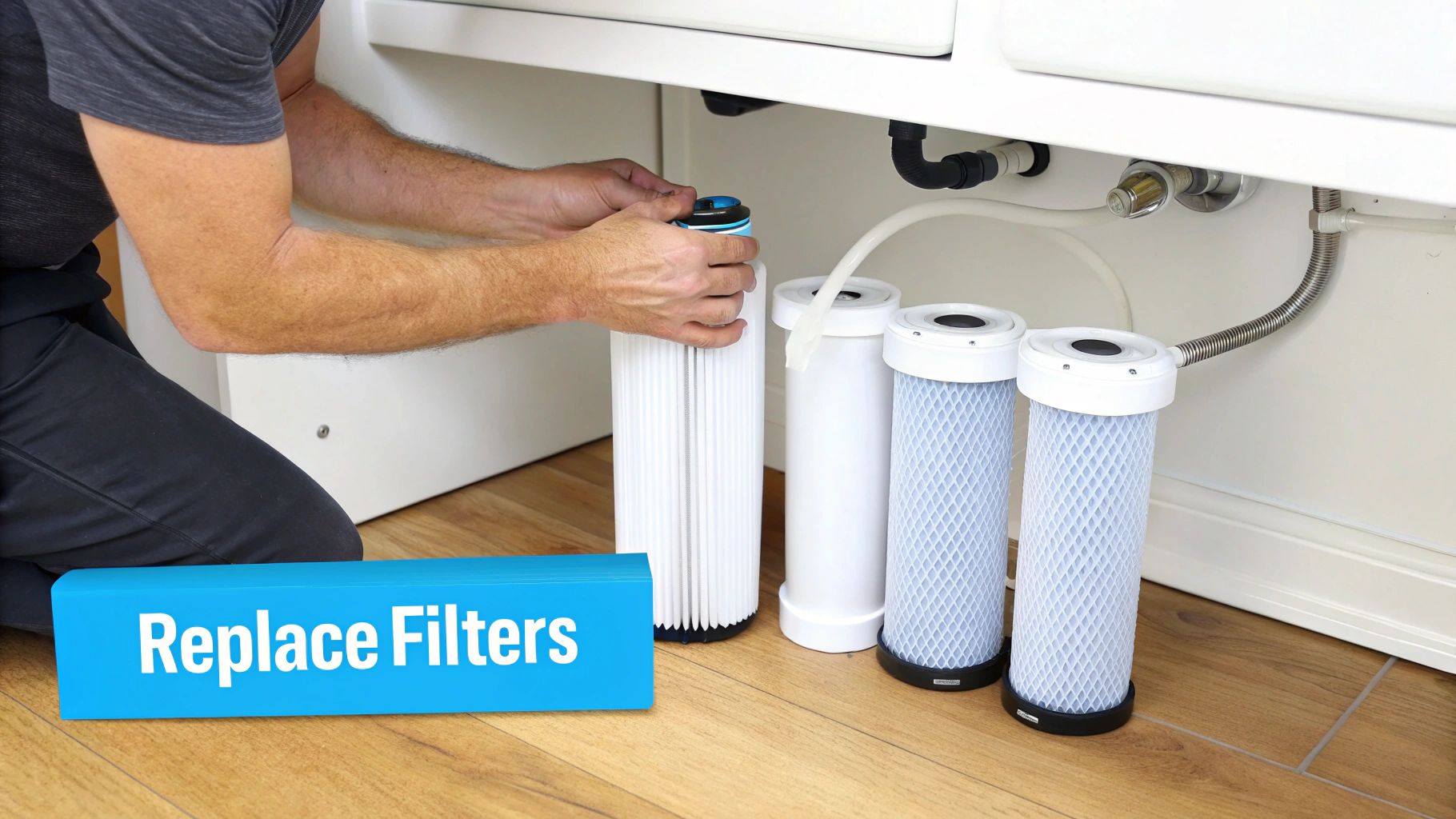
A person replaces multiple water filters under a kitchen sink, with new filters on the wooden floor.

Putting in a quality water filtration system is a huge first step. But the real secret to getting that clean, low-TDS water for years to come? It's all in the follow-through.

The initial setup and a consistent maintenance schedule are what truly keep your system at the top of its game. If you let it slide, you’re basically buying a high-performance car and never changing the oil. Sooner or later, you'll see that performance drop.

Setting Up Your System for Success

Getting your system installed can be anything from a simple Saturday project to a job for the pros, all depending on what you bought.

A standard under-sink Reverse Osmosis (RO) unit, for instance, is usually pretty DIY-friendly. Most people with basic tools can get one up and running. Manufacturers have really stepped up their game with things like color-coded tubes and dead-simple instructions.

A whole-house system, though? That's a different story. You’ll be cutting into your main water line, and that takes some serious plumbing know-how. If that sounds intimidating, it’s a smart move to call in a licensed plumber. They'll make sure it's done right, with no leaks, and everything's up to code.

A flawless installation is the foundation of a high-performing filtration system. Taking the time to do it right—or hiring someone who can—prevents common headaches like leaks, low pressure, and premature filter failure.

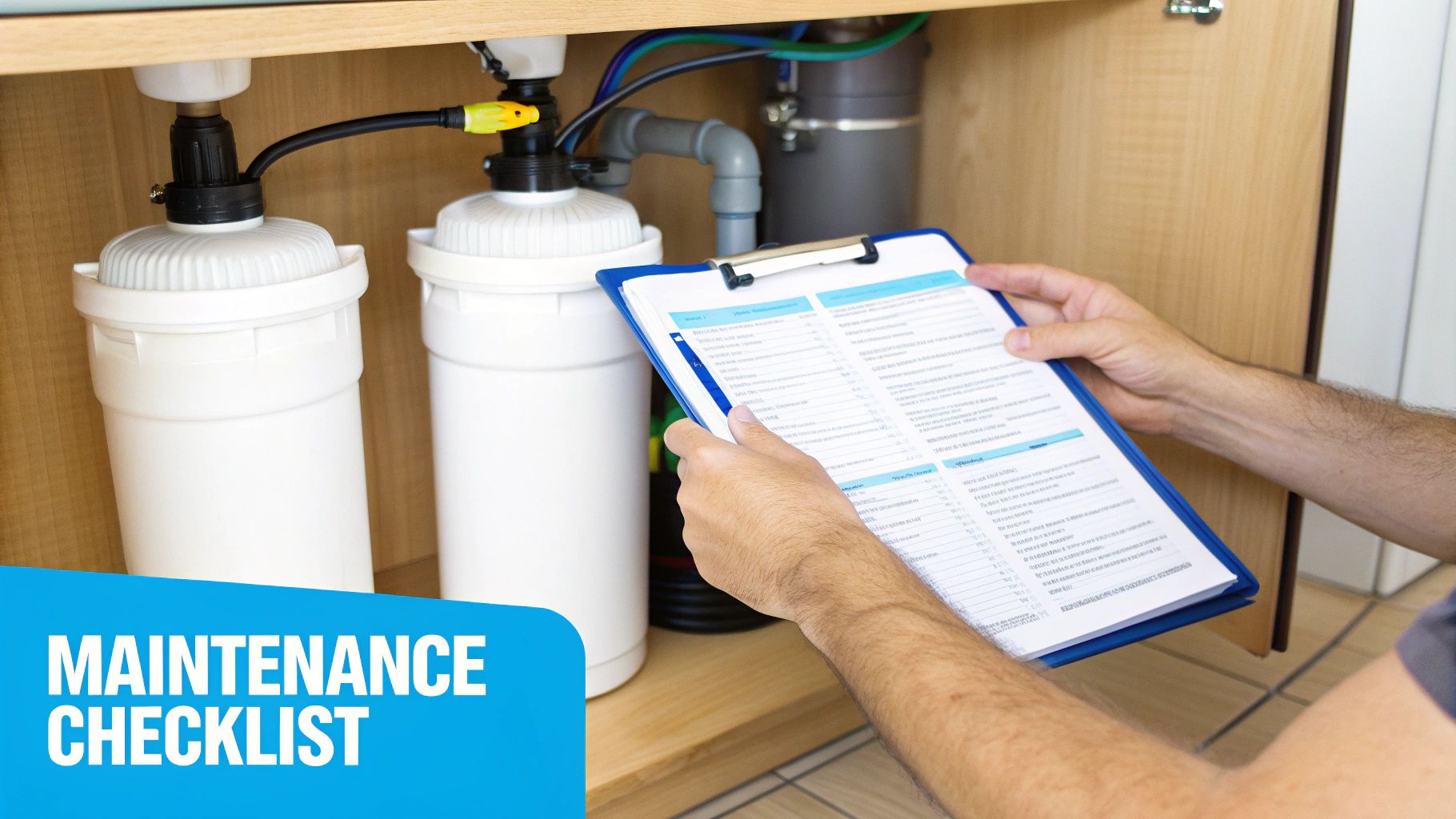
Your Essential Maintenance Checklist

Once you're all set up, the game shifts to routine maintenance. This isn't just about keeping the water on; it's about making sure your system is actually pulling its weight and cutting down those TDS levels. Over time, those filters get packed with all the gunk they’re supposed to be removing.

For a typical RO system, here’s a rough timeline to follow:

  • Pre-Filters (Every 6-12 Months): Think of these as the bouncers for your system. The sediment and carbon filters grab the big stuff—rust, silt, chlorine—before it can get to the more sensitive parts. Swapping these out on schedule is the best thing you can do to protect the RO membrane.
  • RO Membrane (Every 2-3 Years): This is the heart of the operation, where the serious TDS reduction happens. How long it lasts really depends on your water quality and how diligent you are with those pre-filters.
  • Post-Filter (Every 12 Months): This is the final polish. This last carbon filter gets rid of any lingering off-tastes before the water hits your glass.

This isn't just about under-sink systems, either. Even simpler filters need attention. Knowing the basics of routine filter changes keeps all your drinking water sources clean and safe.

Troubleshooting Common Filtration Issues

Even with the best maintenance, things can go sideways. No need to panic. Most problems have simple fixes.

If you suddenly notice a drop in water pressure, a clogged pre-filter is almost always the cause. If the water starts tasting "off" all of a sudden, that’s your post-filter telling you it's time for a change.

The biggest red flag, though, is a sudden spike in your TDS readings. If you test your water and see the numbers have jumped, it’s a strong sign your RO membrane has finally given up the ghost. Keeping a TDS meter handy lets you do quick spot-checks to catch these problems early. It’s this kind of proactive approach that ensures you always know how to reduce TDS in water.

Your Top Questions About Lowering TDS in Water

Once you start looking into TDS, it's natural for a bunch of questions to come up. It can feel like a whole new world. To help you out, we've gathered the most common questions and myths we hear from people just like you and answered them in plain English.

Think of this as your go-to guide for busting myths and getting clear on how to manage the TDS in your home's water. We want you to have the practical, real-world info you need to make the right choice for your family.

Is a High TDS Level Automatically Dangerous?

This is the big one, and the short answer is: usually, no. A high TDS number doesn't automatically mean your water is dangerous. Most of the time, it just points to a high concentration of harmless minerals like calcium and magnesium, which are the culprits behind "hard water."

The catch is that a basic TDS meter can't distinguish between those benign minerals and nasty stuff like lead, arsenic, or pesticides. That's why the EPA suggests keeping TDS below 500 ppm. If your reading is north of that—or if you're on well water—it's smart to get a proper lab test done. That's the only way to know for sure what you're dealing with.

Why Doesn't Boiling Water Lower My TDS?

This is a really common misconception. People assume boiling purifies water, and while it does kill germs, it actually makes your TDS worse.

Here’s why: when you boil water, the pure H₂O turns into steam and escapes, but all the dissolved solids—the salts, minerals, and metals—are left behind. As the water level drops, those solids become even more concentrated. So, while boiling is great for disinfecting water, your TDS reading will actually go up, not down.

Key Takeaway: Boiling water sterilizes it but concentrates dissolved solids, increasing the TDS level. True TDS reduction requires physically removing the solids through filtration or distillation.

What Is the Difference Between a Regular Filter and an RO System?

This is a super important distinction to understand. The standard carbon filter you have in your pitcher or fridge is designed to make your water taste and smell better. It does a fantastic job of grabbing things like chlorine and some organic chemicals.

A Reverse Osmosis (RO) system, on the other hand, is a whole different beast. It uses a high-tech semipermeable membrane with microscopic pores to physically block and strip out up to 99% of all dissolved solids.

Let's break it down simply:

  • Standard Carbon Filter: Think of it like a sponge that soaks up specific contaminants like chlorine. It won't do much for your TDS reading.
  • Reverse Osmosis System: This is more like a bouncer at an exclusive club. It only lets pure water molecules through and kicks almost everything else out. For lowering TDS at home, it’s the best tool for the job.

Can My Water's TDS Be Too Low?

It's a fair question. Once you see how powerful an RO system is, you might wonder if you can take too much out of the water. Some worry that removing minerals makes water unhealthy or "dead."

The truth is, we get the vast majority of our essential minerals from our food, not our water. The amount of calcium or magnesium you'd get from even very hard water is pretty tiny compared to what a balanced diet provides.

In fact, most people end up loving the pure, clean taste of low-TDS water, which typically clocks in between 0-50 ppm. For almost everyone, the peace of mind that comes from removing potential contaminants far outweighs the loss of a few trace minerals from your water.


At Water Filter Advisor, we believe everyone deserves access to clean, safe, and great-tasting water. Our in-depth guides and unbiased reviews are designed to help you find the perfect filtration solution for your home, so you can feel confident with every sip. Explore our expert buying guides and find your ideal water filter today.

How to Banish Hard Water for Good: Your Guide to Removing Calcium

If you’re waging a never-ending war against crusty white buildup on your faucets and fixtures, you've met the villain of this story: calcium. The two most powerful heroes in the fight against hard water are a whole-house water softener or a targeted reverse osmosis (RO) system. Think of them as the ultimate tag team for stopping that chalky limescale from ever showing up to the party.

Your Quick Guide to Solving Hard Water Nightmares

Let's be real—if your shower doors look permanently cloudy and your soap stubbornly refuses to lather, you’ve got hard water. The culprit is an excess of dissolved calcium, and it’s more than just an eyesore. Over time, that scaly buildup is like cholesterol for your home's arteries, choking the life out of your appliances and clogging your pipes.

It's a frustrating, soap-scum-covered problem, but you don't have to live with it. I've seen countless homeowners reclaim their homes from the clutches of calcium by choosing the right filtration strategy. And it almost always boils down to one of two battle plans.

Choosing Your Filtration Strategy

The first, and most comprehensive, fix is a whole-house water softener. This bad boy gets installed right where your main water line enters your house, treating every single drop you use. It works through a clever bit of chemistry called ion exchange, where it essentially tricks the "hard" calcium and magnesium ions into swapping places with "soft" sodium ions. This protects your entire plumbing infrastructure—from the water heater you never see to the coffee maker you use every morning.

Now, if your main headache is the funky taste of your tap water or the film on your cooked veggies, a point-of-use system like reverse osmosis is a fantastic option. These are typically installed right under the kitchen sink. An RO system is the overachiever of water filters, pushing water through a special membrane that strips out a ridiculously high percentage of contaminants—calcium included. For more in-depth info, you can find tons of professional advice on water filtration to help you weigh your options.

The decision often comes down to this: Are you looking to protect your entire home's plumbing and appliances, or do you crave ultra-pure water at a specific tap for drinking and cooking?

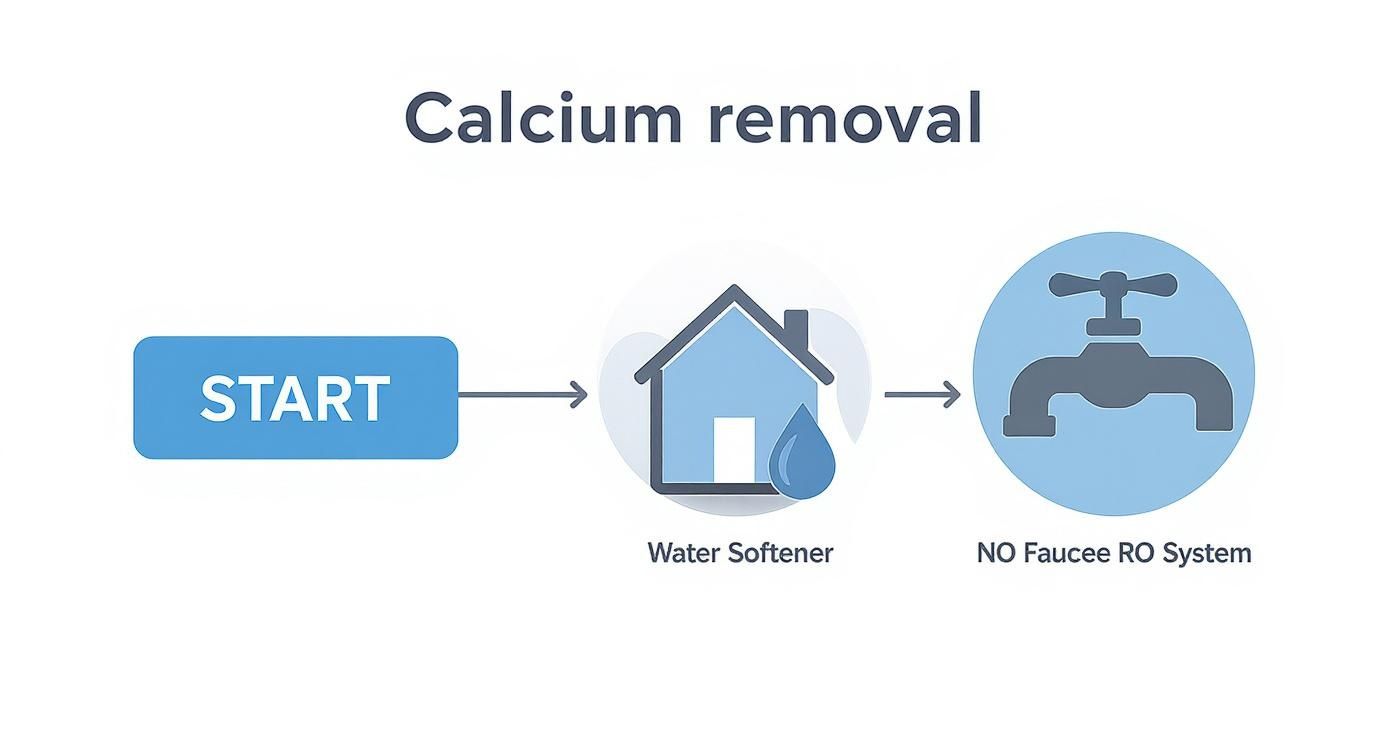
This simple decision tree can help you visualize which path is right for your home.

A flowchart showing the process of calcium removal from water, involving a water softener.

As you can see, the scope of your problem—whether it’s a house-wide menace or a kitchen-specific annoyance—points you directly to the most logical solution. While these systems prevent future issues, if you're already dealing with existing spots on your glass surfaces, a good guide on how to get hard water spots off windows can help you clean up the existing mess.

Comparing Calcium Removal Methods at a Glance

To make things even clearer, I put together a quick table comparing the top methods for kicking calcium to the curb. It breaks down what each is best for, the typical cost you can expect, and the main benefit you'll get.

Method Best For Typical Cost Range Primary Benefit
Water Softener Whole-house protection for all pipes and appliances $800 – $3,000+ Prevents limescale buildup everywhere in the home
Reverse Osmosis Purifying drinking and cooking water at a single tap $250 – $900 Removes up to 99% of all dissolved solids for pure taste

This table gives you a solid starting point. Think about your budget and your biggest hard water frustration, and the right choice should become pretty clear.

Pinpointing Your Home's Hard Water Severity

Before you can declare war on hard water, you need to know the strength of your enemy. Guessing at your water’s hardness is like trying to bake a cake without a recipe—you might end up with something edible, but it’s definitely not going to be perfect. Nailing down the specifics is the essential first step to choosing the right filtration system for your home.

The good news? You don't need a Ph.D. in chemistry to figure this out. A simple at-home test can give you a pretty good idea of what's going on with your water, confirming your suspicions before you commit to a solution.

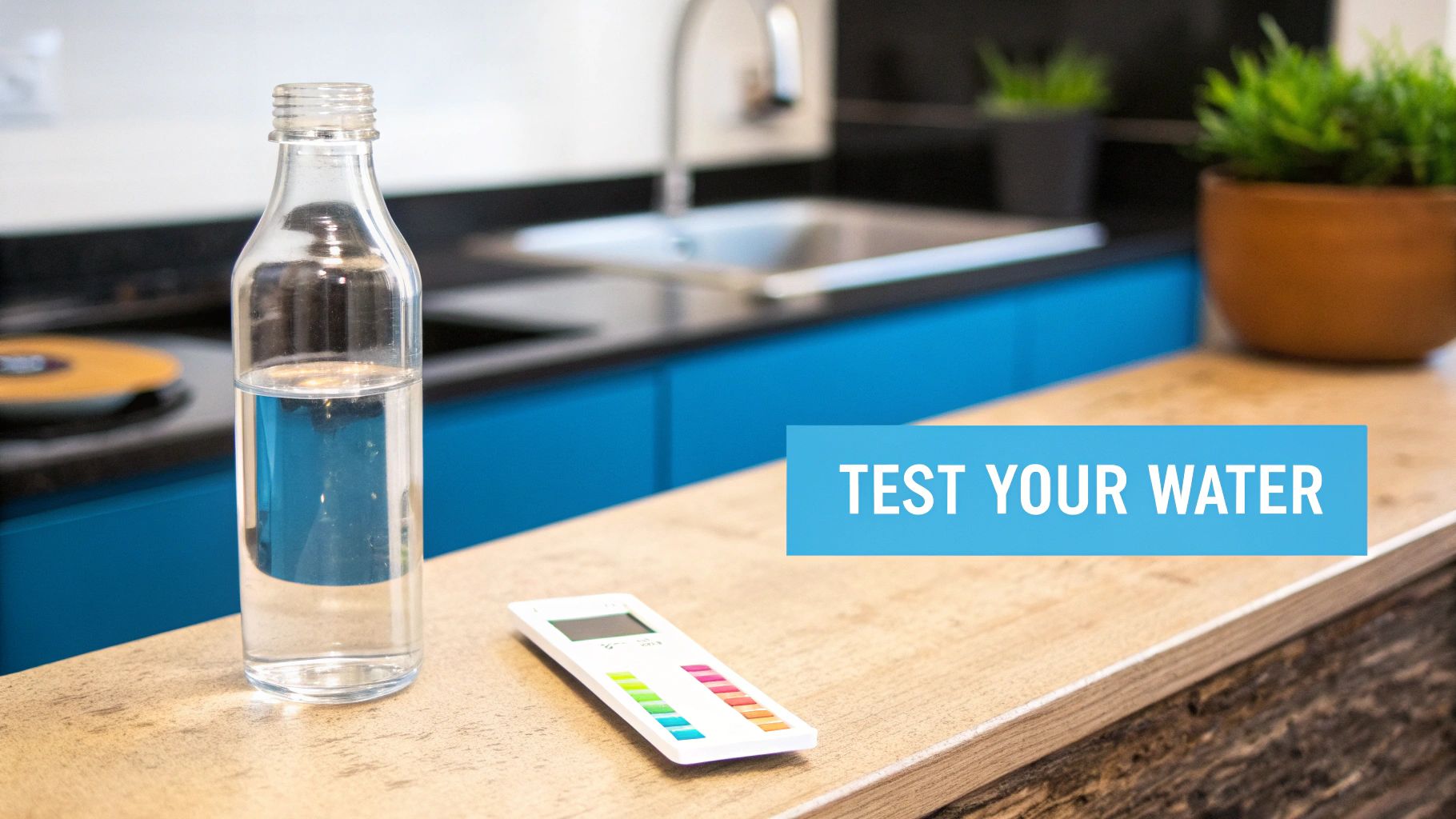
A water bottle and a testing strip on a kitchen counter with a 'Test Your Water' banner.

The Simple Soap Suds Test

Think of this as your five-minute hard water detective work. It's not perfectly scientific, but it’s a surprisingly good indicator that can tell you if you're on the right track.

Here's how to do it:

  1. Grab a clean, clear water bottle with a cap that seals tightly.
  2. Fill it about one-third of the way with your cold tap water.
  3. Add 10 drops of a pure liquid soap, like a basic Castile soap. Don't use detergents; many are designed to create suds even in the hardest water.
  4. Shake it like you mean it for about 15 seconds.

Now, observe the results. If the bottle is brimming with fluffy, rich suds and the water underneath is clear, congratulations—you likely have soft water. But if you’re looking at a sad, scummy film with just a few pathetic bubbles and cloudy water, you've got hard water. The soap has reacted with the calcium to create gross soap scum instead of a luxurious lather.

Getting a Precise Reading with Test Kits

The soap test tells you there's a problem, but it doesn't tell you the scale of it. To properly size a water softener or select the right filter, you need an actual number. That’s where water hardness test kits come in—they’re cheap, easy to find, and even simpler to use.

Most kits come with test strips that you just dip into a sample of your tap water. After a moment, the strip changes color. You then match that color to a chart to get a specific measurement of your water's hardness.

Pro Tip: For the most accurate reading, test cold water straight from a faucet that has no existing filtration. Your outdoor spigot or a utility sink is perfect. This gives you a true baseline of the water coming into your house before it's been treated in any way.

Understanding the Numbers: GPG vs PPM

Your test kit will show results in one of two units: grains per gallon (GPG) or parts per million (PPM). Don't let the terms intimidate you; they're just different ways of measuring the exact same thing.

  • Parts Per Million (PPM): This is the same as milligrams per liter (mg/L). It simply tells you how many milligrams of calcium carbonate are present in one liter of water.
  • Grains Per Gallon (GPG): This is the industry standard for water softeners in the U.S. For context, one GPG is equal to 17.1 PPM.

If your kit only shows a PPM reading, just divide that number by 17.1 to get your GPG. That GPG number is the golden ticket you'll need when you start shopping for a water softener.

The U.S. Geological Survey uses these numbers to classify water hardness, giving us a clear set of benchmarks.

Water Hardness Level Grains Per Gallon (GPG) Parts Per Million (PPM)
Soft 0 – 3.5 0 – 60
Moderately Hard 3.5 – 7.0 61 – 120
Hard 7.0 – 10.5 121 – 180
Very Hard Over 10.5 Over 180

Once you have your GPG, you’ve got the most critical piece of the puzzle. Generally, if your water tests at 7 GPG or higher, investing in a system to remove calcium is going to make a noticeable, life-improving difference in your home.

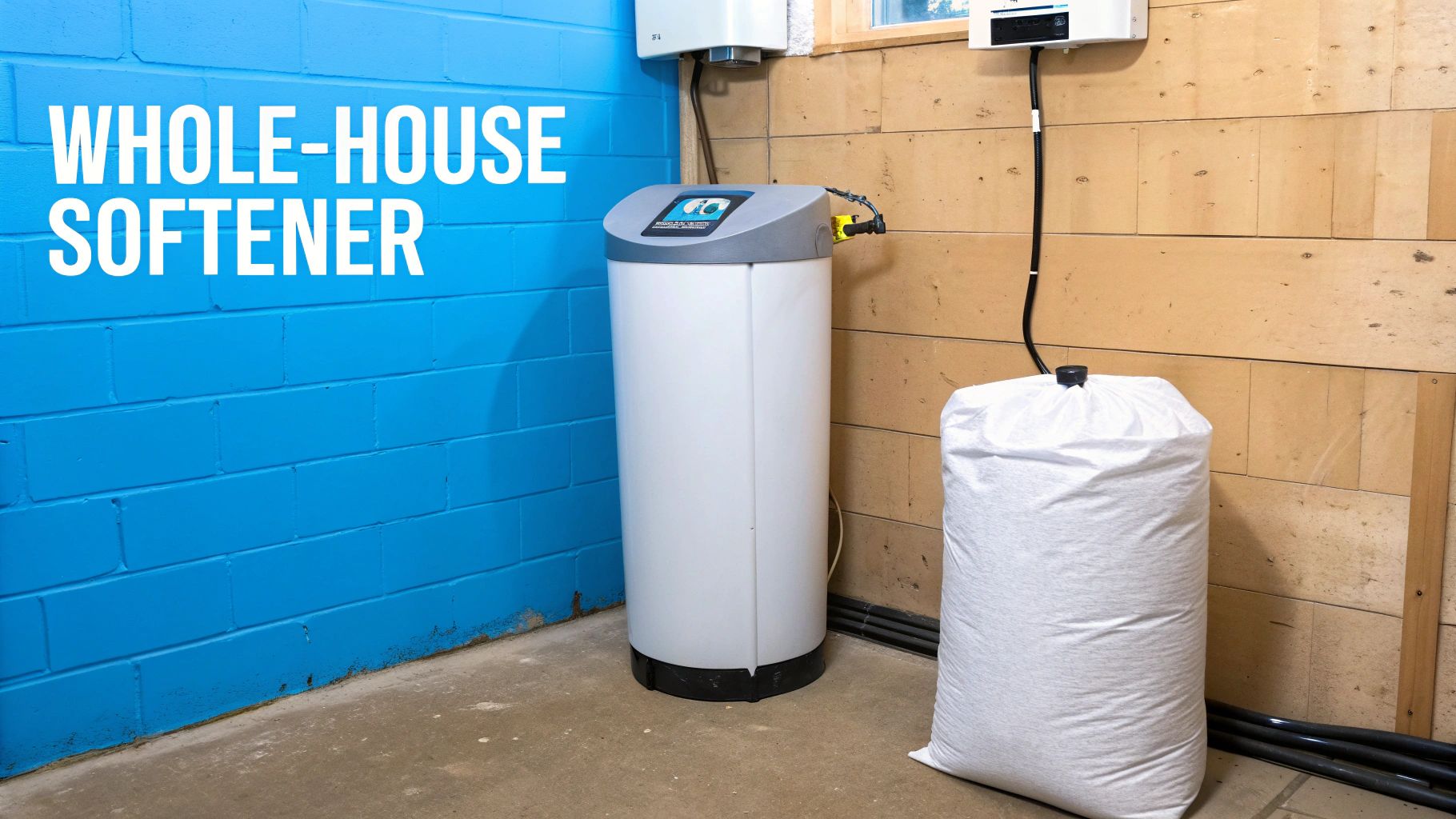
Whole-House Water Softeners: The Ultimate Calcium Defense

If you're sick of fighting a losing battle against hard water in every single room, it's time to stop playing defense and bring in the heavy artillery. For a truly comprehensive, set-it-and-forget-it solution, nothing beats a whole-house water softener. This is the undisputed champion of hard water treatment, installed right where your main water line enters your home to shield every pipe, faucet, and appliance from the tyranny of scale buildup.

Think of it as a bouncer for your entire plumbing system. Its one job is to catch the troublemakers—calcium and magnesium ions—and swap them out for something far more civilized before they can cause any problems. This process is called ion exchange, and it's the gold standard for a reason.

A water softener and salt bag in a basement with blue concrete block walls and wood paneling.

So, How Does This Ion Exchange Magic Work?

Inside every salt-based water softener is a tank packed with thousands of tiny resin beads. These beads come pre-loaded with harmless sodium ions. As your hard water flows through this tank, the calcium and magnesium ions—which carry a stronger positive charge—are magnetically drawn to the resin beads.

They literally kick the sodium ions off the beads and take their place. The newly "softened" water, now carrying the sodium ions, flows right on into your house. It’s a simple, elegant trade that happens millions of times as water passes through the system.

This process continues until the resin beads are completely saturated with calcium and magnesium, with no more sodium left to trade. At that point, the softener kicks into a self-cleaning mode called regeneration.

The Regeneration Cycle: What to Expect

Regeneration is just the softener’s way of hitting the reset button. The system automatically flushes the resin tank with a brine solution—a mix of salt and water from a separate tank. This concentrated saltwater bath washes away all the captured calcium and magnesium, sending them harmlessly down the drain.

This process recharges the beads with a fresh supply of sodium ions, getting them ready to soften more water. It’s usually programmed to happen in the middle of the night, based on your water hardness and how much water your family uses.

Your only job? Keep the brine tank topped up with water softener salt. Depending on your system and water quality, you might only need to add a new bag of salt every month or two. It’s a tiny bit of maintenance for total home protection.

Sizing Your System for Peak Performance

Picking the right size softener is absolutely critical. If it’s too small, it will constantly be regenerating, wasting salt and water. If it's too big, you’ve overspent, and it can lead to other issues.

Sizing boils down to two key numbers:

  • Your Water Hardness: Measured in grains per gallon (GPG), which you found with your water test.
  • Your Daily Water Usage: A solid estimate is 75 gallons per person, per day. A family of four would use about 300 gallons daily.

To figure out your daily softening needs, just multiply those two numbers.

Here’s a quick example:
Let's say a family of four has water with 15 GPG of hardness.
4 people x 75 gallons/person = 300 gallons per day
300 gallons x 15 GPG = 4,500 grains of hardness to remove daily.

This number tells you how much work the softener has to do each day. Softeners are rated by their grain capacity (e.g., 32,000-grain), which is how many grains they can remove before needing to regenerate. A perfectly sized system should only need to regenerate about once a week.

Investing in a whole-house system is a big move, but it provides a definitive answer to the hard water problem. For those wanting to dig deeper, exploring guides on the best whole house water filtration system for your home can provide even more context. A properly chosen softener will protect your home, save you money on appliance repairs, and improve your daily life—from softer skin to cleaner, brighter clothes.

Targeted Purity with Point-of-Use Filtration

What if your biggest headache isn't protecting your entire plumbing system, but just getting a great-tasting, clean glass of water from the kitchen sink? Maybe you're renting and can't install a big whole-house system, or perhaps you just don't see the point in treating the water you use to flush toilets.

This is exactly where point-of-use (POU) filtration shines.

Instead of a broad, house-wide approach, POU systems are like sharpshooters. They focus on a single faucet—usually in the kitchen—to give you exceptionally pure water right where you need it for drinking and cooking. When the goal is specifically how to remove calcium from water you're going to consume, the hands-down winner is a reverse osmosis system.

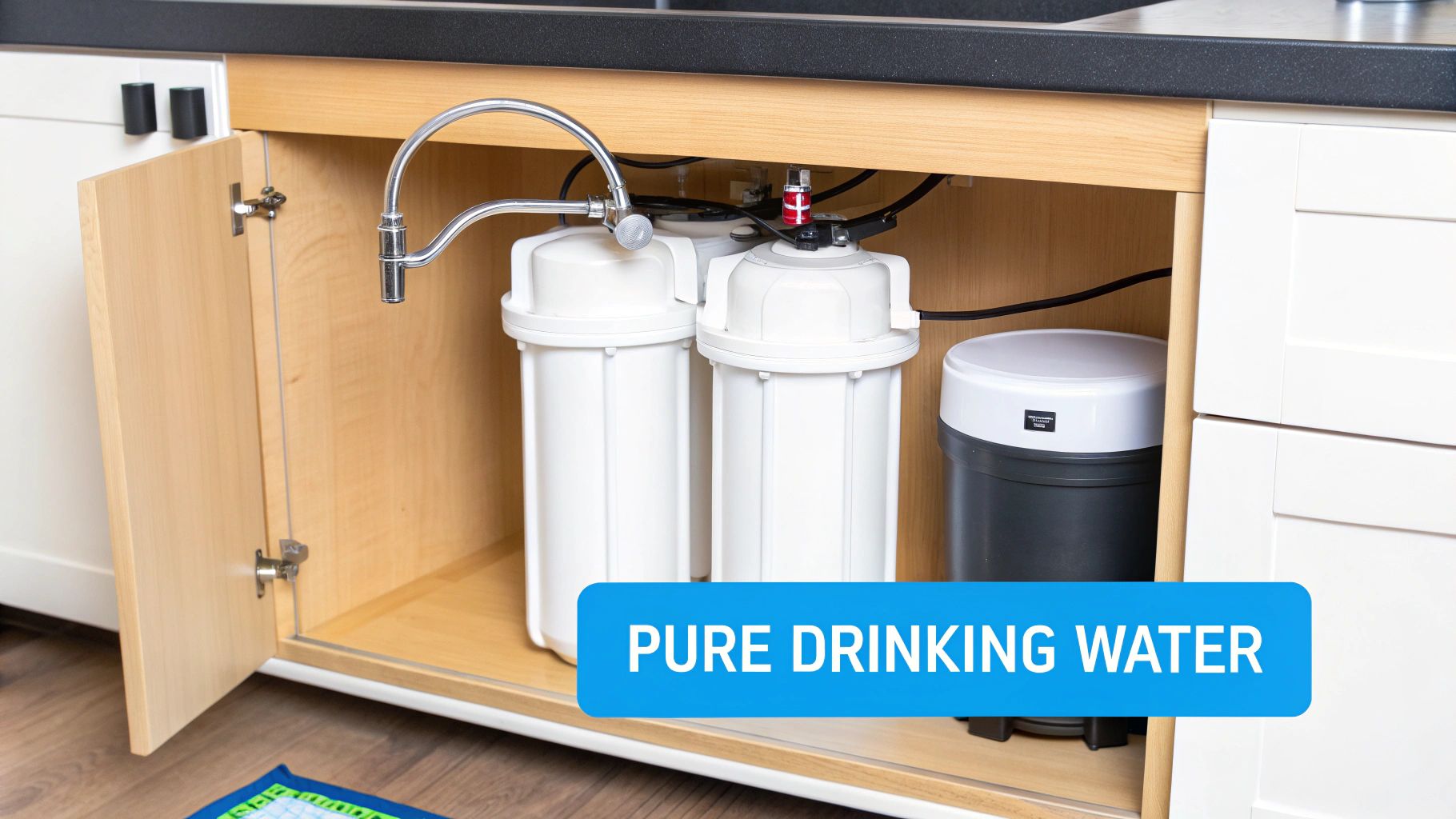
An under-sink water filtration system provides pure drinking water from a chrome faucet in a kitchen cabinet.

Reverse Osmosis: The Under-Sink Powerhouse

A reverse osmosis (RO) system is a multi-stage workhorse that typically lives in the cabinet right under your kitchen sink. This isn't your average pitcher filter; it's in a whole different league.

The magic happens at its semi-permeable membrane. Think of it as a microscopic bouncer at an exclusive club—the pores are so tiny that only water molecules are on the VIP list.

When your tap water is pushed against this membrane, the water molecules squeeze through to the clean side. Everything else—calcium, magnesium, lead, chlorine, and a whole host of other dissolved solids—gets rejected and washed down the drain. The result is stunningly pure water, with up to 99% of all contaminants stripped away.

Reverse osmosis doesn't just soften water; it purifies it. A water softener simply swaps calcium ions for sodium ions. An RO system physically removes the calcium completely, along with nearly everything else.

This makes RO the perfect fix if your goal is bigger than just fighting limescale. You get water that's not only free from hardness minerals but also tastes incredibly crisp and clean because all the other gunk affecting flavor and odor is gone, too.

How an RO System Works Under Your Sink

It helps to know what's going on inside the unit to appreciate its power. A typical under-sink RO system follows a few key steps:

  • Pre-Filters: Before the water even gets near the main membrane, it flows through sediment and carbon pre-filters. These are the bodyguards, catching big stuff like rust, dirt, and chlorine, which protects the delicate RO membrane from getting clogged or damaged.
  • The RO Membrane: This is where the real heavy lifting happens. Water pressure forces H₂O molecules through the membrane, leaving the calcium ions and other impurities behind to be flushed away.
  • Storage Tank: The RO process is slow and steady, so the purified water collects in a small pressurized tank. This gives you a ready supply of clean water the moment you open the tap.
  • Post-Filter: As a final touch, water from the tank passes through one last carbon filter on its way to your glass. This "polishing" filter removes any potential lingering tastes or odors from the tank.

All of this is hooked up to a sleek, dedicated faucet right on your sink. It’s the perfect setup for filling a water bottle, making coffee, or cooking pasta with water you know is as clean as it gets.

What About Water Distillers?

Another POU method that gets rid of calcium is distillation. A water distiller works by boiling water into steam, which leaves all the minerals and contaminants behind. The steam is then cooled and condensed back into pure liquid water.

Distillation is incredibly effective—it produces some of the purest water you can get. For day-to-day use in a home, though, distillers have some real-world drawbacks compared to RO systems.

Feature Reverse Osmosis (RO) Water Distiller
Speed Instant access from a tap Slow; takes hours to make a gallon
Convenience On-demand water Batch process; you have to fill it
Energy Use Uses water pressure Needs electricity to boil water
Installation Under-sink plumbing Sits on your countertop

While distillation is a great technology, its slow, batch-by-batch process just isn't practical for a busy kitchen that needs clean water now. For most homeowners who want to remove calcium for drinking and cooking, the on-demand convenience of a quality RO system makes it the obvious choice.

Getting It Installed and Keeping It Running

Choosing your water filtration system is the first big win, but the job isn't done yet. Proper installation and a little bit of upkeep are what will give you years of hassle-free, calcium-free water. It's like buying a fantastic new car; you still have to change the oil to keep it running smoothly.

This is your game plan for getting everything set up correctly and keeping it in top shape, whether you're a weekend DIY warrior or you'd rather hand the job to a pro. A little effort now saves you from major headaches down the road.

Setting Up Your Water Softener

A whole-house water softener is a serious piece of equipment, and its installation is more involved than, say, a new toaster. It needs to be plumbed directly into your main water line, usually between your water meter and your water heater. This is key because it ensures every drop of water entering your home gets treated.

If you've got solid plumbing skills, you can definitely tackle this yourself. But if you're even a little hesitant, call a plumber. A pro can get it done in a few hours, guaranteeing no leaks and a perfect setup from the start.

Once it's in, your most important job is to program the regeneration schedule. This is the automatic cleaning cycle where the system flushes out the collected minerals and recharges itself. Most modern softeners have a simple digital interface where you'll enter two numbers:

  • Your Water Hardness (GPG): That number you got from your water test.
  • The Number of People in Your Home: This helps the system estimate your daily water use.

With that info, the softener figures out the best time to regenerate—usually in the dead of night. Nailing this setting is critical for efficiency. It keeps the system from wasting salt and water by regenerating too often, or worse, not regenerating enough and letting hard water sneak through.

The Simple Routine of Softener Upkeep

After that initial setup, you’ll be pleasantly surprised by how low-maintenance a water softener is. Your main responsibility is just keeping the brine tank topped up with the right kind of salt.

  • Check Salt Levels: Once a month, just pop the lid and take a peek. As a rule of thumb, you always want the salt level to be higher than the water level.
  • Watch for "Salt Bridges": Every now and then, a hard crust can form over the top of the salt pile. This "bridge" stops the salt from dissolving into the water below. If the salt level hasn't budged in a while, give the side of the tank a gentle whack or use a broom handle to break up the crust.

And that’s about it. A well-maintained softener can easily last 15 years or more, quietly protecting your pipes and appliances from the shadows.

Pro Tip: Check your softener’s manual for its preferred salt type. Some newer high-efficiency models work best with purer salt pellets, while others are perfectly happy with the less expensive salt crystals.

Installing and Maintaining an RO System

Putting in an under-sink reverse osmosis (RO) system is a much more common DIY project. The kits usually come with everything you need and clear instructions. You’ll be tapping into your cold water line, drilling a small hole in your countertop for the dedicated RO faucet, and connecting the various filter housings and the storage tank.

The most important part of owning an RO system is sticking to the filter replacement schedule. An RO system is only as good as its filters, and if they get clogged, performance will plummet.

Filter Type Typical Replacement Schedule What It Does
Sediment Pre-Filter Every 6-12 months Catches the big stuff like rust, sand, and dirt.
Carbon Pre-Filter Every 6-12 months Removes chlorine, which can destroy the RO membrane.
RO Membrane Every 2-4 years This is the heart of the system; it removes the calcium.
Carbon Post-Filter Every 12 months Gives the water a final "polish" for a clean taste.

Put these dates on your calendar or set a reminder on your phone. Swapping filters on time is the number one thing you can do to ensure your RO system keeps delivering pure, great-tasting water. If you notice the water pressure from your RO faucet starting to drop, that's a classic sign a filter change is overdue.

Got Questions About Getting Rid of Calcium? We've Got Answers.

Even after doing your research, a few questions can still bubble up. That’s completely normal. When you’re dealing with something as vital as your home’s water, you want to be 100% sure you're making the right call. Let's tackle some of the most common things homeowners ask when they're figuring out how to remove calcium from their water.

Getting straight answers now means you won't have any surprises later. You can move forward feeling confident you’ve picked the best solution for your house and family.

Will a Water Softener Make My Water Taste Salty?

This is probably the number one concern we hear, but the short answer is no. The ion-exchange process adds a very small amount of sodium, not table salt (sodium chloride). The amount is directly tied to your water's hardness—the harder the water, the more sodium is needed to soften it.

Honestly, for most people, the amount of sodium is less than what’s in a single slice of white bread. The vast majority of people never even notice a change in taste.

Worried because you're on a strict low-sodium diet? You've got options. You can use potassium chloride pellets instead of sodium chloride. Another popular route is to pair your softener with an under-sink reverse osmosis system for drinking and cooking water, which will remove that added sodium anyway.

Can I Just Use a Standard Water Filter Pitcher to Remove Calcium?

It’s a great question, but unfortunately, those popular fridge pitchers are the wrong tool for this job. They typically use activated carbon filters, which are fantastic for making water taste and smell better by removing things like chlorine.

But they do absolutely nothing to remove dissolved hard minerals like calcium and magnesium. To really get rid of the minerals causing that crusty limescale, you need a system specifically designed for it, like an ion-exchange water softener or a reverse osmosis filter.

Is It Bad for Me to Drink Hard Water with Calcium in It?

Health-wise, drinking hard water is perfectly safe. In fact, your body needs essential minerals like calcium and magnesium to function properly. The whole reason for removing calcium from water has nothing to do with health—it's all about protecting your home and making your life easier.

The real problems caused by hard water are mechanical and cosmetic:

  • Limescale buildup that ruins appliances and clogs up your pipes.
  • Annoying spots and a filmy residue on your dishes, shower doors, and faucets.
  • Dry, itchy skin and hair that feels dull and brittle because of soap scum.

At the end of the day, people install these systems to stop expensive damage to their homes and to make daily tasks like cleaning and showering a whole lot more enjoyable.


Figuring out the world of water filtration can seem like a lot, but Water Filter Advisor is here to keep it simple. We create clear, research-backed guides to help you land on the perfect solution for your home's unique water needs. Check out our in-depth reviews and expert advice at https://www.waterfilteradvisor.com to get safer, better-tasting water today.

How to Remove Nitrates from Well Water for a Safer Home

If you've got nitrates in your well water, a standard pitcher filter just isn't going to cut it. You need a dedicated system to tackle this specific problem. For home use, the two most reliable technologies are reverse osmosis and ion exchange. Both are fantastic at physically removing or swapping out the nitrate ions, bringing your water back into a safe range and giving you peace of mind.

Why Nitrates in Your Well Water Are a Silent Problem

That glass of water from your well might look perfectly clear and refreshing, but it could be hiding a dangerous secret. Nitrates are one of the most common contaminants found in groundwater, and you'd never know they were there—they have no color, taste, or smell. This makes them a silent but serious issue for millions of well owners.

Unlike city water, which is constantly tested and treated, a private well is 100% the homeowner's responsibility. The buck stops with you when it comes to ensuring your family's water is safe to drink.

Where Do Nitrates Come From?

Nitrates (NO₃⁻) are just nitrogen compounds that dissolve easily in water. While they occur naturally at low levels, human activity can cause their concentration in groundwater to skyrocket. Think of the ground as a giant sponge; anything put on the surface can eventually seep down into the very water your well taps into.

The most common culprits behind high nitrate levels are:

  • Agricultural Runoff: Nitrogen-based fertilizers are a primary source. When farmers apply more fertilizer than crops can use, the excess washes away with rain or irrigation, filtering down into the groundwater.
  • Septic Systems: An old, failing, or poorly placed septic tank can leak untreated waste into the surrounding soil, releasing a steady stream of nitrates.
  • Livestock Manure: Runoff from large farms and animal feedlots is loaded with nitrogen from animal waste, which can contaminate nearby wells.

Ultimately, tackling nitrate contamination at its source means looking at how the land around us is managed. Practices focused on improving soil quality naturally play a huge role in preventing nitrates from leaching into our water supplies in the first place.

The Hidden Health Risks

For most healthy adults, a little nitrate in their water isn't a huge deal. But for vulnerable groups, it’s a completely different story. The biggest danger is a condition called methemoglobinemia, better known as "blue baby syndrome."

When infants under six months drink water high in nitrates, their bodies convert those nitrates into nitrites. This messes with the blood's ability to carry oxygen, which can be fatal.

The U.S. Environmental Protection Agency (EPA) set the safe drinking water limit for nitrates at 10 milligrams per liter (mg/L)—or 10 parts per million (ppm). This standard was put in place specifically to protect infants from blue baby syndrome.

Pregnant women and people with certain health conditions like anemia or heart disease are also at greater risk. Because the threat is so severe, figuring out how to remove nitrates from your well water is absolutely essential for your family's safety.

Your Options for Nitrate Removal

The good news is that there are proven home filtration technologies that can solve this problem. Just know that your Brita filter or standard water softener won't touch nitrates. And whatever you do, don't boil the water! Boiling only makes the problem worse by increasing the nitrate concentration as the water evaporates.

Effective solutions target nitrates directly. This problem is more widespread than you might think; the USGS estimates that about 7% of domestic wells in the U.S. have nitrate levels above the safe limit. You can dig into the data from the USGS water quality assessment yourself.

To get you started, here’s a quick rundown of the most effective technologies we'll cover in this guide.

Quick Guide to Home Nitrate Removal Methods

This table summarizes the best filtration methods for getting rid of nitrates in your well water, so you can see at a glance how they work and what they're best used for.

Filtration Method How It Works Best For
Reverse Osmosis Uses high pressure to force water through a semipermeable membrane, blocking nitrates and other contaminants. Point-of-use systems for drinking and cooking water; also removes a wide range of other contaminants.
Ion Exchange Employs a special resin that captures nitrate ions from the water and replaces them with harmless chloride ions. Whole-house (point-of-entry) systems where all water in the home needs treatment for nitrates.
Distillation Boils water to create steam, leaving nitrates and other impurities behind, then condenses the steam back into pure water. Smaller, countertop batches of highly purified water; effective but slow and energy-intensive for daily use.

Each of these systems has its own set of pros and cons, which we'll dive into next to help you pick the right one for your home.

First Things First: Get a Real Number on Your Nitrate Levels

Before you even think about buying a filter, you need to know exactly what you’re dealing with. When it comes to your family’s health, guessing is not an option. Nitrates are sneaky—you can't see them, taste them, or smell them. Testing is the only way to find out if they're in your well water and at what concentration.

If you're on a private well, this is all on you. Unlike city water, which is tested regularly by law, your well's safety is your responsibility. Think of it as a crucial first step in taking control of your water quality.

From a Quick Check to a Certified Analysis

You've got a couple of ways to go about testing. The one you pick really just depends on if you need a quick ballpark number or a precise figure you can bank on.

  • DIY Test Strips: These are the fast and cheap route. Dip a strip in your water, wait a second, and match the color to a chart. They're perfect for a quick spot-check or for making sure your filter is still working down the road. Just know they give you a range, like 10-20 mg/L, not a hard number.

  • Professional Lab Analysis: This is the undisputed champ for accuracy. You'll grab a water sample following their instructions and mail it off to a state-certified lab. The report you get back will be dead-on precise, giving you the exact nitrate concentration. This is the data you need to choose and size a treatment system correctly.

While those DIY strips are handy, I always tell people to start with a professional lab test. It's the only way to know your starting point for sure.

So, what do the numbers on the report actually mean? You'll see nitrates listed as either milligrams per liter (mg/L) or parts per million (ppm). Don't let it confuse you—they're the exact same thing. 10 mg/L is identical to 10 ppm.

What to Do With Your Test Results

Once that report is in your hands, the magic number you're looking for is 10 mg/L. That's the Maximum Contaminant Level (MCL) set by the EPA. If your number is at or above 10 mg/L, you need to take action, especially if you have infants or pregnant women in the house.

Let me give you a real-world example. I worked with a family out in a rural area who were getting nervous about all the farming nearby. They’d never tested their well before. The lab report came back with a nitrate level of 15 mg/L—a full 50% over the safety limit.

That one number changed everything. It took their vague worry and turned it into a concrete problem with a clear solution. Armed with that 15 mg/L figure, they knew they needed a serious system like reverse osmosis or a dedicated anion exchange filter. That's the power of good data; it removes the uncertainty and puts you on a clear path to safe water.

Your Guide to the Best Nitrate Filtration Systems

Okay, you've got your water test results in hand and a hard number for your nitrate levels. Now for the fun part: picking your weapon.

When it comes to removing nitrates from well water, three technologies consistently rise to the top: Reverse Osmosis (RO), Ion Exchange, and Distillation. Each one gets the job done differently, and the best fit for your home really comes down to your specific needs, your budget, and how you use your water.

Let's dig into these workhorse methods and see what makes them tick.

Reverse Osmosis: The All-Around Contaminant Blocker

Think of a filter so ridiculously fine it can stop individual ions in their tracks. That's the magic behind reverse osmosis.

An RO system uses your home's water pressure to force water through a special, semipermeable membrane. This membrane acts like a super-strict bouncer at a nightclub—it lets pure water molecules slip through but slams the door on larger molecules. That includes dissolved salts, heavy metals, and, most importantly for us, nitrates.

Because it’s a beast at removing a whole slew of contaminants (often 90-98% of them), RO is a very popular choice. The purified water gets stored in a small tank under your sink, ready to go from a dedicated faucet. This makes it a perfect "point-of-use" (POU) system that treats just the water you'll be drinking and cooking with.

The trade-off? RO systems do produce wastewater, often called brine, which carries all those rejected contaminants down the drain. For every gallon of pure water you get, a few gallons get flushed. Modern systems are much better about this, but it's something to keep in mind. They also strip out everything, even beneficial minerals, which can make the water taste a bit "flat."

Ion Exchange: The Targeted Nitrate Swapper

If RO is a broad-spectrum shield, ion exchange is more like a heat-seeking missile aimed squarely at nitrates. This approach uses a tank packed with millions of tiny resin beads that have been "charged" with harmless chloride ions.

As your well water flows through this resin bed, a pretty clever swap takes place. The resin is more attracted to the nitrate ions in your water than the chloride ions it's holding. So, it snatches the nitrates out of the water and releases an equal amount of chloride to take their place. It’s a clean, efficient, and highly effective trade.

This efficiency makes ion exchange a great choice for "point-of-entry" (POE), or whole-house systems, treating every single drop of water coming into your home. The system does need to "regenerate" every so often. This involves flushing the resin with a saltwater brine to wash away all the captured nitrates and recharge the beads with fresh chloride.

Heads Up: An ion exchange system for nitrates uses a special anion resin to target negatively charged ions like nitrates (NO₃⁻). This is not the same as a standard water softener, which uses a cation resin to go after positively charged hardness minerals like calcium.

Distillation: The Original Water Purifier

Distillation is basically nature's purification process, condensed into a countertop appliance. A distiller works by boiling your water, turning it into pure steam. When the water evaporates, it leaves everything else behind—nitrates, minerals, heavy metals, you name it.

That pure water vapor is then collected and cooled in a separate chamber, where it condenses back into liquid. What you're left with is exceptionally pure water, free from pretty much all impurities. It’s a bulletproof method for getting rid of nitrates.

The catch is that distillation is slow. It works in batches and uses a fair amount of electricity to do its thing. It’s just not practical for treating all the water in your home or for getting a quick glass of water on demand. It’s really best for making smaller amounts of ultra-pure water for drinking, cooking, or maybe for medical devices. You can see similar principles at work in high-purity lab water purifier systems.

What you decide to do with your water test results is the most critical step.

A flowchart asking 'Is your water safe?' leading to 'Safe' for clean water and 'Unsafe' for polluted water.

This decision tree shows the simple path from testing your water to confirming it's safe. An "unsafe" result means it's time to take action.

Nitrate Removal System Comparison: Reverse Osmosis vs. Ion Exchange vs. Distillation

Trying to pick the right system can feel like a lot. To make things a little easier, we’ve put the top three methods side-by-side to see how they stack up on the things that matter most to a homeowner.

Feature Reverse Osmosis Ion Exchange Distillation
Primary Use Point-of-Use (drinking water) Point-of-Entry (whole-house) Countertop (small batches)
Effectiveness Excellent (90-98% removal) Excellent (90-95% removal) Near total removal (99%+)
Other Contaminants Removes a wide range Only removes specific anions Removes nearly everything
Installation Cost Low to Moderate Moderate to High Low (no installation)
Operating Cost Moderate (filter changes) Moderate (salt, water) High (electricity)
Maintenance Regular filter/membrane changes Refill salt, occasional resin care Regular cleaning/descaling
Water Taste Can taste "flat" or "empty" May have slightly salty taste Very pure, flat taste

So, what's the bottom line? For most families just wanting to ensure their drinking and cooking water is safe, a point-of-use reverse osmosis system hits the sweet spot of performance, cost, and convenience. If you need to treat every faucet in your house, a dedicated nitrate-selective ion exchange system is the way to go. Distillation remains a solid, if niche, choice for those who need the absolute highest purity in smaller quantities.

Choosing the Right System Setup for Your Home

Alright, you’ve done the hard part. You understand the tech behind reverse osmosis and ion exchange and have a feel for their strengths and weaknesses. Now it's time to bring it home—literally. This isn't just about picking a product off a shelf; it's about matching the right hardware to your family's daily life and the unique plumbing of your house.

The whole decision really hinges on one simple question: do you need to treat every drop of water in your house, or just the water you drink and cook with? Your answer will point you straight to the perfect setup.

Point-of-Use vs. Point-of-Entry Systems

The first fork in the road is deciding between a Point-of-Use (POU) and a Point-of-Entry (POE) system. I like to think of it as the difference between a scalpel and a floodlight—one is for precision work, the other for broad coverage.

A Point-of-Use (POU) system gets the job done right where you need it most. The classic example is an under-sink reverse osmosis unit that feeds a special, dedicated faucet right next to your main kitchen tap.

  • Who it's for: Frankly, most households dealing with nitrates. The health risk is all about ingestion, so zeroing in on your drinking and cooking water is an incredibly smart and budget-friendly approach.
  • What it looks like in practice: You'll fill your water bottle, coffee maker, and pasta pots from this dedicated faucet. Water for washing hands or dishes at the main sink, along with every other tap in the house, will still be your regular, untreated well water.

On the other hand, a Point-of-Entry (POE) system is the full-house solution. We install this beast right where the main water line comes into your home, treating every single drop of water that flows past it.

  • Who it's for: This is for homes with seriously high nitrate levels or other water quality problems you want gone everywhere. It’s the comprehensive, no-compromise option.
  • What it looks like in practice: This is a much bigger job, both in terms of equipment and installation. Because of the high flow rates needed to run a whole house, ion exchange is the go-to technology for POE nitrate removal.

For the vast majority of families I work with, a POU system is the clear winner for nitrates. It tackles the actual health risk head-on without the cost and complexity of a whole-house installation.

Let me give you a real-world example. A family finds their well water has nitrate levels around 12-15 mg/L. They install an under-sink RO system. This gives them total confidence in the water they drink, while they continue to use untreated well water for showering and laundry, where nitrates pose zero risk. It's the perfect balance.

Sizing Your System for Your Family

Once you've picked your approach (POU or POE), you have to make sure the system can actually keep up with your household's demand. It all comes down to capacity and flow rate.

For a POU reverse osmosis system, the magic number is Gallons Per Day (GPD). A standard under-sink unit might be rated at 50 to 75 GPD. That doesn't mean you'll use 50 gallons in a day, but it tells you how fast the system can produce purified water to refill its little storage tank. For a family of four, a 50 GPD system is almost always plenty for all your drinking and cooking needs.

For a POE ion exchange system, we're talking about flow rate, measured in Gallons Per Minute (GPM). You need a system that won’t leave you with a dribbling shower just because the dishwasher kicked on. A pro will calculate your home's peak demand, but for reference, a typical family home usually requires a system that can handle 10-15 GPM without breaking a sweat.

Pre-Filters and Post-Treatments: The Unsung Heroes

A top-tier nitrate removal system is rarely a solo act. To protect your main unit and get water that actually tastes great, you absolutely need to think about what happens before and after the heavy lifting.

Pre-filtration is non-negotiable with well water. Period. Your well can kick up sediment, sand, and rust that will shred a delicate RO membrane or gum up the resin beads in an ion exchange system in no time.

  • Sediment Filter: This is your system’s bodyguard. It’s a simple cartridge that grabs all the physical gunk before it can do any damage to the expensive parts downstream.
  • Carbon Filter: If you've got any "earthy" or chemical tastes and odors in your water, a carbon pre-filter is fantastic for absorbing them before they get to the main unit.

Post-treatment is all about polishing the water to perfection right before it hits your glass. This is especially crucial for reverse osmosis.

  • Remineralization Filter: RO is so effective it strips out everything, including beneficial minerals like calcium and magnesium. This can leave the water tasting sterile and "flat." A remineralization filter adds a touch of these healthy minerals back, which makes a world of difference in taste and can slightly balance the water's pH.
  • UV Purifier: If your water test also flagged any bacteria or viruses, a UV light is the perfect final security checkpoint. Added after the main system, it zaps any lingering microorganisms to ensure total safety.

Putting these pieces together means you’re not just buying a filter—you’re building a complete system that will run efficiently, last for years, and deliver consistently safe and delicious water.

Keeping Your Water Safe with Smart System Maintenance

A person holding a maintenance checklist, inspecting an under-sink water filtration system and pipes in a cabinet.

Putting in a new filtration system is a great first move, but it's definitely not a "set it and forget it" kind of deal. Think of it like a new car—you wouldn't skip the oil changes, right? Regular maintenance is what keeps that system running smoothly and protecting your family for years to come.

If you let it slide, even the best system will eventually stop working effectively. Filters clog, membranes get fouled, and resin beds get worn out. This isn't just a performance issue; it directly impacts the safety of your water.

Your Reverse Osmosis Maintenance Checklist

Reverse osmosis systems are the go-to for nitrate removal, but their multi-stage setup means you need to pay attention to a few different parts. Each component has a specific job and, more importantly, a limited lifespan.

Your system’s manual is the best guide, but here’s a general schedule to keep in mind:

  • Sediment & Carbon Pre-filters: These are the gatekeepers, protecting the delicate RO membrane from grit and chlorine. You'll want to replace these every 6 to 12 months.
  • RO Membrane: This is the core of your system. If you take care of the pre-filters, the membrane itself can last 2 to 3 years. A classic sign it’s failing is a noticeable drop in how much water it produces.
  • Carbon Post-filter: This last filter is what polishes the water for taste. Swap it out every 12 months to keep things tasting fresh and clean.

Keeping Your Ion Exchange System Regenerating

An ion exchange system is pretty low-maintenance, but it has one critical need: salt. The salt in the brine tank is what recharges the resin beads, allowing them to keep grabbing nitrates out of your water.

Think of the salt as fuel for your nitrate removal engine. If you let the brine tank run dry, the system can't recharge, and nitrates will start slipping right through into your taps.

Pop the lid on your brine tank at least once a month. A good rule of thumb is to always keep it at least half-full. The good news? The resin bed itself is a real workhorse, often lasting 10 years or more with proper care.

The Simple Care for Distillation Units

If you went with a distiller, you’ve got the easiest maintenance routine of the bunch. Because distillers boil water, their main enemy is the mineral buildup (or scale) that gets left behind. This limescale can coat the heating element and make the whole unit less efficient.

Just plan on cleaning it every few weeks or once a month, depending on how hard your water is. It's usually a simple process involving a cleaning cycle with some white vinegar or a descaling solution. Let it soak, give it a rinse, and you’re back in business.

The Non-Negotiable Annual Re-Test

No matter what system you have, this is the one maintenance step you can't skip: re-testing your well water every year. It’s the only way to know for sure that your system is still doing its job.

Well chemistry can change. It can be affected by seasonal shifts, nearby farming, or even a failing septic system. An annual lab test confirms your filter is handling the current nitrate levels and will catch any new issues before they become a real problem.

This is especially critical since high nitrate levels over the 10 mg/L limit are a serious health concern, linked to "blue baby syndrome" and other risks. If you want to dig deeper, you can learn more about the global impact of nitrate contamination and see why staying on top of it is so important.

This yearly check-up gives you true peace of mind. It’s the final step in knowing you’ve successfully removed the nitrates from your well water—and that they’re staying out.

Common Questions About Nitrates in Well Water

Even with all the facts, some questions always pop up when you're trying to figure out how to handle nitrates in your well water. Let's run through the most common ones I hear to get you on the right track.

Can I Just Boil My Water to Get Rid of Nitrates?

This is a huge, and frankly dangerous, mistake. Never boil water to remove nitrates. Boiling is great for killing bacteria, but it actually makes your nitrate problem worse.

As the water boils, some of it turns to steam and escapes, but the nitrates get left behind. This means you end up with the same amount of nitrates in less water, which shoots their concentration way up.

If you start with water at 10 mg/L, a good boil can easily push that to 15 mg/L or more. That's a big jump into a more dangerous zone, especially for infants.

Will a Regular Water Softener or Pitcher Filter Work?

Nope, sorry. A standard water softener is a type of ion exchange system, but it’s only built to grab positively charged things like the calcium and magnesium that cause hard water. Nitrates are negatively charged, so a softener just lets them slide right by.

Same deal with that carbon filter in your fridge pitcher. It’s a champ at getting rid of chlorine and making your water taste better, but it physically can't trap dissolved nitrates. You need a specific tool for the job, like reverse osmosis or a special nitrate-selective ion exchange filter.

Is an Under-Sink System Really Enough?

For most families, absolutely. A point-of-use (POU) system that sits right under your kitchen sink is usually the perfect fit. The real health risk from nitrates comes from drinking the water or using it to mix baby formula or cook.

A POU unit, like a reverse osmosis system, treats just the water you’ll actually consume. This makes it a super effective and affordable way to solve the problem. Going with a whole-house system is usually overkill unless your nitrate levels are off the charts or you're dealing with a bunch of other water quality problems at the same time. For more general tips on home setups, you can find a lot of good water filtration advice to see what might work for you.

My Neighbor's Well Is Fine, So Mine Should Be Too, Right?

I wouldn't bet on it. It’s amazing how different well water can be, even from one yard to the next.

Things like the depth of your well, the local geology, which way the groundwater is flowing, and how close you are to a septic tank or a fertilized field can create totally different conditions. The only way to know for sure what's in your water is to get your own test done.


At Water Filter Advisor, our goal is to help you find the right fix for your home's water. Check out our guides and reviews to make a smart choice for your family's health over at https://www.waterfilteradvisor.com.
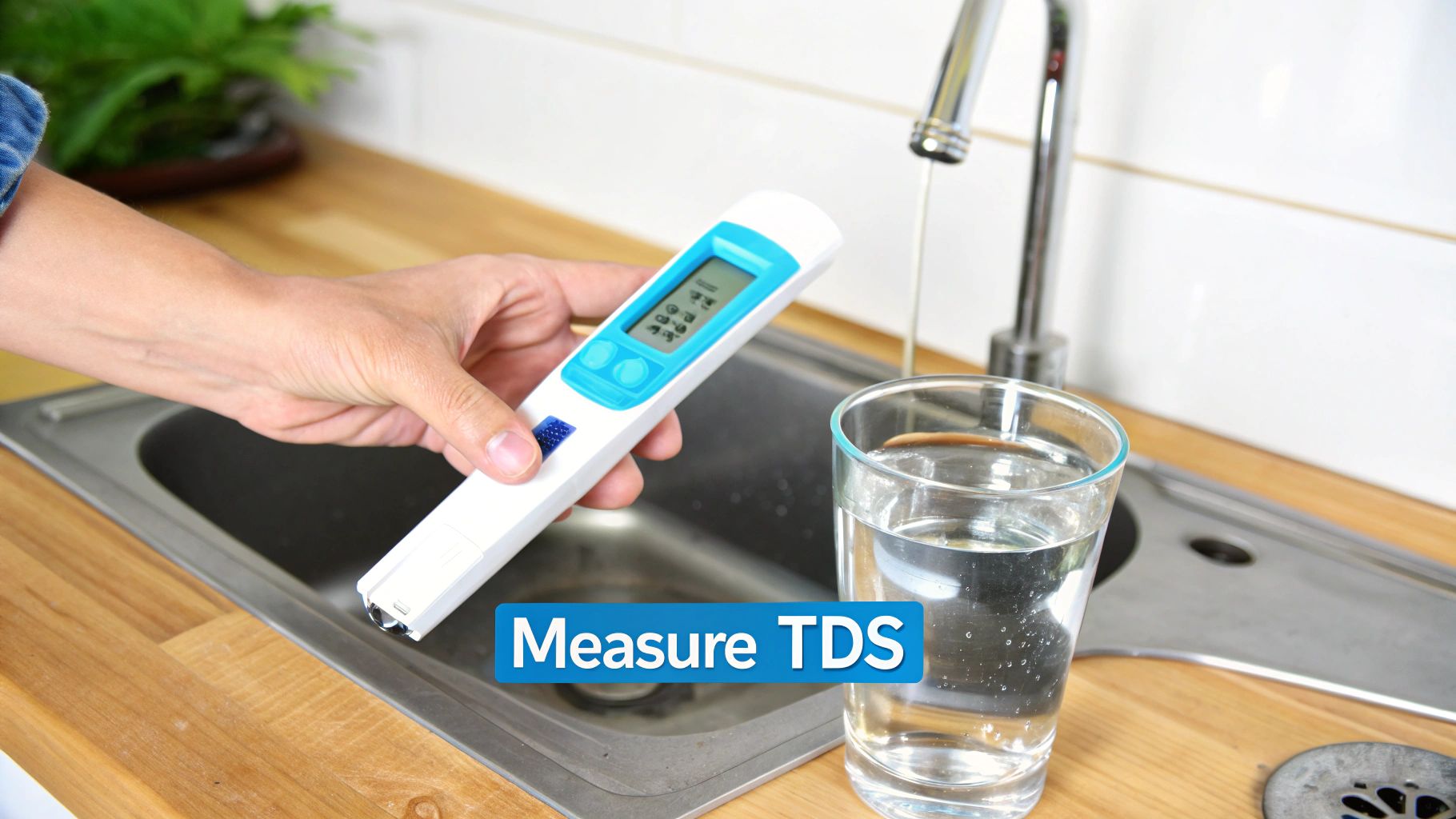
What is a TDS Meter: Your Secret Weapon for Better Home Water

Ever poured a glass of tap water, held it up to the light, and wondered what’s really swimming around in there? It might look crystal clear, but your water is carrying a secret cargo of dissolved stuff—minerals, salts, metals, you name it.

Think of a TDS meter as your personal water quality detective. This simple handheld gadget gives you a near-instant reading of the Total Dissolved Solids (TDS) in your water. In just a few seconds, you get a snapshot of what’s going on with your water, giving you the power to know if your home water filter is actually doing its job.

Your Quick Guide to Water Purity Testing

A person tests water purity in a glass with a TDS meter on a modern kitchen counter.

Just because water looks clean doesn't mean it is. It can be carrying all sorts of dissolved materials that make your coffee taste off, give your ice cubes a weird cloudy look, or even build up as crusty scale inside your pipes and appliances over time.

This is where understanding Total Dissolved Solids, or TDS, becomes a game-changer for any homeowner interested in better water.

A TDS meter doesn't magically identify every single substance. Instead, it measures the water's electrical conductivity. The more dissolved ionic solids like salts and minerals there are, the more easily electricity can pass through. The meter translates this conductivity reading into a number, usually in parts per million (ppm), which gives you a solid estimate of the total "stuff" dissolved in your water.

What Does Your First Reading Actually Mean?

Getting a number from the meter is the easy part. Making sense of it is where the fun begins. A high reading isn't automatically a red alert, as many of those dissolved solids are perfectly harmless minerals like calcium and magnesium that our bodies can use.

But what that number does give you is a crucial baseline.

A TDS reading is your first clue in an investigation. It tells you if there's a high concentration of dissolved "stuff," prompting you to ask the next important question: "What is that stuff, and is my filter removing it?"

This simple piece of information is incredibly valuable, especially if you have a water filter or are thinking about getting one. It’s the starting point for deciding if your tap water could taste better, be kinder to your home, and if your filtration system is truly earning its keep. For anyone who cares about the quality of the water in their home, a TDS meter is an essential tool.

So, How Does This Little Gadget Actually Work?

It might seem like some kind of high-tech magic, but the science behind a TDS meter is actually pretty straightforward. It's not "seeing" or identifying individual particles in your water. Instead, it’s measuring how well your water can conduct electricity.

Imagine your glass of water is a tiny highway. All those dissolved solids—the calcium, magnesium, sodium, and so on—are the cars on that road. Pure, distilled water is like a completely empty highway; electricity has a tough time getting from one side to the other. But once you add those mineral "cars," you create a perfect path for an electrical current to flow right through.

A TDS meter uses this exact principle. Its tip has two little metal probes (electrodes). When you dip it in water, the meter sends a tiny, harmless electrical charge from one probe to the other.

From Electricity to a Simple Number

The meter then measures how much of that electrical charge makes it to the second probe. The more dissolved solids you have, the more "cars" are on the highway, and the stronger the electrical signal will be. This measurement is called electrical conductivity (EC).

From there, a smart little chip inside the meter takes that EC reading and converts it into a number we can all understand: parts per million (ppm). It’s important to know that this is a very good estimate, not a precise chemical breakdown from a lab.

In short, a TDS meter isn't counting particles. It's really just checking the electrical traffic in your water and giving you a simple number that represents the total amount of dissolved stuff.

This is what makes a TDS meter such a fantastic tool for any homeowner. You get an instant snapshot of your water quality without having to send a sample off to a lab.

Why This Matters for Your Water Filter

Once you understand how it works, the readings become a powerful tool. For example, if you test the water coming from a reverse osmosis (RO) system, you want to see a very low number. RO systems are designed to strip out nearly all of those conductive minerals.

So, if you test your RO water and the reading is almost the same as your tap water, you know something’s up. The "highway" is still packed with cars, which means your filter isn't doing its job anymore. This simple electrical checkup gives you the feedback you need to keep your system running right and ensure your family is drinking pure, clean water.

Decoding the Numbers on Your TDS Meter

Getting a number to pop up on your TDS meter’s screen is the easy part. But what does it actually mean? That's where you turn a simple number into real, useful knowledge about your home's water quality.

The most important thing to remember is that different water sources have wildly different—and often perfectly normal—TDS levels. A reading of 250 ppm from your city tap water might be totally fine, but seeing that same number from your reverse osmosis system would definitely tell you something is wrong. It all comes down to the source and the filter.

What Is a Good TDS Reading for My Water?

Honestly, the "ideal" TDS level depends on your personal taste and your filtration goals. Well water, for example, naturally picks up beneficial minerals like calcium and magnesium as it filters through layers of rock. A higher reading here isn't a red flag; it just means you have mineral-rich water.

On the other hand, a good reverse osmosis (RO) system is designed to strip out pretty much everything, getting the water as pure as possible. In that case, a low reading, often below 50 ppm, is exactly what you want to see. It’s a clear sign your filter is doing its job right.

Illustration comparing a blue water drop labeled 'Low TDS' with an orange drop labeled 'High TDS' indicating water quality.

This just shows that a higher TDS simply means more "stuff" is dissolved in the water. That stuff could be anything from harmless minerals to contaminants you'd rather not drink. Your filter's job is to remove the unwanted stuff.

Comparing Common Household Water Sources

To make sense of your own results, it helps to see how they stack up against typical levels for other types of water you might find around the house. Bottled spring water is going to have a much different TDS profile than your tap water, and both will be different from the water coming out of your refrigerator's filter.

Each source has a unique story, and its TDS level is a big part of that.

Remember, a "high" TDS reading doesn't automatically mean "bad water." It's simply an indicator of a higher concentration of dissolved substances. The crucial next step is understanding what those substances might be and if your filter is removing them.

The table below gives you a quick reference for what to expect when you test different water sources. Think of it as a cheat sheet to help you benchmark your own results and figure out if your filter is performing as it should.

Typical TDS Levels in Common Household Water Sources

Here’s a quick comparison of average TDS readings you can expect from different types of water you might test at home.

Water Source Typical TDS Range (ppm) Primary Dissolved Solids
Reverse Osmosis Water 0 – 50 ppm Very few; highly purified. A low number confirms the filter is effective.
Bottled Spring Water 50 – 200 ppm Natural minerals like calcium and potassium that contribute to taste.
Typical Tap Water 150 – 400 ppm A mix of chlorine, salts, and minerals added during municipal treatment.
Well Water 200 – 500+ ppm Naturally occurring minerals like magnesium, calcium, and iron from the ground.

Seeing where your water falls on this chart can give you a much better sense of whether your numbers are normal or if it's time to investigate your filtration options further.

What a TDS Meter Cannot Tell You

While a TDS meter is a fantastic tool to have in your water filtration toolkit, it's really important to know what it doesn't do. Think of it this way: it's like stepping on a bathroom scale. The scale gives you one number—your total weight—but it can't tell you your body fat percentage, muscle mass, or bone density. It just sees the total.

A TDS meter is the same way with your water. It gives you a single number for the total quantity of dissolved stuff, but it has absolutely no idea what that stuff is. If you remember only one thing about its limitations, let it be that.

It only picks up on solids that can conduct electricity. That means a whole host of nasty contaminants can be floating around in your water, completely undetected by your meter.

What Your TDS Meter Won't Detect

Because the meter works by measuring electrical conductivity, it's totally blind to some of the most serious water contaminants people worry about. These substances don't carry an electrical charge, so as far as the meter is concerned, they simply don't exist.

A TDS meter will NOT detect:

  • Lead and Other Heavy Metals: Things like arsenic, mercury, and chromium won't show up.
  • Pesticides and Herbicides: Runoff from farms or your neighbor's lawn? Your meter won't see it.
  • Pharmaceuticals: Trace amounts of medications in the water supply are invisible to a TDS test.
  • Chlorine: The very disinfectant your city uses to treat the water doesn't register.
  • Bacteria and Viruses: Biological threats like E. coli are not measured at all.

This same principle applies in other areas, too. For instance, understanding pool water maintenance is all about using specific tests for chlorine and pH levels, not just a TDS meter, to keep the water safe and balanced.

A low TDS reading does not guarantee your water is safe. It only means there is a low amount of dissolved ionic solids like minerals and salts.

So, what's the takeaway? Use your TDS meter as a first-pass screening tool for your water filter's performance. A high number is a red flag telling you it's time to get a real lab test that can pinpoint exactly what’s in your water. Only then can you choose a filter that actually solves your problem.

Using a TDS Meter with Your Water Filter

A TDS meter, glass of water, and plant, illustrating water quality before testing.

Okay, this is where a TDS meter really shines. It stops being just a neat gadget and becomes your go-to partner for home water filtration. Think of it as a report card for your filter, giving you clear, hard numbers on whether it’s actually doing its job.

The key is the simple "before and after" test. This is especially powerful if you have a system designed to strip out nearly everything, like a Reverse Osmosis (RO) unit. It’s the easiest way to know if your investment is paying off.

The Before and After Performance Check

It couldn’t be simpler. First, grab a sample of your regular tap water and jot down the TDS reading.

Then, run that same water through your filter system and test the filtered water. That's it. The gap between those two numbers tells you everything.

A good RO system should be knocking out over 90% of the total dissolved solids. So, if your tap water starts at 300 ppm, the water coming out of your RO faucet should be way down, ideally under 30 ppm. If those numbers are creeping closer together, it's a huge red flag that your filter membranes are shot and need to be replaced.

This quick check takes all the guesswork out of the equation. Forget just swapping filters when the calendar says so. Now you can change them based on actual performance, making sure you’re always getting the pure water you paid for.

Why Different Filters Affect TDS Differently

Here’s something important to remember: not all filters are made the same, and they definitely don't all tackle TDS. A meter helps you understand what your filter is supposed to do, so you don't have unrealistic expectations.

  • Carbon Filters (like in pitchers or on your faucet): These are great for making water taste and smell better by removing things like chlorine. They don't remove dissolved mineral salts, so you’ll see little to no drop in your TDS reading. That's normal!
  • Reverse Osmosis (RO) Systems: These are the champs of TDS reduction. An RO system forces water through a special membrane that strips out the vast majority of dissolved solids. With these, you expect to see a huge drop in the TDS number.
  • Water Softeners: This one trips people up. A softener works by swapping "hard" mineral ions (calcium, magnesium) for "soft" sodium ions. Since it's just trading one dissolved solid for another, a water softener will not lower your TDS. In fact, it might even make it go up slightly.

People are catching on to this. The global market for digital TDS meters hit about $2.5 billion in 2023 and is expected to grow to around $3.8 billion by 2028. This isn't just a niche hobby; it's a worldwide trend of people wanting to know exactly what’s in their water.

Once you know how your filter is meant to work, your TDS meter becomes a powerful tool. And if you're looking into different filtration options, our guides have some great advice on choosing the right water filter for your needs. At the end of the day, a TDS meter is the accountability partner that proves your filter is living up to its promises.

Your Simple Guide to Using a TDS Meter

https://www.youtube.com/embed/EtoCiUM9RwE

Ready to find out what's in your water? Good news: using a TDS meter is about as easy as it gets. You can get a reading in less than a minute.

Just pop the cap off, turn it on, and dip the end with the two metal probes into a glass of your water. You don't need to sink the whole thing—just the tip.

Give it a gentle swirl to knock off any tiny air bubbles that might be clinging to the probes. After a few seconds, the number on the display will lock in. That’s it! That number is your TDS reading in parts per million (ppm).

Tips for an Accurate Reading

To make sure your results are reliable every single time, a few little habits go a long way. This is especially important if you're trying to track how well a water filter is working over time.

  • Test at Room Temperature: The temperature of the water can actually change the reading. For the most consistent and accurate results, try to test your water when it's around 77°F (25°C).
  • Use a Clean Glass: Seems obvious, but any leftover soap or residue in a glass can easily throw off your numbers. Always grab a sparkling clean, well-rinsed glass for your sample.
  • Keep the Probes Clean: After you're done, give the meter’s probes a quick rinse with distilled water (if you have some) and gently wipe them dry. This stops minerals from building up and messing with your next test.

A Quick Word on Calibration

Most TDS meters are all set and calibrated right out of the box. But like any measuring tool, they can drift a bit over time and lose their pinpoint accuracy.

Calibration is just a fancy word for resetting your meter against a solution with a known TDS level, making sure its readings are trustworthy.

If you test your water a lot, it’s a smart move to check the calibration every few months. A quick tune-up with a calibration solution ensures you can always trust the numbers you're seeing, giving you real confidence in your water quality.

Common Questions About Using a TDS Meter

Even after getting the hang of it, you might still have a few questions floating around. That’s perfectly normal. Let's tackle some of the most common things people ask when using a TDS meter to figure out their water.

What Is the Ideal TDS Level for Drinking Water?

Honestly, there isn't a single "perfect" number because everyone's taste is a little different. For safety and aesthetics, the EPA recommends keeping TDS below 500 ppm.

Many people find that water with some natural minerals, usually in the 50-150 ppm range, tastes best. On the other hand, if you're using a high-quality reverse osmosis system, you'll see readings under 50 ppm, which gives you that exceptionally pure, crisp taste.

Does High TDS Mean I Have Hard Water?

It's a really strong hint, but it's not a definite "yes." Hard water is specifically caused by high concentrations of calcium and magnesium. Since those are dissolved solids, water that's truly hard will always give you a high TDS reading.

But, you can also get a high TDS reading from other things like sodium or potassium, which don't cause hardness. Just think of it this way: a TDS meter points toward potential hardness, but you'd need a specific hardness test to be sure.

A high TDS reading is a signal to investigate, not to panic. It’s your first step toward understanding your water, empowering you to ask the right questions and find the best filtration solution for your home.

My Tap Water Reading Is High. What Should I Do?

A high number is just your cue to do a little more digging. A great first step is to look up your local water utility’s annual quality report, which you can usually find online. This report breaks down exactly what's in your municipal water.

If you're on well water or just want more detail, the best next move is a comprehensive lab test. A professional analysis will pinpoint the specific substances pushing your TDS up, so you can choose a water filter that actually targets those contaminants.


Ready to take the next step toward purer, better-tasting water? The experts at Water Filter Advisor provide in-depth guides and unbiased reviews to help you find the perfect filtration system for your home. Explore your options at https://www.waterfilteradvisor.com.
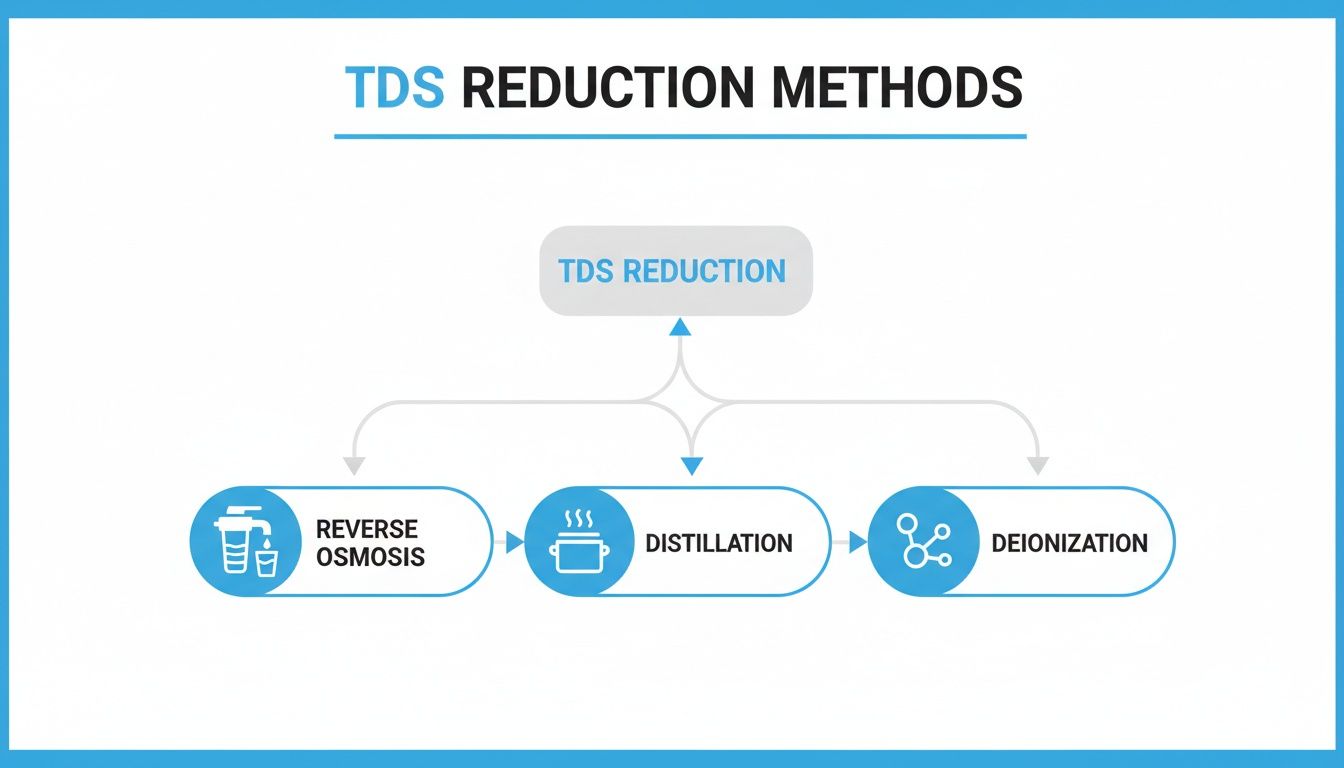
Finding Your Perfect Home Water Filtration System: The Ultimate Guide

Let's be real: choosing the best home water filtration system feels a lot like trying to order a coffee in a café with a fifty-item menu. Do you want the pour-over, the cold brew, the reverse-osmosis-double-shot-latte? It's confusing! But relax. Finding the right system isn't about knowing all the jargon; it's about figuring out what you want from your water. For some, it’s a fortress-like whole-house system that guards every tap. For others, it's a specialized under-sink unit that turns kitchen water into liquid gold. The perfect fit is always a blend of power, price, and practicality for your home.

Your Guide to Choosing the Right Water Filter

A person pouring a glass of clean, filtered water from a kitchen faucet into a glass.

Diving into the world of home water filters can make your head spin. You’ll hear terms like "reverse osmosis," "activated carbon," and "point-of-entry," and it’s tempting to just close the tab and grab another bottle of water. But let's cut through the noise. The mission is simple: make the water your family drinks, cooks with, and bathes in as pristine as possible.

This guide is your friendly translator. We're going to give you a clear roadmap to help you pick the system that's genuinely right for you. Think of this not as a chore, but as an upgrade to your home—an investment in your family's health and your own peace of mind.

Why This Decision Matters More Than Ever

Let's face it, we're all a little more obsessed with what's in our water these days, and for good reason. The global market for home water filtration was pegged at around USD 13.98 billion in 2024, and it's projected to rocket to nearly USD 37.54 billion by 2034. That explosive growth isn't just a trend; it's a sign that we're all becoming more aware of waterborne contaminants and demanding safer options right from our own taps. You can read more about the growth of the home water filtration market if you love digging into the data.

We'll break down everything you need to know, from the big-gun systems to the quick-and-easy fixes, so you can match the right filter to your specific water woes.

A Quick Comparison of Popular System Types

Before we get into the nitty-gritty, let's get a bird's-eye view. This table is your cheat sheet to the most common options, showing you at a glance what they do and where they live.

System Type Primary Coverage Best For Typical Installation
Whole-House Every tap and appliance in the home Comprehensive protection against chlorine, sediment, and chemicals Professional installation at the main water line
Under-Sink A single tap, usually the kitchen sink Purifying drinking and cooking water with high precision DIY or professional installation under the sink
Faucet-Mounted A single faucet Renters or those seeking an easy, temporary solution Simple DIY installation directly on the faucet
Countertop Dispensing purified water Small households or individuals wanting a portable option No installation; sits on the counter

Once you see these categories, you can start to figure out which path makes sense for your home, your lifestyle, and your clean-water goals.

Comparing Home Water Filtration System Types

Figuring out the best water filter for your home really comes down to one question: where do you want to treat your water? Think of it like home security. You could install a massive system that guards every window and door, or you could put a single smart camera on the front porch. Both are effective, but they solve very different problems.

Each type of filter has a specific superpower. Your choice will likely depend on whether you own or rent, and if your main quest is simply better-tasting drinking water or protecting your entire home's plumbing from unseen villains. Let's meet the four main contenders.

Whole-House Systems: The All-Encompassing Guardian

A whole-house water filtration system is the big kahuna. Also known as a Point-of-Entry (POE) system, it’s the most comprehensive solution on the market. Installed right where your main water line enters your house, it acts as a bouncer, cleaning every drop of water before it gets inside. That means your kitchen faucet, showers, washing machine, and dishwasher all get the VIP treatment with filtered water.

This is the only setup that truly protects your plumbing and appliances from the crud—like sediment and chlorine—that can cause damage over time. For a homeowner, it’s a game-changer. You’ll get chlorine-free water for showers and baths (hello, softer skin and hair!), and you'll extend the life of your appliances by stopping scale and gunk before they can build up. It’s a long-term investment in your home’s health.

A huge, often overlooked benefit here is protecting your home's entire plumbing network. By catching sediment and chlorine at the source, a whole-house system stops the slow, steady corrosion and clogging that can lead to some seriously expensive repair bills down the road.

Under-Sink Systems: The Drinking Water Specialist

While a whole-house system is great for broad-spectrum defense, an under-sink water filter is a specialist, a sniper rifle aimed squarely at the water you drink and cook with. Tucked away in the cabinet under your kitchen sink, these systems use advanced technologies like reverse osmosis to deliver incredibly pure water right where it matters most.

These units tap into your cold water line and typically come with their own dedicated, elegant faucet. This is perfect for homeowners and renters who want to eliminate specific, hard-to-catch contaminants like lead, fluoride, pesticides, or pharmaceuticals from their drinking water, without wasting filter life on the water used to flush the toilet.

Here’s where an under-sink system really shines:

  • For the Health-Conscious Family: A good reverse osmosis system can remove up to 99% of total dissolved solids (TDS). That’s about as pure as H₂O gets.
  • For the Gourmet Cook: Filtered water makes everything taste better. Your morning coffee, evening tea, soups, and even pasta will have a cleaner, more vibrant flavor without the chemical aftertaste.
  • For Apartment Dwellers: Many of these systems are surprisingly easy to install and, more importantly, uninstall, making them a practical, high-performance choice when you can't make permanent changes.

Countertop and Faucet-Mounted Filters: The Convenient Solvers

If you're looking for simplicity and a setup you can complete in the time it takes to make a cup of coffee, countertop filters and faucet-mounted filters are your heroes. These Point-of-Use (POU) systems are incredibly easy to install and are a fantastic choice for renters, dorm rooms, or anyone who can't (or doesn't want to) mess with their plumbing.

A faucet-mounted filter screws right onto your kitchen tap, and a little lever lets you switch between filtered and unfiltered water instantly. Countertop filters sit next to your sink, connecting with a small tube to filter water into their own dispenser. Both are champions at making tap water taste and smell better by kicking chlorine to the curb. Just know their capacity is smaller, and they won't remove as broad a range of contaminants as the bigger systems.

Still, their convenience and low upfront cost make them the best home water filtration system for individuals, college students, or small households with basic water quality concerns.

How Different Water Filtration Technologies Perform

Choosing the best home water filtration system is less about the box it comes in and more about the magic happening inside. Once you understand how different filtration methods work, you can match a system to the specific troublemakers in your water. Let's pull back the curtain on what these technologies actually do.

We'll look at the four major players in home water filtration: Activated Carbon, Reverse Osmosis (RO), UV Purification, and Ion Exchange. Each one is a specialist, designed to tackle a different set of challenges, from a funky chlorine taste to invisible microbial invaders.

This map gives you a quick visual on how different filters are categorized by where they go in your home.

Infographic about best home water filtration system

As you can see, the first decision is where you need filtration—the whole house, a single sink, or just a countertop pitcher. That choice starts to narrow down the technology you'll probably end up with.

Activated Carbon: The Workhorse for Taste and Odor

Activated carbon is the rockstar of the filter world, found in everything from simple pitchers to massive whole-house systems. It works like a chemical magnet. Its surface is covered in millions of microscopic pores, creating a huge surface area that traps organic compounds and chemicals like chlorine through a process called adsorption.

This is precisely why activated carbon filters are the undisputed champions at making municipal water taste and smell fantastic. They are brilliant at removing chlorine, chloramines, volatile organic compounds (VOCs), and some pesticides. For most people on city water, a good carbon filter is all it takes to turn funky tap water into something crisp and refreshing.

Just know its focus is specific. Activated carbon won’t touch heavy metals like lead, dissolved minerals, nitrates, or microorganisms. It's a targeted tool, not a cure-all.

Reverse Osmosis: The Purity Powerhouse

When you want water that is as pure as a mountain spring, Reverse Osmosis (RO) is the undisputed king. This technology uses household water pressure to force water through a semipermeable membrane with pores so tiny that almost nothing besides a water molecule can squeeze through.

RO systems are absolute beasts at removing a massive list of contaminants, including:

  • Heavy metals like lead, arsenic, and mercury.
  • Dissolved solids such as salts, fluoride, and nitrates.
  • Even some viruses and bacteria.

This level of purification makes it the gold standard for drinking water. The market agrees; reverse osmosis systems claimed over a 38% revenue share in 2021 because they’re just that effective. UV systems also hold a big piece of the market, valued for their ability to neutralize pathogens. You can review the home water filtration unit market analysis for more data on these trends.

But this power comes with a trade-off. The RO process is slow and it produces wastewater—for every gallon of pure water, several gallons carrying the rejected contaminants are flushed away. It also strips out beneficial minerals like calcium and magnesium, which can affect the water’s taste and pH.

UV Purification: The Microbial Guardian

Unlike other methods that physically trap contaminants, UV Purification is a silent assassin. It zaps water with ultraviolet light, which scrambles the DNA of microorganisms like bacteria, viruses, and protozoa (think Giardia and Cryptosporidium). This renders them harmless, preventing them from reproducing and making you sick.

A UV purifier isn't a "filter" in the traditional sense, since it doesn't remove anything from the water. Its one and only job is to make water microbiologically safe. This makes it an absolute must-have for homes on well water, which isn't treated by a municipality and can be a breeding ground for nasty bugs.

It's critical to remember that UV systems always need a pre-filter, usually for sediment. UV light can only work its magic in clear water; any murkiness can act like a shield, protecting pathogens from the purifying light. It has zero effect on chemicals, heavy metals, or chlorine.

Ion Exchange: The Hard Water Specialist

Ever seen that chalky white limescale on your faucets or struggled to get a good lather from your soap? You've met hard water. Ion Exchange is the technology built to solve that exact problem and is the science behind traditional water softeners.

The system uses a bed of resin beads charged with sodium (or sometimes potassium) ions. As hard water flows through, the beads grab onto the hardness minerals—calcium and magnesium—and release the sodium ions in their place. This "exchange" effectively softens the water, saving your plumbing and appliances from scale buildup.

Some specialized ion exchange resins can also target other contaminants like nitrates or even heavy metals. But like UV, it’s a highly specific tool. It won't remove chlorine, sediment, or bacteria, so it’s usually part of a larger system, not a standalone solution for drinking water.

To help you sort through it all, here's a quick breakdown of how each technology stacks up against common water issues.

Filtration Technology Performance Matrix

Technology Removes Chlorine & Odor Removes Lead & Heavy Metals Removes Bacteria & Viruses Average Annual Cost Best For
Activated Carbon Excellent Poor No $50 – $200 Improving the taste and smell of city water.
Reverse Osmosis Excellent Excellent Good $150 – $300 Maximum purity for drinking water, removing a wide range of contaminants.
UV Purification No No Excellent $100 – $150 Disinfecting well water or ensuring microbiological safety.
Ion Exchange No Some (Specialized) No $200 – $400+ Softening hard water to prevent scale buildup and protect appliances.

At the end of the day, the best home water filtration system is often a combination of these technologies, custom-built to tackle the unique chemistry of your home's water.

Finding a Filter for Your Unique Household Needs

A family smiling and drinking glasses of clean water in their kitchen.

Sure, the technical specs on a water filter box are a good start, but they don't tell the whole story. The best filter is the one that solves your problems and fits into your life without a fuss. A powerful whole-house system is overkill for a solo renter, while a simple pitcher just won't cut it for a large family on well water.

Let's walk through a few real-world scenarios to see how to match the right technology to the right home.

The Renter in a City Apartment

Picture this: you're in a downtown apartment. You can't touch the plumbing, but you're tired of that swimming-pool taste in your tap water and the endless parade of plastic water bottles. Your mission is simple: get better-tasting water for drinking and cooking, no plumber required.

In this scenario, a non-permanent, point-of-use (POU) system is the hero. Your best bets are:

  • A High-Quality Water Pitcher: The easiest fix of all. A pitcher with a solid activated carbon filter will zap that chlorine taste and smell almost instantly.
  • A Faucet-Mounted Filter: This gives you filtered water on demand, right from the tap. It screws on in minutes and comes off just as easily when you move.
  • A Countertop Reverse Osmosis System: If you’re worried about more than just taste—like lead from the building's old pipes—a countertop RO unit brings serious purification power without any installation headaches.

The name of the game here is convenience. These options require zero permanent changes and deliver immediate results where you need them most: the kitchen.

The Health-Focused Family with Young Children

Now, let's imagine a family in a suburban home with young kids. Safety is their top priority. They’ve seen their local water quality report and are concerned about potential lead from aging city pipes, industrial chemicals like PFAS, and disinfection byproducts.

This family needs a serious line of defense for their drinking water. The clear winner is an under-sink reverse osmosis (RO) system. An RO system is a purification powerhouse, capable of removing up to 99% of all dissolved solids from your water.

This technology is a champion at targeting contaminants like:

  • Lead and other heavy metals
  • PFAS "forever chemicals"
  • Chlorine and chloramines
  • Nitrates and fluoride

By putting an RO system under the kitchen sink, this family gets peace of mind. They know every glass of water, every baby bottle, and every pot of pasta is made with truly purified water. It's targeted, high-level protection without the cost of treating every drop in the house.

If you're already planning some work, keep in mind that a big project like an ultimate kitchen remodel checklist is the perfect time to integrate an under-sink system. Planning for it during a renovation makes the installation seamless.

The Rural Homeowner on Well Water

Finally, let’s head out to the country to a home on a private well. Unlike city water, well water is untreated. It can come with a whole menu of surprises depending on the local geology—sediment, hard water minerals, iron that leaves ugly orange stains, and even bacteria or viruses.

For this homeowner, a single filter won't do the job. The best solution is a customized, multi-stage whole-house (point-of-entry) system designed to tackle the well's specific problems head-on.

A common setup for well water usually involves a few key stages:

  1. A Sediment Pre-Filter: This is the first line of defense, catching all the sand, dirt, and rust to protect the more delicate filters downstream.
  2. An Iron Filter or Water Softener: An iron filter gets rid of that metallic taste and prevents staining, while a softener tackles the calcium and magnesium that cause nasty limescale buildup.
  3. A Carbon Filter: This stage handles chemical contaminants, pesticides, and any lingering bad tastes or odors.
  4. A UV Purifier: This is the non-negotiable final step. An ultraviolet light zaps any bacteria, viruses, or other microorganisms, making the water safe to drink without adding chemicals like chlorine.

This layered strategy ensures that every single tap—from the kitchen sink to the shower—delivers clean, safe, and great-tasting water, protecting both the family's health and the home's plumbing.

What to Look For Before You Buy a Water Filter

So, you’re ready to get cleaner water. Fantastic! But it’s easy to get swayed by marketing hype. To find a system that actually delivers on its promises, you need to look past the flashy ads and focus on a few key details.

This is your final checkpoint. We'll walk through the essential questions to ask, making sure the filter you choose is a sound investment for your home and health.

The absolute first thing to look for is third-party certification. This isn't just a "nice to have"—it's proof that a filter actually works. Certifications from organizations like the NSF (National Sanitation Foundation) and ANSI (American National Standards Institute) mean the system has been independently tested to do what it claims.

Understanding Key Certifications

Not all certifications are created equal. They test for different contaminants, so knowing what they mean helps you find the right filter for your specific water problems.

  • NSF/ANSI 42: Think of this as the "taste and smell" certification. It confirms a filter's ability to reduce aesthetic impurities like chlorine. If your goal is simply better-tasting tap water, this is a great standard to look for.
  • NSF/ANSI 53: This one is all about health effects. It's a much tougher standard that verifies a filter can remove specific, harmful contaminants like lead, mercury, asbestos, and parasites like Cryptosporidium. If you have health concerns, this certification is non-negotiable.
  • NSF/ANSI 58: This standard is specifically for reverse osmosis (RO) systems. It validates the system’s power to drastically reduce a long list of contaminants, including hard-to-remove ones like fluoride, nitrates, and heavy metals.

A filter without independent certification is just making a promise. An NSF/ANSI certified system has provided proof, giving you confidence that it will protect your family's health as advertised.

Flow Rate and Long-Term Costs

Beyond what a filter removes, you have to consider how it performs day-to-day. For whole-house systems, the flow rate—measured in gallons per minute (GPM)—is a huge deal. An undersized system will lead to a frustrating drop in water pressure whenever you try to shower and run the dishwasher at the same time.

Make sure the GPM rating of any whole-house system can handle your household's peak demand. A good rule of thumb is to estimate the flow rates of your major water-using appliances and fixtures.

Finally, think beyond the sticker price. The true cost of ownership includes the initial purchase, installation, and the ongoing expense of replacement filters. A cheap system with expensive, short-lived filters can end up costing you far more over time than a quality unit with longer-lasting filters. For more guidance on this, check out our collection of water filter advice.

Installation and Professional Help

The last piece of the puzzle is getting it installed. Faucet filters and countertop units are easy DIY jobs you can finish in minutes.

However, under-sink and whole-house systems often require cutting into your home’s plumbing. If that sounds intimidating, it's wise to budget for a professional. Understanding the scope of general plumbing services can help you find a qualified installer to get the job done right—no leaks, no hassle, just peace of mind.

Common Questions About Home Water Filtration

It’s normal to have a few final questions before choosing a new filter. Getting a handle on the day-to-day details is what makes the difference between a good purchase and a great one. Let's tackle some of the most common things people ask when choosing the best home water filtration system.

First, how do you even know what you’re trying to filter out? It’s simpler than you might think.

Your local water utility is required to publish an annual Consumer Confidence Report (CCR), or water quality report. A quick search on your town's website should bring it right up. This report gives you a detailed look at what contaminants were tested for and at what levels.

If your home uses a private well or you just want a more specific reading of the water coming from your pipes, grab an at-home water test kit. It's a great way to pinpoint issues like lead, bacteria, or hardness that a city-wide report might miss.

Do Water Filters Remove Healthy Minerals?

This is a fantastic question, and the answer depends entirely on the filtration technology.

Filters that rely on activated carbon—including most pitchers, faucet attachments, and many basic whole-house systems—are selective. They excel at grabbing chemicals like chlorine but typically let beneficial minerals like calcium and magnesium pass right through. You get cleaner water without sacrificing the good stuff.

A Reverse Osmosis (RO) system, on the other hand, is a purist. Its membrane is so fine that it strips out nearly everything, including those healthy minerals. While this produces incredibly pure water, many people add a remineralization filter to their RO setup to put those essential minerals back into the water for better taste and health benefits.

How Often Should I Change The Filter?

Sticking to the manufacturer's replacement schedule is non-negotiable. An old, clogged filter doesn't just stop working; it can become a breeding ground for bacteria and potentially dump all the contaminants it caught right back into your water.

Here’s a rough idea of what to expect:

  • Faucet Filters: Every 2 to 3 months is typical.
  • Under-Sink Carbon Filters: Plan on every 6 to 12 months.
  • RO Membranes: These are the long-haul players, often lasting 2 years or more.
  • Whole-House Sediment Filters: This depends heavily on your water quality, but a 3 to 6-month swap is common.

Always follow the official schedule for your specific model. It’s the only way to guarantee your system is working as certified and keeping your water consistently safe and delicious.


Ready to take the next step toward cleaner, safer water? The experts at Water Filter Advisor provide in-depth reviews, comparisons, and maintenance guides to help you make a confident choice. Visit us at https://www.waterfilteradvisor.com to find the perfect solution for your home.