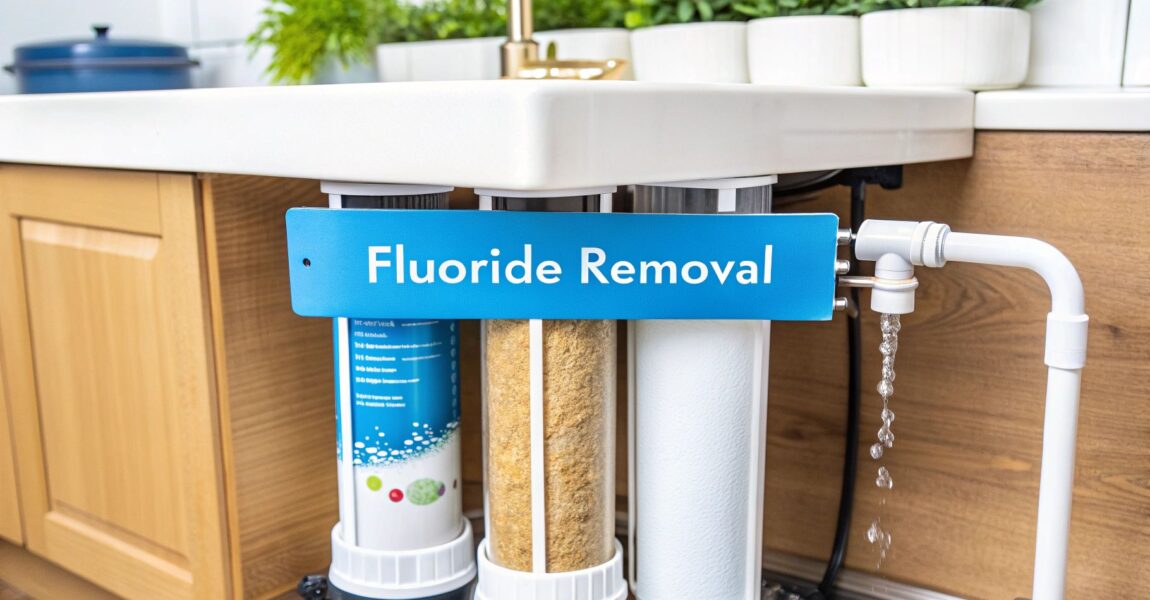
When it comes to getting fluoride out of your home’s drinking water, here's the straight truth: your standard Brita-style pitcher filter just isn't going to get the job done. To really take on this specific contaminant, you need a filtration system built for the task. It's a special ops mission, and you need the right gear.
The most reliable, proven technologies are Reverse Osmosis (RO), Activated Alumina, and Bone Char Carbon. Each one uses a completely different process to grab and remove those tiny fluoride ions, ensuring your tap water is as pure as you want it to be.
Finding the Right Fluoride Filter for Your Home
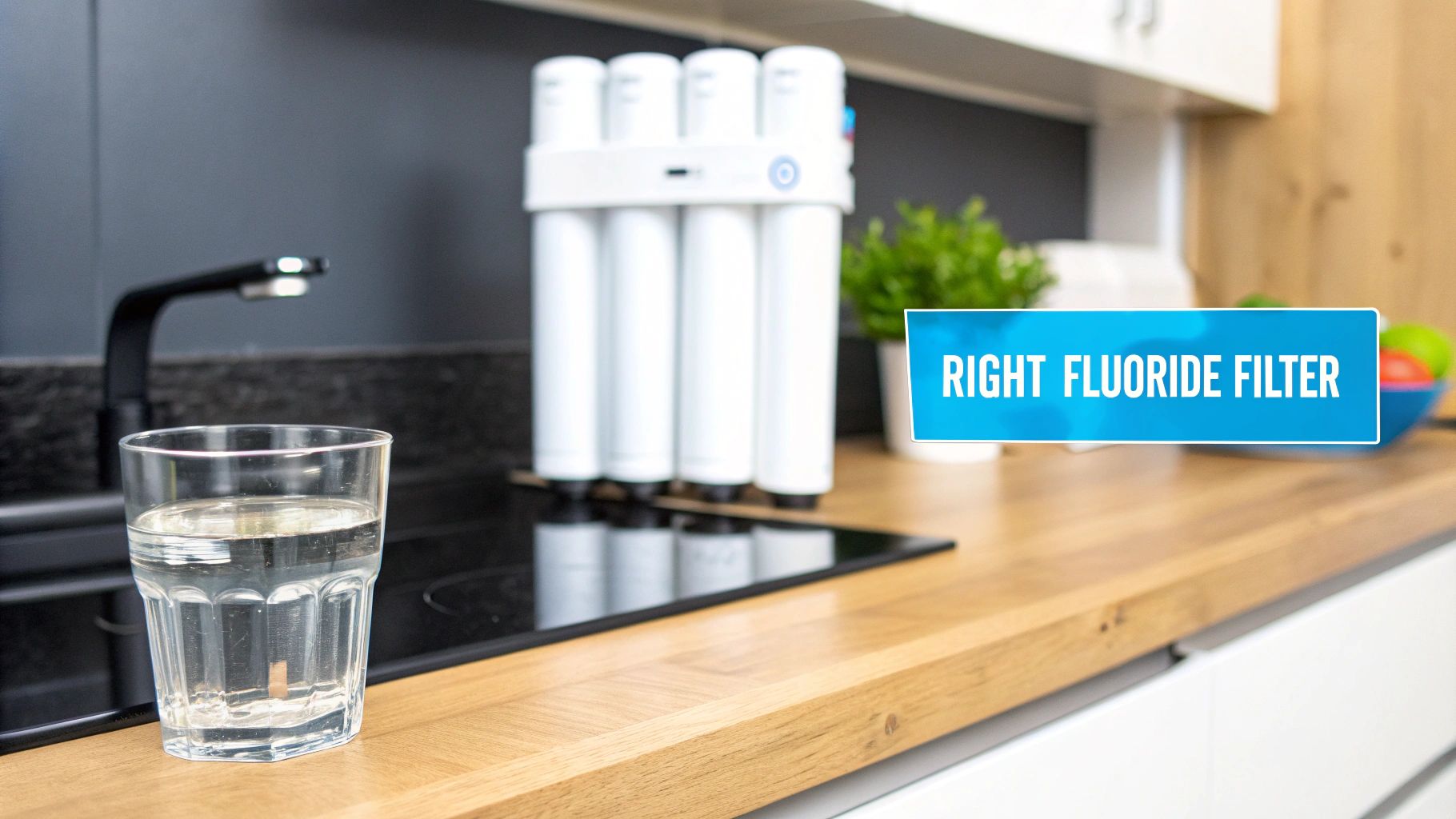
Picking the right water filter can feel like navigating a maze, but it’s simple when you know the secret: fluoride is a dissolved mineral. This means it behaves very differently in water than the chunky stuff like chlorine or sediment that most basic filters are designed to catch.
Think of it this way: a standard carbon filter is like a fishing net trying to catch grains of sand. The sand (our fluoride) is so fine it slips right through the holes. To actually filter out fluoride, you need a method with a much, much finer "net"—or one that can attract the fluoride ions like a magnet.
The Proven Technologies
This is where the three heavy hitters come into play. Each one has a unique superpower for tackling fluoride, and understanding their different approaches is the first step to choosing your champion.
Here's a quick look at how they work:
- Reverse Osmosis (RO): This high-tech method uses serious pressure to force water through a special membrane packed with microscopic pores. Water molecules get VIP access, but fluoride and other dissolved solids are left behind at the velvet rope.
- Activated Alumina (AA): This filter media acts like a specialized magnet for fluoride. As water passes over it, fluoride ions are literally pulled out of the water and stick to the alumina surface.
- Bone Char Carbon: This is an all-natural media made from charred animal bone. It works through a process called adsorption, where fluoride ions chemically bond to its unique surface.
Understanding these core technologies is essential. You'll see a lot of products out there making big claims, but only filters using one of these three methods have been consistently proven to slash fluoride levels in your home's drinking water.
To give you a quick, at-a-glance comparison, the table below lines up these top methods side-by-side. It focuses on what matters most to homeowners—how well they work, what they cost, and where they make the most sense in your home. This should give you a solid starting point before we dig into the details of each.
Comparing Top Fluoride Removal Technologies
Here's a quick comparison of the most effective filter types for removing fluoride, highlighting their performance, cost, and best applications for homeowners.
| Filtration Technology | Fluoride Removal Rate | Ideal Application | Average Cost |
|---|---|---|---|
| Reverse Osmosis (RO) | Up to 99% | Under-sink systems for drinking/cooking water. | Moderate to High |
| Activated Alumina | Up to 98% | Both under-sink and whole-house systems. | Moderate |
| Bone Char Carbon | Up to 90% | Often used in countertop or pitcher-style fluoride filters. | Low to Moderate |
As you can see, each has its strengths. Now, let’s get into the nitty-gritty of how each one performs in a real-world home setup.
Why Your Standard Water Filter Can't Remove Fluoride
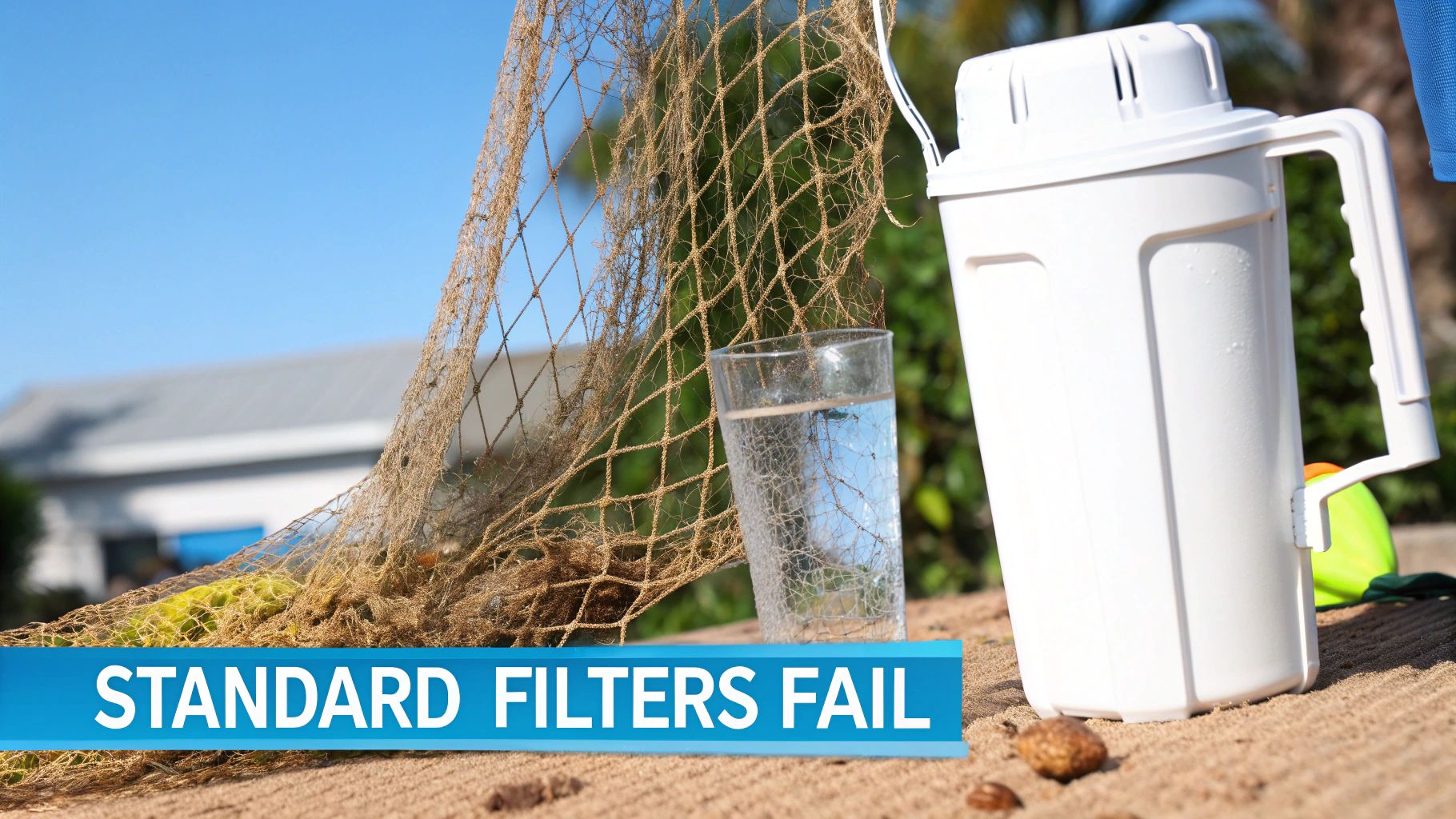
It's a mistake anyone could make. You've got that water pitcher in the fridge or a simple filter screwed onto your faucet, and you assume it’s taking care of everything. After all, you bought it to make your water safer, right? But when it comes to fluoride, that's almost never the case. Most standard filters just aren't built for the job.
The problem comes down to the very nature of fluoride in your water. Fluoride is a dissolved ionic mineral. Think about stirring salt into a glass of water—it vanishes, becoming one with the liquid. You can't see it, and you can't strain it out with a coffee filter.
That's exactly how your typical activated carbon filter sees fluoride. Imagine the filter is a fishing net. It's fantastic at catching the "big fish" like chlorine molecules, which are large enough to get snagged easily. It also grabs sediment and other gunk that makes water taste and smell off. But those tiny, dissolved fluoride ions? They're like grains of sand, slipping right through the holes.
The Science of What Slips Through
Standard activated carbon filters work using a process called adsorption. It’s a surface-level action where contaminants like chlorine literally stick to the carbon's massive internal surface. It's a bit like how lint clings to a sweater.
But this method is completely useless against dissolved minerals like fluoride. The fluoride ions just don't have the right chemical properties to "stick" to the carbon. This is the fundamental reason why your go-to pitcher filter can make your water taste a whole lot better, but leaves the fluoride level completely unchanged.
To actually pull fluoride out, you need a different game plan entirely. You need a filter that can either:
- Physically block the ions with pores so tiny they can't pass through (like Reverse Osmosis).
- Chemically grab and bond with the fluoride ions (like Activated Alumina or Bone Char).
The core takeaway is simple: standard filters target taste and odor by removing large contaminants. Filters that remove fluoride are specialized systems designed to target tiny, dissolved minerals that basic filters can't even see.
A Market Built on Two Sides of the Same Coin
It's a strange situation. While many of us are actively looking for filters that remove fluoride, a massive global industry is paid to do the exact opposite. Utilities across the United States and Australia deliberately add fluorosilicic acid to public water supplies to promote dental health.
This practice supports a market that's projected to be worth US$161.8 million by 2025, with water treatment making up almost half of that demand. This constant addition of fluoride is what directly fuels our need for specialized home filtration. It’s created a unique cycle of treatment and removal. You can dig into the scale of the fluorosilicic acid market over on fluoridealert.org.
Getting this distinction is the first step to avoiding products that don't work and money that's better spent elsewhere. Knowing what fails—and why—is the key to finding a solution that actually gets the job done.
The Big Three: A Look at Proven Fluoride Removal Methods
So, your trusty pitcher filter isn't cutting it for fluoride. That’s okay—it was never really designed for that job. Now, let’s talk about the heavy hitters, the specialized technologies that are actually built from the ground up to target and remove fluoride from your water.
When you get serious about filtering fluoride, there are really only three games in town. These are the methods that have been proven time and again in home water systems.
We’re going to break down each one, but don't worry, we'll skip the dense, jargon-filled textbook explanations. Instead, I'll give you some simple analogies to help you understand exactly how they work, what they're great at, and where you might run into some trade-offs.
Reverse Osmosis: The Bouncer of Water Filtration
Think of your water supply as an exclusive club, and only the purest water molecules can get inside. Reverse Osmosis (RO) is that huge, no-nonsense bouncer standing at the velvet rope, checking IDs and turning away anyone who isn't on the list.
An RO system uses the water pressure in your pipes to force water through a special semipermeable membrane. This isn't just any filter material; it's a sheet engineered with microscopic pores so incredibly small that almost nothing besides H₂O can pass through.
Bigger molecules—like dissolved salts, heavy metals, and of course, fluoride ions—are physically stopped in their tracks. They get denied entry and are rerouted down a separate drain line. What makes it past the bouncer is some of the purest water you can get.
- The Good: RO is the undisputed champion of purity. These systems routinely remove 95% to 99% of fluoride, along with a massive list of other contaminants like lead, chlorine, arsenic, and nitrates.
- The Catch: This level of filtration has a couple of strings attached. RO systems create wastewater (the stuff that gets "bounced"), and they require their own dedicated storage tank and faucet, which usually gets installed under your kitchen sink.
It's hard to overstate just how popular reverse osmosis has become for households looking to get serious about their water quality. RO systems now make up about 29% of the entire global water treatment market, giving them the biggest piece of the pie worldwide. The main reason? Sheer performance. A well-designed RO unit can strip out up to 99% of dissolved contaminants, including fluoride. This incredible effectiveness has made RO a go-to solution, especially in areas where fluoride levels in the groundwater are higher than the 1.5 mg/L guideline set by the WHO. You can dig into more stats on the water filtration market over at zionmarketresearch.com.
Activated Alumina: The Fluoride Magnet
If RO is the bouncer, then Activated Alumina (AA) is more like a high-powered, specialized magnet. It doesn’t physically block contaminants with a barrier. Instead, it pulls them right out of the water.
The filter itself is filled with a highly porous form of aluminum oxide. As your water flows through the filter cartridge, fluoride ions are chemically attracted to the surface of these little alumina beads, where they stick tight. The water flows on, but the fluoride gets left behind, clinging to the filter media.
This process is called adsorption, and it’s extremely effective for zeroing in on specific contaminants. And I know what you’re thinking—aluminum? Don't worry, a properly designed and certified system won't leach any significant amount of aluminum back into your water.
One thing to keep in mind with Activated Alumina is that its performance really depends on your water's pH. It works best in slightly acidic water (pH 5.0 to 6.0), and its ability to grab fluoride can drop off if your water is on the alkaline side.
Bone Char: The Original Natural Adsorber
The last of our proven methods is Bone Char Carbon, which is actually one of the oldest water purification tricks in the book. This filter media is made by charring animal bones at incredibly high temperatures without much oxygen, a process that creates a highly porous carbon material with a massive amount of surface area.
Bone char works a lot like Activated Alumina through the process of adsorption. But it has a secret weapon called hydroxyapatite. The chemical structure of hydroxyapatite has a natural, powerful attraction to fluoride and heavy metals, causing them to bond right onto the bone char's surface.
For centuries, bone char has been used not just for water but in other industries (like sugar refining) for its amazing purification abilities. It’s particularly good at removing fluoride, lead, arsenic, and chlorine.
- The Good: It’s a very effective and completely natural way to filter water without any complex machinery. It’s also great at reducing a whole cocktail of common contaminants.
- The Catch: Its fluoride removal rate, while good, typically maxes out at around 90%, which is a little less than what you can get from a top-tier RO or AA system. The quality of the bone char media can also vary a bit from one brand to another.
Each of these three methods will get you to your goal of fluoride-free water, but they all take a different road to get there. Getting a handle on these key differences is the first step in picking the perfect system for your home, your budget, and your water.
Now, let's stack these three technologies side-by-side to make the comparison even clearer.
A Deep Dive into Fluoride Filtration Technologies
Choosing a filter isn't just about picking the one with the highest removal rate. You also have to consider installation, maintenance, cost, and how it fits into your daily life. This table breaks down the key differences between the "big three" fluoride filters to help you see which one truly fits your needs.
| Feature | Reverse Osmosis (RO) | Activated Alumina (AA) | Bone Char Carbon |
|---|---|---|---|
| Fluoride Removal Rate | 95% – 99%+ | Up to 95% | Up to 90% |
| How It Works | Filtration: Pushes water through a micro-porous membrane, physically blocking contaminants. | Adsorption: Fluoride ions chemically stick to the surface of the alumina media. | Adsorption: Fluoride and heavy metals bond to the hydroxyapatite in the carbon structure. |
| Other Contaminants Removed | Very broad spectrum: lead, arsenic, chlorine, nitrates, pesticides, pharmaceuticals, and many more. | Primarily targets fluoride and arsenic. Can reduce some other contaminants. | Effective for fluoride, lead, arsenic, chlorine, and other heavy metals. |
| Typical Installation | Under-sink (Point-of-Use) with a dedicated faucet and storage tank. More complex installation. | Can be used in countertop, under-sink, or whole-house (Point-of-Entry) systems. | Can be used in countertop, under-sink, or whole-house systems. |
| Water Waste | Yes. Produces wastewater (brine) that is flushed down the drain. | No. Does not produce wastewater during the filtration process. | No. Does not produce wastewater. |
| Impact on Water pH | Can make water slightly acidic by removing alkaline minerals. | No. Does not significantly alter water pH. | No. Does not significantly alter water pH. |
| Best For | Homeowners who want the absolute highest level of purity and need to remove a wide range of contaminants. | Homeowners specifically targeting fluoride and arsenic who prefer a system with no water waste. | Homeowners looking for a natural, effective filtration method without water waste. |
As you can see, there's no single "best" filter—just the best one for your specific situation. If you're after ultimate purity and don't mind a more involved installation, RO is a powerhouse. But if you're focused on fluoride and want a simpler, zero-waste system, Activated Alumina or Bone Char are fantastic and highly effective alternatives.
Choosing Between Under-Sink and Whole-House Systems
So you’ve landed on the right filter technology for your needs. Great. Now for the next big question: where do you put it? This really comes down to a choice between treating the water at one specific faucet or treating every single drop that comes into your house.
It’s the classic showdown between a Point-of-Use (POU) system and a Point-of-Entry (POE) system. There’s no single right answer—it all depends on what you're trying to accomplish.
Think of your home's plumbing like a tree. A whole-house system (POE) gets installed right at the main trunk where water enters your home. It purifies all the water flowing to every branch—every shower, every sink, every appliance. An under-sink system (POU), on the other hand, is like hanging a small, specialized filter on just one of those branches, focusing only on the water you'll be drinking and cooking with.
Point-of-Use: The Targeted Approach
For most folks who are specifically concerned about fluoride, an under-sink system is the way to go. These units, which often use Reverse Osmosis, are installed right in the cabinet under your kitchen sink. They feed a small, dedicated faucet on your countertop, giving you purified water on demand.
This approach is smart, efficient, and easy on the wallet. You get incredibly pure, fluoride-free water exactly where you need it most—for drinking, making coffee, boiling pasta, and filling up water bottles. You’re not wasting money filtering the water you use to flush toilets or wash your clothes.
The chart below gives you a quick visual on how to decide between the most common filter types, which are almost always found in these targeted under-sink setups.
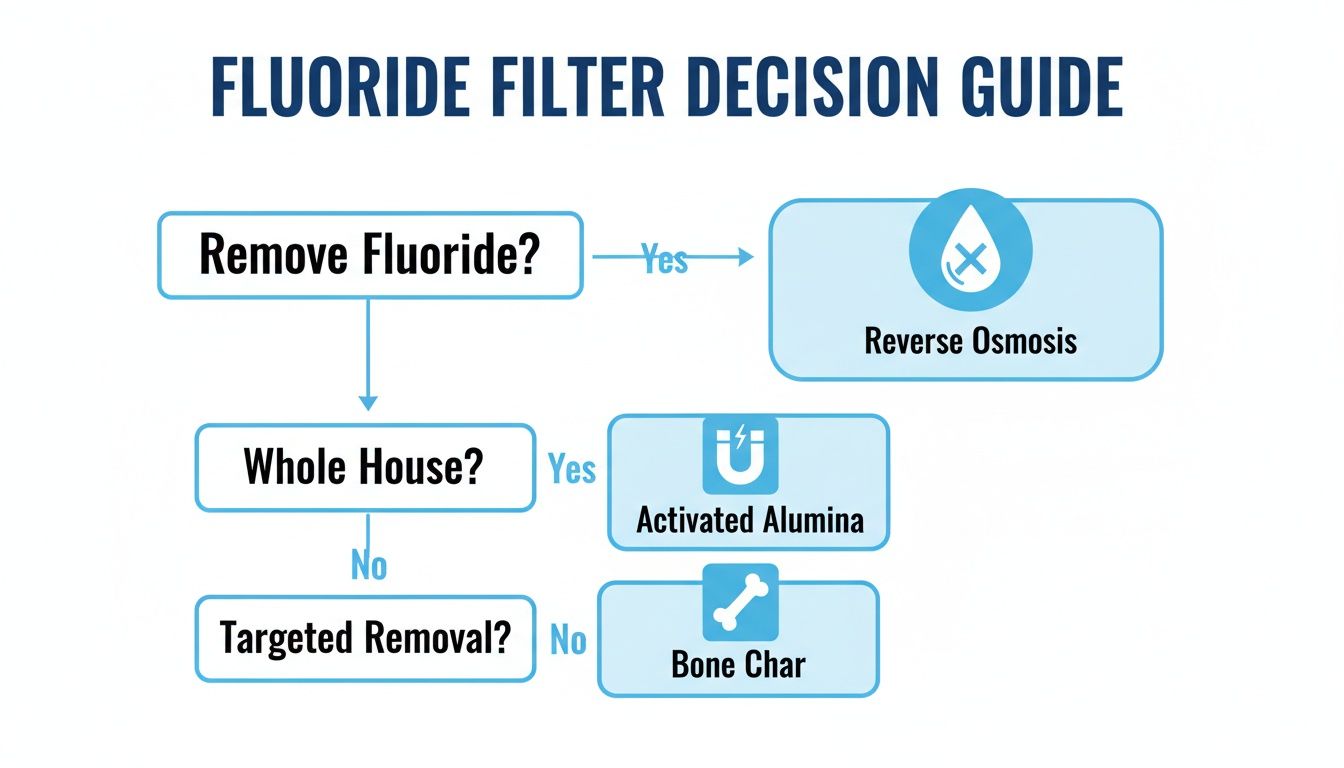
As you can see, whether you go with Reverse Osmosis for the highest level of purity or an adsorption media like Activated Alumina, the technology is perfectly suited for a specific point of use.
Whole-House: The Comprehensive Solution
A whole-house system is a much bigger deal. We're talking a larger investment upfront and a more involved installation. These systems are workhorses, built to handle the high flow rates needed to treat thousands of gallons for your entire home.
Why would someone go this route for fluoride? The main reason is if you have serious concerns about skin absorption during baths and showers, or if you simply want the peace of mind of knowing there’s no fluoride in your laundry or dishwasher water.
Keep in Mind: While the skin can absorb certain things from water, fluoride absorption through bathing is generally considered pretty minimal for most people. The primary way we take in fluoride is by drinking it. This is why a targeted under-sink system is the most practical choice for the vast majority of families.
So, how do you decide? It really comes down to weighing a few key factors:
- Cost: Under-sink systems are way more affordable. The initial price is lower, and the replacement filters won't hit your wallet as hard.
- Installation: Many homeowners can tackle an under-sink filter installation as a DIY project over a weekend. A whole-house system? Not so much. It almost always requires a professional plumber because it involves cutting into your home's main water line.
- Maintenance: Both systems need filter changes, but the big, heavy cartridges for whole-house units are more expensive and can be a real pain to swap out.
- Your Goal: Is your main priority pure drinking water? An under-sink system is the clear winner. Do you want fluoride gone from every single tap, no exceptions? A whole-house system is the only way to make that happen.
When you're looking at different home water solutions, it's sometimes helpful to think about the bigger picture of your home's plumbing. You might need to coordinate a filter installation with other work. A company that provides a range of services, like water heater installation services, will have a good understanding of how all these systems tie together.
Ultimately, the choice is yours. Once you're clear on what you want to achieve with your water, you can confidently pick the system that’s the perfect match for your family’s needs and your budget.
Your Smart Buyer's Checklist for Fluoride Filters

You've waded through the different technologies and you've got a good idea of where you want to install your filter. Now for the fun part—actually picking one out. But before you hit that "buy" button, it pays to run through a quick final checklist. This will make sure the system you choose is a genuine performer that actually delivers, without any nasty surprises down the road.
Think of it like a pre-purchase inspection. A great filter isn't just about a high removal rate; it’s about having proof of that performance, understanding the long-term costs, and finding a maintenance routine you can actually live with. Let's walk through the essential checkpoints.
Look for Third-Party Certification
First things first: verify the manufacturer's claims. The easiest way to do this is by looking for independent, third-party certifications. In the water filter world, the gold standard comes from groups like the NSF (National Sanitation Foundation) and ANSI (American National Standards Institute). These organizations don't just take a company's word for it—they put these filters through some seriously tough testing to prove they do what they claim.
When you're shopping for filters that remove fluoride, these are the key certifications you want to see:
- NSF/ANSI 53: This is the big one for health-related contaminants, including fluoride. A filter with this stamp of approval has proven it can reduce high fluoride levels down to the EPA's maximum allowable limit of 4 mg/L.
- NSF/ANSI 58: This standard is specifically for Reverse Osmosis (RO) systems. It's a really comprehensive certification that covers everything from fluoride reduction to the system's structural integrity and overall efficiency.
- NSF/ANSI 42: While this one is more about aesthetics—like getting rid of that chlorine taste and smell—it's still a great sign of a quality product. You'll often see the best fluoride filters carry this certification alongside NSF 53 or 58.
Be wary of vague claims like "tested to NSF standards." True certification means you should be able to look up the product right on the official NSF website.
Scrutinize the Performance Data Sheet
Every legitimate water filter comes with a Performance Data Sheet. This is the spec sheet, the nitty-gritty document that spells out exactly what the filter removes and just how well it does it. You can usually find it on the product page online or tucked inside the box.
Don't just give it a quick glance—actually read it. Hunt for the line item for "Fluoride" and check the average percentage reduction. A top-tier system should be removing over 90% of fluoride, easy. This sheet is basically the manufacturer’s contract with you, so if a company can't or won't provide one, that's a huge red flag.
Calculate the True Cost of Ownership
The price you see on the website is just the beginning. The real cost of any water filter is what you spend over its entire life. This is called the total cost of ownership, and figuring it out now can save you a ton of money and frustration later on.
To get the real number, you need to add up:
- Initial Purchase Price: The upfront cost of the system.
- Replacement Filter Costs: This is the biggest ongoing expense. How much are the replacement cartridges?
- Filter Lifespan: How often do they need to be changed? Every six months? Every few years? A cheap filter that needs new cartridges constantly can end up costing you more than a pricier unit with long-lasting filters.
Think about it this way. System A is $150, but needs a $60 filter change every 6 months. System B is $300, but its $100 filter only needs replacing once a year. After two years, you’d have spent $390 on System A ($150 + 4x$60), but only $500 on System B ($300 + 2x$100). Knowing these numbers helps you make a smarter long-term investment.
Check Maintenance Needs and Ease of Use
Last but not least, be honest with yourself about maintenance. How easy is it to swap out the filters? Do you need a bunch of special tools or have to shut off the main water line to your house? Some under-sink RO systems have brilliantly simple twist-off cartridges, while others are a bit more involved.
Jump on YouTube and watch a video of the filter change process if you can, or at least read some customer reviews. A system that's a complicated, messy hassle to maintain is one you're going to put off dealing with, and that defeats the whole purpose.
For even more tips on picking the right unit, check out our general advice on water filters to help guide your decision. By running through this checklist, you can be confident you're choosing a reliable and effective solution for your home.
Common Questions About Fluoride Water Filters
Even after you've got a good handle on the technology, a few practical questions almost always come up when you’re about to pull the trigger on a filter. To help clear up any last-minute doubts, we’ve put together the most common questions we hear from homeowners. Think of these as the final pieces of the puzzle to help you move forward with confidence.
Let's dive in and tackle some of the biggest concerns.
Do Brita Pitcher Filters Remove Fluoride?
Nope. Standard pitcher filters like Brita or Pur just can't do it. These filters use a basic activated carbon, which is great for getting rid of that chlorine taste and smell, making your water more pleasant to drink. But when it comes to dissolved minerals like fluoride, they’re completely ineffective.
Imagine trying to catch salt dissolved in water with a spaghetti strainer—it's just going to pass right through. To actually grab onto fluoride ions, you need a specialized filter media like reverse osmosis, activated alumina, or bone char.
Does Boiling Water Get Rid of Fluoride?
This is a really common myth, and it's a dangerous one. Boiling water does the exact opposite of what you want. As the water boils, pure H₂O turns into steam and evaporates, but all the minerals—including fluoride—get left behind.
This actually makes the fluoride more concentrated in the water that's left. If you boil a liter of water down to half a liter, you’ve just doubled the fluoride concentration. This is a huge deal for anyone using tap water to mix baby formula or when cooking things that soak up a lot of water, like rice and pasta.
Is an Under-Sink System Enough or Do I Need a Whole-House Filter?
For most families, an under-sink system is the perfect sweet spot. If your main goal is simply to have pure, fluoride-free water for drinking and cooking, then a Point-of-Use (POU) system installed at your kitchen sink is the most effective and cost-efficient way to go.
A whole-house filter, or a Point-of-Entry (POE) system, is a much bigger and more expensive project. It's usually only necessary if you have very specific concerns about absorbing fluoride through your skin during baths and showers. Since drinking is the primary way we're exposed to fluoride, most people find that just treating the water they consume is more than enough.
Here's the bottom line: unless you have a compelling medical reason to treat every single faucet, an under-sink system delivers the best bang for your buck in terms of performance, cost, and convenience for removing fluoride.
How Can I Find Out if My Tap Water Contains Fluoride?
Knowing what you’re dealing with is always the first step. Thankfully, finding out your fluoride level is pretty straightforward.
- For City or Municipal Water: Your local water utility is required by law to send out an annual water quality report, often called a Consumer Confidence Report (CCR). This report will list the average fluoride concentration. You can usually find it right on their website, or you can call and ask them to mail you a copy.
- For Private Well Water: If you're on a well, you're the captain of your own ship—and that includes water testing. The only way to know for sure what your fluoride level is is to send a sample to a state-certified lab. They'll give you an exact number so you can choose the right filter for your situation.
Will a Fluoride Filter Also Remove Essential Minerals?
That’s a great question, and it comes up a lot, especially with Reverse Osmosis (RO) systems. The short answer is yes—because RO membranes are so fine, they strip out nearly everything, including beneficial minerals like calcium and magnesium.
But it’s important to keep this in perspective. We get the vast majority of our essential minerals from the food we eat, not the water we drink. While tap water can chip in a little, it’s not our main source. For anyone still concerned, many modern RO systems now come with a remineralization filter as the final step. This adds a healthy balance of minerals back into the water right before it hits your glass, which also improves the taste and pH.
At Water Filter Advisor, we're here to give you clear, research-backed advice to help you protect your family's health. Check out our detailed guides and reviews to find the perfect filtration system for your home.
Ready to find your filter? Learn more at https://www.waterfilteradvisor.com.
- January 10, 2026
- 0
- Uncategorized
