Best Water Filter to Remove Fluoride and Chlorine

You fill a glass from the kitchen tap, take a sip, and notice the pool-water taste is finally gone. The new filter did its job, at least on the part you could taste. That's where a lot of homeowners stop, and it's also where confusion starts.

Chlorine is easy to notice because your mouth tells you it's there. Fluoride doesn't announce itself the same way. So people buy a pitcher, a faucet filter, or a refrigerator cartridge, the water tastes cleaner, and they assume everything they cared about is being handled by one device. In many homes, it isn't.

A good water filter to remove fluoride and chlorine has to solve two different chemistry problems at once. That matters, because the filter media that grabs chlorine well is often the same media that does almost nothing for fluoride. If you only shop by taste improvement, you can end up fixing half the issue and leaving the other half untouched.

Why Your Water Filter Might Only Be Doing Half the Job

A homeowner calls after installing a common carbon pitcher. The complaint is usually the same. “The water tastes much better, but I'm still not sure it's removing what I bought it for.” That's a fair question.

Chlorine gives quick feedback. When carbon removes it, the sharp smell drops off and the water becomes easier to drink. That immediate improvement makes the filter feel more capable than it may be.

A woman looks concerned while holding a glass of tap water in a clean modern kitchen.

The taste test misleads a lot of people

Most basic home filters are built around activated carbon. That's excellent for cleaning up chlorine taste and odor, which is why so many people feel instant relief after installing one. But a better taste isn't the same thing as broad contaminant removal.

I've seen plenty of setups where the owner believed the filter was “taking everything out” because the water smelled fresh. In practice, the unit was doing exactly what carbon does best and almost nothing beyond that in the fluoride department.

Practical rule: If a filter mainly advertises taste and odor improvement, assume it's targeting chlorine first, not fluoride.

Why this matters in real homes

This is especially common in city-water homes. Municipal water often arrives already disinfected, so chlorine is the first thing people want gone. They buy the easiest solution on the shelf and never realize that fluoride removal requires a different kind of tool.

The result is a mismatch between expectation and performance:

  • Pitchers and faucet filters often make water taste better fast.
  • Homeowners assume broad purification because the change is obvious.
  • Fluoride remains the unanswered question unless the system uses specialized media or membrane technology.

That's the puzzle worth solving before you spend more money. If your goal is only better taste, a simple carbon filter may be enough. If your goal is to remove both chlorine and fluoride, you need to shop by filtration method, not by taste alone.

A Tale of Two Contaminants Understanding Fluoride and Chlorine

Chlorine and fluoride behave differently in water, and that difference determines how they must be filtered. Homeowners often notice chlorine first because it affects smell and taste right away. Fluoride is less obvious, but it is usually the harder contaminant to remove.

Chlorine is relatively easy work for activated carbon. Carbon removes it through adsorption and catalytic reduction at the media surface, which is why pitchers, faucet filters, and refrigerator cartridges do a good job improving taste and odor. If the goal is better coffee or tea, that can be enough. Anyone comparing options for appliance use can look at PureHQ coffee filter recommendations to see why chlorine reduction changes flavor so noticeably.
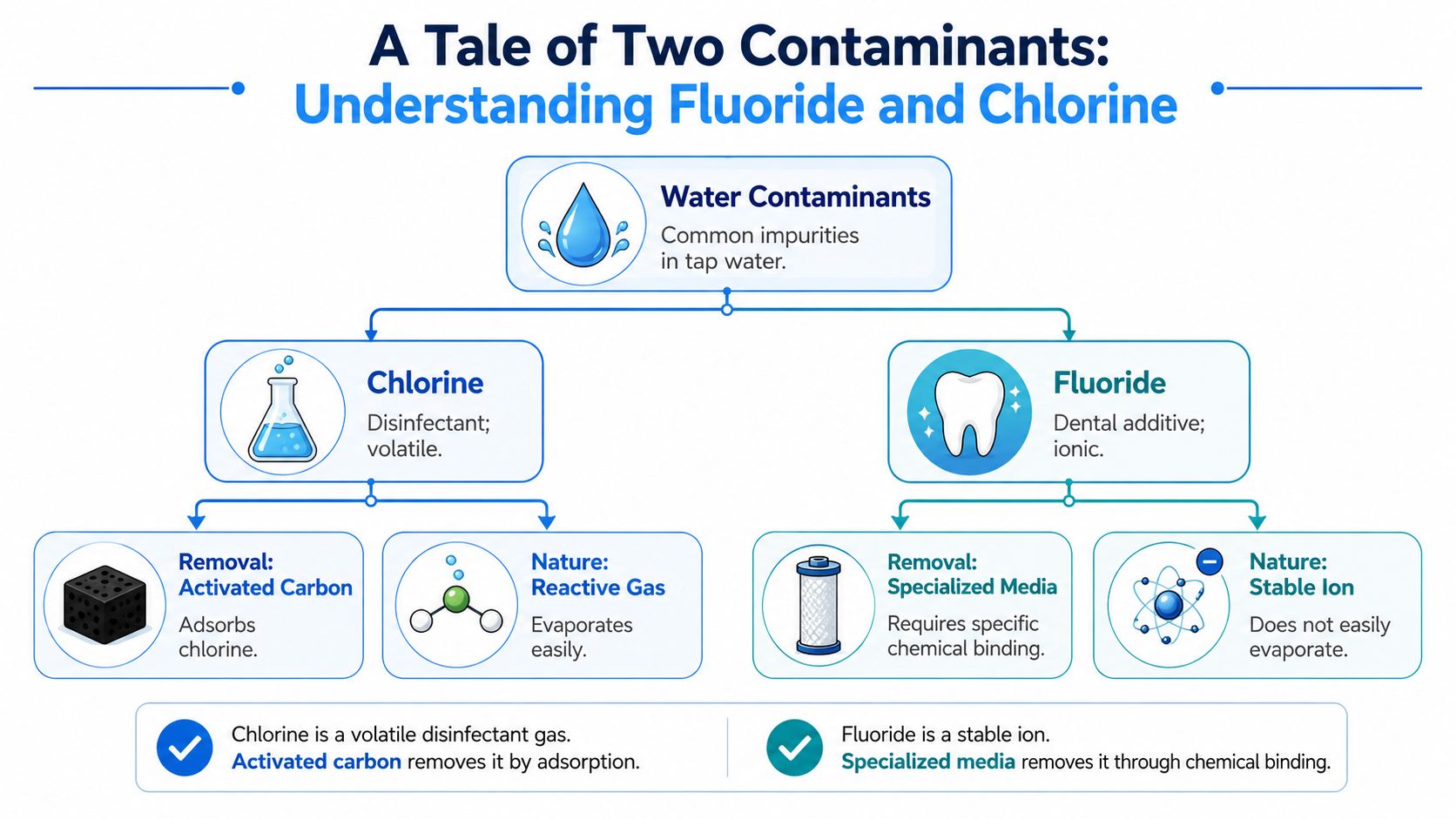
An infographic comparing properties of water contaminants chlorine and fluoride and their respective removal methods.

Why carbon wins on chlorine

Activated carbon has a huge internal surface area. As water passes through, chlorine reacts at that surface and gets removed efficiently. That is a good match between contaminant and media.

In the field, this is why simple carbon systems earn a solid reputation. They are affordable, easy to install, and they solve the problem people can smell at the sink.

Why fluoride needs a different tool

Fluoride is a dissolved ion, not a contaminant that standard carbon grabs well. In practical terms, it stays in solution unless the system uses a membrane or a media designed for ionic removal.

The Water Professor lab review notes that filters built to remove fluoride and chlorine often rely on specialist anion exchange resin because standard activated carbon is not effective at removing negatively charged fluoride ions. That design is still uncommon in many general-purpose household filters.

Chlorine reduction and fluoride reduction are separate performance claims. A filter can be excellent at one and do very little for the other.

A simple way to evaluate any product is to ask what mechanism is doing the work. If the answer is only activated carbon, expect strong chlorine reduction and limited fluoride removal. If the system includes reverse osmosis, activated alumina, bone char, or specialty fluoride media, it is built for a different job.

This is the point many product labels blur. "Cleaner taste" usually signals chlorine treatment. Fluoride removal needs separate proof in the specifications, certifications, or test data. Without that, a filter may improve the water you notice while leaving the dissolved contaminant you set out to address.

Your Filtration Toolkit for Fluoride and Chlorine

Once you know chlorine and fluoride need different treatment, the shortlist gets much clearer. For home use, the main tools are reverse osmosis, activated alumina, and bone char. Each solves a different part of the problem, and the best systems usually combine media instead of asking one filter to do every job.

Reverse osmosis as the main drinking-water solution

For a homeowner who wants one under-sink system to address both contaminants, reverse osmosis is usually the strongest fit. RO systems achieve fluoride removal rates between 90% and 95%, while also removing chlorine. By comparison, basic activated carbon filters show negligible fluoride reduction, typically 0% to 5%, despite removing over 90% of chlorine (Frizzlife fluoride filter guide).

That difference matters at the kitchen sink. Carbon is very good at handling chlorine taste and odor, but fluoride is dissolved in the water at the ionic level. An RO membrane is built for that finer job.

Most residential RO units are multi-stage systems for a reason. A carbon pre-filter reduces chlorine before the water reaches the membrane, which helps protect membrane life. Then the membrane handles fluoride and other dissolved contaminants. In practice, that stacked design is why RO remains the most common point-of-use answer for households trying to solve both problems with one system.

If you want a broader look at how these treatment methods compare across the home, Oxy Plus Water's purification guide is a useful companion read.

Activated alumina and bone char

Activated alumina and bone char are specialty fluoride media. They are not general-purpose taste filters. They are used because fluoride needs a surface or process designed to capture it.

Activated alumina can remove fluoride in the 70% to 90% range, and bone char can also reach the 70% to 90% range. As noted earlier from the Waterdrop fluoride filter guide, alumina performance is highly dependent on water pH, while bone char relies on adsorption and appears more often in niche or gravity-fed setups than in mainstream residential systems. That is the trade-off. These media can work well, but they ask for more attention to water chemistry, cartridge sizing, and replacement timing than a homeowner usually expects.

I tell homeowners to treat these media like a specialty tool in a toolbox. Useful in the right conditions. Less forgiving if the water is outside the range the media likes.

Filtration Technology Comparison

Technology Fluoride Removal Chlorine Removal Key Pro Key Con
Reverse Osmosis 90% to 95% Removes chlorine Strong all-in-one option for drinking water More complex system and ongoing maintenance
Activated Alumina 70% to 90% Best used as part of a broader strategy Targeted fluoride media Performance depends heavily on pH
Bone Char 70% to 90% Can be paired with carbon stages for chlorine Specialized fluoride adsorption Less common in residential systems
Basic Activated Carbon 0% to 5% Over 90% Great for taste and odor Barely touches fluoride

Real trade-offs homeowners should expect

No filter media is perfect in every house.

  • RO works best for many households that want both contaminants addressed at one tap. It is usually the most complete point-of-use option.
  • Activated alumina can make sense for targeted fluoride reduction. It works best when the water chemistry supports it.
  • Bone char is a valid fluoride filter media, but it is less common. Product availability and homeowner preference often shape that choice.
  • Basic carbon still has an important job. It just should not be mistaken for a fluoride solution.

The practical takeaway is simple. A water filter to remove fluoride and chlorine usually needs more than one method. If a product only lists carbon, expect good chlorine reduction and little fluoride removal. If it uses carbon plus RO, or carbon plus a fluoride-specific media, it is built to handle the full job instead of half of it.

From Faucets to Whole-House The Right System for You

The same filtration media can show up in very different system styles. That's where shopping gets practical. You're no longer choosing only between technologies. You're choosing where in the house the treatment happens and how much of your water you want covered.
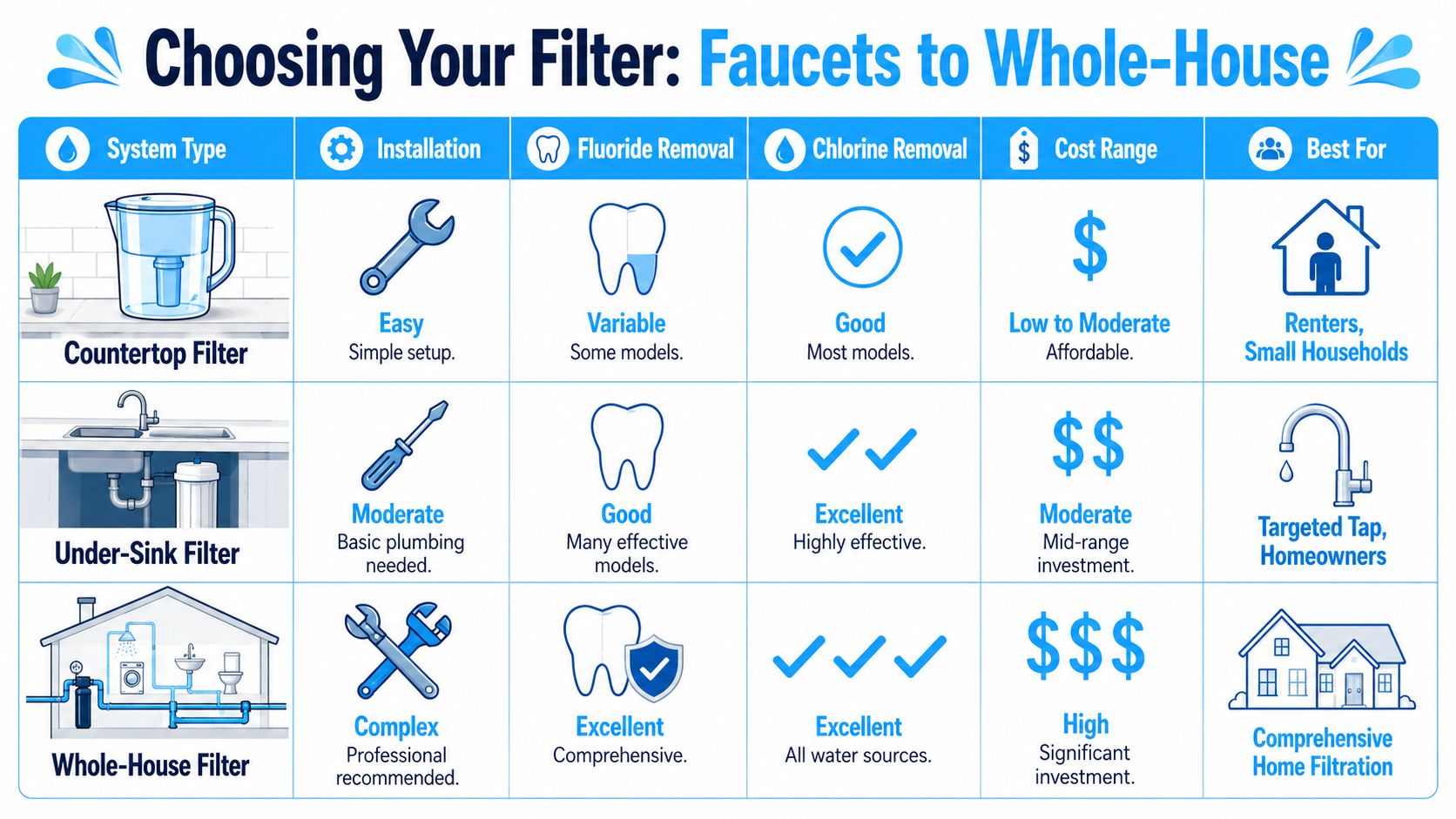
A comparison chart showing three types of water filtration systems: countertop, under-sink, and whole-house options.

Countertop and under-sink systems

A countertop unit makes sense when drilling holes or modifying plumbing isn't realistic. Renters often go this route because they can install and remove the system with minimal fuss. The compromise is usually capacity, appearance, and fewer top-tier options for fluoride removal.

An under-sink system is the workhorse for homeowners. It stays out of sight, serves the kitchen tap where drinking and cooking happen, and gives you access to more serious filtration setups, especially reverse osmosis systems with multiple stages.

For many families, under-sink is the sweet spot. It treats the water you consume most without forcing you into a whole-home project.

Whole-house fluoride filtration is changing

For years, the standard advice was simple: if you want fluoride removal, use point-of-use RO at the kitchen sink and forget about whole-house options. That advice is getting less reliable.

Here's the claim that has changed the conversation: contrary to advice that dismisses whole-house fluoride removal as “cost-prohibitive,” emerging 2024 point-of-entry systems are now available for under $1,000 and show 100% fluoride elimination in independent lab tests, challenging the notion that point-of-use RO is the only option (video discussion of emerging whole-house fluoride systems).

That doesn't mean every whole-house unit on the market suddenly removes fluoride well. It means homeowners should stop assuming the category is impossible on principle. The market is moving, and some newer systems are aimed at families who want fluoride-reduced water not only for drinking, but also for bathing and general household use.

Later in the buying process, many homeowners also start thinking beyond water. If you're improving the quality of what runs through your house, it's common to look at indoor air next, and a good overview of a home air purifier can help frame that broader home-comfort conversation.

A quick product explainer can help visualize how system categories differ in real life:

Matching the system to the household

The best decision often comes down to:

  • Renter or frequent mover
    A countertop fluoride-capable system is usually the most realistic choice.

  • Homeowner focused on drinking and cooking water
    An under-sink RO system is often the practical answer.

  • Family wanting treatment at every tap
    A whole-house system deserves a fresh look, especially if broad home coverage matters.

  • Buyer with limited tolerance for ongoing adjustments
    Simpler, more standardized systems tend to be easier to live with than highly conditional media setups.

Buying the right system is less about finding the “best filter” in the abstract and more about choosing the right location for treatment.

Keeping Your Water Pure Installation and Maintenance

A good system can disappoint fast if it's installed poorly or maintained casually. Water filtration is a lot like a furnace filter or a car oil filter. The equipment matters, but the schedule matters too.

Installation needs to match the system

Countertop units are usually straightforward. Under-sink systems ask for more care because you're dealing with feed lines, drain connections, storage tanks in some models, and a dedicated faucet in many setups. Whole-house systems are another step up and often belong in the hands of a qualified installer.

That doesn't mean homeowners can't handle parts of the process. It means you should be honest about your skill level. A poorly seated fitting or a bypassed stage can undermine a very good system.

Certification is the trust marker to look for

For fluoride reduction, one standard matters more than marketing language. To ensure performance for fluoride removal, systems must be certified to NSF/ANSI Standard 58, the only standard specifically validating fluoride reduction alongside other health-affecting compounds like chlorine (Aquasana explanation of fluoride removal and Standard 58).

That's the benchmark I tell people to look for first when comparing RO systems. A box can say a lot. Certification gives you a harder reference point than advertising copy.

Maintenance is not optional

Once the system is installed, the homeowner's job is simple but important:

  1. Change pre-filters on schedule. In RO systems, those stages protect the membrane and help preserve overall performance.
  2. Replace specialty cartridges when they're due. Activated alumina, bone char, and combination filters lose effectiveness as media gets spent.
  3. Watch for taste changes or flow drops. Those are often the first clues that service is overdue.
  4. Test when confidence matters. If fluoride removal is the reason you bought the system, periodic verification is worth doing.

A TDS meter can help you keep an eye on RO system behavior, but it doesn't directly confirm fluoride levels. For that, proper water testing is the better tool. If you want a broader maintenance and buying reference library, the guidance at Water Filter Advisor advice is a useful place to compare checklists and upkeep topics.

The best filter in the house is the one you maintain on time. A neglected premium system can underperform a well-kept basic one.

A Clear Look at Long-Term Costs and Benefits

A lot of homeowners learn the cost question the hard way. They buy a filter that handles chlorine because the water tastes better in a day or two, then realize later it does little for fluoride and end up buying a second system. Paying twice for partial treatment is where substantial waste starts.

Long-term value comes from matching the technology to the job from the start. Chlorine is usually the easy part. Carbon handles taste and odor well, and it does it at a reasonable cost. Fluoride is different. It usually calls for reverse osmosis or a specialty media stage, which raises the purchase price and adds maintenance. That extra cost is not padding. It reflects the fact that you are treating two contaminants that behave differently in water.

The benefits are uneven, but real. Chlorine reduction is obvious at the faucet because the smell and taste change quickly. Fluoride reduction is not something you can judge with your senses, which is exactly why buyers need to pay attention to system design, certification, and replacement schedules.

A concrete example helps. High-performance filters like the Home Master Jr. F2 CFF25-10 model can remove up to 93% of fluoride in addition to chlorine, VOCs, and pesticides (The Perfect Water product overview). The useful lesson is not the brand name alone. It is that effective dual-contaminant treatment usually means combining methods rather than relying on one basic filter stage.

Use this checklist before you buy:

  • What are you treating for? Better taste and odor, or a system that also targets fluoride?
  • Where do you need treated water? One drinking tap, the kitchen sink, or multiple points in the house?
  • Will you keep up with maintenance? A good system only stays good if cartridges and membranes are replaced on time.

That last point matters more than buyers expect.

A well-matched system often costs more up front, but it usually delivers better value over time than buying a chlorine-focused filter first and replacing it later with something more capable. That is especially true now that some whole-house setups are starting to address fluoride with specialty configurations, even though point-of-use treatment is still the more common and practical route for most homes. While not the cheapest option, a system designed for both fluoride and chlorine is a smarter long-term investment when properly matched to your needs.


If you're comparing systems and want practical help without the marketing fog, Water Filter Advisor is a strong next stop. It's built for homeowners who want clear guidance on choosing, maintaining, and verifying the right water filtration setup for real-life use.
A Homeowner’s Guide to Filters That Remove Fluoride

When it comes to getting fluoride out of your home’s drinking water, here's the straight truth: your standard Brita-style pitcher filter just isn't going to get the job done. To really take on this specific contaminant, you need a filtration system built for the task. It's a special ops mission, and you need the right gear.

The most reliable, proven technologies are Reverse Osmosis (RO), Activated Alumina, and Bone Char Carbon. Each one uses a completely different process to grab and remove those tiny fluoride ions, ensuring your tap water is as pure as you want it to be.

Finding the Right Fluoride Filter for Your Home

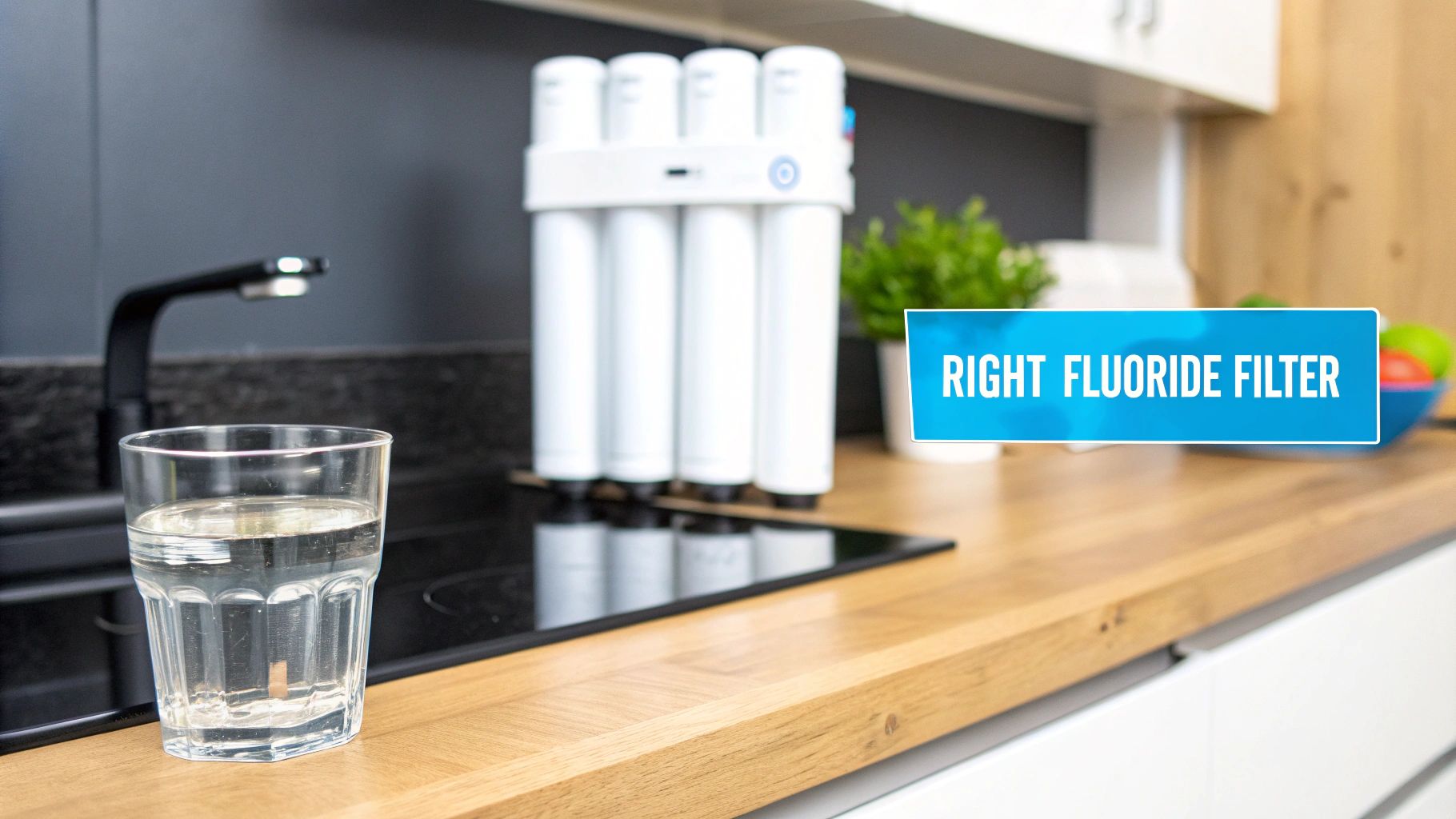
A white water filter system on a modern kitchen counter with a glass of water and a faucet.

Picking the right water filter can feel like navigating a maze, but it’s simple when you know the secret: fluoride is a dissolved mineral. This means it behaves very differently in water than the chunky stuff like chlorine or sediment that most basic filters are designed to catch.

Think of it this way: a standard carbon filter is like a fishing net trying to catch grains of sand. The sand (our fluoride) is so fine it slips right through the holes. To actually filter out fluoride, you need a method with a much, much finer "net"—or one that can attract the fluoride ions like a magnet.

The Proven Technologies

This is where the three heavy hitters come into play. Each one has a unique superpower for tackling fluoride, and understanding their different approaches is the first step to choosing your champion.

Here's a quick look at how they work:

  • Reverse Osmosis (RO): This high-tech method uses serious pressure to force water through a special membrane packed with microscopic pores. Water molecules get VIP access, but fluoride and other dissolved solids are left behind at the velvet rope.
  • Activated Alumina (AA): This filter media acts like a specialized magnet for fluoride. As water passes over it, fluoride ions are literally pulled out of the water and stick to the alumina surface.
  • Bone Char Carbon: This is an all-natural media made from charred animal bone. It works through a process called adsorption, where fluoride ions chemically bond to its unique surface.

Understanding these core technologies is essential. You'll see a lot of products out there making big claims, but only filters using one of these three methods have been consistently proven to slash fluoride levels in your home's drinking water.

To give you a quick, at-a-glance comparison, the table below lines up these top methods side-by-side. It focuses on what matters most to homeowners—how well they work, what they cost, and where they make the most sense in your home. This should give you a solid starting point before we dig into the details of each.

Comparing Top Fluoride Removal Technologies

Here's a quick comparison of the most effective filter types for removing fluoride, highlighting their performance, cost, and best applications for homeowners.

Filtration Technology Fluoride Removal Rate Ideal Application Average Cost
Reverse Osmosis (RO) Up to 99% Under-sink systems for drinking/cooking water. Moderate to High
Activated Alumina Up to 98% Both under-sink and whole-house systems. Moderate
Bone Char Carbon Up to 90% Often used in countertop or pitcher-style fluoride filters. Low to Moderate

As you can see, each has its strengths. Now, let’s get into the nitty-gritty of how each one performs in a real-world home setup.

Why Your Standard Water Filter Can't Remove Fluoride

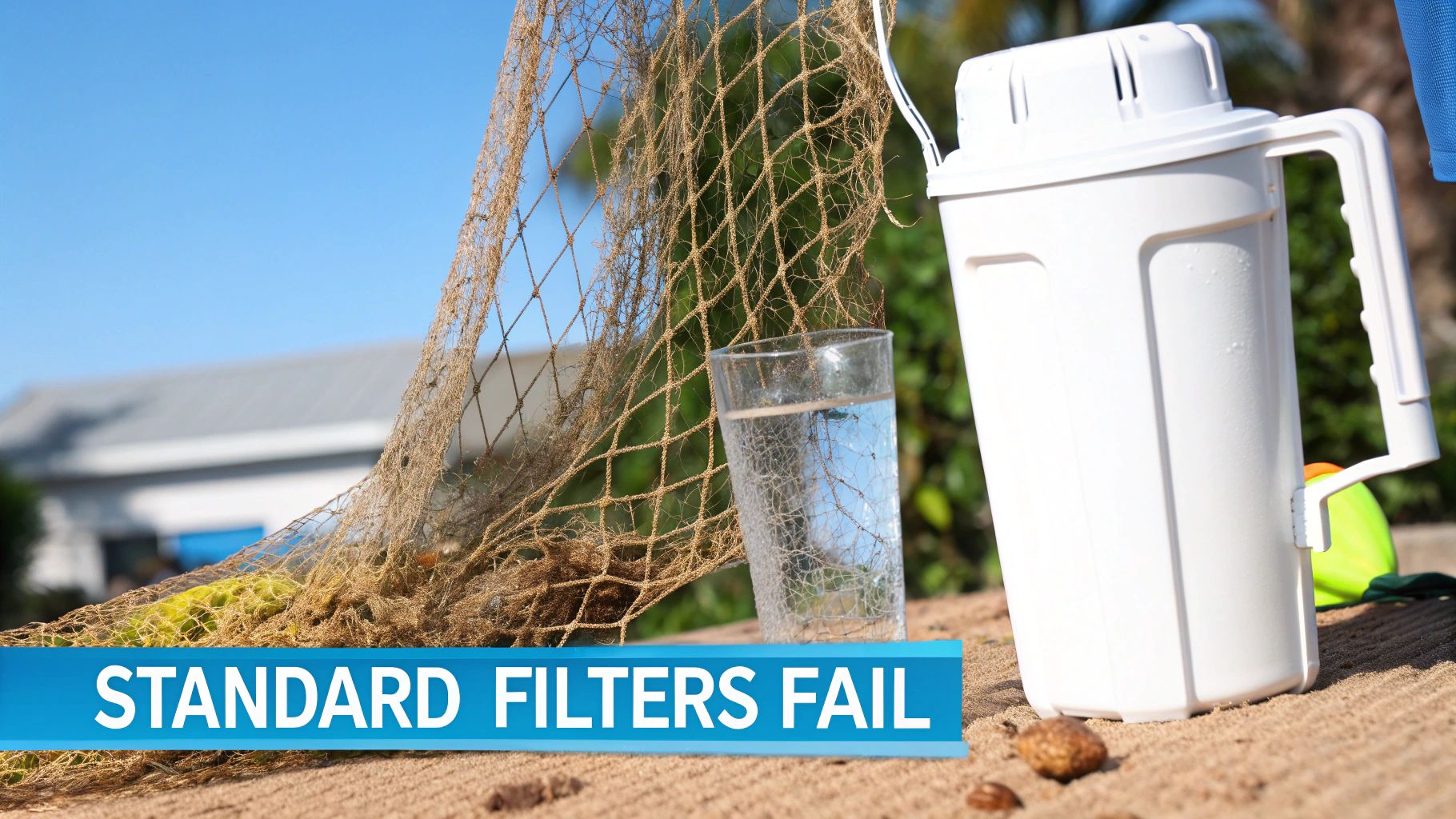
A white water filter pitcher and glass of water on sand, with a fishing net and a banner: "STANDARD FILTERS FAIL".

It's a mistake anyone could make. You've got that water pitcher in the fridge or a simple filter screwed onto your faucet, and you assume it’s taking care of everything. After all, you bought it to make your water safer, right? But when it comes to fluoride, that's almost never the case. Most standard filters just aren't built for the job.

The problem comes down to the very nature of fluoride in your water. Fluoride is a dissolved ionic mineral. Think about stirring salt into a glass of water—it vanishes, becoming one with the liquid. You can't see it, and you can't strain it out with a coffee filter.

That's exactly how your typical activated carbon filter sees fluoride. Imagine the filter is a fishing net. It's fantastic at catching the "big fish" like chlorine molecules, which are large enough to get snagged easily. It also grabs sediment and other gunk that makes water taste and smell off. But those tiny, dissolved fluoride ions? They're like grains of sand, slipping right through the holes.

The Science of What Slips Through

Standard activated carbon filters work using a process called adsorption. It’s a surface-level action where contaminants like chlorine literally stick to the carbon's massive internal surface. It's a bit like how lint clings to a sweater.

But this method is completely useless against dissolved minerals like fluoride. The fluoride ions just don't have the right chemical properties to "stick" to the carbon. This is the fundamental reason why your go-to pitcher filter can make your water taste a whole lot better, but leaves the fluoride level completely unchanged.

To actually pull fluoride out, you need a different game plan entirely. You need a filter that can either:

  • Physically block the ions with pores so tiny they can't pass through (like Reverse Osmosis).
  • Chemically grab and bond with the fluoride ions (like Activated Alumina or Bone Char).

The core takeaway is simple: standard filters target taste and odor by removing large contaminants. Filters that remove fluoride are specialized systems designed to target tiny, dissolved minerals that basic filters can't even see.

A Market Built on Two Sides of the Same Coin

It's a strange situation. While many of us are actively looking for filters that remove fluoride, a massive global industry is paid to do the exact opposite. Utilities across the United States and Australia deliberately add fluorosilicic acid to public water supplies to promote dental health.

This practice supports a market that's projected to be worth US$161.8 million by 2025, with water treatment making up almost half of that demand. This constant addition of fluoride is what directly fuels our need for specialized home filtration. It’s created a unique cycle of treatment and removal. You can dig into the scale of the fluorosilicic acid market over on fluoridealert.org.

Getting this distinction is the first step to avoiding products that don't work and money that's better spent elsewhere. Knowing what fails—and why—is the key to finding a solution that actually gets the job done.

The Big Three: A Look at Proven Fluoride Removal Methods

So, your trusty pitcher filter isn't cutting it for fluoride. That’s okay—it was never really designed for that job. Now, let’s talk about the heavy hitters, the specialized technologies that are actually built from the ground up to target and remove fluoride from your water.

When you get serious about filtering fluoride, there are really only three games in town. These are the methods that have been proven time and again in home water systems.

We’re going to break down each one, but don't worry, we'll skip the dense, jargon-filled textbook explanations. Instead, I'll give you some simple analogies to help you understand exactly how they work, what they're great at, and where you might run into some trade-offs.

Reverse Osmosis: The Bouncer of Water Filtration

Think of your water supply as an exclusive club, and only the purest water molecules can get inside. Reverse Osmosis (RO) is that huge, no-nonsense bouncer standing at the velvet rope, checking IDs and turning away anyone who isn't on the list.

An RO system uses the water pressure in your pipes to force water through a special semipermeable membrane. This isn't just any filter material; it's a sheet engineered with microscopic pores so incredibly small that almost nothing besides H₂O can pass through.

Bigger molecules—like dissolved salts, heavy metals, and of course, fluoride ions—are physically stopped in their tracks. They get denied entry and are rerouted down a separate drain line. What makes it past the bouncer is some of the purest water you can get.

  • The Good: RO is the undisputed champion of purity. These systems routinely remove 95% to 99% of fluoride, along with a massive list of other contaminants like lead, chlorine, arsenic, and nitrates.
  • The Catch: This level of filtration has a couple of strings attached. RO systems create wastewater (the stuff that gets "bounced"), and they require their own dedicated storage tank and faucet, which usually gets installed under your kitchen sink.

It's hard to overstate just how popular reverse osmosis has become for households looking to get serious about their water quality. RO systems now make up about 29% of the entire global water treatment market, giving them the biggest piece of the pie worldwide. The main reason? Sheer performance. A well-designed RO unit can strip out up to 99% of dissolved contaminants, including fluoride. This incredible effectiveness has made RO a go-to solution, especially in areas where fluoride levels in the groundwater are higher than the 1.5 mg/L guideline set by the WHO. You can dig into more stats on the water filtration market over at zionmarketresearch.com.

Activated Alumina: The Fluoride Magnet

If RO is the bouncer, then Activated Alumina (AA) is more like a high-powered, specialized magnet. It doesn’t physically block contaminants with a barrier. Instead, it pulls them right out of the water.

The filter itself is filled with a highly porous form of aluminum oxide. As your water flows through the filter cartridge, fluoride ions are chemically attracted to the surface of these little alumina beads, where they stick tight. The water flows on, but the fluoride gets left behind, clinging to the filter media.

This process is called adsorption, and it’s extremely effective for zeroing in on specific contaminants. And I know what you’re thinking—aluminum? Don't worry, a properly designed and certified system won't leach any significant amount of aluminum back into your water.

One thing to keep in mind with Activated Alumina is that its performance really depends on your water's pH. It works best in slightly acidic water (pH 5.0 to 6.0), and its ability to grab fluoride can drop off if your water is on the alkaline side.

Bone Char: The Original Natural Adsorber

The last of our proven methods is Bone Char Carbon, which is actually one of the oldest water purification tricks in the book. This filter media is made by charring animal bones at incredibly high temperatures without much oxygen, a process that creates a highly porous carbon material with a massive amount of surface area.

Bone char works a lot like Activated Alumina through the process of adsorption. But it has a secret weapon called hydroxyapatite. The chemical structure of hydroxyapatite has a natural, powerful attraction to fluoride and heavy metals, causing them to bond right onto the bone char's surface.

For centuries, bone char has been used not just for water but in other industries (like sugar refining) for its amazing purification abilities. It’s particularly good at removing fluoride, lead, arsenic, and chlorine.

  • The Good: It’s a very effective and completely natural way to filter water without any complex machinery. It’s also great at reducing a whole cocktail of common contaminants.
  • The Catch: Its fluoride removal rate, while good, typically maxes out at around 90%, which is a little less than what you can get from a top-tier RO or AA system. The quality of the bone char media can also vary a bit from one brand to another.

Each of these three methods will get you to your goal of fluoride-free water, but they all take a different road to get there. Getting a handle on these key differences is the first step in picking the perfect system for your home, your budget, and your water.

Now, let's stack these three technologies side-by-side to make the comparison even clearer.

A Deep Dive into Fluoride Filtration Technologies

Choosing a filter isn't just about picking the one with the highest removal rate. You also have to consider installation, maintenance, cost, and how it fits into your daily life. This table breaks down the key differences between the "big three" fluoride filters to help you see which one truly fits your needs.

Feature Reverse Osmosis (RO) Activated Alumina (AA) Bone Char Carbon
Fluoride Removal Rate 95% – 99%+ Up to 95% Up to 90%
How It Works Filtration: Pushes water through a micro-porous membrane, physically blocking contaminants. Adsorption: Fluoride ions chemically stick to the surface of the alumina media. Adsorption: Fluoride and heavy metals bond to the hydroxyapatite in the carbon structure.
Other Contaminants Removed Very broad spectrum: lead, arsenic, chlorine, nitrates, pesticides, pharmaceuticals, and many more. Primarily targets fluoride and arsenic. Can reduce some other contaminants. Effective for fluoride, lead, arsenic, chlorine, and other heavy metals.
Typical Installation Under-sink (Point-of-Use) with a dedicated faucet and storage tank. More complex installation. Can be used in countertop, under-sink, or whole-house (Point-of-Entry) systems. Can be used in countertop, under-sink, or whole-house systems.
Water Waste Yes. Produces wastewater (brine) that is flushed down the drain. No. Does not produce wastewater during the filtration process. No. Does not produce wastewater.
Impact on Water pH Can make water slightly acidic by removing alkaline minerals. No. Does not significantly alter water pH. No. Does not significantly alter water pH.
Best For Homeowners who want the absolute highest level of purity and need to remove a wide range of contaminants. Homeowners specifically targeting fluoride and arsenic who prefer a system with no water waste. Homeowners looking for a natural, effective filtration method without water waste.

As you can see, there's no single "best" filter—just the best one for your specific situation. If you're after ultimate purity and don't mind a more involved installation, RO is a powerhouse. But if you're focused on fluoride and want a simpler, zero-waste system, Activated Alumina or Bone Char are fantastic and highly effective alternatives.

Choosing Between Under-Sink and Whole-House Systems

So you’ve landed on the right filter technology for your needs. Great. Now for the next big question: where do you put it? This really comes down to a choice between treating the water at one specific faucet or treating every single drop that comes into your house.

It’s the classic showdown between a Point-of-Use (POU) system and a Point-of-Entry (POE) system. There’s no single right answer—it all depends on what you're trying to accomplish.

Think of your home's plumbing like a tree. A whole-house system (POE) gets installed right at the main trunk where water enters your home. It purifies all the water flowing to every branch—every shower, every sink, every appliance. An under-sink system (POU), on the other hand, is like hanging a small, specialized filter on just one of those branches, focusing only on the water you'll be drinking and cooking with.

Point-of-Use: The Targeted Approach

For most folks who are specifically concerned about fluoride, an under-sink system is the way to go. These units, which often use Reverse Osmosis, are installed right in the cabinet under your kitchen sink. They feed a small, dedicated faucet on your countertop, giving you purified water on demand.

This approach is smart, efficient, and easy on the wallet. You get incredibly pure, fluoride-free water exactly where you need it most—for drinking, making coffee, boiling pasta, and filling up water bottles. You’re not wasting money filtering the water you use to flush toilets or wash your clothes.

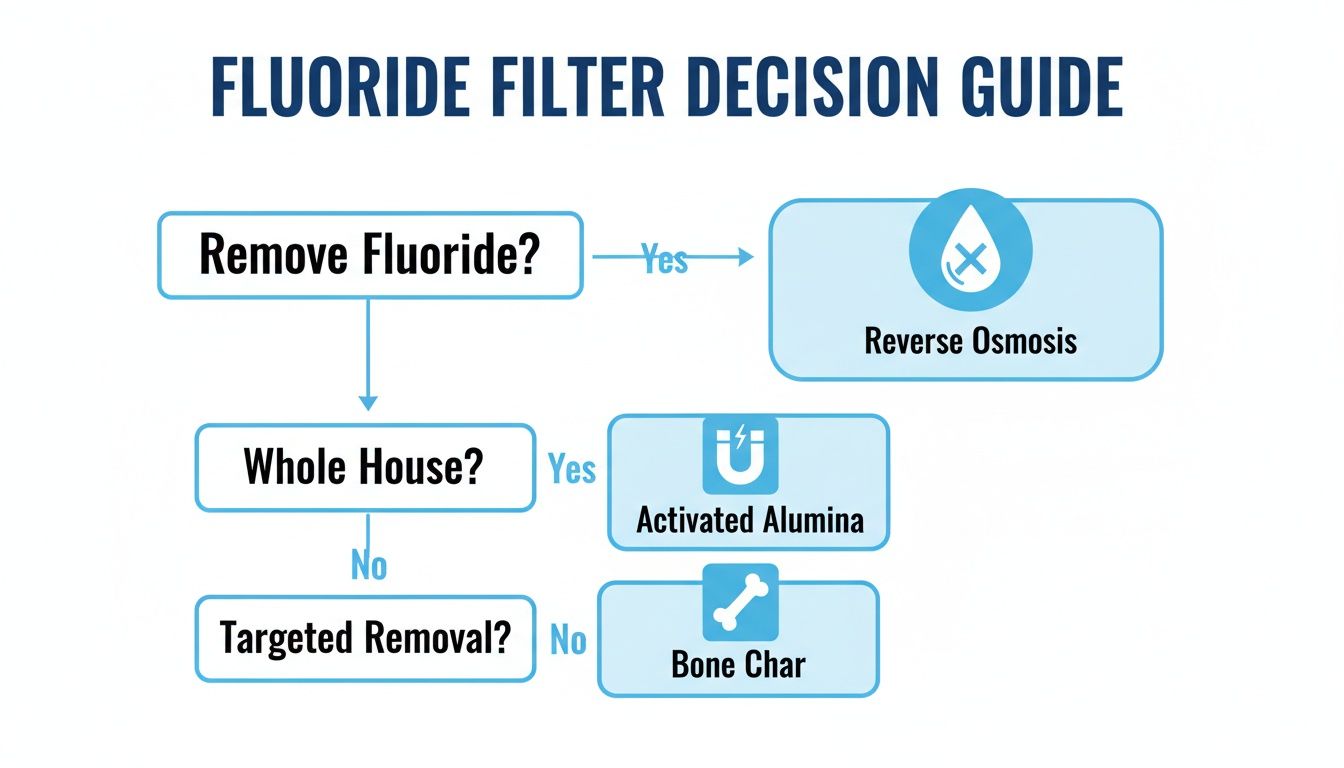
The chart below gives you a quick visual on how to decide between the most common filter types, which are almost always found in these targeted under-sink setups.

Fluoride filter decision guide flowchart presenting reverse osmosis, activated alumina, and bone char options.

As you can see, whether you go with Reverse Osmosis for the highest level of purity or an adsorption media like Activated Alumina, the technology is perfectly suited for a specific point of use.

Whole-House: The Comprehensive Solution

A whole-house system is a much bigger deal. We're talking a larger investment upfront and a more involved installation. These systems are workhorses, built to handle the high flow rates needed to treat thousands of gallons for your entire home.

Why would someone go this route for fluoride? The main reason is if you have serious concerns about skin absorption during baths and showers, or if you simply want the peace of mind of knowing there’s no fluoride in your laundry or dishwasher water.

Keep in Mind: While the skin can absorb certain things from water, fluoride absorption through bathing is generally considered pretty minimal for most people. The primary way we take in fluoride is by drinking it. This is why a targeted under-sink system is the most practical choice for the vast majority of families.

So, how do you decide? It really comes down to weighing a few key factors:

  • Cost: Under-sink systems are way more affordable. The initial price is lower, and the replacement filters won't hit your wallet as hard.
  • Installation: Many homeowners can tackle an under-sink filter installation as a DIY project over a weekend. A whole-house system? Not so much. It almost always requires a professional plumber because it involves cutting into your home's main water line.
  • Maintenance: Both systems need filter changes, but the big, heavy cartridges for whole-house units are more expensive and can be a real pain to swap out.
  • Your Goal: Is your main priority pure drinking water? An under-sink system is the clear winner. Do you want fluoride gone from every single tap, no exceptions? A whole-house system is the only way to make that happen.

When you're looking at different home water solutions, it's sometimes helpful to think about the bigger picture of your home's plumbing. You might need to coordinate a filter installation with other work. A company that provides a range of services, like water heater installation services, will have a good understanding of how all these systems tie together.

Ultimately, the choice is yours. Once you're clear on what you want to achieve with your water, you can confidently pick the system that’s the perfect match for your family’s needs and your budget.

Your Smart Buyer's Checklist for Fluoride Filters

A flat lay of a desk with coffee, a clipboard with a 'Filter Checklist' and a pen.

You've waded through the different technologies and you've got a good idea of where you want to install your filter. Now for the fun part—actually picking one out. But before you hit that "buy" button, it pays to run through a quick final checklist. This will make sure the system you choose is a genuine performer that actually delivers, without any nasty surprises down the road.

Think of it like a pre-purchase inspection. A great filter isn't just about a high removal rate; it’s about having proof of that performance, understanding the long-term costs, and finding a maintenance routine you can actually live with. Let's walk through the essential checkpoints.

Look for Third-Party Certification

First things first: verify the manufacturer's claims. The easiest way to do this is by looking for independent, third-party certifications. In the water filter world, the gold standard comes from groups like the NSF (National Sanitation Foundation) and ANSI (American National Standards Institute). These organizations don't just take a company's word for it—they put these filters through some seriously tough testing to prove they do what they claim.

When you're shopping for filters that remove fluoride, these are the key certifications you want to see:

  • NSF/ANSI 53: This is the big one for health-related contaminants, including fluoride. A filter with this stamp of approval has proven it can reduce high fluoride levels down to the EPA's maximum allowable limit of 4 mg/L.
  • NSF/ANSI 58: This standard is specifically for Reverse Osmosis (RO) systems. It's a really comprehensive certification that covers everything from fluoride reduction to the system's structural integrity and overall efficiency.
  • NSF/ANSI 42: While this one is more about aesthetics—like getting rid of that chlorine taste and smell—it's still a great sign of a quality product. You'll often see the best fluoride filters carry this certification alongside NSF 53 or 58.

Be wary of vague claims like "tested to NSF standards." True certification means you should be able to look up the product right on the official NSF website.

Scrutinize the Performance Data Sheet

Every legitimate water filter comes with a Performance Data Sheet. This is the spec sheet, the nitty-gritty document that spells out exactly what the filter removes and just how well it does it. You can usually find it on the product page online or tucked inside the box.

Don't just give it a quick glance—actually read it. Hunt for the line item for "Fluoride" and check the average percentage reduction. A top-tier system should be removing over 90% of fluoride, easy. This sheet is basically the manufacturer’s contract with you, so if a company can't or won't provide one, that's a huge red flag.

Calculate the True Cost of Ownership

The price you see on the website is just the beginning. The real cost of any water filter is what you spend over its entire life. This is called the total cost of ownership, and figuring it out now can save you a ton of money and frustration later on.

To get the real number, you need to add up:

  1. Initial Purchase Price: The upfront cost of the system.
  2. Replacement Filter Costs: This is the biggest ongoing expense. How much are the replacement cartridges?
  3. Filter Lifespan: How often do they need to be changed? Every six months? Every few years? A cheap filter that needs new cartridges constantly can end up costing you more than a pricier unit with long-lasting filters.

Think about it this way. System A is $150, but needs a $60 filter change every 6 months. System B is $300, but its $100 filter only needs replacing once a year. After two years, you’d have spent $390 on System A ($150 + 4x$60), but only $500 on System B ($300 + 2x$100). Knowing these numbers helps you make a smarter long-term investment.

Check Maintenance Needs and Ease of Use

Last but not least, be honest with yourself about maintenance. How easy is it to swap out the filters? Do you need a bunch of special tools or have to shut off the main water line to your house? Some under-sink RO systems have brilliantly simple twist-off cartridges, while others are a bit more involved.

Jump on YouTube and watch a video of the filter change process if you can, or at least read some customer reviews. A system that's a complicated, messy hassle to maintain is one you're going to put off dealing with, and that defeats the whole purpose.

For even more tips on picking the right unit, check out our general advice on water filters to help guide your decision. By running through this checklist, you can be confident you're choosing a reliable and effective solution for your home.

Common Questions About Fluoride Water Filters

Even after you've got a good handle on the technology, a few practical questions almost always come up when you’re about to pull the trigger on a filter. To help clear up any last-minute doubts, we’ve put together the most common questions we hear from homeowners. Think of these as the final pieces of the puzzle to help you move forward with confidence.

Let's dive in and tackle some of the biggest concerns.

Do Brita Pitcher Filters Remove Fluoride?

Nope. Standard pitcher filters like Brita or Pur just can't do it. These filters use a basic activated carbon, which is great for getting rid of that chlorine taste and smell, making your water more pleasant to drink. But when it comes to dissolved minerals like fluoride, they’re completely ineffective.

Imagine trying to catch salt dissolved in water with a spaghetti strainer—it's just going to pass right through. To actually grab onto fluoride ions, you need a specialized filter media like reverse osmosis, activated alumina, or bone char.

Does Boiling Water Get Rid of Fluoride?

This is a really common myth, and it's a dangerous one. Boiling water does the exact opposite of what you want. As the water boils, pure H₂O turns into steam and evaporates, but all the minerals—including fluoride—get left behind.

This actually makes the fluoride more concentrated in the water that's left. If you boil a liter of water down to half a liter, you’ve just doubled the fluoride concentration. This is a huge deal for anyone using tap water to mix baby formula or when cooking things that soak up a lot of water, like rice and pasta.

Is an Under-Sink System Enough or Do I Need a Whole-House Filter?

For most families, an under-sink system is the perfect sweet spot. If your main goal is simply to have pure, fluoride-free water for drinking and cooking, then a Point-of-Use (POU) system installed at your kitchen sink is the most effective and cost-efficient way to go.

A whole-house filter, or a Point-of-Entry (POE) system, is a much bigger and more expensive project. It's usually only necessary if you have very specific concerns about absorbing fluoride through your skin during baths and showers. Since drinking is the primary way we're exposed to fluoride, most people find that just treating the water they consume is more than enough.

Here's the bottom line: unless you have a compelling medical reason to treat every single faucet, an under-sink system delivers the best bang for your buck in terms of performance, cost, and convenience for removing fluoride.

How Can I Find Out if My Tap Water Contains Fluoride?

Knowing what you’re dealing with is always the first step. Thankfully, finding out your fluoride level is pretty straightforward.

  • For City or Municipal Water: Your local water utility is required by law to send out an annual water quality report, often called a Consumer Confidence Report (CCR). This report will list the average fluoride concentration. You can usually find it right on their website, or you can call and ask them to mail you a copy.
  • For Private Well Water: If you're on a well, you're the captain of your own ship—and that includes water testing. The only way to know for sure what your fluoride level is is to send a sample to a state-certified lab. They'll give you an exact number so you can choose the right filter for your situation.

Will a Fluoride Filter Also Remove Essential Minerals?

That’s a great question, and it comes up a lot, especially with Reverse Osmosis (RO) systems. The short answer is yes—because RO membranes are so fine, they strip out nearly everything, including beneficial minerals like calcium and magnesium.

But it’s important to keep this in perspective. We get the vast majority of our essential minerals from the food we eat, not the water we drink. While tap water can chip in a little, it’s not our main source. For anyone still concerned, many modern RO systems now come with a remineralization filter as the final step. This adds a healthy balance of minerals back into the water right before it hits your glass, which also improves the taste and pH.


At Water Filter Advisor, we're here to give you clear, research-backed advice to help you protect your family's health. Check out our detailed guides and reviews to find the perfect filtration system for your home.

Ready to find your filter? Learn more at https://www.waterfilteradvisor.com.