So, you want better tap water. Welcome to the club! But when you start looking, you run into two heavy hitters: standard water filters and reverse osmosis systems. What's the real difference?
Let's cut to the chase. A standard filtered water system is like a bouncer at a club—it grabs the obvious troublemakers, like chlorine, making your water taste and smell way better. A reverse osmosis (RO) system is like a top-secret government lab—it purifies your water, zapping up to 99% of almost everything else, including salts, heavy metals, and fluoride.
The choice boils down to a simple question: are you looking for a simple taste upgrade, or do you want the absolute purest water you can get flowing from your tap?
Choosing Your Home Water System: A Quick Comparison
Diving into the world of home water filtration can feel like you’ve stumbled into a chemistry class you didn't sign up for. You'll hear technical terms like "activated carbon" and "semi-permeable membrane" tossed around, which can make a simple decision feel surprisingly complex.
But don't worry. Comparing filtered water to reverse osmosis is easier than it sounds. It all comes down to what's lurking in your water and what you personally want to kick to the curb.
Key Differences at a Glance
Think of standard filters—the kind you find in a simple pitcher, faucet attachment, or under-sink unit—as a basic gatekeeper. They do a fantastic job of grabbing the big stuff that ruins the taste and smell of your water, especially chlorine. They take your regular city tap water and make it genuinely pleasant to drink.
Reverse osmosis (RO) is a whole other beast. It's more like a high-security checkpoint for your water. By forcing water through an incredibly fine membrane, it strips out nearly everything that isn't pure H₂O. We're talking dissolved salts, fluoride, arsenic, lead, and a long list of other contaminants that simpler filters can't even see.
To make the right call, let's put them side-by-side. This table cuts through the noise and lays out the core differences.
Filtered Water vs Reverse Osmosis at a Glance
| Feature | Standard Water Filters | Reverse Osmosis (RO) Systems |
|---|---|---|
| Primary Goal | Improves taste, odor, and clarity by removing chlorine and sediment. | Purifies water by removing a huge range of dissolved contaminants. |
| Technology | Uses media like activated carbon or sediment screens to trap particles. | Pushes water through a high-tech membrane to separate out impurities. |
| Contaminant Removal | Great for chlorine, sediment, some VOCs, and larger particles. | Removes up to 99% of TDS, including salts, fluoride, arsenic, and lead. |
| Mineral Impact | Keeps healthy minerals like calcium and magnesium. | Removes almost all minerals, both the good guys and the bad guys. |
| Installation | Simple (pitchers, faucet mounts) to moderate (under-sink systems). | More complex, usually needing a dedicated faucet and drain connection. |
This gives you a solid starting point. For more in-depth comparisons and product suggestions, you can always check out more expert advice to zero in on the perfect fit. Now, let's dig deeper to help you match the right system to your home's unique needs.
Before we can really get into the reverse osmosis vs. filtered water debate, we need to be clear about what we mean by "filtered water." It's a broad term that covers a few popular technologies, each one a specific tool for a specific job. These methods don't technically purify water; they improve it by tackling problems like bad taste, weird smells, and cloudy appearance.
Think of standard filters as a bouncer at a club. They aren't there to check the ID of every single molecule, but they are great at stopping the most obvious troublemakers from getting past the rope. For most people on city water, this is often all you need to take your tap water from "meh" to "ahh."
The Workhorse: Activated Carbon Filters
The most common player in the home filtration game is the activated carbon filter. This is the magic inside everything from your basic water pitcher and refrigerator filter to the more serious under-sink and whole-house systems. It's so popular because it’s incredibly good at one thing: adsorption.
An activated carbon filter is basically a super-sponge with a massive, porous surface area that acts like a magnet for certain contaminants. As water flows through, chemicals and impurities get trapped and stick to the surface. It’s especially good at nabbing chlorine—the chemical most cities use for disinfection and the main reason your tap water can taste and smell like a swimming pool.
By removing chlorine and some volatile organic compounds (VOCs), these filters make a huge difference in how your water tastes. If you want to get into the nitty-gritty, you can dig deeper into understanding water filtration and its impact on flavor. For many households, just getting rid of that chemical funk is the entire goal.
The Gatekeepers: Sediment Filters
Next up are sediment filters. These are the unsung heroes in many home water setups, especially for homes with older pipes or private well water. Their job is simple, physical screening—they’re basically a high-tech net designed to catch solid gunk.
Imagine pouring water through an extremely fine mesh. That’s what a sediment filter does, catching debris both big and small, like:
- Rust flakes from old pipes
- Sand and silt
- Dirt and other bits of organic matter
These filters are absolutely essential for protecting the more delicate and expensive parts of a system that might come after them, like an RO membrane. They keep your water clear and prevent clogs, making sure everything runs smoothly.
The Specialist: UV Purifiers
While carbon and sediment filters deal with chemicals and grit, ultraviolet (UV) purifiers are built to fight an entirely different enemy: living microorganisms. A UV purifier isn't a "filter" in the traditional sense because it doesn't actually remove anything from the water. Instead, it blasts the water with powerful UV-C light.
This blast of UV light wrecks the DNA of bacteria, viruses, and nasty protozoa like Giardia and Cryptosporidium. It doesn't kill them, but it renders them sterile and harmless, neutralizing them without adding a single chemical to your water.
UV purification is a crucial defense for anyone on a private well, where microbial contamination is a real risk. It’s also used as a final safety step in many high-end systems to give you total peace of mind against invisible biological threats that other filters can't touch.
Each of these standard methods is great at its specific job, but they all leave smaller, dissolved contaminants behind. And that’s where the conversation really shifts over to reverse osmosis.
How Reverse Osmosis Delivers Ultimate Water Purity
When a standard filter just won't cut it, reverse osmosis (RO) steps into a league of its own. This isn't just about filtering water; it's a full-blown purification process designed to strip your tap water down to its purest form: H₂O. If you're looking for the absolute cleanest water possible for your home, this is the technology you need to know.
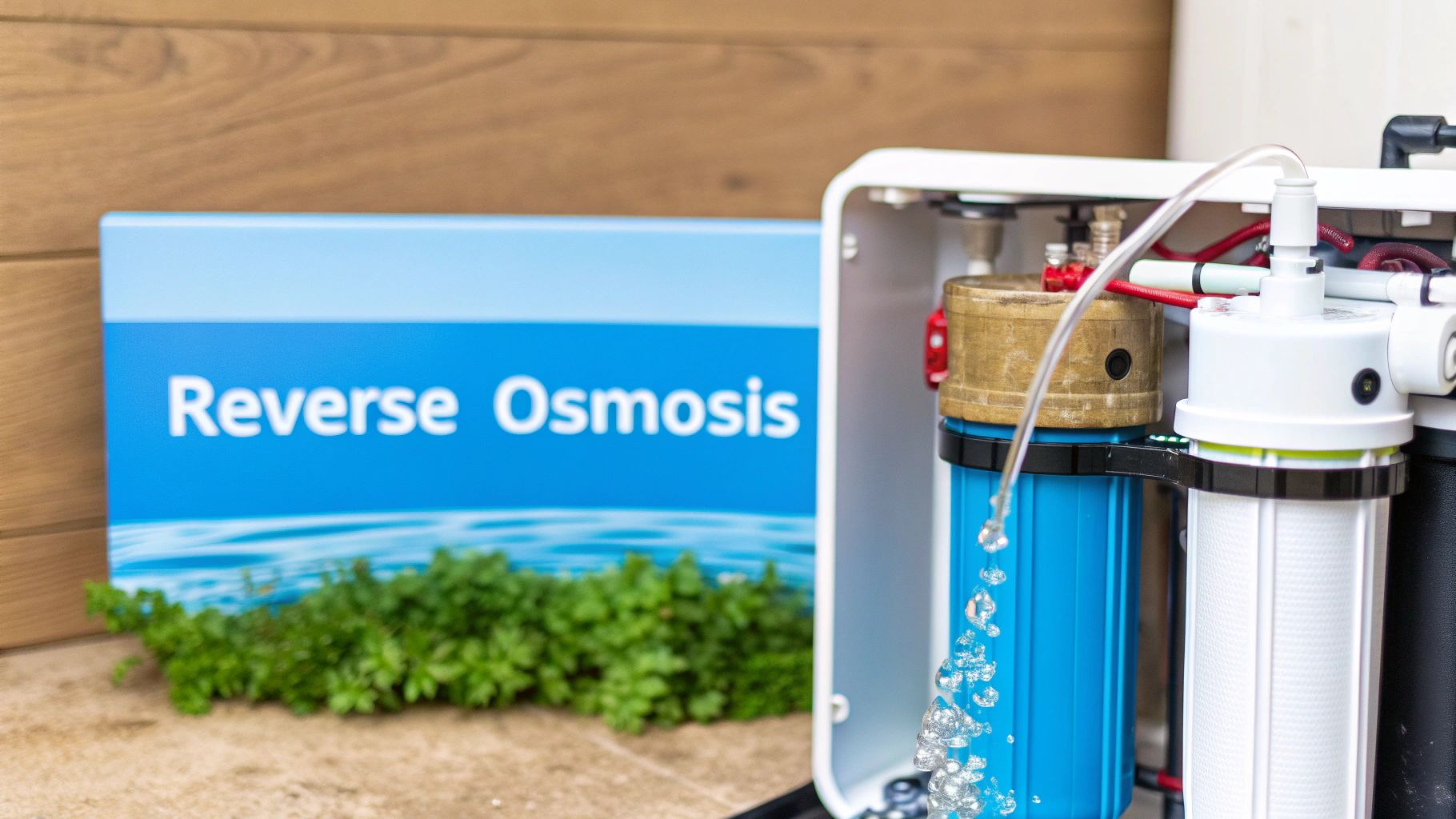
The concept is surprisingly simple but incredibly powerful. An RO system uses your home's water pressure to push tap water through a special semi-permeable membrane. This membrane is the heart of the system, packed with microscopic pores around 0.0001 microns—so tiny that practically nothing but pure water molecules can squeeze through.
Everything else dissolved in the water—from salts and heavy metals to fluoride and nitrates—gets blocked and flushed down the drain. This core difference is what truly separates simple filtering from genuine purification when you compare filtered water vs reverse osmosis.
The Multi-Stage Purification Journey
A typical under-sink RO system isn't a one-trick pony. It’s a team of filters working in harmony, with each stage playing a crucial part in delivering that incredibly pure water.
- Sediment Pre-Filter: This is the bodyguard. It stops all the physical gunk like rust, sand, and dirt, protecting the more sensitive parts of the system from getting clogged or damaged.
- Carbon Pre-Filter: Before the main event, water flows through an activated carbon filter. Its job is to remove chlorine and other chemicals that could wreck the delicate RO membrane, helping it last longer and work better.
- The RO Membrane: This is where the magic happens. Water is forced through the membrane, which separates the pure water from a long list of dissolved contaminants.
- Storage Tank: Because the RO process is slow and steady, the purified water is stored in a small pressurized tank under your sink. This gives you a ready supply of clean water whenever you turn on the faucet.
- Post-Filter (Polishing Filter): Right before the water comes out of your special RO faucet, it usually gets one last pass through another carbon filter. This final "polish" removes any lingering tastes or smells picked up from the tank, ensuring your water is perfectly crisp and delicious.
This methodical, multi-stage process is exactly why RO is considered the gold standard for home water treatment. It’s not one filter doing all the work; it’s a coordinated system built for maximum purity.
You can't argue with the results. Reverse osmosis technology is a major player in the global water purification scene, holding about 36-39% of the market share. Its power to remove up to 99% of dissolved salts, heavy metals, and fluoride makes it an essential tool, especially where groundwater quality is a concern. You can find more details on the water filter market and current trends.
What Makes RO the Ultimate Choice for Purity
The number one reason people choose reverse osmosis is simple: it removes the nasty stuff that other filters can't even touch. An activated carbon filter is great for getting rid of chlorine, but it's completely helpless against dissolved inorganic compounds.
An RO system, on the other hand, is built to tackle a whole range of tough contaminants:
- Heavy Metals: It dramatically reduces lead, arsenic, mercury, and chromium.
- Dissolved Solids: It slashes the Total Dissolved Solids (TDS) count, which includes salts and other minerals.
- Fluoride: This is one of the very few home-use methods that effectively removes fluoride.
- Nitrates & Nitrites: A must-have for anyone on well water, especially near agricultural areas.
This level of performance gives you complete peace of mind. For families with specific health concerns, compromised immune systems, or anyone who just wants the purest water they can get, the power of RO is unmatched. It’s the final word when just improving your water isn’t enough and you’re aiming for true purification.
Contaminant Removal: A Detailed Performance Comparison
This is where the gloves come off and the real differences between standard filters and reverse osmosis (RO) shine. Choosing the right system for your home isn’t just about the technology—it's about matching that tech to the specific water problems you need to solve.
You can think of it this way: standard filters are great at making decent water even better, while reverse osmosis is designed to take questionable water and make it exceptionally pure. Let’s break down exactly what each method is built to handle and what it leaves behind.
Taste, Odor, and Chlorine: The Realm of Carbon Filters
For most homes on a municipal water supply, the biggest complaints are about taste and smell. The culprit is almost always chlorine, which is where filters using activated carbon are the undisputed champions. They are specialists at improving the "aesthetic" qualities of your water.
Activated carbon works like a sponge, using its huge internal surface area to adsorb chlorine and other volatile organic compounds (VOCs). When water flows through, these unwanted elements get trapped, leaving you with water that tastes crisp and clean, without that faint “swimming pool” aroma. Their job pretty much stops there, though; they aren't designed to touch dissolved solids, heavy metals, or salts.
If your main goal is simply to banish that chlorine taste and odor, an activated carbon filter is the most direct and budget-friendly solution. While RO also removes chlorine (usually in a pre-filter), its true purpose is to tackle a much wider range of contaminants.
Tackling Heavy Metals, Fluoride, and Nitrates
Here's where reverse osmosis systems pull away from the pack. Contaminants like lead from old pipes, naturally occurring arsenic, fluoride added by water districts, and nitrates from farm runoff are all dissolved in water. Standard carbon or sediment filters just can't physically grab them.
An RO system's semi-permeable membrane, with pores as tiny as 0.0001 microns, is specifically engineered to block these dissolved inorganic compounds. It forcefully separates pure water molecules from a long list of things you don't want to drink.
- Lead & Arsenic: RO systems are proven to reduce these toxic heavy metals, often by over 95%.
- Fluoride: It’s one of the only residential water treatment methods that can reliably remove fluoride.
- Nitrates: For homes on well water near agricultural land, an RO system is a critical defense against nitrate contamination.
If your water test shows high levels of any of these, reverse osmosis isn't just a good idea—it's essential for your family's safety and peace of mind.
The Mineral Question: Beneficial vs. Unwanted Solids
A huge difference between filters and RO is how they treat minerals. Standard filters like carbon are selective; they take out the bad stuff but let beneficial minerals like calcium and magnesium pass right through. Many people prefer this for both taste and potential health benefits.
Reverse osmosis, however, is not selective at all. Its ultra-fine membrane strips out nearly all total dissolved solids (TDS). This includes harmful contaminants, but it also takes out those healthy minerals. The result is incredibly pure but "demineralized" water. While we don't rely on water for our primary mineral intake, some people find the taste a bit flat. To solve this, many modern RO systems now come with a remineralization post-filter that adds a balanced amount of healthy minerals back into the water right before it hits your glass.
Contaminant Removal Capabilities: Filter vs RO
To make this simple, the table below gives you a clear, at-a-glance breakdown of what each technology can and cannot do. Use it to quickly match your specific concerns with the right system.
| Contaminant | Activated Carbon Filter | Sediment Filter | UV Purifier | Reverse Osmosis System |
|---|---|---|---|---|
| Chlorine | Excellent | Ineffective | Ineffective | Excellent (via pre-filter) |
| Sediment (Sand, Silt, Rust) | Fair | Excellent | Ineffective | Excellent (via pre-filter) |
| Lead & Heavy Metals | Limited / Varies | Ineffective | Ineffective | Excellent |
| Fluoride | Ineffective | Ineffective | Ineffective | Excellent |
| Nitrates & Sulfates | Ineffective | Ineffective | Ineffective | Excellent |
| Bacteria & Viruses | Ineffective | Ineffective | Excellent | Good (but UV is better) |
| Healthy Minerals | Retains | Retains | Retains | Removes |
Ultimately, your decision comes down to your water quality. If you have generally safe city water and just want it to taste better, a standard filter is a perfect fit. But if you have specific worries about hard-to-remove contaminants or just want the highest level of purity possible, reverse osmosis is the undisputed champion.
The Real-World Breakdown: Cost, Upkeep, and Installation
Performance is one thing, but how a system fits into your budget and your life is what really matters. When we get down to the practical differences of filtered water vs reverse osmosis, the cost, maintenance, and installation are worlds apart.
The Financial Commitment
Let's talk money. These two approaches are on completely different financial planets.
Standard filters are your easy entry point. A basic water pitcher can be yours for $20-$40, and a more serious under-sink or faucet-mounted setup will run you $50 to $200. The ongoing costs are straightforward, too—you'll swap out filter cartridges every few months, which usually costs between $15 and $50 a pop.
Reverse osmosis systems are a bigger investment in your home's water quality. A solid under-sink RO unit starts around $200 and can easily top $500, especially with fancy features like a remineralization stage. The long-term costs are also more involved. You aren't just changing one filter; you're replacing multiple cartridges (sediment, carbon, etc.) every year and the main RO membrane every two to four years.
This decision tree cuts through the noise by boiling it down to what you care about most: better taste or ultimate purity.
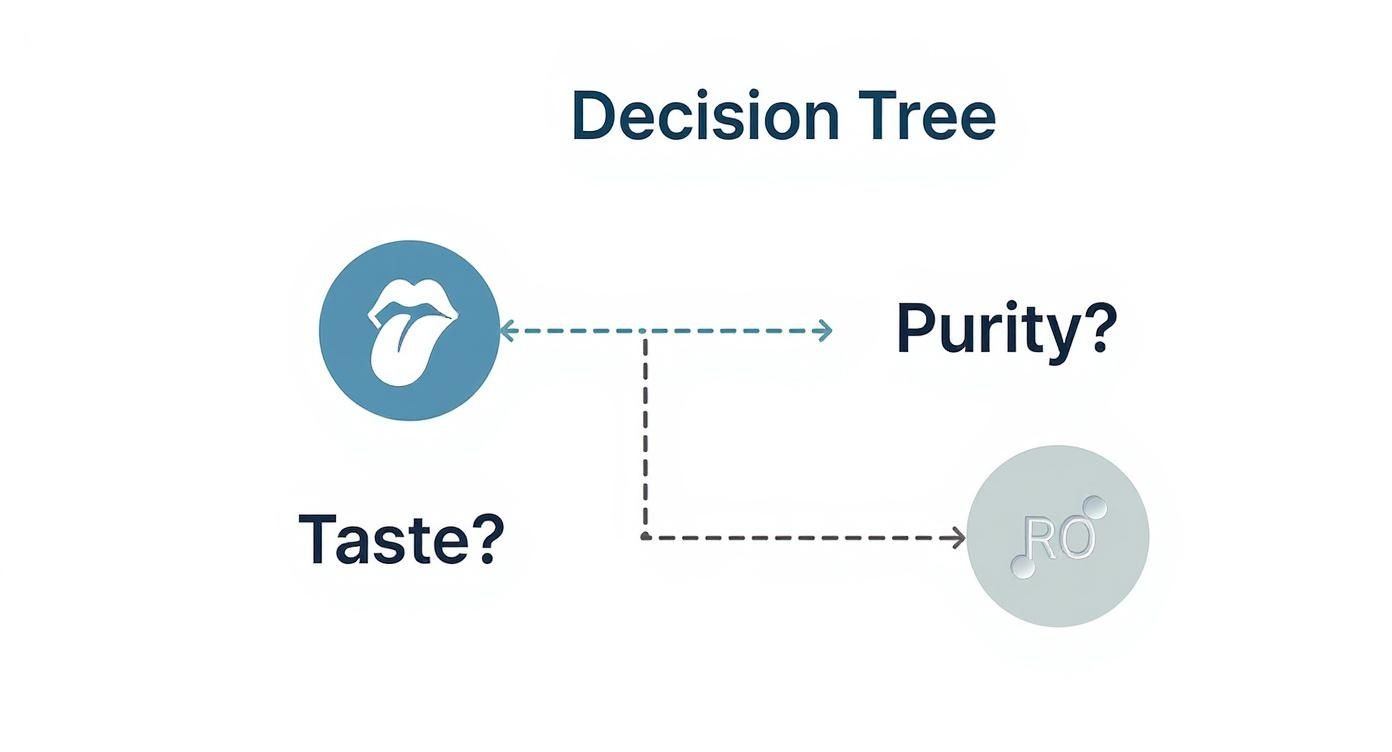
As you can see, if you're just looking to improve taste and odor, a standard filter is your best bet. If you're after the highest level of purification possible, the path leads straight to reverse osmosis.
Installation: A Weekend Project or a Call to a Pro?
This is another area where the two systems couldn't be more different.
Most standard water filters are designed with the DIYer in mind. A pitcher filter obviously needs no installation, and you can usually twist a faucet filter on in minutes without any tools. Even most under-sink carbon filters are manageable for anyone comfortable with basic home repairs.
Installing a reverse osmosis system is a real project. It involves:
- Drilling a new hole in your countertop or sink for its dedicated faucet.
- Tapping into your sink's drainpipe to get rid of the wastewater.
- Juggling multiple water line connections for all the different parts—pre-filters, the membrane, the storage tank, and the faucet.
While many kits are marketed for DIY, one wrong move can lead to a leaky disaster under your sink. That's why a lot of homeowners just hire a plumber, which can add another $150-$300 to the initial cost.
Let's Talk About RO Water Waste
One of the biggest concerns people have with reverse osmosis is the wastewater. It’s a valid point. To flush away all those contaminants it removes, the system has to send a certain amount of water down the drain. This is a key difference from standard filters, which produce zero wastewater.
The efficiency of an RO system is all about its pure-water-to-wastewater ratio. Older systems were infamous water hogs, sometimes wasting three gallons (or more!) for every single gallon of pure water they produced. Thankfully, modern technology has come a long way.
Today’s systems are much smarter. While you might still see ratios from 1:1 to 3:1 (waste to pure), the best modern RO units have dramatically improved, with some models achieving nearly 80% water recovery rates. In fact, the US EPA calculates that if everyone switched to WaterSense-labeled RO systems, we could save over 3.1 billion gallons of water across the country every year. You can learn more about how newer systems have tackled this issue over at hawaiiancoolwater.com. This progress makes choosing an RO system a much more eco-friendly decision than it used to be.
Matching a Water System to Your Household Needs
The choice between a standard water filter and a reverse osmosis system gets a lot easier once you stop focusing on technical specs and start thinking about your actual situation at home. What's the real goal here? Are you just trying to make your morning coffee taste better, or are you worried about specific health risks hiding in your water supply?
Let's walk through a few common household scenarios to figure out which system is the right fit for you.

Different Households Different Solutions
Scenario 1: The City Dweller Seeking Better Taste
You live in an apartment or a fairly new house with a reliable municipal water supply. Your main gripe is that chlorine smell and taste that makes tap water just a little bit… off. You’re not really concerned about heavy metals or anything serious—you just want crisp, clean-tasting water on demand.
- Ideal Solution: A simple activated carbon filter. This could be anything from a pitcher in the fridge to a filter you screw onto your faucet or install under the sink. They're affordable, easy to manage, and fantastic at knocking out that chlorine taste for much better-tasting water.
Scenario 2: The Suburban Family with Older Plumbing
Your family lives in a home built before the 1980s, and you have a nagging worry about lead potentially leaching from old pipes or solder joints. The city’s water report looks okay, but you're not so sure about the plumbing that leads directly to your kitchen tap.
- Ideal Solution: A reverse osmosis system. When it comes to dissolved heavy metals like lead, this is hands-down the most reliable option for a home. While some high-end carbon filters are certified to reduce lead, an RO system offers the highest level of protection and peace of mind for your family.
Think of it as a matter of risk management. If you just want better taste, a standard filter is perfectly fine. But for tough-to-remove contaminants like lead or fluoride, reverse osmosis is the undisputed winner for maximum safety.
Scenario 3: The Rural Homeowner on Well Water
You're on a private well, which means you're the captain of your own water quality ship. Your list of potential concerns is long, from sediment and rust to invisible threats like nitrates from agricultural runoff or even bacteria and viruses.
- Ideal Solution: A multi-stage approach is non-negotiable here. A powerful setup would start with a sediment pre-filter to catch the big stuff, followed by a reverse osmosis system to tackle dissolved contaminants like nitrates, and then a UV purifier as the final line of defense against microorganisms. This combination gives you a robust shield against the unknowns of well water.
Scenario 4: The Health-Conscious Individual Seeking Purity
You want your water to be as pure as humanly possible. We're talking free from fluoride, trace pharmaceuticals, microplastics, and all the other emerging contaminants you hear about. Your goal is simple: total control over what's in your glass, leaving nothing but pure H₂O.
- Ideal Solution: A high-efficiency reverse osmosis system, probably one that includes a remineralization stage. RO is unmatched in its power to strip out the widest range of dissolved solids. Adding a remineralization filter puts beneficial minerals like calcium and magnesium back into the water, which improves the taste and balances the pH for perfectly optimized drinking water.
As you plan out your installation, especially for a more involved RO system, it's smart to think about the long term. Looking into innovations like smart plumbing systems with leak-detecting pipes can make a real difference in your installation and future maintenance plans. Once you diagnose what your home truly needs, you can pick a system with confidence, knowing it will deliver exactly what you're looking for.
Common Questions About Home Water Filtration
Deciding between a standard filter and a reverse osmosis system can feel a bit overwhelming. Let's tackle some of the most common questions head-on to help you get the clarity you need.
Does Reverse Osmosis Remove Healthy Minerals From Water?
Yes, it does. The RO process is so fine that it strips out nearly all dissolved solids, including good-for-you minerals like calcium and magnesium.
But here's the thing: we get the vast majority of our minerals from food, not water. If you're still concerned or just prefer the taste of mineral water, many modern RO systems have an add-on remineralization filter that puts a healthy dose of minerals back in before the water ever hits your glass.
Can I Install a Reverse Osmosis System Myself?
Absolutely. Most under-sink RO systems are designed for the handy homeowner. If you're okay with basic plumbing tasks—like hooking up a few water lines and drilling a small hole in your countertop for the new faucet—you can probably get it done in an afternoon.
If that sounds like a recipe for a weekend headache, just call a plumber. It's a quick job for a pro and gives you peace of mind that it's done right and won't spring a leak.
The most crucial part of the filtered water vs reverse osmosis decision is knowing what you're trying to remove. Without that information, you're just guessing.
How Do I Know What Contaminants Are in My Water?
The only way to know for sure is to test it.
A good first step is to check the free consumer confidence report (CCR) from your local water utility. It gives you a baseline of what they've found. For a more precise look at what's coming out of your faucet—and this is a must if you have a private well—you can buy a home water test kit or send a sample to a state-certified lab for a full-blown analysis.
At Water Filter Advisor, our goal is to give you the clear, unbiased information you need to choose the best water filtration system for your family's health and peace of mind. Explore our in-depth guides and reviews at https://www.waterfilteradvisor.com.
- November 22, 2025
- 0
- Uncategorized
