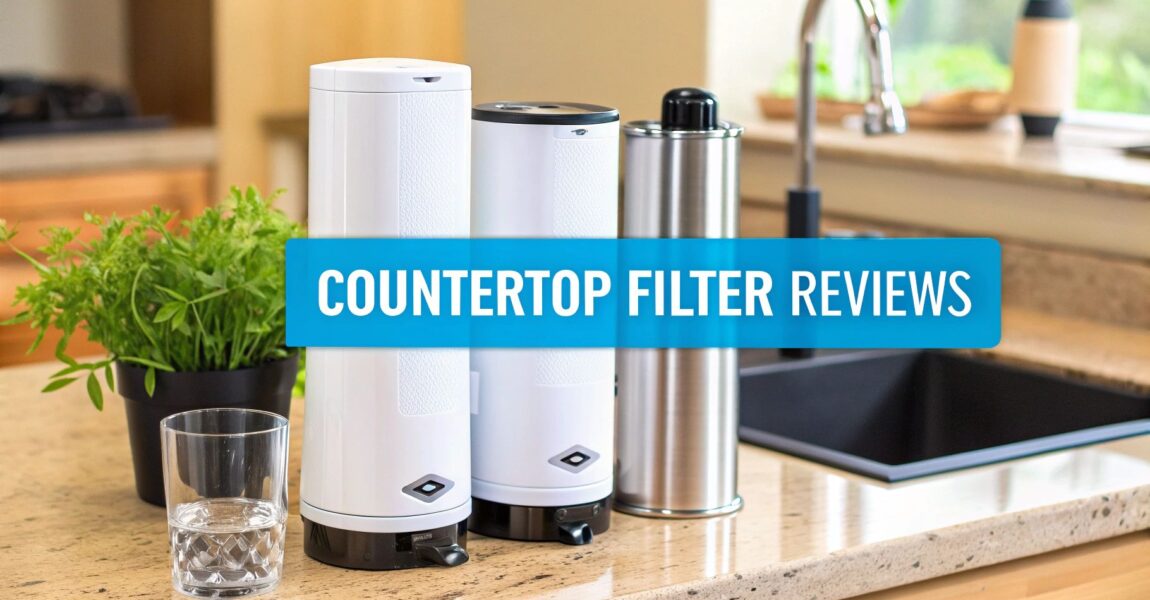
Picking the right countertop water filter is about way more than just improving the taste of your water—it’s one of the most important decisions you can make for your family's health. The best systems are the ones that are independently certified to pull out the nasty stuff like lead and chlorine, all without needing a plumber to get it running. They just sit on your counter, ready to go.
Why Finding the Right Countertop Filter Matters
Let's be honest, the tap water in many places isn't as pure as we'd like to think. Even after municipal treatment, it can still be a cocktail of unwanted extras. We're talking everything from chlorine that makes your water taste like a swimming pool to more serious contaminants like lead from old pipes, industrial chemicals, and even tiny bits of plastic. A good countertop filter is your last line of defense, turning your kitchen tap into a source of pure, safe hydration.
This isn't just a hunch people have; the numbers back it up. The market for these filters hit USD 1.5 billion in 2024 and is expected to almost double by 2033. That boom is happening because people are genuinely worried about water quality, with nearly 30% of Americans feeling uneasy about what’s coming out of their taps. You can dig into more data on this expanding market to see just how fast things are changing.
Understanding Your Water Quality
Before you even start looking at filters, you need to know what you're fighting. Your local water utility has to give you an annual water quality report, sometimes called a Consumer Confidence Report (CCR). This is your secret weapon. It tells you exactly what contaminants are in your water and at what levels, so you know what you actually need to filter out.
Some of the most common culprits lurking in tap water include:
- Chlorine and Chloramine: Great for disinfection, not so great for taste.
- Heavy Metals: Lead and mercury are notorious for leaching from aging plumbing.
- Volatile Organic Compounds (VOCs): These often come from industrial runoff and pesticides.
- Emerging Contaminants: Things like microplastics and trace pharmaceuticals are showing up more and more.
A high-quality filter isn't just another kitchen gadget; it’s a proactive health tool. It gives you direct control over what your family is drinking every single day, making sure every glass is clean, safe, and tastes great.
Making an Informed Choice
The trick is to match the filter's strengths to your water's weaknesses. A filter that's a beast at removing chlorine might not touch lead, and vice versa. Our reviews are designed to break down these critical differences for you, comparing the top models on their real-world performance, certifications, and what they'll actually cost you over time. Once you understand the "why" behind it all, you'll be in a much better position to pick the perfect system for your home.
Decoding Countertop Filtration Technology
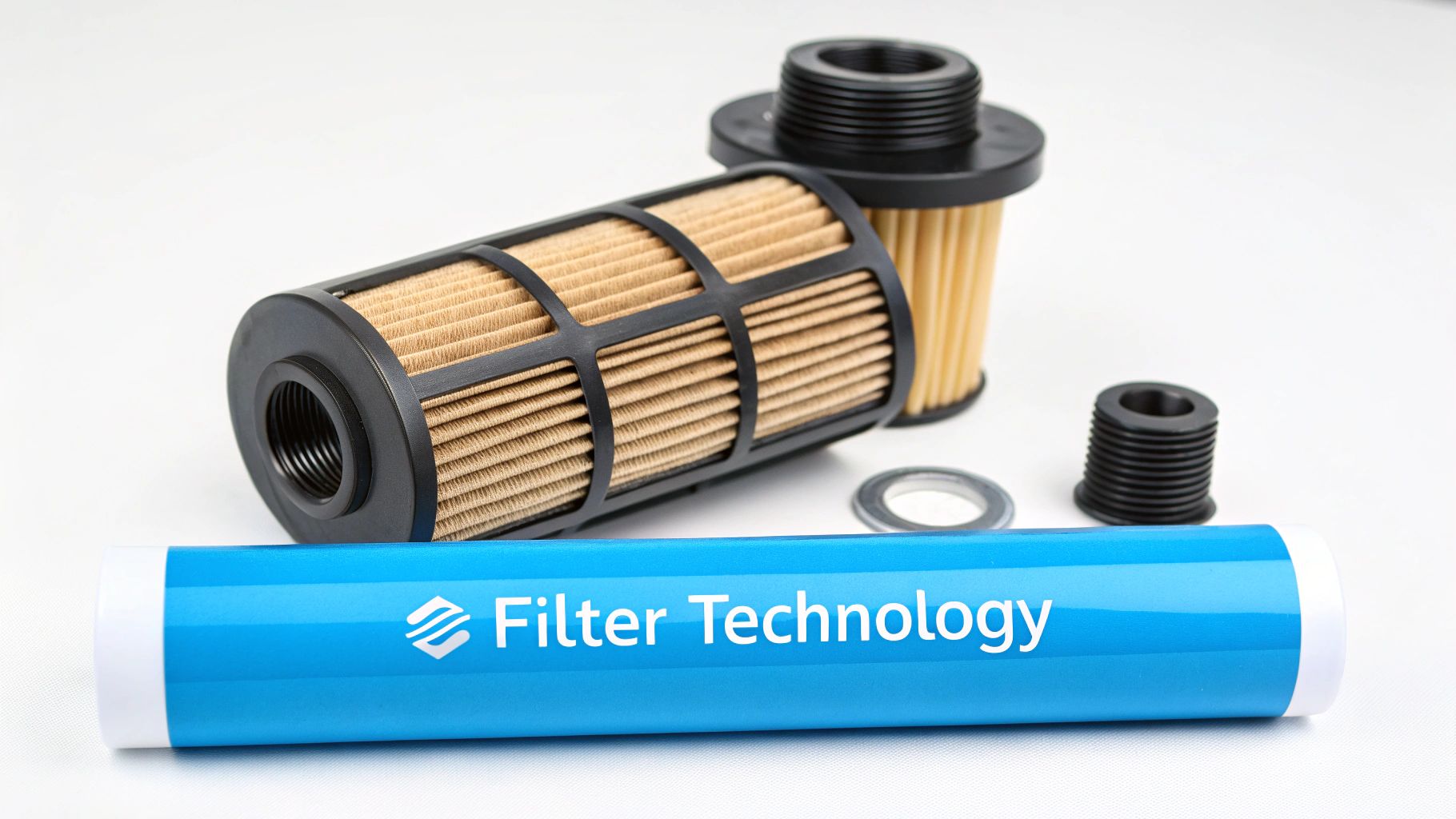
Before you start looking at specific models, it helps to know what's actually happening inside these things. Not all filters are the same, and the tech they use determines what gets pulled out of your water. Think of it this way: a basic carbon filter is perfect if you just want better-tasting water, but you'll need something much more robust to tackle contaminants like heavy metals.
Each countertop filter is built differently, designed for different kitchens and different water problems. Some work using simple gravity, while others pack in advanced membranes to get your water exceptionally pure.
How Different Countertop Systems Work
The way a filter delivers clean water is just as important as what's inside the filter media. Countertop systems usually fall into one of three buckets, each with its own pros and cons for your home.
- Gravity-Fed Systems: These are the simplest of the bunch. You've probably seen them—stainless steel or glass containers with two chambers. You just pour tap water into the top, and gravity does the work, pulling it through the filter elements into the bottom reservoir. They don’t need electricity or any plumbing hookups, but they aren't exactly fast.
- Faucet-Mounted Units: Just like the name implies, these little guys attach right to your kitchen faucet. A small diverter valve lets you flip between regular tap water for doing dishes and filtered water for drinking. They're super convenient and don't take up any counter space.
- Direct-Connect Filters: These models sit on your counter but hook up to the faucet with a small hose. This setup gives them enough room for more serious, multi-stage filtration that you just can't fit into a tiny faucet mount. It's a great middle-ground, offering powerful filtering without a permanent installation.
The core difference really boils down to flow and complexity. Gravity systems are simple but slow. Faucet mounts are all about instant convenience. Direct-connect models strike a balance between power and ease of use.
The Science Inside the Filter
The real magic is what’s going on inside the filter cartridge itself. Different materials are used to go after specific contaminants, from the chlorine that makes your water taste funky to invisible threats like lead and PFAS. To really get it, you can draw parallels by understanding different purification and filtration technologies for air, where different methods also target different particle sizes.
Here are the main technologies you’ll run into when comparing countertop filters:
-
Activated Carbon: This is the absolute workhorse of water filtration. Carbon has a super porous surface that basically acts like a contaminant magnet. Through a process called adsorption, it traps things like chlorine, VOCs, and pesticides, which is why it dramatically improves the taste and smell of your water.
-
Ceramic Filters: Made from natural ceramic, these filters are packed with microscopic pores that physically block out sediment, bacteria, and cysts. They're often cleanable and last a long time, making them a solid, reliable choice for dealing with microbiological contaminants.
-
Reverse Osmosis (RO): This is pretty much the top tier of water filtration. RO systems use your home's water pressure to force water through a special membrane with incredibly tiny pores. This process strips out up to 99.9% of all dissolved solids—we’re talking lead, fluoride, arsenic, and even microplastics. The only catch is that it also removes good minerals. That's why many RO systems now include a remineralization stage to add healthy stuff like calcium and magnesium back in, improving the taste and health benefits. It basically turns your kitchen into a personal water bottling plant.
Comparing Top Countertop Water Filters
Diving into the world of countertop water filters can get confusing fast, but a good side-by-side comparison cuts through the noise. We're putting the top contenders under a microscope to see how they actually perform in a real kitchen—not just what their marketing says. We'll focus on certified performance, daily use, and what clean water will really cost you over time.
The market for these systems is booming. In fact, the global water filtration market is expected to hit around USD 4.88 billion by 2025. Big brands are rolling out new models with everything from activated carbon to reverse osmosis, which makes knowing the real differences more important than ever. Check out more insights on the competitive water filtration market to see what’s driving this growth.
Let's break down the best options to help you find the right fit.
Gravity-Fed Contender: The Big Berkey
The Big Berkey is probably the most recognizable gravity-fed filter out there, famous for its stainless steel body and ability to work completely off-grid. It’s simple: you pour water in the top, and gravity pulls it through the "Black Berkey" purification elements into the bottom chamber. That simplicity is its biggest selling point.
However, the elephant in the room is its lack of NSF certification. While the company has independent lab results, it hasn't gone through the standardized, third-party testing that NSF/ANSI certification requires. For some folks, this is a dealbreaker, especially when competitors proudly display their NSF credentials.
Another thing to consider is the speed. Because it's a gravity system, it’s a slow drip. That can be a real pain for busy families or anyone who needs filtered water on demand for cooking or pets. If your house goes through a lot of water, you’ll find yourself waiting for it to refill.
Finally, some users have run into issues with leaks. Reports mention problems with the seal between the two chambers or at the spigot, which could let unfiltered water contaminate the clean supply. It’s not a universal problem, but it's a known weak point you need to watch.
Direct-Connect Powerhouse: The Aquasana AQ-4000
If you want certified performance and on-demand water, a direct-connect system like the Aquasana AQ-4000 is a fantastic alternative. This unit sits on your counter and hooks right up to the faucet with a small hose and diverter valve. You can switch between filtered and unfiltered water just by pulling a pin.
The AQ-4000’s real claim to fame is its powerful multi-stage filtration, which is NSF certified against standards 42, 53, and 401. This isn't just marketing fluff—it’s third-party proof that it gets the job done.
Here’s what those certifications actually mean:
- NSF 42: Takes care of aesthetic stuff like chlorine, making your water taste and smell much better.
- NSF 53: Goes after health-related contaminants, including lead, mercury, asbestos, and certain VOCs.
- NSF 401: Tackles emerging contaminants like traces of pharmaceuticals and herbicides.
This certified performance gives you a level of confidence you just don't get with non-certified systems. The direct connection also means filtered water is instant—no waiting around.
The Aquasana AQ-4000’s strength lies in its "show your work" approach. By achieving multiple NSF certifications, it provides transparent, verifiable proof of its ability to remove dozens of harmful contaminants, making it a trusted choice for health-conscious users.
Installation is usually a breeze for most standard faucets; you just unscrew your aerator and attach the diverter. One catch: it won't work with pull-out or sprayer-style faucets, so keep that in mind. The long-term costs are predictable, with filters needing a swap every six months.
Reverse Osmosis Innovator: The SimPure Y9A
For those who want the absolute best purification you can get in a countertop unit, reverse osmosis (RO) is the way to go. The SimPure Y9A really stands out by combining incredible filtration power with a design that solves common RO headaches. It's a plug-and-play unit, so there's no installation at all.
Its 6-stage filtration process is designed to remove just about everything. It strips out up to 99.99% of over 1,000 contaminants, including tough stuff like lead, PFAS, fluoride, arsenic, and microplastics. It's hard to find a more thorough filter.
But what really makes the SimPure Y9A special is its final stage: alkaline remineralization. A common knock against RO is that it removes beneficial minerals like calcium and magnesium, which can make water taste flat and acidic. SimPure's system adds those healthy minerals back in, raising the pH to over 7.5 for a much better taste.
It’s also incredibly convenient for daily use.
- Fast Flow Rate: It fills a 6 oz glass in about 12 seconds—way faster than many other countertop RO models.
- User-Friendly Design: It has indicators that tell you exactly when to change the filters and a side-loading tank for easy refills.
- Simple Maintenance: The filters are twist-and-pull, so changing them takes about 3 seconds with no tools.
This mix of deep purification, better taste, and smart design makes it a top choice if you want the purest water possible without any hassle.
Top Countertop Water Filters At A Glance
To help you see the differences more clearly, we've put together a quick comparison table. This snapshot lays out the key specs for each model so you can easily match a system to your needs.
| Model Name | Filter Type | Key Contaminants Removed | NSF Certification | Filter Lifespan | Avg. Cost Per Gallon |
|---|---|---|---|---|---|
| Big Berkey | Gravity-Fed | Bacteria, Viruses, VOCs, Fluoride (claims) | No | 6,000 gallons (pair) | ~$0.02 |
| Aquasana AQ-4000 | Direct-Connect | Chlorine, Lead, Mercury, VOCs, Asbestos | Yes (42, 53, 401) | 450 gallons | ~$0.11 |
| SimPure Y9A | Reverse Osmosis | 99.9% of all contaminants, including PFAS & Fluoride | Components Certified | 6-12 months | ~$0.15 |
This table shows the trade-offs at a glance. The Berkey offers incredible filter life and low cost-per-gallon, but lacks official certification. The Aquasana provides certified, on-demand performance, while the SimPure delivers the highest level of purification for those who want it all.
Choosing Based on Your Home's Needs
There’s no "one-size-fits-all" filter. The right choice really comes down to what you need.
If you’re a renter, live somewhere with power outages, or just want something portable, the Big Berkey is a solid, electricity-free option. Its large capacity is perfect for families, as long as you’re okay with the lack of NSF certification and the slow filtration speed.
For most people in a home or apartment with a standard faucet, the Aquasana AQ-4000 hits the sweet spot. It delivers a huge, certified improvement in water quality and strikes a great balance between performance, convenience, and cost.
If your main goal is to remove the absolute widest range of contaminants—especially tough ones like fluoride, PFAS, or heavy metals—then the SimPure Y9A is the undisputed winner. Its top-tier RO purification, remineralization for better taste, and user-friendly design make it the premium choice for the purest water you can get at home.
Choosing the Best Filter for Your Lifestyle
Picking the right countertop water filter isn't about finding a single "best" one—because that doesn't really exist. The real goal is to find the perfect fit for your life. A filter that's a dream for a single person in a tiny apartment could be a total headache for a big family worried about specific water contaminants.
Your daily routine, the number of people in your home, and what you’re trying to remove from your water should be your guide. When you match a filter's strong suits to your needs, you get more than just an appliance; you get a seamless part of your daily life that delivers clean, great-tasting water without any fuss.
For the Renter in a Small Apartment
If you're renting, especially in a place where counter space is prime real estate, you need something that's a breeze to install and just as easy to uninstall. You can't be making permanent changes to the plumbing, and the last thing you want is a clunky system taking up all your prep space. The perfect filter here is compact, powerful, and won’t leave a mark when you move out.
A direct-connect model like the Aquasana AQ-4000 is a fantastic choice for this. It attaches right to your existing faucet in minutes, no tools needed—you just screw it on. With the flick of a switch, you get filtered water instantly, so there’s no waiting around. When your lease is up, just unscrew it and take it with you. It’s a smart, portable investment.
For the Large Family Needing Heavy-Duty Filtration
For a big family, two things are non-negotiable: capacity and performance. You need a system that can handle constant use—from drinking and cooking to filling up everyone's water bottles for school and sports. Even more critical, if you live in an area with known water quality problems like lead, fluoride, or PFAS, you need a filter that’s certified to take those specific threats out.
This is exactly where a high-capacity reverse osmosis (RO) system like the SimPure Y9A comes into its own. Its multi-stage filtration process is built to handle the toughest contaminants, removing up to 99.99% of over 1,000 different pollutants. It also works fast, filling a glass in about 12 seconds, which is a lifesaver in a busy household. As a bonus, its remineralization stage adds healthy minerals back in, so the water tastes crisp and clean for everyone.
This chart helps visualize how different filters stack up when you consider initial cost, how long the filters last, and their overall performance.
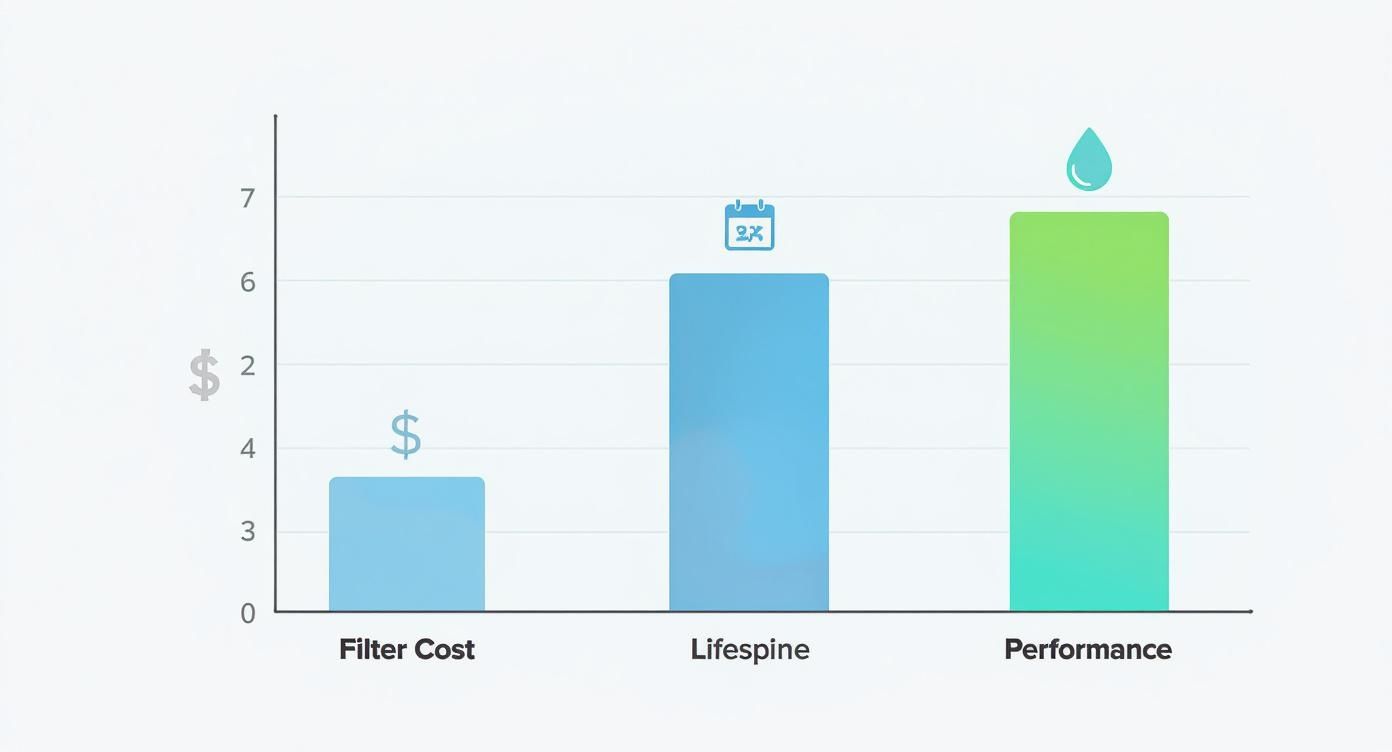
As you can see, there are trade-offs. Some filters are cheaper upfront but need new filters more often, while others deliver top-tier performance but require a bigger initial investment.
For the Budget-Conscious but Health-Focused Individual
Being on a tight budget shouldn't mean you have to skimp on safety. The trick is finding a filter that offers certified performance against common contaminants without a hefty price tag or expensive replacements. You’re looking for a reliable workhorse that nails the essentials, like getting rid of chlorine and lead.
Your ideal budget-friendly filter should prioritize NSF certifications over flashy features. Verified performance against standards like NSF 42 and 53 ensures you're getting proven protection where it counts the most, delivering real value and peace of mind.
Once again, the Aquasana AQ-4000 is a standout here. It’s one of the most affordable NSF-certified filters you can find, with proof that it removes dozens of contaminants. The upfront cost is low, and the replacement filters won't break the bank, which makes the long-term cost easy to manage. For more help on making the right call, check out our comprehensive water filter advice articles.
For the Person Who Just Wants Better-Tasting Water
Sometimes, the mission is simple: you just want water that tastes and smells better for your coffee, tea, or cooking. Your tap water is probably safe, but that strong chlorine taste from the treatment plant can be a real turn-off. You don't need a complex RO system for this; you just need good carbon filtration.
A simple gravity-fed pitcher or a faucet-mounted filter could do the job. But for better performance and on-demand convenience, a direct-connect system is still a top pick. It removes chlorine and other things that affect taste right when you need it, instantly upgrading all your drinks and meals. This focus on taste is a big reason the water purification market was valued at USD 48.2 billion globally in 2023 and is expected to keep growing as more people seek out reliable filtration.
Calculating the Real Cost of Clean Water
When you’re shopping for a countertop water filter, the sticker price is just the first drop in the bucket. To get a real sense of what you'll be spending, you have to look beyond the initial purchase and focus on the ongoing costs. That's where the true story of the system's lifetime value really unfolds.
The biggest ongoing expense, hands down, is the replacement filters. A unit that looks like a great deal upfront can quickly turn into a money pit if its filters are expensive or need to be swapped out constantly. This is exactly why calculating the "cost per gallon" is one of the smartest things you can do when comparing models.
Breaking Down the Cost Per Gallon
To figure out the true cost, you just need to do a little bit of math that combines the initial price with the long-term upkeep. This simple calculation cuts through the marketing and shows you which systems offer genuine value.
Here’s an easy way to work it out:
- Initial System Cost: The price you pay for the unit.
- Replacement Filter Cost: What a new set of filters will run you.
- Filter Lifespan (Gallons): How much water the filter can clean before it needs to be replaced.
When you add the upfront cost to the filter costs over a few years and divide by the total gallons you get, you get a much clearer picture of your investment. For instance, a cheap unit might only process 450 gallons per filter, while a more robust system’s filters could last for 6,000 gallons. That difference dramatically changes the long-term expense.
Real-World Cost Comparison
Let’s apply this to the models we’ve been looking at. The numbers often reveal a surprising truth about what "value" really means.
A gravity-fed system like the Big Berkey has a high initial price tag (nearly $400), but its filters last for thousands of gallons. This brings the long-term cost down to just a few cents per gallon.
On the other hand, a direct-connect model like the Aquasana AQ-4000 is much cheaper to buy—around $100—but its filters need changing more often. Over time, that leads to a higher cost per gallon. It just goes to show that the initial purchase price can be pretty misleading. The real expense is tied directly to how long those filters last.
Calculating the cost per gallon shifts your perspective from a one-time purchase to a long-term investment in your health. A slightly higher upfront cost for a system with durable, long-lasting filters often proves to be the more economical choice over the years.
Factors That Affect Filter Longevity
Your own home's water quality also plays a huge part in how long your filters will actually last. The manufacturer’s estimate is based on average water conditions, but your mileage may vary.
If your tap water has a lot of sediment or other tough contaminants, your filter has to work harder. This extra load can clog up the filter media much faster than expected, forcing you to replace it sooner and bumping up your annual costs. It's always a good idea to check your local water quality report to see what your filter will be up against. This way, you can budget accurately and keep your water pure without any surprises.
Still Have Questions About Countertop Filters?
Even after digging into the details, you might have a few lingering questions. It’s completely normal. Getting these last few things cleared up is what helps you land on a filter you'll be happy with for years. Let's tackle some of the most common things people ask when looking at countertop water filter reviews.
Answering these will give you the full picture so you can make your choice with confidence.
How Do I Know What’s Actually in My Tap Water?
This is the perfect place to start. Your best bet is to check your local water utility's annual Consumer Confidence Report (CCR). It's a legally required document that lists all detected contaminants in your municipal water supply from the past year, and you can usually find it right on your city or county's website.
If you're on well water or just want a more detailed look, you can grab an at-home water test kit or send a water sample to a certified lab for a complete analysis.
Will These Filters Strip Out the Good Stuff, Like Minerals?
That’s a great question, and the answer comes down to the technology inside the filter.
-
Activated Carbon & Ceramic Filters: Systems like the Aquasana AQ-4000 use these filter types. They're designed to grab the things that make water taste and smell bad, like chlorine, and remove harmful contaminants like lead. They leave healthy minerals like calcium, magnesium, and potassium right where they belong—in your water.
-
Reverse Osmosis (RO) Filters: On the other hand, RO systems like the SimPure Y9A use a super-fine membrane that strips out almost everything, including those beneficial minerals. To fix this, many newer RO units now include a remineralization stage that adds healthy minerals back into the purified water, which improves both the taste and its nutritional benefits.
Here's the bottom line: if keeping natural minerals in your water is a priority, a quality carbon filter is a fantastic choice. If you want the absolute purest water possible, just make sure to get an RO system that specifically says it has a remineralization feature.
How Often Do I Need to Clean the Filter Unit?
No matter which model you pick, regular cleaning is key for keeping things hygienic and running smoothly. For gravity-fed units like a Berkey, you'll want to clean the stainless steel chambers every time you swap out the filter elements. If you notice any buildup sooner, clean it then.
For faucet-mounted filters or RO systems, a simple wipe-down of the outside housing and the spigot once a week with a damp cloth does the trick. Any removable tanks or pitchers should be washed with a little mild soap and water about once a month to keep any gunk from growing. Just follow the manufacturer's specific instructions—it'll help your unit last longer and keep your water tasting fresh.
At Water Filter Advisor, we're here to arm you with all the info you need to find the right filter for your home. Feel free to explore our other guides and reviews to make a choice you can feel great about. https://www.waterfilteradvisor.com
- October 23, 2025
- 0
- Uncategorized
