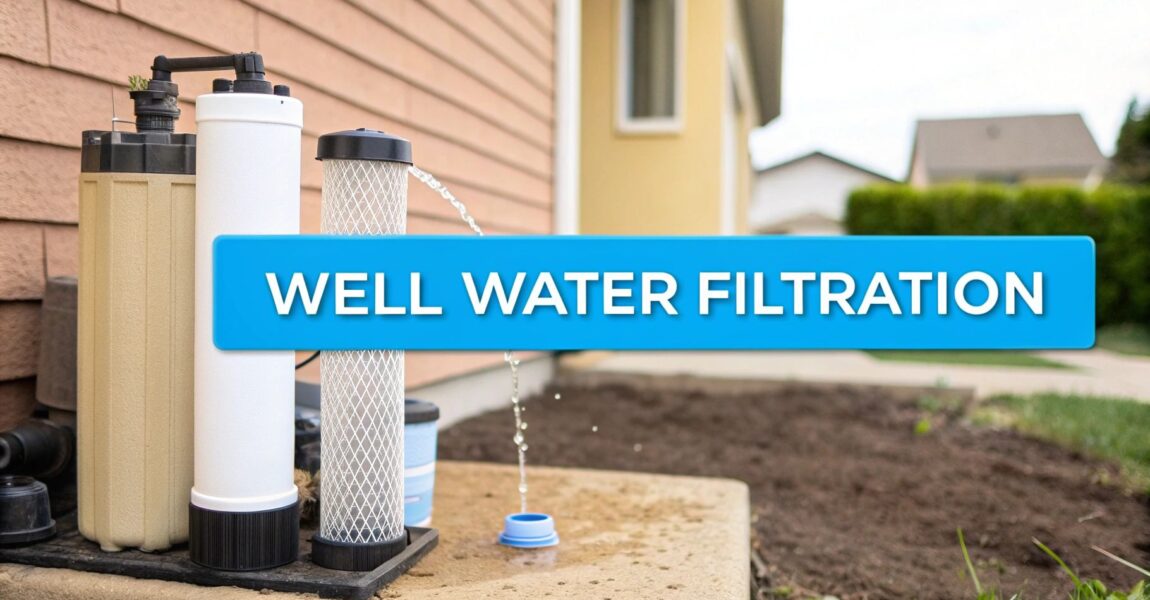
Choosing Well Water Filtration Systems for Your Home
If you're one of the millions of homeowners who gets their water from a private well, you know the freedom that comes with it. No monthly water bill! But you also know the responsibility for that water's quality is 100% on you.
Unlike city water, which is treated before it ever reaches your home, well water is a direct line from the ground to your tap. That means it's up to you to handle whatever comes along for the ride—sediment, iron, nasty bacteria, and even chemicals. A good well water filtration system isn't just a nice-to-have; it's the essential gatekeeper that makes sure your water is safe, clean, and delicious.
Why Your Well Water Needs a Guardian

There's something special about having your own private well. But that independence means you're the one in charge of your water's quality and safety. While the earth does a decent job of filtering water naturally, it’s far from a perfect bouncer.
Whatever is in the ground around your property has a good chance of ending up in your glass. This could be anything from naturally occurring minerals that cause hard water to agricultural runoff or invisible bacteria. This guide is here to give you the know-how to tackle these challenges head-on.
From Murky to Crystal Clear
Think of yourself as becoming your own personal water treatment expert. You’re about to learn the story of your water, from the moment it enters the ground to the second it hits your faucet. We’ll dig into the common culprits behind those frustrating household water problems, like:
- Aesthetic Issues: Things like that "rotten egg" smell, rust-colored stains ruining your sinks and toilets, or water that just looks cloudy and unappealing.
- Hidden Dangers: These are the invisible threats you can't see, smell, or taste. We're talking about bacteria, nitrates, arsenic, and other chemicals that can pose serious health risks.
- Appliance Assassins: Hard water minerals are notorious for building up inside your pipes, water heater, and dishwasher. This limescale buildup chokes their efficiency and shortens their lifespan.
Managing your well water isn't about just buying a random filter. It's about building a custom defense system designed specifically for your water's unique chemistry. This guide is your blueprint.
Once you understand what's really in your well water, you can confidently choose the right well water filtration systems to protect your home and family. We'll walk you through everything—from testing your water to picking, installing, and maintaining the perfect setup—so every drop is pure, safe, and tastes fantastic.
What Is Hiding in Your Well Water?
Before you can even think about choosing a well water filtration system, you first have to know what you’re up against. Think of your well water as its own little ecosystem. While it's mostly pure, it almost always has a few uninvited guests from the surrounding earth, and these intruders fall into a few distinct categories.
Figuring out what's in your water is the most important first step. You wouldn’t buy a home security system without knowing if you’re trying to stop a raccoon or a burglar, right? The same logic applies here. A professional water test is your reconnaissance mission, giving you the intel you need to build the right defense.
The Physical Intruders You Can See
First up are the things you can actually see—the particles and debris that make your water look cloudy or just plain dirty. These are usually the easiest problems to spot and are often the first thing a good filtration setup tackles.
Think of your well as a giant underground reservoir. As rainwater trickles down through soil and rock to fill it, it picks up tiny hitchhikers along the way. These often include:
- Sediment, Silt, and Sand: These are the fine bits of dirt and rock that cause cloudiness, a quality known as turbidity. They don't just look bad; they can clog up your pipes, wear out appliance parts, and settle at the bottom of your water heater, making it work harder and less efficiently.
- Rust and Iron Particles: Seeing orange or reddish-brown stains in your sinks, toilets, or laundry? That’s a dead giveaway for iron. It’s a super common mineral in groundwater that can also give your water a metallic taste.
These physical bits are more than just an eyesore. They provide perfect hiding spots for bacteria and can gum up the works for more advanced filters, like UV purifiers. This is exactly why a simple sediment filter is almost always the first component in any well water system.
To help you get a better handle on what might be lurking, here’s a quick guide to connect the dots between what you see, smell, or taste and the likely culprit.
Common Well Water Contaminants and Their Signs
| Contaminant Type | Common Examples | Potential Signs in Your Home |
|---|---|---|
| Physical | Sediment, Silt, Sand, Rust | Cloudy or murky water, orange/brown stains on fixtures and laundry, gritty texture. |
| Chemical | Calcium & Magnesium (Hardness) | Soap scum, mineral buildup (limescale) on faucets, poor soap lather, stiff laundry. |
| Chemical | Hydrogen Sulfide | A distinct "rotten egg" smell, especially from hot water. |
| Chemical | Heavy Metals (Arsenic, Lead) | Often tasteless, colorless, and odorless. Requires a lab test to detect. |
| Biological | Bacteria (E. coli, Coliform) | Also tasteless, colorless, and odorless. Can cause stomach issues or illness. |
This table is just a starting point. While some issues are obvious, many of the most serious contaminants are completely invisible, which is why a professional lab test is non-negotiable for well owners.
The Invisible Chemical Threats
Next, we have the chemical contaminants. These are dissolved substances you often can't see, taste, or smell, which is what makes them so tricky. They can seep into groundwater from all sorts of places, like farm runoff, industrial pollution, or even just the natural rocks in your area.
For well owners, this is a huge deal. The whole reason filtration became popular was because of concerns over contamination in private water sources. Globally, around 2 billion people drink from sources contaminated with feces, a stark reminder of the health risks of untreated water. Here in the United States, about 15% of the population gets their water from private wells, which aren't regulated by the EPA like city water. This leaves the responsibility for safety squarely on the homeowner. You can discover more insights about the global water filter market and its growth drivers over on openpr.com.
Some of the most common chemical culprits are:
- Nitrates and Nitrites: These usually come from fertilizers or leaky septic systems. High nitrate levels are a serious health risk, particularly for infants.
- Heavy Metals: Arsenic, lead, and mercury can leach into groundwater from natural mineral deposits or industrial activity. Long-term exposure can cause severe health problems.
- Hardness Minerals: Calcium and magnesium are the duo responsible for hard water. While not a health hazard, they cause limescale buildup that wreaks havoc on your pipes, appliances, and even your skin and hair.
- Hydrogen Sulfide: This is the gas that produces that awful "rotten egg" smell. It's created by harmless bacteria in the ground, but it can make your water completely undrinkable.
A comprehensive water test is the only way to uncover these hidden chemical threats. Without one, you’re just guessing at what your water needs, which can be an expensive and ineffective gamble.
The Biological Contaminants
Finally, we get to the biological contaminants—the living microorganisms that can make you sick. Because well water isn't treated with chlorine like city water, it’s a potential breeding ground for bacteria and viruses that get in from animal waste or failing septic tanks.
These microscopic invaders include:
- Bacteria: E. coli and coliform bacteria are the big ones. Their presence is a strong indicator that your well has been contaminated with fecal matter, which means other nasty, disease-causing pathogens could be in there too.
- Viruses and Protozoa: Organisms like Giardia and Cryptosporidium are notorious for causing severe gastrointestinal illness.
You can't see, smell, or taste these organisms, so a specific test for bacteria is absolutely critical. This is the one area you can’t afford to mess around with, making a UV purifier or another disinfection system a must-have for many well owners.
Alright, you've got the results from your water test. Think of that report as a scouting report on the enemy. Now, it's time to build your dream team of filters to defend your home's water supply.
Choosing the right well water filtration systems isn't a one-size-fits-all deal. It's more like putting together a special ops team—each filter has a specific job, a unique skill set designed to take out a particular contaminant. It's rare that a single, magic-bullet filter will solve all your well water woes. That's why the most effective setups are multi-stage, layering different technologies to create an impenetrable defense.
You wouldn't ask the bouncer checking IDs at the door (your sediment filter) to deal with an invisible threat like bacteria, right? You need layers. Each part of the system has its role, working in concert to deliver clean, safe water from the moment it enters your house. This approach guarantees total protection, from chunky sand and silt down to microscopic germs you can't even see.
This diagram gives you a bird's-eye view of the main categories of well water filters, showing how they all fit together.
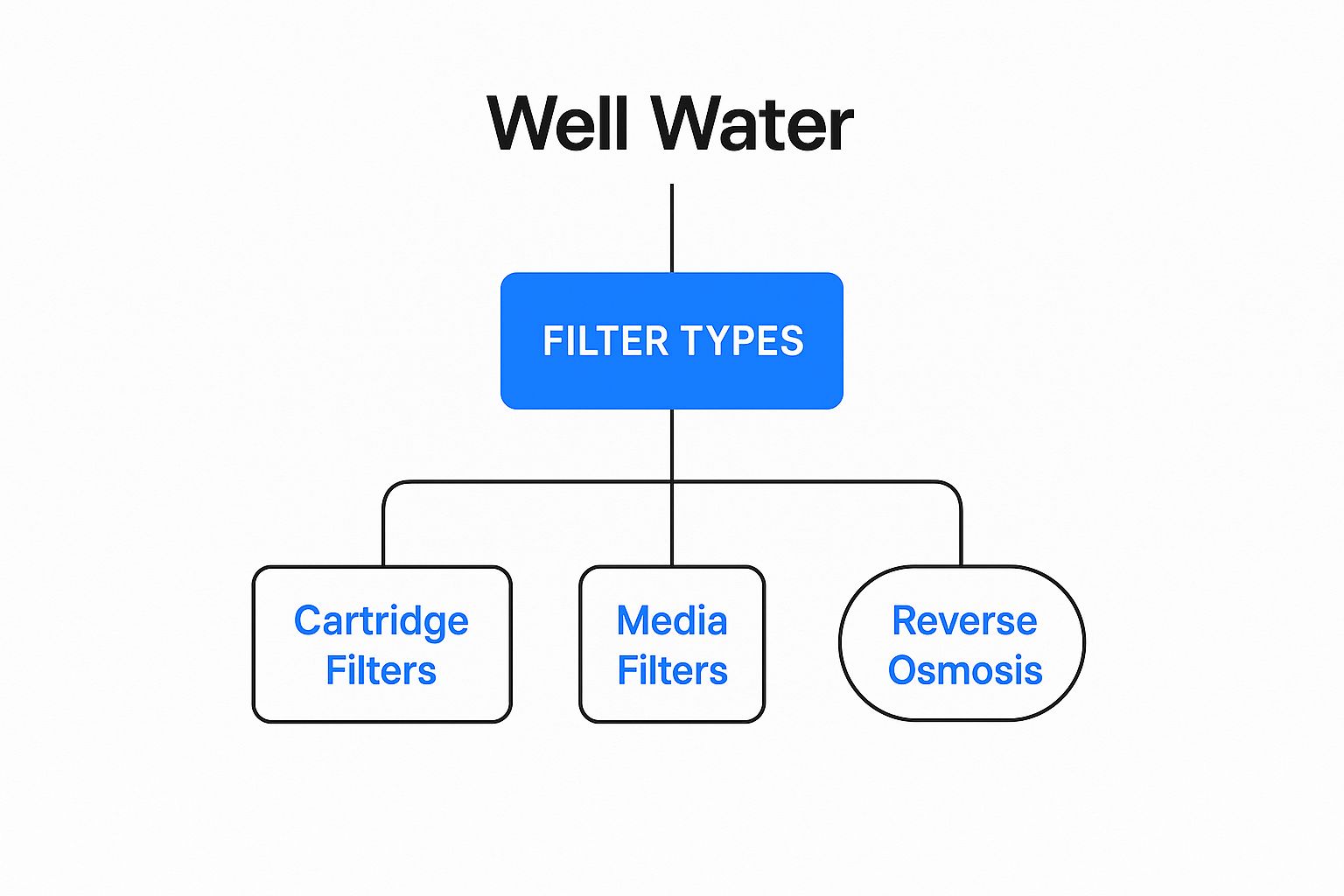
As you can see, a solid strategy will likely mix and match a few of these types to get the job done right.
The Frontline Defender: Sediment Filters
Every great well water system kicks off with a sediment filter. This is your first line of defense, the bouncer at the door whose job is to stop the big, clumsy invaders before they gum up the works. Its mission is simple but absolutely critical: catch all the physical junk like sand, dirt, silt, and rust flakes.
Think of it like a screen on your window—it lets the fresh air (water) in but keeps the bugs (sediment) out. By trapping all that debris right at the start, a sediment filter not only clears up cloudy water but also acts as a bodyguard for the more delicate and expensive filters down the line. This one simple step can dramatically boost the lifespan and performance of your entire system.
The Taste and Odor Specialist: Carbon Filters
Next in the lineup is the activated carbon filter. This is your specialist, the one you call in to handle chemical contaminants and get rid of funky tastes and smells. If your water has that swimming pool chlorine odor or a weird, earthy taste, this is your hero.
The secret is its ridiculously huge internal surface area, made up of millions of microscopic pores. These pores work like a magnet for chemicals, snagging things like chlorine, pesticides, and volatile organic compounds (VOCs) through a process called adsorption. It’s the MVP for turning murky, smelly water into something that tastes crisp, clean, and refreshing.
The Mineral Manager: Water Softeners
Did your water report come back with high levels of calcium and magnesium? If so, you've got hard water. That's where a water softener steps in. Now, it's not technically a "filter" in the traditional sense; it's more of a water conditioner. Its job is to stop mineral buildup—that crusty limescale that wreaks havoc on your appliances and leaves soap scum all over your shower.
A water softener uses a clever process called ion exchange. It literally swaps out the "hard" mineral ions (calcium and magnesium) for "soft" sodium ions. This simple trade prevents scale from ever forming in your pipes, water heater, and dishwasher.
This system is your best defense against the costly damage hard water can cause, especially to appliances like water heaters, which can fail years ahead of schedule without one.
The Heavy-Duty Brawler: Iron and Sulfur Filters
For those wells cursed with rusty orange stains and that distinct "rotten egg" smell, you need to bring in the heavy hitters. Iron filters and air-injection oxidizing (AIO) systems are the specialized brawlers built to knock out high concentrations of iron, manganese, and hydrogen sulfide gas.
These systems work by oxidizing the dissolved troublemakers, which basically forces them to turn into solid particles. Once they're solid, the filter media can easily grab and flush them away, getting rid of those ugly stains and nasty smells for good. This targeted attack is way more effective than hoping a standard carbon filter or softener can handle a serious iron or sulfur problem.
The Microbial Assassin: UV Purifiers
If your water test flagged bacteria, coliform, E. coli, or other living critters, you need a surefire way to neutralize them. A UV purifier is the silent assassin for these biological threats. The best part? It doesn't add a single chemical to your water or alter its taste.
It uses a powerful ultraviolet lamp that zaps any water flowing past it. This UV light scrambles the DNA of bacteria, viruses, and other microorganisms, making it impossible for them to reproduce and cause harm. It’s a clean, highly effective final barrier that ensures your water is biologically safe to drink.
The Ultimate Purifier: Reverse Osmosis Systems
Finally, when you want the absolute highest level of purity for your drinking and cooking water, you bring in the special forces: reverse osmosis (RO). An RO system uses a super-fine, semi-permeable membrane to strip out up to 99% of all dissolved solids.
It forces water through this membrane, which is so tight it blocks nearly everything that isn't a pure water molecule. We're talking heavy metals like lead and arsenic, plus nitrates, fluoride, and salts. Because this purification process is slow and meticulous, RO systems are usually installed at a single tap—like under the kitchen sink—to provide a dedicated source of incredibly pure water right where you use it most.
How to Choose the Right Filtration System
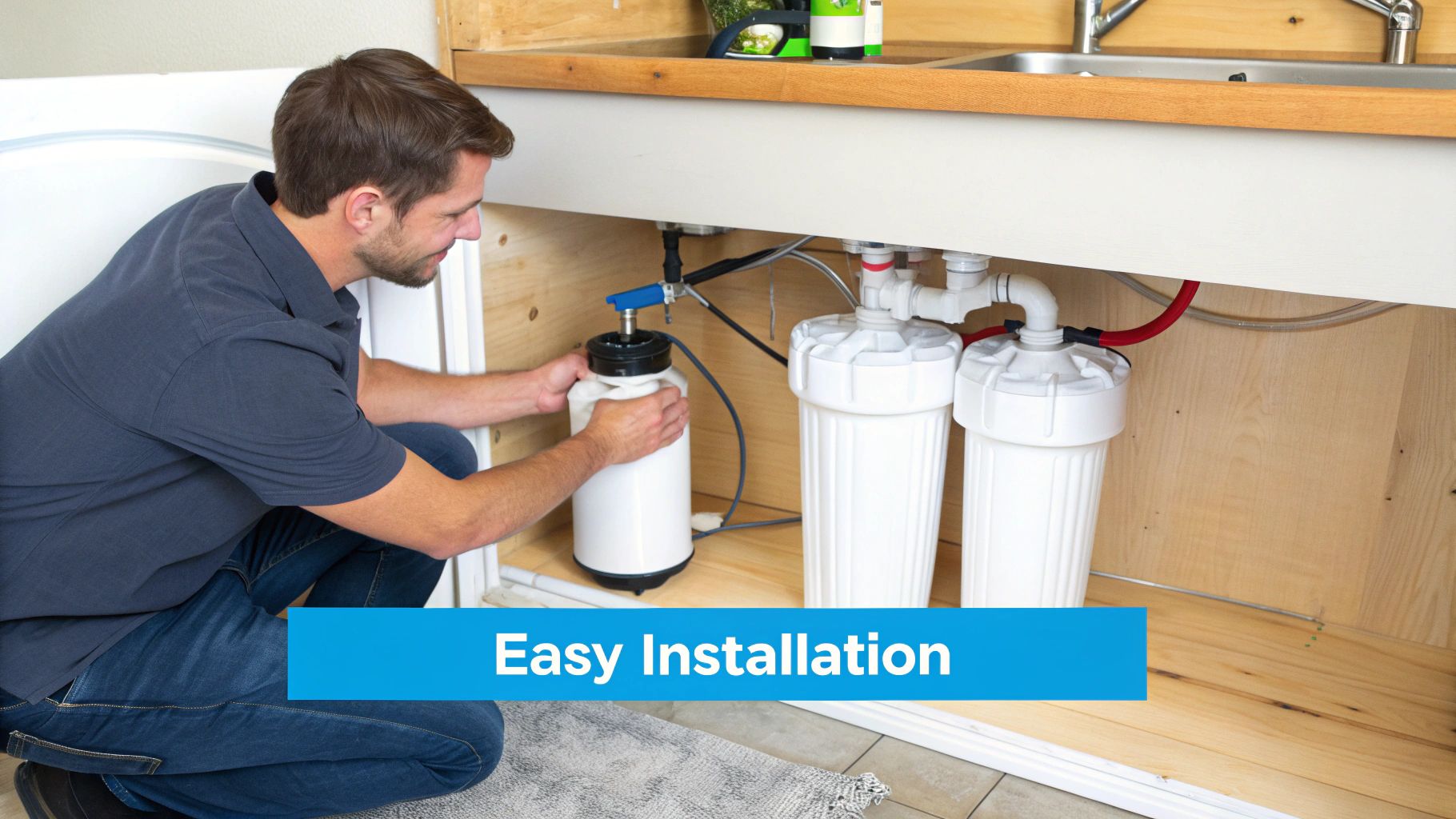
Alright, you’ve got your water test results back. Now the real fun begins. This is where you put on your detective hat and figure out exactly what your water needs to be clean, safe, and great-tasting.
Choosing the right well water filtration system isn’t about buying the most expensive gear you can find. It’s about a smart, targeted approach based on what’s actually in your water, how much of it you use, and where you need it most. Your water test is your road map—let’s use it to build the perfect solution for your home.
Decode Your Water Test and Match the Filter
Think of your water test as a diagnostic report for your well. It tells you exactly what you’re up against. Are sediment levels high? Is iron turning your fixtures orange? Your job is to match each problem with the right tool.
Here’s a simple way to break it down:
- High Sediment or Turbidity: If your water looks cloudy, a sediment pre-filter is non-negotiable. This is always your first line of defense, catching all the dirt, sand, and rust before it can clog up the rest of your system.
- Elevated Iron or Manganese: Seeing those classic orange or black stains? You’ll probably need a dedicated iron filter or an air-injection oxidizing (AIO) system. A water softener alone just can't keep up with heavy iron.
- Positive for Bacteria (E. coli, Coliform): This is a serious health concern that needs an immediate fix. A UV purification system is your best bet here. It zaps bacteria and viruses with ultraviolet light, making your water biologically safe without adding any chemicals.
- Hard Water Minerals (Calcium & Magnesium): If you're tired of limescale buildup on your faucets and appliances, a water softener is the clear winner. It's the only way to truly tackle hardness.
Make a checklist from your water report. For every contaminant you find, you'll want a specific filter stage designed to remove it.
Calculate Your Household's Flow Rate
Here's a detail that's easy to miss but can make or break your system: flow rate. Measured in gallons per minute (GPM), this tells you how much water your system can process at once. Get this wrong, and you'll be dealing with a frustrating trickle every time someone flushes a toilet while the shower is running.
You don't want your filter system to become a bottleneck. A system that's too small for your home will choke your water pressure.
To get a rough idea, just add up the GPM of the fixtures you might use at the same time. A shower is about 2.5 GPM, a toilet can be 2.2 GPM, and a sink faucet is around 1.5 GPM. For a typical family of four, a system that can handle 10-15 GPM is a pretty safe bet to keep the pressure strong everywhere.
Picking a system with a flow rate that meets or slightly beats your home's peak demand is the single best way to guarantee you never have to worry about weak water pressure again.
Point of Entry vs. Point of Use Systems
The last big decision is where you need the filtered water. Do you want to treat every drop coming into your house, or just the water at a specific tap? This leads you to two main categories: Point-of-Entry (POE) and Point-of-Use (POU).
Deciding between a whole-house system and a single-tap filter really comes down to the scope of your water problems and your end goals. Are you trying to protect your entire plumbing system or just purify your drinking water? Here's a quick comparison to help you think it through.
Point-of-Entry (POE) vs. Point-of-Use (POU) Systems
| Feature | Point-of-Entry (Whole House) | Point-of-Use (Single Tap) |
|---|---|---|
| Location | Installed at the main water line. | Installed at a single fixture (e.g., under the kitchen sink). |
| Treatment Scope | Treats all water entering the home. | Treats water for one specific tap or appliance. |
| Best For | Widespread issues: hardness, sediment, iron, general chemicals. | Targeted issues: lead, chlorine, cysts, specific taste/odor problems. |
| Primary Benefit | Protects plumbing, appliances, skin, and hair. | Provides highly purified water for drinking and cooking. |
| Typical Cost | Higher initial investment. | Lower initial cost. |
| Maintenance | Less frequent, but larger filter changes. | More frequent, but smaller and easier filter changes. |
Ultimately, a whole-house POE system offers a comprehensive solution, safeguarding your entire home. The global market for these systems was valued at $10.17 billion and is expected to keep growing as more people become aware of well water contaminants.
On the other hand, POU systems like an under-sink reverse osmosis unit are fantastic for getting ultra-pure water right where you need it most—your kitchen. They are an excellent, budget-friendly way to target drinking water quality without overhauling your entire plumbing setup.
Getting It Installed and Keeping It Running
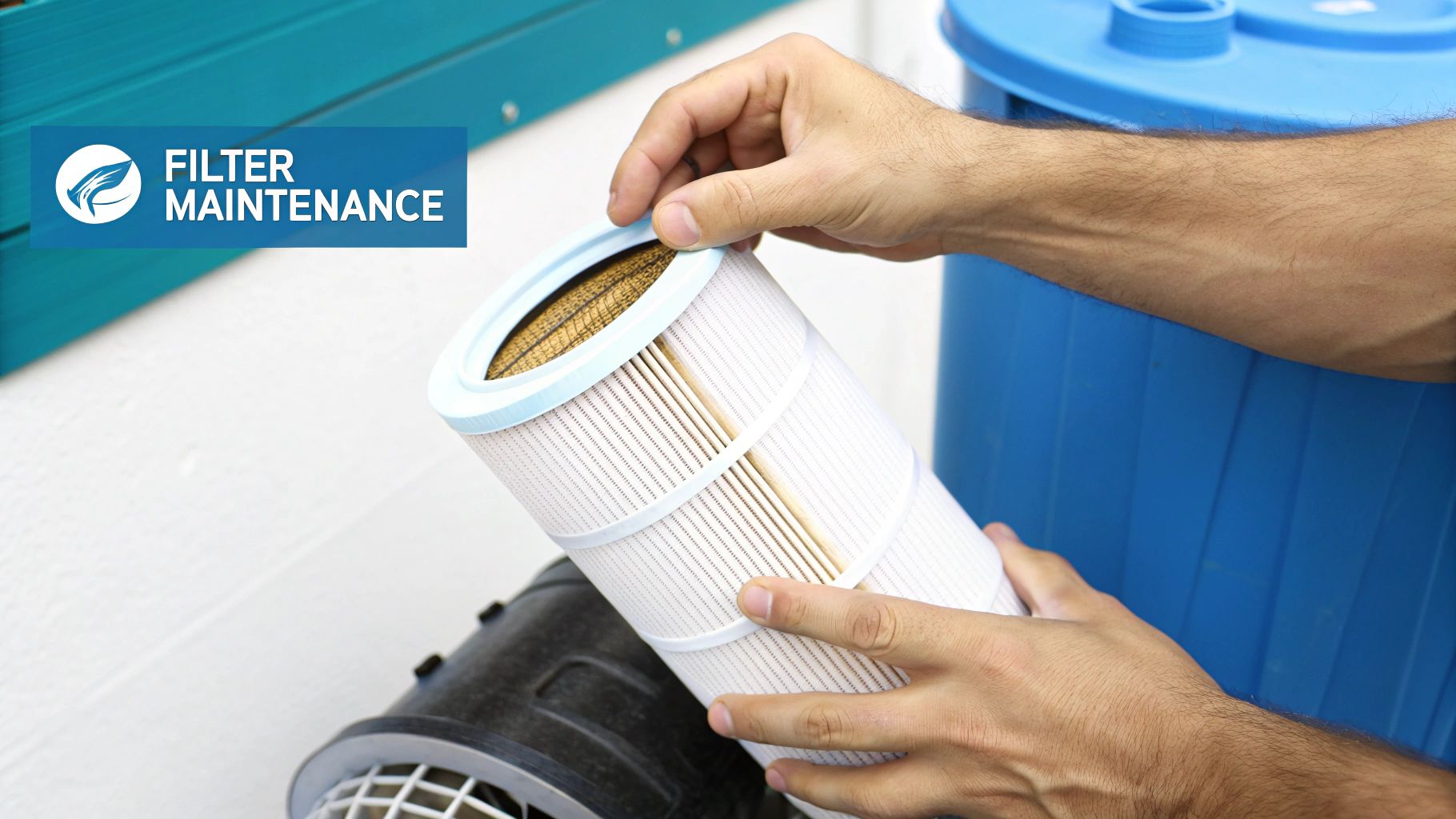
You’ve picked out the perfect filtration system for your well. Awesome. But now comes the part that makes it all work: getting it installed right and setting up a simple plan to keep it that way.
Think of your new system like a car you just drove off the lot. The installation is like making sure the engine is seated correctly, but the routine maintenance—the oil changes and filter swaps—is what keeps it from breaking down on the side of the road. Neglect this part, and you’re just asking for trouble.
DIY vs. Calling in a Pro
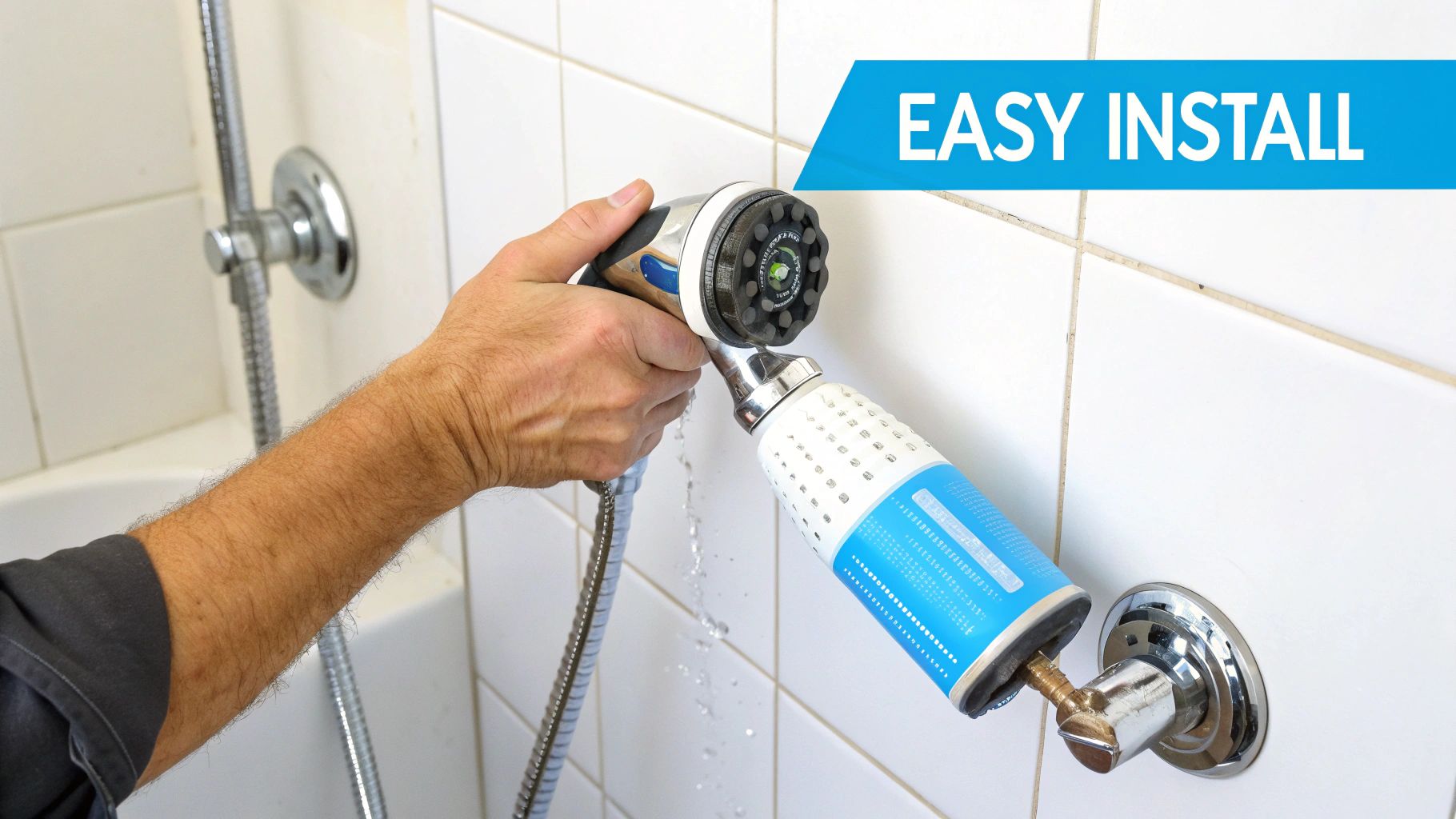
First up, you need to decide if you’re going to tackle the installation yourself or hire a professional. It's a big decision. While a lot of us love a good weekend project, a botched plumbing job can quickly turn into leaks, water damage, or a system that doesn't filter anything at all.
Installing a simple under-sink filter is usually something you can handle on your own. But a whole-house system with multiple tanks? That's a whole different ballgame. It means cutting into your main water line, and that requires some serious skill and confidence.
Ask yourself these questions:
- How complex is this thing? Is it a single filter cartridge, or a multi-stage setup with a UV light that needs wiring?
- What are my plumbing skills, really? Are you comfortable cutting pipe, sweating copper fittings, and knowing for sure it won't leak?
- Do I have the right tools? We're talking pipe cutters, multiple wrenches, maybe even PEX crimpers.
- What does the warranty say? Some manufacturers will void the warranty unless a licensed professional installs the system.
If you’re hesitating on any of those, just call a plumber. The cost of a professional install—often a few hundred to over a thousand dollars—is a small price to pay for the peace of mind that it’s done right.
Your Maintenance Playbook
Once your system is up and running, a little bit of proactive care is your best friend. Filters are designed to catch gunk, which means eventually, they get full. A clogged filter is not only useless, but it can also tank your home’s water pressure.
Think of your maintenance schedule as the playbook for your system's health. It turns these little tasks into simple habits, stopping small issues before they become big, expensive headaches.
The idea is to get into a routine. A good way to stay on top of everything is to use a preventive maintenance schedule template to track what needs to be done and when. No more guessing.
Here’s a general guide for what your schedule might look like:
- Sediment Pre-Filter: This is your first line of defense and gets dirty the fastest. Plan on swapping this out every 3-6 months, depending on how much sediment is in your water.
- Carbon Filters: These filters typically need to be replaced every 6-12 months. Always double-check the manufacturer's recommendation.
- Reverse Osmosis (RO) Membranes: The main RO membrane is a long-hauler and can last 2-5 years. But don't forget its pre-filters and post-filters—those still need to be changed every 6-12 months.
- UV Purifier Lamp: A UV bulb needs to be replaced every single year. It might still light up after 12 months, but its germ-killing intensity fades, leaving your water vulnerable.
- Water Softener Salt: This isn’t a replacement, just a refill. Peek inside the brine tank once a month and top it off with salt pellets as needed.
Jot these dates down in a calendar or set reminders on your phone. Sticking to a schedule is the single most important thing you can do to protect your investment and keep your water clean and safe for years to come.
Your Top Well Water Filtration Questions Answered
Stepping into the world of well water filtration can feel like learning a new language. You've got questions, and we've got straightforward answers from our years of experience. Let's tackle some of the most common ones homeowners ask.
How Often Should I Test My Well Water?
Think of it like an annual check-up for your water. At a minimum, you should test your well water once a year for the usual suspects like bacteria and nitrates.
But you also have to be your own first line of defense. If you ever notice a sudden change in the taste, smell, or even the color of your water, get it tested right away. It's also a smart move to do a more comprehensive test for things like heavy metals and pesticides every 3-5 years. You never know when something deep in the ground has shifted, and it's always better to be safe.
Can a Single Filter Solve All My Well Water Problems?
That’s a common hope, but unfortunately, it’s not realistic. Well water is rarely a one-problem situation; you're usually dealing with a cocktail of sediment, hard minerals, and maybe even some unseen biological contaminants.
Since most filters are built to do one job really well, a single filter just can't handle that kind of complexity. This is exactly why multi-stage systems are the gold standard. A setup that combines a sediment filter, a carbon filter, and a UV purifier creates a powerful, layered defense that addresses everything in turn.
A layered filtration strategy is the key. Each stage acts as a specialist, working with the others to remove a wide range of contaminants, ensuring the water is thoroughly treated before it reaches your tap.
A properly installed system shouldn't crush your water pressure. If you notice a serious drop, it's almost always one of two things: either your filters are clogged and screaming for a replacement, or the system itself is too small for your home's needs. Always check the flow rate (measured in gallons per minute) and make sure it can keep up with your family’s peak water usage.
Looking for more info? You might find answers in these additional Well Water FAQs.
Ready to ensure every drop from your well is clean and safe? The experts at Water Filter Advisor provide in-depth guides and unbiased reviews to help you confidently choose the perfect system for your home. Explore our resources and make the right decision for your family's water at https://www.waterfilteradvisor.com.
Article created using Outrank