Let's be real for a second: have you ever looked at a glass of tap water and wondered what's really in there? Sure, city water gets the spa treatment at a plant somewhere, but then it travels through miles of ancient pipes to get to you. Along the way, it can pick up some uninvited guests like chlorine, lead, and other mystery gunk. A good water filter isn't just a gadget; it's the final bouncer at the door, making sure only the good stuff gets in.
Why a Great Water Filter is Your Home's Unsung Hero
Choosing the best water filter for your home is more than just a kitchen upgrade; it's a power move for your family's health and your own sanity. Even when your local water report says everything is "A-OK" by federal standards, that piece of paper doesn't tell you the whole story of what's splashing out of your faucet.
Think of it like this: the water that leaves the treatment plant is like a freshly detailed car. But by the time it gets to your driveway after a long, dirty road trip, it's not so pristine anymore. It can pick up all sorts of contaminants from underground pipes, some of which might be older than your grandparents. This is why even "safe" water can taste like a swimming pool or leave chalky buildup on your faucets.
The Usual Suspects Lurking in Your Tap Water
To win the war for clean water, you have to know your enemy. Different filters are like different superheroes, each with a specific villain they're built to defeat. Figure out what's in your water, and you're halfway to finding the perfect sidekick for your home.
Here are a few of the common troublemakers a quality filter can show the door:
- Chlorine and Chloramine: The stuff cities use to disinfect water. Great for killing germs, not so great for taste and smell.
- Heavy Metals: Nasty characters like lead and arsenic can sneak in from old plumbing and pose serious health risks, even in tiny amounts.
- Sediment and Particulates: We're talking about little bits of rust, sand, and silt that make your water cloudy and are rough on your appliances.
- Volatile Organic Compounds (VOCs): These are industrial and agricultural chemicals that you definitely don't want in your morning coffee.
We're witnessing a huge cultural shift. People are waking up to the reality of their water quality. A home filtration system is no longer a luxury—it's becoming as essential as a lock on the front door.
A Growing Global Thirst for Purity
This quest for clean water isn't just happening in your neighborhood; it's a worldwide movement. The global water purifier market was valued at a cool USD 45.7 billion in 2024 and is projected to nearly double to over USD 88.8 billion by 2034. That's not just growth; it's a revolution, fueled by a greater understanding of waterborne contaminants. You can explore more about these market dynamics to see just how big this wave is.
At the end of the day, the mission is simple: make sure every drop you and your family drink is as clean, safe, and delicious as possible. In this guide, we’ll arm you with the knowledge to choose your champion filter with total confidence.
Decoding the Magic Behind Water Filtration Tech
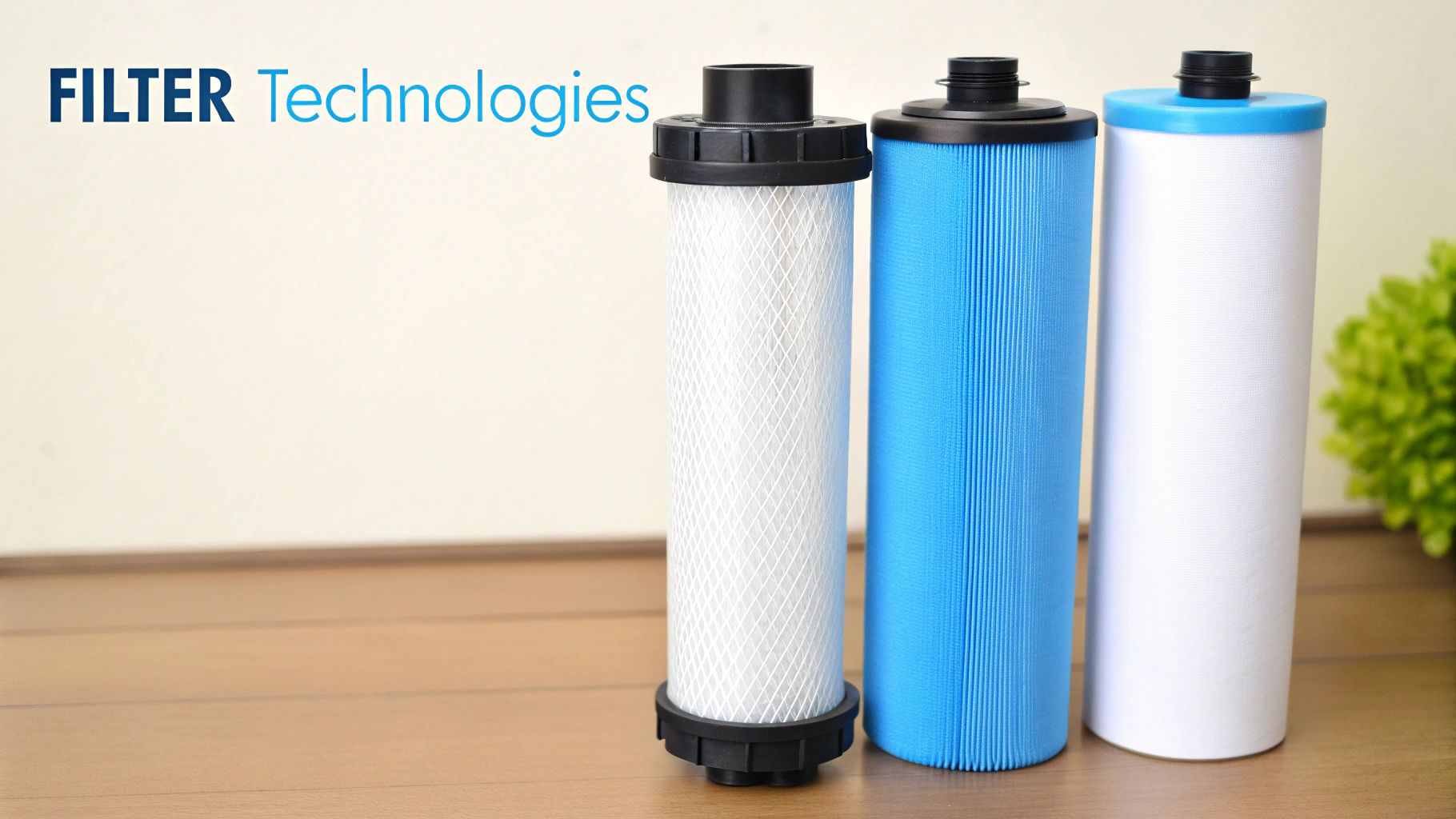
To find the best water filter for your home, you need to peek behind the curtain and see how the magic happens. Different filtration technologies are designed to solve different problems. The real secret is matching the right tech to the specific junk you're trying to kick out of your water. Let's pull apart the most common systems to see what makes them tick and where they truly excel.
This isn't about blindly trusting a brand's flashy promises. It's about understanding the science so you can cut through the marketing noise. Each method has its superpowers, its perfect mission, and yes, its kryptonite. Knowing these details is the difference between a brilliant investment and a regrettable paperweight.
Activated Carbon: The Crowd-Pleasing Workhorse
You'll find activated carbon in practically everything, from your basic pitcher filter to beefy whole-house systems. It's the undisputed MVP of filtration. Imagine it as a microscopic sponge with a massive surface area, covered in tiny nooks and crannies that trap contaminants through a process called adsorption.
When water flows through, unwanted guests like chlorine, pesticides, and VOCs get stuck to the carbon's surface. The result? Water that tastes and smells crisp and clean. Since most city water has a chemical aftertaste from disinfectants, carbon filters are fantastic for an instant upgrade. If you want to nerd out, you can check out the science behind hypochlorous acid, a common chlorine treatment.
Ideal Use Case Comparison
| Filter Type | Best For | Contaminant Focus |
|---|---|---|
| Pitcher/Faucet Filters | Renters or small households who just want better-tasting drinking water, fast. | Chlorine, taste, odor. |
| Whole House Carbon Filters | Homeowners ready to banish chlorine from every tap, protecting skin and hair in the shower, too. | Chlorine, chloramine, VOCs. |
But here's the fine print: while carbon is a champion at improving your water's vibe, standard versions won't touch things like lead, nitrates, or microorganisms. For that level of security, you need to call in the special forces.
Reverse Osmosis: The Purity Powerhouse
If you’re looking for water that’s as close to pure H₂O as you can get at home, Reverse Osmosis (RO) is your answer. This system uses pressure to force water through a special membrane with pores so ridiculously small that only water molecules can get through. It’s like having a molecular bouncer at a VIP club, turning away almost everything else.
This process is ruthlessly effective at removing a massive range of contaminants. A good RO system will decimate or completely eliminate:
- Heavy metals like lead, arsenic, and mercury.
- Dissolved solids like salt, fluoride, and nitrates.
- It can even kick out some bacteria and viruses, elevating it to purification status.
The classic knock against RO was water waste. Old systems were infamous for flushing gallons of water down the drain for every clean gallon produced. Luckily, modern high-efficiency models have dramatically improved, making them much friendlier to the planet and your water bill.
Because it’s so thorough, RO is typically installed under the sink with its own sleek, dedicated faucet, giving you ultra-pure water for drinking and cooking right where you need it most.
UV Purification: The Microbe-Slaying Guardian
Unlike filters that physically trap gunk, a UV purifier is an assassin. It uses a powerful ultraviolet lamp to bombard water with germicidal rays. This light attacks the DNA of bacteria, viruses, and nasty protozoa like Giardia and Cryptosporidium, making it impossible for them to reproduce and make you sick.
UV purification is a clean, chemical-free hit. It adds nothing to your water and doesn't change the taste at all. It’s an absolute non-negotiable for anyone on private well water, since wells don't get the city treatment and are far more vulnerable to microbiological party-crashers.
Just remember, a UV system is a specialist—it only handles living threats. It must be teamed up with sediment and carbon filters to tackle particles and chemicals. If your water is cloudy, the sediment can act like tiny bodyguards, shielding microbes from the UV light. Pre-filtration isn't just a suggestion; it's a mandatory partner for a successful mission.
Comparing the Top Home Water Filtration Systems
Let's cut to the chase. Choosing the right water filter for your home goes beyond flashy packaging. It's a practical decision that boils down to performance, long-term costs, and how much hassle you're willing to endure. To make the smart choice, you need a no-nonsense, head-to-head comparison of how these systems perform in the real world.
We're about to put the leading technologies in the ring together, judging them on what really counts—what they remove, what they'll cost you over five years, and what it actually takes to get one up and running.
Effectiveness in Contaminant Removal
The entire point of a filter is to deliver cleaner, safer water. But "clean" is a relative term. A filter's true might is measured by the specific villains it can vanquish, which is why hunting for NSF/ANSI certifications is your secret weapon.
An Activated Carbon filter—the hero of most pitchers and faucet attachments—is your go-to for making water taste and smell like it came from a mountain spring. It's a beast at grabbing chlorine and some VOCs. But that's where its power ends. It won't lift a finger against dissolved solids, heavy metals like lead, or microbial invaders.
On the other end of the battlefield, a Reverse Osmosis (RO) system is the heavyweight champion. It forces water through an impossibly fine membrane, stripping out a massive list of impurities. We're talking lead, arsenic, fluoride, nitrates, and even some viruses, achieving up to a 99% reduction in total dissolved solids (TDS).
Then there's the UV Purifier, the specialist operative. It doesn't actually remove anything. Instead, it unleashes a blast of ultraviolet light to neutralize bacteria and viruses by scrambling their DNA. This makes UV an essential guardian for well water, but it needs backup to handle chemical contaminants.
Key Insight: The "best" filter is the one that's perfectly matched to the specific contaminants in your water. You won't know your enemy until you get a water test. Only then can you decide if you need the overwhelming force of an RO system or if a simple carbon filter can win the day.
Installation and Maintenance Realities
Setting up a filter can range from "easier than making toast" to a full-blown weekend project. This is a massive factor that determines which system truly fits your home and lifestyle.
-
Pitcher and Faucet Filters: These are the definition of plug-and-play. You can have one running in minutes. Maintenance is a simple cartridge swap every few months. They're a perfect match for renters or anyone allergic to commitment.
-
Under-Sink RO Systems: This is more of a commitment. It involves tapping into your cold water line, drilling a hole in your countertop for a dedicated faucet, and connecting a drain line. It's a manageable DIY for the handy, but it's a permanent modification. Maintenance is also more involved, with multiple filters and the RO membrane needing replacement on different schedules (from 6 to 24 months).
-
Whole House Systems: This is the big kahuna. It requires a professional plumber to install it where the main water line enters your home. The upside? Once it's in, maintenance is often a breeze, with some filter media lasting for years. You're trading upfront cost and complexity for ultimate long-term convenience.
This infographic gives you a quick visual on how these technologies compare when you factor in effectiveness, cost, and installation.
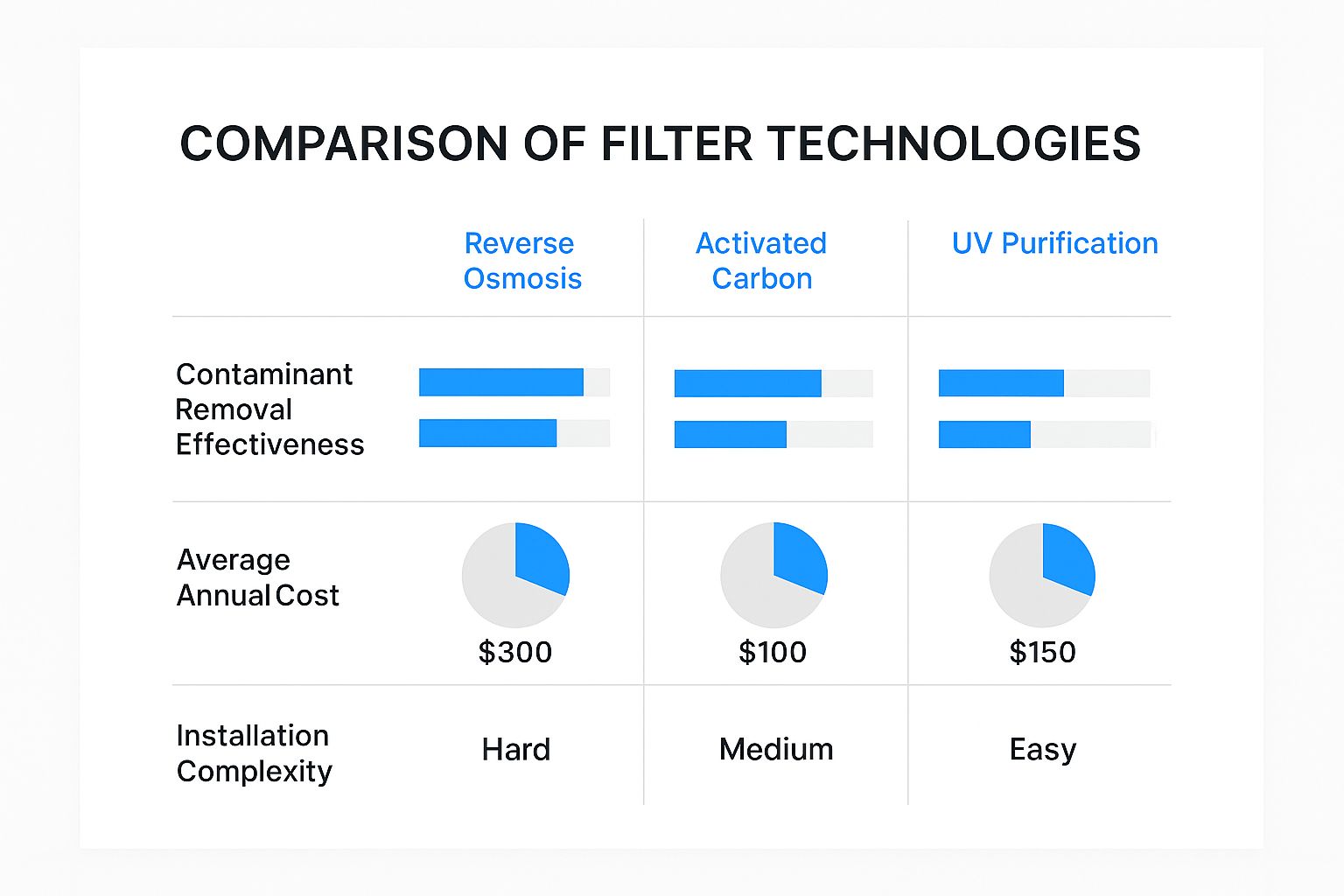
As you can see, it’s all about trade-offs. Reverse Osmosis delivers the best filtration, but you'll pay for it in price and installation effort. Activated Carbon is cheap and easy, but its filtering power is limited.
The True Cost of Ownership
That price on the box? That's just the entry fee. The number you should really care about is the Total Cost of Ownership, which includes the initial purchase, installation, and all the replacement filters you'll buy over the next few years. Looking at it this way often reveals that the "cheapest" option is anything but.
Let's crunch the numbers for a family of four choosing between a pitcher and an RO system.
Scenario A: The Pitcher Filter
A pitcher costs about $30. Filters are around $8 each and need replacing every 40 gallons. If your family drinks two gallons a day, you're swapping filters every 20 days. That's roughly 18 filters a year.
- Annual Filter Cost: 18 filters x $8 = $144 per year
Scenario B: The Under-Sink RO System
A quality RO system costs about $250 upfront. But its filters have serious staying power. The pre-filters might run $40 a year, while the main RO membrane costs $50 but only needs replacing every two years (averaging $25 per year).
- Annual Filter Cost: $40 + $25 = $65 per year
The RO system has a higher sticker price, but its annual filter costs are less than half the pitcher's. Over five years, the family would spend $720 on pitcher filters, compared to just $575 for the RO system (initial purchase included). And for that lower long-term cost, they get dramatically better water quality.
This is exactly why you have to play the long game. As more people wise up, the market is exploding. The home water filtration industry, valued at USD 20.5 billion in 2021, is set to rocket past USD 25.3 billion by 2025. You can discover more insights about home water filtration trends to see how this health-conscious revolution is reshaping our kitchens.
Choosing the Right Filter for Your Home and Lifestyle
https://www.youtube.com/embed/DOPweBJInr4
Let's bust a myth right now: there is no single "best water filter for home." The idea of a one-size-fits-all champion is pure fiction. The right system is the one that seamlessly integrates with your life, your home, and the unique cocktail of contaminants flowing from your tap. It's a personal decision that balances performance with practicality.
Instead of drowning in technical specs, let's approach this like a matchmaker, pairing common household scenarios with their ideal filtration partner. This way, you can see how different technologies solve real, everyday problems.
The Smart Choice for Apartment Renters
Living in an apartment means you can't just start playing plumber. This immediately knocks complex under-sink or whole-house systems out of the running. For renters, the perfect solution has to be effective, ridiculously easy to install, and just as simple to pack up when you move.
This is where faucet-mounted filters and high-quality water pitchers absolutely dominate. A good faucet filter twists onto your kitchen tap in seconds, giving you on-demand filtered water. They typically use activated carbon to eliminate that funky chlorine taste and smell, making your tap water instantly more enjoyable.
- Top Recommendation: A faucet-mounted filter with NSF certification for reducing both chlorine and lead.
- Why It Works: You get point-of-use convenience without leaving a trace. It's designed for a life on the move.
- Cost Factor: The initial cost is tiny, and swapping filters every few months won't break the bank.
The Workhorse System for Large Families
A busy family of four or more goes through water like it's their job. You're not just pouring drinks; you're boiling pasta, washing vegetables, and filling an endless stream of water bottles. A small pitcher just can't keep up, and constantly changing those little filters becomes a tedious and surprisingly expensive chore.
For this level of demand, an under-sink Reverse Osmosis (RO) system is the undisputed champion. Installed neatly out of sight, it provides a limitless supply of incredibly pure water from its own stylish faucet. This is a true powerhouse, built to remove a huge list of contaminants like heavy metals, fluoride, and dissolved solids.
An under-sink RO system is an investment in both convenience and quality. For a large family, it eliminates the constant refilling of pitchers and provides a virtually unlimited supply of purified water, ultimately proving more cost-effective than smaller filters.
Yes, the initial setup is more involved, but the long-term rewards are massive. The filters last much longer—often 6 to 12 months for pre-filters and up to two years for the main RO membrane—making maintenance a far less frequent and more predictable task.
The Essential Filter for Well Water
If your water comes from a private well, you're playing a completely different game than city folks. Well water isn't treated by a municipality, which means it’s vulnerable to microbiological invaders like bacteria, viruses, and cysts. These aren't just gross; they can pose serious health risks.
For any home on a well, a UV Purifier is not a luxury; it's an absolute necessity. This system uses ultraviolet light to zap the DNA of microorganisms, rendering them harmless without adding a single chemical to your water. It’s a powerful, reliable method for disinfection.
However, a UV system is a specialist and needs a team. To work properly, it must be paired with pre-filters:
- Sediment Filter: This is the first line of defense, catching dirt, sand, and rust. UV light can't work in cloudy water, so clarity is key.
- Activated Carbon Filter: Stage two removes chemicals and polishes the water's taste before its final pass by the UV lamp.
This multi-stage fortress provides a complete point-of-entry solution, ensuring your well water is safe for the entire house. For more detailed guidance, you can find a wealth of practical advice for your water filter needs to make sure you've covered all your bases.
The Budget-Friendly Option for Singles and Couples
For an individual or a couple, the primary goal is often just to make tap water taste better without a major investment. Since water usage is lower, a high-capacity system is usually overkill. The focus here is on a solution that's effective, affordable, and blissfully simple.
A high-quality water filter pitcher is the perfect starting point. Modern pitchers are light-years ahead of older models, with many now certified to reduce serious contaminants like lead, mercury, and certain pesticides. They require zero installation and offer the flexibility of having cold, filtered water ready to go in the fridge.
The only catch is staying on top of filter changes, typically every 40 gallons or two months. If you slack off, the filter stops working and can even become a breeding ground for bacteria. But for its low cost and proven performance, a certified pitcher remains the best water filter for home use when budget and simplicity are your top priorities.
The Future of Water Filtration in Smart Homes
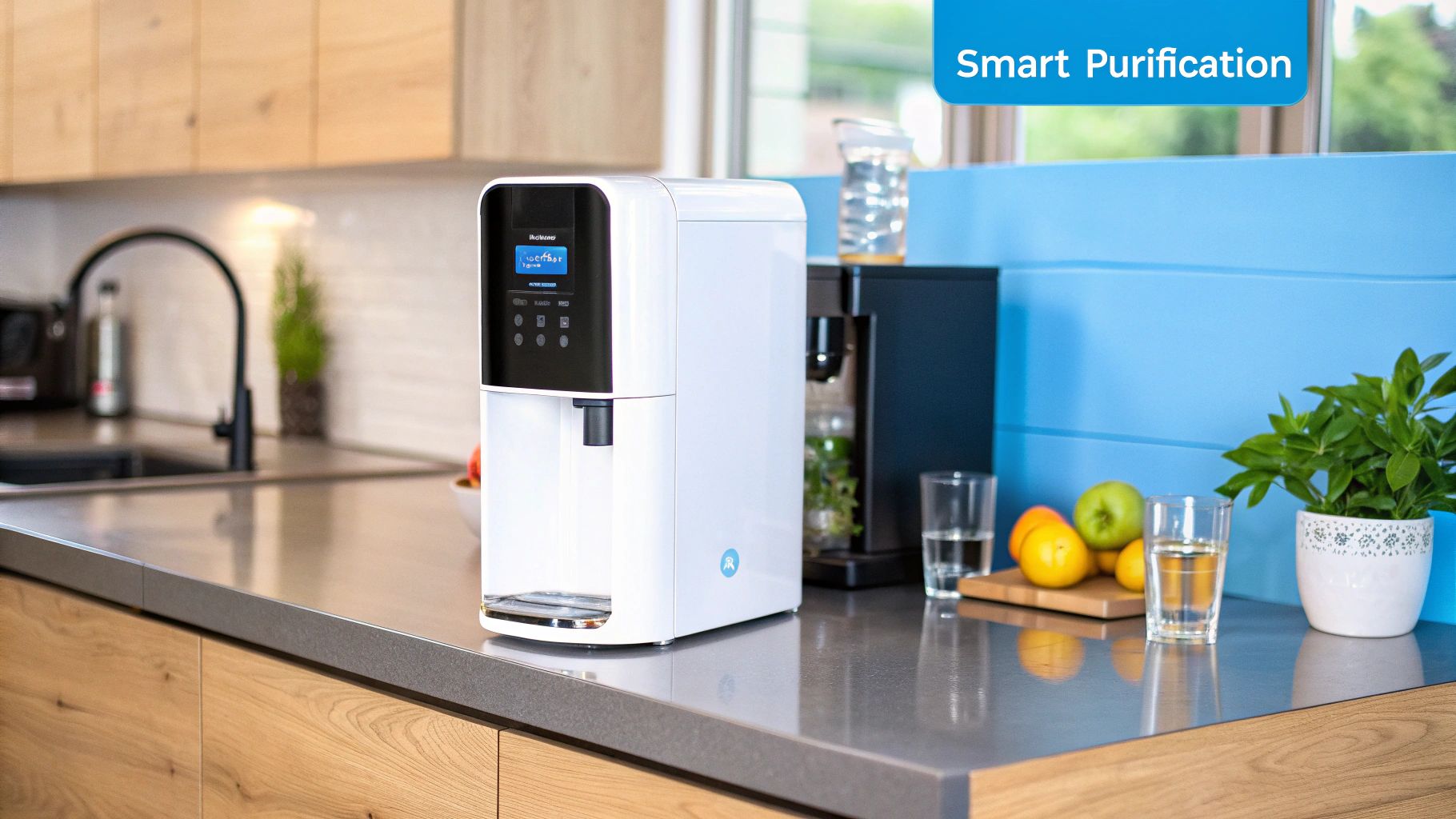
The days of sticking a reminder note on your fridge to change your water filter are fading fast. Home water filtration is getting a massive tech upgrade, ushering in a new era of systems that are smarter, more connected, and far more intuitive. These aren't just filters anymore; they're intelligent guardians of your home's water supply.
This evolution is powered by the integration of AI and IoT (Internet of Things) technology directly into the filtration systems. The newest models can monitor your water quality in real-time, track your household's usage patterns, and send detailed updates straight to your smartphone. It’s a quantum leap from a simple calendar alert.
The Rise of Intelligent Water Management
Smart water filters are changing the game by arming us with proactive, data-driven knowledge. Instead of blindly following a generic replacement schedule, these systems analyze your actual water consumption to predict the precise moment a filter's effectiveness begins to drop. This predictive maintenance ensures your system is always operating at peak performance.
And the world is taking notice. The global residential water purifier market, valued at around USD 21.96 billion in 2024, is projected to surge to an astonishing USD 76.61 billion by 2034. This boom is driven by innovations like AI-powered contaminant detection and dynamic filtration that adjusts to your water's needs.
This intelligence delivers real, tangible benefits:
- Real-time Quality Monitoring: Onboard sensors continuously test your water, giving you an instant snapshot of its purity.
- Predictive Filter Alerts: The system notifies you before a filter expires, based on actual usage, not just a date on a calendar.
- Leak Detection: Some advanced models can even detect leaks and automatically shut off the water, preventing a potential catastrophe.
A smart water filter does more than just clean your water—it gives you peace of mind. When you know the exact status of your system and your water quality at any given moment, all the guesswork just disappears.
Seamless Smart Home Integration
The real magic unfolds when these systems begin to communicate with the rest of your smart home ecosystem. Imagine your water filter syncing with other devices to create a truly automated and responsive living environment.
You could ask Amazon Alexa or Google Assistant for a quick water quality update or check your filter's remaining lifespan with a simple voice command. Some systems can even be programmed to automatically reorder new filters when they're running low, ensuring you never miss a swap. As filtration becomes more intelligent, it solidifies its place as a cornerstone of the connected home. To see how it all fits together, check out this ultimate guide to smart apartment technology.
Ultimately, a smart purifier offers a level of convenience and control that traditional models simply can't match, making it a natural and powerful addition to any modern home.
Common Questions About Home Water Filters
Even after diving deep into the world of filtration, it’s normal to have a few questions lingering. Choosing the right water filter is a big decision, and you want to be absolutely sure you’re making the best call for your home.
We’ve rounded up some of the most frequent questions we hear. Consider this your final cheat sheet to help you choose with total confidence.
Do I Really Need a Water Filter If My City Water Is Safe?
This is the million-dollar question. While your city's water may meet federal standards when it leaves the plant, that's just the start of its journey. The water then travels through miles of pipes—some potentially decades old—before reaching your tap.
Along the way, it can pick up unwelcome hitchhikers: lead from old plumbing, residual chlorine from the treatment process, and other sediment. A home filter acts as your personal, last line of defense. It's an extra layer of security that also happens to make your water taste and smell infinitely better, which is the main reason most people get one.
How Do I Know What Contaminants Are in My Water?
You can't solve a problem you can't see. Identifying what's actually in your water is the most crucial first step. The easiest starting point is your local utility's annual Consumer Confidence Report (CCR). This gives you a general overview of the municipal supply.
But for the truth about what’s coming from your own faucet, you need to test it.
- At-Home Test Kits: These are perfect for quick checks on things like chlorine and water hardness.
- Lab Testing: To get the complete, detailed story, send a water sample to a state-certified lab. This is the gold standard and an absolute must if you're on a private well.
Don't guess. A proper water test is an investment that pays for itself. It guarantees you buy a filter that targets your specific problems, saving you from wasting money and time on the wrong solution.
What Is the Difference Between Water Filtration and Purification?
People often use these terms interchangeably, but they mean different things in the water world. Filtration is a physical process, like a high-tech strainer that traps particles like sediment, chlorine, and some larger bacteria.
Purification is the next level. It removes or neutralizes even the tiniest microscopic threats, including viruses. This is typically achieved with technologies like UV light (which deactivates them) or the ultra-fine membranes found in Reverse Osmosis systems. An RO system is powerful enough to be classified as a purifier because it can remove up to 99% of all dissolved solids, including microbiological contaminants.
How Often Should I Change My Water Filters?
This one is non-negotiable. The simple answer is: follow the manufacturer's instructions to the letter. Filter replacement schedules vary wildly depending on the system type and your household's water usage.
For example:
- A pitcher filter might need a new cartridge every two months.
- An under-sink system's pre-filters could last 6-12 months.
- The main RO membrane in a reverse osmosis system can go for two years or more.
Procrastinating on this is a huge mistake. A clogged filter doesn't just stop working; it can become a breeding ground for bacteria. Even worse, it can release all the contaminants it has captured back into your water, potentially making it dirtier than unfiltered tap water.
At Water Filter Advisor, we give you the resources to make a smart choice, from deep-dive reviews to easy-to-follow maintenance guides. Check out our expert advice and find the perfect water filter for your family.
Find your ideal water filter on WaterFilterAdvisor.com
- October 15, 2025
- 0
- Uncategorized
