
If you're hunting for the best reverse osmosis system for your home, let me cut to the chase. Based on expert reviews and some serious lab testing, modern tankless models are leading the pack. A system like the Waterdrop G3P800 is a standout for its powerful filtration and instant water flow—perfect for families who want pure water without a bulky tank gobbling up precious under-sink real estate.
Why a Reverse Osmosis System Is Your Home's Best Upgrade
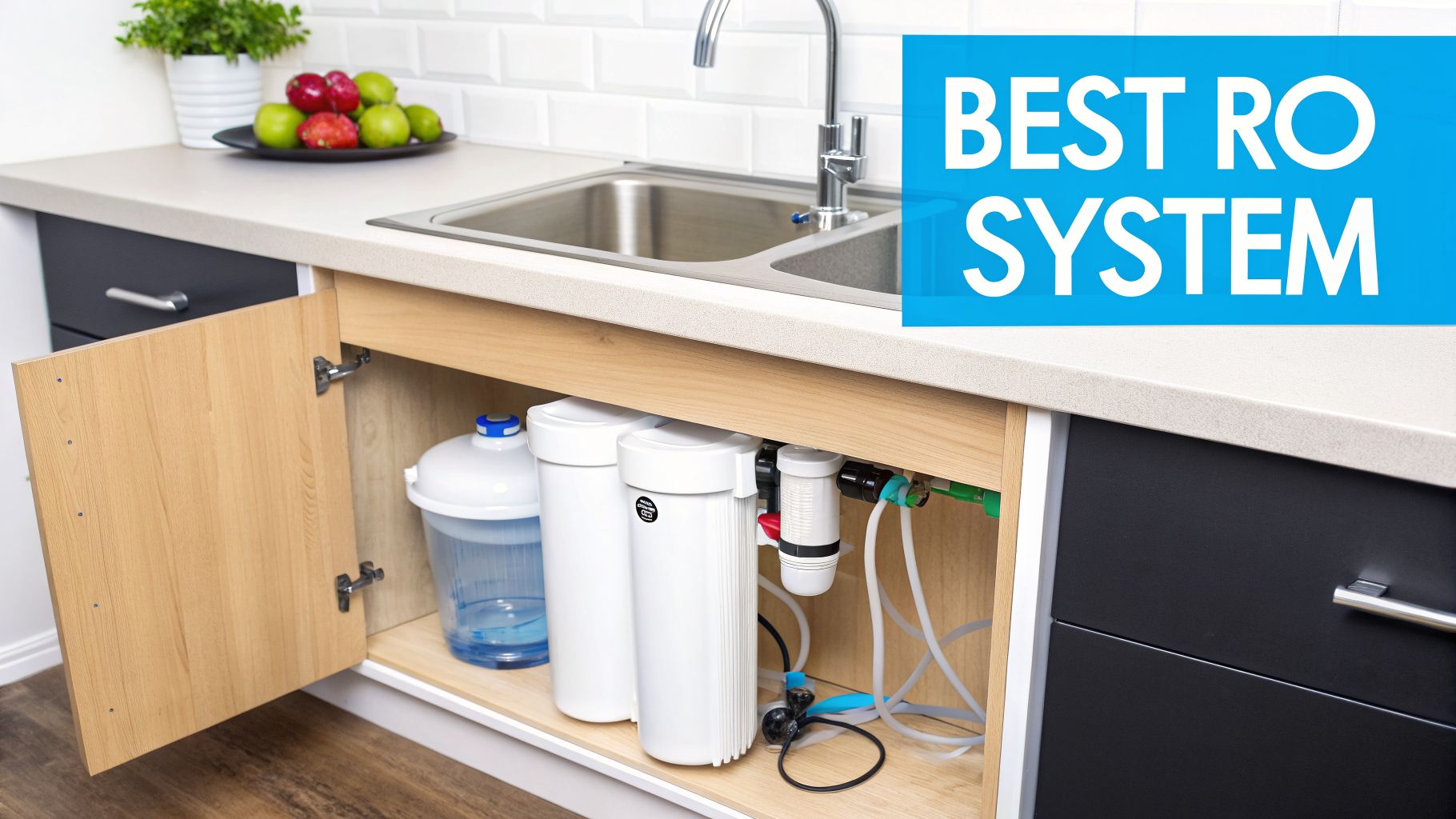
Ever pause mid-sip and wonder what’s actually coming out of your faucet? You’re not alone. Between the swimming-pool tang of chlorine and genuine worries about lead, PFAS "forever chemicals," and other invisible nasties, getting clean water at home has become a big deal. A reverse osmosis (RO) system is, simply put, the heavyweight champion of home water purification, acting as a multi-stage bodyguard against a massive list of contaminants.
Think of it this way: a basic pitcher filter is like a friendly bouncer at a club, politely asking the obvious troublemakers to leave. An RO system, however, is a microscopic special agent with a VIP list, a velvet rope, and a semi-permeable membrane that blocks impurities on a molecular level. Only pure water molecules get past the checkpoint, while up to 99% of dissolved solids are unceremoniously shown the door (or, in this case, the drain).
What to Expect From This Guide
I know that navigating the world of RO systems can feel like trying to assemble IKEA furniture in the dark. You’ve got different types, technical jargon, and a dozen features to sort through. My mission here is to torch the confusion and give you clear, straightforward advice. We’ll break down everything you need to know to find the right reverse osmosis system for your home, from how the technology works to a direct comparison of the top models on the market.
For instance, lab tests from 2026 put the Waterdrop G3P800 at the top of the list for its incredible 99.99% filtration efficiency. It’s a tankless model that pumps out water at a solid 0.6 gallons per minute (GPM), so your family won’t be left waiting. Compare that to a traditional tank model like the APEC ROES-50, which still hits around 99% efficiency but eats up a lot more cabinet space. For most homeowners, the G3P800’s compact design is a huge win. You can find more deep-dives from these kinds of home water filtration reviews over at hellawater.com.
The real benefit of a reverse osmosis system is confidence. It's the peace of mind you get knowing, without a doubt, that the water your family drinks and cooks with is clean and safe from the worst contaminants found in both city and well water.
Top-Rated RO Systems at a Glance
To give you a quick lay of the land, this table breaks down how the leading RO systems stack up. We’ll get into the nitty-gritty later, but this gives you a fast look at their key differences and where they shine.
| Model | System Type | Key Feature | Best For |
|---|---|---|---|
| Waterdrop G3P800 | Tankless Under-Sink | On-demand flow and high efficiency (0.6 GPM) | Families needing fast, continuous pure water with limited space |
| APEC ROES-50 | Tank-Based Under-Sink | Reliable, multi-stage filtration with storage | Budget-conscious households with average water needs |
| iSpring RCC7AK | Tank-Based Under-Sink | Includes a remineralization filter for taste | Users who prefer the taste of mineral water |
| Kinetico K5 Station | Whole-House | Point-of-entry system purifies all house water | Homes on well water or those seeking total-home protection |
This chart is just a starting point. As you'll see, the "best" system really depends on your water source, how much water you use, and how much space you have to work with.
How Reverse Osmosis Makes Your Water Pure
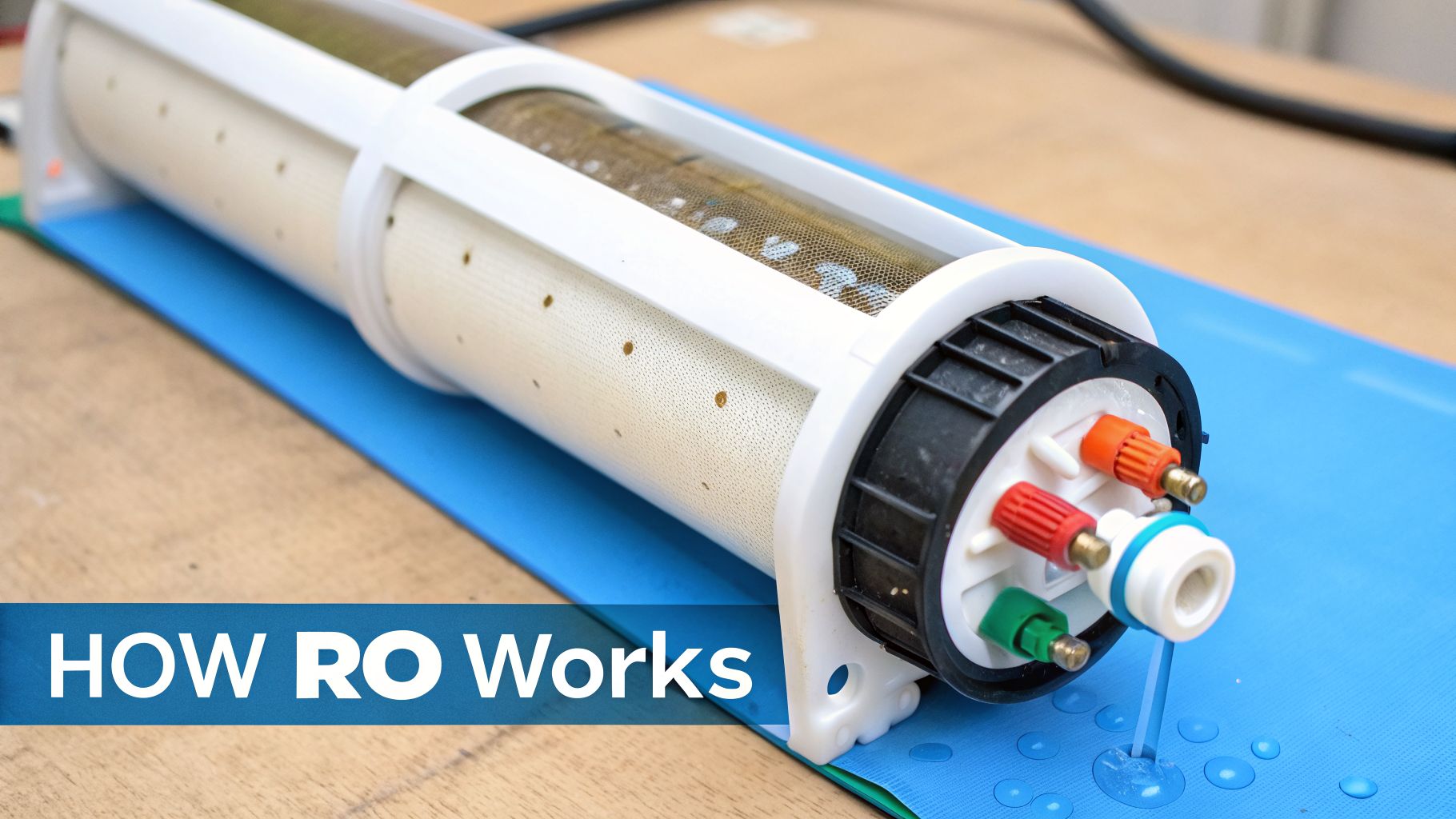
You might hear "reverse osmosis" and picture a vast, humming industrial complex, but the process happening under your sink is elegantly simple. Think of it as a multi-step cleanup crew for your tap water, where each stage targets a different set of problems.
First, your water hits a sediment pre-filter. Its only job is to get rid of the big stuff—the visible gunk that makes water look cloudy. This includes rust flakes from old city pipes, sand, silt, and any other grit that's crashed the party.
Next, the water moves through one or more carbon filters. These are the chemical warfare specialists. They use adsorption to snatch things like chlorine, which municipalities use for disinfection but which can leave your water with that tell-tale chemical taste and smell.
The Heart Of The System: The RO Membrane
With the large debris and chlorine out of the way, the water is ready for the star of the show: the reverse osmosis membrane. This is what does the real heavy lifting.
The membrane is a sheet of material with pores so ridiculously small they measure about 0.0001 microns. To put that in perspective, a single human hair is roughly 70 microns thick. Your home's water pressure provides the muscle, shoving water molecules through these tiny openings while almost everything else gets rejected.
This is the critical difference between an RO system and a standard water filter. It doesn’t just trap particles; it physically forces pure water through a barrier, leaving a huge range of dissolved contaminants behind. It's not a net; it's a nearly impenetrable wall.
This process is incredibly effective at removing tough contaminants that other filters simply can't touch. All the rejected gunk and dissolved solids are washed away into your drain line, so only the cleanest water remains.
- Heavy Metals: Lead, arsenic, mercury, and chromium are stopped cold.
- Dissolved Solids: It drastically cuts down the Total Dissolved Solids (TDS) in your water, which includes salts, nitrates, and fluoride.
- Emerging Contaminants: RO is one of the very few residential filter types proven to remove PFAS, often called "forever chemicals," which are a growing concern in water supplies nationwide.
The Final Polish
After passing through the membrane, the purified water usually gets one last pass through a carbon "polishing" filter. This is a final quality check to catch any faint tastes or odors the water might have picked up along the way. The result is exceptionally crisp, clean water that tastes like… well, nothing at all. Just pure hydration.
Many modern systems also add a remineralization filter at the very end. Because RO is so thorough, it strips out healthy minerals like calcium and magnesium right along with the bad stuff. This final stage puts those beneficial minerals back in, not only getting rid of the "flat" taste some people notice in RO water but also raising its pH to be less acidic.
Key Factors for Evaluating RO Systems
Picking the right reverse osmosis system isn’t about grabbing the most popular box off the shelf. You need to look past the marketing and match the hardware to your home's water, your family's needs, and your budget. Get this right, and you'll have a system that works for you for years.
This decision tree breaks down the first few questions to ask. It’s a simple way to see if your situation points toward a smaller under-sink unit or a larger whole-house system.
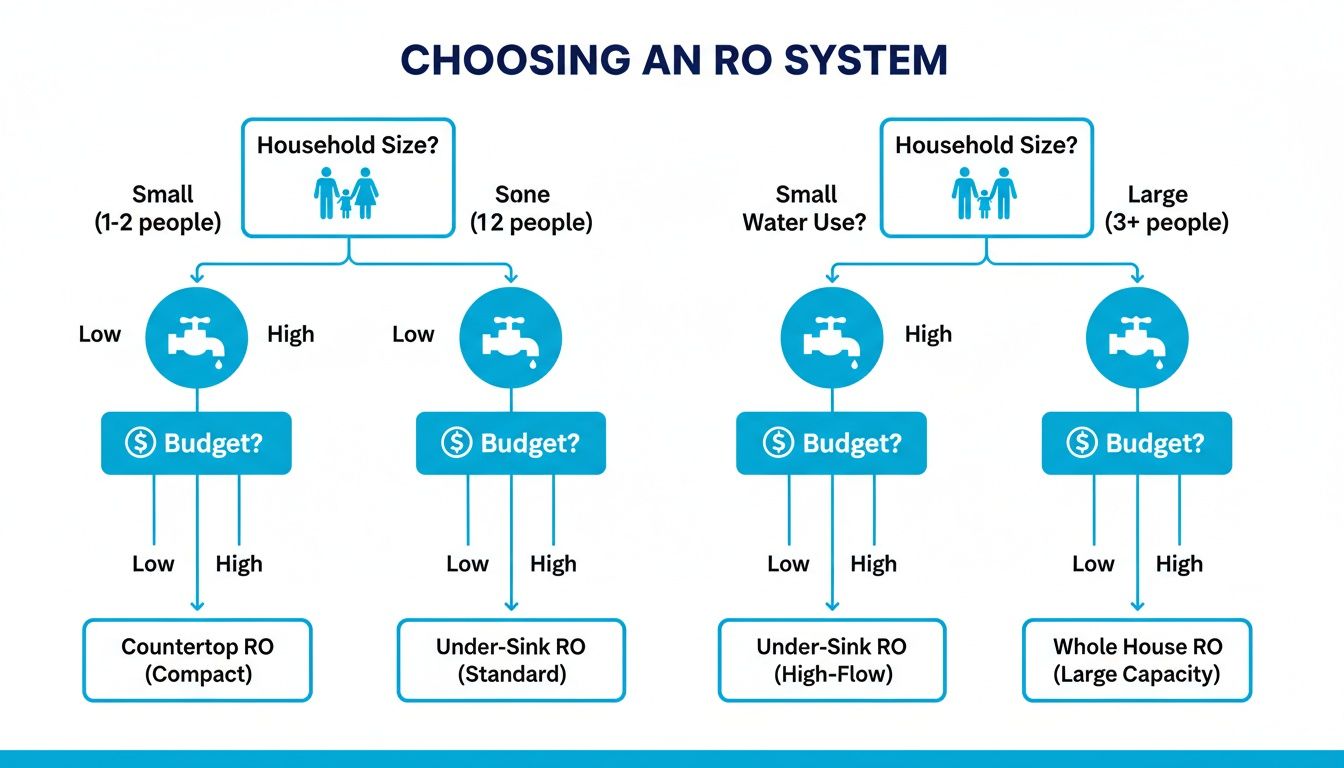
Use it to get a quick handle on which category you should be shopping in. From there, we can dig into the details that really matter.
Decoding Contaminant Removal Claims
An RO system's main job is pulling contaminants out of your water. But talk is cheap. You need proof, and that comes from NSF/ANSI certifications. These aren't marketing fluff; they are independent, third-party tests that prove a system performs as advertised.
Here are the two big ones to look for:
- NSF/ANSI 58: This is the gold standard for reverse osmosis. It confirms the system can reduce tough contaminants like lead, fluoride, arsenic, and nitrates. A system carrying this seal has passed strict tests for filtration performance, structural integrity, and material safety.
- NSF/ANSI 401: Think of this as an extra layer of defense against modern pollutants. This standard certifies the reduction of up to 15 "emerging contaminants," which can include certain pesticides, herbicides, and even trace amounts of pharmaceuticals. If you live near farmland or just want maximum peace of mind, this certification is worth its weight in gold.
If a system doesn't have these certifications, you're just taking the manufacturer's word for it. Always look for the NSF seal.
Matching Flow Rate To Your Household
Flow rate, measured in Gallons Per Day (GPD), tells you how fast a system makes purified water. This number directly affects your daily life. Go too small, and you'll be staring at a trickling faucet while waiting for a pot to fill.
For a one or two-person home, a 50–75 GPD system usually does the trick. But for a family of four or more—or if you're a home chef who cooks with a lot of filtered water—you'll be much happier with a system rated for 100 GPD or more.
Pro Tip: GPD is a lab-tested ideal. Real-world factors like low household water pressure or very cold tap water can slow things down. It's a smart move to buy a system with a slightly higher GPD rating than your bare minimum to ensure you're never left high and dry.
Evaluating Water Waste And Efficiency
Older RO systems were notoriously wasteful, dumping gallons of "brine" water down the drain for every gallon of pure water they produced. Thankfully, modern systems are much, much better. High-efficiency models now have waste-to-pure water ratios of 2:1 or even an impressive 1:1.
When you compare models, look for the "waste ratio" or "efficiency ratio." A lower number means less wasted water, which is good for the planet and your water bill.
For those wanting purified water at every faucet, some experts like contractor Mike Holmes recommend whole-house solutions. Systems like the Kinetico K5, for example, can be configured to target specific local issues like chloramine and deliver clean water everywhere. You can learn more about picking the right system on Make It Right.
The Importance Of Remineralization
Here's the one "catch" with RO filtration: it's so thorough that it strips out healthy minerals like calcium and magnesium right along with the bad stuff. This can leave the water tasting sterile and slightly acidic.
The fix is a remineralization filter. Many of the best home reverse osmosis systems now include this as a final stage to add a small amount of beneficial minerals back into the water.
This one step does two important things:
- Improves Taste: It brings back a clean, natural flavor. No more "flat" water.
- Balances pH: It makes the water less acidic, raising it to a more neutral or slightly alkaline pH.
If you care about the taste of your water or want the benefits of those minerals, make sure the system you choose has a remineralization stage. It makes a huge difference.
Comparing Tank vs Tankless RO Systems
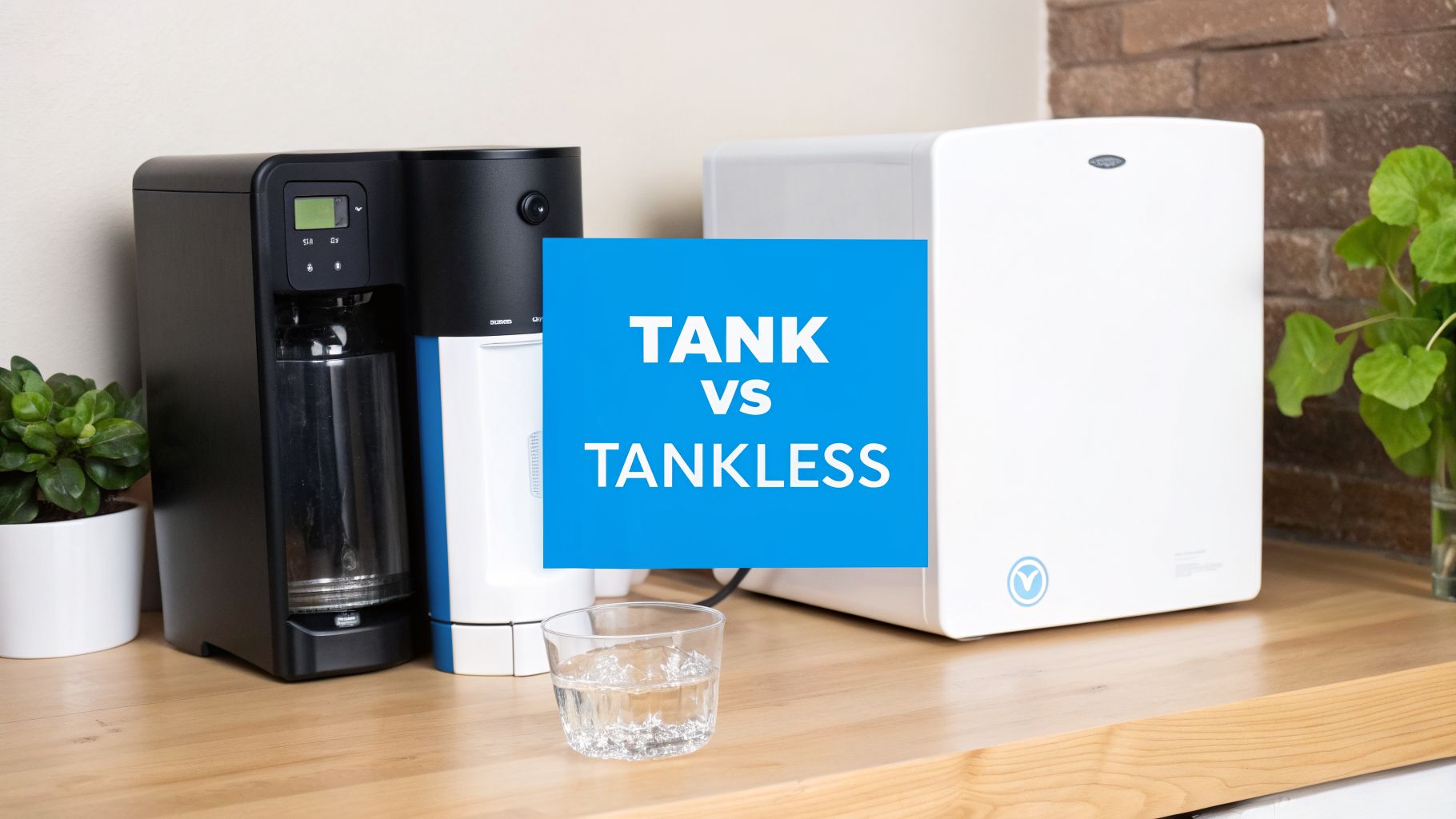
When you’re ready to get an RO system, the first big fork in the road is deciding between a model with a tank or one that's tankless. This isn't a small detail—it completely changes how you use your water, how much space you lose under the sink, and how fast you can fill a glass.
Let's dig into this crucial choice.
The traditional RO system, the kind that's been around for decades, uses a pressurized storage tank. Because reverse osmosis takes time, the system slowly fills this tank with pure water, creating a reserve you can draw from instantly. It’s a reliable, time-tested design.
Tankless RO systems are the modern answer. They use powerful internal pumps and beefier membranes to purify water on the spot, as soon as you turn on the faucet. No bulky tank needed, which is a huge win for anyone tight on cabinet space.
The Flow Rate Reality
The most obvious difference you’ll notice day-to-day is the flow of water. A tank-based system gives you a strong stream of water, but only until the tank runs out. Once it’s empty, you’re stuck waiting for it to slowly refill, which is a real headache when you're trying to fill a big pot for pasta or have guests over.
Tankless systems, on the other hand, deliver an endless supply. Their flow rate is steady and consistent, often measured in Gallons Per Day (GPD). A good tankless unit can push out 400–800 GPD, meaning you literally can't out-demand it.
The Bottom Line: If you have a large, busy family that’s always in the kitchen, a tankless system's non-stop flow is a massive quality-of-life upgrade. For smaller households or couples, a standard tank system will probably do the job just fine.
The Battle for Under-Sink Space
For many, this is the deciding factor. A traditional RO setup is a space hog. It needs room for the filter cartridges and a storage tank that can be as big as a small propane tank. If you have a garbage disposal or a deep sink, good luck fitting it all in.
This is where tankless systems clean up. Getting rid of the tank leaves you with a sleek, compact unit that fits neatly in almost any cabinet. You get to keep your storage space for cleaning supplies, which is a game-changer in apartments, condos, or any kitchen where space is at a premium.
Purity, Waste, and Upkeep
Both systems will give you incredibly pure water, but there are a few subtle differences. Water can sit in a storage tank for hours or even days, which can sometimes lead to a slightly stale taste. With tankless, the water is purified just seconds before it hits your glass, so it's as fresh as it gets.
Water efficiency is another key battleground. Older tank systems were notorious water wasters, often flushing 4 or 5 gallons of brine down the drain for every gallon of pure water produced. Modern tankless systems are far more efficient, with many achieving a 1:1 or 2:1 waste-to-pure-water ratio. That saves a lot of water and money over time.
Maintenance is also a bit different. Both require regular filter changes, but tank systems have the extra step of sanitizing the tank itself every year or so to prevent any bacterial buildup. Tankless systems are simpler—just twist off the old filters and twist on the new ones.
To make the choice clearer, here’s a direct comparison of how these two types of systems stack up across the most important factors.
Tank vs. Tankless RO Systems Head-to-Head
| Feature | Tank-Based RO System | Tankless RO System | Recommendation Context |
|---|---|---|---|
| Water Flow | Strong initial flow, but limited by tank size. Can run out during high use. | Continuous, on-demand flow. Can't run out. | Tankless wins for large families or anyone who uses a lot of filtered water at once. |
| Footprint | Large. Requires significant space for both filters and the storage tank. | Compact and sleek. Fits easily under most sinks, saving valuable space. | Tankless is the clear choice for small kitchens, apartments, or crowded cabinets. |
| Water Freshness | Good. Water is stored, which can lead to a stale taste if not used quickly. | Excellent. Water is filtered seconds before you drink it, ensuring maximum freshness. | If taste is your absolute top priority, go tankless. |
| Water Waste | Varies. Older models are very inefficient (4:1+). Newer models are better. | Highly efficient. Most modern systems are 1:1 or 2:1 (waste-to-pure). | Tankless is more eco-friendly and saves money on your water bill over the long run. |
| Initial Cost | Generally lower upfront cost. A more budget-friendly entry point. | Higher upfront investment due to the pump and advanced technology. | If budget is tight, a tank-based system is a solid start. |
| Maintenance | Requires periodic filter changes and annual tank sanitization. | Simple twist-and-lock filter changes. No tank to clean. | Tankless offers simpler, more straightforward maintenance. |
Ultimately, there's no single "best" choice for everyone. A traditional tank-based system is a proven, affordable option that works well for many homes with average water needs and enough space.
But if you value on-demand convenience, want to save every inch of cabinet space, and prefer the freshest possible water with minimal waste, a tankless system is definitely the way to go in 2026.
Calculating The Real Cost Of An RO System
An RO system is a fantastic investment in your family’s health, but let's talk turkey: what’s the real long-term cost? To find the right reverse osmosis system, you have to look past the sticker price. The true cost includes the unit itself, ongoing maintenance, and even the impact on your utility bills.
Let's break down the numbers so you can budget accurately and avoid any nasty surprises down the road.
Beyond The Initial Purchase Price
The upfront price for an RO system can be anything from a couple of hundred dollars for a basic model with a tank to over a thousand for a high-end, tankless one. But that's just the start. Your biggest ongoing expense will be filter replacements.
Most systems use several filters that you'll have to replace on different schedules. Here’s what you can generally expect:
- Sediment & Carbon Pre-filters: Plan on replacing these every 6 to 12 months.
- RO Membrane: This is the workhorse of the system and should last 2 to 5 years.
- Post-filter/Remineralization Filter: These are typically changed every 12 months.
Before you buy, do the math on the annual cost of these filters. A system that looks cheap upfront might cost you more over five years if the filters are pricey or need changing all the time.
Installation And Utility Bill Impact
Are you going to install the system yourself or call a plumber? A DIY job is free if you're handy with a wrench, but a professional will likely charge between $150 and $400, depending on how complex the installation is. If you're not comfortable drilling into your counter or tapping into water lines, you need to factor this cost in.
Water waste is another big one. Old RO systems were notoriously inefficient, but newer models are much better. According to EPA data, older units could waste as much as 10 gallons of water for every one gallon of pure water they produced. Today, new WaterSense-labeled models can get that down to just 2.3 gallons or less. That could save a household over 3,100 gallons of water a year. Top-tier systems can even hit an impressive 1:1 waste-to-pure water ratio. You can find more details on these efficiency standards from the EPA's page on reverse osmosis systems.
Choosing a water-efficient model isn't just about being green; it saves you cold, hard cash. The savings on your water bill can be huge over time.
Don't forget to count the savings from kicking the bottled water habit for good. If your family spends $30 a month on bottled water, you’ll save $360 a year. That’s often enough to cover your annual filter costs and pay off the system itself in just a couple of years. When you add it all up, an RO system is usually a very smart financial move.
RO System Installation And Maintenance Tips
So, you’ve picked out your reverse osmosis system. Before you can enjoy that first glorious glass of pure, clean water, you have to get it installed and figure out a maintenance plan. Getting these two steps right is the key to making sure your system works like a dream for years to come.
First up is the installation. You have two real options: do it yourself or call a plumber. Many of the newer RO systems are designed for DIY, coming with color-coded tubes and good instructions. If you know your way around basic plumbing, like shutting off the water and using a drill, you can probably get it done in an afternoon and save a couple hundred bucks.
But if the thought of drilling into a granite countertop or cutting into a drain pipe makes you break into a cold sweat, hiring a pro is money well spent. They'll make sure nothing leaks and the whole setup is optimized from the get-go.
Professional vs DIY Installation
If you're remodeling, checking a smart kitchen planning guide can help you figure out the best spot for your system so it fits seamlessly.
- DIY Installation: This is a great option if you're handy with tools and feel comfortable with plumbing basics. The kits give you everything you need, but you have to follow the instructions to the letter to avoid leaks.
- Professional Installation: Go this route if you have expensive counters, not much space under the sink, or just want the job done right without the stress. A plumber can also handle any weird plumbing quirks they might find.
Your Long-Term Maintenance Checklist
An RO system needs regular attention to keep working properly. If you skip filter changes, you're not just risking water quality—you could ruin the RO membrane itself.
Think of your RO maintenance schedule like getting an oil change for your car. The pre-filters protect the more expensive and critical parts—in this case, the RO membrane—from premature failure. Sticking to the schedule is the single best thing you can do to extend your system's life.
Here's a general schedule you can follow, but always double-check the guide that came with your specific system.
- Sediment and Carbon Pre-filters: These filters take the biggest hits, grabbing sediment and chlorine. You'll need to change them every 6-12 months to keep the RO membrane safe.
- RO Membrane: This is the core of the whole system. If you take care of it, it can last 2 to 4 years. If your water flow starts to slow down to a trickle, that's a good sign it's time for a replacement.
- Carbon Post-filter/Remineralization Filter: This is the last step that makes your water taste great. Replace it every 12 months so your water stays crisp and fresh.
- System Sanitization: It's a good habit to sanitize the storage tank (if you have one) and lines when you do your annual filter change. This prevents any bacteria from building up over time.
Common Issues And Quick Fixes
Even the best RO systems can act up sometimes. The good news is that most problems are pretty simple to fix yourself.
- Slow Water Flow: This is the number one complaint. First, make sure the water supply valve is all the way open. If it is, your pre-filters are likely clogged, or the air pressure in your storage tank is low.
- Strange Noises: A bit of gurgling is usually normal—that's just the sound of the system working and flushing wastewater. But if you hear a loud, constant noise, it could be a water pressure problem or a filter that isn't seated correctly.
- Leaks: As soon as you spot a drip, shut off the water to the RO system. Leaks almost always happen at the connection points. Double-check that all the tubes are pushed in tight and the filter housings are snug (but don't crank on them too hard).
For more detailed guides on fixing these issues, check out our collection of water filtration advice. Keeping on top of this simple maintenance will ensure you get a long life out of your RO system.
Your RO System Questions Answered
We get a lot of questions from homeowners who are close to choosing a reverse osmosis system but have a few final concerns. Here are the answers to the most common ones.
A big question is about minerals: “Does reverse osmosis remove healthy minerals?” Yes, it does. The RO membrane is so effective it removes beneficial minerals like calcium and magnesium right along with the contaminants. This can leave the water tasting "flat" or sterile to some people.
That’s why many modern systems include a remineralization filter.
Remineralization and Water Waste
The best RO systems today add a final stage that puts a small amount of healthy minerals back into the water right before it comes out of your tap.
This final step accomplishes two things:
- Improves taste: It brings back a crisp, natural taste to the water.
- Raises pH: It makes the water slightly alkaline, which many people prefer to the slightly acidic water that comes directly from an RO membrane.
Another concern is water waste. Older RO systems were known for being inefficient, but today's models are much better. High-efficiency systems have significantly cut down on the wastewater, with the best units achieving a 1:1 pure-to-waste water ratio.
The "waste ratio" is a key spec to check. A lower number means less water is wasted, which saves you money on your water bill.
How Long Will An RO System Last?
With proper maintenance, a good reverse osmosis system will last 10 to 15 years. The main unit is built to be durable, but its lifespan really comes down to how well you take care of it.
The single most important maintenance task is changing the filters on schedule. Following the manufacturer's timeline for replacing the sediment, carbon, and remineralization filters is crucial. This not only keeps your water pure but also protects the RO membrane—the most expensive part of the system—from getting clogged and failing prematurely. In colder areas, it’s also a good idea to know how to winterize your home's plumbing to protect your entire system. If you stay on top of maintenance, your RO system will deliver clean water for years.
At Water Filter Advisor, we help you understand water filtration. Our reviews and guides are made to give you the confidence to choose, install, and maintain the right system for your home. See our resources to find the best water solution for your family at https://www.waterfilteradvisor.com.
- April 6, 2026
- Uncategorized
