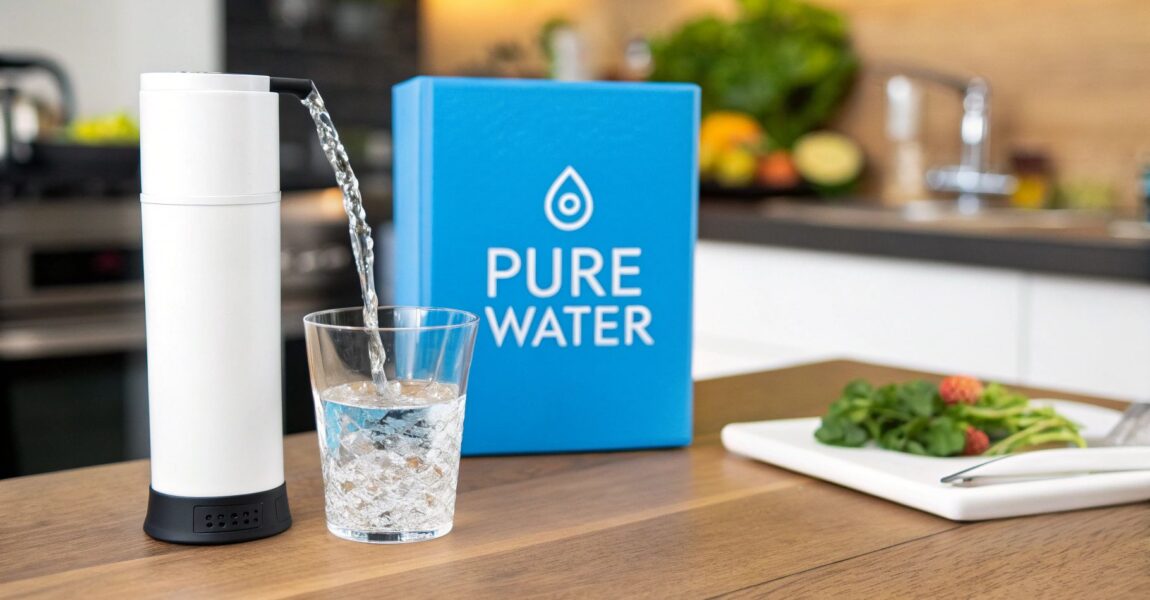
So, you're on the hunt for the best countertop water filter? Your quest probably started with a single, nagging thought: "What in the world is actually coming out of my kitchen tap?" For most folks, that question leads them down a path to two excellent choices: gravity-fed systems or reverse osmosis units. Both are superstars at providing powerful, multi-stage filtration without needing to call in a plumber.
Think of them as your personal bodyguards, standing between you and the mysterious stuff lurking in your water.
Why Your Tap Water Might Need a Hero
You turn the handle, and out comes clear, seemingly perfect water. It's easy to assume it's pure. And while U.S. tap water is among the safest on the planet, it travels a long, winding road from the treatment plant to your glass. Along the way, it can pick up some unwelcome hitchhikers that mess with its taste, smell, and overall quality.
This is where a countertop water filter swoops in to save the day. It’s not about distrusting your local water utility; it’s about taking complete control of that final foot of the journey before the water hits your lips.
The Usual Suspects in Your Tap Water
Most of us have noticed little quirks in our water that a good filter can eliminate in a heartbeat. Here are the common culprits:
- The "Swimming Pool" Effect: Cities use chlorine to disinfect water and kill off nasty bacteria. It’s a necessary process, but it can leave behind that distinct chemical smell and taste. Not exactly the recipe for a refreshing drink.
- Ancient Pipes: The pipes that deliver water to your house—and even the ones inside your walls—can be decades old. Older plumbing can leach contaminants like lead into your water, a serious health concern, especially for families with kids.
- The Invisible Intruders: Often, the most worrisome stuff is what you can't see, taste, or smell. We're talking about industrial runoff, pesticides from farms, and even disinfection byproducts created during the water treatment process itself.
A high-quality countertop filter is like a bouncer at a club, politely showing these unwanted contaminants the door right before you take a sip. It's an incredibly simple upgrade for ensuring every glass is as pure and delicious as it should be.
Take Back Control of Your Water
A countertop filter puts the power of pure water back in your hands. It's a fantastic solution for homeowners and renters alike because it requires no permanent changes to your plumbing.
Whether you opt for a simple gravity-fed dispenser or a more advanced unit that connects to your faucet, you're essentially buying peace of mind.
For those facing significant water challenges or considering a whole-house solution, looking into professional water filtration systems can be a great option. For most kitchens, however, a countertop unit hits that perfect sweet spot of performance, convenience, and affordability. It's your first step toward healthier, better-tasting water, every single day.
How Countertop Water Filters Work Their Magic
Ever popped the lid off a countertop filter and wondered what alchemy is happening inside? It’s far more than just a fancy pitcher. Think of it as a high-tech obstacle course for your tap water, where different layers of defense team up to block unwanted intruders.
These clever devices pack some serious filtration technology to snag various types of contaminants. Understanding how they work is the secret to choosing the right one for your home, ensuring you’re not just buying a gadget, but a genuine solution to your water woes.
It’s no wonder people are seeking better water. The global market for these point-of-use systems was valued at $35.6 billion in 2025 and is projected to soar to $53.2 billion by 2032. And who’s leading this charge? Homeowners and renters just like you, making up a massive 70% of the market. You can read the full research about the growing water purifier market to see the big picture.
Activated Carbon: The Contaminant Magnet
The first and most common line of defense is activated carbon. Imagine a sponge that’s incredibly porous, with a surface area the size of a football field, acting like a powerful magnet for all sorts of chemical gunk. That's precisely what this material does.
As water flows through it, contaminants like chlorine, pesticides, and funky industrial chemicals (known as VOCs) get stuck to the carbon's surface. This process is called adsorption. It’s why activated carbon is the undisputed champion of banishing that swimming pool taste and smell, making your water instantly more enjoyable.
Reverse Osmosis: The Ultimate Gatekeeper
When you need to get serious about purity, you bring in the big guns: reverse osmosis (RO). Picture a bouncer at an exclusive club who only lets the absolute VIPs—in this case, pure water molecules—pass through the velvet rope. The "bouncer" here is the RO membrane, a filter with pores so minuscule that almost nothing else can squeeze through.
Your home’s water pressure pushes water against this membrane. The water molecules wriggle through to the clean side, while dissolved solids, heavy metals, and other nasty stuff are left behind and flushed down the drain.
Reverse osmosis is the heavy hitter of water filtration. It is phenomenally effective at blocking a huge list of contaminants, including lead, arsenic, fluoride, and nitrates. It is one of the most thorough purification methods available for home use.
This level of filtration offers unparalleled peace of mind, knowing that you’re drinking exceptionally clean water free from some of the most troubling modern contaminants.
Specialized Forces: Ion Exchange and UV Light
Some of the best countertop water filter models don't stop there. They deploy specialized stages to tackle specific problems.
- Ion Exchange: This is essentially a trading system. The filter contains tiny resin beads that snatch minerals causing hard water, like calcium and magnesium. In exchange, they release a harmless ion like sodium. It's a simple swap that "softens" the water.
- UV Purifiers: Think of this as the final security sweep. A UV lamp zaps the water with ultraviolet light, which scrambles the DNA of bacteria, viruses, and other microorganisms. It doesn't physically remove them, but it neutralizes them, rendering them completely harmless.
By layering these technologies, a great multi-stage filter builds a formidable defense. Carbon handles taste and odor, RO tackles dangerous microscopic particles, and other stages can manage hard water or neutralize germs. It’s this combined-arms approach that lets you pour a glass of water with absolute confidence.
Choosing Your Countertop Champion
Alright, now that you’re a filtration tech whiz, let's get practical. How do you pick the best countertop water filter for your real-life kitchen? It really boils down to comparing the main styles and deciding what fits best with your home, family, and daily routine.
We’re going to break down the three main contenders: the classic gravity-fed dispensers, the nimble faucet-diverter units, and the mighty standalone multi-stage systems. Each has its own unique strengths, and one is sure to be the perfect match for your counter space and water needs.
Gravity-Fed Dispensers: The Slow and Steady Winner
You’ve seen them: those classic, often stainless steel, gravity-fed systems. The concept is beautifully simple. You pour water into the top chamber, and gravity patiently pulls it down through filter elements into a bottom reservoir. From there, a spigot delivers your pure water.
People adore these for their simplicity and effectiveness. They don't need electricity or a connection to your plumbing, which makes them incredibly versatile. You can place one anywhere on your counter or even take it on a family camping trip.
The primary trade-off is speed. Filtering a full batch of water takes time, so it's more of a "fill it and let it do its thing" approach. They also command a fair amount of counter real estate, which might be a dealbreaker in cozier kitchens.
Faucet-Diverter Filters: Instant Gratification
A faucet-diverter filter is all about on-demand convenience. This compact unit screws directly onto your kitchen faucet. When you want filtered water, you simply flick a switch, and it diverts tap water through the filter. Presto, purified water in an instant.
Installation is typically a breeze, taking just a few minutes with no tools required. This makes them a fantastic choice for renters or anyone hesitant to modify their plumbing. They are also major space-savers, keeping your countertops clear.
The catch is usually the filtration power. While excellent for removing chlorine and improving taste, most faucet-diverter models aren't as comprehensive as their multi-stage cousins. Also, a word of warning: they are not compatible with pull-out or sprayer-style faucets, so be sure to check your tap style before you buy.
Standalone Multi-Stage Systems: The Powerhouse Performers
Standalone multi-stage filters are the heavyweights of the countertop world. These systems sit on your counter and often combine multiple technologies, like activated carbon and reverse osmosis, to deliver exceptionally pure water. You fill a reservoir, and the machine takes care of the rest.
These are the systems you choose when you’re serious about removing a long list of contaminants—from lead and fluoride to PFAS and other stubborn chemicals. Many of these advanced units are gaining popularity as people look for high-performance appliances when incorporating smart technology into your kitchen design.
The biggest selling point of a standalone system is its sheer purification power. They often combine multiple filter types to tackle nearly any water quality issue, giving you ultimate peace of mind.
Their main drawbacks can be a higher upfront cost and the space they occupy. They also require an electrical outlet to run the pumps needed for processes like reverse osmosis.
To help you visualize the best choice for your needs, this chart breaks down which filter type is ideal based on your primary water concern.
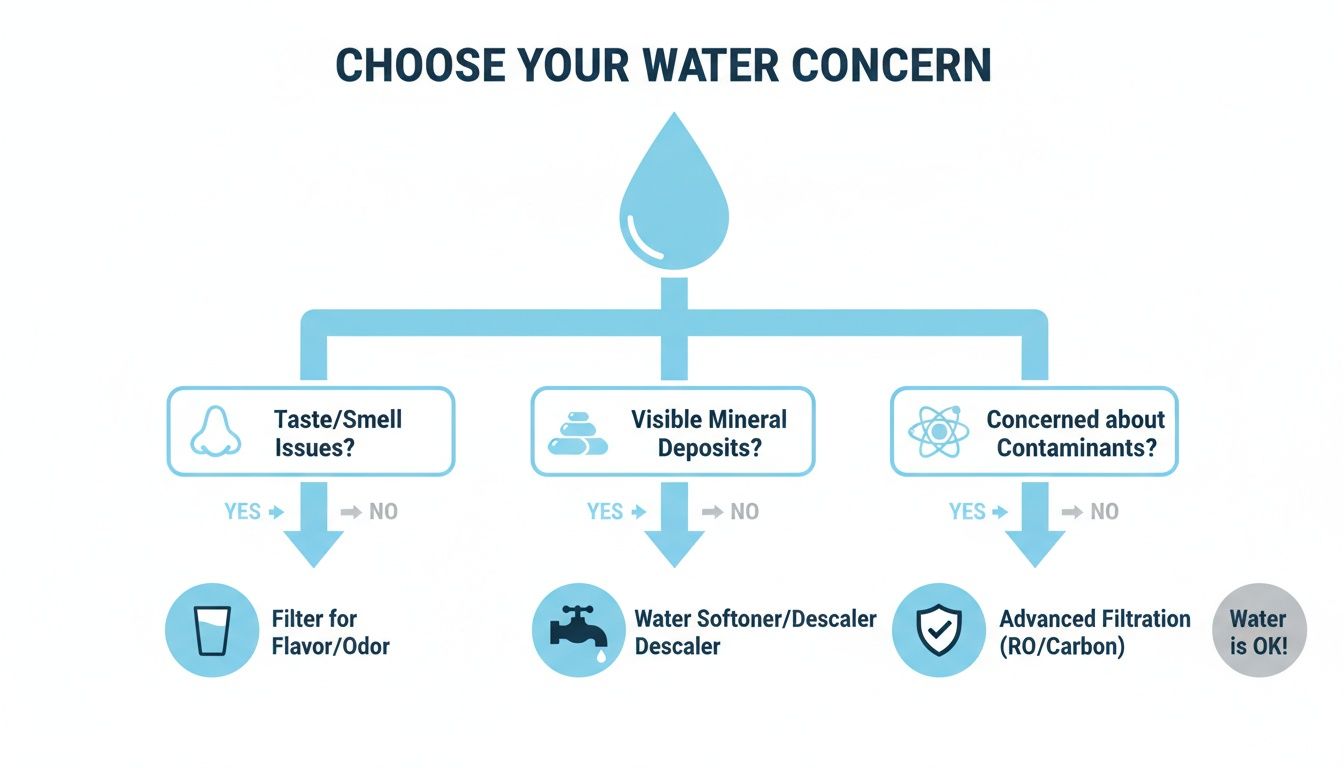
As you can see, whether your goal is simply better taste, managing hard water minerals, or eliminating serious contaminants, there's a specific filter technology that gets the job done.
Here’s a quick cheat sheet to help you compare these options side-by-side.
Countertop Water Filter Types At a Glance
| Filter Type | Installation | Filtration Speed | Best For Removing | Ideal Household |
|---|---|---|---|---|
| Gravity-Fed | None | Slow (batch processing) | Chlorine, Sediment, some Heavy Metals | Patient households, renters, and off-grid use. |
| Faucet-Diverter | Simple (screws onto faucet) | Instant (on-demand) | Chlorine, Lead, Bad Taste/Odor | Small kitchens, renters, singles, or couples. |
| Standalone | None (sits on counter) | Moderate (batch processing) | Wide range including Fluoride, PFAS, Heavy Metals | Families with serious water quality concerns. |
This table lays it all out, helping you match a filter's strengths to what your home actually needs. Whether it's the grab-and-go convenience of a faucet filter or the deep-cleaning power of a multi-stage system, the right choice is all about your priorities.
Understanding Filter Certifications and Performance
When you're shopping for a countertop water filter, you'll be bombarded with technical jargon and bold marketing claims. How can you be sure a filter actually does what it promises on the box?
The secret is to look past the flashy advertising and find the official stamps of approval from third-party testers. Think of it this way: anyone can claim their car is fast, but it’s the verified time slip from a racetrack that provides the proof. For water filters, the most respected "racetrack" is NSF International.
An NSF/ANSI certification means an independent lab has rigorously tested the filter to verify that it truly removes the contaminants it claims to. It’s your guarantee that you're buying a proven performer, not just a slick piece of marketing.
Decoding the Most Important NSF Certifications
You don't need a degree in chemistry to understand this. For countertop filters, there are really only two key NSF/ANSI standards you need to recognize.
NSF/ANSI 42 – The "Taste and Smell" Standard: This certification is all about the aesthetic qualities of your water. It confirms that a filter is effective at reducing substances that affect taste and odor, like chlorine. If your main complaint is that your tap water has a "public pool" vibe, this is the standard to look for.
NSF/ANSI 53 – The "Health Effects" Standard: This is the heavy hitter. When a filter earns an NSF 53 certification, it has been proven to reduce specific contaminants that are harmful to your health. We're talking about nasty stuff like lead, mercury, asbestos, cysts (like Giardia), and a range of volatile organic compounds (VOCs). If you have serious concerns about your water quality, this is the certification that truly matters.
Seeing these seals on a product means you can trust the manufacturer's claims. It’s the best way to cut through the noise and choose a filter with confidence.
How to Read a Performance Data Sheet
Beyond the official seals, any reputable filter will come with a performance data sheet. It might look a bit intimidating, but this is where you find out the filter's true capabilities. It's a detailed report card that lists every contaminant the filter is certified to reduce and, more importantly, by how much.
Don't just scan for a long list of contaminants. Pay close attention to the percentage of reduction. A filter that removes 99.5% of lead is vastly superior to one that only removes 90%. The data sheet gives you the real numbers to compare apples to apples.
This sheet also specifies the filter's capacity, usually in gallons. This tells you how much water it can purify before the cartridge needs replacing, which is crucial for understanding the true long-term cost. For anyone concerned about contaminants like TTHMs or hydrogen sulfide in their city water, some NSF-certified systems offer multi-stage purification that can tackle over 50 contaminants. You can explore more trends in the countertop filtration market on Data Insights Market.
Once you know how to spot an NSF seal and read a performance data sheet, you transform from a casual shopper into an informed buyer. You’ll be able to see right past the hype and select the filter that is truly proven to work.
Calculating the Real Cost of Clean Water
It’s easy to focus on the initial price tag when you're shopping for a countertop water filter. But that sticker price is just the first chapter. The real cost unfolds over months and years of use, and knowing how to calculate it is the key to making a smart investment.
The biggest ongoing expense, by far, is the replacement filters. Think of it like a razor: you buy the handle once, but you'll be buying blades for as long as you use it. This is where the true cost of ownership is revealed.
The Cost-Per-Gallon Formula
To get a fair, apples-to-apples comparison between different models, you need a simple way to calculate your cost per gallon. Don't worry, it's easier than it sounds.
First, you need two numbers for any filter you're considering: the price of a replacement cartridge and its capacity (how many gallons it can purify before it's exhausted).
Then, just plug them into this simple formula:
Replacement Filter Cost ÷ Filter Capacity (in Gallons) = Cost Per Gallon
Let's say a replacement filter costs $60 and is rated for 400 gallons. Your math is simply $60 ÷ 400, which equals $0.15 per gallon. That single number is a game-changer. It allows you to cut through marketing claims and see which system will actually be kinder to your wallet in the long run.
By focusing on the cost-per-gallon, you shift from simply buying a product to investing in a long-term water solution. A filter with a higher upfront price but cheaper, longer-lasting cartridges might actually save you hundreds of dollars over time.
Countertop Filter vs. Bottled Water
So, where does that cost-per-gallon figure fit in the real world? Let's pit it against the never-ending expense of bottled water.
The average cost for a single-use bottle of water in the U.S. is about $1.50. Do the math, and that comes out to a staggering $11.35 per gallon. When you compare that to the $0.15 per gallon from our countertop filter example, the savings are astronomical.
- Countertop Filter: Provides hundreds of gallons of pure water for mere pennies per gallon.
- Bottled Water: Must be purchased over and over, at a cost that is often 50 to 70 times higher than filtered tap water.
Switching to a countertop filter isn't just a victory for your health—it's a massive win for your bank account. Over a single year, a family can easily save hundreds, if not thousands, of dollars just by kicking the bottled water habit.
The Hidden Value of Warranties and Support
Beyond the cost of filters, a couple of other factors add to the overall value of your purchase. A good warranty and accessible customer support are essentially an insurance policy for your investment.
Look for companies that stand behind their products with a solid warranty of at least one year. This protects you if a part is defective or fails prematurely. Likewise, good customer support can be a lifesaver when you're stuck on setup, have a maintenance question, or need to troubleshoot an issue. A company that’s easy to reach adds significant hidden value, ensuring your filter remains a reliable workhorse in your kitchen for years to come.
Simple Installation and Maintenance Tips
The idea of installing a new kitchen appliance can feel a bit daunting, but that’s one of the greatest things about countertop water filters: their sheer simplicity. Most are designed for you to get them up and running in minutes, often without even opening a toolbox.
You'll go from a sealed box to fresh, clean water faster than it takes to brew a pot of coffee.
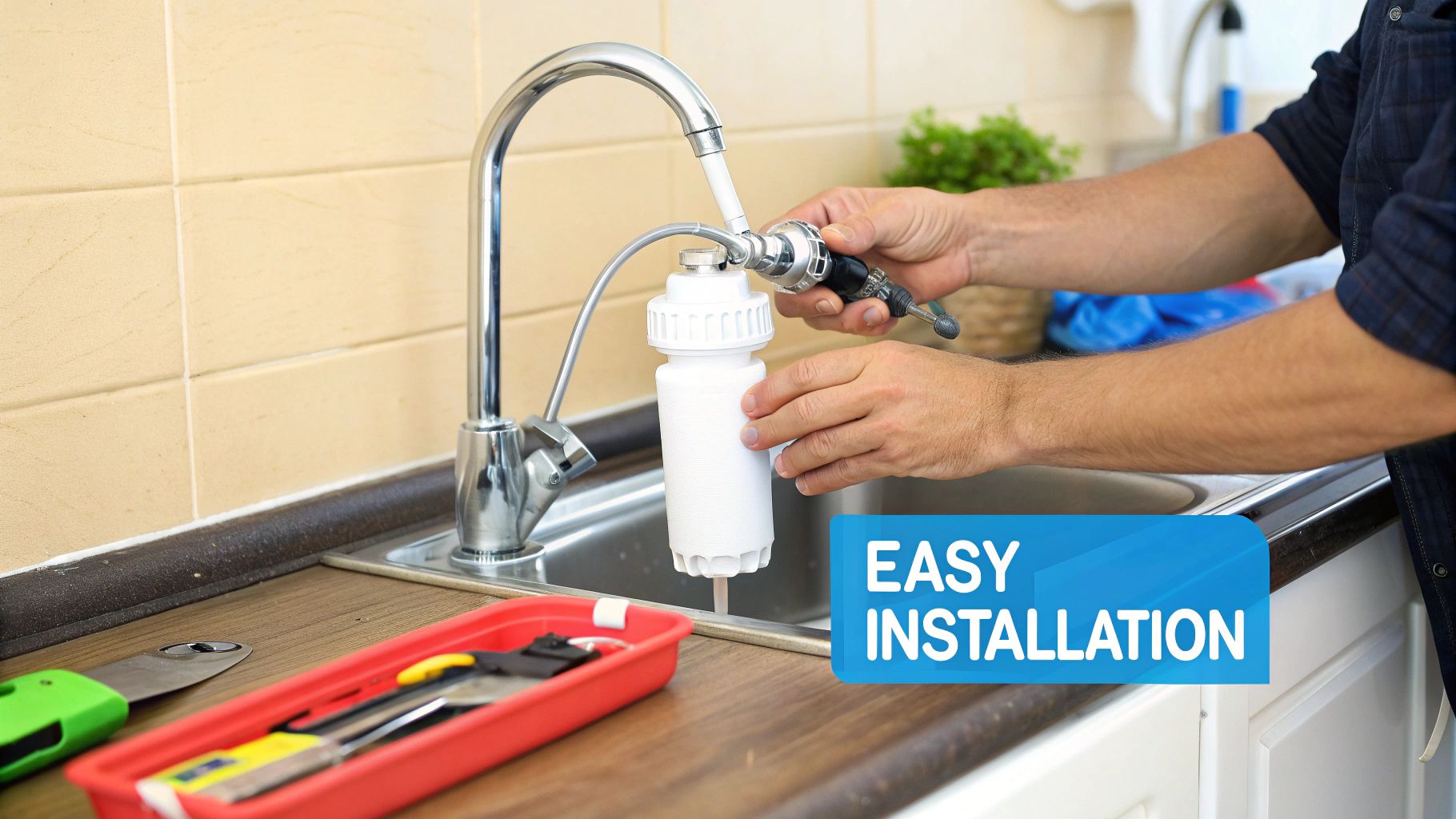
Whether you’ve chosen a model that connects to your tap or a standalone gravity system, you’ll be amazed at how easy it is. These devices are built for convenience, not complexity.
Getting Started: Your First Setup
The setup process varies slightly by filter type, but both are incredibly user-friendly. Don't even think about calling a plumber; this is a DIY job you can nail on the first try.
For Faucet-Mounted Filters:
- Unscrew the Aerator: First, just twist off the little screen at the tip of your faucet. Most come off by hand, but if it's stubborn, a pair of pliers will do the trick.
- Find the Right Adapter: Your filter kit will include a variety of adapters. Simply find the one that matches the threads on your faucet.
- Attach the Filter: Screw the adapter on, then connect the filter’s diverter valve. It’s usually just a hand-tighten job, and that’s it—you're done!
For Gravity-Fed Systems:
This is even easier. It’s really just a matter of assembling the parts and preparing the filters. You’ll need to seat the filter elements in the upper chamber and prime them, which usually just involves running some tap water through them to flush out any loose carbon dust.
The entire process, from unboxing to enjoying that first glass of pure water, typically takes less than 15 minutes. It's a tiny time commitment for a massive upgrade in your water quality.
Long-Term Care and Maintenance
Once your filter is up and running, a little routine care will keep it performing perfectly for years. Good maintenance isn't just about extending the life of your unit; it's about ensuring you’re always getting the cleanest, safest water possible.
Think of it as a quick health checkup for your filter.
A simple maintenance checklist really only has a few key tasks:
- Filter Replacement Schedule: This is the most important one. Mark your calendar for when the cartridges need changing, following the manufacturer's gallon rating or time estimate (e.g., every six months).
- Regular Cleaning: Give the exterior of the unit and the spigot a quick wipe-down with a damp cloth once a week. For gravity systems, wash the chambers with mild soap and water whenever you change the filters.
- Watch for Performance Changes: Your filter will tell you when it’s getting tired. The most obvious sign is a slowdown in water flow. If it suddenly takes much longer to fill your glass, the filter is likely clogged with the contaminants it has removed and needs to be replaced.
Following these simple steps will ensure your investment continues to pay dividends with delicious, safe drinking water day after day.
Got Questions? We’ve Got Answers.
You've done the research, but a few practical questions might still be nagging at you. That's completely normal. Let's tackle the most common questions people have right before they choose a filter. This is your final check-in to make sure you're 100% confident in your choice.
Can I Hook a Filter Up to My Pull-Out Sprayer Faucet?
This is easily the number one question we get, and for good reason. The short answer is almost always no.
Faucet-diverter filters—the ones that screw onto the end of the tap—are designed for standard faucets with a removable aerator. Pull-out or sprayer-style faucets have a different head design, and the adapters included with filters simply won't fit. Trying to force it is a recipe for a broken faucet, a broken filter, or both.
If you have a pull-out faucet, don't despair! Your best options are a gravity-fed system or a standalone countertop unit. Since they don't connect to your plumbing at all, they completely sidestep the compatibility issue.
How Can I Find Out What’s Actually in My Tap Water?
This is the single most empowering step you can take. Your local water utility is required by the EPA to publish an annual water quality report, often called a Consumer Confidence Report (CCR). A quick search on their website should bring it right up.
Think of it as a report card for your tap water. It lists all the contaminants they tested for over the last year and shows the levels detected. With that report in hand, you can shop for a filter that is certified to remove the specific contaminants present in your water.
Are These Filters Really Better Than a Simple Pitcher?
Pitcher filters are a decent entry point, but countertop filters represent a major leap forward in both filtration power and daily convenience.
Here’s why they’re a solid upgrade:
- Serious Filtration Power: Most countertop systems, especially multi-stage and reverse osmosis models, can remove a much wider range of contaminants. They often carry an NSF/ANSI 53 certification for health-related concerns like lead, which many basic pitchers cannot claim.
- More Water, Faster: Forget the constant chore of refilling a small pitcher. Gravity systems can hold gallons of purified water, while faucet-diverter units provide filtered water instantly, right on demand.
- Long-Lasting Filters: A typical countertop filter cartridge can purify hundreds of gallons before needing a swap. In comparison, most pitcher filters are only rated for about 40 gallons. That means fewer filter changes and a lower cost for every gallon you drink.
A pitcher is certainly better than nothing, but a countertop filter is a more powerful, convenient, and long-term solution for providing clean, safe, and great-tasting water for your family.
Ready to stop worrying about your tap water? Water Filter Advisor provides the expert reviews and straightforward advice you need to find the perfect filtration system for your home. Explore our in-depth guides and comparisons at https://www.waterfilteradvisor.com and start your journey to cleaner water today.
- February 6, 2026
- 0
- Uncategorized
