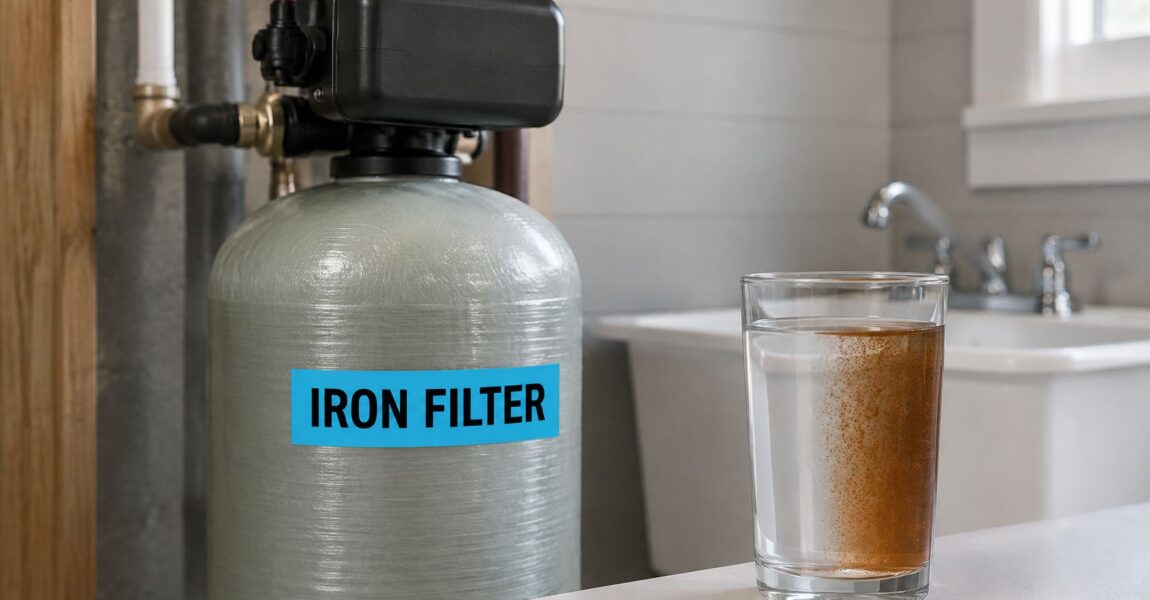
You pour a tall glass of cold well water, hold it up to the kitchen light, and smile because it looks crystal clear. Then you walk into the bathroom and spot a stubborn orange halo creeping around the drain of your white tub, right next to a laundry hamper full of formerly white T-shirts that now look faintly peach. That gap between clear tap water and rust-stained porcelain trips up more well owners than almost any other household water headache.
An air injection iron filter solves that exact mystery by pulling ordinary room air into your plumbing before the water ever reaches a faucet. Rather than acting like a passive screen, it runs a two-stage oxidation and capture process that forces invisible dissolved iron to turn into solid particles and traps them in a dedicated media tank. The U.S. Environmental Protection Agency classifies aeration followed by filtration as an oxidation step that creates physical iron particles so a downstream filter bed can separate them out, with periodic backwashing clearing the trapped solids before they clog the media.
Before you compare tanks, valves, or prices, grab one set of baseline numbers from a certified laboratory test of your untreated raw water. Testing once gives you the exact figures needed to check water compatibility and size your equipment accurately:
- Total iron and dissolved (ferrous) iron: Shows both how much iron is present and how much of it can react with injected air.
- pH and alkalinity: Reveals whether your water chemistry will let oxygen convert iron quickly or drag its feet.
- Manganese and arsenic: Flags co-contaminants that clear water hides and air injection rarely handles alone.
- Hydrogen sulfide and turbidity: Identifies rotten-egg gas and suspended sediment that compete for oxygen or foul the filter bed.
Carry that single lab report from start to finish. Every decision about whether an air injection iron filter fits your home, how large the tank needs to be, and whether you need a backup treatment stage depends on those numbers.
How Air Injection Turns Hidden Iron Into Rust Particles
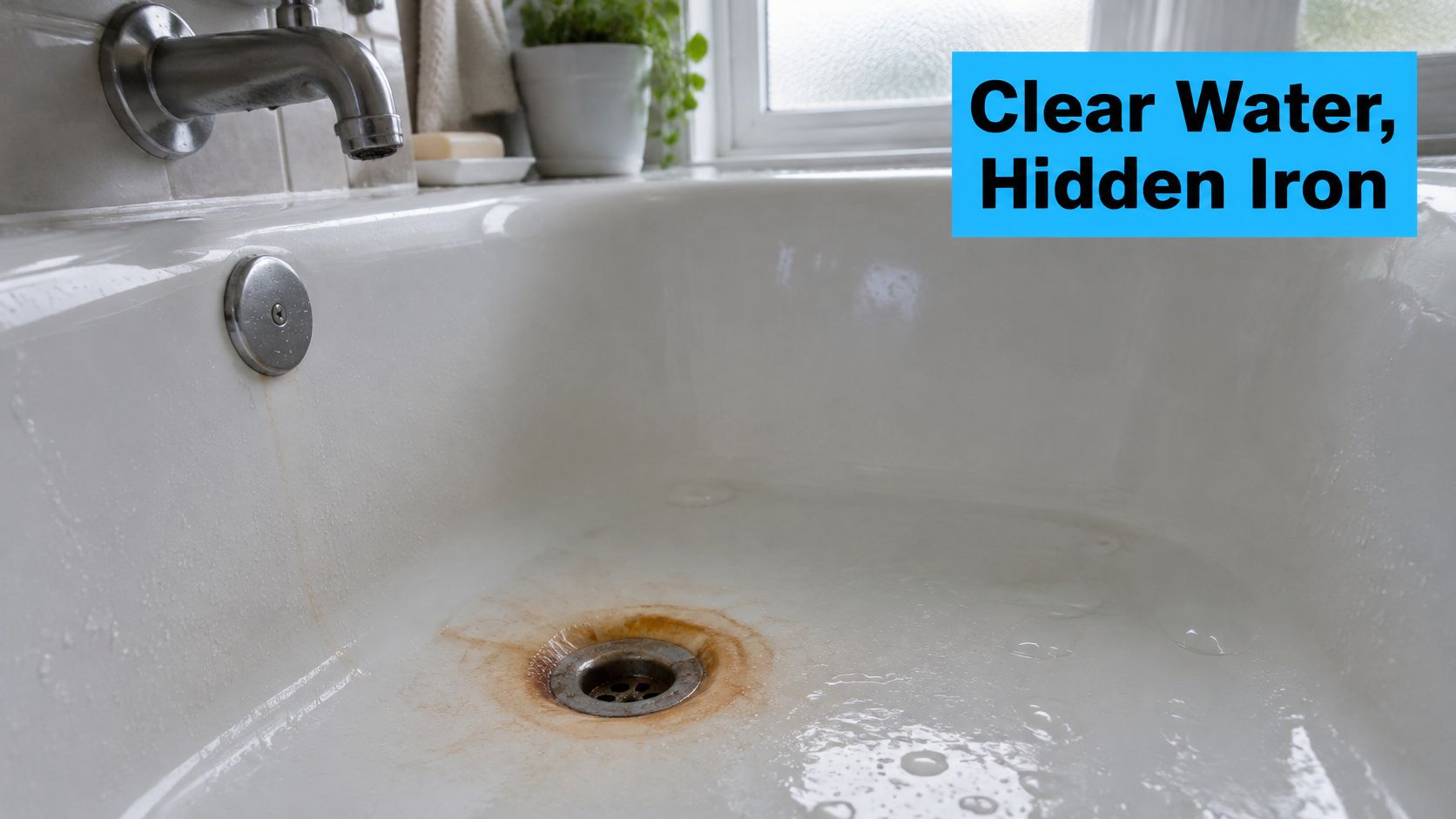
A freshly scrubbed porcelain tub can stay spotless on Monday and wear a rusty ring around the drain by Thursday, even though the water filling that tub looked completely transparent. The culprit isn't dirty pipes flaking apart. It's ferrous iron, written chemically as Fe(II), sitting invisibly dissolved inside underground well water that hasn't touched oxygen in years.
Think of a freshly sliced apple sitting on your kitchen counter. The moment your knife cuts through the skin, the flesh looks crisp and pale white. Give it twenty minutes in open air, and oxygen reacts with compounds inside the apple to turn the surface brown. Dissolved ferrous iron behaves the same way inside your home. Underground, your well holds very little dissolved oxygen, so Fe(II) stays hidden in solution. The second that water splashes out of your showerhead, sits in a toilet tank, or coats the rim of a bathtub, oxygen triggers a chemical change and leaves behind red-brown stains.
Two Stages Working in Sequence
An air injection iron filter moves that kitchen-counter reaction inside your utility room, where you can control it and catch the mess. According to Penn State Extension, aeration systems introduce oxygen by cascading water, bubbling air through the stream, or stripping dissolved gases so soluble ferrous iron oxidizes into ferric iron, or Fe(III), which appears as less-soluble rust particles. Those newly formed particles still float inside the water, so Penn State Extension emphasizes that a separate filter stage is essential to capture the precipitate before it reaches your faucets, washing machine, and water heater.
Stage one uses an air injector or venturi fitting to pull atmospheric air into the pressurized flow, creating an oxygen-rich pocket or contact zone where Fe(II) converts into solid Fe(III). Stage two sends that freshly oxidized water down through a granular media bed that physically strains out the red-brown particles. Skipping or undersizing the filtration bed defeats the entire purpose because oxidizing iron without capturing it delivers visible rust straight to your taps. Aeration lets you avoid dosing chemical oxidants into your drinking water, though the upfront equipment generally carries a higher initial cost than basic chemical feed setups.
Oxygen only changes the form of the iron. The media bed is what actually removes it from your home's plumbing.
Why Water pH Changes the Speed of the Reaction
Air doesn't oxidize iron at the same speed in every well. A kinetic and pilot treatment study archived by the National Library of Medicine reports that atmospheric oxygen converts ferrous iron slowly around pH 7 and speeds up substantially once water pH rises above roughly 6.5. Injecting air doesn't just add oxygen; it also strips out dissolved carbon dioxide, which nudges water pH upward on its own.
In a Pennsylvania pilot study documented in that same publication, increasing airflow raised the water's pH by just 0.3 units while boosting the heterogeneous oxidation rate by more than 300%, dropping dissolved iron from 0.6 mg/L down to below 0.05 mg/L. That pilot even achieved effective oxidation between pH 6.3 and 6.5, proving that well-designed airflow, contact time, and oxygen transfer work together to determine real-world results.
Try a five-minute kitchen check before you even wait for lab bottles to arrive. Fill a clear drinking glass straight from an untreated cold tap, set it on the counter overnight, and look closely in the morning. Does the water start out clear and develop an orange tint or rusty specks on the bottom after sitting? If so, dissolved ferrous iron is almost certainly driving your stains.
Which Water Conditions Suit Air Injection
Not every rusty well responds well to oxygen alone. Comparing your laboratory report line by line against the table below shows whether an air injection iron filter is a natural fit for your household or a mismatch waiting to frustrate you.
| Water parameter | Reference or threshold | Air injection fit |
|---|---|---|
| Total iron | 0.3 mg/L secondary standard (aesthetic) | Good fit when most iron is dissolved ferrous iron |
| Ferrous iron share | Clear when drawn, turns orange after exposure | Best fit, oxidizes inside the system |
| pH | Above about 6.5 | Faster oxidation; below 6.5 needs pH correction or another oxidant |
| Manganese | Secondary aesthetic benchmark for dark staining | Weak fit; usually needs a separate oxidant or catalytic media |
| Hydrogen sulfide | Rotten-egg odor at low levels | Aeration can strip the gas; confirm with a test |
| Arsenic | Federal health-based drinking water limit | Not reliably removed; needs a dedicated test and process |
Reading Your Lab Report Row by Row
Start with total iron and ferrous iron share, since those two numbers account for most homeowner complaints. Penn State Extension notes that the 0.3 mg/L secondary drinking-water standard for iron is an aesthetic benchmark rather than a health-based federal limit, marking the point where metallic flavor, murky coffee or tea, and yellow-to-orange staining start showing up on fixtures and laundry. When your lab sheet shows iron above that mark and most of it is dissolved ferrous iron, air injection targets the exact chemical pathway causing your stains.
Controlled treatment results show how cleanly oxygen and physical capture can polish high-iron water when chemistry cooperates. Research published in Desalination and Water Treatment documents air oxidation at pH 8 paired with microfiltration lowering permeate iron below 0.3 mg/L, while a chemical-oxidation, coagulation, and filtration sequence lowered total iron to 0.04 to 0.08 mg/L, comfortably under the cited European standard of 0.2 mg/L. In field groundwater testing using aeration and natural sand filtration, treated iron dropped to 0.09 mg/L, though manganese only reached 0.11 mg/L at maximum runtime.
Check your pH reading next, because acidic well water throws a wrench into chemical-free aeration. When raw water sits below the neutral-to-alkaline sweet spot, oxygen takes far longer to convert dissolved iron into filterable rust, letting untreated iron slip straight past the media bed and stain your sinks anyway. Acidic wells typically need an acid-neutralizing calcite stage ahead of the filter or a stronger oxidant altogether.
Where Secondary Contaminants Complicate the Picture
Hydrogen sulfide often tags along with dissolved iron in deep wells, announcing itself with a sharp rotten-egg smell the moment you run hot water. Aeration naturally helps oxidize and strip sulfur gas out of the water, though high odor loads require enough contact time and proper venting so gas doesn't escape into your basement. Always verify sulfur levels with a proper test rather than relying on your nose, since odor fatigue makes homeowners underestimate what visitors smell right away.
Manganese and arsenic are the two rows that catch buyers off guard. Manganese leaves dark brown or black rings in toilets and dishwashers and resists simple air oxidation much more stubbornly than iron does, which is why field sand filtration still left measurable manganese behind even after polishing iron well below the aesthetic benchmark. Arsenic carries serious health risks, adds zero taste or color, and won't disappear just because your bathtub stops turning orange.
Apply one straightforward decision rule to your certified raw-water lab report. If iron is the only parameter outside range and your pH sits comfortably above the acidic zone, an air injection iron filter is a strong candidate for your home. If two or more rows fail, especially low pH paired with manganese or any detectable arsenic, skip straight to alternative treatment options instead of forcing air injection to do a job it wasn't built for. Skip cheap dip strips for this verdict, since a single home strip rarely separates dissolved ferrous iron from oxidized particles or detects trace arsenic reliably.
Sizing an Air-Injection Filter to Your Peak Flow
Shopping for an iron filter by average daily water use is the quickest way to end up with weak shower pressure and orange stains returning on busy mornings. Your equipment never sees an average flow rate. It sees peak demand, the messy fifteen minutes at 7:00 a.m. when two showers are steaming, a toilet flushes, and the washing machine starts filling all at once.
Consider a realistic household scenario: a family of four living in a two-bathroom home with a dishwasher and an automatic clothes washer. If two people shower simultaneously while the washing machine draws cold water, the incoming well line surges well past gentle single-faucet flow. A compact filter that delivered sparkling water when a technician tested one bathroom sink can push water through its media bed so fast during peak demand that dissolved iron doesn't have enough contact time to oxidize, or oxidized rust pushes right through the bed.
| Sizing input | What to measure | Why it matters |
|---|---|---|
| Peak flow (gpm) | Fixtures that can run at once, such as two showers, a dishwasher, and a washer | A unit that passes at low test flow may fail at peak demand |
| Contact volume | Gallons between the injector and the filter bed | Gives Fe(II) time to oxidize before capture |
| Pressure loss | Gauge reading across the media at peak flow | Predicts weak showers and well pump strain |
| Backwash drain capacity | Drain or outlet flow rate | Bed must lift and fluidize to flush captured iron |
| Pump capacity | Pump curve at service and backwash flow | Must deliver both flows without starving the house |
| Iron load | Lab total iron in mg/L (for example, 2 ppm versus 8 ppm) | Sets how often the bed must backwash |
| Unit rating | Model capacity versus retail pricing, such as AFW Silver Series specs | Match verified capacity to lab results, not to sales copy |
Why Lab Removal Percentages Never Tell the Whole Story
Product brochures love bold removal percentages, yet a single lab number rarely predicts what happens in your basement. A groundwater aeration study published in Springer Open reported that a three-hole venturi configuration achieved 98.77% iron removal under experimental conditions. That figure came from one specific venturi geometry, aeration duration, flow rate, water temperature, pH, media bed, and backwash cycle, so it isn't a universal household guarantee.
Greater air-to-water contact does boost dissolved oxygen and create more filterable ferric precipitate, which is why the study's authors and EPA guidance place aeration alongside chlorine, ozone, and permanganate as an oxidation method paired with physical separation. Still, translating that chemistry into clean laundry depends on matching contact volume, media depth, and pump output to your home's actual water load.
Price swings make capacity comparisons even trickier. In 2026, AFW Filters listed a sale price of $709.99 for its Silver Series air-injection iron filter, stating capacity limits of up to 8 ppm iron, 4 ppm sulfur, and 2 ppm manganese. Meanwhile, an Amazon listing for the AFW Filters Silver 10 air-injection system, carrying a manufacturer-recorded production year of 2024, priced the unit at $1,329. Treat those figures as a reminder to compare a unit's stated contaminant limits and tank volume against your lab report first, rather than assuming a higher sticker price handles more iron or a lower sale price fits every well.
Sizing reality: Bring four items to your installer before accepting any quote: your lab readings for iron, manganese, and pH, your simultaneous peak-fixture estimate, your well pump specifications, and the location and flow capacity of your nearest drain.
When a Properly Sized Filter Suddenly Lets Iron Back Through
Even a well-matched air injection iron filter can perform cleanly for months and then allow metallic taste or faint rust rings to reappear. Before blaming the tank, check five common mechanical culprits using your pressure gauges and a quick tap test:
- Scale-clogged injector or venturi: Mineral deposits narrow the tiny throat inside the injector, choking off oxygen intake until dissolved iron passes straight through unoxidized.
- Dropped air draw: A worn check valve, cracked tubing, or clogged air intake screen shrinks the internal air pocket, leaving too little oxygen to react with peak-flow water.
- Fouled or channeled media bed: Heavy iron buildup glues filter granules into hard clumps, carving shortcuts where water races through without getting strained.
- Infrequent backwashing: Stretching regeneration intervals too far packs the bed with rust solids, raising differential pressure and pushing particles into household pipes.
- Seasonal iron surges: Heavy rain or shifts in the water table can bump raw-water iron well above your original baseline, overwhelming a previously accurate timer setting.
Comparing pressure readings across the tank alongside a raw-versus-treated tap sample quickly narrows down whether you're facing an air-intake blockage, a worn media bed, or a shift in the well itself.
How to Plumb the System Step by Step
Knowing the exact sequence of pipes, tanks, and vents protects your investment even if you hire a licensed plumber to turn every wrench. Local plumbing codes govern drain connections, backflow prevention, and pressure relief in most jurisdictions, so hire a licensed professional wherever code requires one, and use these eight checkpoints to verify the finished installation before signing off.
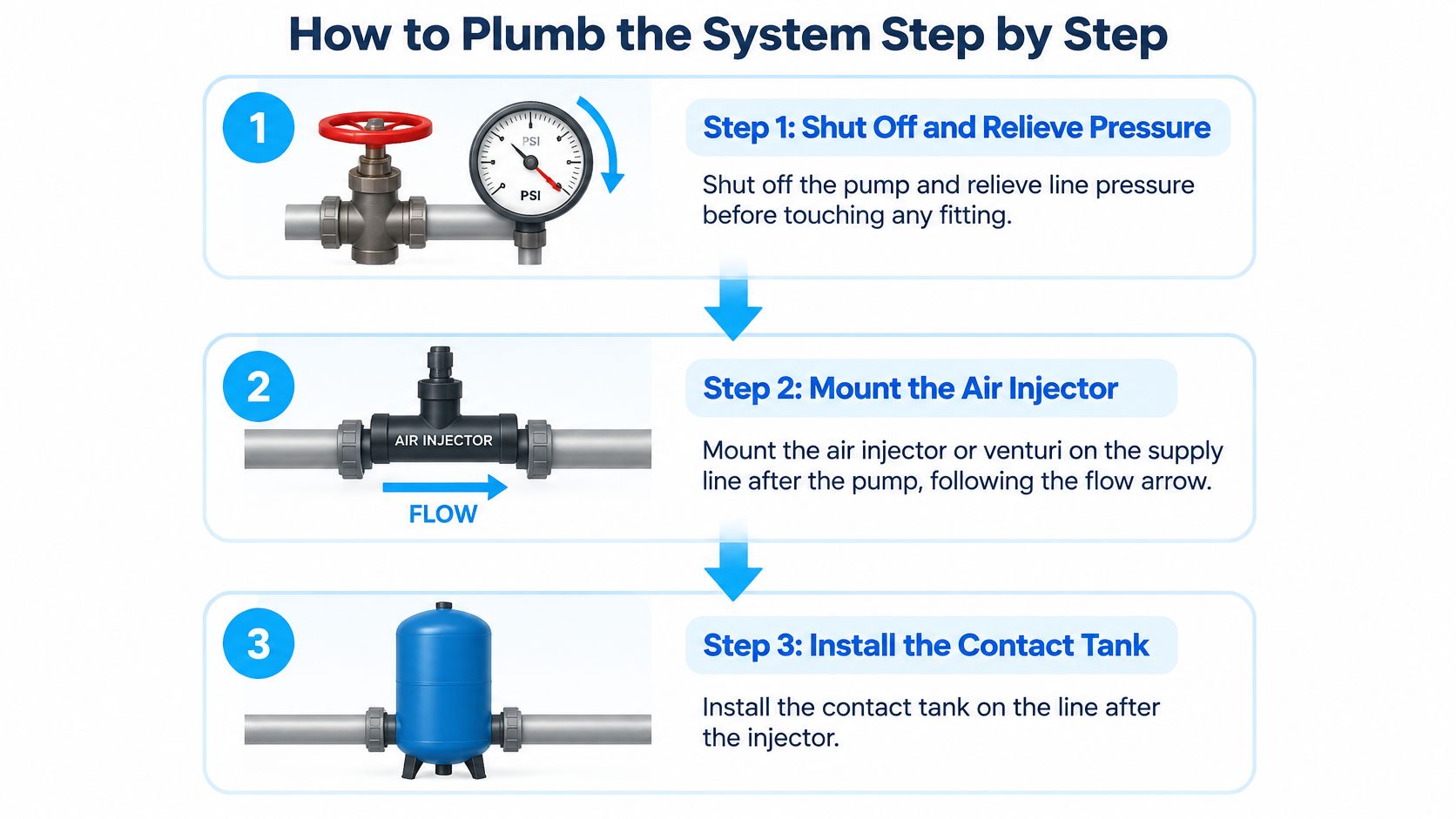
The visual overview below highlights the first three foundational stages that set up safe pressure relief, proper air injection direction, and oxidation contact space.
Eight Installation Checkpoints to Verify
- Shut off the well pump and relieve line pressure. Your installer should cut electrical power to the pump, close the main shutoff valve, and open a low faucet until flow stops completely. Working on a depressurized line prevents water hammer, damaged seals, and flooded utility rooms.
- Mount the air injector or venturi after the pressure tank, following the flow arrow. Placing the injector downstream of the well pump and pressure tank protects pump impellers from air locking while drawing oxygen cleanly into moving water. Check the molded directional arrow on the fitting body, because a backward venturi draws zero air and starves the oxidation stage.
- Install the contact tank downstream of the injector. If your system uses a separate retention or contact tank rather than a single-tank air pocket, it must sit right after the injector. That extra volume gives dissolved ferrous iron precious seconds to react with oxygen and clump into filterable rust before reaching the media.
- Connect the filter tank with its control valve and air vent in place. Position the media tank after the contact vessel, fitted with a bypass valve so you can service the unit without shutting off water to the entire house. Verify that an automatic air-release valve is installed where specified so excess pockets of trapped air bleed safely instead of making faucets spit and sputter.
- Route the backwash drain to an approved outlet with an air gap. The drain line carries heavy rust slurry out of the tank during regeneration and must terminate over a floor drain, standpipe, or utility sink with a physical air gap between the pipe end and the flood rim. That air gap keeps backed-up sewer or greywater from ever siphoning backward into your drinking water supply.
- Program the air draw and backwash timer from the manual, not factory defaults. Factory presets assume generic water conditions that rarely match your well's iron concentration or household occupancy. Watch the installer enter your actual backwash duration, air-draw cycle, and regeneration frequency based on the manufacturer's manual and your raw-water lab report.
- Restore power, purge trapped air, and flush until clear. Once fittings are tightened, the installer should slowly reopen the main valve, put the filter through a full initial backwash to rinse fine dust out of new media, and run a nearby cold tap until sputtering stops and the stream looks clean.
- Run a tap test and compare it against your raw-water lab sheet. Clear water at the laundry tub is encouraging, yet visual clarity doesn't prove dissolved iron is gone. Comparing a post-installation water test against your original untreated baseline is the only real proof that oxidation and capture are working as promised.
Seeing how the tanks, bypass valves, and drain lines connect in a real utility room makes it much easier to spot plumbing shortcuts during a walkthrough. Watch the short installation walkthrough below to see these components laid out in sequence.
What a Properly Commissioned System Looks Like
Walk down to your utility room right after the first complete regeneration cycle and check three quick signs. You should hear a gentle, steady hiss during the air-draw phase confirming the venturi is pulling atmospheric oxygen cleanly. Every union, elbow, and bypass valve should feel bone dry to the touch under full household water pressure, and a glass filled from the kitchen tap should stay clear and colorless even after sitting on the counter overnight.
Backwashing and Upkeep That Keeps Iron From Breaking Through
Many homeowners treat backwashing like changing a furnace filter, an annoying background chore you can stretch out to save a few gallons of water. In reality, backwashing is half of the treatment engine. Every gallon of rusty water your air injection iron filter cleans leaves solid ferric particles wedged inside the media bed, and those trapped solids stay there until high-velocity reverse flow lifts the bed and flushes them down the drain.
A 2025 peer-reviewed investigation indexed by the National Library of Medicine examined dual-media rapid-sand filters and confirmed that backwash hydraulics actively govern whether oxidized iron, manganese, and ammonium stay captured, break through into clean water, or redistribute deeper into the filter bed. That broader 2025 review also warns that poor iron and manganese management leads to progressive clogging across water supply systems when media cleaning falls out of step with source-water chemistry.
Stretching backwash intervals too far rarely saves money. Overloaded media builds up severe pressure drop, forces your well pump to work harder, and eventually lets oxidized rust break through straight into your appliances and plumbing. Flip the mistake the other way, and overly frequent backwashing wastes hundreds of gallons of well water while risking disruption to catalytic coatings or biologically active filter layers. Understanding how a backwashing water filter lifts, cleans, and resettles its media bed helps you tune regeneration to your well instead of blindly trusting a plastic timer dial.
| Trigger | What to measure | Action |
|---|---|---|
| Pressure drop across the tank | Gauge reading before and after backwash | Backwash when the drop passes the manufacturer's limit for the media |
| Treated-water iron | Sample at the tap after a cycle | Shorten the interval if iron returns above the baseline |
| Drain clarity | Watch wash water at the end of a cycle | Lengthen the cycle if the drain still runs cloudy |
| Pump flow at peak demand | Flow reading with several fixtures open | Confirm the pump can deliver backwash and service flow |
An Evidence-Based Protocol That Proves Your Filter Works
Hearing your control valve click on at 2:00 a.m. only tells you the timer motor has power. It never proves the media bed lifted, cleaned itself, or stripped iron out of your shower water. Replace guesswork with a simple four-step verification routine:
- Record your untreated baseline once: Save your initial laboratory iron and manganese results in a notebook clipped near the filter tank so every future test has a true reference point.
- Log pressure before and after backwash: Install inexpensive pressure gauges on the inlet and outlet pipes of the filter tank, then jot down the difference right before a cycle and immediately after. A healthy backwash restores the pressure gap back to its clean-bed starting point.
- Verify flow during real demand: Open two or three cold fixtures while watching the outlet pressure gauge, and confirm your well pump can also sustain the required backwash flow rate without short-cycling.
- Sample treated water after a cycle: Draw a treated sample a few hours after backwashing, once the bed has settled, and check for iron breakthrough rather than waiting until orange stains return to your bathtub.
Maintenance truth: A control valve cycling on schedule proves the timer works. Only a post-backwash pressure drop recovery and a clean tap test prove the filter is actually removing iron.
Adjusting for Seasons and Building a First-Year Rhythm
Private wells rarely stay chemically identical from January to July. Spring snowmelt, prolonged drought, and heavy summer storms alter groundwater levels and can push noticeably higher dissolved iron loads into your casing overnight. If you notice subtle metallic tastes after a wet spring or a stretch of dry weather, re-test raw and treated water right away instead of waiting for your annual checkup.
During your first year of ownership, spend five minutes once a month checking the inlet and outlet pressure gauges, glancing at the drain discharge near the end of a manual backwash to make sure the water clears up before rinsing stops, and wiping dust off the air-intake screen. Once four seasons of readings show steady pressure recovery and clean tap results, adjust your timer interval to match what your measurements prove.
Where Air Injection Falls Short and What to Use Instead
Consumer brochures frequently pitch air injection as a universal, chemical-free miracle box for every rural well. Real groundwater chemistry is far pickier, especially when iron brings uninvited guests along for the ride.
A peer-reviewed Iowa pilot detailed in a 2025 review from the Royal Society of Chemistry puts that assumption under a microscope. Researchers ran an aeration-contacting and granular-filtration system on groundwater holding roughly 2.9 mg/L iron, 80 µg/L manganese, and 23 µg/L arsenic. The system knocked out the iron as expected, yet the researchers noted that arsenic capture depended heavily on water pH, overall water chemistry, and the exact amount and form of iron available to bind arsenic onto fresh iron solids. Sparkling clear tap water and stain-free sinks did not settle whether arsenic was safely removed.
That same 2025 review separates aeration followed by filtration from catalytic media, chemical oxidants, and alkalization specifically because each contaminant demands its own oxidation energy and contact conditions. Air alone oxidizes ferrous iron smoothly under favorable chemistry, but it often leaves dissolved manganese largely untouched and offers zero reliable guarantee against arsenic.
| Method | Best fit | Main limit |
|---|---|---|
| Air injection with filter | Ferrous iron at pH above about 6.5 | Weak on manganese and arsenic |
| Chemical oxidant feed (chlorine or permanganate) | Iron with manganese or low pH | Needs chemical handling and residual monitoring |
| Ozone | Iron, manganese, and taste or odor problems | Higher equipment cost and upkeep |
| Catalytic media (greensand type) | Iron and manganese | Needs regeneration and pH within its range |
| Reverse osmosis at the tap | Drinking water only | Does not treat the whole house and wastes water |
Matching the Right Backup Process to Your Problem
Treat the comparison table as a roadmap for conversations with a water specialist, not a one-click shopping verdict. Each alternative solves a specific blind spot that trips up air injection, while trading away some convenience:
- Chemical oxidant feed (chlorine or potassium permanganate): Strong liquid oxidants break through stubborn manganese, acidic water, and slimy iron bacteria that laugh at plain room air. You take on regular tank refills, metering pump upkeep, and residual monitoring (often paired with a carbon filter to remove leftover chlorine taste).
- Ozone injection: Generating ozone gas on-site delivers far stronger oxidation than atmospheric air without storing bottles of bleach in your basement, tackling iron, manganese, and stubborn odors together. Upfront hardware costs run significantly higher, and ozone generators require periodic maintenance to stay reliable.
- Catalytic media beds (greensand-style media): Coated granular media speeds up oxidation right on the surface of each grain, grabbing both iron and manganese effectively inside a single tank. These beds still require proper pH balance and periodic chemical or oxidant regeneration so the catalytic surface doesn't exhaust prematurely.
- Point-of-use reverse osmosis: Installing a dedicated under-sink reverse osmosis unit creates a strong final barrier for cooking and drinking water when health-based contaminants like arsenic enter the picture. Because it only feeds one kitchen tap and sends reject water down the drain, it protects your drinking glasses rather than your washing machine or showerheads.
Never assume your drinking water is safe from arsenic just because your bathtub stopped turning orange. Clear water only proves you solved an aesthetic problem.
The Rule for Co-Contaminants
Draw a firm boundary whenever your raw-water lab report flags manganese or arsenic alongside iron. Do not assume an air injection iron filter will catch either one as a bonus side effect. Plan a dedicated treatment step built specifically for that contaminant, whether that means upgrading to chemical oxidation or catalytic media for whole-house manganese control, or adding certified point-of-use arsenic removal at the kitchen sink, and always verify the final output with a follow-up laboratory test at the tap.
Confirm Your Water Test Before You Buy
Smart home water filtration always starts with data on paper, never with a sales pitch in your driveway. Before you spend a dollar on tanks or plumbing, run through five quick steps in order so every purchase matches the actual water coming out of your ground:
- Order a certified laboratory analysis of your raw, untreated water. Request total iron, dissolved iron, manganese, pH, alkalinity, hydrogen sulfide, arsenic, and turbidity in a single panel.
- Check each lab result against compatibility thresholds. Mark every parameter that lands cleanly in range and circle any red flags like acidic pH, high manganese, or detectable arsenic.
- Calculate your peak household flow. Tally the fixtures that realistically run together on your busiest mornings, and note your well pump output and drain capacity.
- Bring your lab sheet and flow estimate to a licensed installer. Ask for written performance expectations stating what your iron concentration should measure at the tap after installation.
- Book your post-install tap test and first backwash check. Confirm the filter strips out dissolved iron in real operation and recovers its clean-bed pressure drop after regenerating.
Simple home test strips work fine for quick iron and pH checks once your system is already running, and learning how to test water for iron helps you spot breakthrough early. Leave arsenic and manganese decisions to a state-certified laboratory, where detection limits are accurate enough to protect your family's health. At Water Filter Advisor, we link readers to water test kits so they can check their home water supply, and our Choosing a Water Filter guide walks through matching test results to the right household setup.
With your lab report and peak flow estimate in hand, you now face one of three clear verdicts. Proceed with a properly sized air injection iron filter if dissolved iron is your primary issue in favorable pH water, pair it with a dedicated manganese or arsenic treatment stage if co-contaminants appear, or step directly into chemical oxidation or catalytic media if your well chemistry falls outside air injection's sweet spot.
Since 2007, we've focused on breaking down home water filtration data into practical buying guides, head-to-head system comparisons, and maintenance checklists that keep families out of costly guesswork. Whether you're comparing whole-house air-injection tanks, checking under-sink backup filters for drinking water, or hunting for reliable water testing tools, visit Water Filter Advisor to explore our guides and choose the right filtration setup for your well with confidence.
- November 28, 2026
- Uncategorized
