The advice you'll hear most often is some version of this: buy the unit with the NSF seal and you're covered. It gets repeated in comment threads, in product Q&A sections and in plenty of buying guides, and it's wrong in a specific way. A filter housing can carry NSF/ANSI 61, NSF/ANSI 372, or both, and those marks answer two completely different questions.
Neither mark answers the question most homeowners are asking, which is whether the filter takes lead or anything else out of the water. NSF 61 vs NSF 372 is a question about materials, not about treatment. Mixing the two up is how people end up with a housing that's lead-free by definition and a cartridge that does nothing about the lead in their pipes.
Match the mark to the part and the confusion disappears. One standard covers what's in the material, the other covers what leaves it, and a third set of tests covers what the filter removes.
NSF 61 vs NSF 372 at a Glance
The mix-up starts before anyone reads a standard sheet: buyers treat an NSF mark as a general contaminant-removal claim. It isn't one. NSF/ANSI 61 establishes minimum health-effects requirements for the chemical contaminants and impurities that products, components and materials may impart to drinking water (NSF's overview of NSF/ANSI 61). NSF/ANSI 372 is a lead-content standard, and certification against it verifies a component meets the lead thresholds set under the U.S. Safe Drinking Water Act.
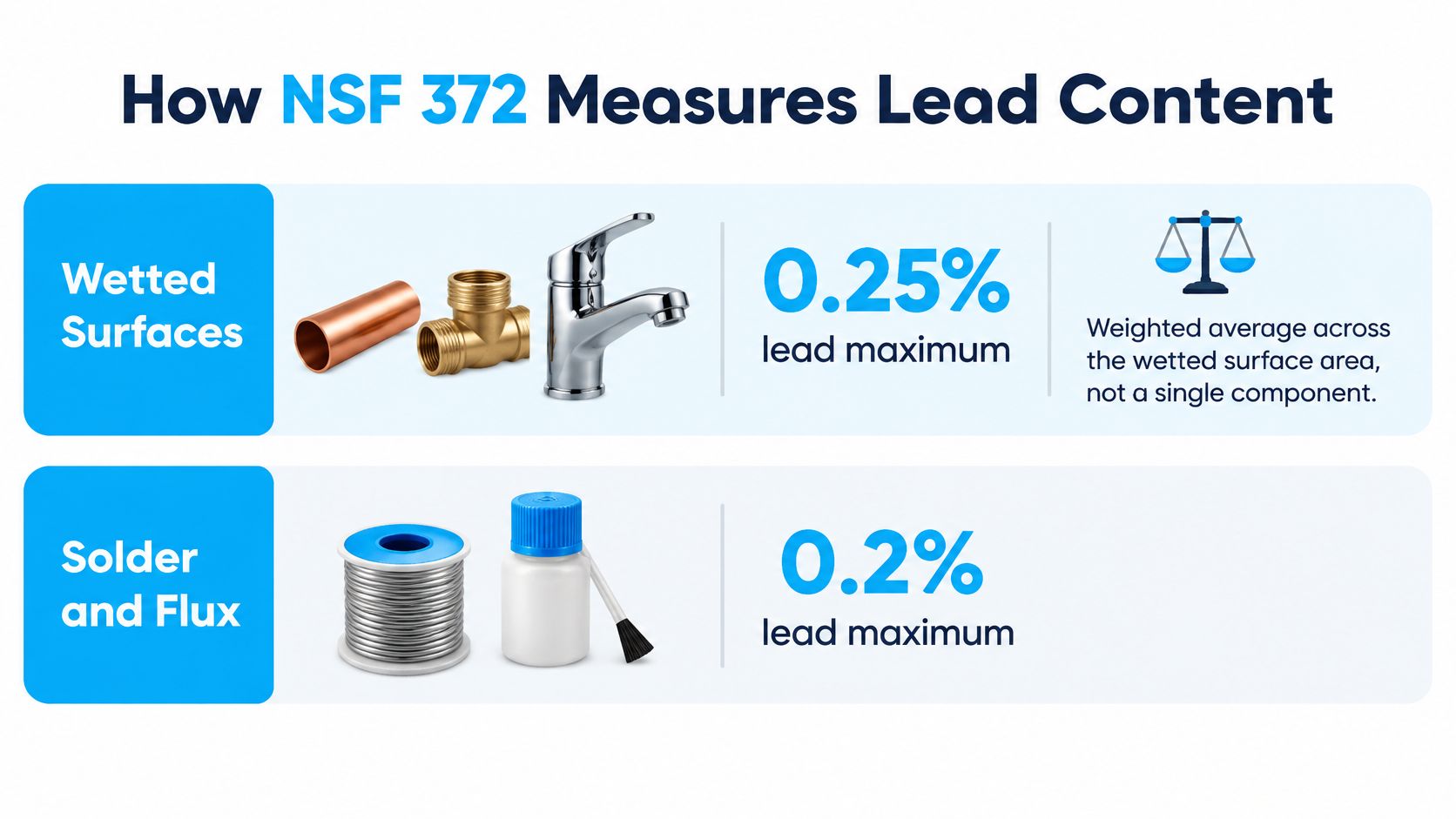
Those thresholds are a weighted average of no more than 0.25% lead across wetted surfaces for most pipes, fittings, plumbing fittings and fixtures, with a separate limit of less than 0.2% lead for solder and flux.
At the point of purchase the two marks divide the work cleanly. A 372 certification primarily answers one question: does the material composition meet the lead-free limit? A 61 certification addresses whether contaminants from the component can migrate into drinking water at unacceptable levels under the standard's testing framework. Neither label belongs on a filter that removes contaminants, and neither one is a substitute for a performance claim.
Set them side by side and the division of labor becomes obvious.
NSF/ANSI 61 and NSF/ANSI 372 compared on the same criteria
| Factor | NSF/ANSI 61 | NSF/ANSI 372 |
|---|---|---|
| Question it answers | Can chemicals leach from wetted materials into drinking water? | Do wetted materials stay under the lead-content limit? |
| What it tests | Chemical migration under specified extraction conditions | Lead content of wetted components |
| Lead limit | Modern 61 incorporates the 372 lead limit for applicable products | Weighted average of no more than 0.25% lead on wetted surfaces; less than 0.2% lead for solder and flux, under the Safe Drinking Water Act |
| Products covered | Materials and components that contact drinking water across the treatment train | Components that convey or dispense drinking or cooking water, including some items outside 61's scope |
| Proves the filter removes contaminants? | No | No |
The rule to carry into the aisle: 372 answers the lead-content question, 61 answers the leaching question, and a listing that carries both gives the most complete picture of a wetted part.
That last row is the one people miss. A mark on a carton confirms a property of the product, and it never confirms a result at your tap.
How NSF 372 Measures Lead Content
Lead-free doesn't mean zero lead, and the figure that settles the question is an average rather than a cap on every part. The U.S. Environmental Protection Agency defines lead-free for the wetted surfaces of pipes, fittings and fixtures as a weighted average of no more than 0.25% lead, with a separate limit of no more than 0.2% lead for solder and flux (EPA guidance on lead-free requirements). NSF/ANSI/CAN 372 verifies that content claim and does one job: it confirms the lead content of the wetted components.
The two ceilings sit on a spec sheet like this.
Why the Average Matters
Weighting is the part people skip. A wetted surface contributes to the average in proportion to its area, so a large plastic shell dominates the calculation while a small brass insert barely moves it. The 0.25% figure describes the mix, not every gram of metal in the box. Solder and flux get the tighter 0.2% ceiling because those materials join pipes and can present a lot of wetted area inside a small joint.
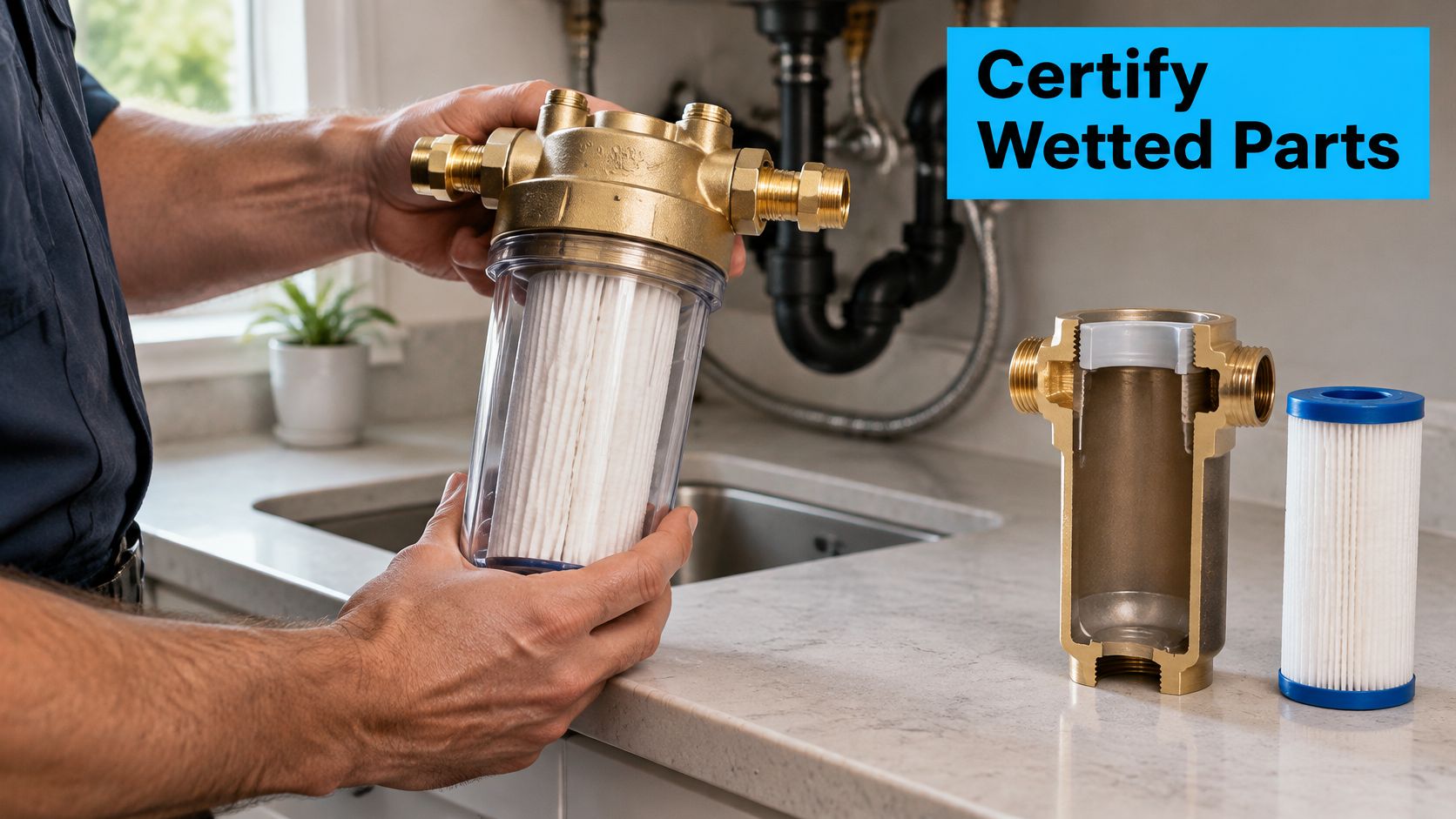
Take an under-sink housing with a plastic body, a brass threaded insert at the inlet and a short copper tailpiece soldered to the shutoff. Every surface the water touches counts as wetted: the interior of the shell, the brass threads, the solder bead inside the joint, the sealing ring under the cap. A 372 listing for the housing covers the lead content of the parts it names. A brass insert sourced from a different supplier should carry its own listing, because the housing's certificate doesn't travel with a part it didn't cover.
What 372 Leaves Unanswered
A 372 listing tells you the wetted materials meet the lead-content definition. It doesn't tell you what the cartridge does about lead in the water, and it doesn't evaluate migration from those materials at all. For a household filter, 372 helps establish that the housing, fittings or other wetted plumbing parts stay under the material-content threshold, and it stops there.
Three things to check on the listing itself:
- The named parts: the scope should list the wetted housing, fittings, tubing and any solder joint, not just the brand name.
- The applicable limit: metal parts sit under the 0.25% weighted average, and solder and flux sit under 0.2%. A claim that names neither number is untraceable.
- The claim wording: a lead-free statement that cites the standard and the limit is verifiable. A bare badge with no standard number is marketing.
How NSF 61 Tests Chemical Leaching
NSF 61 is a health-effects standard for materials and components that contact drinking water, and its test is an extraction rather than an inspection. A sample of the wetted material is exposed to water under specified extraction conditions, and that water is then analyzed for contaminants that migrated out, metals and non-metals alike (Virginia Department of Health factsheet on the lead-free rule). What comes back is a measure of what a material gives up to water, which is a different property from what the material contains.
Conditions matter because materials behave differently at temperature and pH extremes. That's why a 61 listing states the temperature rating and the end use it was evaluated for, instead of granting blanket approval for any water under any condition.
Where Leaching Matters Most in a Home
The wetted parts of a filter system are more numerous than the box suggests:
- Housings and caps: the largest wetted surface area in most systems, and often the cheapest plastic in the assembly.
- Tubing and liners: flexible lines and push-fit connectors that sit wet for years.
- Sealants and gaskets: small parts with a big share of contact area, easy to overlook and easy to source uncertified.
- Faucet bodies and spouts: the parts a faucet-mounted or undersink unit discharges through.
- Replacement parts: O-rings, cartridges and fittings bought later, which arrive with whatever paperwork the seller provides.
A Faucet Filter, Part by Part
Consider a faucet-mounted filter with a plastic housing and rubber gaskets. The housing and the gaskets are the wetted parts a 61 listing has to cover, and if those gaskets come from a different supplier than the housing, the housing's certificate says nothing about them. A brass outlet fitting carrying a 372 mark still needs leaching evidence of its own, because the lead-content test doesn't evaluate migration into water.
A 61 mark on a box means a product was evaluated. The listing tells you which product, at which temperature, for which use.
Leaching is one exposure route among several, and it helps to know what else can turn up in household water. The greener household water safety guide covers the chlorine, lead and biological risks that sit alongside the material question, which is useful context when you're deciding how far a certification claim reaches.
What matters for a purchase is narrower: hot-water suitability isn't automatic, so a listing covering cold water alone doesn't extend to a hot-water faucet or shower unit. The certification listing, not the box, is the record that decides your case, and the checks for reading it come later.
Why Labels From Older Products Confuse Buyers
Old product labels still create real buying mistakes. The two standards were not always separate, and older wording remains on product pages, packaging photos and closeout stock. NSF's account of the change traces that shift in dated steps (NSF's history of the 60 and 61 standards). NSF/ANSI 61 Annex G was introduced in December 2008, establishing parameters for meeting the 0.25% lead-content requirement.
NSF/ANSI 372 later became the dedicated lead-content standard. The lead-determination procedures moved out of Annex G and were re-established in 372. Annex G was then retired from NSF/ANSI 61 as the standards evolved. NSF/ANSI/CAN 61 later incorporated 372 compliance for applicable products, while leaving categories exempted under the Safe Drinking Water Act outside that route. That history matters because a seller may describe a product as “61G,” “NSF pw-G,” “372” or current 61 without explaining what each record evaluated.
The standard text keeps moving too. The American National Standards Institute reported in 2024 that NSF/ANSI 61-2024 revised the 2023 edition of the drinking-water-system-components standard, so the edition year on a certificate is part of what you're reading. A newer edition number can tell you which version was used, but it still does not prove that every part of a filter assembly is covered.
What Each Mark Tells You
Certification markings buyers see and what each one covers
| Marking on label | What it covers | What to do |
|---|---|---|
| NSF/ANSI 61 Annex G or NSF 61G | Lead content and lead leaching under the historic framework | Treat as older evidence; confirm the current listing |
| NSF/ANSI 372 | Lead content of wetted components only | Pair it with a 61 listing for leaching evidence |
| NSF/ANSI/CAN 61 (current) | Health effects; incorporates 372 for applicable products | Check the listing for hot-water use and product category |
| NSF pw-G | Older marking that NSF guidance treats as a predecessor mark | Confirm equivalence against the current listing before relying on it |
NSF's consumer guidance on plumbing product markings makes the equivalence problem explicit: older products may show NSF 61G or NSF pw-G while newer ones show NSF/ANSI/CAN 61 or 372, so a shopper needs a scope comparison rather than a newer-is-better rule.
The practical mistake is treating one mark as whole-product proof. A lead-content mark answers one question, while a health-effects listing answers another. Match each wetted part of the filter to the right listing before trusting the label on the box.
An old label is evidence to verify, not proof.
A current 61 listing that explicitly incorporates 372 is a strong record for a wetted part. Anything older needs the current listing checked against it, because the question is which questions a given record answers.
Common Misreadings of Lead-Free and Health Claims
Three readings of these marks are common, and each one asks a certification to do work it was never built for.
A lead-free mark means the product contains no lead. The limit is a weighted average of up to 0.25% across wetted surfaces, with solder and flux held to 0.2%, so a compliant part can still contain measurable lead. Lead-free is a legal definition with a number attached, not a laboratory finding of zero.
A 372 mark proves the whole filter is safe for drinking water. It covers lead content only, and it doesn't test whether other chemicals migrate into water. NSF states that 61 addresses health effects by testing contaminants that can leach from drinking-water-contact materials, a materially different risk (NSF's technical requirements for NSF/ANSI/CAN 372). A product can satisfy a lead-free requirement while carrying no evidence of broader chemical-extraction performance. Certification also attaches to specific models, materials, sizes, temperatures and end uses, so one certified component doesn't certify the assembly around it.
A 61 listing means the water is clean. 61 certifies a material and a product property, not the water an entire home receives. Lead exposure also depends on upstream plumbing, how long water sits in the lines before you draw it, and the corrosion conditions inside those pipes. A 61 mark on a housing is not a lead-reduction claim, and no label on a housing can tell you what your tap will pour tomorrow morning.
The misreadings hit hardest on the parts people buy without thinking: filter housings, fittings, tubing, sealants, faucets and replacement parts. Those are the components where a mark gets borrowed from the box and applied to a part it never covered.
The correct reading: a certification confirms a property of a product. Your water needs a tested cartridge, and where lead is a concern, a test of the water itself.
The practical question isn't which standard is better. It's whether the exact unit on your counter carries the right listing for the part it plays.
Matching Certifications to Your Home Filter
Your setup decides the requirement. The question isn't which standard wins in the abstract, it's which parts of your filter touch the water and what each part has been certified to do.
A typical under-sink assembly puts several wetted materials in one housing.
What Each Setup Actually Needs
For a whole-house or under-sink housing sold with a lead-free claim, look for 372 on the wetted housing and fittings plus a 61 listing covering the same materials. Two marks on one assembly aren't redundant, because they cover different risks on the same metal.
A faucet or shower filter used for drinking water needs 61 on the wetted parts, and if the unit serves hot water, the listing has to say so. Certification follows the model, so the cold-water version of a unit tells you nothing about the version plumbed to the hot line.
Replacement cartridges are where coverage drops. The listing should name the exact cartridge model and size, because a cartridge that fits physically can sit outside the certification scope.
For a home on well water or older plumbing with a lead concern, wetted-part certifications are necessary but not sufficient. Add a cartridge certified for lead reduction under NSF/ANSI 53 and test the water before you buy, and our guide on how to remove lead from water walks through the treatment options in order of effectiveness.
Certification to require for each filter setup
| Filter setup | Certification to require | Why it matters |
|---|---|---|
| Whole-house or under-sink housing with a lead-free claim | NSF 372 plus an NSF 61 listing | Lead content and leaching both apply to the wetted housing and fittings |
| Faucet or shower filter used for drinking water | NSF 61, with a hot-water listing if used for hot water | Chemical migration from wetted parts depends on temperature and end use |
| Replacement cartridge only | Listing for the exact cartridge model and size | Certification can apply to particular models, sizes and materials |
| Well water or older plumbing with a lead concern | NSF 372 or 61 on wetted parts, plus a cartridge certified for lead reduction under NSF/ANSI 53 | Material certification does not show the water a home delivers is lead-free |
Our own coverage runs across whole house, shower, refrigerator, faucet, under the sink, replacement and portable water filters, and the certification question changes with each type because the wetted parts change. The table is the starting point; the listing decides the case. Neither 61 nor 372 proves a filter reduces anything in the water, so the decision is complete only when the wetted parts and the cartridge's performance claim have both been checked.
Verify the Listing Before You Buy Your Filter
A certification logo on the carton doesn't establish coverage for every part inside. Before paying, match the exact model to the certifier's listing and check which wetted components and claims it covers.
Start with the product label.
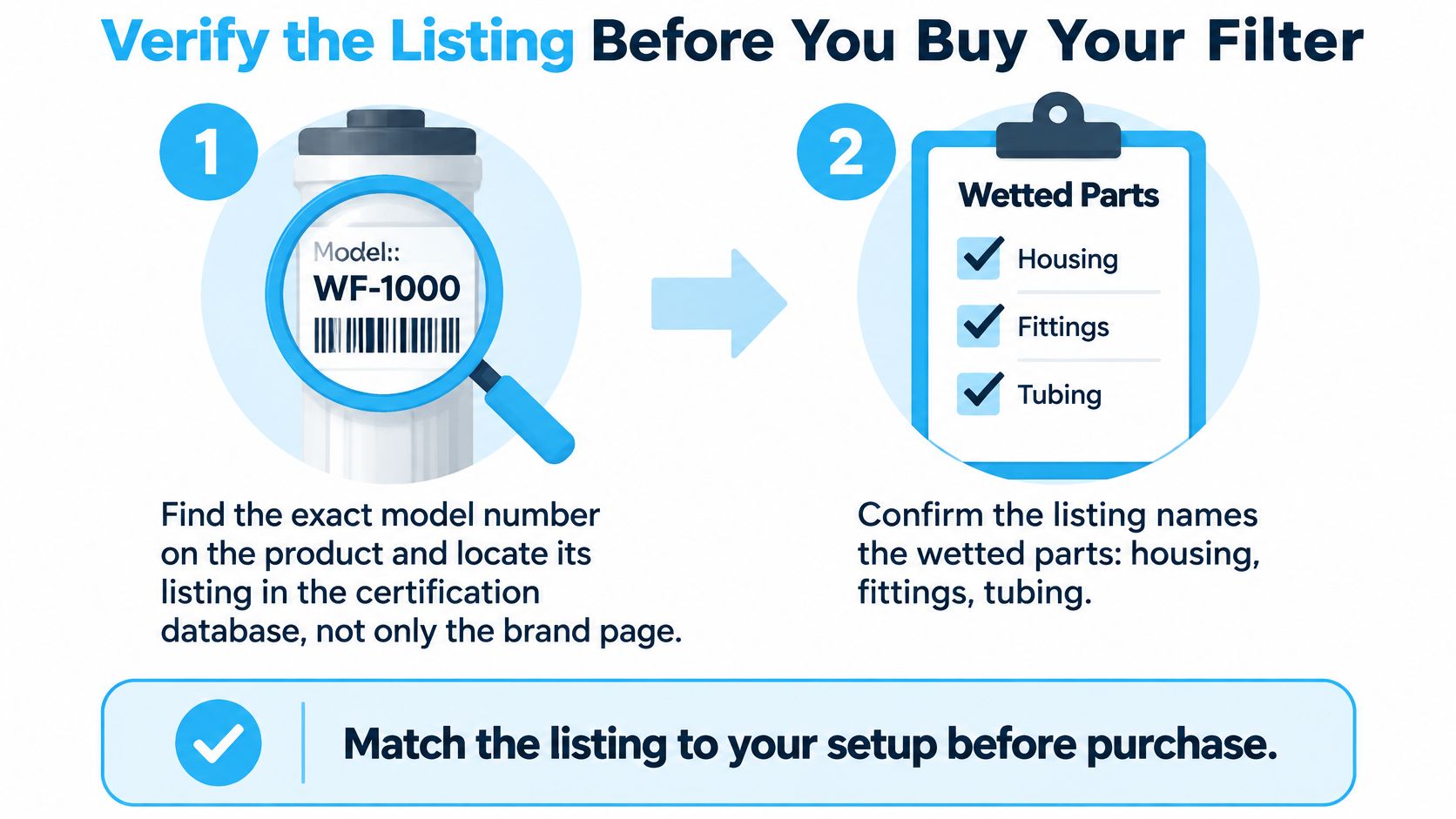
- Find the exact model number. Copy it from the product or carton, then search the certifier's own database. A store page title or similar model name may point to a different unit. Match the number before comparing certification claims.
- Confirm the listing names the wetted parts. Check the scope for the housing, fittings, tubing, sealants and cartridge. Don't assume an unnamed component is covered just because another part carries a mark.
- Check which standard is covered. Look for NSF 61 coverage for chemical leaching and NSF 372 for the lead-free claim, or a 61 listing explicitly incorporating the lead requirement. Match each claim to the parts listed; a lead-content mark alone doesn't establish health-effects coverage.
- Confirm hot-water suitability if the unit serves hot water. Check that the listing identifies the intended domestic or commercial hot-water use. Cold-water coverage doesn't establish suitability for hot-water service.
- Read any lead-reduction claim separately. Removal performance needs certification such as NSF/ANSI 53. Neither 61 nor 372 substitutes for that claim. Check the cartridge's performance listing separately from the housing's material certification.
- Match the replacement cartridge to the listed model and size, then check the stated replacement interval. A cartridge that fits physically may fall outside the listed scope. Keep the model details available for future replacement purchases.
- Order a home water test if lead is suspected. Testing before installation helps you choose a cartridge that addresses the actual problem and provides a baseline for later comparison.
For help distinguishing the marks, read our explanation of what NSF certification covers. Water Filter Advisor's Simple Water Test Kits section lets visitors browse available kits and check their home supply before choosing treatment.
Check the package details again when ordering replacements. The purchasing habit also applies to case-quantity nitrile glove checks: match the item being ordered to its packaging details. For a filter, the deciding details are the exact model, cartridge size and certification scope.
Water Filter Advisor covers whole house, under-sink, faucet, shower, refrigerator, replacement and portable filters. Use the relevant guide to compare options, then confirm the listing against the unit you'll receive. The listing establishes what is certified; your water test helps establish which treatment you need.
- November 26, 2026
- Uncategorized
