Carbon, KDF, vitamin C, and sediment shower filters should not be assumed to remove fluoride; reductions generally above 80 percent come from activated alumina or reverse osmosis, not a typical shower cartridge. Buying a filter because it has more stages, mineral beads, or a chlorine-removal claim doesn't establish that it reduces fluoride.
The popular advice to screw on a shower filter and solve every water problem skips the most important question: what is the filter designed to remove? A screen that catches grit, a material that reacts with chlorine, and a membrane that separates dissolved ions do different jobs.
When shopping for fluoride filters for shower use, start with the evidence rather than the packaging. A credible claim needs a fluoride-specific laboratory report under conditions that resemble a working shower.
What Shower Filters Can and Cannot Remove
An ordinary shower cartridge is a chlorine or sediment tool, not a proven fluoride treatment. A handheld housing doesn't change that distinction, and adding several media layers doesn't automatically create a fluoride-removal system.
Shower and home media versus dissolved fluoride
| Media | Fluoride role | Documented reduction | Shower fit |
|---|---|---|---|
| Activated carbon | Chlorine, taste, and odor only in this comparison | Not established for fluoride | No |
| KDF copper-zinc | Chlorine and some metals | Not established for fluoride | No |
| Vitamin C | Neutralizes chlorine and chloramine | Not established for fluoride | No |
| Sediment screen | Particles only | None for dissolved fluoride | No |
| Activated alumina | Adsorbs fluoride ions | Generally above 80%, sometimes near 98% | Poor; needs volume, contact time, and pH near 5.5 |
| Reverse osmosis | Rejects dissolved ions | Generally above 80%, sometimes near 98% | No; commonly point-of-use with a tank |
| Ion exchange | Can remove fluoride in an engineered bed | Requires resin-specific testing with competing ions | Rare in shower cartridges |
The established treatment figures and operating requirements come from EPA fluoride-treatment design guidance, which describes removal generally above 80%, sometimes approaching 98%, and activated-alumina pretreatment near pH 5.5, followed by pH correction. Those are engineered-treatment conditions, not a performance promise for anything containing a handful of specialty granules.
Why the ordinary media don't qualify
Activated carbon is useful for chlorine and many organic taste-and-odor compounds. That usefulness doesn't establish reliable capture of dissolved fluoride, especially in a compact shower housing.
KDF copper-zinc works through different chemistry from a sediment screen or adsorption bed. Its chlorine and metal applications don't make it an all-purpose dissolved-ion remover.
Vitamin C is another easy source of confusion. It can neutralize chlorine and chloramine, but neutralizing a disinfectant isn't the same process as separating fluoride from water.
A sediment screen has the simplest limitation: dissolved fluoride isn't a particle. Making the screen finer doesn't give it the chemistry needed to capture an ion.
Why specialty treatment needs more room
Activated alumina holds fluoride on aluminum-oxide grain surfaces, a process called adsorption. Its performance changes with water chemistry, competing ions, contact time, and how much usable capacity remains.
Reverse osmosis uses a membrane rather than a loose bed of shower-filter media. A conventional under-sink arrangement includes plumbing for treated water and reject water, often with storage, rather than a cartridge hanging behind a showerhead.
Specialty ion exchange can also be appropriate in a designed treatment bed. But an ordinary hardness-softening resin isn't interchangeable with fluoride-selective treatment, and a bone-char pitcher claim doesn't transfer to a fast-flowing shower.
The acceptable proof is specific:
- Starting and finishing concentrations: Influent and effluent fluoride measurements.
- Operating conditions: Flow rate, temperature, and pressure.
- Useful capacity: How much water was treated before performance declined.
- Test identity: The method or standard and the independent laboratory responsible.
Why Fluoride Slips Past a Shower Cartridge
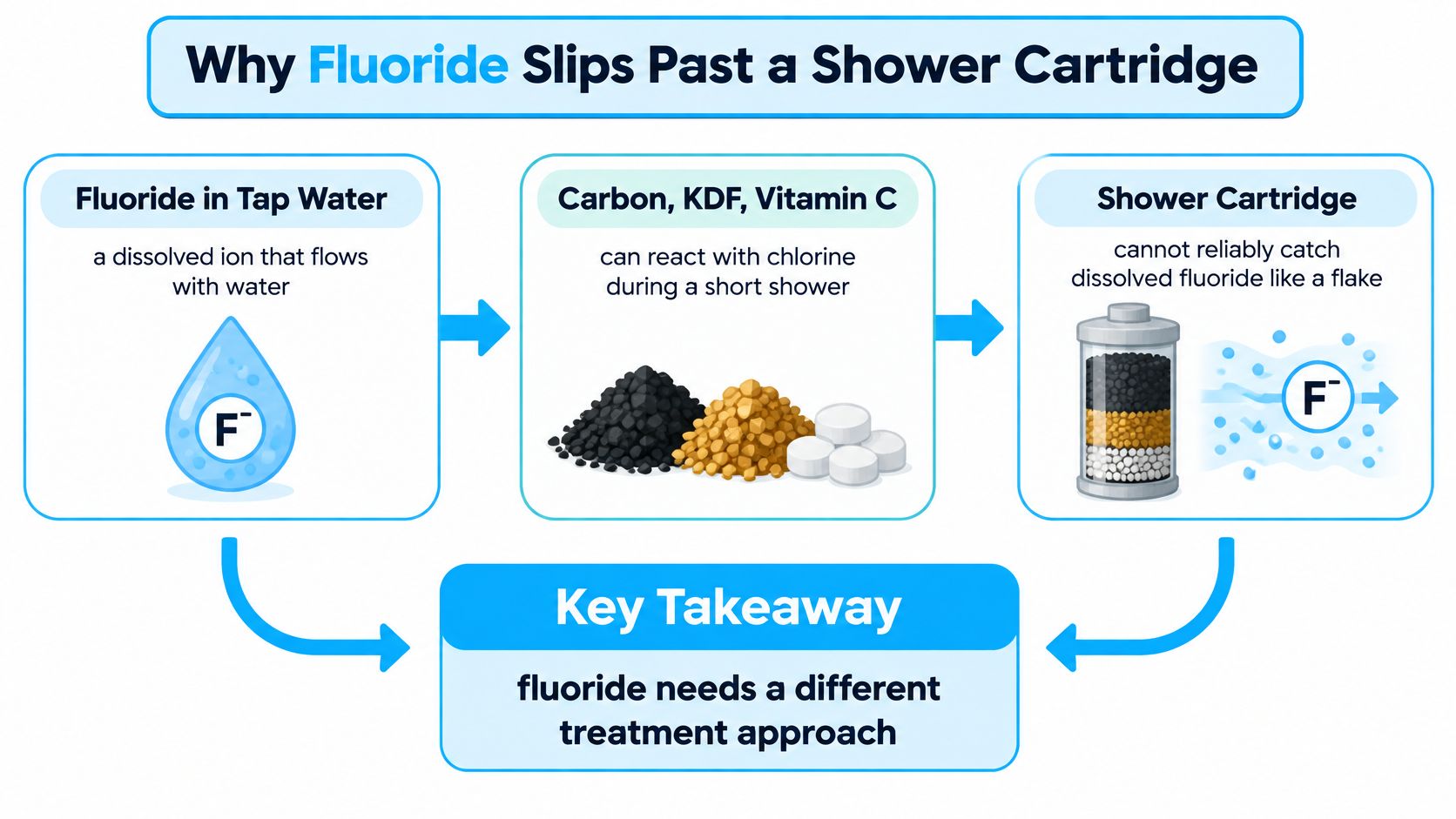
Say you install a clear shower cartridge filled with white beads, black granules, and a fine mesh pad. The shower smells less chlorinated afterward, so it's tempting to assume the filter caught everything else, too.
Fluoride doesn't behave like a rust flake. It behaves more like salt already dissolved in soup: a strainer can catch the vegetables, but the dissolved salt travels through with the liquid.
The distinction is easier to follow when the treatment jobs are separated visually.
A short pass isn't a treatment bed
Chlorine is reactive, so suitable carbon, copper-zinc media, or vitamin C can act on it as water passes through. Fluoride requires a different separation mechanism; you can't assume it will attach reliably to the same surfaces.
Inside a small cartridge, water moves through the available spaces between the media. A larger housing, a slower flow, and a carefully selected treatment material can provide conditions that a compact showerhead can't reproduce.
Consider a hypothetical test in which a seller drips water slowly through a cartridge into a collection bottle. Even if the laboratory measures a reduction, that result doesn't establish what happens when someone opens the shower valve and sends hot water through the cartridge continuously.
Cleaner-smelling shower water is not lower-fluoride water.
The water brings competition
A fluoride adsorption bed doesn't receive fluoride alone. Other dissolved substances arrive at the same time, and the water's chemistry affects how effectively the media can capture the target contaminant.
Competing ions, including sulfate and bicarbonate, can interfere with specialty treatment. A higher incoming fluoride concentration also places a greater load on the available removal capacity.
That creates a maintenance problem you can't solve by sniffing the water:
- Chlorine odor may change even when fluoride performance is unproven.
- Specialty media can become exhausted without an obvious change in water appearance.
- Early performance can differ from later performance, so a fresh-cartridge test isn't a lifetime guarantee.
The useful question isn't whether the cartridge contains a material associated with fluoride removal. It's whether the complete device can maintain that removal under its intended operating conditions.
Look for laboratory flow, temperature, and pressure that fit your actual installation. Otherwise, an impressive percentage may describe a bench setup rather than the shower you use each morning.
Fluoride Limits and What a Shower Adds
Fluoride benchmarks for household water
| Benchmark | Level | What it addresses | Applies to showers? |
|---|---|---|---|
| EPA enforceable MCL | 4.0 mg/L | Crippling skeletal fluorosis | No, public drinking water |
| EPA secondary standard | 2.0 mg/L | Moderate to severe dental fluorosis; public notice requirements above this level | No |
| WHO drinking-water guideline | 1.5 mg/L | Increasing dental fluorosis risk; progressively higher concentrations raise skeletal risk | No |
| Typical groundwater concentration | Usually not above 10 mg/L | Natural variation from local rock; much higher concentrations occur in some places | No |
The EPA's fluoride drinking-water standards include an enforceable 4.0 mg/L maximum contaminant level, established in 1986 to prevent crippling skeletal fluorosis, and a 2.0 mg/L secondary standard addressing moderate-to-severe dental fluorosis. The WHO drinking-water and groundwater benchmarks concern water people consume, not shower-filter performance.
These benchmarks answer different questions from a filter test. A public supply can meet the primary drinking-water limit while exceeding the secondary guideline, and neither outcome tells you what a particular shower cartridge removes.
Under EPA's fluoride protocol, public systems above 2.0 mg/L but at or below 4.0 mg/L must provide public notice. That requirement shouldn't be confused with a recommendation to buy a shower attachment.
What's actually known about shower exposure
A reliable ordinary-shower absorption percentage hasn't been established in the government evidence discussed here. The ATSDR health consultation describes some skin absorption of soluble fluoride but says ATSDR and EPA hadn't identified studies quantifying its amount and rate; it also describes insufficient information to calculate inhalation exposure and resulting risk during showering.
Chemical context matters. Fluoride in treated household water isn't the same exposure scenario as fluorine gas or corrosive industrial hydrogen fluoride.
The CDC's hydrogen-fluoride toxicology guidance describes deep tissue penetration and skin absorption in that chemical-exposure context. It doesn't establish a clinically significant fluoride dose from an ordinary shower.
Practical rule: Don't turn evidence that absorption is possible into a claim that a household shower delivers a known harmful dose.
Fluoride's different uses can also cause confusion. For dental context, you can explore why toothpaste contains fluoride through Mouthology, while keeping that question separate from home-water treatment.
For filtration decisions, the defensible approach is measured water concentration and documented device performance, not precise shower-dose calculations that the evidence can't support.
Shower Filter Claims Checked Against Lab Sheets
In 2024, PureShowers said its 7 Spray–8 Stage Hand Held Shower Filter could remove up to 99% of fluoride in a company announcement published by PR.com. That's a seller's ceiling claim, not, by itself, a complete independent performance record.
Treat a product photograph and a laboratory document as different kinds of information.
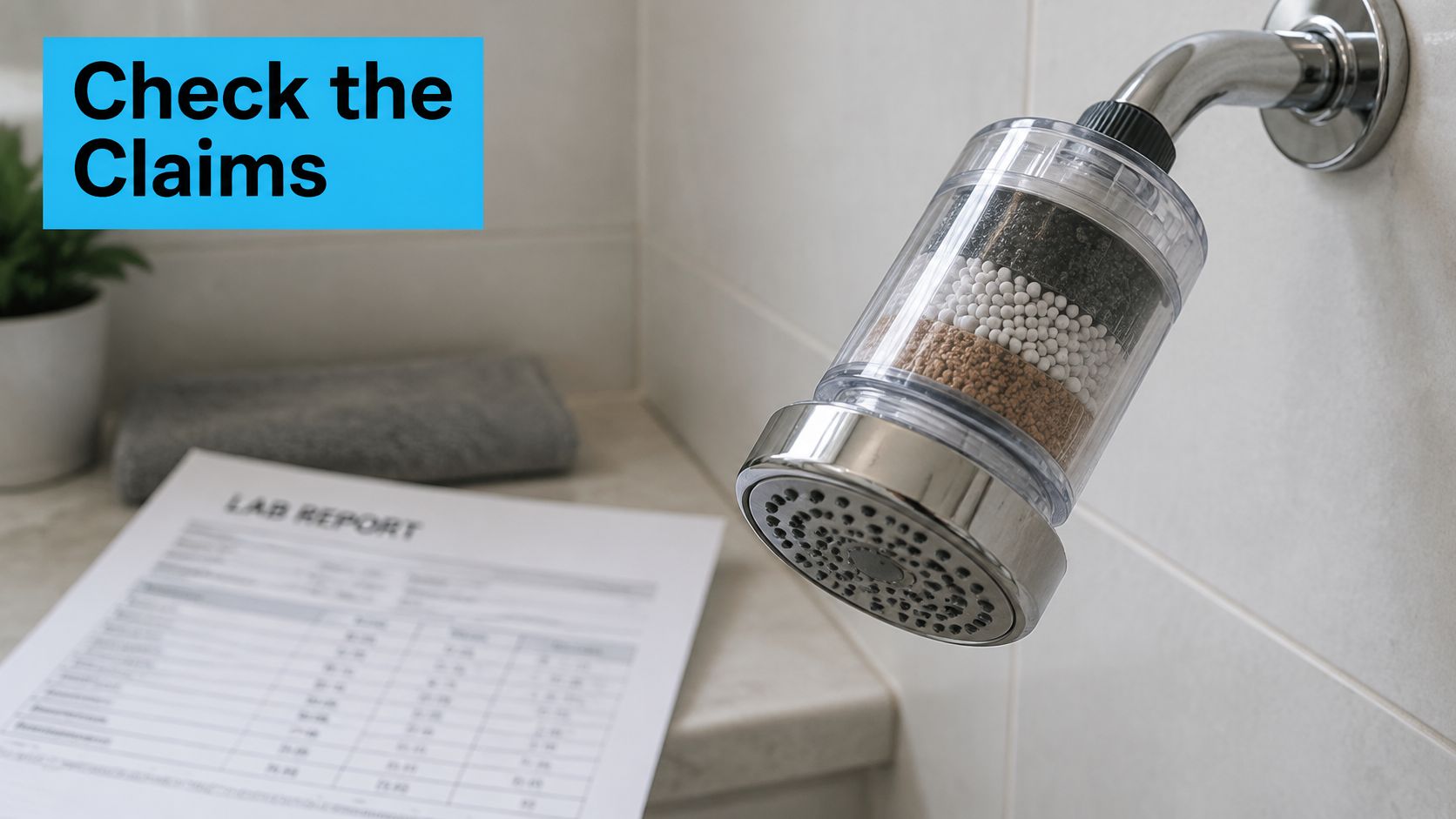
An independent laboratory test dated April 10, 2023, published by Oasis Health for an AquaHomeGroup 20 Stage Shower Filter, measured 0.26 mg/L fluoride after filtration and didn't report a percentage reduction. Without a corresponding starting concentration, that result can't establish the proportion removed.
A finishing number needs a starting number
A low outlet measurement could reflect effective treatment, low-fluoride incoming water, or both. It's no more possible to calculate removal from the outlet alone than to calculate a shopping discount from the final price alone.
Percentage reduction compares the difference between incoming and outgoing concentrations with the incoming concentration. Both measurements must belong to the same test under documented operating conditions.
Request these fields before treating a product as a fluoride filter:
- Influent fluoride: The incoming concentration in mg/L.
- Effluent fluoride: The treated concentration in mg/L.
- Test flow: The water flow in gallons per minute.
- Capacity to breakthrough: The treated gallons before the claimed performance no longer holds.
- Method or standard: What procedure the laboratory followed and what it evaluated.
Stage counts and spray settings don't supply any of these missing measurements. Nor does a chlorine certification automatically cover fluoride; certification has a defined scope.
For a visual companion to the product discussion, use the video below, but keep the written laboratory report as the basis for any removal claim.
If your utility uses chloramine, compare devices designed for that separate job with our guide to shower filters that remove chloramine. Don't let evidence for disinfectant reduction stand in for fluoride evidence.
When a seller won't provide a suitable test sheet, leave fluoride reduction out of your purchase calculation. Judge the cartridge only on the functions it can substantiate, without adding health outcomes the laboratory never measured.
Test Your Water Before You Buy
Start with the water result, not the contaminant list on a box. A treatment decision becomes much easier when you know what's entering the house and which outlet matters.
Build a useful baseline
- Find your utility report. Read the latest Consumer Confidence Report and locate fluoride in mg/L. Check which disinfectant the utility uses, too.
- Test a private well directly. Use a certified laboratory and request fluoride and hardness. If the well is disinfected or you're investigating a disinfectant concern, discuss chlorine or chloramine testing and sample handling with the laboratory.
- Label the sampling point. Record whether the sample came from an untreated cold tap, treated drinking faucet, shower supply, or another location. Don't compare unlike sampling points.
- Choose the treatment job. Separate a drinking-water fluoride concern from bathroom odor, sediment, or hardness. Each can require a different device.
- Set an acceptance test. Before buying, decide what treated-water result you need and how you'll verify it.
A test result without a clearly identified sampling point is a weak foundation for a filter purchase.
Keep the laboratory report, utility report, and proposed filter specification together. If the product's tested incoming-water conditions don't resemble your results, ask for clarification before spending money.
A shower cartridge may suit a disinfectant-odor complaint. A measured fluoride concern calls for evaluating dedicated drinking-water treatment or, where justified, an engineered whole-house system.
Drinking Water Filters That Cut Fluoride
For most households that need fluoride reduction, a fluoride-tested under-sink reverse-osmosis system is the practical starting point. It treats the water used for drinking and cooking without requiring every bath, toilet flush, and laundry cycle to pass through the same process.
That's a more focused purchase than trying to turn a showerhead into a miniature treatment plant. The right system still needs a documented fluoride claim and compatibility with your incoming water.
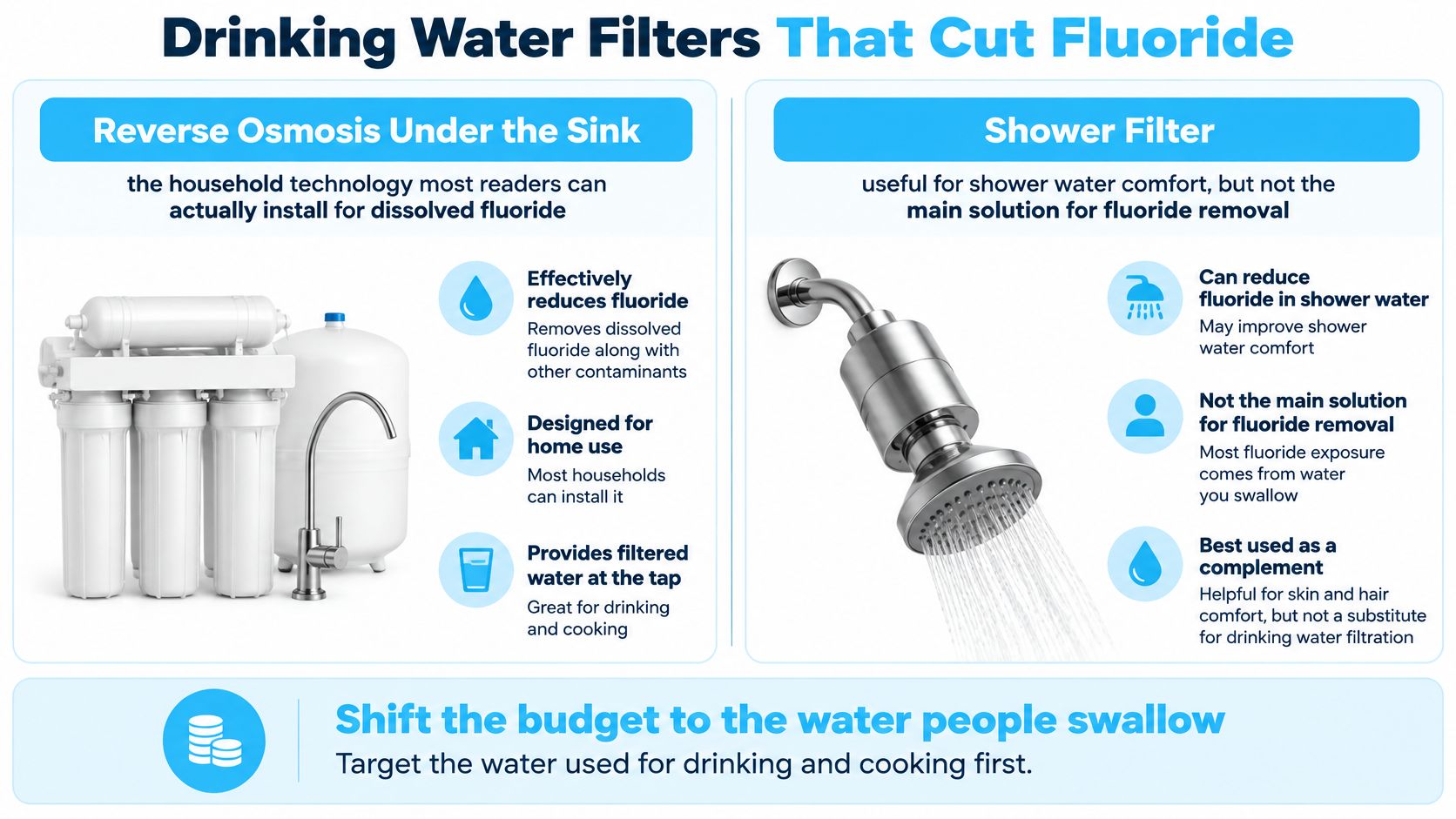
What under-sink reverse osmosis involves
A conventional installation has a sediment prefilter, a carbon stage to protect a chlorine-sensitive membrane, the membrane itself, and a dedicated treated-water faucet. Many systems also use a storage tank, although tankless arrangements exist.
The membrane separates the incoming water into a treated stream and a reject stream. That means you need suitable drain plumbing and should compare the manufacturer's wastewater information rather than assuming every system uses water equally efficiently.
Check the practical fit before selecting a model:
- Supply conditions: Confirm acceptable pressure, temperature, and incoming-water chemistry.
- Cabinet space: Allow room for cartridges, tubing, service access, and any tank.
- Operating cost: Include prefilters, membrane replacement, and testing.
- Fluoride documentation: Match the claim to the complete system, not just the membrane material.
Our guide to choosing an under-sink water filter that removes fluoride can help you compare that configuration with other point-of-use options.
When alumina or a well-treatment system fits better
Activated alumina can be useful where a properly designed adsorption system suits the water chemistry and treatment goal. It requires an appropriate media bed, operating controls, and a replacement or regeneration plan, not merely a cartridge labeled with the media's name.
Private wells deserve particular care. The WHO fluoride background document sets a drinking-water guideline of 1.5 mg/L and explains that groundwater concentrations usually don't exceed 10 mg/L, although much higher natural concentrations occur.
The local geology makes your own laboratory result more useful than a neighbor's report. A water-treatment professional can use that result, together with other water-quality measurements, to assess whether point-of-use treatment is enough or a whole-house specialty system is justified.
A whole-house installation can supply treated water to showers, but it's a different project from buying a shower cartridge. It may require pretreatment, a substantial media vessel, monitoring, and planned servicing.
Pitchers and faucet filters also need product-specific scrutiny. A carbon block isn't a fluoride treatment because it makes drinking water taste better. Choose the treatment around the measured contaminant and the volume you need, rather than the longest contaminant list.
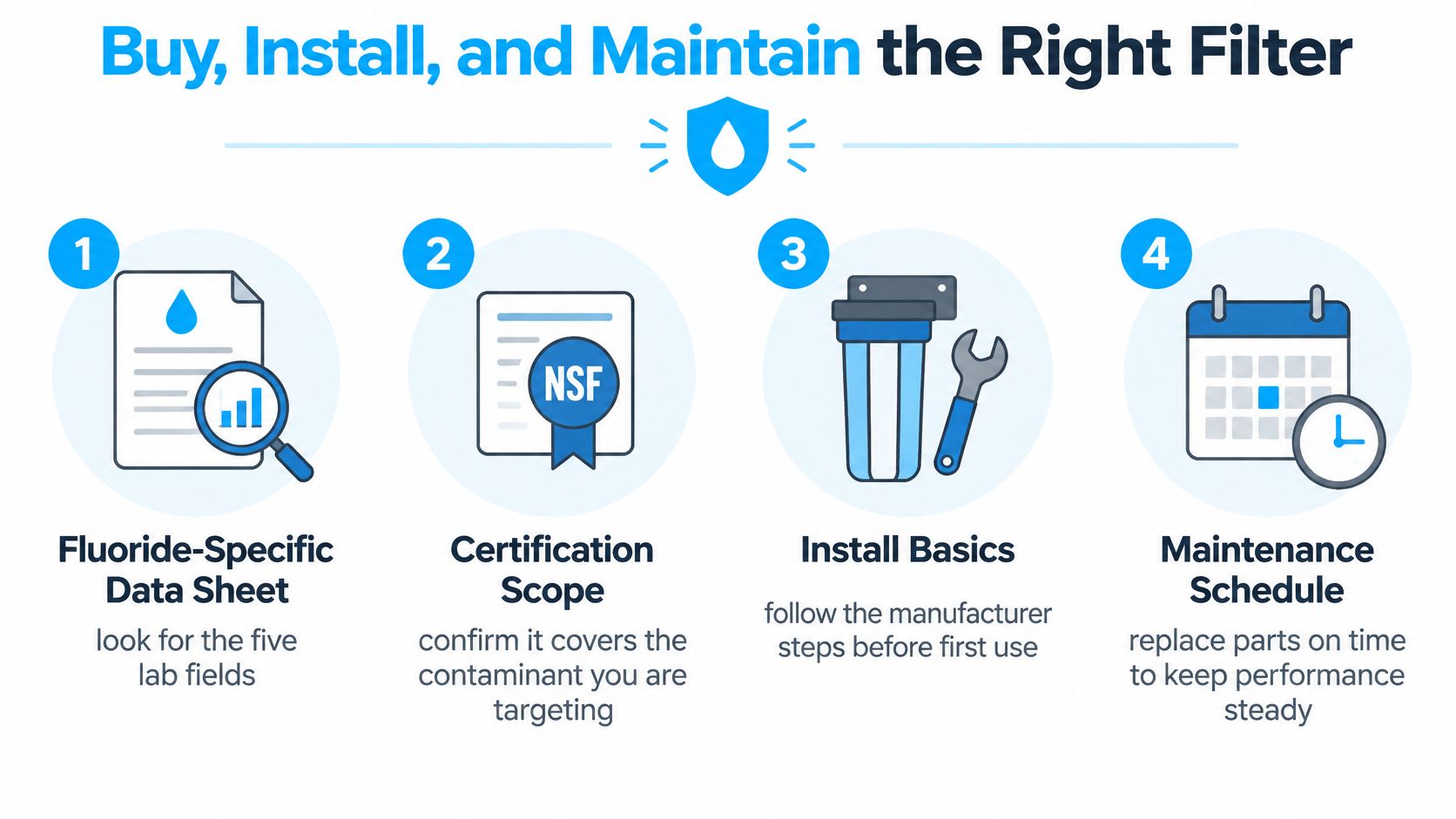
Buy, Install, and Maintain the Right Filter
Check the purchase details before taking anything apart. An unsuitable connection or inaccessible replacement cartridge can turn an otherwise sensible choice into an expensive inconvenience.
Purchase checks
- Performance scope: Obtain the fluoride-specific report if fluoride is the target, and check the exact model against any certification listing.
- Ownership costs: Compare replacement parts, rated capacity, wastewater information, and testing costs.
- Physical fit: Verify shower threads, housing clearance, cabinet access, and landlord permission where needed.
- Serviceability: Confirm that replacement cartridges and membranes are available and that you can reach them.
Keep those checks alongside the installation and maintenance record.
Install with a pass-or-fail check
- Fit a shower cartridge without forcing it. Seat the washer, follow the product's sealing instructions, and hand-tighten where specified. Turn on the water slowly; a dry housing and swivel pass, while seepage means shut down and reseat the connection.
- Prepare an under-sink installation safely. Shut off the cold supply and confirm the isolation valve holds before disconnecting tubing. Install the supply adapter, approved drain connection, and any tank according to the system instructions and local plumbing requirements.
- Flush and commission the system. Sanitize where instructed and discard the manufacturer-specified startup water. Check every fitting with a dry tissue, then verify normal filling, dispensing, and shutoff.
- Verify treatment and schedule service. After commissioning, sample the treated drinking faucet for fluoride if that was your goal. Record the result and install date, then set reminders for each component's replacement schedule.
A pressure drop, slow production, or leaking housing needs investigation, but none is a dependable fluoride-exhaustion indicator. Replace specialty media on its validated schedule even if the water still smells fine, and use follow-up testing to confirm continued performance.
Choose the Right Fix for Your Goal
For bathroom disinfectant odor, buy a shower filter tested for the disinfectant in your supply. For fluoride, put the budget toward a water test and appropriately documented drinking-water treatment.
Those are separate purchases with separate success measures. A more pleasant shower doesn't confirm fluoride removal, and a well-performing drinking-water system doesn't need to treat every bathroom fixture to serve its purpose.
Make the decision measurable
- For shower comfort: Compare relevant disinfectant performance, usable flow, connection fit, and cartridge cost. Don't treat the cartridge as a medical treatment or assume it resolves hardness.
- For fluoride reduction: Establish the untreated drinking-water result, select a device suited to that water, and verify the treated faucet afterward.
- For a private well: Test your own supply before specifying treatment. Nearby geology and another household's equipment aren't substitutes for your sample.
At Water Filter Advisor, we were founded to analyze and spread the word about water filtration, with an emphasis on getting down to the data. That means separating a useful chlorine cartridge from a fluoride claim that hasn't been demonstrated.
Keep the final purchase grounded in a measured concentration, a suitable treatment mechanism, and a maintenance plan you can follow. The best fit isn't the filter with the busiest label; it's the one whose documented job matches your water.
Visit Water Filter Advisor to find water test kit resources and compare shower filtration with dedicated fluoride-treatment options. Use our installation and maintenance guidance to plan the next step, and subscribe to our weekly newsletter for new home-water filtration guides.
- November 2, 2026
- Uncategorized
