You fill a glass from the refrigerator door, drop a handful of ice into it, and expect both to taste clean. When the water suddenly tastes like chlorine, the ice has an odd odor, or the dispenser slows to a trickle, the filter becomes the first suspect. Yet a refrigerator with water filter and ice maker isn't a miniature treatment plant. It's a point-of-use filter with a defined job, and that job depends on the cartridge installed and the contaminants in your tap water.
The most useful way to evaluate one is to follow the water from the household supply line to the cartridge, then to the dispenser and ice maker. From there, the important questions become practical: What does the filter reduce? Which certifications support that claim? How much water can it treat? When is another system more appropriate?
What a Refrigerator With Water Filter and Ice Maker Actually Does
A refrigerator with water filter and ice maker performs two connected tasks. It sends treated water to the chilled dispenser, and it uses that same supply to fill an ice mold. The filter sits in the path before both outputs, so the cartridge's certified claims apply to the water and ice produced through that circuit.
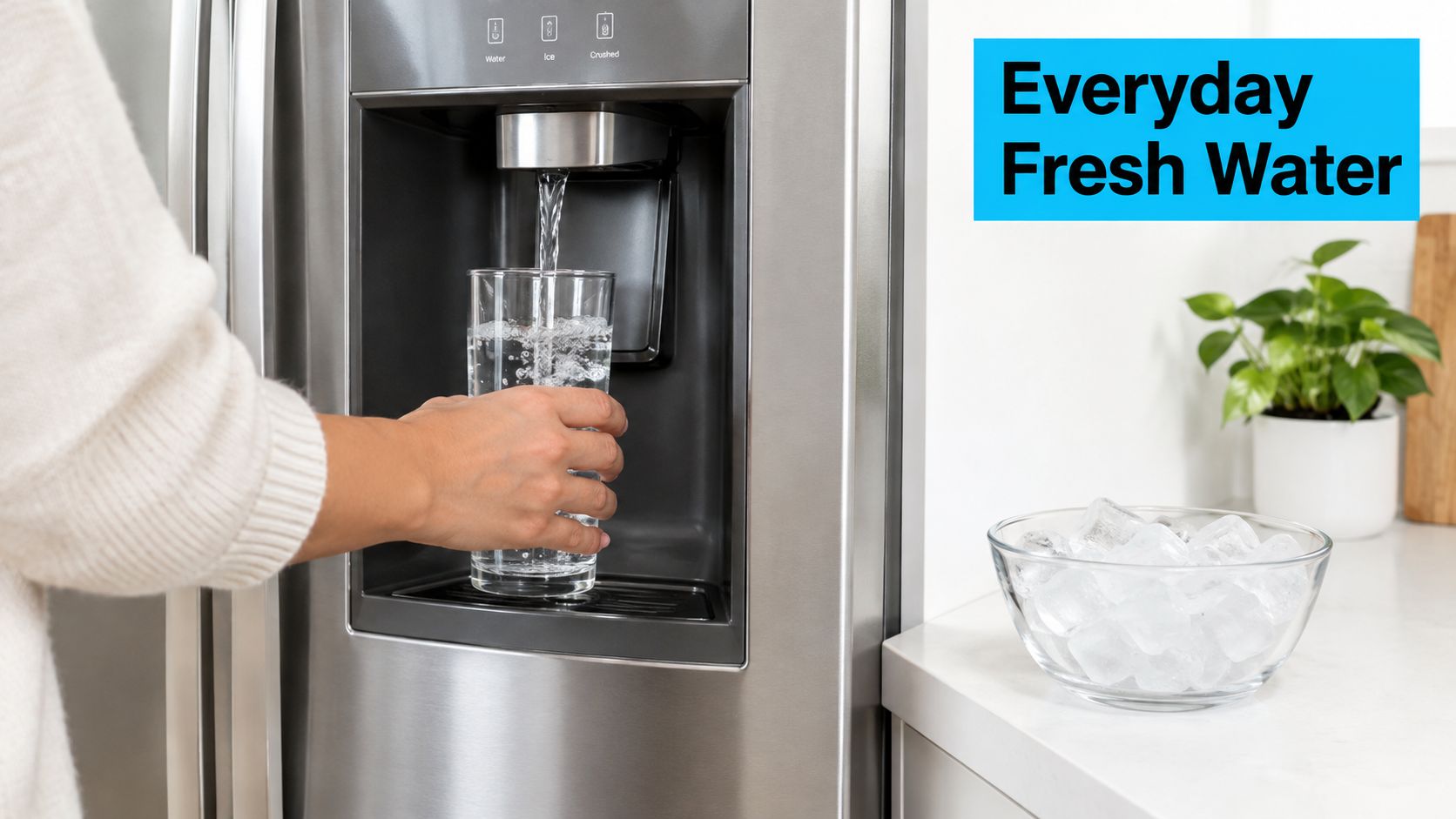
That convenience has a clear boundary. EPA identifies refrigerator-inserted cartridges as point-of-use drinking-water filters, meaning they treat water delivered to the refrigerator rather than every tap in the home. The kitchen sink, bathroom faucets, showers, washing machine, and other appliances remain untreated unless they have separate filtration. EPA guidance on point-of-use filters also explains that federal law doesn't require these devices to be used or third-party certified, so shoppers need to verify the claims themselves.
A short history of a useful feature
The ice maker grew out of commercial refrigeration. In 1834, Jacob Perkins built the first practical vapor-compression refrigerating machine. James Harrison later built a machine capable of producing approximately 3,000 kilograms of ice per day in 1854, and an ice-maker patent was issued to him in Australia in 1855. The first commercial ice makers appeared in the 1870s, edible-ice production became an important milestone in the 1920s, and automatic household ice making emerged during the 1950s. Servel's 1953 Automatic Ice-Maker Refrigerator is a documented household milestone. A history of refrigeration and ice making shows how commercial equipment evolved into an integrated domestic appliance.
That history explains the modern arrangement: refrigeration, freezing, water control, and mechanical ice harvesting share one compact system. A filter can improve the taste and odor of both outputs, but it won't automatically address every health-related contaminant.
Practical rule: Treat the refrigerator cartridge as a targeted drinking-water device, not as whole-home protection.
The rest of the decision comes down to matching the filter's documented performance to your water. A generic “water filter” label isn't enough. You need the exact cartridge model, its capacity, its certifications, and its contaminant-specific data.
How the Built-In Filter and Ice Maker Work Together
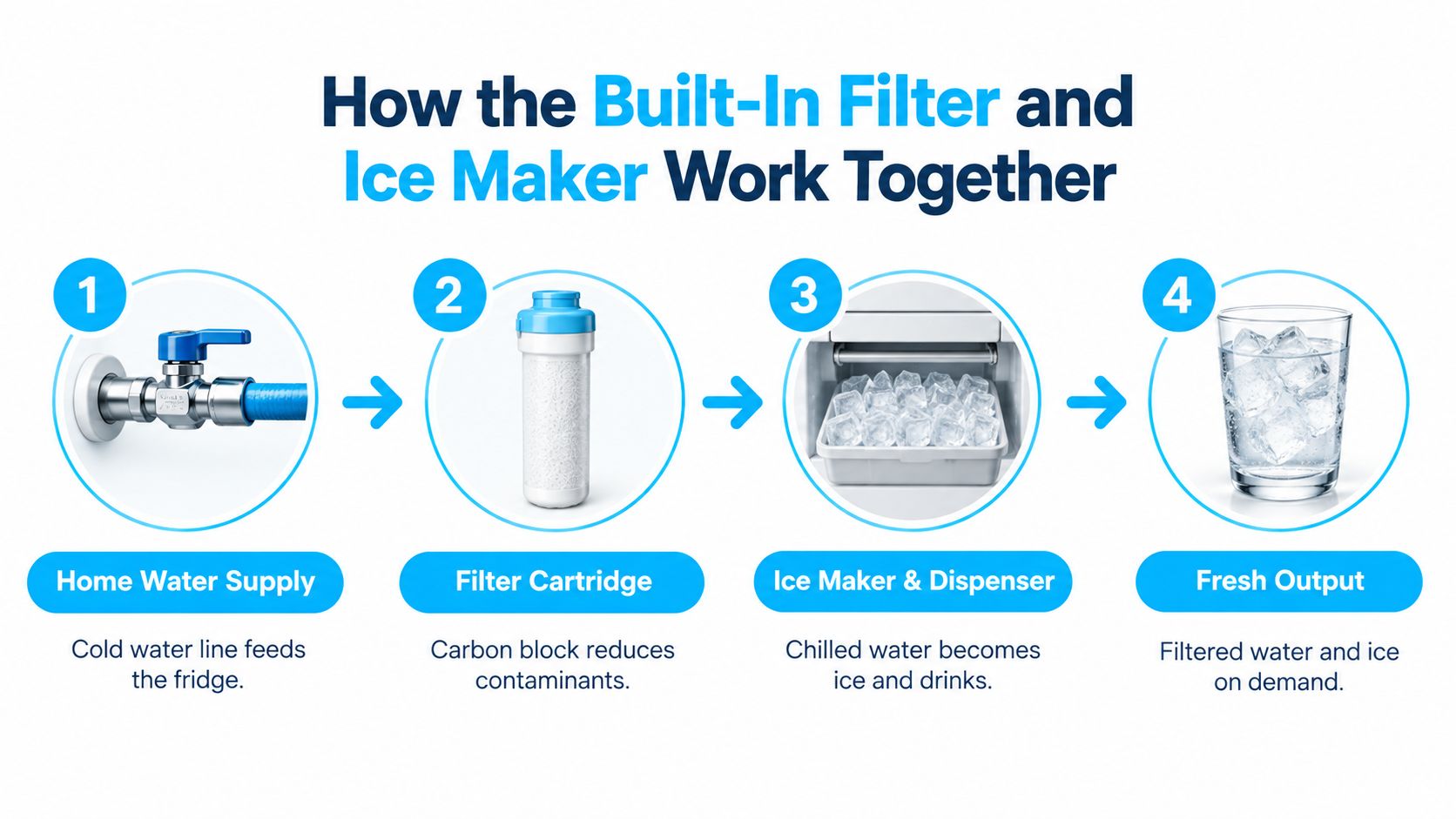
Think of the appliance as a short pipeline with two outlets. Water enters from the home supply, passes through one replaceable cartridge, and then travels toward either your glass or the ice mold.
The water path
Home supply line: A cold-water line connects the refrigerator to the household plumbing. Depending on the installation, that connection may use a dedicated tee, compression fitting, or saddle valve.
Filter housing: The water enters a twist-in or push-in cartridge housing. Many refrigerator filters use activated-carbon media, often formed into a carbon block. The media can capture or reduce specific substances, but its effectiveness depends on the cartridge design and tested claims.
Two destinations: Filtered water travels to the door dispenser and to the ice maker's mold. The ice maker fills, freezes the water, releases the cubes, and stores them in the bin.
Shared capacity: Every glass and batch of ice uses part of the cartridge's rated treatment capacity. A household that relies heavily on both outputs consumes that capacity faster than one that uses the dispenser occasionally.
The shared line is why you shouldn't assume that ice receives a different level of treatment from drinking water. Unless the appliance has an unusual configuration, both outputs depend on the same cartridge and the same certified contaminant claims.
What the carbon cartridge can and can't do
Activated carbon is commonly used to improve chlorine taste, odor, and particulate quality. It isn't a universal barrier. A cartridge certified for aesthetic improvement may not be certified for dissolved lead, PFAS, microbes, hardness minerals, or other health-related concerns.
The housing also matters mechanically. A cartridge that isn't seated correctly can leak, bypass water, or restrict flow. Replacements should match the refrigerator model or the approved compatible form factor, and the water line behind the appliance should remain free from kinks.
The appliance's convenience comes from combining filtration with cooling and ice production. Its limitation comes from the same design. One small cartridge must handle everything the refrigerator dispenses and freezes, so performance depends on both the media and the amount of water passing through it.
Contaminants These Filters Typically Reduce
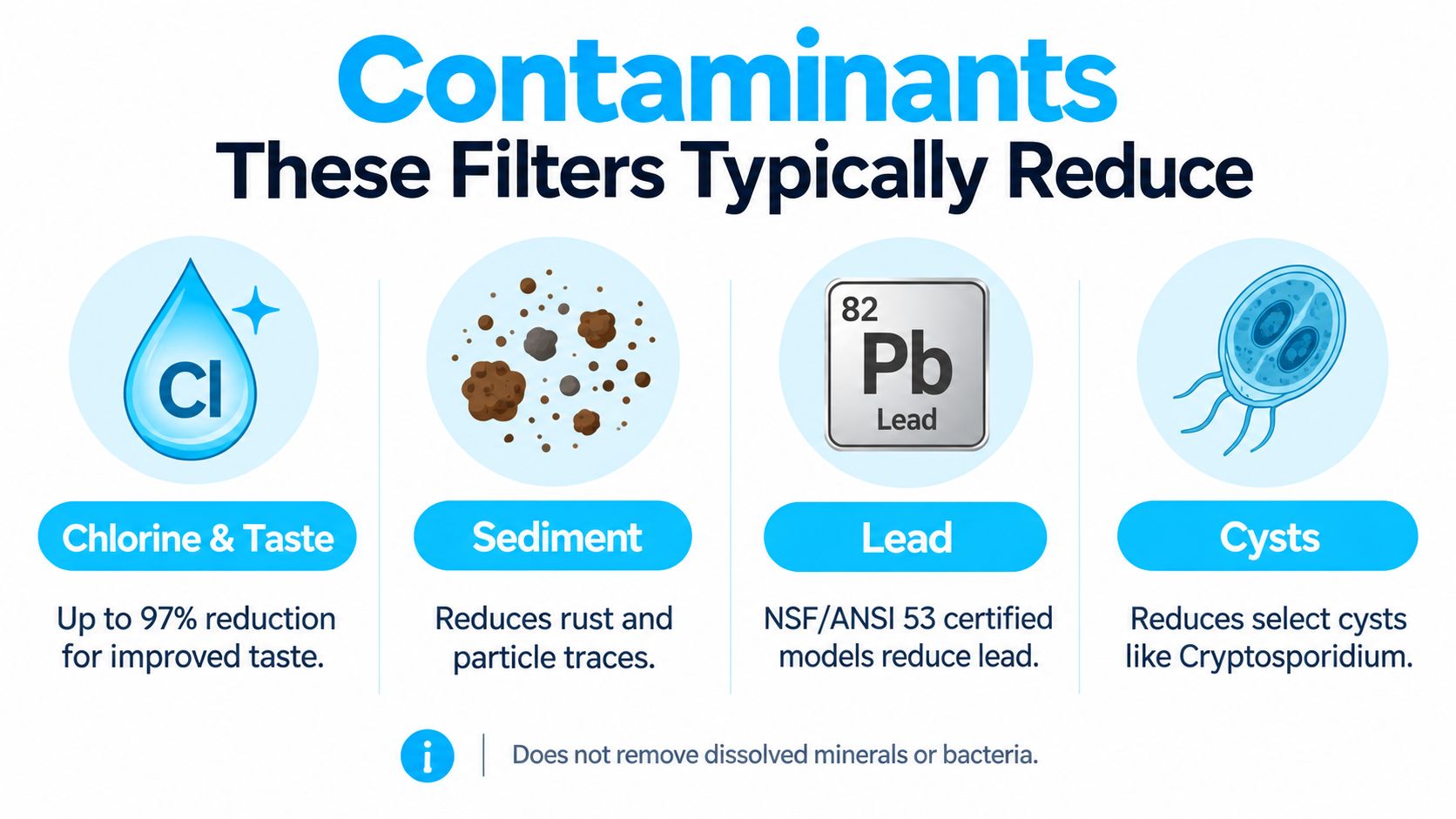
Start with the problem you can identify at the glass. Chlorine may create a swimming-pool taste or smell, while sediment can leave visible particles or affect the appearance of ice. These are aesthetic and particulate concerns, and many refrigerator cartridges address them through activated carbon and particle reduction media.
Taste and particles
NSF/ANSI 42 covers aesthetic and particulate-related claims. A cartridge with a relevant claim may reduce chlorine taste and odor, sediment, rust particles, or cloudiness caused by suspended material. That doesn't mean it removes dissolved minerals responsible for hardness, and it doesn't mean the cartridge disinfects water.
Lead requires closer attention. EPA distinguishes between dissolved-metal reduction and particulate reduction. A cartridge certified under NSF/ANSI 53 for lead reduction has been evaluated for a health-effect claim, while NSF/ANSI 42 Class I particulate reduction addresses very small particles that may contain lead. EPA's refrigerator-filter guidance recommends checking both certifications when lead is the concern.
Health-related claims
Some refrigerator cartridges carry claims for contaminants such as lead, mercury, certain volatile organic compounds, or selected microbial cysts. Those claims are not implied by the word “filtered.” They must appear in the model's performance data and be supported by an applicable certification.
PFAS deserves particular caution. A peer-reviewed evaluation found that only 68% of refrigerator filters showed significant removal of the tested PFAS compounds, with average removal near 50%. Short-chain compounds were removed at roughly 47%, compared with about 65% for long-chain compounds. The peer-reviewed PFAS evaluation demonstrates why one positive laboratory result shouldn't be treated as proof that every refrigerator cartridge handles every PFAS compound.
Where expectations often go wrong
Typical carbon cartridges aren't water softeners. They generally aren't a complete answer for hardness minerals, and they shouldn't be treated as emergency disinfection equipment. Microbes, hydrogen sulfide, iron, chloramine, and PFAS each require a specific claim and, in some homes, a different treatment approach.
A filter can be useful without being a complete safety solution.
The safest habit is to ignore broad packaging language until you find the exact performance sheet. Match the listed contaminant to your water test, and check whether the claim applies to the cartridge model installed in your refrigerator.
Certifications That Matter and What They Actually Mean
Certification turns a vague promise into a narrower, testable claim. NSF/ANSI 42 usually relates to aesthetic effects such as chlorine taste, odor, and particulate reduction. NSF/ANSI 53 addresses health-effect contaminants, including lead, when the specific cartridge carries that claim.
A taste-and-odor cartridge may make water more pleasant without reducing dissolved lead. A lead-reduction cartridge must show that its assembled filter was tested for that purpose. EPA recommends looking for accredited third-party certification rather than relying on a general “purified” or “filtered” statement.
Read the standard beside the contaminant
| Standard | What It Covers | Typical Refrigerator Filter Claim |
|---|---|---|
| NSF/ANSI 42 | Aesthetic effects and particulate-related claims | Chlorine taste, odor, and particulate reduction |
| NSF/ANSI 53 | Health-effect contaminants | Lead reduction and other listed health claims |
| NSF/ANSI 401 | Selected emerging contaminants | Only the emerging contaminants named for the model |
| NSF P473 | Specific PFAS claims | PFAS reduction only where the model is certified |
| NSF/ANSI 55 | Microbiological treatment systems | Claims associated with qualifying microbiological purifiers |
These standards don't make every cartridge interchangeable. Certification is claim-specific, and a seal on one replacement doesn't automatically transfer to a visually similar cartridge from another manufacturer.
What a lead claim means in testing
For a lead-reduction claim, NSF certification testing challenges the assembled filter with 150 parts per billion of lead and requires treated water below 5 parts per billion. Under those specified test conditions, that corresponds to at least approximately 96.7% reduction. EPA's consumer guide to certified lead filters explains why the exact certification and contaminant claim matter.
Check the certifier's public listing using the full cartridge model number. Don't rely on a logo alone, especially when a seller displays a standard without naming the tested claim.
Built-In Filters Versus Pitchers, Faucet, and Under-Sink Systems
A built-in refrigerator filter wins at the moment of use. You open the door, fill a glass, and receive ice from the same water connection. It doesn't occupy counter space, and it avoids the repeated filling associated with a pitcher.
A pitcher offers portability and a simple setup. Its reservoir needs refilling, and its flow is usually slower. A faucet-mounted filter treats water at one tap and can provide quick access, but it adds equipment around the sink and doesn't automatically feed the refrigerator's ice maker.
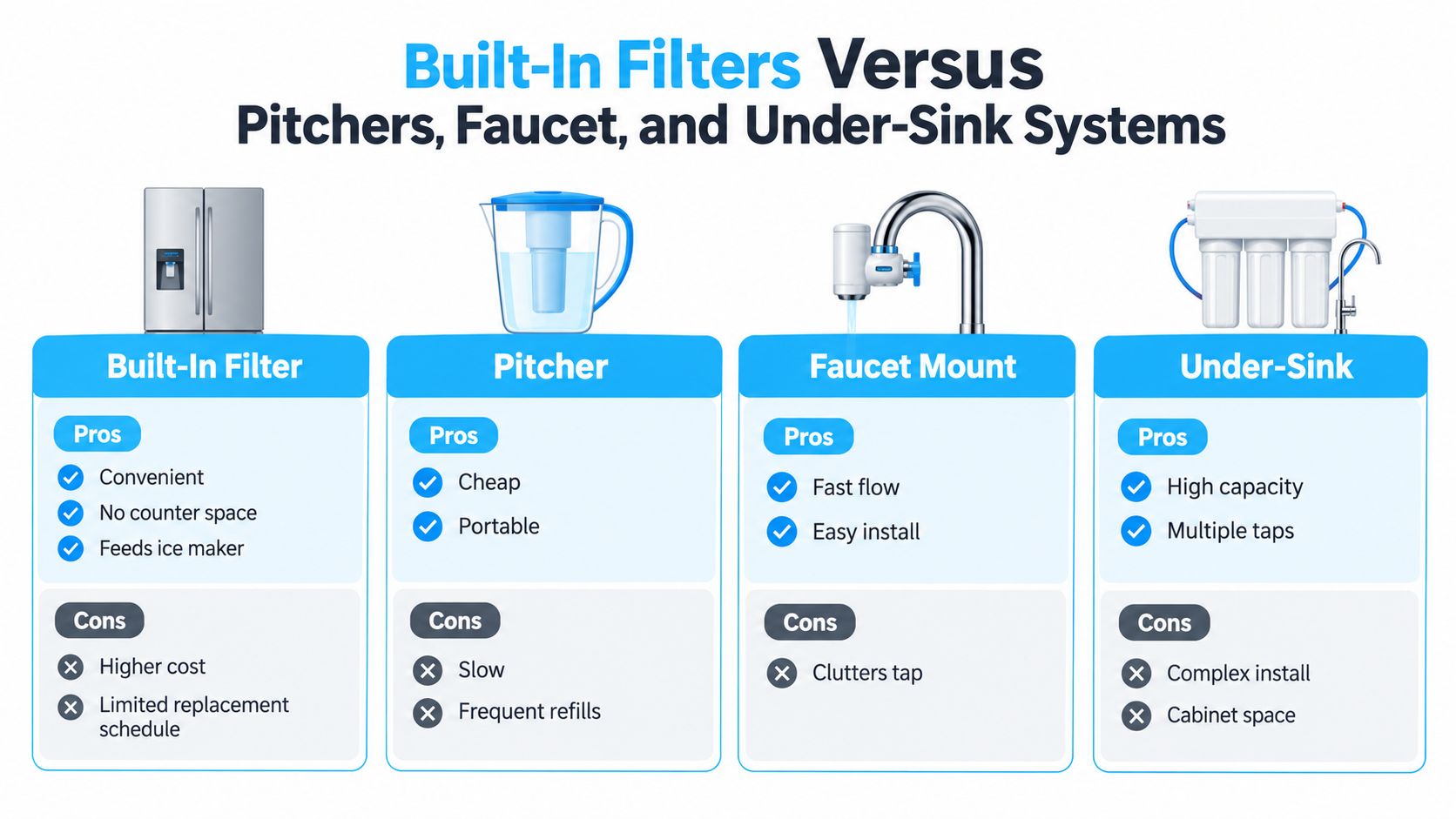
Match the system to the job
| System | Strongest advantage | Main limitation |
|---|---|---|
| Built-in refrigerator filter | Chilled water and ice from one integrated circuit | Limited to the refrigerator and cartridge claims |
| Pitcher | Portable, simple, and suitable for renters | Requires refilling and storage space |
| Faucet mount | Direct access at the sink | Doesn't normally filter refrigerator water |
| Under-sink carbon system | Higher capacity and dedicated treatment | Uses cabinet space and needs plumbing work |
| Under-sink reverse osmosis | Broad reduction of many dissolved contaminants | More complex installation and wastewater, and it won't feed the ice maker unless plumbed into that line |
The word “better” doesn't help until you name the contaminant. A refrigerator cartridge may be entirely appropriate for chlorine taste and dispenser convenience. It may be a poor fit for a household concerned about broad dissolved-contaminant reduction, recurring PFAS exposure, or a water-quality problem that affects every tap.
When another system makes sense
A dedicated under-sink system can create a stronger foundation for drinking and cooking water at the sink. Reverse osmosis can provide broader dissolved-contaminant treatment, but it takes more space and may produce wastewater. It also doesn't serve the refrigerator unless the plumbing is designed to send treated water there.
Whole-home treatment addresses a different goal altogether. It can treat water entering multiple fixtures, while a refrigerator cartridge remains limited to the dispenser and ice maker circuit.
The practical choice may be a combination. Some households use an under-sink system for cooking water and a certified refrigerator cartridge for convenient chilled water and ice. Others need only the refrigerator filter because their priority is taste and the household water test doesn't indicate a contaminant requiring broader treatment.
Installation, Replacement Timing, and Maintenance Habits
The water connection and the cartridge housing are separate parts of the installation. The supply line connects the refrigerator to household plumbing, often through a saddle valve or compression tee. The cartridge then fits into the refrigerator's internal housing or an approved inline position.
A homeowner can usually replace a correctly matched cartridge without changing the plumbing. Plumbing alterations, leaking valves, unusual tubing, or a damaged connection deserve more caution because a small leak behind a refrigerator can damage flooring and cabinets.
Replace by capacity, not guesswork
A filter's useful life is defined by its rated capacity, the volume of water the manufacturer says the cartridge can treat. NSF states that certification under NSF/ANSI 53 requires manufacturers to disclose that capacity, which should appear in the owner's manual, packaging, or product specifications. NSF's lead-reduction listing guidance explains why the volume rating matters.
Every glass and batch of ice consumes capacity. Sediment or unusually contaminated water can also affect real-world performance, so a household that uses the dispenser and ice maker heavily may reach the rated limit sooner than a household with light use. Don't continue treating the cartridge as reliable just because it still fits in the housing.
A practical routine looks like this:
- Record the installation: Write the installation date and rated capacity on the cartridge or in a household maintenance note.
- Watch the output: A taste change, unusual odor, or reduced flow deserves attention, but these signs don't replace the manufacturer's capacity rating.
- Use the exact replacement: Confirm the refrigerator model, cartridge model, seals, and seating mechanism before installation.
- Flush the new cartridge: Follow the manufacturer's flushing instructions before drinking or collecting ice.
For additional refrigerator-filter replacement and maintenance guidance, use the Water Filter Advisor refrigerator filter advice.
After a boil-water advisory
A household filter isn't emergency disinfection equipment. CDC says most kitchen and household filters typically don't remove or kill all bacteria or viruses, so residents should boil tap water during a boil-water advisory even if the water has passed through a filter. CDC guidance for household water treatment during emergencies also recommends flushing the refrigerator system afterward.
Run the refrigerator water for the specified flushing period, allow the ice maker container to fill, and discard that ice. Let it fill completely once more, discard the new batch, and clean the ice container. Contaminated water may remain in the tubing, filter, reservoir, or bin even after the advisory ends.
Testing Your Water and Matching the Filter to the Result
The right cartridge is the one that addresses the water you use. Taste can identify a nuisance, but it can't tell you whether dissolved lead, PFAS, or another health-related contaminant is present.
Start with the most reliable information available for your home. A municipal consumer confidence report can provide useful background for city-water households. Home strip kits can offer quick screening for selected conditions, while a mail-in laboratory panel can provide more detailed testing. Neither a taste test nor a generic online ranking can replace contaminant-specific results.
Turn results into specifications
Use the result as a shopping filter:
- Chlorine taste or odor: Look for a relevant NSF/ANSI 42 claim.
- Lead: Look for an NSF/ANSI 53 lead-reduction claim, and check whether the cartridge also has NSF/ANSI 42 Class I particulate reduction where applicable.
- PFAS: Look for a cartridge with a specific NSF P473 claim, not merely an activated-carbon label.
- Hardness minerals: A refrigerator carbon cartridge usually isn't the right solution. Consider treatment designed for hardness.
- Hydrogen sulfide or iron: Match the water chemistry to a system designed for those concerns rather than assuming a refrigerator cartridge will handle them.
- Microbes: Don't rely on a standard household cartridge during an advisory or emergency. Follow public-health instructions and choose a properly certified microbiological treatment system when needed.
PFAS results show why certified claims deserve priority. A Duke summary of newer research reported that activated-carbon filters used in refrigerators removed PFAS by 73% on average, while reverse-osmosis and two-stage systems achieved at least 94%. The Duke summary of the newer PFAS research presents a useful comparison, but an average still doesn't guarantee reliable removal of every PFAS compound in every water matrix.
Keep the decision narrow
Don't buy the longest contaminant list. Buy the cartridge whose tested claims correspond to your priority contaminants, whose capacity fits your household, and whose replacement supply you can maintain.
If the test shows a concern outside the refrigerator cartridge's certified scope, move the treatment point. An under-sink system, an inline pre-filter, or broader whole-home treatment may make more sense than asking a small appliance cartridge to solve a plumbing-wide problem.
Choosing the Right Model and a Final Decision Checklist
A refrigerator model can have an excellent dispenser and a weak filtration claim, or a modest-looking cartridge with well-documented performance. Judge the water system separately from the appliance's finish, screen, or ice-bin design.
Begin with the cartridge. Confirm the exact model, the applicable NSF/ANSI certification, the contaminant-specific reduction claim, the rated capacity, and the availability of replacements. If a seller shows a certification logo but doesn't identify the tested cartridge or claim, treat that as incomplete information.
Check the appliance fit too
The refrigerator still has to work in your kitchen. Measure the opening, door swing, water connection, filter location, and clearance needed to remove the appliance for maintenance. A guide to kitchen design fridge clearance tips can help you account for installation space before comparing counter-depth and standard-depth models.
Then consider the practical details:
- Water and ice access: Confirm that the dispenser and ice maker use the filtered circuit you expect.
- Cartridge supply: Check that genuine or properly certified replacements remain available.
- Capacity: Choose a rated volume that matches drinking and ice use without encouraging overdue replacement.
- Maintenance: Make sure the people in the household can replace, flush, and monitor the cartridge.
- Water concern: Match the filter claim to a water test, not to a broad marketing phrase.
- Plumbing scope: Remember that refrigerator filtration won't treat other taps.
A simple final checklist can prevent most mismatches:
- Verify the exact certification and contaminant claim.
- Compare the claim with your water test or municipal information.
- Confirm the cartridge fits the refrigerator and is realistically available.
- Check the rated capacity against dispenser and ice-maker use.
- Review installation, flushing, and post-advisory procedures.
- Choose a different treatment system if the concern extends beyond the refrigerator circuit.
A refrigerator with water filter and ice maker is a strong convenience when its certified job matches your household's actual need. It becomes the wrong tool when you expect it to soften hard water, disinfect an emergency supply, or treat every fixture in the home.
Water Filter Advisor offers practical guidance on refrigerator, inline, under-sink, faucet, and whole-home filters, including certification checks, cartridge replacement, water testing, and maintenance. Visit Water Filter Advisor to compare filtration approaches and choose a refrigerator cartridge based on your water concerns rather than a generic label.
- October 8, 2026
- Uncategorized
