
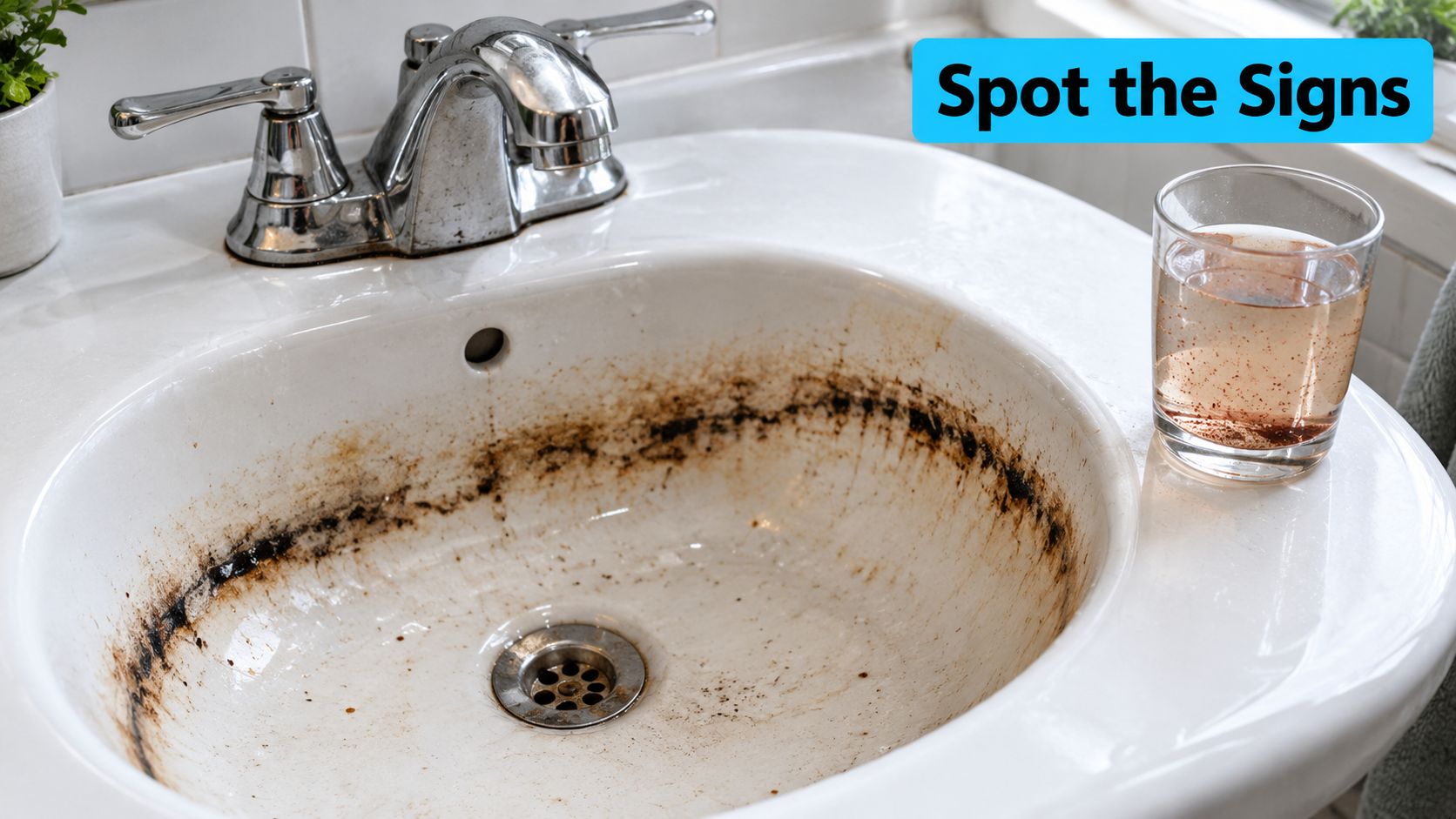
A black ring has appeared inside the toilet. The bathroom sink looks as if someone sprinkled charcoal around the drain, and the water in a clear glass develops dark particles after it sits. Or perhaps the water looks perfectly clear, but it leaves a metallic taste and stains white laundry.
These are familiar signs for private-well owners, but they don't reveal the most important detail: whether the manganese is dissolved or already present as particles. That distinction determines whether a sediment cartridge can help, whether oxidation is necessary, and whether a whole-house treatment system will work reliably.
Manganese removal from well water isn't a matter of buying any filter labeled “manganese.” The right design follows the water chemistry, the household's peak flow, and the people using the water.
Recognizing Manganese in Your Well Water
A homeowner may first blame iron or hard water. Orange staining usually points toward iron, while manganese more often produces black, dark brown, gray, or nearly purple discoloration. You may see it on porcelain, laundry, faucets, shower surfaces, or the bottom of a glass. A metallic or bitter taste can also appear, especially after the water has contacted air.
The confusing part is that manganese can remain invisible while it's dissolved. Freshly drawn well water may look clean at the tap, then darken as the manganese reacts with oxygen. By the time a homeowner sees particles or staining, the water has already been changing form outside the well or inside the plumbing.
Dissolved and particulate manganese behave differently
Dissolved manganese is carried through the water as Mn(II), so a standard sediment cartridge generally has nothing solid to catch. Particulate manganese has already been oxidized into manganese-oxide solids. A properly selected filter can capture those particles, provided the filter has enough depth, capacity, and backwashing flow.
This is why one home may need only particle filtration while another needs an oxidant, contact tank, and pressure filter. A filter that catches visible black sediment won't necessarily remove manganese that still passes through as clear water.
pH also influences how readily manganese oxidizes. A system may remove iron adequately while allowing dissolved manganese to pass because manganese reacts more slowly and often needs stronger oxidation conditions. Visual inspection can't tell you which form dominates, and it can't establish whether the water is suitable for drinking or formula preparation.
Why the problem is broader than one troublesome well
Manganese isn't limited to unusual or isolated groundwater supplies. A USGS assessment of more than 43,000 wells found that approximately 7% of private domestic wells contained manganese above the agency's human-health benchmark of 300 micrograms per liter, or 0.300 mg/L. Those wells supply drinking water to an estimated 2.6 million people, with higher concentrations most common in the Mississippi Valley, the Great Lakes region, and the eastern United States as far north as Maine.
Practical rule: Staining tells you that manganese may be present. Only a laboratory result tells you how much is present and which treatment train makes sense.
Testing Your Water for Manganese Content
Start with a sample of untreated well water. Collecting only water after a softener, cartridge, or oxidation filter can hide the actual manganese load and lead to equipment that is too small or uses the wrong process.
Ask a qualified laboratory for a panel that supports treatment design. At minimum, the raw-water report should include:
- Manganese: Request a result that helps distinguish dissolved manganese from total manganese when the laboratory offers both.
- Iron: Iron affects oxidant demand, filter loading, and the choice of media.
- pH and alkalinity: These values indicate whether oxidation and filtration can proceed effectively without correction.
- Turbidity: Turbidity helps identify existing particulate loading and whether a prefilter may be necessary.
- Sulfide and ammonia: Both can affect oxidant demand and system operation.
- Oxidizable organic matter: Organic material can consume oxidant before it reaches the manganese.
- Hardness and other relevant chemistry: These results help determine whether ion exchange is practical or whether it may be overloaded.
Home strips can be useful for a rough pH check, but they aren't a dependable basis for manganese removal. A laboratory measurement is especially important when the water looks clear, because dissolved manganese can pass through a simple particle filter without changing the appearance of the water.
Collect the sample carefully
Follow the laboratory's bottle, preservation, and shipping instructions. Use the supplied container, avoid touching the inside of the cap or bottle, and sample from a cold-water tap that hasn't been treated unless you're specifically testing a treatment outlet.
If the lab provides separate instructions for dissolved and total manganese, follow them closely. Oxygen exposure can change the balance between dissolved and particulate forms, so casual collection in a household glass can produce a misleading picture.
Test both sides of the equipment after installation. The untreated result tells you what the system must handle. The treated-water result tells you whether the installed system removes manganese at the outlet used for drinking and cooking.
Minnesota guidance recommends that private-well owners test for manganese, particularly when infants drink tap water, and test the water after it passes through the household treatment unit. Its action thresholds identify manganese above 100 micrograms per liter for babies under one year and above 300 micrograms per liter for everyone else. The Minnesota Department of Health guidance recommends an alternative water source for infant formula, consideration of a pitcher filter or home treatment, and retesting after corrective action.
Retest whenever the well changes, treatment media is replaced, oxidant settings are adjusted, or staining returns. The report isn't paperwork to file away. It's the feedback that tells you whether the treatment is still doing its job.
Choosing the Right Manganese Removal Method
The decision starts with one question: is the manganese dissolved, particulate, or both? Dissolved manganese usually needs oxidation followed by filtration, adsorption, or ion exchange. Particulate manganese may respond to a properly sized filter, but a high particle load can foul softener resin and restrict a cartridge quickly.
Oxidation and filtration is the most flexible whole-house approach for moderate or difficult water. Air, chlorine, chlorine dioxide, ozone, or potassium permanganate can convert dissolved Mn(II) into manganese-oxide particles. A pressure filter or rapid-sand filter then removes those solids. The system needs enough contact time, correct pH, suitable media depth, and a backwash cycle that can carry away the accumulated solids.
A laboratory groundwater study treated raw water containing 4.11 mg/L manganese and 5.79 mg/L iron with aeration and natural-sand filtration. At the experiment's maximum operating condition, manganese declined to 0.11 mg/L, approximately 97.3% removal, while iron declined to 0.09 mg/L, according to the published groundwater treatment study. That result demonstrates the oxidation-plus-filtration principle, not a guaranteed household result. Your pH, flow rate, temperature, organic matter, dissolved oxygen, and media condition may produce a different outcome.
Compare the main options
| Method | Best For | Key Advantage | Main Limitation |
|---|---|---|---|
| Oxidation plus pressure filtration | Dissolved manganese with moderate or high loading, often alongside iron | Handles the conversion and particle capture as separate, controllable stages | Requires correct oxidant dosing, contact time, filtration, and backwashing |
| Greensand or manganese media | Water needing catalytic oxidation and whole-house filtration | Can combine oxidation support with particle capture | Media may need regeneration or carefully controlled operating conditions |
| Birm media | Compatible water chemistry with sufficient oxidation support | Straightforward media filtration when the raw water fits its requirements | Performance can suffer when pH, dissolved oxygen, or oxidant conditions are unsuitable |
| Ion exchange softener | Lower dissolved manganese occurring with hardness | Uses an existing softening process to remove some dissolved metal | Oxidized particles can foul resin, and high manganese loads can exceed the resin's practical capacity |
| Sequestrant chemical feeder | Appearance control where preventing precipitation is acceptable | Can keep some metals from forming visible deposits | It doesn't remove manganese from the water, so it isn't the same as filtration |
| Point-of-use reverse osmosis | Drinking and cooking water at one or more taps | Provides a final treatment stage for dissolved contaminants | Doesn't protect the rest of the home's plumbing or bathing water |
For a broader explanation of well-water treatment equipment and filter selection, the well-water filtration advice can help you compare treatment stages before choosing hardware.
Use the test results to narrow the choice. Low dissolved manganese with hardness may make ion exchange practical. Visible particles with little dissolved load may call for particle filtration. Dissolved manganese combined with iron, sulfide, or a challenging pH usually points toward a staged oxidation and filtration design.
Installing and Sizing Your Treatment System
A manganese system fails most often because the installer treats contact time and flow rate as afterthoughts. The filter must handle the home's peak demand, not merely the average amount of water used during a day.
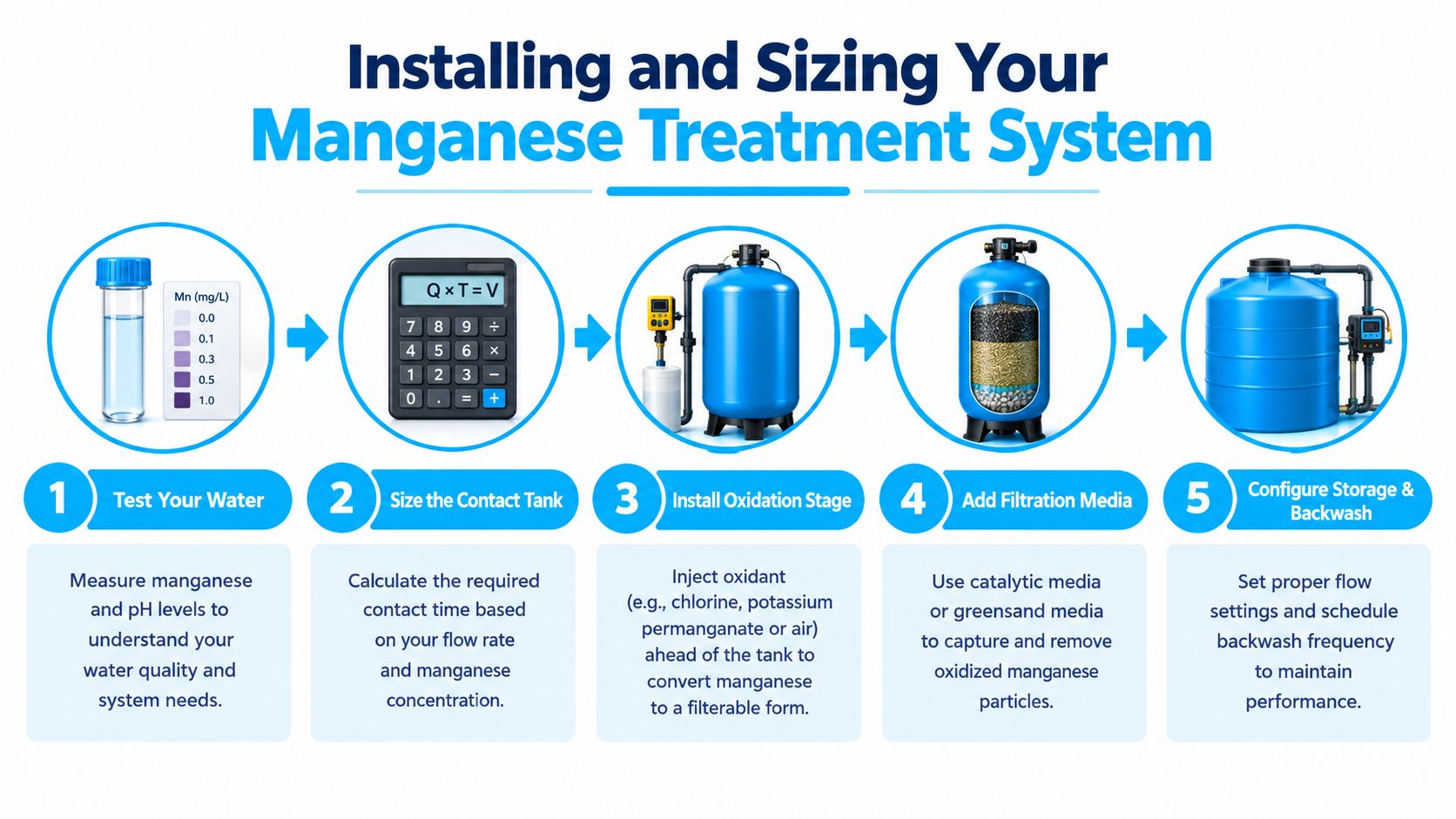
For dissolved Mn(II), begin with the complete treatment train described in this groundwater treatment guidance: test raw water for manganese, iron, pH, alkalinity, turbidity, sulfide, and ammonia; oxidize the manganese; hold the water for approximately 10 to 30 minutes after oxidation; then filter the generated manganese-oxide particles through a properly sized pressure or rapid-sand filter.
Manganese commonly needs 20 to 30 minutes of contact time, while iron can be removed within 10 to 15 minutes under reported optimum conditions of pH 7.5 to 8.5 and dissolved oxygen above 2 mg/L. Those figures are design references, not permission to install an undersized tank. The actual requirement depends on your oxidant, pH, water temperature, manganese concentration, and flow.
Build the stages in the right order
A practical installation typically follows this sequence:
- Protect the equipment from excess sediment. A coarse prefilter can keep sand and heavy grit from entering valves or fouling the main media bed, but it isn't a substitute for manganese treatment.
- Correct the water chemistry when needed. Low pH can undermine oxidation and media performance. If testing indicates a correction stage, install it before the oxidation process.
- Inject or introduce the oxidant. Air injection is useful in suitable water, while chlorine, ozone, chlorine dioxide, or potassium permanganate may be selected for more demanding chemistry.
- Provide a real contact zone. A short pipe run isn't automatically a contact tank. The water needs enough protected volume and residence time for manganese oxidation to proceed.
- Filter the solids and backwash them away. Catalytic, greensand, manganese-coated, or other suitable media can capture the oxide particles, but the vessel must have sufficient bed depth and backwash flow.
The filter tank's service flow, backwash flow, and well-pump output must agree. A tank that removes manganese at a low flow can release particles when several showers, toilets, or appliances operate together.
DIY work is reasonable for plumbing connections when the homeowner understands flow direction, drain routing, electrical safety, and valve programming. Bring in a water-treatment professional when chemical injection, pH correction, pressure-tank changes, or backwash discharge require system-wide coordination.
Maintaining Your Manganese Removal System
A manganese system is a process, not a one-time appliance. Oxidant delivery, contact volume, media condition, pressure, and backwash performance all determine whether the filter continues to remove the metal.
The World Health Organization's manganese fact sheet identifies oxidation and filtration, adsorption and oxidation, softening or ion exchange, and biological filtration as viable approaches. The operating principle remains consistent: oxidation converts dissolved manganese into an insoluble form that a filter can capture, while adsorption or ion exchange can address manganese that remains dissolved.
Watch the system, not just the stains
Check the treated-water result after commissioning, then repeat testing when media, settings, or source-water conditions change. A clear tap doesn't prove that dissolved manganese is gone, and a return of staining doesn't identify the cause by itself.
Use the symptoms as clues:
- Staining returns: Check oxidant delivery, contact time, pH, service flow, and filter loading before replacing all the media.
- Pressure drops: Inspect the prefilter, verify the backwash cycle, and look for accumulated manganese solids or a clogged drain path.
- Taste changes: Test the treated outlet and inspect chemical feed settings, residual control, and any post-treatment cartridge.
- Backwash becomes ineffective: Confirm that the well pump and plumbing can supply the required flow and that the valve completes its full cycle.
- Chemical treatment drifts: Clean injection points, inspect pump tubing, verify the solution strength, and check that the feeder responds to actual water demand.
Potassium permanganate systems need attention to the solution tank, feed tubing, injector, and safety controls. Chlorine systems need inspection of the solution supply, injection point, pump, and residual. Air-injection systems need checks for air delivery, venting, and filter loading.
Don't accept a fixed replacement calendar without looking at the water and the equipment. Media life depends on manganese loading, iron, turbidity, flow, regeneration, and backwash quality. A laboratory outlet test is more useful than a calendar date when deciding whether the system needs adjustment or media replacement.
Seasonal changes can alter well-water chemistry and household demand. Retesting after extended periods of low use, heavy pumping, or noticeable changes in taste and staining helps catch performance loss before the problem spreads through the plumbing.
Common Manganese Treatment Mistakes to Avoid
The most expensive mistake is buying a filter before determining whether the manganese is dissolved. A standard sediment cartridge can catch black particles that have already formed, but it can't reliably remove manganese that remains dissolved in clear water. It may also clog quickly when the raw water contains substantial particulate material.
Boiling isn't a removal method. Evaporation can concentrate manganese rather than eliminate it, so boiling water doesn't solve the underlying problem.

Don't confuse appearance targets with health protection
A water system may make the water look clear without meeting the household's chosen health-protective target. That target depends on the applicable jurisdiction and the people drinking the water.
The Canadian manganese guidance lists a maximum acceptable concentration of 0.12 mg/L and an aesthetic objective of 0.02 mg/L. Massachusetts recommends a lifetime concentration limit of 0.3 mg/L and advises that infants under one year shouldn't receive water above 0.3 mg/L for more than 10 days per year or use it for formula beyond that period.
That difference matters. A homeowner focused on dark staining may choose one target, while a household preparing infant formula may need a more protective decision. Review the measured concentration, household risk profile, local benchmark, and whether point-of-use treatment is sufficient for drinking and cooking.
A softener alone is another common false economy. Ion exchange can be useful for lower dissolved manganese under suitable conditions, especially when the home already needs softening. It isn't a dependable answer for high manganese or water carrying oxidized particles that can foul the resin.
Whole-house treatment also deserves careful thought. An under-sink system may protect drinking and cooking water, but it won't address manganese entering showers, laundry, water heaters, or other fixtures. Conversely, installing an expensive whole-house system without testing can create unnecessary complexity.
The following video offers a visual overview of manganese treatment considerations. It should complement, not replace, a laboratory water analysis and treated-outlet testing.
Troubleshooting Manganese Removal Problems
When staining returns, don't begin by replacing the filter media. First compare an untreated sample with a treated-outlet sample. That comparison separates a source-water change from a failure inside the treatment train.
If untreated manganese has increased, the well chemistry or pumping conditions may have changed. If untreated water is stable but the outlet has worsened, inspect the oxidation stage, contact volume, filter loading, and backwash cycle.
Use the symptoms as a decision path
Dark particles after the treatment stage usually indicate incomplete oxidation, insufficient contact time, excessive service flow, or a filter that is releasing accumulated solids. Check oxidant residuals where appropriate, then verify that the tank has the operating volume and backwash rate it needs.
Metallic taste with little visible sediment can indicate dissolved manganese breakthrough. Test the outlet rather than relying on appearance, and review pH, oxidant dose, and media condition.
Reduced pressure points toward a blocked cartridge, loaded media bed, restricted drain, or incomplete backwash. A pressure gauge before and after the filter can show whether the restriction is localized.
Inconsistent results often come from demand-based equipment that isn't synchronized with the actual well pump or household flow. Confirm that the pump can provide the required service and backwash flow, and check whether multiple fixtures are exceeding the design rate.
Winterize equipment in unheated spaces before freezing conditions. Water trapped in tanks, valves, tubing, or drain lines can damage components, while colder water can slow oxidation and change filter performance.
Call a qualified professional when chemical feed is involved, when pressure changes threaten the well system, or when repeated outlet tests remain high after basic maintenance. The correct repair depends on chemistry and hydraulics, not on the name printed on the filter tank.
Water Filter Advisor offers practical guidance on choosing, comparing, installing, and maintaining home filtration equipment, including oxidation-based approaches for iron and manganese in well water. Visit Water Filter Advisor to review treatment options and use the water-test results to choose a system that matches your home's chemistry.
- October 6, 2026
- Uncategorized
