You turn on the kitchen faucet expecting clear water, then the sink leaves behind orange streaks, the coffee tastes faintly metallic, and a black speck keeps showing up in the aerator. That's usually the moment homeowners start looking at iron and manganese filters, because the problem isn't just cosmetic anymore, it's become part of daily life.
The tricky part is that iron is usually the loud one, with rust-colored stains and cloudy water, while manganese often hides in the background until it leaves dark marks on fixtures and laundry. Both tend to show up together in groundwater, and the fix only makes sense once you understand why manganese is usually the harder contaminant to remove and why that matters for sizing a home system.
What Iron and Manganese Are and Why They Show Up in Home Water
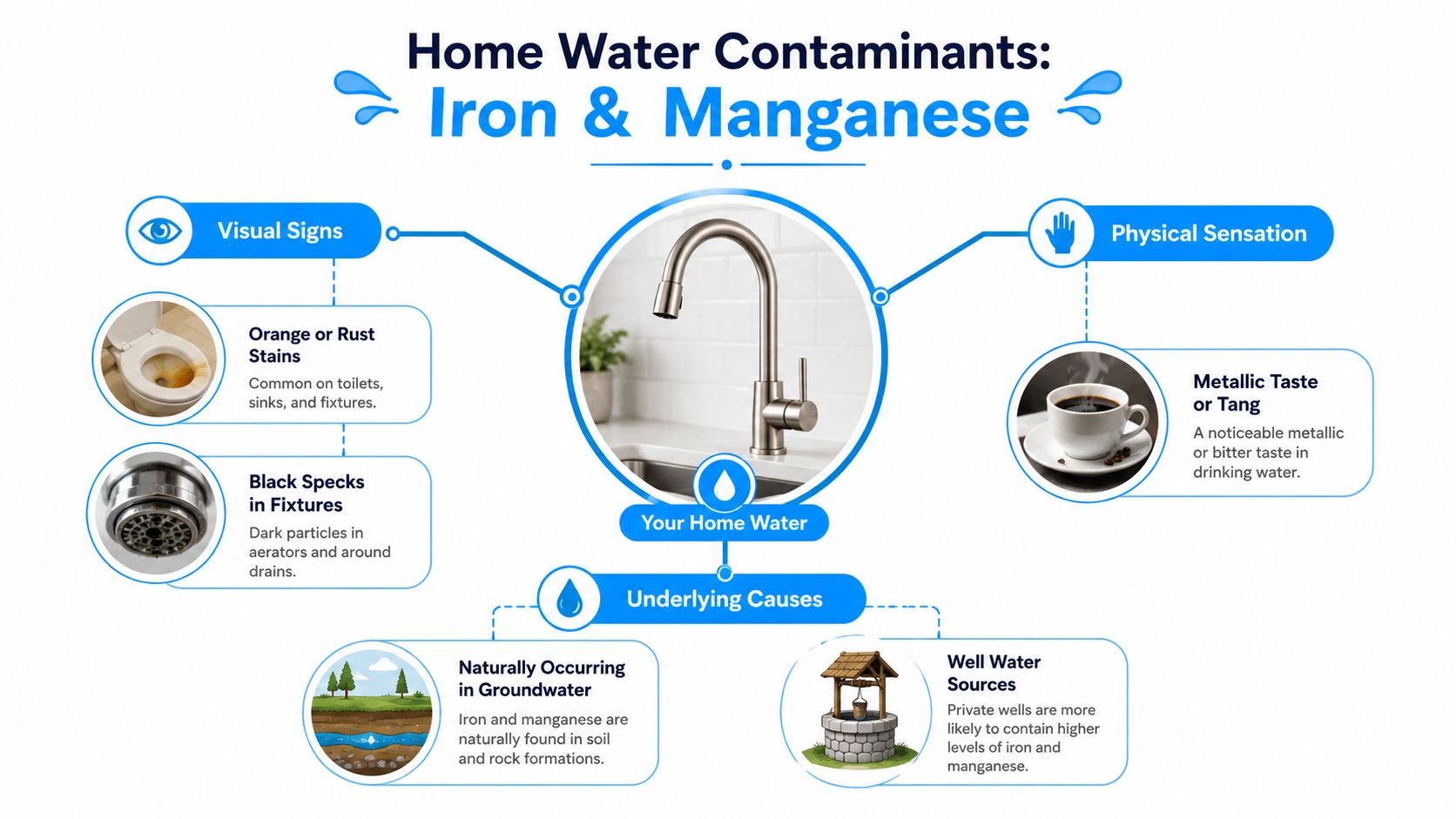
A homeowner often notices the same pattern first, a toilet tank with orange staining, a sink that leaves rusty rings, or a cup of tea that tastes off. Iron and manganese are common groundwater companions, and they're the kind of minerals that don't look dramatic in the raw water sample but show up fast once water sits in plumbing, hits air, or dries on porcelain.
Iron is the more obvious troublemaker. It can leave reddish-brown stains, metallic taste, and the kind of buildup that makes a faucet look older than it is. Manganese acts like iron's quieter relative, but it still leaves black or dark-brown marks on laundry, fixtures, and sink basins. That's why homeowners often describe the water as “dirty” even when it's technically clear at the tap.
Clear water iron and rusty particles behave differently
The form matters. Clear-water iron is dissolved, so it can come out of the tap looking fine and still oxidize later. Ferric iron is already turned into particles, so it looks rusty or cloudy sooner and can be easier to trap. Manganese follows a similar logic, but it tends to be more stubborn in the plumbing because the chemistry is less forgiving.
That's why a home can have one of those frustrating half-problems. The water may look acceptable in a glass, yet the sink, shower, and laundry room tell a different story. A filter is usually being asked to solve more than taste, it's being asked to protect pipes, appliances, and finishes from repeated mineral contact.
Practical rule: if the stains are dark and persistent, don't assume iron is the whole story. Manganese may be part of the reason the cleanup keeps coming back.
How Iron and Manganese Filters Actually Work
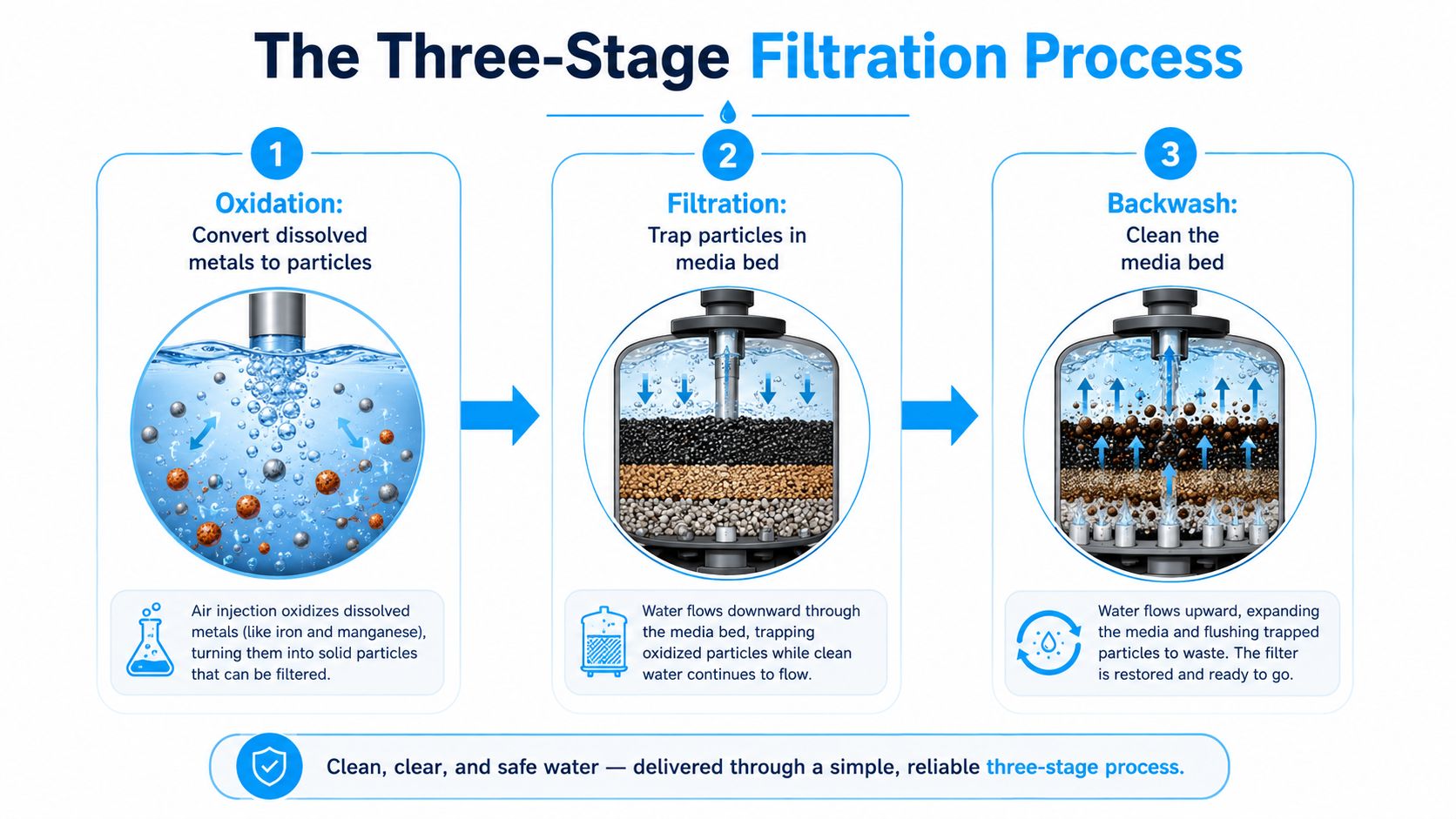
Every effective system has to do three jobs. It has to turn dissolved metals into particles, trap those particles, and then clean itself so the media doesn't clog or lose capacity. That's the whole game, whether the unit sits in a basement on well water or at the point of entry on a municipal line.
Oxidation creates something the filter can catch
Oxidation is the first step in most systems. Air, chlorine, or potassium permanganate can change dissolved Fe2+ and Mn2+ into solid oxides, which are far easier for a media bed to capture. This process is like pouring a pile of loose iron filings through a sifter; the goal isn't just to move the water, it's to turn invisible dissolved metal into bigger clumps that the bed can hold.
Catalytic media makes that process faster. Manganese greensand, Birm, and manganese dioxide-coated media give the water a surface that helps the oxidation reaction happen inside the tank instead of waiting for it to happen slowly in the plumbing. That's why these systems are often described as “chemical-free” or “low-chemical,” even though the chemistry is still doing the heavy lifting.
Good systems don't just filter, they create the right particle first. If the iron or manganese never turns into a solid, the bed can't grab it.
Ion exchange is a different path
Some systems use ion exchange instead of oxidation. In that setup, the resin swaps metal ions for sodium ions, the same general idea as a softener exchanging hardness minerals. It can work well for moderate levels, especially when a home also needs softening, but it's not the same as a catalytic oxidation filter.
The last piece is the cleanout cycle. Media beds need backwashing or regeneration so the trapped metals don't pack the bed shut. A technician who skips that step is basically asking the filter to keep catching more and more debris without ever emptying the basket.
For a homeowner who wants a plumbing-focused overview of how treatment equipment fits into the rest of the house, the Premier Builders plumbing page is a useful reference point alongside the filtration discussion.
Comparing the Main Filter Types for Homes
Homeowners usually get sold on a brand name before they understand the water chemistry. That leads to bad matches. The better approach is to compare each filter by what it handles well, what it struggles with, and what kind of house it fits.
The practical shortlist
Greensand with potassium permanganate fits homes with stronger iron and manganese issues, especially when the water needs an actively regenerated oxidation medium. Its weakness is obvious, it asks the homeowner to manage permanganate carefully and stay on schedule.
Birm is attractive when the water chemistry cooperates, because it avoids permanganate handling. Its weakness is that it needs the right oxygen and pH conditions, so it's not the forgiving choice for every well.
Manganese dioxide media gives strong catalytic help, and that's often useful when manganese is the harder target. The tradeoff is that it still depends on the tank being sized correctly and the water staying inside the media's operating envelope.
Air-injection systems fit moderate iron loads and homeowners who want a simpler approach with fewer chemicals. Their weakness is that they aren't magic, they still need the right chemistry and contact time to work well.
Catalytic carbon can help with light iron and can also address chlorine or chloramine reduction in some setups. Its weak point is the same one most carbon systems face, it isn't meant to solve heavy metal loading by itself.
Ion exchange is a good fit when a home wants both softening and some metal reduction in one unit. The weakness is that it's not the first choice when manganese is the main problem and the water chemistry is tougher.
Residential Iron and Manganese Filter Types at a Glance
| Filter Type | Oxidation Method | Best For | Watch Out For |
|---|---|---|---|
| Greensand | Potassium permanganate regeneration | Stronger iron and manganese treatment | Chemical handling and scheduled regeneration |
| Birm | Catalytic oxidation with oxygen support | Lower-maintenance setups with suitable water chemistry | Needs the right pH and oxygen |
| Manganese dioxide media | Catalytic surface oxidation | Homes where manganese is the harder target | Performance depends on sizing and water chemistry |
| Air injection | Built-in air oxidation | Moderate iron with simpler operation | Can struggle if chemistry is outside range |
| Catalytic carbon | Catalytic adsorption and oxidation support | Light iron plus chlorine or chloramine reduction | Not for heavy metal loading |
| Ion exchange | Sodium exchange on resin | Homes wanting softening plus moderate metal control | Not the best standalone answer for difficult manganese |
Testing Your Water and Reading the Numbers
A filter choice without a test result is just a guess in a nicer box. The smartest starting point is a certified lab test for well water, because that gives you the actual mineral profile, not a hand-wavy impression from a test strip. If you're on city water, the Consumer Confidence Report can give you the public supply picture, while a home kit can still help you screen for obvious changes.
Read the result as a treatment clue, not a verdict
The useful number is the concentration in mg/L. Penn State Extension says drinking water should contain no more than 0.3 mg/L of iron and less than 0.05 mg/L of manganese in private systems, while a 2025 review cites a paired reference of 0.2 mg/L iron and 0.05 mg/L manganese for drinking water (Penn State Extension, Royal Society of Chemistry review). Those numbers matter because they tell you when the water is likely to stain, taste metallic, or leave dark residue behind.
A single result still doesn't tell the whole story. pH, hardness, and hydrogen sulfide can all change how the water behaves in a filter and in the house. That's why one well might need oxidation plus catalytic media, while another needs a different path entirely.
A lab sheet that says “iron is moderate” isn't enough. You still need the pH and the rest of the water chemistry before a system can be sized correctly.
What to ask the lab for
- Iron and manganese: Get both, because the easier-looking contaminant can distract from the harder one.
- pH: This affects how well oxidation and catalytic media will perform.
- Hardness: It changes scale potential and may point toward softening.
- Hydrogen sulfide: Rotten-egg odor can change the treatment sequence.
- TDS or general mineral content: Not for every system, but useful context for the full picture.
Sizing and Selecting the Right System for Your Home
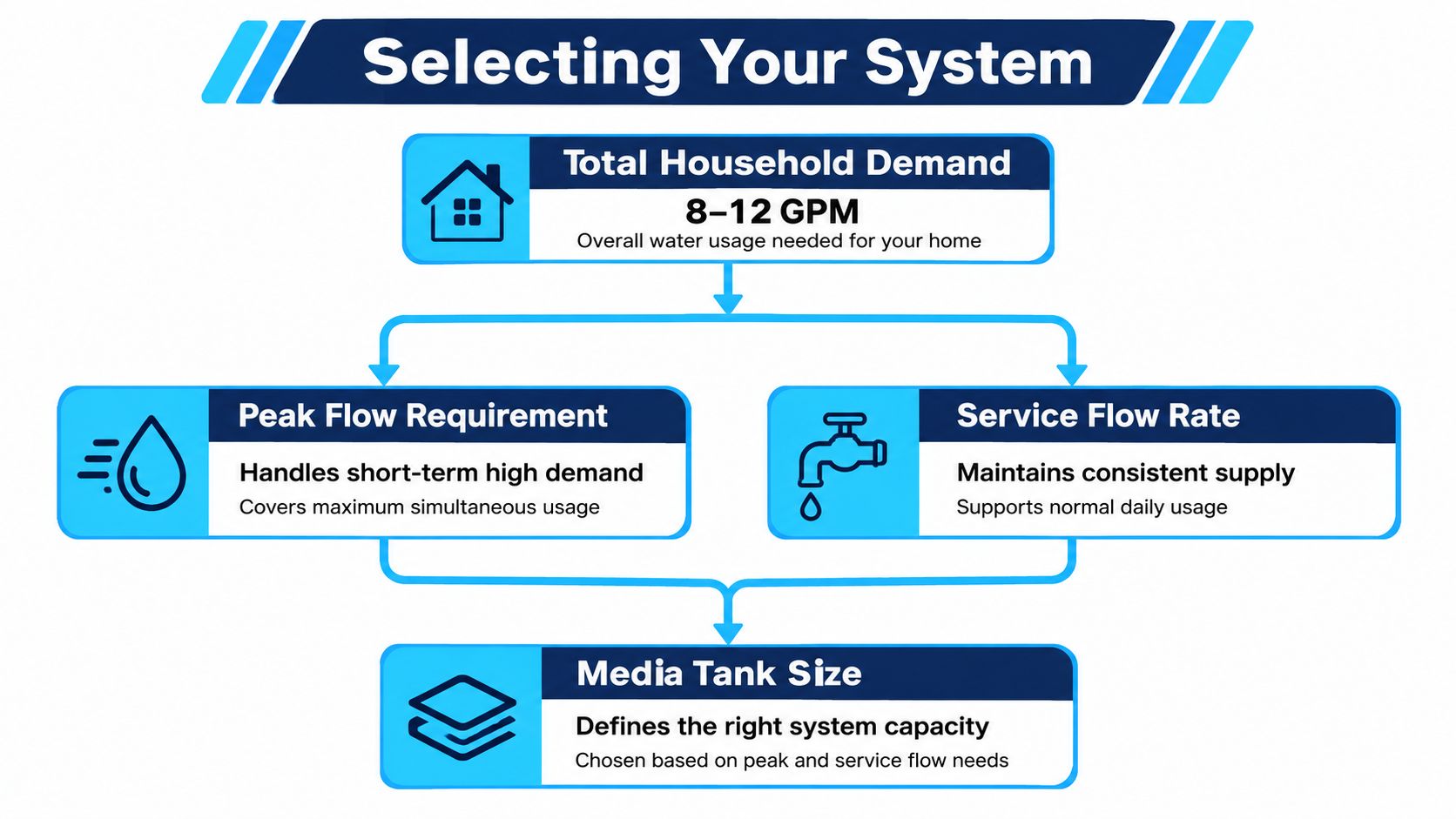
Manganese should drive the sizing decision. That sounds simple, but it saves a lot of disappointment, because iron is usually easier to remove than manganese and a system built around the visible rust problem can still let the darker contaminant slip through. In practice, that means the stronger manganese target sets the pace, then iron gets handled along the way.
Start with peak flow, not just house size
A home's peak demand is the first practical number. A 3 to 4 bathroom home often runs around 8 to 12 GPM during heavy use, and that's the flow the filter has to survive without breaking contact time. Commercial-style design data also show why this matters, since conservative service flow rates are often much lower than people expect, and undersizing cuts performance fast (Irish standard and sizing guide).
Match the chemistry window to the media
Different media have tight operating windows. One technical sheet lists pH 6.8–9.0 for iron, pH 8.0–9.0 for manganese, and pH 8.0–8.5 for combined iron-and-manganese removal, while another commercial system is rated for pH 7–11, 25–80 PSI, and 36–120°F (technical data sheet). That's the kind of detail that decides whether the tank works smoothly or keeps disappointing the family at the sink.
A small example makes the logic clearer. A 4-person household with 0.8 mg/L iron and 0.15 mg/L manganese needs a system chosen for manganese first, not iron first. That usually pushes the homeowner toward a catalytic or oxidizing whole-house unit sized for the peak flow, because the easier iron load shouldn't be the limiting factor.
Installation and Ongoing Maintenance
A whole-house iron or manganese unit usually lives at the point of entry. On well water, that often means after the pressure tank. On municipal water, it usually sits right after the meter. Either way, it needs a bypass, a drain for backwash, and power for the control valve, because a system that can't rinse itself won't stay effective for long.
The first week after installation is the quiet test. Water use feels normal, but the filter is doing more than the faucet shows. Backwash cycles reverse the flow through the media bed and flush out trapped solids, and that's the moment when a lot of systems prove whether they were installed and programmed correctly.
What upkeep actually looks like at home
- Check chemical levels regularly: If the system uses potassium permanganate, don't let the feeder run dry.
- Watch the backwash schedule: Skipping it lets the bed pack down and lose capacity.
- Inspect the media annually: Look for channeling, clogging, or signs that the bed is aging.
- Keep the plumbing ends clean: A clogged aerator can make a good system look bad by trapping leftover debris at the sink.
A real maintenance rhythm matters more than a dramatic repair. One month you glance at the tank and the drain line. Another month you refill a chemical feeder or inspect the media. Over time, those small checks keep the household from sliding back into staining and taste problems.
If the water starts changing again, don't blame the faucet first. A dirty aerator, a skipped backwash, or a depleted chemical feed can make a healthy system look like it failed.
Costs, Common Problems, and Smart Fixes
A homeowner usually wants the straight answer on money. Basic air-injection or Birm systems often sit in the low-to-mid four figures installed, greensand systems with permanganate land higher, and ion exchange units tend to track more like water softener pricing. The ongoing part matters too, because chemical use, media refresh, and service time all belong in the full cost picture.
Why systems disappoint
A system that still leaves stains after installation usually has one of three problems. The bed may be undersized for the actual peak flow, the pH may be outside the media's comfort zone, or the water may be asking more of the filter than the design can handle. Manganese breakthrough is especially frustrating because the water can look better while still missing the target.
Channeling is another familiar issue. Water takes the easiest path through the media, so part of the bed sits idle while another part gets overloaded. When that happens, the fix is usually about backwash performance, flow rate, or bed condition, not just swapping a cartridge and hoping for the best.
A greensand system can fail in a simpler way, too, if the permanganate feed gets neglected. The media loses its oxidation capacity, and the filter slowly stops acting like the treatment device it was supposed to be. That kind of failure is preventable with a refill routine and a quick visual check during service.
Common problem and likely fix
| Problem | Likely Cause | Smart Fix |
|---|---|---|
| Staining continues | Sizing or pH issue | Recheck water test and peak flow |
| Media channels | Weak backwash or poor bed condition | Adjust backwash settings and inspect media |
| Permanganate runs out | Forgotten feeder refill | Set a refill schedule and alarm |
| Manganese still breaks through | Manganese target was underdesigned | Size around manganese first |
A separate field result shows why that last point matters. In one groundwater system, treatment lowered iron from 0.93 ± 0.91 mg/L to 0.18 ± 0.14 mg/L, but manganese only moved from 0.24 ± 0.1 mg/L to 0.105 ± 0.06 mg/L, with removal efficiencies of 77.7% for iron and 62.5% for manganese (groundwater filtration study). In plain English, iron often gives up first, manganese keeps fighting.
Choosing Well and Answers to Common Homeowner Questions
The decision gets much easier when you keep the order straight. Test first. Size around manganese first. Pick the simplest technology that matches the chemistry. Maintain it on schedule. That's the whole framework, and it keeps you from buying a system that fixes the stain but misses the target.
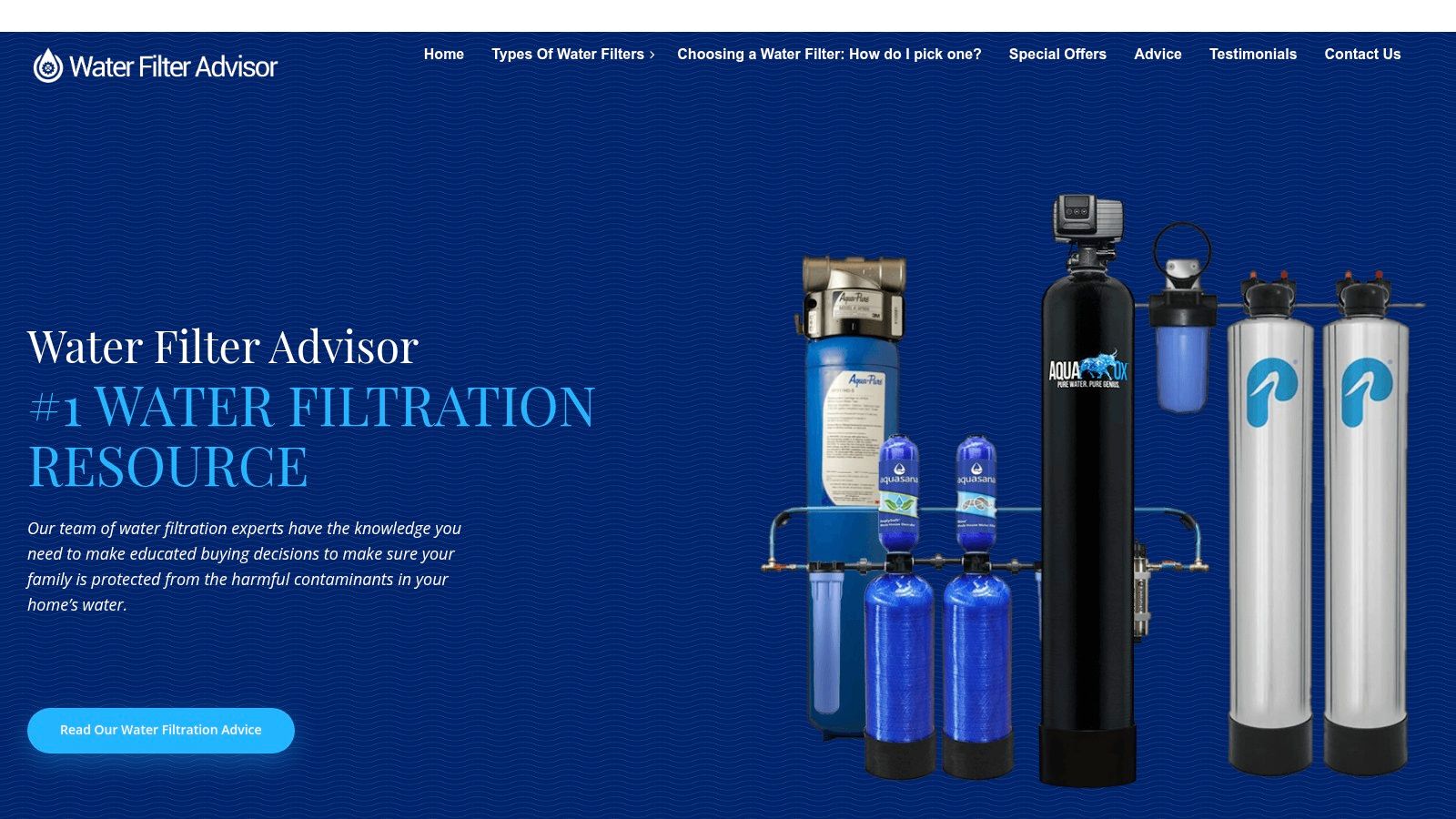
If the water also smells like sulfur, many homeowners ask whether one filter can handle everything. Sometimes yes, but only when the treatment sequence matches the chemistry. If you're sorting through options and want a plain-language guide, the advice section from Water Filter Advisor is a useful place to compare whole-house approaches before you commit.
Can one whole-house unit beat a point-of-use filter? Yes, if the problem is throughout the house, because point-of-use treatment won't protect the shower, laundry, or water heater.
What if I have manganese but almost no iron? Treat manganese as the main design driver, since it's usually harder to remove.
How do I know the media is exhausted? The clearest sign is a return of staining, taste, or dark specks after a period of good performance.
If you're ready to stop guessing, visit Water Filter Advisor and use its homeowner-focused filtration guides to narrow your options. It can help you compare treatment types, understand maintenance, and choose an iron and manganese filter that fits the actual water in your house.
- August 14, 2026
- Uncategorized
