You're standing at the sink with a glass of water that came from your own well, and instead of feeling proud of that independence, you're second-guessing every sip. Maybe the water tastes metallic. Maybe the kettle scales up fast. Maybe a lab report just came back with nitrate, arsenic, fluoride, or a TDS reading high enough to make you stop and stare.
That's the moment many homeowners start looking at reverse osmosis for well water.
It's a smart place to look. A properly matched RO system can turn difficult well water into clean drinking water that tastes dramatically better and removes contaminants a basic sediment or carbon filter can't touch. But well water isn't forgiving. The same chemistry that makes RO so useful also makes it easy to install the wrong setup, foul a membrane early, and waste money on equipment that never had a chance.
Is Reverse Osmosis the Answer for Your Well Water Woes
A common scenario goes like this. A homeowner gets a water test after years of putting up with odd taste, white crust on fixtures, or concern about what's really in the glass. The results show a mix of nuisance issues and health-related contaminants. That's usually when bottled water starts showing up in the garage.
RO is often the right answer, but only for the right job.
For homes on well water, reverse osmosis can remove about 90 to 99% of minerals and dissolved solids such as nitrates, arsenic, and fluoride, depending on water chemistry and membrane type, and it often produces water with TDS under 10 to 50 mg/L after treatment, according to this overview of RO for homes on well water. That's why RO sits in a different category from ordinary cartridge filters. It's designed to deal with what's dissolved, not just what's floating.
When RO makes sense
RO usually belongs on your shortlist when your well water has issues like:
- High dissolved solids that create a salty, bitter, or flat taste
- Nitrate concerns that simple sediment filters won't solve
- Arsenic or fluoride that call for a more targeted treatment method
- Persistent scaling from mineral-heavy water, especially at the drinking tap
- A desire to stop buying bottled water while getting more consistent quality at home
When RO alone is not the answer
RO is not a magic box you bolt under a sink and forget.
A strong RO system can polish water beautifully. It can't make bad raw water harmless if the pretreatment is wrong or missing.
If your well has bacteria, heavy sediment, iron staining, manganese, severe hardness, or unstable seasonal water quality, RO may still be part of the solution. It just won't be the whole solution. That distinction saves homeowners a lot of frustration.
How RO Transforms Well Water from Problematic to Pure
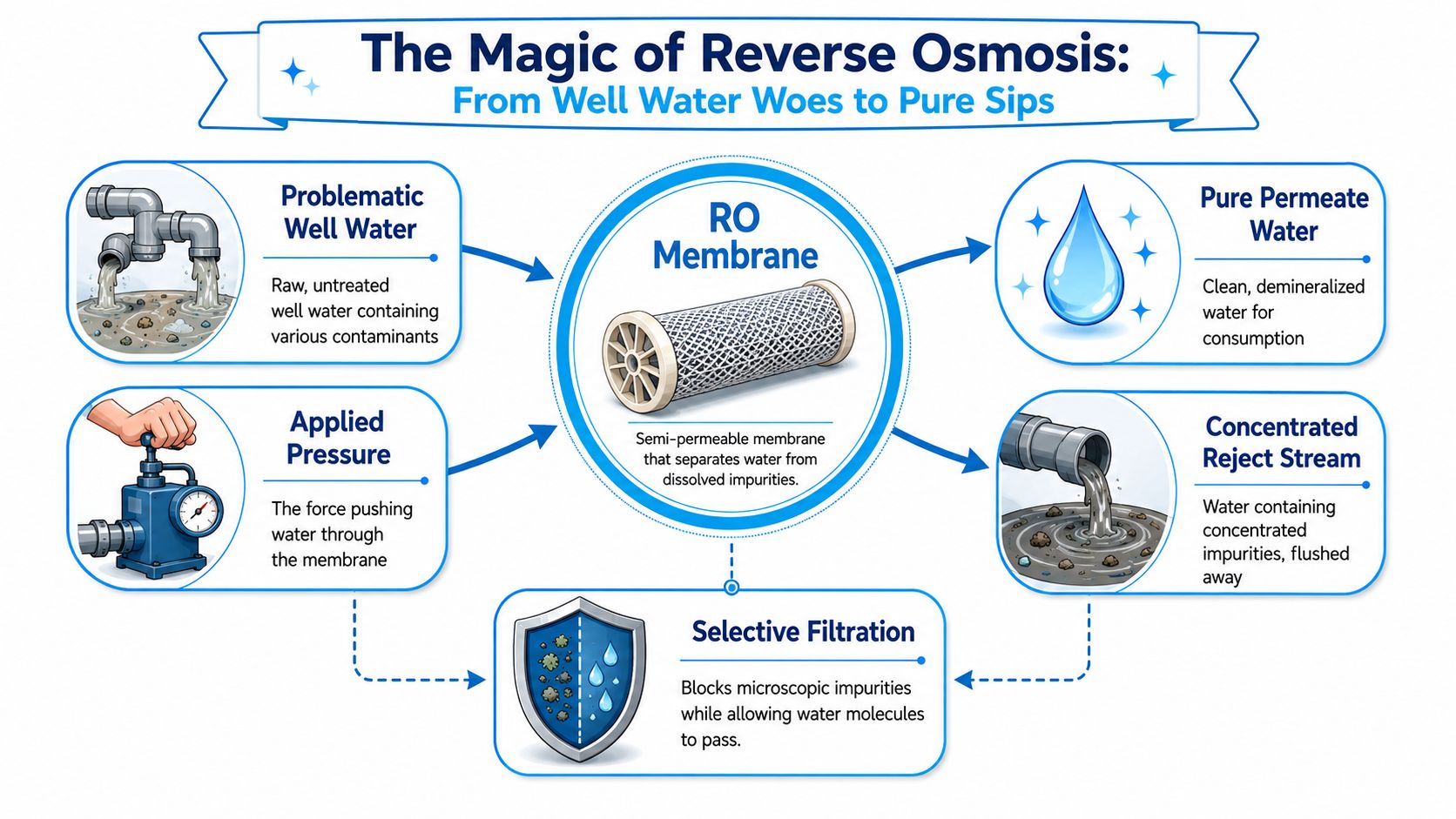
At the heart of reverse osmosis is a semipermeable membrane. The easiest way to think about it is as a pressure-driven barrier. Water molecules pass through. Many dissolved contaminants do not. That's very different from a basic sediment filter, which mainly catches visible particles.
What actually happens inside the system
Your well water enters the system under pressure. The membrane separates the flow into two streams:
| Stream | What it is | What happens next |
|---|---|---|
| Permeate | Purified water that passes through the membrane | It goes to the storage tank or faucet |
| Reject stream | Concentrated water carrying the contaminants left behind | It goes to drain |
That reject stream matters because RO doesn't “destroy” contaminants. It separates them. Dissolved salts, nitrate, arsenic, fluoride, and heavy metals stay concentrated on one side, while the purified water moves to the other.
What RO is especially good at in well water
Well-designed RO membranes typically remove 90 to 99% of dissolved salts, nitrate, arsenic, fluoride, and heavy metals, can reduce TDS from over 1,000 to 2,000 mg/L in some wells to below 50 mg/L, and have shown arsenic removal exceeding 95% with fluoride reductions of 90 to 98%, as detailed in this reverse osmosis water filtration guide. That's the practical reason homeowners install it. It tackles the things ordinary whole-house filters often leave behind.
RO-treated water also feels different in daily use. Coffee tastes cleaner. Ice cubes stop carrying that odd mineral edge. Tea doesn't get that murky top film as easily.
RO water and very low mineral content
Some homeowners are surprised by how “light” RO water tastes at first. That's normal. Once you strip out much of the dissolved mineral load, the water often tastes cleaner and less harsh. If you've ever looked into ultra-pure water in other uses, this expert guide to deionized window cleaning is a useful example of how removing dissolved minerals changes performance in a totally different setting. The principle is the same. Fewer dissolved solids means fewer spots, deposits, and residues.
RO shines when the real problem is dissolved contamination. It's less impressive when homeowners expect it to handle every upstream problem by itself.
That's why the membrane gets the credit, but the rest of the system decides whether the membrane gets to do its job for years or fails early.
Start with a Water Test Not a Shopping Cart
The costliest mistake I see is buying an RO system first and asking what the water contains later. That's backwards. A well isn't a standardized water source. Two houses on the same road can have very different chemistry.
A shopping cart won't tell you whether your membrane is about to face iron, manganese, hardness, fine sediment, bacteria, tannins, or a salinity level that changes how the system should be configured. A proper test will.
What your test needs to tell you
At minimum, you need a recent lab-quality picture of the water chemistry that affects both safety and system design. The exact panel can vary, but the decision logic doesn't.
Look for these categories:
- Dissolved contaminant profile so you know whether RO is needed for nitrate, arsenic, fluoride, or high TDS
- Hardness and scaling potential because membrane performance drops when scale forms
- Iron and manganese because those two foul membranes fast when they oxidize and plate out
- Sediment and clarity issues that can overload prefilters and shorten service life
- pH and general stability because treatment performance depends on feed-water conditions
- Bacteria testing because biological contamination is a separate treatment issue, not a detail to ignore
Why guessing gets expensive
Homeowners often choose systems based on gallons per day, stage count, or online reviews. Those things matter less than the feed water. A beautifully built RO unit still loses if raw well water arrives dirty, oxidizing, or scale-forming.
Public guidance on RO and well water doesn't always help with the practical trade-off either. This well water treatment guidance from Nebraska Extension makes an important point: homeowner materials often explain what RO can remove, but don't break down how salinity, recovery, concentration, scaling, and wastewater interact in actual well-water conditions. That gap is why people buy systems that look right on paper and perform poorly in the field.
A better buying sequence
Use this order instead:
- Test first with a recent, thorough sample.
- Read the report for treatment design, not just pass or fail.
- Match pretreatment to the water, not to a product ad.
- Choose the RO unit last, once you know what it will be fed.
If you want help interpreting the treatment side of that process, the practical articles at Water Filter Advisor's advice center are a useful starting point for comparing common filtration approaches without jumping straight into a purchase.
Buy an RO system without a water test, and you're not making a decision. You're placing a bet.
The Non-Negotiable World of RO Pre-Treatment
For well water, pretreatment isn't an accessory. It's the difference between an RO membrane that works cleanly and one that clogs, scales, or fouls before it should.
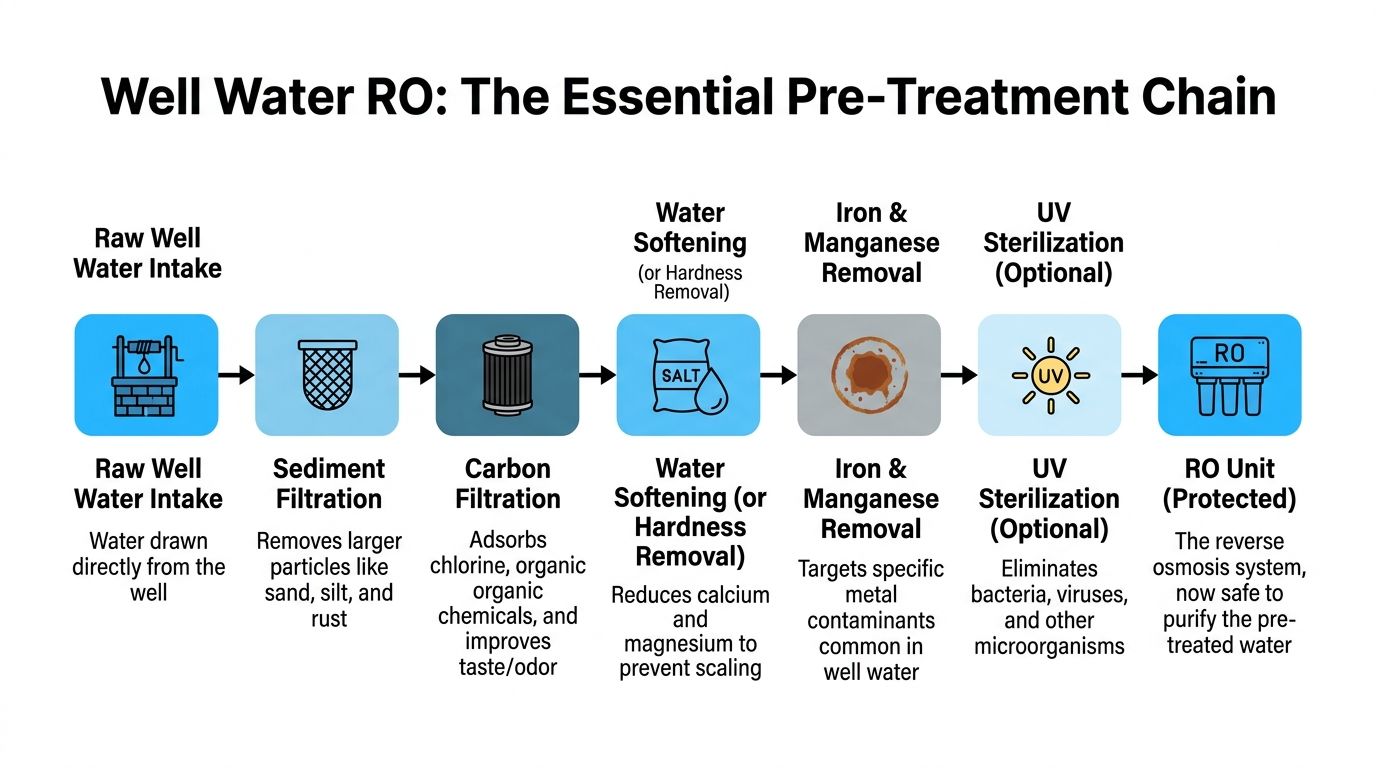
Raw well water often brings a combination of suspended solids, hardness, iron, manganese, and organic matter. Each one stresses the membrane differently. The membrane doesn't care whether the damage came from grit, scale, or metal fouling. It just stops performing.
The basic if your water has X then you need Y logic
This is the practical treatment chain most homeowners need to think through:
- If your water has sand, silt, or cloudiness, start with sediment filtration. Fine particles don't just make water look bad. They abrade and clog downstream components.
- If your water has chlorine from any prior treatment step or objectionable taste and odor compounds, activated carbon usually belongs ahead of the RO unit.
- If your water is hard, a softener is often the membrane's best friend. Hardness minerals are a classic source of scaling.
- If your water has iron or manganese, use dedicated removal ahead of RO. Don't expect the membrane to tolerate metal loading for long.
- If bacteria is part of the picture, address that separately with the right disinfection strategy. RO is not a substitute for a properly designed microbiological treatment step.
The operating targets that matter
For well water treatment, feed water turbidity should be below 1 NTU and SDI below 3 to 5. Iron and manganese should be under 0.05 ppm to prevent fouling. Effective pretreatment can extend RO membrane life from a typical 3 to 5 years to over 7 years, according to the earlier-cited RO water filtration guidance.
Those aren't abstract design notes. They're the thresholds that separate a protected membrane from one that slowly loses rejection, pressure, and output.
A short visual helps here before the deeper system discussion.
What works in the field
A good pretreatment train is boring in the best way. It removes stress before the water reaches the membrane.
Here's the sequence that usually makes sense:
| Water problem | Pretreatment tool | Why it matters |
|---|---|---|
| Sediment | Sediment filter or multimedia filtration | Keeps particles from plugging cartridges and membrane surfaces |
| Hardness | Water softener or hardness control | Reduces scale formation on the membrane |
| Iron and manganese | Oxidation-filtration or dedicated iron removal | Prevents metal fouling and pressure rise |
| Taste, odor, residual oxidants | Activated carbon | Protects components and improves final water quality |
What does not work
What fails most often is partial pretreatment. A homeowner installs a small under-sink RO because the faucet water tastes bad, but the incoming well water still carries iron or hardness that the system was never built to handle. The first months look fine. Then production slows, the drain runs longer, and the water quality drifts.
Field note: Membranes usually die from what happened before them, not inside them.
Treat the RO unit as the final polishing stage, not the first line of defense. That mindset changes everything.
Choosing Your System Point of Use vs Whole House
Once the pretreatment picture is clear, the next decision is scope. Do you want RO water at one faucet, or at every fixture in the house?
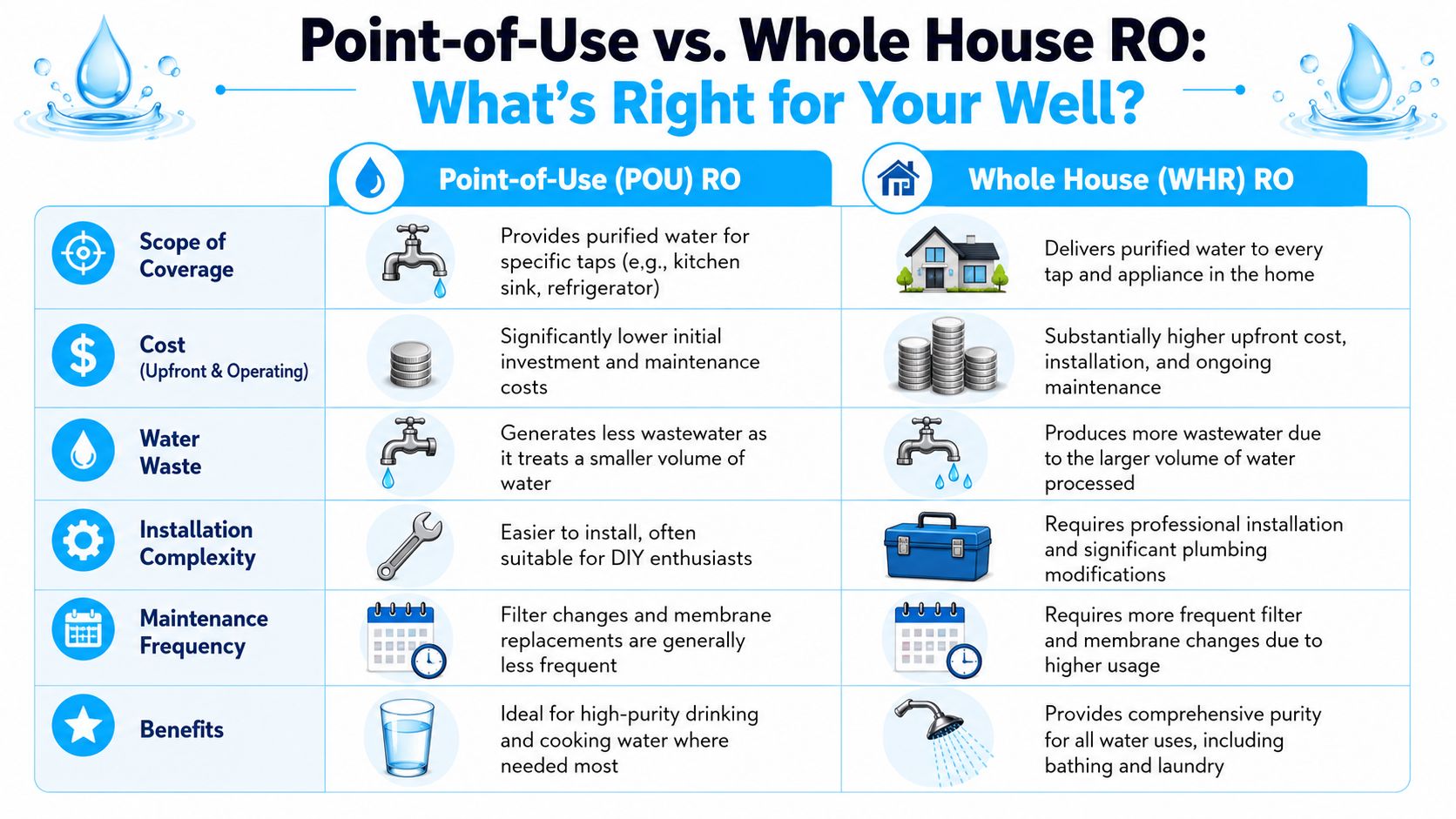
For most homes, this comes down to a straightforward question. Where do you need ultra-low-TDS water? Drinking and cooking are one answer. Every shower, toilet, and laundry line is another.
Point of use under the sink
A point-of-use RO system usually sits under the kitchen sink and feeds a dedicated faucet, sometimes the refrigerator as well. This is the practical winner for many well owners.
Why? Because the highest-value use of RO water is usually drinking, cooking, ice, coffee, infant formula, and food prep. That's a relatively small daily volume, and a smaller system can serve it well.
Point-of-use systems also keep the wastewater and maintenance burden contained to one area. If your goal is safer, better-tasting water at the tap you drink from, this is often the sharpest answer.
Whole-house RO
A whole-house RO system treats water before it enters the home plumbing. It's a major project. It takes space, planning, a drain strategy, storage, and a realistic conversation about water use.
Whole-house RO makes sense in narrow situations, such as extremely poor source water where the homeowner wants low-mineral water throughout the property, or where specific non-drinking uses are also suffering from the dissolved load. But it is not the default answer for the average household on a private well.
Side-by-side practical comparison
| Decision factor | Point-of-use RO | Whole-house RO |
|---|---|---|
| Best use case | Drinking and cooking water | Entire home water supply |
| Installation | Smaller plumbing job | Large equipment and professional design |
| Water demand | Lower treated volume | High treated volume |
| Wastewater impact | Easier to manage | Much more important to evaluate |
| Maintenance burden | Focused and simpler | Broader and more involved |
Water efficiency matters more than many buyers realize
This is where product selection starts to matter in a very practical way. Older RO systems can waste 5 to 10 gallons for every gallon of pure water, while WaterSense-labeled systems must send no more than 2.3 gallons of reject water to drain per gallon treated and can save a household over 3,100 gallons of water annually, according to the EPA's WaterSense information on point-of-use reverse osmosis systems.
That matters even more on well water because reject water isn't just a utility bill issue. It affects septic loading, drain planning, and how much total water your system handles in daily life.
A practical rule for choosing
- Choose point-of-use if your main goal is high-quality drinking water and you want the cleanest, least complicated path.
- Choose whole-house only if you have a specific reason to need RO-quality water everywhere and you're prepared for the infrastructure that comes with it.
- Stay skeptical of oversized solutions if a smaller one solves the core problem better.
Most families don't need RO water in every toilet tank. They need excellent water where they eat and drink.
Installation Maintenance and Long-Term Costs
The system price is only the opening bid. The full ownership story includes installation quality, feed pressure, filter service, membrane replacement, and the discipline to maintain the equipment on schedule.
Installation realities
A straightforward under-sink system is often within reach for a confident DIY homeowner, especially if the plumbing is accessible and the pretreatment is already in place. Well-water setups get more complicated fast when you add softeners, iron filters, booster pumps, drain connections, storage tanks, or a whole-house layout.
Pressure is one of the first practical hurdles. RO depends on pressure to move water through the membrane. If the well system delivers inconsistent or low pressure at the point of use, the RO unit may produce water slowly, reject more water than expected, or fail to perform consistently. In those cases, a booster pump often turns a frustrating system into a workable one.
The maintenance schedule you can't skip
The maintenance rhythm is simple, but it has to happen. Typical RO maintenance involves replacing sediment and carbon pre-filters annually, while the membrane itself generally needs replacement every 3 to 5 years, depending on water quality and usage. Poor maintenance can increase bacterial growth risk and allow contaminant breakthrough, according to Culligan's reverse osmosis maintenance guide.
That schedule assumes the system is properly matched to the water. If pretreatment is weak, the membrane may not make it to the healthy end of that range.
What homeowners should budget for mentally
Think in three layers:
- Initial setup includes the RO unit, any required pretreatment, possible plumbing work, and sometimes a pressure upgrade.
- Routine service includes cartridge changes, periodic sanitizing, and keeping an eye on performance.
- Long-cycle replacement includes the membrane and, eventually, other wear components such as tanks, valves, or pumps.
If you want low-hassle RO ownership, spend your effort on design and pretreatment at the beginning. That's where the future service calls are won or lost.
Signs your system needs attention
Don't wait for total failure. Common warning signs include:
- Slow production at the drinking faucet
- Taste drift after a period of good performance
- Long drain run times
- Drop in pressure at the RO faucet
- Visible neglect on filters that should've been changed already
A well-built RO system can be satisfying to live with. A neglected one turns into an expensive reminder that water treatment is a process, not a one-time purchase.
Your Final Decision Checklist for Well Water RO
The best reverse osmosis system for well water isn't the one with the most stages or the slickest ad. It's the one that matches your water, your house, and your tolerance for maintenance.
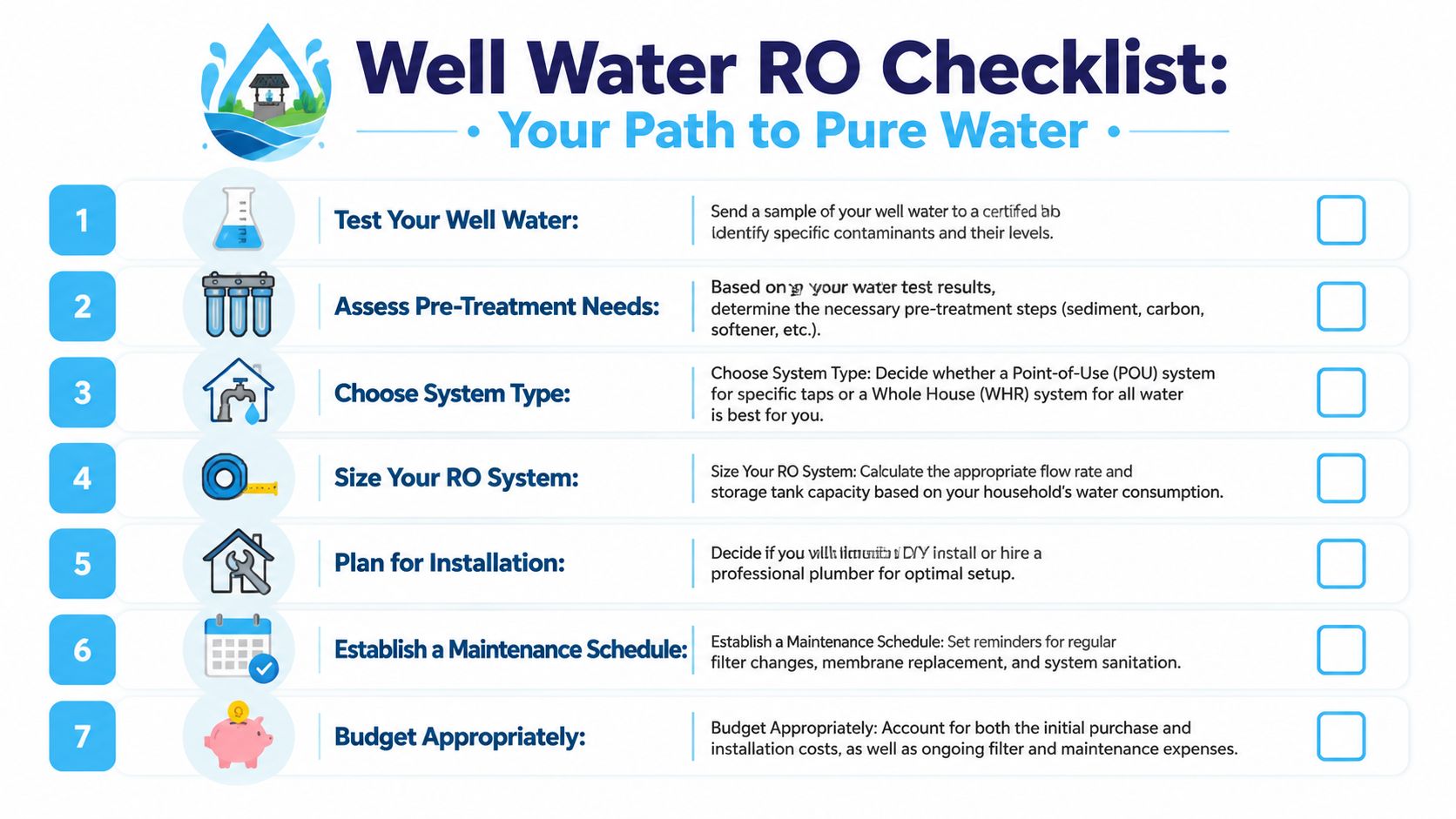
Run through this checklist before you buy:
The homeowner sanity check
- Have you tested the well water recently and reviewed the results for treatment design, not just potability?
- Do you know the pretreatment needs for sediment, hardness, iron, manganese, and any microbiological concerns?
- Have you chosen the right scope between under-sink point-of-use and whole-house treatment?
- Have you checked pressure and drain needs so the system can operate properly in your home?
- Do you understand the maintenance cycle and are you willing to stay on top of it?
- Have you planned for reject water and how that fits your plumbing or septic setup?
- Are you buying a treatment system, not just an RO box?
The decision that usually works best
For many homeowners, the smart path looks like this: test the well, install the right pretreatment, and use a point-of-use RO system for drinking and cooking water. That gives you the highest-value improvement with the least disruption.
Whole-house RO has its place. It's just a specialized solution, not the automatic upgrade many people assume it is.
Good RO ownership starts before installation. The winning move is matching the system to the water you actually have.
If you make the decision that way, reverse osmosis stops being a gamble and starts behaving like what it should be: a dependable piece of home water treatment equipment.
If you're comparing filtration options and want plain-English help sorting through well water problems, replacement schedules, and system types, Water Filter Advisor is a useful resource for homeowners who want practical guidance before they buy.
- June 23, 2026
- Uncategorized
