
If you’re waging a never-ending war against crusty white buildup on your faucets and fixtures, you've met the villain of this story: calcium. The two most powerful heroes in the fight against hard water are a whole-house water softener or a targeted reverse osmosis (RO) system. Think of them as the ultimate tag team for stopping that chalky limescale from ever showing up to the party.
Your Quick Guide to Solving Hard Water Nightmares
Let's be real—if your shower doors look permanently cloudy and your soap stubbornly refuses to lather, you’ve got hard water. The culprit is an excess of dissolved calcium, and it’s more than just an eyesore. Over time, that scaly buildup is like cholesterol for your home's arteries, choking the life out of your appliances and clogging your pipes.
It's a frustrating, soap-scum-covered problem, but you don't have to live with it. I've seen countless homeowners reclaim their homes from the clutches of calcium by choosing the right filtration strategy. And it almost always boils down to one of two battle plans.
Choosing Your Filtration Strategy
The first, and most comprehensive, fix is a whole-house water softener. This bad boy gets installed right where your main water line enters your house, treating every single drop you use. It works through a clever bit of chemistry called ion exchange, where it essentially tricks the "hard" calcium and magnesium ions into swapping places with "soft" sodium ions. This protects your entire plumbing infrastructure—from the water heater you never see to the coffee maker you use every morning.
Now, if your main headache is the funky taste of your tap water or the film on your cooked veggies, a point-of-use system like reverse osmosis is a fantastic option. These are typically installed right under the kitchen sink. An RO system is the overachiever of water filters, pushing water through a special membrane that strips out a ridiculously high percentage of contaminants—calcium included. For more in-depth info, you can find tons of professional advice on water filtration to help you weigh your options.
The decision often comes down to this: Are you looking to protect your entire home's plumbing and appliances, or do you crave ultra-pure water at a specific tap for drinking and cooking?
This simple decision tree can help you visualize which path is right for your home.
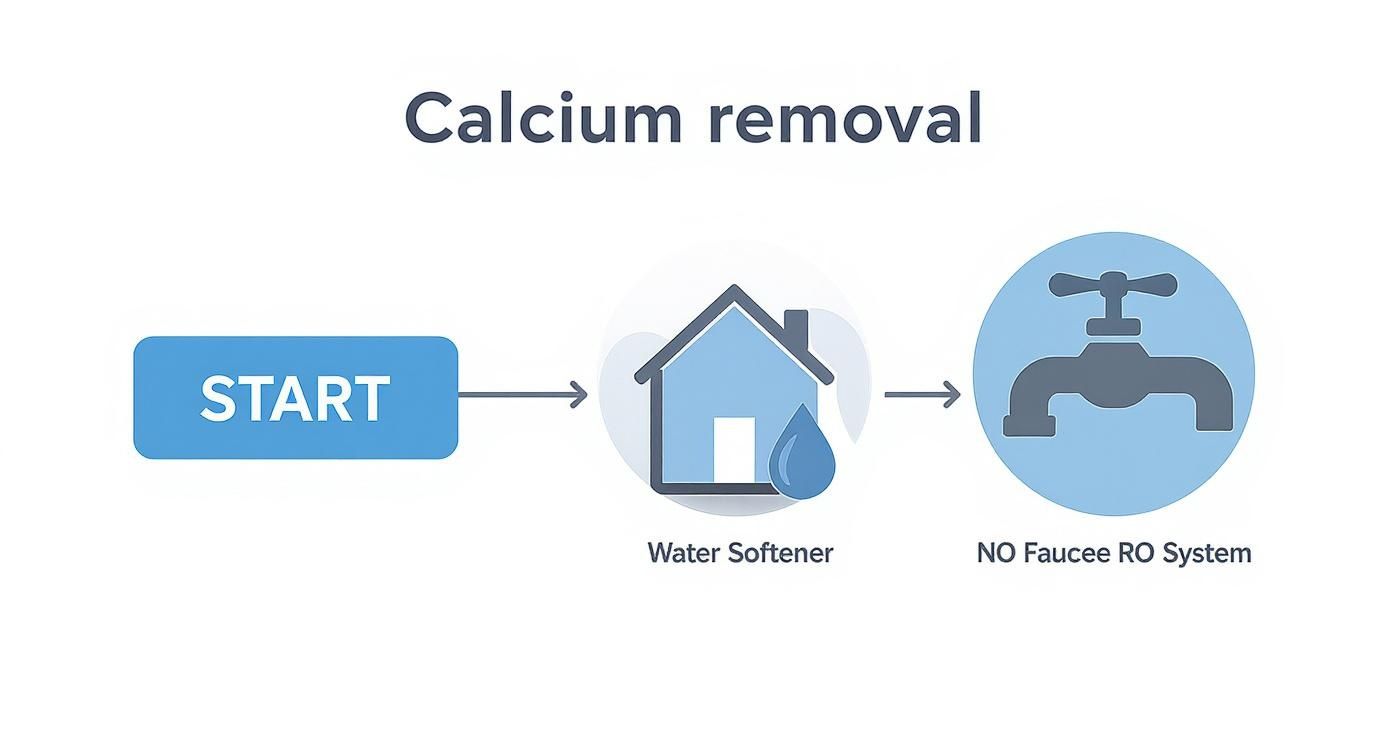
As you can see, the scope of your problem—whether it’s a house-wide menace or a kitchen-specific annoyance—points you directly to the most logical solution. While these systems prevent future issues, if you're already dealing with existing spots on your glass surfaces, a good guide on how to get hard water spots off windows can help you clean up the existing mess.
Comparing Calcium Removal Methods at a Glance
To make things even clearer, I put together a quick table comparing the top methods for kicking calcium to the curb. It breaks down what each is best for, the typical cost you can expect, and the main benefit you'll get.
| Method | Best For | Typical Cost Range | Primary Benefit |
|---|---|---|---|
| Water Softener | Whole-house protection for all pipes and appliances | $800 – $3,000+ | Prevents limescale buildup everywhere in the home |
| Reverse Osmosis | Purifying drinking and cooking water at a single tap | $250 – $900 | Removes up to 99% of all dissolved solids for pure taste |
This table gives you a solid starting point. Think about your budget and your biggest hard water frustration, and the right choice should become pretty clear.
Pinpointing Your Home's Hard Water Severity
Before you can declare war on hard water, you need to know the strength of your enemy. Guessing at your water’s hardness is like trying to bake a cake without a recipe—you might end up with something edible, but it’s definitely not going to be perfect. Nailing down the specifics is the essential first step to choosing the right filtration system for your home.
The good news? You don't need a Ph.D. in chemistry to figure this out. A simple at-home test can give you a pretty good idea of what's going on with your water, confirming your suspicions before you commit to a solution.
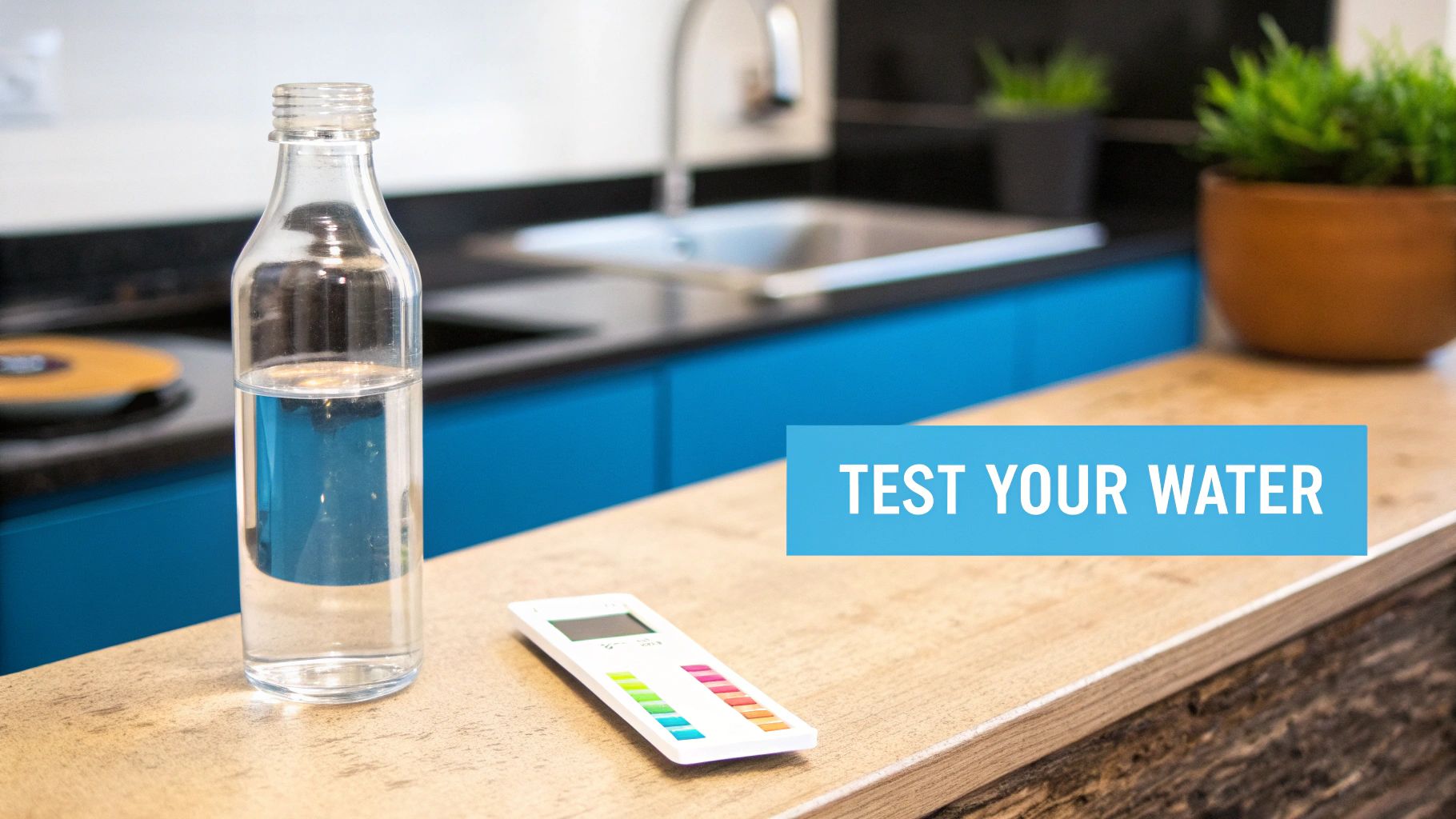
The Simple Soap Suds Test
Think of this as your five-minute hard water detective work. It's not perfectly scientific, but it’s a surprisingly good indicator that can tell you if you're on the right track.
Here's how to do it:
- Grab a clean, clear water bottle with a cap that seals tightly.
- Fill it about one-third of the way with your cold tap water.
- Add 10 drops of a pure liquid soap, like a basic Castile soap. Don't use detergents; many are designed to create suds even in the hardest water.
- Shake it like you mean it for about 15 seconds.
Now, observe the results. If the bottle is brimming with fluffy, rich suds and the water underneath is clear, congratulations—you likely have soft water. But if you’re looking at a sad, scummy film with just a few pathetic bubbles and cloudy water, you've got hard water. The soap has reacted with the calcium to create gross soap scum instead of a luxurious lather.
Getting a Precise Reading with Test Kits
The soap test tells you there's a problem, but it doesn't tell you the scale of it. To properly size a water softener or select the right filter, you need an actual number. That’s where water hardness test kits come in—they’re cheap, easy to find, and even simpler to use.
Most kits come with test strips that you just dip into a sample of your tap water. After a moment, the strip changes color. You then match that color to a chart to get a specific measurement of your water's hardness.
Pro Tip: For the most accurate reading, test cold water straight from a faucet that has no existing filtration. Your outdoor spigot or a utility sink is perfect. This gives you a true baseline of the water coming into your house before it's been treated in any way.
Understanding the Numbers: GPG vs PPM
Your test kit will show results in one of two units: grains per gallon (GPG) or parts per million (PPM). Don't let the terms intimidate you; they're just different ways of measuring the exact same thing.
- Parts Per Million (PPM): This is the same as milligrams per liter (mg/L). It simply tells you how many milligrams of calcium carbonate are present in one liter of water.
- Grains Per Gallon (GPG): This is the industry standard for water softeners in the U.S. For context, one GPG is equal to 17.1 PPM.
If your kit only shows a PPM reading, just divide that number by 17.1 to get your GPG. That GPG number is the golden ticket you'll need when you start shopping for a water softener.
The U.S. Geological Survey uses these numbers to classify water hardness, giving us a clear set of benchmarks.
| Water Hardness Level | Grains Per Gallon (GPG) | Parts Per Million (PPM) |
|---|---|---|
| Soft | 0 – 3.5 | 0 – 60 |
| Moderately Hard | 3.5 – 7.0 | 61 – 120 |
| Hard | 7.0 – 10.5 | 121 – 180 |
| Very Hard | Over 10.5 | Over 180 |
Once you have your GPG, you’ve got the most critical piece of the puzzle. Generally, if your water tests at 7 GPG or higher, investing in a system to remove calcium is going to make a noticeable, life-improving difference in your home.
Whole-House Water Softeners: The Ultimate Calcium Defense
If you're sick of fighting a losing battle against hard water in every single room, it's time to stop playing defense and bring in the heavy artillery. For a truly comprehensive, set-it-and-forget-it solution, nothing beats a whole-house water softener. This is the undisputed champion of hard water treatment, installed right where your main water line enters your home to shield every pipe, faucet, and appliance from the tyranny of scale buildup.
Think of it as a bouncer for your entire plumbing system. Its one job is to catch the troublemakers—calcium and magnesium ions—and swap them out for something far more civilized before they can cause any problems. This process is called ion exchange, and it's the gold standard for a reason.
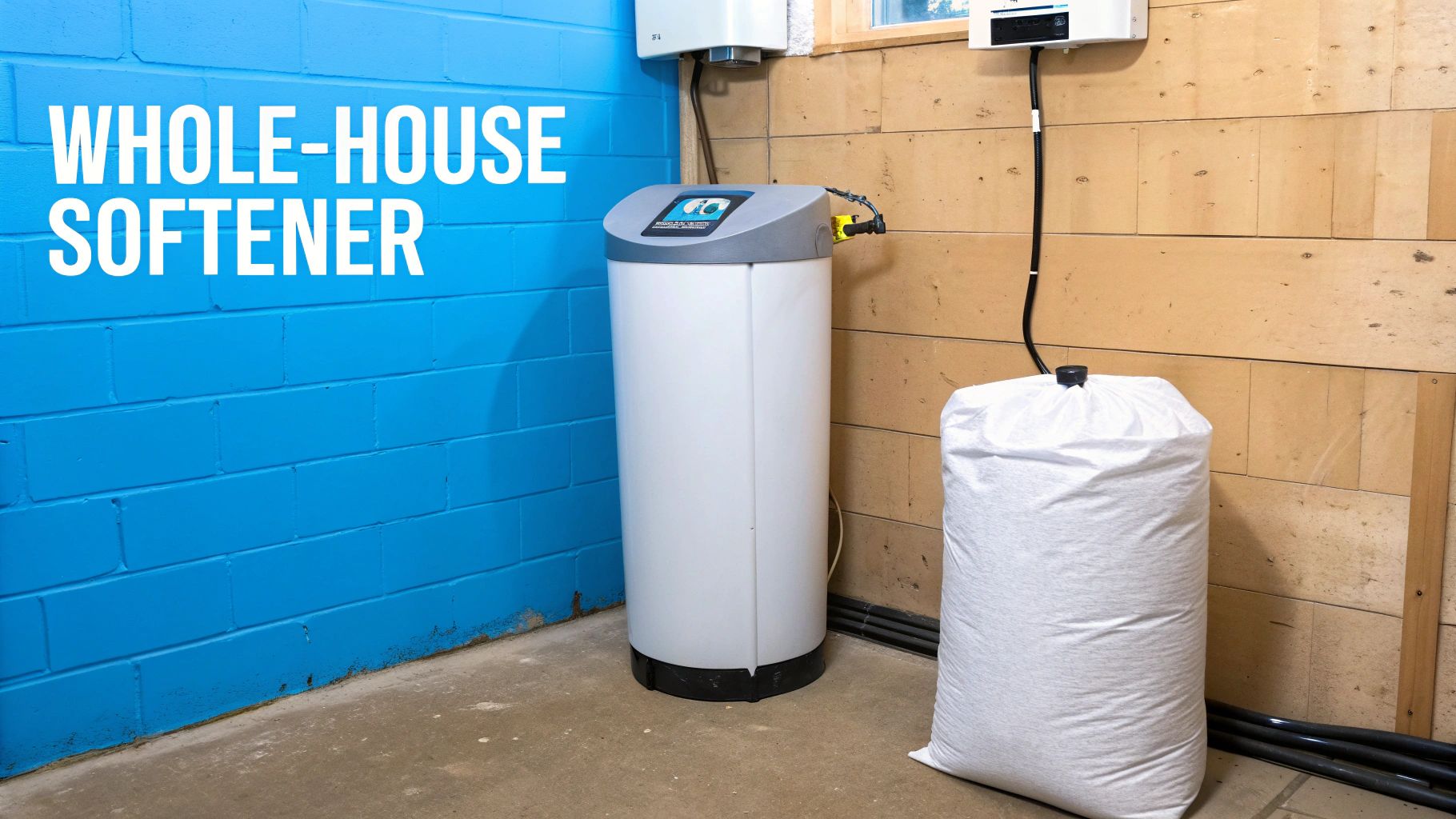
So, How Does This Ion Exchange Magic Work?
Inside every salt-based water softener is a tank packed with thousands of tiny resin beads. These beads come pre-loaded with harmless sodium ions. As your hard water flows through this tank, the calcium and magnesium ions—which carry a stronger positive charge—are magnetically drawn to the resin beads.
They literally kick the sodium ions off the beads and take their place. The newly "softened" water, now carrying the sodium ions, flows right on into your house. It’s a simple, elegant trade that happens millions of times as water passes through the system.
This process continues until the resin beads are completely saturated with calcium and magnesium, with no more sodium left to trade. At that point, the softener kicks into a self-cleaning mode called regeneration.
The Regeneration Cycle: What to Expect
Regeneration is just the softener’s way of hitting the reset button. The system automatically flushes the resin tank with a brine solution—a mix of salt and water from a separate tank. This concentrated saltwater bath washes away all the captured calcium and magnesium, sending them harmlessly down the drain.
This process recharges the beads with a fresh supply of sodium ions, getting them ready to soften more water. It’s usually programmed to happen in the middle of the night, based on your water hardness and how much water your family uses.
Your only job? Keep the brine tank topped up with water softener salt. Depending on your system and water quality, you might only need to add a new bag of salt every month or two. It’s a tiny bit of maintenance for total home protection.
Sizing Your System for Peak Performance
Picking the right size softener is absolutely critical. If it’s too small, it will constantly be regenerating, wasting salt and water. If it's too big, you’ve overspent, and it can lead to other issues.
Sizing boils down to two key numbers:
- Your Water Hardness: Measured in grains per gallon (GPG), which you found with your water test.
- Your Daily Water Usage: A solid estimate is 75 gallons per person, per day. A family of four would use about 300 gallons daily.
To figure out your daily softening needs, just multiply those two numbers.
Here’s a quick example:
Let's say a family of four has water with 15 GPG of hardness.4 people x 75 gallons/person = 300 gallons per day300 gallons x 15 GPG = 4,500 grains of hardness to remove daily.
This number tells you how much work the softener has to do each day. Softeners are rated by their grain capacity (e.g., 32,000-grain), which is how many grains they can remove before needing to regenerate. A perfectly sized system should only need to regenerate about once a week.
Investing in a whole-house system is a big move, but it provides a definitive answer to the hard water problem. For those wanting to dig deeper, exploring guides on the best whole house water filtration system for your home can provide even more context. A properly chosen softener will protect your home, save you money on appliance repairs, and improve your daily life—from softer skin to cleaner, brighter clothes.
Targeted Purity with Point-of-Use Filtration
What if your biggest headache isn't protecting your entire plumbing system, but just getting a great-tasting, clean glass of water from the kitchen sink? Maybe you're renting and can't install a big whole-house system, or perhaps you just don't see the point in treating the water you use to flush toilets.
This is exactly where point-of-use (POU) filtration shines.
Instead of a broad, house-wide approach, POU systems are like sharpshooters. They focus on a single faucet—usually in the kitchen—to give you exceptionally pure water right where you need it for drinking and cooking. When the goal is specifically how to remove calcium from water you're going to consume, the hands-down winner is a reverse osmosis system.
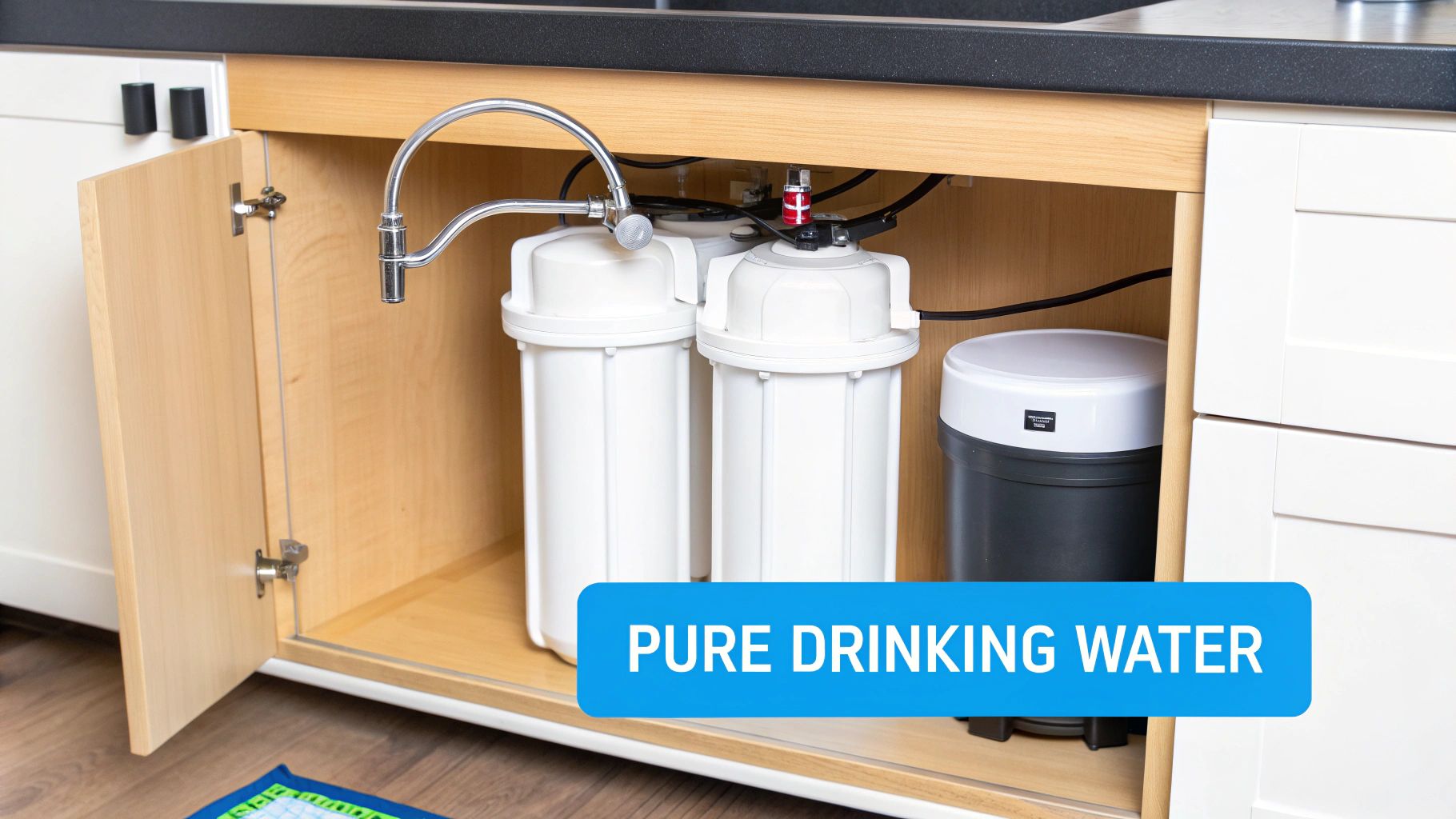
Reverse Osmosis: The Under-Sink Powerhouse
A reverse osmosis (RO) system is a multi-stage workhorse that typically lives in the cabinet right under your kitchen sink. This isn't your average pitcher filter; it's in a whole different league.
The magic happens at its semi-permeable membrane. Think of it as a microscopic bouncer at an exclusive club—the pores are so tiny that only water molecules are on the VIP list.
When your tap water is pushed against this membrane, the water molecules squeeze through to the clean side. Everything else—calcium, magnesium, lead, chlorine, and a whole host of other dissolved solids—gets rejected and washed down the drain. The result is stunningly pure water, with up to 99% of all contaminants stripped away.
Reverse osmosis doesn't just soften water; it purifies it. A water softener simply swaps calcium ions for sodium ions. An RO system physically removes the calcium completely, along with nearly everything else.
This makes RO the perfect fix if your goal is bigger than just fighting limescale. You get water that's not only free from hardness minerals but also tastes incredibly crisp and clean because all the other gunk affecting flavor and odor is gone, too.
How an RO System Works Under Your Sink
It helps to know what's going on inside the unit to appreciate its power. A typical under-sink RO system follows a few key steps:
- Pre-Filters: Before the water even gets near the main membrane, it flows through sediment and carbon pre-filters. These are the bodyguards, catching big stuff like rust, dirt, and chlorine, which protects the delicate RO membrane from getting clogged or damaged.
- The RO Membrane: This is where the real heavy lifting happens. Water pressure forces H₂O molecules through the membrane, leaving the calcium ions and other impurities behind to be flushed away.
- Storage Tank: The RO process is slow and steady, so the purified water collects in a small pressurized tank. This gives you a ready supply of clean water the moment you open the tap.
- Post-Filter: As a final touch, water from the tank passes through one last carbon filter on its way to your glass. This "polishing" filter removes any potential lingering tastes or odors from the tank.
All of this is hooked up to a sleek, dedicated faucet right on your sink. It’s the perfect setup for filling a water bottle, making coffee, or cooking pasta with water you know is as clean as it gets.
What About Water Distillers?
Another POU method that gets rid of calcium is distillation. A water distiller works by boiling water into steam, which leaves all the minerals and contaminants behind. The steam is then cooled and condensed back into pure liquid water.
Distillation is incredibly effective—it produces some of the purest water you can get. For day-to-day use in a home, though, distillers have some real-world drawbacks compared to RO systems.
| Feature | Reverse Osmosis (RO) | Water Distiller |
|---|---|---|
| Speed | Instant access from a tap | Slow; takes hours to make a gallon |
| Convenience | On-demand water | Batch process; you have to fill it |
| Energy Use | Uses water pressure | Needs electricity to boil water |
| Installation | Under-sink plumbing | Sits on your countertop |
While distillation is a great technology, its slow, batch-by-batch process just isn't practical for a busy kitchen that needs clean water now. For most homeowners who want to remove calcium for drinking and cooking, the on-demand convenience of a quality RO system makes it the obvious choice.
Getting It Installed and Keeping It Running
Choosing your water filtration system is the first big win, but the job isn't done yet. Proper installation and a little bit of upkeep are what will give you years of hassle-free, calcium-free water. It's like buying a fantastic new car; you still have to change the oil to keep it running smoothly.
This is your game plan for getting everything set up correctly and keeping it in top shape, whether you're a weekend DIY warrior or you'd rather hand the job to a pro. A little effort now saves you from major headaches down the road.
Setting Up Your Water Softener
A whole-house water softener is a serious piece of equipment, and its installation is more involved than, say, a new toaster. It needs to be plumbed directly into your main water line, usually between your water meter and your water heater. This is key because it ensures every drop of water entering your home gets treated.
If you've got solid plumbing skills, you can definitely tackle this yourself. But if you're even a little hesitant, call a plumber. A pro can get it done in a few hours, guaranteeing no leaks and a perfect setup from the start.
Once it's in, your most important job is to program the regeneration schedule. This is the automatic cleaning cycle where the system flushes out the collected minerals and recharges itself. Most modern softeners have a simple digital interface where you'll enter two numbers:
- Your Water Hardness (GPG): That number you got from your water test.
- The Number of People in Your Home: This helps the system estimate your daily water use.
With that info, the softener figures out the best time to regenerate—usually in the dead of night. Nailing this setting is critical for efficiency. It keeps the system from wasting salt and water by regenerating too often, or worse, not regenerating enough and letting hard water sneak through.
The Simple Routine of Softener Upkeep
After that initial setup, you’ll be pleasantly surprised by how low-maintenance a water softener is. Your main responsibility is just keeping the brine tank topped up with the right kind of salt.
- Check Salt Levels: Once a month, just pop the lid and take a peek. As a rule of thumb, you always want the salt level to be higher than the water level.
- Watch for "Salt Bridges": Every now and then, a hard crust can form over the top of the salt pile. This "bridge" stops the salt from dissolving into the water below. If the salt level hasn't budged in a while, give the side of the tank a gentle whack or use a broom handle to break up the crust.
And that’s about it. A well-maintained softener can easily last 15 years or more, quietly protecting your pipes and appliances from the shadows.
Pro Tip: Check your softener’s manual for its preferred salt type. Some newer high-efficiency models work best with purer salt pellets, while others are perfectly happy with the less expensive salt crystals.
Installing and Maintaining an RO System
Putting in an under-sink reverse osmosis (RO) system is a much more common DIY project. The kits usually come with everything you need and clear instructions. You’ll be tapping into your cold water line, drilling a small hole in your countertop for the dedicated RO faucet, and connecting the various filter housings and the storage tank.
The most important part of owning an RO system is sticking to the filter replacement schedule. An RO system is only as good as its filters, and if they get clogged, performance will plummet.
| Filter Type | Typical Replacement Schedule | What It Does |
|---|---|---|
| Sediment Pre-Filter | Every 6-12 months | Catches the big stuff like rust, sand, and dirt. |
| Carbon Pre-Filter | Every 6-12 months | Removes chlorine, which can destroy the RO membrane. |
| RO Membrane | Every 2-4 years | This is the heart of the system; it removes the calcium. |
| Carbon Post-Filter | Every 12 months | Gives the water a final "polish" for a clean taste. |
Put these dates on your calendar or set a reminder on your phone. Swapping filters on time is the number one thing you can do to ensure your RO system keeps delivering pure, great-tasting water. If you notice the water pressure from your RO faucet starting to drop, that's a classic sign a filter change is overdue.
Got Questions About Getting Rid of Calcium? We've Got Answers.
Even after doing your research, a few questions can still bubble up. That’s completely normal. When you’re dealing with something as vital as your home’s water, you want to be 100% sure you're making the right call. Let's tackle some of the most common things homeowners ask when they're figuring out how to remove calcium from their water.
Getting straight answers now means you won't have any surprises later. You can move forward feeling confident you’ve picked the best solution for your house and family.
Will a Water Softener Make My Water Taste Salty?
This is probably the number one concern we hear, but the short answer is no. The ion-exchange process adds a very small amount of sodium, not table salt (sodium chloride). The amount is directly tied to your water's hardness—the harder the water, the more sodium is needed to soften it.
Honestly, for most people, the amount of sodium is less than what’s in a single slice of white bread. The vast majority of people never even notice a change in taste.
Worried because you're on a strict low-sodium diet? You've got options. You can use potassium chloride pellets instead of sodium chloride. Another popular route is to pair your softener with an under-sink reverse osmosis system for drinking and cooking water, which will remove that added sodium anyway.
Can I Just Use a Standard Water Filter Pitcher to Remove Calcium?
It’s a great question, but unfortunately, those popular fridge pitchers are the wrong tool for this job. They typically use activated carbon filters, which are fantastic for making water taste and smell better by removing things like chlorine.
But they do absolutely nothing to remove dissolved hard minerals like calcium and magnesium. To really get rid of the minerals causing that crusty limescale, you need a system specifically designed for it, like an ion-exchange water softener or a reverse osmosis filter.
Is It Bad for Me to Drink Hard Water with Calcium in It?
Health-wise, drinking hard water is perfectly safe. In fact, your body needs essential minerals like calcium and magnesium to function properly. The whole reason for removing calcium from water has nothing to do with health—it's all about protecting your home and making your life easier.
The real problems caused by hard water are mechanical and cosmetic:
- Limescale buildup that ruins appliances and clogs up your pipes.
- Annoying spots and a filmy residue on your dishes, shower doors, and faucets.
- Dry, itchy skin and hair that feels dull and brittle because of soap scum.
At the end of the day, people install these systems to stop expensive damage to their homes and to make daily tasks like cleaning and showering a whole lot more enjoyable.
Figuring out the world of water filtration can seem like a lot, but Water Filter Advisor is here to keep it simple. We create clear, research-backed guides to help you land on the perfect solution for your home's unique water needs. Check out our in-depth reviews and expert advice at https://www.waterfilteradvisor.com to get safer, better-tasting water today.
- December 9, 2025
- 0
- Uncategorized
