Ever turn on your tap and get a whiff of a public swimming pool? Or notice your "clean" dishes have weird, chalky spots? You're not alone. When you're on the hunt for one of the best whole house water filtration systems, you’ll discover they are multi-stage powerhouses designed to tackle everything from chlorine and sediment to a whole army of unwanted chemicals. Top-tier systems like SpringWell's CF1 are the workhorses of the water world, boasting impressive flow rates and filters that last for what feels like forever.
The whole point of these systems is simple but brilliant: make sure every single tap in your house—from the kitchen sink to the shower—pours out clean, safe, and fantastic-tasting water.
Why Every Tap in Your Home Deserves a Guardian
Imagine a single, powerful security checkpoint for all the water entering your home. It’s a bouncer at the door that makes sure every last drop is purified before it ever reaches your family. That’s the genius behind a whole house water filtration system. It moves way beyond a dinky pitcher filter and instead treats everything right at the source.
When you take this approach, you're doing more than just improving the taste of your drinking water. You're fundamentally changing your relationship with water all through your house. Every time you cook, clean, shower, or do laundry, you're using healthier, cleaner water. It's a total home upgrade.
The Growing Demand for Cleaner Water
Let's be honest, people are more aware than ever about what's actually flowing through their pipes. There are real concerns about the byproducts of city water treatment, like chlorine, not to mention sneaky contaminants like lead or nasty industrial chemicals. This isn't just a small trend anymore; it's a full-blown movement of homeowners wanting to take control of their water quality.
You can see this shift in the market's explosive growth. The global water filtration market, currently valued at around $14 billion, is expected to skyrocket to nearly $35 billion by 2034. That kind of growth tells you one thing: families everywhere are demanding safer, more reliable water. If you want to dive deeper, you can discover more insights about the whole house filtration market trends and see why so many people are making the switch.
For a quick visual, this infographic breaks down how a whole house system works in a really straightforward way.
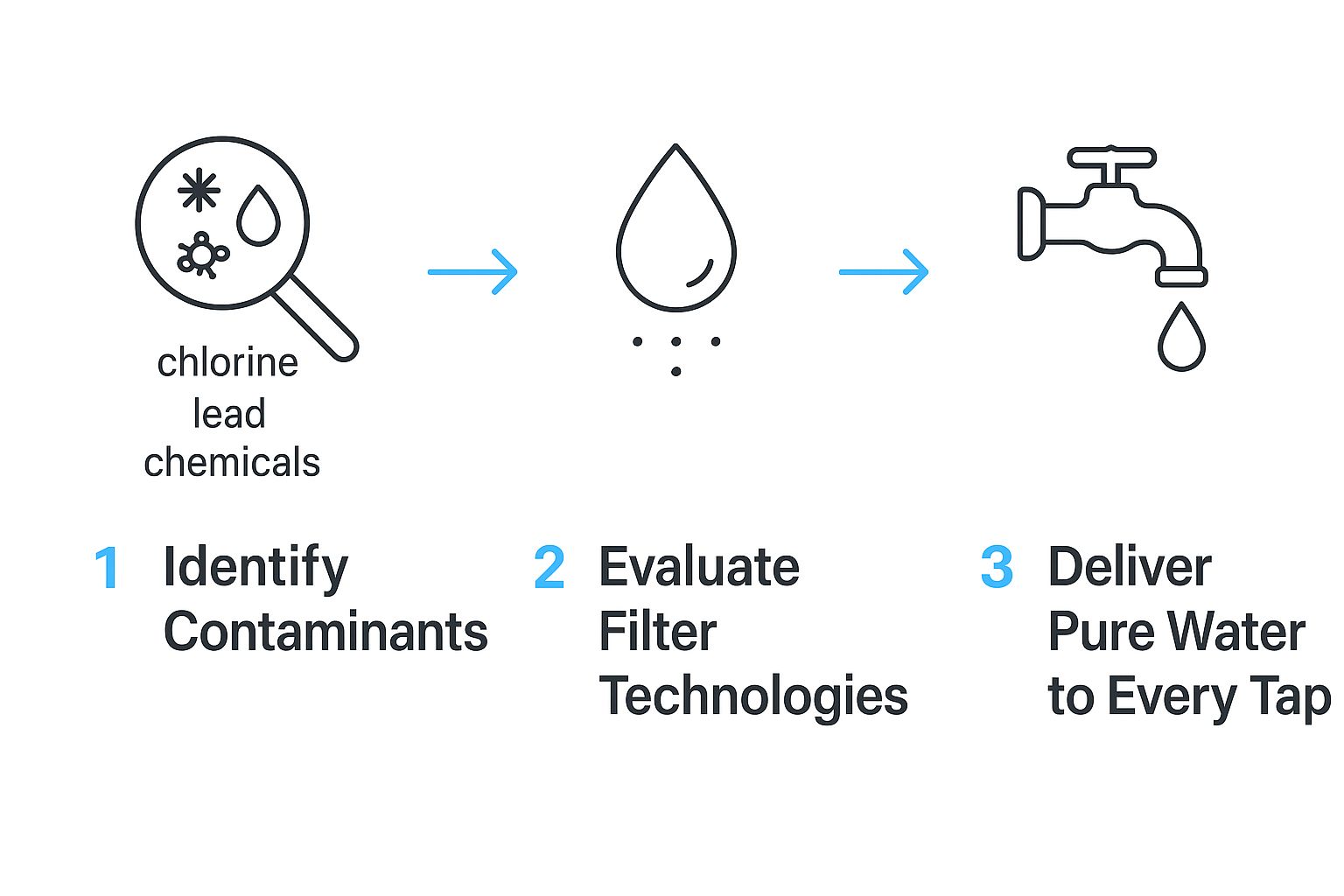
As you can see, the process is logical. It starts by figuring out what gunk is in your water, then uses the right filter technology to get rid of it, and finally sends that purified water to every tap in your house.
To give you a snapshot of what these systems bring to the table, here's a quick rundown of the main benefits.
Key Benefits of Whole House Water Filtration
| Benefit Area | Impact on Your Home |
|---|---|
| Health & Safety | Reduces exposure to contaminants like chlorine, lead, and pesticides in drinking, cooking, and bathing water. |
| Appliance Longevity | Prevents sediment and scale buildup, extending the life of water heaters, washing machines, and dishwashers. |
| Better Skin & Hair | Filtering out chlorine and other harsh chemicals can lead to softer skin and healthier, less brittle hair. |
| Improved Taste & Odor | Eliminates the chemical taste and smell common in municipal water, making everything from coffee to pasta taste better. |
| Cost Savings | Dramatically reduces or eliminates the need for bottled water, saving you money and reducing plastic waste. |
Ultimately, a good system improves nearly every aspect of how you use water at home.
A whole house system is more than an appliance; it's an investment in your home's infrastructure and your family's well-being, providing peace of mind with every glass you drink and every shower you take.
This guide is your complete roadmap to pure water. We'll cut through the marketing noise and technical jargon to help you pick the best whole house water filtration system for your home and your family. We’ll get into how the different technologies work, what features really matter when you're choosing, and how to understand the true cost over the long haul.
How a Whole House Filter Actually Cleans Your Water
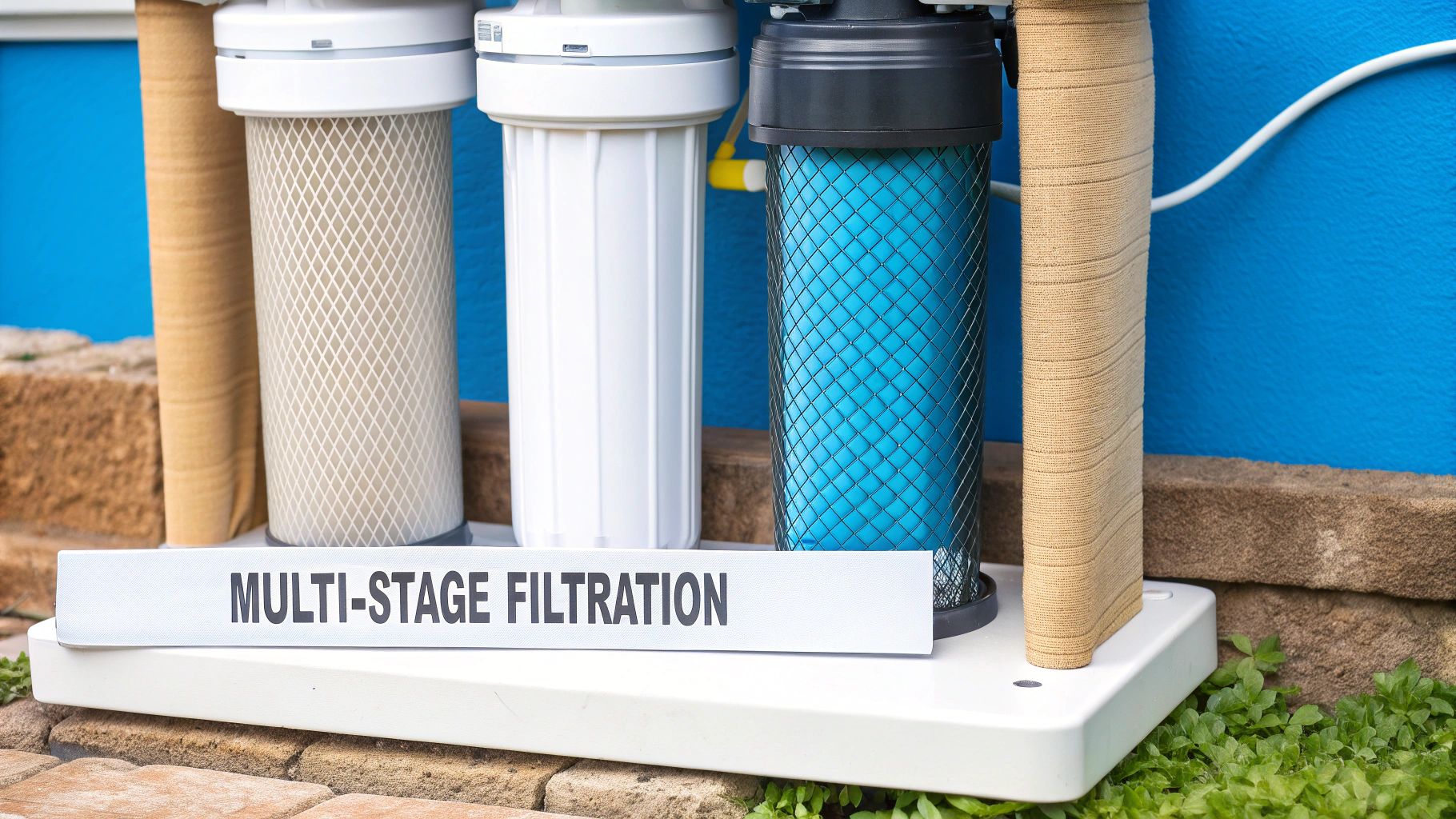
Ever wondered what's really going on inside one of these systems? It's not magic, but it’s a pretty smart process. Think of it like a high-tech car wash for your water. Before a single drop enters your home's pipes, it has to pass through a series of checkpoints, each one designed to grab a different kind of unwanted gunk.
The whole operation is installed right where your main water line comes into the house—what plumbers call the point of entry. This is key. By treating the water here, every single tap in your house gets the good stuff, from your kitchen sink and shower all the way to your washing machine and dishwasher.
Let's walk through the journey your water takes.
Stage 1: The Sediment Pre-Filter
First up is the bouncer of the system: the sediment filter. Its job is simple but absolutely critical—it catches all the big, clunky stuff.
This first line of defense is all about trapping the physical particles you can sometimes see, the things that make water look cloudy and can wreck your pipes and appliances over time.
- Rust Flakes: Little bits that break loose from old city mains or even your own plumbing.
- Sand and Silt: Super common in well water, but can show up in city water, too.
- Dirt and Debris: Pretty much any other solid junk that has hitched a ride in your water supply.
By yanking these larger particles out from the get-go, the sediment filter acts as a bodyguard for the more sensitive and expensive filters that come next. Without it, those finer filters would get clogged up in no time, making them less effective and forcing you to replace them way too often. Most of these sediment filters need to be swapped out every 6 to 9 months, depending on how much sediment is in your water.
Stage 2: The Carbon Filter Workhorse
Once the water is clear of the big debris, it flows into the main event: the main filtration tank. This is usually packed with a high-grade activated carbon, and it's where the real heavy lifting happens, especially if you're on city water.
Carbon is a master of a process called adsorption. Don't confuse it with absorption. Think of it more like a powerful magnet for chemicals. The carbon itself is incredibly porous, giving it a massive surface area to trap and hold onto chemical contaminants as water passes through.
The number one target for these carbon filters is chlorine. It's used in over 98% of U.S. public water systems to kill germs, but it’s also what gives your tap water that "public pool" smell and taste.
A good catalytic carbon filter will remove up to 99.6% of chlorine and its cousin, chloramine, which makes a huge difference in how your water tastes and smells. But it doesn't stop there. This stage also does a fantastic job of reducing:
- Pesticides and Herbicides
- Industrial Solvents
- Volatile Organic Compounds (VOCs)
- Trihalomethanes (TTHMs), which are nasty byproducts from the disinfection process.
The best part? The carbon media in this main tank is the heart of the whole system and it's built to last. We're talking a lifespan of 1,000,000 gallons or up to 10 years before you even have to think about replacing it. It's a true set-it-and-forget-it solution for better water.
Stage 3: Optional Specialized Treatments
For a lot of folks, those first two stages are all they need for pristine home water. But if you have specific water headaches, especially with well water or ridiculously hard water, you can add specialized stages to the mix.
- UV Purifiers: You can add an ultraviolet (UV) light chamber to the end of the line. It's a chemical-free way to zap microorganisms. The UV light scrambles the DNA of bacteria, viruses, and cysts, making them completely harmless before they ever reach your tap.
- Water Softeners: If you're tired of hard water scale building up on everything, an ion exchange water softener can be integrated into the system. It specifically goes after the minerals that cause all that trouble, like calcium and magnesium, saving your appliances and getting rid of those annoying spots on your glassware.
By layering these stages, a whole house system gives you a complete defense, delivering water that isn't just clean, but is customized to fix exactly what’s wrong with your water.
What Really Matters When Choosing Your System
Shopping for a whole-house water filter can feel like a chore. You're hit with a dozen different brands, all making huge promises, and it’s easy to get lost in the marketing noise. But here’s the secret: the best system isn't about the flashiest brand. It's about understanding what actually makes a filter work for your home.
To cut through the hype, we're going to focus on four core pillars. Get these right, and you'll be making a smart investment instead of an expensive mistake. By the end of this, you’ll know exactly how to look past a sales pitch and find a system truly built to solve your specific water problems.
Pillar 1: Know Your Enemy (The Contaminants)
Before you can pick the right weapon, you need to know what you're fighting. Every single water source is different, carrying its own unique cocktail of contaminants. Just guessing what's in your pipes is a surefire way to waste money on a system that doesn't do what you need.
So, the very first step is to get a clear picture of your water's chemistry.
- If you have city water: Your local municipality is required to publish a Consumer Confidence Report (CCR) every year. This is a great starting point, as it lists everything they test for and whether any contaminants are pushing legal limits.
- If you have well water (or just want the full story): A home water test kit is your best bet. These give you precise readings on everything from chlorine and lead to iron and pH, essentially creating a detailed blueprint of what's flowing from your taps.
Once you know exactly what’s in your water, then you can find a filter specifically designed to take it out.
Pillar 2: Master Your Flow Rate
Ever jump into what you thought would be a great shower, only to be met with a weak, dribbling disappointment? A low flow rate is usually the culprit, and picking the wrong filter can make it so much worse.
Flow rate is measured in gallons per minute (GPM), and it’s one of the most critical specs people overlook.
Think of it this way: your plumbing is a highway, and water is the traffic. A filter with a low GPM rating is like shutting down a few lanes during rush hour. The moment you run the dishwasher, a shower, and a sink at the same time, you get a traffic jam. The result? Your water pressure tanks.
To keep things flowing smoothly, pick a system with a GPM rating that can handle your home's peak demand. A house with 1-3 bathrooms generally needs a system that can push at least 10 GPM. For larger homes, you'll want to look for 15 GPM or more to maintain that strong, steady pressure everywhere.
Pillar 3: Decode the Filter Media
The real magic of filtration happens inside the tank, within the filter media. Different materials are engineered to grab different contaminants. Knowing what they are and what they do is how you match a system perfectly to your water test results.
Here’s a quick rundown of the main players:
- Catalytic Activated Carbon: This is the industry workhorse. It's fantastic for pulling out chlorine, chloramine, pesticides, and other chemicals that give water that "off" taste and smell. Its surface is incredibly porous, acting like a magnet for chemicals.
- Kinetic Degradation Fluxion (KDF): Often paired with carbon, KDF is a mix of copper and zinc. It’s a beast when it comes to removing heavy metals like lead and mercury. As a bonus, it also stops bacteria and algae from growing inside your filter tank.
- Sediment Filters: This is your first line of defense. These filters are designed to catch the big stuff—dirt, rust, sand, and sediment. By trapping these particles upfront, they protect the more sensitive filter stages from getting clogged.
- Ion Exchange Resin: If you have hard water, this is what you need. This is the heart of a water softener, designed specifically to grab the minerals like calcium and magnesium that cause scale buildup.
The best systems out there will use a combination of these, creating a multi-stage defense against whatever's in your water.
Pillar 4: Trust, but Verify with Certifications
So, how do you actually know if a filter does what the box says it does? That's where third-party certifications come in. They are your proof of performance, confirming a system has been put through the wringer to meet strict, independent standards.
The gold standard to look for is NSF/ANSI (National Sanitation Foundation/American National Standards Institute).
- NSF/ANSI 42: This certifies a system reduces aesthetic issues—things like chlorine taste and odor.
- NSF/ANSI 53: This is a much tougher standard. It verifies the filter reduces health-related contaminants, including lead, cysts, and certain industrial chemicals (VOCs).
- NSF/ANSI 401: This one addresses "emerging contaminants," like trace amounts of pharmaceuticals and pesticides that are becoming more common.
Before you buy, always check the product's official specs for these certifications. It’s the single best way to know you're putting your money into a system that will deliver on its promise of cleaner, safer water. This demand for proven performance is a big deal; a recent analysis shows the whole-house water purifier market is on track to hit $16.91 billion, largely because more people are concerned about water quality. You can read the full research about water purifier market trends to get the details.
Comparing the Top Types of Whole House Systems
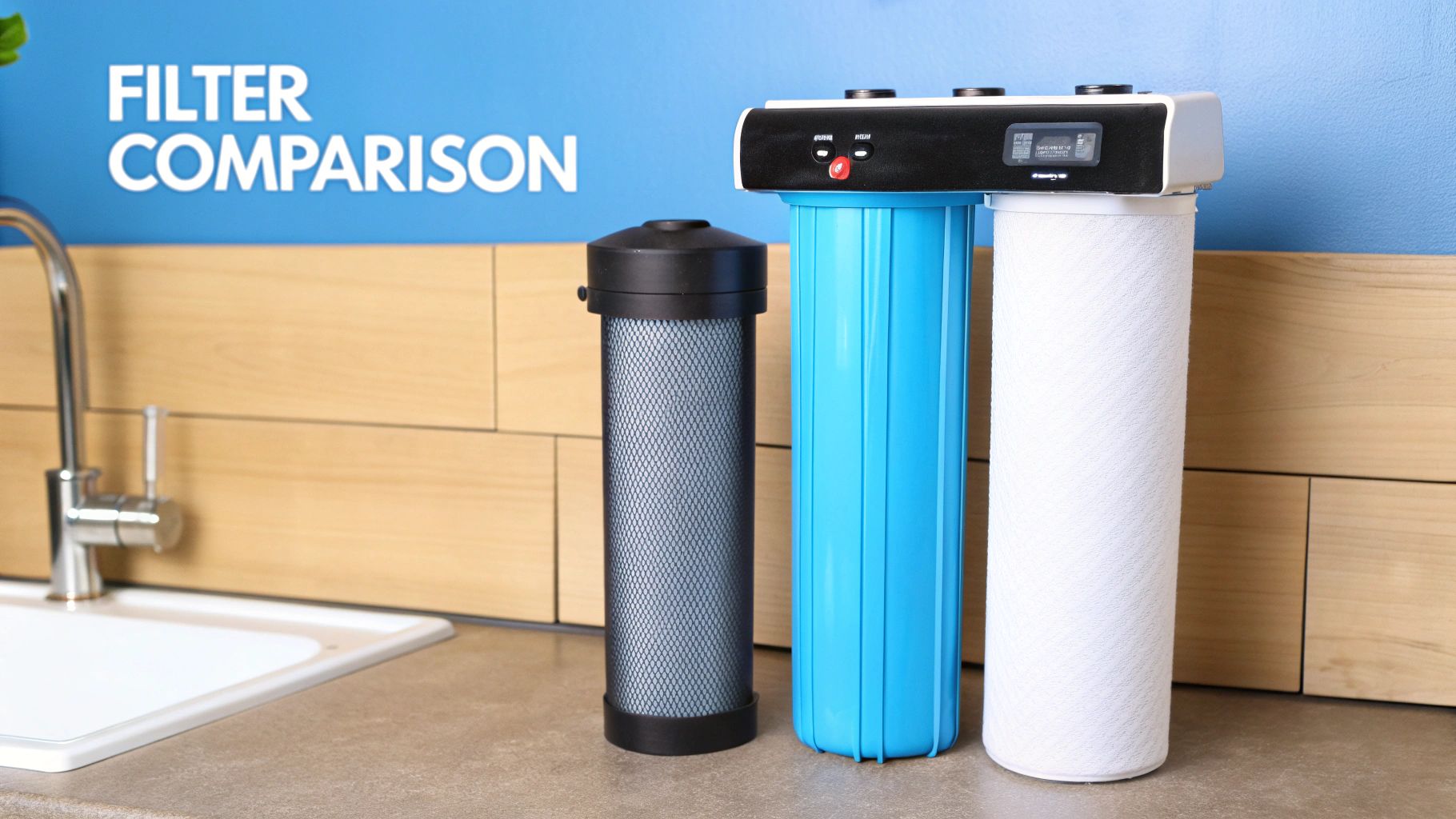
Picking the best whole house water filter isn't a one-size-fits-all deal. Honestly, the right system for you comes down to your water source and the specific problems you're trying to fix. Not all filters are created equal, and choosing the right type of system is the single most important decision you'll make.
Let's break down the three main players in the home filtration game. Each one is built for a different battle—whether you're dealing with chemically-treated city water, mineral-heavy hard water, or the unique curveballs that come from a private well. Understanding their strengths and weaknesses will help you zero in on the perfect fit for your home.
Multi-Stage Carbon Filters: The City Water Champion
For the vast majority of people hooked up to a municipal water supply, a multi-stage carbon filter is your best bet. Think of it as the ultimate chlorine-killer. Cities treat water with chlorine or chloramine to keep it safe on its way to you, but those chemicals often leave behind a funky taste and smell.
These systems are absolute masters at getting rid of those aesthetic issues, making your water taste and smell fresh and clean again.
- What they remove best: They nail chlorine and chloramines, getting rid of over 99% of them. They're also great at pulling out things like pesticides, herbicides, and other volatile organic compounds (VOCs).
- Maintenance: This is a huge win. The main carbon media can last for 1,000,000 gallons or up to 10 years. All you have to do is swap out the inexpensive sediment pre-filter every 6-9 months.
- Cost: In general, these are the most affordable whole-house systems out there, offering incredible value for anyone on city water.
Water Softener Combination Systems: The Hard Water Hero
If you're seeing chalky buildup on your faucets, can't get your soap to lather, and find spots all over your clean dishes, you've got hard water. The culprit is a high concentration of minerals like calcium and magnesium. A standard carbon filter won't touch this stuff; you need a system specifically designed to fight minerals.
A water softener combination system does just that. It's a two-in-one setup that pairs a powerful carbon filter with an ion-exchange water softener. First, the carbon filter strips out chemicals like chlorine, and then the softener gets to work removing the hard minerals.
This integrated approach not only improves taste and odor but also protects your entire plumbing system and water-using appliances from the damaging effects of scale buildup.
Specialized Well Water Systems: The Rural Guardian
Well water is a completely different ballgame. It's untreated, which means it can have a wild mix of contaminants coming straight from the ground. Common culprits include high levels of iron that stain your sinks and tubs, hydrogen sulfide that gives off that "rotten egg" smell, manganese, and even potentially harmful bacteria.
A standard carbon filter just isn't built for this kind of job. Specialized well water systems are the heavy-duty units you need for these specific issues.
- Iron and Manganese: Many use what's called an air-injection oxidation (AIO) process to literally force these minerals out of the water. Systems like the SpringWell WS1 can remove up to 7 PPM of iron and 8 PPM of hydrogen sulfide.
- Bacteria and Viruses: Since well water isn't disinfected, pairing the system with a UV purifier is a must-have to neutralize any microbiological threats.
- Maintenance: You'd think these beefy systems would be a pain, but they're surprisingly low-maintenance. Many have an automatic backwash cycle that cleans the filter media on its own, so there are often no filters to replace.
To make the choice even clearer, let's put the key facts side-by-side.
Comparison of Whole House Filtration System Types
Here’s a quick-glance table to help you compare the main system types based on what they do best, what they remove, and what you can expect for upkeep.
| System Type | Best For | Primary Contaminants Removed | Average Maintenance |
|---|---|---|---|
| Multi-Stage Carbon | Homes with city/municipal water | Chlorine, chloramine, pesticides, VOCs, sediment | Replace pre-filter every 6-9 months; main media lasts 5-10 years. |
| Softener Combo | Homes with hard water (city or well) | Hard minerals (calcium, magnesium), chlorine, sediment | Same as carbon filter, plus the need to occasionally add salt to the brine tank. |
| Well Water System | Homes using private well water | Iron, manganese, sulfur, sediment, bacteria (with UV) | Often self-cleaning with automatic backwash; no regular filter changes. |
Ultimately, this chart should give you a solid starting point. Pinpoint your water source and your main complaints, and you'll be well on your way to choosing the right solution.
Understanding Installation, Maintenance, and Long-Term Costs
Buying one of the best whole house water filtration systems is really just the beginning. To make a smart investment, you have to look past the sticker price and understand what you're really signing up for—from installation to keeping it running year after year.
Taking an honest look at these long-term factors helps you budget properly and avoids any nasty surprises later on.
DIY vs. Professional Installation
Your first big decision is how to get the system up and running. Some of the simpler, single-tank units are definitely geared toward the handy homeowner. If you're comfortable with basic plumbing like cutting pipe and fitting valves, a DIY install is totally doable.
However, for the more complex multi-stage systems, calling in a licensed plumber is usually the smart play. A pro makes sure the job is done right, meets local plumbing codes, and—most importantly—doesn't void your system's warranty. Improper installation is a real headache, with 17.3% of users complaining about leaking fittings. If you need help weighing your options, you can find more helpful advice at https://www.waterfilteradvisor.com.
The Reality of Long-Term Maintenance
Once it’s in, you have to keep up with maintenance to keep it working at its best. Think of it like an oil change for your car—it’s a non-negotiable task if you want performance and a long life. The exact schedule really depends on the system you pick.
-
Pre-Filter Changes: This is your most frequent job. The sediment pre-filter is the first line of defense and usually needs swapping out every 3 to 9 months. It’s a quick and easy task you can handle yourself.
-
Main Filter Replacement: The main filter media, typically a big carbon tank, is the workhorse. This thing is built to last. Depending on the model, it can go for 3 to 10 years or up to a specific capacity like 1,000,000 gallons.
-
Salt for Softeners: If your system includes a water softener, you'll need to top off the brine tank with salt every so often to keep it regenerating properly.
To get the most out of your system, you need to understand what's involved in its ongoing care. You can learn more about general filter replacement procedures to get a feel for the process.
Budgeting for the Total Cost of Ownership
The real cost of a whole house water filter is more than just the price you pay upfront. To get an accurate picture, you need to factor in all the expenses over the life of the system.
The total cost of ownership is a combination of the initial system price, the ongoing cost of replacement filters, and any potential fees for professional installation or maintenance.
High filter replacement costs are a major issue, with 8.9% of owners citing it as a big pain point. You can seriously lower your long-term expenses by picking a system with filters that last a long time. It’s the best way to avoid that common frustration. Proper planning ensures you invest in a system that delivers pure water without draining your wallet.
Alright, we’ve covered the "what" and "why" of whole house filtration. Now, let's get practical and look at some of the best systems on the market.
Trying to pick the right filter can feel overwhelming, so I've picked out a few top-tier models that are absolute workhorses for specific situations. Instead of just crowning one "best," these are my go-to recommendations for the most common water problems people face.
These picks are based on real-world performance, filtration power, flow rate, and long-term value. Whether you’re on city water or a private well, this should give you a solid starting point.
Best for City Water: SpringWell CF1
If you're on city water, your main battle is usually with chlorine, chloramines, and other chemicals used for disinfection. For that job, the SpringWell CF1 is tough to beat. It’s specifically engineered to target and remove those contaminants.
This thing is built to last and doesn't demand a lot of attention. It uses a smart 4-stage process, combining KDF media with catalytic carbon to get the job done right.
- Filtration Power: It’s certified to remove up to 99.6% of chlorine and chloramines. It also grabs pesticides, herbicides, and other nasty VOCs.
- Flow Rate: You get a solid 9 GPM, which is more than enough for a home with up to three bathrooms. No more weak showers.
- Filter Lifespan: The main filter media is a beast, rated for 1,000,000 gallons. For most families, that’s about 10 years of use, making it a fantastic set-it-and-forget-it investment.
The only thing you’ll need to do is swap out the sediment pre-filter every six to nine months. For city dwellers who want clean, safe water without the hassle, this is my top recommendation.
Top Choice for Well Water: SpringWell WS1
Well water is a whole different ballgame. You’re often dealing with iron, manganese, and that lovely rotten-egg smell from hydrogen sulfide. A basic carbon filter just won't make a dent. That’s where the SpringWell WS1 comes in.
This is a specialized system that uses an air-injection oxidation process to literally force those well-specific contaminants out of your water before they can stain your fixtures or make your water smell.
The WS1 is engineered to remove up to 7 PPM of iron, 8 PPM of hydrogen sulfide, and 1 PPM of manganese. This process gets rid of stains and odors without adding any chemicals to your water.
One of the best things about this system is that it cleans itself. It automatically backwashes to flush the trapped gunk down the drain and refresh its internal air pocket. That means no filters to replace, which is a huge win for a system this powerful. Plus, with a 12 GPM flow rate, it can handle larger homes without skipping a beat.
Best Softener Combo System: Aquasana EQ-1000
What if you've got both chemical contaminants and hard water scale buildup? A combo system is your best bet. The Aquasana EQ-1000 Whole House Filter & Salt-Free Descaler tackles both problems in one streamlined unit.
Water first passes through a multi-stage filter to get rid of chlorine and other chemicals. Then, it goes through a salt-free descaler to handle the hard water minerals.
- Dual Functionality: It’s proven to reduce over 97% of chlorine, while its Scale Control Media (SCM) technology conditions the water to stop minerals from clinging to your pipes and appliances.
- Eco-Friendly: Since it’s a salt-free system, it doesn't need electricity or waste water during a regeneration cycle like a traditional softener.
- Long Lifespan: Just like the SpringWell CF1, the main filter here is rated for 1,000,000 gallons or 10 years. It’s an excellent all-in-one solution for homeowners who want to solve multiple water issues at once.
Your Questions Answered
Even after doing all the homework, a few questions can still pop up when you're ready to choose a system. Let's tackle the most common ones we hear from homeowners to clear up any final confusion.
We want you to feel totally confident when you pick a whole house water filtration system for your family.
Will a Whole House Filter Kill My Water Pressure?
When it’s sized and installed right, you should not notice a drop in your water pressure. If you do run into pressure problems, it’s almost always one of two things: the system’s flow rate (GPM) is too low for your house, or the filters are clogged and need changing.
Pro Tip: Pick a system with a GPM rating that can handle your family's peak water usage. For most homes, 10-15 GPM is a solid bet to keep your showers strong and every faucet running smoothly.
How Often Do I Really Need to Change the Filters?
This is a big one, and it really depends on the type of system you have and how dirty your local water is to begin with.
Here’s a quick guide:
- Sediment Pre-filters: These guys do the initial heavy lifting. Plan on swapping them out every 3 to 9 months.
- Main Carbon Media: This is the core of the system and lasts a lot longer. You’re typically looking at 3 to 10 years of use, or up to a specific capacity like 1,000,000 gallons.
Always double-check what the manufacturer suggests for your model. It’s the best way to keep your system working like it should and protect your investment.
Can I Just Install This Thing Myself?
If you’re pretty handy and have some plumbing experience, you might be able to tackle a simpler, single-tank system. But for the more complex systems that hook right into your main water line, we strongly recommend calling a licensed plumber.
Getting it done professionally means it’s up to code, you won’t have to worry about surprise leaks, and—most importantly—it keeps your product warranty valid.
At Water Filter Advisor, our job is to give you clear, practical advice for getting safer, better-tasting water at home. Check out our guides and reviews to make your choice with complete confidence. Find the right solution for you at https://www.waterfilteradvisor.com.
- October 18, 2025
- 0
- Uncategorized
