When you’re staring down the water purifier vs reverse osmosis aisle, it’s easy to get lost in the jargon. Here’s the secret: "water purifier" is a catch-all term for anything from a simple pitcher filter to a high-tech UV light. Reverse osmosis (RO), on the other hand, is a very specific and powerful type of filtration. It's like comparing "vehicle" to "Formula 1 race car."
So, how do you choose? It all boils down to one simple question: what uninvited guests are you trying to kick out of your tap water?
Choosing Your Home Water Filtration System
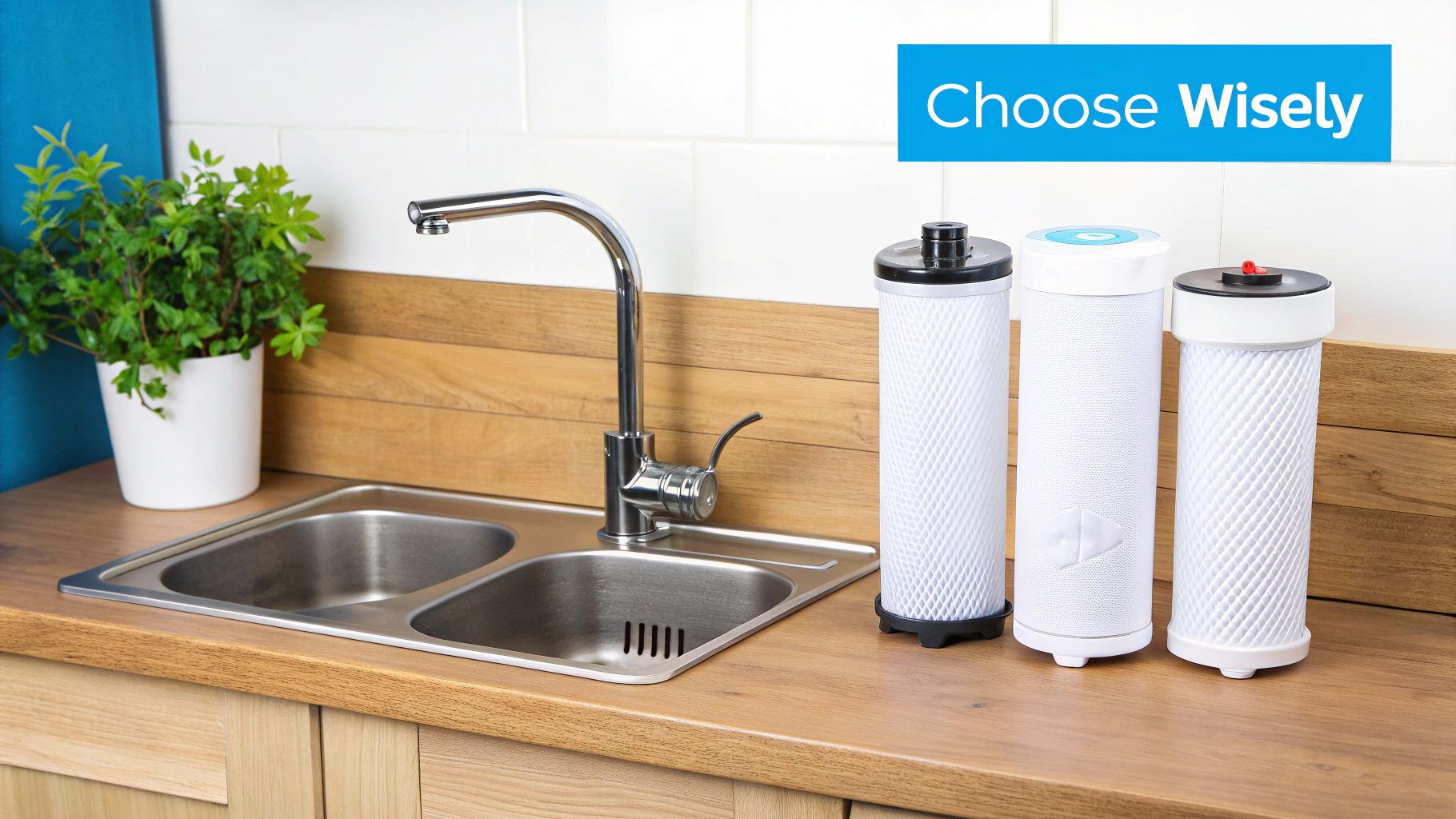
Diving into the world of home water filtration can feel like you need an engineering degree, but the goal is simple: match the right tool to your water's specific problems. Think of "water purifier" as a giant toolbox. Inside, you've got different tools for different jobs. Activated carbon filters, for instance, are the champions of taste, fantastic at banishing that swimming-pool chlorine flavor from city water. UV purifiers are like tiny bouncers, designed to zap bacteria and viruses that try to crash the party.
Reverse Osmosis, however, is the special forces of water filtration. An RO system uses some serious muscle (your home’s water pressure) to force water through an impossibly fine membrane. We're talking about microscopic pores that slam the door on a massive range of contaminants that other filters just wave on through.
Understanding the Core Differences
At its heart, the difference is all about the mission. A basic carbon filter might make your municipal water taste and smell like it came from a mountain spring, but it won’t do a thing about dissolved solids like salts or heavy metals like lead. It’s like putting a tuxedo on a pig—it looks better, but it’s still a pig.
That’s where an RO system flexes its muscles. It’s the heavyweight champion for tackling those tough, invisible contaminants that keep people up at night.
To make the right call, you have to play detective and figure out what's lurking in your water. Start by grabbing your local utility's annual water quality report. For a deeper dive, you can find more specific advice on home water filtration to pinpoint your exact needs.
To help you see the difference clearly, here’s a quick breakdown of how these two approaches stack up.
Key Differences at a Glance
This table gives you a bird's-eye view of how general purifiers and specialized RO systems compare on the most important points.
| Feature | General Water Purifiers (Carbon/UV) | Reverse Osmosis (RO) Systems |
|---|---|---|
| Primary Function | Targets specific issues like taste, odor, chlorine, or microorganisms. | Removes a broad spectrum of dissolved solids, chemicals, and heavy metals. |
| Filtration Method | Adsorption (carbon), sterilization (UV), or physical trapping (ceramic). | Pushes water through a superfine, semi-permeable membrane. |
| Best For | Improving the sensory qualities of municipally treated water. | Purifying water with high TDS, heavy metals, fluoride, or unknown contaminants. |
| Contaminant Removal | Selective; varies greatly by the specific technology used. | Comprehensive; removes up to 99% of most dissolved contaminants. |
This isn't about simply picking the most powerful system; it's about finding the right one for your home and your water.
Why This Comparison Matters
The choice isn't about which system is "better" in a vacuum, but which is better for you. RO systems are incredibly effective, and their popularity shows it. The global water purifier market was valued at USD 35.01 billion in 2024, with RO-based systems leading the pack by a wide margin.
The right water filter is a personalized solution. Your goal should be to find a system that effectively removes the specific contaminants present in your tap water without over-purifying or adding unnecessary complexity to your daily routine.
As you weigh your options, thinking about greener hydration tips and alternatives to plastic water bottles can also help guide your decision. This guide will give you the framework you need to choose with total confidence.
How Different Water Filtration Technologies Work
To really settle the water purifier vs reverse osmosis debate, you’ve got to get a handle on how these systems actually clean your water. Think of it like a toolbox—each technology is a specific tool designed for a specific job. They aren't all interchangeable, and how they work on the inside reveals their true strengths and weaknesses.
Imagine your tap water has a whole cocktail of things you'd rather not drink: sediment, chemicals like chlorine, and even microscopic bugs. Each filtration method takes a different swing at these problems, from setting up a physical blockade to triggering a chemical reaction.
The Power of Reverse Osmosis: A Molecular Sieve
Reverse Osmosis, or RO, is the heavy hitter of home water filtration. It uses your home’s water pressure to force water through a semi-permeable membrane. This membrane is the magic behind the whole process; it's a special material with pores so tiny they measure about 0.0001 microns.
That’s a hard number to picture, but it’s roughly 500 times smaller than what many standard filters can even dream of catching.
This system acts like the world's strictest bouncer. Only pure water molecules are on the guest list and small enough to pass through the membrane. Everything else—dissolved salts, heavy metals like lead and arsenic, fluoride, and even tiny viruses—gets rejected and washed down the drain. This is why an RO system can remove up to 99% of total dissolved solids (TDS).
Reverse osmosis doesn't just filter water; it purifies it on a molecular level. By physically blocking a vast range of contaminants, it produces water that is exceptionally clean, far beyond the capabilities of most other common filtration methods.
Activated Carbon Filters: The Adsorption Specialist
Activated carbon filters are probably what you picture when you think of a standard "water purifier." They are fantastic at making your water taste and smell better. Instead of a physical barrier like RO, they use a process called adsorption.
Think of an activated carbon filter as a sort of magnetic sponge for specific contaminants. The carbon is specially treated to create a massive internal surface area full of nooks and crannies. When water flows through, chemicals like chlorine and volatile organic compounds (VOCs) get stuck to this surface and are pulled out of the water.
This method is top-notch for:
- Removing Chlorine: This is the number one reason for bad taste and odor in city water.
- Reducing Pesticides and Herbicides: It effectively traps many common organic chemicals.
- Improving Overall Palatability: It just makes your tap water more pleasant to drink.
But here’s the catch: activated carbon doesn't touch dissolved minerals, salts, or heavy metals. It improves the sensory experience but doesn't purify water to the same level as RO. While we're talking about home drinking water, it's useful to understand how filter comparisons work across different applications. For example, looking at different filtration technologies and their efficiency in a pool setting can offer broader insight.
UV Purifiers: The Microbe Neutralizer
Unlike RO and carbon filters that physically pull stuff out of the water, an Ultraviolet (UV) purifier is more like a sterilizer. It uses a special lamp that blasts the water with UV-C light, a wavelength of ultraviolet radiation that’s deadly to microorganisms.
As water flows past the UV lamp, this light zaps bacteria, viruses, and protozoa like Giardia. The UV energy messes up their DNA, which stops them from reproducing and making you sick. The microbes are still technically in the water, but they’ve been rendered completely harmless.
UV is a great solution if your main concern is microbiologically unsafe water, like from a private well. But it does nothing to remove other contaminants—it won't change the taste, smell, or chemical makeup. That’s why you’ll almost always see UV systems paired with other filters, like sediment and carbon pre-filters, to provide a complete solution.
Comparing Contaminant Removal Performance
When you're trying to decide between a standard water purifier and a reverse osmosis system, performance is everything. What a filter actually takes out of your water is the only thing that really matters. This is where you see the true strengths and weaknesses of each technology, and it’s why one system might be perfect for your house while another just won't cut it.
Let's break down how Reverse Osmosis (RO), activated carbon, and UV purifiers stack up against the most common troublemakers in tap water. By comparing them side-by-side, you’ll get a crystal-clear idea of which tool is right for the job.
This simple visual shows you the core job of each of these three main filtration methods.
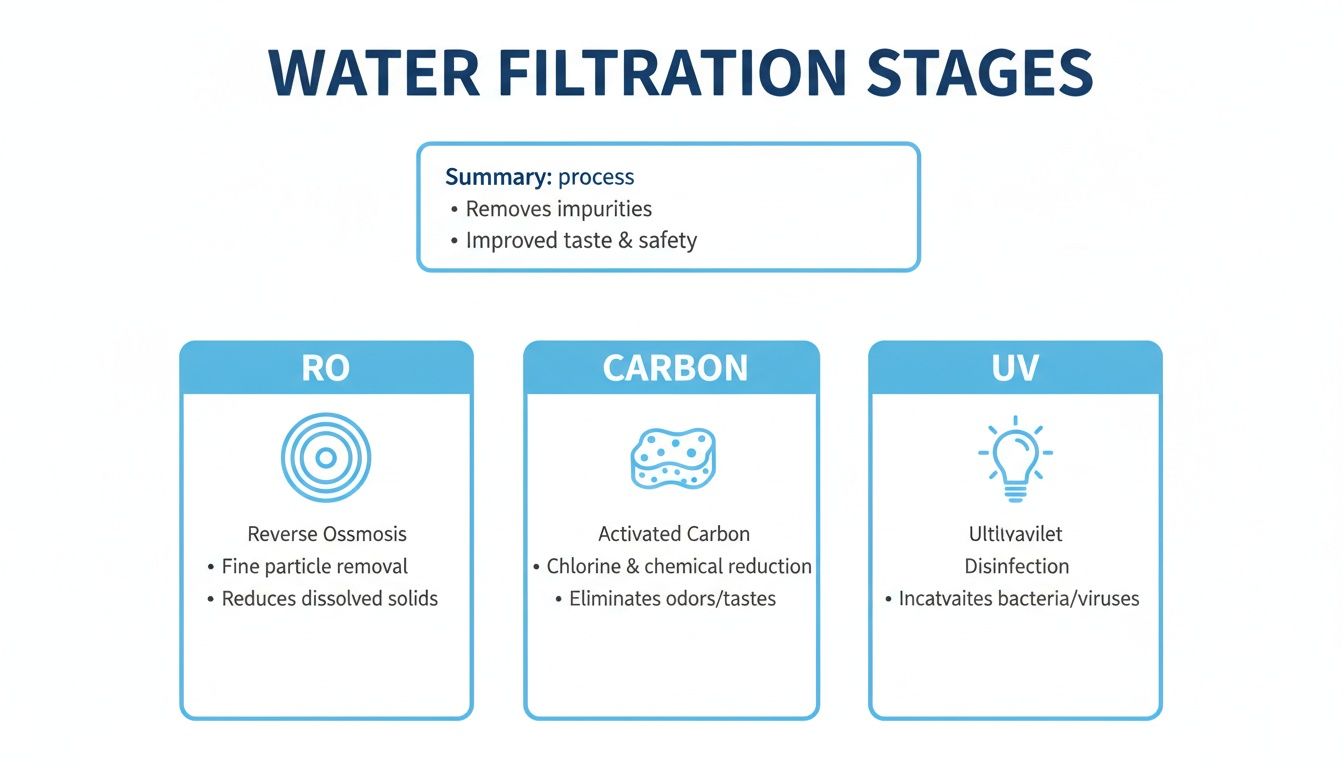
As the infographic shows, RO acts as a physical gatekeeper, carbon is like a chemical sponge, and UV is a germ-killing sterilizer. Each one solves a very different problem.
Heavy Metals and Dissolved Solids
This is where Reverse Osmosis is the undisputed champion. The semi-permeable membrane in an RO system has incredibly tiny pores—we're talking 0.0001 microns—that physically block a huge range of dissolved contaminants that other filters can't even touch.
Things like lead, arsenic, mercury, and fluoride are stopped in their tracks, with RO systems removing them at a rate of 95-99%. These systems also crush it when it comes to reducing Total Dissolved Solids (TDS), which is the catch-all term for all the inorganic salts and minerals dissolved in your water. High TDS can make water taste "off" and signals a heavy load of minerals and other stuff.
A standard activated carbon filter, on the other hand, does next to nothing for heavy metals or TDS. And a UV purifier? It has zero effect on these contaminants because it’s only designed to deal with microorganisms.
Key Takeaway: If your water report flags high TDS or shows traces of heavy metals like lead or arsenic, a Reverse Osmosis system is hands down the most effective solution you can get.
Chlorine, Taste, and Odor
Now, if you’re just trying to make your tap water taste and smell better, activated carbon filters are the clear winners. Most city water is treated with chlorine or chloramine, and while they do a great job disinfecting, they can leave behind that classic "pool water" taste and smell.
Activated carbon uses a process called adsorption, where chemical contaminants literally stick to the carbon's massive surface area. This makes it fantastic for:
- Wiping out Chlorine: It zaps that chemical taste and makes your water much more pleasant to drink.
- Grabbing VOCs: It's great at catching many pesticides and industrial chemicals (Volatile Organic Compounds).
- Fixing Funky Smells: Gets rid of any musty or earthy odors.
What’s interesting is that nearly every RO system on the market includes an activated carbon filter as a preliminary step, or pre-filter. This isn't just for taste—it’s crucial for protecting the delicate RO membrane, which chlorine can destroy. So while RO systems deliver great-tasting water, it's really the carbon filter doing the heavy lifting here.
Bacteria, Viruses, and Microorganisms
Here, the roles flip completely, and the UV purifier gets its moment to shine. If your main concern is microbiological contamination—something folks with well water or in areas with boil-water advisories know all about—then UV is the specialist you need.
A UV purifier zaps water with ultraviolet light, which effectively scrambles the DNA of bacteria, viruses, and nasty protozoa like Giardia. It sterilizes the water and makes them harmless without adding a single chemical.
An RO membrane is also excellent at removing these bugs simply because its pores are too small for them to pass through. However, RO systems aren't typically certified as a standalone disinfection method. That’s why the gold standard for microbiologically unsafe water is often a multi-stage system that pairs RO with a UV purifier to guarantee nothing gets through.
A simple activated carbon filter offers zero protection against bacteria and viruses. In fact, if you don't change it on schedule, an old carbon filter can become a breeding ground for them.
Filtration Effectiveness by Contaminant Type
To pull this all together, it helps to see a direct comparison of how each technology performs against specific water contaminants. This table lays it all out.
| Contaminant | Reverse Osmosis (RO) | Activated Carbon | UV Purifier |
|---|---|---|---|
| Total Dissolved Solids (TDS) | Excellent (99%) | Poor (No effect) | Poor (No effect) |
| Heavy Metals (Lead, Arsenic) | Excellent (95-99%) | Limited to Poor | Poor (No effect) |
| Chlorine & Chloramine | Excellent (with pre-filter) | Excellent | Poor (No effect) |
| Pesticides & VOCs | Good to Excellent | Good to Excellent | Poor (No effect) |
| Bacteria & Viruses | Excellent | Poor (No protection) | Excellent |
| Fluoride | Excellent (90-97%) | Poor (No effect) | Poor (No effect) |
Looking at performance this way makes the whole "water purifier vs reverse osmosis" debate a lot clearer. The right choice for you really comes down to knowing exactly what you need to remove from your home's water.
Weighing the Practical Costs and Maintenance
Performance numbers are great, but they don't tell the whole story. The "water purifier vs reverse osmosis" debate isn't just about what comes out of the tap; it's also about the real-world experience of living with the system day in and day out. Installation, upkeep, and running costs are where you'll really feel the difference.
Let's start with getting it set up. A lot of standard purifiers, like your basic countertop or faucet-mounted carbon filters, are about as easy as it gets. They're genuinely plug-and-play. You can have one running in five minutes, no tools needed, which is perfect if you're renting or just don't want to mess with your plumbing.
An under-sink reverse osmosis system is a different beast entirely. It's more of a project. You'll need some basic plumbing know-how to tap into your cold water line, drill a hole for a separate faucet, and install a drain saddle for the wastewater. It’s doable, but it’s definitely not a tool-free, five-minute job.
Breaking Down the Total Cost of Ownership
The price you see on the box is just the beginning. To get the real picture, you have to look at the long-term cost of replacing filters, and this is where the two options really part ways.
A simple carbon filter pitcher or faucet attachment is cheap to buy. The catch? That single cartridge doesn't last long. You'll be swapping it out every two or three months, and those replacement costs sneak up on you over a year.
A reverse osmosis system costs more upfront, no question. But its long-term costs are spread out over several filters that you change on different schedules:
- Sediment and Carbon Pre-filters: These are the workhorses, protecting the main membrane. Plan on changing them every 6 to 12 months.
- RO Membrane: This is the heart of the system. It's built to last, typically for 2 to 5 years.
- Polishing Post-filter: This last step makes the water taste great. You'll usually replace it once a year.
Even though an RO system has more components to track, the actual cost per gallon of pure water often ends up being way cheaper in the long run than buying endless cartridges or cases of bottled water.
The Question of Water Waste
Water waste has always been the big knock against reverse osmosis. Older systems were notorious for it, flushing contaminants away by sending several gallons of "reject water" down the drain for every single gallon of purified water they made.
But things have changed—a lot. Modern, high-efficiency RO systems have made huge strides. Many now use permeate pumps or booster pumps to drastically cut down on wastewater, getting the ratio much closer to 1:1. That’s one gallon wasted for one gallon purified, a massive improvement.
The efficiency of a reverse osmosis system is a key factor in its long-term cost and environmental impact. While older models were known for high water waste, today's advanced systems are engineered to be far more conservative, making them a much more practical choice for daily home use.
This leap in efficiency is a huge reason why these systems are catching on globally. In fact, the Asia-Pacific region made up nearly 40% of the world's water purifier market in 2024, with RO technology leading the charge for home use. You can see more details in the global water purifier market trends on Precedence Research. This worldwide trend shows that modern RO isn't a wasteful luxury anymore; it’s a viable, everyday solution for millions of families.
Matching a Filtration System to Your Lifestyle
Technical specs are one thing, but the real test is how a system fits into your day-to-day life. When it comes to the "water purifier vs reverse osmosis" debate, the best choice is always the one that solves your problems without creating new ones. Let's look at how the data applies to a few real-world situations to find your perfect match.
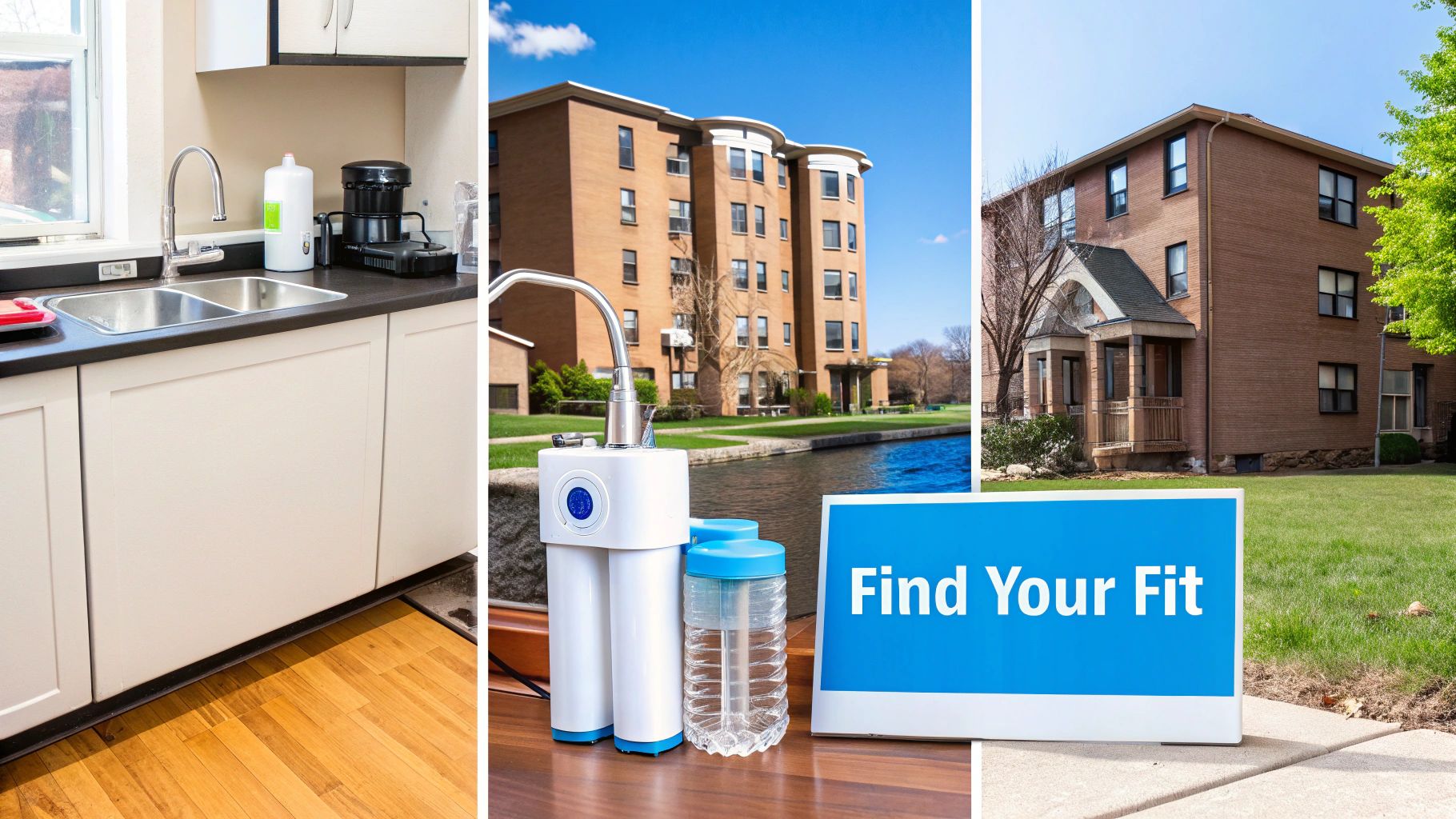
We’ll break this down by looking at three common household profiles. By seeing how different needs point to very different solutions, you'll get a clear idea of which path is right for you.
The City Apartment Renter
Let's say you're renting an apartment with city-treated water. Your biggest complaint is that strong chlorine taste and smell that messes with your morning coffee. You’re not too worried about heavy metals or bacteria, you just want water that’s more pleasant to drink.
For this situation, a quality activated carbon filter is your best bet. It's affordable, incredibly easy to install (we’re talking countertop or faucet-mount models), and doesn't require any permanent changes to the plumbing. Most importantly, it's a champ at removing chlorine and improving taste, which is exactly what you need.
An RO system would be complete overkill here. The installation is a hassle, often a non-starter for renters, and its heavy-duty filtration isn't necessary for water that's already safe to drink and low in dissolved solids.
The Suburban Family with Well Water
Now, picture a family in a suburban home with a private well. Their latest water test showed some bacteria, high iron, and a lot of other minerals (high TDS). Taste is an issue, but their number one priority is making sure the water is completely safe for the kids.
This is the classic scenario where a multi-stage system with Reverse Osmosis and UV purification is the only real answer. Here's why that combination works so well:
- Pre-filters will catch the sediment and iron, protecting the more sensitive parts of the system.
- The RO membrane will knock down the high TDS, pulling out dissolved minerals and any potential chemical runoff.
- The UV purifier is the final gatekeeper, zapping any bacteria or viruses to guarantee the water is microbiologically safe.
A simple carbon filter would be dangerously out of its league here, offering zero protection against the primary health risk—bacteria. This family needs the kind of comprehensive purification that only a combined RO and UV system can deliver.
When you're on a private well, filtration stops being about taste and starts being about safety. A multi-stage RO system isn't a luxury; it's a non-negotiable health safeguard.
The Health-Conscious Homeowner
Finally, think about a homeowner who has done their homework on their municipal water report. The water meets federal guidelines, but they're not comfortable with the legally "acceptable" levels of things like fluoride, lead from old service lines, or trace pharmaceuticals. Their goal is absolute purity and total peace of mind.
For this person, a Reverse Osmosis system is the clear winner. It's one of the only residential technologies that can reliably remove up to 99% of total dissolved solids, catching the very contaminants that other purifiers miss. We're talking about fluoride, lead, arsenic, and nitrates—all effectively eliminated.
The market for high-purity solutions like this is growing fast. Analysts predict a compound annual growth rate of 7–9% for the global water purifier market, showing that more and more people are looking for specialized solutions. You can find more details on this trend in the laboratory water purifier market report on cognitivemarketresearch.com. For the health-conscious homeowner, the powerful contaminant removal of RO is the only option that delivers the results they're looking for.
Common Questions About Home Water Filtration
Figuring out the world of home water filtration can bring up a lot of questions. As you get into the weeds of the water purifier vs reverse osmosis debate, you'll probably start wondering about the day-to-day details. Here are some clear, straightforward answers to the questions we hear most from homeowners, designed to help you make that final decision with confidence.
Do Reverse Osmosis Systems Really Take Out the Healthy Minerals?
Yes, that’s actually a core part of how RO purification works. The system's membrane is incredibly fine, designed to stop almost anything that isn't a pure water molecule. That includes beneficial minerals like calcium and magnesium. For some people, this can make the water taste a little "flat" or even slightly acidic.
But this is a well-known issue with a really simple fix. Many modern RO systems now include a remineralization filter as the very last step. This special cartridge adds a small, healthy amount of these minerals back into the water right before it hits your glass. It's a game-changer for taste and also helps raise the water's pH to be more alkaline and pleasant.
Can I Install a Reverse Osmosis System Myself?
For most people, yes. The vast majority of under-sink RO systems you can buy today are designed for DIY installation. They usually come with good instructions, color-coded tubes, and fittings that just click together. If you're comfortable with basic jobs around the house—like turning off the water under your sink and using a power drill—you can definitely tackle this on a weekend.
The biggest potential challenge is drilling the hole in your countertop for the separate RO faucet. If you have a laminate or butcher block counter, it's pretty simple.
A word of caution: if your countertop is granite, quartz, or marble, we strongly recommend hiring a professional plumber. They have the right diamond-tipped drill bits and know-how to get the job done without cracking an expensive countertop.
How Often Will I Need to Replace the Filters?
This is one of the biggest practical differences between systems, and the answer really depends on the type you choose and how good (or bad) your tap water is to begin with. Here’s a quick rundown of what to expect:
- Simple Carbon Filters (like in pitchers or on faucets): These need the most attention, usually a filter change every 2-3 months.
- Multi-Stage RO Systems: These have a staggered schedule. The first-stage sediment and carbon filters typically need to be replaced every 6-12 months. The final "polishing" filter is usually swapped out once a year. The workhorse RO membrane itself is the most durable part, lasting anywhere from 2 to 5 years.
Always check the manufacturer's specific guidelines for your model. If you have a lot of sediment or chlorine in your water, you might find yourself changing filters a bit more often.
Is an RO System Cheaper Than Bottled Water in the Long Run?
Absolutely, and it’s not even a close contest. An RO system has a higher price tag upfront, but the long-term savings are huge. Just think about the cost per gallon. A family that regularly buys bottled water can easily spend hundreds, if not thousands, of dollars every single year.
Once your RO system is in, the cost to produce a gallon of pure water is literally just pennies—that just covers the cost of your replacement filters over time. An RO system pays for itself many times over throughout its life.
And it's not just about the money. You get the incredible convenience of having unlimited pure water right at your tap. Plus, you’ll be making a massive dent in your household's plastic waste, which is a fantastic environmental win. That initial investment quickly turns into a smart, sustainable choice for both your wallet and the planet.
At Water Filter Advisor, we are committed to helping you find the perfect water filtration solution for your home. Our in-depth guides and unbiased reviews break down everything you need to know, from installation to long-term maintenance, so you can enjoy safe, great-tasting water every day. Explore our resources and take the next step toward better water at https://www.waterfilteradvisor.com.
- December 21, 2025
- 0
- Uncategorized
