So, you're ready to ditch questionable tap water and upgrade your home with a water filtration system. Fantastic choice! But the big question looms: What’s this going to cost? The truth is, it’s a bit of a choose-your-own-adventure. You could be looking at a breezy $150 for an under-sink filter you tackle on a Saturday afternoon, or you could invest upwards of $5,000 for a top-of-the-line whole-house system installed by a seasoned pro. The final bill really comes down to the system you pick and whether you're calling in the plumbing cavalry.
Your Quick Guide To Water Filter Installation Costs
Trying to pin down the water filtration system installation cost can feel like trying to guess the number of jellybeans in a jar. Are you just looking to make your kitchen tap water taste like it came from a mountain spring, or do you need a fortress-like system that purifies every drop coming into your home? Each path has a different price tag, not just for the unit itself but for the labor to get it humming along.
This guide is here to demystify the dollars and cents. We’ll walk through the typical costs for the most common types of home water filters, from small, single-faucet heroes to the big guns that guard your entire home, so you can build a realistic budget from the get-go.
A First Look at the Numbers
Before we dive into the nitty-gritty of plumber rates and filter replacements, let's get a bird's-eye view. Your initial investment is always a mix of two things: the hardware (the filter system itself) and the installation (the brains and brawn to get it working). Some simpler systems are perfect for a weekend DIY project, while others really need a professional touch to avoid turning your basement into an accidental swimming pool. If you're curious about what the pros handle, checking out their professional water filtration system services can give you a great idea of the scope of work.
Here’s a pro tip: always start with a water test. Once you know exactly what’s in your water—whether it’s just chlorine giving it a "pool party" vibe or something more complex—you can choose the right filter without paying for features you don’t need. It's the smartest first step you can take.
To make things easier, we've put together a quick comparison table. It gives you an at-a-glance look at what to expect so you can match your needs to your budget. For a deeper dive into picking the perfect system for your water quality issues, you can find some fantastic advice at Water Filter Advisor.
Estimated Installation Costs By System Type
Here’s a breakdown of what you can generally expect to pay for the most common types of water filtration systems, including both the unit and the cost of professional installation.
| System Type | Average Total Installation Cost (Materials + Labor) | Best For |
|---|---|---|
| Faucet/Shower Filter | $50 – $150 | Renters or those needing targeted chlorine and sediment removal at a single point. |
| Under-Sink Filter | $150 – $700 | Improving the taste and quality of drinking and cooking water at the kitchen sink. |
| Reverse Osmosis (RO) | $300 – $1,200 | Homeowners wanting to remove a wide spectrum of contaminants, including heavy metals and dissolved solids. |
| Whole-House System | $1,000 – $5,000+ | Families seeking comprehensive filtration for every tap, protecting plumbing and appliances from sediment and scale. |
As you can see, the range is pretty wide. A simple screw-on faucet filter is a quick and cheap fix, while a comprehensive whole-house system is a much bigger investment that protects your entire home's water supply.
Breaking Down Your Installation Quote
When a plumber hands you an installation quote, it can feel like you're trying to decipher a secret code. You see a jumble of line items, part numbers, and dollar signs, but what does it all really mean for your wallet?
At the end of the day, every water filtration system installation cost breaks down into two main buckets: the equipment itself and the skilled labor needed to get it up and running in your home. Getting a handle on this split is the first step toward really understanding what you're paying for and not just blindly trusting the numbers.
Decoding The Labor Cost Component
Labor is almost always the wildcard in any quote. A plumber's hourly rate can swing wildly from $45 to over $200, depending on where you live and their level of expertise. For a simple under-sink filter, you might only be looking at an hour or two of work, which keeps the labor cost pretty manageable.
But things can get complicated—and expensive—fast. A few common curveballs can turn a quick job into a much bigger project.
- Tricky Pipe Rerouting: If your main water line is tucked away in a cramped crawlspace or the existing plumbing looks like a plate of spaghetti, you can bet the labor hours will start to add up.
- Drilling Through Countertops: That sleek, dedicated faucet for your new reverse osmosis system looks great, but someone has to drill a hole through your granite or quartz countertop to install it. That’s a delicate job that takes extra time, skill, and a steady hand.
- Adding Pre-Treatment Systems: Have really hard water or lots of sediment? You might need a pre-filter installed ahead of your main unit, which means more parts, more connections, and more labor.
- Running Electrical: Some systems, like those with UV purifiers, need power. If there isn't an outlet handy, you might need an electrician to run a new line, adding another professional's time to the bill.
This is exactly why you should always ask for an itemized quote. Seeing a breakdown of the estimated hours helps you understand precisely where the money is going and ensures there are no surprises.
Understanding The Equipment Cost Component
The other half of the story is the system itself. The price tag on the hardware is all about the technology inside, the brand name on the box, and how much water it can handle. It’s no secret that high upfront costs are a major hurdle in the water filtration world, especially for advanced units.
While you can get a countertop reverse osmosis system installed for $100-$500 or an under-sink model for $300-$1,000, a whole-house solution can easily jump to $5,000-$12,000. Brand matters, too. A GE Pro Elite unit might run you $200-$500 for the hardware, whereas a system from a premium brand like Culligan could be anywhere from $250 to over $2,000. And that’s before you even factor in the national average labor cost of $300-$700. You can learn more about the factors influencing reverse osmosis system costs and see how they stack up.
By understanding both the materials and labor sections of your quote, you transform from a passive customer into an informed homeowner. You can ask targeted questions, compare estimates effectively, and ensure you're getting fair value for a system that will protect your home's water for years.
Think of a detailed quote not just as a bill, but as a blueprint for the project. It tells you exactly what parts are being used (like a Culligan versus an EcoWater system), how long the job is expected to take, and any obstacles the plumber is planning for. This kind of transparency is key to spotting a fair deal and making a confident investment in your home's water quality.
DIY Project vs. Professional Plumber: Who Should You Call?
One of the biggest forks in the road for your water filtration system installation cost is deciding whether to go it alone or bring in a pro. It’s the age-old debate: save some cash on labor or guarantee the job gets done right the first time? The answer really boils down to the complexity of the system and how comfortable you are getting up close and personal with your home's plumbing.
This decision is about more than just the upfront cost; it's a balance between immediate savings and long-term peace of mind. Let's dig into when you should roll up your sleeves and when it's time to pick up the phone.
The Weekend Warrior's DIY Route
For the handy homeowner, installing your own filter can be a really satisfying project. You pick up a new skill, get to know your home's plumbing a little better, and—best of all—you get to keep that labor money in your pocket.
Many systems are practically made for DIY. Faucet-mounted filters, showerhead units, and most countertop systems are genuinely "plug-and-play." You’re usually just unscrewing an old part and attaching the new one. Even many under-sink filters are well within the grasp of a confident DIYer with a good YouTube tutorial.
If you're tackling it yourself, you'll need a few basic tools on hand:
- Adjustable Wrenches: A must-have for getting fittings tight (but not too tight!).
- A Bucket and Towels: Trust us, there will be drips. Be prepared.
- A Drill: You might need this to mount the filter housing or its separate faucet.
- Teflon Tape: Your best friend for creating a watertight seal on any threaded connection.
There’s nothing quite like that feeling of turning on the faucet and tasting crisp, clean water from a system you installed yourself. But it's not a path without a few potential pitfalls.
When to Call in a Professional Plumber
As tempting as it is to save a few hundred bucks, some jobs are just better left to the experts. A licensed plumber doesn't just bring tools; they bring years of experience, a keen eye for potential problems, and crucial liability insurance.
Whole-house filtration systems and more complex reverse osmosis units often require cutting into your home's main water line. This isn't a beginner-friendly task. One small mistake here isn't a tiny drip under the sink—it could mean a flooded basement, serious water damage, and a repair bill that dwarfs what you would have paid for installation.
A slow, hidden leak from a poorly installed fitting can quietly fester behind a wall or cabinet, leading to thousands in mold remediation and structural repairs down the road. Worse yet, fumbling the installation yourself could instantly void your new system's warranty, leaving you high and dry if the unit itself fails.
Hiring a pro gives you some major advantages:
- Expertise: They’ve seen it all and can handle any weird plumbing quirks your house throws at them.
- Efficiency: A professional can knock out an installation in a couple of hours that might take a novice an entire weekend of frustration.
- Guarantees: A reputable plumber will stand by their work, giving you someone to call if things go wrong.
When looking for a plumber, make it a rule to get at least three itemized quotes from licensed and insured professionals. A quick check of their online reviews and a request for references can save you a world of headache. You're not just paying for labor; you're buying expertise and the confidence that the job is done right.
Comparing Costs Of Popular Home Water Filters
Not all filters are created equal, and neither are their price tags. Think of choosing a water filter like picking a vehicle—a zippy scooter is perfect for city errands, while you'll need a heavy-duty truck for hauling big loads. The right system for your home really depends on your specific needs and what's lurking in your water.
The biggest question is: what are you trying to get out of your water? Are you just fighting the funky chlorine taste from city treatment, or are you in a full-on battle with heavy sediment and iron from a private well? Each job requires a different tool, and each comes with its own water filtration system installation cost.
Let’s break down the most popular options to see how their costs and capabilities stack up.
Point-Of-Use Filters: The Targeted Approach
Point-of-use (POU) filters are the specialists. Instead of treating every drop of water in your home, they focus their efforts on a single spot—usually the kitchen sink. This targeted approach is a super cost-effective way to get high-quality drinking and cooking water right where you use it the most.
Two main players dominate this category:
- Standard Under-Sink Filters: These are the workhorses for improving taste and odor. They’re great for getting rid of chlorine, sediment, and some volatile organic compounds (VOCs). Expect the filter itself to cost between $100 and $500, with a pro installation adding another $150 to $300.
- Reverse Osmosis (RO) Systems: These are the surgeons of water filtration. Using a special membrane, they can remove an incredible range of tough contaminants, including lead, arsenic, fluoride, and other dissolved solids. Because they're more complex, RO systems cost more upfront—anywhere from $250 to over $1,000 for the equipment. Installation is also more involved, often running $200 to $600 since it needs its own faucet and a drain line connection.
For a family that uses a lot of water, a high-capacity RO system is a serious investment. A 1000 GPD (gallons per day) system for a 4-5 person household can cost around $3,734, plus another $2,040 for a 220-gallon storage tank. Tack on $600-$1,000 for installation, and you're looking at a total of $6,374-$6,774 just to get started.
Over a decade, the total cost of ownership can hit $13,398.59, which works out to about $111.65 per month. That might sound like a lot, but it often beats the relentless expense and waste of bottled water. In comparison, a standard under-sink filter is a much more affordable solution, ranging from $150-$4,800 fully installed, and it still does a great job on common problems like TTHMs and iron. You can dig into more details by exploring the latest market research on home water filtration systems.
To help you visualize the differences, we've put together a handy table comparing the most common system types side-by-side.
Cost & Feature Comparison Of Home Water Filter Types
| System Type | Upfront Equipment Cost | Average Installation Cost | Annual Maintenance Cost | Primary Benefits |
|---|---|---|---|---|
| Under-Sink Filter | $100 – $500 | $150 – $300 | $50 – $150 | Improves taste and odor at one faucet; removes chlorine and sediment. |
| Reverse Osmosis | $250 – $1,000+ | $200 – $600 | $100 – $300 | Removes the widest range of contaminants, including heavy metals, fluoride, and salts. |
| Whole-House Filter | $800 – $4,000+ | $500 – $2,000+ | $150 – $500+ | Treats all water in the home, protecting plumbing and appliances while improving water quality everywhere. |
Ultimately, the right choice balances your water quality goals with your budget, both for the initial purchase and for the ongoing upkeep.
Whole-House Systems: The Ultimate Guardian
If you want comprehensive protection for every faucet, shower, and appliance in your house, a whole-house system is the way to go. These systems are installed right where the main water line enters your home, acting as a gatekeeper to make sure only clean, filtered water flows through your pipes.
This all-in-one approach is perfect if you're dealing with widespread issues like:
- Hard Water: A whole-house water softener (a type of filter) removes minerals like calcium and magnesium that cause nasty scale buildup, protecting your pipes, water heater, and dishwasher.
- Heavy Sediment or Iron: If you're on well water, a whole-house sediment or iron filter is practically a must-have to prevent stained sinks and clogged pipes.
- Chlorine and Chemicals: A whole-house carbon filter improves water everywhere. That means healthier skin and hair in the shower and better-tasting water from every single tap.
The real benefit of a whole-house system is total peace of mind. You’re not just getting better drinking water; you're protecting your entire home's plumbing infrastructure, from the water heater to the washing machine.
Because they’re bigger and more complex, whole-house systems are a bigger investment. The equipment alone can run from $800 to over $4,000. You'll almost certainly need a professional to install it, which typically adds another $500 to $2,000 to the bill, depending on how complicated your plumbing is. For homes on well water that need multi-stage treatment (for sediment, iron, and bacteria, for example), the total installed cost can easily climb to $9,500 or more.
The Hidden Costs Of Clean Water
That feeling of satisfaction on the day your new water filter is installed is great, but it’s not where the story ends for your wallet. The initial water filtration system installation cost is just chapter one. To really get a handle on what you're spending, you have to look at the total cost of ownership—all the ongoing expenses that keep clean, safe water flowing for years to come.
It’s a bit like buying a car. You could grab one with a low sticker price that turns out to be a gas-guzzler with pricey, frequent oil changes. Or, you could spend more upfront for a fuel-efficient model that barely needs any maintenance. Over ten years, that "cheaper" car can easily cost you a whole lot more. Water filters are the exact same way.
Uncovering The Ongoing Expenses
The biggest recurring cost for any water filtration system is, without a doubt, the replacement filters. These cartridges are the heart of the whole operation, trapping all the gunk you don't want in your water. And just like any filter, they eventually get clogged and have to be swapped out.
How often you’ll be doing this comes down to two main things:
- Your Water Quality: If your local water is loaded with sediment, chlorine, or other contaminants, your filters are going to be working overtime and will need to be replaced sooner.
- Your Water Usage: A big family that’s constantly running the dishwasher, doing laundry, and taking showers will burn through filters much faster than someone living alone.
On top of the initial setup, you'll also need to factor in things like monthly water system maintenance, which is absolutely essential for keeping your system running efficiently for the long haul.
This chart gives you a quick look at what you can expect for annual filter replacement costs for the most common types of systems.
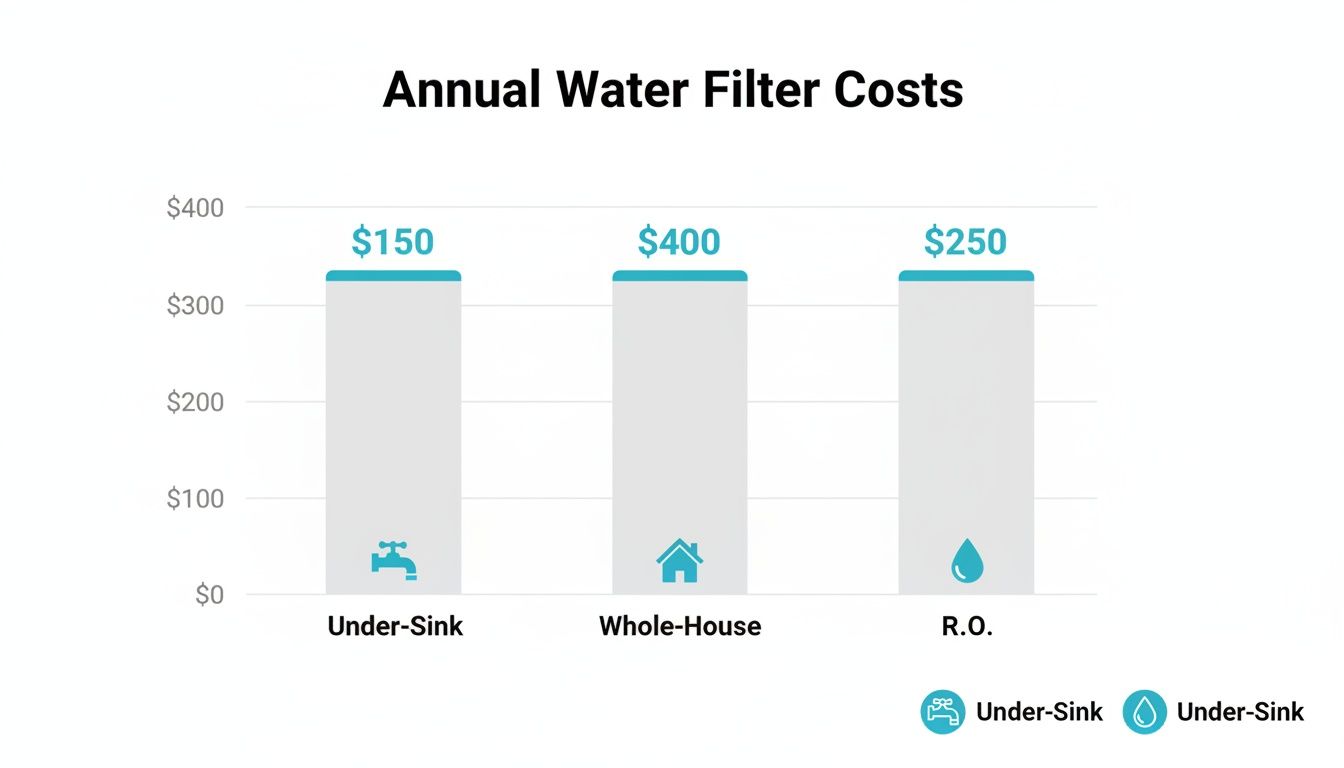
As you can see, whole-house systems usually have the highest yearly upkeep cost, mainly because their filters are bigger and more complex.
Calculating The True Lifetime Cost
Let's put some real numbers to this. For a typical family home of 4-5 people, a reverse osmosis system could run you anywhere from $5,100 to $7,200 once it's fully installed with a storage tank. That price can creep up past $7,400 if you have well water and need pretreatment for things like iron.
But that's not all. You should also plan on spending about $400 a year for general maintenance and filter changes. And then, every 3-5 years, you’ll need to replace the RO membranes, which can cost another $50 to $100. It all adds up, so planning for the long term is key.
The real "cost" of clean water isn’t just the price on the installation invoice. It’s the sum of the upfront price plus a decade of replacement filters, membranes, and any professional servicing required.
When you're shopping around and comparing different systems, always ask about the price and lifespan of the replacement filters. A system that looks cheap at first but uses expensive, hard-to-find proprietary filters can become a real financial headache. Often, the smarter move is to spend a little more on a unit that uses affordable, widely available filters. That’s how you make sure your investment keeps paying you back with clean, safe water for your family.
Smart Ways To Save On Your Installation
Getting clean, safe water into your home is one of the best investments you can make, but it doesn't need to break the bank. With a little strategic thinking, you can knock down the total water filtration system installation cost quite a bit without skimping on quality. It's all about planning ahead before you pull out your credit card.
One of the easiest tricks in the book is to time your purchase right. Just like you wouldn't buy a new grill at the start of summer, water filtration systems often go on sale during certain times of the year. Keep an eye out for seasonal deals around Black Friday or end-of-year sales when companies are trying to clear out inventory.
The Most Powerful Money-Saving Tool
Before you even think about which system to buy, the absolute best thing you can do to save money is get your water tested. Think of a comprehensive water test as your roadmap—it points out exactly what contaminants you're dealing with. Without that information, you could easily waste money on a heavy-duty system built to tackle iron and arsenic when all you really had was a chlorine taste problem that a simple carbon filter could fix.
Don't pay for filtration you don't need. A water test is your best defense against overspending. It makes sure the system you buy is the right tool for your specific problem, potentially saving you hundreds or even thousands on gear you never needed in the first place.
Once you know what's in your water, you can shop with surgical precision. This targeted approach is the cornerstone of a cost-effective installation.
Bundle and Save on Labor Costs
Here’s a great pro tip: if you’ve already got a plumber scheduled to come over for something else—maybe to fix that drip under the sink or install a new water heater—ask them about bundling the filter installation. Many plumbers will cut you a deal for getting multiple jobs done in one trip, since it saves them time and travel. This is a fantastic way to shave a decent chunk off that final labor bill.
Finally, you need to play the long game. The price on the box is just the beginning.
- Filter Affordability: Always check the price of replacement cartridges for any system you're considering. A unit that seems cheap upfront can become a money pit if it uses expensive, proprietary filters.
- Filter Availability: Stick with systems that use standard-sized filters. They're sold everywhere by lots of different brands, which keeps prices competitive and guarantees you’ll never have trouble finding a replacement.
Choosing a system with cheap, easy-to-find filters is one of the smartest financial decisions you can make. It turns what could be a one-time purchase with expensive upkeep into a truly sustainable, long-term solution for clean water.
Installation Costs: Your Questions Answered
When you're staring down the final quote, it's easy to get a little nervous. The world of plumbing, local codes, and your home's unique water situation can feel like it's adding a lot of complexity to the water filtration system installation cost.
Let’s clear the air and tackle those common "what if" questions head-on. We've put together answers to the most frequent things homeowners ask, so you can build your budget with confidence and sidestep any last-minute surprises.
Does My Location Really Change the Installation Cost?
It absolutely does. The cost of living in your area directly impacts what a licensed plumber charges per hour. You can expect a plumber in a major city like San Francisco or New York to have a much higher rate than one in a small, rural town.
On top of that, local regulations might require permits, which can add another line item to your bill. The best way to get a real number for your specific area? Get at least three quotes from local, reputable plumbers. That'll give you a solid baseline to work from.
Are There Hidden Costs I Should Brace For?
A good plumber will be upfront about everything, but sometimes your home's plumbing throws a curveball. These "hidden" costs aren't about dishonesty; they're about dealing with unforeseen issues.
- Old Plumbing: If the installer finds corroded pipes that won't create a secure connection, they'll need to be replaced first. That's an added cost.
- Electrical Needs: Systems with UV purifiers need power. If there's no outlet handy, you'll need to hire an electrician to run one.
- Cabinet Modifications: Squeezing a reverse osmosis system under your sink might mean the plumber needs to make a few small cuts to your cabinetry to get it to fit.
Here's a pro tip: always set aside a contingency fund of about 10-15% of the total quoted price. Think of it as a safety net. If an unexpected issue pops up, it won't wreck your budget or stall the project.
How Much More Is It To Install a Filter For Well Water?
Filtering well water is a whole different ballgame—it's usually more complex and definitely more expensive than treating city water. Wells can have a nasty cocktail of contaminants that municipal water doesn't, like high iron, manganese, sulfur, sediment, and even bacteria like E. coli.
Because of this, a well water system is almost never a single filter. It's a multi-stage solution that often includes:
- A sediment pre-filter to grab the big stuff like sand and dirt.
- An iron and sulfur filter to get rid of rust stains and that "rotten egg" smell.
- A water softener to tackle hard water minerals.
- A UV light to neutralize bacteria and viruses.
A complete system designed to handle well water problems can easily run from $3,000 to over $9,500 once installation is factored in. A professional water test is the essential first step to figure out exactly what your well needs.
Can I Actually Negotiate the Price With a Plumber?
While you probably can't haggle over a plumber's hourly rate, you're not powerless. Your best negotiating tool is being prepared. When you get at least three itemized quotes, you can compare them line by line.
If one quote seems way out of line for a specific part or labor task, you can politely ask them to explain the difference. You can also see if they offer discounts for bundling the job with other plumbing work, paying with cash, or if you buy the system directly from them. A homeowner who has done their homework is always in the best position to get a fair price.
Ready to stop wondering and start enjoying cleaner, safer water? At Water Filter Advisor, we provide in-depth guides, unbiased reviews, and practical tips to help you make the best choice for your home and budget. Explore our resources today to find your perfect water filtration solution. Find out more at https://www.waterfilteradvisor.com.
- January 7, 2026
- 0
- Uncategorized
