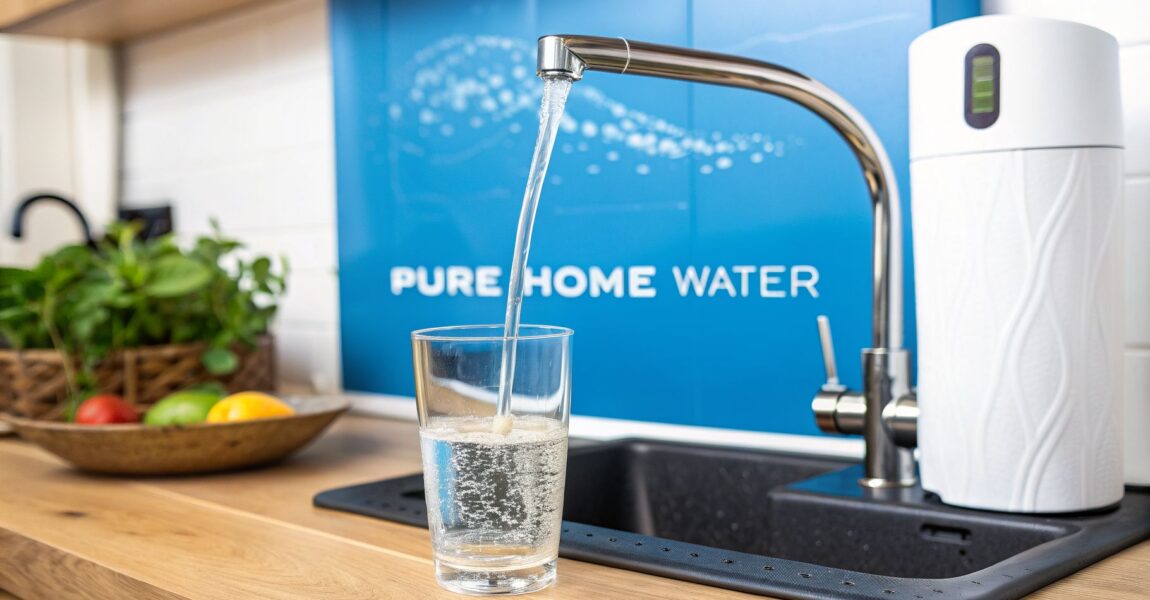
Ever wondered what it would be like to have a VIP bouncer for your tap water? That's exactly what an ultra filtration system is. It's the ultimate gatekeeper for your home's water supply, using a high-tech membrane riddled with microscopic pores to physically block nasty intruders like bacteria and viruses from crashing your party. It’s a seriously powerful way to get exceptionally pure water right from your faucet, and it does it all using your home's regular water pressure—no chemicals or funny business required.
How Ultra Filtration Magically Cleans Your Water
You know how a coffee filter lets that beautiful dark liquid through but holds back the gritty grounds? Ultra filtration works on the exact same principle, just on a ridiculously small scale. It's a straightforward but incredibly effective mechanical filtering process that's pure genius in its simplicity.
The real MVP of any ultra filtration (UF) system is its hollow fiber membrane. This isn't just a flat sheet; it's a dense bundle of thousands of tiny, hollow tubes, like a fistful of microscopic straws. The walls of these straws are peppered with pores typically between 0.01 and 0.1 microns wide. To put that in perspective, a single human hair is about 70 microns thick. These pores are so small they act as an impenetrable wall against most waterborne baddies.
The Mechanical Gatekeeper at Work
When tap water enters the UF system, your home's water pressure shoves it against the outside of these hollow fibers. The tiny water molecules are small enough to do the limbo, squeezing through the pores and into the hollow center of the tubes. They emerge on the other side as sparkling, purified water.
But anything larger gets left behind, physically denied entry. This includes a whole rogue's gallery of things you don't want in your glass:
- Bacteria and Viruses: Most of these troublemakers are bigger than 0.02 microns, so the UF membrane stops them cold.
- Sediment and Silt: All those fine particles that make water look like it has a secret are blocked.
- Cysts: Microscopic parasites like Giardia and Cryptosporidium are easily shown the door.
- Some Plastics: The membrane can even snag certain microplastics floating around in your water.
The beauty of ultra filtration is its brute-force elegance. It's not a complex chemical reaction. It's a physical barrier that separates pure water from the gunk, just like a sieve separates flour from lumps—only on a much, much finer level.
This all happens in real-time, giving you clean water whenever you turn on the faucet without needing a bulky storage tank. And since it runs on normal water pressure, it's about as energy-efficient as it gets.
A Growing Solution for Modern Water Woes
This effective and efficient technology is really catching on. While it's long been a workhorse in large-scale municipal water treatment, it's becoming the go-to hero for homes and businesses. The global market for these systems shows just how reliable they are, projected to jump from USD 1,987 million in 2025 to USD 3,146 million by 2034. This trend highlights a growing demand for water purification that is both powerful and sustainable. You can discover more insights about this growing market and its applications.
At the end of the day, what's happening inside an ultra filtration system is beautifully simple. It’s a solid physical barrier making sure that what comes out of your tap is just clean, safe water, ready for drinking, cooking, and enjoying.
Ultra Filtration vs. The Other Guys: A Filter Showdown
Trying to pick the right water filter for your home can feel like you've stumbled into the wrong aisle at the hardware store. You're bombarded with technical jargon and a ton of competing claims. To get it right, you need a clear, no-nonsense comparison of how these different technologies actually stack up.
Ultra filtration (UF) systems hold a really unique sweet spot in the world of water purification. They offer a fantastic balance of powerful filtration, efficiency, and health benefits that makes them stand out from the other filters you see on the shelf.
This diagram gives you a quick visual of how it works. Contaminated water goes in, gets squeezed through the UF membrane, and comes out pure. Simple as that.

As you can see, the membrane is a physical gatekeeper. It literally blocks the bad stuff while letting the good, clean water molecules flow right through.
Now, let's break down how UF throws down against the competition.
It's easy to get lost in the specs, so here's a quick cheat sheet comparing the most common filter types you'll find for your home.
How Ultra Filtration Compares to Other Filters
| Filtration Method | Removes Bacteria & Viruses | Keeps Healthy Minerals | Wastes Water | Best Use Case |
|---|---|---|---|---|
| Ultra Filtration | Yes | Yes | No | Whole-home or POU for comprehensive microbiological safety without removing minerals. |
| Reverse Osmosis | Yes | No | Yes | POU for removing the widest possible range of contaminants, including salts and minerals. |
| Carbon Filter | No | Yes | No | Improving taste and odor by removing chlorine and chemicals; often used with other filters. |
| Microfiltration | Bacteria Only | Yes | No | Basic microbiological protection, good for sediment and larger bacteria like Giardia. |
This table makes it pretty clear—each filter has its own superpower. The right choice really depends on what's lurking in your water and what you want to kick out.
Ultra Filtration vs. Reverse Osmosis
Think of Reverse Osmosis (RO) as the heavyweight champion of water purification. It's incredibly powerful. RO systems use intense pressure to force water through a membrane with pores so tiny—we're talking 0.0001 microns—that almost nothing else gets through. This process strips out bacteria, viruses, heavy metals, and even dissolved salts.
But that raw power comes with a couple of big downsides for the average home. First, RO wastes a lot of water. To make one gallon of pure water, it might send several gallons of wastewater right down the drain. Second, because the filter is so strict, it also removes beneficial minerals like calcium and magnesium, which give water its taste and have health benefits.
Ultra filtration, with its 0.01 micron pores, strikes a much better balance. It’s small enough to block all the nasty microbiological threats—bacteria, protozoa, and even tiny viruses—but it lets those healthy, dissolved minerals pass right on through. You get water that’s safe from pathogens but still has its natural, healthy mineral content, all without the wasteful habits of an RO system.
Ultra Filtration vs. Carbon Filters
Activated carbon filters are everywhere, and for good reason. Imagine a carbon filter as a powerful magnet for chemicals. It works through a process called adsorption, where things like chlorine, pesticides, and VOCs (volatile organic compounds) get stuck to the carbon’s massive surface area. This is why carbon filters are rockstars at making your water taste and smell amazing.
But here’s the catch: they do next to nothing for microbiological safety. A typical carbon filter in a pitcher or on your faucet just can't physically stop bacteria or viruses. The pores are simply too big.
This is where ultra filtration really shines. The UF membrane is a physical barrier that those tiny pathogens simply can't squeeze through. In fact, the best UF systems actually include carbon filters as part of their dream team. This combo gives you the best of both worlds: the carbon removes chemicals and improves taste, while the UF membrane ensures the water is completely free of dangerous microorganisms.
For a homeowner, the goal isn't just to pick one filter type over another. It's about finding a system that combines the right technologies for complete protection. A UF system with carbon stages is a far more robust solution than either one on its own.
Ultra Filtration vs. Microfiltration
Microfiltration (MF) is UF's closest relative. It also uses a physical membrane to block contaminants, but the pores are a bit bigger, usually around 0.1 microns. That's plenty small enough to stop protozoa like Giardia and Cryptosporidium, and it gets most bacteria, too.
The critical difference comes down to viruses. Viruses are so small they can often slip right through a microfiltration membrane. An ultra filtration system, with pores that are ten times smaller, offers a much more reliable defense against viral threats. For families with small children, elderly members, or anyone with a compromised immune system, that extra layer of protection is absolutely essential.
Choosing the Right Ultra Filtration System for Your Home
So, you’ve decided that an ultra filtration system is the right move for safer, cleaner water. Fantastic choice! Now comes the fun part: which one is the right fit for your home? The choice really boils down to one simple question—are you looking to purify water for a single tap, or do you want to give the entire house the VIP treatment?

This isn't just about where the filter goes; it’s about tailoring the solution to your family’s needs and your water quality goals. The two main types of residential ultra filtration systems are Point-of-Use (POU) and Point-of-Entry (POE), and they each play a very different role.
Point-of-Use (POU) Systems: The Kitchen Sink Specialist
Think of a Point-of-Use (POU) system as a precision instrument. It’s designed to deliver highly purified water to one specific spot, which is almost always the kitchen sink. These are compact units that tuck away neatly under the sink and connect to their own dedicated faucet.
The big win with a POU system is getting targeted, top-quality filtration exactly where you need it most—for the water you drink and cook with.
- Cost-Effective: POU systems are much friendlier on the wallet to buy and install compared to their whole-house cousins.
- Easy Installation: Most under-sink models are simple enough for a confident DIY-er to install over a weekend.
- Focused Power: They concentrate their filtering muscle on a single tap, so you're not wasting filtration capacity on water for flushing toilets or washing socks.
This makes POU systems a fantastic choice for renters, smaller households, or anyone whose main mission is to purify their drinking water from nasty microbiological contaminants.
Point-of-Entry (POE) Systems: The Whole-House Guardian
A Point-of-Entry (POE) system, also known as a whole-house system, is your home's comprehensive bodyguard. It’s installed right where the main water line enters your house, treating every last drop of water that flows through your pipes. That means clean water from the kitchen tap, the showers, the dishwasher, and the washing machine.
Going with a POE system brings the benefits of purified water to every room. This is a game-changer for families dealing with sensitive skin, as it strips out the irritants that can cause problems. To see how these stack up against other options, it's worth comparing them with other whole home water filtration systems.
A POE system offers total peace of mind. It creates a complete barrier that stops contaminants from ever entering your home's plumbing. This isn't just about protecting your health; it's about protecting your pipes and appliances from sediment and other gunk, too.
With a POE system, you're not just drinking clean water—you're bathing in it, washing your clothes in it, and truly living in it.
Decoding the Specs: Flow Rate and Filter Life
Once you've decided between POU and POE, you need to look at a couple of key numbers to make sure the system can keep up with your household's daily life.
Flow Rate (GPM): This is measured in Gallons Per Minute and tells you how much filtered water the system can kick out at once. For a POU system at your kitchen sink, a flow rate of 0.5 to 1 GPM is typically plenty. But for a POE system, you'll need a much beefier rate—think 10 to 20 GPM—to run a shower and the dishwasher at the same time without your water pressure dropping to a sad trickle.
Filter Lifespan: This tells you how long the filter cartridges will last before you need to swap them out. Keep in mind, this can vary a lot based on how much water you use and how gunky your local supply is. Always check the cost of replacement filters and factor that into your long-term budget.
The good news is that the market for these filters is booming. The global ultrafiltration market is expected to jump from USD 56.63 billion in 2025 to USD 87.21 billion by 2030. That means more innovation and better prices are on the way for you. Once you've weighed these factors, you can invest with confidence, knowing you've picked the perfect guardian for your home's water. If you're looking for more guidance, check out our page to get more expert water filter advice.
Installation and Maintenance You Can Actually Handle
So you've decided an ultra filtration system is the right move for your home's water. Great call. But even the best system in the world won't do you much good if it's not installed correctly and looked after properly.
The awesome news? Keeping these systems running in tip-top shape is surprisingly straightforward. You don't need a plumbing degree to get pure, clean water flowing from your tap.

Whether you're looking at a small under-sink setup or a full whole-house unit, getting a handle on the setup and upkeep is key. It’s what ensures you’ll get great-tasting, safe water for years to come.
DIY vs. Professional Installation
One of the first things people ask is, "Can I really install this myself?" It really boils down to two things: which system you bought and how friendly you are with a wrench.
Under-Sink (POU) Systems: These are practically made for the weekend warrior. Most of the time, you're just mounting the unit under the sink, tapping into the cold water line with some simple push-to-connect fittings, and drilling a hole for a dedicated faucet. If you can follow instructions and aren't afraid of a little plumbing, you can knock this out in an afternoon.
Whole-House (POE) Systems: This is a different beast entirely. A whole-house system ties directly into your home's main water line. One wrong move here can mean a serious leak and thousands in water damage. For this reason, we almost always tell people to hire a licensed plumber. It's just not worth the risk.
Let’s be real: while an under-sink system is a perfect DIY project, the peace of mind you get from a pro installing your whole-house system is worth every single penny. You know it’s done right from the start.
Your Simple Maintenance Checklist
When it comes to long-term care, ultra filtration systems are wonderfully low-drama. It’s all about simple, routine check-ups, not complicated repairs. Being proactive here is what keeps your water pure and your system happy. Think of it as a little Planned Preventive Maintenance for your water.
Here’s what a typical schedule looks like:
Sediment & Carbon Pre-Filters (Every 6-12 Months): These guys are the first line of defense, catching big gunk and chlorine before they can reach the main UF membrane. Swapping them out is critical and usually just involves unscrewing the filter housing and popping in a new cartridge. If your water has a lot of sediment, you might be doing this closer to the 6-month mark.
UF Membrane (Every 2-5 Years): The hollow fiber membrane is the heart of the system, and it's built to last. Most systems have a backwashing feature—either automatic or manual—that flushes out the gunk that builds up on the membrane. This self-cleaning process is why the membrane can go for years, often needing replacement only every 2 to 5 years.
System Sanitization (Annually): Once a year, when you're already changing filters, it's a smart idea to sanitize the system. This is a quick step that prevents any nasty bacteria from setting up shop inside the filter housings and keeps your water as fresh as possible.
Stick to this simple routine, and you'll sidestep problems like low water pressure or reduced flow. It's a small bit of effort for a huge payoff: knowing your family’s water is always clean and safe.
Decoding Certifications and Performance Claims
When you’re shopping for an ultrafiltration system, the packaging can be a real headache. It’s usually covered in labels, percentages, and acronyms that make you feel like you need a chemistry degree just to figure out what you’re buying.
But cutting through that marketing noise is the single best way to know if a filter will actually walk the walk. The key is to look for independent, third-party certifications.
Think of a certification as a report card from an unbiased expert. These organizations put the filter through its paces under tough, standardized conditions to verify the manufacturer’s claims. The most respected name in the water filtration game is NSF/ANSI (National Sanitation Foundation/American National Standards Institute).
The Key Certifications to Know
Not all NSF/ANSI certifications are created equal. For home water filters, you’ll mainly see two standards, and they test for completely different things. Knowing the difference is critical.
NSF/ANSI 42 – The "Looks and Tastes Better" Standard: If a filter has this stamp of approval, it’s been proven to improve the aesthetics of your water—its look, taste, and smell. This standard focuses on non-health-related issues, like reducing chlorine or particulates that make water cloudy.
NSF/ANSI 53 – The "Health and Safety" Standard: This is the big one. A system certified to NSF/ANSI 53 has passed rigorous testing for its ability to reduce specific health-related contaminants like lead, cysts (such as Giardia), asbestos, and certain chemicals.
Any ultrafiltration system built for microbiological safety should, at a bare minimum, have performance data showing it can remove tiny living organisms, which is often validated under protocols similar to NSF/ANSI 53.
Understanding "Log Reduction"
You'll often see performance claims like “99.99% reduction of bacteria.” In scientific terms, this is called a "log reduction," which is just a simple way to talk about really, really big numbers.
A "log reduction" is a measurement of how thoroughly a filter removes contaminants. Each "log" represents a 90% reduction. So, a 1-log reduction is 90%, a 2-log reduction is 99%, a 3-log is 99.9%, and a 4-log is 99.99%.
When a UF system claims a 4-log reduction of bacteria, it means for every 10,000 bacteria that went into the filter, only one made it out the other side. That’s the kind of proven, high-level performance you need when you’re dealing with microscopic threats.
The quality of the filter membrane is what makes this possible. Today, polymeric ultrafiltration membranes are the industry standard, making up 65.0% of the market because they're both durable and affordable. This technology is a huge deal in the water treatment sector, which itself made up 41.7% of all membrane filtration revenue in 2025. You can find more details about membrane filtration technology and see why it's becoming so important.
By looking for these specific, third-party-verified numbers and certifications, you can confidently choose a system. You're no longer just taking a company's word for it—you're relying on proven, scientific data to protect your home's water.
Your Ultra Filtration Questions, Answered
Even after getting the full scoop on ultra filtration, you probably have a few practical questions kicking around. That's perfectly normal. When you're thinking about an investment in your home's water, you want to be sure about the day-to-day details.
We’ve rounded up the most common questions homeowners ask before taking the plunge. Let's get you some clear, straightforward answers.
Will My Water Taste and Smell Better?
On its own, a UF membrane is a physical barrier—it stops particles, not the dissolved stuff like chlorine that can make water taste like a swimming pool.
That's why you'll almost always find high-quality UF systems paired with activated carbon filters. The carbon acts like a sponge for bad tastes and odors, soaking up chlorine and other chemical flavors. The UF membrane handles the germs, but it’s the carbon that delivers that crisp, clean taste.
Is My Water Pressure Going to Drop?
Any filter will add a little bit of resistance, but a properly sized UF system shouldn't cause a noticeable drop in your water pressure. If your shower suddenly feels weak after installation, it's usually a red flag for one of two things.
First, your filter cartridges might just be clogged and screaming for a change. The second possibility is that the system's flow rate isn't high enough for your home's demand. Whole-house systems are built for high flow, but sticking to the maintenance schedule is key to keeping that pressure strong and steady.
How Often Do I Need to Change UF Filters and What’s the Cost?
Filter life really depends on your water quality and how much you use, but here’s a good rule of thumb for budgeting. The main ultra filtration membrane is the workhorse and can last anywhere from 2 to 5 years.
The sediment and carbon pre-filters that protect that main membrane need more frequent swaps, typically every 6 to 12 months.
As for cost, you could be looking at around $50 for a set of under-sink pre-filters or up to a few hundred dollars for a whole-house UF membrane replacement. It’s smart to factor these ongoing costs into your decision to see the true long-term price tag.
When comparing systems, look at the total cost of ownership—the upfront price plus the filter replacements over time. A slightly pricier unit with longer-lasting filters might actually be the better deal in the long run.
Are Ultra Filtration Systems a Good Choice for Well Water?
Absolutely. UF systems are a fantastic line of defense for well water, especially against microbiological threats like bacteria (think E. coli) and general cloudiness from sediment. The membrane is a physical wall these contaminants just can't get through.
But well water can be tricky. It often comes with other issues like hardness minerals, iron, or sulfur that UF won’t touch. That's why getting a comprehensive water test done first is non-negotiable.
More often than not, the best setup for a well is a multi-stage approach—like putting a water softener or an iron filter in front of the UF system. This protects the membrane and tackles all of your water problems at once.
What's the Difference Between UF and UV?
This one trips a lot of people up since both deal with microbiological safety. The main difference is how they do their job.
Ultra Filtration (UF) is a physical barrier. It removes contaminants by blocking them with a fine membrane and flushing them away.
Ultraviolet (UV) Purification is a disinfection process. It uses a special light to inactivate microorganisms, scrambling their DNA so they can't make you sick.
UF also pulls out physical gunk like silt, making the water clearer. UV, on the other hand, only zaps germs and needs other filters to handle anything else.
Does Ultra Filtration Remove PFAS or "Forever Chemicals"?
This is a huge question right now. A standard UF membrane by itself is not effective against PFAS. These "forever chemicals" are dissolved in water and the molecules are just too small to get caught in the UF membrane's pores.
However, top-tier ultra filtration systems solve this by adding other filtration stages.
- Activated Carbon: This is the go-to for reducing PFAS in homes. More advanced catalytic carbon is even better at it.
- Reverse Osmosis (RO): If you want the highest level of removal, RO is the answer. It can eliminate up to 99% of PFAS.
- Specialty Resins: Some systems use special media designed specifically to grab onto PFAS molecules.
Bottom line: If a water test shows you have PFAS, make sure the system you choose specifically includes one of these technologies. The UF membrane alone won't get the job done.
Choosing the right water filtration system is a significant step toward a healthier home. At Water Filter Advisor, we are committed to providing the clear, research-driven guidance you need to make the best choice for your family.
Explore our in-depth guides and expert reviews at Water Filter Advisor
- February 26, 2026
- 0
- Uncategorized
