What Is Iron Bacteria in Well Water Explained
Iron bacteria in well water are groundwater microbes that oxidize iron and produce sticky slime, usually a nuisance rather than a known cause of illness, and they can grow with iron concentrations as low as 0.01 mg/L. The main job is matching the problem to the right home filter and well treatment, because removing iron, controlling slime, and making an unsafe well safe are different tasks.
You might be staring at orange jelly inside the toilet tank while a nearly new whole-house cartridge struggles to keep water flowing. Before you buy another filter, work out whether you're dealing with mineral particles, living buildup, or a sanitary problem that filtration alone won't solve.
What Iron Bacteria Means at the Kitchen Tap
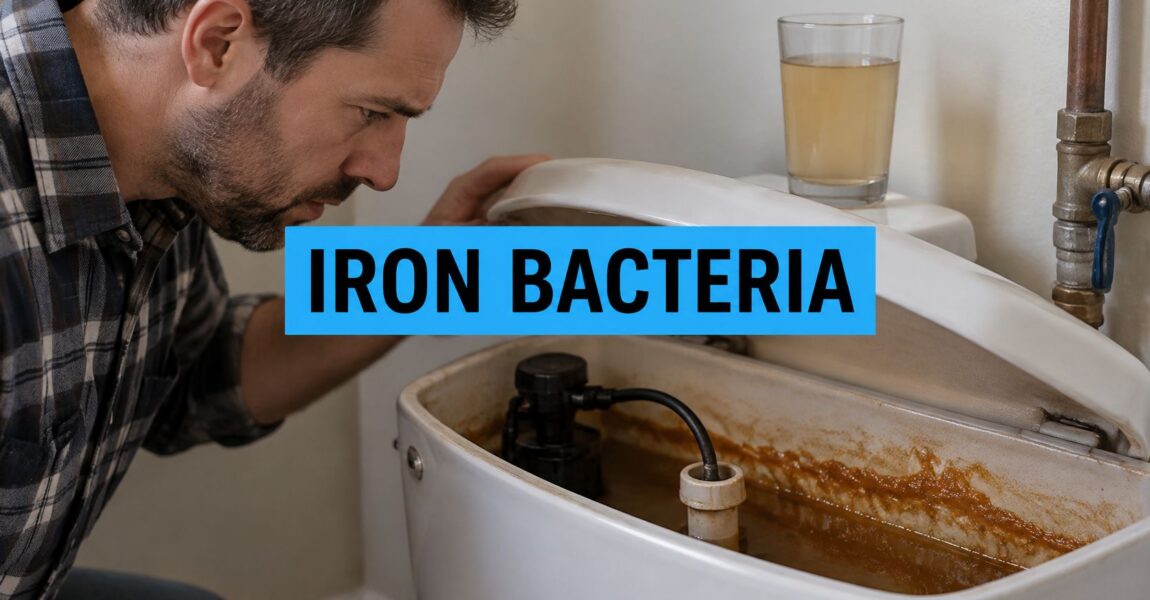
You lift the toilet-tank lid and find a slippery orange coating. At the kitchen faucet, the water smells musty, yet it looks clear in a glass. Meanwhile, rust-colored streaks keep returning to the laundry.
That combination suggests iron bacteria, not rusty water. These naturally occurring microorganisms obtain energy by oxidizing dissolved iron or manganese. The University of Georgia's well-water guidance explains that no drinking-water standard exists specifically for iron bacteria because they haven't been shown to cause illness.
The water's appearance at the faucet doesn't reveal what's growing upstream.
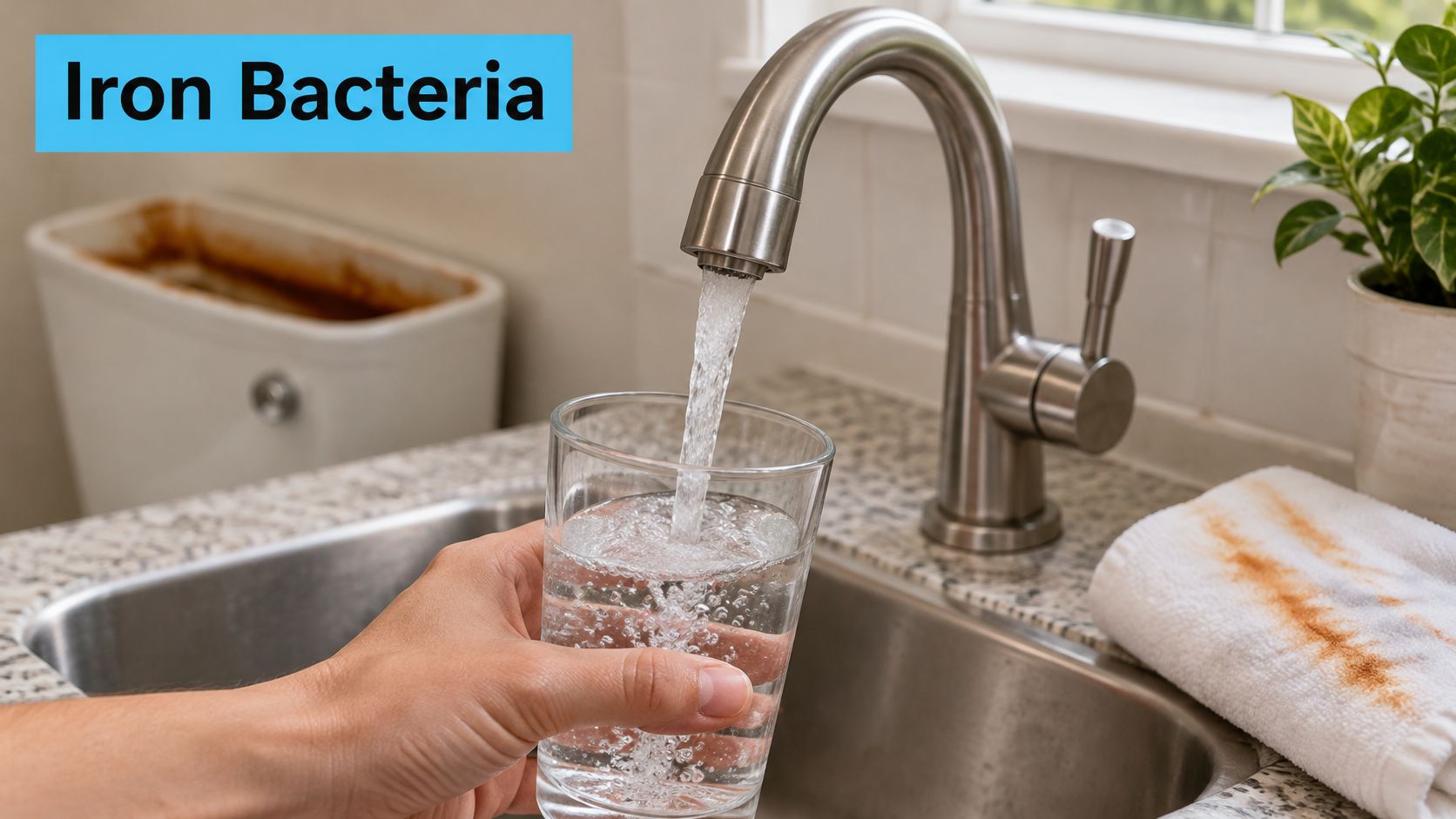
Why a nuisance still needs treatment
As the organisms grow, they produce gelatinous biofilm, a sticky material that collects on well screens, pump parts, tanks, pipes, and fixtures. That buildup matters to your filtration system: a cartridge downstream may catch loose material, but it can't clean the surfaces where the slime originates.
The deposits can also smell, stain, and restrict flow. Buying a finer cartridge may capture smaller particles while making the clogging problem more noticeable.
Penn State Extension reports that iron concentrations as low as 0.01 mg/L can support growth, as noted in the university guidance linked above. A modest iron result therefore doesn't rule out a biological problem.
Practical rule: A filter that catches rust isn't necessarily a treatment for the organisms producing the slime.
Dissolved iron can remain invisible underground where oxygen is scarce. After pumping exposes the water to air, that iron can become visible rust-colored particles. Iron bacteria incorporate those particles into persistent, sticky deposits.
For a useful home-water diagnosis, keep separate questions on your list:
- Slime: Is attached bacterial growth fouling the well and equipment?
- Iron: How much dissolved or particulate mineral material needs removal?
- Sanitary safety: Could harmful contamination be present?
A household can have any combination of these problems. The filter should follow the diagnosis, not the color of the toilet tank.
How Iron Bacteria Build Slime Inside a Well
Think of a well as a dark pantry rather than an empty drinking straw. Groundwater supplies dissolved minerals, surfaces provide places to attach, and quiet pockets let deposits accumulate.
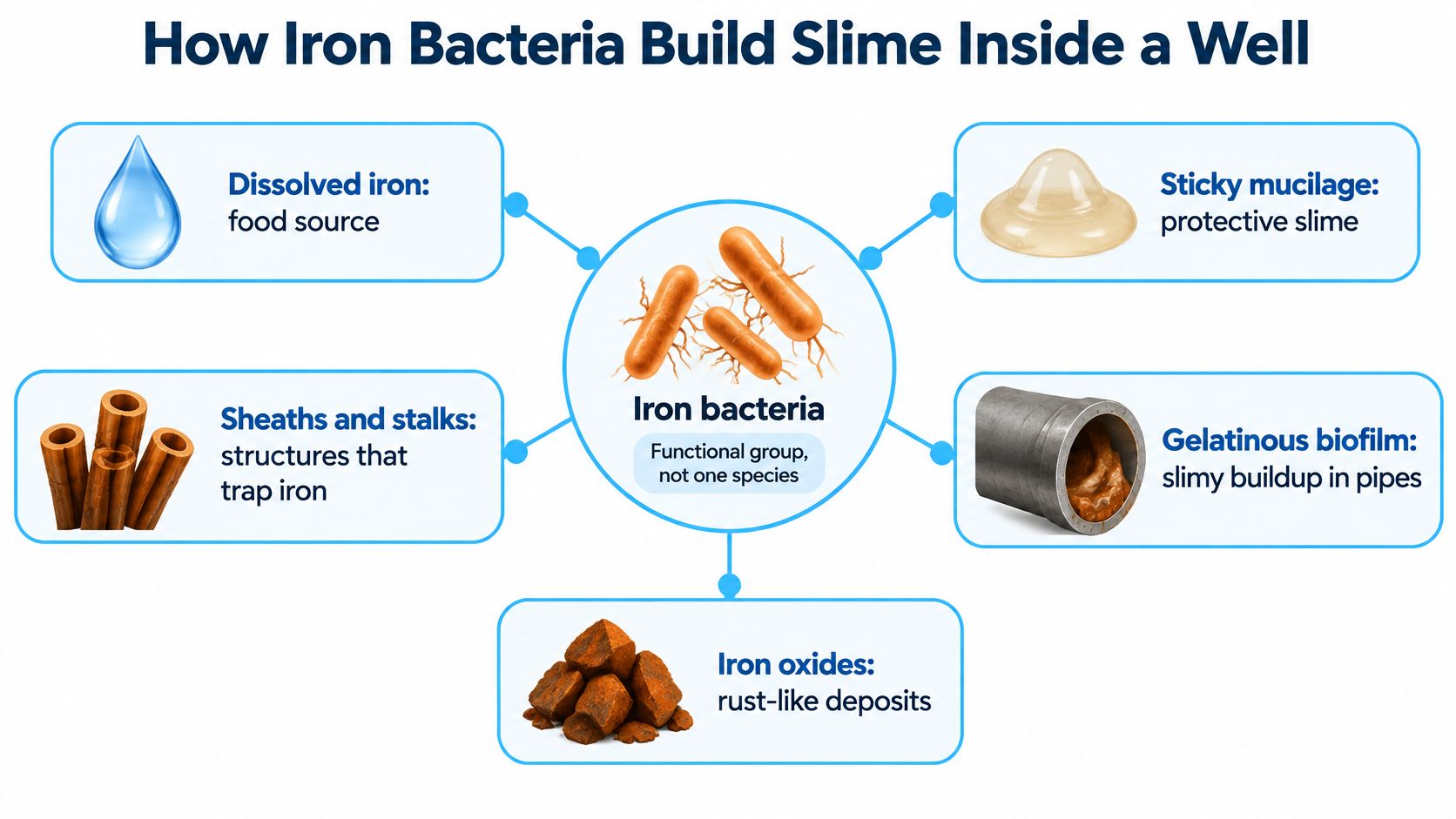
Iron bacteria aren't a single species. They're a functional group of microorganisms that use dissolved iron and secrete sticky material called mucilage. The North Carolina Department of Environmental Quality's iron-bacteria guidance describes sheaths, stalks, and gelatinous biofilms that trap iron oxides and produce characteristic rust-colored slime.
The diagram shows how the organisms and mineral deposits fit together.
Follow the water through the system
Consider a drop of groundwater approaching a well screen. It may contain dissolved iron without looking dirty. As conditions change during pumping, iron can oxidize, and organisms attached to nearby surfaces can collect the resulting mineral material in their slime.
That gel behaves differently from loose sand. Sand can travel with moving water until a filter catches it. An attached bacterial mat clings to the screen, casing, or pipe, so flushing away discolored water doesn't necessarily remove the source.
Many of these organisms can grow without sunlight and don't require oxygen-rich surface conditions. A dark casing isn't protection against them. Iron-rich groundwater and low-flow areas can support growth inside the well and throughout connected equipment.
The household consequences follow the plumbing:
- At the screen: Deposits reduce the open area through which groundwater enters.
- Around the pump and tank: Attached material creates maintenance work that a kitchen filter can't reach.
- Inside treatment equipment: Slime can coat media and interfere with normal filtration.
- At quiet fixtures: Toilet tanks and seldom-used lines offer places for visible buildup.
Why clear water can still foul a filter
A clear sample tells you little about attached deposits. You might draw an apparently clean glass while a mat remains inside the well, periodically releasing material into the whole-house filter.
That explains a frustrating pattern: replacing the cartridge improves flow, but the replacement soon collects more sticky material. You've cleared the collection point, not necessarily the source.
For another visual explanation of the well-water problem, this video provides additional context.
The organisms' presence mainly signals conditions favorable to iron-related growth. Other water-quality problems can coexist with it, and appearance can't establish microbiological safety. When contamination is suspected, an accredited laboratory's total coliform and E. coli testing belongs alongside the filtration assessment.
Signs of Iron Bacteria Around the House
Household clues that point to iron bacteria
| Clue | Typical look or smell | Unlike plain iron | Filter implication |
|---|---|---|---|
| Toilet tank or aerator film | Red, orange, yellow, brown, or gray jelly | Ordinary staining lacks a slimy mat | A cartridge can keep clogging until upstream slime is controlled |
| Tap odor | Swampy, musty, petroleum-like, cucumber-like, or rotten vegetation | A metallic taste alone doesn't identify bacterial growth | Consider carbon after disinfection, not a pitcher as the only step |
| Laundry and fixture stains | Rust streaks that return after cleaning | Clear water that rusts after standing can indicate dissolved iron without slime | Use oxidation plus filtration once bacterial growth is controlled |
| Flow loss | Reduced pump delivery, restricted screen, or rapid cartridge clogging | Color alone may occur with otherwise steady flow | Sediment filtration can't restore a fouled well screen |
| Modest lab iron | Slime despite a low iron reading | Even substantial iron doesn't automatically mean biofilm | Don't skip an iron-bacteria test because mineral iron looks low |
Look for texture, not just orange color
An orange mark isn't a diagnosis. Mineral iron can leave rusty stains without forming a gelatinous coating, while bacterial deposits tend to feel slippery and cling as a film or mat.
A toilet tank is useful because it holds water between flushes. Faucet aerators can collect evidence too, although an aerator's debris may also include ordinary sediment. Don't open a pressure tank or dismantle pump equipment just to search for slime.
Taste and smell need the same caution. Earthy or musty water supports an investigation, but neither a metallic taste nor an unusual odor proves iron bacteria are responsible. A petroleum-like smell shouldn't be dismissed as harmless bacterial activity without testing.
Color tells you what to investigate. It doesn't tell you which treatment to buy.
Say the upstairs toilet has jelly-like deposits, the basement tap smells musty after sitting unused, and the kitchen cartridge contains sticky brown material. Together, those observations justify testing and a well inspection more strongly than a rusty sink alone.
The practical filter distinction is whether you're catching loose particles or continuously receiving material from attached growth. A smaller-micron cartridge won't resolve that distinction.
Notice where flow drops
A well that used to fill a bucket briskly but now delivers a weak stream deserves more than another cartridge change. Biofilm can narrow the well screen or piping before water reaches the filter housing.
Compare performance with the treatment equipment assessed by a qualified technician. If the restriction is upstream, installing a larger sediment filter won't restore the screen's open area. Conversely, a clogged cartridge can reduce household pressure even when the pump and well remain serviceable.
Before calling a contractor, collect useful observations:
- Photograph the film: Capture the toilet tank, aerator deposits, and used cartridge.
- Map the odor: Note whether it occurs at every tap or only at rarely used fixtures.
- Record flow changes: Describe whether the problem affects the whole house or a particular outlet.
- Keep the lab sheet: Bring actual results rather than a description such as slightly high iron.
These details help separate a localized plumbing issue from a source-water problem. They still can't answer the safety question. A stain-free glass and an unpleasant-smelling glass both need laboratory evidence when sanitary contamination is a concern.
Health Risk Versus Iron and Unsafe Wells
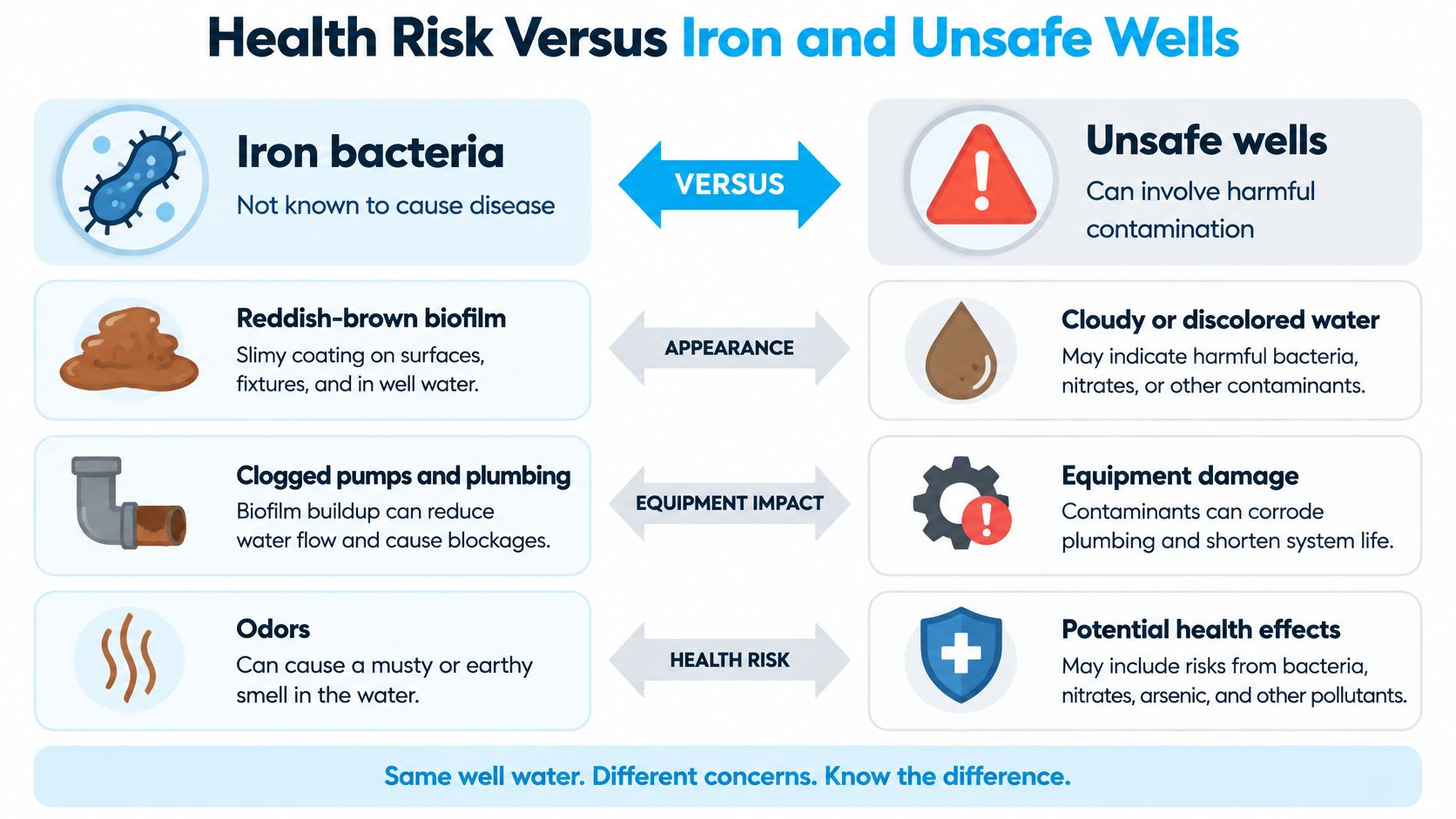
Iron bacteria aren't known to cause disease, according to the Minnesota Department of Health's iron-in-well-water guidance. Their practical effects include biofilm, clogged equipment, and odors, and iron-related conditions can make eliminating other harmful bacteria more difficult.
That doesn't mean a slimy well is safe. It means the nuisance organism and the sanitary condition of the water require separate judgments.
Three well-water problems people mix up
| Problem | Main clue | Health meaning | Home response |
|---|---|---|---|
| Iron bacteria | Orange or brown slime, odd odors, clogged screens | Nuisance organisms, not known to cause disease | Clean and disinfect the well as appropriate, then filter precipitated iron |
| Dissolved or particulate iron | Rust stains, metallic taste, clear water that becomes cloudy | A mineral and operational issue, not the bacteria themselves | Oxidize where necessary, allow contact time, then filter |
| Coliform or E. coli | Laboratory result or reason to suspect sewage or surface-water entry | Possible sanitary contamination; E. coli is particularly concerning | Accredited testing and a safety response, not a stain filter alone |
A clean-looking glass isn't a safety certificate
An iron filter can improve color without disinfecting the source. If contamination entered through a damaged well component, removing the orange particles doesn't repair that pathway or establish that the water is suitable to drink.
The distinction resembles a damp windowsill and a leaking drain: cleaning the visible mess isn't the same as identifying where unwanted water entered. Likewise, iron slime points toward maintenance, while sanitary indicator results prompt investigation of contamination pathways.
Total coliform bacteria aren't all disease-causing organisms, and a positive result doesn't automatically prove sewage entered the well. They're indicators that require interpretation and follow-up. E. coli detection is a different and more urgent sanitary warning.
The comparison below keeps the nuisance and safety questions separate.
Choose the response by the result
A positive iron-bacteria result should prompt source inspection and appropriate laboratory testing, not panic. Ask whether the well needs rehabilitation, whether mineral iron remains to be filtered, and whether separate sanitary results change how the household may use the water.
If sanitary contamination is suspected, don't rely on a pitcher, ordinary carbon cartridge, or iron-removal system to make drinking water safe. Follow the laboratory or local health authority's advice about an alternative supply and corrective treatment.
For stains and slime, plan well maintenance plus iron treatment. For a sanitary warning, establish a verified safety response before selecting convenience or taste filters.
Tests to Order Before Buying a Filter
Ask the laboratory for iron concentration, iron bacteria, pH, alkalinity, and hardness. That's the panel recommended by the Illinois Department of Public Health's iron-in-drinking-water guidance, rather than choosing equipment from an iron reading alone.
Request separate accredited testing for total coliform and E. coli when sanitary contamination is suspected. A positive sanitary result is a reason to pause a DIY filter installation and get qualified help, not just add another cartridge.
What the results change
- Iron concentration: Helps establish the mineral-removal load and whether oxidation and media filtration are appropriate.
- Iron bacteria: Identifies whether biological control must accompany mineral treatment.
- pH and alkalinity: Help determine whether the proposed oxidation process will produce particles effectively and whether correction is needed.
- Hardness: Flags scaling concerns and helps plan softener protection and treatment order.
Catalytic media enhances the reaction between oxygen and dissolved iron, then captures insoluble material. That can be useful for mineral iron, but persistent bacterial growth may require disinfection ahead of the filtration equipment.
Ask installers to explain the treatment sequence against your results. A useful proposal identifies what each stage does, how it's maintained, and what evidence will show it's working.
Buying check: If the quote arrives before the water analysis, ask what assumptions the equipment selection relies on.
Collect a useful sample, not just a convenient one
Call the laboratory before filling a bottle. Ask which sampling point to use, whether it needs untreated water, and how to collect and transport the bacterial samples. Don't assume a bottle rinsed at the kitchen sink is suitable.
Bring your symptom log and identify existing treatment stages. A sample collected after a softener or filter may not describe the raw water the proposed system must handle.
Water Filter Advisor was founded to analyze and spread the word about water filtration, with an emphasis on getting down to the data. Our guide to well-water test kits can help you understand first-look home testing, but iron-bacteria and sanitary decisions still belong with an accredited laboratory.
For deposits inside the casing, lost pump capacity, or chemical rehabilitation involving acids or surfactants, involve a licensed well contractor. After disinfection, arrange follow-up sampling on the laboratory's timetable so temporary improvement isn't mistaken for lasting control.
Get the panel first, then the filter quote. That order helps prevent an expensive system from becoming another place for untreated slime to collect.
Treatment and Home Filtration That Actually Holds
Home treatment paths for iron bacteria
| Path | Best when | Key requirement | Filtration role |
|---|---|---|---|
| Shock chlorination | Initial treatment or occasional recurrence | Adequate concentration, circulation, contact, and purging | Isolate or remove cartridges as appropriate; restore service after purging |
| Professional rehabilitation | Thick casing slime, failed shocks, lost pump flow | Physical cleaning followed by disinfectant; specialist control of acids or surfactants | Household cartridges can't scrape deposits from the well |
| Continuous chlorination | Persistent rapid regrowth | Controlled dosing, contact, and safe discharge planning | Backwashing carbon can capture debris and reduce residual chlorine |
| Oxidation and filtration | Mineral iron remains after biological control | Enough reaction time before filtration | Sand, catalytic, or oxidizing media captures formed particles |
Treatment has linked jobs: remove or control attached growth, then capture the mineral solids produced during oxidation. Skipping either can leave the household replacing fouled media without resolving the cause.
This treatment sequence shows where well rehabilitation and household filtration belong.
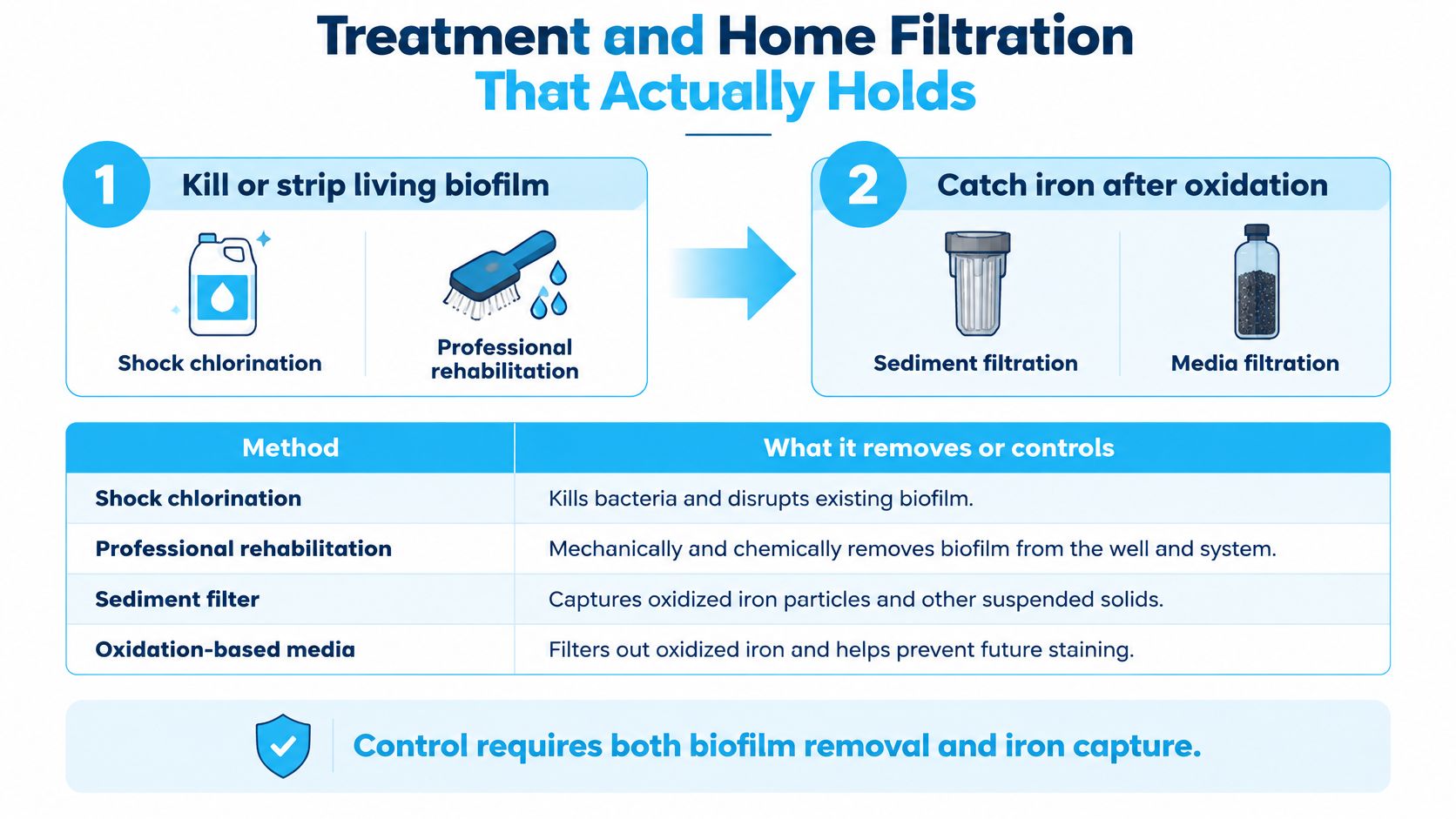
Shock treatment needs a well-specific plan
The Montana environmental guidance describes approximately 8 quarts of 5.25% chlorine bleach mixed with 100 gallons of water, recirculation for one hour, and contact for at least 24 hours before thorough purging. Treat that as a documented treatment pattern, not a universal dose for an unknown well volume or a different bleach concentration.
- Confirm the procedure. Have the contractor establish the well volume, bleach strength, equipment compatibility, and discharge location.
- Prepare the system. Remove or isolate vulnerable treatment components according to their manufacturer's directions.
- Mix and circulate. Distribute the prepared solution through the casing and pump piping.
- Reach the plumbing. Run outlets as directed until chlorine reaches them, then maintain the prescribed contact period.
- Purge and verify. Keep the treated water out of household drinking use until flushing and the required follow-up checks are complete.
Never mix bleach with acids or other cleaners.
Escalate when deposits remain
A dose can fail because attached deposits shield organisms or the source reseeds the system. The Michigan well-rehabilitation guidance describes physical cleaning and controlled chemical treatment; its technical background also identifies heating to approximately 60°C (140°F) for 30 minutes as a potential specialist approach.
Casing scrubbing, pump cleaning, surfactants, acids, and heat treatment aren't weekend experiments. Incorrect handling can damage equipment or contaminate the well. Chlorinated discharge also needs a plan because it can harm septic systems and aquatic environments.
Build the filtration stages around the chemistry
For persistent regrowth, continuous low-level chlorination may be appropriate. In a chlorine-oxidation design, Ohio State's iron-treatment guidance describes approximately 20 to 30 minutes of retention before filter sand removes the formed particles.
A backwashing carbon stage can then reduce residual chlorine and collect remaining debris. Catalytic or oxidizing media is another mineral-treatment option when the water chemistry and biological control support it.
Use our guide to removing iron from water to understand these filtration choices. A sediment cartridge alone can collect released slime, but it can't rehabilitate the source that keeps supplying it.
Keep the Well Clear and Pick the Next Filter
A successful treatment plan includes recurrence management. The Minnesota Department of Health's iron-bacteria guidance describes control as a well-maintenance problem that may require cleaning, disinfection, and continued attention rather than a single chemical dose.
Have equipment disinfected during well servicing, address stagnant plumbing, and agree on a follow-up plan with the contractor. Photograph the toilet tank after cleanup so you have a useful baseline rather than relying on memory.
Maintain the system you actually need
- Watch biological conditions: Arrange repeat bacterial sampling after treatment and include sanitary testing in routine well care.
- Maintain mineral removal: Backwash and service media according to the equipment's operating requirements.
- Check chlorine treatment: Where continuous dosing is used, maintain the dosing, contact, and downstream carbon stages together.
- Review drinking-water treatment: Use point-of-use equipment for identified remaining needs, not as a substitute for well rehabilitation.
Once biological control is stable, choose equipment for the remaining chemistry. Whole-house iron treatment protects fixtures throughout the home; an under-sink system serves a different purpose and won't stop upstream deposits.
Keep the lab sheet beside any filter comparison. Match the proposed media, maintenance work, and treatment sequence to measured conditions rather than choosing from a photograph of orange slime.
Your next step is specific: test the raw water, arrange appropriate well cleaning and disinfection, then select filtration for the iron and treatment residuals that remain. That's a more useful purchase plan than installing another cartridge and hoping it lasts.
Water Filter Advisor offers water-test-kit resources and a Choosing a Water Filter guide to help you compare whole-house and drinking-water options. Visit Water Filter Advisor with your lab results in hand, and use those resources to match your next filter to the water you need to treat.
