
What Is Tannin in Water and How to Filter It at Home
You turn on the kitchen faucet and the water looks faintly yellow. A glass left on the counter takes on the color of weak tea, the laundry comes out with yellow marks, and the water carries an earthy smell. If you rely on a private well, your first thought may be contamination. In many homes, the color comes from tannins, natural organic material that water picks up as it moves through soil and vegetation.
That explanation is reassuring, but it shouldn't end the investigation. Tannins are usually an aesthetic water-filtration problem, yet their presence can point to surface-water influence around a shallow well or spring. The right response is to identify the chemistry, test related water-quality indicators, and then choose filtration media that matches the complete water report.
Understanding Tannins in Your Home Water Supply
A clear glass may reveal the problem before any test does. The water looks yellow or tea-colored, becomes darker after a storm or seasonal change, and leaves marks on light fabrics, porcelain, fixtures, or laundry. Some homeowners also notice a tangy taste or a musty, earthy odor.
So, what is tannin in water? Tannin is natural organic material formed when water moves through peaty soil and decaying vegetation. Tea provides a useful comparison. Tea leaves release soluble compounds that tint water, and leaves, roots, peat, and other plant matter can do something similar as rainwater and groundwater pass through the environment.

Why the water looks and smells different
Tannins are also described as humic or fulvic acid, terms for naturally occurring dissolved organic material. They stay dispersed in the water instead of settling like sand or rust particles, so a basic sediment filter often leaves the color largely unchanged.
The shade may be barely yellow or strongly tea-like. Color helps describe the complaint, but it cannot identify every substance present or show whether the supply has a broader water-quality issue.
Practical rule: Yellow water isn't automatically dangerous, and clear water isn't proof that every water-quality concern is absent.
Aesthetic doesn't mean irrelevant
Tannins are generally treated as an aesthetic issue rather than a health risk. The immediate concerns are usually color, taste, odor, staining, and reduced confidence in the household supply. Those effects still matter. They can change drinking habits and interfere with laundry, bathing, and routine household use.
Tannin color can also act as a source-water clue. It may reflect organic material entering the supply, so homeowners should not treat appearance alone as a complete diagnosis. Test the water for related indicators, such as iron, manganese, acidity, and possible surface-water influence, before selecting equipment. A filter may improve appearance while leaving another problem untouched.
Record when the color, odor, and taste change, then compare those observations with well conditions, weather, and equipment performance. Homeowners who already keep maintenance records can apply the same method to water quality. Forge Reliability maintenance insights provide useful context for inspection records and preventive maintenance.
Where Tannins Come From and Why Your Water Is Affected
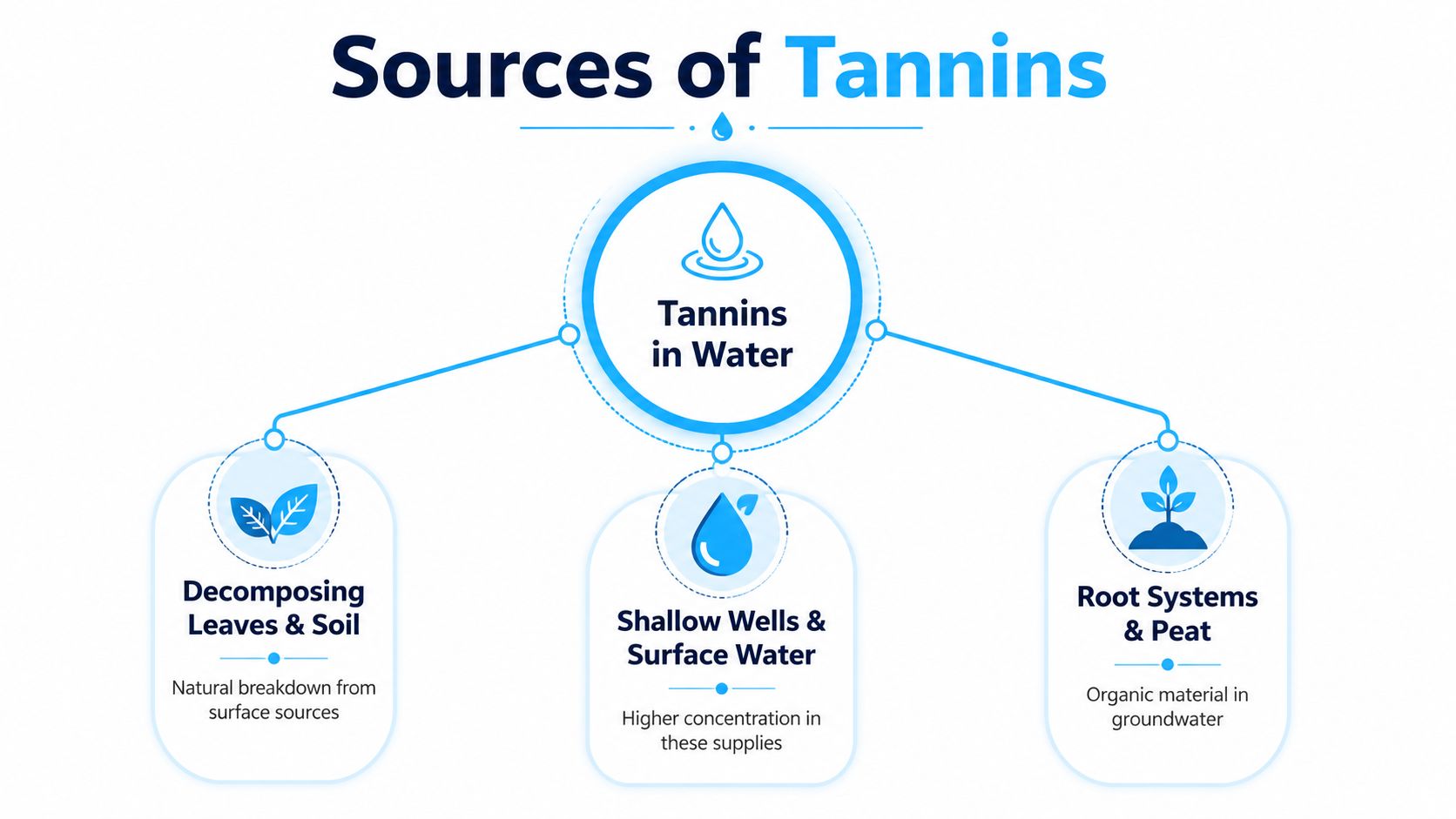
A well beside wetlands may produce tea-colored water after rain, while a deeper well in stable groundwater can remain clear. Rivers and lakes face greater contact with decaying leaves, peat, and other organic material that can release tannins. The surrounding environment often explains why two nearby homes experience different water color.
Water follows available pathways. Rain moves through leaf litter and peat, dissolves organic compounds, then reaches shallow groundwater. Marshy, low-lying, or coastal properties may therefore see more tannin-related discoloration than homes in dry, higher-altitude settings. Shallow wells and surface supplies commonly face this influence more than deeper wells.
Why location changes the treatment problem
The same tea color can come from different water conditions. One supply may contain dissolved organic material as the main concern. Another may contain tannins along with iron, manganese, low pH, or conditions that increase the chance of bacterial contamination. Color describes the symptom, not the full chemistry.
Tannins are generally treated as a secondary aesthetic concern, rather than a federally regulated primary drinking-water contaminant in the United States. The U.S. EPA secondary standard for color is not federally enforced, according to ATS Environmental's tannin guidance. A supply can therefore remain discolored without the color itself being classified as a direct health hazard.
That distinction should not end the investigation. Removing tannin color may improve appearance and taste, yet it will not correct low pH, metals, bacteria, or a problem with the well's construction. The broader pattern matters: recurring color after storms, changing odor, or sudden shifts in taste can indicate source-water influence that deserves testing beyond an aesthetic filter.
Surface influence deserves a closer look
Tannin color can be a source-water clue. Organic material entering a shallow well or a system affected by both surface water and groundwater may share a pathway with microorganisms. Tannins are not necessarily pathogens, but their presence can support the case for microbiological testing and a wider review of well conditions.
For a visual explanation of natural organic material and water movement, this water-treatment video connects the area around a home with the chemistry found at the tap. Record changes in color, odor, and taste alongside rainfall, well conditions, and equipment performance. Those observations help a laboratory or water-treatment professional determine whether the home needs tannin treatment alone or a broader water-quality response.
Testing Your Water for Tannins and Related Contaminants
A clear glass can reveal a pattern, but it cannot identify the cause. Fill one with water and leave it undisturbed overnight, following the observation described in this home tannin-filter guidance. Check for settling, a visible color change, or a tint that stands out more clearly against a white background.
Treat this as a screening observation. It can help you describe the problem to a laboratory or water-treatment professional, but it cannot separate tannins from iron, manganese, sediment, or other sources of discoloration.
Use color as a description, not a diagnosis
A practical concentration guide groups visible color into these bands:
- Less than 0.05 ppm: A faint yellow tinge.
- 0.05 to 2.0 ppm: Darker golden-yellow water.
- About 3 ppm: Light tea-colored water.
- 5 ppm: Dark tea-colored water.
These visual ranges come from Crystal Quest's tannin concentration guide. They help you describe severity, much like using a paint sample to explain a wall color. A laboratory result is more useful for choosing equipment because treatment depends on the water's full chemistry.

Test beyond tannins
If your well water shows tannin color, request testing for tannins or color, iron, manganese, pH, and bacteria. Iron can cause rust-like staining, manganese can affect treatment, and pH influences oxidation and media performance. Bacteria testing addresses the source-water question that color alone cannot answer.
The important question isn't only whether tannins are toxic. Ask whether the discoloration shows that your well is vulnerable to surface-water influence.
Private wells and systems combining surface water with groundwater deserve extra attention because tannins may occur alongside wider quality problems. Color that appears after heavy rain, changes with the seasons, or comes with turbidity or unusual odor should prompt testing. Follow the laboratory's instructions for collecting a clean sample, then choose treatment from the results rather than from color alone.
Comparing Home Filtration Options for Tannin Removal
Tannins behave like dissolved natural organic matter, so the most suitable equipment usually relies on adsorption, ion exchange, or specialized media rather than simple particle filtration. A whole-house system may be appropriate when every fixture has yellow water, while a point-of-use carbon filter may be enough when the concern is limited to drinking water.
A manufacturer markets a whole-house tannin system to reduce tannins up to 3 ppm, as stated on Pentair's whole-house tannin filtration page. That figure is a product claim for a particular system, not a universal promise for every home. Actual performance depends on flow, water chemistry, media condition, and co-contaminants.
| Method | Best For | Limitations |
|---|---|---|
| Whole-house tannin filtration | Homes with color, taste, or staining at multiple fixtures | Requires sizing and media selection based on the water report |
| Activated carbon | Polishing taste, odor, and some dissolved organic material | Can perform poorly when the organic load or competing contaminants are high |
| Specialized tannin removal media | Dissolved tannins that need targeted whole-house treatment | May require pretreatment, regeneration, and ongoing service |
| Oxidation plus carbon | Water containing iron and tannins together | More complex installation and control of oxidation conditions |
| Sediment filtration | Visible particles accompanying the discoloration | Doesn't reliably remove dissolved tannin color |
Match the process to the chemistry
Activated carbon is attractive because it can improve taste and odor while reducing some organic compounds. It isn't a universal tannin solution, especially when iron or manganese also occupies treatment capacity or creates fouling. Specialized tannin media can provide more targeted removal, but it still needs correct sizing and maintenance.
The treatment-engineering literature on tannin-based coagulants and dissolved organic matter describes tannins as removable through coagulation and flocculation in potable and industrial applications. That approach is generally more relevant to engineered treatment plants than a typical household cartridge, but it reinforces an important point: color removal is a chemistry problem, not a matter of adding a finer screen.
For homeowners, the best choice follows the report. If tannins are the only finding, specialized media or a properly designed whole-house system may be sensible. If iron and manganese accompany them, plan for pretreatment and a process that addresses each contaminant instead of expecting one cartridge to do everything.
Why Tannin Filters Fail and How to Avoid Common Mistakes
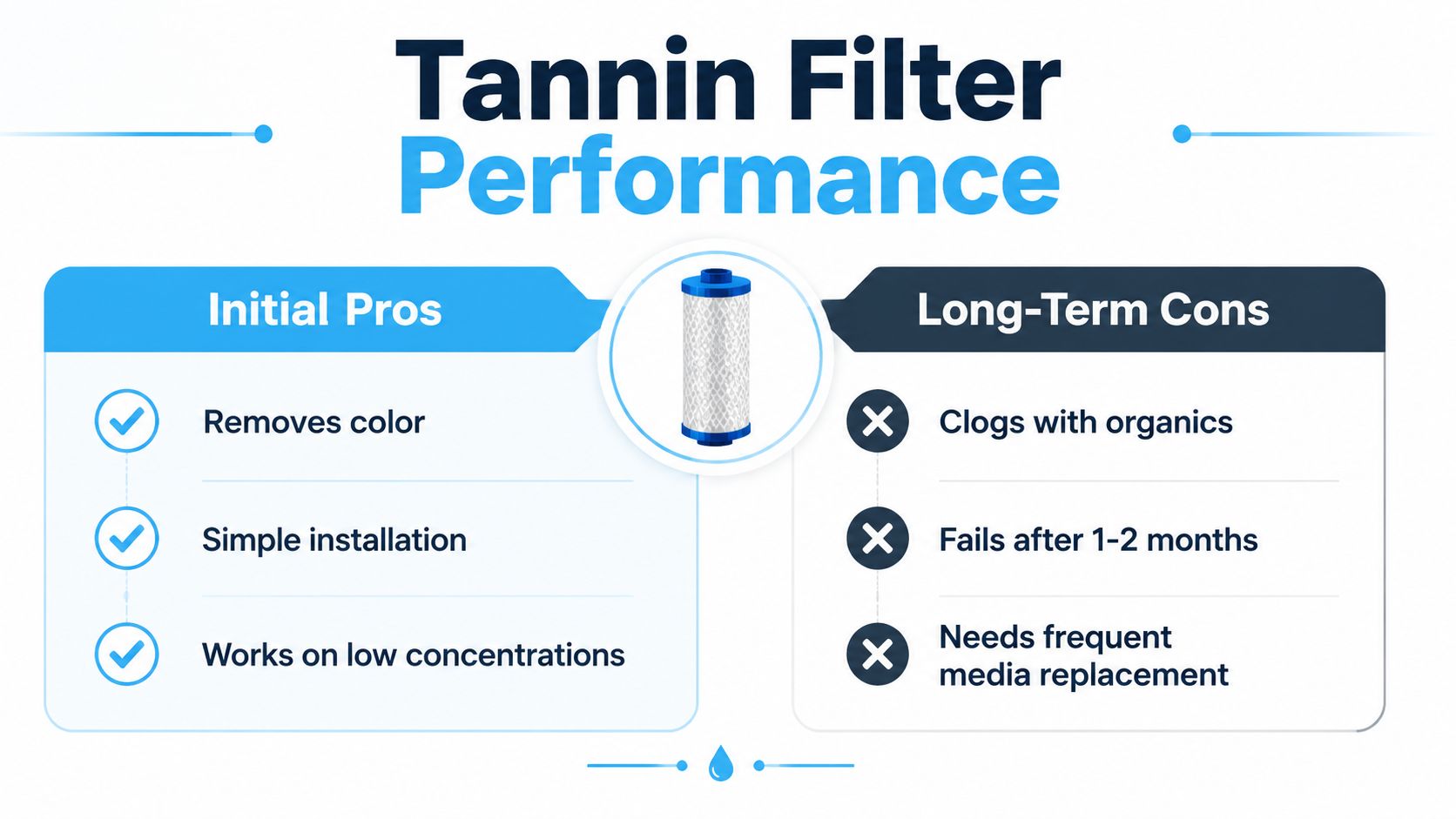
A tannin filter may produce clear water at first and then lose performance after a short operating period. That doesn't necessarily mean the equipment was useless. It may mean the media was exposed to more dissolved organic material, iron, manganese, or flow than the design could handle.
The common mistake is to treat every yellow-water complaint as a stand-alone tannin problem. Iron can foul media, manganese can require oxidation conditions that a simple tannin system doesn't provide, and changes in pH can alter how the treatment process works. The EPA training material on iron and manganese control notes that control can require specific oxidation targets and that sequestration is ineffective when manganese is present at high levels.
Why early success can be misleading
A new bed of media often has substantial capacity. Once that capacity is reduced, color can break through even though water still looks acceptable at the filter outlet during brief checks. If the system lacks a proper backwash, receives excessive flow, or treats water with a higher organic load than expected, the service life can shrink.
The same EPA material discusses treatment targets that aim for very low residual manganese levels. That matters because manganese isn't another version of tannin. A system designed to capture dissolved organic color may not oxidize and remove manganese effectively.
Build treatment in stages when needed
When iron and tannins coexist, recent industry guidance points to two-step treatment that combines oxidation with activated carbon. The logic is straightforward. Oxidation changes dissolved iron into a form that can be filtered, while carbon addresses organic taste, odor, and color after the heavier contaminant burden has been reduced.
Avoid choosing equipment based only on a product label. Ask these questions before installation:
- What was tested: Does the report include tannin or color, iron, manganese, pH, and bacteria?
- What is the process: Does the system use ion exchange, adsorption, oxidation, carbon, or a combination?
- What happens during backwash: Can the home supply the required flow and dispose of the wastewater?
- What is the maintenance plan: How will you know when media is exhausted or fouled?
A filter that “worked for a month” may have exposed a design mismatch, not a mysterious failure. Correct diagnosis prevents repeated cartridge purchases and points toward a system that treats the complete water chemistry.
Maintaining Your Tannin Filtration System for Long-Term Performance
Tannin filtration is not a set-it-and-forget-it project. Dissolved organic material can consume media capacity, and seasonal changes can alter the water reaching a well or treatment system. Maintenance begins with a record of the installation date, media type, valve settings, observed color, taste, odor, and any laboratory results.
Watch the water and the equipment
A gradual return of yellow color is the clearest warning, but it isn't the only one. Pay attention to renewed staining, changes in taste or odor, reduced flow, unusual pressure behavior, and backwash problems. Inspect housings for leaks and confirm that automatic controls complete their cycles.
Media replacement schedules should come from the equipment manufacturer or installer because service life varies with concentration, flow, water use, and competing contaminants. A fixed calendar chosen without testing can lead to premature replacement or delayed maintenance.
Use a simple monitoring routine:
- Record appearance: Compare a clear sample against a white background.
- Check after maintenance: Confirm that the water improves at the tap, not only immediately after the filter.
- Retest periodically: Repeat laboratory testing when water conditions change or performance declines.
- Track total ownership: Include media, cartridges, salt or regenerant where applicable, backwash water, testing, repairs, and professional service.
A clear faucet sample is the result to verify. A clean-looking tank isn't proof that the media still has capacity.
Homeowners can usually handle visual checks, cartridge changes, leak inspection, and recordkeeping. Call a water-treatment professional when the system needs sizing, oxidation control, valve adjustment, media replacement, unusual plumbing changes, or interpretation of conflicting test results. If bacteria are detected or a well appears vulnerable to surface intrusion, involve an appropriate certified laboratory and qualified water professional rather than relying on filtration maintenance alone.
Making the Right Decision for Your Home Water Quality
Tea-colored water gives you a starting clue, not a complete diagnosis. Use this decision path:
- Notice discoloration: Collect observations about color, odor, taste, staining, and when the change occurs.
- Test broadly: Include tannins or color, iron, manganese, pH, and bacteria.
- Classify the problem: Treat it as aesthetic when tannins are isolated, source-related when the well shows surface-water vulnerability, or both when co-contaminants appear.
- Select the process: Choose specialized tannin media, carbon, oxidation, sediment removal, or a staged combination according to the report.
- Plan maintenance: Confirm backwash, media replacement, retesting, and service requirements before buying.
The most useful answer to “what is tannin in water?” includes both chemistry and context. Tannins are generally not considered harmful to human health, but discoloration in a private well can justify microbiological testing because the same pathway may expose the supply to pathogens. For practical guidance on comparing filtration equipment and water-treatment decisions, consult the Water Filter Advisor advice library.
If your results show only tannins, focus on effective aesthetic filtration. If iron, manganese, low pH, or bacteria also appear, don't let a clear glass hide the larger treatment requirement. A qualified professional can match pretreatment, media, flow capacity, and maintenance to your actual water test.
Water Filter Advisor helps households compare home filtration systems, understand treatment media, and plan replacement and maintenance around real water-quality results. Visit Water Filter Advisor to review guidance for tannin-related discoloration, whole-house filtration, water testing, and long-term system care before you choose equipment.
